Journey Around The Globe
ready for the next destination
A Wee Bit of Scottish Highlands and Loch Ness
HIGHLANDS and LOCH NESS, SCOTLAND: Scotland definitely is one of the most beautiful and diverse countries in the world and one of my most favorite place. Apart from its big and beautiful cities, highlands is the place where Scotland’s true beauty lies. This is a paradise for the photographers and nature lovers.

- Driving by beautiful scenes of the Highlands in Scotland

I wonder if it’s the natural beauty or Scotland’s whisky that made this country a hotbed of geniuses. Alexander Graham Bell, inventor of telephone was a Scottish man and so was the inventors of steam engine, bicycle, and television. The country also produced writers like Sir Walter Scot from the past to J. K. Rowling to this age. Peter Pan and Jackal & Hyde are just some of the classics that originated in this country too.
For sheer atmosphere, Scotland’s rugged and unbeatable scenery can be enjoyed when you get out of its big cities and enter into a continuous breathtaking wilderness. You get to visit Scotland’s most spectacular mountains, picturesque fjord-like lochs and a diversity of islands. Although I only saw from distance, if you are lucky you just might see some cute long-haired highland cows or may be some wild lives in their natural habitats. Wood, forests, mountains, lochs, walking, wildlife watching, water sports, fishing, golf or just taking in the view…just to name some of the things you can do in the highlands. I wish to go back there one more time again to enjoy Scotland’s vast natural beauty whole heartedly. This was a place where I could pause and create some unforgettable memories…I haven’t seen anything like this before.

- Took from our moving bus…picturesque
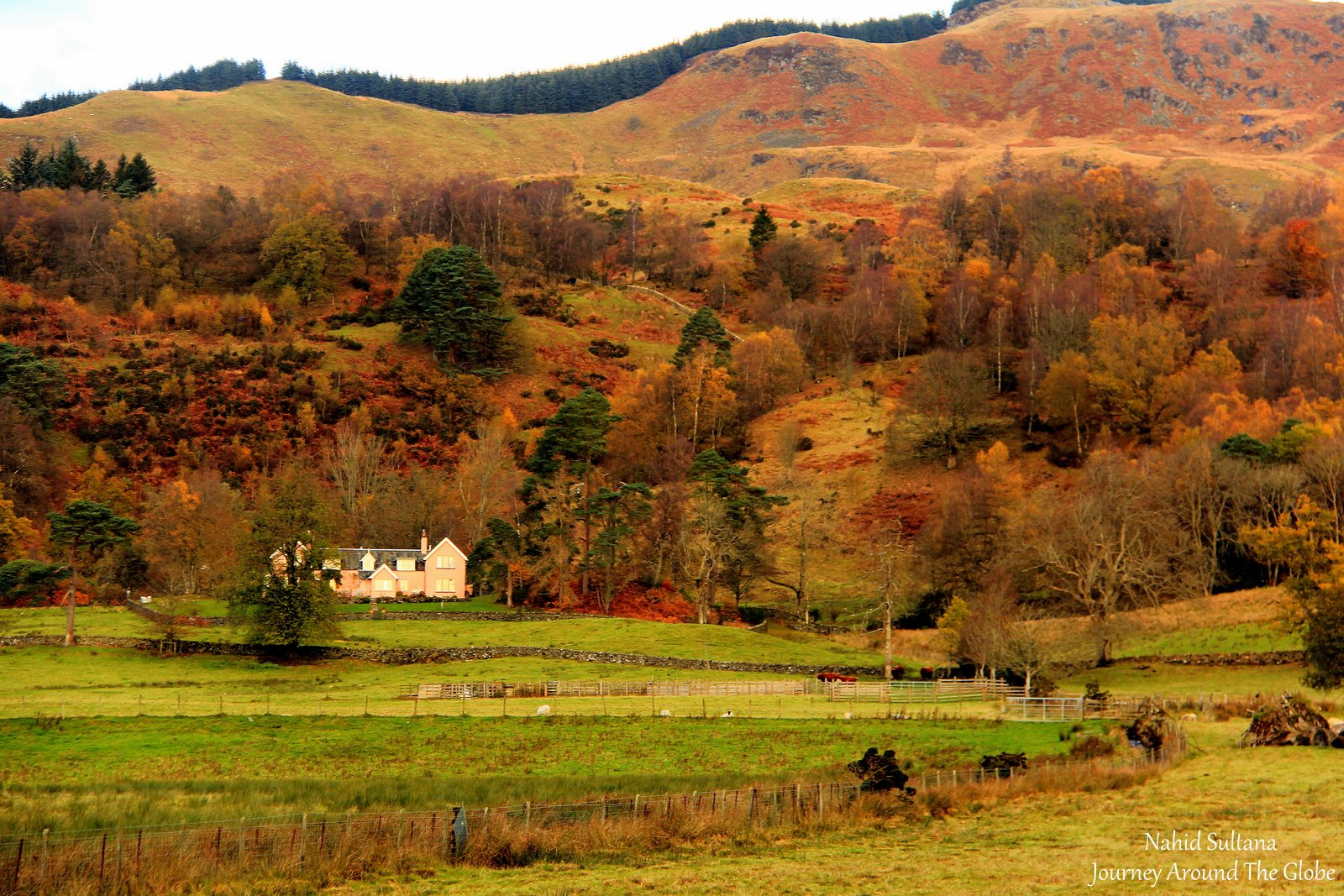
I booked this day-trip to the Highlands through my hotel “Ailsa Craig Hotel” in Edinburgh. The company was Gray Line Scottish Coach Tours and they charge 41 GBP per adult (prices are for transport and guided coach tour only and the trip is not suitable for children). I was picked from my hotel at 7:30am and the tour started sharply at 8am. They had lots of different choices, like visiting Glasgow, Rosslyn Chapel, Stirling Castle, and etc., but the one I took was the longest of all which lasted about 12 hours. By the time I was dropped off near my hotel, it was little bit past 8pm. The tour is available every day and I think, even in winter season. The driver, who was also our guide, was a knowledgeable and a fun person who gave us history and told stories of highlands all the way; once in a while he played some Celtic and Scottish/Gaelic songs and some significant songs that tells stories on the places we’ve visited, like songs about Glen Coe Massacre when we stopped at Glen Coe and Loch Lomond song when we were passing the lake. Overall it was a memorable journey and the drive from beginning to end was jaw-dropping and pleasant, would highly recommend to anyone visiting Scotland.

- Breathtaking countryside of Scotland
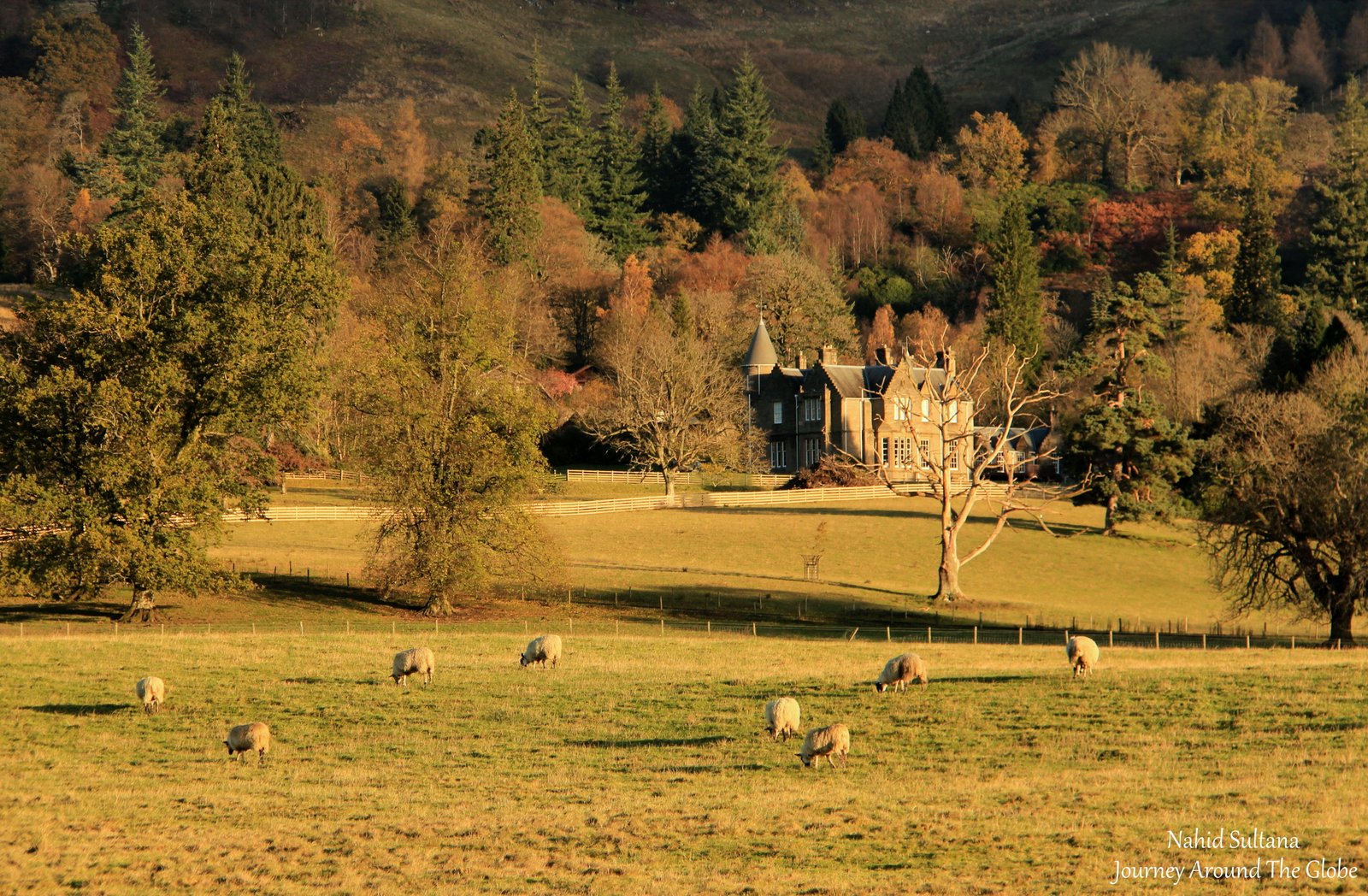
As our guide put it, this trip was a just an appetizer. To enjoy Scottish Highlands to the fullest, you need to stay in the local sights and spend few days. That trip gave us only the highlights of countryside from highways and by the road-side.
TIME of TRAVEL: The day started very nicely with some cloud and little cold. But later we got drizzle and winds, or as the Scots would call it “whiskey weather”. It does get very windy up on the mountains or near the lakes. Bad part was that it started raining, kinda badly, when we took the cruise on Loch Ness. I still managed to get some pictures but I just wished it was little bit warmer and no water drops on my camera.
The best part of coming to Scotland was that I got to see the most beautiful colors of fall in the countryside, on mountains, and by the lakes. Unlike other places, falls stays in Scotland for 6 weeks, plenty of time to enjoy the rustic autumn color or to photograph them.
MY HOTEL: Please see my page on Edinburgh to see the hotel I stayed in during my trip to Scotland.
PLACES I’VE VISITED: The total journey of this trip was 360 miles/600 km in 12 hours. And the highest point we’ve visited here was about 1016 ft. above sea level. Hope you like the pictures I took along this journey.

- Passing by some snow-capped mountains in the Highlands
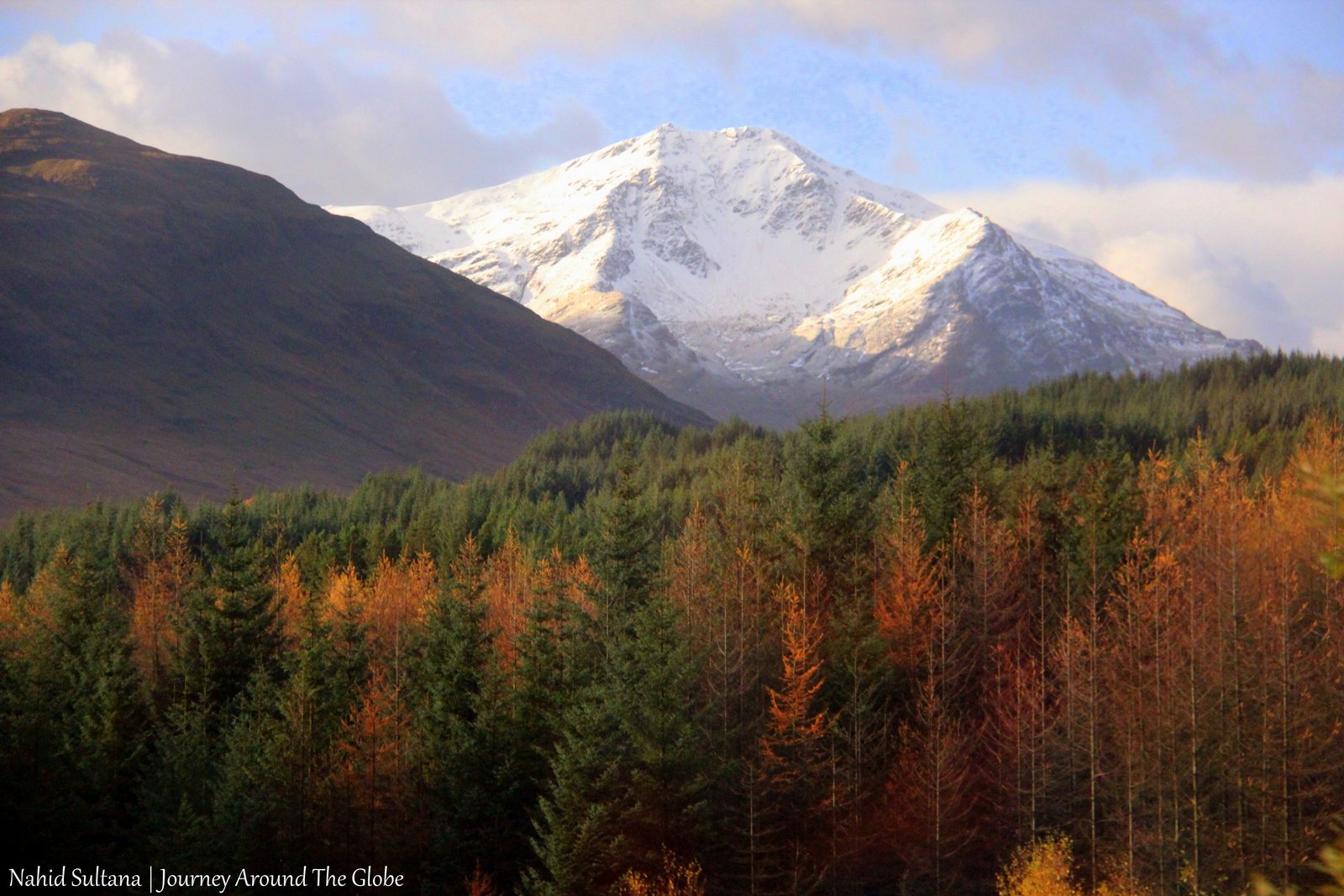
After our bus got out of the city and started toward the countryside, we passed few castles and monuments, like Doune Castle and Wallace Monument. Another historic landmark we passed by was the field of Battle of Bannockburn. Robert the Bruce fought here in the 14th century with King Edward II of England for Scotland’s freedom and Scotland won victoriously.
After passing one of the famous lochs/lakes of Scotland, Loch Lomond, we stopped in the dark brooding Pass of Glen Coe (meaning “Valley of the Weeping” in Gaelic). Here we stopped for 5 minutes to take some photos…in the rain. This beautiful valley got famous after the massacre of 1692 where 180 people (including women and children) were murdered by the English. Glen Coe looked like a very beautiful valley w/snow-capped mountains, small hills, creeks, and water falls. It looked stunning even in rain.

- Continuously beautiful…
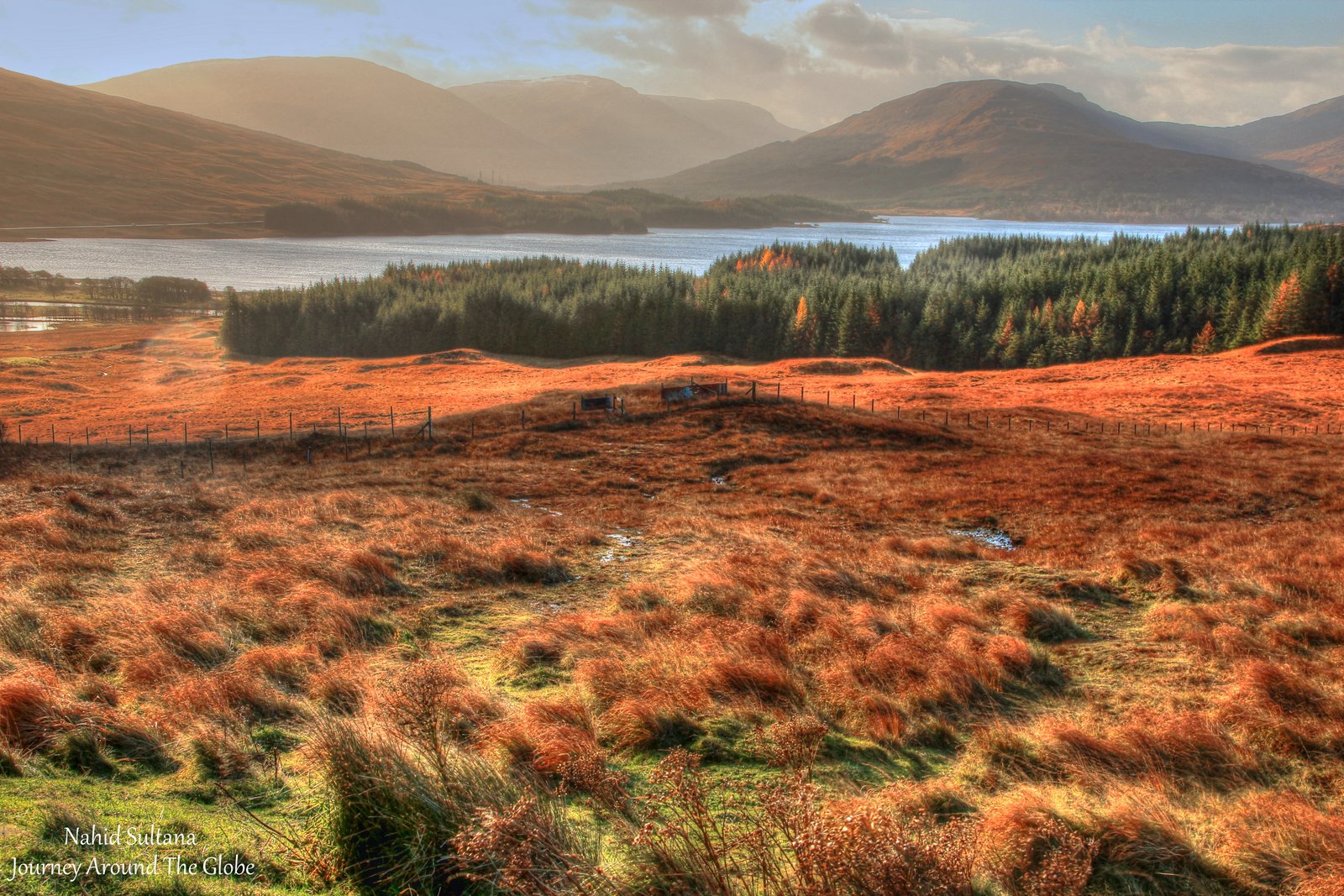
While we were heading for Loch Ness, we saw the mountain range Nevis and many other big and small lakes and rivers. We were lucky to see the highest mountain of Britain, Ben Nevis, (also known as “Scotland’s Outdoor Capital”) on our way too.
Main highlight of this tour was visiting the famous Loch Ness. So here we were in Fort Augustus for our lunch break and our cruise on Loch Ness. Cruise is optional in tour and costs additional 12 GBP per person. Most of the people in our group took this cruise…to see Nessie, the Loch Ness monster. Yep, even the cruise has hi-tech sonar under water imaging system that provides you with the best chance to see what really lies at the bottom of the famous Loch Ness.
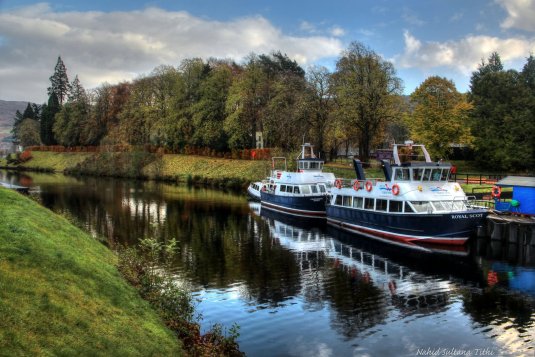
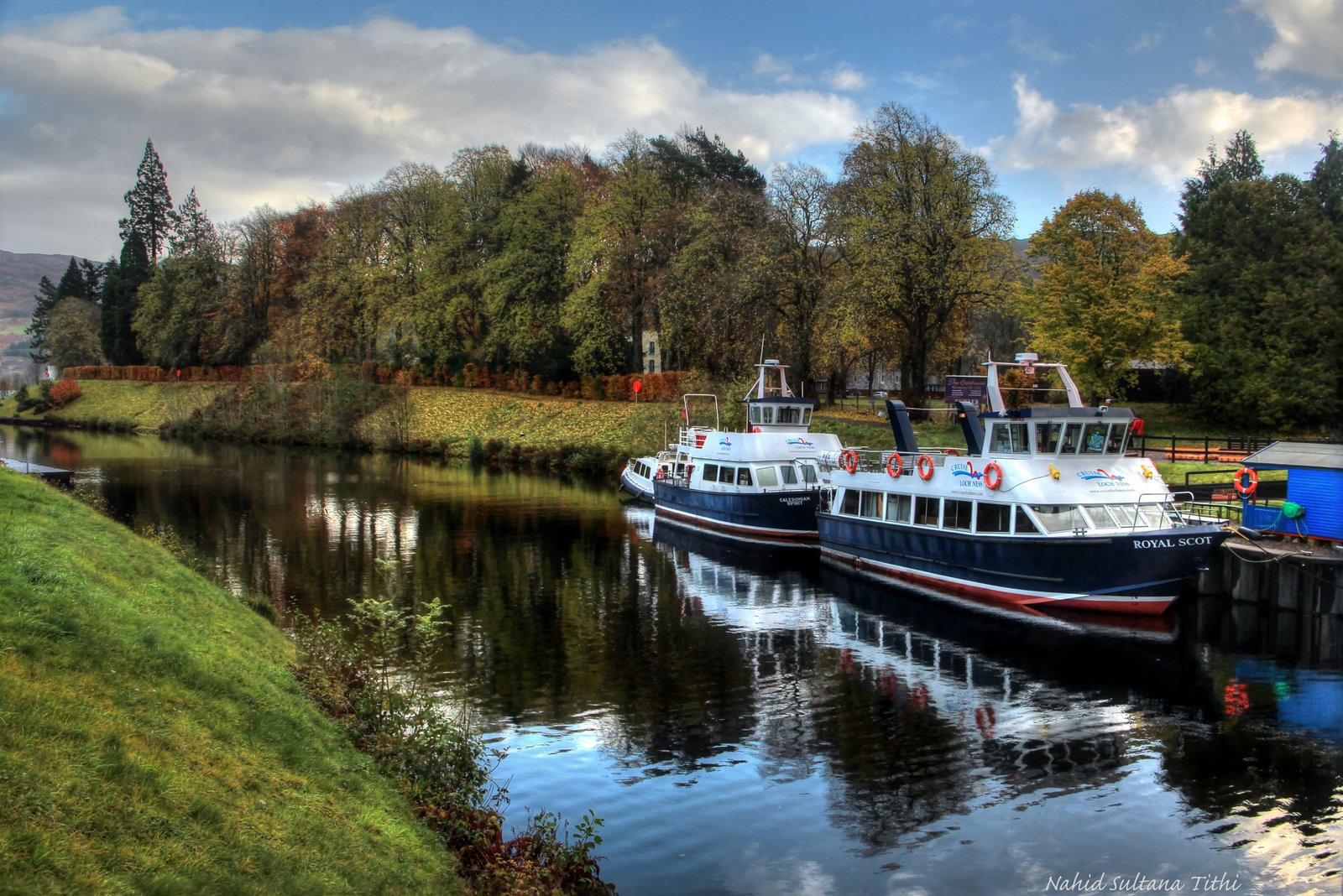
- Our boat awaits for the cruise on Loch Ness
We had about 1 ½ hours to spend in Fort Augustus to eat and look around before getting on board. Fort Augustus is a bustling little touristic town which becomes really slow and quiet during the winter time. I had some meat pasty for lunch, although there were some nice restaurants in the town to sit down and relax… I preferred walking while eating.
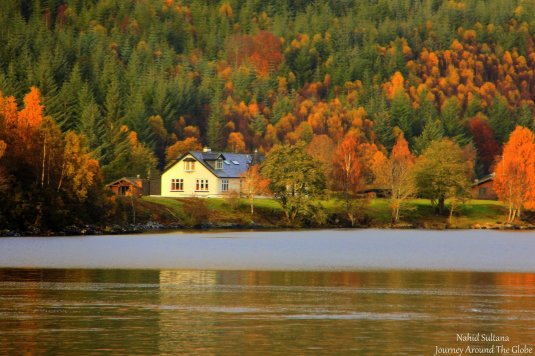
- A small house by Loch Ness
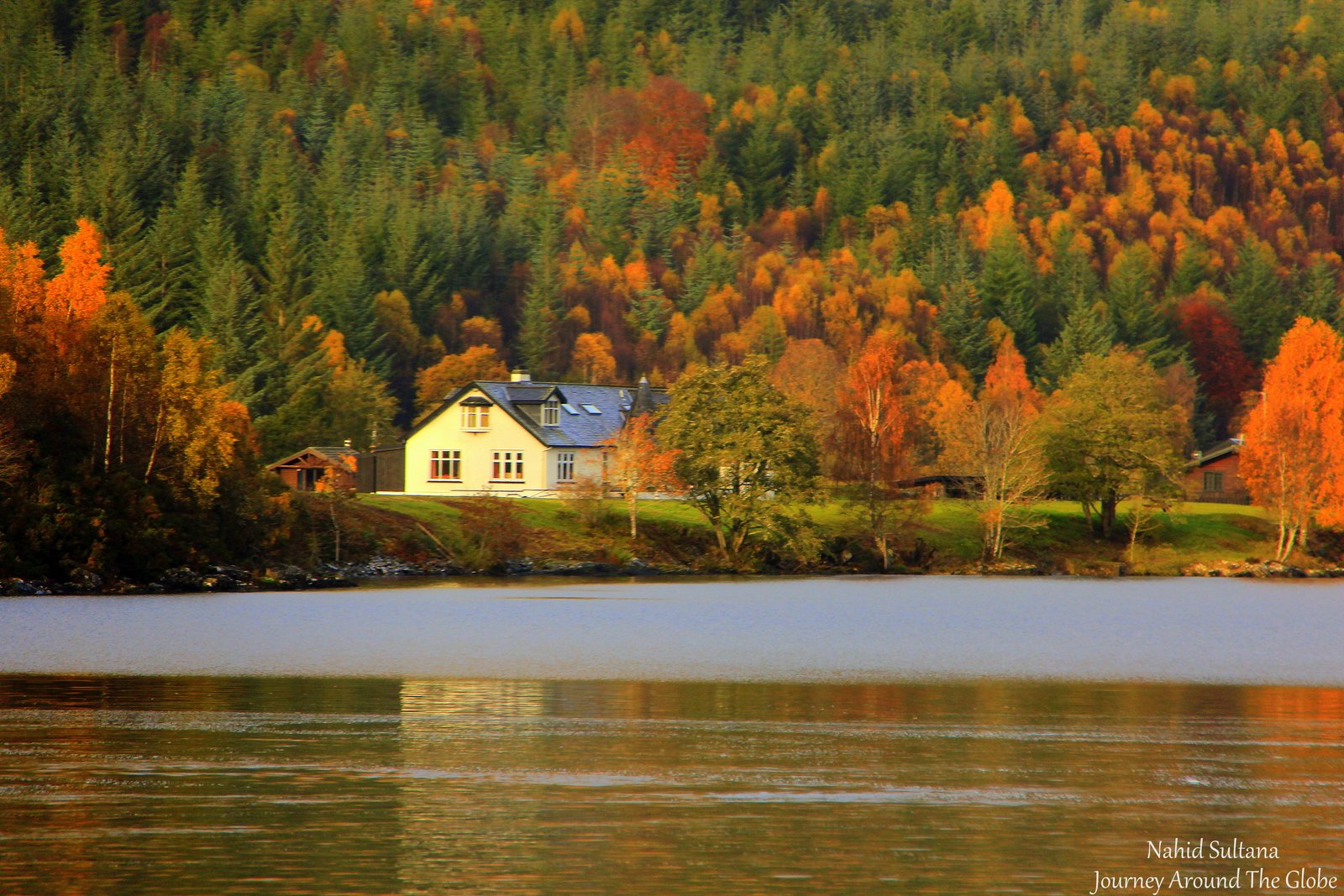
Loch Ness is an 800 ft. deep and 270 miles long lake, making it the longest lake in Scotland. When the boat leaves the harbor you can see St. Augustus Abbey at one side from a little distance. As I mentioned above, for those who are fanatic about finding Nessie the Loch Ness monster, the boat is equipped with an underwater camera system, tourists can view on a TV what is really beneath the boat. But while we were all looking for Nessie, I was having good time looking at many shades of fall by the lake’s bank and nearby hills.
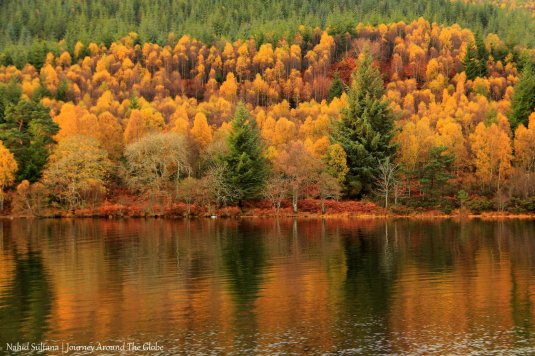
- Fall in Scotland, while cruising on Loch Ness
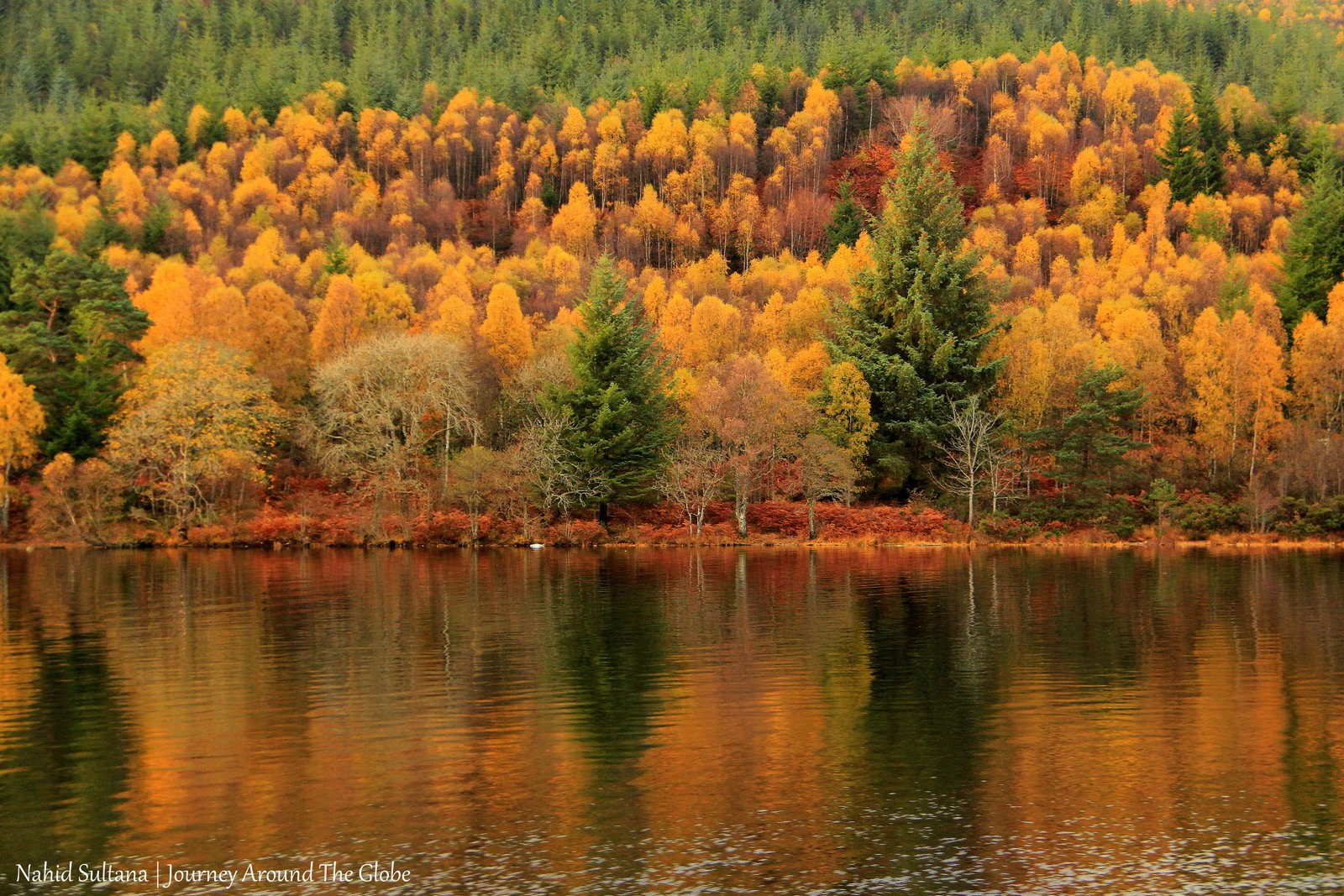
After we were done with our cruise, we started driving to north again along the entire length of Loch Ness, stopping next at Urquhart Castle. The water near the castle has the deepest point at 800 ft. We just stopped for 5 minutes again to snap some pictures of this old castle. Urquhart Castle is a 15th century castle which is in ruins now. This 15th century photogenic place is shown in most of the Scottish calendars. We only saw the skeleton of it from a distance and barely managed to take some photos. But the castle is open all year round and tourists can pay a fee to visit it.

- Urquhart Castle by Loch Ness in Scotland
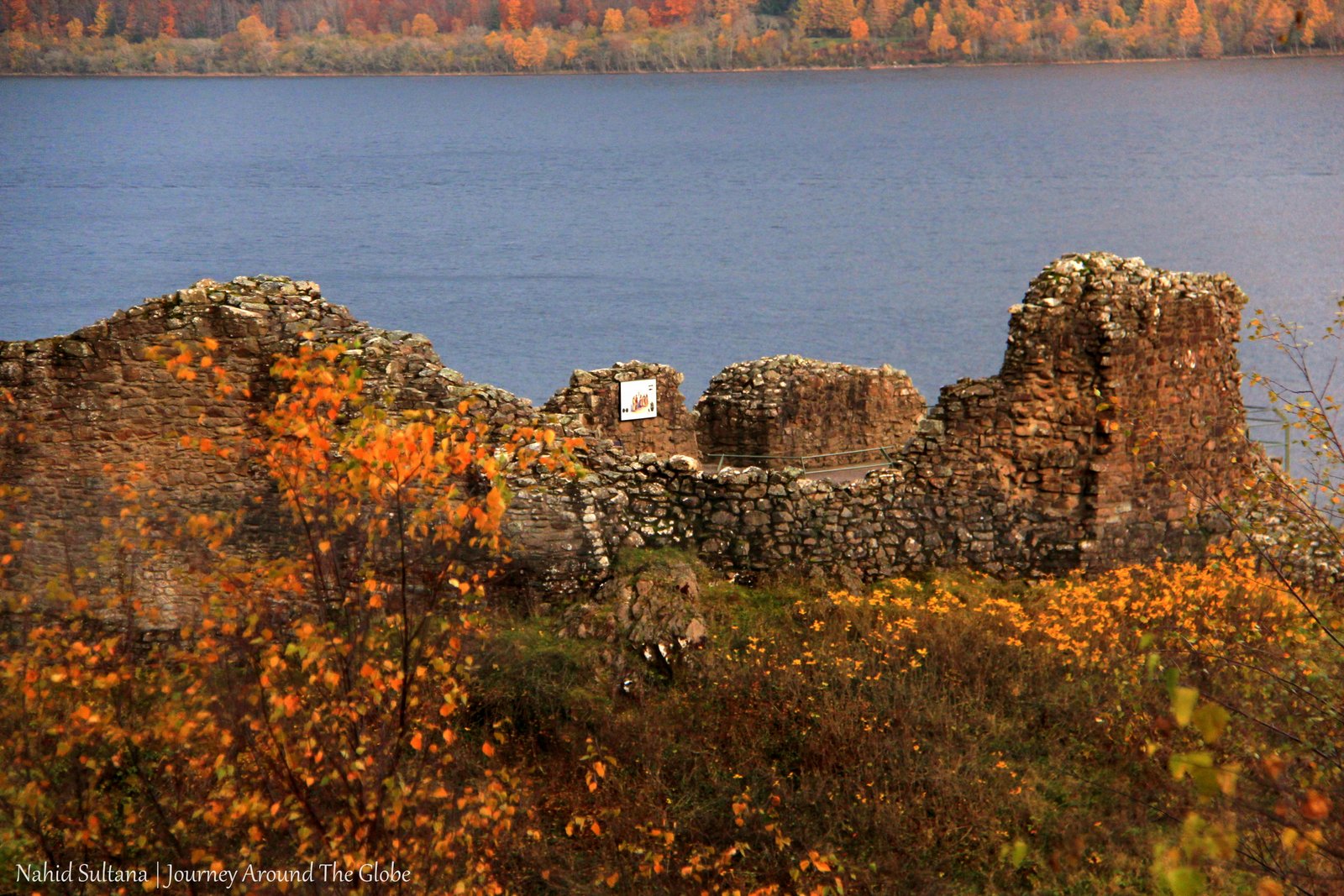
It was almost after dark when we reached Inverness, the Highland capital. Of course Inverness is a big city and you really have to stay here overnight to actually visit all the places here. It looked very beautiful as we drove thru its old town passing some old and new buildings and small squares…wish we could stop somewhere for little bit to take some photos.
Pitlochry was our last stop before heading back to Edinburgh. It has a delightful Victorian resort town, nice place for shopping and spend couple hours. But it was too dark by then and everything closes early in the winter time.
And as the final site, we saw the gorgeous railway bridge, Forth Bridge (3rd in top 10 bridges of world), before arriving back in Edinburgh. Too bad I couldn’t take any picture from our moving bus. It was built in 1890 and is one most iconic railway structure in the world.
So, we spent about 12 hours in this trip driving on Scottish Highlands, passing many villages, famous lochs, green meadows, historic castles and monuments, and finally got to see the famous Loch Ness where Nessie the Loch Ness monster lives. We did try our best to see him but he was hiding so deep in the water, we missed him this time…uh, maybe next time Nessie, I will be back in Scotland again to have a cup of tea and Scottish fudge with you…till then stay cool.
Related articles
- Happiness is Photography: Scotland (ministryofhappiness.wordpress.com)
- Highland Experience Tour Part 2: Inverlochy Castle and Glen Coe (bembesabroad.wordpress.com)
- The Highlands and Loch Ness (careysadventures.wordpress.com)
- Highland Experience Tour Part 1: Loch Ness and Hairy Coos (bembesabroad.wordpress.com)
- Highlands (Scotland Part II) (amelialondontravels.wordpress.com)
- The Skye’s the limit! (also, photos!) (dhmannix.wordpress.com)
- Why I love Scotland (wwellend.wordpress.com)
Share this:

One of my favorite capitals in the world – Edinburgh
EDINBURGH, SCOTLAND: Edinburgh is a city steeped in stories, myths, and legends. Enclosed by Nor Loch, Edinburgh has been the royal capital of Scotland since 1437. While ancient volcanic activity shaped its landscape, many medieval relics made its history more charming and intriguing.

- Panoramic view of the city and Nor Loch from Edinburgh Castle
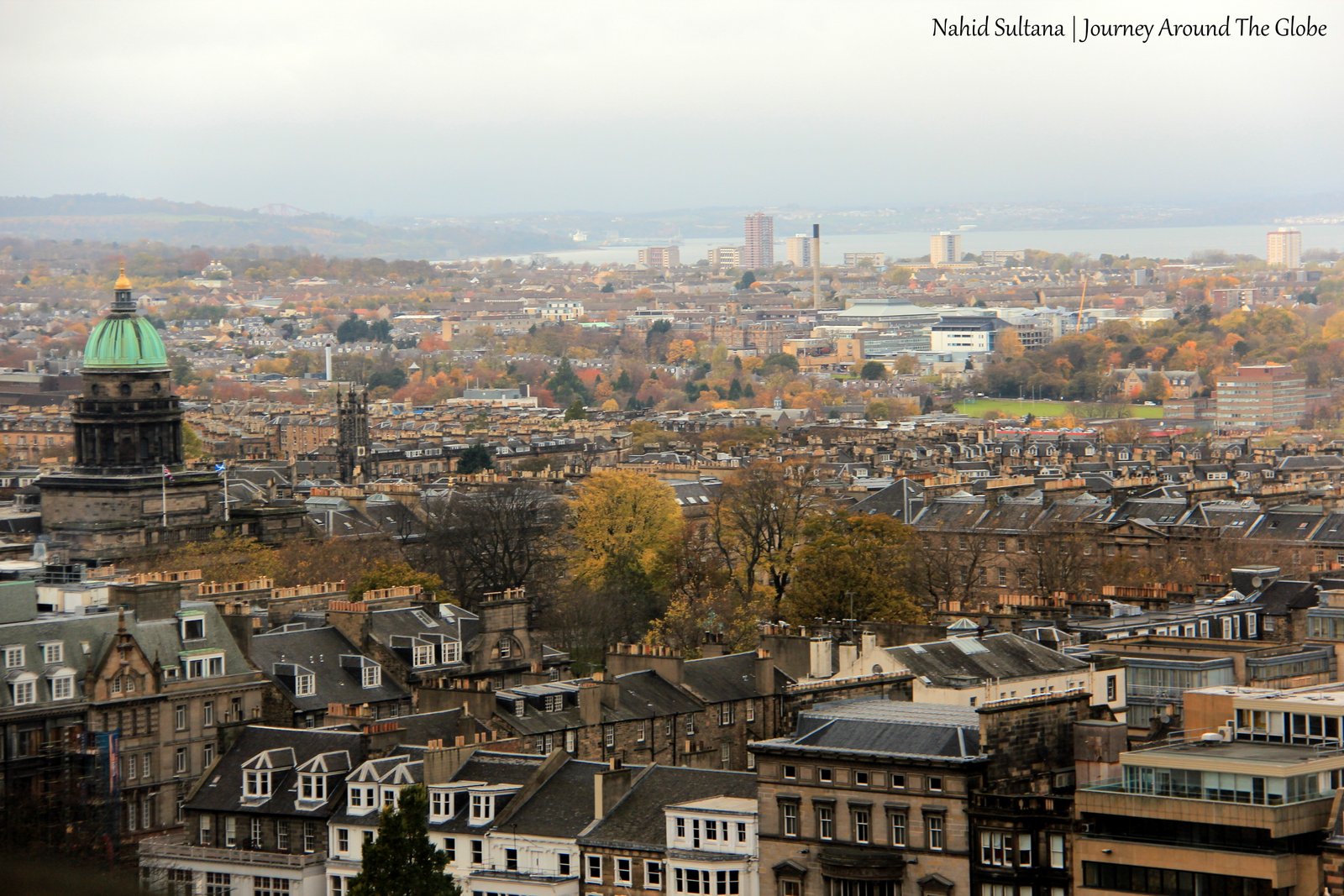
Edinburgh’s Old Town was also shaped by prehistoric volcanic activity. Built on a steep volcanic rock that protected the Castle and town from attack, the town developed along the ridge, Royal Mile that runs from the Castle to Holyrood Palace. The growth of the town was constricted by its medieval boundaries. Therefore, Edinburgh couldn’t expand outwards, so it started rising upwards with multistory buildings. The city is enclosed south and north by Loch Nor.

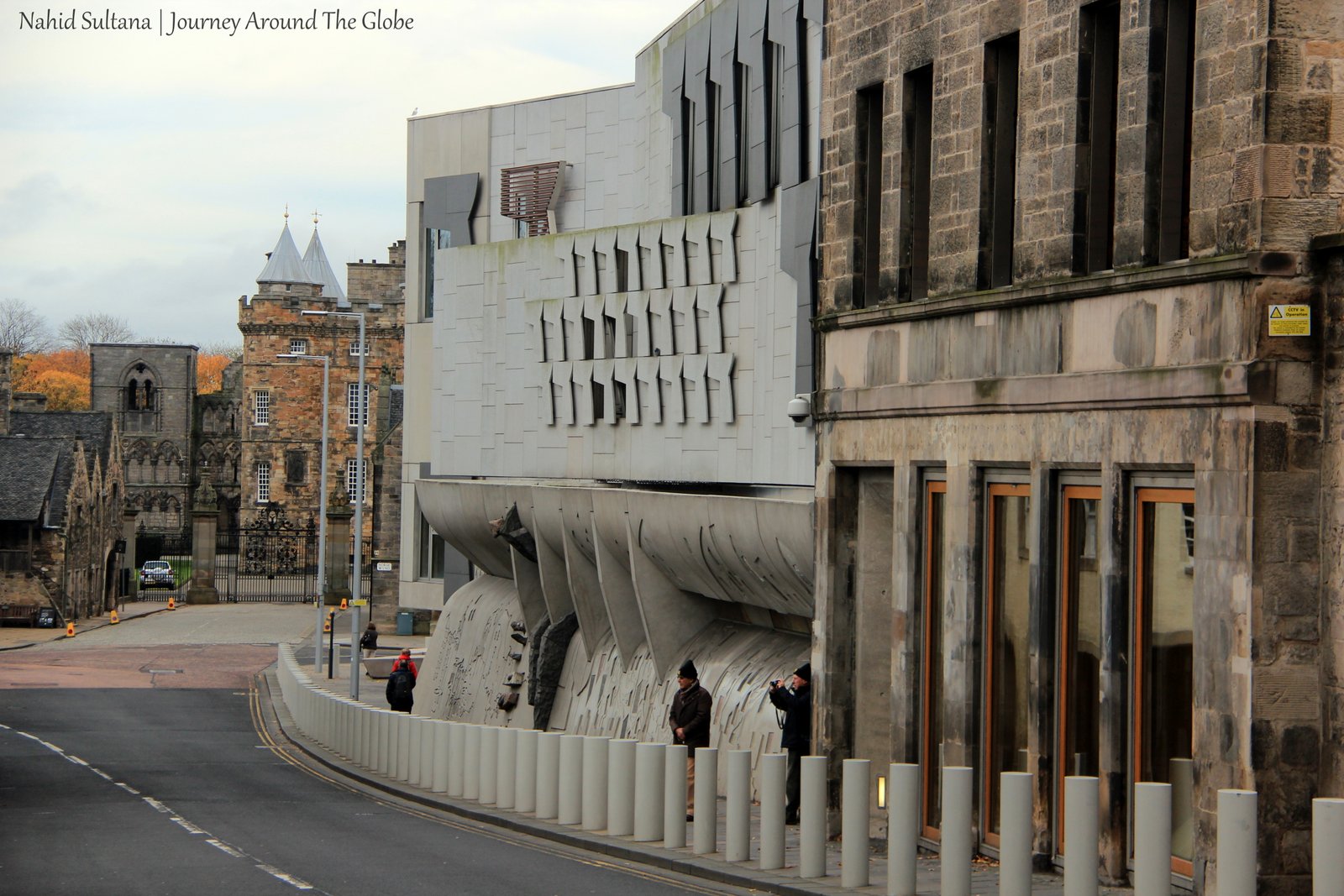
- Royal Mile – the backbone of Old Edinburgh. Scottish Parliament (on the right) and Holyrood Palace (in the back)
Edinburgh might have an enriched history but it definitely doesn’t live in the past. The medieval Old Town contrasts sharply with the Georgian New Town and they are both part of UNESCO World Heritage Site now. New Town was known as the Athens of north once, while the Old Town, known as the original Manhattan, was a place for the poor in the middle age. Getting around the city is fairly easy here which can be done on foot. Walking is highly recommended here because it gives you time to soak up the real Edinburgh at your own pace.
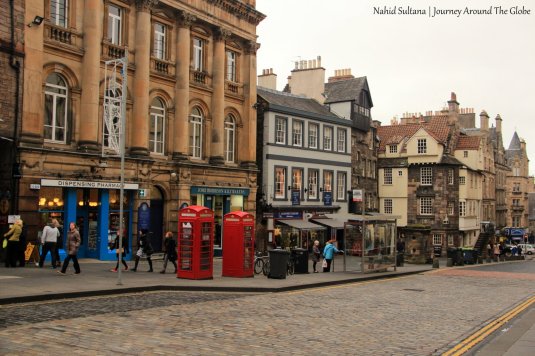
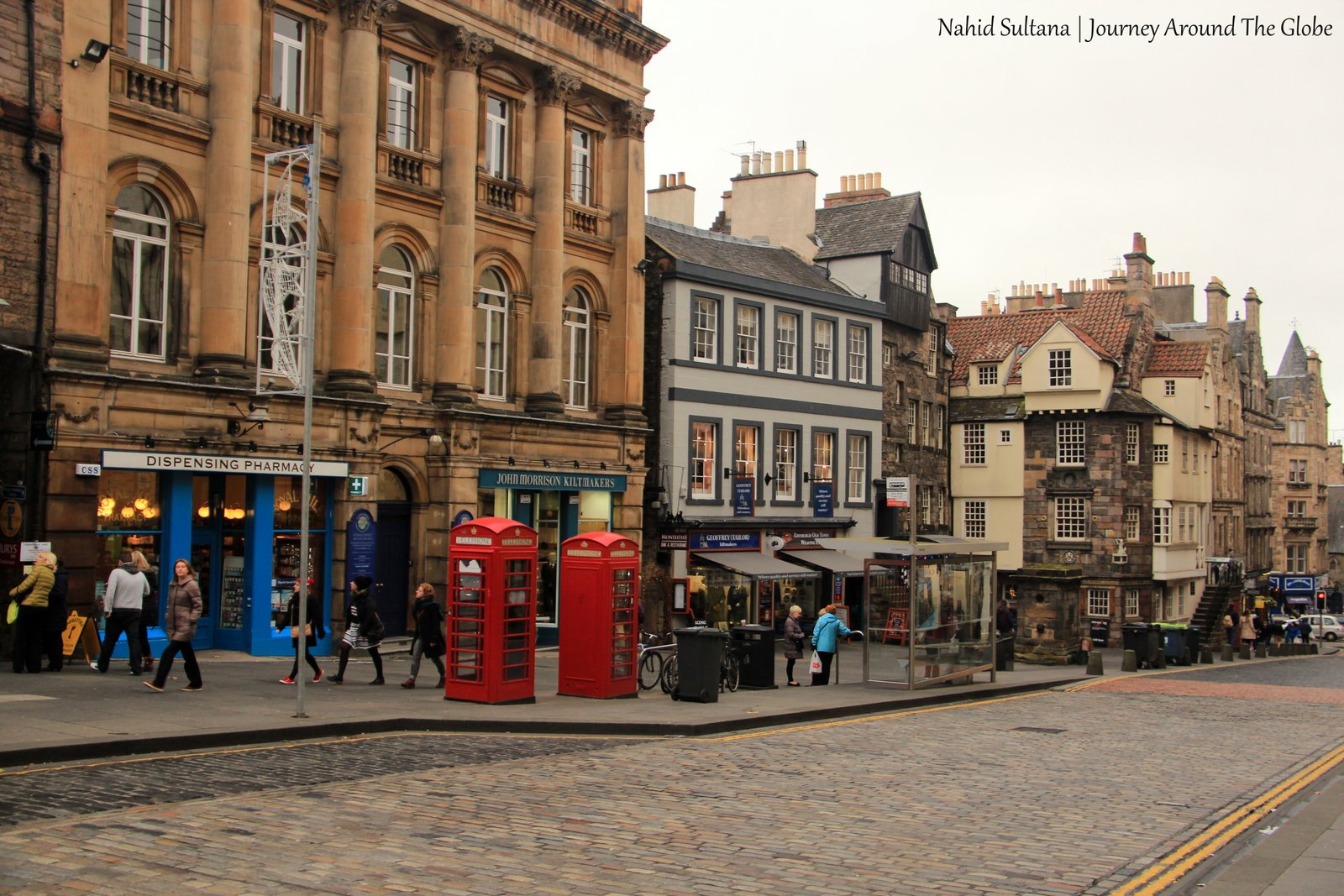
- Walking on Royal Mile in Edinburgh
I have visited other capitals of Great Britain, like London and Belfast, or even Dublin in Ireland. But in my opinion Scotland is nothing like that and has more scenic beauty and thrills than any of those cities. I left Edinburgh feeling absolutely satisfied and content that I had a chance of visiting this place.
TIME of TRAVEL: I visited Edinburgh in the middle of November 2013. This is actually off-season to visit this place, because the weather can be unpredictable at this time. Expect cold, wind, rain with little or no sunshine in November. But I was told that if you are coming here for the first time or just for sight-seeing, it’s better to avoid August, because some big festivals take place in this month and can get really crowded with thousands of locals and tourists.
MY HOTEL: My hotel (or should I say hostel?), Ailsa Craig Hotel on Royal Terrace (right beside Crowne Plaza), was ok for me since I was traveling alone this time, leaving my husband and daughters back in Belgium (my husband was kind enough to babysit the girls while I took a solo vacation). The hotel was about 20 – 25 minutes of long walk from Waverly Bridge bus station. When I reached the hotel I was told that the internet isn’t working, there is no elevator to go to my room on the 3rd floor, and that there is no bathroom inside my room. I tried my best not to be shocked when he said bathroom is a shared common one for all the 3rd floor rooms. Good thing there was at least a sink with a mirror in my room and had free breakfast but the bad thing was all the rooms are so close to each other that I could hear a baby crying opposite to my room whole time the first night. The best part of it was that hotel had some very friendly and helpful staffs. I booked my Scottish Highland and Loch Ness tour thru them; the guy even gave me some tips on where to go for taking early morning photographs. The location of the hotel wasn’t bad either. It was only about 15 minutes of walk from Holyrood Palace on Royal Mile.
Last night in Edinburgh I stayed in Hilton near the airport since I had an early morning flight to catch. It’s only 5 minutes of walk from the airport.
EATING and SHOPPING: My 1st dinner here was at a Nepalese/Tibetan restaurant, Gurkha Brigade on Leith Walk. I was in the mood for some spices and hot stuff and you can get good spicy food here for a nice price. There were few other Indian restaurants on this street. Mediterranean and Italian were some other options I had. For the 2nd night, I came here again to try an Indian restaurant. This was “Passage To India” opposite of Theater Royal. They had some Punjabi specialty food…again, good food with a cheap bill.
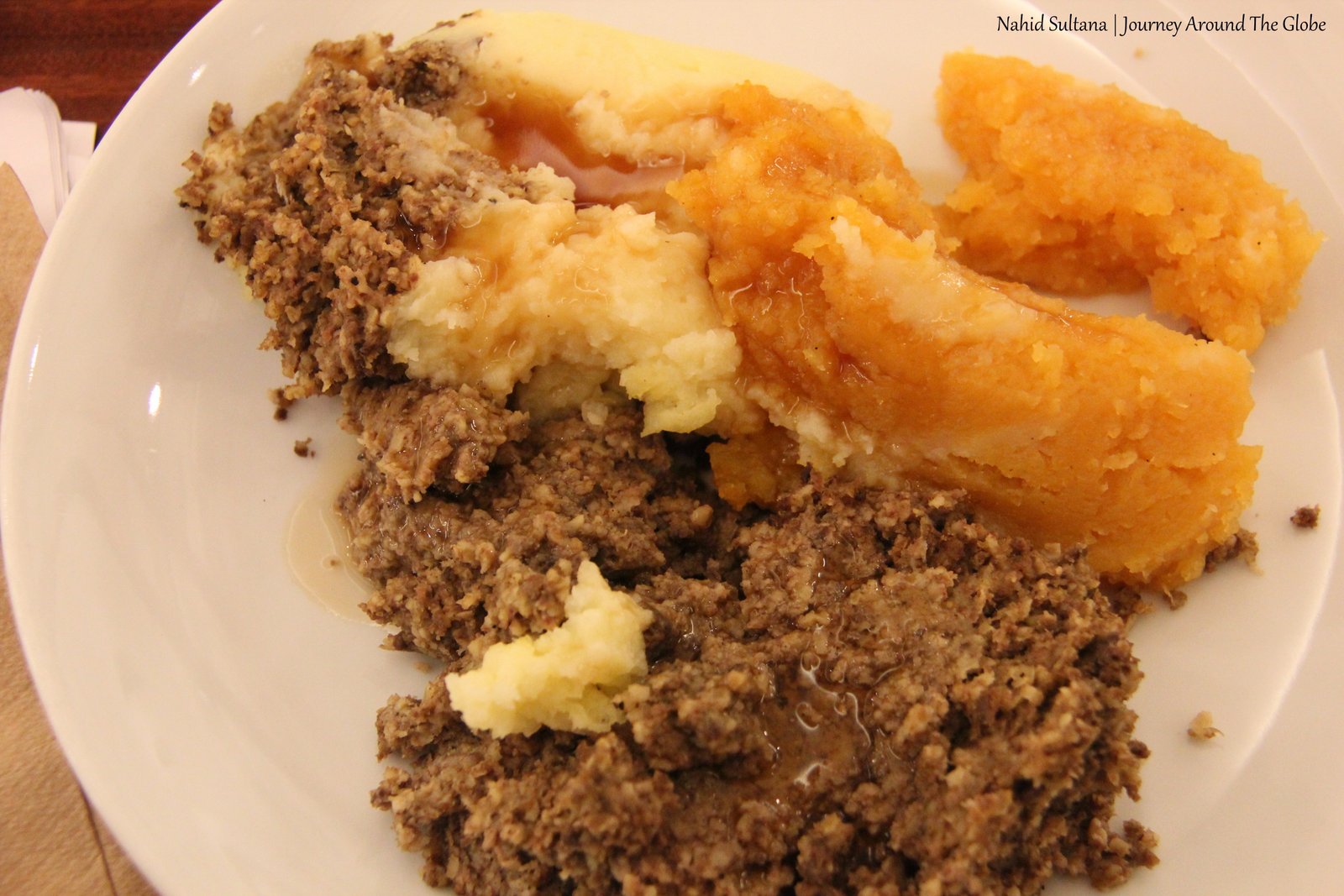
I wasn’t getting time to try haggis, one of the most famous Scottish food that tourists try, all this time. So, when I was in Edinburgh Castle, I saw their café is selling haggis. Here is some information on what haggis is, took it from the café’s menu: “Haggis is savory pudding containing sheep’s pluck (heart, liver, and lungs); minced with onion, oatmeal, spices, and salt, mixed with stock, and traditionally encased in the animal’s stomach. Traditionally served with swede/turnip and mashed potatoes”. But let me tell you I was VERY disappointed after tasting that dish. It was a big dish and I could barely eat 1/3 of it. May be I should have tried in different place or something but left a disgusting taste in my mouth for the next couple hours. So after visiting Edinburgh Castle when I was taking a stroll on Royal Mile and going back towards my hotel after dark, I saw another Bangladeshi/Indian restaurant on Royal Mile and just went inside without giving a second thought. It was a bit early dinner for me at 4:30 but couldn’t resist. It is called “Shamoli” where they had Indian and Thai dishes…very good.
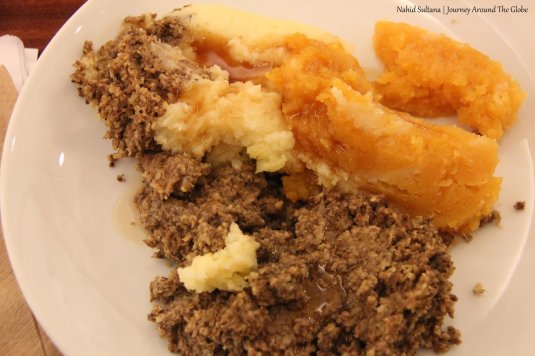
- Haggis in Edinburgh Castle
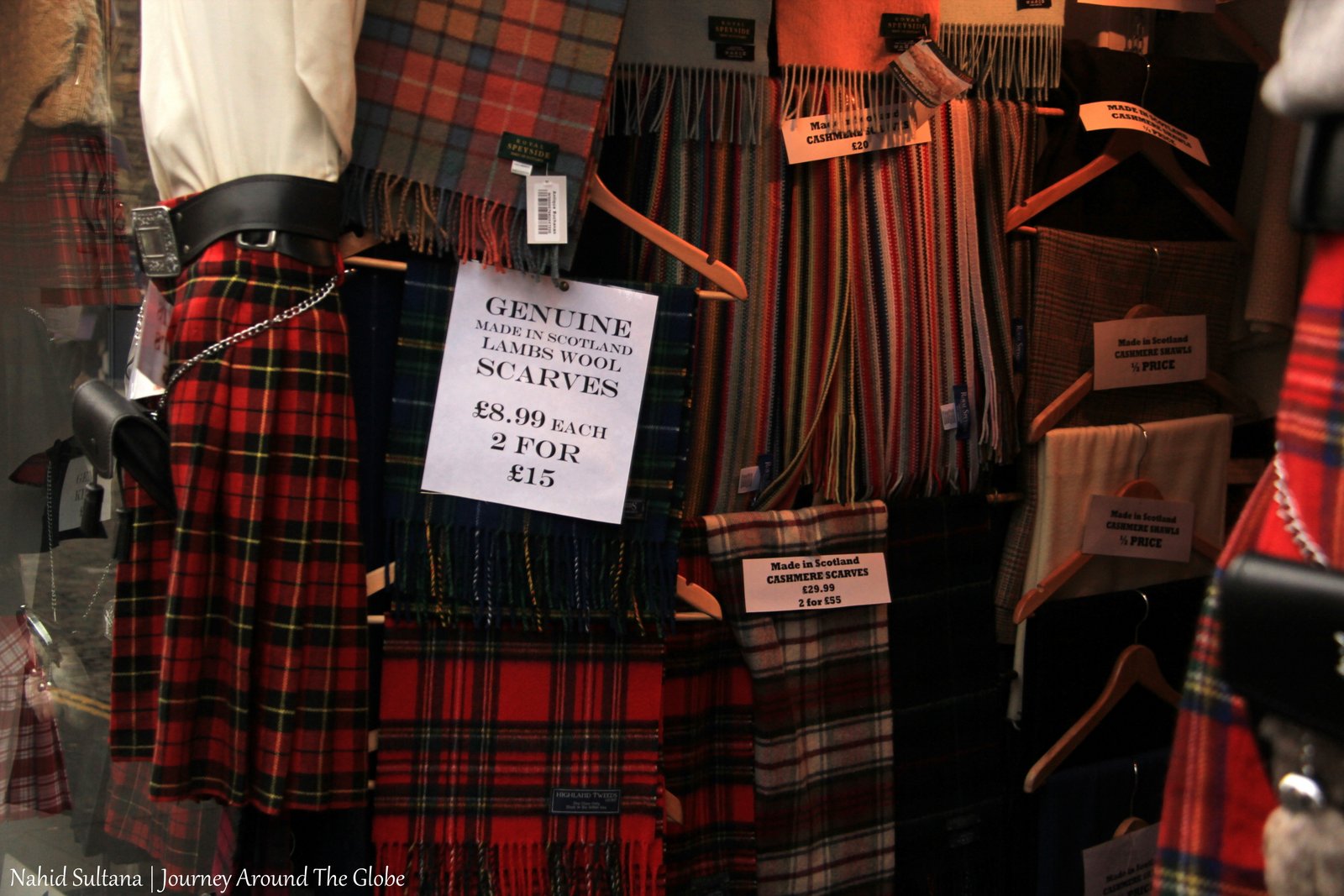
For shopping, if you are into Scottish kilts, you will find many on Royal Mile. Of course these stores/showrooms on Royal Mile are nothing but tourist traps and should be avoided if time spares. There were many small stores off of Royal Mile, just have to take turn on one of the small streets and you will find same quality products at much cheaper price. Cashmere is very popular here. Lamb wool items, like scarves, sweaters, and etc. can be found at various price and quality. Buy some Celtic jewelries, bagpipes CDs, or Scottish fudge and toffees here.

- Some Scottish souvenirs in one of the stores on Royal Mile, Edinburgh
PLACES I’VE VISITED: I had only a day…a whole day to explore Edinburgh. While it was not nearly enough for this city of so much to take in, I had to hop through only the main highlights of it. I started my tour very early morning at one side of Royal Mile at Canongate. I just followed Royal Mile and checked out whatever was on my way till I reached Edinburgh Castle. Royal Mile may be a heavily touristic area but I just loved its charismatic look and attitude. This is the backbone of medieval Edinburgh that runs from Holyrood Palace all the way to Edinburgh Castle. Most of the main sites are on this street. You will be amazed by all the old and historic buildings that line up on both sides of Royal Mile and all the souvenir shops, cafes, restaurants keep this place lively day or night. Royal Mile is not a pedestrian zone but not heavily crowded by cars either.

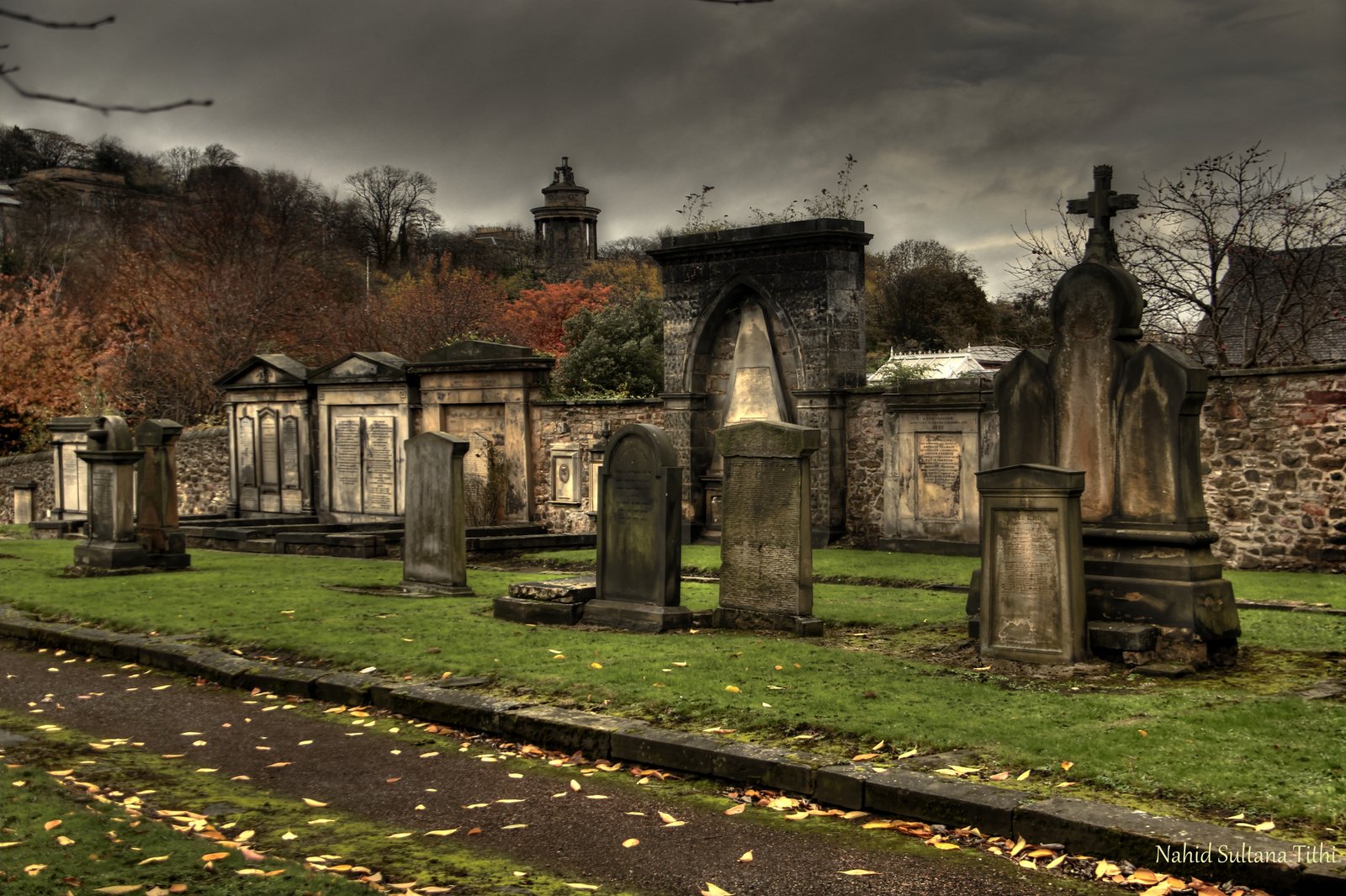
- An old cemetery on Royal Mile
For panoramic view of Old or New Town and further beyond, you can climb Arthur’s Seat (which supposed to offer spectacular sunrise) or Calton Hill. I couldn’t go to any of those but definitely nice place to get great some great views.
1) PALACE of HOLYROODHOUSE: This has been the royal residence of Royal Scottish family for more than 500 years. Her Majesty the Queen of Scotland visits and stays here every summer and no tourists are allowed at that time of the year. Presently, other than being a formal residence, many official matters of Scotland are conducted here.
Front courtyard is a grand place with a beautiful fountain and grand façade of palace in front of you. Arthur’s Seat, a volcanic hill created thousands of years ago, can be seen from here too.

- Front facade of Holyrood Palace at one end of Royal Mile, Edinburgh

The palace houses some of the magnificent collection of art of Royal history. The Royal and Historic Apartments at the palace are regularly used by the Queen and Members of the Royal Family to receive and entertain their guests on ceremonial and official occasions and are furnished with treasures from the Royal Collection. Historic Apartments include Mary, Queen of Scots’ Chambers – the setting for many dramatic episodes in Mary’s turbulent reign. This is where Mary’s secretary Rizzio was murdered in front of pregnant Mary by her husband Lord Darnley.
Some of the other important rooms in the palace are: Queen’s Bedchamber and King’s Bedchamber which are still decorated in the 17th century’s original style. Royal Dining Room and Throne Room were marvelous too. Along with all these rooms notice Great Gallery where Sean Connery was awarded along with many other achievers. Many antiques, old musical instruments, other 17th century furniture, decoration, and plastered ceiling set a unique mode of this place. I asked one of the attendants why all these rooms had really old, discolored, and worn-out fabrics and linens. Interestingly, the Royal Family doesn’t want to change their century old and generation old decors.
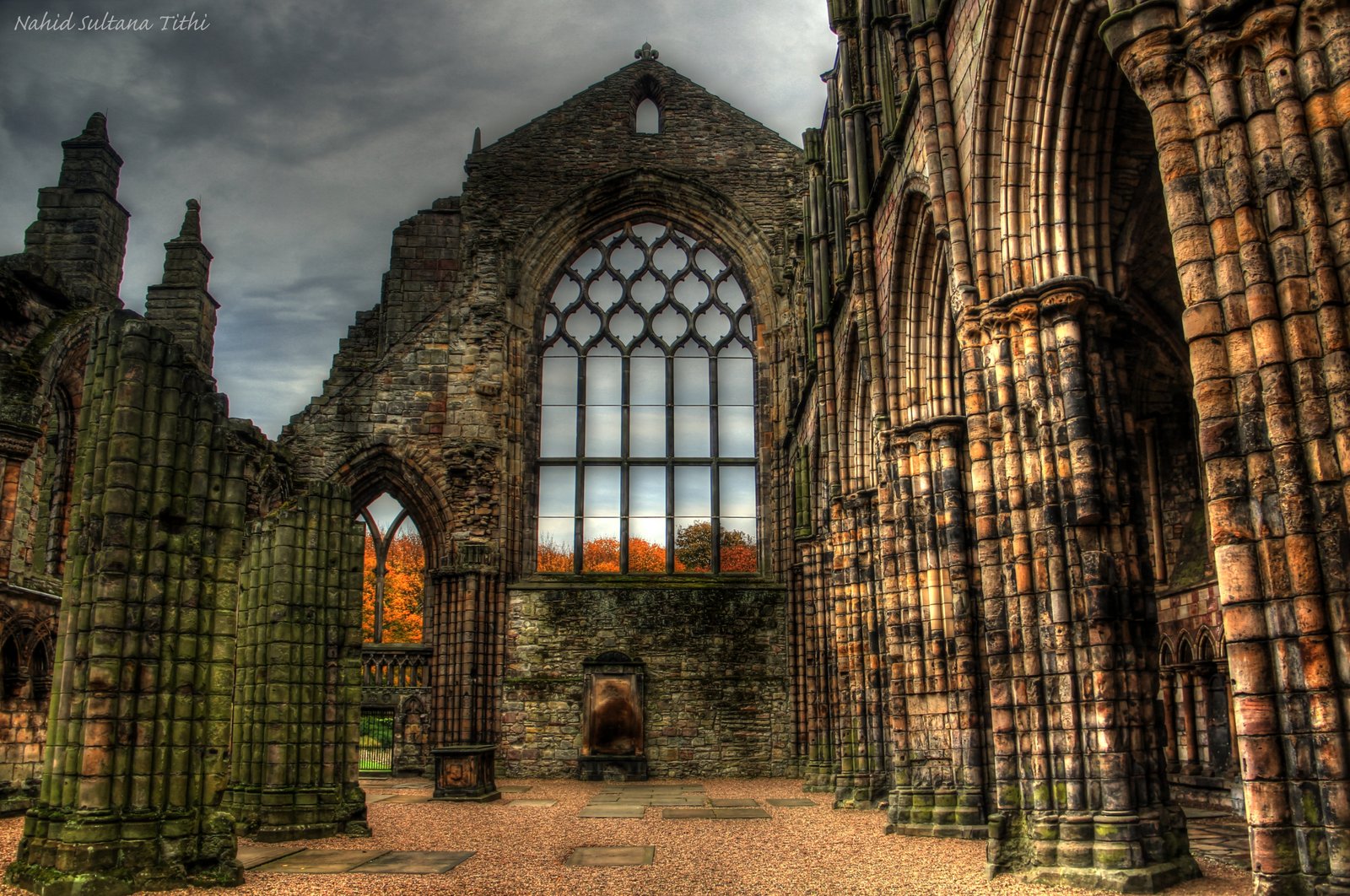
Holyrood Abbey comes at the very end of the tour and leaves a majestic memory of this whole place. This is a dramatic picturesque ruin site with ancient altar, columns, and Gothic walls. Founded by King David I in 1128 Holyrood Abbey was altered and expanded over the centuries. By 1500 this was one of the largest and most impressive monasteries in Scotland. Currently, the only surviving part of the once much larger abbey complex are the nave and its surrounding walls. The palace garden was closed (only opens in summer) and so was the Queen’s Gallery which hosts changing exhibitions from the Royal Collection. Ticket is separate for the gallery.

- Ruins of Holyrood Abbey in Edinburgh
I couldn’t take any photos inside the Royal and Historic Apartments since it is an active palace, but in the abbey or courtyard is ok. Ticket includes a detailed audio guide. It took me about 1 ½ hours to tour the palace in a slow pace. The palace is open daily from 9:30am except Good Friday, 25 – 26 December and during royal visits.
2) SCOTTISH PARLIAMENT: Only a few steps from Holyrood Palace, on its opposite side of the street, is the Scottish Parliament. It’s an award-winning home of the Scottish Parliament in the heart of Edinburgh’s Old Town. The parliament truly is a stylish and contemporary state of the art building and looks nothing like a traditional parliament house.
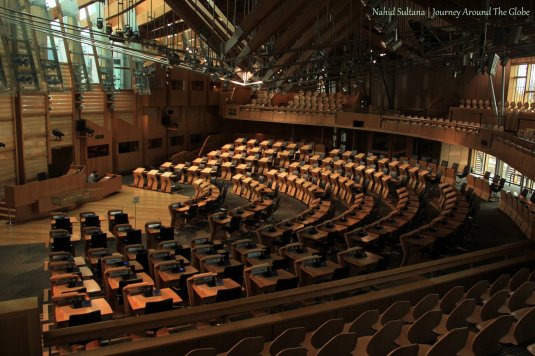
- Debate Chamber of Scottish Parliament
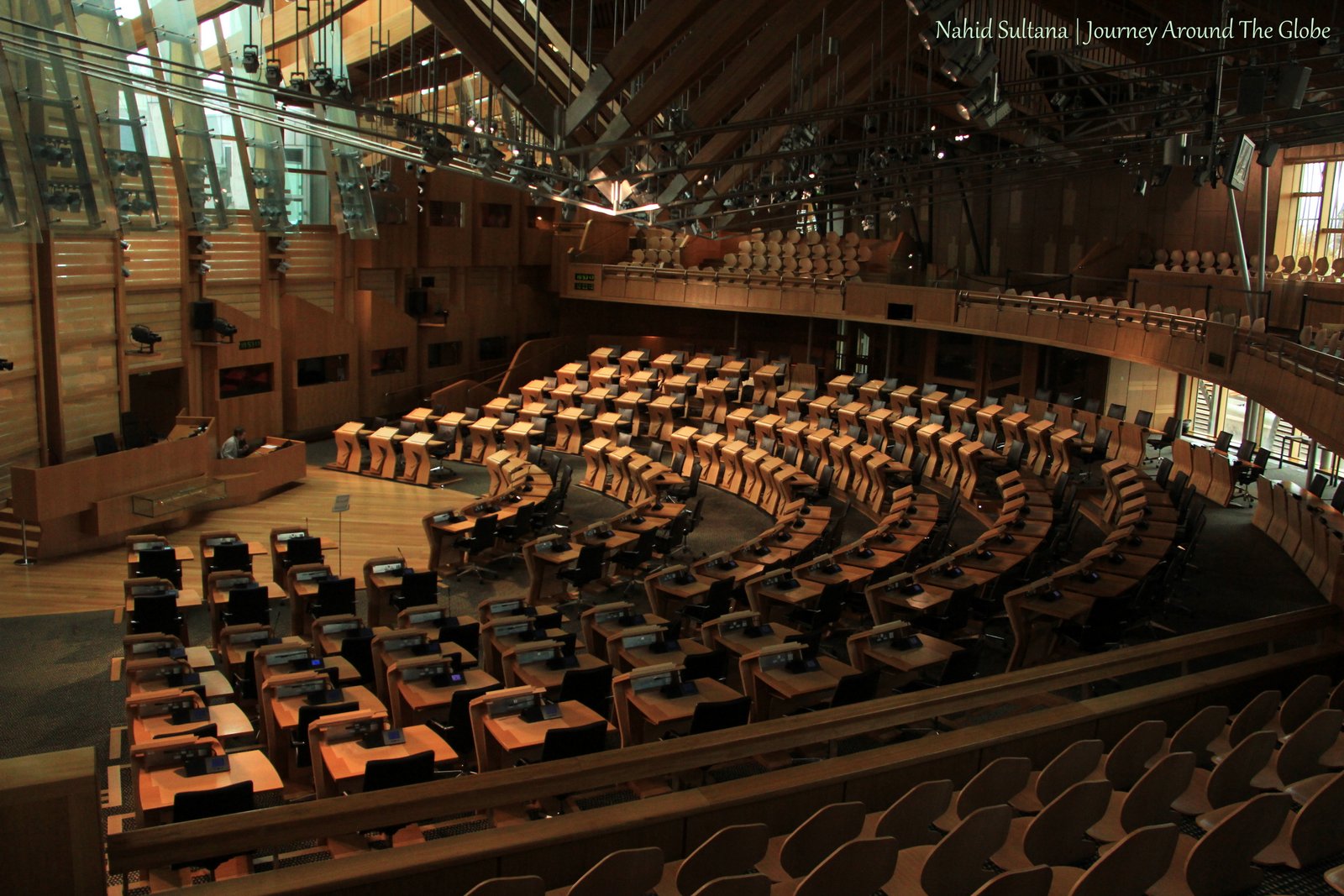
Access to the building is free, just have to go through a security checkpoint. Visitors can join free guided-tour of 50 minutes (have to book ahead of time) to discover the art and architecture of the parliament and how it works. I toured the parliament by myself and therefore couldn’t visit some of the private chambers and stuff. But still could explore the public areas, like the Debating Chamber, exhibition center, Main Hall, and Garden Lobby. There is also a café and a gift shop inside the parliament.
3) THE MUSEUM of EDINBURGH: As I was walking toward the Edinburgh Castle on Royal Mile, “The Museum of Edinburgh” came into my attention and decided to check it out. This is city’s treasure box filled with iconic objects from the capital’s past. The house itself is a well-preserved group of 16th to 18th century domestic buildings. It’s a journey thru time giving you a brief history of how the city developed. Many paintings, silverwares, glass arts, artistic potteries, and 18th century ceramics are displayed in 3 different floors.
“Foundation Edinburgh: the story of a city” is a 17-minutes video tour inside the museum that gives you a fascinating story of Scotland’s capital from prehistory to the present day shown in a blacked-out theater. Watch the city grow beneath your feet on a screen built into the floor – from the volcanic creation of Arthur’s Seat in prehistoric times thru the ages. The video runs every half hour throughout the day and costs 4 GBP.
The best part of this museum is that it’s free to enter. Opening times are Monday to Saturday: 10am – 5pm and Sunday: 12pm – 5pm (August only).
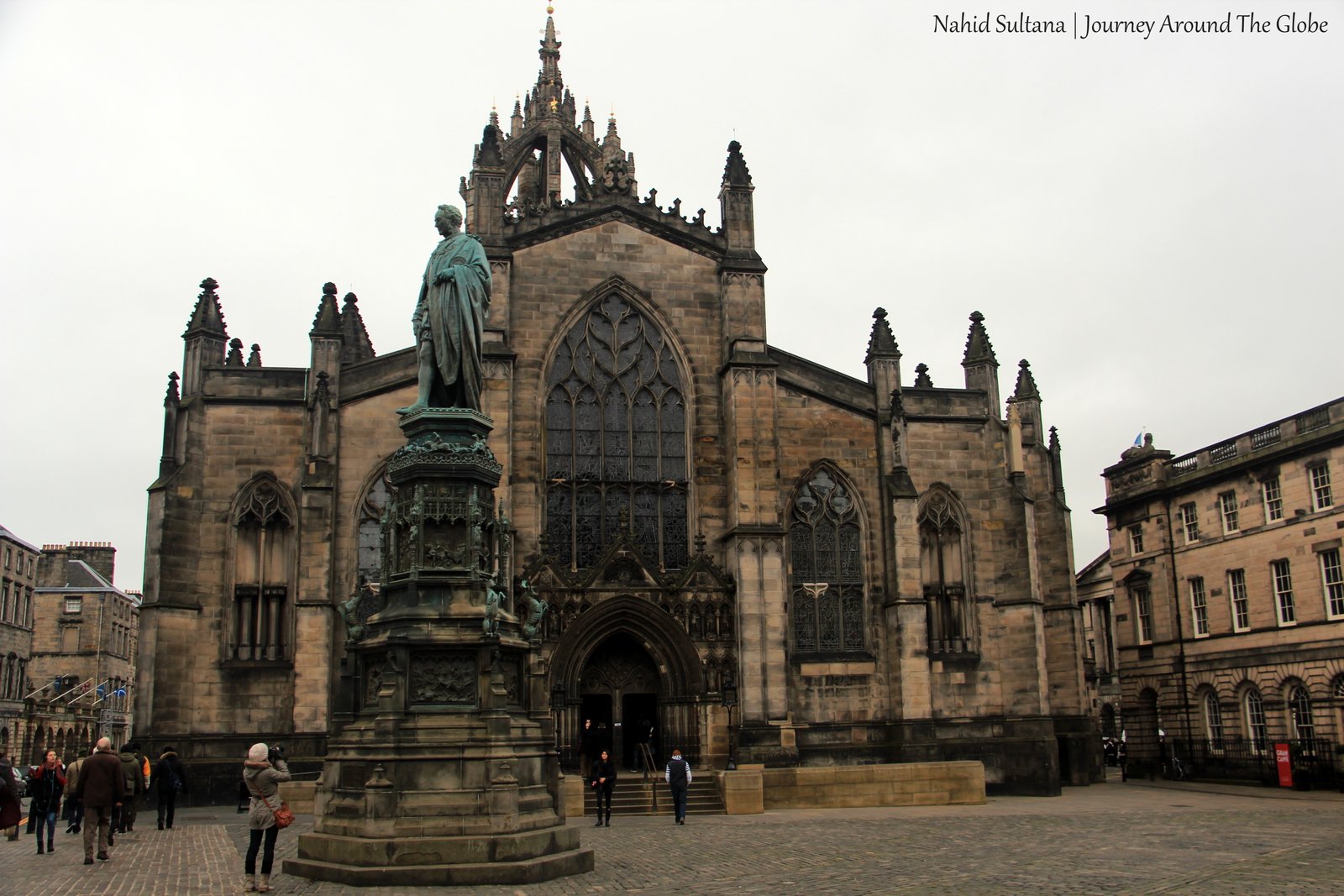
4) ST. GILES CATHEDRAL: This is an eye-catching architecture from the 13th century standing on Royal Mile in between Holyrood Palace and Edinburgh Castle. St. Giles Cathedral is probably the most famous and historic cathedral of the country. Ancient pillars and dazzling windows are something to appreciate here. Inside the cathedral is very majestic and grand just like its outer look. Do check out the unique crowned spire of this cathedral. It’s free to enter but had to pay 2 GBP for taking photos.

- St. Giles Cathedral on Royal Mile in Edinburgh
5) EDINBURGH CASTLE: At the other end of Royal Mile on one of the highest point of the city is Edinburgh Castle. This is a national icon of Scotland and itself is a storyteller of Edinburgh. No trip to Edinburgh is ever complete without a trip to the imposing castle. This was once a mighty fortress, the defender of the nation, and home of the famous Royal Edinburgh Military. The castle has dominated city’s skyline and looked over the famous Royal Mile for centuries. Now it is enlisted in UNESCO World Heritage Site. Its imposing walls have provided sanctuary and protection for many of Scotland’s kings and queens. The castle is in very good condition and ‘til today its walls have protected countless treasures of the city and the country. There are too much to see and take in here. I didn’t even realize how few hours went by walking on the cobblestone of this magnificent fortress and being amazed by its century old interiors.
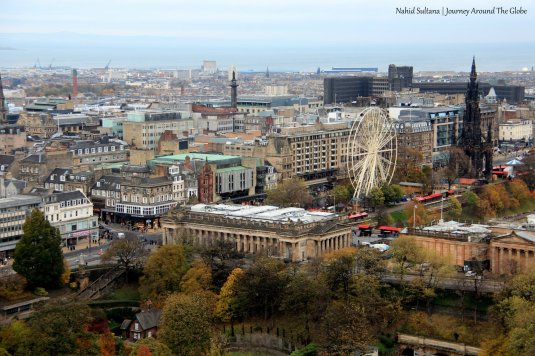
- Looking over Edinburgh from the castle
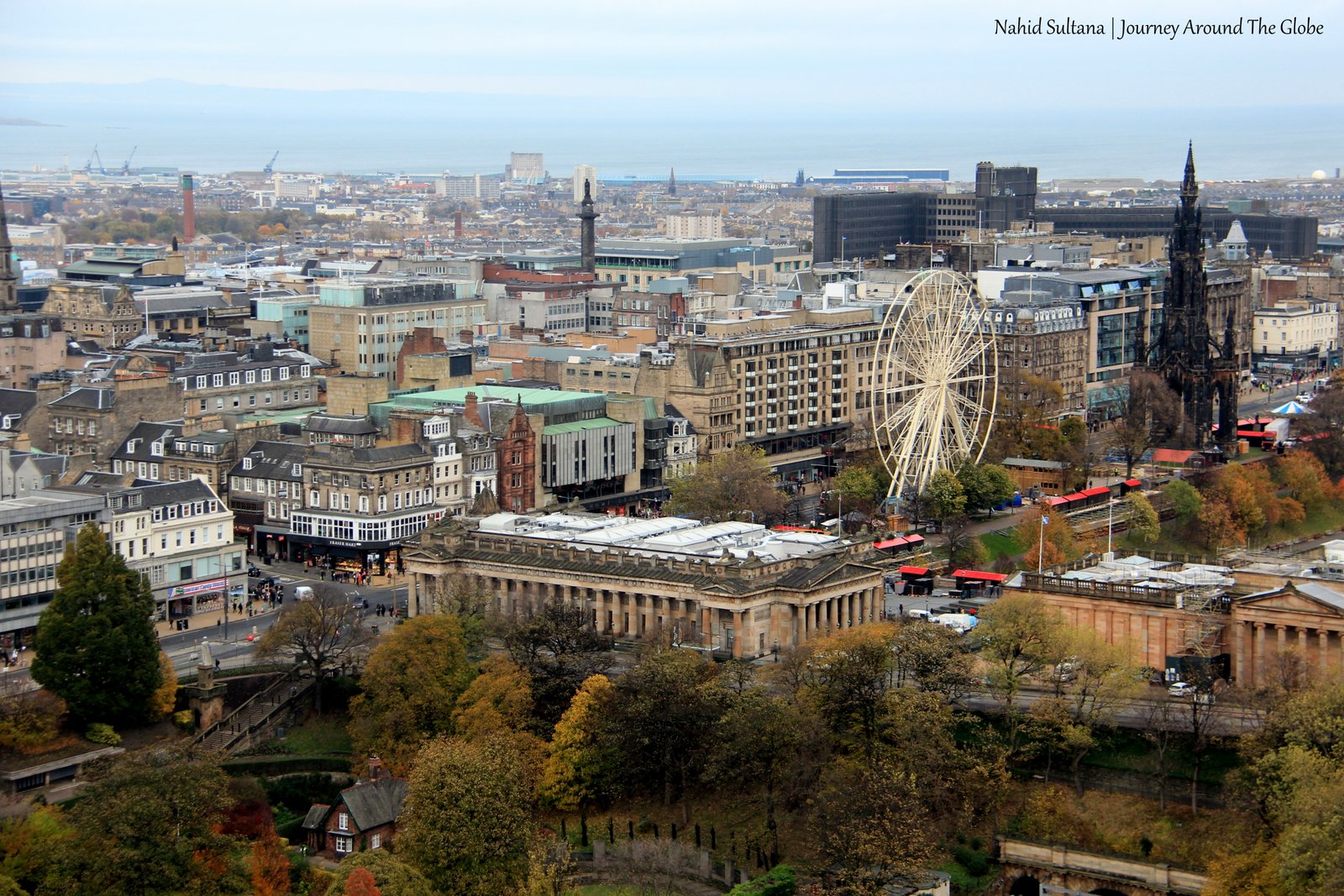
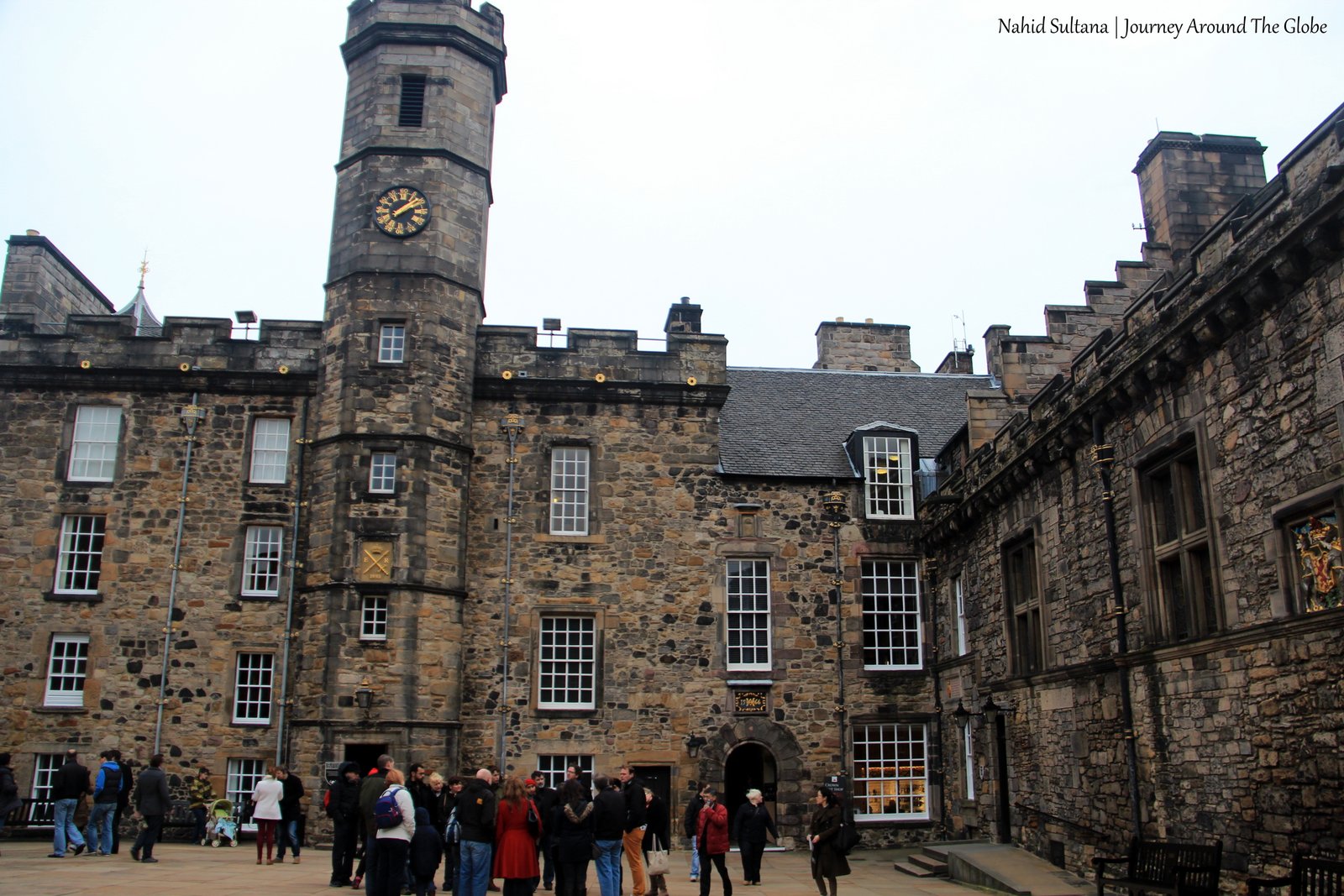
It slipped my mind but visitors can gather at 1pm near the One O’clock Gun to see the master-gunner fire the gun everyday…a traditional that has been carried out almost daily since 1861, except Sundays, Christmas Day and Good Friday. Make sure to visit the quiet and small St. Margaret’s Chapel which is the oldest building in Edinburgh from 12th century. Two of the top highlights of this castle are The Crown Room and Royal Palace. Crown Room is where Scotland’s glittering crown jewels, crown, scepter, Sword of State (which was used in the coronation of Mary Queen of Scots in 1543) and the historic Stone of Destiny located. The Royal Crown came back to Scotland from England in 1996 after 700 years. It’s from 1540 AD, and made with Scottish gold, engraved, enameled, and ornamented with gemstones including diamond, garnets, amethysts, and quartz. Royal Palace was the residence of the steward Kings and Queens in the 15th and 16th centuries. This is where Mary Queen of Scotland gave birth to James VI in 1566 (man behind the King James Version of Bible). It takes about 30 minutes just visit these Scottish treasures and read up on their fascinating history. Close to the Royal Palace is the Scottish National War Memorial…a shrine to those Scotsmen of all ranks who fell in conflict from World War onwards. In the same courtyard where the Victorian Great Hall located is where tourists can be amazed by the original hammer-beam roof. Built in the late 15th century as a majestic setting for ceremonial occasions it is still used today for state and royal functions. The hall also holds a fabulous display of arms and armors as well as the “key” to the castle. Last but not least, I visited the Prisons of War which is a must-see in Edinburgh Castle. This is an atmospheric recreation of the life of prisoners at the end of the 18th century.

- Royal Palace (front) and Great Hall (right) in Edinburgh Castle
Other than the above that I visited, there are other museums here that may interest some visitors: The National War Museum of Scotland which hosts two individual regimental museums. But besides all mind-boggling history and artifacts that the castle offer to its guests, it also has views across the capital, over the Firth of Forth and into Fife. Enjoy the panoramic views from all of the castle walls.
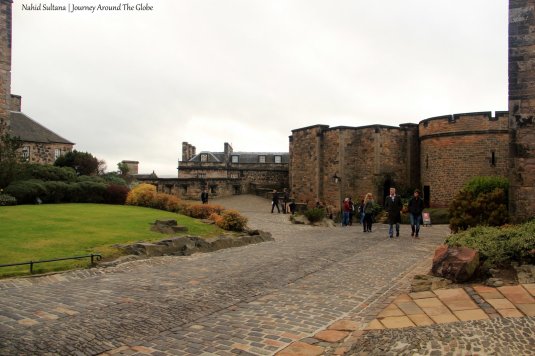
- Lost in Edinburgh Castle
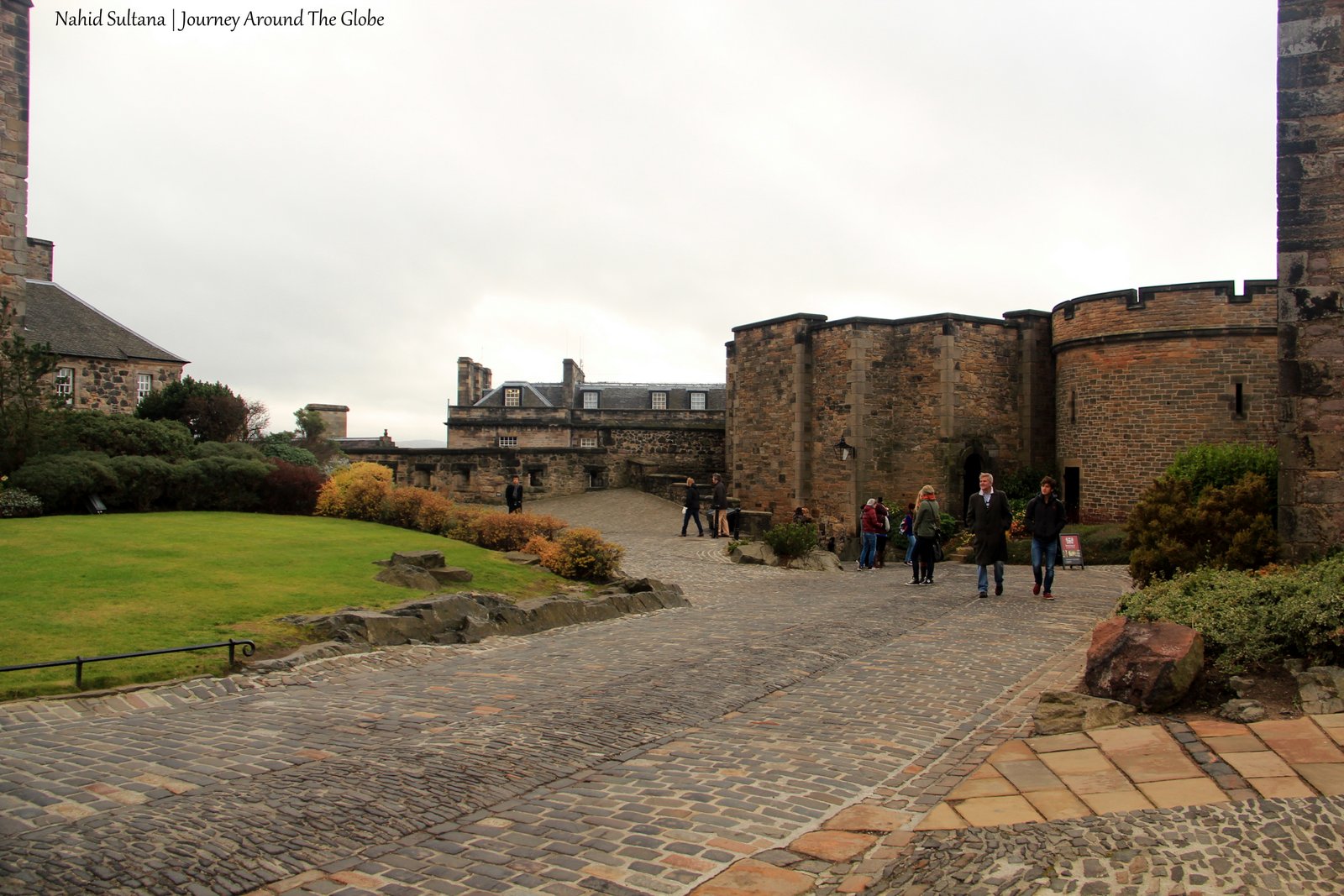
Adult ticket is 16 GBP per adult and 9.60 GBP for kids. Audio guide (available in many languages) is extra 3 GBP but highly recommended. It’s about 4 ½ hours long, but you can skip through some chapters and listen to the ones only interest you. There are more than one gift shops all around the castle and a café and a tea room. Do plan to stay here few hours.
6) MARY KING’S CLOSE: This is the REAL Mary King’s Close underneath Royal Mile of Edinburgh that once used to exist as part of a medieval city from 1622. Opposite to St. Giles Cathedral, the entrance to Mary King’ Close is through Warriston’s Close. “Closes” are basically small alleys from big streets that existed (still exist actually) in the old town of Edinburgh few centuries ago. Mary King’s Close is one such “Close” from that time which was eventually sealed by the authority to develop newer city on top of it. This is a slice of Edinburgh’s medieval history and shouldn’t be missed. Buried deep beneath Edinburgh’s Royal Mile lies the city’s hidden streets that remained frozen in time since the 17th century.
I haven’t visited a place quite like Mary King’ Close before. This is one unique tour that everyone should take in Edinburgh. With a guide, visitors can explore 4 main medieval streets of this area and experience what it was really like for the people who lived, worked, and died here. We had a chance to meet some prominent people of the “close” too. You get to hear how this once bustling environment was sealed. This is an important piece of Edinburgh’s rich history which reveals a fascinating underground network of hidden closes and rooms. If you are like me, who is tickled by medieval history and legends, take this tour and you won’t regret.
This is an educational, interactive, and fun tour; I enjoyed it very much. Our guide was a superb actress and a knowledgeable girl. She told us some legends and myths that went around during that time while we were walking thru some very well-preserved dark alleys and houses. This spooky trip is not suitable for kids or someone who is claustrophobic.”. It’s 12.95 GBP per adult for an hour tour with a guide. And sorry, no photos are allowed inside the close…
Related articles
- Haggis, Tatties and Neeps: 10 Things to Do in Edinburgh (thebritishberliner.wordpress.com)
- Edinburgh, Scotland (tyhewitt.wordpress.com)
- Top Things to Do and See in Edinburgh (epicatravel.com)
- EdinburghSketcher: Royal Mile building (scotsman.com)
- The Counter, The Royal Mile Tavern, Edinburgh Christmas Market (irelandforthought.wordpress.com)
Share this:

Day trip to former capitals of Lithuania – Karnave and Trakai
KARNAVE and TRAKAI, LITHUANIA: Visiting Karnave and Trakai was a tempting day-trip for us during our trip to Vilnius, Lithuania. Both of the towns were so close to Vilnius that we decided to get out of the capital for a day and enjoy some suburbs time.
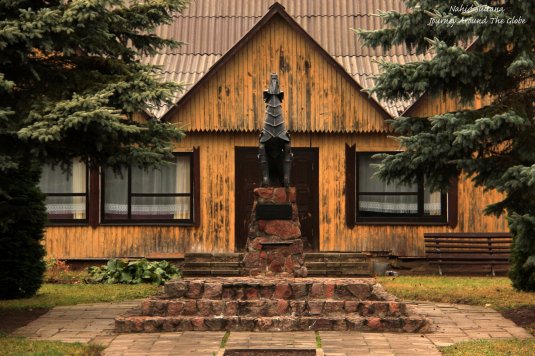
- A howling iron wolf – an official symbol of Lithuania

Karnave is about 35 km NW of Vilnius. This was the first capital of Lithuania. It was a trading city back then. But unfortunately the city was badly destroyed by the Germans crusaders and then Lithuanians themselves (to defend) in the 14th century and was never rebuilt. Now it’s enlisted in UNESCO World Heritage Site.
Trakai was Lithuania’s former medieval capital when Grand Duke Gediminas moved it from Karnave sometime during 14th century. It was first mentioned in the history in 1337. This small town is well known for its many different inhabitants like Lithuanians, Jews, Poles, Russians, Tatars, and Lithuanian Karaim (an intriguing Turkish speaking offshoot of the large Judaic Karaim movement who arrived in the town at the end of the 14th century and who are currently on the border of extinction). The city is about 28 km from Vilnius and is a lake district with 5 beautiful water bodies. I am happy that we took this tour…makes a perfect full or half a day trip if you are in Vilnius.
Thanks to our hotel who helped us to book this trip through a company, called Vilnius City Tour (vilniuscitytour.com). It was a private tour just by ourselves along with a driver and a great guide, Asta. We were picked up from our hotel around 9am. After visiting Karnave, Trakai, and some portion of Vilnius old town, we were brought back to hotel around 6pm. It cost us about $400 (290 euros or 1000 LTL) for our family of 4 (2 kids: 7 and 3 years old). Lunch wasn’t included here but we didn’t have to pay any entrance fees in anywhere.
TIME of TRAVEL: We visited Lithuania at the beginning of November 2013. It was not-so-great day when we took this trip. It was very cold and definitely cloudy at the beginning. Up to Karnave, the weather was fine…just had to deal with the cold. But when we were in Trakai, it started raining. But we still managed to visit the Trakai’s castle but if the weather permitted we would have had great time by the lake too.
OUR HOTEL: We stayed in Hotel Atrium in old town of Vilnius. Please check the “Our Hotel” section in my page on Vilnius under Lithuania.
EATING and SHOPPING: I didn’t find many shops or restaurants in Karnave but Trakai was a good place for some local souvenir hunt. Along the side of Lake Galve where Trakai Island Castle is located, there are lots of outdoor vendors who were selling variety of different trinkets. There were many cafes and restaurants by the lake too. We had lunch in a lake-view restaurant, called Bona Pizzeria…enjoyed the stunning view of the castle from our table as well as good food. They had pizza and pasta for the kids and soups, salads, and some Lithuanian dishes for our adult taste buds.
One thing that you just have to try in Trakai is kibinai. It’s a meat pastry which is Karaim (a minority tribe in Trakai) specialty. You can find kibinai in Vilnius or other towns in Lithuania, but Trakai is the where you can find it in its best form.
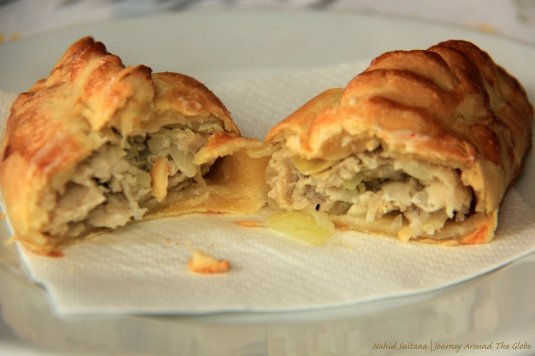
- Kibinai – meat pastry, a specialty of Trakai

PLACES WE’VE VISITED: This was a day trip we took from Vilnius. First we were taken to Karnave and spent about couple hours there. Then our guide took us to Trakai. Here we spent about few hours too including lunch. We were done with these two places about 3pm. Our last destination was Vilnius where she showed some sites that we didn’t cover on our own. Please visit my page on Vilnius to see all the places we’ve visited there.
1) KARNAVE: As I mentioned before this was Lithuania’s first capital and a very historic place. It was very quiet that day, I think we were the only tourists there and it was the weather to blame. Overall, there aren’t much to do or even see in Karnave, at least not around this time of the year.
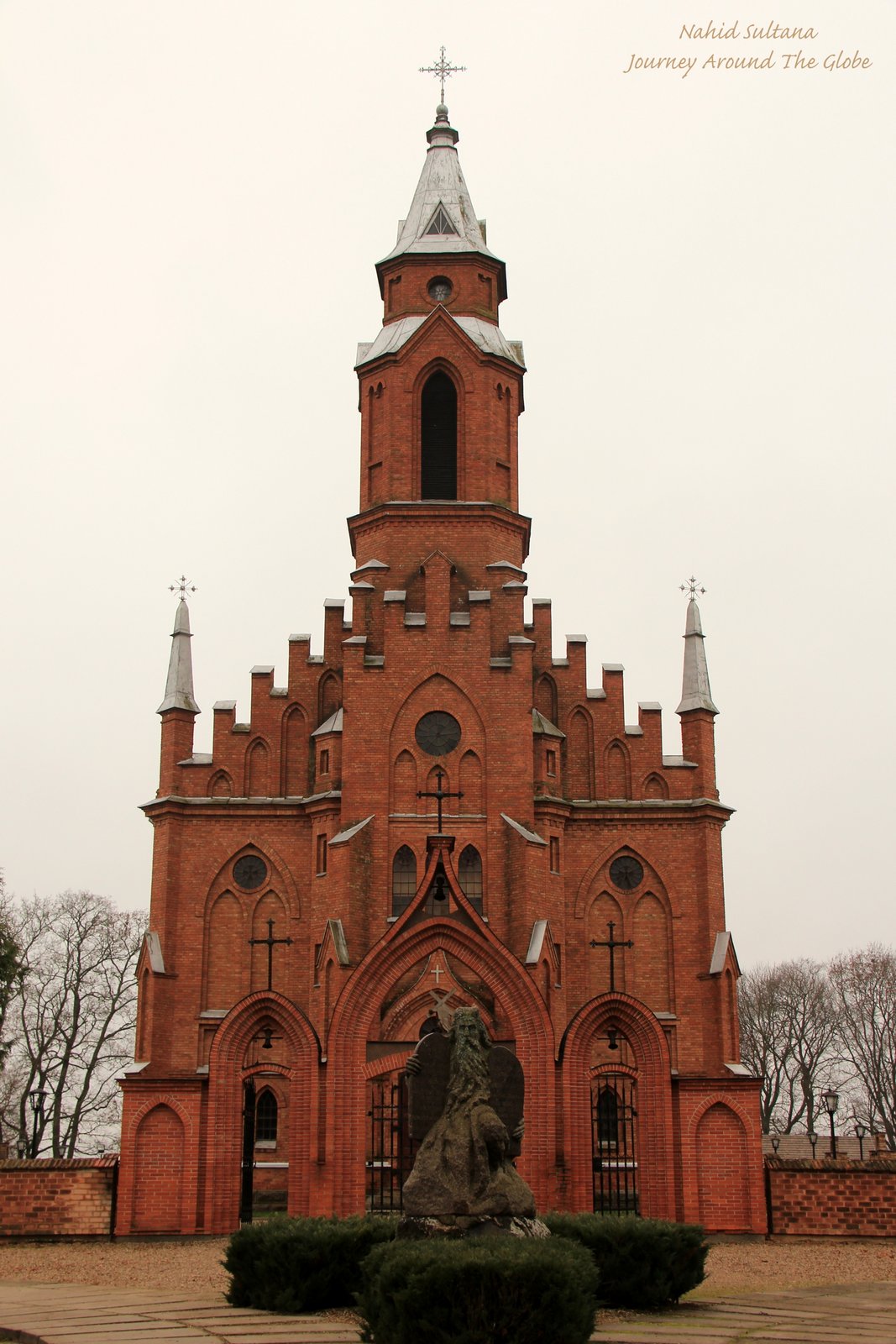
Church of Saint Mary of Scapular was built in 1920. We didn’t go inside the church but our guide did take us to a gated area where church Father lives to show us a memorial for Jerusalem and a man-made lake in the shape of Lithuania’s map. At one side of the church, there are some ruins of an early church (mainly some bricks/stones where the original nave used to be) from few centuries ago in the 15th century.

- Church of Saint Mary of Scapular in Karnave, Lithuania
You can see River Neris flowing at a distance when standing behind the church and in front of the mounds. It’s a beautiful valley and very historic place for this country. As we were standing behind the church and facing the mounds and River Neris, left mound, called Mindaugas Mound, was where Lithuania’s first and last king, King Mindaugas was crowned. Out of total 5 original mounds, you can see 4 of them. We climbed on two mounds and let me tell you, view from there is just too pretty. During summer, big festivals and events take place on these mounds.
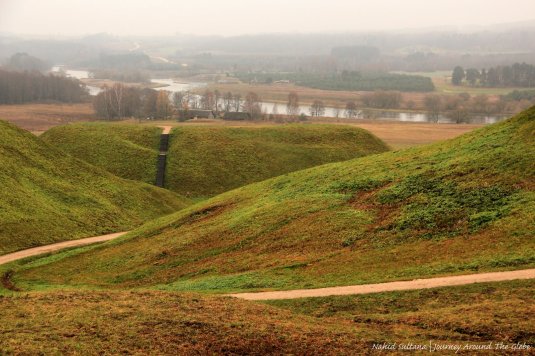
- Historic mounds of Karnave in Lithuania

We were done with Karnave in about less than 2 hours, then headed towards Trakai.
2) TRAKAI: From Karnave to Trakai the distance is about 25 km. This is mainly a lake resort area and a perfect holiday place during summer. It started raining when we got off the coach in Trakai and walking towards the castle. But I could imagine how beautiful it probably looks in the summer months. I am sure visitors at that time can enjoy the waterscape and expanse of lakes everywhere in Trakai.
The main attraction of Trakai other than the lakes is Trakai Island Castle which was the residence of Vytotus the Great. This grand and romantic castle ruins of Trakai attract major tourists in Lithuania. Sitting quietly on Lake Galve, construction of this Gothic masterpiece started in the 14th century. The castle was damaged and eventually abandoned in 1655 after a war with Muscovy. Ironically, it was during the Soviet occupation of Lithuania that the castle was eventually restored to its former glory.

- Trakai Island Castle on Lake Galve in Lithuania

We crossed a footbridge and walked little more to reach the main entrance to the castle. Two main structures of this castles are the defensive outer and the Ducal Palace. Upon entering to the main front courtyard, you can see beautiful fortress of red bricks in all three sides. Trakai History Museum is spread around the castle and linked via many arrays of wooden steps and dark spiral staircases. Soldiers’ barracks, Great Hall, and other small rooms are filled with some original furniture, decors, ceramics, potteries, and etc. Though Trakai Island Castle looks more like a fortress than a palace, there are bedrooms of kings and queens that you can visit.

- Inside Trakai Island Castle in Lithuania

A collection of items were dug up in the vicinity of the castle, such as a huge collection of coins. Some explanations in the castle are in English, but mostly they are in Lithuanian and Russian.
Related articles
- Bloody history and current look of Vilnius, Lithuania (journeyaroundtheglobe.com)
- Day 33: Vilnius, Lithuania (philsworldconquest.wordpress.com)
- Day 32: Suwalki, Poland to Vilnius, Lithuania (philsworldconquest.wordpress.com)
- Trakai, Old Town and ‘Traditional Lithuanian Drinking’ (muchadoabouttaylor.wordpress.com)
- Bloody history and current look of Vilnius, Lithuania (topsvetaine.wordpress.com)
- Top 5 Night life Spots in Vilnius, Lithuania (missurasa.wordpress.com)
- Vilnius valdo! (eacleary.wordpress.com)
- Tourist Numb, History-Seeped: Vilnius, Lithuania (topsvetaine.wordpress.com)
Share this:

Bloody history and current look of Vilnius, Lithuania
VILNIUS, LITHUANIA: Vilnius is the capital of Lithuania and definitely one of the most vibrant and unique cities of former Soviet Union. Historically, it was formed in 1236 by Lithuania’s first and last king, King Mindaugas.
Lithuania has about less than 3 million people, among which mostly are Catholics. Their language roots back to Baltic tribes and interestingly very similar to Sanskrit. But locals speak very good English and most of the older generations speak Russian too.

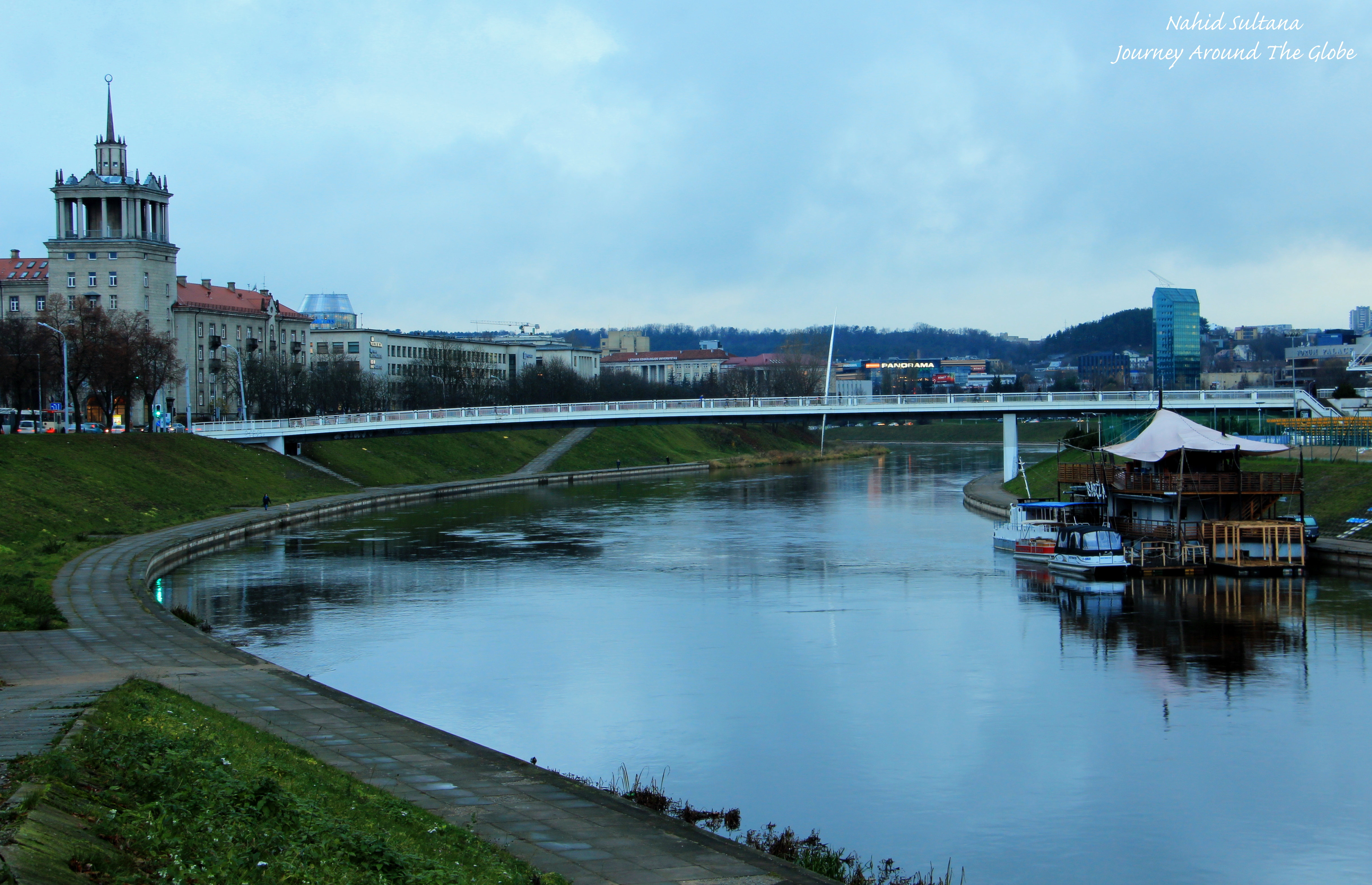
- Vilnius, Lithuania by River Neris
The years 1940 to 1941 reflect a very difficult and tragic period in the history of Lithuania. The country’s future was decided by other states when it was occupied in June of 1940 by the Soviets, and later annexed. Sovietisation and the brutal persecution of its citizens began. Over 30,000 people were persecuted under the first Soviet occupation (from June 1940 to June 1941). These persecutions and deportations of Lithuanians were only the beginning of the story of brutality and loss that lasted half a century. This experience is still alive in the memories of people of that generation, and to others through the stories of grandparents or parents. It has affected their fates and the fates of succeeding generations.
Deportations, the mass evictions of people from their places of residence to the remotest regions of the Soviet Union, were one of the most brutal measures taken by the Soviet regime against civilians. Entire families, parents, grand-parents children, newborns, and the sick were secretly, usually in the dead of nights, carried away in cattle cars.
The armed resistance by partisans between 1944 and 1953 took the lives of over 20,000 people. More than half of them perished fighting for freedom between 1944 and 1945. Most of the fighters who died were younger than 21. Even their deaths were brutally displayed in the public. In order to frighten civilians, the bodies of partisans were laid out in town squares, yards, and farmers’ markets.
Vilnius reminded me little bit of St. Petersburg. Old town of Vilnius is very nice and is enlisted as UNESCO World Heritage Site. Look for howling iron wolf in many places of Vilnius that depicts Gediminas’ (Grand Duke of Lithuania) prophetic dream. There at total of 52 churches in Vilnius, some…may be most of them date back to the medieval ages. But interestingly religious wise Lithuania was originally a pagan country and was the last country in Europe to accept Christianity.
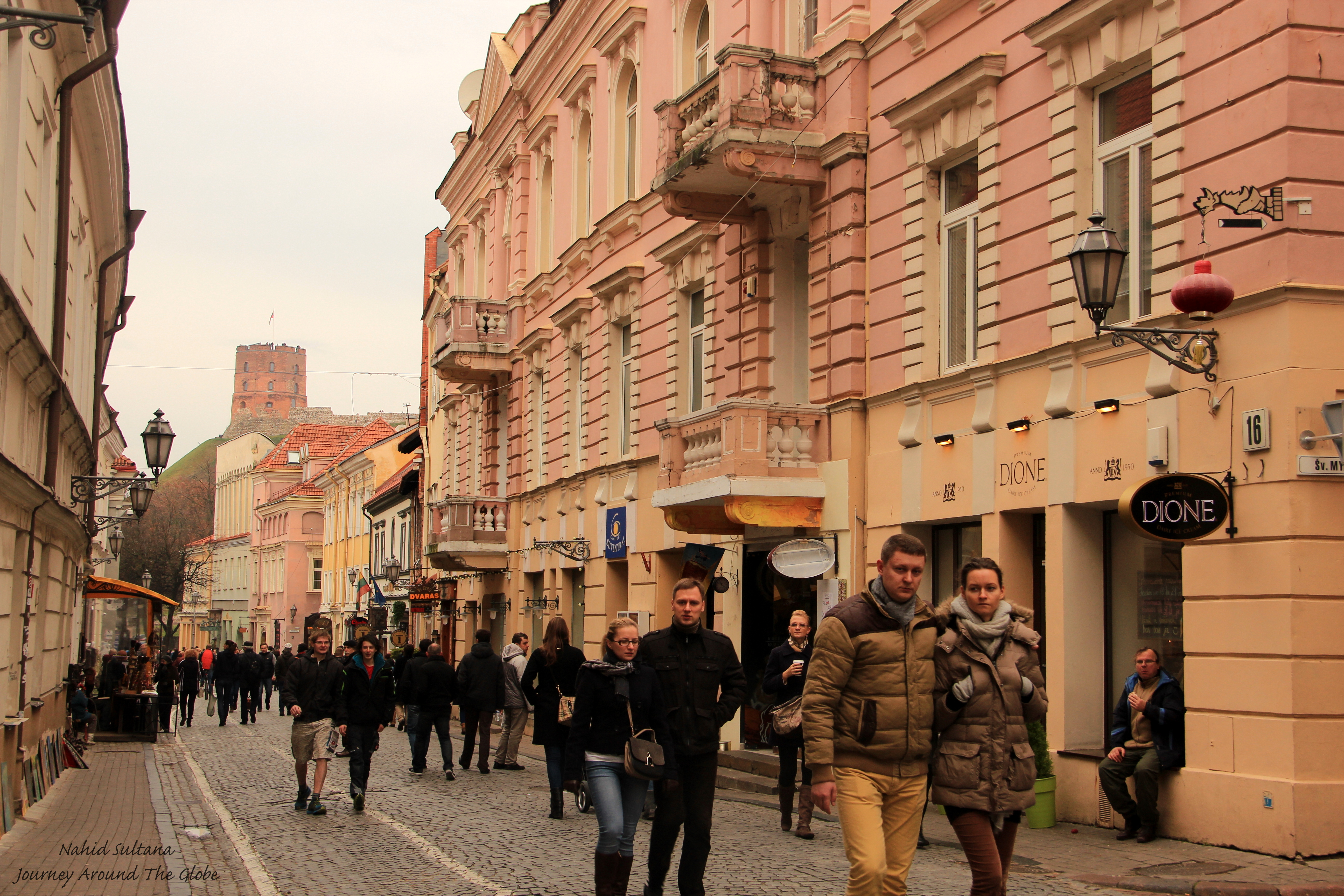
- Old town of Vilnius, Tower of Gediminas Castle in the back
TIME of TRAVEL: It was the first week of November 2013 when we visited Vilnius. Eastern Europe can get really cold and chilly around this time of the year but we were very well prepared. The temperature was around early 40s during the day and mid 30s around the evening. We got a little bit of drizzle here and there but no major rain or snow.
OUR HOTEL: We stayed in Atrium in the old town of Vilnius which was only a few steps from Cathedral Square and right in the middle of the shopping district. It was a gorgeous hotel with nice breakfast and free Wi-Fi in our room. The only thing I didn’t like about this hotel was that it didn’t have any elevator. The staffs were helpful giving us different options of making day-trips to nearby sites of Vilnius. Vilnius’s only Argentinean restaurant “El Gaucho Sano” is in this hotel where we had our last dinner…very fancy and truly good food. The location was also a plus point for this hotel, since we were within walking distance from all the main attractions of the city including St. Anne’s Church, Town Hall Square, and the overall old town pedestrian zone. The hotel is surrounded by many restaurants from fast food to authentic local Lithuanian kitchens. Also, many souvenirs shops and other boutique stores were very close by.
EATING and SHOPPING: Like Riga, Vilnius is an amber city too. There countless amber stores in the old town. Most of the decent stores will give you their authentication certificate with the jewelries or decors you buy. Many Russian influenced souvenirs are very common here, like Russian dolls, lacquered boxes. Many squares have local hand-craft vendors in the weekend.

- Some Lithuanian souvenirs in Vilnius stores

Our first dinner in Vilnius was in Forto Dvaras on Pillies Street, very close to Cathedral Square. Seemed like all the locals knew about this restaurant. It indeed offers some great local dishes with reasonable prices. We mostly tried some local Lithuanian dishes, like cheese dumplings, potato pancakes (Lithuanians eat lots and lots of potatoes). The building itself is a historic place with underground sitting arrangements. Cili Pica is a chain restaurant where we had 2 of our meals in Vilnius. You can find them almost in every neighborhood in old town. They have a nice combination of pasta, variety of pizzas, salads, soups, and some Lithuanian dishes. The price is very reasonable and the menu is very kids friendly. We also ate in Charlie’s Pizza on Pillies Street couple times. They mostly have lots of different types of pizzas, soups, salads, and some Lithuanian dishes. If you get a chance try their unique black breads…either in breakfast or with soup.

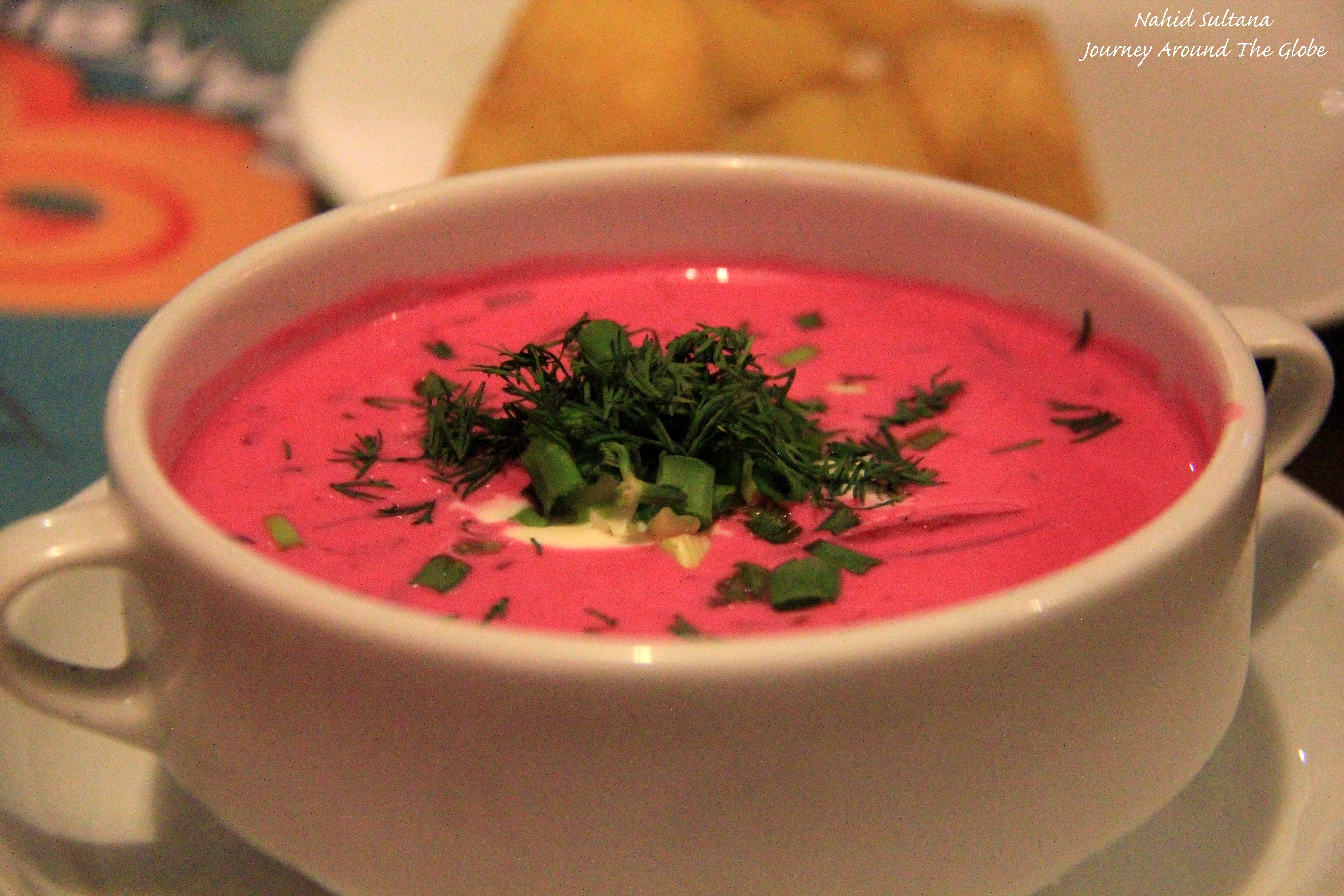
- Cold beetroot soup…a very famous Lithuanian dish
PLACES WE’E VISITED: We spent 2 full days in Vilnius and 1 day outside the city in Karnave and Trakai visiting the oldest capitals of the country. There are plenty of museums in Vilnius if they interest you. The old town of Vilnius is big, bigger than many other European cities we’ve visited, but everything can be cover on foot. Notice the Green Bridge on River Neris which is the oldest bridge of Vilnius dating back to 1536. The Town Hall Square is a very lively place here which once used to be the main market square during the middle age.
1) CATHEDRAL SQUARE and VILNIUS CATHEDRAL: Cathedral Square is a big place and a historic place of this country.
Vilnius Cathedral is Lithuania’s most important sanctuary since its construction started in 1387. The cathedral changed its appearance many times with each new century. The present classical form of Gothic elements is from the 18th century. The exterior statues were added in the 19th century. Many biblical paintings are on display here, carvings on the ceiling are very beautiful too. The altar is simple with few columns.

- Vilnius Cathedral after dark, standing there since the 14th century, Vilnius, Lithuania
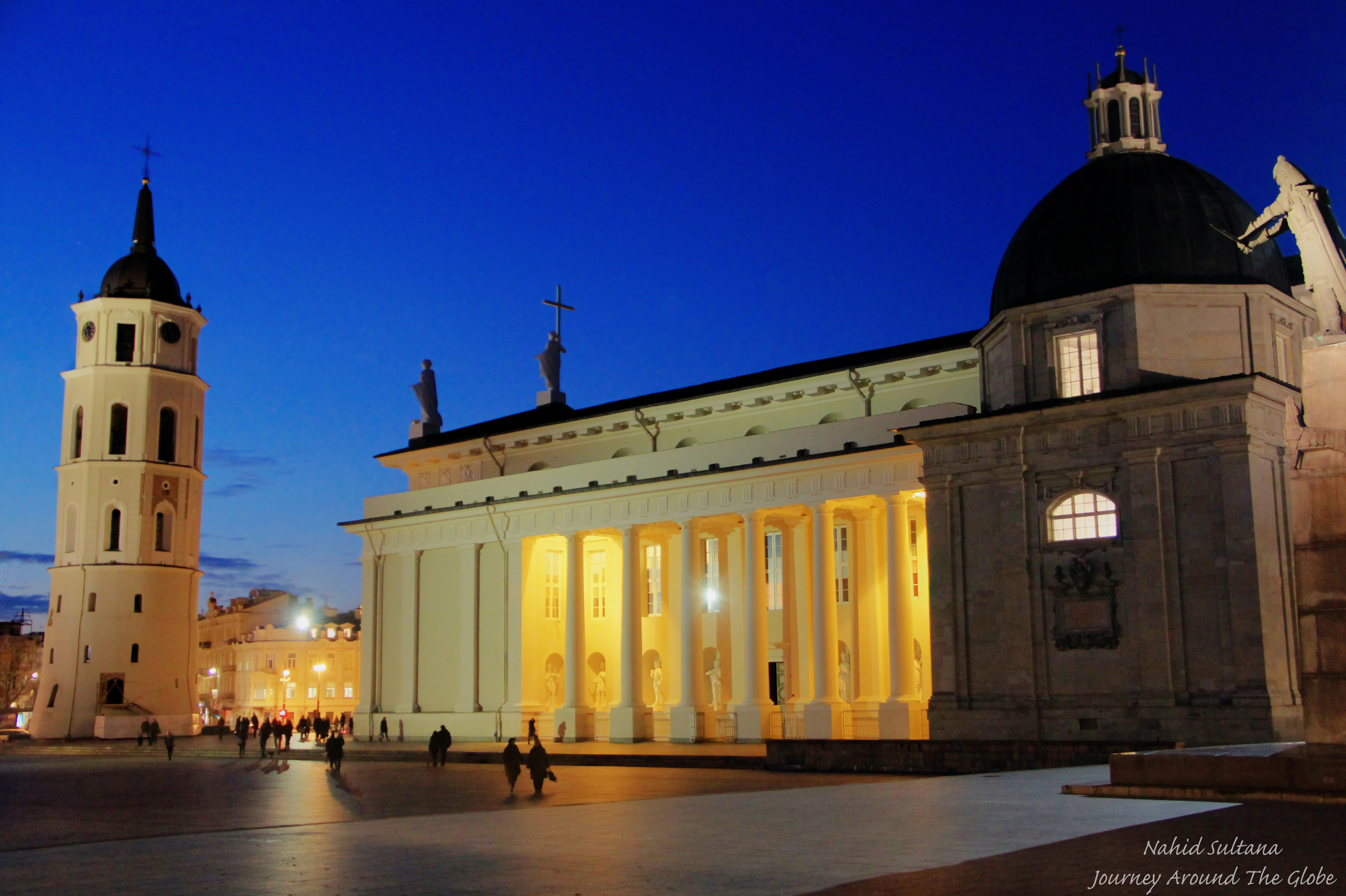
The most decorative part here is Baroque style St. Casimir’s Chapel (saint patron of Lithuania). His tomb along with other remains is kept here. This chapel is considered as one of the country’s national treasures. Although we didn’t go there, crypt beneath the church contains the remains of Lithuanian rulers and bishops. The 3 statues of St. Stanislaus, Helena, and Casimir on the roof supposedly represent Poland, Russia, and Lithuania. Belfry (57m) outside the church was built in 1522 on one of the 14th century towers of the Lower Castle.
It is free to enter the cathedral and located at the bottom of Gediminas Castle.
2) KGB MUSEUM: Also known as Museum of Genocide Victims, KGB Museum is a unique and moving museum and a must-see in Vilnius, even if you are not the museum type person. This is one of a kind place in the Baltic region. The museum is set up in the former KBG headquarters and prisons where Soviet crimes were planned and committed in the course of 50 years. Nazi Gestapo and the KGB occupied this building at different times of the 20th century. Genocide of the population was planned here. Citizens of Lithuania were imprisoned, interrogated, tortured, and killed here in a mass level. Visitors can learn about the most tragic period in Lithuanian history in exhibitions in prison cells, the execution cell, and the rooms of the KGB officers. The exhibitions deal with the painful and dramatic times of this country including the loss of independence, brutal reprisals at the hands of the Soviet regime, and the bitter fight for the reestablishment of independence.

- Inside KGB Museum where many Jews were persecuted by Nazis during WWII, Vilnius, Lithuania
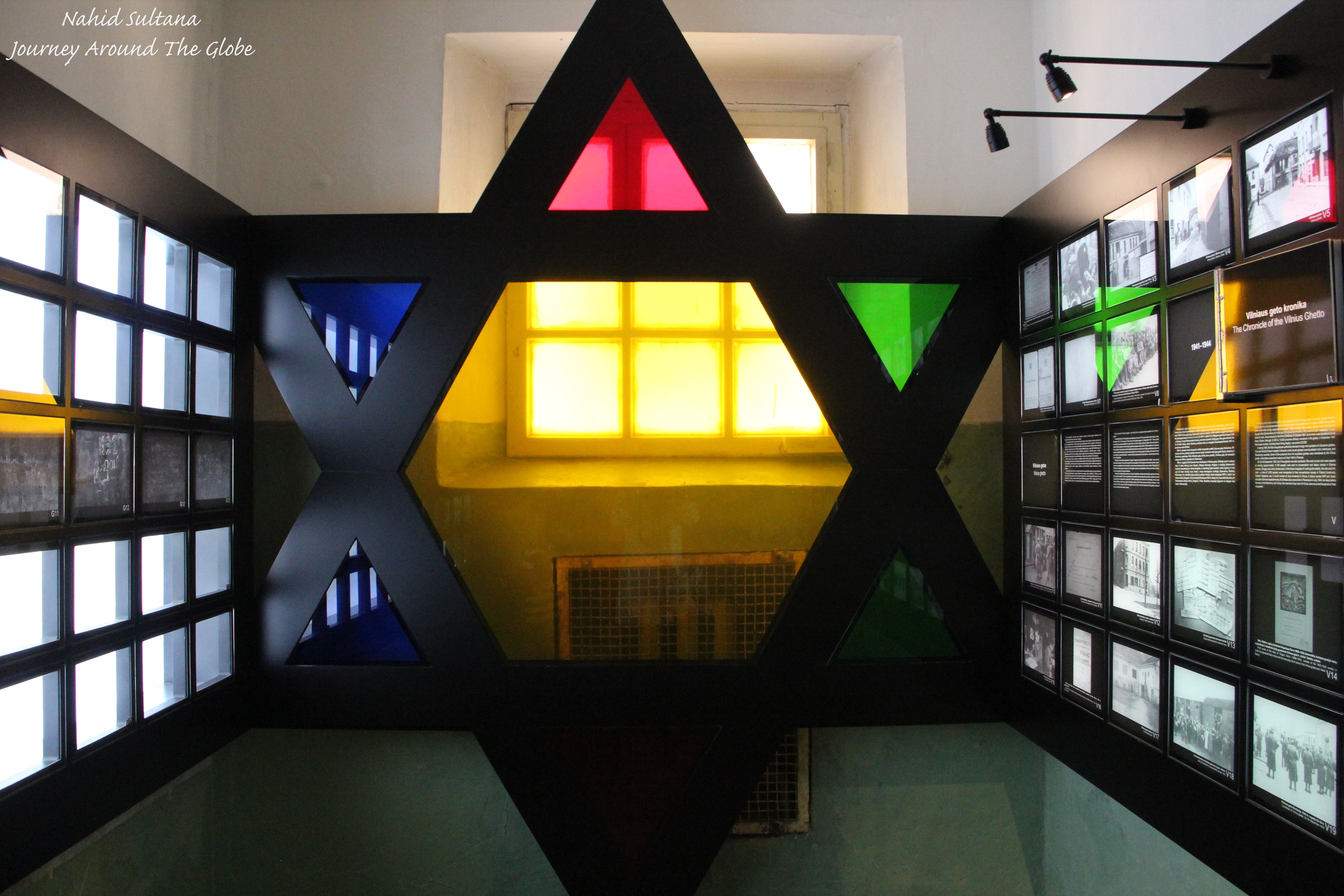
The museum is housed in a 19th century neo-Classical mansion previously used as a court building. The main façade with a front entrance faces Gediminas Avenue. Throughout the Soviet era (1940 to 1941 and 1945 to 1991) the building was occupied by the Soviet repressive institutions such as the NKVD-NKGB-MGB-KGB while during the period 1941 to 1944, the Nazi Gestapo reigned in the building. Out of this building came the evil thoughts for the extermination of residents and persecution of many people. The bottom bricks on the exterior of this museum have the names of those who were believed to be executed inside this building.
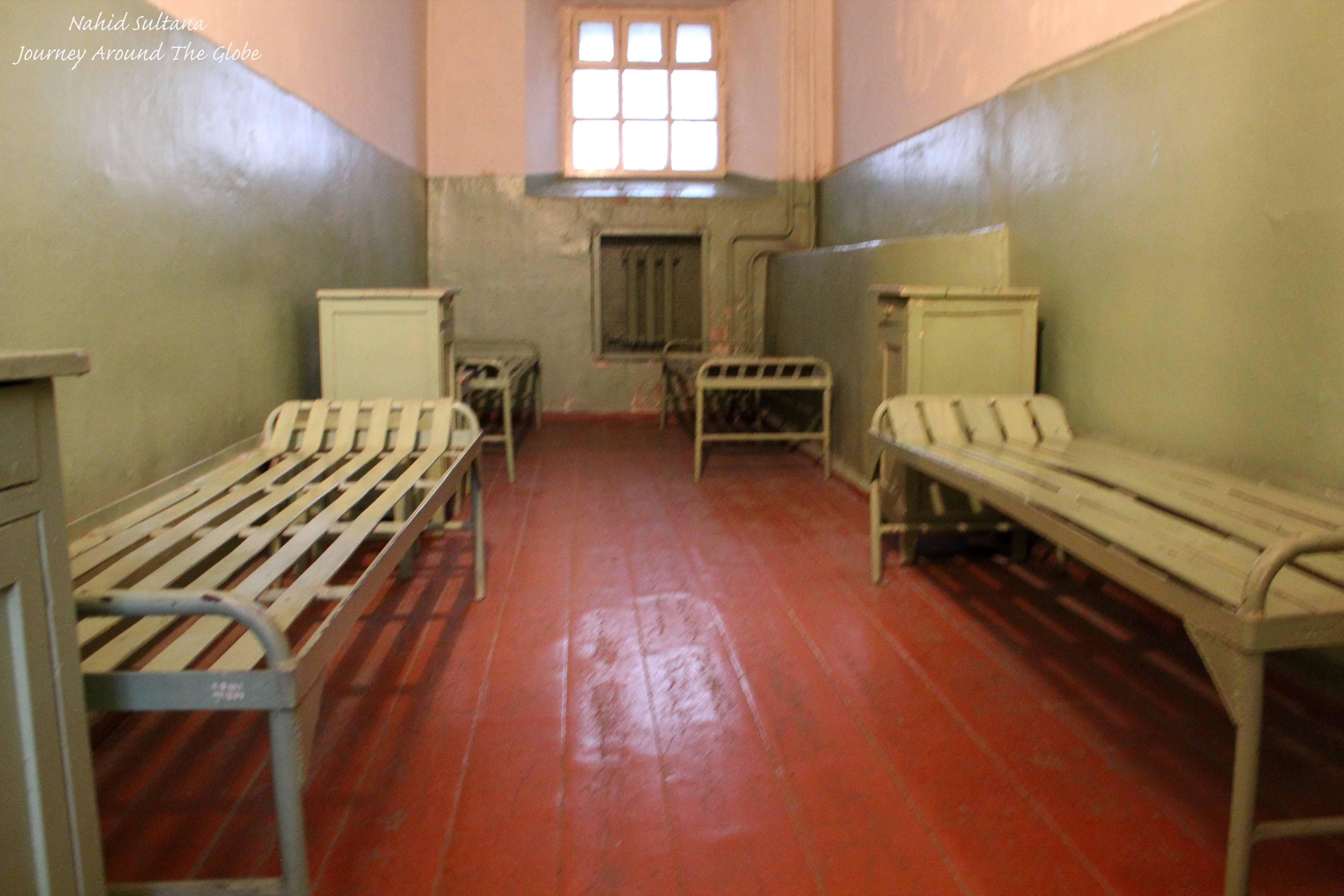
The basement of the building served as a prison for the Nazis while the Soviets used it as a prison with an execution chamber inside. From autumn 1942, the building houses the Special Squad of the German Security Police and SD which carried out mass massacres in the forest of Paneriai (just outside of Vilnius) of Jews, communists, Soviet activists and members of the resistance movement. The stones outside the building bear the names of the freedom fighters killed from 1944 to 1947. Other than the museum, the building also houses Genocide and Resistance Research Centre of Lithuania and the Lithuanian Special Archives where the former KGB archive documents are stored.
- A prisoner’s cell in the basement of KGB Museum in Vilnius, Lithuania
The main part of the exposition is on the top floor which houses material about anti-Soviet and anti-Nazi resistance and information about the participants in the fights for freedom and genocide victims. Here, visitors can see furniture from the 40s, things used by NKGB-MGB officers, the inventory of the desk, and the interiors details are shown here, with materials from the period 1939 to 1941. Also the pictures and stories of civilians who were deported from their homelands to the remotest areas of Soviet Union are in display here. The documentary materials displayed acquaints visitors with the procedures of organizing and carrying out deportations, the legal status and living conditions of the deportees, and statistical documents about the deportations. Documentary and feature films, and photographs of burial grounds in Siberia, supplement the factual information, and show the fate and misery of the people who suffered humiliation and injustice.
It is situated in the very heart of Vilnius about less than a mile from Cathedral Square, took us about 20 minutes to walk there. The museum is open Wednesday to Saturday from 10 – 6, Sunday from 10 – 5, and closed on Mondays and Tuesdays. Ticket is 6 LTL per person, 8 LTL if you want to include an audio guide, and 5 LTL for camera pass.
3) GEDIMINAS CASTLE and TOWER: Also known as Upper Castle, this castle is considered as a symbol of Vilnius. The castle and its tower are located on the 48-meter high hill and were named after the city’s founder Gediminas, the Grand Duke of Lithuania. Built at the beginning of the 14th century, and replacing an earlier wooden one, it withstood the attacks of the Crusaders. At the beginning of the 15th century, it was rebuilt strengthened, and along with the Lower Castle, composed a powerful defensive complex. After damage caused by the war with Moscow in 1655, the castle lost its importance and was not rebuilt. After WWII, the best surviving tower in the upper castle, Gediminas Tower, was restored and now houses a museum and an observation platform that offers visitors an impressive panoramic view.

- Vilnius after dark, a stunning view from Gediminas Castle
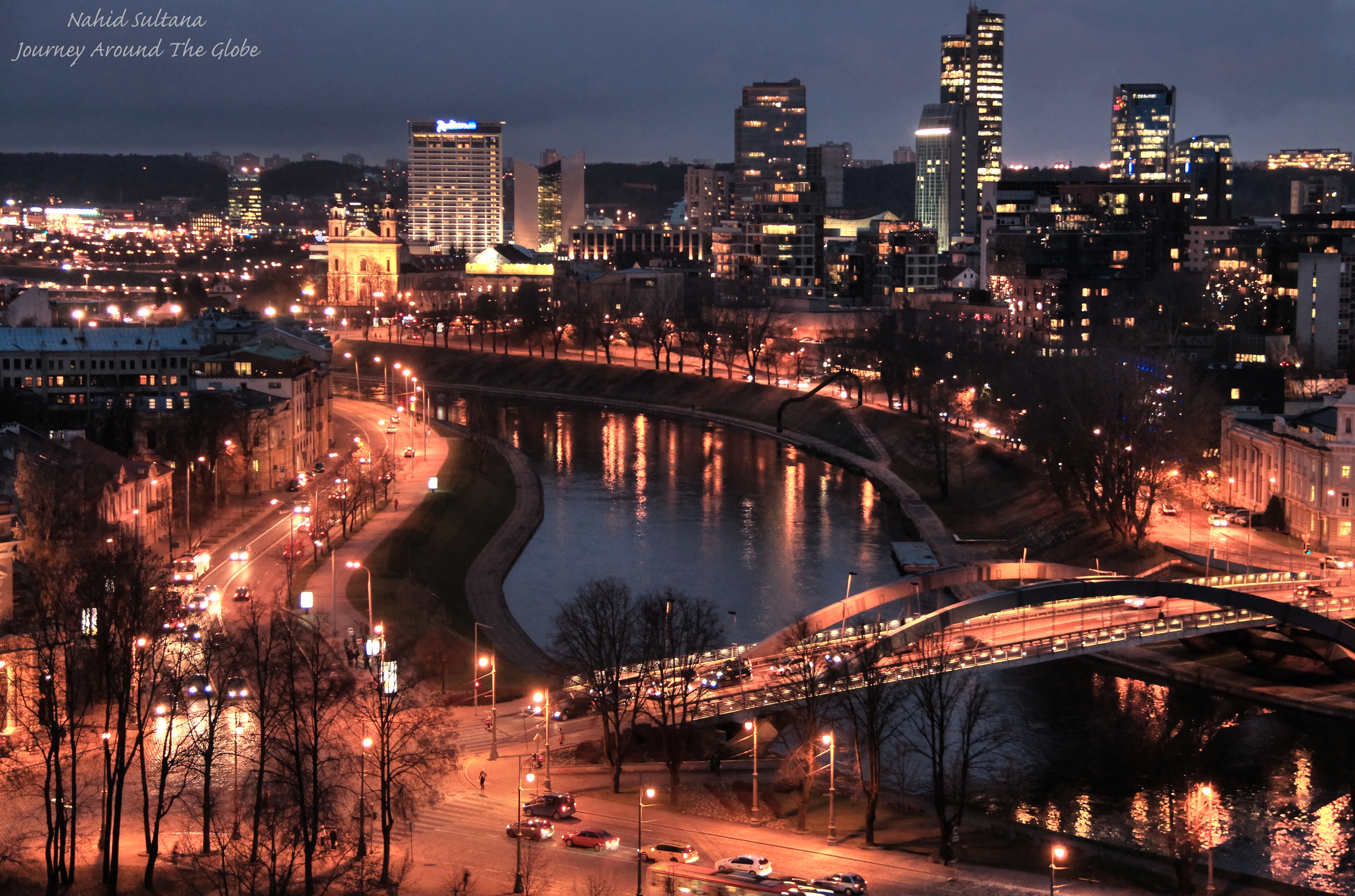
Gediminas Castle offers best view of Vilnius. We went there after dark and enjoyed stunning views of old town and new town. Also River Neris and bridges on it look fantastic from here. We didn’t go inside the museum or tower as it was closed by then.

- Gediminas Tower in Upper Castle in Vilnius, Lithuania
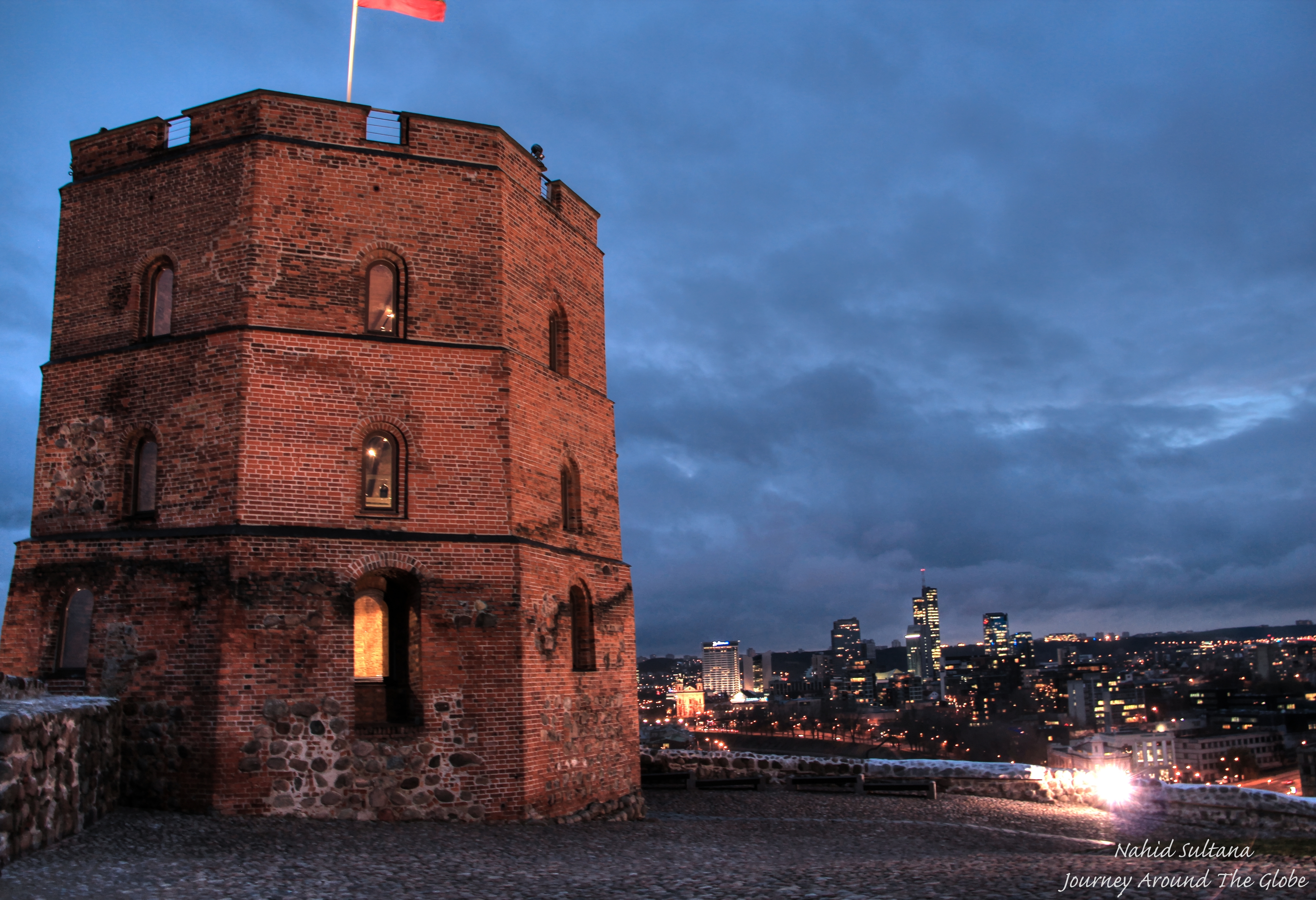
Funicular to the castle is open in May – September from 10 to7 daily and October – April from 10 to 5 daily. You can also walk up the castle from either Cathedral Square or by the river Vilnia. Ticket price is 3 LTL for round trip and 2 LTL for one way ticket. The castle hill opens at 7am and is visitors can stay there until 9pm.
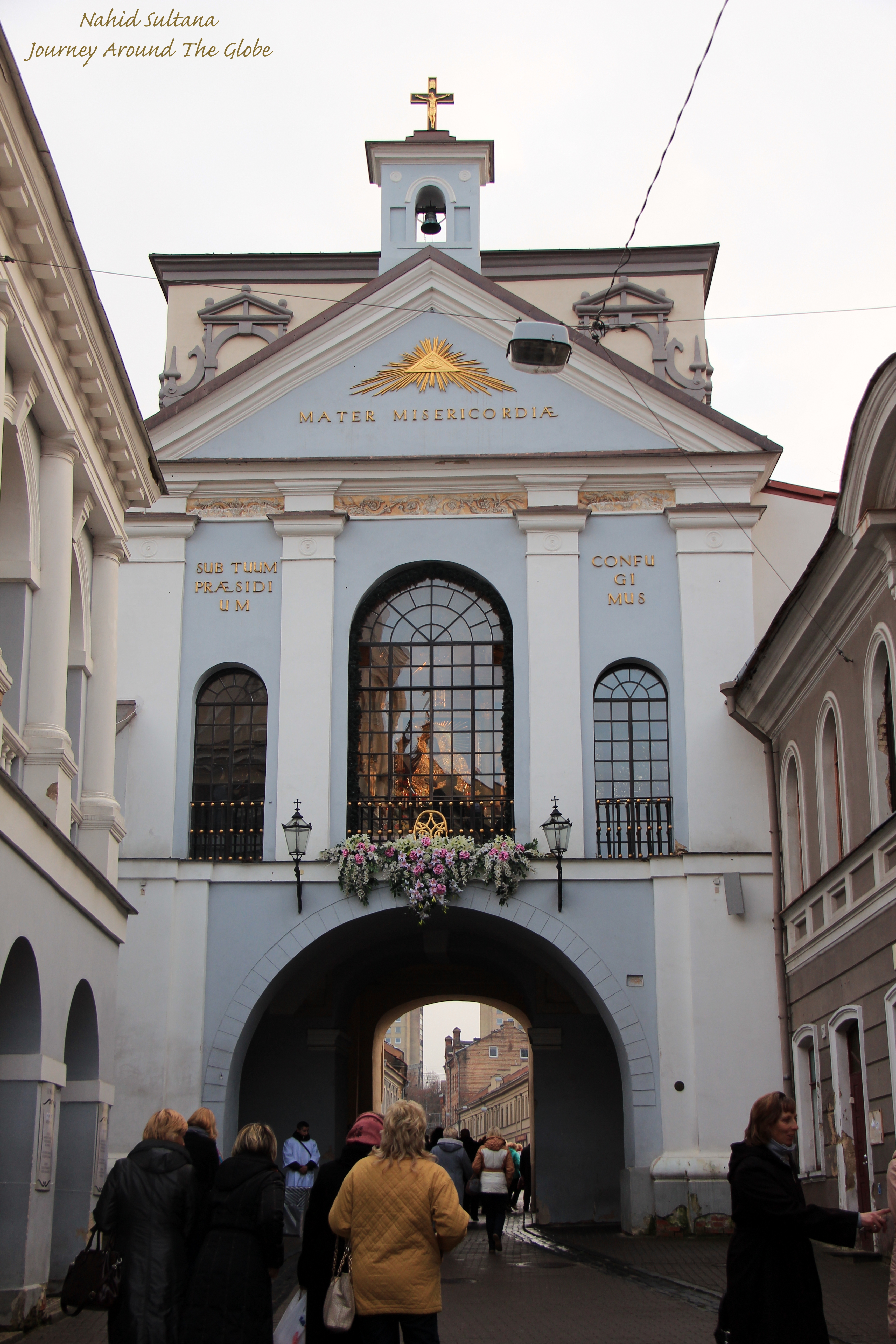
4) THE GATE of DAWN: The Gates of Dawn, the only one of ten original defense wall gates remaining, was built in 1514. After the reconstruction of 1829 the Chapel acquired the features of late Classicism. The Chapel in the Gates of Dawn houses a gold image of The Blessed Virgin Mary, Mother of Mercy, which was placed above the gate to protect the city. The chapel is very small but beautiful, it can get crowded since many worshippers go there to for prayers. Free to enter and is located very close to city’s town hall.
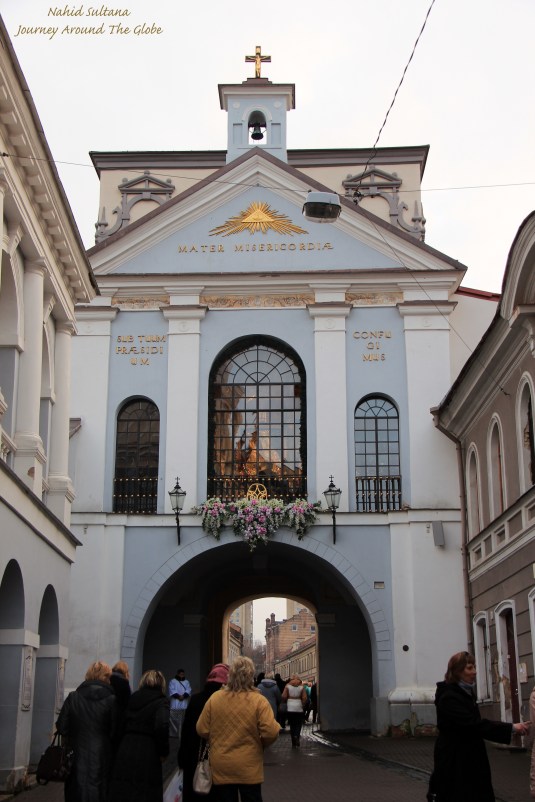
- The Gate of Dawn in Vilnius, Lithuania
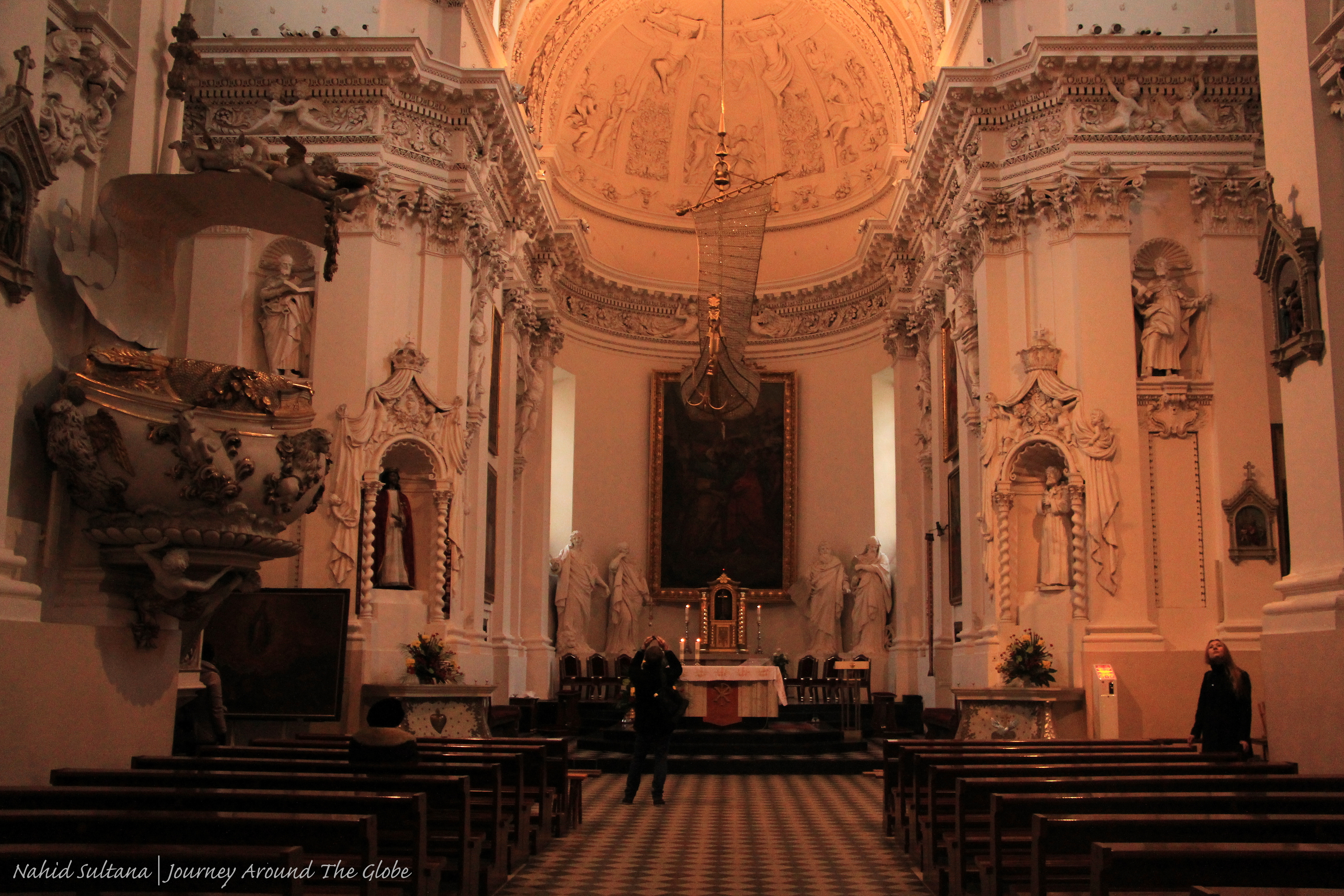
5) CHURCH of ST. PETER and PAUL: This is considered as the pearl of Lithuanian Baroque and the most splendid example of the style. Exterior of this church was built around 1668 – 1674, and the interior took another 30 years. The interior of the church is famous for its exceptional baroque sculpture works where one can see about 2,000 stucco moldings representing miscellaneous religious and mythological scenes. The founder of the church Grand hetman M. K. Pacas was an Italian noble man who settled in Lithuania and wanted to build his own church. The coat of arms of the Pacas family can be seen above the entrance. Two Italian architects created a harmonious synthesis of architecture, sculpture, and art: about 2000 figures are arranged according to the principle of the world as a theater. Behind the altar is a picture of Saints Peter and Paul by the famous artists P. Smuglevicius. Many war memorial/depiction can be seen since it was built after a war. Look up to the elegantly decorated and detailed carved dome and some 17th century frescoes on the walls. Painting in the altar depicts Peter and Paul saying goodbye to each other with 4 evangelists: Luke, Mathew, Mark, and John.

- Inside Church of St. Peter and Paul in Vilnius, Lithuania…a masterpiece of Lithuanian Baroque
6) HILL of THREE CROSSES: 165 meters above sea level, this hill is one of the symbols of the importance of Christianity in Lithuania and Lithuania’s mourning and hope. Three white crosses were erected to commemorate 7 Polish Franciscan monks, who, according to a legend, came as missionaries and were tortured and martyred by pagans on this site and were thrown in River Vilnia. The first wooden crosses of Holy Trinity were built in 1613, and later renovated, but removed by the Russian administration after the revolt of 1863. A concrete monument was built in 1916. The Soviet authorities destroyed the crosses with explosives in 1950, but after it was rebuilt in 1988 they have been standing in their original place, imprinted in the silhouette of Vilnius as symbols of Christianity of Lithuania.

- Hill of Three Crosses in Vilnius, Lithuania
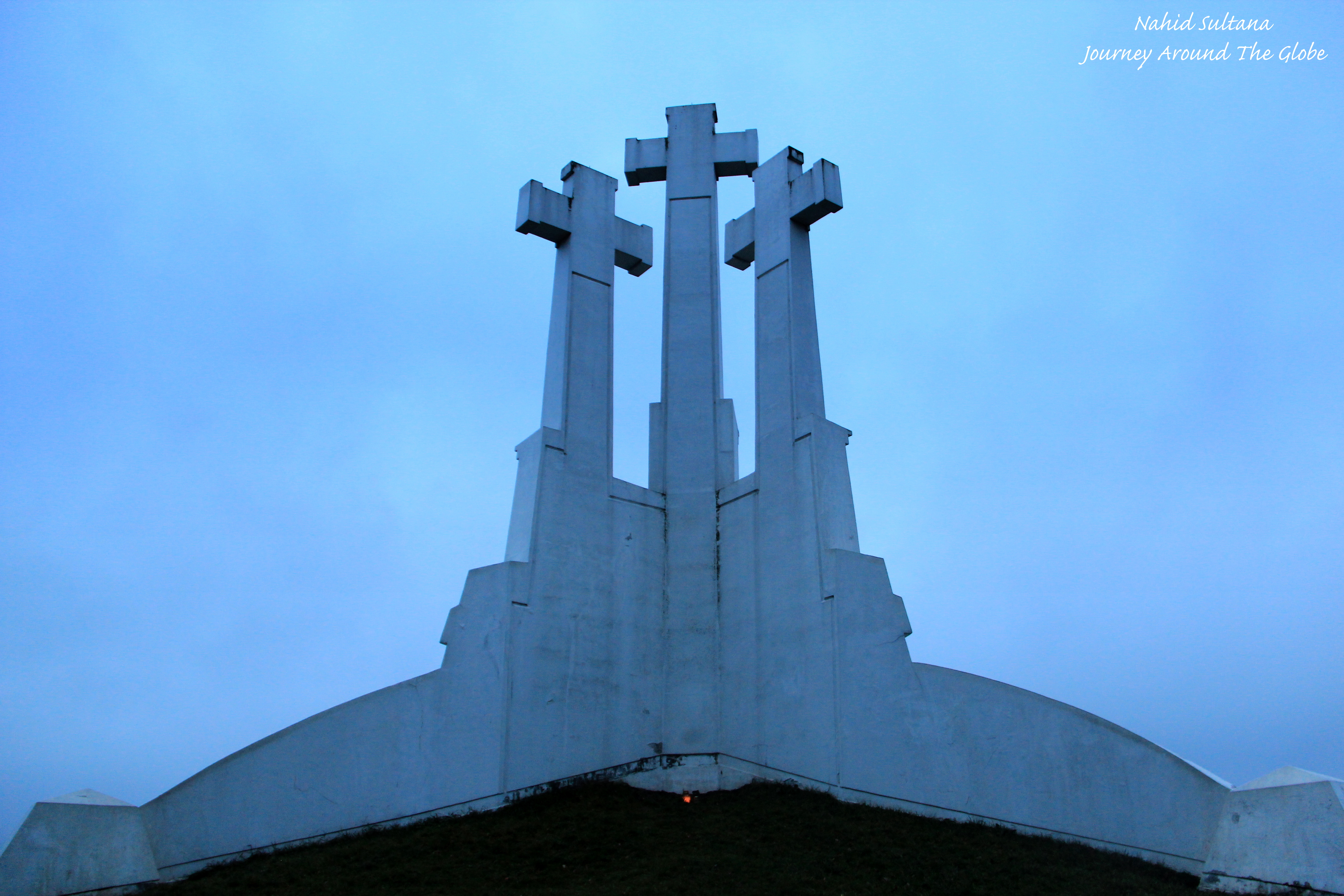
An excellent view of old town is also to be found at this spot. You can also see Gediminas Castle along with a beautiful panoramic view of the old town from up here. The entrance is free.
7) PRESIDENTIAL PALACE: This is the official residence of the President of Lithuania. This building is in the central part of the former Governor’s Palace. The first palace here was built in the 15th century and was used as the Vilnius bishops’ residence until the last division of the Polish-Lithuanian state in 1795. In the 19th century it was visited by many distinguished personalities, such as Napoleon Bonaparte and M. Kutuzov. Now it’s an Empire style building having impressive and decorated colonnades on the both sides of the palace. Although we didn’t go inside since it was already end of the day, the interiors are supposed to be very beautiful. The president’s office is the on the right side of the palace.
8) VILNIUS UNIVERSITY: The University was established in 1579 representing different architectural styles: Gothic, Renaissance, Baroque, and Classicism. It consists of 13 enclosed courtyards. St. Johns Church (14th – 18th century) and the highest viewing point of the old town – 68 meters high campanile. This is one of the oldest and biggest universities in Easter Europe. The university has the oldest library of the country. Visitors have to pay 5 LTL to go to the front courtyard.
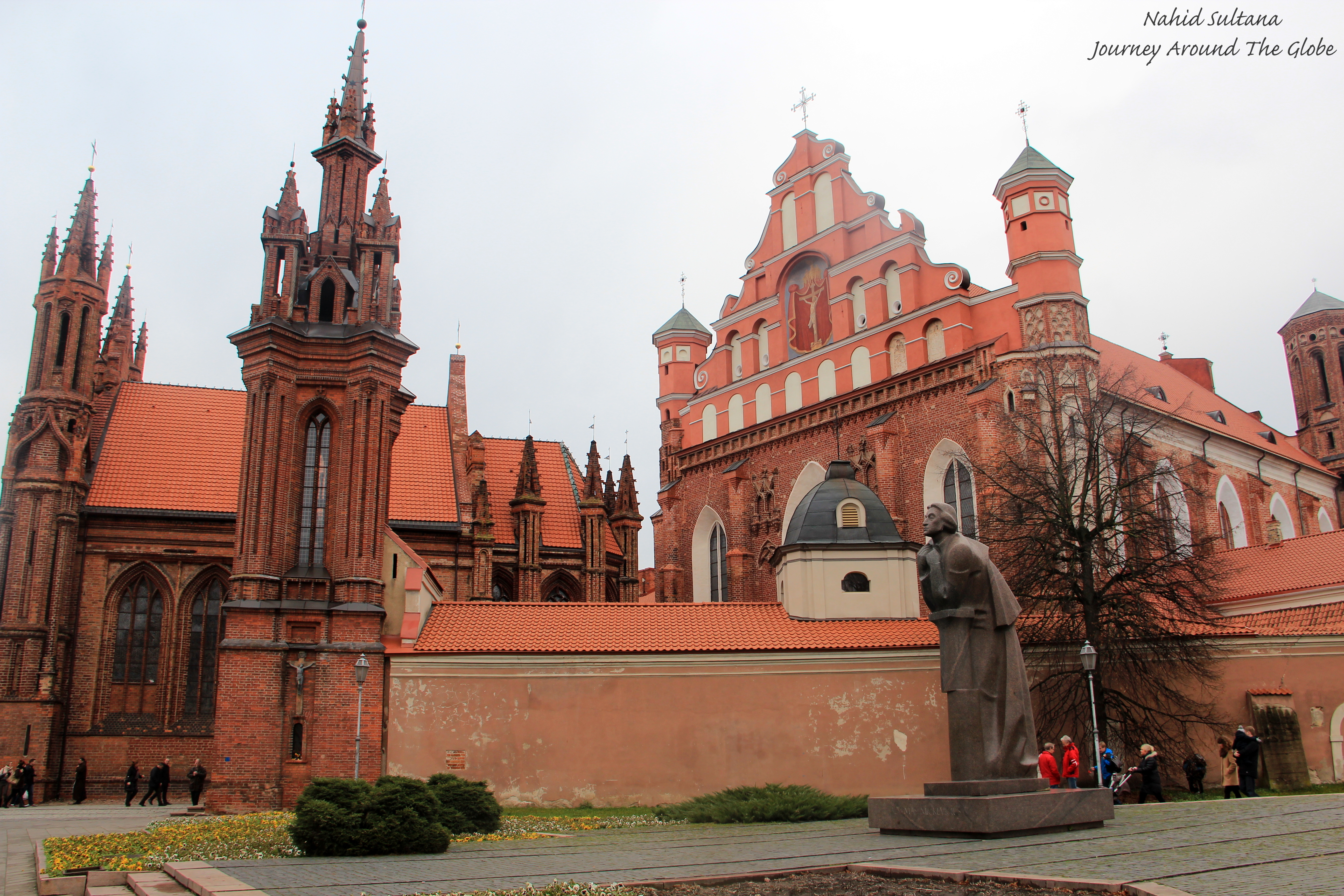
9) ST. ANNE’S CHURCH: This church was built at the turn of the 15th-16th century and is the most fascinating and prominent late Gothic building in Lithuania. This is one of the oldest churches in Vilnius. It was built from 33 types of simple clay bricks. It is a small church but so beautiful that Napoleon wanted to take it on his palm and bring it to Paris. There is a statue of a famous Polish poet (Adam Mickiewicz) beside the church who was a student and then teacher at Vilnius University. There is no entrance fee and it’s located before entering Uzupis District.

- St. Anne’s Church and Bernardine Church near Uzupis District in Vilnius, Lithuania
10) AMBER MUSEUMS and GALLERY: The museum and gallery were established in a Baroque style house of the 17th century. The cellar keeps a valuable archeological finding: well-preserved kilns dating back of the end of the 15th-16th century. Museum houses exhibition about history of amber origin, differences in form, size, and color.
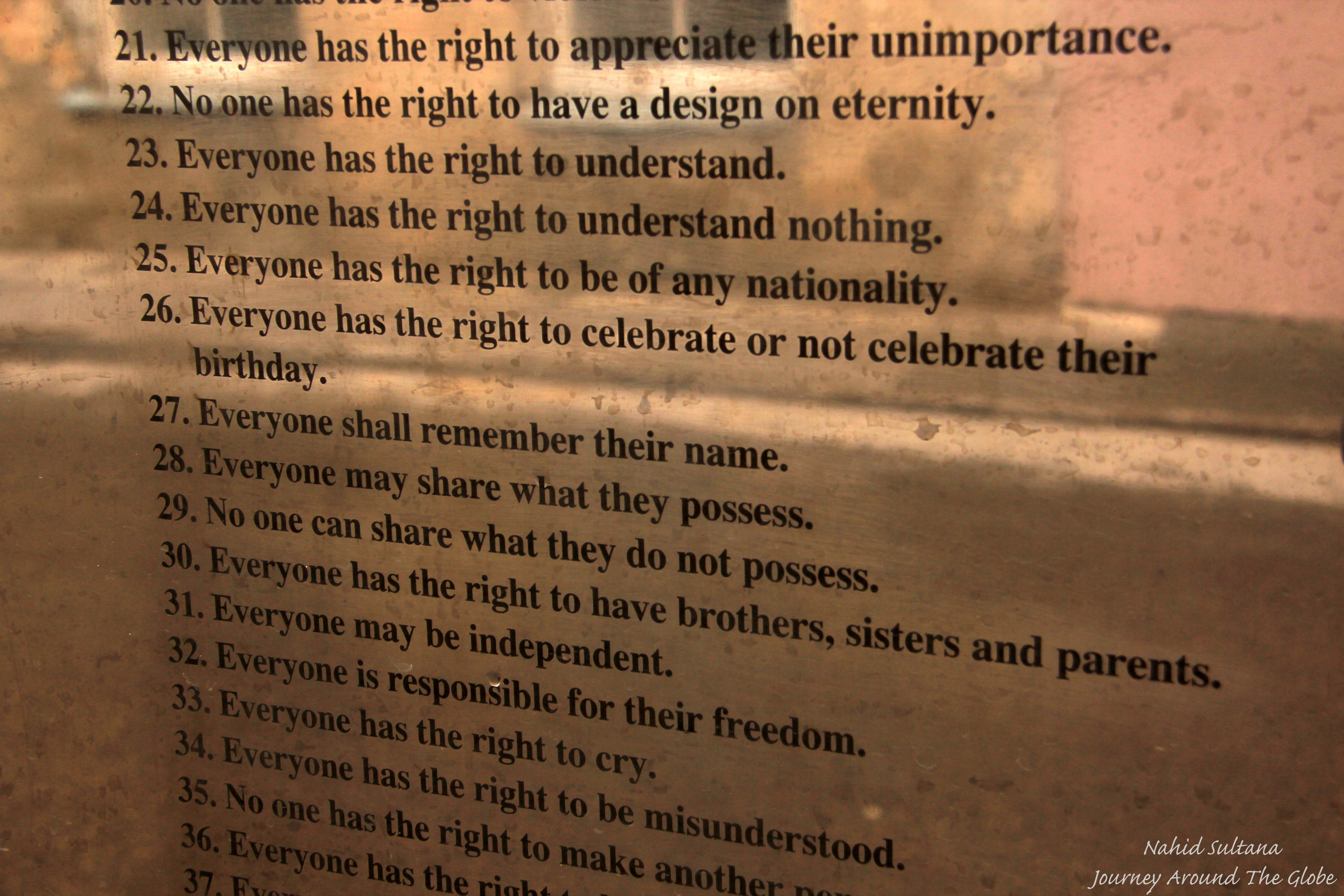
11) UZUPIS DISTRICT or UZUPIS REPUBLIC: Uzupis is a unique state within a state by River Vilnia in the old town – it has its own president, anthem, constitution, flag, and guardian – the bronze Uzupis Angel (look for the big statue of an angel standing over an egg and blowing trumpet). The constitution of the Republic of Uzupis is available in many languages for public viewing at the beginning of Paupio Street. We’ve heard that on the April Fools’ Day mock border polices actually stamp tourists’ passports for fun.
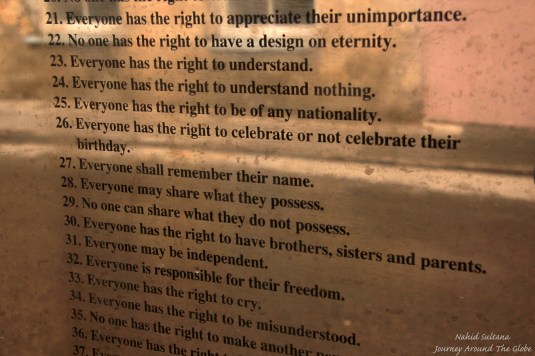
- A small portion of Uzupis District’s constitution in Vilnius, Lithuania
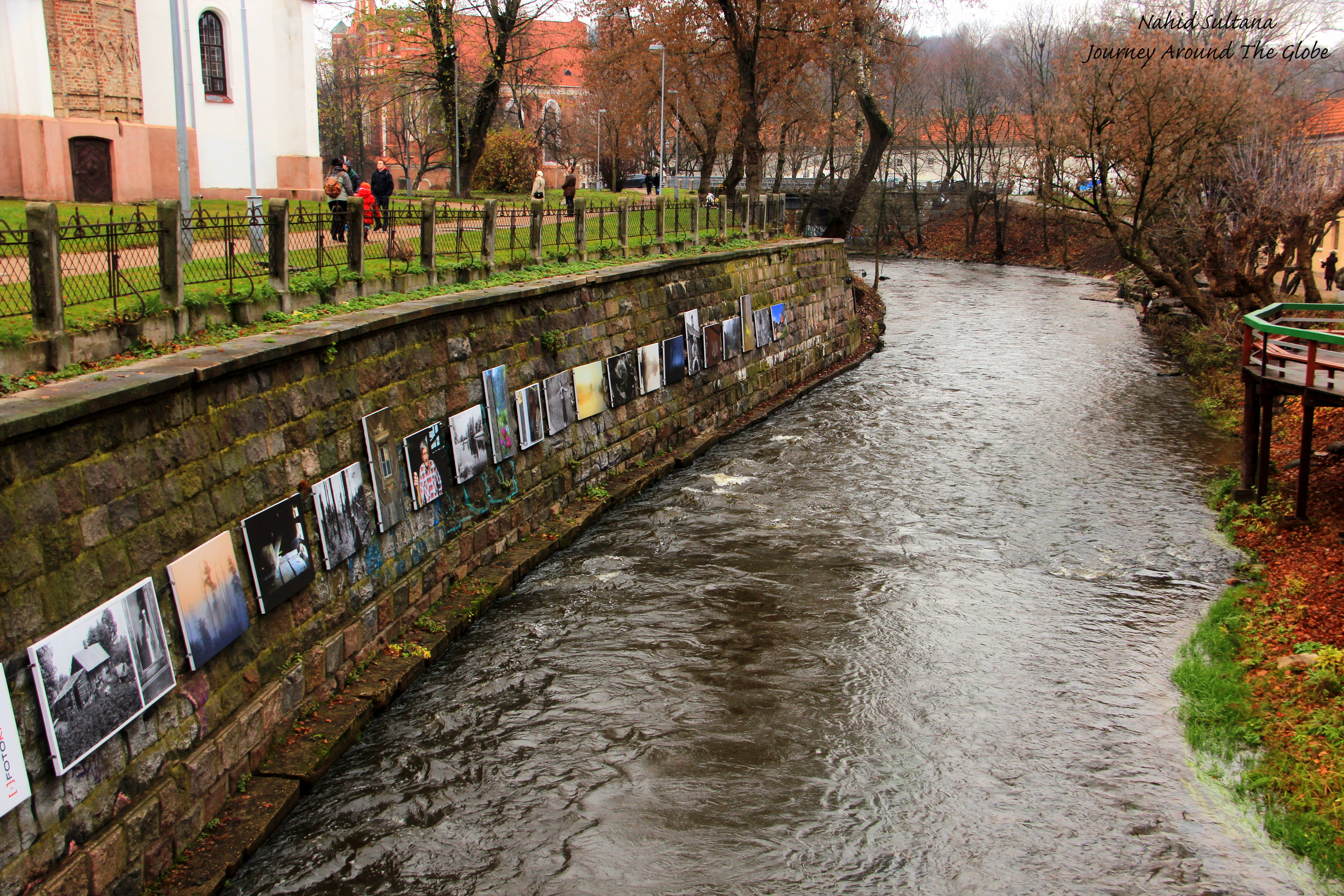
Historically this place used to be occupied by artists, painters, and…poors. Now city’s mayor lives in Uzupis District and many other rich families. This is a hub for many art galleries. Walk by the river to see some sculptures and creative art works on the street. Overall, this is a very nice place.

- Uzupis District in Vilnius, Lithuania…beautiful located by River Vilnia
12) ST. FRANCIS OF ASSISI CHURCH (BERNARDINE CHURCH): This Roman Catholic Church was built at the end of the 15th century and is one of the largest sacred Gothic buildings in the country. The church is said to have the oldest crucifix in the country from the 15th century. Brick exterior and wooden interior of this church is small but worth visiting.
There was a service going on when we went there, could only peeked from outside the glass door. Bernardine Church is located right behind St. Anne. Church is open from until 7pm every day and there free to enter.
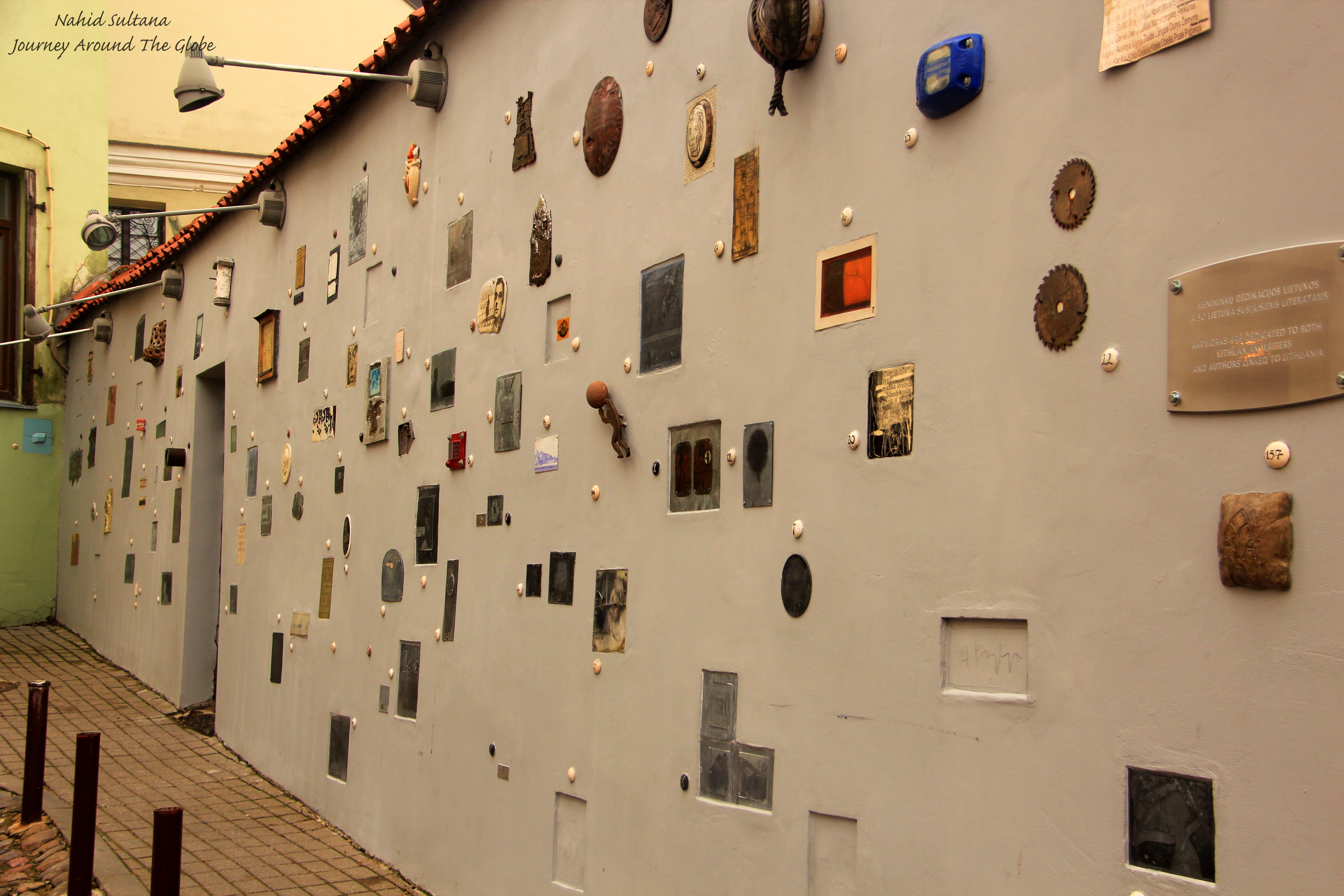
13) LITERATU STREET: It is thought that this street was named “Literatu” only at the second half of 19th century in the honor of the poet Adam Mickiewicz who lived here. This is a small stretch of street with many artistic objects mounted on the wall mainly created between 2010 and 2012. This wall was solemnly opened in the street where painters and other field artists created outdoor proof techniques like plates or small objects made of ceramics, sculptures, metal, wood, glass, etc, in the color of litterateurs.

- A wall in Literatu Street in Vilnius, Lithuania, decorated with many artworks
14) RUSSIAN ORTHODOX CHURCH of ST. NICHOLAS: In 1514 a Gothic church with elements of the Byzantine style was erected on top of another old church that was burnt down previously. During it reconstruction after the fire of 1748, its architecture was changed: the pediment, the facades, and the heightened tower became Baroque. In the 19th century the church acquired its present Byzantine appearance. The chapel inside contains a mosaic of St. Michael the Archangel, created at the Art Academy in St. Petersburg. Despite the reconstructions, the building has preserved many authentic Gothic elements and some valuable pieces of Byzantine art.
It’s located very close to Town Hall. Inside and outside of this church are both beautiful. It’s small but has a gorgeous altar inside and many golden crosses outside on its domes.
15) ST. CASIMIR (JESUIT) CHURCH: St. Casimir is the patron saint of Lithuania. This is the first and one of the finest Baroque churches in Vilnius built by the Jesuits. The cornerstone, dragged by some 700 people, was laid in 1604. The building suffered a great deal from wars and fires. In the 18th century, the collapsed dome was replaced by a new one with a crown, and the interior was decorated with 13 Late Baroque altars, most of which were destroyed by Napoleon’s army. In 1868 it was adapted for the Russian Orthodox Church: the towers were lowered and topped with onion-shaped helmets, and the Baroque frescoes and sculptures were demolished. After WWII the church was turned into the Museum of Atheism and in 1991 returned to the Jesuits.

- St. Casimir Church in Vilnius
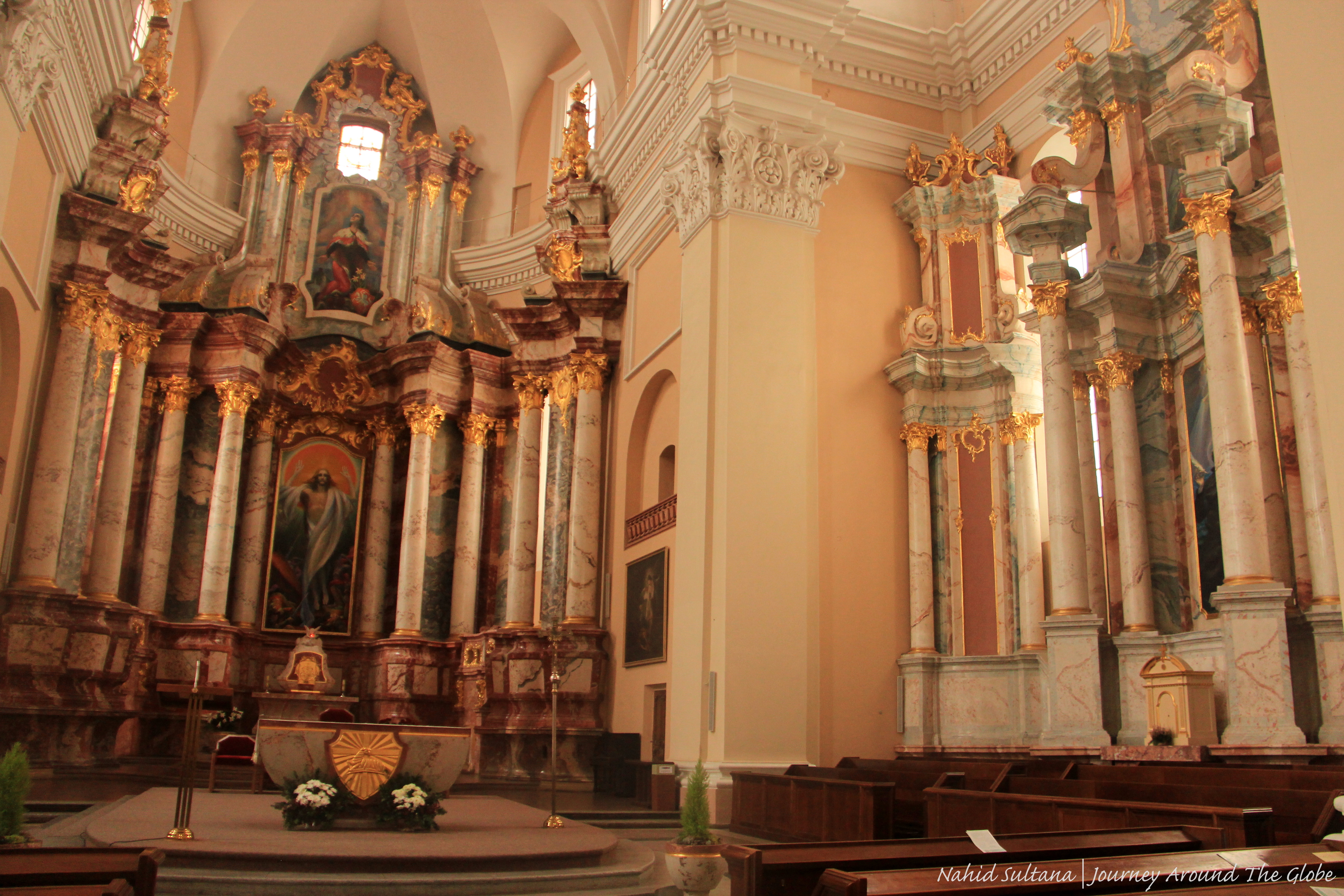
The majestic cupola of 40 meters rises where the central nave and transept meet. 17 meters in diameter, it is topped on the outside by the crown of the grand duke of Lithuania. It’s elegantly decorated red and white altar with marble columns and high dome make it a really beautiful church to visit.
The church is open on weekdays from 4:30-6:30 and on Sundays from 8:30 to 2pm. It is free to enter and located near Town Hall.
16) VILNIUS JEWISH GHETTO: Here is a brief history on the two ghettos of Vilnius, collected from the information board:
“The Vilnius Ghetto was established on 6 September 1941 on the initiative of Vilnius City Commissioner Hans Hingst. Up to the end of October 1941, there were two ghettos in Vilnius – Large (about 30,000 prisoners) and Small (9000 – 11000 prisoners). Most of the Jews imprisoned in the Large Ghetto were qualified specialists and skilled workers, while the Small Ghetto was the ghetto of the incapacitated (the elderly, frail, and sick). By the end of 1941, German and Lithuanian police units and SD special squad had killed about 30,000 Vilnius Jews in Paneriai Forest, located outside the city. During the mass killing actions, all the residents of the Small Ghetto were killed and this ghetto ceased to exist.
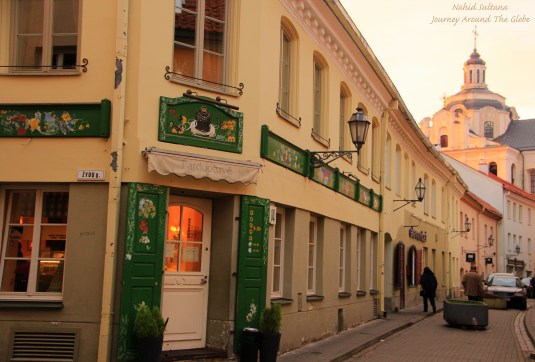
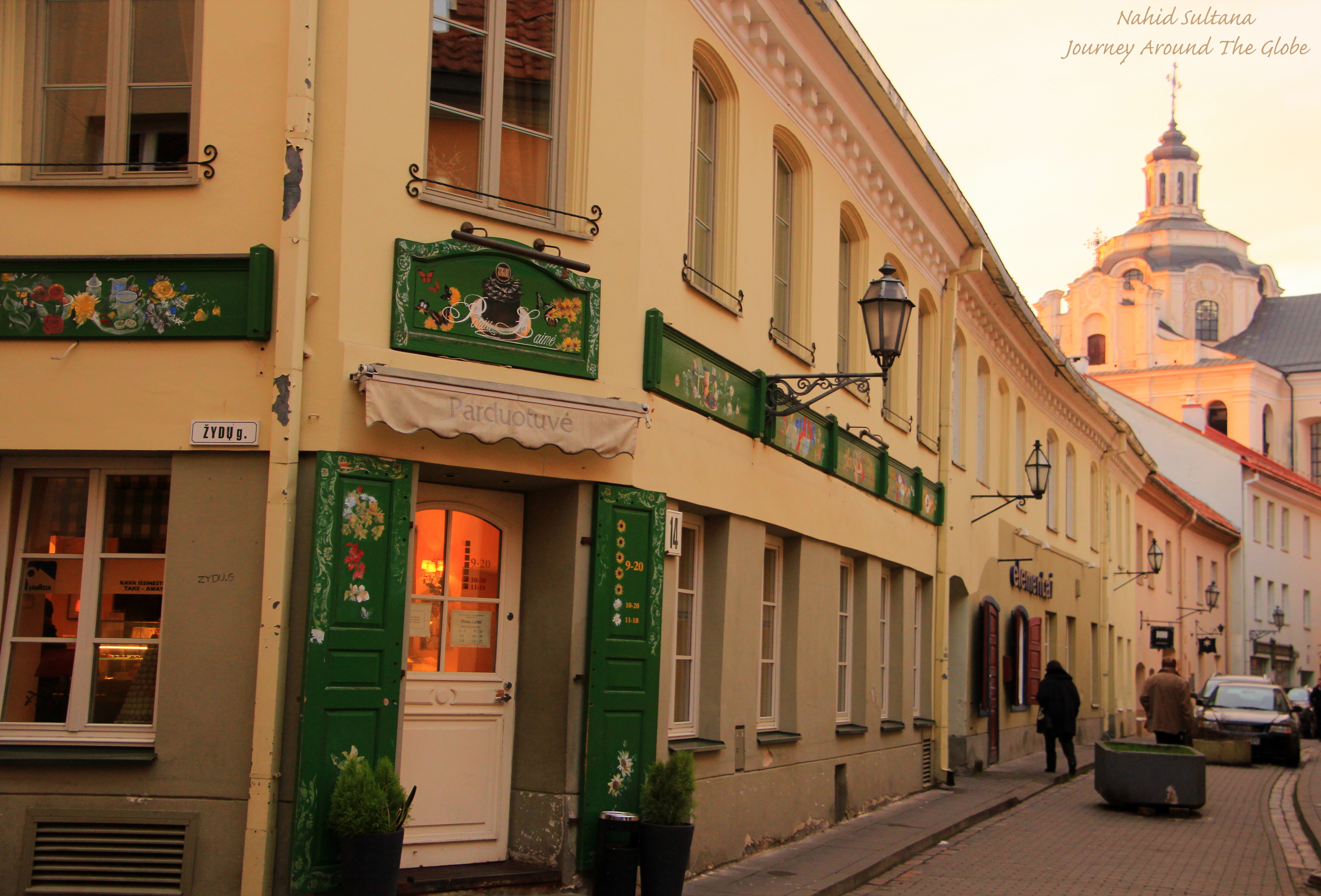
- Present look of what once used to be a Jewish Ghetto before WWII in Vilnius, Lithuania
During the period of December 1941 – March 1943 there were no mass killings of ghetto prisoners as the demand for labor force in the German war economy increased. During this period the ghetto became a kind of “state within a state”, with its own government, police, various workshops, forms of spiritual and cultural life and institutions…
On 23 – 24 September 1943, the occupational authorities liquidated the ghetto. About 14,000 Vilnius Ghetto prisoners were deported to labor and concentration camps in Estonia, Latvia, and other countries. Around 2000 – 3000 Jews still worked at various institutions in Vilnius, which were important to Germans. In early July 1944, with the Red Army approaching Vilnius, however, the last remaining Jews in Vilnius were killed. Only about 2000 – 3000 Vilnius Jews of 58,000 survived the Nazi occupation.”
We entered the former ghetto from Stikllu Gatve from the Town Hall Square. There is nothing much to do or see here except for going back in time and try to feel the situation of the victims here from 1941 1944. There are some beautifully designed buildings, high-class hotels, exquisite shops, and cafés here. The whole neighborhood is very calm and quiet.
Related articles
- Make a wish (fractionsoftheworld.wordpress.com)
Share this:

Magical Efteling in The Netherlands
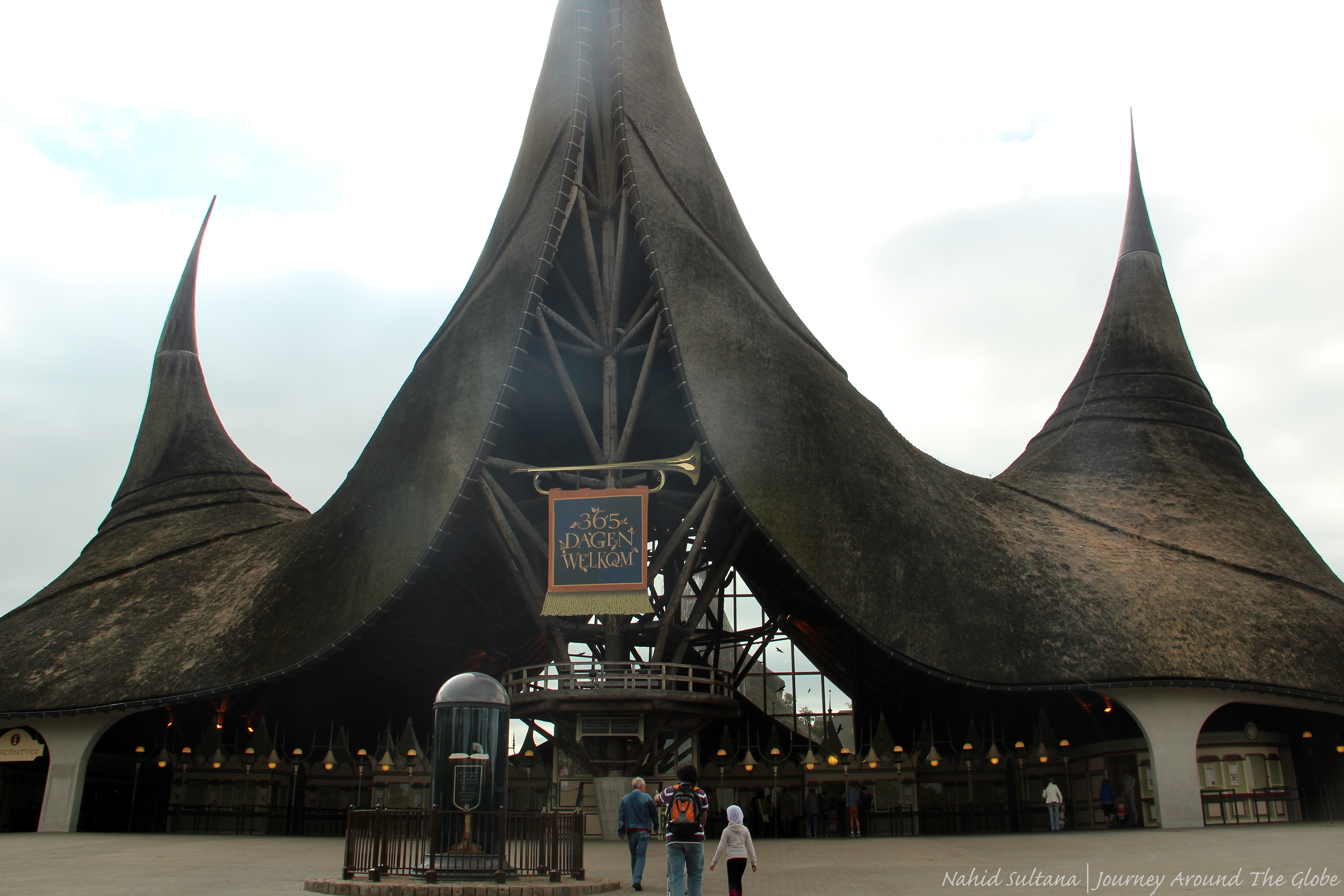
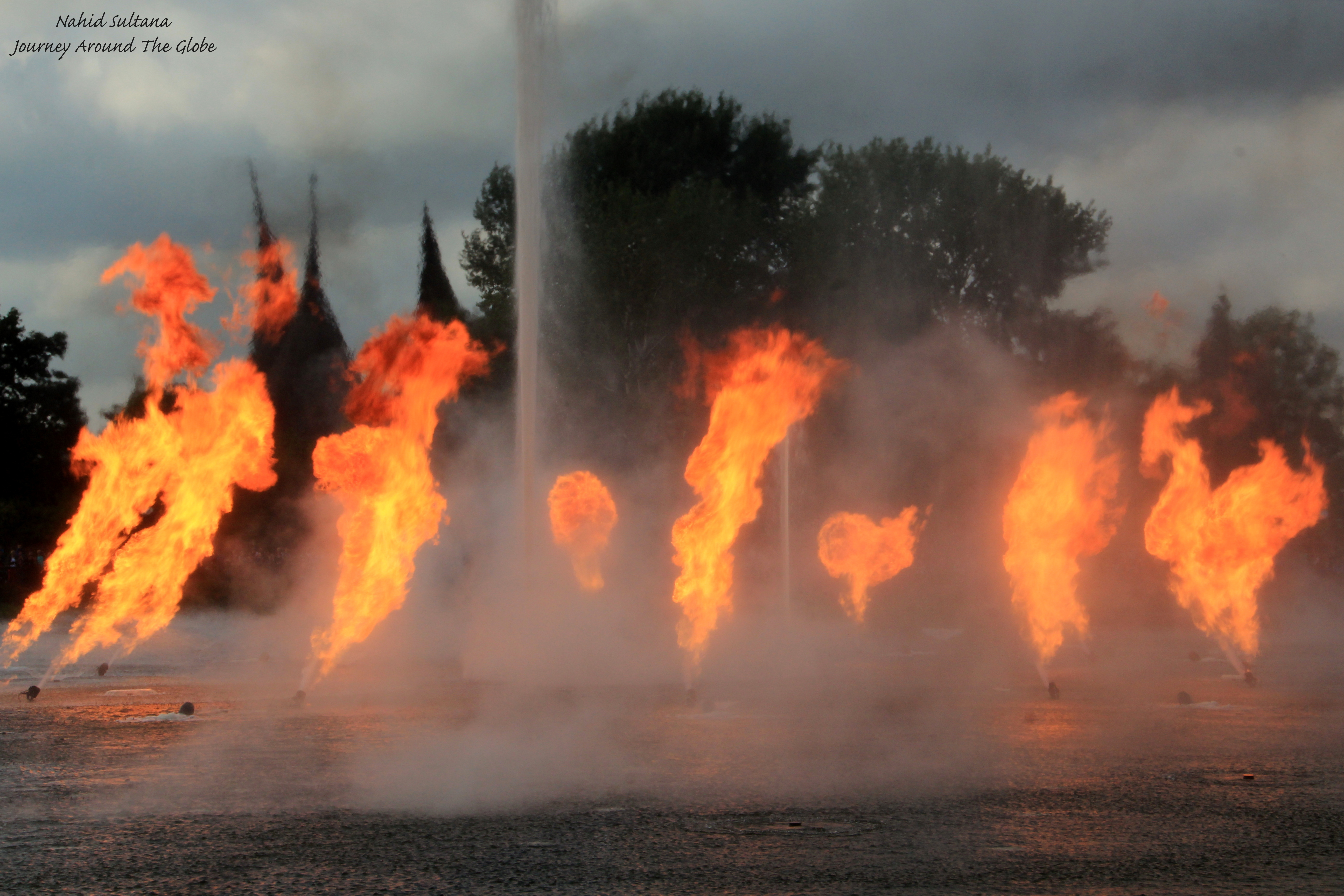
EFTELING, THE NETHERLANDS: Efteling is one of the oldest theme parks in the world and one of the biggest in Europe which is located in Kaatsheuvel in The Netherlands. The whole park is themed around legends, fairy-tales, magical stories, and folklores. We took our girls there in September of 2013 for some summer fun before their school started and spent a whole day there. You can find rides for different ages, scenes from many folklore stories like Hansel and Gretel, The Red Dancing Shoes, Cinderella, Rapunzel, Gnome houses, and many more. I have been to many theme parks in the USA but this one is really makes you feel like you are in a fairy-tale story book. The park dresses up differently in different seasons, winter is probably one of the best time to see its fabulous lighting and decorations. The day we went there was also a water, fire, lighting, and music show on its lake near the entrance right before the closing time…which was fabulous.
It was about little more than hour drive from Tervuren, Belgium. The ticket 40 euros per person plus the parking. But parking is not a problem here. There are couple hotels inside the park and of course many cafes, restaurants, and snack bars.
Enjoy these picture from our trip to Efteling. But if you have time and kids be sure to visit this place in The Netherlands and be mesmerize as soon as you enter Efteling’s world.

- The grand entrance to Efteling

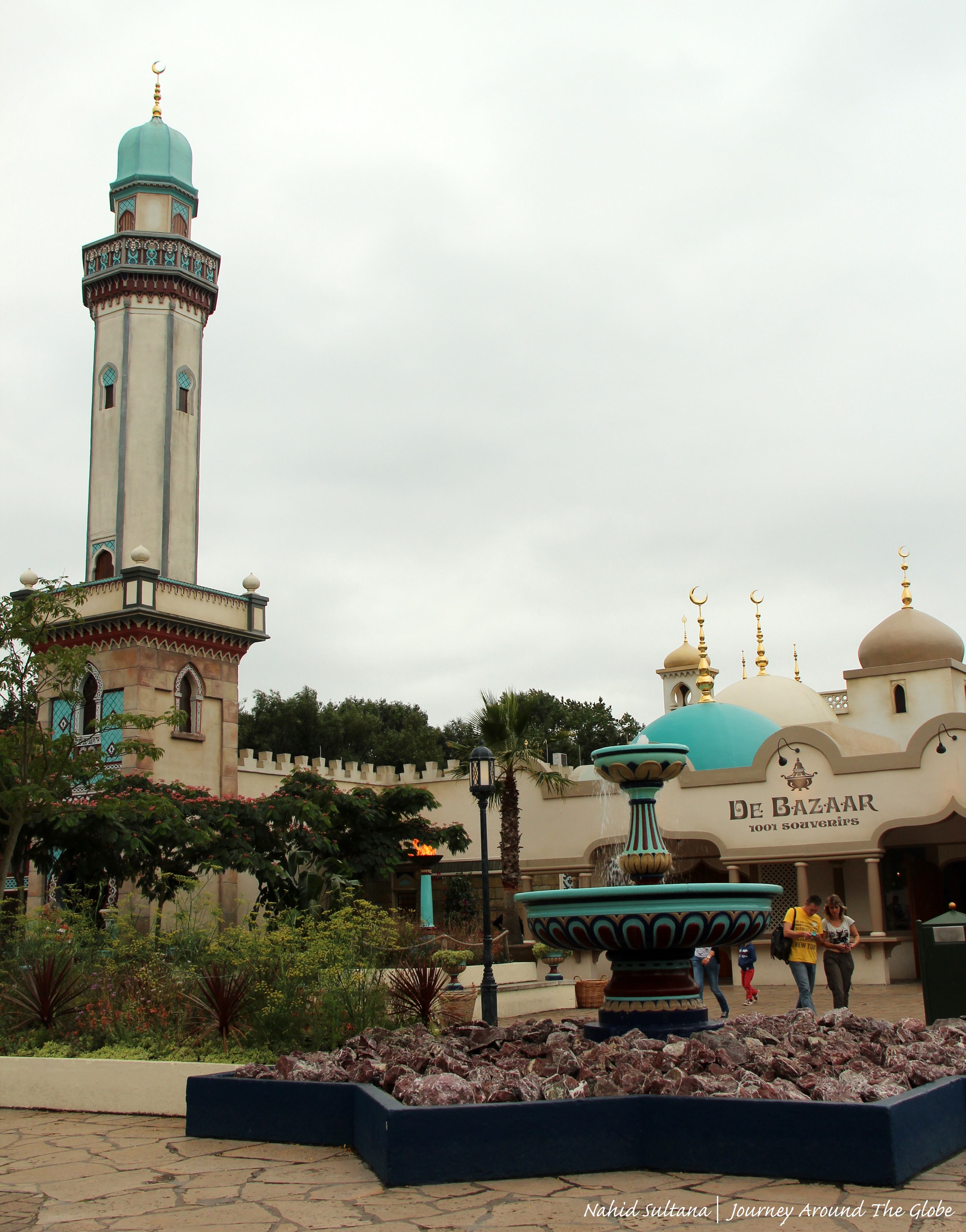
- “De Bazar” section of Efteling

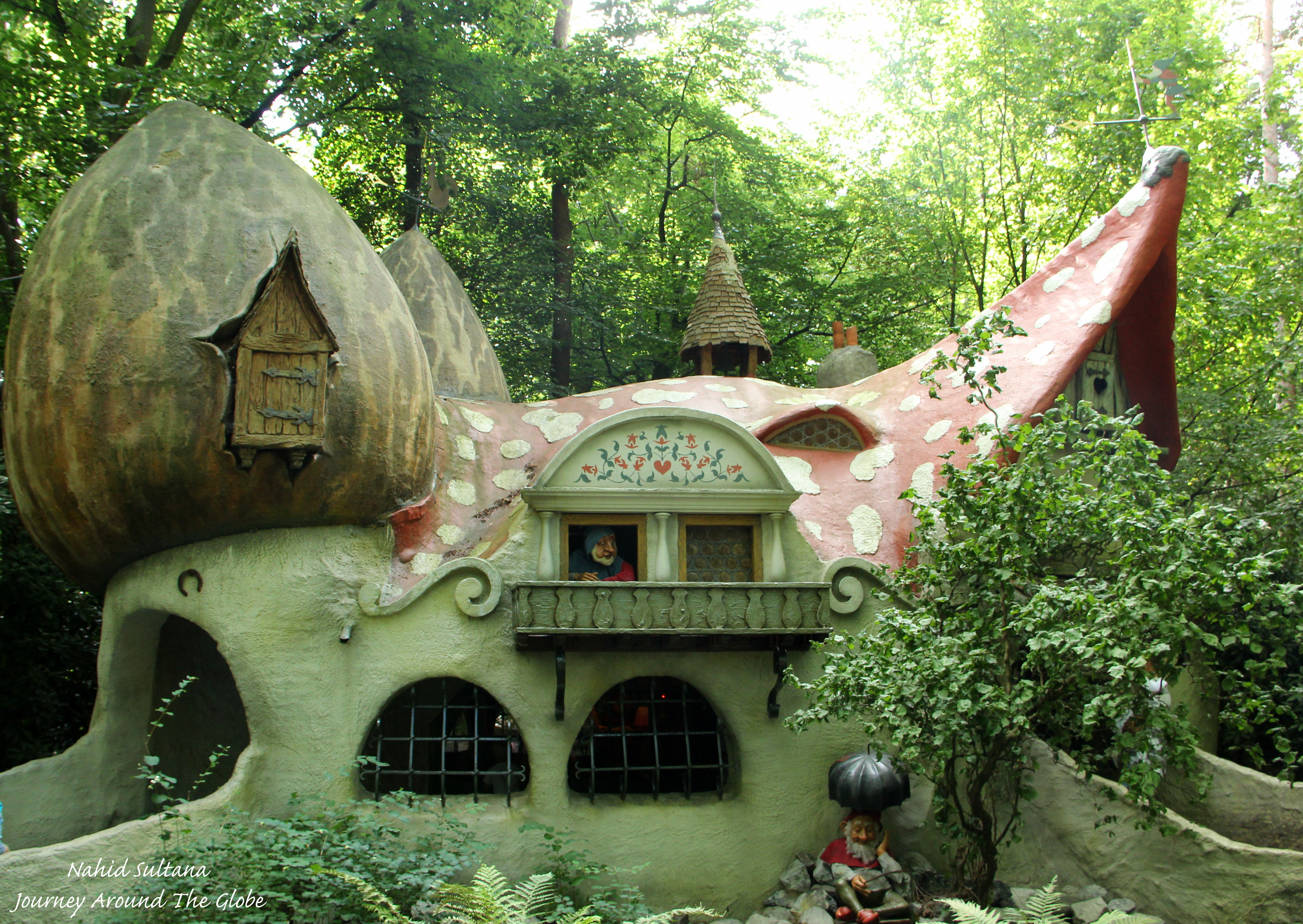
- A gnome’s house in Efteling

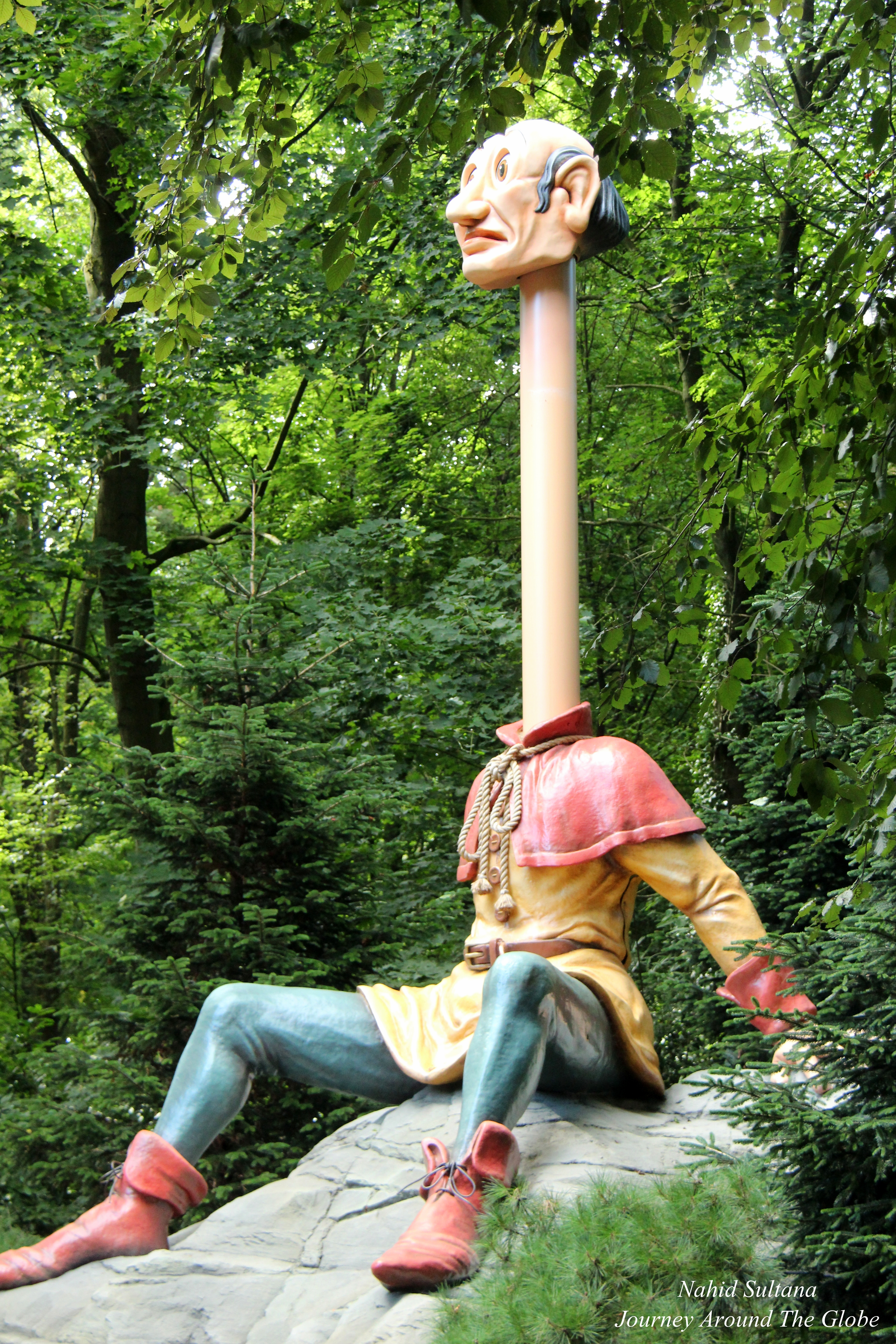
- “The Long Neck“
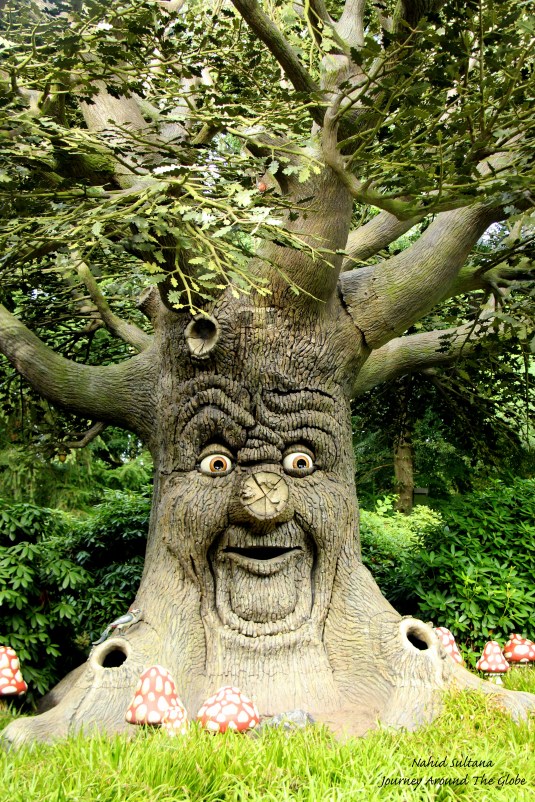
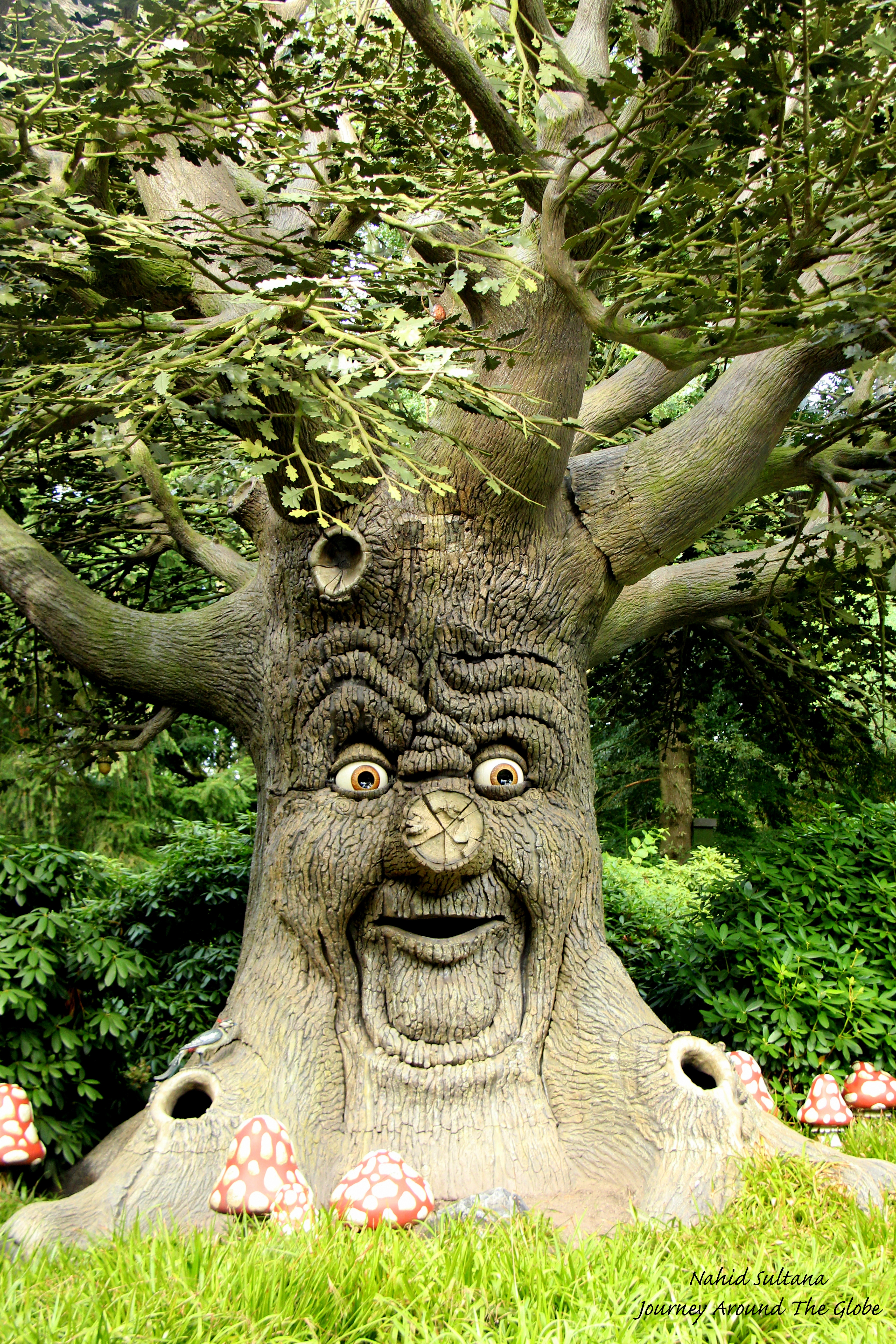
- A talking tree in Efteling

- Fire and water show near the entrance at the end of the day in Efteling
Related articles
- On My Travels – The Netherlands (thewanderingbookworm.wordpress.com)
- Inq 3 synthesis (rolleraj.wordpress.com)
- Inq 3 first annotation (rolleraj.wordpress.com)
- The loveliness of learners and how angry schools can make me (saysomethingin.wordpress.com)
Share this:

Business Excellence Award 2020 from AI Global Media for The Most Entertaining Personal Travel Blog – Pacific Northwest USA

Top Posts & Pages


Authors
 Globe Runner
Business Excellence Award 2020 for The Most Entertaining Personal Travel Blog – Pacific Northwest USA

Business Excellence Award 2020 from AI Global Media

 Journey Around The Globe