Journey Around The Globe
ready for the next destination
My 10 favorite travel quotes
We’ve travelled quite a bit in the past few years, especially last year after we moved to Belgium from U.S.A. Leaving comfort of your own home and heading towards a strange land do take some guts and an open mind. It’s sad but true that though we went to many cities and countries, quality of some of those trips weren’t as perfect as I’ve expected them to be. I would rather travel less and have higher quality of vacation. When I say “quality”, I don’t mean flying in First Class or staying in a 5-star hotel or eating in the fanciest restaurants. My vision of any great trip is to make good memories with my family. I may not remember all the details of all the places we went to during our visits but I always remember how I felt with my loved ones when I am in a new place. Pleasant feelings of being in a certain place are tied together with the people I am traveling with…for me that makes a perfect vacation.
I gathered some quotes on traveling that really speak my mind. Hope they inspire everyone to go out there and take the big challenge of going to a place where you don’t know the people, culture, language, food, and religion.
1) “Traveling is a brutality. It forces you to trust strangers and to lose sight of all that familiar comfort of home and friends. You are constantly off balance. Nothing is yours except the essential things – air, sleep, dreams, the sea, the sky – all things tending towards the eternal or what we imagine of it.” – Cesare Pavese
2) “One’s destination is never a place, but a new way of seeing things.” – Henry Miller
3) ″A traveler without observation is a bird without wings.” – Moslih Eddin Saadi
4) “All journeys have secret destinations of which the traveler is unaware.” – Martin Buber
5) “If you reject the food, ignore the customs, fear the religion and avoid the people, you might better stay at home.” – James Michener
6) “I have found out that there ain’t no surer way to find out whether you like people or hate them than to travel with them.” – Mark Twain
7) “Like all great travelers, I have seen more than I remember, and remember more than I have seen.” – Benjamin Disraeli
8) “Travel makes one modest, you see what a tiny place you occupy in the world.”— Gustave Flaubert
9) “Our happiest moments as tourists always seem to come when we stumble upon one thing while in pursuit of something else.” — Lawrence Block
And finally, my MOST favorite one which many travelers forget when going to a new place
10) “When you travel, remember that a foreign country is not designed to make you comfortable. It is designed to make its own people comfortable.” – Clifton Fadiman

Related articles
- To Travel (managuagunntoday.wordpress.com)
- Culture – Benjamin Disraeli and Cosmopolitan Jerusalem (interactblogs.wordpress.com)
- Gustave Flaubert, the XIXth Century IMAX (sunbea.wordpress.com)
- It’s Never Too Late… (jolifebeautiful.wordpress.com)
Share this:

A day by the Alps in Lucerne, Switzerland
LUCERNE, SWITZERLAND: Lucerne was completely different from what I had imagined it to be. After looking at some Google images, I knew it would be surrounded by the Alps, has a lake, and some nice views. Of course it has the giant Alps guarding the city from different directions and deep blue Lake Lucerne being a huge home for lots and lots of elegant and friendly white swans. But the city itself is charismatic and charming as well as loaded with Swiss history and a feeling of medieval city life. In addition to that, the location is great to explore other nearby Swiss cities like Zurich, Berne, Basel, Interlaken and regions, like French Alsace, German Black Forest, and finally, the mighty Alps.

- Lucerne Bay, Chapel Bridge, the Alps in Luncerne, Switzerland
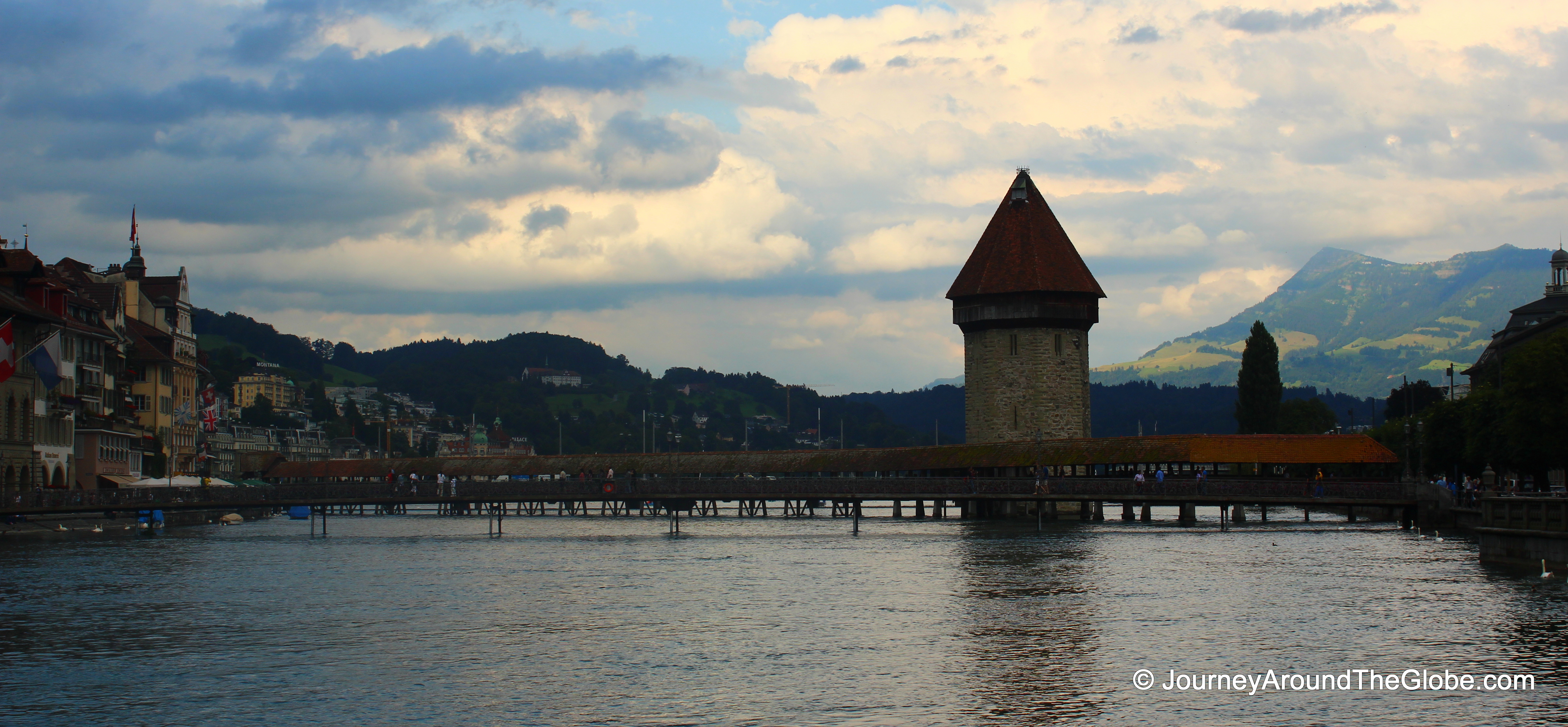
The main attractions in Lucerne are within walking distance. Taking a stroll or just chilling by Lake Lucerne is half the fun here. The official language of the city is German, but I’ve heard people speaking French and most of the locals are very fluent in English as well. One thing to remember when driving on autobahn and entering Basel (or Switzerland) is that you have to pay 40 CHF to get a toll ticket. The ticket is valid for one calendar year indicating on the sticker. There are few garages close to The Chapel Bridge or the old town, don’t have to take any risk of parking by the curbside.
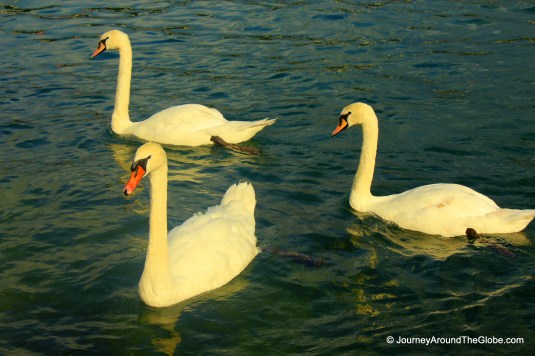
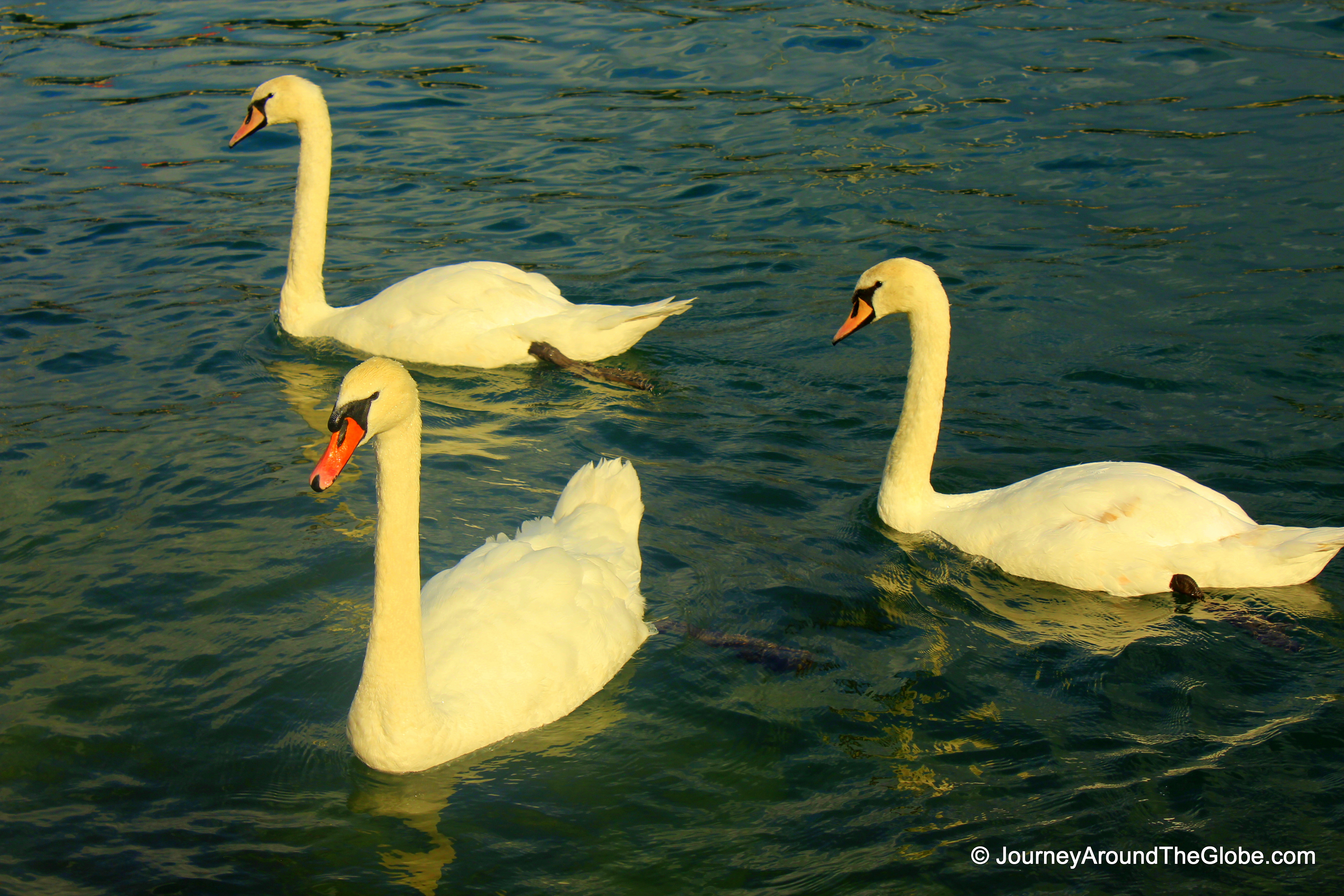
- Majestic swans of Lucerne Bay in Switzerland
TIME OF TRAVELING: We drove to Basel during first week July, 2012. It was a nice and scenic 5 hours of drive from Tervuren, Belgium. From there, we came to Lucerne for a day trip, which was about an hour drive from Basel. The weather was extremely cooperative, not too hot, not too cold, and luckily, no rain.

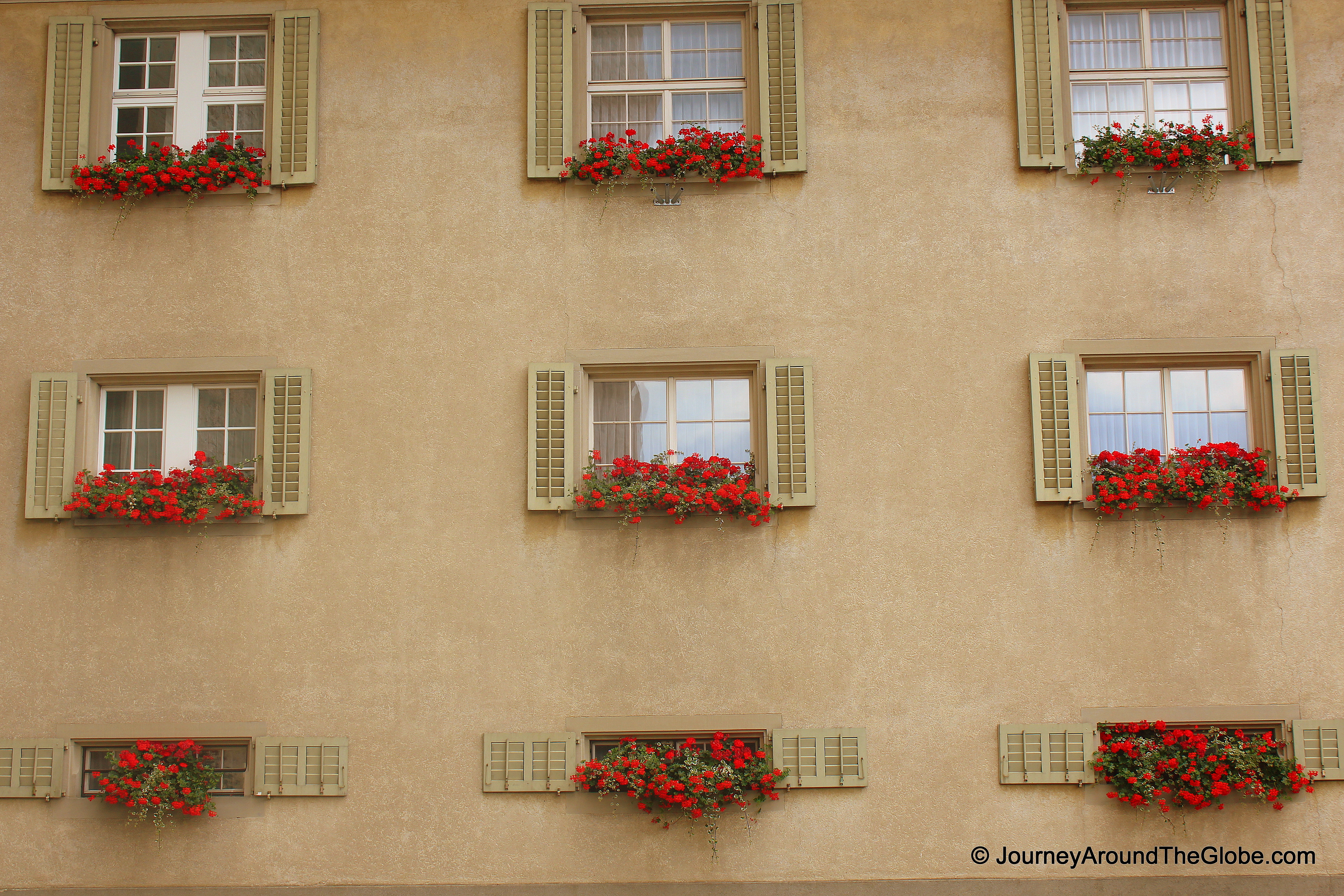
- Summer blooms in Lucerne, Switzerland
OUR HOTEL: We stayed in Dorin Hotels & Resorts in Basel. The hotel didn’t have free breakfast but free Wi-Fi and paid car garage were perfect for us. The best part of the hotel was that they gave us free tram pass for 4 of us for the duration of our stay which we could use both in Basel and Lucerne. Also the location of this hotel was perfect. It was only 7/8 minutes tram ride from Basel city center and about an hour drive to Lucerne.
WHAT TO EAT AND BUY IN LUCERNE: Of course, Swiss chocolates are something to eat and buy in Switzerland. Other than Lindt, “Villars” is a good brand of Swiss chocolates. Additionally, Swiss knives, watches (if you have some extra cash to spare), and cowbells are some of the popular souvenirs to take back home. Buying Swiss watches from Switzerland doesn’t mean that you will get them cheaper here, these cost about the same anywhere else in the world. There are tons of Swiss watch stores in Lucerne and some of them are actually open on Sundays too.
PLACES WE HAVE VISITED: We spent a whole day in Lucerne and saw all the things we wanted to see in our list. Here are all the places we could explore in a day:

- Swiss cows on the Alps, you can actually hear the bells clanging around their necks
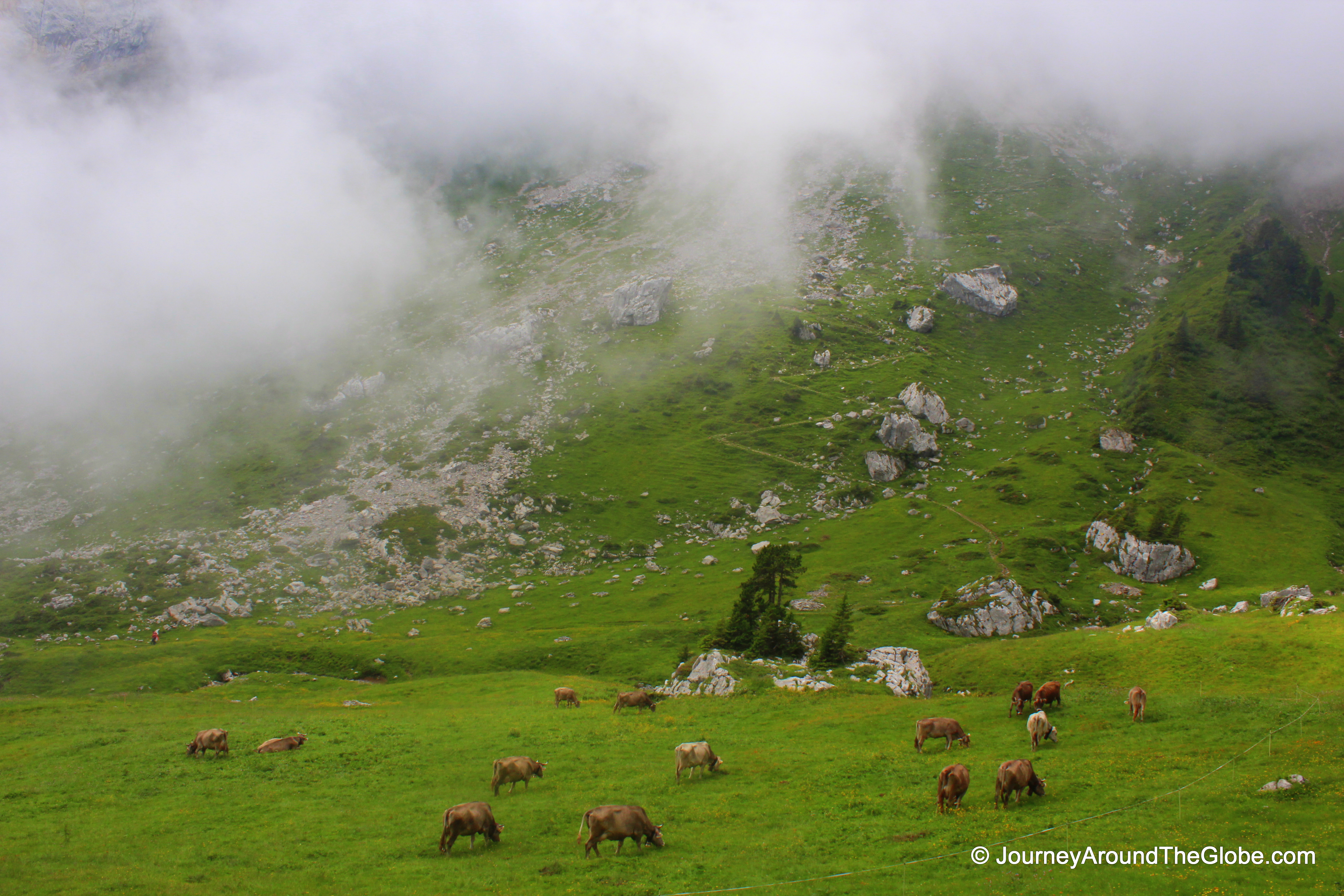
1) Mt. PILATUS: If you want to enjoy the breathtaking view of one and only Alps, consider going to Mt. Pilatus for that and it is a one of a life-time experience. A trip on Mt. Pilatus involving the cogwheel railway (world’s STEEPEST cogwheel railway) or various cableways is an experience not to be missed. Mt. Pilatus offers a spectacular view of Lucerne Bay on a clear day. If its cloudy and you can’t see the bay, don’t worry, looking at soothing greenery up on the mountains, listening to Swiss cows clinging their bells as they roam around the hills, hugging the clouds, and enjoying fauna & flora are just some of many things to do and see here. This is a great adventure for all ages and visitors get a good impression of the rocky and wild side of Alps.

- A cog-wheel rail (world’s steepest cog-wheel ride) crawling up Mount Pilatus in Switzerland
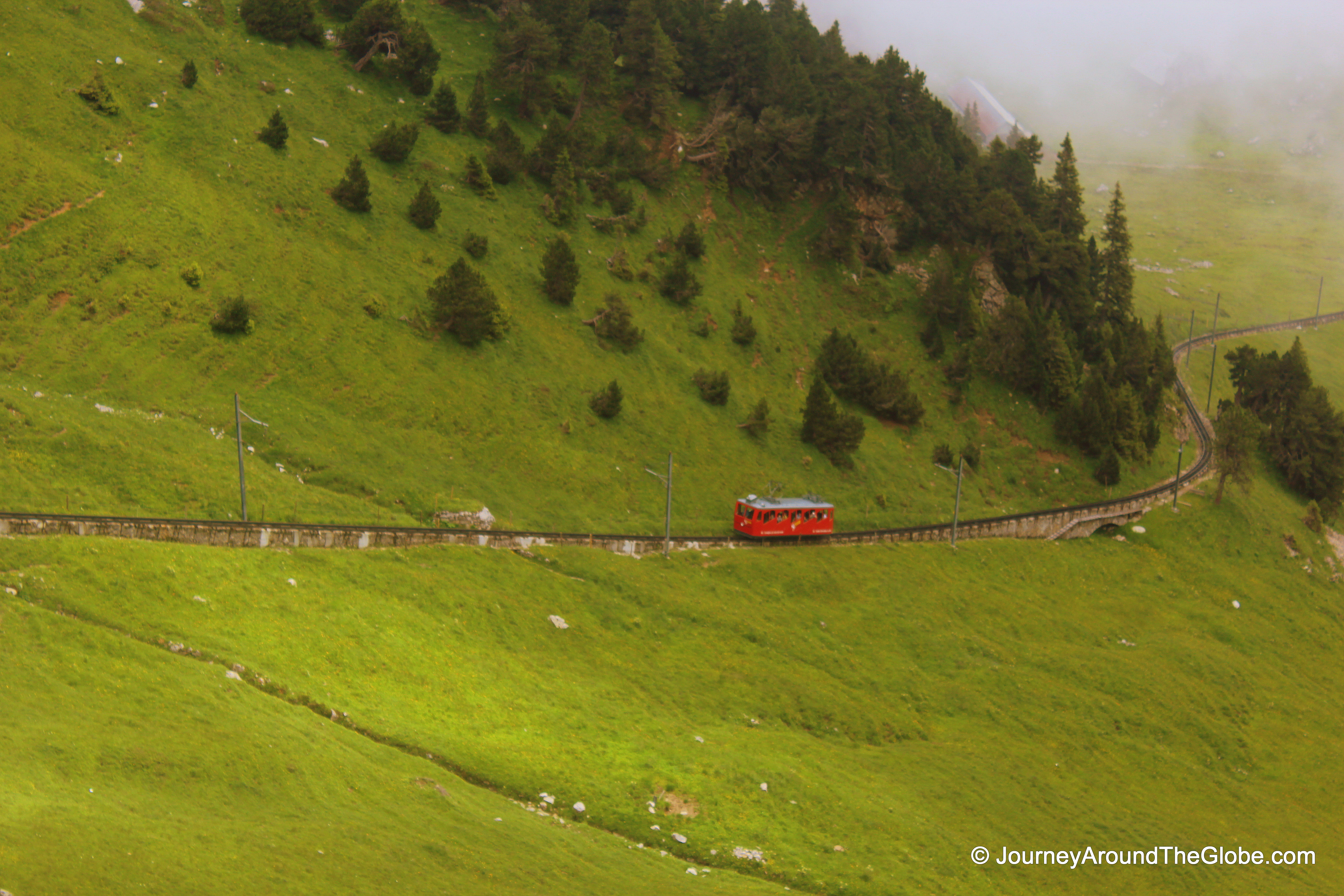
This is a great place for hiking for the pro-hikers. The fantastic trails offer everything from easy to alpine. We really didn’t hike, but took some short walks with the kids to admire different parts of the mountain. Even if you don’t prefer hiking, plan to spend at least couple hours on Pilatus. I would highly recommend taking a fleece or light sweater when going 8000 ft. high in elevation. The weather is very unpredictable here, it kept changing from hot to cold and hot again.

- From top of Mount Pilatus, Switzerland
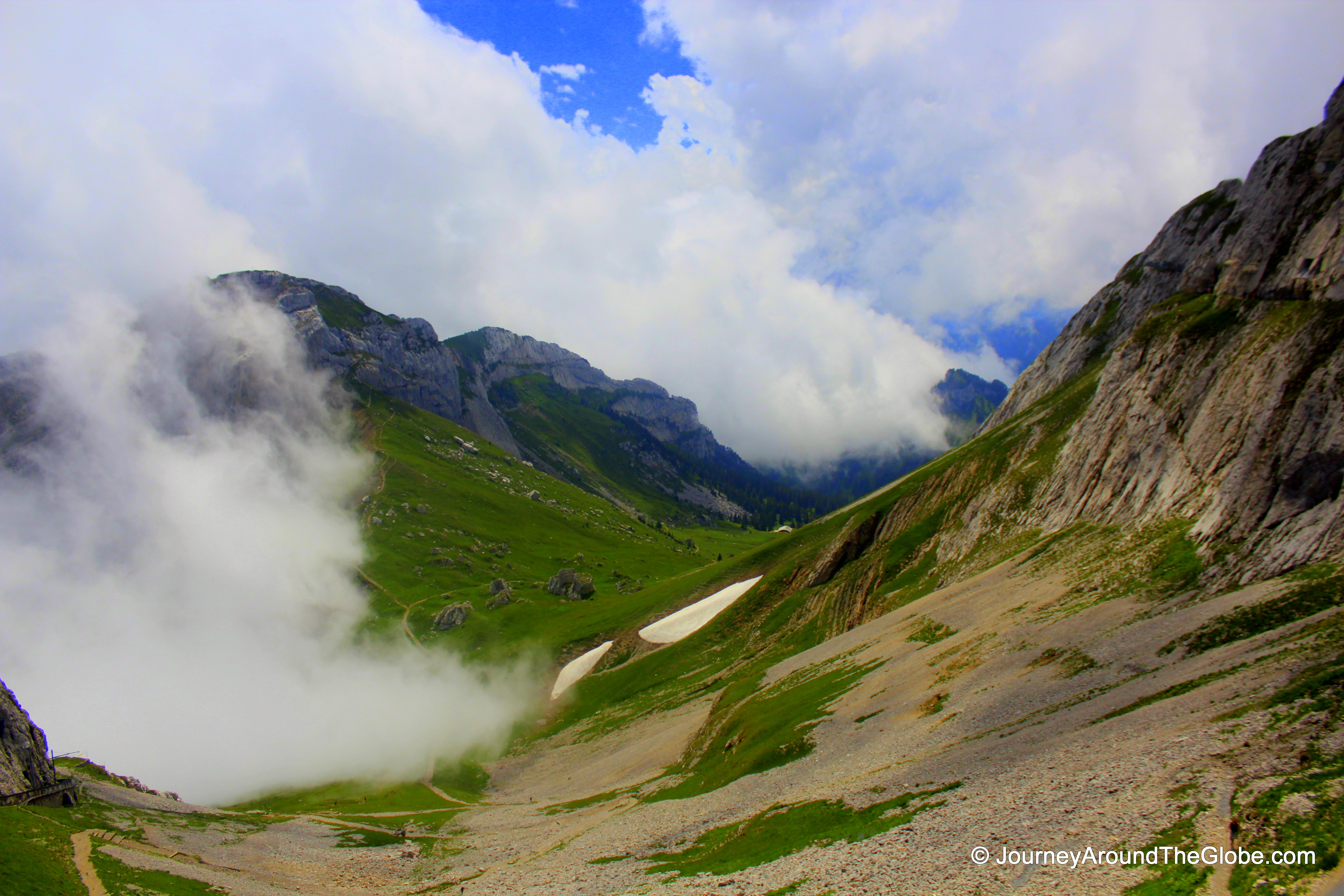
There are several different options to go on top of Mt. Pilatus. We took the cogwheel ride from bottom of Mt. Pilatus and within 30 minutes we were on top of the cloudy mountain. For the round trip of cogwheel ride we paid 70 CHS per adult, 35 CHS for our 6 years old and nothing for the 2 years old. There are few restaurants on top of Alpnachstad. Visit www.pilatus.ch to see all the options and packages are available for the visitors to make this trip a really great experience.

- View of Lucerne Bay as we were going down the mountain in Switzerland
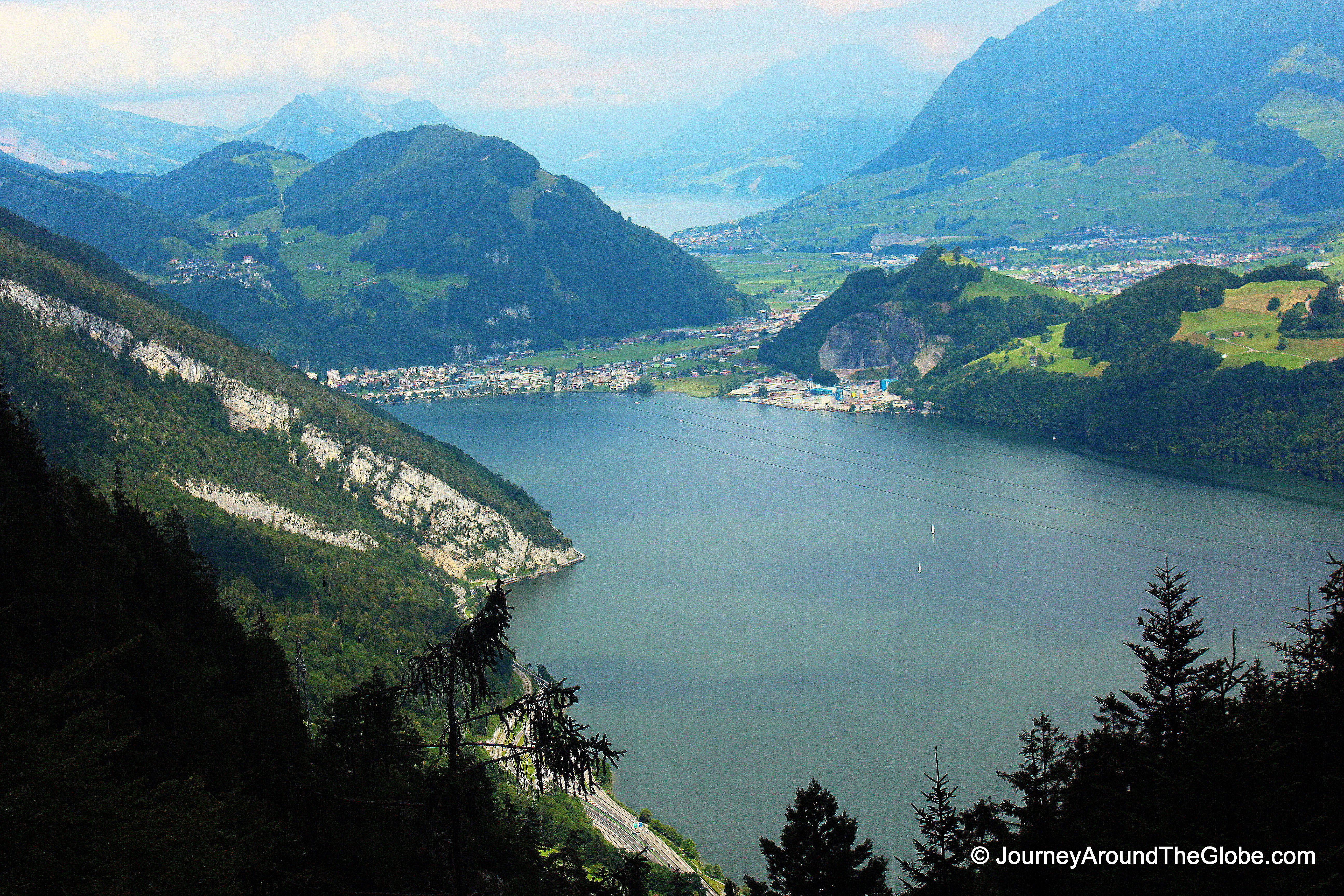
2) THE CHAPEL BRIDGE (KAPELLBRÜCK): This is the oldest wooden bridge in Europe and a must see landmark in Lucerne. Built in the 14th century, the bridge served as rampart and town fortification during that time. Chapel Bridge was burnt down in 1993 around midnight, which unfortunately, also damaged a lot of the paintings there dating from the 17th century. But you can still see the remaining paintings while crossing the bridge.
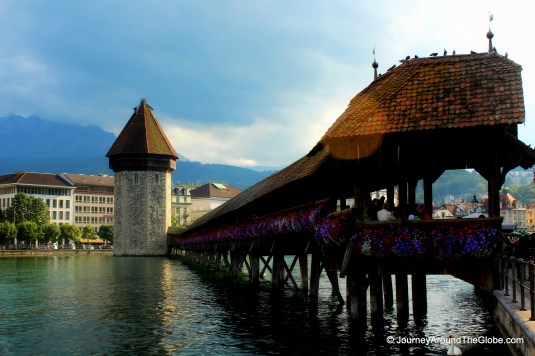
- The Chapel Bridge in Lucerne, Switzerland
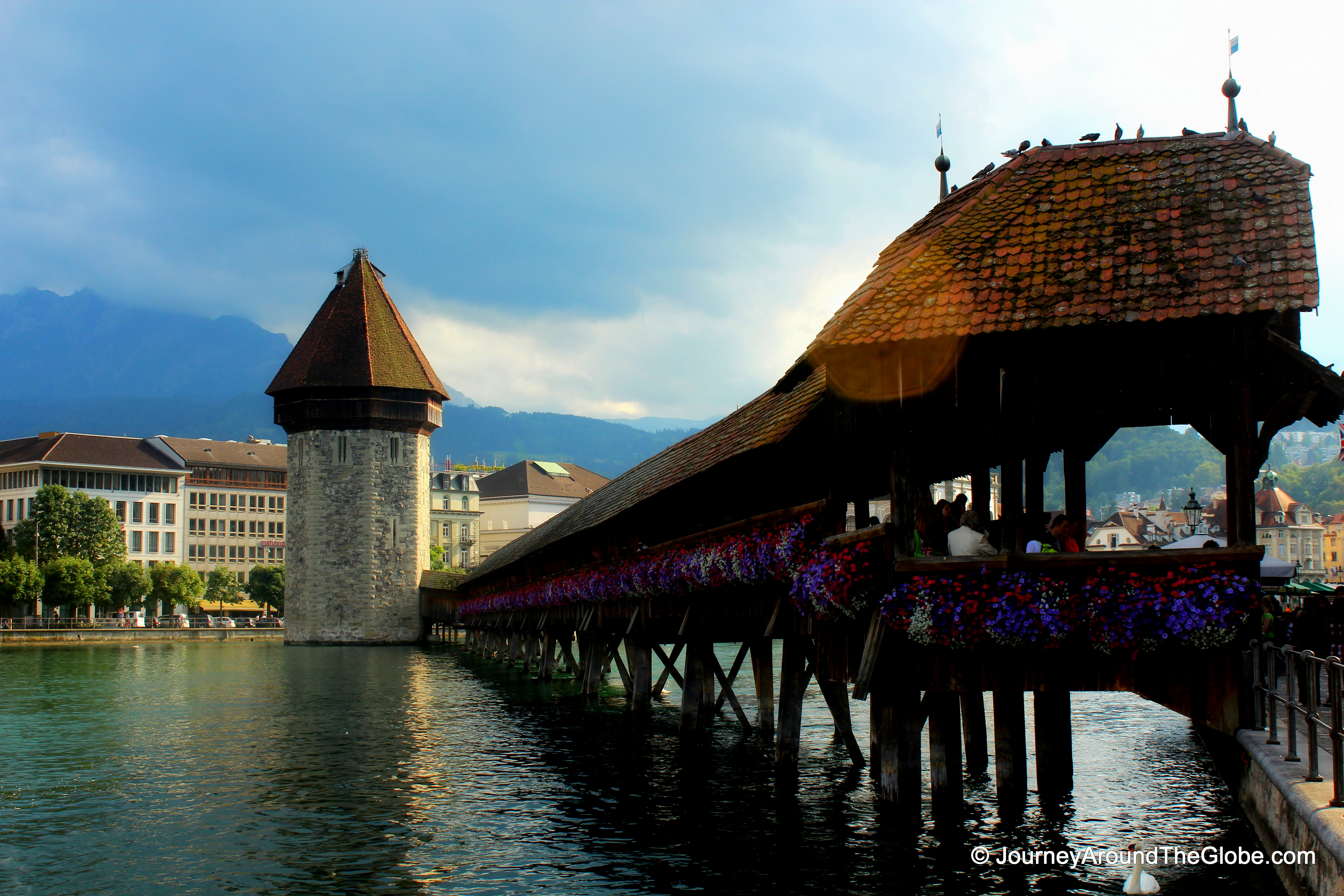
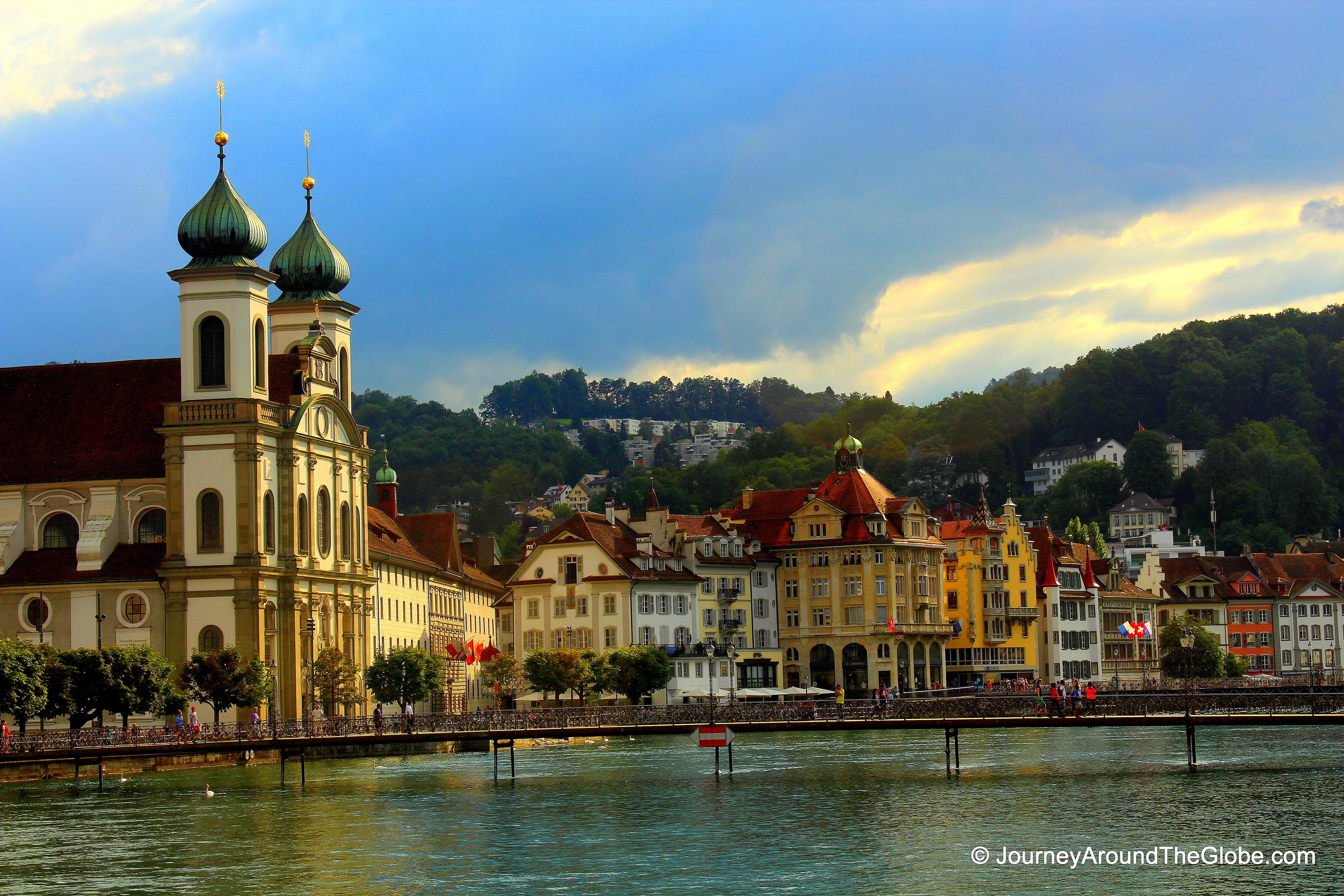
Walking over the Chapel Bridge is a fantastic experience. During the summer, it is decorated with beautiful flowers on both sides. I couldn’t stop taking pictures of the surrounding jaw-dropping view from the bridge. We were standing there surrounded by many white swans with the Alps on one side, old town and medieval buildings lined by the water on another side (which kind reminded me of Venice), and several gorgeous architectures on the other side. Jesuitenkirche, with its green twin towers, is an example of one of those beautiful buildings that can be seen from the Chapel Bridge. I am sure anyone will instantly fall in love with the view from the bridge after seeing such splash of colors all around it. Don’t forget to buy some souvenirs from the store right on the bridge.

- View of Jesuitenkirche and surroundings from the Chapel Bridge, Lucerne, Switzerland
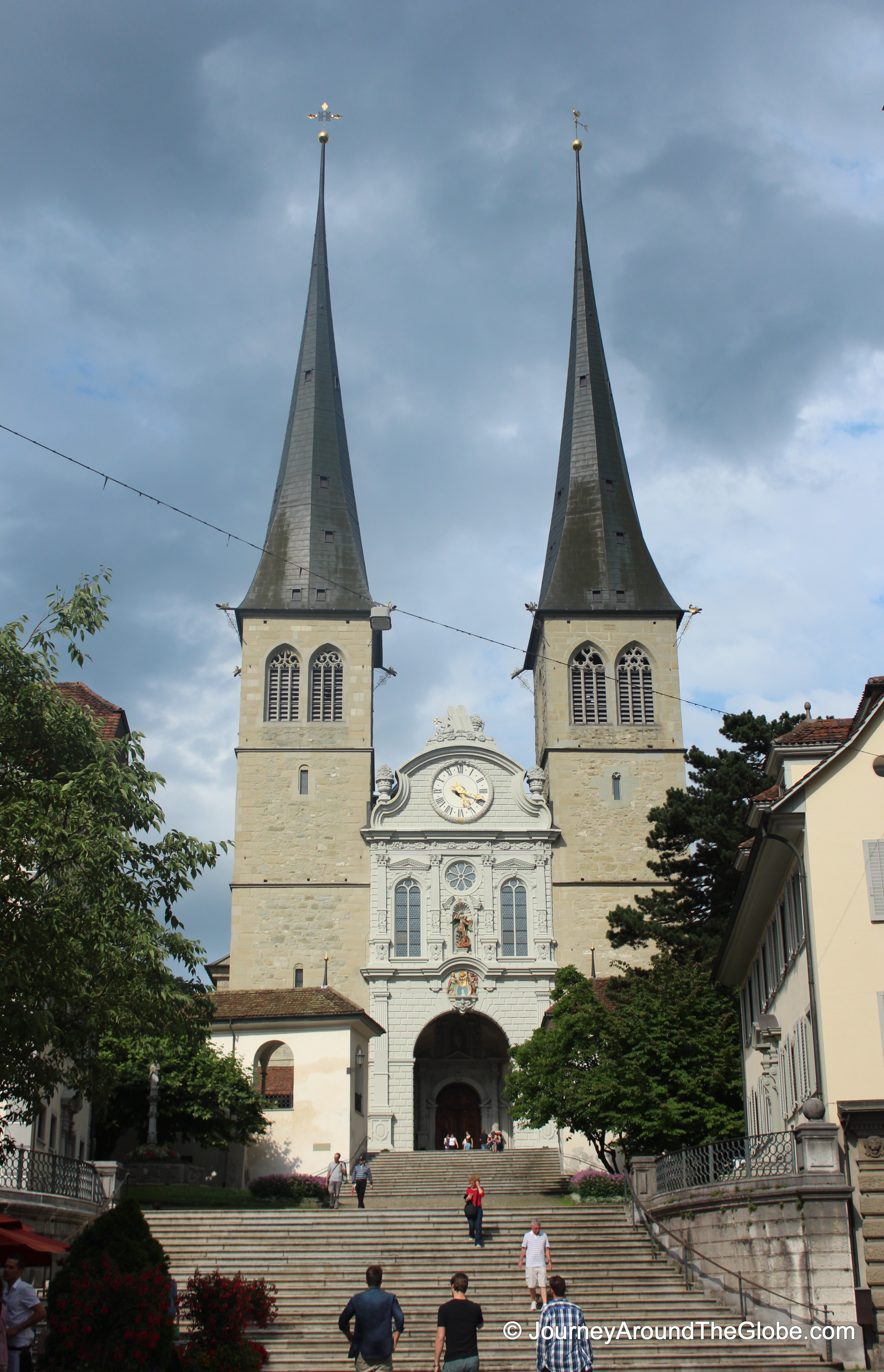
3) HOFKIRCHE: This can easily be recognized by its twin towers. You have to climb some stairs to go inside the church. Interior is very nicely decorated with giant white columns and furniture in dark wood. There are several old large paintings here. The cemetery outside the church is very peaceful and calm. Also the view of the city from up the stairs near the church is simply lovely.
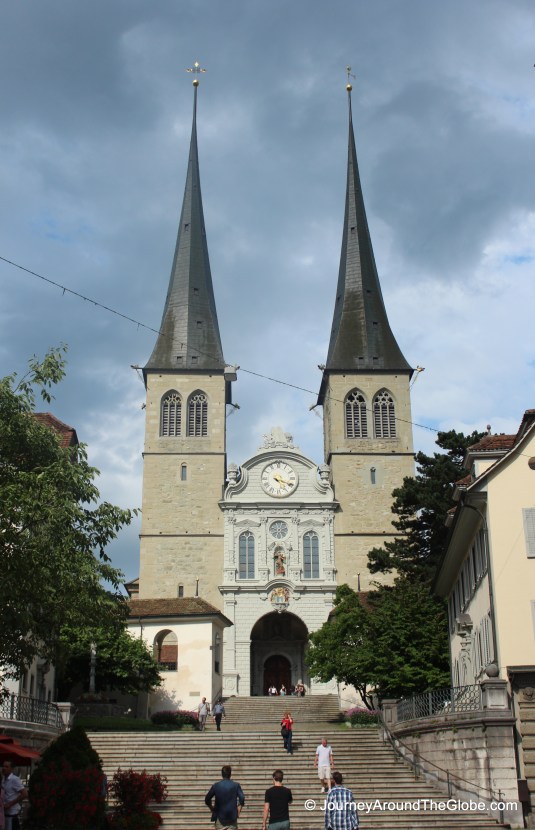
- Hofkirche in Lucerne, Switzerland
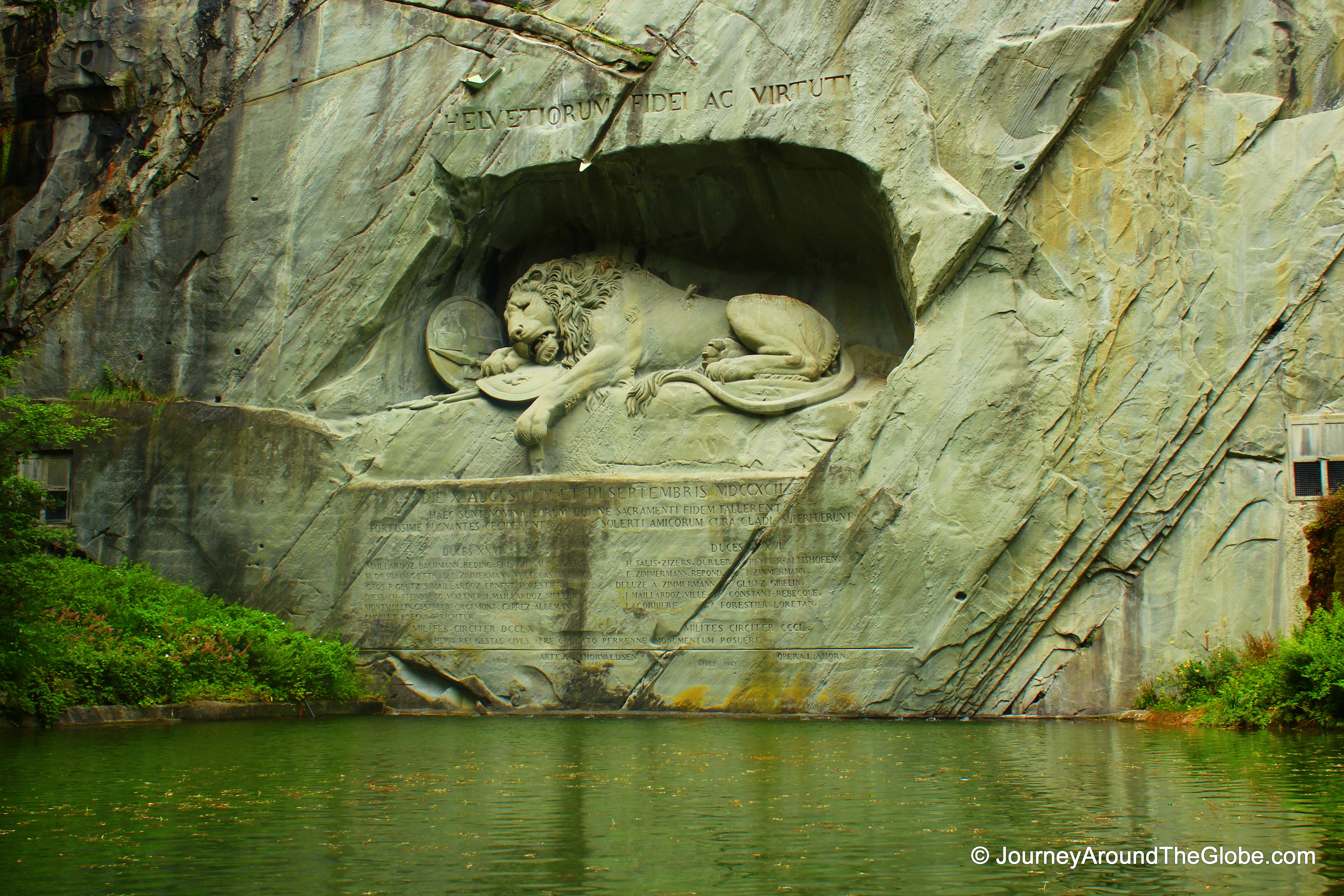
4) LOWENDENKMAL (THE LION MONUMENT): Also known as the Lion of Lucerne, is a sculpture of a mortally wounded lion, situated in a very calm and serene place shaded by lots of green trees. This mourning lion commemorates the Swiss mercenaries who, in the service of Louis XVI King of France, were massacred in 1792 during the French Revolution. The inscription “Helvetiorum fidei ac virtruti” means “To the loyalty and bravery of the Swiss”. This stone-curved sculpture is 6 meters high and 10 meters long. Many writers have praised this sculpture in their works, one of them is Mark Twain, who said “the most mournful and moving piece of stone in the world.”

- The Lion Monument of Lucerne, Switzerland
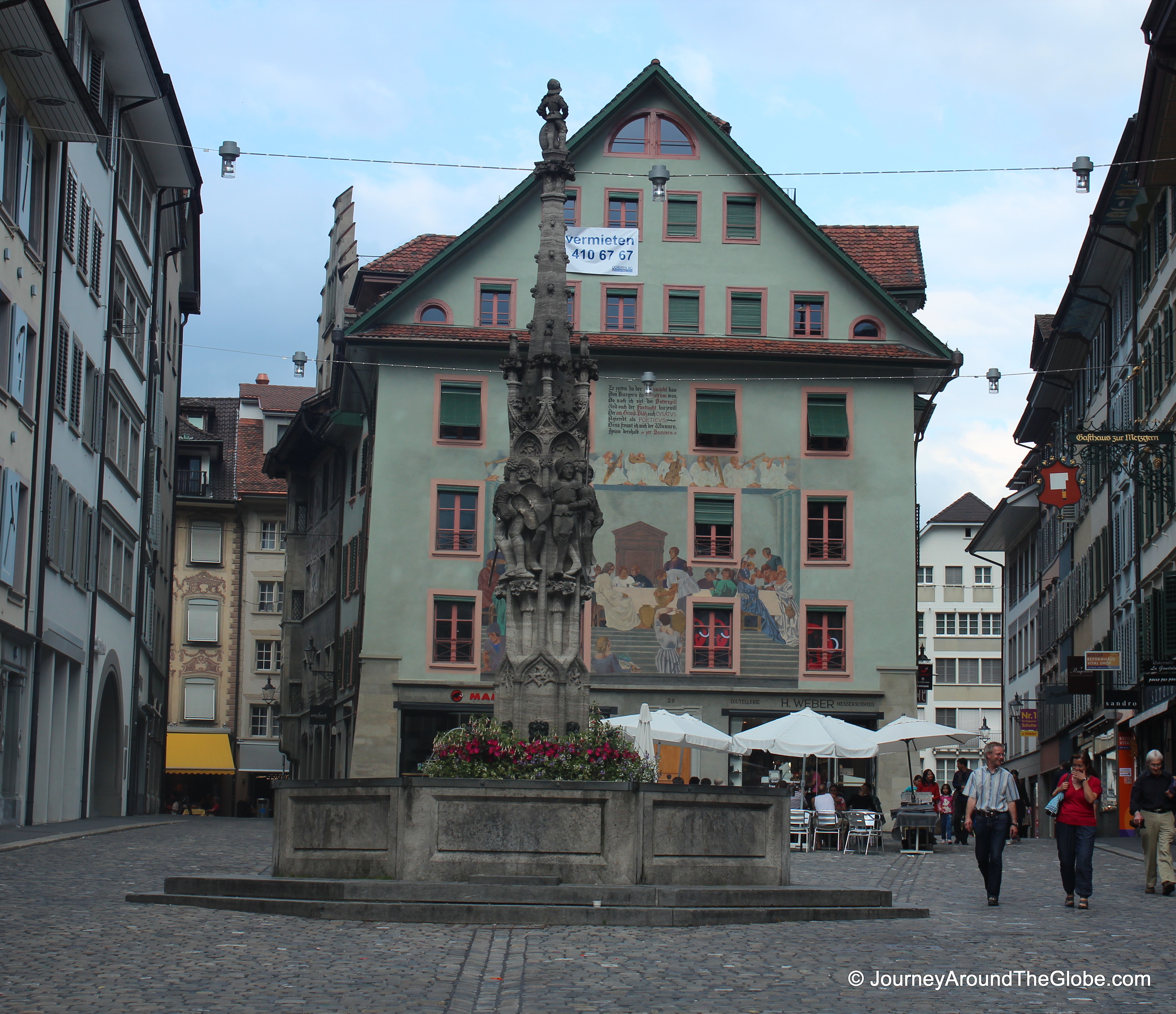
5) ALTSTADT (OLD TOWN): This is a fascinating place to get lost and connect with Swiss history. The old town is rather small but remarkably well-preserved. Enjoy small squares like Weinmarkt, Kapellplatz, Theaterplatz and Lucerne Rathaus (City Hall) in Kornmarkt with its maroon clock tower. Its narrow streets, passages, and murals on buildings are truly admirable. You can also see Lake Lucerne and The Chapel Bridge once in a while thru those old buildings. Overall, the old town of Lucerne takes you back to past centuries and leaves you with a pleasant feeling.
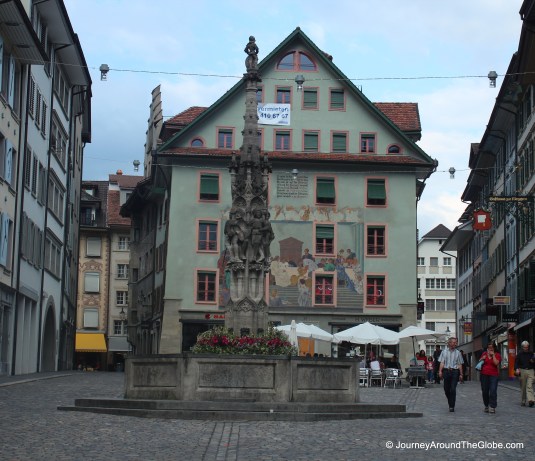
- Old town of Lucerne near the Town Hall in Switzerland
6) TRIP TO BASEL: Basel is less than hour drive from Lucerne. It makes a great day trip to get some taste of Swiss city-life. The public transportation system in Basel is extremely well. Please check out my page on Basel on the right to get more travel information on this city.

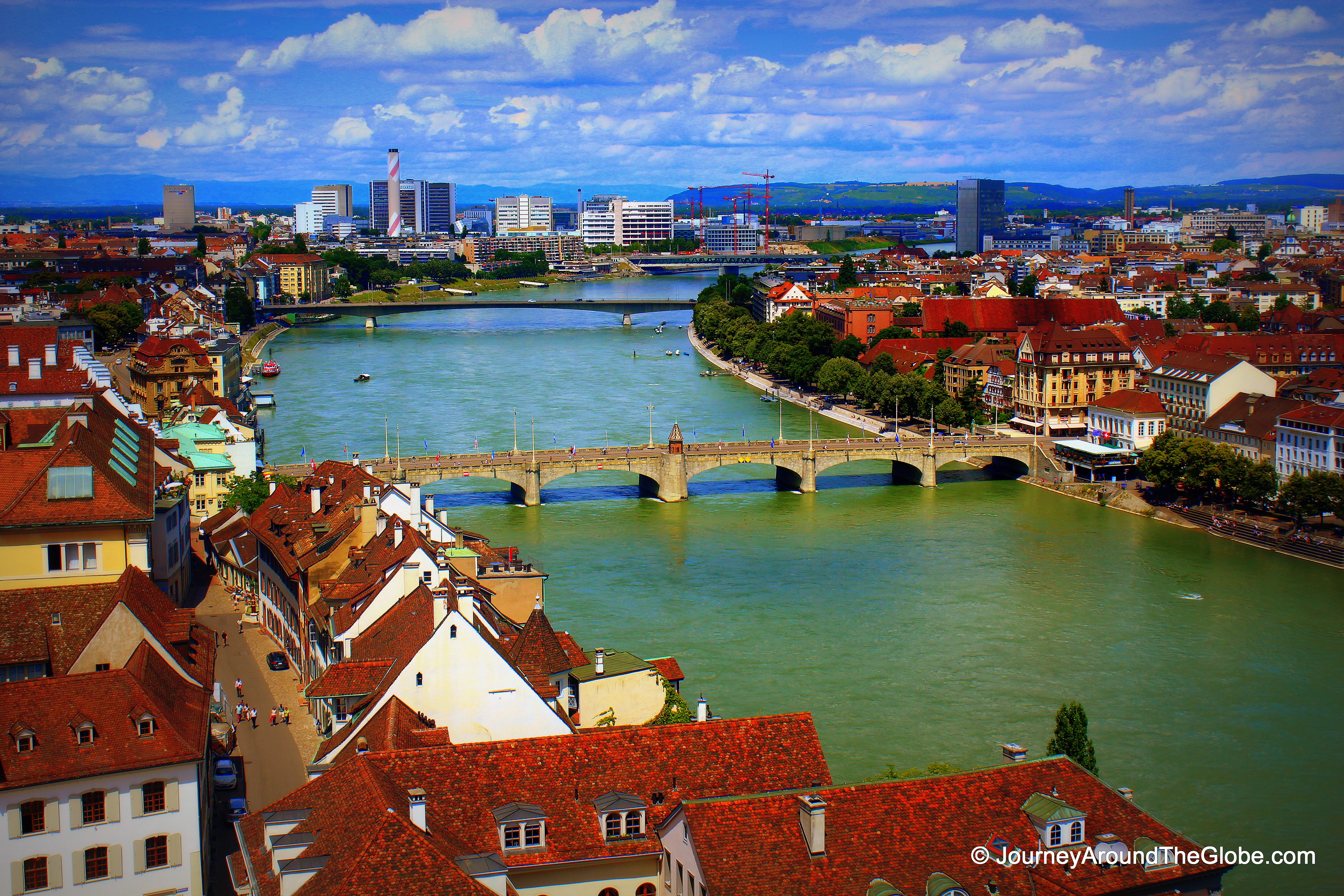
- View of River Rhine and the city from the top of Basel Munster tower
Related articles
- Beautiful Basel, Switzerland (journeyaroundtheglobe.com)
- lucerne, switzerland (tinaineurope.wordpress.com)
- Where In The World..? – 22nd July 2012 (amateurarchaeologist.wordpress.com)
- Lucerne, Switzerland (letterpressedthoughts.wordpress.com)
- Day 30 — Mt. Pilatus and Luzern — Friday, July 13th (kandas-adventures.typepad.com)
Share this:

Dear Dublin,
DUBLIN, REPUBLIC OF IRELAND: Visiting Ireland was a dream coming true for me. I am not so much into crowded city, but I simply loved the hustling and bustling of Dublin. It’s an up-beat city with lots of energy and attitude. I truly enjoyed the great combination of its laid back charms and busy city life. How is it possible? Come to Dublin and they will show you how they can be both laid back and yet be spontaneous all at the same time. After visiting Dublin, I realized that Irish are the friendliest and jolliest people in Europe. They will just come and start a conversation instantly and will come forward to help you if they see you looking left and right with a map in your hands.

- The old city wall of Dublin
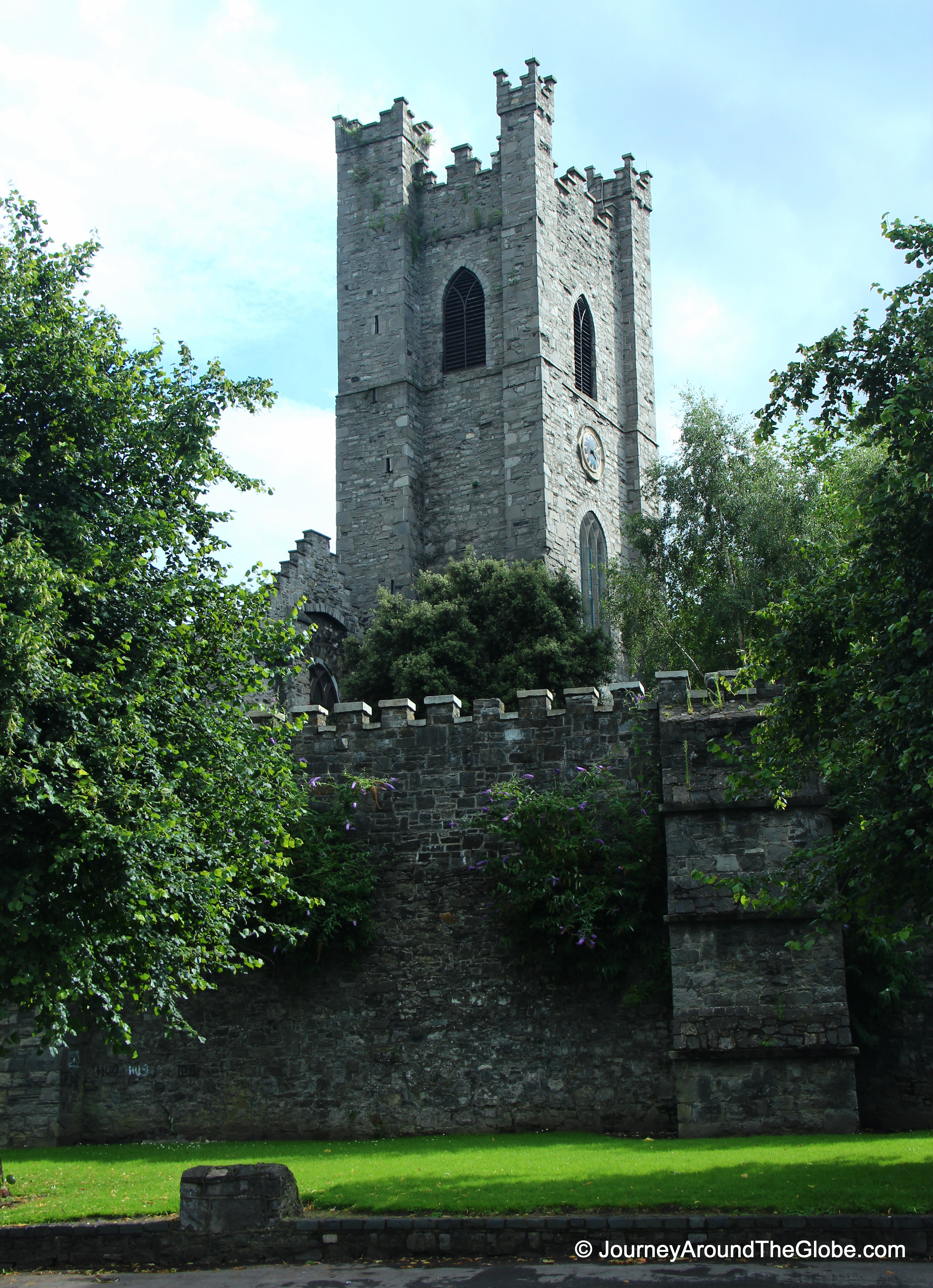
Ireland was established or founded in 988 A.D. but got its independency from Great Britain in 1921. Dublin (“Dubh” and “Linn” means The Black Pool in Gaelic), being the capital of Ireland, has many historical buildings and places that played big role in getting their freedom from the English. River Liffey made its way to different parts of the city making it even more beautiful.
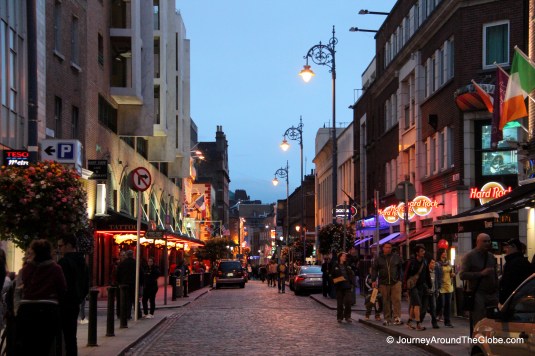
- Walking around near Temple Bar in Dublin, Ireland
TIME OF TRAVELING: We took a train from Belfast to Dublin in the 2nd week of August, 2012. It was a nice 2:30 hours of scenic train ride. We did buy the tickets before hand, but I am sure you can buy them on the stop too but will cost more. We didn’t get much of rain during our stay, may be once or twice a sudden heavy rain for 5 minutes and that’s all. Otherwise, the summer is very pleasant here, may be a bit chilly at night.
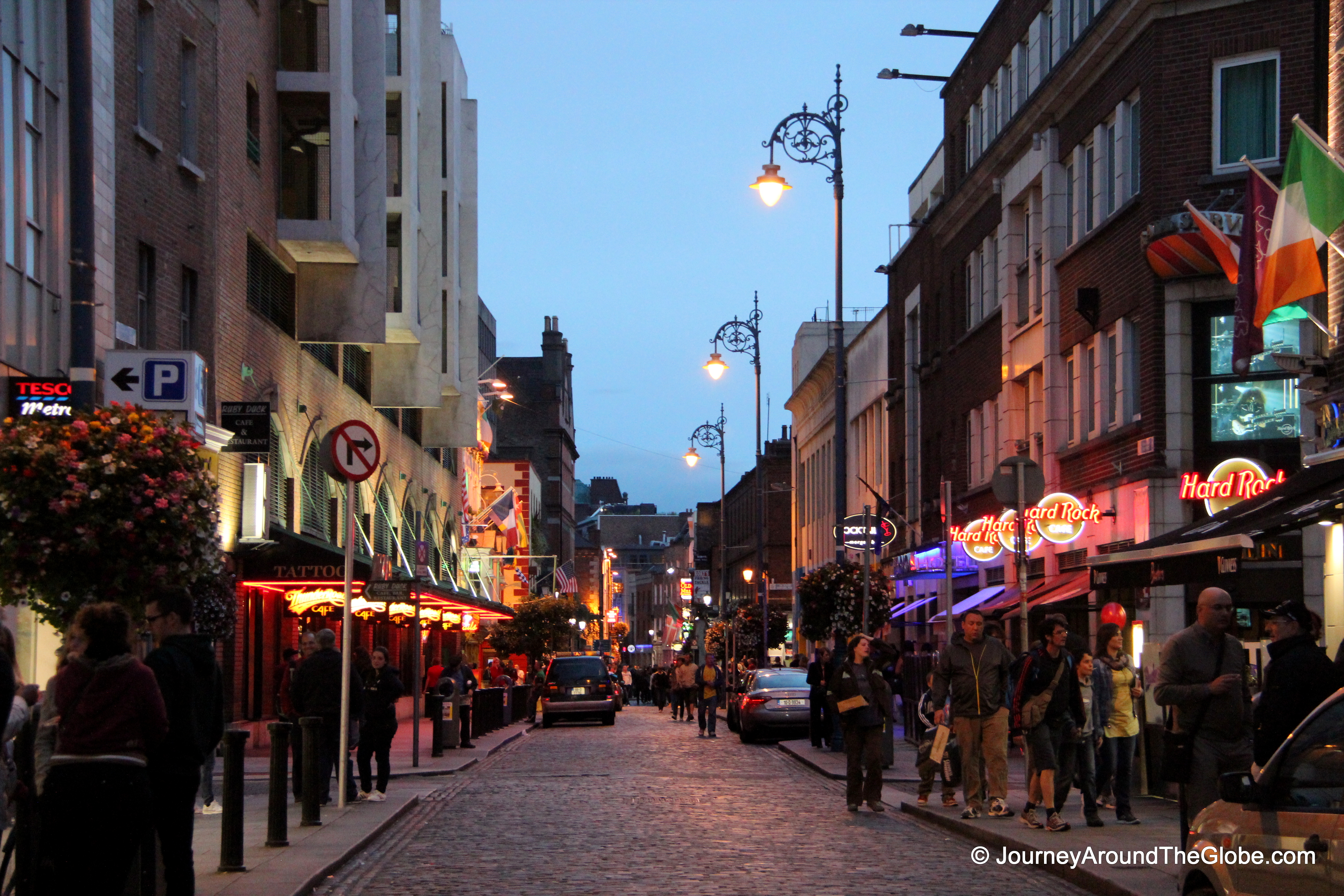
OUR HOTEL: We stayed in Blooms Hotel in Temple Bar. This is a 3-stars hotel with free Wi-Fi but the location was AWESOME. This is about a minute walk from the heart of Temple Bar. We usually explored other parts of the city during day and had our dinners in Temple Bar. This is also within 10 minutes of walk from most of the tourist attractions like Dublin Castle, Dublin City Hall, O’Connell Street, and Trinity College.
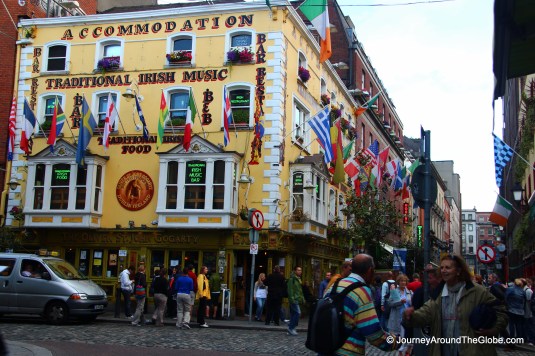
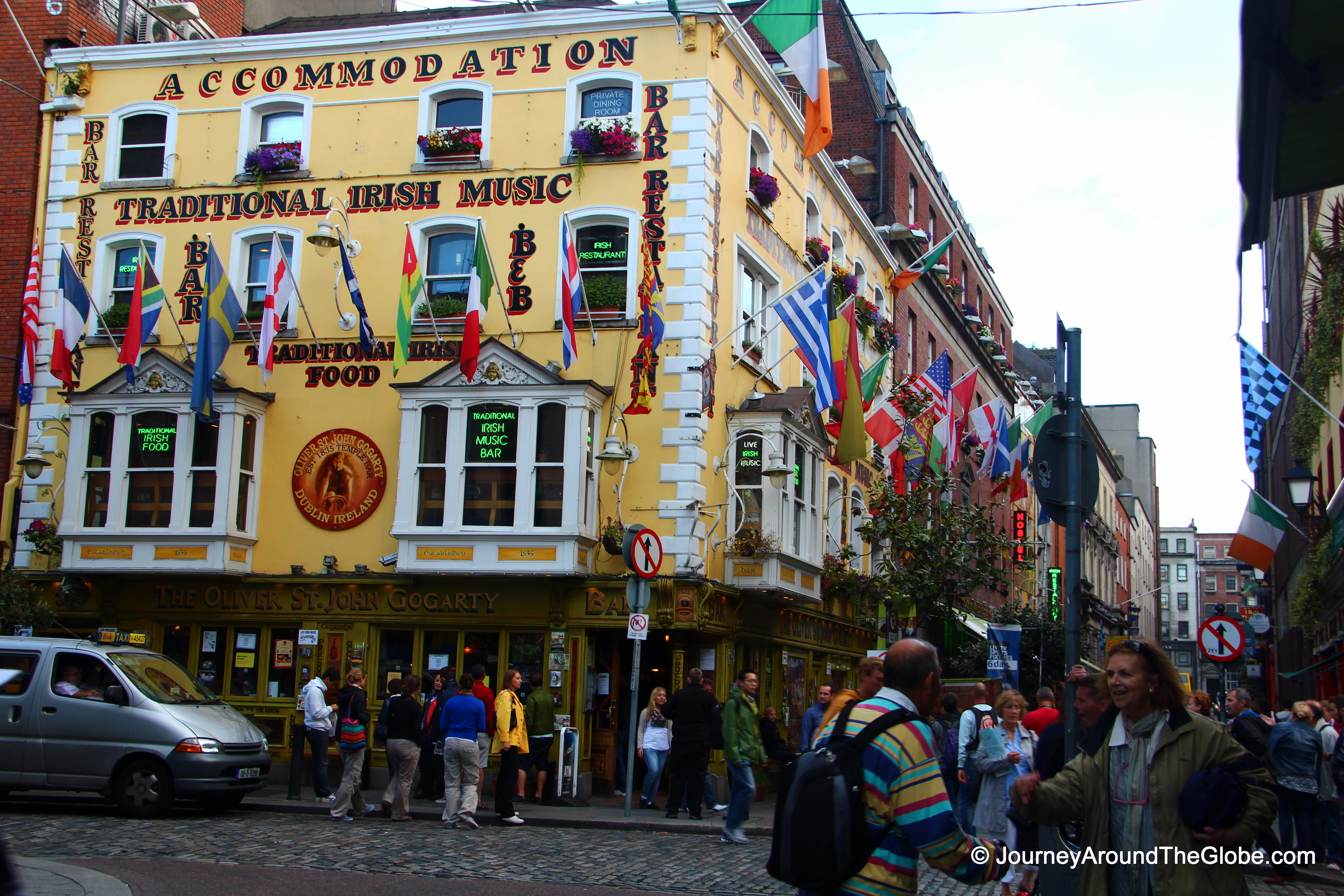
- A popular Irish pub on the street near Temple Bar where our Hotel Blooms was located
WHAT TO EAT AND BUY IN DUBLIN: “There is more philosophy in a pint of Guinness than in all the books in Trinity College” – Martin Keane, Proprietorship. I found this quote on the tiny envelope where our hotel receptionist put the keys for our room. This tells a lot about what to drink in Ireland, doesn’t it? Other than that, traditional Irish stew is a very famous dish here which is cooked with lots of potatoes and vegetables like carrots. Some places have it with beef, but if you want the old-style stew then lamb is the way to go. Fish items are also very well-known here for those seafood lovers. There are tons of traditional Irish restaurants with live music and performers in Temple Bar. We had one dinner and a traditional Irish breakfast in one morning in O’Shea’s which has good Irish food for good price. For another dinner we tried another restaurant called “Rome to Mexico” where you can get Mexican food as well as Italian food. Some people may be surprised that we actually went for Mexican restaurants in Dublin!!! This is what happens when you are away from Taco Bell for too long!!! The food was the yummiest and the place was right beside the original Temple Bar restaurant (the red building).

- My Irish stew in O’Shea’s near Temple Bar

For gifts and souvenirs, Carroll is the biggest store in the city. They are almost everywhere in Temple Bar and O’Connell Street. They have the largest selection of Irish gift items and you can find anything and everything that you are looking for including Irish CDs, t-shirts, mugs, Celtic ornaments and jewelries, Guinness items, and leprechaun. There are some other stores as well selling the same stuff. I bought a sweat-shirt “Temple Bar” written on it; you can only find it in Temple Bar, nowhere else.
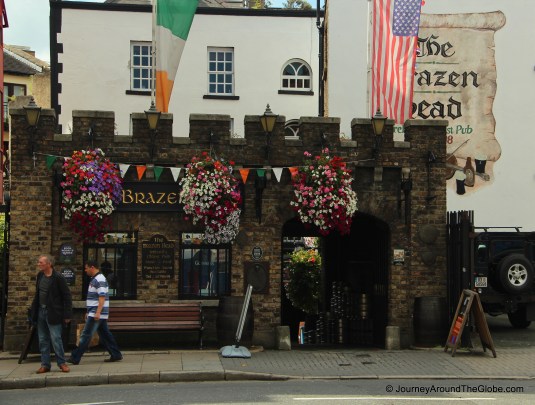
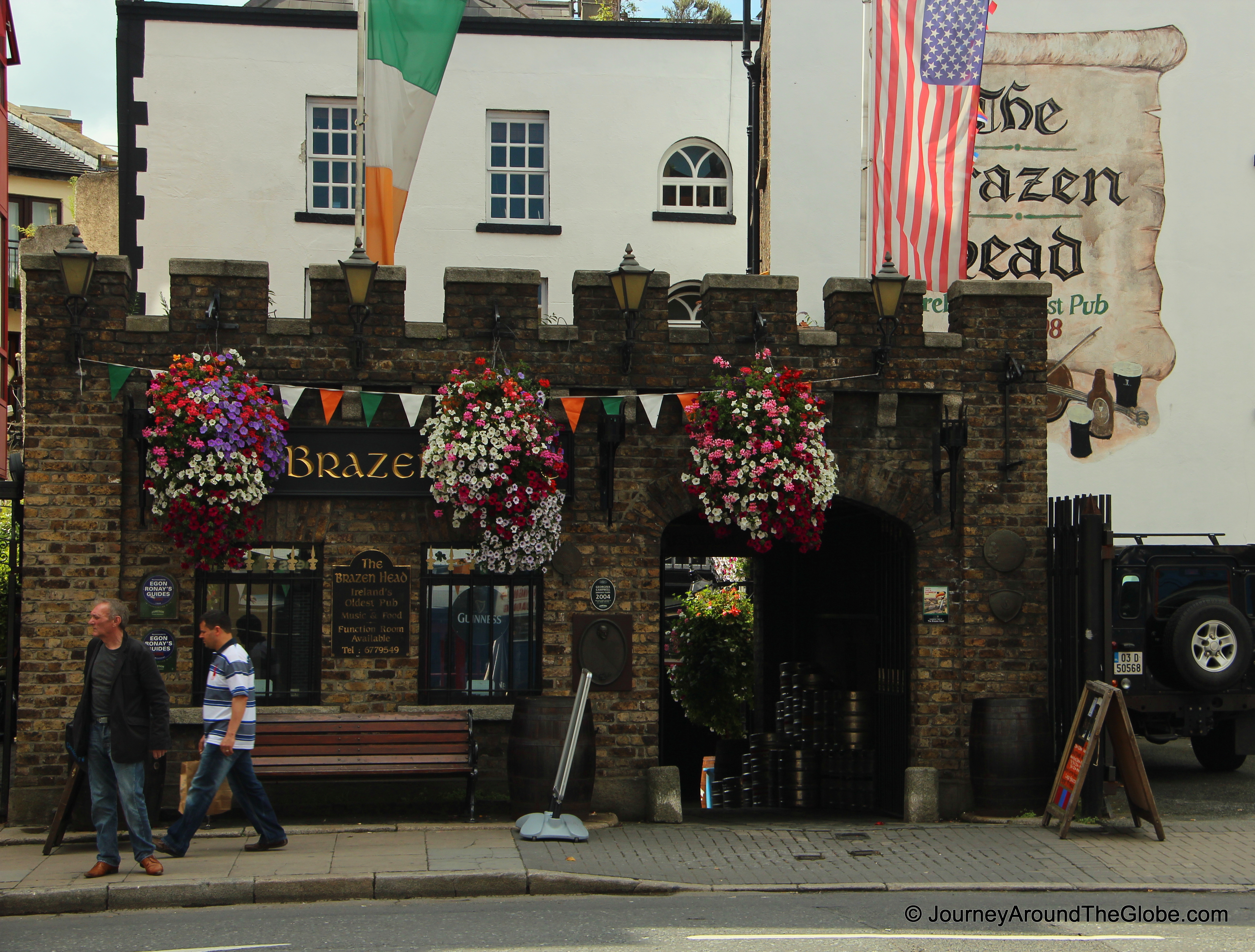
- The oldest Irish pub from 1198 – Brezen Head Inn
PLACES WE’VE VISITED: We got 2 full days in Dublin. We didn’t go out to countryside to see the true beauty of Ireland this time. We were enjoying the city itself so much that we decided not to go to the mountains or the coastal sides. As usual, we hit most of the places by foot. It is a lot of walking but it didn’t feel like so since I was enjoying every bit of the city. Dublin is known for its beautiful and colorful doors…so pay attention when walking around the city or a neighborhood for these doors.
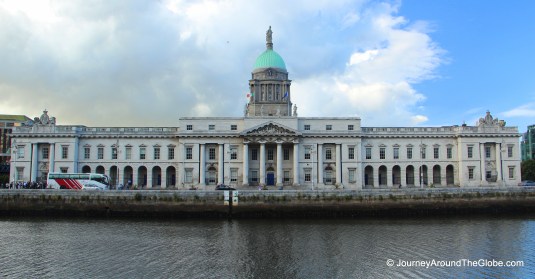
- Customs House by River Liffey in Dublin, Ireland
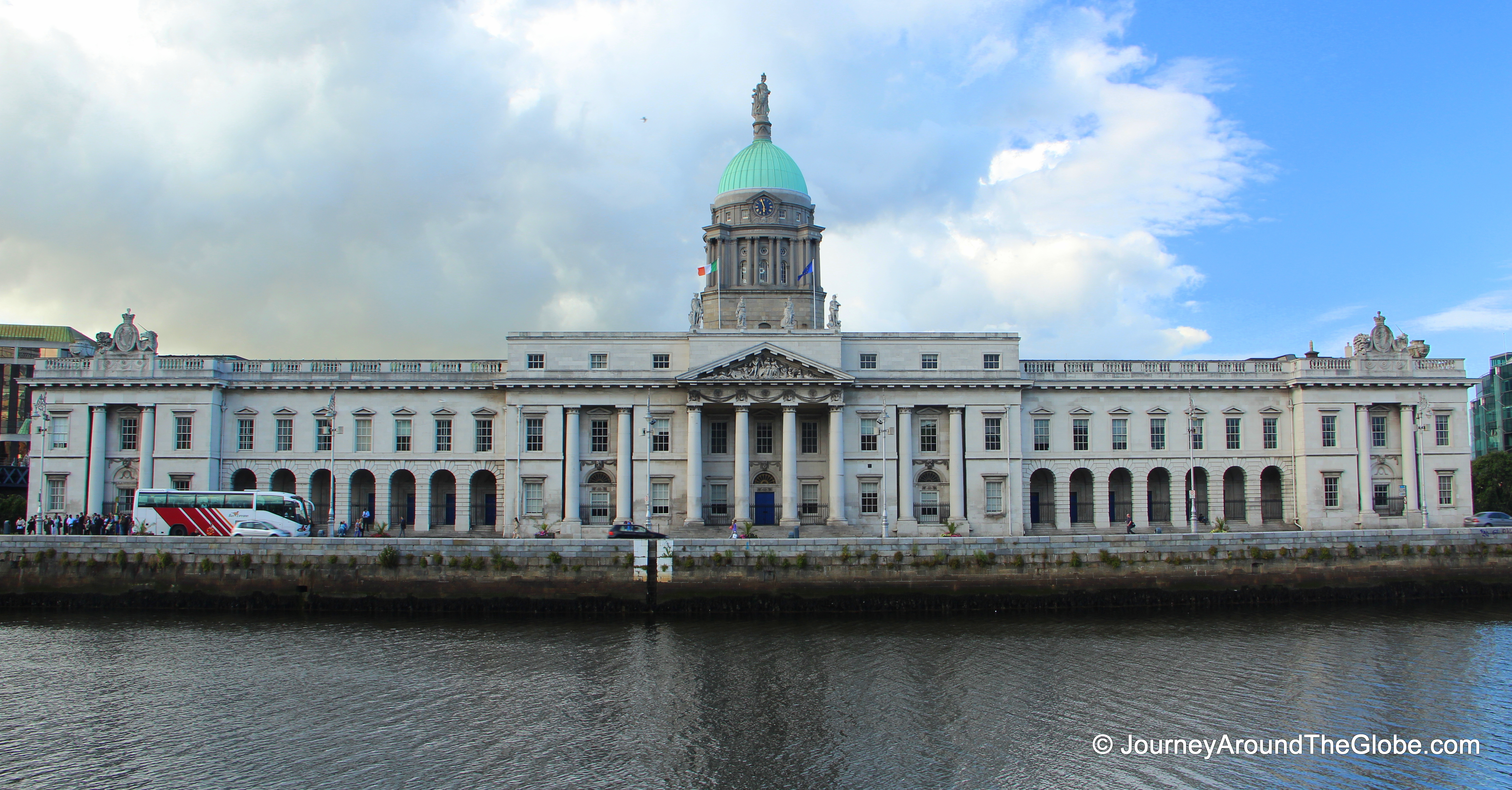
Some of the places that we saw other than the ones I’ve listed are old city wall, Samuel Beckett Bridge on River Liffey which looks like a harp (built in 2009), the grand building of Customs House on the bank of Liffey and very close to Samuel Beckett Bridge (built in 1791), Brezen Head Inn – the oldest Irish pub from 1198, and one of the world’s oldest cast-iron bridges, Ha’Penney Bridge.
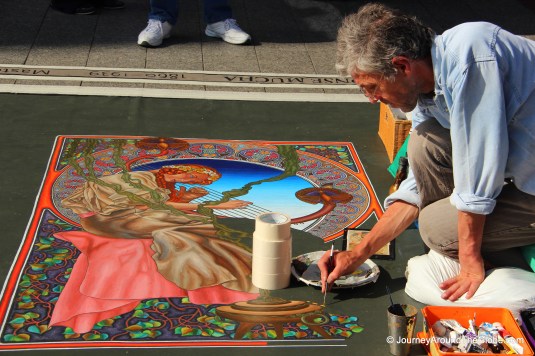
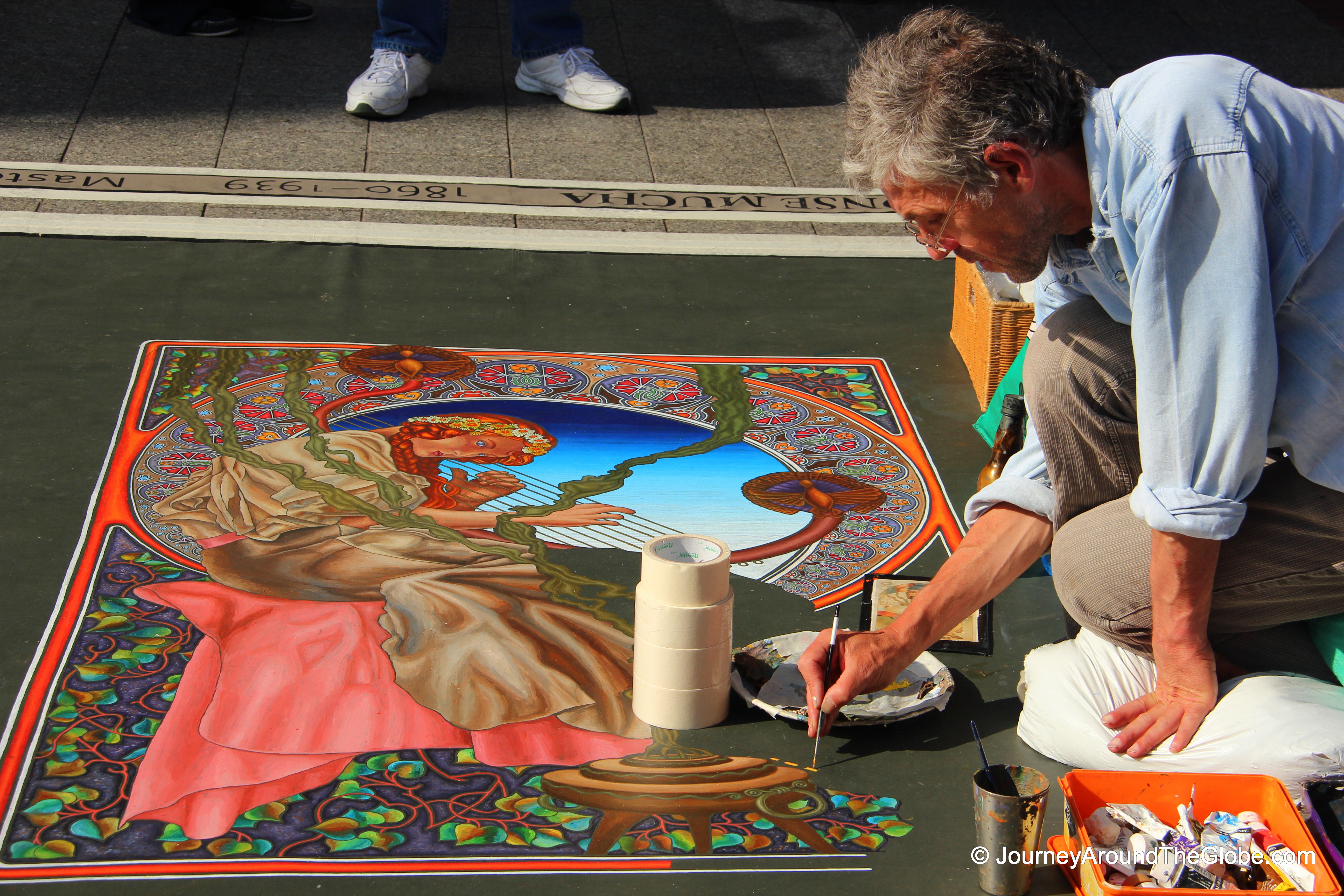
- An artist and his creative mind near Dublin Spire
1) O’CONNELL STREET & BRIDGE, O’CONNELL MONUMENT, and THE SPIRE: This is the heart of Dublin and THE place to hang out day or night. The long stretch of O’Connell Street is a perfect place to eat, buy souvenirs, do shopping, enjoy River Liffey from O’Connell Bridge (built in 1880), or to just take a stroll. One of the iconic buildings of Dublin, the historical General Post Office, is also located here. You will find some high-end restaurants here as well as good fast foods like McDonald’s, Burger King, and Subway.

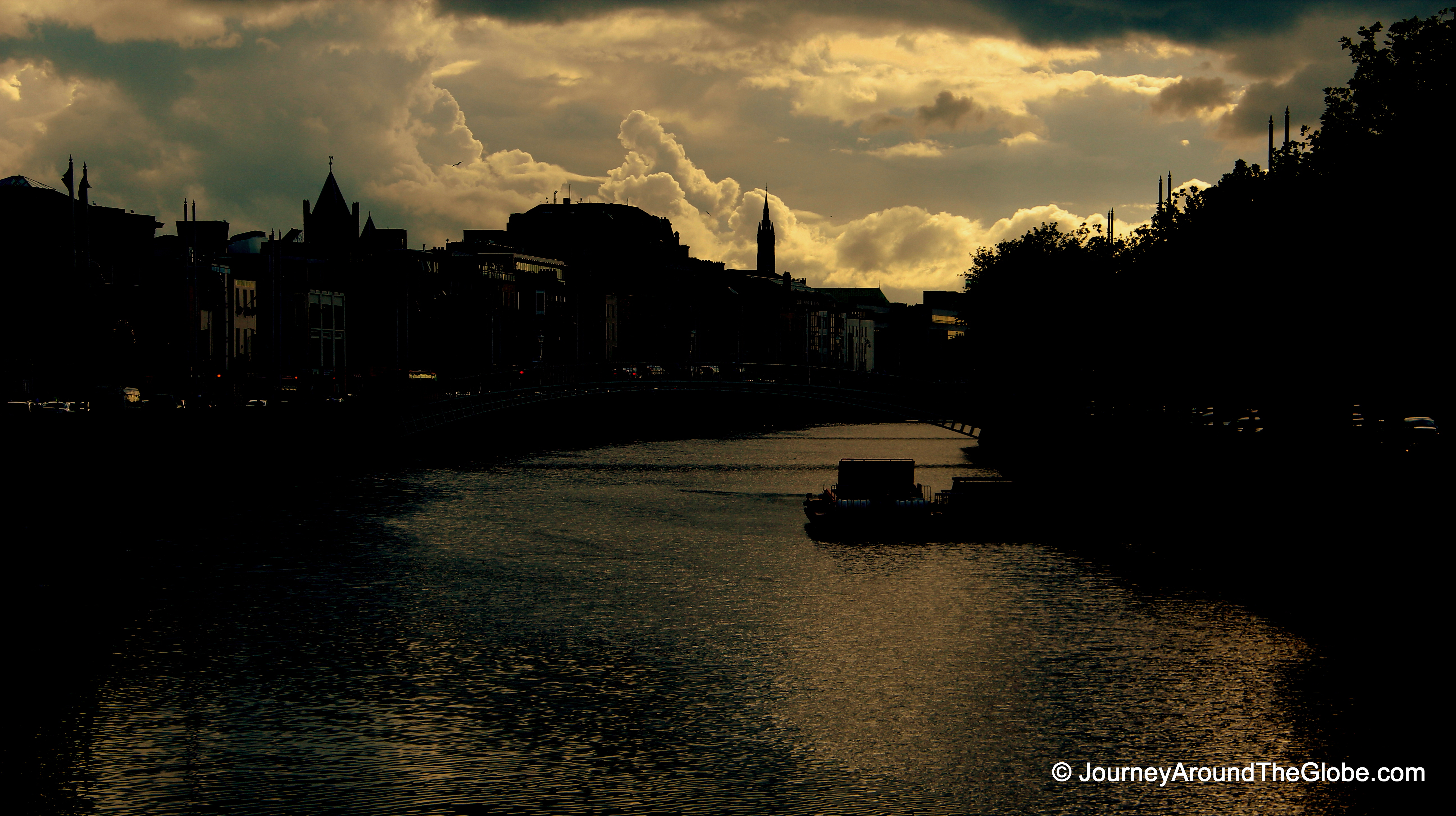
- View of River Liffey and the city of Dublin from O’Connell Bridge during sunset
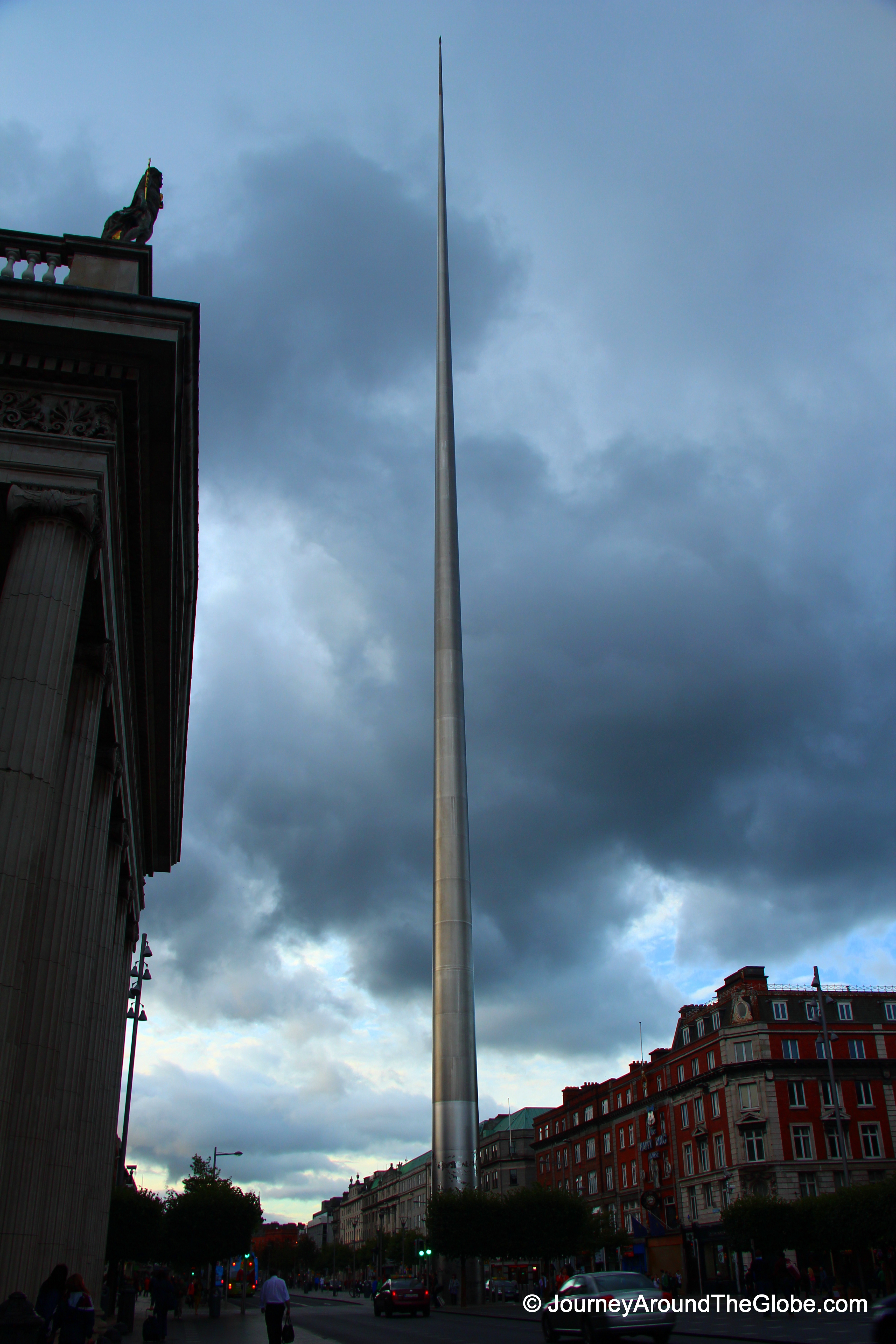
O’Connell Monument, built in 1882, is right near O’Connell Bridge as you are coming from south. And the Spire (built in 2003), one of the tallest sky-touching needles I have ever seen, is on one side of O’Connell Street. The small branches of O’Connell Street are very impressive and charming as well.

- The Dublin Spire on O’Connell Street and the building of General Post Office on the left
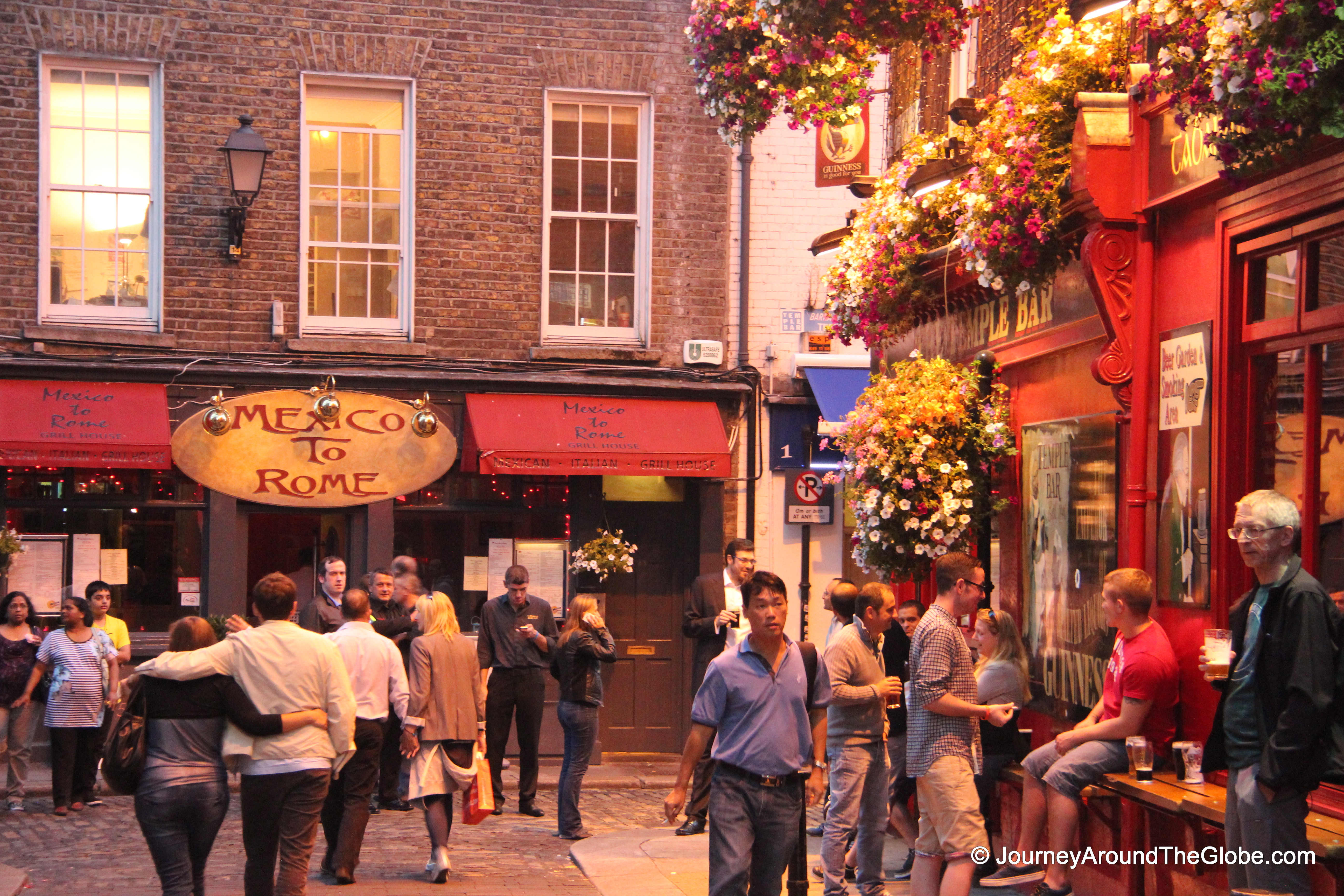
2) TEMPLE BAR: Nightlife here in Temple Bar is definitely noteworthy. This is where the good stuffs are happening in Dublin. I don’t think this place ever sleeps. It becomes more beautiful and more crowded after evening. Temple Bar consists of few streets and blocks mostly cobbled-streets for pedestrians. You will see colorful flower baskets in front of most of the restaurants and pubs. This is the best place to hang-out and have a drink or meal. Most of the restaurants here are traditional Irish pubs and usually have live performers, singers, comedians every night, especially in weekends.

- Temple Bar, the first building in Temple Bar area, on the right and Mexico to Rome, where we ate one night
3) ST. PATRICK’S CHURCH: This is a giant edifice with English style Clock Tower right beside St. Patrick’s Park. The Normans built a church in stone on this site in 1191. This was rebuilt in the early 13th century and is the building we see today. This is a lovely church as well as a great museum for those who loves history. The writer of famous book “Gulliver’s Travel” Jonathan Swift’s grave is located in the south aisle of the nave of the cathedral. He was the Dean of this cathedral from 1713 – 1745 and wrote the book while he was in that position. His pulpit can still be seen although it is no longer used. The cathedral houses some memoirs of Jonathan Swift along with other previous deans. Pay attention to the sparkly and colorful tiled floor as you walk on them.
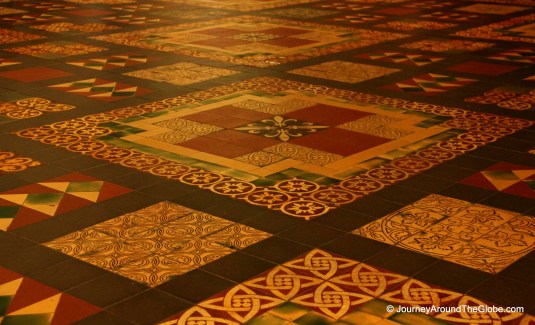
- The colorful tiled floor of St. Patrick Cathedral in Dublin, Ireland
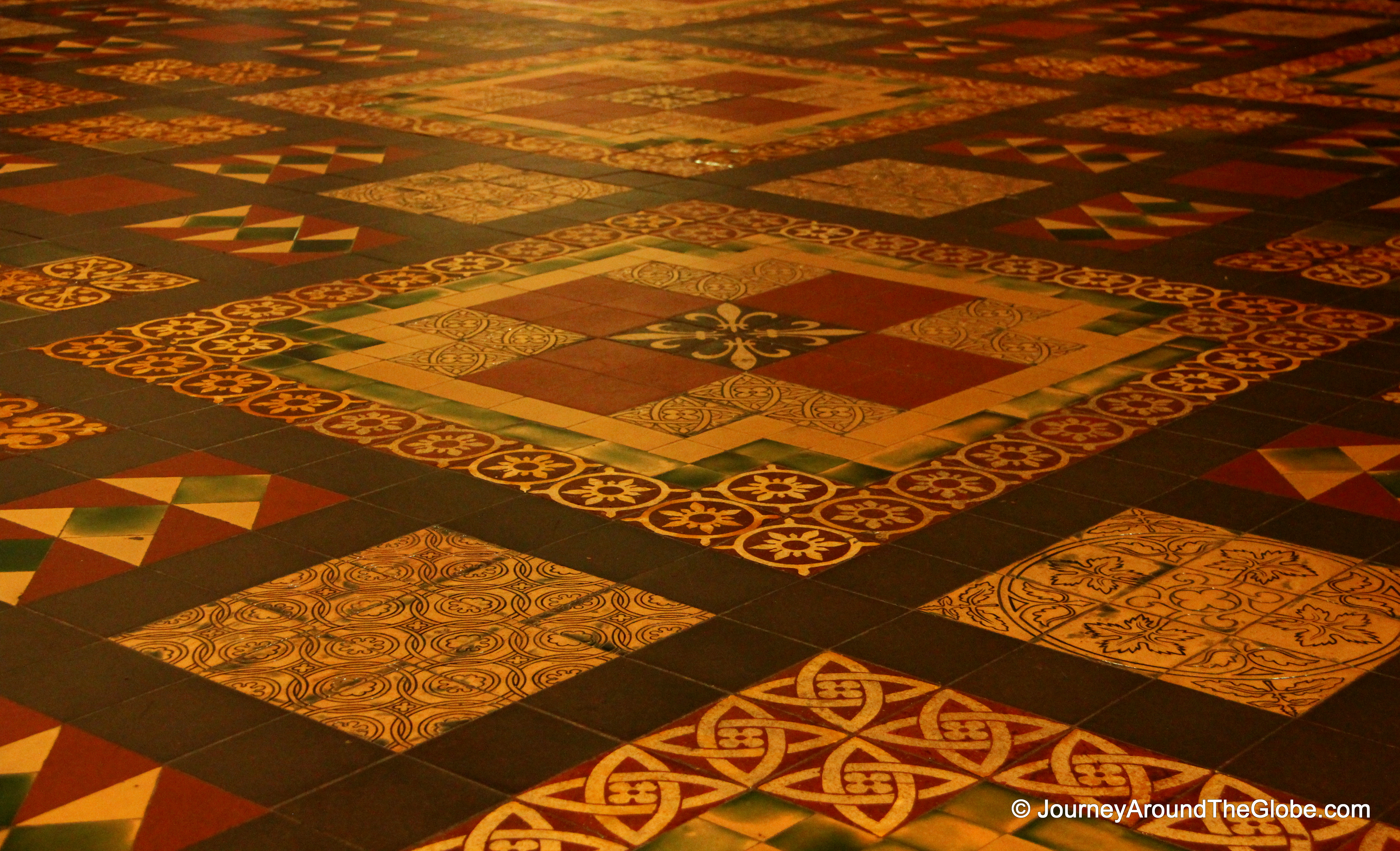
The church is open Mon – Fri: 9 – 5, Sat: 9 – 6. The fee to enter the church is 5:50 euros per adult and family ticket is 15 euros (2 adults + 2 children).

- Inside St. Patrick Cathedral, Dublin, Ireland

4) CHRIST’S CHURCH CATHEDRAL: This church was founded in 1030 A.D. making is the oldest building in Dublin. Christ’s Church Cathedral is very similar to St. Patrick’s Church inside and out. They both have similar English style outer look and very similar colorful floor design and altar. The church has a great collection of cathedral’s history, artifacts from royal gifts and communal ceremonies. Do go downstairs to visit the interesting crypt and treasury where visitors can see old costumes of the church’s members, the oldest foundation of the church from 11th century, old furniture, silverware, and ceremonial artifacts on display. The crypt is not only one of the largest medieval crypts in either Britain or Ireland, but also the oldest structure in Dublin. One interesting display in the crypt is the cat and rat (opposite the gift shop) – the one presumably chasing the other, were trapped in an organ pipe in the 1860s and became mummified. Another FYI, Christ Church Cathedral has a record-breaking 19 bells, the greatest number of bells in the world run full-circle.

- Christ Church Cathedral on the right and Dublinia Museum on the left in Dublin, Ireland
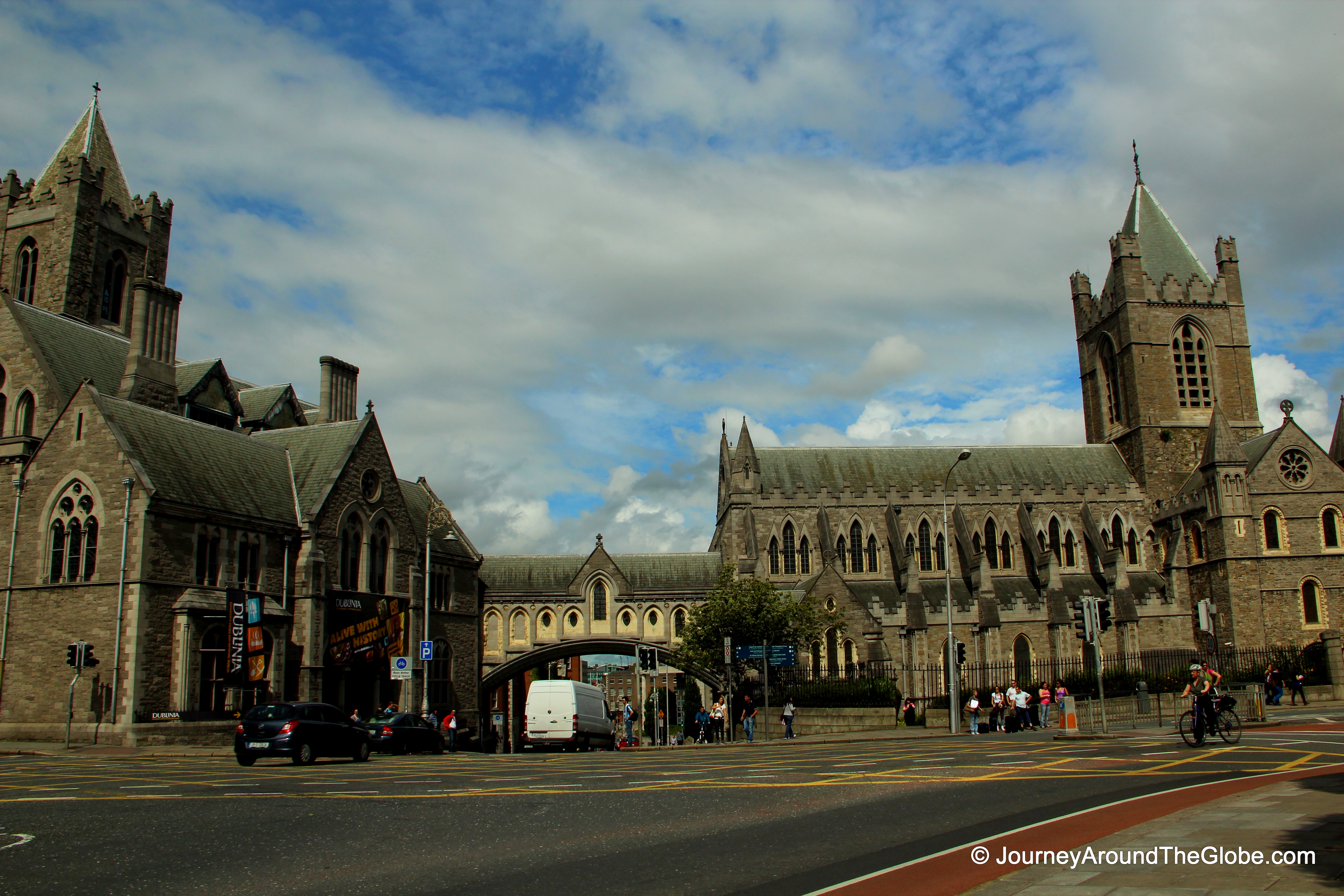
Christ’s Church Cathedral is open daily 9:45 – 6 in June – August and 9:45 – 5 in September – December. The crypt and treasury are open until 5. The entrance fee is 6 euros per adult, 2 euros per child, and 14 euros per family with 2 adults and 2 children. You can also get combo ticket for this church and Dublinia Museum for a cheaper price. You can go top of the bell tower for 4 euros extra and it takes about 30 minutes; kids 12 years or under aren’t allowed to go there.
5) DUBLIN CITY HALL: This is another grand building and an outstanding example of Georgian architecture situated right beside Dublin Castle. It was built between 1769 and 1779 by the Guild of Merchants. The building has been used as the city hall since 1852. The exhibition here displays story of Dublin, Ireland from 988 when the Vikings found this city, medieval life of this city, Ireland under British laws, history of their independence, and finally, how it got its modern face. If you are not interested in the history or exhibition, go to the Rotunda on the 2nd level, which is free of charge. This is a big circular hall with spacious dome, supported by 12 columns and beautiful art-works on the wall. There are few statues of the glorious sons of Ireland who played major roles in getting their freedom and to the society.
City Hall is open Mon – Sat: 10 – 5:15 and closed on Sundays and holidays. Exhibition of city hall is 4 euros per adult, 1:50 euros per kid, and 10 euros for family ticket (2 adults and 2 children).
6) DUBLIN CASTLE & SURROUNDING SITES: Unlike most of the castle we’ve seen so far, Dublin Castle is right in the middle of the city and right beside the town hall. The castle was established in 1204 A.D. We walked right in the inner courtyard of the castle which has relatively new buildings on all the sides. The courtyard featured some sand sculptures in the center and we saw an artist working on his project to make a sand-sculpture surrounded by other finished sculptures. We didn’t really go inside the castle, just spent some time walking around outside. There is a small chapel, called the Chapel Royal, near the Record Tower (with 15 ft. thick walls), which functioned as a top security jail for State prisoners in the old days and is the last intact medieval tower of Dublin City. Go around the other side of the castle where you will see few museums, and entrance to Dubh Linn Garden which once was the original site of Dubh-linn harbor (Black Pool in Gaelic) from which the city got its name from. The gardens are designed as a helicopter landing pad, with a pattern of six interlocking brick pathways (inspired by Celtic design) that are distinctive from the air. The Coach House, a mock-Gothic stone façade opposite of the main entrance, was constructed to house the Lord Lieutenant’s own coach and string of horses. Chester Beatty Library, located on one side of this garden, is a world-renowned art museum and library containing a rich and diverse collection of prints, drawings, books, miniature paintings, and decorative arts from Asia, the Middle East, North Africa, and Europe. We didn’t go inside the library, but you can see Egyptian papyrus texts, illuminated copies of the Koran, the Bible, and European medieval and Renaissance manuscripts.

- Sand sculptures in the inner-courtyard of Dublin Castle
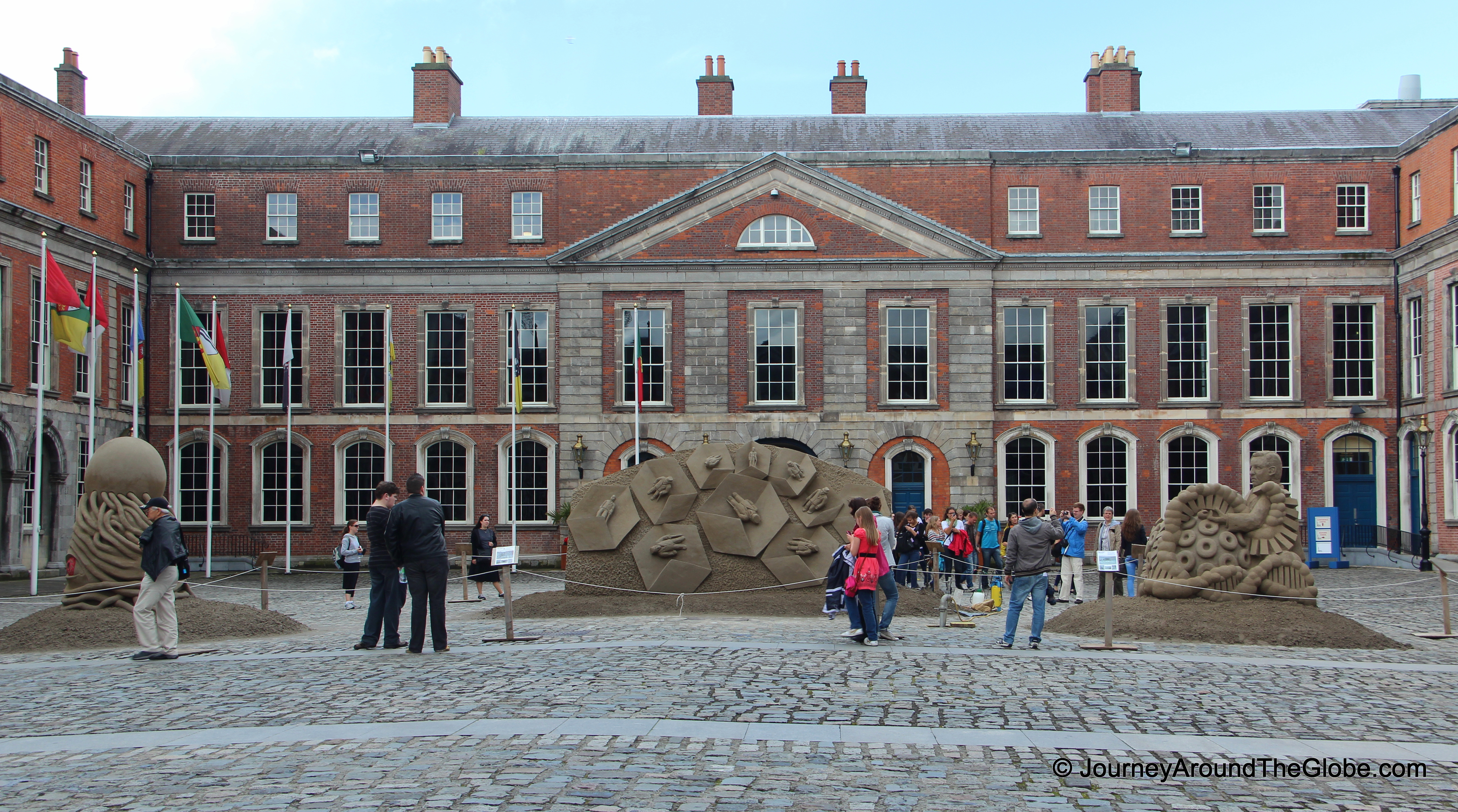
The castle is open Mon – Sat: 10 – 4:45, Sun & Holidays: 12 – 4:45. There is no entrance fee but you will need guided tour to go inside the castle that costs 4.50 euros per adult and 2 euros for kids less than 12 years of age.
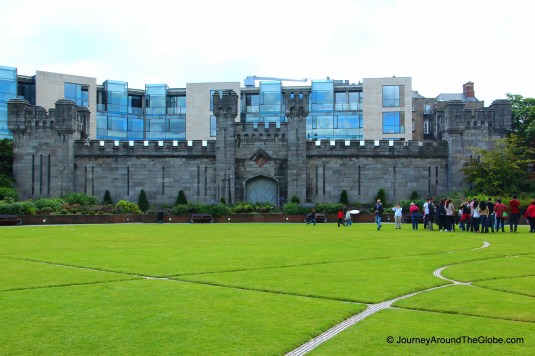
- Dubh-Linn Garden and the Coach House in the back in Dublin, Ireland

7) TRINITY COLLEGE & THE OLD LIBRARY: Trinity College is among one of the prestigious universities of the world and is beautifully situated in the heart of Dublin. It wasn’t that crowded in summer since most of the students were gone for the break. This Library square is very nice and calm where you can see the largest Oregon Maple tree in Europe from 1800’s.

- Entering the world-renowned Trinity College in Dublin, Ireland
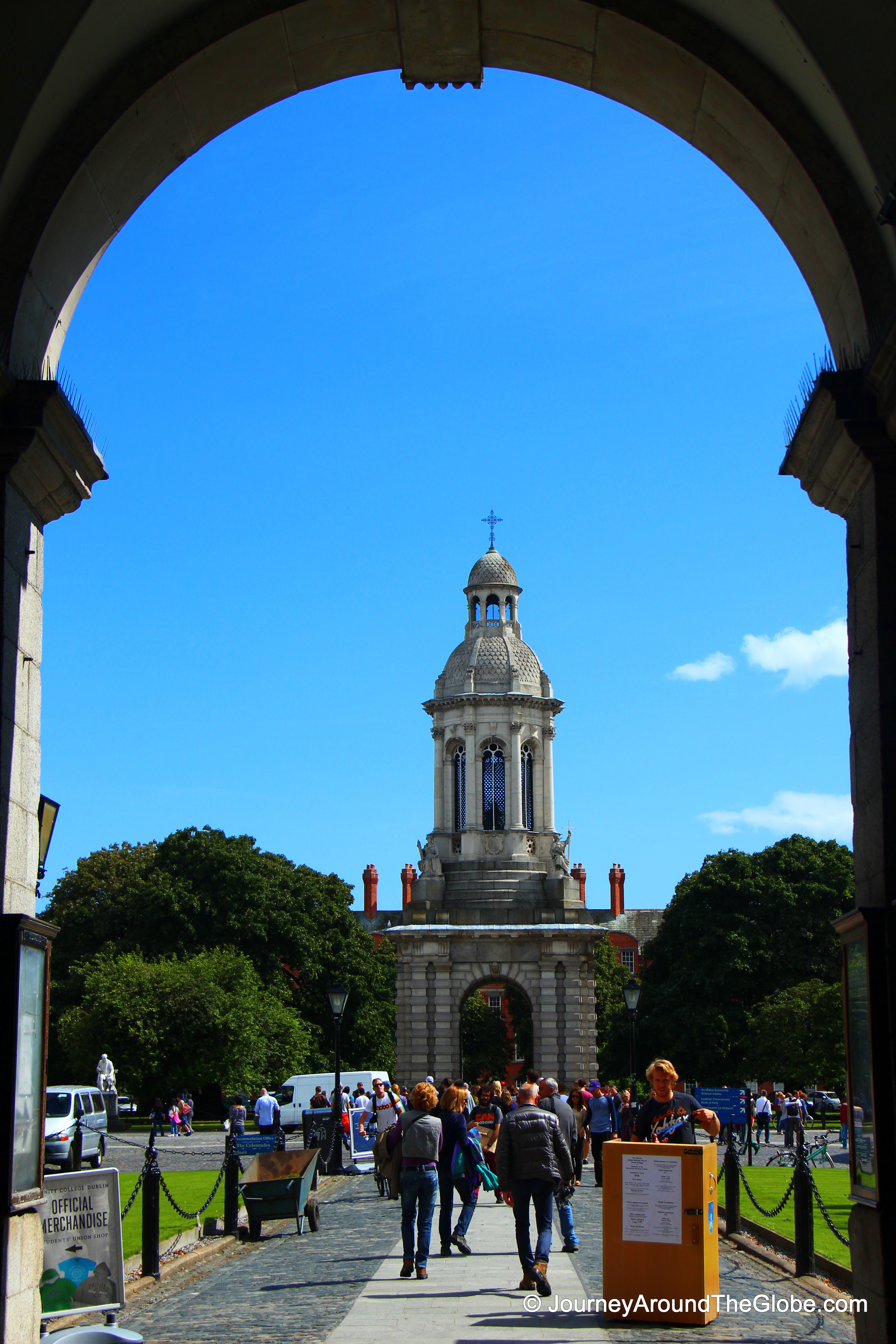
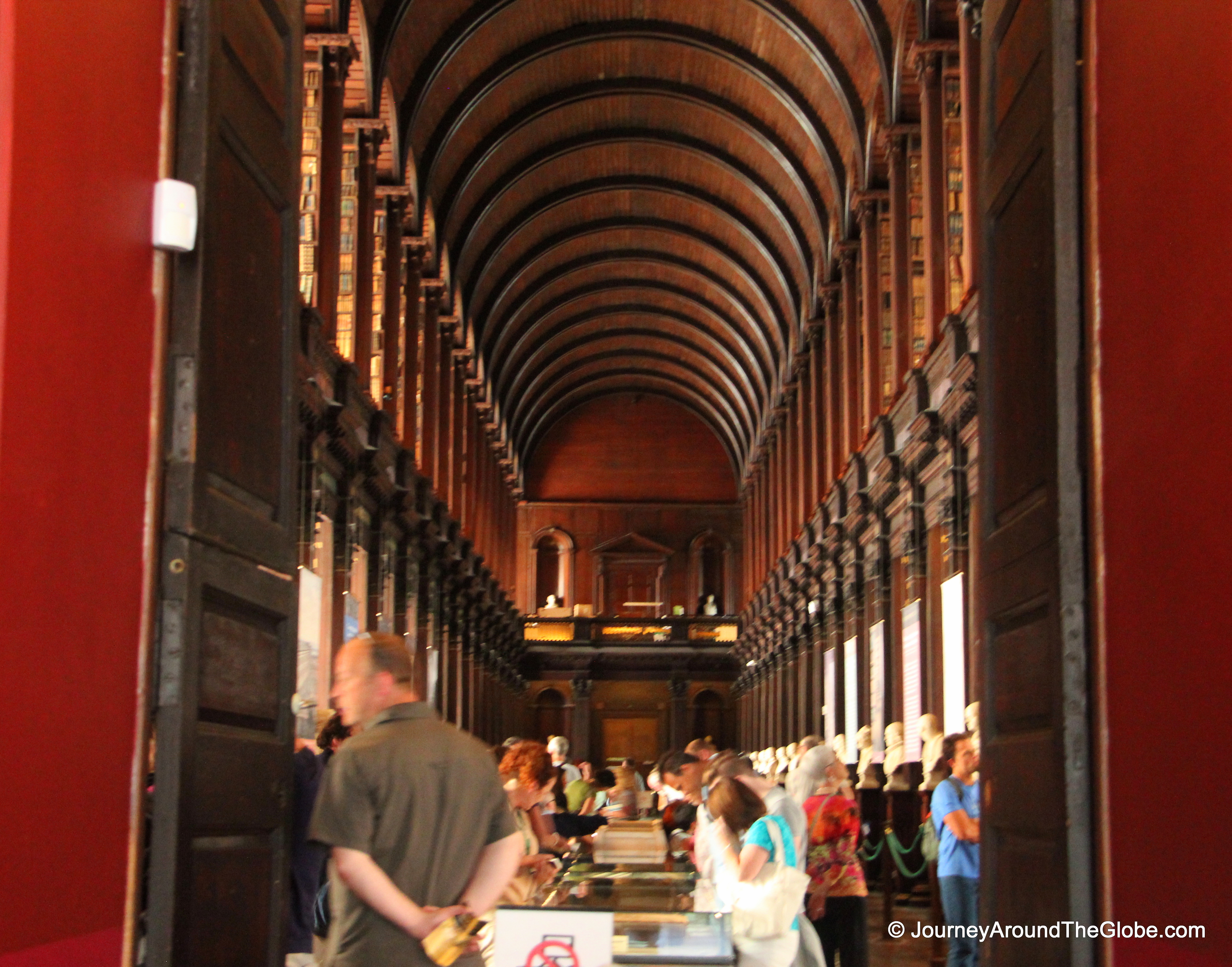
Most of the visitors come to visit this college mainly to see its Old Library and Book of Kells (about 1 million visitors every year)…the cream of Irish beauty. Trinity College Library Dublin is one of the world’s great research libraries, holding the largest collection of manuscripts and printed books in Ireland. The earliest surviving building, the Old Library, was built between 1712 and 1732. The exhibition area of the Old Library displays Irish medieval gospel manuscripts, principally the gorgeously illustrated and colorful calligraphy of original manuscript of the Book of Kells, the Book of Armagh and the Book of Durrow along with the history of these prints. These books were written in around 800s by Irish monks. The main chamber of the Old Library, the Long Room, is about 65 meters in length and houses around 200,000 of the Library’s oldest books. The oldest surviving harp from Ireland, probably dating from the 15th century, is also displayed in the Long Room. As an early emblem of early society, this is the harm which appears on Irish coins. The Long Room also has busts of many famous intellectual people like Newton, Aristotle, Shakespeare, Socrates, and many more. It kinda feels overwhelming being among thousands of old books, and manuscripts.
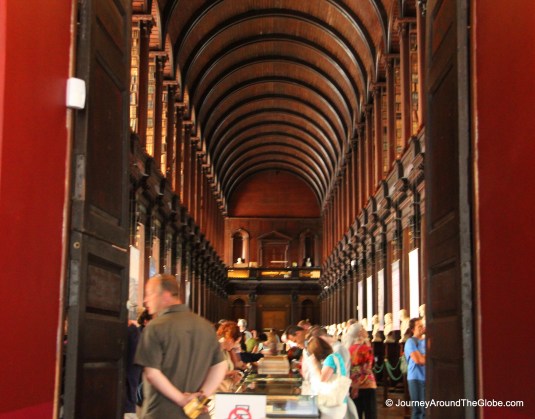
- The magnificent Old Library of Trinity College in Dublin, Ireland
We, luckily, found a young guy selling tickets for walking tour in the university (Old Library is self-guided) near the main entrance. The tour costs us 10 euros per adult (kids are free) for 30 minutes which allows you to go to the Old Library as well. This was a good deal not only because the guide is a student of this college who can give you practical insights of this place but also you can use the same ticket to enter the library of Trinity College which is otherwise 9 euros. Be ready to stand on the line for a while to go inside the library. Pictures aren’t allowed in the exhibition area and in the Long Room.
8) AN POST MUSEUM: This is the general post office on O’Connell Street which was captured by Irish rebels on Easter Monday in 1916. This is one of the iconic buildings of Dublin that played a big role on their independence. The museum displays old stamps, videos/information on the early methods of delivering mails and parcels. The main reason we went to this museum was to see what actually happened on that Easter Monday in 1916 and surely, the video in the museum provided us with those great historical moments. An Post Museum is open Mon – Fri: 10 – 5 and Saturday: 10 – 4. The entrance fee is 2 euros per adults and free for the kids.
9) TRIP TO BELFAST: Belfast, the capital of Northern Ireland, is very close to Dublin…only 2 hours and 30 minutes of scenic train ride. The city itself is very beautiful and vibrant. There are few guided tour bus services that you can take to visit the coastal side of the country and go to Northern Ireland’s only UNESCO World Heritage site Giant’s Causeway. Please visit my page on Belfast from the side bar to see all the fun things you can do in Belfast.
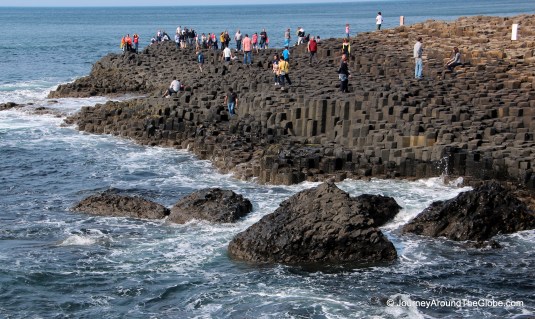
- Giant’s Causeway – the only UNESCO World Heritage Site in Northern Ireland
Related articles
- Beautiful Day over the Dublin’s Liffey River (mydigitalphotographyblog.wordpress.com)
- A night in Dublin and an amazing day tour (thechroniclesofireland.wordpress.com)
Share this:

A weekend in Belfast, Northern Ireland
BELFAST, NORTHERN IRELAND: This is the home of Titanic, where this famous ship was built. This is a city with lots of characters and history. This is relatively an under-discovered place compared to its neighboring big city Dublin. Belfast went thru lots of conflicts and bloodshed in the recent years among the Nationalists and the Loyalists. Whole Northern Ireland is a beautiful country with abundant scenic beauties by the coasts, giant cliffs, cozy small villages, medieval castles, and plenty of jolly Irish people.

- Belfast, Northern Ireland
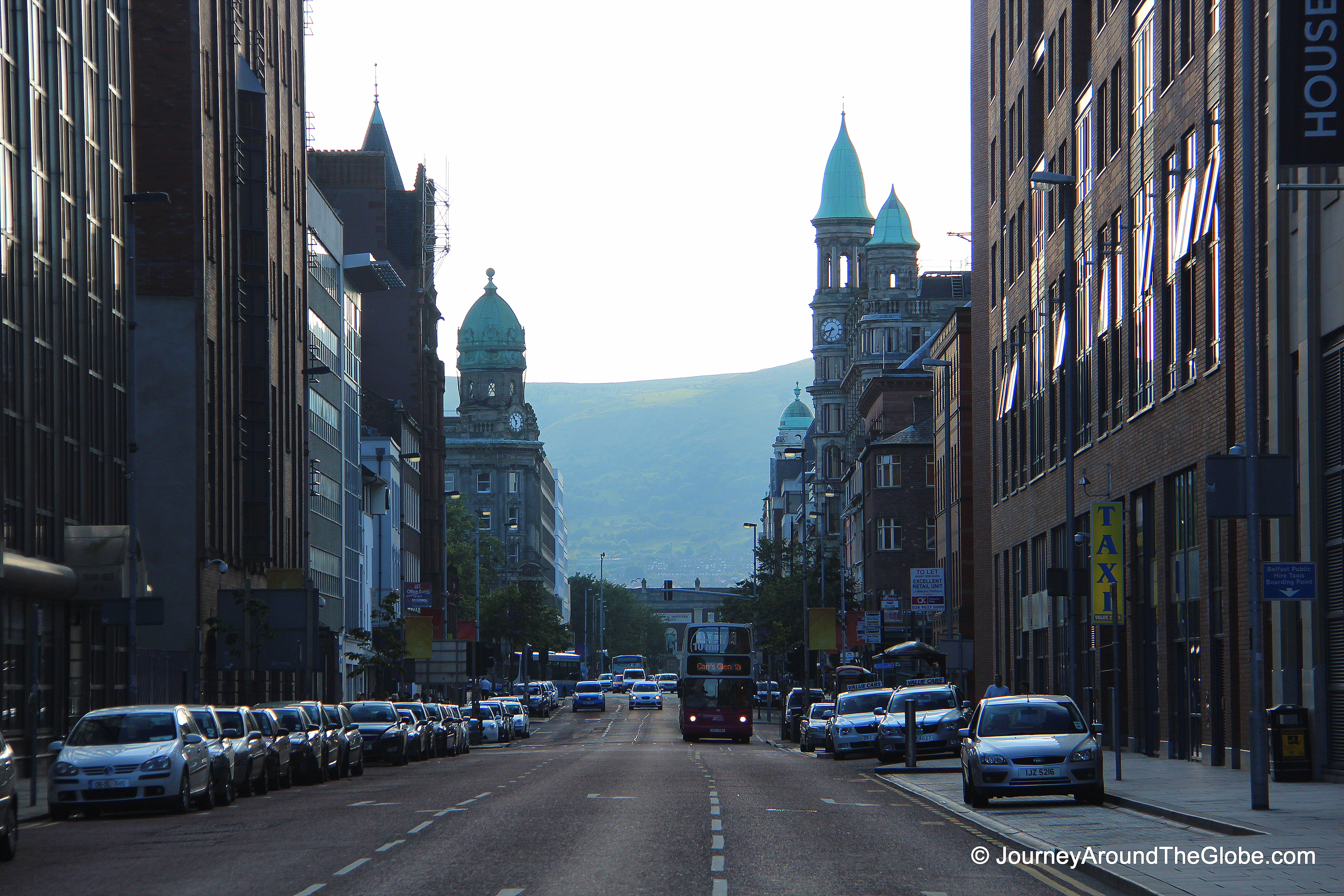
The city is very lively around the town hall and city center. Most of the landmarks are very close by and within walking distance from here, except for Belfast Castle, Titanic Museum, and the historical murals of Nationalists and Loyalists from the “Troubled Years”. All the famous roads, places, or squares that we’ve visited had information boards providing histories and maps on that particular place. Black Taxi tour of the city is very famous here and can be arranged by any hotels.

- Walking around in Belfast, Northern Ireland
TIME OF TRAVEL: We came to Belfast during the 2nd week of August, 2012. We thought we were going to get some rain during our visit, but luckily, the sun was shining upon us most of the time.

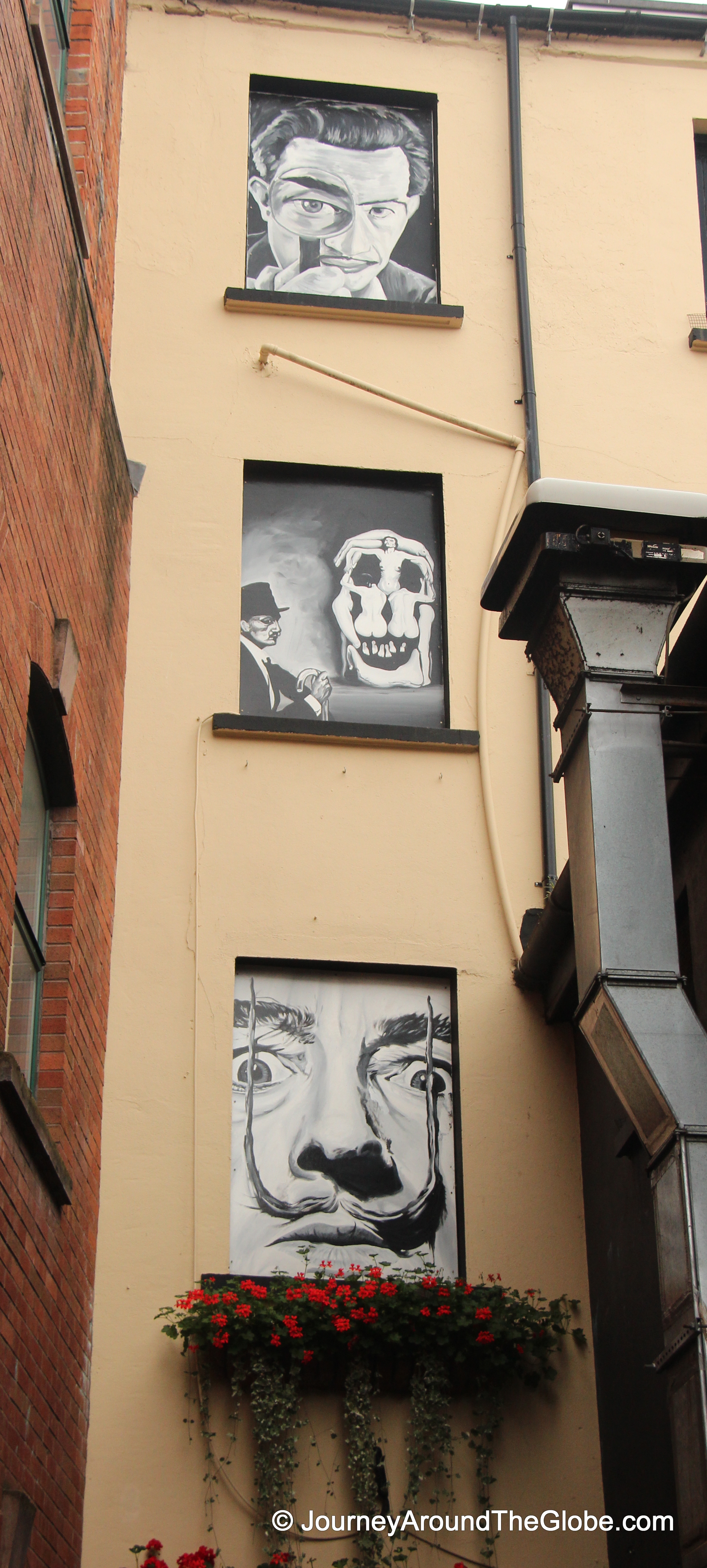
- Belfast – home of many interesting murals

OUR HOTEL: Our hotel was Holiday Inn Belfast here. Being so close to Belfast Town Hall (about 10 minutes’ walk), this location was just great for us. The hotel didn’t have free breakfast or Wi-Fi (except for the computer in the lobby) but did have great customer service.
WHAT TO EAT AND BUY IN BELFAST: We ate twice in an Italian restaurant called “Pizza Express” which was very close our hotel. But something Irish that my husband tried on our way to Giant Causeway was Irish stew made with lots of potatoes and some beef looked pretty good.
There are lots and lots of things to buy from Belfast, like Celtic jewelaries, arts and CDs, leprechaun, cool t-shirts, and many more things. Also, since the famous ship Titanic being was built here, you will see lots of items related to Titanic in Belfast. There are couple souvenir stores in the city center near the Town Hall. Try looking for a store called “Carroll’s”, which is the biggest one we saw here. Also if you go to Giant’s Causeway, you will see lots of arts and wall decor on Northern Island, especially on Giants Causeway and many children book on the story of the giants of Ireland and Scotland.
PLACES WE’VE VISITED: Here are the things we covered in our 1 ½ days of stay in Belfast. We couldn’t go to Titanic Museum, where the ship was built and Belfast Castle. We did go in front of Victorian architecture Grand Opera House, Presbyterian Assembly Building on Howard Street, and St. George’s Market (one of Belfast’s oldest attractions) but didn’t go inside any of these. All the places that we visited were within walking distance.

- A pro-Palestanian poster on Falls Road, home of many Nationalists

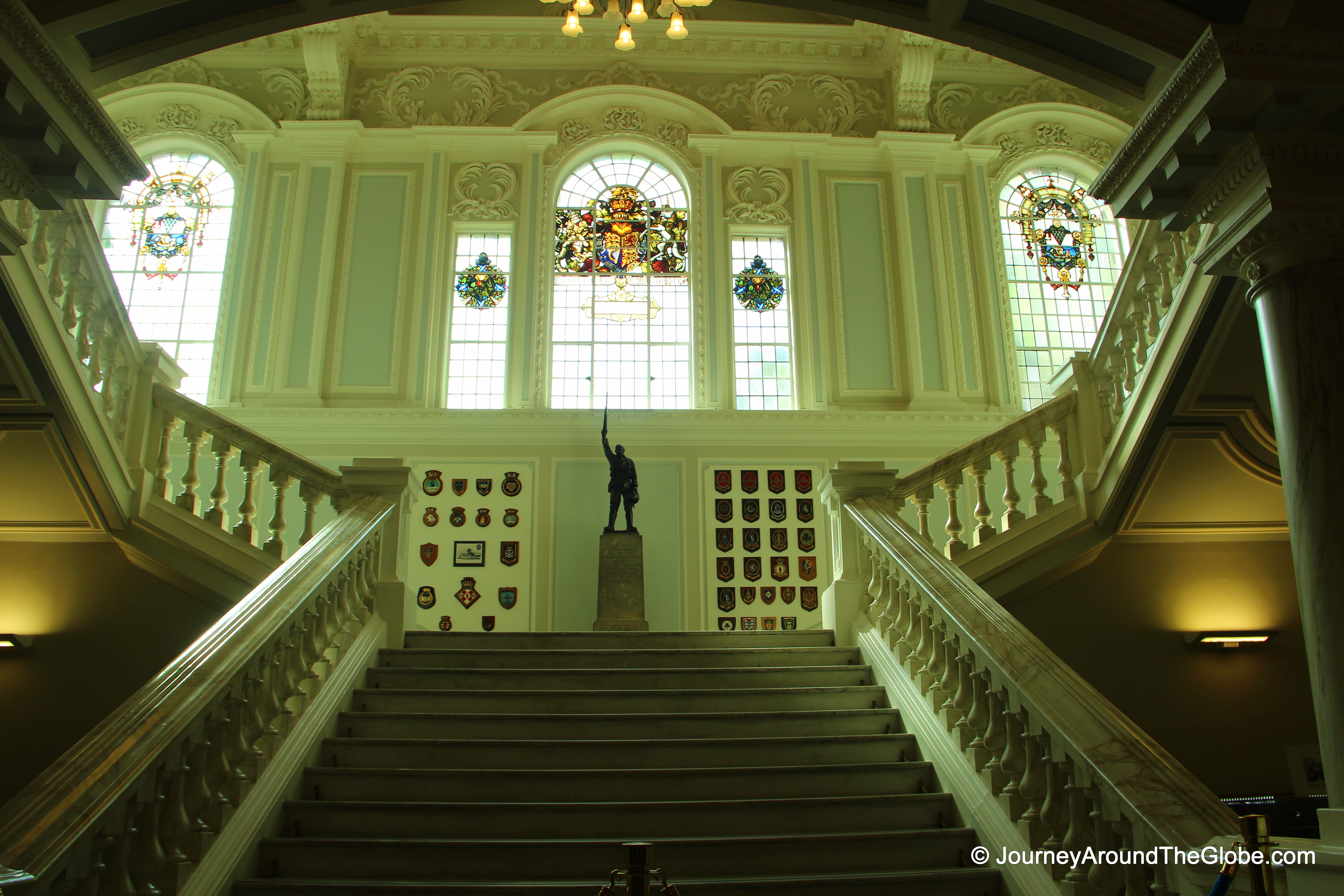
1) BELFAST TOWN HALL & DONEGALL SQUARE: This is a fine example of classical Renaissance style architecture. You can take a free guided tour of the town hall from Mon – Sat: 11 – 3. We couldn’t catch it since they don’t have anything on Sundays. But we did go to the courtyard and the main lobby. The lobby looks very beautiful with some stained-glass windows, mosaic floor, and a high dome. There is a very informative exhibition on the 1st floor (for free) which features city’s past and current life style and history of the city.

- From the main lobby of Belfast Town Hall
The surroundings of this building are very beautiful too. Front of the town hall is a big grassy space where all the locals hang out and chill. Olympics 2012 was going on when we went to Belfast and they put a huge TV out in front of town hall. It was pretty sight of seeing all the locals so enthusiastic about the Olympics. There are many statues of different types of cows with many arts and colors. I am sure your kids will enjoy posing with those cows, I know mine did.

- Belfast Town Hall in Northern Ireland
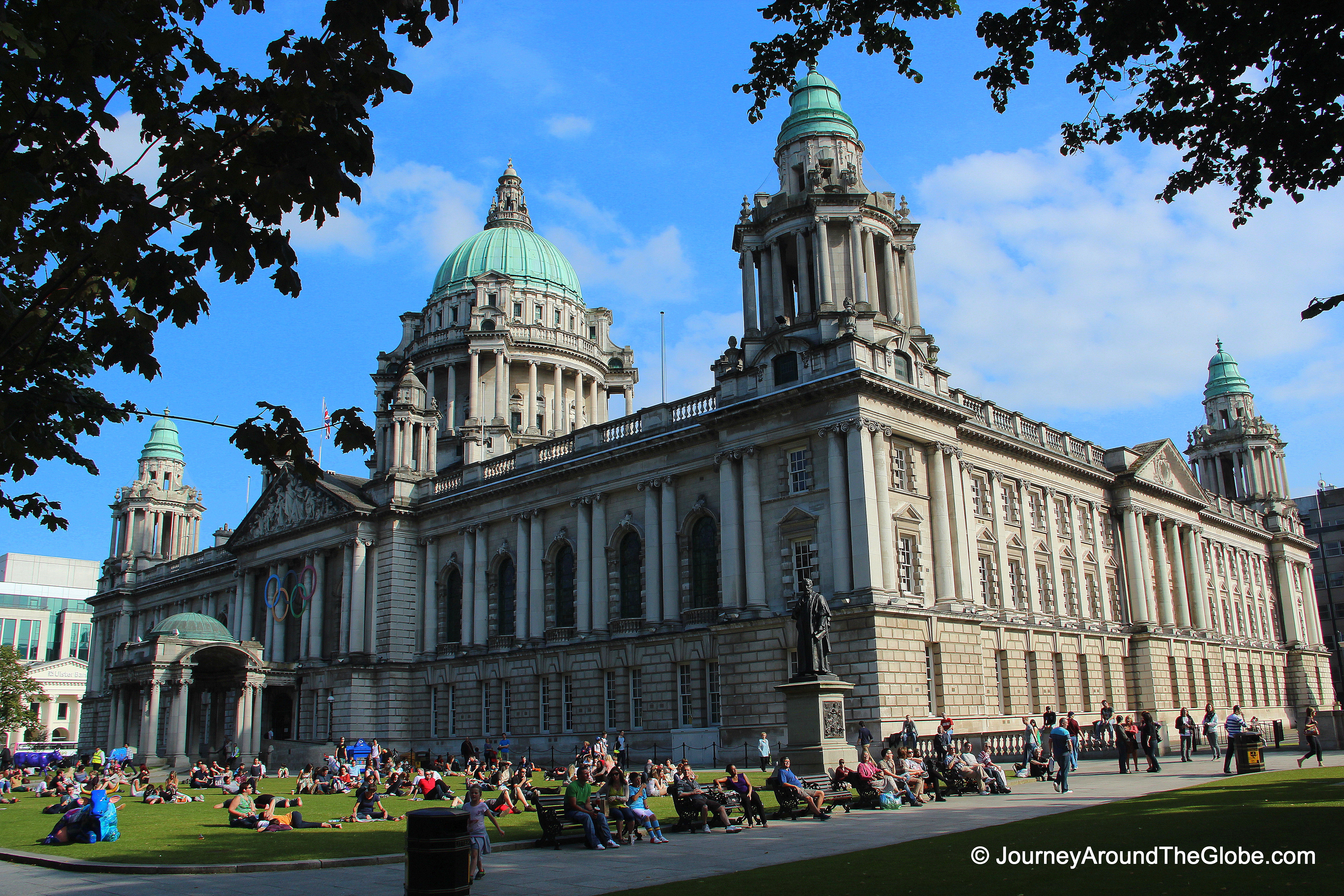
Donegall Square has to be the heart of the city where all the fun things are happening. This is the street right in front of Town Hall. It’s fun to just stroll here, do shopping, eat, and just enjoy the atmosphere.
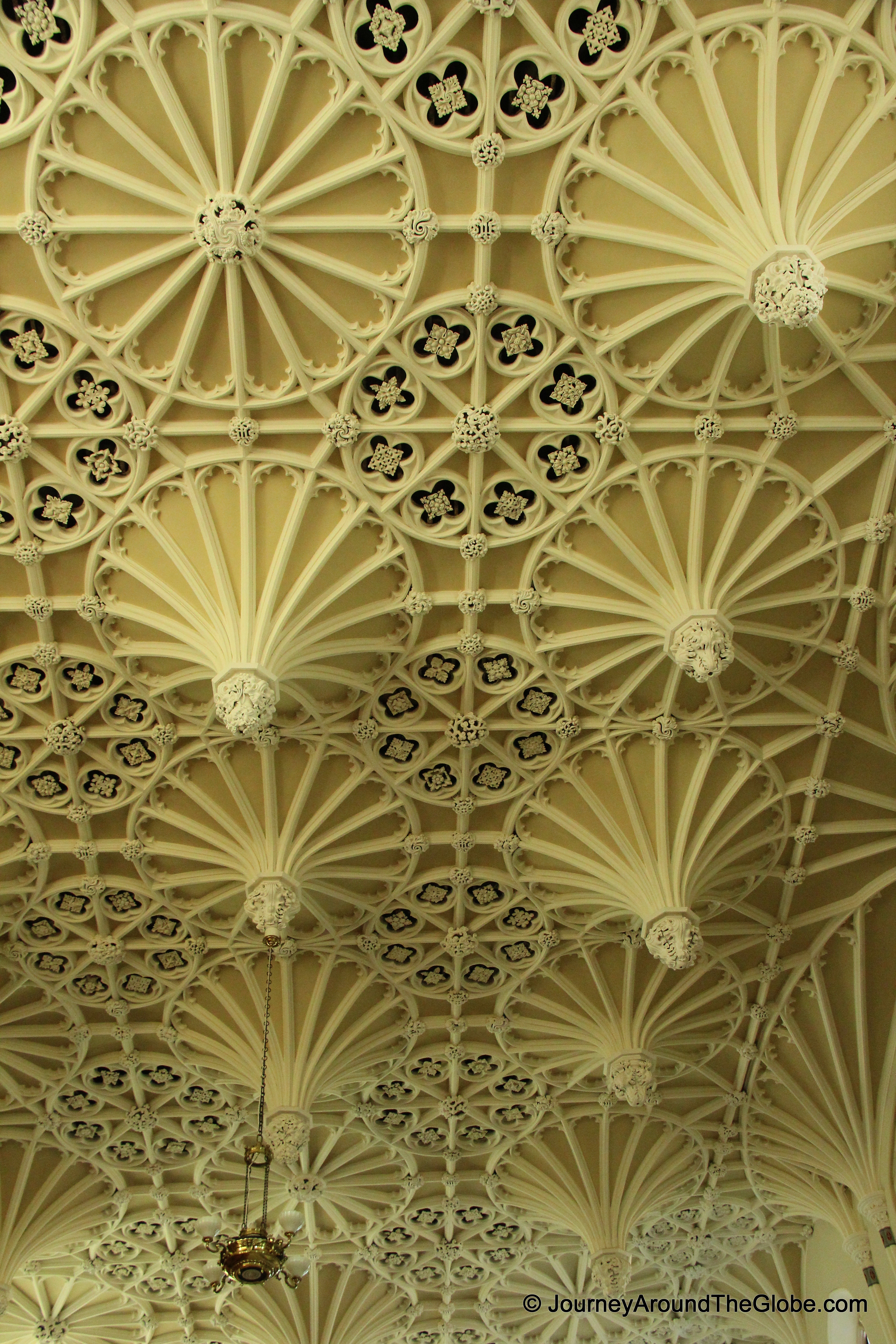
2) MALACHY CHURCH: This wasn’t on our to-do list for Belfast. We were walking towards the town hall and this romantic building caught our eyes right away and we had to checkout inside of the church. Construction of this building completed in 1844. This is one of the finest examples of late Georgian-Tudor Revival Churches in Ireland. Exterior looks more like a castle than a church and the interior is something we’ve never seen before. St. Malachy’s Church, regarded as an architectural gem, with detail in textures, subtlety in color and richness of imagery, creates a peaceful sanctuary in the midst of the bustling city. Altar was more than just elegant and the design of the ceiling looks like an upside down wedding cake with many candles. The back wall of the church features 14 stages of Passion of the Christ in rich wood-curved wall hangings with great details.
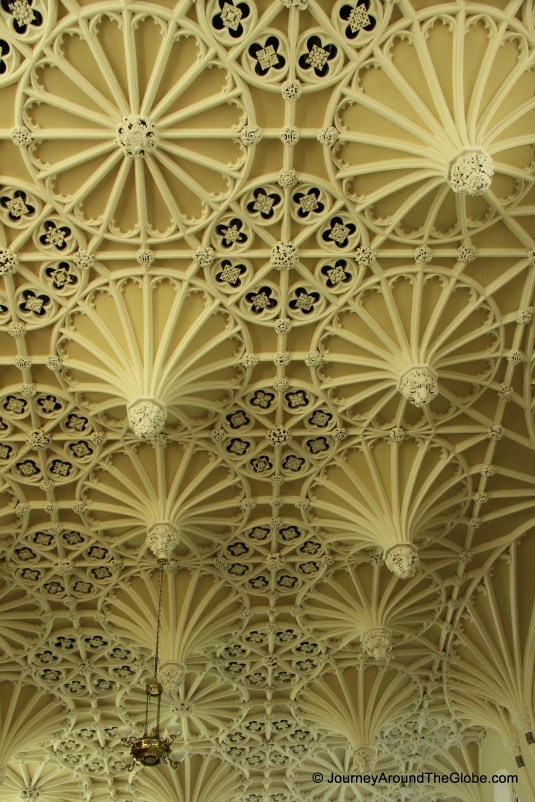
- Ceiling of Malachy’s Church that looks like an upside down wedding cake
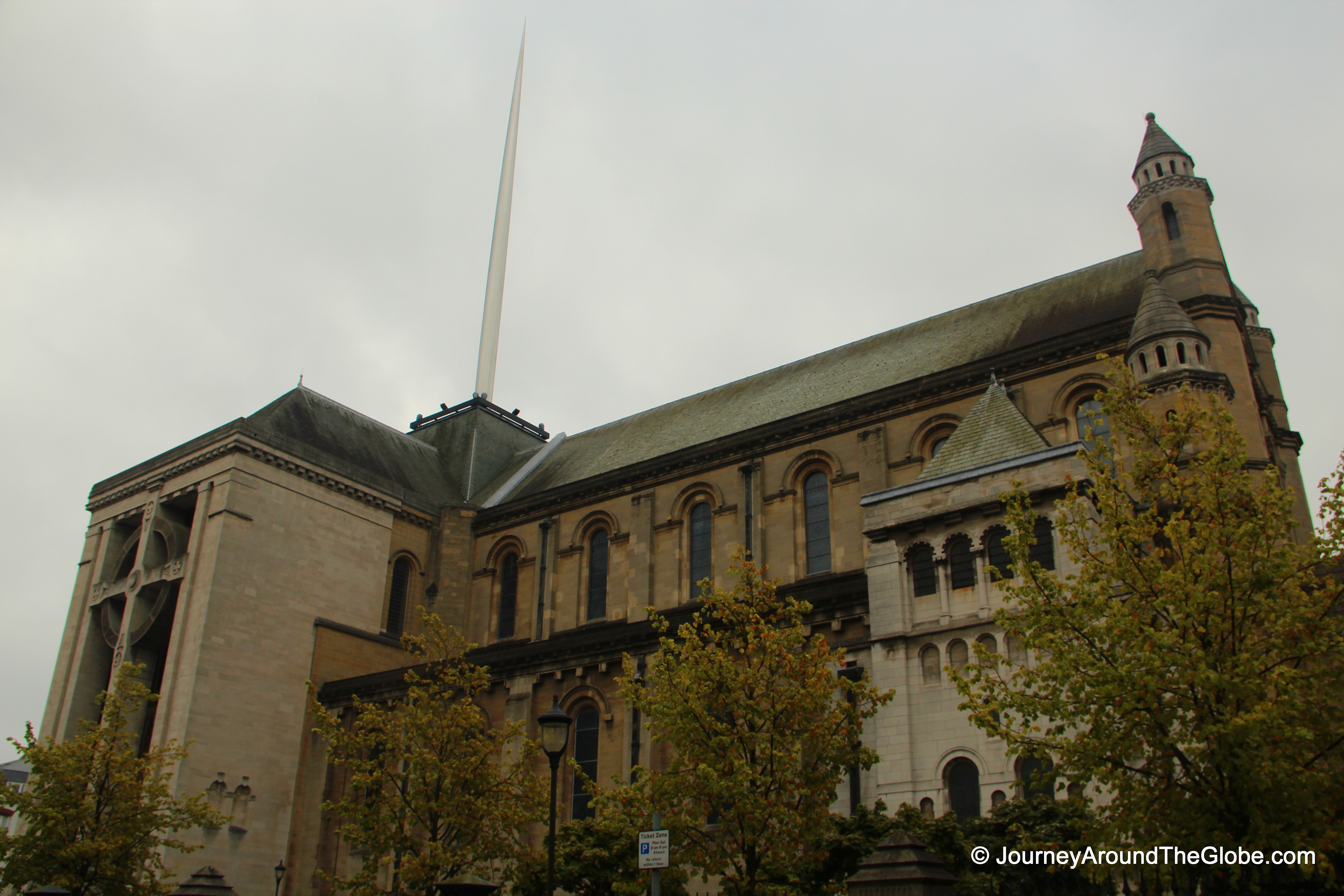
3) ST. ANNE’S CATHEDRAL or BELFAST CATHEDRAL: This is a stunning cathedral inside and out. The church has the biggest Celtic cross in Northern Ireland which is located on one of the outside walls of the church. The unique stainless steel spire was added in 2006 that can be seen from far distance. It was dedicated to all the fallen of 9/11 terror attack in NYC in the presence of the Bishop of New York. The original organ was built in 1907. The church is decorated with some fascinating stained-glass windows, tablets, plaques, flags, and statues. The place is free to enter to visit every day from 8 am – 4 pm.

- The spire and the biggest Celtic cross (on the left) in Northern Ireland of St. Anne’s Cathedral in Belfast
4) LAGAN LOOKOUT & BIG FISH: This is a nice place to sit-down for a while just to enjoy the river and the city surrounding it. If you are walking straight from Albert Clock towards River Lagan. You can’t miss the sculpture of monster blue fish of Donegall Quay called Big Fish, which is located right beside the Lagan Lookout.

- The Big Fish in Lagan Lookout
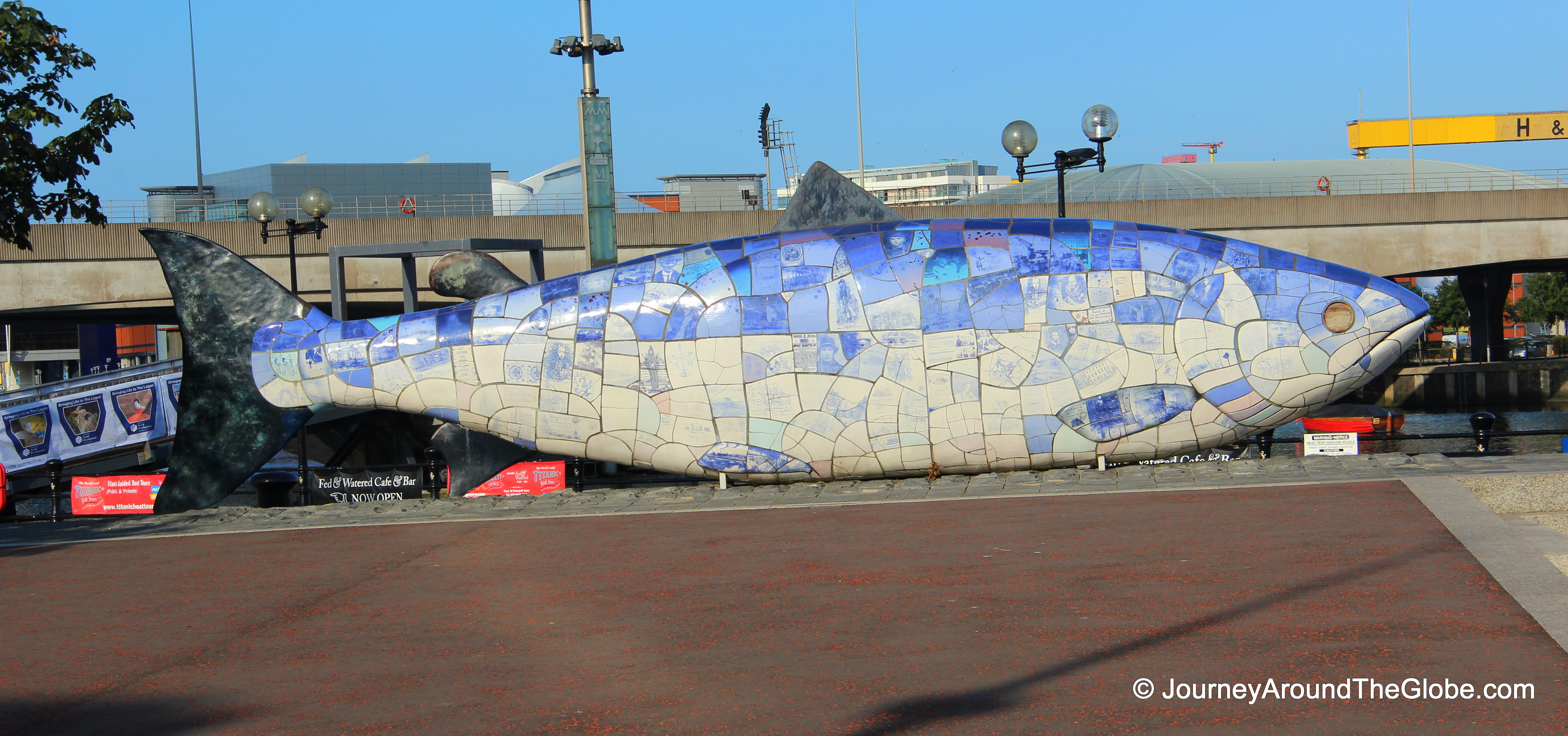
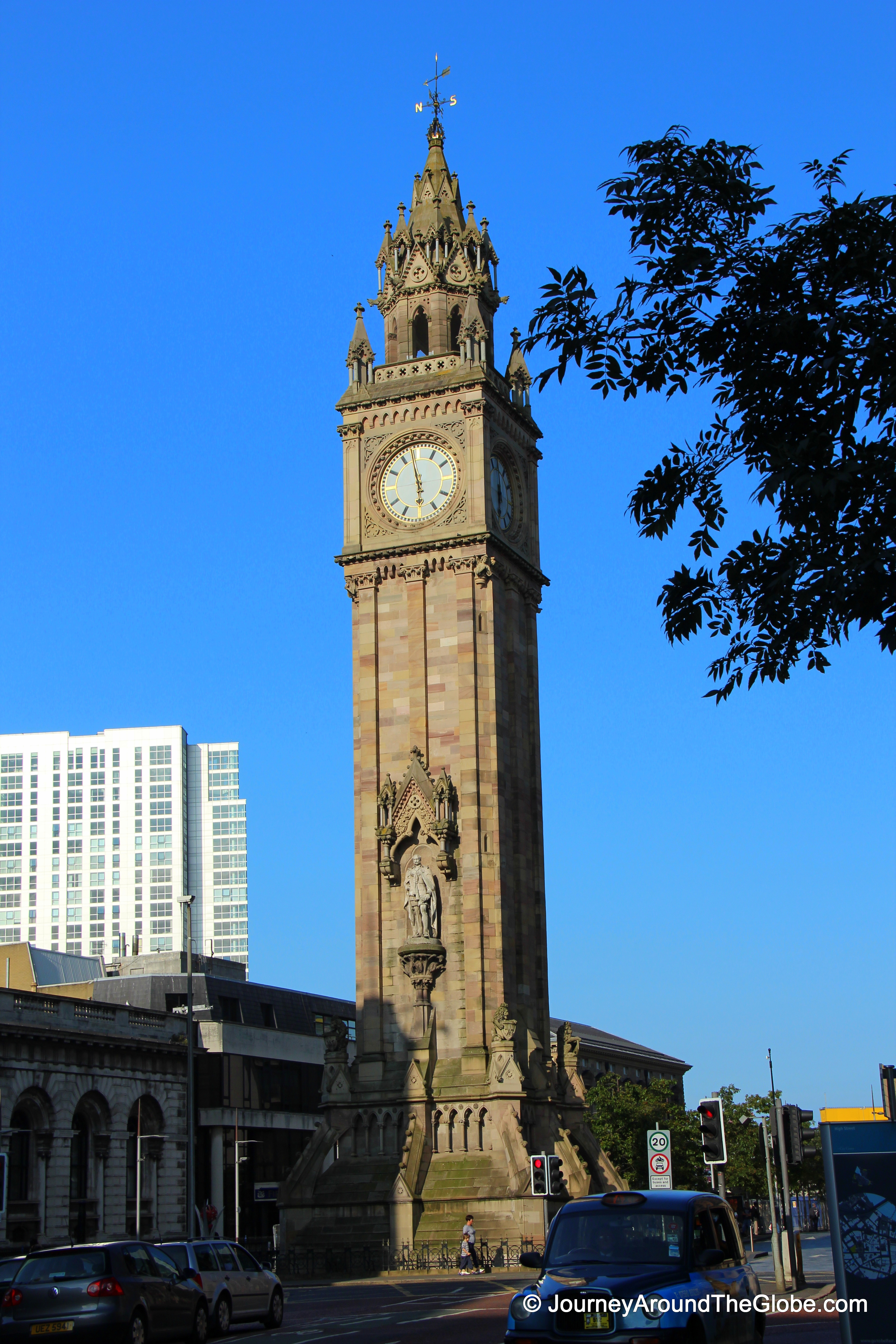
5) ALBERT MEMORIAL CLOCK: This is next to “the Custom House” by River Lagan and the blue fish sculpture. This 35 meters high tower was constructed mainly of sandstone and was erected in 1865. The Albert Memorial Clock was built as a memorial to Queen Victoria’s husband, Prince Albert, who died in 1861. It leans 1.25 meters off vertical, making it Belfast’s very own leaning tower. Another place that may interest to some people is that there is a 300 years old Irish pub called McHughs in between Albert Clock and River Lagan lookout. The bar has been standing there since 17th century and one of Belfast’s most historic pubs.

- Albert Memorial Clock
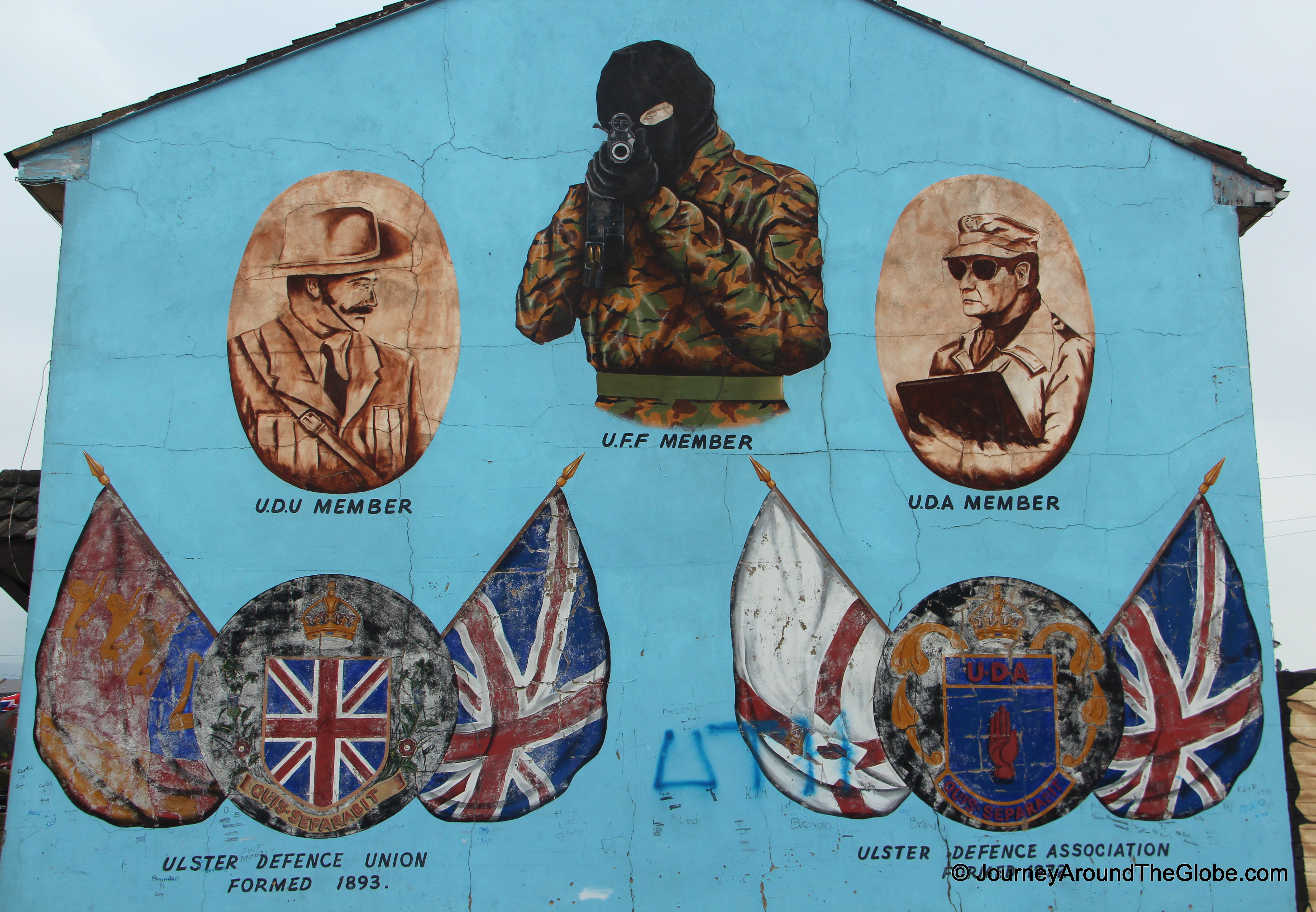
6) BELFAST POLITICAL MURAL TOUR w/BLACK TAXI: This is definitely a must do in Belfast to know better of its past and how the city came to its present atmosphere. Most of these murals are located in the ghettos and were done mainly by the poorer ones. Our first stop was at Lower Shankil among all the residential neighborhoods. “Nothing About Us…Without Us… Is For Us”, this was one of the messages in a mural we saw there. Here all of the murals were done by the Loyalists or Protestants who were loyal to the United Kingdom. These are some of world’s finest house-sized murals that depict stories of the Loyalists, praise their leaders, show their anger and hatred towards the Nationalists. Some of these murals were taken down due to some violent graphics; they simply don’t want their new generations to grow up seeing pictures of men with guns, murderers, and shooters near their houses.

- One of the murals in Lower Shankill, the gun man is targeting his gun towards a building where the Catholics/Nationalists used to live in Belfast, Northern Ireland
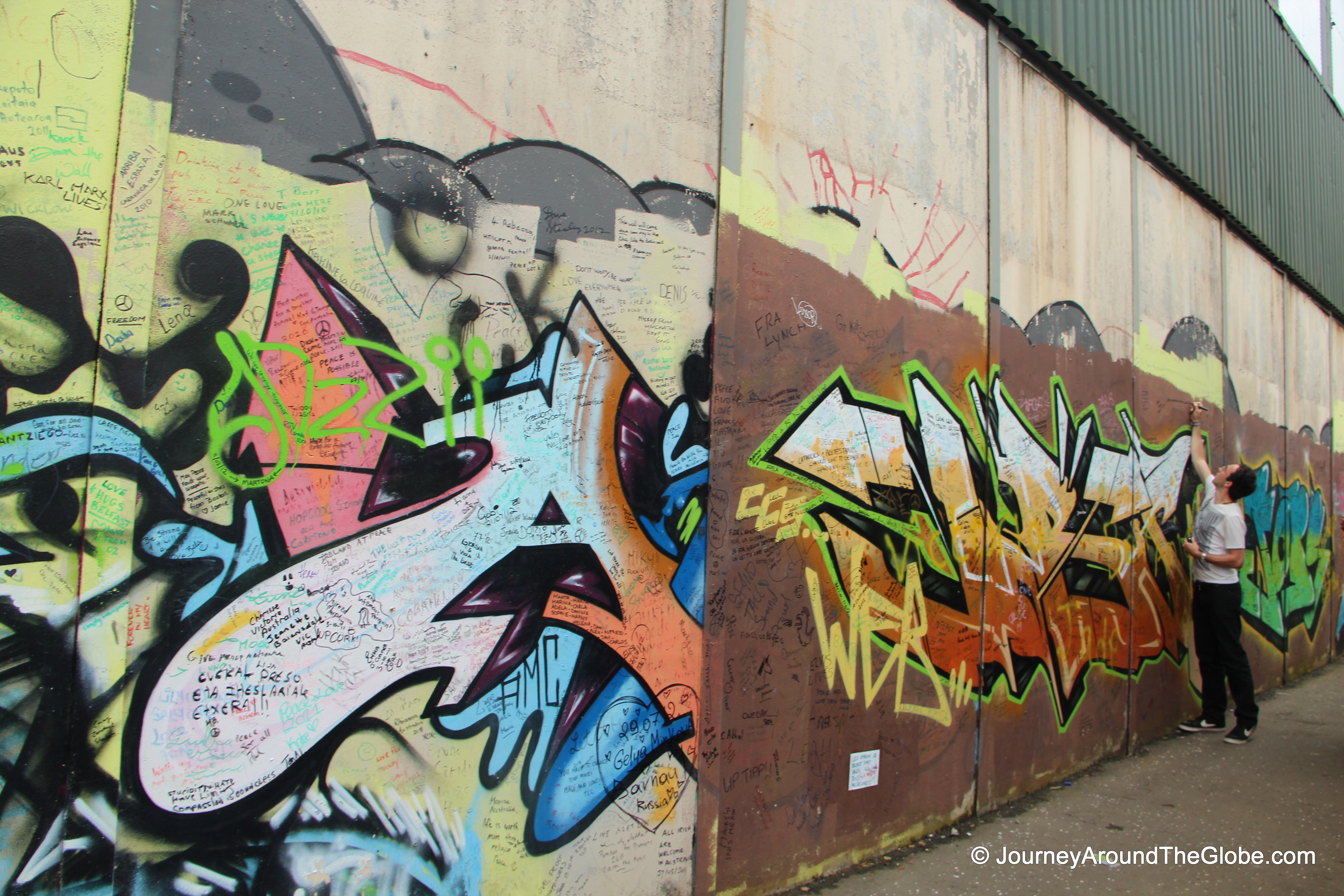
Then after passing the old Supreme Court and old prison we stopped at the Peace Wall. This was built by the government to separate Nationalist and Loyalist neighborhoods. Peace wall is about one mile long and now more like a message board filled with colorful graffiti. You will see quotes from many well-known people who visited this wall in the past and left their quotes on this wall, like Dalai Lama, Bill Clinton, Khalil Gibran etc. It’s a tradition for any visitors to leave their comments and “Peace” messages on this wall to the people of Belfast. You can easily spend a good amount of time walking along this wall and reading wonderful phrases that people left behind from all over the world.

- A visitor leaving message on Peace Wall in Belfast
After passing a small memorial, Clonard Martyrs Memorial, dedicated to those who were killed by Loyalists and British Forces during the course of conflict on Bombay Street, we stopped at Falls Road. This is the place where you will see all the murals done by the Nationalists or Catholics depicting their side of the stories. Lots of these graphics show faces of Nationalists who died in hunger-strike in recent years.

- A mural on Falls Road, which represents The Nationalist of Belfast, Northern Ireland
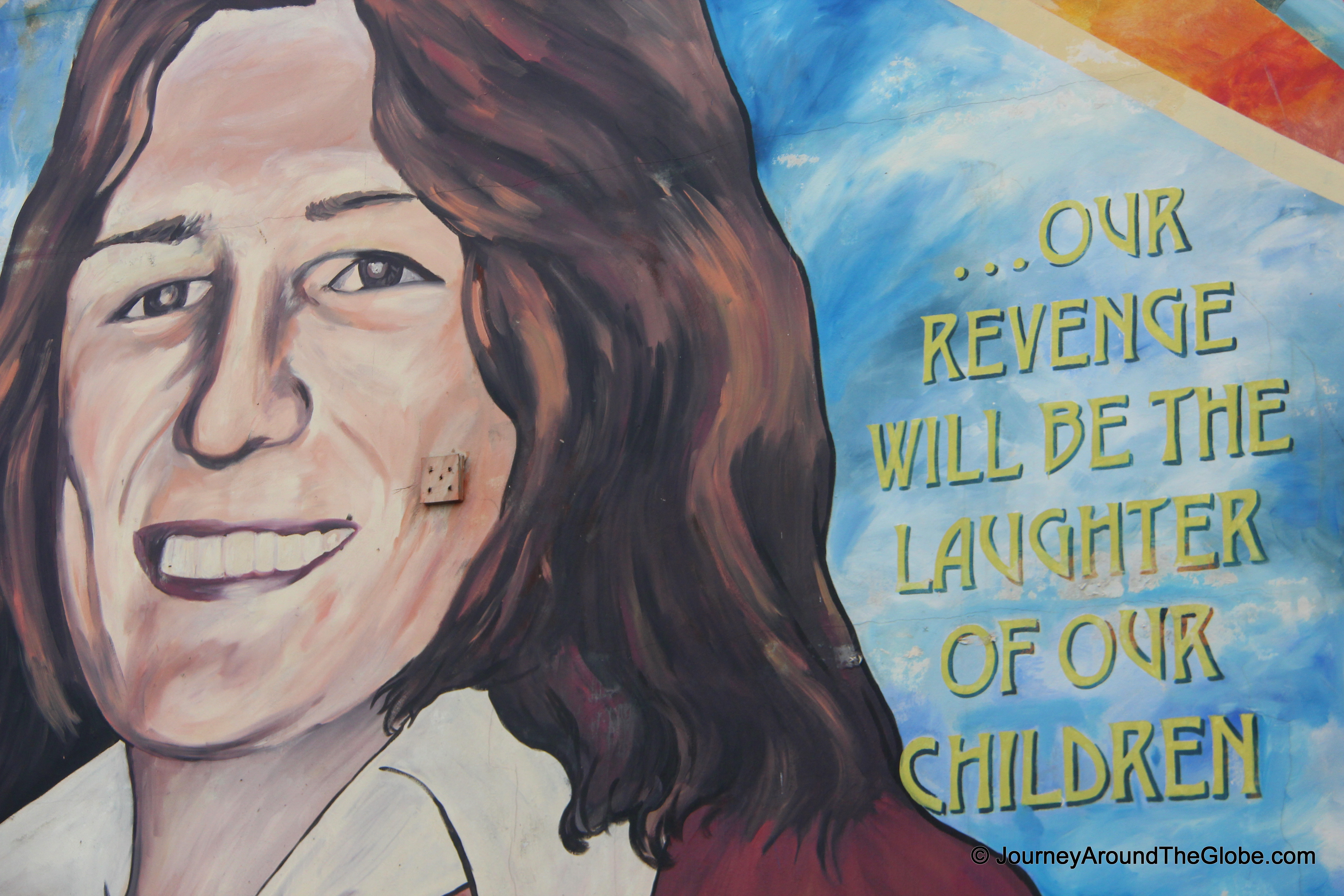
We took a Black Taxi tour to go see these famous murals of Belfast. These murals aren’t located all in one place. We kinda got on and off the taxi at several stops to see the murals, Peace wall and the memorial. It took us little more than an hour to go to different neighborhoods and roads to see them. Taxi charged us 30 pounds and our driver was excellent at giving us all the detail history of the past and stories of the current situation.
7) GUIDED TOUR TO GIANTS CAUSEWAY: We took a guided tour bus from Belfast to Giant’s Causeway for a whole day where we visited not only Giant’s Causeway but also some other historical sites and scenic locations of the country. The tour company, Isango, charged 10 pounds per adult and 7:50 pounds for kids 4-14 years of age. If we didn’t take this tour we had no way to visit these magnificent, natural beauties. These are the places we went as a group; we had to pay some additional fees in some of these spots but those were optional if you want to visit some additional places.
a. CARRICK FERGUS CASTLE: This was our first stop in our tour. It is one of the best preserved castles in Northern Island. This medieval castle is situated by the waterfront (Belfast Loch) and was built sometime in the 11th century. We didn’t go inside the castle, just enjoyed the nice surroundings and the harbor for 15 minutes, took some pictures, and then off to the bus again.
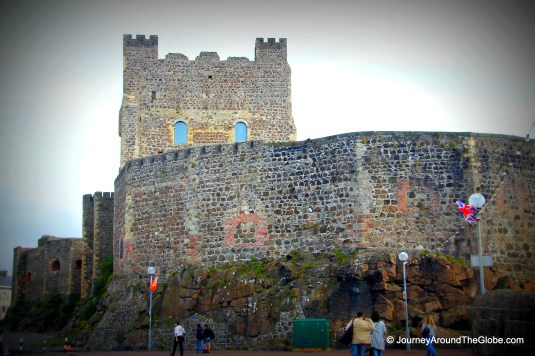
- Carrick Fergus Castle outside Belfast, Northern Ireland
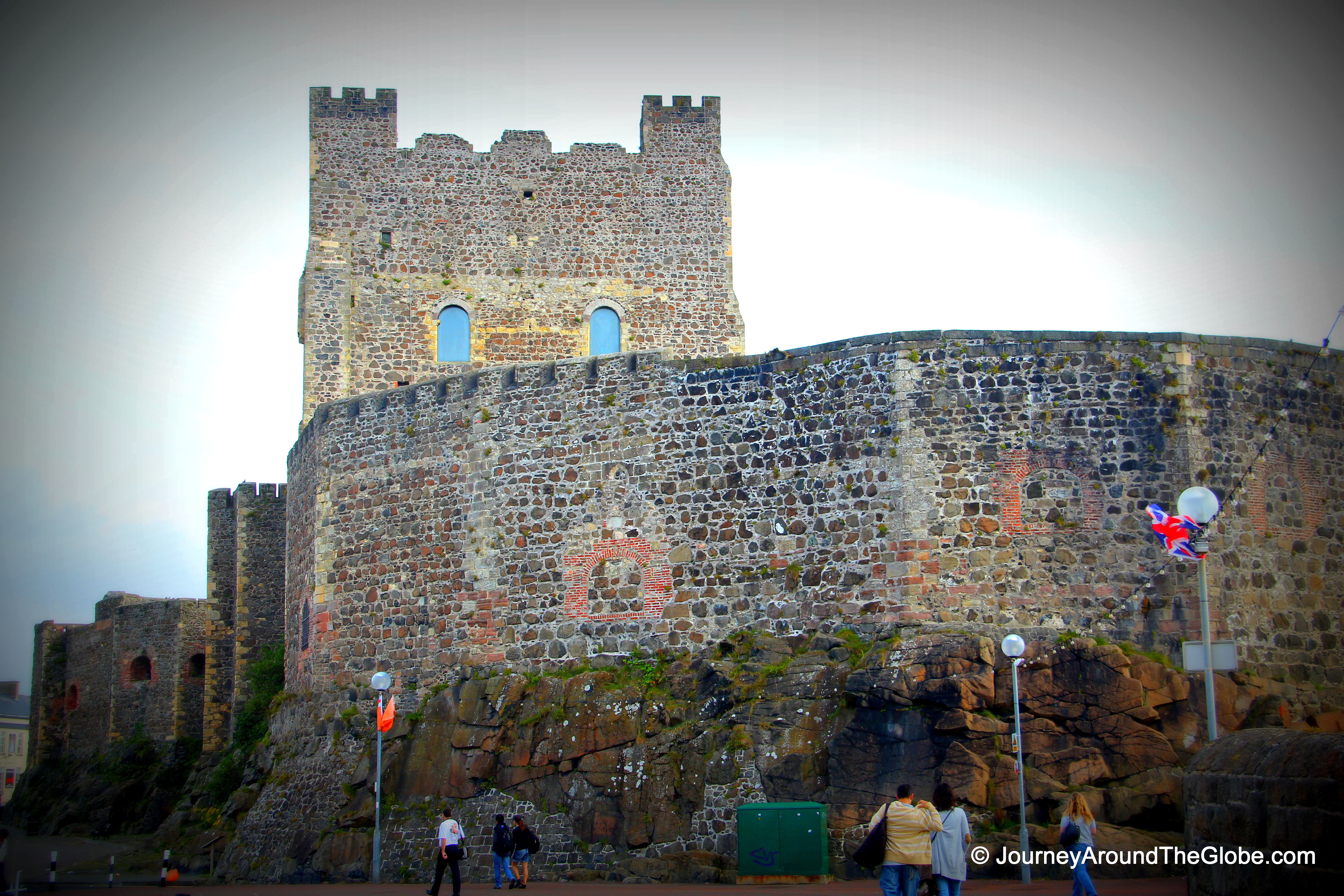
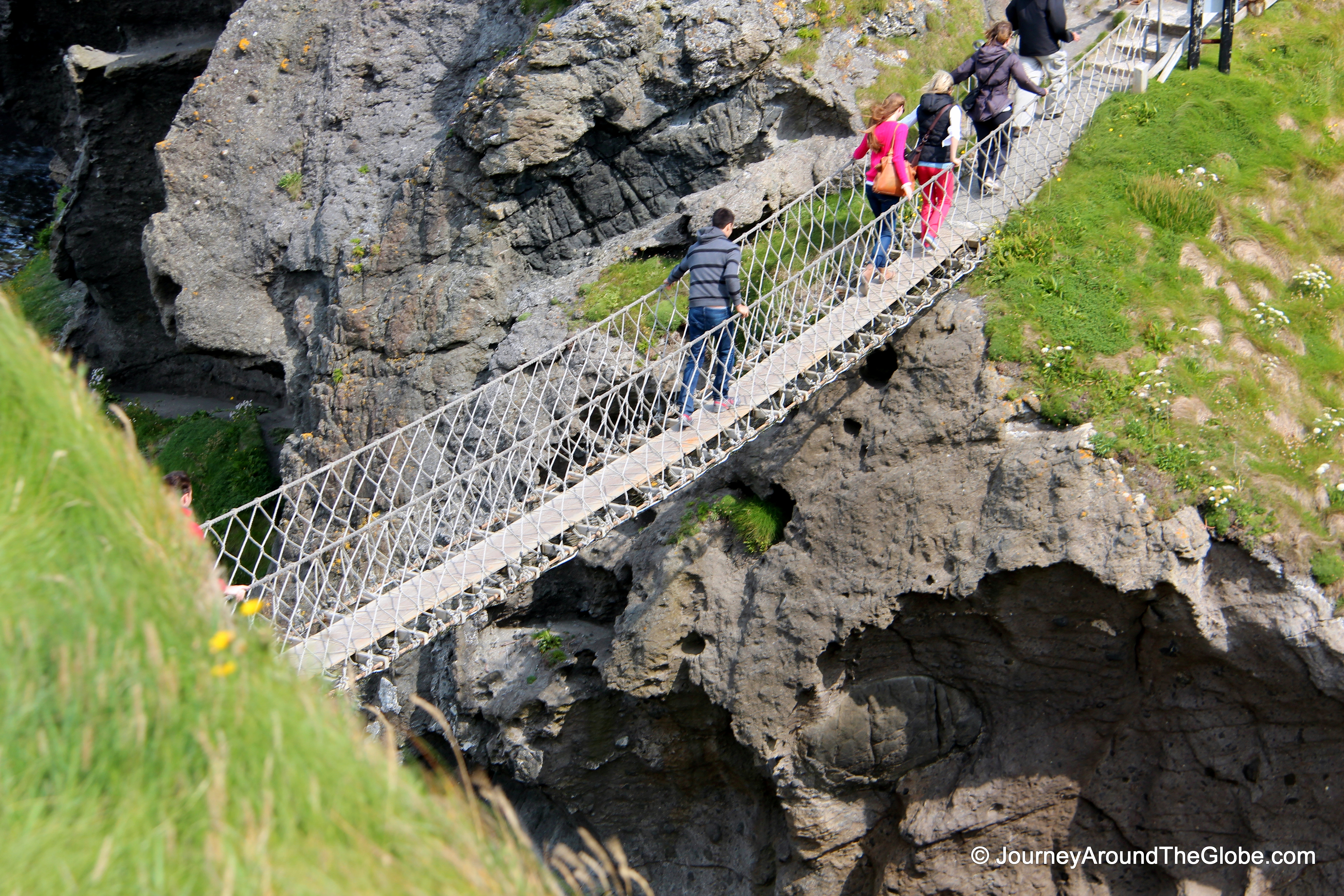
b. CARRICK-A-REDE & ROPE BRIDGE: Our second stop was at Carrick-A-Rede. The beauty of this place is beyond my expression. Trip to Northern Ireland would not have been full-filled without seeing or experiencing something like this. After our bus dropped us off near the entrance we had about hour and half to walk 1 km along the coast, then after about 160 steps we came to the Rope Bridge. Originally some salmon fishermen built this Rope Bridge about 300 years ago to connect a small island with mainland. On a good day as many as 300 might have been trapped in the nets that were spread out from the tiny island. Balancing their catch on their backs and holding on with one hand the fishermen ventured back and forth over the swaying rope bridge that spanned the deep chasm between the headland and the tiny island. The bridge is about 20 meters and about 30 meters above water. This is a very windy place, thus make it an adventurous journey all over. The view of the cliffs, nearby small islands, and water is incredible from here.

- Surrounding views of Carrick-A-Rede while walking towards the Rope Bridge
The admission to cross the rope bridge is 5.09 pounds for adults and 2.63 pounds for kids, and 12.45 pounds for a family (2 adults + 3 children). Here is the time-table for the bridge:
Jan. 1 – Feb. 26: 10:30 – 2:45 daily
Feb. 27 – May 27: 10:00 – 5:15 daily
May 28 – Sept. 2: 10:00 – 6:00 daily
Sept. 3 – Oct. 31: 10:00 – 5:15 daily
Nov. 1 – Dec. 31: 10:30 – 2:45 daily
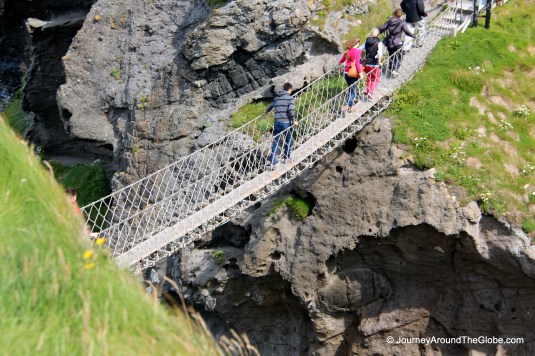
- Carrick-A-Rede Rope Bridge in Northern Ireland
c. BUSHMILL DISTELLARY: Our third stop for lunch was at this old whiskey company from 1608 A.D. This is Ireland’s oldest working whiskey distillery. You can actually go and watch whiskey making taking place and enjoy a small taster too. After our lunch, saw some people buying Bushmill’s world renowned whiskey. I am not sure if the restaurant is open to everyone or only to the groups of tour buses, but the food was reasonably cheap and very good.
d. DUNLUCE CASTLE: This was our fourth stop before going to Giant’s Causeway. It was only 5-7 minutes away from Giant’s Causeway. We could see the castle only from a distance and got out of the bus for 5 minutes just to take some picture. I am not sure how old this castle is but looked like centuries old building. The castle looked like one of those old brick castles on a giant cliff by the water from Hollywood movies. Although it was only for 5 minutes, I loved that incredible view of the castle, nearby cliffs, and the blue coast…uh, simply breathtaking.

- Dunluce Castle of Northern Ireland

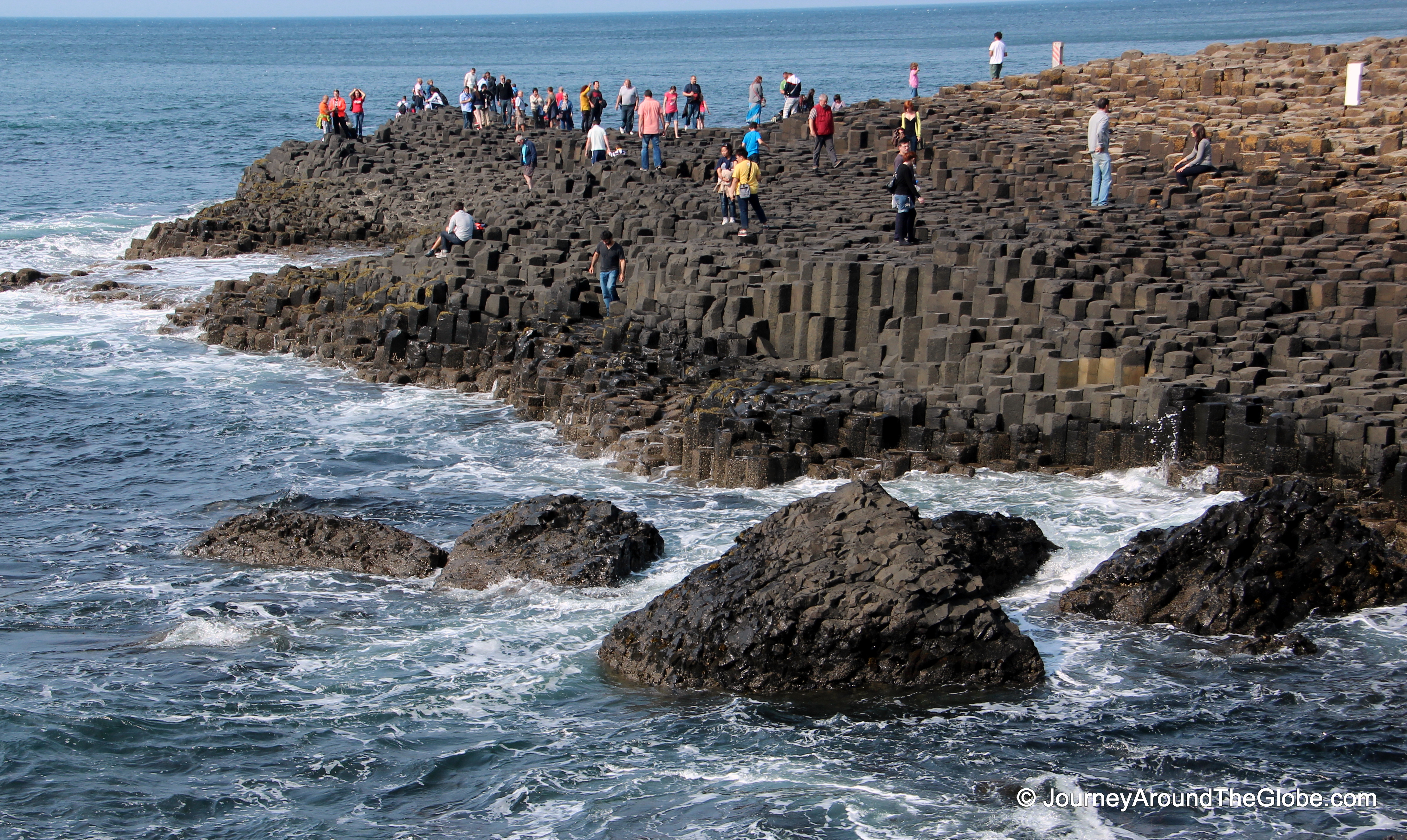
e. GIANTS CAUSEWAY: This is Northern Ireland’s only UNESCO World Heritage site and only about 90 minutes’ drive from Belfast. This is the coastal site where visitors experience not only the incredible view of the mountains, cliffs, and ocean, but also some 40,000 interlocking basalt columns rising out of the sea. It is a mind-boggling site not to be missed. The visitor center provides you with more information on this spectacular coastal site of Northern Ireland where you can see some interactive videos, read information board, and see the mythical giants walking around (in costumes) ready to take pictures with anyone.
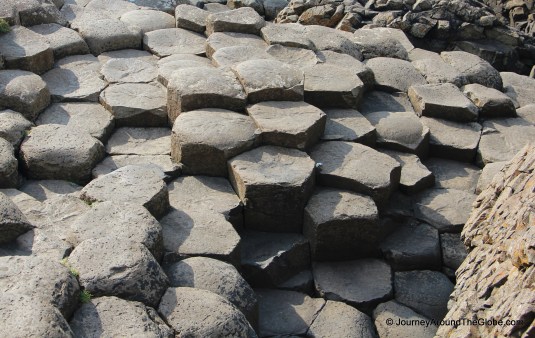
- Nature’s miracle – hexagonal shaped stones of Giant’s Causeway in Northern Ireland
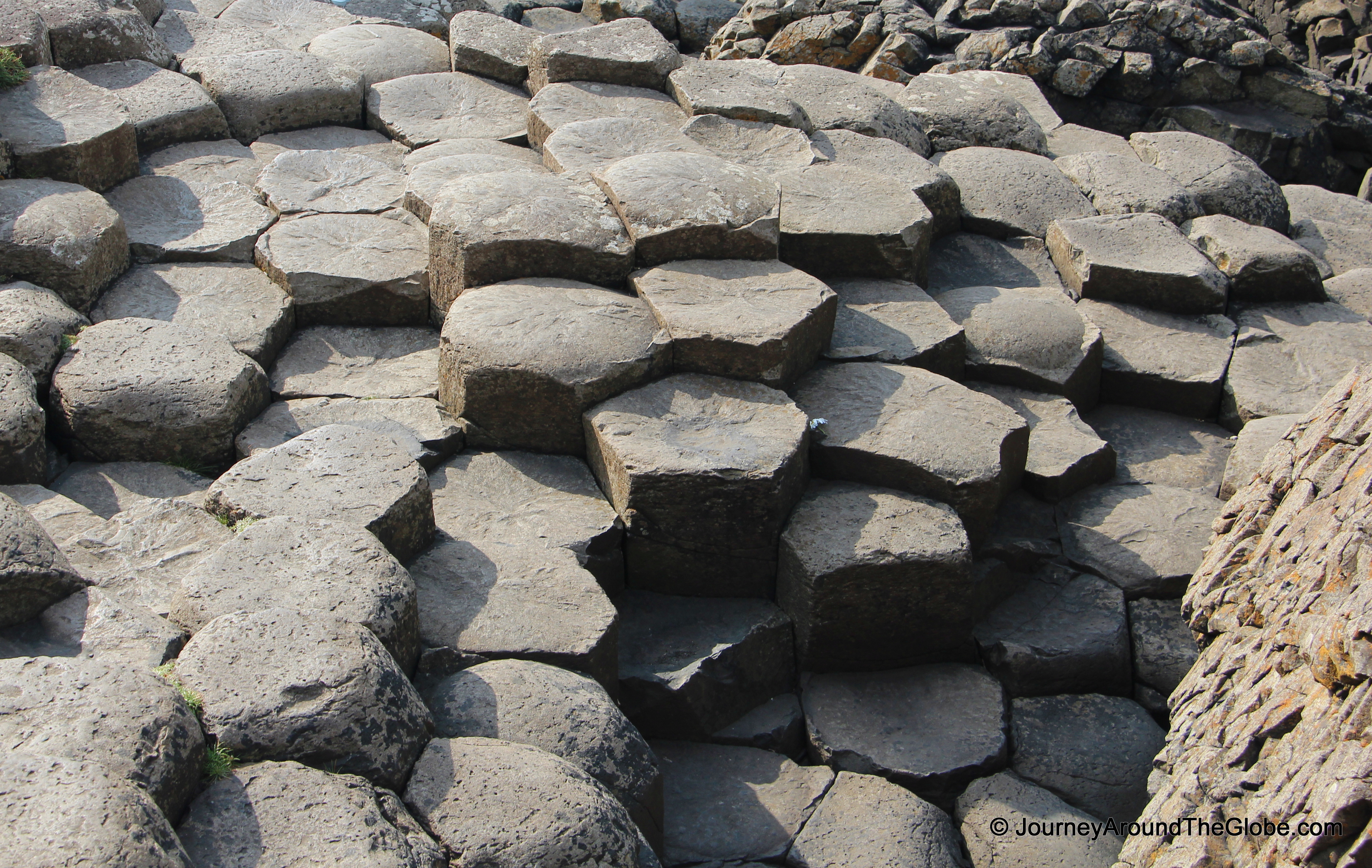
There is a popular myth on how the creation of Giant’s Causeway took place. It goes that an Irish giant, Fionn, was always hungry for good fight and wanted to prove his superior strength. So he decided to fight against a rival Scottish giant name Benandonner. To cross the ocean, Fionn built his own pathway (the causeway) of stepping stones (using these hexagonal stones) from Ireland to Scotland. But when he reached to Scotland, he saw just how large Benandonner was. He escaped back to Ireland right when the Scottish giant saw him. Benandonner used the causeway to come to Ireland to come and fight with the Irish giant. Fionn ran back home and asked his wife to help. His wife gave him an idea and he crawled into a crib. When Benandonner came, Fionn’s wife told him not to wake the baby up. Seeing how large Fionn’s baby was in the crib, he was scared and ran back to Scotland, breaking up the causeway to prevent Fionn following him.

- Pillars of stones in Giant’s Causeway in Northern Ireland
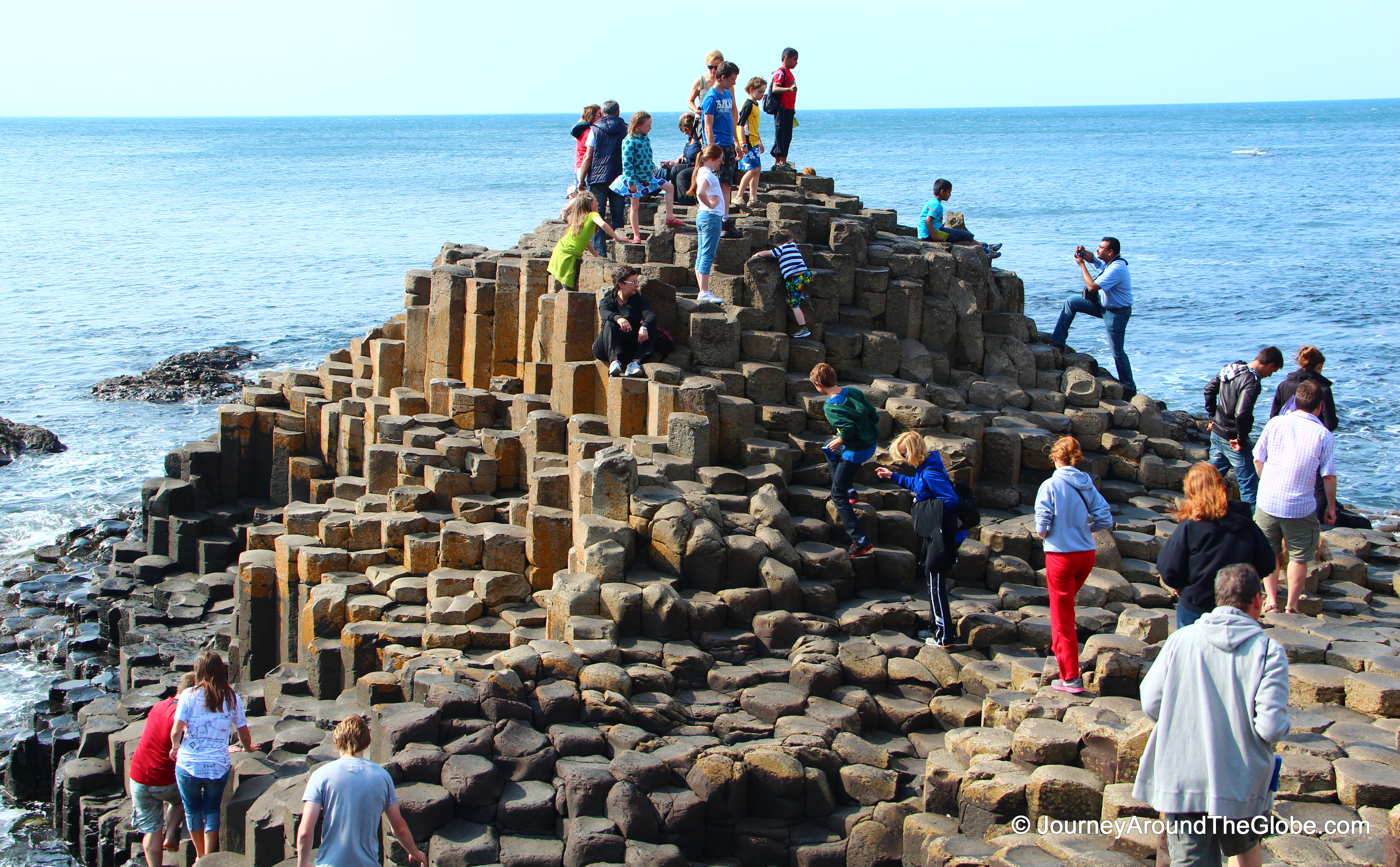
This story is quiet fascinating, but the science tells us something else. The Giant’s Causeway is the result of intense volcanic and geological activity. The Causeway provides a glimpse into the Earth’s most ancient past. An epic 60 million year-old legacy to the cooling and shrinking of successive lava flows.
- Giant’s Causeway – the only UNESCO World Heritage Site in Northern Ireland
Related articles
- A Letter to Peter McNaney (Chief Executive, Belfast City Council) (missrmjones.wordpress.com)
Share this:

Capital of the first and oldest kingdom on earth – Copenhagen, Denmark
COPENHAGEN, DENMARK (KØBENHAVN): Copenhagen is a consistently beautiful city everywhere you go. It seemed all the little things at every direction I looked were saying, “click me, click me”. Copenhagen is the largest city in Oresund region and the capital of the first and OLDEST KINGDOM of the world. The city is well-blended with fairy tale figures, statue of old kings, and interesting contemporary sculptures all over. You will see really old style buildings standing right beside ultra-modern brave and sexy architectures.

- A naturally blue city Copenhagen, Denmark

What make the city even more fun to visit are the friendly and helpful Danes. They speak very good English, as well as some German. The city is very spread out and therefore, be ready to walk a lot. Best thing is to focus on one area and spend a day or 2 just on that. The city has lots and lots and LOTS of places to explore and things to do, which can easily keep its guests busy for months.

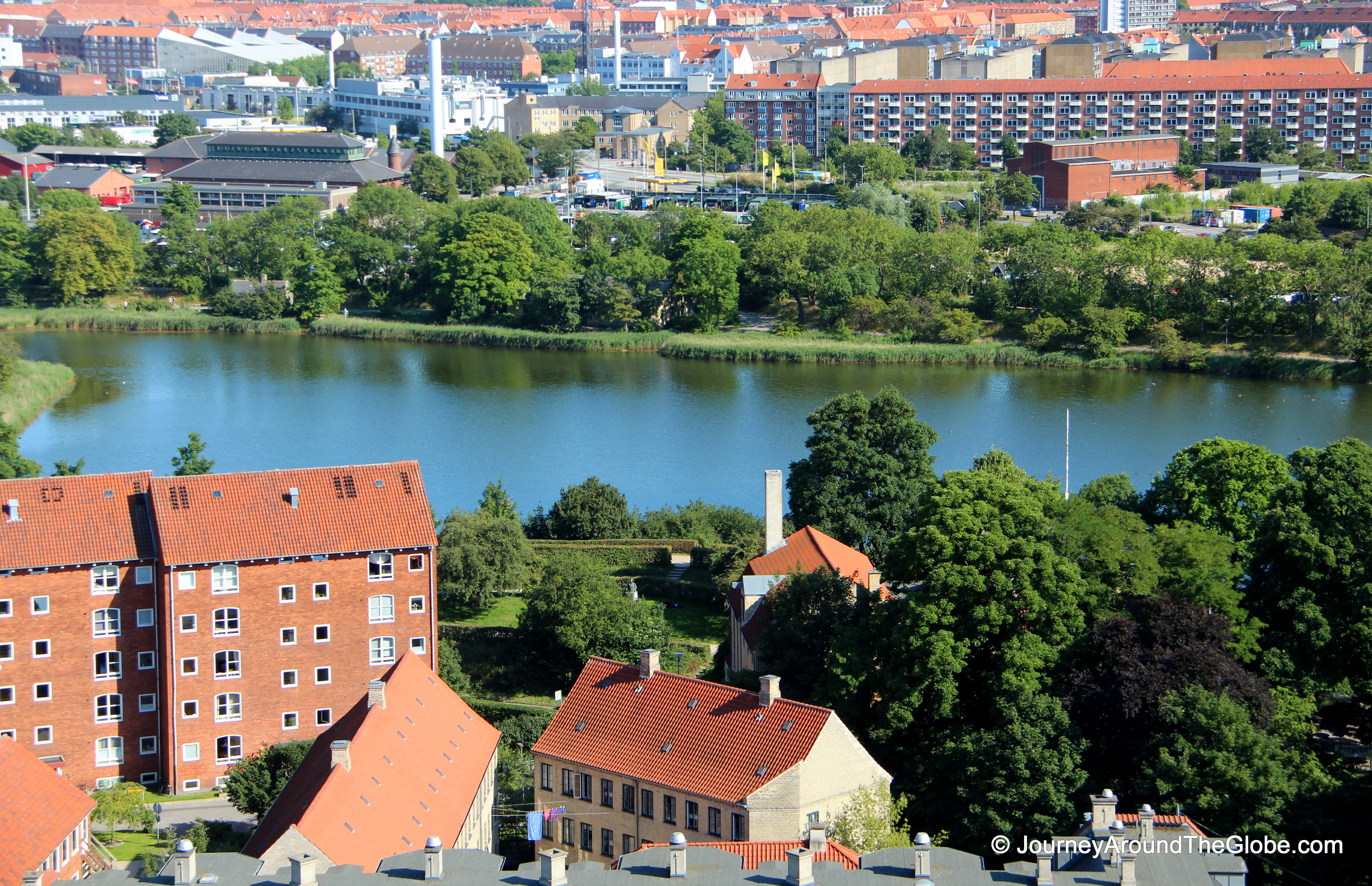
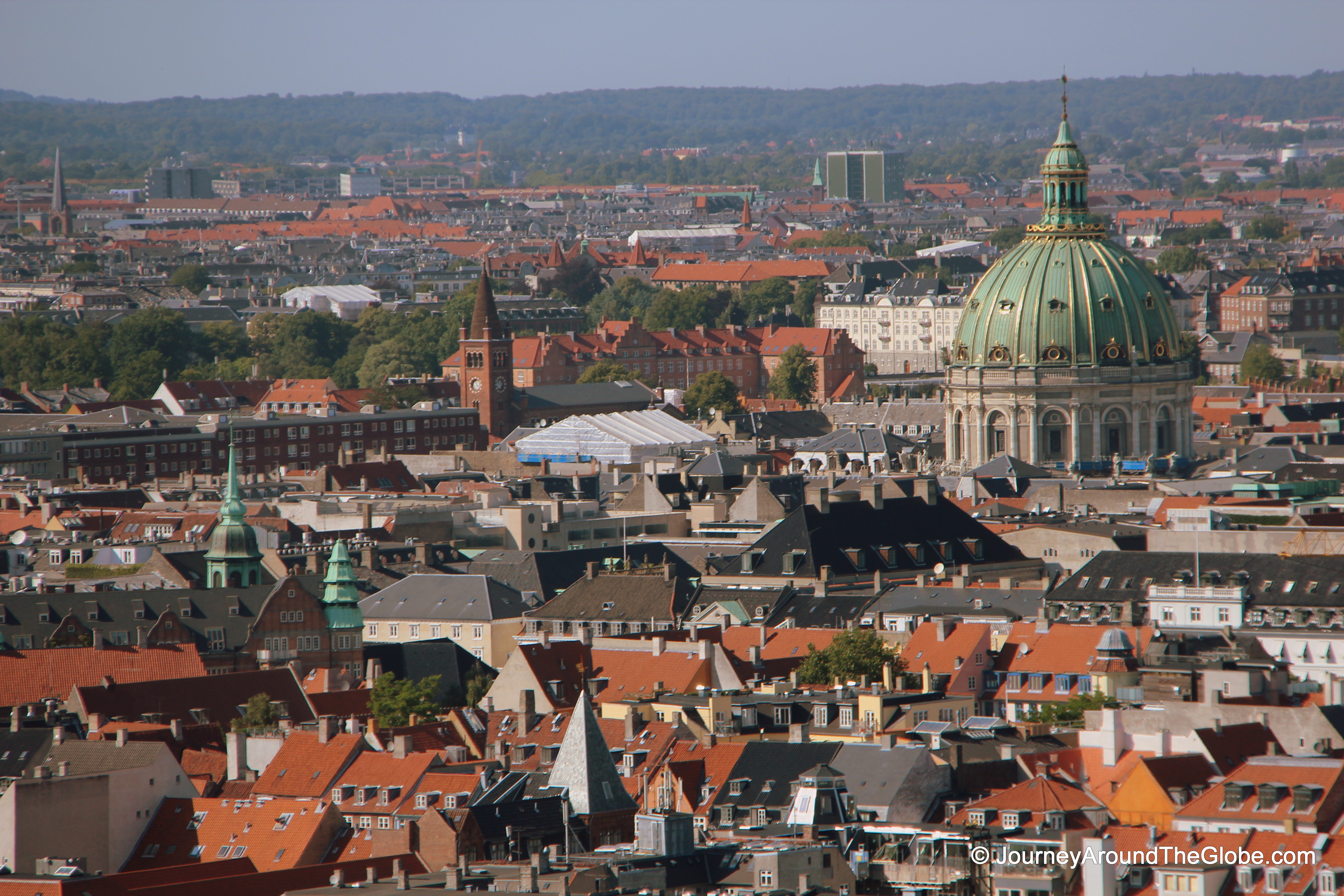
- View of the surroundings from top of Church of Our Savior in Copenhagen, Denmark
TIME OF TRAVEL: Copenhagen was our 3rd stop during our road trip during end of July 2012. Our first stop was Hamburg, Germany, then Billund Legoland in Denmark. It was about 3 hour drive from Billund. Weather was great, around 74 degrees Fahrenheit. Summer in Copenhagen is usually very pleasant during day and may be a bit chilly during night, that’s why most of the hotels (if not all) here don’t have AC.

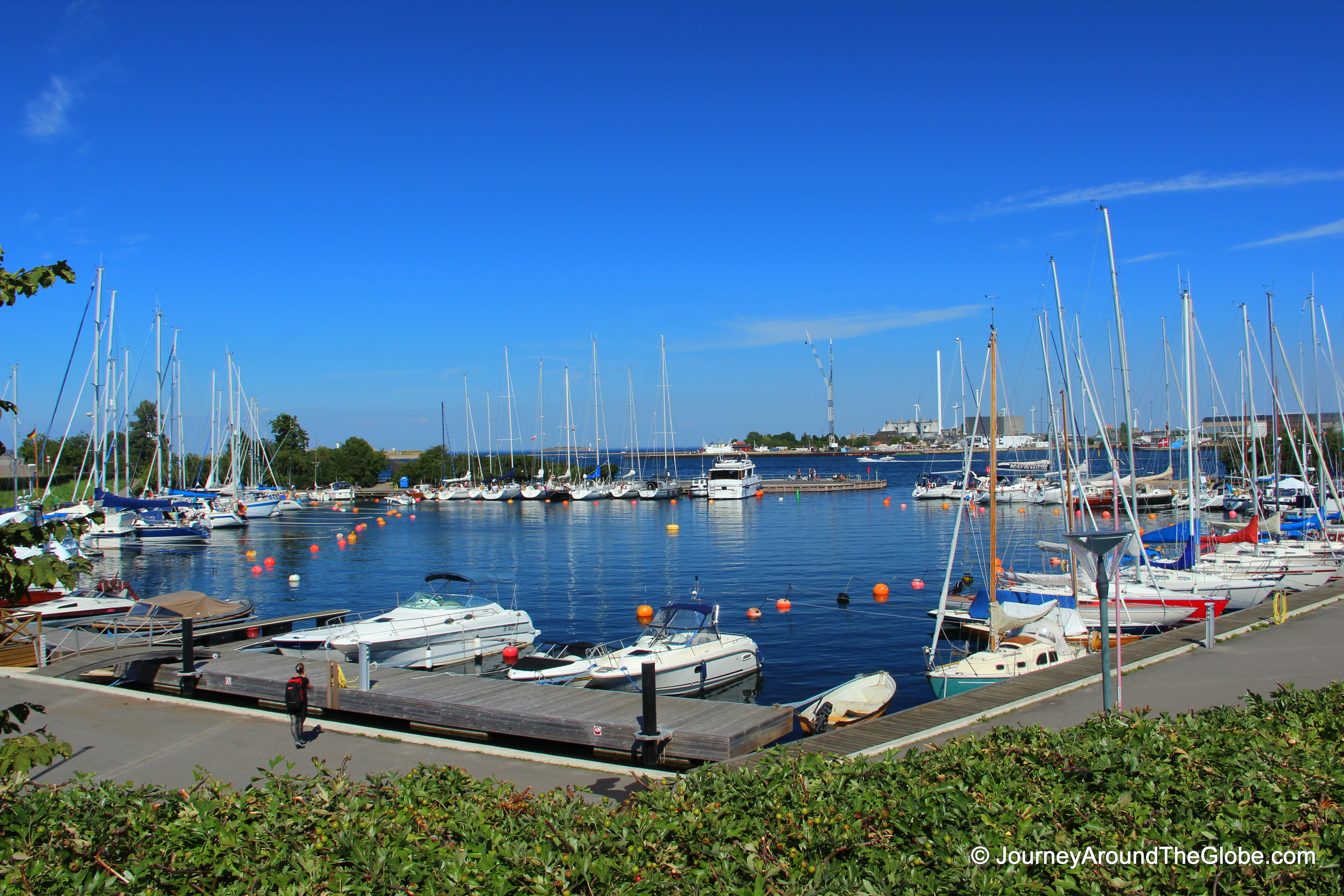
- Beautiful blue sky and blue water as seen from one area of Churchill Park, Copenhagen, Denmark
OUR HOTEL: We stayed in Radisson Blu in Copenhagen, which was about 15-20 minutes of walk from the town hall or Christiansborg Palace and about the same time to go to Nyhavn. The location is ok if you are willing to walk a lot. The hotel didn’t have free breakfast but did have free Wi-Fi and a paid parking garage (garage is free in July).
WHAT TO EAT & BUY IN COPENHAGEN: Cheese or fruit Danish in Denmark is definitely better than any other place. Also, we came to know that WORLD’S BEST restaurant NoMa (Nordic Mad, Mad means Food in Danish) is not too far from Nyhavn in Copenhagen. The ingredients used in this place are ONLY from Denmark or up north from the Nordic area…not from anywhere else in the world. The restaurant was awarded as the best restaurant in the world 3 years in a row and they get 15,000 requests per day to get reservation. You have to make reservation there about a year ago and if you are lucky you may get a table to eat there after a year.
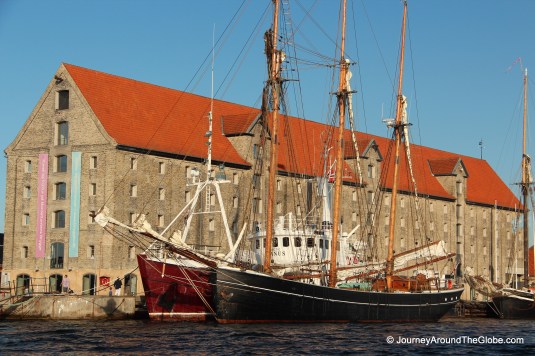
- Saw world’s best restaurant NoMa, located not too far from Nyhavn in our boat tour

For souvenirs, Danish sweaters, Viking items (like ships, hats), bear mugs, statue of Little Mermaid are always something memorable to take back from Copenhagen. Also, if you have kids, Legos are something original of Denmark to give them as gifts.
PLACES WE’VE VISITED: We had about 2 ½ days in Copenhagen. It’s not enough if you want to go to every castle of the town or go to every museum. There are so many things to do and places to see that you can spend weeks enjoying every little bit that city has to offer to its visitors. But we covered quite well within those couple days even with 2 kids.

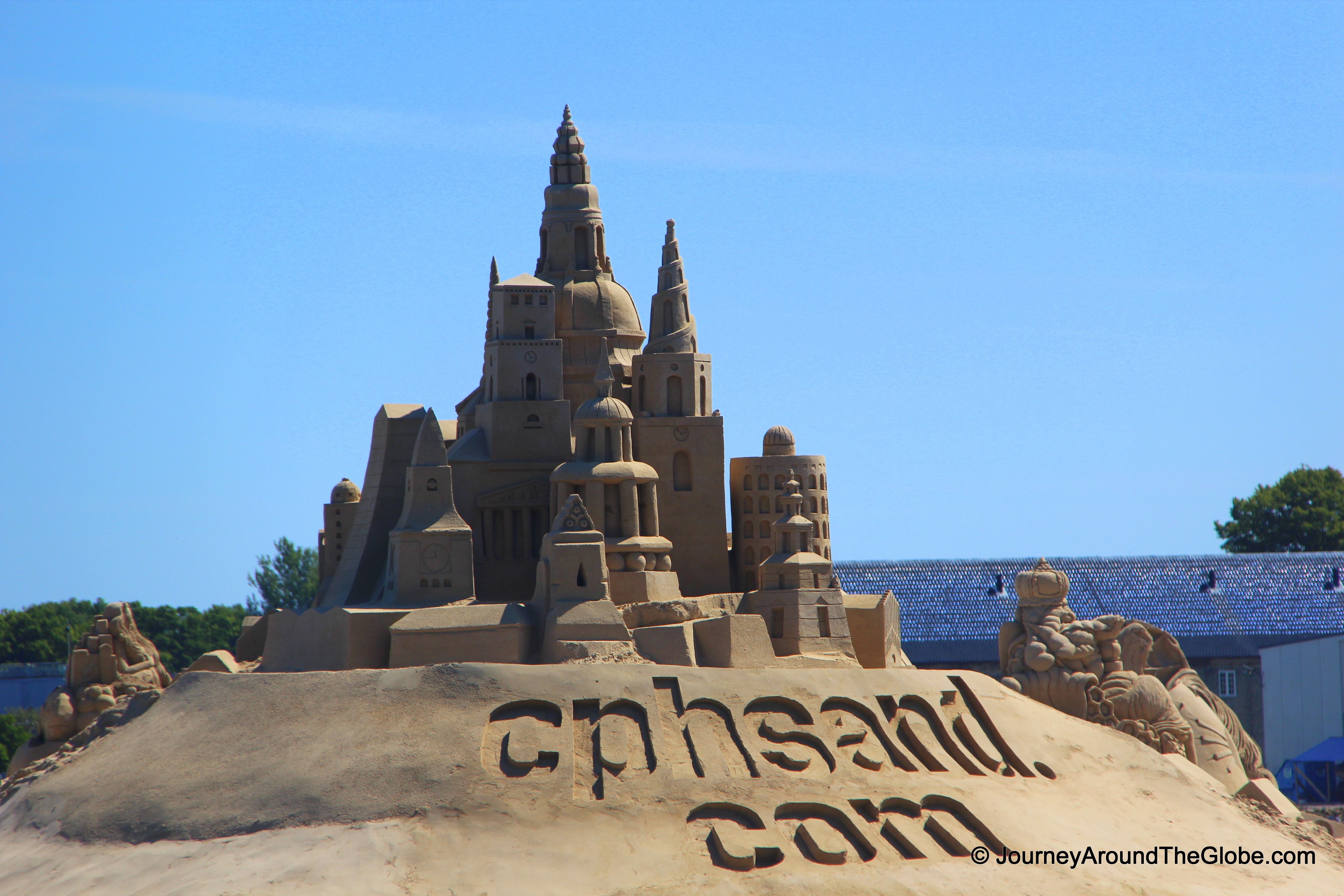
- A sand sculpture (there were many of them) at Ofelia Beach as seen from Ameliaborg Palace in Copenhagen, Denmark
1) RADHAUSPLADSEN & TOWN HALL: Radhauspladsen is a huge square that houses city’s Town Hall. Square has many old buildings lined up by the sides. It’s a great place to chill, do people watching and listen to live music played by local talents. There are couple statues here including a dragon attacking a bull and another one is 2 men on top of a pole looking for their way. The square has many fast food restaurants like KFC, Burger King, and McDonald’s along with many carts selling hot dogs. Frederiksbergsade from the square is a pedestrian zone packed with many fashion designer stores, restaurants, and souvenir stores.
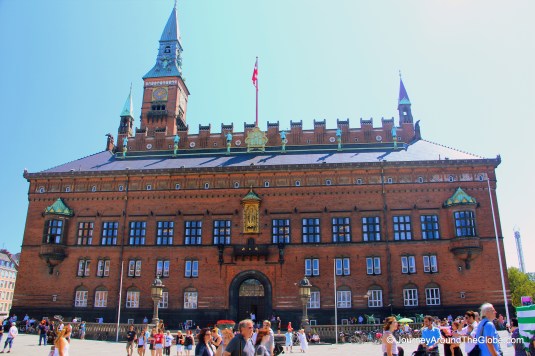
- Town Hall of Copenhagen, Denmark

Copenhagen’s Town Hall is a nice example of classical architecture. Unlike many other town halls, this impressive town hall allows public to roam around inside the building without any guided tours or fees. The main lobby is very large with high glass ceiling. Make sure to go upstairs to 2nd and 3rd floor to check out the hallways, beautiful designs on wall and stairs.
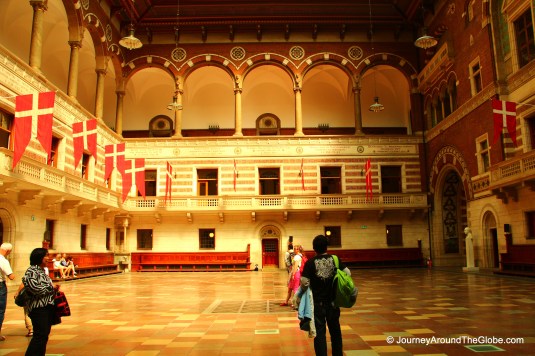
- The main hallway of Copenhagen Town Hall, Denmark

2) PALACES OF COPENHAGEN: There are about few palaces in Copenhagen; we visited 3 of them, excluding Charlottenburg and Frederiksberg palace.

- Danish Royal Guards during the ceremony of Change of Guards in front of Ameliaborg Palace, Copenhagen, Denmark

a. CHRISTIANSBORG: This once used to be the official residence of Danish Royal Family. Presently, it is used as the Danish Parliament and Supreme Court. The palace is today situated at the site where Bishop Absalon built a castle in 1167. The present palace was finished in 1928. At 106 meters high, the tower of Christiansborg Palace is the highest in Copenhagen. During the following 900 years several castles and palaces have been replacing one another. Some of them were demolished and others burned down, but new buildings were always erected again symbolizing the power of the Danish Kingdom.
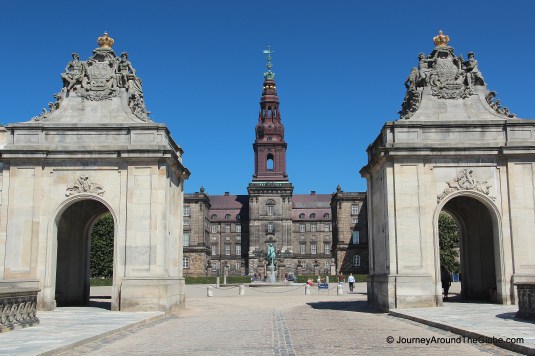
- Entering Christiansborg Palace in Copenhagen, Denmark

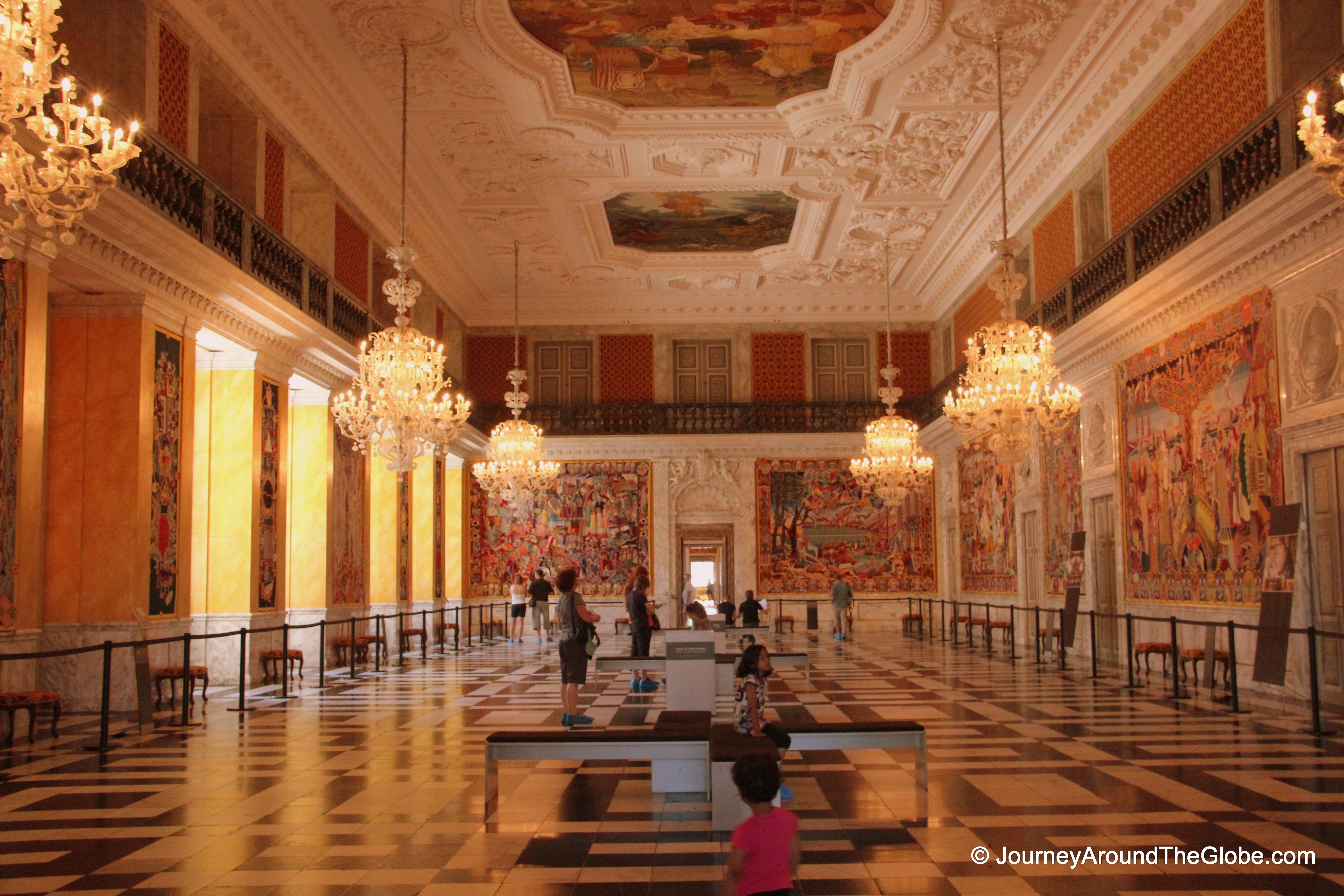
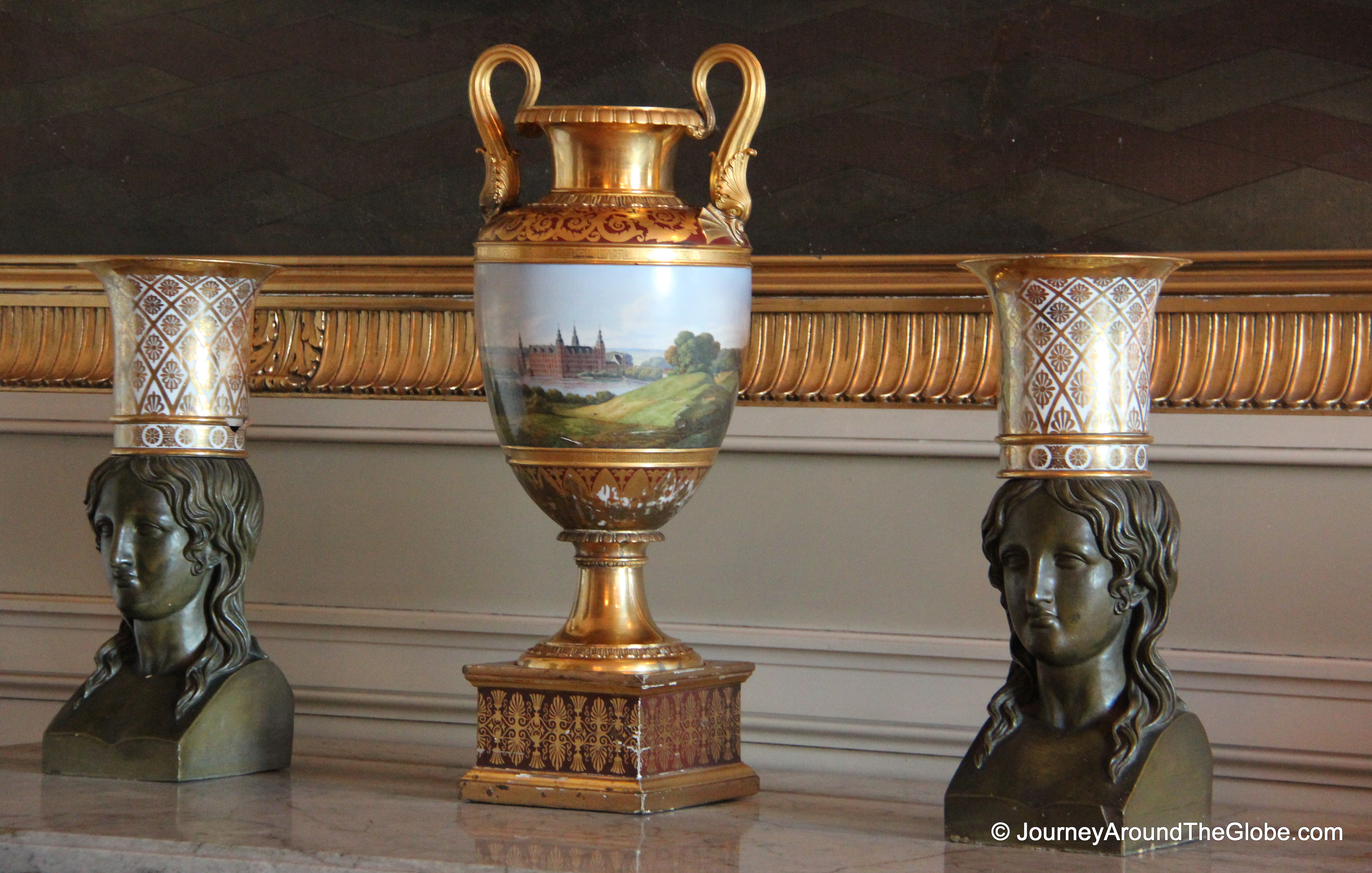
The Reception Hall consists of several important rooms of the castle, like the Throne Room, Great Hall, Dining Hall, Alexander Hall, and others. Each room is decorated with luxurious and elegant look. The beauty of the old furniture, tapestries, chandelier, art/paintings, decorative doors, lamps, vases, candle-holders, marble fire-place is beyond any expressions. These rooms are no less magnificent than the ones of Versailles Palace of France.
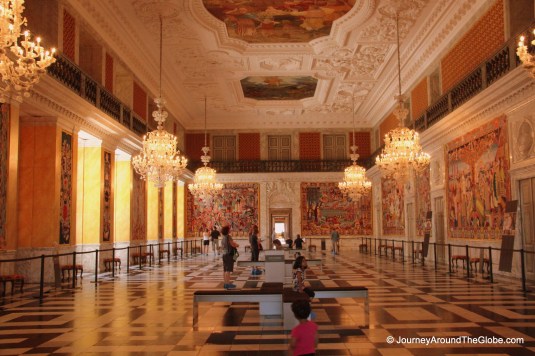
- Great Hall inside Christiansborg Palace, Copenhagen, Denmark
Ruins from previous palaces, about 900 years old, are preserved in one area of this palace. This is a large section underneath one of the present buildings of castle. It briefly tells you the timeline of the early castles built on this spot. You can discover the dark passages and cellars, and read about the story of Copenhagen’s founding and the site’s development from the 12th century. These ruins are a witness to the history of the palace as the center of political events and power struggles for more than 900 years.
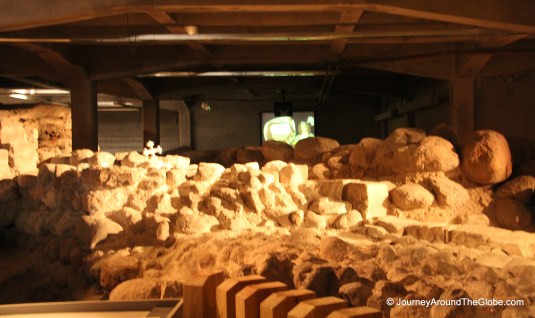
- Ruins of previous castles beneath today’s Christiansborg Palace, Copenhagen, Denmark

The Royal Stables at Christiansborg Palace are the home of the horses and carriages that are used by the Royal Family for official events and festive occasions. When the stables were built in 1745, 250 horses stood among the marble pillars. Today the stables have 14 – 16 horses.
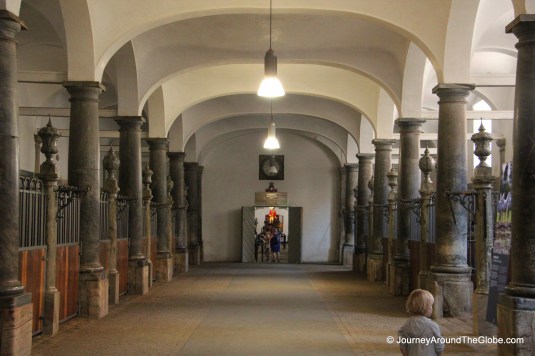
- Royal Stable of Christiansborg Palace, Copenhagen, Denmark
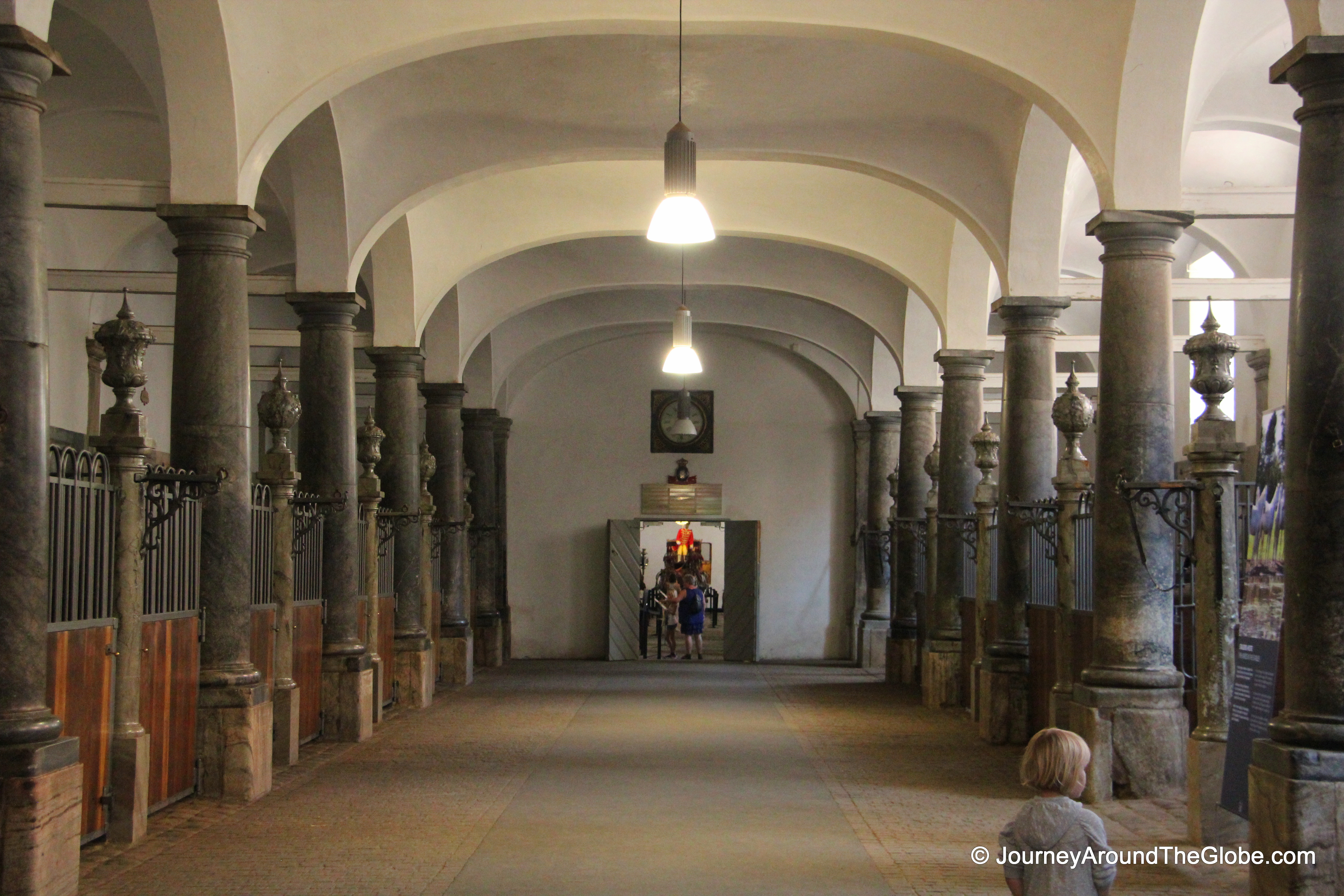
The whole tour of the castle probably took us about couple hours, may be 2 – 2 ½ hours. The Royal Stable, ruins from early Copenhagen, and Reception Hall are all self-guided. The Danish Parliament can only be accessed by guided tour. The castle is open from 10 – 5 pm (Royal Stable is open till 4 pm) and charges 110 DKK per adults (kids under 7 are free). We had no problem going around the castle with a stroller.
- Decoration pieces in the Reception Halls of Christiansborg Palace, Copenhagen, Denmark
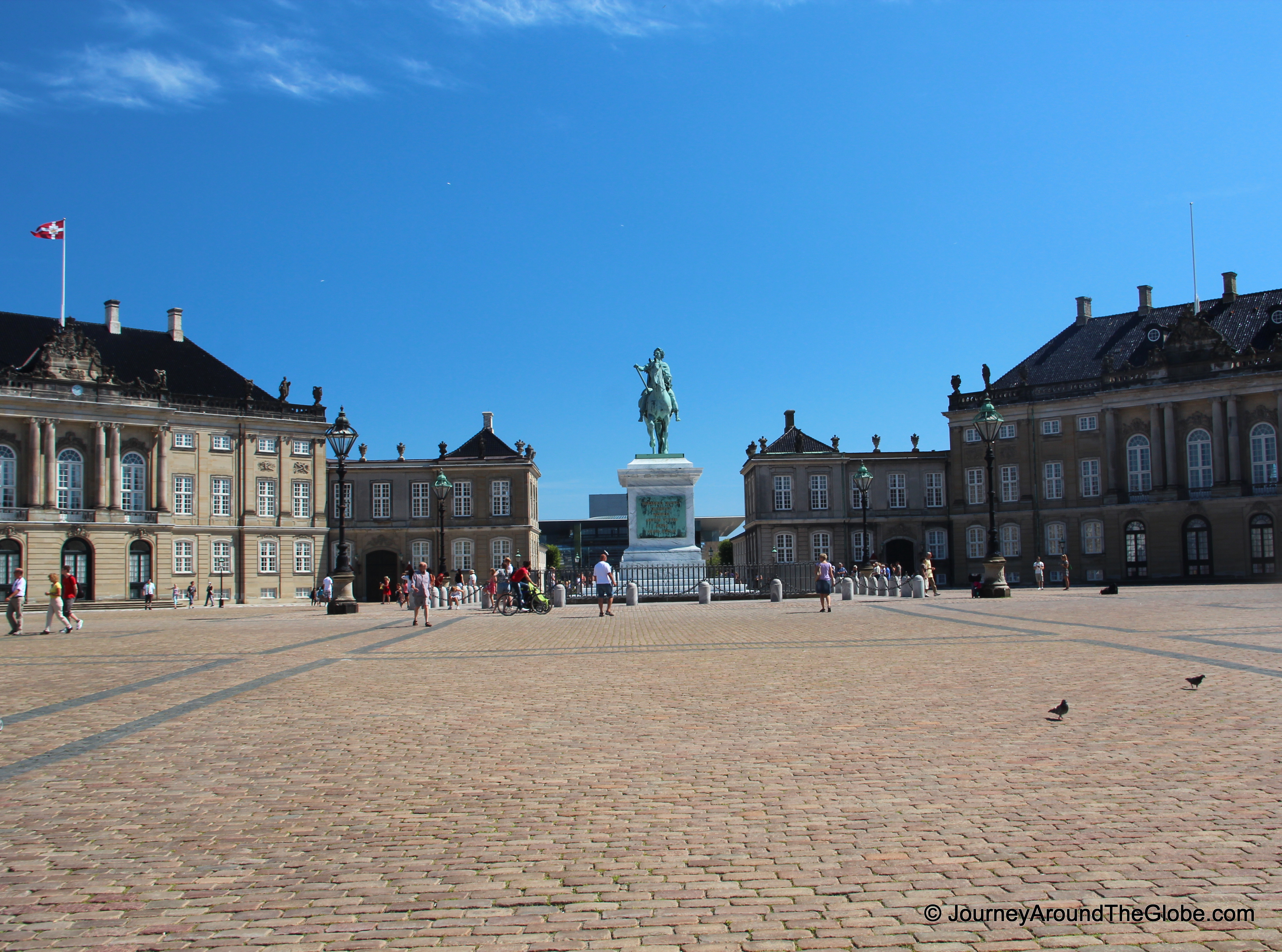
b. AMELIABORG: The palace is very beautifully situated by a big canal. The 4 buildings of this whole palace were built somewhere in the 18th century. The palace is not open to publics since, this is the OFFICIAL RESIDENCE of Danish Royal Family. There are some museums that are accessible by the tourists. You can see uniformed Royal Guards walking in front of each buildings and see change of Guards every day at noon and 2 pm.

- Ameliaborg Palace, the official resident of Danish Royal Family, in Copenhagen, Denmark
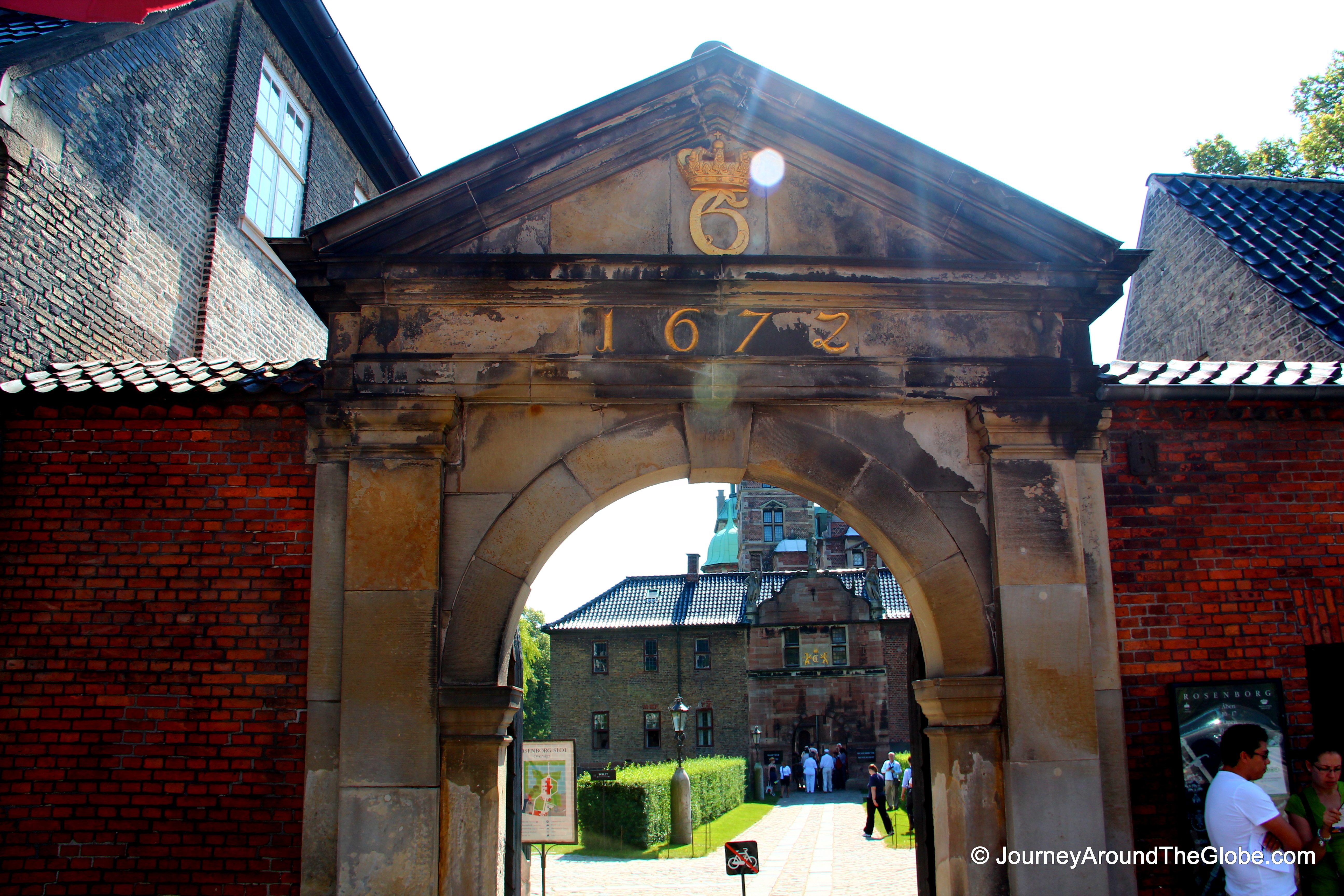
c. ROSENBORG PALACE: This is another beautiful palace of Danish Royal Family. This Dutch Renaissance style castle was built and designed by King Christian IV in 1606 – 1634 as a summer castle. The next three generations of kings lived here, until King Frederik IV erected Frederiksberg Castle in 1710 when it became a sort of storehouse. The royal collections of the kings, who had lived there, Christian IV to Frederic IV, were well-preserved and eventually were opened to the public in 1838. It thus became the FIRST MUSEUM of contemporary culture in Europe.

- Entering Rosenborg Palace in Copenhagen, Denmark
The rooms of this castle are small but very sophisticatedly adorned with very old furniture (beautiful hand-made wardrobes, chairs, and tables), decorative mirrors, large paintings, dazzling chandeliers, high ceilings, pretty floors, hand-weaved tapestries, Victorian porcelain, and many more unique items. Basement and Treasury display objects made of ivory and amber, arms and barrels of Rosenborg-wine, Christian III’s Sword of State from 1551, and crown of few kings and queens of Denmark from 1500s, crown jewels, scepter, orb, the Order of the Elephant, and the Order of the Danish flag.
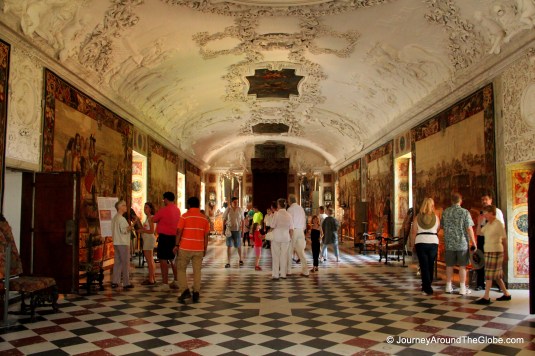
- Coronation Hall of Rosenborg Palace in Copenhagen, Denmark

The palace is open from 10am – 5pm. The ticket to the Royal Treasury and to the castle is 80 DKK per adult and free for kids below 17. You have to pay another 20 DKK if you want to take pictures inside the palace. The combine ticket for Ameliaborg Palace and Rosenborg Palace is 110 DKK. We had to put away our purses and baggage in a locker. The palace is very close to The Round Tower and Church of Our Lady. It took us about 2-3 hours to visit all the rooms and treasury, and then spend some time in the garden.

- Guards inside the perimeter of Rosenborg Palace in Copenhagen, Denmark

3) RUNDETAARN (ROUND TOWER): One of the best-known and most popular structures in Denmark, the Round Tower has been a distinctive feature of Copenhagen skyline since 1642. At the top of the tower you’ll find Europe’s oldest functioning observatory tower, which was originally built for the university by Christian IV. The tower rises 114 feet (34.8 meters) above street level and you can spot most of the city’s famous buildings from here. The path to the viewing platform is via the unique spiral walkway, which is 686 feet (209 meters) long and corkscrews 7 ½ times around the hollow core of the tower. As you are ascending the tower first you will see Trinititus Kirken (Trinity Church) that was built for the students but still an active place for the worshippers. Then at halfway up the Round Tower is the 900 sq. m. stunningly beautiful Library Hall with exhibitions, shops and café. This once housed the whole university’s book collection (about 10,000 books), but when the collection became too large, the library closed in 1861. After that the library moved with the main building of University of Copenhagen, opposite of Church of Our Lady (on Fiolstræde). Now the Library Room in Round Tower hosts changing exhibitions and other cultural events all year round.
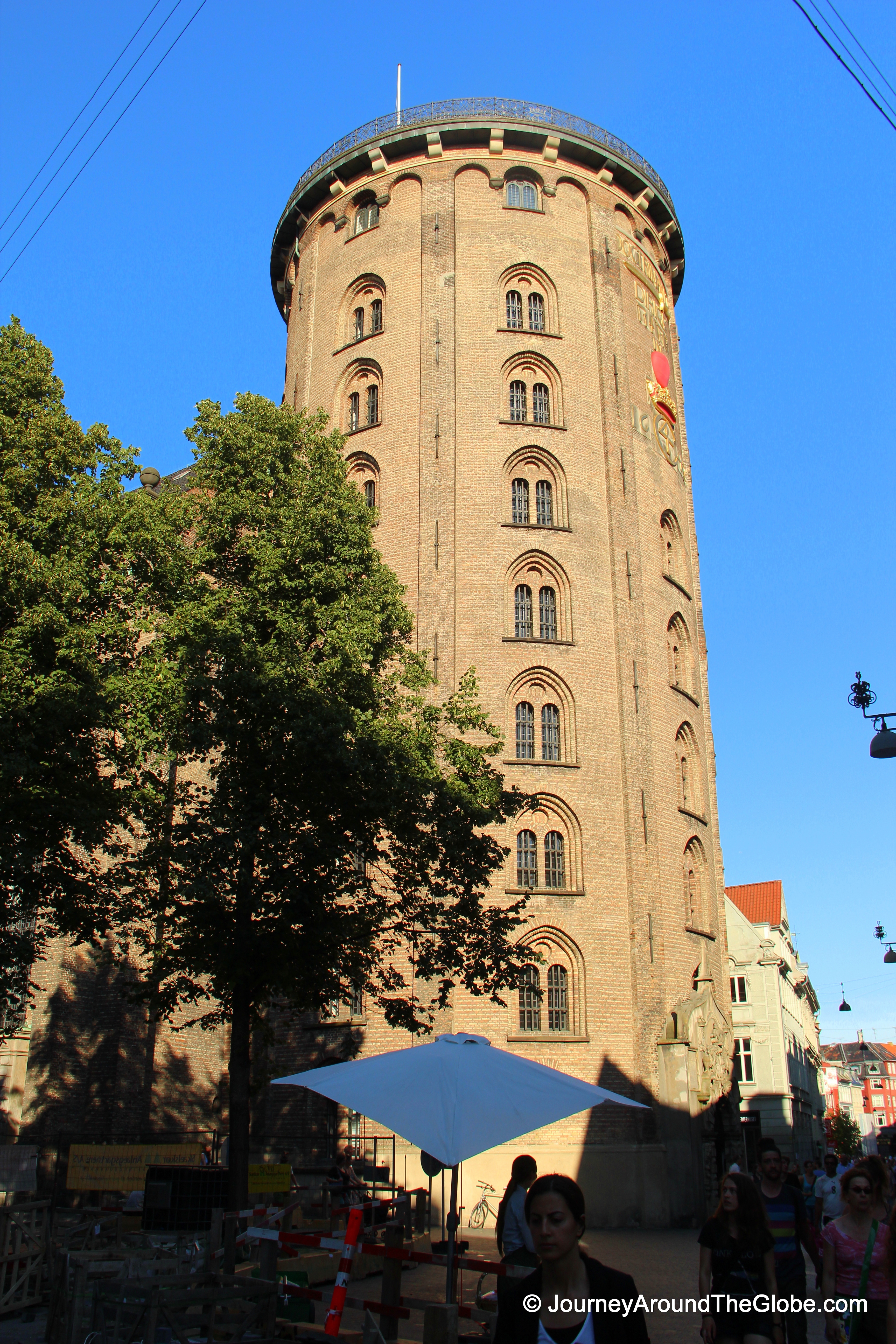
Round Tower is within walking distance from Town Hall, may be 10-15 minutes. It is open from 10am – 8pm every day. Ticket to enter is 25 Danish kroner for adults, 5 kroner for 5 – 15 years, and free for kids below 5.

- The original library of Copenhagen University inside Round Tower, now has a museum, a cafe, and a shop

4) CHURCHES OF COPENHAGEN:
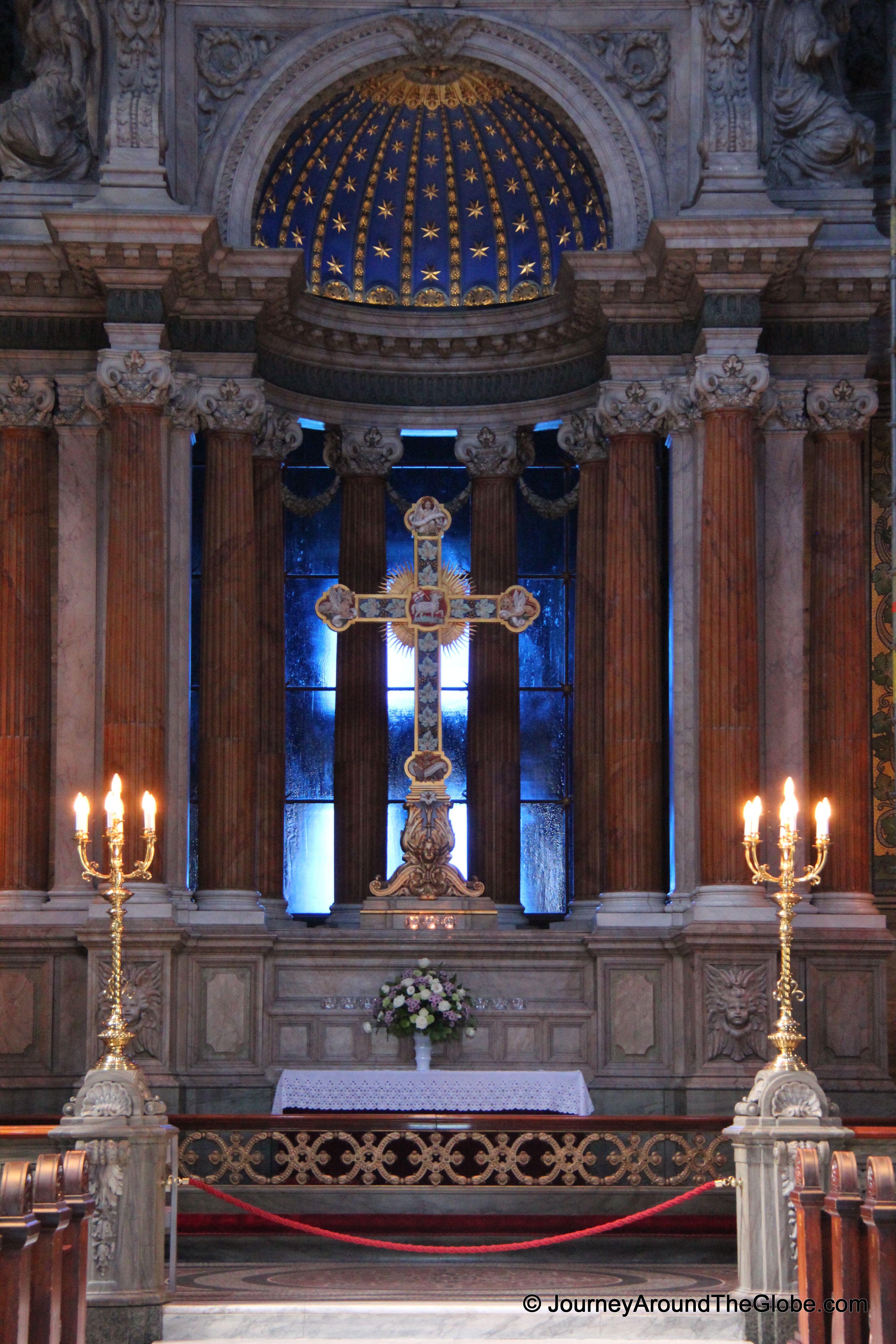
a. MARBLE CHURCH: Also known as Frederiks Kirke, has one of the largest dome, with a span of 31 meters, in northern Europe. Exterior of the church is beautifully adorned with 4 large pillars and many statues. Inside is small and simply with not overly decorated altar. But the fascinating part of it is that the walls and the pillars are made with marble.
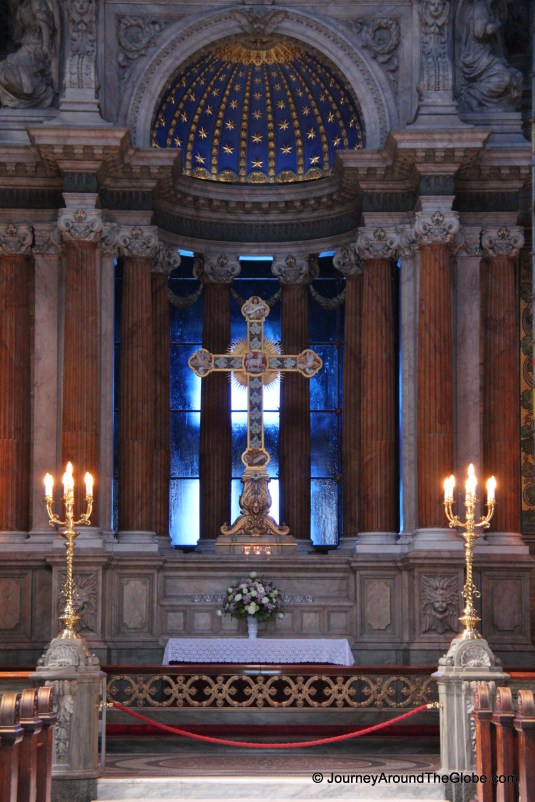
- Simple yet beautiful altar inside Marble Church of Copenhagen, Denmark
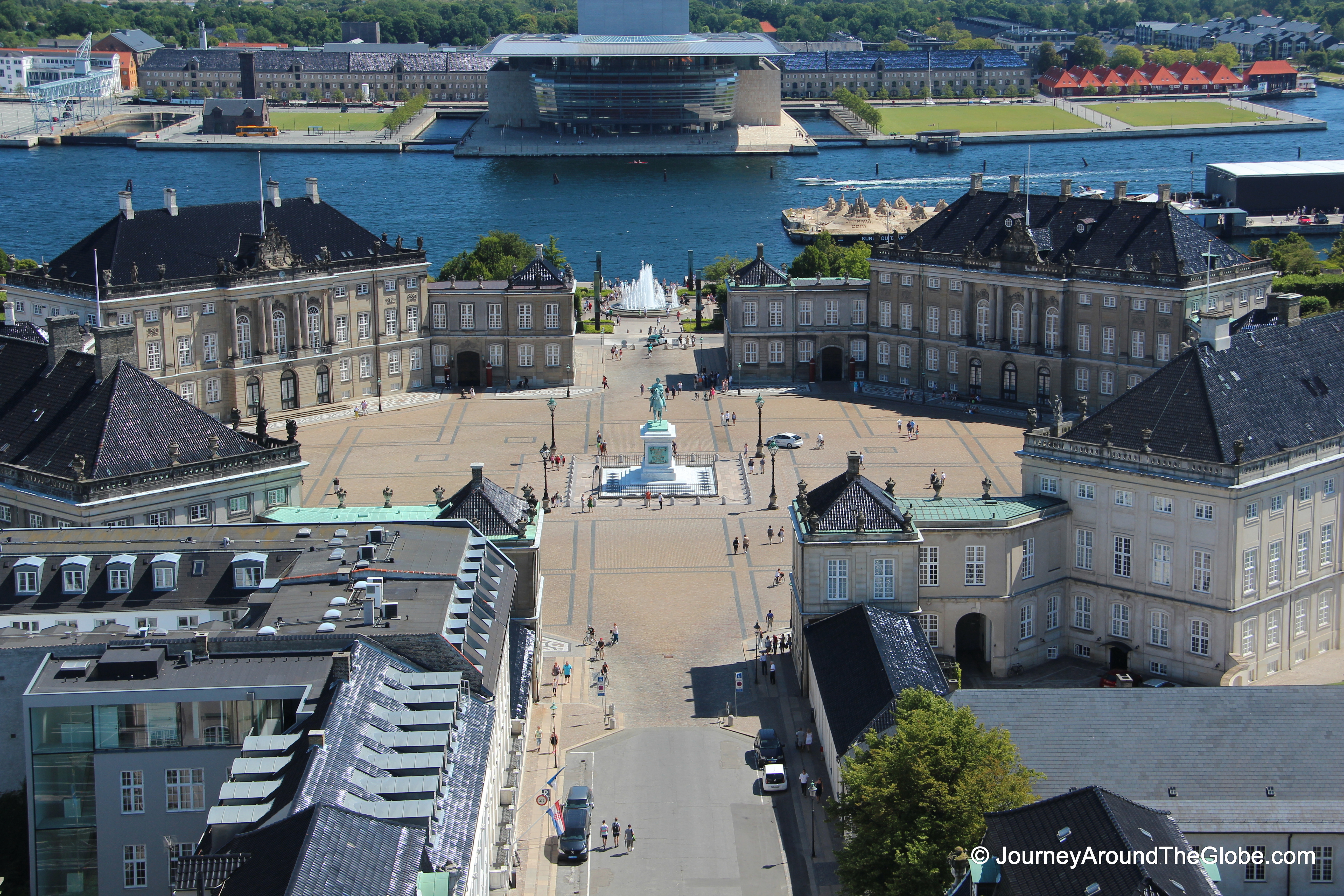
The dome of Marble Church can be climbed up to the top deck only by a guided tour. There are only 2 tours available every day, at 1 pm & at 3 pm. Ticket is 25 Danish kroner for adults, 10 kroner for kids 5 – 15, and free for kids below 5. Visitors have to climb 250 stairs to get a breathtaking view over the city. You can see almost all the main attractions of Copenhagen including towers of all the churches and Town Hall, Ameliaborg Palace right in front, canals, Oresund Bridge, and finally, Sweden on the other side of the bridge.
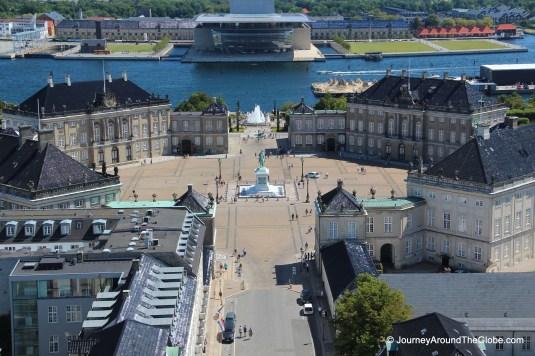
- View of Ameliaborg Palace from top of Marble Church in Copenhagen, Denmark
b. CHURCH OF OUR LADY (VOR FRUE KIRKE): Also known as Copenhagen’s Cathedral, this national cathedral is situated in Vor Frue Plads and next to the main building of the University of Copenhagen. This church has been built four times on the same place since 1209. The cathedral had been associated with the Royal Family for a long time where their ceremonial events such as crowning and weddings took place. The tower is 60 meters high and houses 4 church bells weighing over 4 tons and are the largest bell in Denmark. The smallest bell in the tower is the oldest bell in the country, dating from 1490. The façade of this cathedral is built is neoclassical style with 4 columns supporting the prestigious pediment from mid-19th century. There are 2 statues of Moses and King David on the 2 sides of these columns.

- Love the ambience of the altar of Church of Our Lady in Copenhagen, Denmark
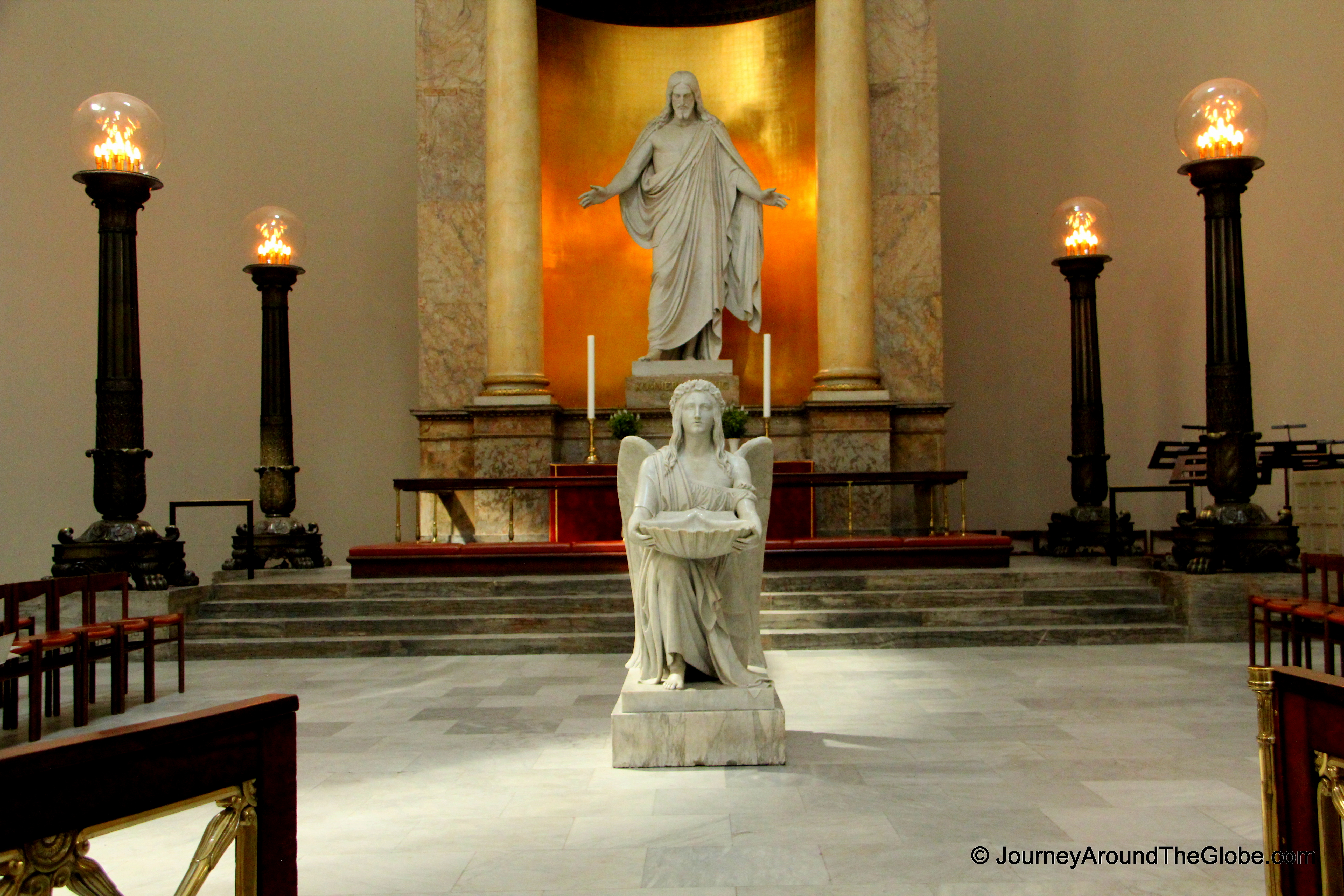
Inside the cathedral is simple but very elegantly adorned with everything white…pillars, walls, ceilings, dome, and sculptures of 12 apostles of Jesus on both sides. The statue of Christ and the beautiful baptismal font in a form of an angel holding a large scallop shell at the altar are made with Italian marble.

- Curved stone work on one of the walls of Church of Our Lady in Copenhagen, Denmark
c. CHURCH OF OUR SAVIOR: The exterior of this church has to be the one of the most uniquely designed ones in Copenhagen (if not the most beautiful) with beautiful spiral tower that can be seen from almost anywhere in the city. The church is designed in Dutch Baroque style. Visitors can climb its 83 meters high tower. There are 400 stairs to go all the way to the top. But that is too much for you, climb 250 steps to the platform and you will still get a wonderful 360 degree view over the city.
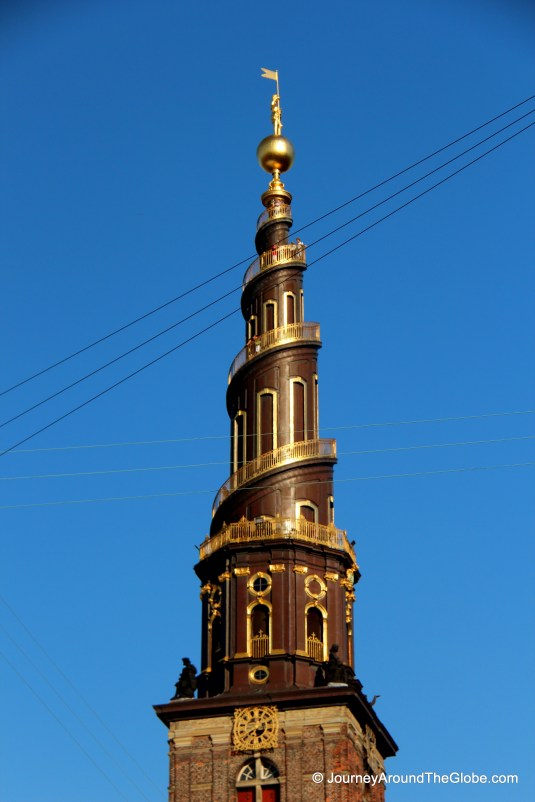
- The unique spire of Church of Our Savior in Copenhagen, Denmark
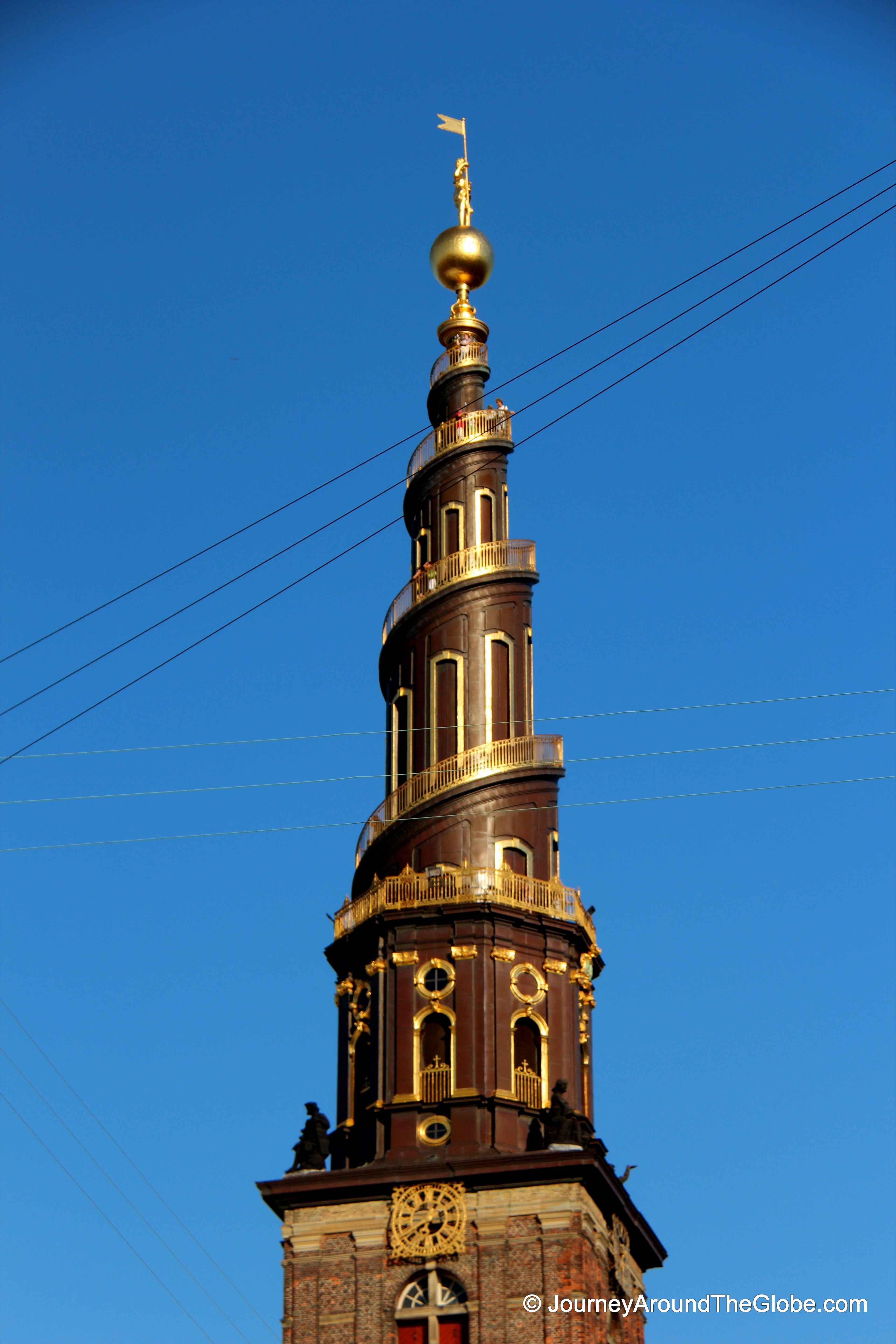
This is located in Island of Christianshavn. The church is open from 10am – 3.30pm every day, and the tower is open Mon – Sat: 10am – 7pm and Sun & Holidays: 10:30am – 7pm. The fee to climb the tower is 35 DKK for adults and 10 DKK for kids.
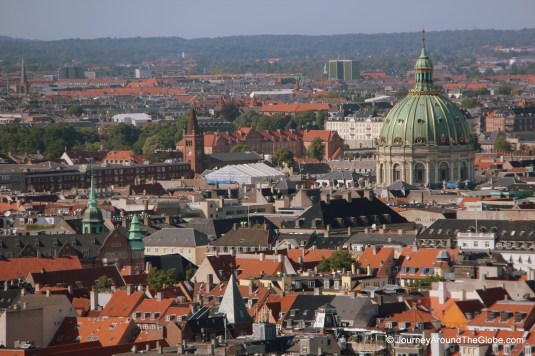
- View of Marble Church and its surroundings from top of Church of Our Savior in Copenhagen, Denmark
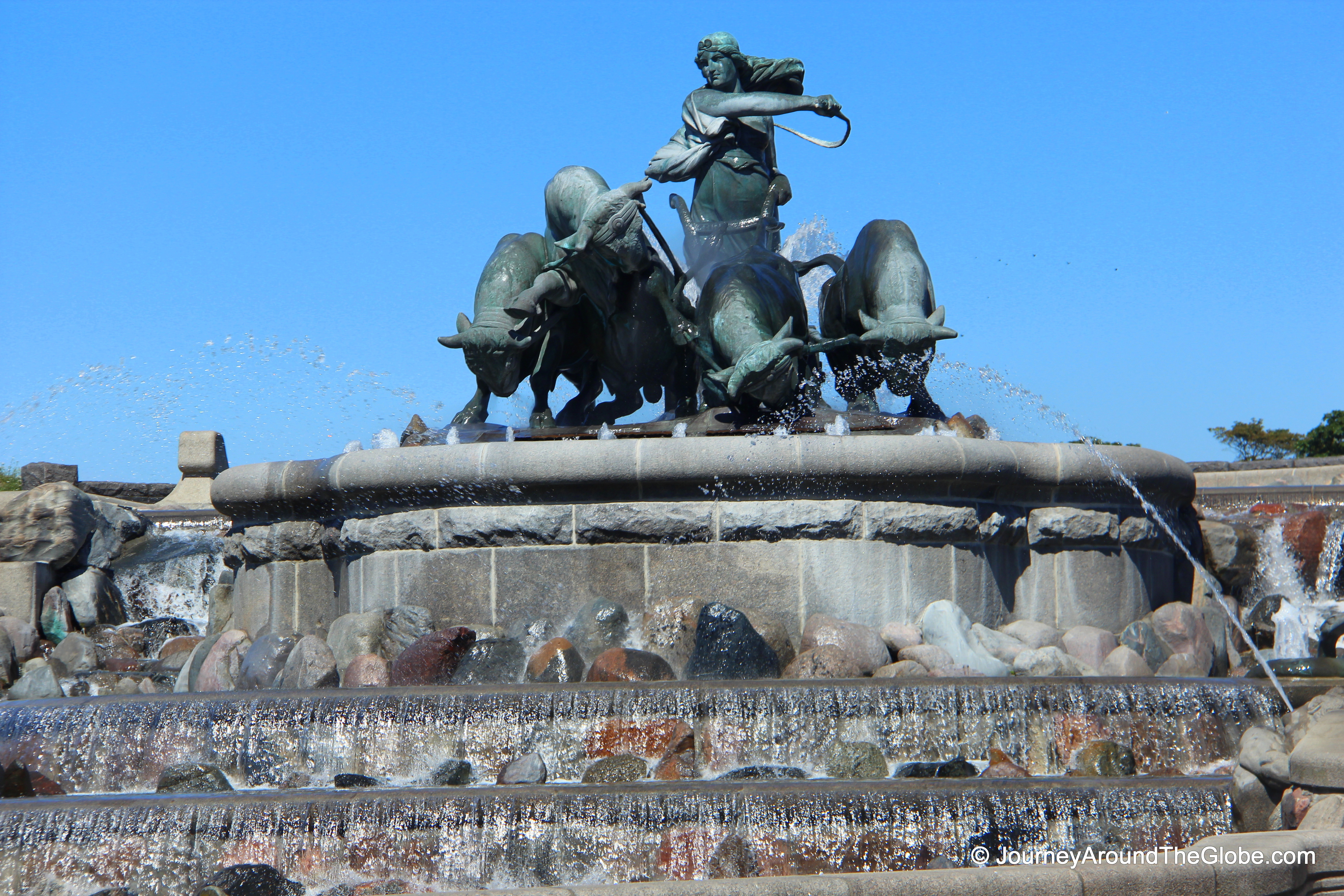
5) CHURCHILL PARK, LITTLE MERMAID & ST. ALBAN’S ANGELICAN CHURCH: Churchill Park is one of the loveliest parks in the city. It is right by the Langelinie water front and a nice place to walk around its small gardens or to have picnic. One of the largest monuments in Copenhagen, Gefion Fountain, is located in one side of this park. The sculpture was built in 1864 – 1937 that features a group of strong oxen’s pulling the plough of legendary Norse goddess Gefion. Then there is another statue “Angel of Liberty” somewhere not-so-visible area by the tourists.

- The huge Gefion Fountain in Churchill Park in Copenhagen, Denmark
But the most famous and the most photographed statues in Copenhagen is a fairy tale figure “The Little Mermaid” in Churchill Park by Langelinie waterfront. This is the Mannekin-Pis of Brussels, or Eiffel Tower of Paris or Colosseum of Rome. You can’t return home from Copenhagen without seeing this mermaid sitting on a big stone and looking out over the water. She has been sitting there since August of 1913 being the icon of Copenhagen.

- Little Mermaid, a world-famous statue and the most photographed landmark in Copenhagen

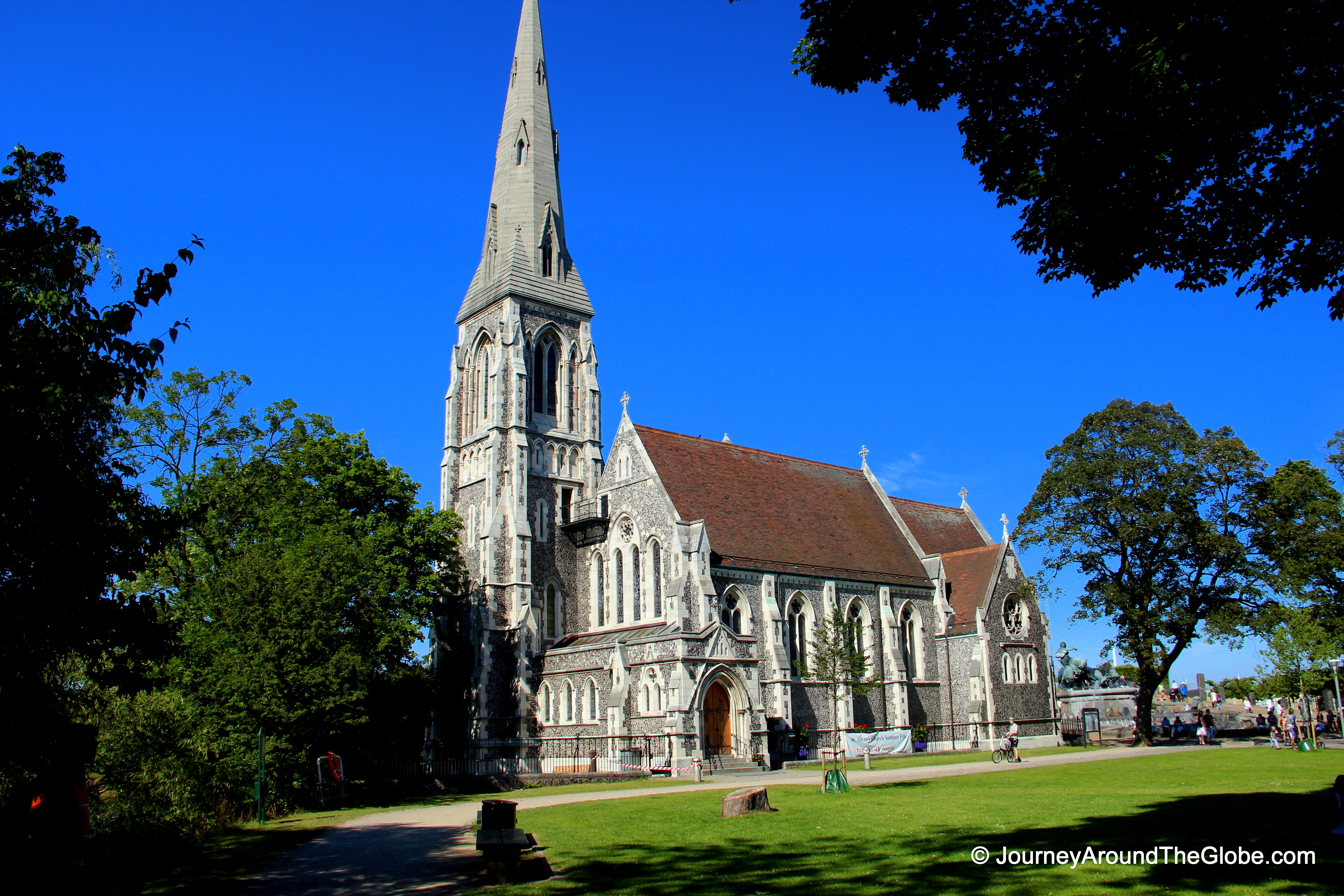
St. Alban’s Church, or as the locals calls it the English Church, is located in Churchill Park very close to Citadel and right beside Gefion Fountain. This is a 125 years old church with Victorian style stained-glass windows. Although we couldn’t go inside (think it closes around 4 pm), the outer look is very impressively decorated in traditional English style with Gothic Revival look, also known as Lancet Gothic.
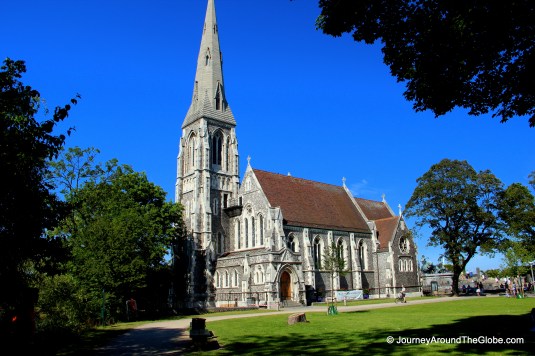
- St. Alban’s Angelican Church in Churchill Park, Copenhagen, Denmark
6) NYHAVEN & BOAT TOUR: This has to be the most colorful and the liveliest place of Copenhagen (and my most favorite place). You will see the buildings by the canal painted with all the colors of rainbow…such a wonderful way to sooth your eyes with. The streets on both sides of the canal are teemed with cafes and pedestrians. Enjoy the crowd, restaurants, canals, boats, sunset, and everything else about it. This is absolutely the hottest spot for young and adults, locals and tourists. Look for a blue building in between a yellow and a maroon building, written 1681…this is the oldest building in Nyhavn.
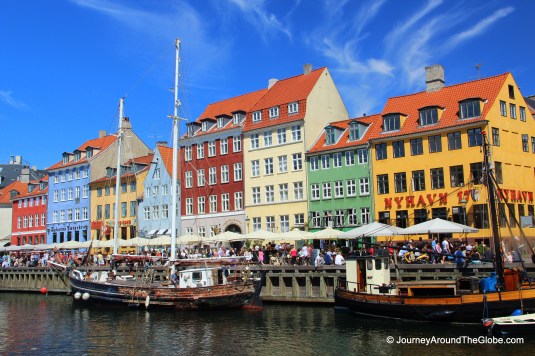
- Burst of colors in Nyhavn (New Harbor) of Copenhagen, Denmark

This is also the place where you can get boat tours around the canals. The tour takes you to many important sites, like Black Diamond (Part of Royal Library), Ameliaborg Palace, Christiansborg Palace, Stock Exchange buildings, Little Mermaid, Royal Theatre, and many other places which I can’t remember right now J. Here are 2 options of boat tours offered by 2 separate services, we took the 1st one:
- Open until 8 pm every day. Charges 40 Danish kroner per adult, 15 kroner for kids 5 – 15 years, and free for kids below 5. The ride is for an hour and runs every 20 minutes.
- Open until 9 pm every day. Charges 70 kroner per adult, 35 kroner for kids 5 – 15, and free for kids below 5. The ride is for 1 hour and 15 minutes and runs every 15 minutes.
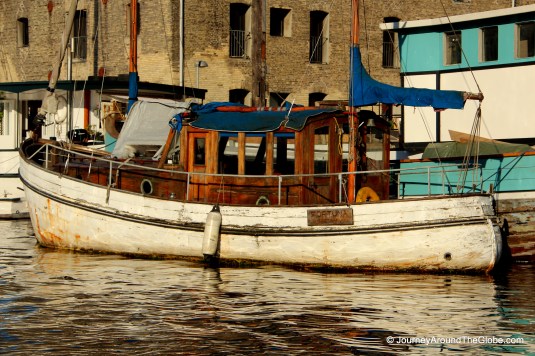
- We saw many of these beautiful boats on the canal in our boat tour

7) CITADEL (KASTELLET): This is one of North Europe’s finest and best preserved fortifications. Presently the fortification is used as a modern military establishment and the buildings are mainly used for paper works. This is a nice and quiet place to take a little stroll, a good place to go jogging too. It is very close to Churchill Park, St. Absalon’s Angelical Church, and Little Mermaid. There is a church, a monument for all the Danes that says “One Moment, One Place, One Person” in Danish, and an eternal flame inside the territory of this citadel.

- Entrance to Citadel in Copenhagen, Denmark

8) TRIP TO LEGOLAND, BILLUND: Billund is about 2 ½ hour drive from Copenhagen and is the ultimate place of Legos. If you haven’t been in LEGOLAND before, this is an awesome place to take your kids to. We spent a whole day there, but you can easily spend couple days exploring all the things made of Legos and going on all the cool rides.

- My 2 princesses in front of Legoland Billund main entrance

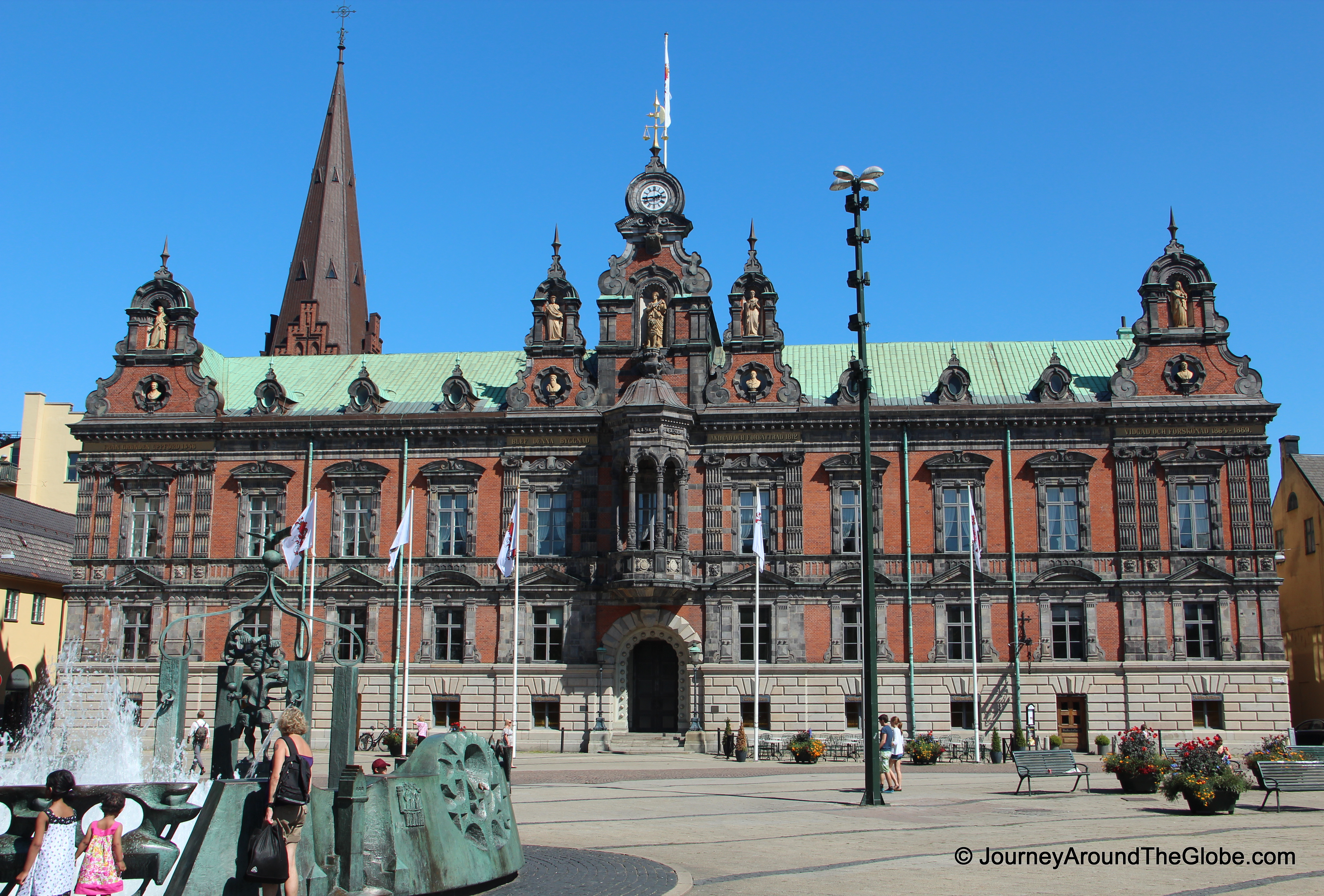
9) TRIP TO MALMO, SWEDEN: Malmo is beautiful city of Sweden and only less than an hour drive from Copenhagen. It makes a perfect day trip. Just a FYI, you have to cross Oresund Bridge to go to Malmo from Copenhagen, where you have to pay about $50 or 310 DKK when crossing the bridge via private car. Please check out my Malmo page to see all the things you can do here.

- Malmo Town Hall, Malmo, Sweden
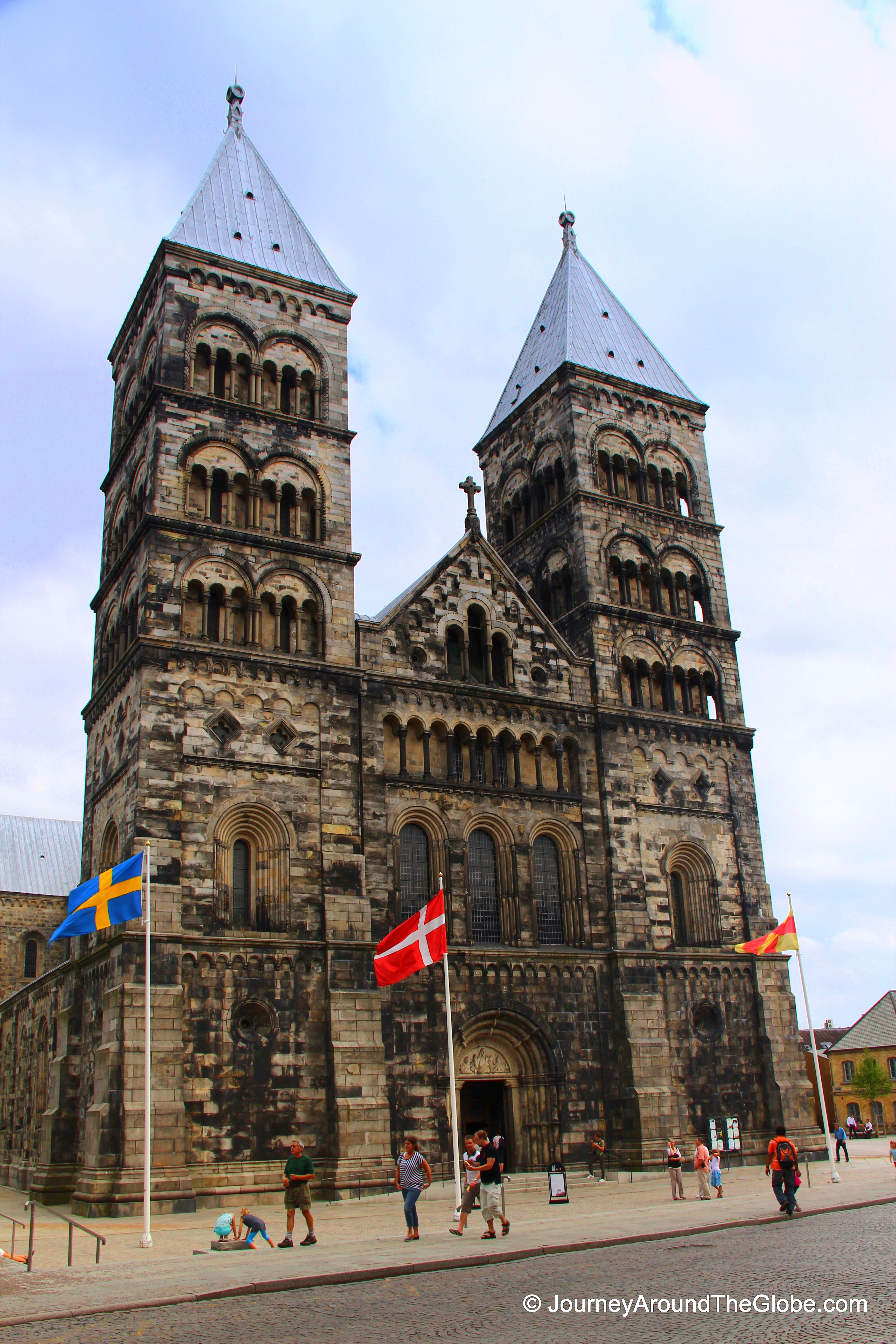
10) TRIP TO LUND, SWEDEN: Lund is another small Swedish town, only 20 – 25 minute drive from Malmo. This is a typical university town and out of all the chaos of its nearby city Malmo. There are not too many things to see or do here, other than just enjoying the beautiful city. This is another great getaway while in Copenhagen or Malmo.

- Imposing Lund Cathedral in Lund, Sweden
Share this:

Business Excellence Award 2020 from AI Global Media for The Most Entertaining Personal Travel Blog – Pacific Northwest USA

Top Posts & Pages


Authors
 Globe Runner
Business Excellence Award 2020 for The Most Entertaining Personal Travel Blog – Pacific Northwest USA

Business Excellence Award 2020 from AI Global Media

 Journey Around The Globe