Journey Around The Globe
ready for the next destination
The Rose-Red City of Petra, Jordan
PETRA, JORDAN: Without any doubt Petra is a world of wonder and the greatest tourist attraction in Jordan. Also known as “Rose-Red City”, this unique city was carved from sheer rock faces by the Nabataeans more than 2000 years ago. This Kingdom existed for centuries before the Romans annexed it. By the 14th century, Petra was completely lost to the West, until in 1812 a Swiss traveler, Johann Ludwig Burckhardt rediscovered it and noted on his diary “It seems very probably that the ruins at Wadi Musa are those of the ancient Petra.”

- Entering Rose-Red City of Petra in Jordan
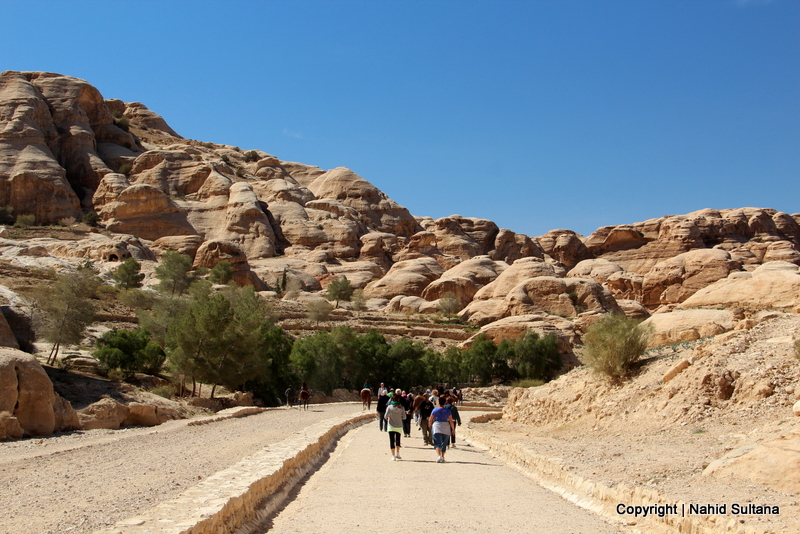
Petra, also known as Wadi Musa or Valley of Moses, is like an open-air museum and the main attraction is the ruins itself. You need at least one day (or few days) to explore the major sites of it. Petra enchants travelers with its revealing appearance and bold history. It never fails to impress them. There is no place like this on earth and its beauty is beyond any expressions. I saw many images of Petra before traveling there, but they come nowhere close to what we experienced.

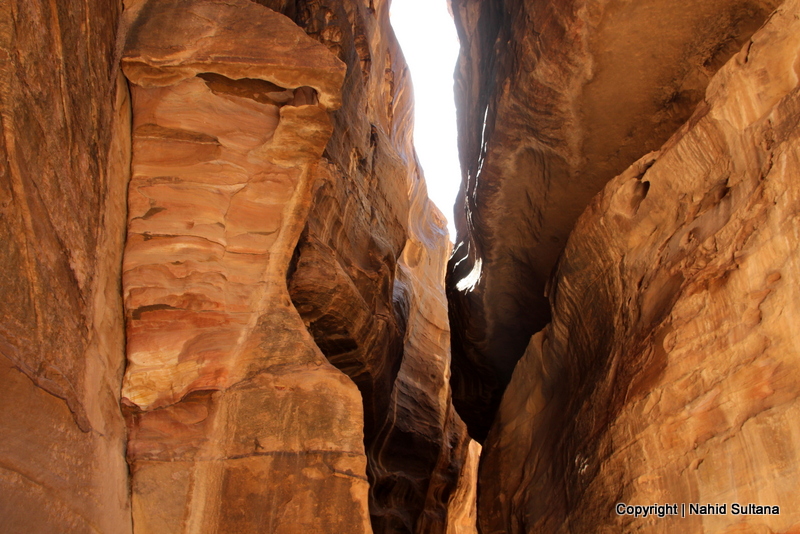
- Little piece of sky that you can see while walking thru Siq in Petra, Jordan
For the history of Petra, I will copy the information from the information board that I saw near the visitor center…I think that sums it up very well. “Petra, as the capital of the Nabataean Kingdom, thrived as an important trading post on the international Spice Route, serving as a crossroad between Arabia, Egypt, Palestine, Syria-Phoenicia, India, China, and the Mediterranean Basin. Nestled within intricate geological formation of mountains and gorges are the impressive tombs that the Nabataeans carved out of the sandstone rock faces. Nabataeans, Romans, and Byzantines built the city of Petra from the 2nd century BC to the 5th century AD. Whilst the architectural facades of the tombs are a harmonious blend of ancient Assyrian, Egyptian, Hellenistic, and Roman styles, archaeological excavation in Petra have brought to light that the city itself survived well into the Byzantine period.” — From information board of Visitors Center in Petra, Jordan.

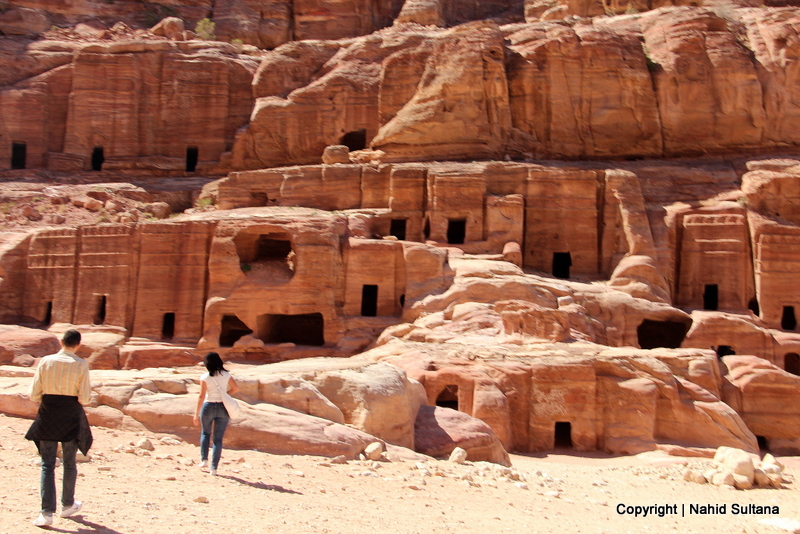
- Hundreds of caves and tombs of Nabataean Kingdom in Petra, Jordan. The picture came a bit out of focus because I was on a mule.
TIME of TRAVELING: We stayed in Jordan all together about a week. Out of that, we spent 2 nights in Petra and one full day exploring the valley and its ancient history. It was mid-February of 2013. Although we were prepared with our jackets the day we were in Petra (all the visitors were actually carrying jackets/sweaters) but when you have to walk few miles those jackets eventually end up either in your backpack or tied to your waist. That’s what happened to us too, but it did get a bit chilly in late afternoon when we were walking back to our hotel. Other than that it was a perfect day to do some outdoor hiking with kids.
OUR HOTEL: We stayed in Movenpick Resort in Petra, right outside the Visitors’ Center. I don’t think I need to say much about Movenpick, it’s a 5-star hotel…very luxurious rooms with excellent customer service. Wi-Fi wasn’t free but breakfast buffet, with variety of different items to choose from, was free for its customers.
EATING and SHOPPING: We had lunch after 4 pm the day we spent in Petra. We were dead tired and just went to the first place we saw, which was luckily next to our hotel. It was nothing fancy, but had some good soups and pizzas. There are many restaurants and cheaper places if you are willing to walk 10-15 minutes from the entrance of Petra. If you are hungry inside Petra, few restaurants/cafes are available after crossing Khazana and Roman Theater.

- My glass of lemonade with a hint of mint on top of the mountain on our way to the monastery in Petra, Jordan
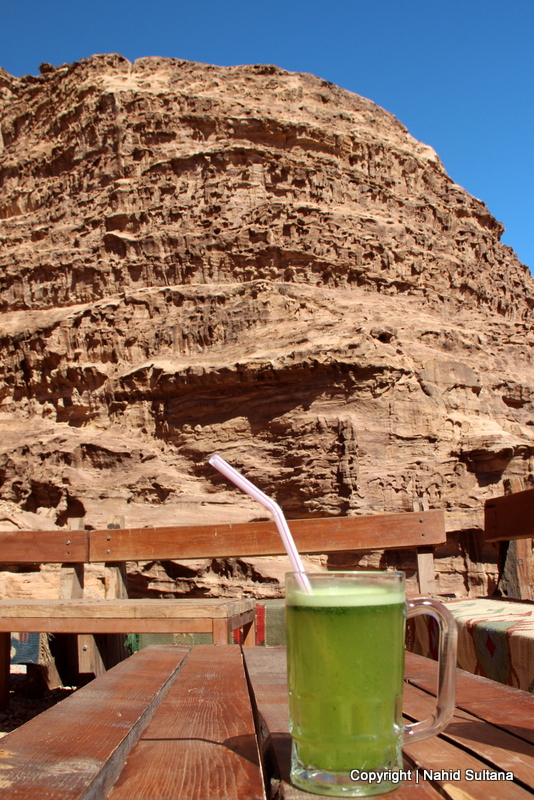
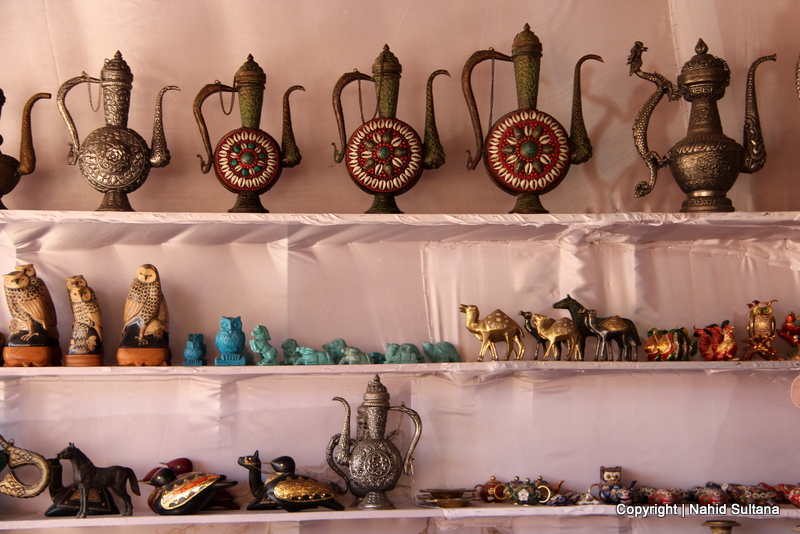
I didn’t see much of shops there, I guess I wasn’t looking at the right directions. I saw a souvenir shop on top of the mountains when we arrived there with our donkeys, and a mule to go to the monastery. Oh and also saw many Bedouin ladies selling local trinkets in the valley and on the mountains.

- A souvenir shop on the mountains selling local trinkets in Petra, Jordan
PLACES WE’VE VISITED: I tried to break our visit of Petra in few different segments to make it easy on me and my readers. We did rent 2 donkeys and a mule to help us climb more than 900 stairs to go to the monastery and then later a horse-drawn carriage from Khazana to the main entrance of Petra thru Siq. It just made it a whole lot easier on the kids and us…can you imagine climbing 900 stairs (they are not even stairs either) with a 7-yrs. and a 3- yrs. and then walk another 15-20 minutes to the monastery? By the way, both of my girls were still sick from our previous day-trips in other parts of Jordan, I truly appreciate their courage and support on this trip.

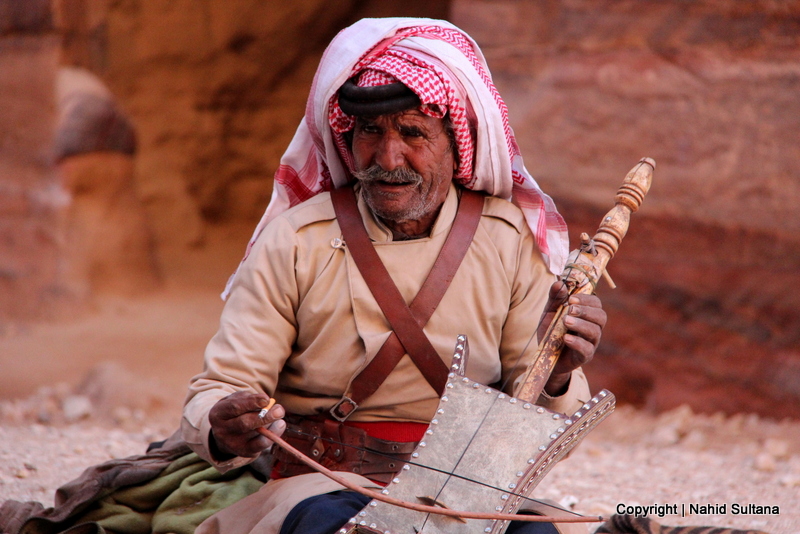
- Man playing a very old instrument, called Rebabh, near Khazana in Petra, Jordan
Here are the price information for our rides if any travelers find it useful:
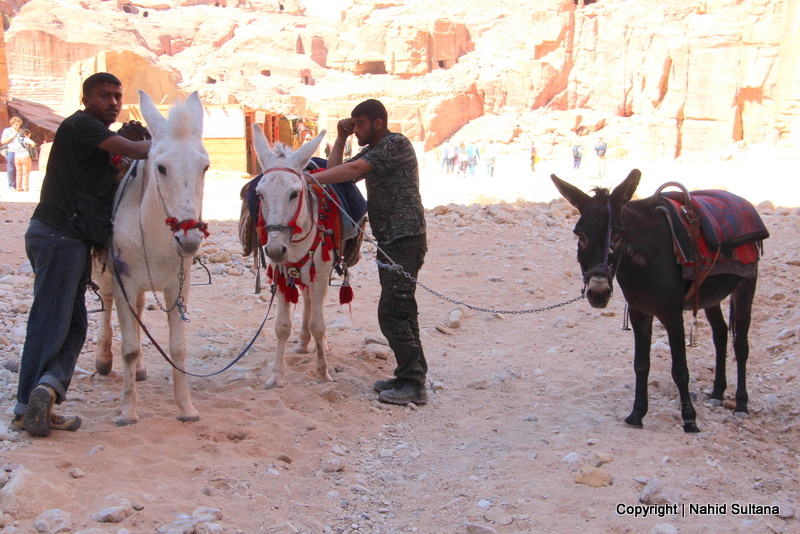
Rent for 2 donkeys and 1 mule (with 2 guides) – From Khazana to Monastery and return is 60 JD + my husband gave them 20 JD tips. 60 JD rent was bargained before we rode on the animals…very important that you do it. This portion of tour took only 2 hours…thanks to those lovely animals for doing the hard work.

- Our guides and rides to the monastery in Petra, Jordan
Horse carriage ride for our whole family from Khazana to Visitors’ Center was 20 JD (no tipping). Disable visitors can rent horse carriage at the entry point for free, but be sure to decide on how much tip you are going to pay them beforehand to avoid any trouble. Right after entering the site, many people will try to get you to rent their horse or donkey and will tell you that it’s free. But remember, legally, it’s only free for disable, sick, or elderly people. Don’t fall for what they say…it’s just a way of making money. Here is the entry fees information: (Guided tour is available in the visitor center)
a) Overnight visitors to Jordan:
1 day – 50 JD
2 days – 55 JD
3 days – 60 JD
b) Day visitors to Jordan:
1 day – 90 JD
Tourists often come from Israel on day trips and hence the ticket category is different for them. You may have either to show your passports or your hotel keys (if staying overnight in Petra) to prove that you are not a day visitor in Jordan.
Okay, so here are some highlights from our Petra tour:
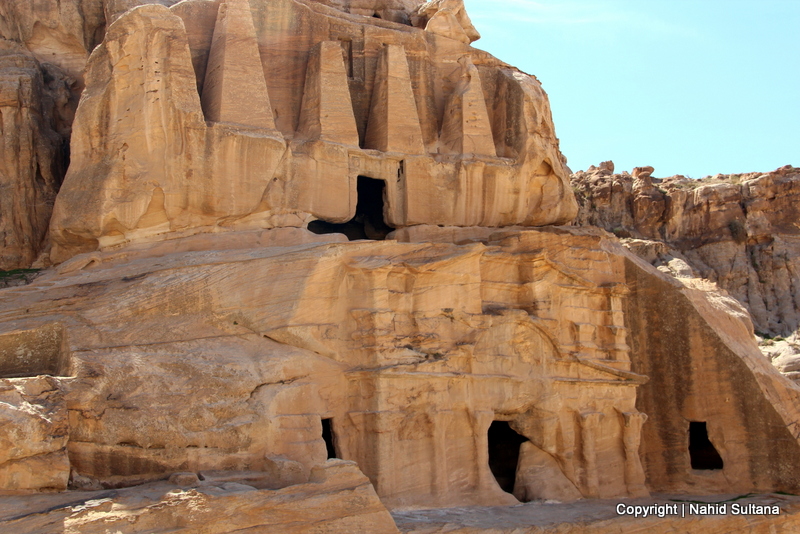
1) FROM VISITORS’ CENTER to BAB AL-SIQ: This walk was about 1 km long until we reached the entry point of Siq. This is just the appetizer for the main beauty of Petra…if appetizer is this good, you can only imagine what the main course would be like!! Both sides of the walkway are guarded by large and small hills and interesting natural rock-formations. We saw many natural and hand-cut caves on this stretch. This area also contains several rock-hewn monuments and memorials, including the distinctive tower tombs known as the Djinn Blocks, the rock-cut funerary complex of the “Obelisk Tomb” and the “Bab Al-Siq Triclinium.”

- Walking from Visitors’ Center to Bab Al-Siq in Petra, Jordan. You can see some Djinn Blocks (the square rocks) here

Djinn Blocks (Djinn is a type of spirit in Arab folklore) are free-standing cube-shaped monuments which served as tombs and memorials to the dead. There are only 3 or 4 of them near Bab Al-Siq but a total of 25 Djinn Blocks can be seen in whole Petra. These are some of the earliest tombs carved in Petra in around 2nd to beginning of 1st century BC. Obelisk Tomb and Bab Al-Siq Triclinium were carved from sandstone cliffs around 25 – 75 AD. Petra’s Bedouin inhabitants named the entrance of Siq “Bab Al-Siq” meaning Gate to the Siq in Arabic.

- A rock-cut funerary complex “Obelisk Tower” before entering Siq in Petra, Jordan
2) THE SIQ: The real beauty of Petra begins as soon as you enter Siq. You can’t imagine its grandness without being here physically. This narrow 2 km passageway takes you right in front of the most popular attraction of Petra, the Khazana (Treasury).

- The Siq – a natural gorge and main entrance to the City of Petra, Jordan

Siq is a natural sandstone gorge that gently winds towards the ancient city of Petra. This was once the main entrance to the city. In its day, Petra was a bustling city that witnessed a constant procession of travelers, visitors, and pilgrims, who passed along this same path. Many carved blocks and petroglyphs can be seen throughout the Siq. Different shades of colors of the canyon and fascinatingly beautiful shaped rocks give this place a different charm. I have never seen anything like this before. This is where natural wonders collide with ancient world.

- A 2000 years old statue carved from stone by Nabataean inside Siq in Petra, Jordan
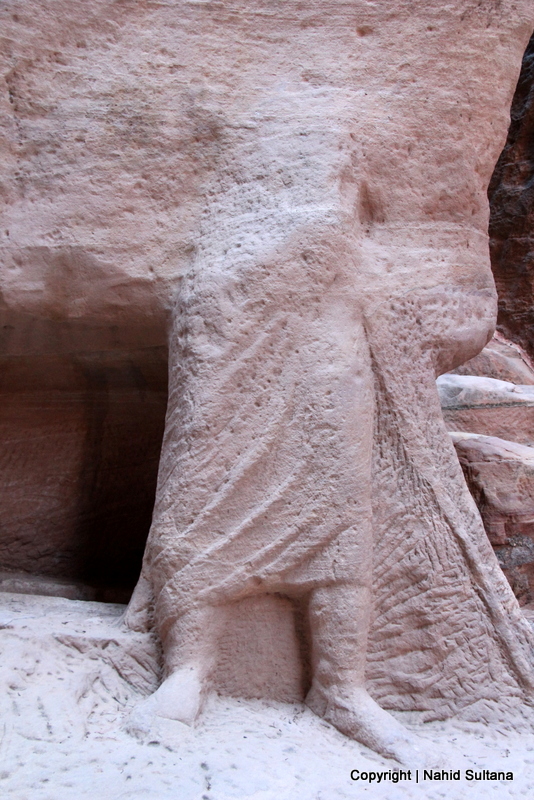
Many remnants of Nabataean history can be seen inside the Siq. Among these are the paved road and Nabataean sacred stone blocks. The paved road in the Siq was originally constructed by the Nabataeans, possibly towards the end of the 1st century BC. Limestone was used for the paving and portions of that road still exist in some areas of Siq.

- Amazing colors and rock formations of Siq in Petra, Jordan
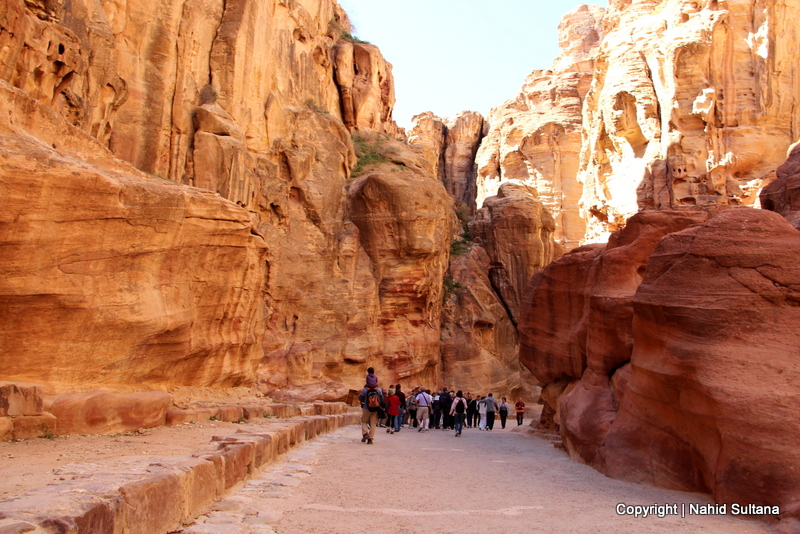
3) Al-KHAZANA (THE TREASURY): After 3 km of walk, Siq dramatically opens up to a magnificent view of the Khazana. This towering façade is the most spectacular monument carved by the Nabataeans from 60 BC – 50 AD. It was impressively carved out of a single block. The name, Khazana, comes from a local Bedouin legend that Pharaoh hid a treasure in the urn at the top. But in reality, it is a mausoleum and would have been used for funerary purposes.
Tourists are not allowed to go inside Khazana. So we rested in front of it for about half an hour while enjoying and appreciating the talented Nabataeans for Khazana’s imposing appearance. By the way, this is where Spielberg’s “Indiana Jones and the Last Crusade” was filmed starring Harrison Ford.

- Al-Khazana (The Treasury) in Petra, Jordan
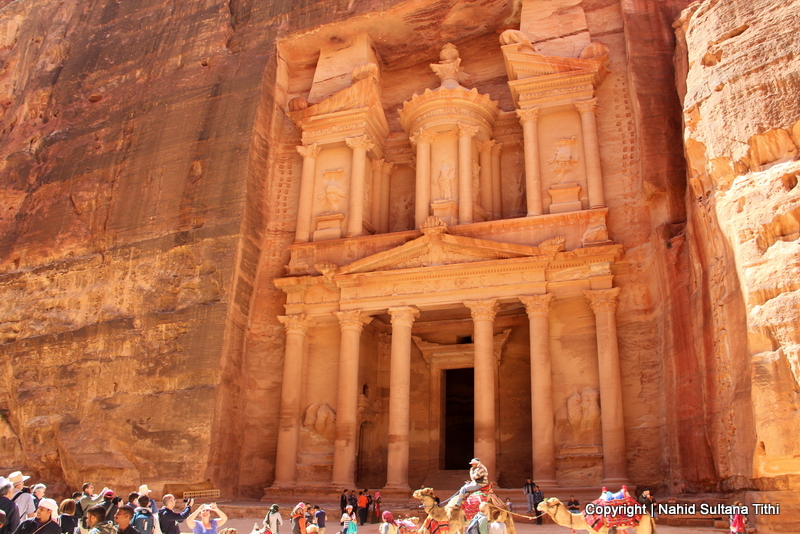
Most of visitors of Petra end their journey here, especially if they are with groups or on a day-trip from Amman or other cities. But this is just the half of Petra’s ancient secret. I would highly recommend travelers to pass this point and start going towards the monastery, otherwise you will miss out a lot of scenic sites that Petra has to offer to its guests.
4) ROYAL TOMBS, CAVES, and RUINS: Leaving Khazana behind to our left, we walked thru another small natural passageway and came in front of a large valley. Some of the tombs here dates back to 200 BC. There is also a 3000-seat Roman Theater from the early 1st century AD in one side of the valley, a Roman style Palace Tomb, and many royal tombs to your right up on the hills. These caves, tombs, and carvings on mountains look like paintings of nature. The beauty doesn’t end anywhere…every corner has surprise, every rock of this valley has some uniqueness. Various walks and climbs reveal hundreds of rock carved tombs and temple façades, funerary halls, and rock reliefs…enough to keep your eyes busy for hours and days.

- Royal tombs and memorials of Nabataeans in Petra, Jordan
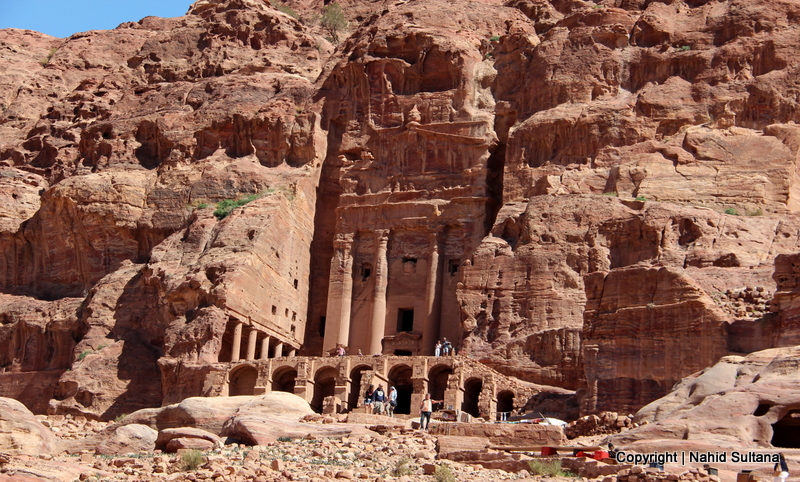
We rented our 2 donkeys and a mule from here. Now I was exploring Wadi Musa (Valley of Moses) riding on my mule. This was much easier than riding a camel (we rode on camels in our trip to Pyramids of Giza in Egypt). I felt much comfortable and was actually able to take pictures using my both hands…it felt so cool.
Many other Roman ruins can still be seen in this part of Petra. Massive columns and old limestone walls will take you back to those bygone days. This was a long way from Khazana before we actually started climbing the stairs to monastery.

- From my mule – riding thru the Roman ruins of Petra
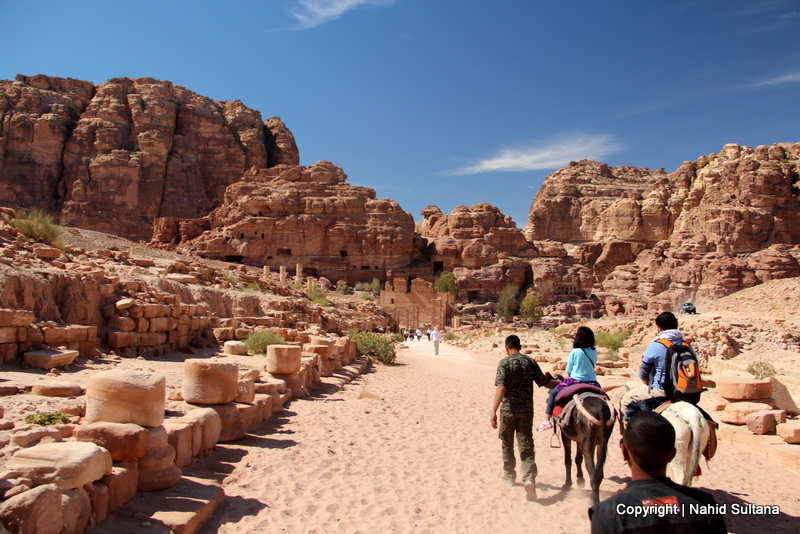
5) WAY to MONASTERY: I think there are hundreds and thousands of caves and tombs in Petra, they are almost everywhere you look. Some of them are natural and some are hand-cut. Our guide with the animals were two Bedouins who reside in some nearby caves in Petra. They were saying in hot summer days these caves become very cool and pleasant while in winter they become very warm and cozy.

- Jabel Petra, mountains of Petra – on our way to the Monastery
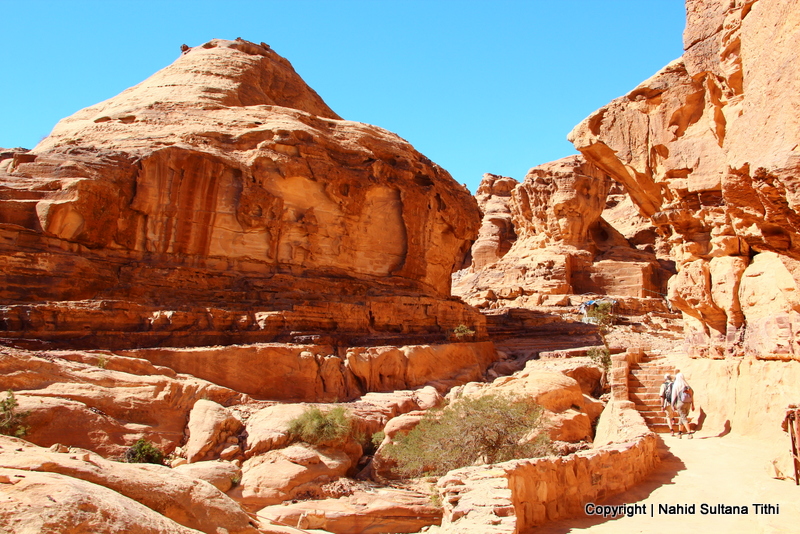
So, after all the ruins and royal tombs the climbing began. There are more than 900 unevenly cut steps to go all the way top to the monastery. The donkeys were very fast climbing although at times I thought he would drop me from his back to the deep down gorge. It was thrilling no doubt but kind of scary too. I scratched my one knee at one point since my mule decided to walk so close to the wall that it had forgotten my legs needed some space. But I would have done it again if I had to.

- A picture perfect place – Petra, Jordan
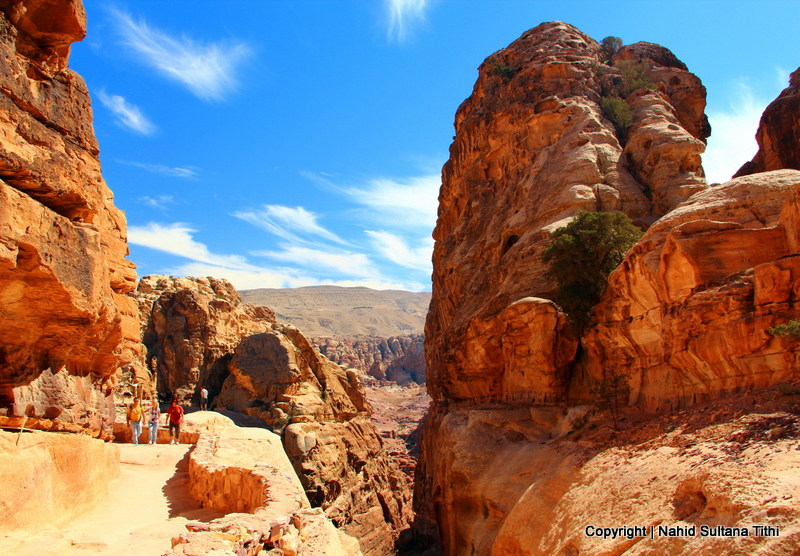
These animals can go up to a certain point of these mountains with tourists. After that the Bedouins and the animals stayed behind and we walked little bit and climbed another 50 steps before some more great views of the valley opened up to us.
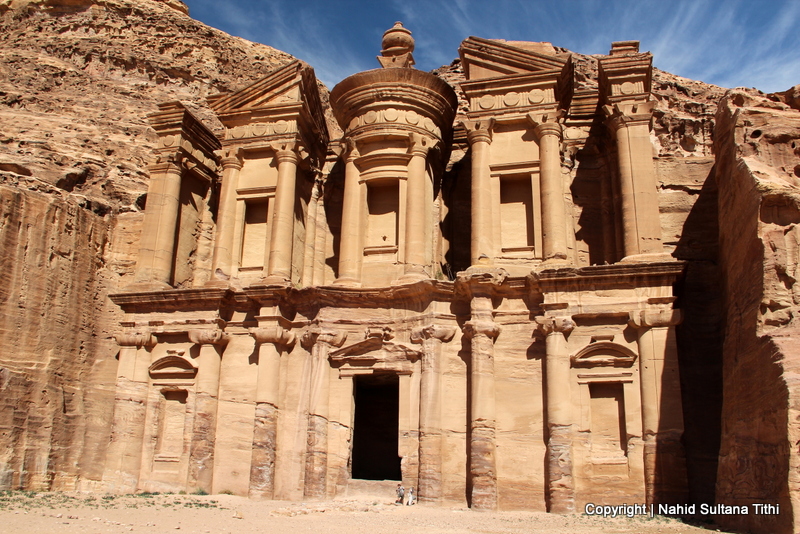
6) THE MONASTERY: Deeply carved into a cliff face of a mountain, known as Jabal ad-Dayr, the façade is traditionally known as “the Monastery”. Built in 85 BC, this is one of the largest monuments in Petra. It looks very similar to Khazana but bigger in size. There isn’t anything to see inside the monastery except for its 3 enclosed walls, but visitors are allowed to go in and take a look around.

- Monastery in Petra, Jordan – carved by the Nabataeans in 85 BC
This was the end of our tour basically. There is a panoramic hill where people hike to see 360 degree view of the Petra city. But all of us were too exhausted to take anymore extra steps. From monastery we head back to our guides, went down some 900 steps, and back to Khazana where they picked us up from. From there, we rented a horse-drawn carriage to take us back to Visitors’ Center to avoid that 3km walk again. We were hungry, tired, sleepy, but absolutely satisfied with this journey. Petra is the most valuable treasure of Jordan. Thanks to the local authority for keeping this place so organized, clean, and safe for visitors. Every traveler must visit Jordan to see Petra, the “Lost City’, and its endless forget-me-not beauty.
PETRA by NIGHT: This is the best way to experience Petra’s look at night, which I missed due to my high fever. My husband went with a big group. This can only be done as a guided tour with officials of Petra Visitors’ Center. Tourists first walk about 1 km from the Visitors’ Center to Siq, then 2 km from Siq all the way to Khazana following a candle-lit path. Here everyone sits down, rests, and drinks a cup of tea under the open sky, served by the Bedouins. As my husband said, while they were drinking tea, a man gave them some history on this place followed by musical performance by a Bedouin. This whole trip is magical because the whole Siq and in front of Khazana are decorated with hundreds of candles on both sides after dark. Although I didn’t go there, I can visualize the adventure of walking thru narrow passage of Siq at night surrounded by many many candles…must feel like you are in a different planet.

- Petra by Night – man telling history of Petra
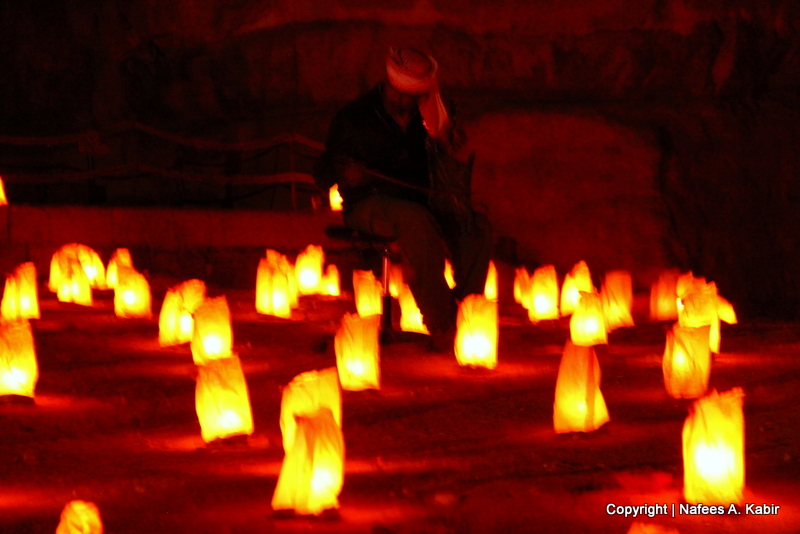
The charge is 12 JD per person to take this walking tour at night. My husband bought the ticket from our hotel reception and just showed up in front of the visitor center of Petra 10 minutes before the tour started. The event takes place Mondays, Wednesdays, and Thursdays of every week. The tour started at 8:30 pm and took about 1 ½ hours to finish up.
Related articles
- Amman and Back (journeyaroundtheglobe.com)
- Know about Petra Jordan ‘The New Seven Wonders of World” (earmarkn.wordpress.com)
- Jordan Holidays Amazing Gateway to Petra (earmarkn.wordpress.com)
- Jordan Trip 2013 – Wadi Mujib, Karak, Dana, and Shobak (journeyaroundtheglobe.com)
- Petra – Journey To A Bygone Era (manjaribhatnagar.wordpress.com)
Share this:

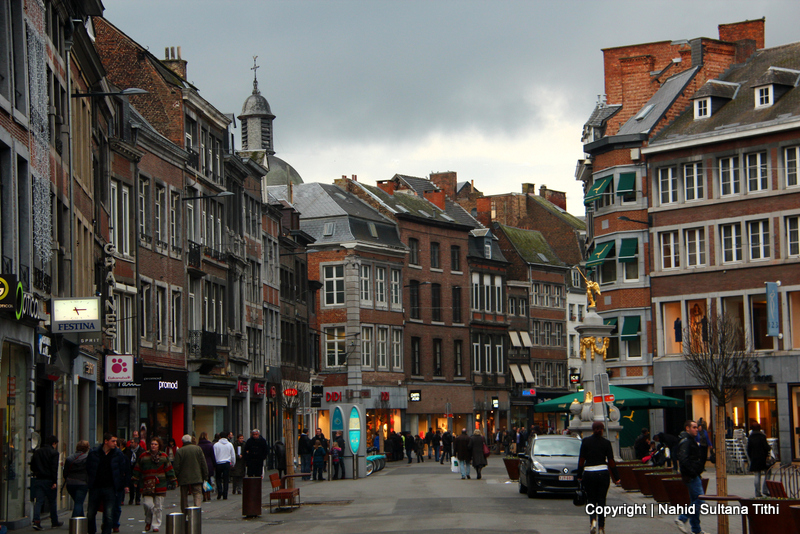
Wallon capital of Belgium – Namur
NAMUR, BELGIUM: Namur, Namen in Flemish, is the capital of the Province of Namur and Wallonia region which is the French-speaking part of Belgium. Located by River Meuse (Mass), the city has its own heritage and unique look. This charming city can be a great getaway for tourists when visiting country’s capital, Brussels.
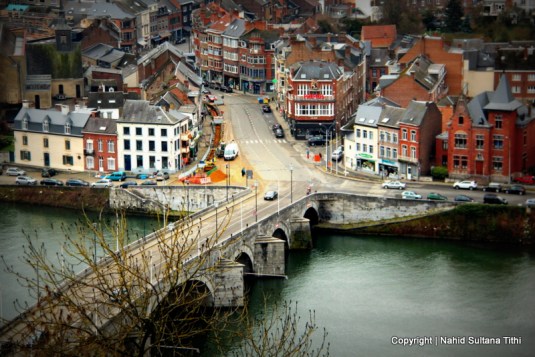
- City of Namur, Belgium

TIME of OUR TRAVEL: It was 2nd Saturday of March, 2013 when we visited Namur. We had a friend from Antwerp who accompanied us in this trip. The winter wasn’t over yet, but that day turned out to be a surprise for us. It was still cold and a bit gloomy in the morning, but luckily no rain (as predicted) and no bone-freezing cold. We left our home around 10:45 am and took us about an hour from Tervuren to reach the citadel of Namur.
EATING and SHOPPING: Most of the streets in old town near Cathedral St. Aubain are loaded with variety of cuisines and cafes. We had lunch in Express Asia on Rue de Fer. There are many bakeries and waffle house to treat your sweet tooth too. By the way, the smell of these waffles were divine…I thought I would have one before leaving, but forgot…hmmm.
Namur won’t disappoint you when it comes to shopping. In fact, I want to go back to Namur one day by myself only to do some crazy shopping spree. You will find almost every type of store on Rue de Fer and all the other small branches of alleys from or around Rue de Fer and close to the university. I wonder if this is the biggest shopping center in Wallonia!
PLACE WE’VE VISITED: We spent about a whole day in Namur, about 6/7 hours. We didn’t have any itinerary or a to-see list to follow. We knew we wanted to see the citadel, after that we just wandered around and went inside whatever looked good in our eyes. One thing that we didn’t see but should have seen was the Belfry of Namur which is an UNESCO World Heritage site. Here are the places we’ve seen and enjoyed:
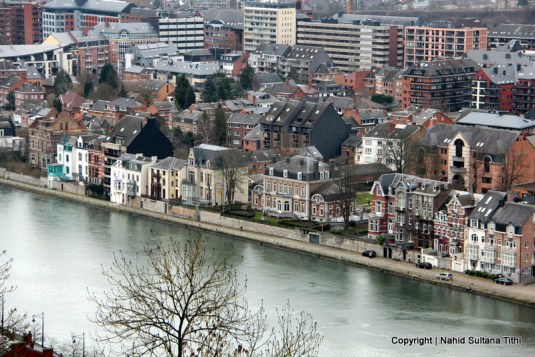
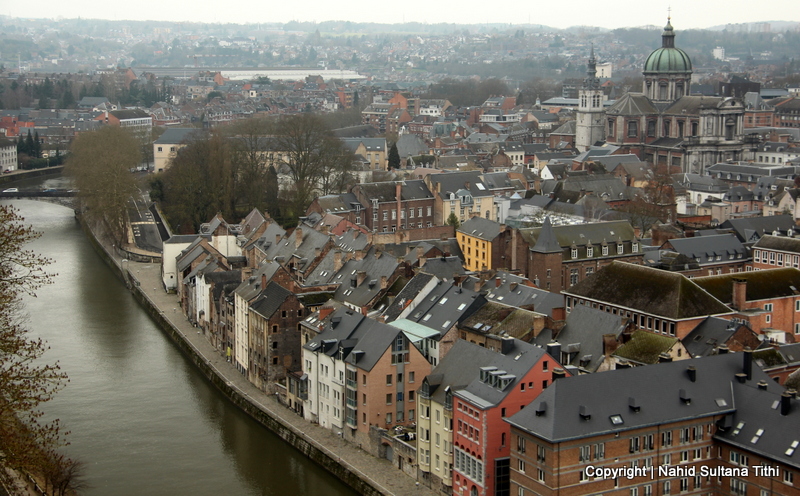
- Namur, Belgium – a view from the citadel
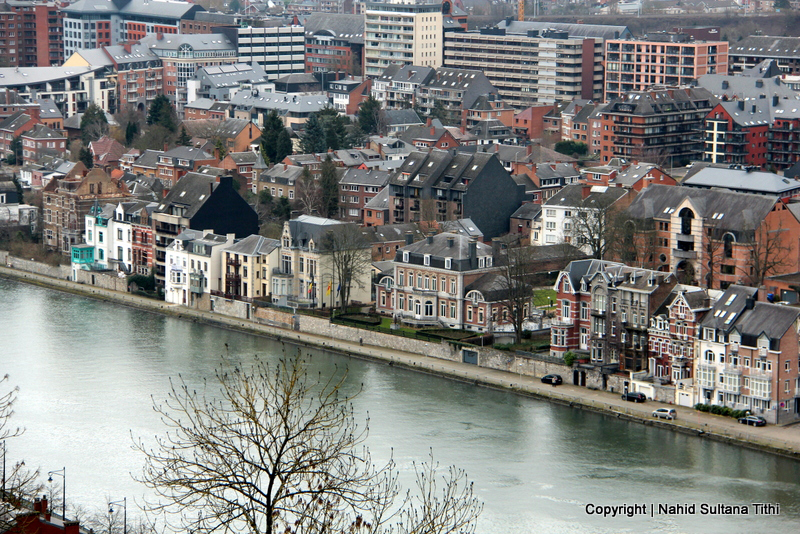
1) CITADELLE de NAMUR: The citadel is town’s most prominent sight. It is more like an open park for the public on top of the mountain. Many locals come here for jogging, walking, and biking. The best part of being on the top is that you get a fantastic view of the whole town. The scenic beauty of River Meuse with old buildings by the side is picture perfect.
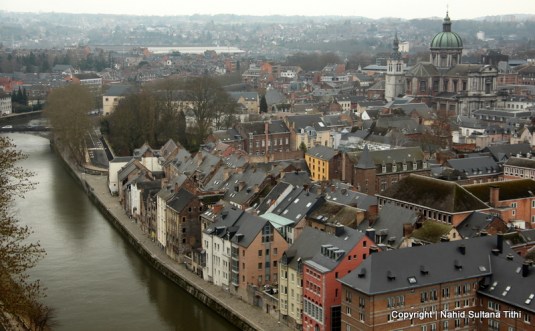
- View of Namur from the citadel in Belgium
The hill where the citadel is located is called, Champeau hill. From 10th – 15th centuries, the castle was the residence of the earl of Namur. In the 16th century, a modern fortification called “Mediane” was built. Chateau de Namur was built in 1910 AD. There are some underground passages to take a walk but can only be done with a tour. Even though there are very few remains from the medieval period, some elements can still be seen, such as the general outline of the castle, 3 of its towers, and part of the foundations.
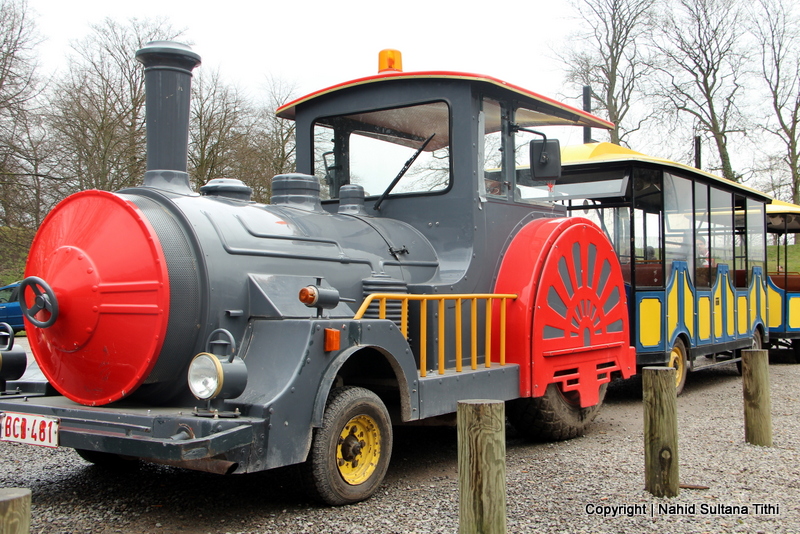
There is no fee to enter the citadel. Train ride costs 4 euros per person (4 years and below are free) and lasts for about 20 minutes. Another package which is available to the tourists costs 9 euros. This is with a guided tour and includes the train ride, underground passages, medieval part of the citadel, and a film. There is a big parking lot in front of reception where we parked for free.
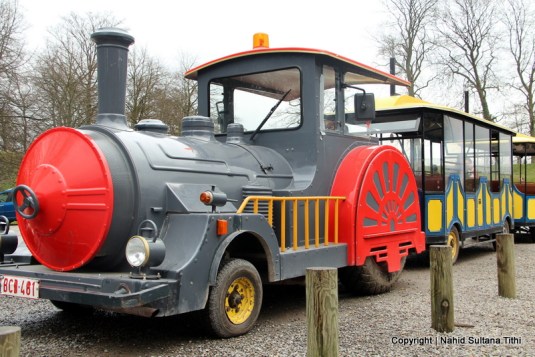
- Tourist train in Citadelle de Namur, Belgium
2) CATHEDRALE ST. AUBAIN: Turquoise dome of this cathedral can be seen from far distance and from top of the citadel. Outer Late-Baroque look of St. Aubain may not impress you as much but it’s a totally different story when you go inside. It’s very big in size but more than that the walls and vaulted ceilings are delightful. The highlights of this church are probably the richly carved dome, decorative main altar, and the huge organ in the back. It didn’t look like a typical Belgian church to me…has more of Italian/Roman touch to it.
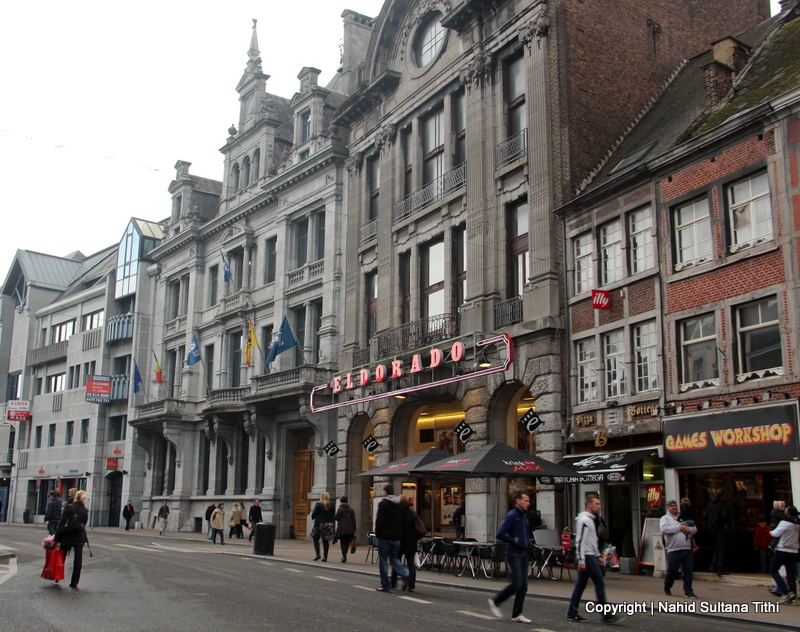
3) RUE de FER: This is probably one of the busiest streets of city where Namur Town Hall is located. The whole stretch of this street (partially pedestrian zone) has tons of shops, local boutiques, brand name places, chocolatiers, and etc…you can say this is the fashion street of the Walloons.

- One of the major shopping streets of Namur – Rue de Fer
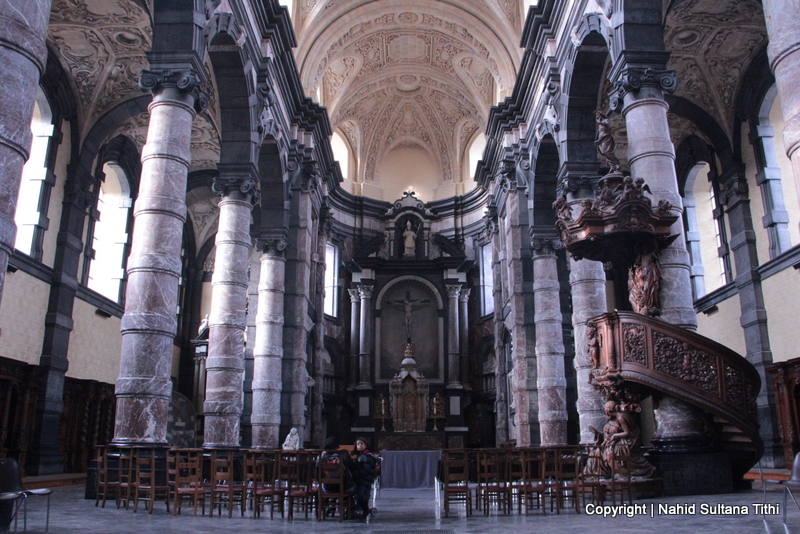
4) CHURCH of ST. LOUP: This is a very sophisticated looking church located in the old town/heart of Namur and very close to Cathedral St. Aubain. The interior of this Baroque style church is very gorgeous. The vaulted ceilings, main altar, the black and red marble naves and columns are remarkable. It is a small church but a must see in Namur.
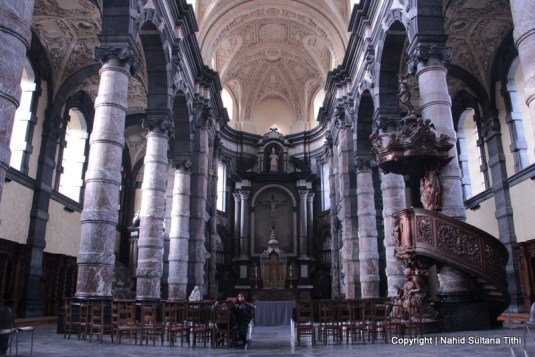
- Inside Church of St. Loup, Namur
5) PLACE de I’ANGE: As I said before, we really didn’t have any to-see list for Namur. We were doing some window shopping on Rue de la Croix (one of the alleys of old town and this big square sort of opened up at the end of the street to our surprise. This is a lively and lovely square with many shops and cafes along with an indoor shopping mall, Galerie Jardin D’harscamp. Most of it is pedestrian zone. We came here little bit before our parking meter was almost up…so could only spent little time here.
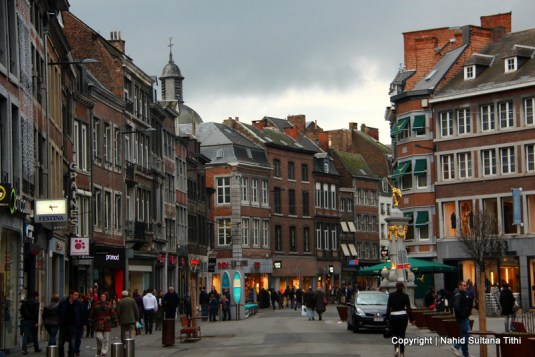
- Place de I’Ange in Namur, Belgium
Related articles
- Bucket list before moving back to America in summer of 2014 (journeyaroundtheglobe.com)
- A historic university town – Leuven, Belgium (journeyaroundtheglobe.com)
Share this:

Jordan Trip 2013 – Wadi Mujib, Karak, Dana, and Shobak
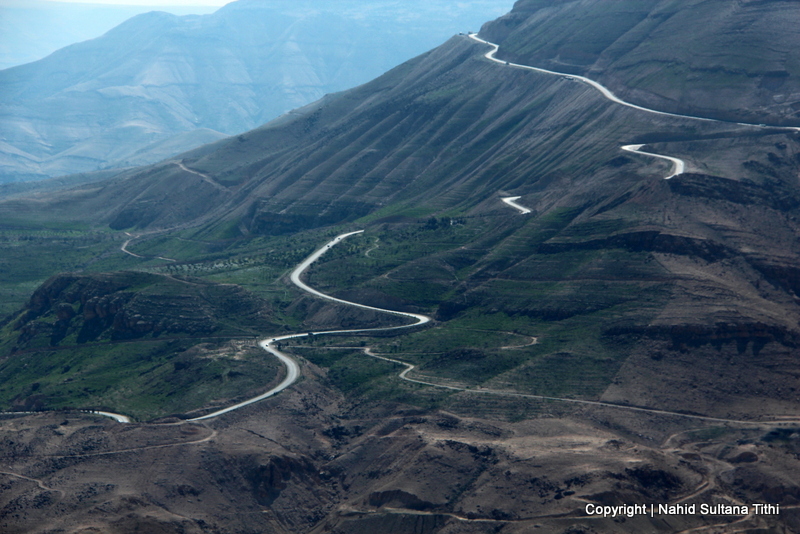
DAY TRIP to WADI MUJIB, KARAK, DANA, and SHOBAK: We took this trip on our way to Petra from Amman during our stay in Jordan in February, 2013. Our guide took King’s Way for this trip instead of regular highway although this takes little bit longer time. King’s Way is a beautiful scenic route that runs from Amman all the way near Petra. This long stretch of road crawls thru green fields, rugged terrains, majestic mountains, vast deserts, deep valleys, and steep canyons. You get to see many small villages up close and personal when driving thru local busy markets or neighborhoods. King’s Way is like U.S. Route 101 or Route 66, some portions are like fast high-ways while some are congested bustling streets.
People usually take this as a day-trip and include Petra along with it and go back to Amman the same day. But since it would be too much on the kids and we wanted to do it in a relaxed way, we paid more than double the price and did it in 2 days. We paid 120 JD for this trip and our driver showed us these 4 small towns, then left us in our hotel in Petra. The plan was to take all the time next day to visit Petra leisurely and go back to Amman via Wadi Rum on our last day in Jordan.

- A small portion of King’s Way in Jordan
OUR HOTEL: After leaving our hotel in Amman and getting on with the journey, we reached Movenpick Resort in Petra around 6 pm. Of course this is a 5-star hotel, so everything is perfect here, you can say. Although Wi-Fi is not free, the breakfast is included in the room-fare. The location was great too, since it’s just outside the visitor center of Petra.
EATING and SHOPPING: We started the day a bit late (my girls were sick and we were exhausted from previous day-trips) and were rushing thru the day to be able to see everything before the closing times. We ended up having lunch around 4:30 in a street-side kebab place in Shobak. You can say that was our dinner too.
For shopping, I really didn’t come across any souvenir shops in this trip, other than single individual Bedouins selling stuff right outside the 2 castles we’ve visited.
PLACES WE’VE VISITED: We left Amman around 10 am and were done with everything by 6 pm. This was a bit tight schedule since we barely made it to our last destination right before closing. May be leaving at 9 am would have given us some extra time. But unfortunately my kids and I fell sick after we reached Jordan, it’s a not that easy waking your toddlers who are suffering from fever and sore throat at 8 am and get them ready for a long day of journey. Anyways, good part is that we got to see everything we wanted to see and more and reached Petra safely at the end of the day. I think we all slept like babies that night, I know I did.
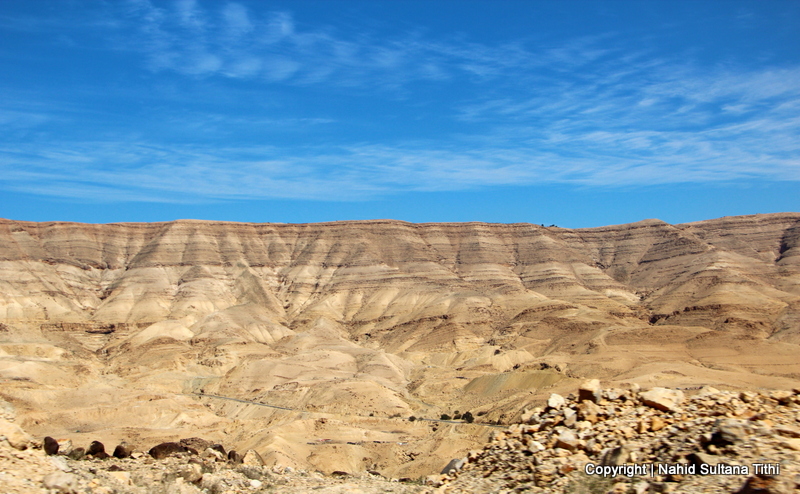
- Driving by beautiful mountains of Jordan
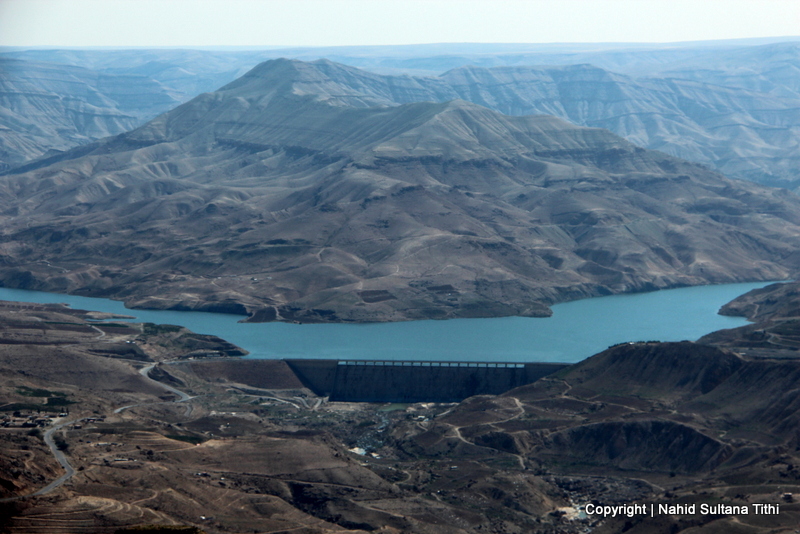
1) WADI MUJIB VIEWPOINT: After driving through some gigantic mountains and zigzagging roads of King’s Way we reached the viewpoint of Wadi Mujib. This is about 95 km from Amman. Although we didn’t go down to the valley, Mujib Nature Reserve is the lowest nature reserve in the world. The immense beauty from this point of Wadi Mujib is unforgettable. The deep valley looks breathtaking from up above. Dam Al-Mujib with its body of water surrounding looks like an oasis in the middle of the desert and stony mountains. The cliffs and the gorges of monstrous mountains and Bedouin settlements tucked away in the wadis make this place a picture perfect sight too. By the way, don’t forget to breathe fresh mountain air while you are up there…very refreshing.

- View of Al Mujib Dam in Jordan
2) KARAK CASTLE in KARAK: Karak is rather a big town and is about 65 km from Wadi Mujib on King’s Way. The castle reached its present form very gradually. The two main building phases were made by the Crusaders from 1142 – 1188 AD (later was occupied by Salahdin) and Mamluk from 1263 – 1517 AD. You can see typical Crusaders’ masonry here characterized by the use of large, roughly cut blocks of hard, dark limestone. On the other hand Mamluk builders used a soft limestone, neatly cut into rectangular blocks, but with a rough or rusticated outer face. Built on a ridge, the massive outer defense wall raises from the steep valleys of Karak isolating from the town and from nearby hills.

- The outer defense wall of Karak Castle in Jordan
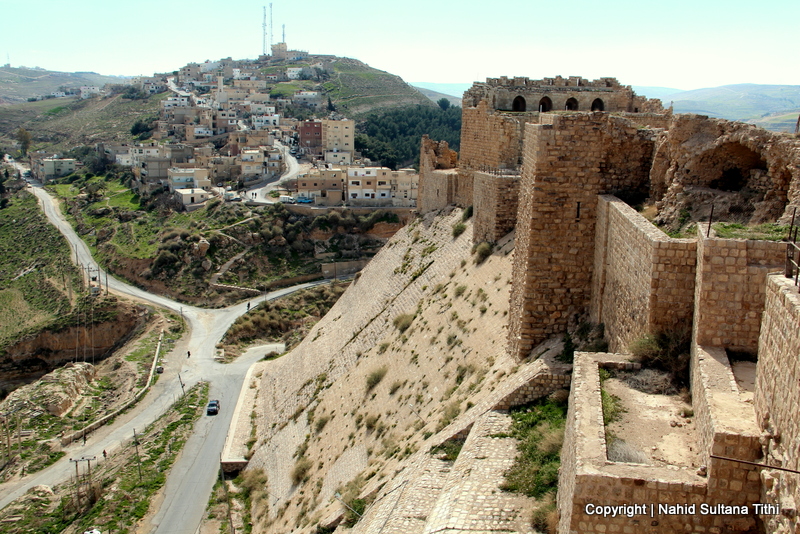
This is a humongous castle, I mean the whole perimeter is very big and open. This is one of the three largest castles in the region, the other two being in Syria. Standing by the outer walls gives a grand view of the whole town and afar. One of the adventurous parts is to walk inside the medieval cluster phobic tunnels and explore small bedrooms (some prisons). The main outer wall remains fairly intact but the buildings inside the boundary are somewhat in ruins.

- One of the dark tunnels of Karak Castle in Jordan
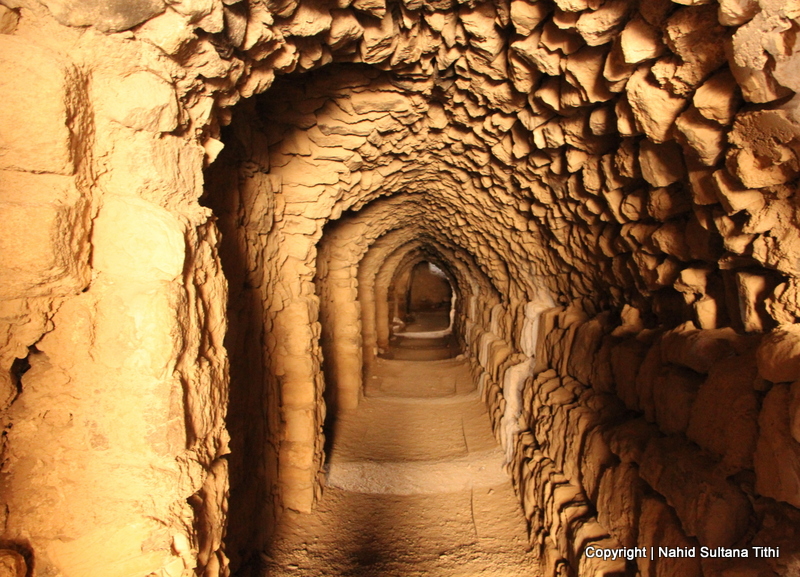
Entrance to the castle is only 1 JD per person and it took us little more than hour and half to walk around its big open space on the hill. Visitors can spend more time exploring all the levels of this castle, walk thru the dark passages, and going inside its many small and big rooms.
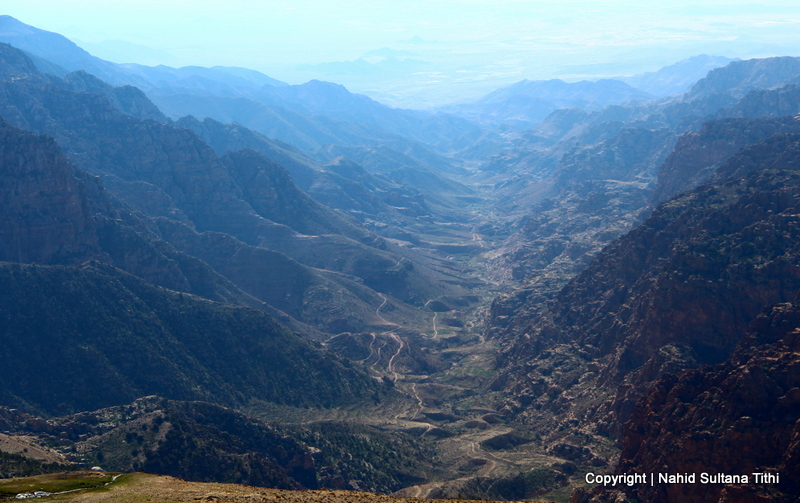
3) DANA VIEWPOINT: Our 3rd stop Dana was simply a short break with some great views of Dana Village at the foothill of giant mountains. It’s about 120 km from Karak. The adjacent canyon in between two hills is also dangerously beautiful. We stopped here only for 10 minutes, took some pictures, ran fast towards Shobak before the castle closes at 4 pm.

- View from Dana and its adjacent valley in Jordan
4) SHOBAK CASTLE in SHOBAK: City of Shobak/Shawbak/Shoubak is about 60 km from Dana and about 40 km away from Petra. This is a much smaller castle than the one in Karak. This was our last destination of the day before reaching Petra. We made it to the Shobak Castle only 5 minutes before the closing time but the guard allowed us in and let us spend 15 minutes to walk around. There is no charge to enter the castle.

- Ruins of Shobak Castle in Jordan
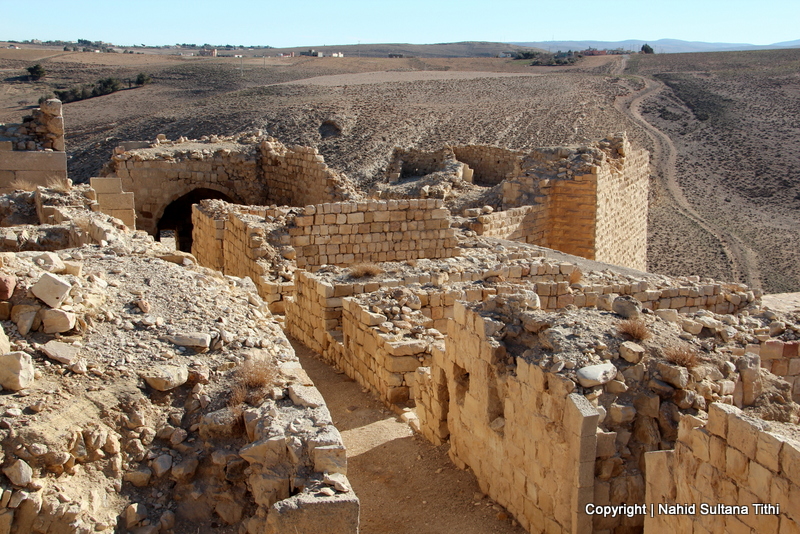
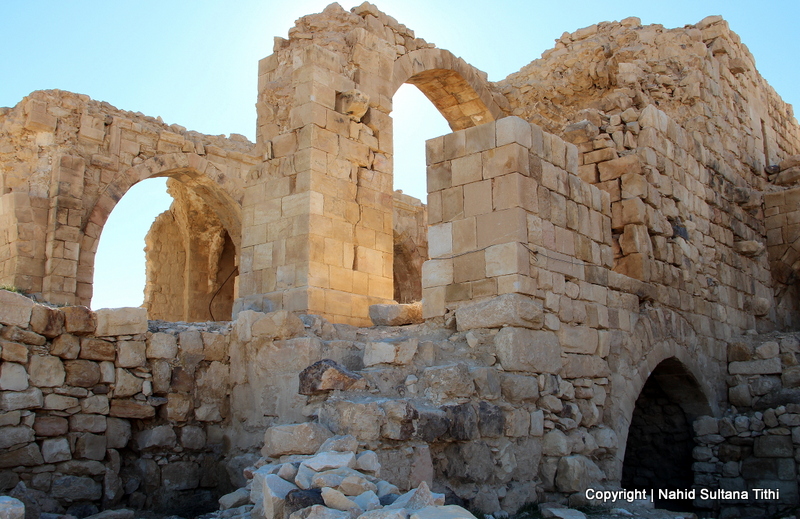
Shobak Castle, built by the Crusaders in 1115 AD, is located up on a high steep mountain…I was kind of scared when our car was going thru that narrow road by the cliff to the main entrance. There are many caves on the body of the mountains where some Bedouins still reside. Our driver was saying, there is one particular cave which is linked to the castle and can be hiked for 30 minutes to go on top of it. The only thing left of Shobak Castle is the dull skeleton of it. We walked by the old walls and some small rooms and tunnels made with sandstone. Ruins of its tower with Arabic calligraphy is visible from outside the castle. Looking out to the rocky and conical mountains was very appealing and glamorous.

- Shobak Castle was built by the Crusaders in 1115 AD
Related articles
- Amman and Back (journeyaroundtheglobe.com)
- the king’s highway to the bedouin camp at petra (catbirdinjordan.wordpress.com)
- Jordan Trip 2013 – Day Trip to Ashabul Kahf, Ajloun, and Jarash (journeyaroundtheglobe.com)
- Jordan in five days… (flipthinks.wordpress.com)
- Jordan 2013 – Day trip to Madaba, Mt. Nebo, Bethany, and Dead Sea (journeyaroundtheglobe.com)
Share this:

Jordan Trip 2013 – Day Trip to Ashabul Kahf, Ajloun, and Jarash
DAY TRIP to ASHABUL KAHF, AJLOUN, and JARASH: This trip was not in our itinerary at first, but our guide/driver suggested that if we have a day to spare we should definitely go and visit these places. Thank God we took his advice and decided to take this trip. I don’t know which one would be my favorite site since each of these sites has different significance and mind-boggling history attached to them. This was arranged by our hotel Arab Tower Hotel in Amman. We paid 54 JD to our driver/guide which didn’t include entry fee to any sites.

- On our way to Ajloun, Jordan…beautiful scenic drive
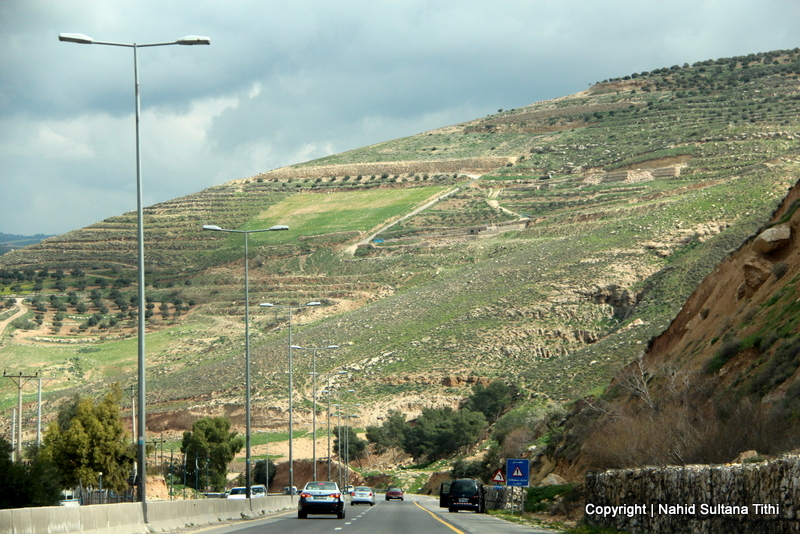
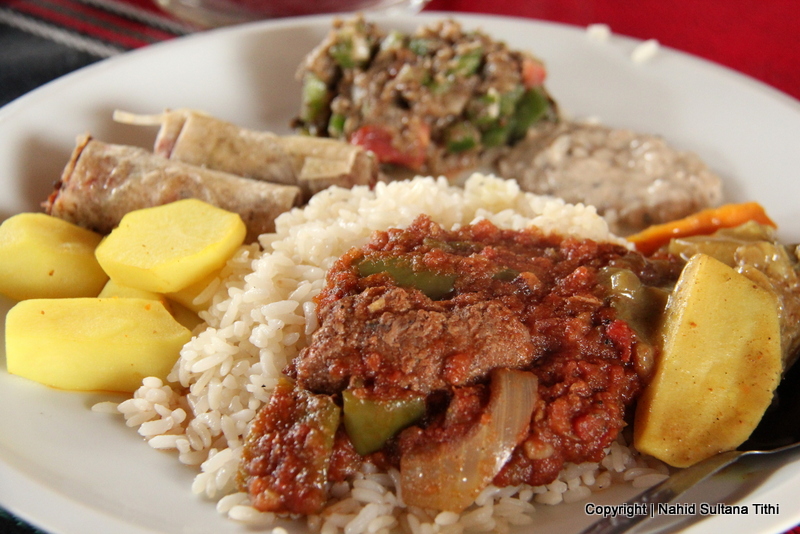
EATING and SHOPPING: We had lunch in a very nice restaurant (Jordanian House) right outside the ancient Roman city in Jarash. It’s a traditional Jordanian restaurant where you can eat all you want for 10 JD per person (kids eat free). Drinks aren’t included and it was weird that even the customers have to pay to use their restroom.
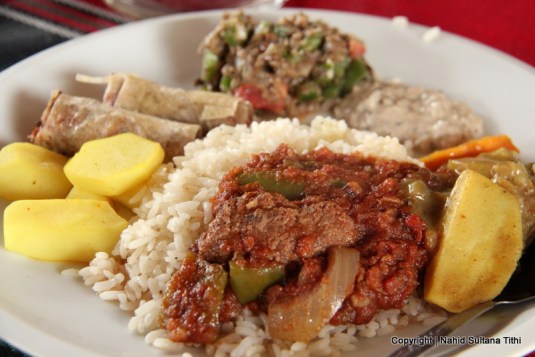
- Lunch buffet in Jordanian House in Jarash
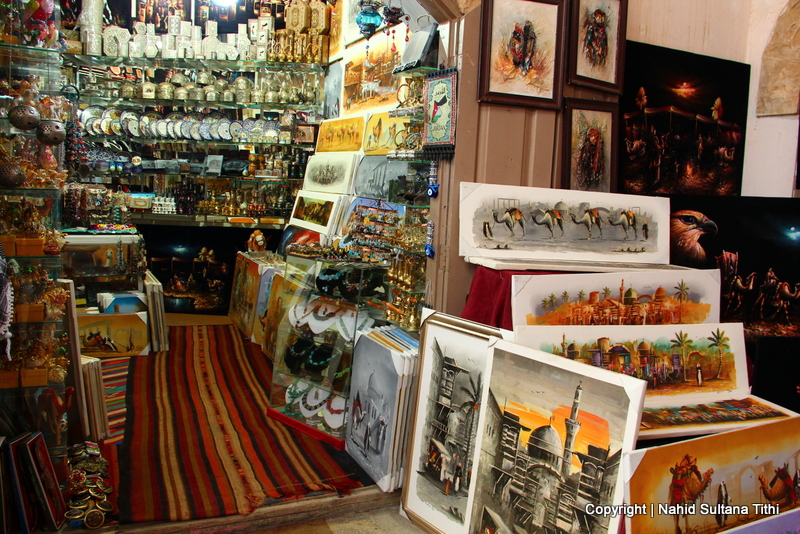
For shopping, the best place is in Jarash right before the ticket office to enter the Roman city. There are tons of small shops selling many local souvenirs, like paintings, colorful scene of desert in bottles made with sands, home decors, kuffiyeh (checkered scarves), religious gift items, and much more. We bought an oil painting for 35 JD and my husband bought 2 kuffiyehs for 5 JD each.

- Souvenir shop in Jarash where we bought our painting from
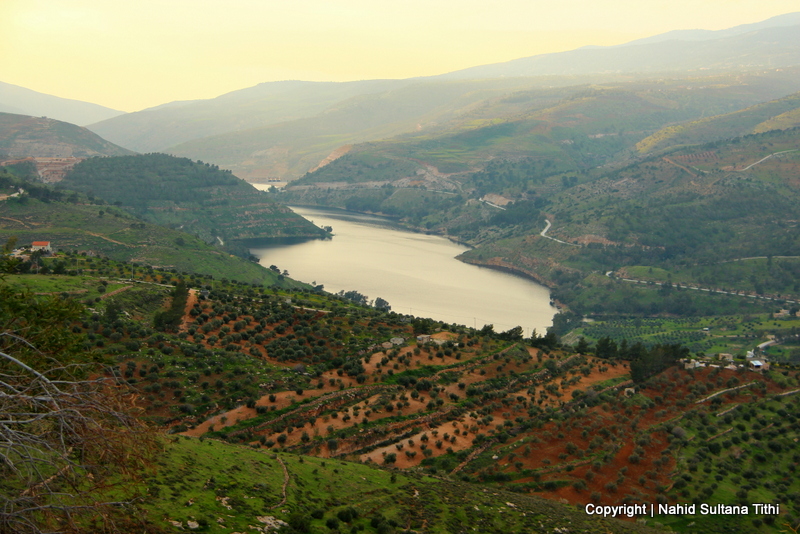
PLACES WE’VE VISITED: We started our journey from Amman about 10 am, were done with all the places, and reached our hotel at 6:30pm in the evening. It was a pleasant weather during day but a bit chilly in the late afternoon.

- Sunset in the mountains near Jarash, Jordan
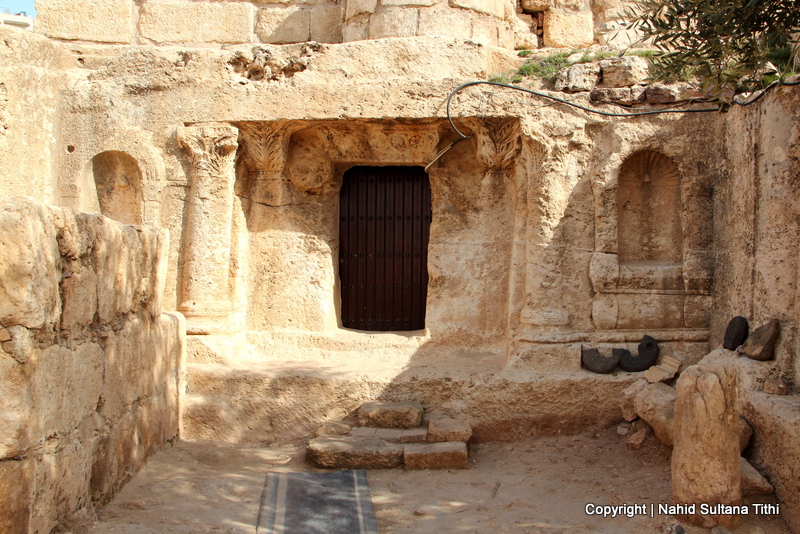
1) ASHABUL KAHF (CAVE of 7 SLEEPERS): This is a historic cave for the Muslims which was mentioned in some verses of the Qur’an (Sura Al-Kahf). The story goes that some 7 young boys were not happy with their king, so they left their city and started to walk in the desert. After a while when they were tired, they stopped and decided to take some rest in a cave. When they woke up, not realizing that they were sleeping for hundreds of years, they went to the market to buy some food and saw their old coins were not usable.

- The door of Ashabul Kahf, Jordan – the cave of 7 sleepers
There were 3 other of such caves were found around different places in Middle-East. But this was proven to be more authentic according to all the evidences given in another Surah of the Qur’an (Surah Yasin). You can still see the place where those 7 boys and their dog slept as well as their burial site inside the cave. There are some ruins of the old mosque that was built by the Umayyad dynasty right on top of this Quranic site. After it was destroyed, a new mosque was built beside the old one.
The cave is about 25 minutes’ drive from city center of Amman. There is no fee to enter but the visitors have to get someone from the gate to come and open the door of the cave.
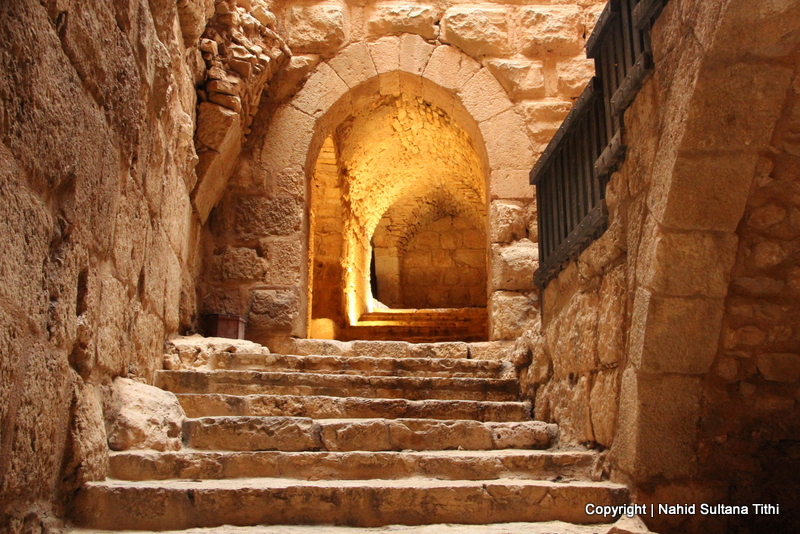
2) AJLOUN CASTLE: This was our second stop after visiting the cave. City of Ajloun is located about 120 km north of Amman and took us about hour and half to reach. Visitors mainly come to this beautiful town situated on several hills to see an old castle built by the mighty Salahdin’s General in 1184. This castle aided in the defeat of the Crusaders 8 centuries ago. The castle is located on a high-top mountain and can be seen from very far distance. This sandstone castle is overlooking the valley and the city of Ajloun. There is a small museum displaying some potteries from Byzantine period and some ancient mosaic works, may be from 5th or 6th century. Inside the castle is like a small maze with many stairs and small rooms. Go all the way to the top of the terrace for an astonishing view of Ajloun settlements. The castle looked very well-preserved but I wish it was well-marked with more information boards.
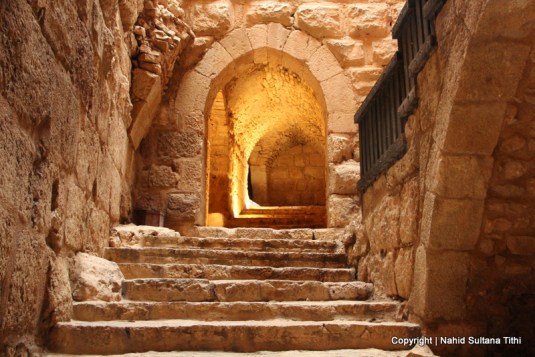
- Inside Ajloun Castle (from the 12th century) in Ajloun, Jordan
Entrance to the castle is 1 JD for adults and free for the kids. Summer hours are 8 – 6 pm and for winter, is 8 – 4 pm. Roaming around the castle with a stroller is not a good idea since there are many stairs to climb but no ramps. It didn’t take us more than 30 minutes inside the castle. There are some pricey souvenir shops outside the castle selling local goods and gift items.
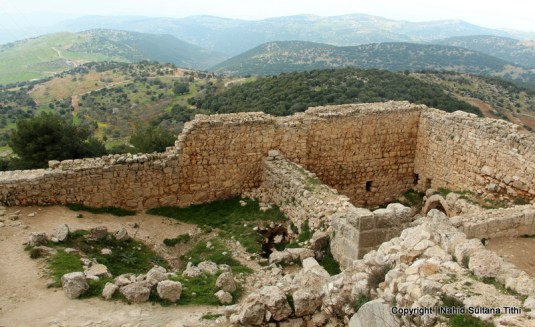
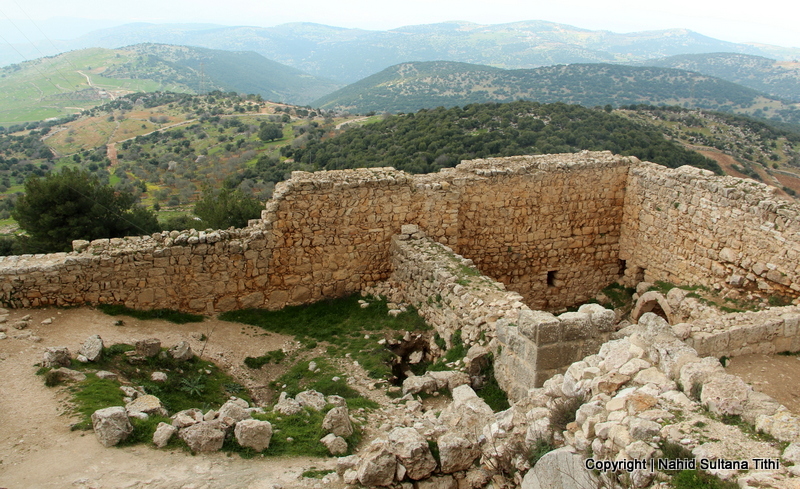
- From the terrace of Ajloun Castle, looking over some ruins and the city
A Muslim Prophet Khidr’s (AS) shrine, from Moses’ time period, is also located in Ajloun. No one knows the exact location of his burial place, just a sign points towards the mountain nearby where he was buried.
Another important place which may interest to some people is that Jesus, his mother, and his disciples passed through and rested in a cave very close to Ajloun city. Now Church of Our Lady of the Mountain stands there to commemorate their journey.
3) ANCIENT ROMAN CITY in JARASH: Our third and final stop of this trip was Jarash and its ancient Roman city. Jarash is located about 35 km south of Ajloun. The history of this city dates back more than 6500 years. This Roman settlement is acknowledged to be one of the best-preserved one in the world.

- A Roman city from the 2nd century in Jerash, Jordan
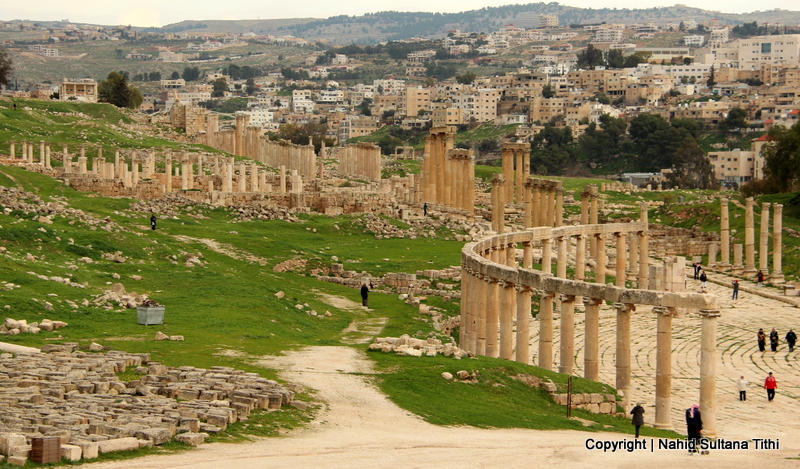
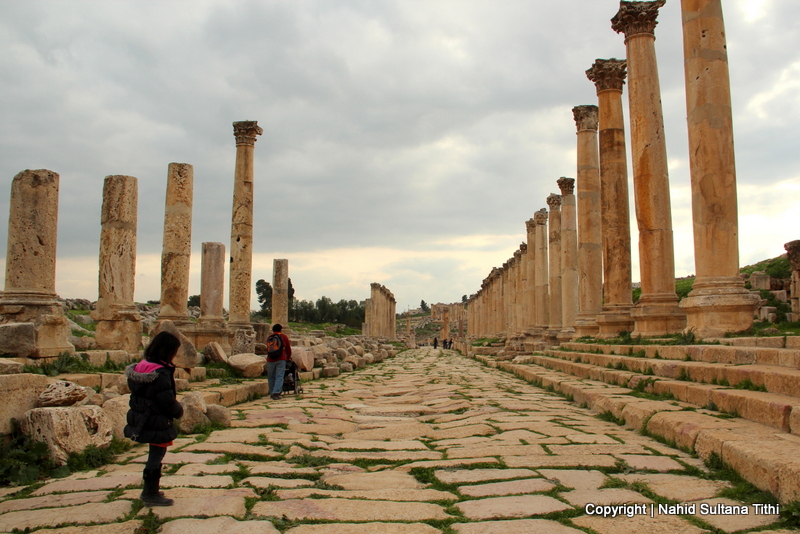
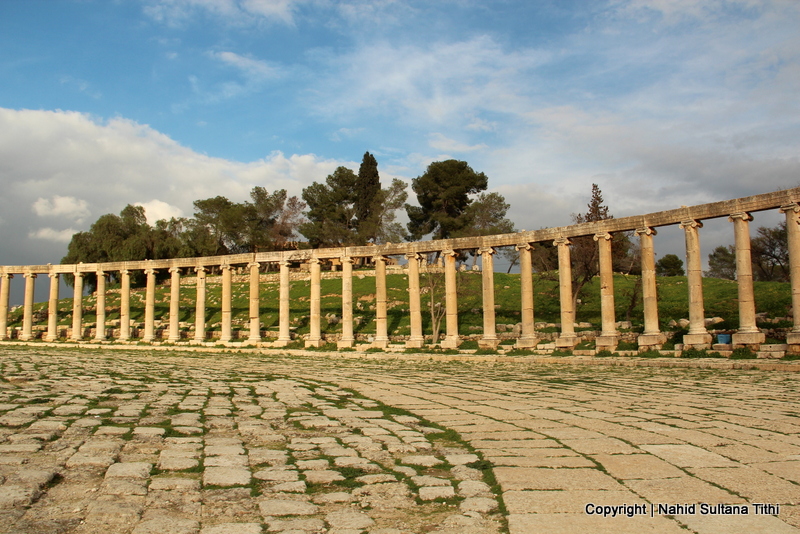
Tour of the city starts with the grand Hadrian’s Arch, which was built in 127 AD when Emperor Hadrian from Roma came to visit Jarash. We walked a little more and came across Hippodrome where horse chariot race once used to take place in the Roman times (the locals still enjoy horse race here few times a month). This is a stadium-like sitting arrangements with a big field in the front to entertain the crowd with the race. The ruins of old stable are still visible. Leaving behind some more ruins we saw the Oval Plaza which looked like a big oval-shaped square fenced with tall columns. Temple of Zeus and South Theater can be seen on your left hand side on a small hill. South Theater was an amphitheater where few locals were entertaining the tourists by playing some bag-pipes. Remaining of Temple of Zeus include few typical Roman-style columns and some walls made with sandstone. I did climb up to the temple and the picture-perfect view from up there was something no one should miss. Then started walking again along a green meadow and saw some shepherds feeding their goats and lambs. The soaring Temple of Aramatis can be seen from afar. This is another very nice and well-preserved temple of the city. After passing the temple, comes the North Theater. Similarly structured like South Theater, this amphitheater looked more for like wealthy people. Take few steps further and you can see another entrance, North Gate, and couple other small arches on the sides to enter the city. One of the major highlights of this city is the Colonnade Street which was once the main road of the city. This majestic walkway guarded by many pillars on both sides runs from the North Gate to all the way to the South Gate.

- The Colonnaded or the main street of Roman city in Jarash, Jordan…decorated with many columns
Jarash is a city that should be included in everyone’s plan when visiting Jordan. Kudos to Jordanian authority for keeping this place so clean and organized. Unlike many other places we’ve visited in the Middle-East or even in the Western world, this Roman city definitely deserves appreciation for its talented past history and charming present day look. The view of the whole town from these ruins are heavenly. I am sure it never fails to impress its guests with its architectural and natural beauty. Many events still take place in Jarash every year, including Jarash Festival, chariot race, gladiator fights, and etc.

- The column fence of Oval Plaza in Roman city, Jarash
Entrance is 8 JD per person and free for the kids. Visitors can stay here until 5 pm. It takes about 2 hours or little more to walk around leisurely among the ruins and go to all the main points of this historic town.
Related articles
- Amman and Back (journeyaroundtheglobe.com)
- Jordan 2013 – Day trip to Madaba, Mt. Nebo, Bethany, and Dead Sea (journeyaroundtheglobe.com)
- Lesson from Surah al-Kahf (thinktalkislam.wordpress.com)
- jerash, ajloun, umm quais and a couple of italians thrown in for good measure (catbirdinjordan.wordpress.com)
- Are the miracles of the Auliya true? (makashfa.wordpress.com)
Share this:

Jordan 2013 – Day trip to Madaba, Mt. Nebo, Bethany, and Dead Sea
DAY TRIP to MADABA, MT. NEBO, BETHANY, and DEAD SEA: This was a great day-trip to get out from hustling bustling Old Town Amman. We saw all the things that we wanted to see in Amman on our first day. 2nd day was kept for this trip which was booked thru Arab Tower Hotel/Al-Burj Arab in Amman. We rented a private taxi for 54JD for the whole day (entrance fee to the below places weren’t included in this fee). The driver spoke very little English but he was a friendly young man and could explain some histories on these places.
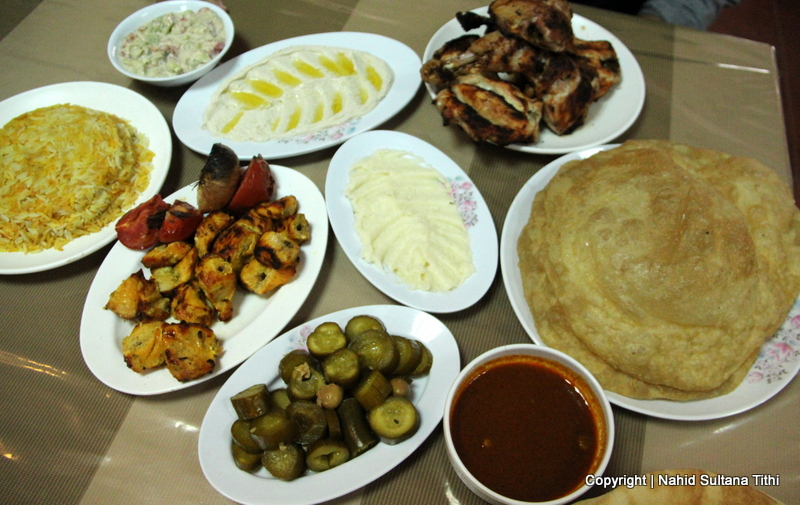
EATING and SHOPPING: We had lunch in a street-side restaurant in Bethany before entering the site. It was mainly bread, Jordanian style rice, hummus, salad, pickles, and kebab. It was nothing fancy but they had good food and clean bathroom. Food here, in these small villages, is very cheap; we ordered food for 2 adults and 2 kids but the bill was only around 14 JD…not bad at all.

- Lunch (chicken kebabs, hummus, pickles, bread, and rice near Bethany, Jordan
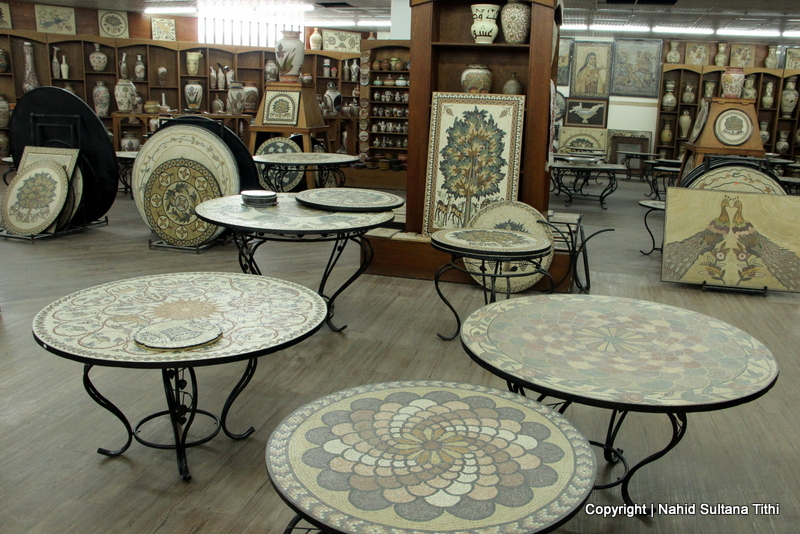
For shopping, you must buy some hand-crafted mosaics when in Madaba. That’s what the city is famous for, but don’t just go anywhere…otherwise the only thing you will get is mosaics made in China. Go to the real factories and showroom in Madaba…they are plenty of them here. They not only have wide variety of mosaic artwork, but also you don’t have to worry about buying fake things and pay extra prices. You can tour the factory, then they will take you to their shop. These hand-crafted mosaics are not cheap. The artists work very hard making these items with hand and many of them take months before getting the final products. These showrooms also usually carry Dead Sea products (like salt, mud, lotion, soaps, and etc.) for much cheaper price than the stores in Dead Sea.

- Hand-made souvenirs in the showroom of Madaba Handcrafts Center, Jordan
PLACES WE’VE VISITED: We left our hotel around 10 in the morning and headed straight towards Madaba. By the time we were done with Dead Sea, it was almost 5pm. The drive was very scenic thru the rugged mountains, stony deserts, some green valleys, and dramatic vast landscape. Look out for Bedouin settlements also, you will know they are Bedouins when you see tents in the middle of nowhere.
1) MADABA: This is a small city about 40 minutes south of Amman. The city itself dates from the Middle Bronze Age. Madaba is known as the “City of Mosaics” for its century’s old history of mosaic arts and designs.

- Map of Holy Land from the 6th century inside Greek Orthodox Church of St. George, Jordan
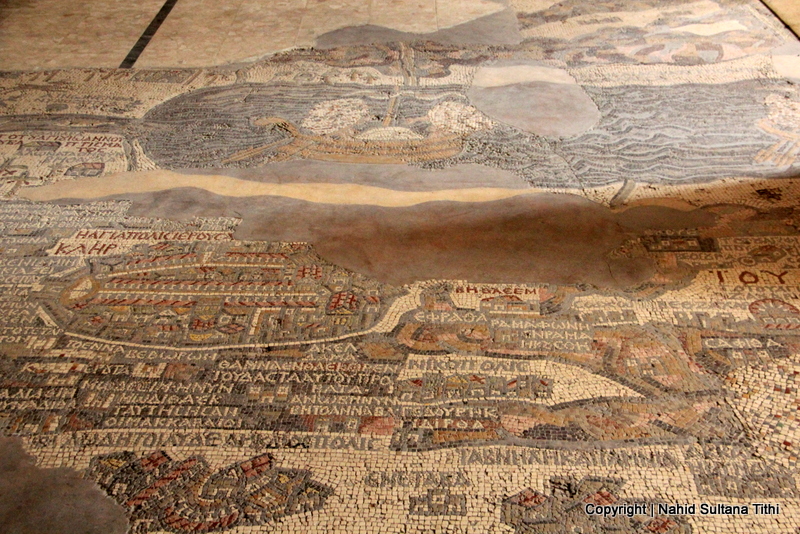
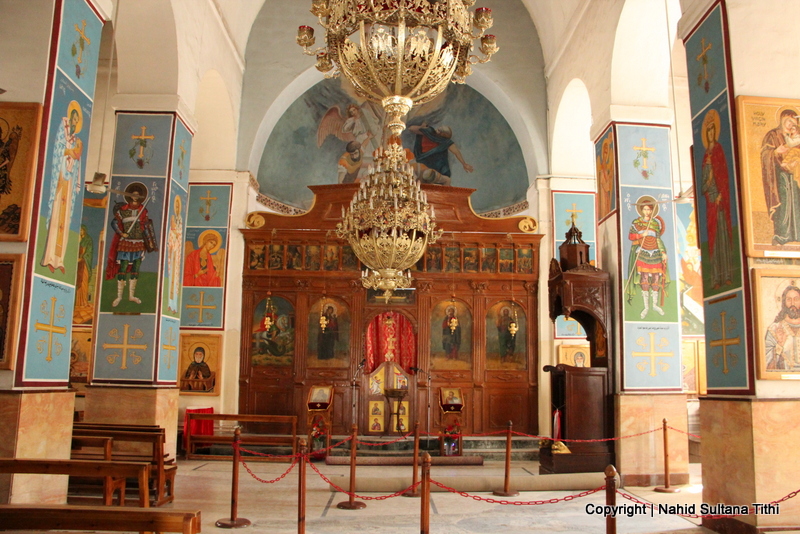
a) GREEK ORTHODOX CHURCH of ST. GEORGE: This was our first stop of the day in Madaba. It is the chief attraction of the city which preserved the original piece of Byzantine-era mosaic map of “Holy Land” from 6th century on its floor. This 25×5 sq. m. map in front of the altar depicts some important details of that time, like hills and valleys, villages and towns of Jerusalem and other holy sites. The church itself is small but a wonderfully vivid and colorful place with many other mosaic wall-hangings and religious paintings. It’s 1 JD to enter the church.

- Greek Orthodox Church of St. George in Madaba which houses the mosaic map of Holy Land from the 6th century
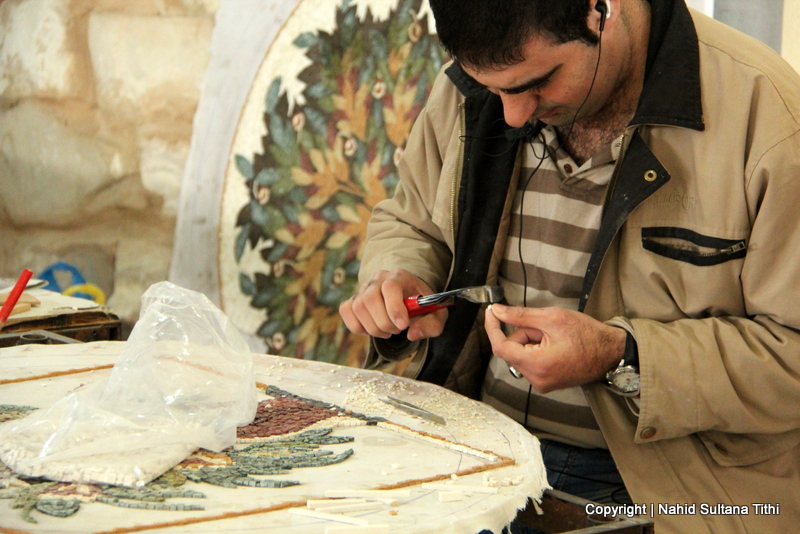
b) MADABA HAND-CRAFTS CENTER: As I have mentioned above that if you want to buy Madaba’s traditional hand-crafted mosaics then it’s better to go to a factory other than buying cheap, fake stuff from small shops on the streets. There are plenty of these government approved places here who will gladly show you around their factories and then bring you to their showrooms. Our driver/guide took us to one such place, called Madaba Hand-Crafts Center. All of the mosaic stones come mainly from the deserts of Madaba, Jarash, or Wadi Rum and they only use natural stone color to design each of their masterpieces. The man inside first showed us how they cut the stones into small square pieces, then how the artists first sketch a design on a piece of white cloth where later they glue the stone pieces one by one. Then it takes few days to dry the glue, after that it’s grouted on a frame upside down and finally, take the white cloth off the stones. It was quite educational for us and the kids. There were ladies who also paint on ceramics and clay pot and later give the mosaic-look on them. After that we walked over to the showroom. This was an incredible place and shoppers’ paradise for those who like collecting authentic and traditional artworks. They not only have furniture or wall-hangings with mosaics, but also very rich quality rugs, Bedouin jewelries, scarves, Dead Sea products, and many more attractive home décor souvenirs. And the good deal is that they can ship any big items to your city’s airport free of charge…all you have to do is just pick it up when it arrives at the airport. There were also some unframed mosaic works which you can take and grout them yourself on floors or kitchen walls.

- An artist cutting stones to make designs on a mosaic decor in Madaba Handcrafts Center, Jordan
2) MT. NEBO: After driving for about 20 more minutes from Madaba Handcrafts Center, we reached Mt. Nebo. This is a holy site for both Muslims and Christians. This is where Prophet Moses climbed at the end of his life to see the “Promised Land” which he never could enter. He also died and was buried here, although no one knows the exact place of his burial to this date.

- View of “Promised Land” – Jericho, Jerusalem, and Dead Sea from Mt. Nebo, Jordan

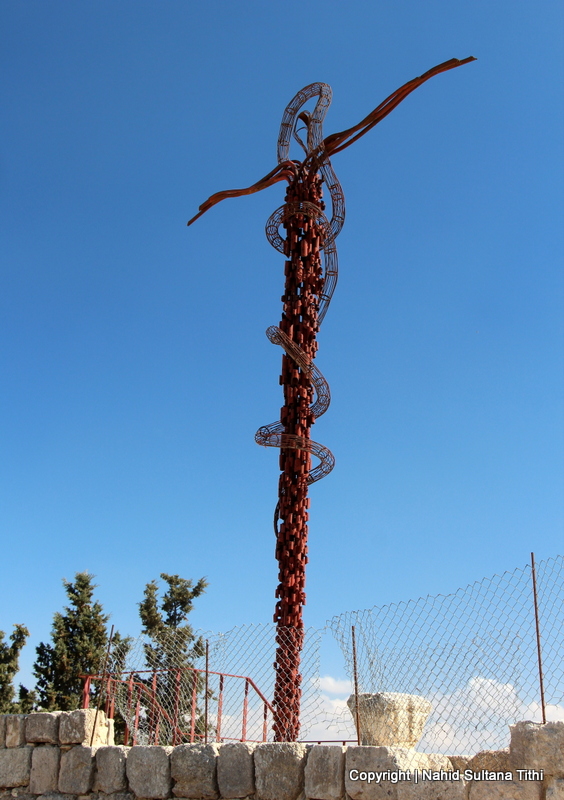
From the summit of the mountain visitors can see, as Moses did, the vast panorama of Jordan River Valley, the Dead Sea, Jericho (about 27 km), and Jerusalem (46 km). This place has been a place of pilgrimage for Christians for hundreds of years. The Serpentine Cross on the mountain is one of the most photographed sculptures of this place that represents serpent taken by Moses into the desert and the cross upon which Jesus was crucified. A big stone-statue marks the visit of Pope John Paul II in 2000 AD near the main entrance.

- The Serpentine Cross sculpture on Mt. Nebo, Jordan
There was a massive renovation going on in the sanctuary for Moses when we went to visit Mt. Nebo. We only could see the original mosaic floors of Mt. Nebo’ first church from the 4th century along with some other old mosaic pieces and artifacts. Mt. Nebo is open from 8 – 4 pm and the entry fee is 1 JD per adult (kids free). You can easily spend an hour or more walking on top of Mt. Nebo looking at the near and far distance pretty sights.
3) BETHANY: After about another half an hour drive from Mt. Nebo, we reached the visitor center of Bethany. Bethany has been identified as a biblical site where Jesus was baptized. The exact point of baptism is known as “Bethany Beyond the Jordan” and this is the place where John was living when he baptized Jesus.
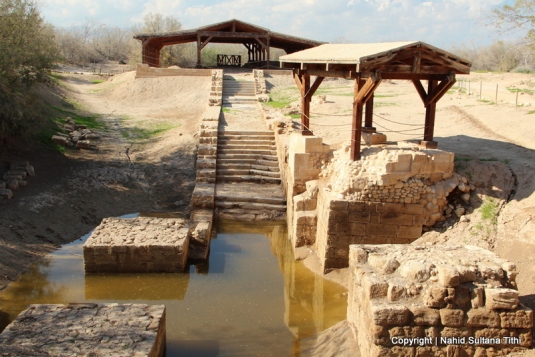
- “Bethany Beyond the Jordan” – The holy site where Jesus was Baptized by John the Baptist in Bethany, Jordan
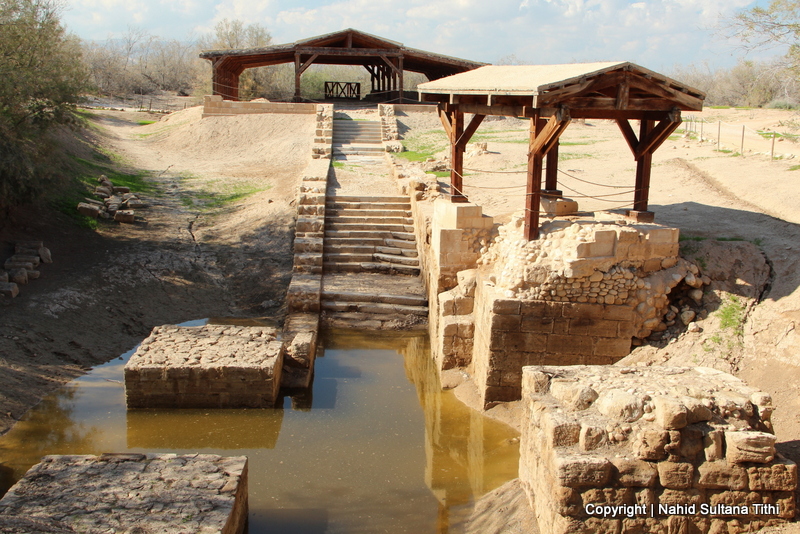
Three chapels were built on the eastern side of the river during the Byzantine period (5th – 6th century AD) with colored mosaic and marble flooring. These excavated remains still can be seen by the visitors in their original states. There are many beautiful churches in this area from almost each sect of Christianity. This is supposed to be a holy site for all 3 monotheistic religions. For Christians it is obvious…Jesus was baptized by John at this very spot and the doors to heaven believed to open here during Christ’s baptism. For Muslims, Mohamed (SAW) said to have crossed this place before going to Jerusalem before his Night Journey (Mir’aj) to the heaven. Finally, one of the hills here is believed to be the place from where Jewish Prophet Elijah ascended to heaven in a chariot of fire. Some portion of “Bethany Beyond the Jordan” is actually in West Bank. Therefore, we had to go in a gov’t shuttle bus and an escort to access the area. This whole trip is for 12 JD per person which also includes audio guide. The service is open from 8:30 – 5 pm and bus runs every half an hour. It takes about 10 minutes from the visitor’s center to go to the Baptism site and the whole tour is for about an hour. First we walked to the Jordan River, then walked another 5 minutes to see the baptism site “Bethany Beyond the Jordan”, and then another site of Jordan River where you can see the Palestinian border only few feet away.
4) DEAD SEA: Dead Sea is flanked by mountains to the east and the rolling hills of Jerusalem to the west, giving it an almost other-worldly beauty. This is also believed to have been home to some Biblical cities, like Sodom and Gomorrah. Either for religious reasons or to enjoy the calm surroundings of the place Dead Sea is a must-see and must-experience place in Jordan. Look on the other side of Dead Sea and you will see Jericho in West Bank.
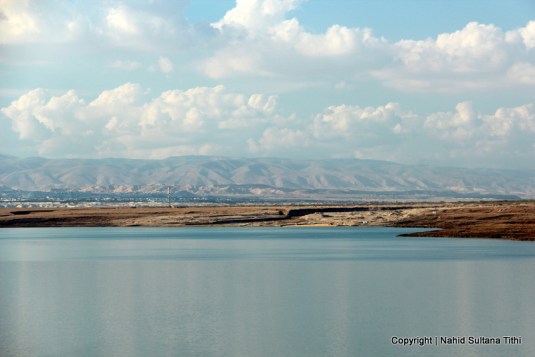
- Dead Sea, Jordan…looking at West Bank on the other side
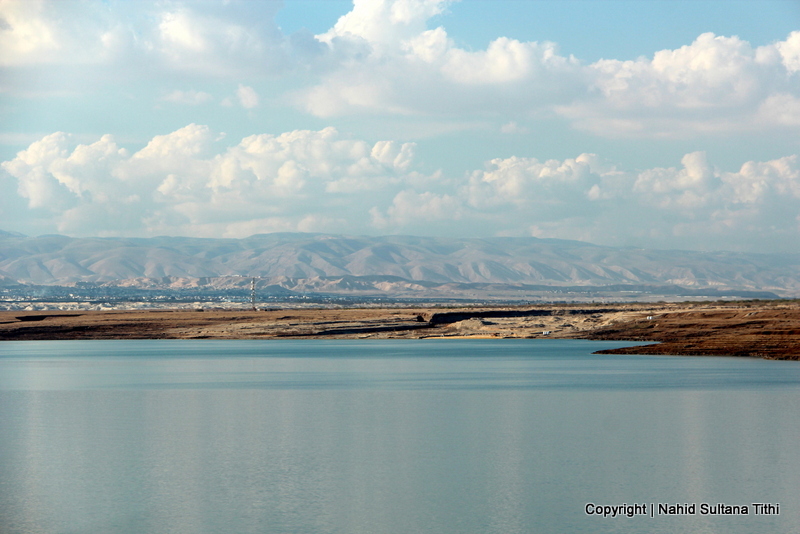
Dead Sea is not the place where people come to “swim”, you can only float on your back in this thick salty body of water. Amman Beach is the place where our guide was saying people pay to go inside for swimming, dining, spa treatment, and lot for things. Since we weren’t going to go for swimming and had little time left before sunset, we just went to a shore of Dead Sea which was free of charge and without any nice amenities. You can rent camels or horses for few minutes here to ride by the water. I saw people floating on their back in this beach too, but there is no shower to clean the heavy salt off your body. Please also visit my page on Dead Sea on the right-hand side under Israel/Palestine for more background information on this unique lake.
Related articles
- Amman and Back (journeyaroundtheglobe.com)
- Looking at “Promise Land” from Mt. Nebo, Jordan (journeyaroundtheglobe.com)
- Mosaic Testament: The Madaba Map (mediaevalmusings.wordpress.com)
- Jordan in five days… (flipthinks.wordpress.com)
Share this:

Business Excellence Award 2020 from AI Global Media for The Most Entertaining Personal Travel Blog – Pacific Northwest USA

Top Posts & Pages


Authors
 Globe Runner
Business Excellence Award 2020 for The Most Entertaining Personal Travel Blog – Pacific Northwest USA

Business Excellence Award 2020 from AI Global Media

 Journey Around The Globe