Journey Around The Globe
ready for the next destination
Highlights of Podgorica, Montenegro
PODGORICA, MONTENEGRO: Podgorica is the capital of Montenegro and it has been the capital of Montenegro since the time of Socialist Yugoslavia. Podgorica’s aerial view looked absolutely stunning from the plane as we were getting closer to the airport. We could see Dineric Alps and Skader Lake from the cabin. It was a beautiful landscape overall. But the city itself is not at all a typical European destination that tourists would visit. The lady in our hotel was asking us why we picked Podgorica as there isn’t much to see or do. But there are lots of Montenegrin coastal lines and mountain resorts that attract many tourists in this country. World War II left the city in great destruction and much of its historic Ottoman architecture vanished with bombings. Now it’s a modern planned city with laid back atmosphere.
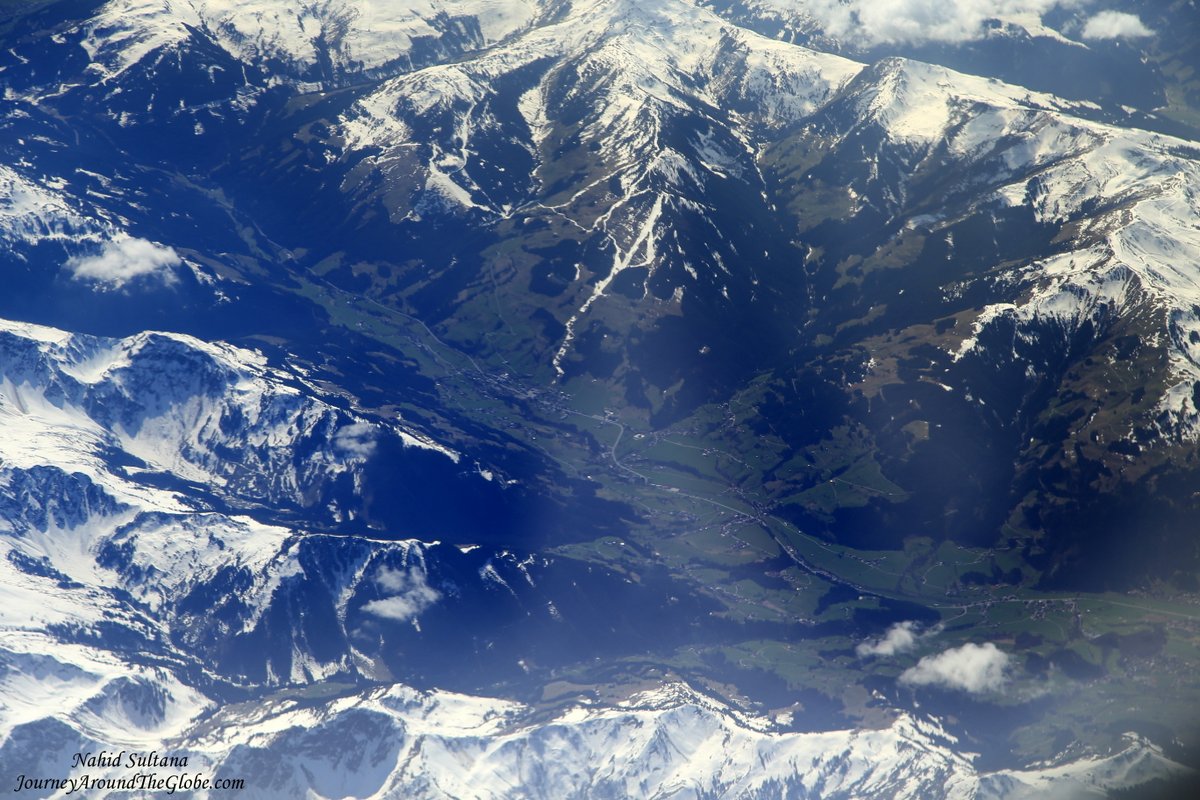
Podgorica city center is about 45 minutes of drive from the airport. The airport is very small and everything is very conveniently located very close to each other, like customs, baggage claim, and rental car etc. The city doesn’t get lots of tourists since it’s not a typical European tourist destination with many sightseeing spots. Lots of people were looking at us interestingly when they saw we were walking with camera and maps; some groups of kids were very happy to see our daughters and were very friendly with them. They even tried their best to speak in English with us.
Transportation here is very cheap. We had our rental car but since taxi is so cheap, we used that to get to the center all the time, didn’t have to worry about parking and stuff. Food is also cheaper here if you compare with rest of Europe or other Eastern European cities.
TIME of TRAVEL: We flew to Podgorica during the Easter Break of 2014 in the 1st week of April. Our plan was to mainly explore all the small countries of former Socialist Yugoslavia and Albania.
OUR HOTEL: We stayed in Hotel BaMBiS in Podgorica. It’s not really in the city center but taxis used to charge use around 2 euros to get to the center point which was about 3kms away. The neighborhood is a quiet one without any restaurants close by. We had to take taxi to the main square for dinners. But it has free parking, Wi-Fi, and excellent breakfast…all included in the price. It’s a 4-star hotel with above average customer service. I would highly recommend to anyone and would stay here again if I ever go back to Podgorica.
EATING and SHOPPING: Since Podgorica doesn’t receive many tourists; we didn’t see any souvenir stores here in the city center or anywhere. I saw in our hotel some beautiful Montenegrin dolls in display but none elsewhere. There are many shops in the pedestrian zone of old town, just be careful when you buy brand name items here, many are not authentic ones.
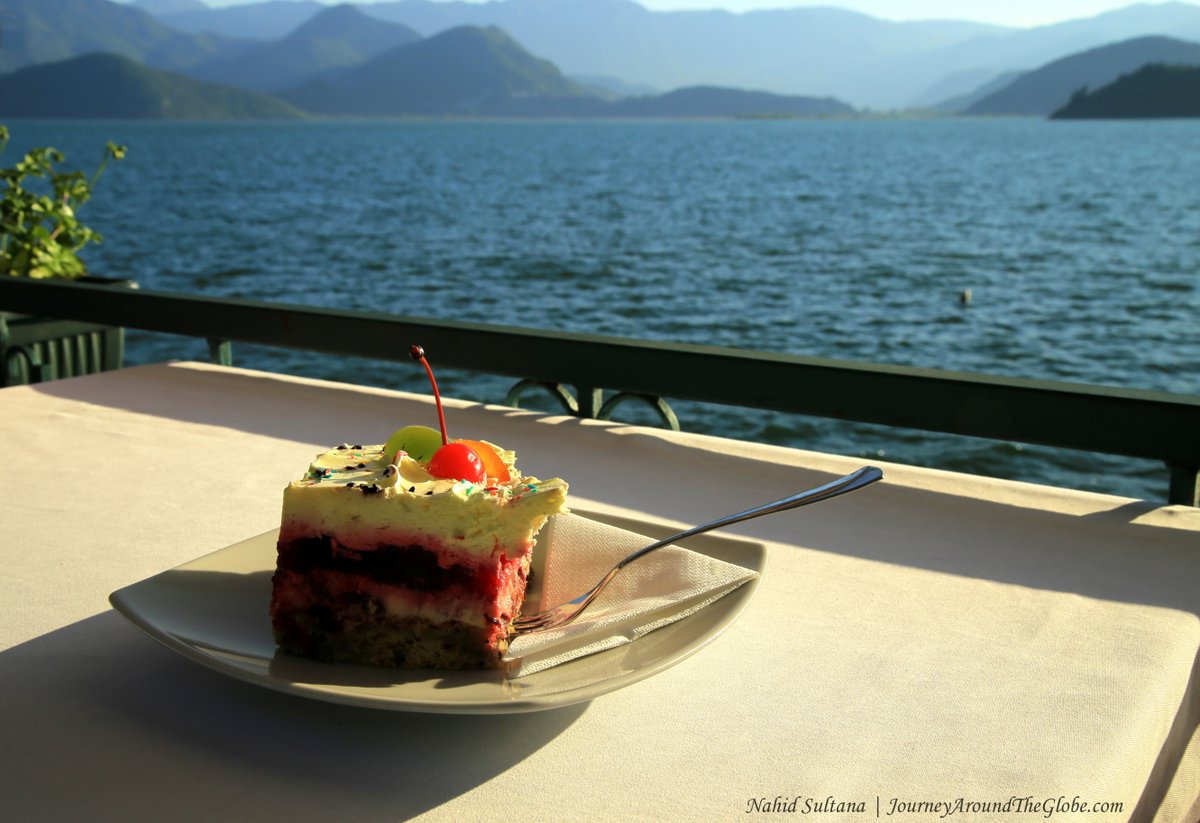
We had our first dinner in a pizza place by the pedestrian street in old town. There were lots of teenage boys who were asking for food or money from here when we sat down to eat. But the restaurant lady told us not to give them anything; they eventually spend it on drugs. Anyways, our next day lunch was at Carine near Trg Republic. Thanks that it was a pleasant day and we could sit outside. The place had big collection of soup, salad, pasta, and ice cream, cake, and pastries for dessert. Another good place for any meal would be going to Skader Lake. We went there one late afternoon and had some pastry and hot drink by the lake in a restaurant called “Jezero”. You get a very nice view of the lake and mountains.
PLACES WE’VE VISITED: Most of the points of interest in Podgorica are near the city center and can be visited on foot. We had roughly a day and half for this city. Without the museums, it took us about couple hours to visit everything in the center. We kept half a day for Skader Lake and that was one good spot not to be missed here.
1) TRG REPUBLIC: It kind of disappointed me but Trg Republic is the main square of the city. It’s a big gathering spot for the locals. Square doesn’t have much to see other than a big fountain in the middle. There are few restaurants at the corners of this square. Haven’t been there at night, may be, the places comes to live at night.
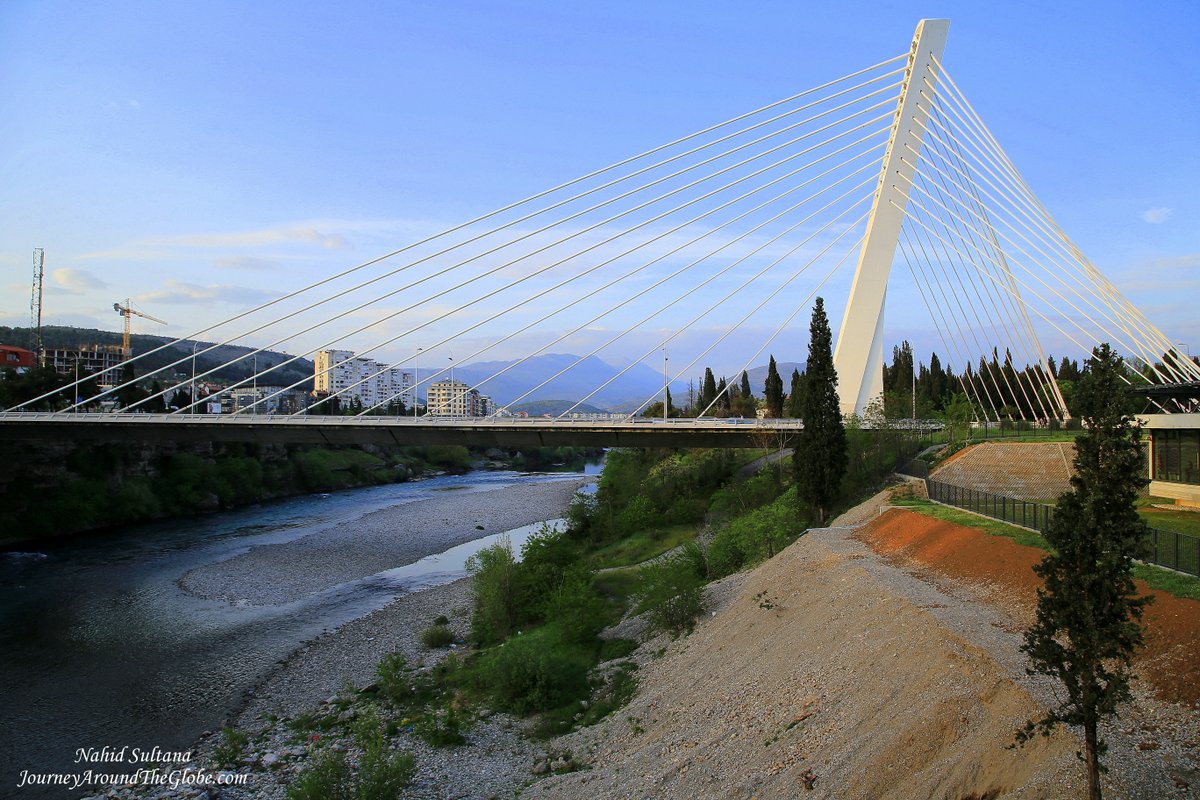
2) MOSKOVSKI BRIDGE and MILLENNIUM BRIDGE: From the pedestrian old town, we walked little bit further towards the river and reached Moskovski Bridge over Moraca River. It’s for pedestrian and people can take the stairs beside the bridge to go down to the river bank. The beautiful modern bridge adjacent to it is the impressive Millennium Bridge. Millennium Bridge looks very photogenic at night when it’s lit up. It’s a nice place to take a stroll at late afternoon.
3) OLD CLOCK TOWER and TURKISH TOWN: The little Turkish town in Podgorica is an old residential place with couple mosques and narrow, curvy streets. An old clock tower also stands at one starting point of the Turkish neighborhood. These mosques are quite old, one we saw from outside was not a working one but the other one was still active. There isn’t much to do here. I was hoping for some Turkish markets but saw nothing other than some old houses and few locals. One local mentioned, about 30 – 40% Muslims of Podgorica live in this neighborhood.
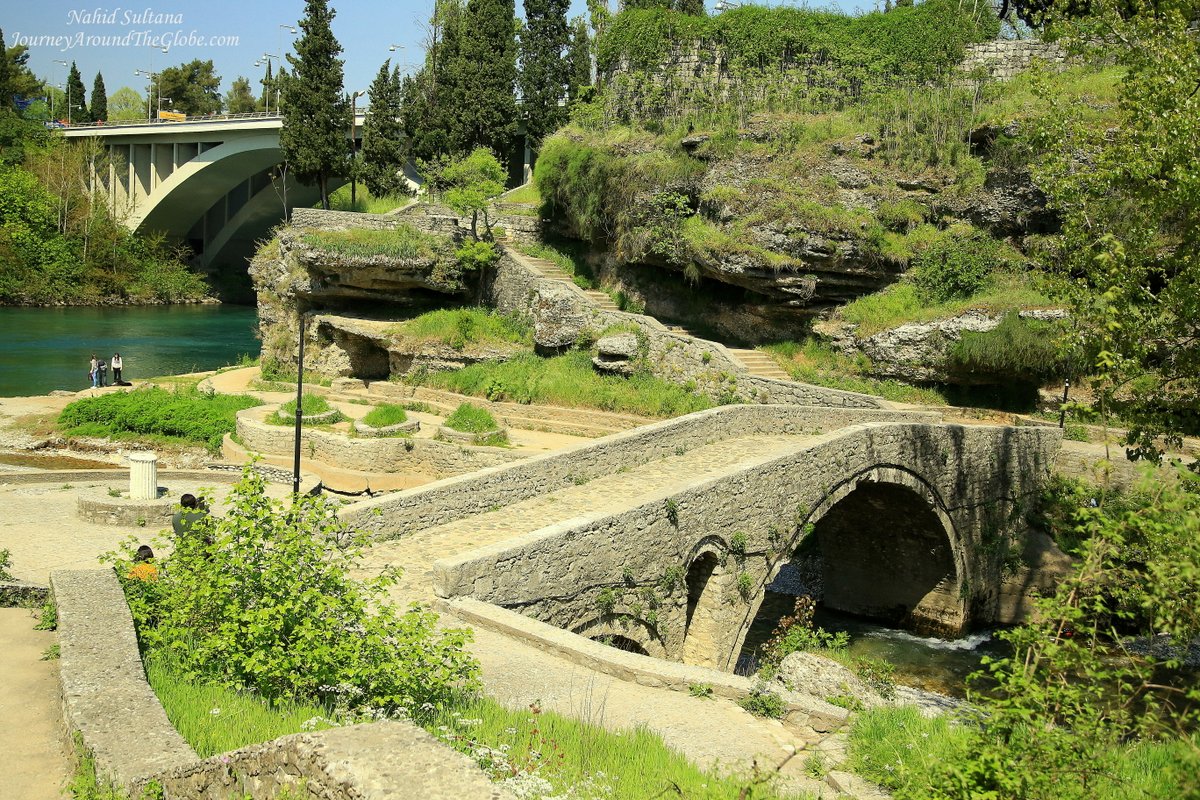
4) SKALINE: This is a really picturesque place and is the confluence of River Ribnica and Moraca. An old Turkish bridge is there over a little stream of Ribnica. There are also some ruins of an old town, some steps, and sitting area near the rivers…a pleasant atmosphere all around. This is definitely a place worth visiting.
5) PARLIAMENT and MONUMENT to KING NIKOLA: Montenegrin Parliament is very close to city center. The Parliament building is not that impressive but the park opposite of it is a lovers’ point and a nice place where locals come for picnic or to relax. Monument of King Nikola stands in that park opposite of the parliament.
6) ST. GEORGE’S CHURCH: This Serbian Orthodox church is located on the slope of Gorica Hill where the city got its name from. It’s a 10th century church. Inside is pretty small but nice; loved its peaceful surroundings.
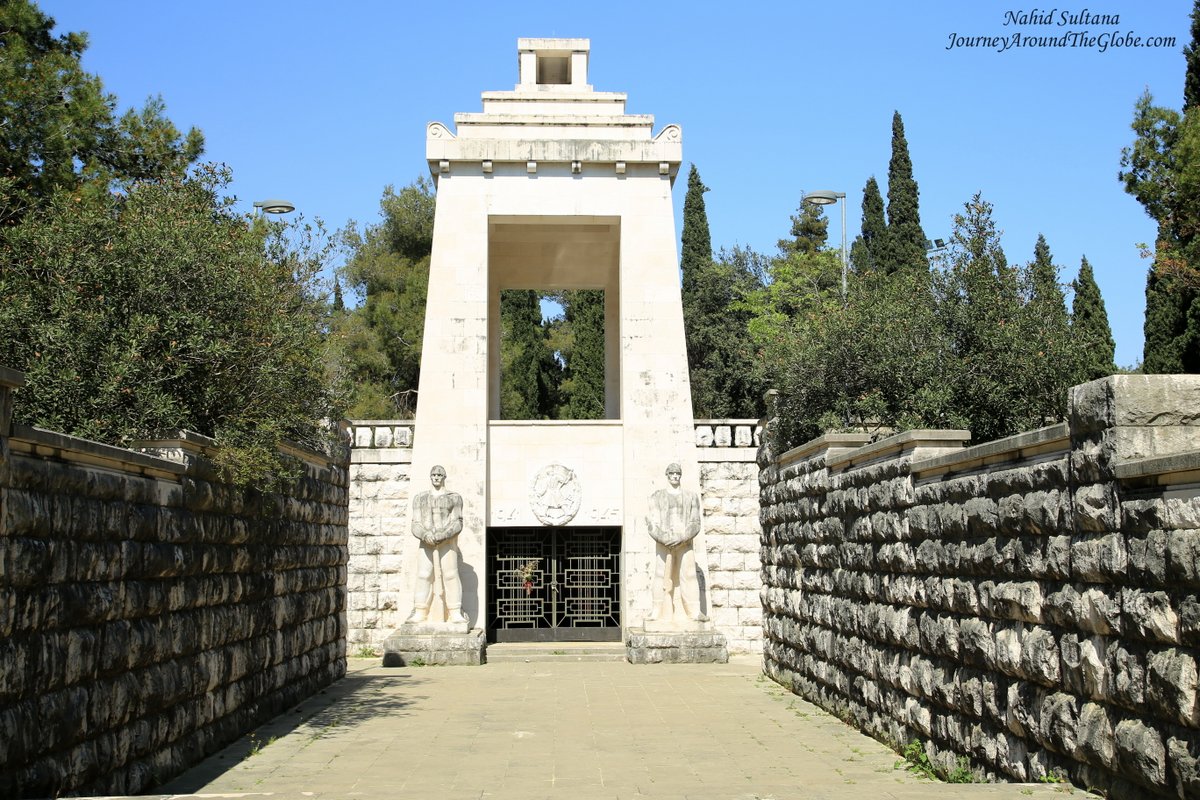
7) WAR MEMORIAL on GORICA HILL: after visiting the church we started climbing the hill little further. It’s a beautiful natural park with lots of trees and bushes. This whole area is a natural reserve, a great place for nature walk, bird watching, and enjoying some moments outside the busy city life. We even saw a little turtle walking on the ground. Little bit more into the park, is a WWII War Memorial. The memorial is not a flashy one; it’s hidden at one side of Gorica Hill where no one really goes. But check out the small hill if you like hiking or taking leisure walks.
8) SKADER LAKE: This is the largest lake in the Balkans. It took us little more than half an hour to reach a panoramic view point from Podgorica city center. The lake shares its border with Albania too. There is a restaurant called “Jezero” by the lake and opposite of an old monastery. We had some hot drinks and pastries here with an excellent view of the lake and mountains. The restaurant can arrange boat tour on the lake and the visitor center is there too. The water was rough that afternoon, so we skipped boat ride and just sat down by the water for long time enjoying its stunning view.
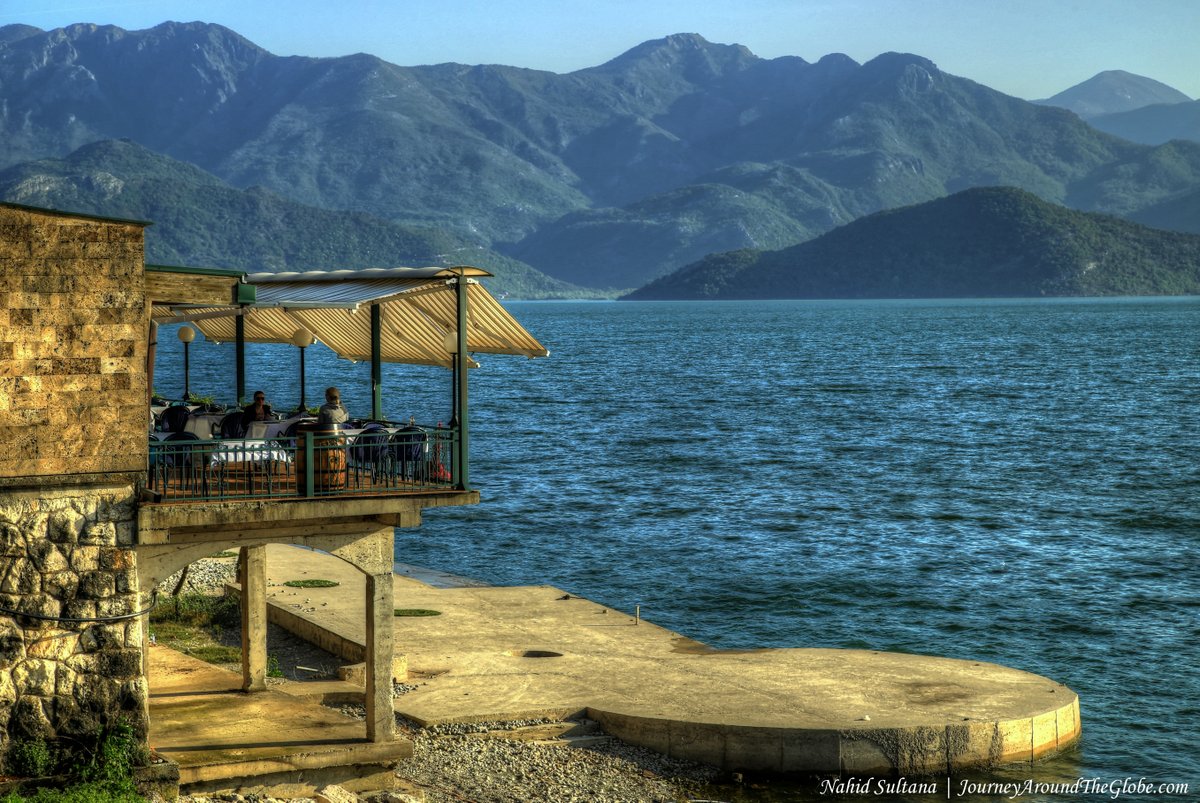
Lessandra Monastery is opposite of this restaurant but we couldn’t make it there because of the road condition. But there are lots of things to do in Skader Lake National Park if you have time and like outdoor activities.
Share this:

An Overseas U.K. Territory – Gibraltar
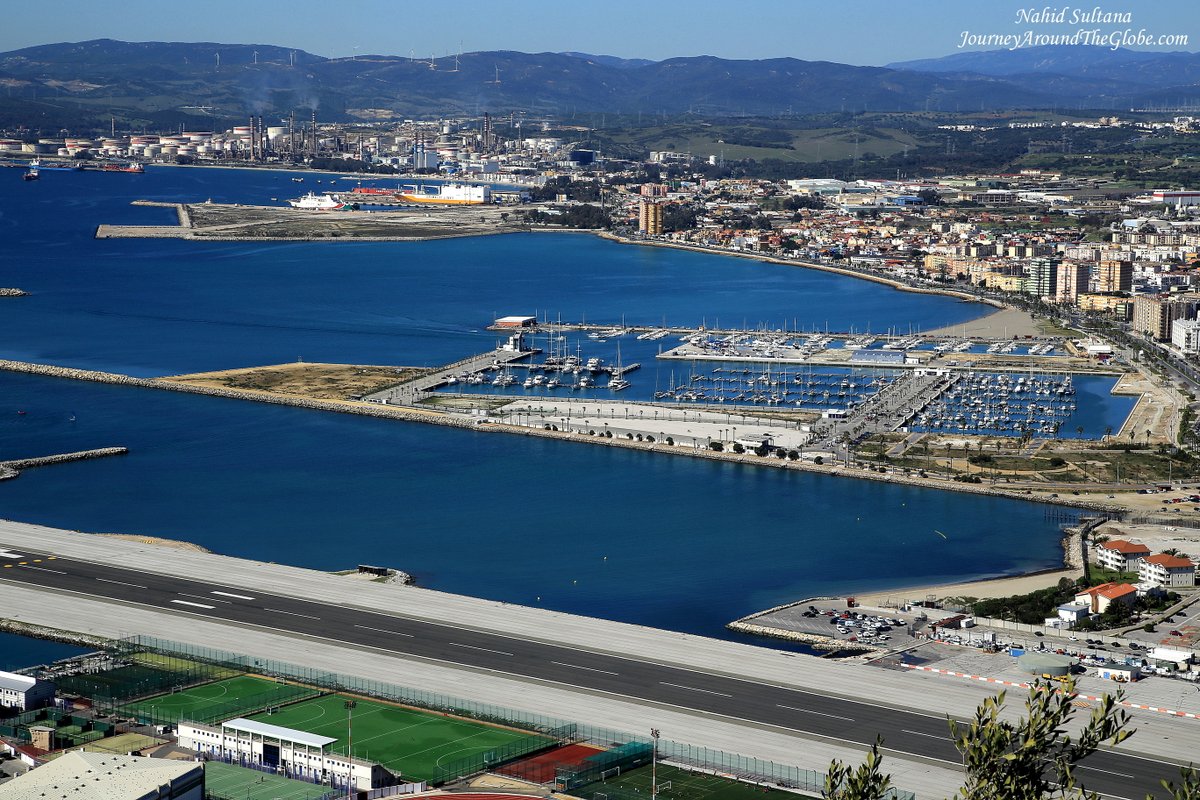
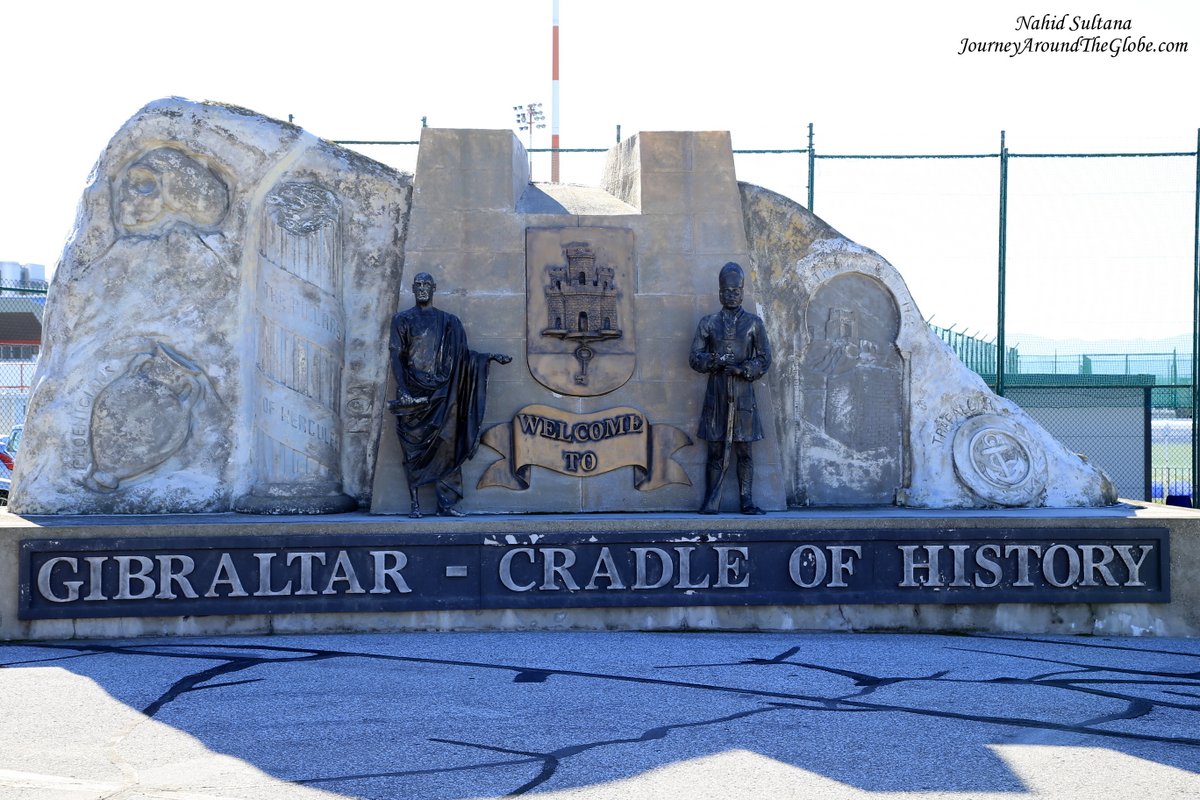
GIBRALTAR: Gibraltar is truly a unique place for those curious travelers. It’s an overseas U.K. territory by the breathtaking Mediterranean Sea. The land is bordered with Spain in one side and therefore the Gibraltarians are fluent in both English and Spanish. Speaking of language, we came to know that interestingly, may be the word “Gibberish” came from Gibraltar where they sometimes speak a mixed dialect with English and Spanish that sounds a bit like…Gibberish.
The name “Gibraltar” arrived from the man who came to this rock from Africa many centuries ago. His name was Tariq. So the place came to be known as “Jabal-Al-Tariq” which means “Mountain of Tariq” in Arabic. In 1704, it became a British territory. Currently, around 30,000 people live in Gibraltar and it gets as many as 7 to 8 million tourists every year.
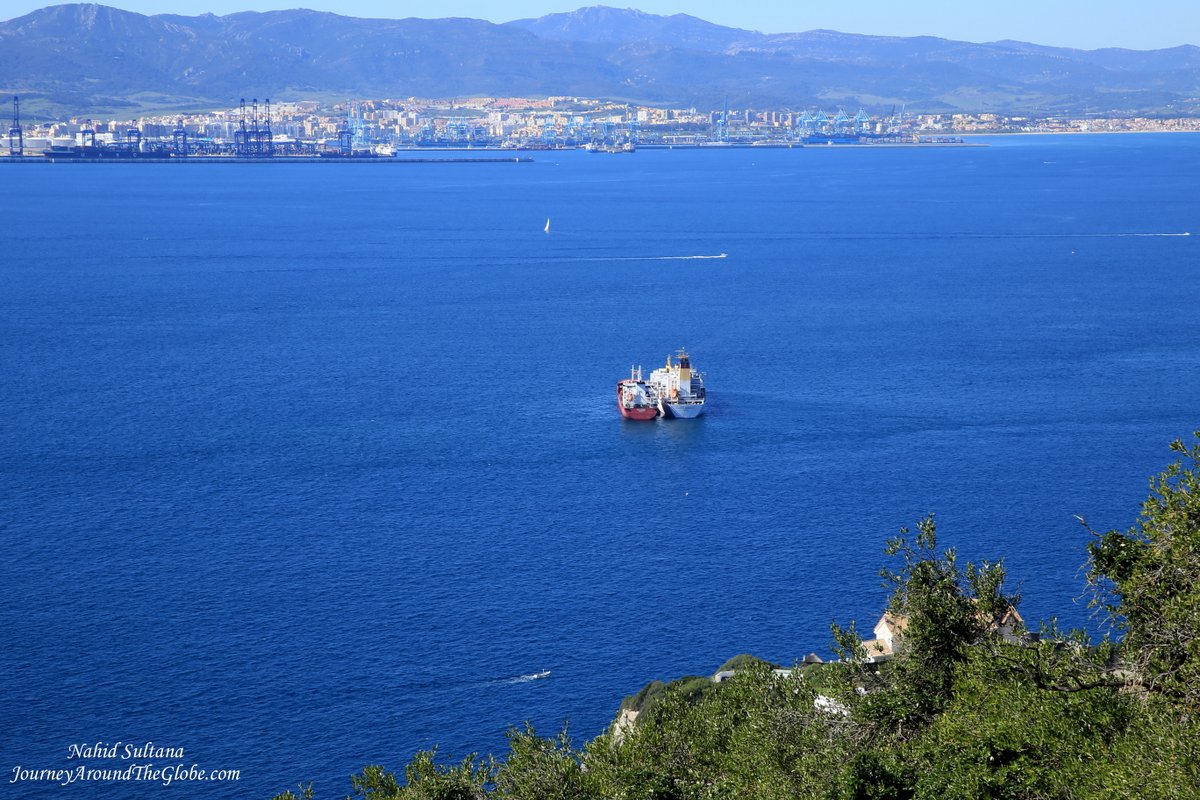
Gibraltar is surrounded by water from three sides with both Atlantic and Mediterranean and Spain on one side. Africa is only 14 miles away from here. You get stunning views from most of the corners of Upper Rock of Spain, Africa, Atlantic, and Mediterranean…it can’t get any better.
Gibraltar doesn’t have any sales tax on any items. Therefore, lots of tourists come here to do major shopping. While local pound is the official currency, they also accept British pounds issued by Bank of England (not the ones from Bank of Scotland and Northern Ireland). Most of the places accept Euros too but your changes will may very well be in pounds.
Driving in Gibraltar may not be that easy for new-comers, especially when going to top of the rock. Good part is that, they drive like the rest of Europeans and not like U.K. on the right-hand side. We left our car on the other side of the border in Spain and crossed border-control on foot. This was a better idea since there were couple big car garages on the Spanish sides and we didn’t have to worry about parking our car in Gibraltar. Another disadvantage of bring the car to the English side is that on our way back the queue to cross border check-point to Spanish side was huge, I mean…humongous. But those of us who were walking, the police didn’t even check our passports.
TIME of TRAVEL: Gibraltar was the last destination of our Andalusian trip in Spain that we took in February of 2014. We checked out from our hotel in Seville on the 2nd morning and drove about 2 hours on scenic highway to get to Gibraltar. When I say scenic, yes…it was a very beautiful drive by the mountains and meadows and countryside. Weather in Gibraltar was mild, not too cold or too hot. But may get a bit windy when you are on top of The Rock of Gibraltar.
OUR HOTEL: We didn’t stay overnight in Gibraltar. We spent the last two nights in Hotel Petit Palace Santa Cruz in Seville. From Gibraltar, we drove back to Malaga where we started our journey from to a catch an early morning flight back to Brussels. Last night in Spain, we stayed in Holiday Inn Express which was very close to Malaga Airport. I think it took us more than an hour to find this hotel, not sure if our GPS is to blame or the fact that you can’t really see the name of this hotel from the road.
EATING and SHOPPING: By the time we reached Gibraltar from Seville, Spain it was already lunch time. We grabbed something quick from McDonald (there was also a Burger King) before crossing the border. In Gibraltar, the main city center has lines of many restaurants and shops. We picked up some finger-foods from an Indian places while walking back towards the border. City center is also a good place to pick up souvenirs and do shopping, as I mentioned above, there is no sales tax in Gibraltar.
PLACES WE’VE VISITED: We hired a taxi from the first bus station right after crossing the border. It was for about 2 ½ hours guided tour for 80 euros for the whole mini-van which seats 6. We had it for four of us. But you can share a ride like this and share the cost. This was a quick and easy way to explore this place. Of course there were time limits with taxi but we did get to visit all the main spots and their highlights. You can walk up to the rock or take a cable car but with the kids, taxi was much smoother. Walking can be fun if you are fit to climb hilly road and the weather is good. Some people take the cable car up and walk down slowly and take time visiting all the attractions.
If you have spare time, may be two other significant places here to visit would be the Moorish Castle and Europa Point. We couldn’t go to any of them because of time. Moorish Castle, from the 1300s, currently, is nothing but in total ruins. You can see the skeleton of it and the tower almost from anywhere. Europa Point is a military base which offers a fantastic view of the bay and continent of Africa on the other side. I don’t think tourists can go all the way to the tip of the Europa Point, but some people do go there as far as the officials allow. Other than these two, there are tons of tunnels in Gibraltar that enthusiastic tourists may find them interesting to discover. Casemates Square is a lively that we passed before walking back to the border control…a great place to hang out and watch world go by.
1) PILLARS of HERCULES or JEWS GATE: This is where our taxi took us first. This is a view-point from where you can see Gibraltar Strait where Atlantic Ocean and Mediterranean Sea come together. Europa Point and Jewish cemetery are also visible from this spot. The best part of it is that you get to see Morocco on the other side in the coast of Africa.
2) ST. MICHAEL’S CAVE: We drove up little more towards the tip of the rock and St. Michael’s Cave was our next stop. This is a gorgeous natural cave and definitely worth a visit. Just to give you an idea of the size of this cave, the visitors’ area is much smaller than Luray Cavern in Virginia, USA.
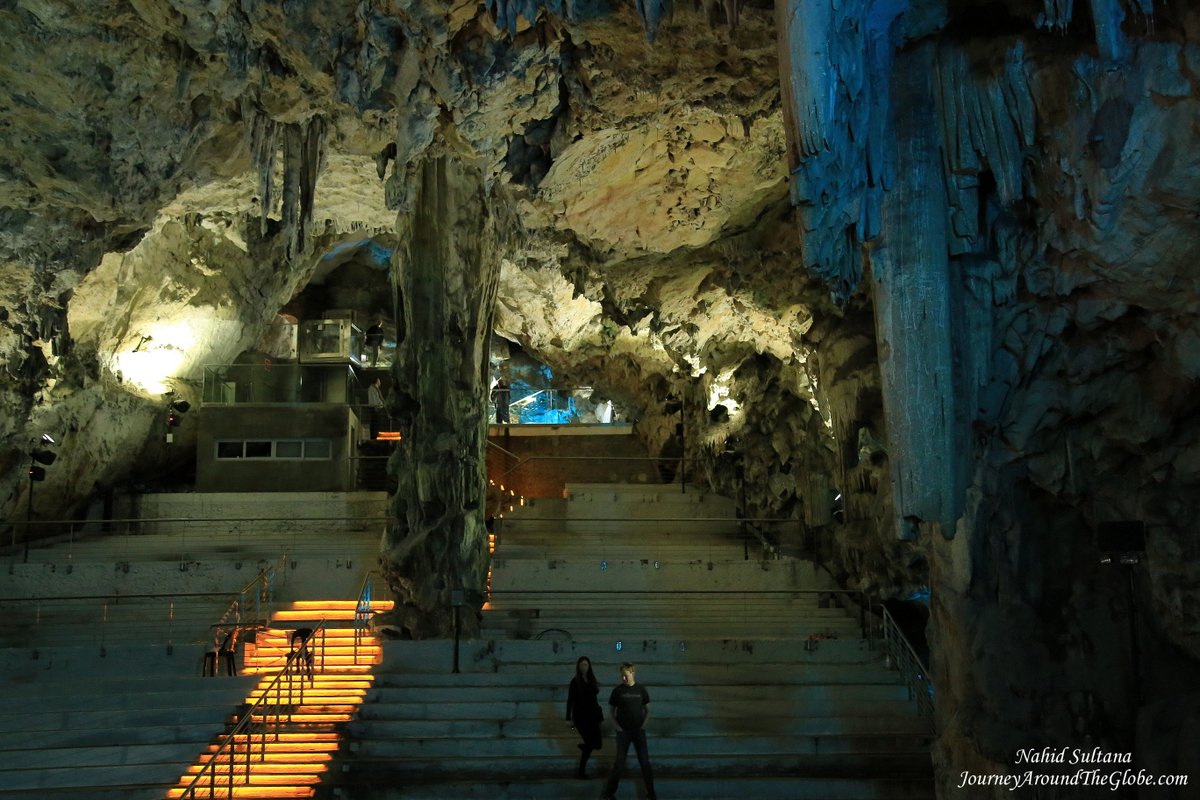
The impressive natural grotto of St. Michael’s Cave was long believed to be a bottomless cave. It winds downward some 700 feet into The Rock. The Upper Hall, fitted out as an auxiliary hospital in during WWII in 1942, but was never used, now it is used for concerts. It took us about 20 minutes to visit the cave.
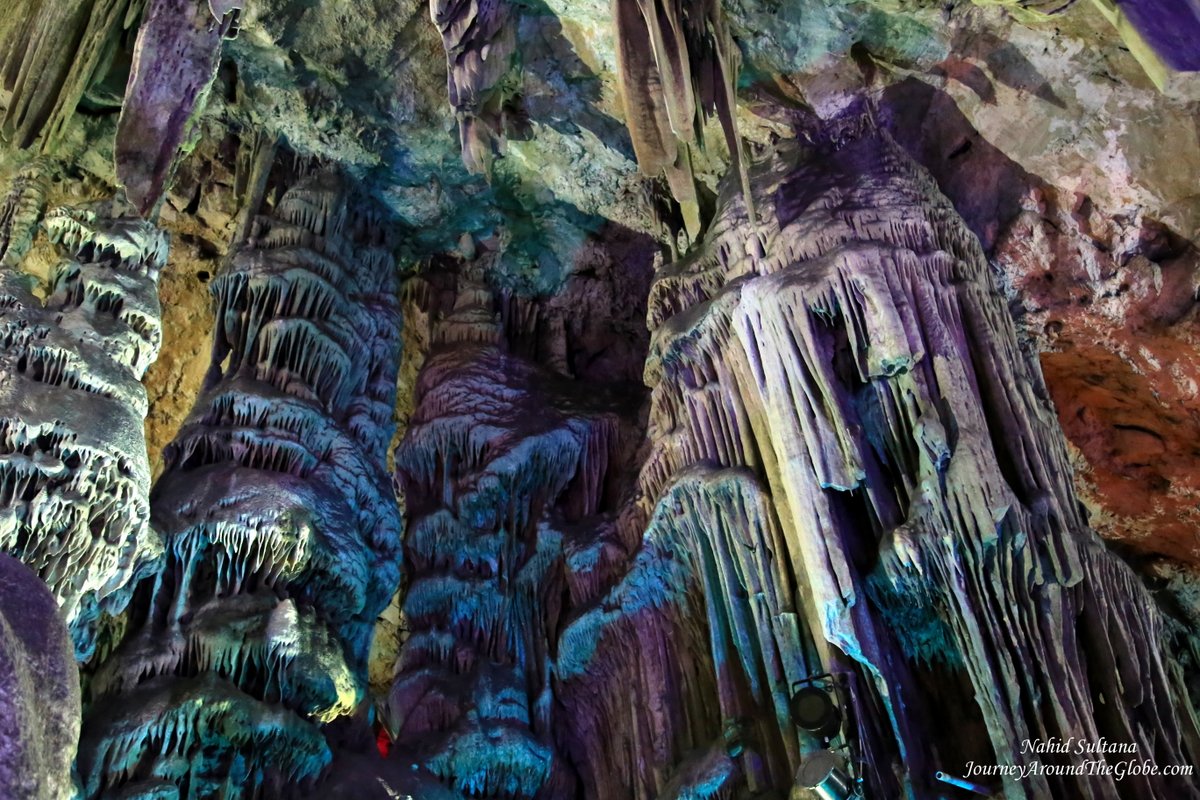
By the way, the cafeteria here is the last one to grab some food in the nature reserve of Upper Rock. It’s better to finish your food before hitting the road again, monkeys here can be notorious and may attack or take away your food if they can smell it.
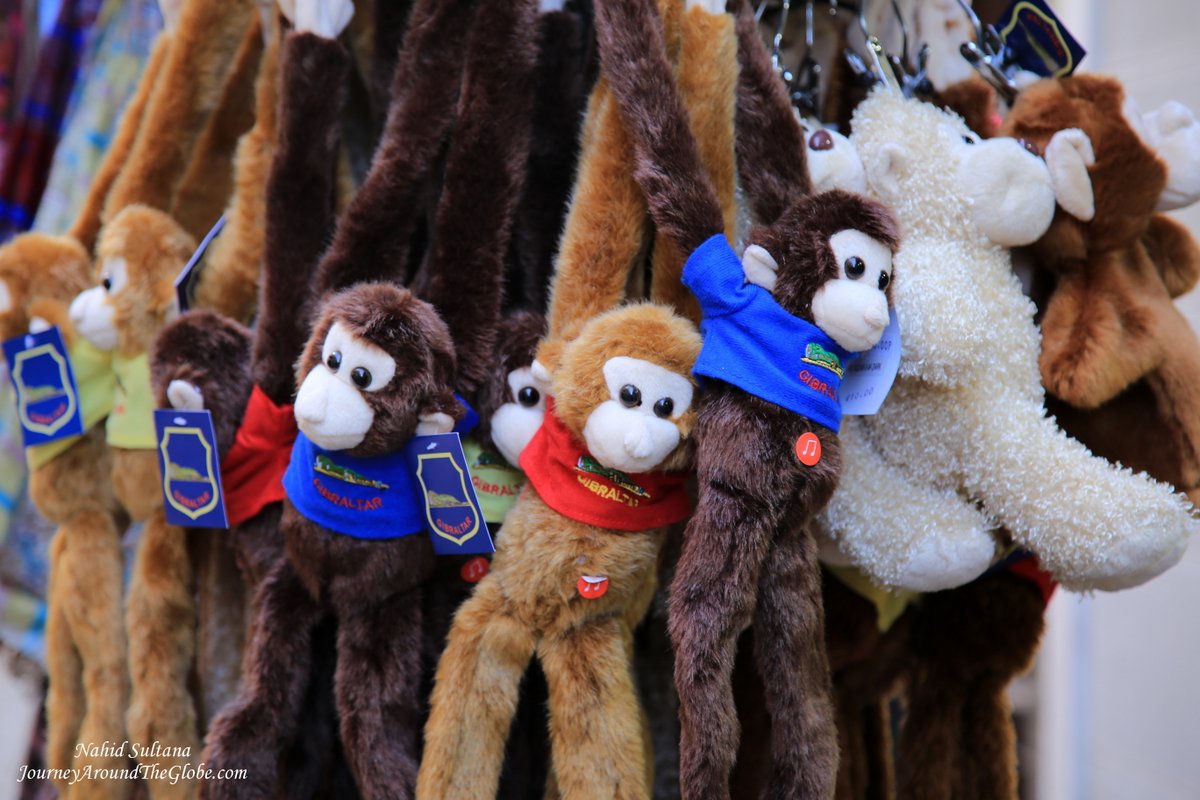
3) A MONKEY FEEDING STATION in UPPER ROCK: Drive from St. Michael’s Cave up to here was very scenic, after all, Gibraltar is surrounded by water on three sides. There are few of these monkey feeding stations all around the Upper Rock. These monkeys, Barbary Macaque, were brought here from Africa many centuries ago. They are used to seeing people all the time, but be careful…they are wild animals on loose. If you are driving your own car, it’s better to roll your windows up when you start climbing the rock.
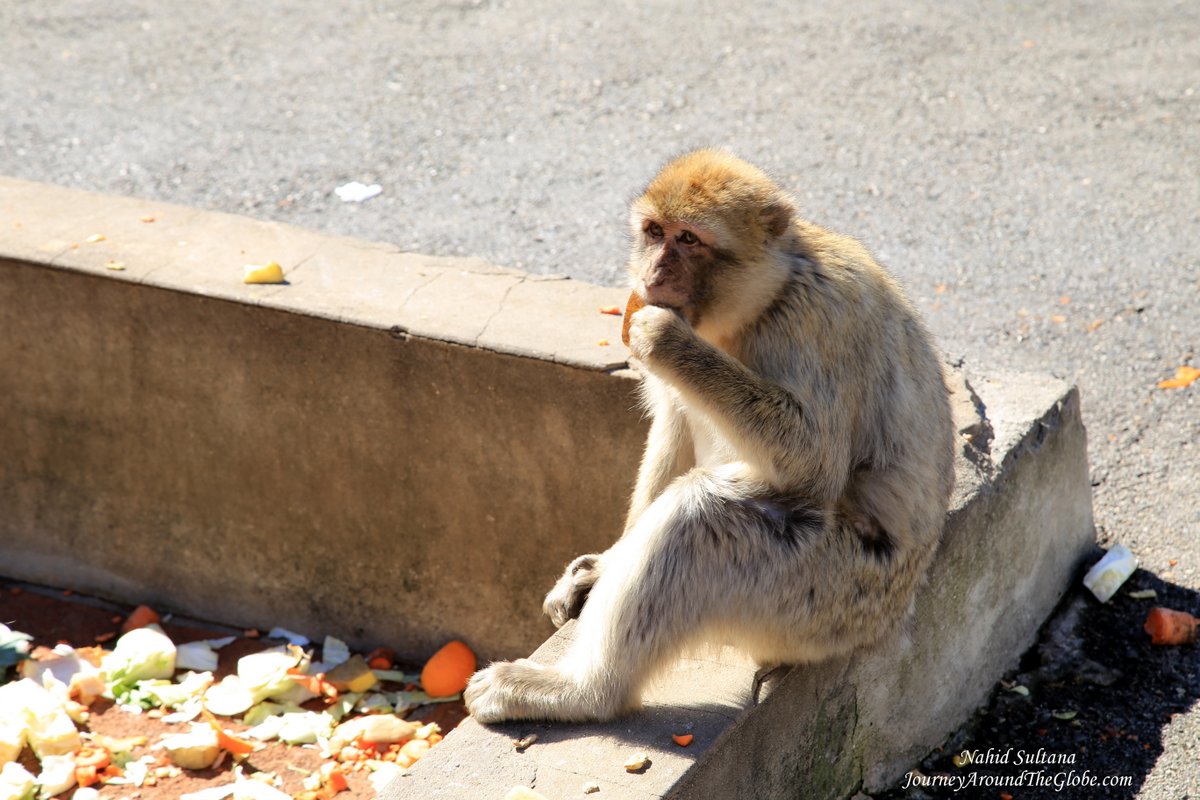
People of Gibraltar love their monkeys and the government actually takes care of them and feeds them at these stations. My girls took few pictures with these cute apes.
4) GREAT SIEGE TUNNEL: This was our last stop with the taxi and on The Rock. You get a fantastic view of Gibraltar, Spain, and all the other surrounding as you stand at the entrance of this tunnel. By the way, there is total of 33 miles of tunnels all around Gibraltar. Interestingly, British army hand dug this one, a 600 meter tunnel, from solid limestone.
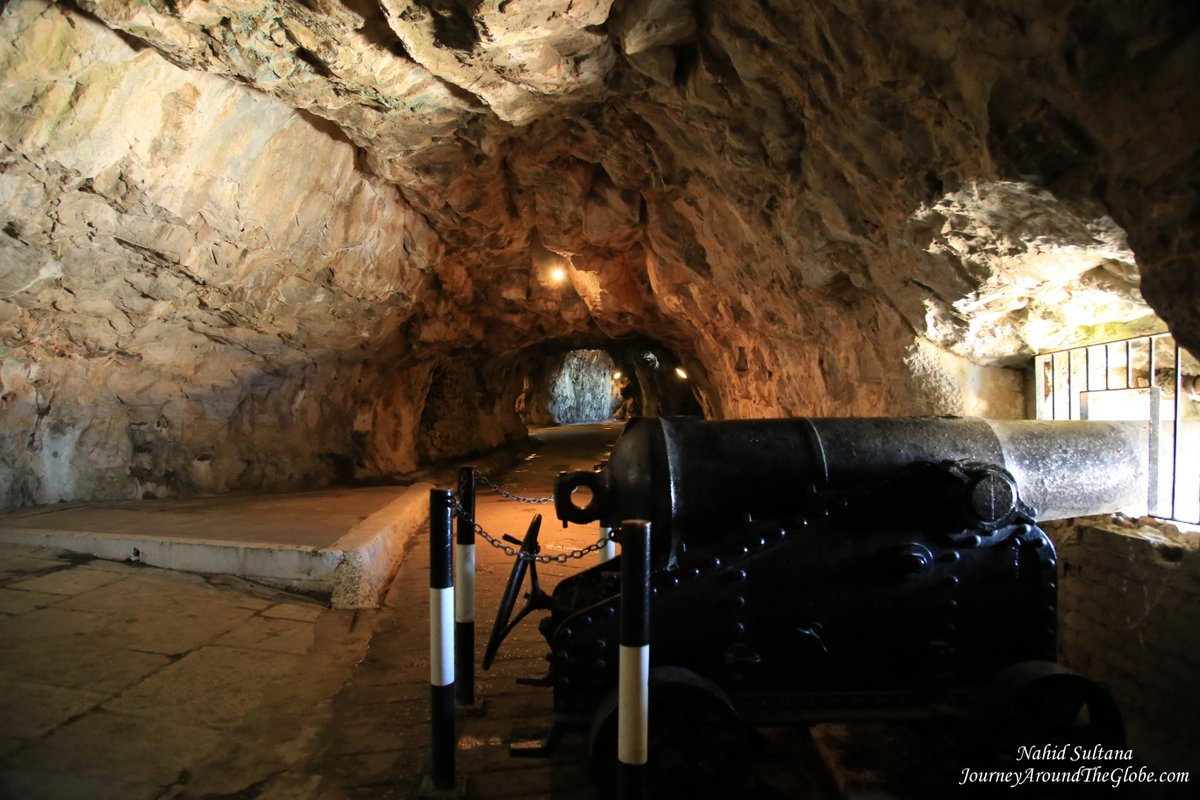
The tunnel was built in the 1700s to defend Gibraltar from the Spanish and French troops during the Great Siege. When the Great Siege ended in February of 1783, the original gallery was 370 feet long. After the end of Napoleonic War in 1815, the risk of war still remained in Europe. So British continued to improve the fortifications of the Rock by including an additional 7 miles (12km) of tunnels. Overall, this is a long snaky tunnel to discover with detailed information about events during the Great Siege and the usage of the tunnel during WWII.
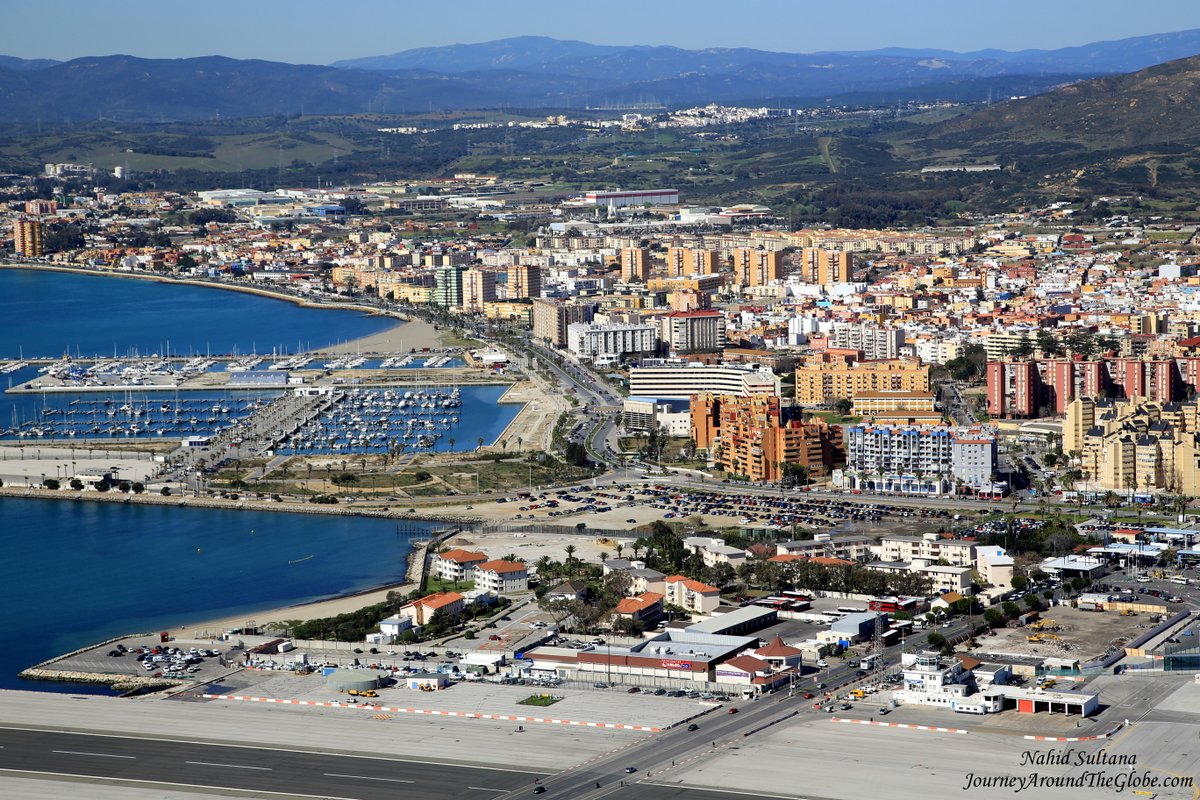
We stayed here about little less than half an hour. After the first part, you may need extra 30 to 45 minutes to go further deep into the tunnel where the gradient becomes steeper and some visitors may find the climb back quite tiring (don’t worry, there is a clear sign in the tunnel with this message). We came back from this point to catch the taxi…the girls were a bit scared too to go further.
5) CITY CENTER: We were dropped off here by our taxi after our short tour of Gibraltar. This is more like a shopping alley with many fancy stores and local boutiques. There isn’t much to do here other than doing some tax-free shopping or having a good meal. There were some point of interests we saw in the information board, like a cemetery, museum, and other landmarks. We didn’t go to any of those place, just took a leisure stroll to both sides and started walking towards the border.
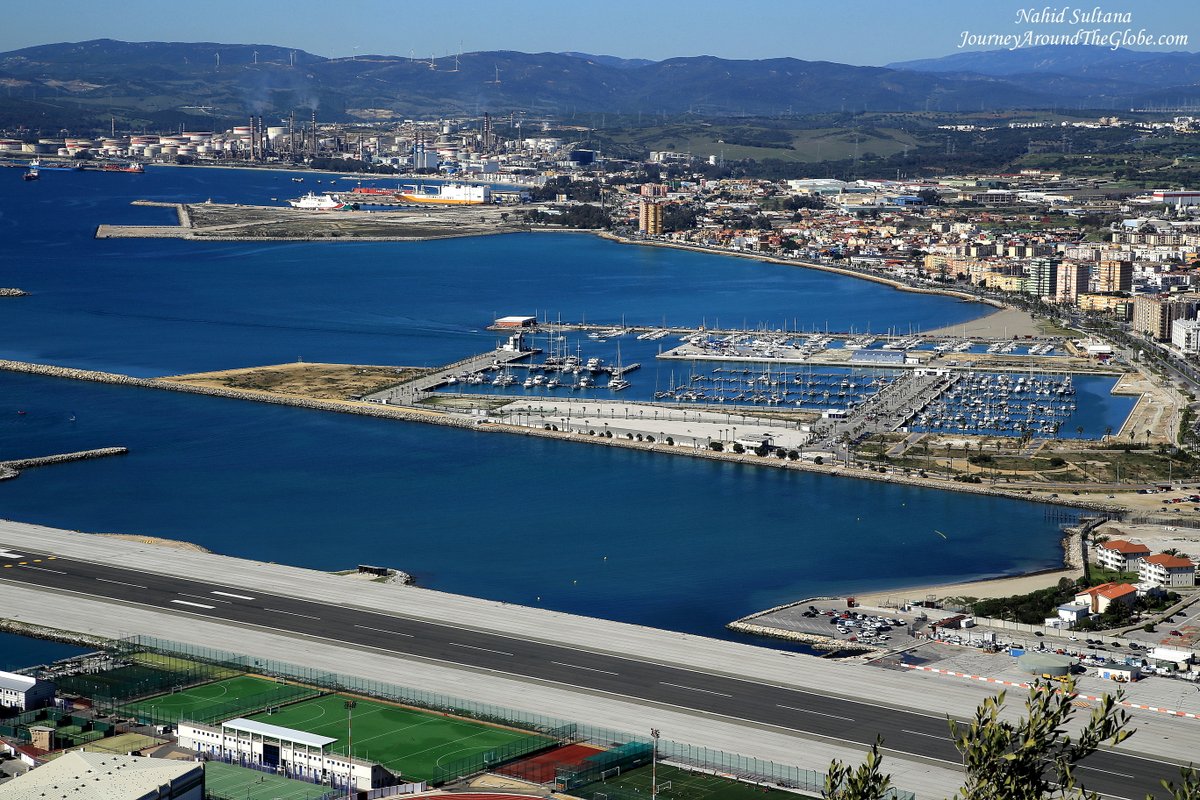
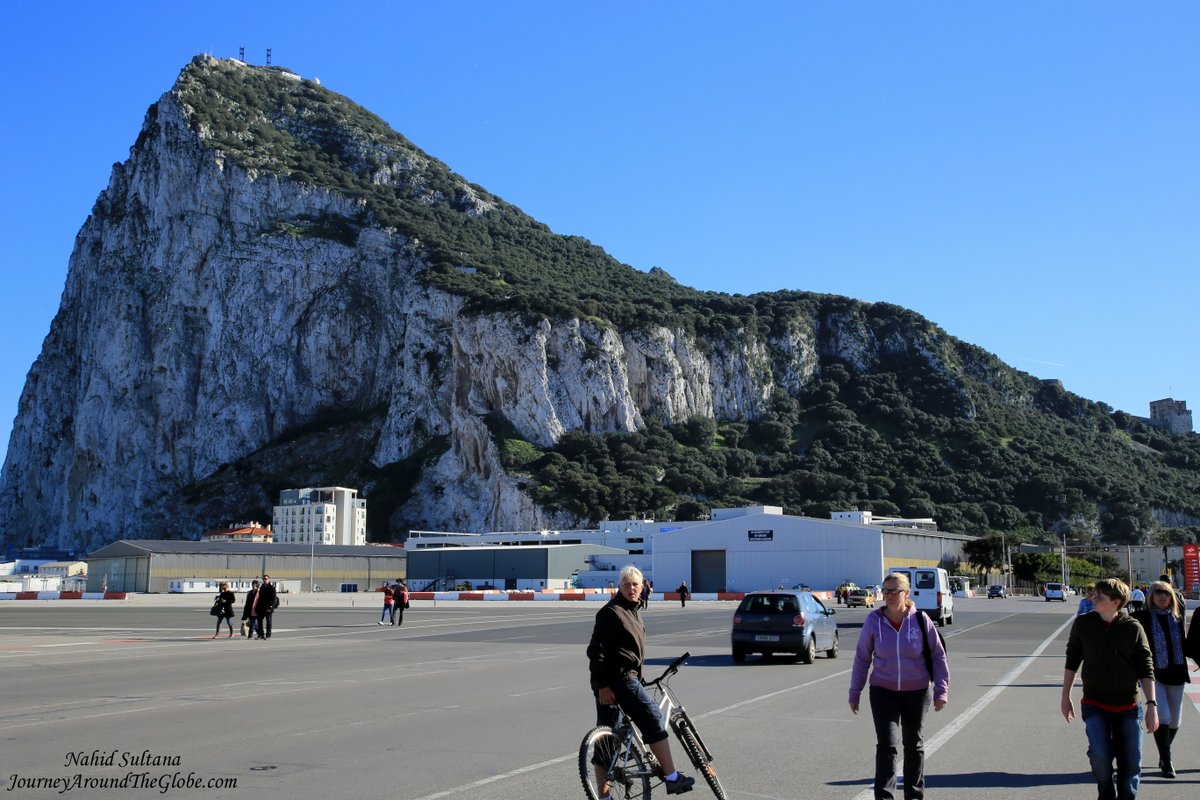
6) GIBRALTAR AIRPORT: Gibraltar Airport has a live runway, meaning it sits on a local street and general public can actually cross this stretch of road on foot or by car. The airport is only few steps from the border on Winston-Churchill Avenue. Fun part of crossing this street was, we were told by the airport securities to hurry up and cross the road quickly because a plane was about to take off and they are clearing all the people from the runway. So we hurried to the other side as a bar came down to stop all the pedestrians and traffic lights turned red to stop all the vehicles. In about couple minutes, we got to see a British Airways making its way to the runway and took off from that runway as all the audiences were going “wow”. We were lucky to see this site, not many people crossing this runway actually get to see an airplane taking off few feet away from them.

Share this:

A day in Seville, Spain
SEVILLE, SPAIN: While Cordoba was the capital of old Andalusia, Seville is the current capital of this region. It is a famous Andalusian destination among the travelers for being a historic city that shaped Spanish culture and heritage. In the 16th century, Seville was the harbor chosen by Queen Isabel as it offered security against pirate attacks. She turned the city into the Port and Door to America. It was the European main commercial city during that time.
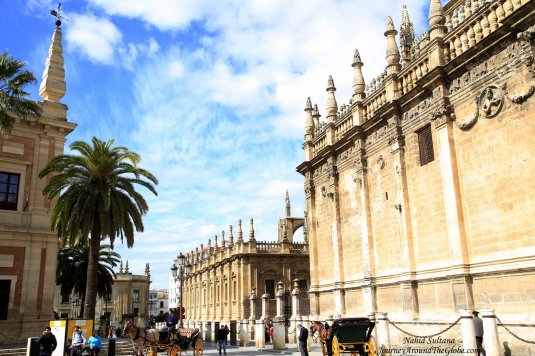
- Historic city center of Seville, Spain

Old town of Seville is very beautiful and well-preserved. It offers sites and activities for all ages and tastes.
TIME of TRAVEL: After visiting Malaga, Granada, and Cordoba in February 2014, we came to Seville. It was about an hour and half drive from Cordoba to Seville. Driving in Andalusia was a fantastic experience since we got to see some clean highways, Sierra Nevada Mountains, countryside, vast fields of olive trees…overall a very scenic drive. Weather is mild during February… pleasant during day and a bit chilly at night.
OUR HOTEL: Our hotel in Seville was Hotel Petit Palace Santa Cruz, about 10 minutes of walk from the cathedral or Alcazar. We didn’t have breakfast included with the price but both the days we were there, we had breakfast in the hotel for 8 euros per adult, I think…and kids were free. Hotel has free Wi-Fi service. It’s an ultra-modern hotel with nice people and very clean rooms.
EATING and SHOPPING: After trying out loads of Spanish food, like paella and tapas in the other Andalusian cities in this trip, we were ready for some other types of cuisine. First night we walked about 20 minutes from our hotel just to get to a local Chinese restaurant. Next lunch was in the old town at an Italian pasta/pizza place. This Italian place was actually very nice with outdoor sitting and good food. And for the night we just picked up a box of pizza from the street on our way to the hotel.
Seville or may be just whole Andalusia is a great place to buy Spanish tiles or ceramic items. These artifacts are beautiful and usually hand-made by local artists. Flamenco dresses for little girls are very popular here. I also loved vibrant colors of Spanish potteries and ceramics.
PLACES WE’VE VISITED: We stayed two nights in Seville but had only a day to explore the main city; went to Gibraltar on the 2nd day. There are many historic churches and museums to visit here. If you go in the right season (April and May), may be you can catch a bullfight in Seville Bullring arena. It may not be for soft-hearted people, because they eventually kill the bull at the end. Another popular show for tourists is the famous Spanish Flamenco performance. If you have spare time, try visiting Cordoba or other beautiful Andalusian cities. Also, Gibraltar (a U.K. territory) could be another unique place to visit from Seville…the drive is about 2 hours one way but worth a visit.
1) SEVILLE CATHEDRAL: First thing we saw on the first day of Seville was this cathedral. This is a grand and impressive edifice in the heart of Seville. Like Cordoba Cathedral, this was also once a mosque. Built in 1198 AD, this was Seville’s main mosque. Both the mosque and the minaret were built using bricks. Original Orange Tree Courtyard of the mosque was conserved and so was its minaret which today forms the lower two-thirds of the Giralda bell tower. Seville Cathedral is arguably the largest church in the world when compared using the measurement of volume.
In 1248, the mosque was turned into a cathedral, but it wasn’t until mid-15th century when the construction work began on this Gothic architecture. Unlike Cordoba’s Mezquita, it was completely changed to a Christian church without leaving any sign of being a mosque at one point. Later, Renaissance and Baroque styles were added in the next couple centuries. Despite the fact that Seville Cathedral contains all sorts of architecture styles from different era, this edifice is known to be the most extensive Gothic cathedral all over the world.
There is a small museum and courtyard before entering the actual cathedral. Once you enter inside, there are more than twenty chapels and countless oversized paintings. One of the highlights of this cathedral is that it is the final resting place of famous explorer Christopher Columbus’ remains along with his son Hernando Columbus’ tomb on the other side of this place. Walk around and on one side of Columbus’ tomb is the historic chapel of Santa Maria de la Antigua where another well-known explorer Ferdinand Magellan and his men prayed in an act of thanks after returning from the expedition of 1519. The voyage was formed with five ships and a crew of 234 men, but only 18 survivors returned in 1522.

- Tomb of famous Spanish explorer Christopher Columbus inside Seville, Spain

La Giralda is the original minaret tower of Seville Mosque here. Now it is the bell tower of this cathedral that can be seen from almost any point of old town. Visitors can climb the tower for a panoramic view of the city. Enjoy and relax in the orange courtyard which has a fountain in the middle surrounded by many orange trees.

- Orange Courtyard of Seville Cathedral
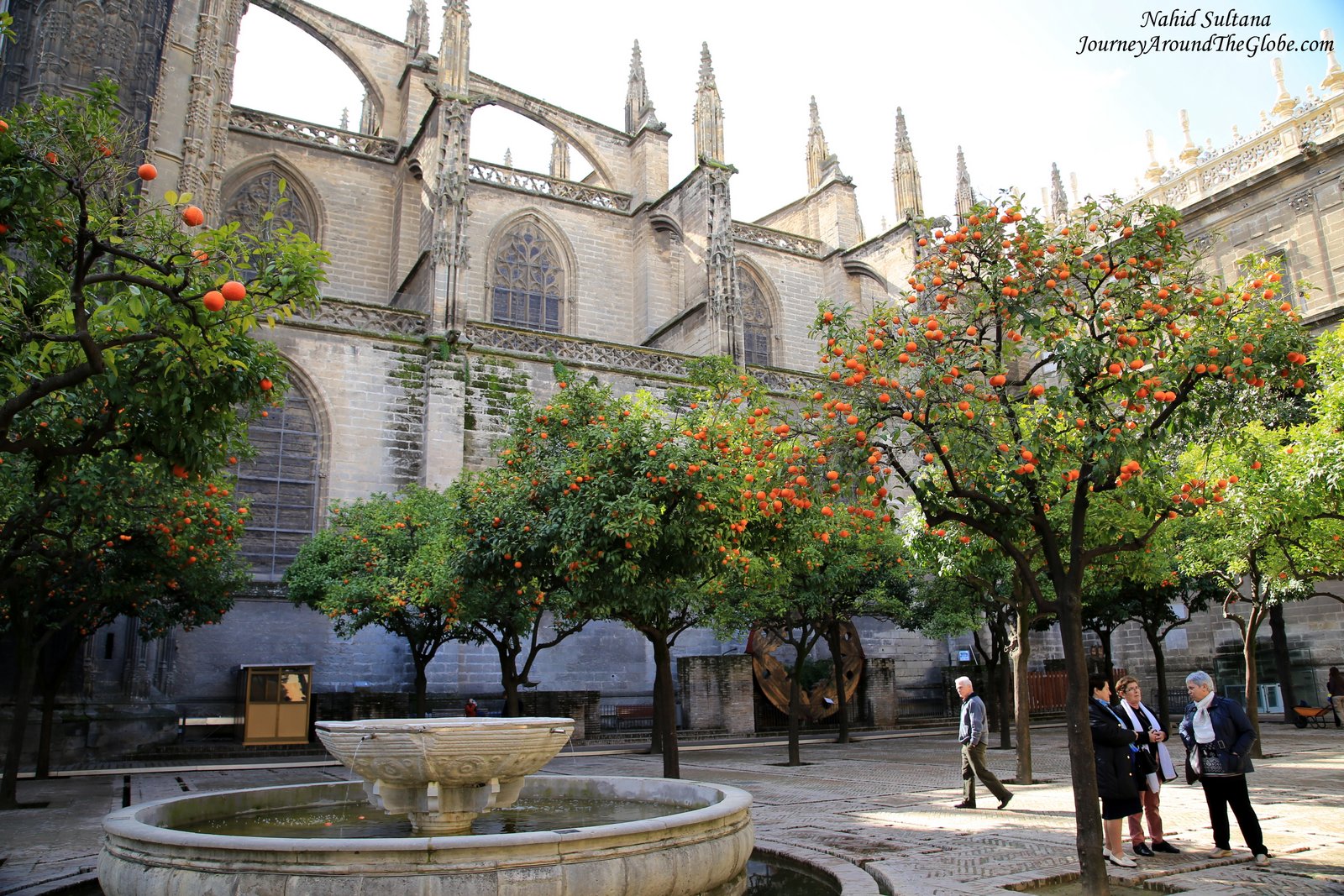
The square in front of the cathedral is very big and a nice place to hang out. You can hire horse carriage to tour the main sites from here. Have a drink in one of the cafes or buy souvenirs from the stores.
The cathedral recommends that you spend at least 90 minutes inside it to get the most of it. Ticket is 8 euros per adult.
2) PLAZA del TRIUNFO: Plaza del Triunfo is a lovely square in between Seville Cathedral and Real Alcazar. You can see many old buildings, beautiful statues, and plenty of open space in this square. Above all it was nice to walk under the sun and the crowd here.

- Plaza del Triunfo in Seville, Spain

3) REAL ALCAZAR: Not too far from the cathedral, Real Alcazar stands on the oldest archeological remains of Seville. It was built in the 10th century over the remains of an Islamic quarter. Since then, between its ancient walls many highlights of the Spanish history have taken place. Built mainly in Moorish style, you can see almost all the architectural styles of Europe in this palace including Taifa, Gothic, Mudejar, Renaissance, Baroque, Mannerist, and Neo-classical. The Royal Alcazar is a harmonious combinations of art, history, and culture. Gothic Palace of Royal Alcazar is a palace that was built in 1284 representing the triumph of Christian ideology against the Muslim past.

- Gorgeous interior of Real Alcazar in Seville, Spain
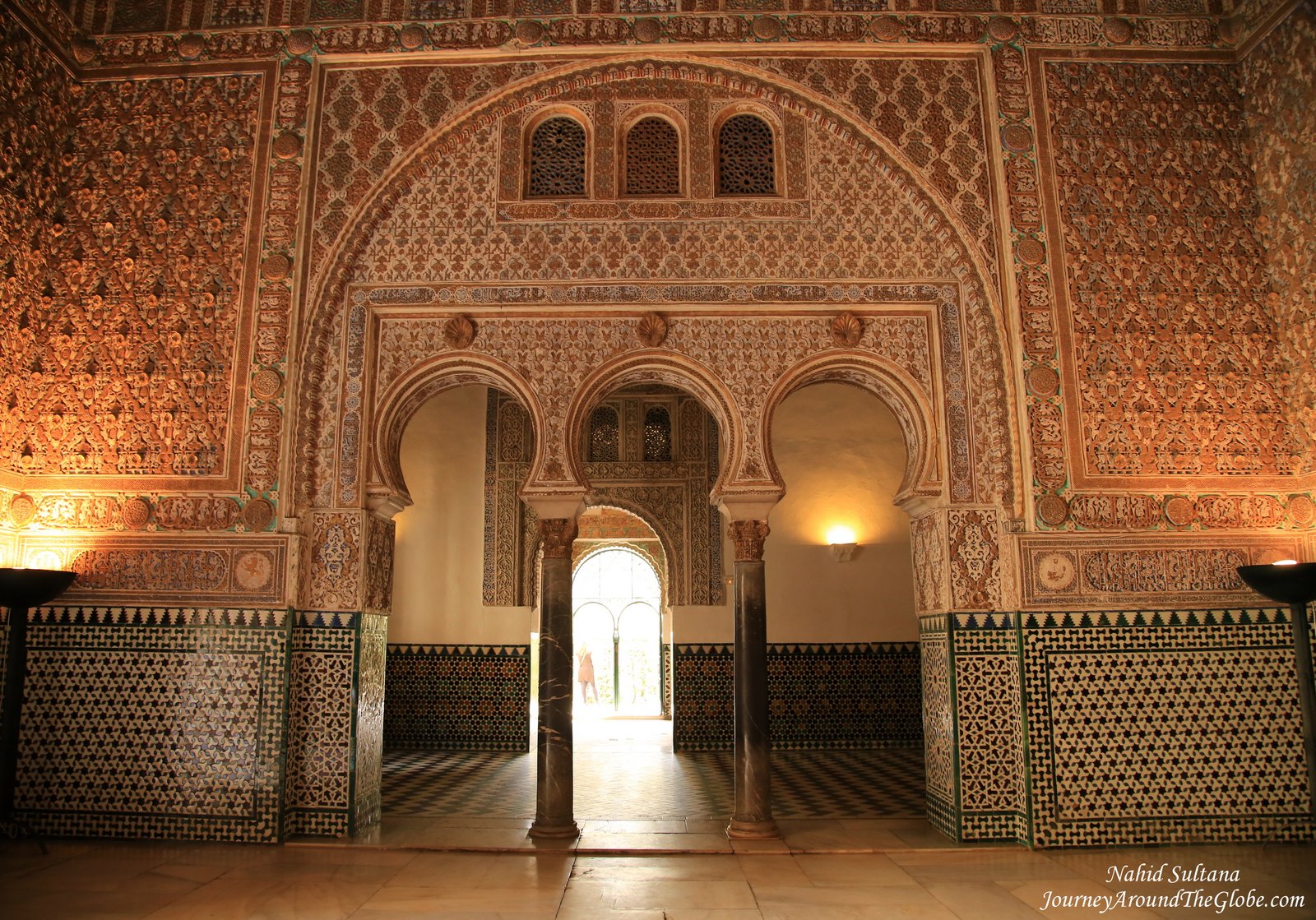
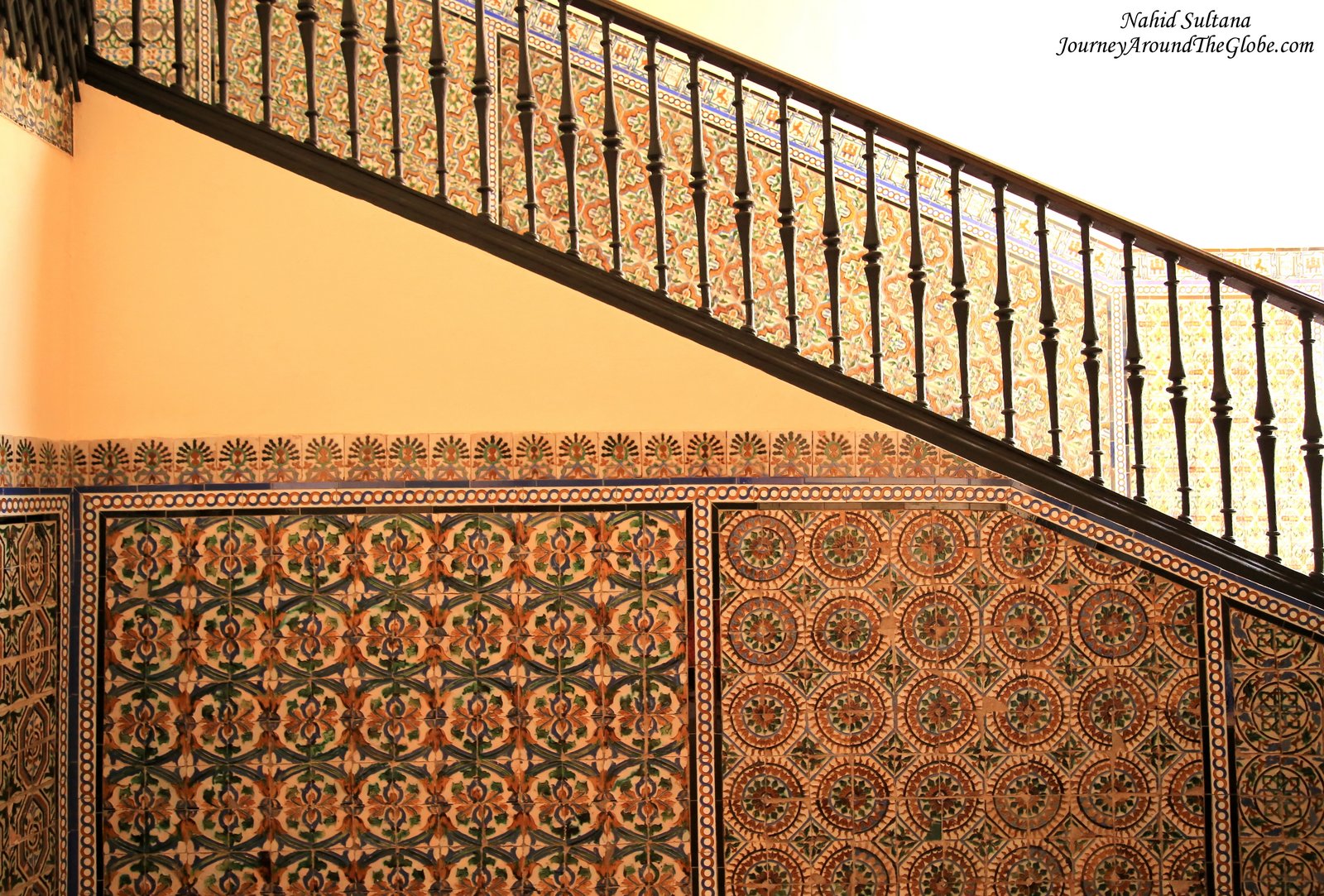
Make sure to visit the historic Admiral’s Hall where Amerigo Vespucci, Ferdinand Magellan, and El Cano planned their first travel around the world and Juan de al Cosa made the first world map in history. The hall is decorated with historical theme paintings from the 19th and early 20th century. Today it is used as a conference room. As you come out from this hall and in the courtyard, take the majestic staircase to upstairs. Small museum with collections of old Spanish tiles from 16th century, Baroque and Renaissance ceramics, traditional hand-fans, Upper Palace of Alcazar today is the official residence of Their Majesties of Kings of Spain in this city.
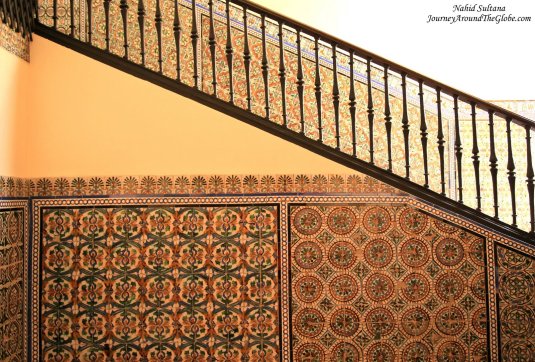
- A majestic staircase of Real Alcazar of Seville, Spain
Main and magnificent attraction of Alcazar is the Moorish palace. It is the most fascinating place to visit in Seville with extravagant architecture, arched doors, lavishly decorated walls with calligraphy and Spanish tiles, handsomely carved ceilings, courtyards with lush gardens, and small ponds. Walk and appreciate many small but elegantly finished rooms. Visit Hall of Ambassadors which was the main hall of the palace and was used as a throne room. The central courtyard with a rectangular water fountain is the most appealing spot here. You get a glimpse of how Muslim royals and Christian emperors lived here many centuries ago.
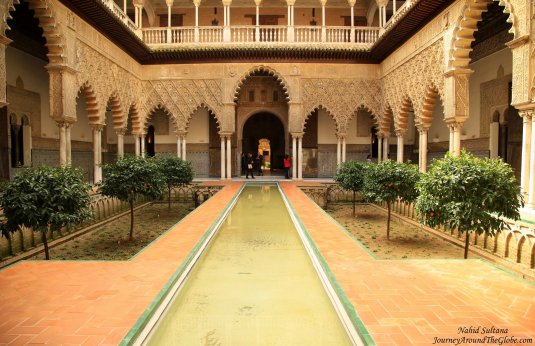
- The most beautiful courtyard with pool of Real Alcazar in Seville, Spain

Since its creation, Royal Alcazar has always been the official residence of the Spanish Heads of State and today it is the oldest Royal Palace of Europe still in use. Now it is part of UNESCO World Heritage Site. Enjoyed its gardens, patios, fountains, old gates, and walls.

- Beautiful arched doors of Real Alcazar in Seville, Spain

Royal Alcazar is open from 9:30am – 5pm in winter and 9:30am – 7pm in summer. It is 8:50 euros per adult and kids below 17 years of age are free. You can get an audio-guide for 5 euros extra.
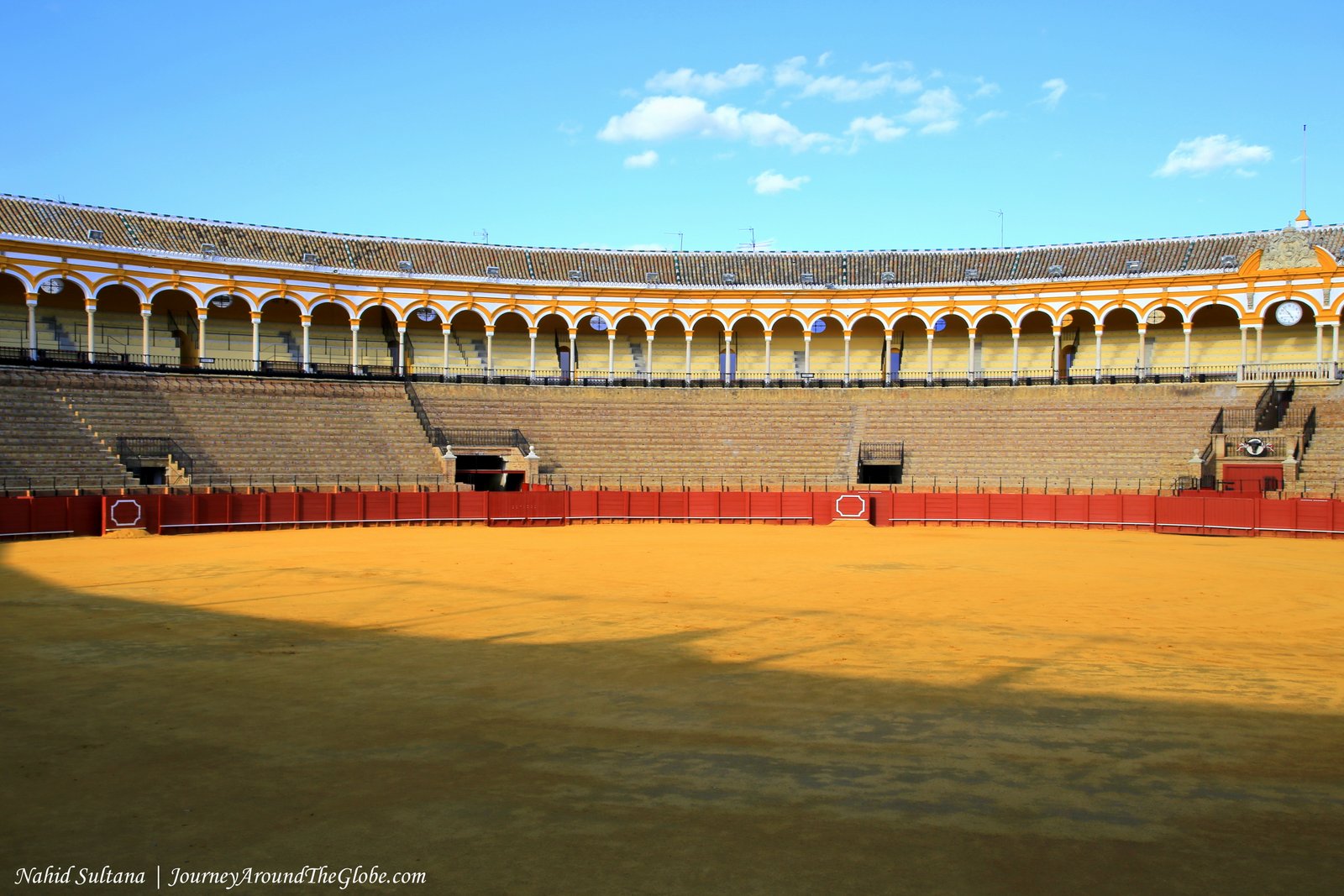
4) PLAZA de TOROS DE SEVILLA (SEVILLE BULLRING): This is one of the most visited monuments of Seville. We walked quite a long way from the city center to come here. This white and yellow building is an eye-catching rare beauty of Seville. Built in 1761 AD, the style is late Baroque with neo-Classical touch. Over the years, this bullring has transformed into one of the models of Bullfighting art evolution. In 1983, it was declared as a Historical Art Monument.

- Seville Bullring – one of the famous bullrings of Spain from 1761 AD.
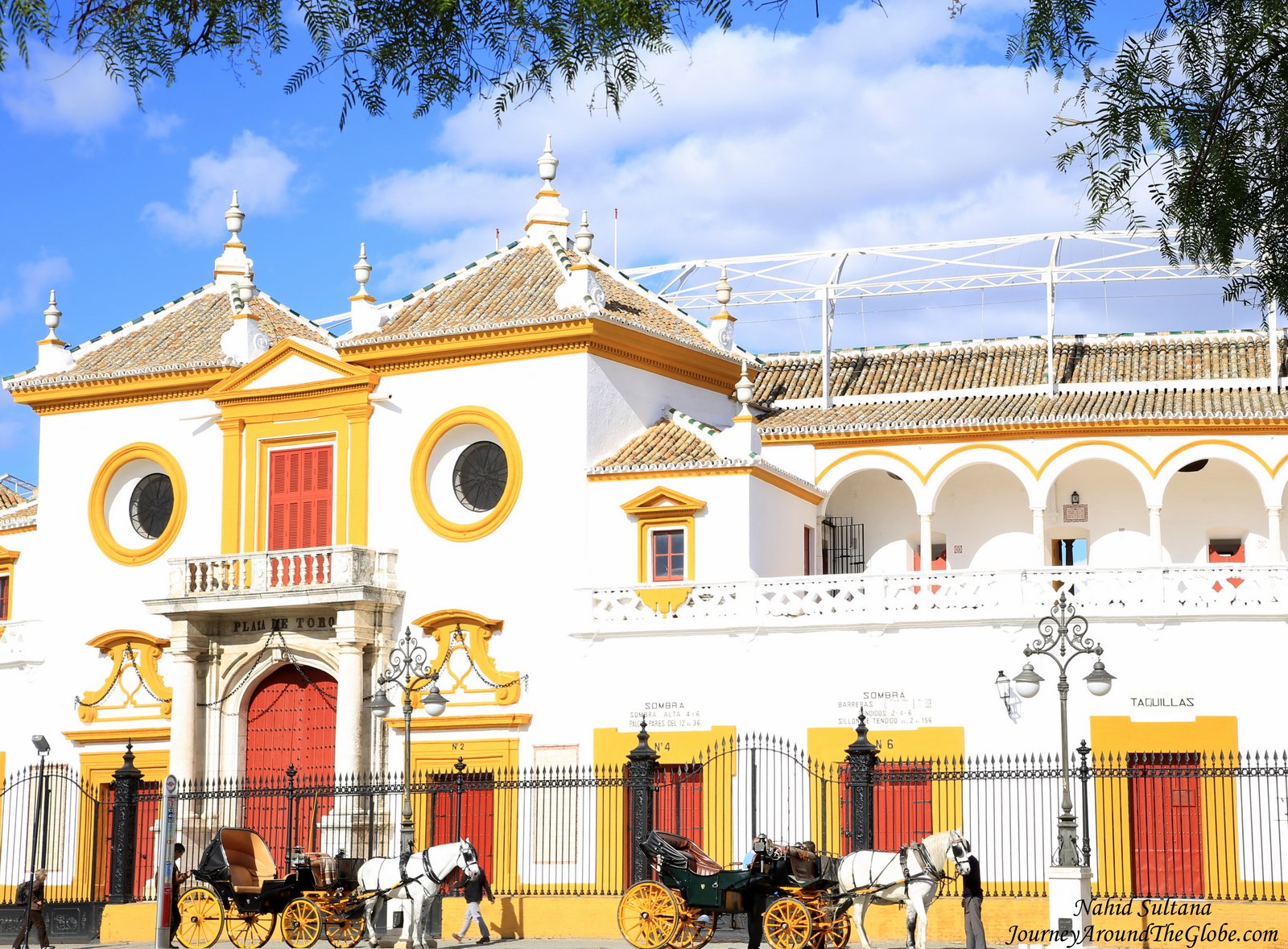
We started our tour with the stadium first. The arena can hold about 12,000 people. You get to see Prince’s Balcony which is only used by the Royal Family. Tickets for bullfight are sold somewhere from 25 euros to 150 euro depending on the location of the seats.
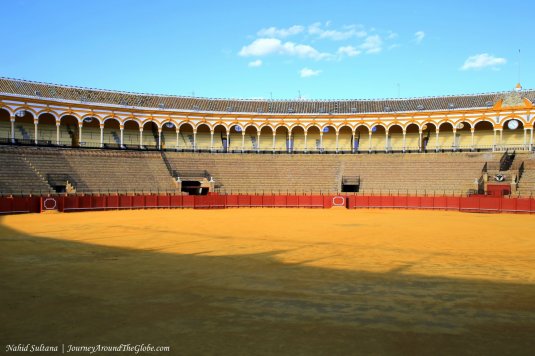
- Seville Bullring in Spain
After visiting the stadium or the ring (visitors can’t really go to the field) we were taken downstairs to the Bullfighting Museum. This is an excellent place to know the history and evolution of Bullfighting in Spain over the ages. The museum features many bullfighting arts and paintings, 20th century bullfighting which is known as the “Golden Age of Bullfighting” and two most outstanding figures of bullfighting. The last section of the museum has images of games and matadors, bull fighters clothing, utensils, posters, capes, bronze sculpture, and lots more. In each show there are 6 bulls and 3 matadors. Whole show lasts for 2 ½ hours. Each matador faces 2 bulls. Now a days, the winner could make 350,000 euros per show!! High season to watch one of these games would be in April and May.
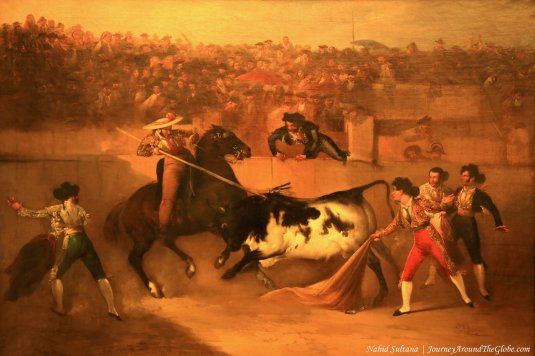
- A painting in Seville Bullring Museum, Spain

After that the tour continued with the Art Gallery, Bullfighter’s Chapel, and the Horses Courtyard. The Art Gallery has a collection of oil paintings from the 18th, 19th, and 20th centuries. All these paintings are work of Spanish artists. You can learn about the culture of bullfighting in Spain from this guided tour. The lady explained us how the game is played, rules, history, famous matadors, and etc…overall, we got to hear some fascinating facts on this sport. But I must say, after visiting this museum, I thought this was a serious cruelty towards those innocent animals and I don’t think I would ever pay my money to see such shows no matter how traditional it is in Spain.
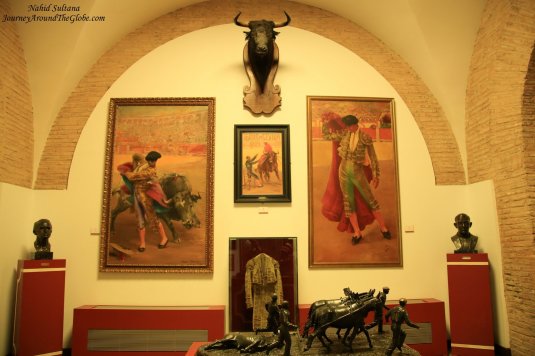
- Seville Bullring Museum, the front statue shows how mules pulls away bull after it is killed in a bullfight

Seville Bullring is accessed only by guide tours which are given in Spanish and English (French and Italian are available upon reservation). The duration of this tour is about 40 minutes. Tours run every 20 minutes but they run out of seats very quickly. Ticket for this tour is 7 euros per adult and 4 euros for 7 – 11 years old children.
5) TORRE de ORO: This is very close to the bullring and near the river. We took a leisure stroll by the river towards this tower after visiting Seville Bullring. This is a 13th century tower that now houses maritime museum. We didn’t go inside the museum but the area is very lovely to relax and to enjoy the atmosphere.

- Torre de Oro, a 13th century tower in Seville, Spain

Share this:

Cordoba, Spain – the capital of old Andalusia
CORDOBA, SPAIN: Cordoba, the unique Andalusian monumental city, has been part of UNESCO World Heritage Site since 1994. It offers one of the more extensive and well-conserved historical quarters of Europe to its visitors. Cordoba’s environment is full of charm that coexists peacefully with its attractive monuments, cultures, landscapes, and legacy, as Roman capital, court of Caliphs, and cradle of three cultures: Christian, Islamic, and Jewish. It contains a mind-blowing mixture of diverse cultures. Situated in the center of Andalusia, this is a matchless city for its monuments, history, natural environment, variety of leisure activities, and gastronomy.

- Picturesque Cordoba
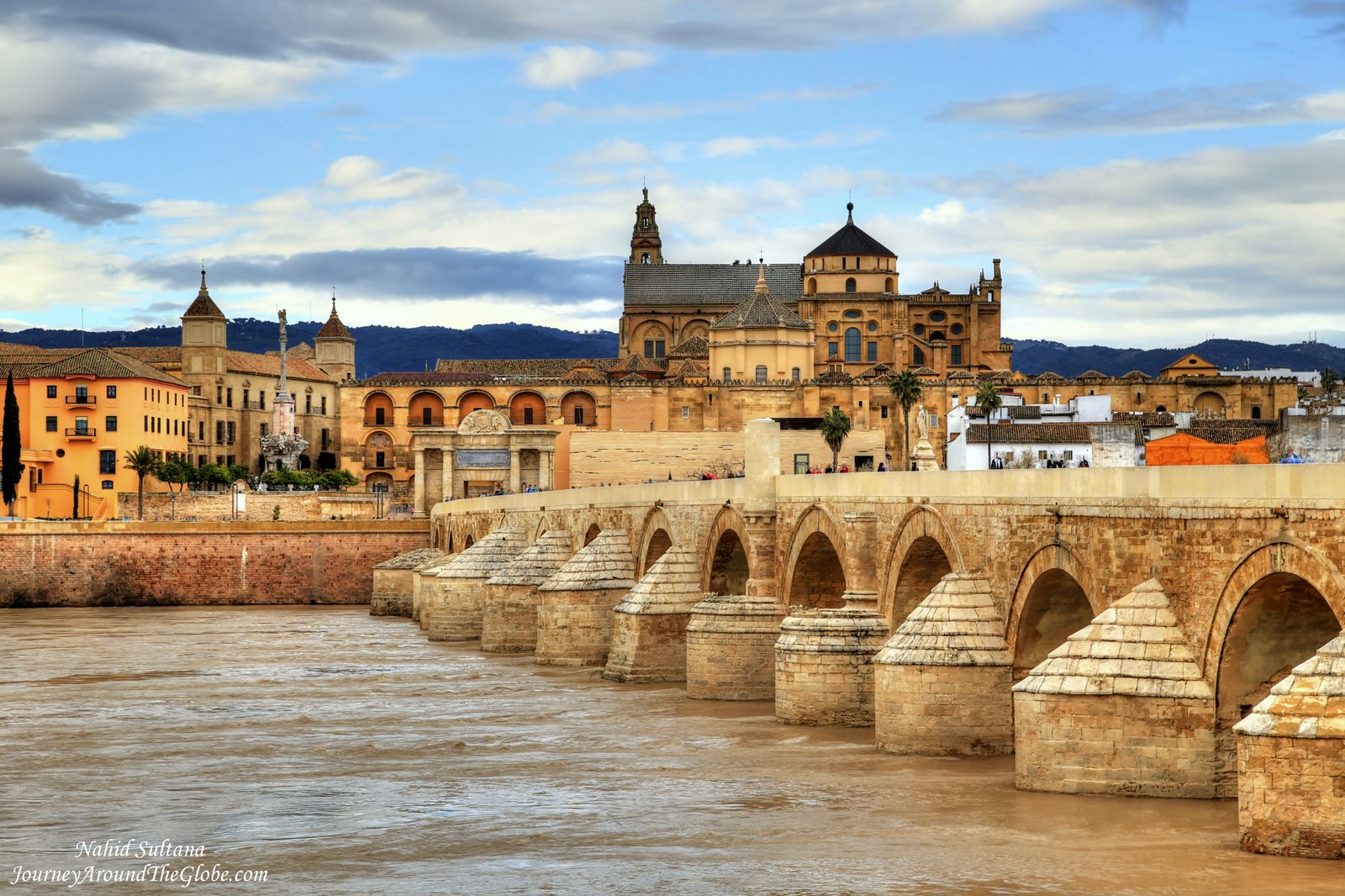
Cordoba was the capital of Al-Andalus during Muslim rulers, a territory that extended as far as the Duero River. A portion of Guadalquivir River runs thru the city and can be enjoyed within walking distance from the old town.
This is the city I loved the most in this great country of Spain. It has the appeal that I look for when visiting European cities which big cities like Barcelona or Madrid lack. Cordoba’s old town is beyond beautiful with Moorish influence and welcoming environment all over. If you can spare time, try visiting Granada or Seville for more Andalusian treats…each town is unique in its own way. Cordoba is a busy town with lots of tourists and locals, especially many school-going kids who come here in groups for field-trips. But this part of the city gets really quiet right after dark, if you are looking for some awesome night-life, may be you have to get out of this area and go to the newer neighborhoods.
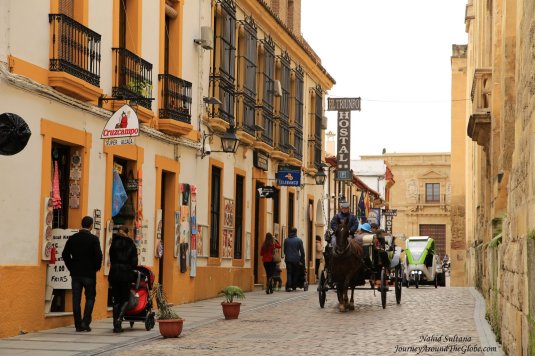
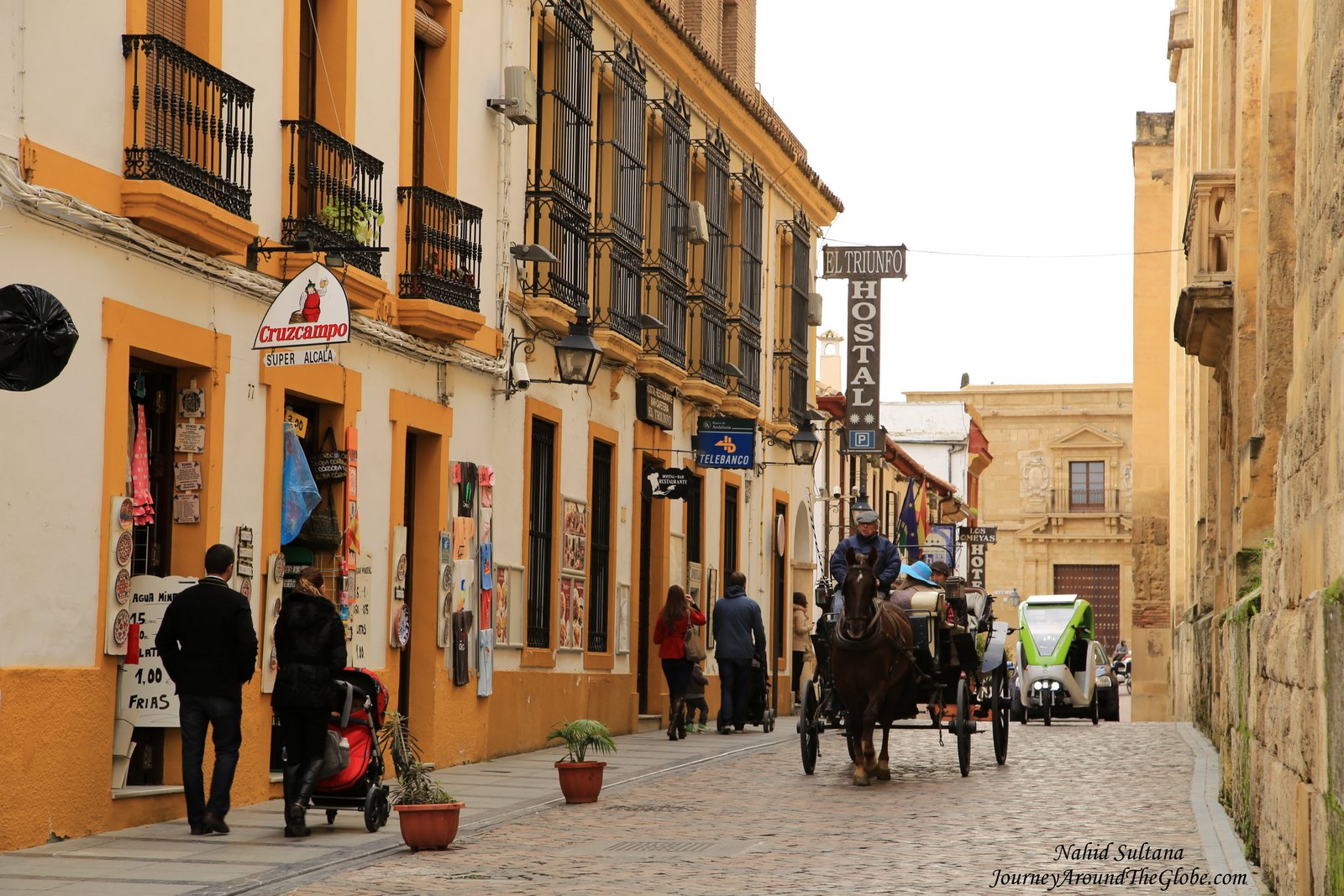
- Medieval old town of Cordoba in Spain
TIME of TRAVEL: We went back to Spain in February 2014 for the second time to check out Andalusia region of this country. We visited Malaga and Granada before coming to Cordoba. The drive was about 2 hours from Granada to Cordoba. By the way that drive was very scenic, you can see the mountains, lush green fields, and countless olive trees for miles after miles. Weather was excellent, not too cold not too hot. But my little daughter somehow caught ear infection in this journey and had to take her to the hospital nearby where we got free treatment and free medication…yes, Spain is a great country when it comes to health care too.
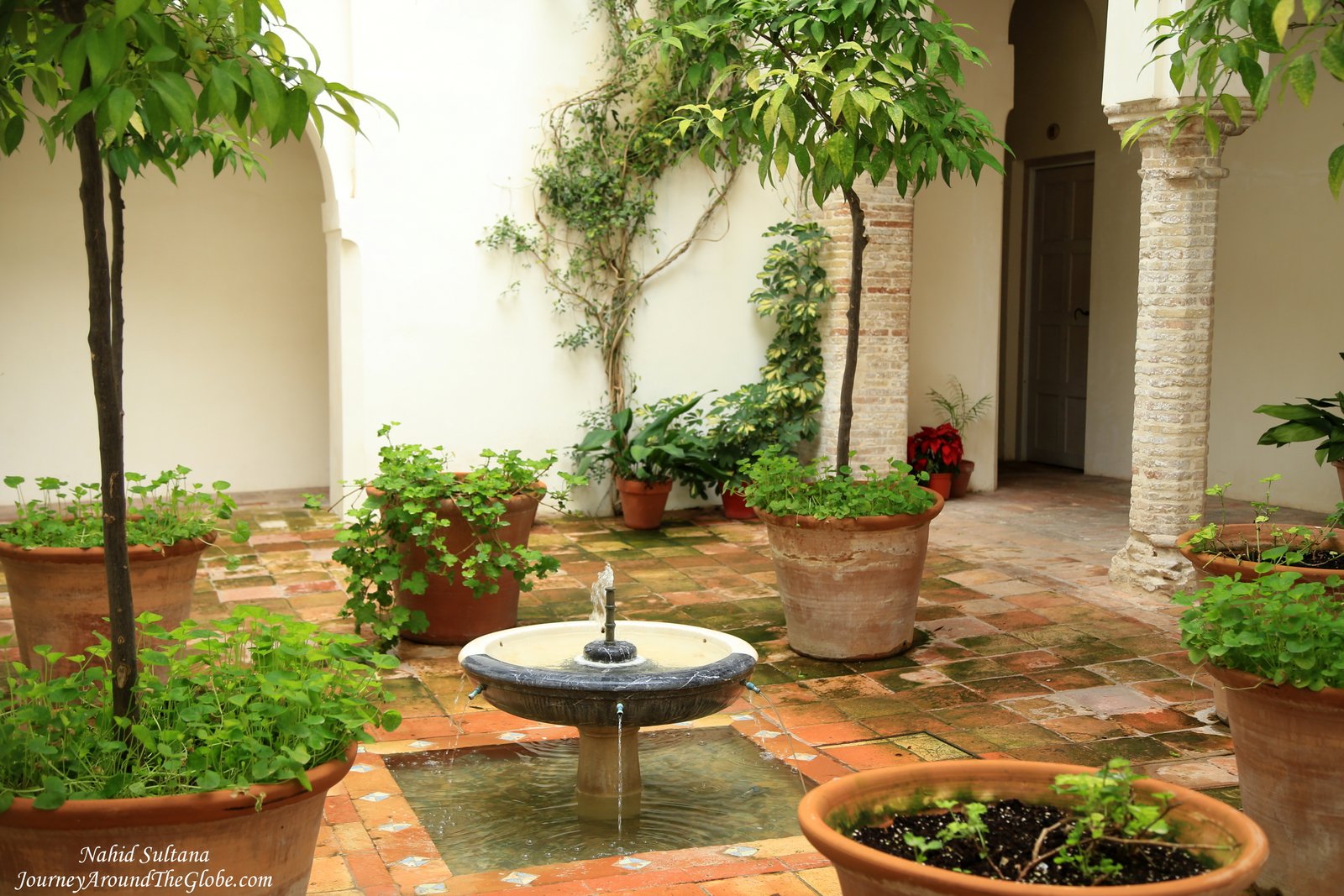
OUR HOTEL: We stayed in Las Casas de la Juderia in the Jewish quarter of old town. As usual, my husband’s choice was excellent for this place. This was the best hotel among all the places we stayed in Andalusia. It looked more like a “Riad” in Morocco with cute little courtyards and fountains in the front. Cordoba Mezquita and Roman Bridge were only 10 minutes of walk from the hotel. Breakfast wasn’t included here but had Wi-Fi in the room. We were also very surprised on our first evening here when they brought us some snacks (fruit kebabs on sticks and cakes) to our room…all free of charge, something we never experienced before. This was an excellent hotel and one of the best from all the hotels we ever stayed in so far.
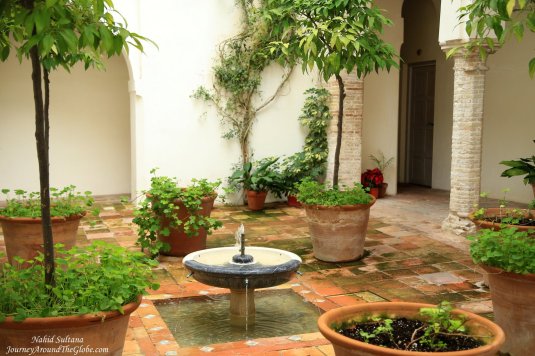
- A lovely courtyard of our hotel in Cordoba, Spain
EATING and SHOPPING: Our first lunch in Cordoba was in our hotel, Las Casas de la Juderia. It was by far one of the best places here to eat. Although not typical Spanish dish, we loved every single dish we ordered from fish soup to creamy rice with Cuttlefish, to can’t remember all the other dishes. Next lunch was at a Subway near the Mezquita and dinner was a quick Indian/Middle-Eastern restaurant in the old town. As I mentioned, the town gets really quiet around 8 or 9pm. Some of the restaurants close early but we were lucky to find that Indian restaurant at 10pm when most of the places were closed.
Cordoba’s old town is packed with many shops and boutiques. You will find generic souvenirs to elegant designer stores here. Some souvenirs to buy from here can be Spanish potteries, t-shirts with calligraphy, and Islamic arts. We bought two Flamenco dresses for our girls for about 10 euros each…they loved it for its vibrant colors and unique design.

- Flamenco dresses for Barbie in Cordoba, Spain – how cute is that?

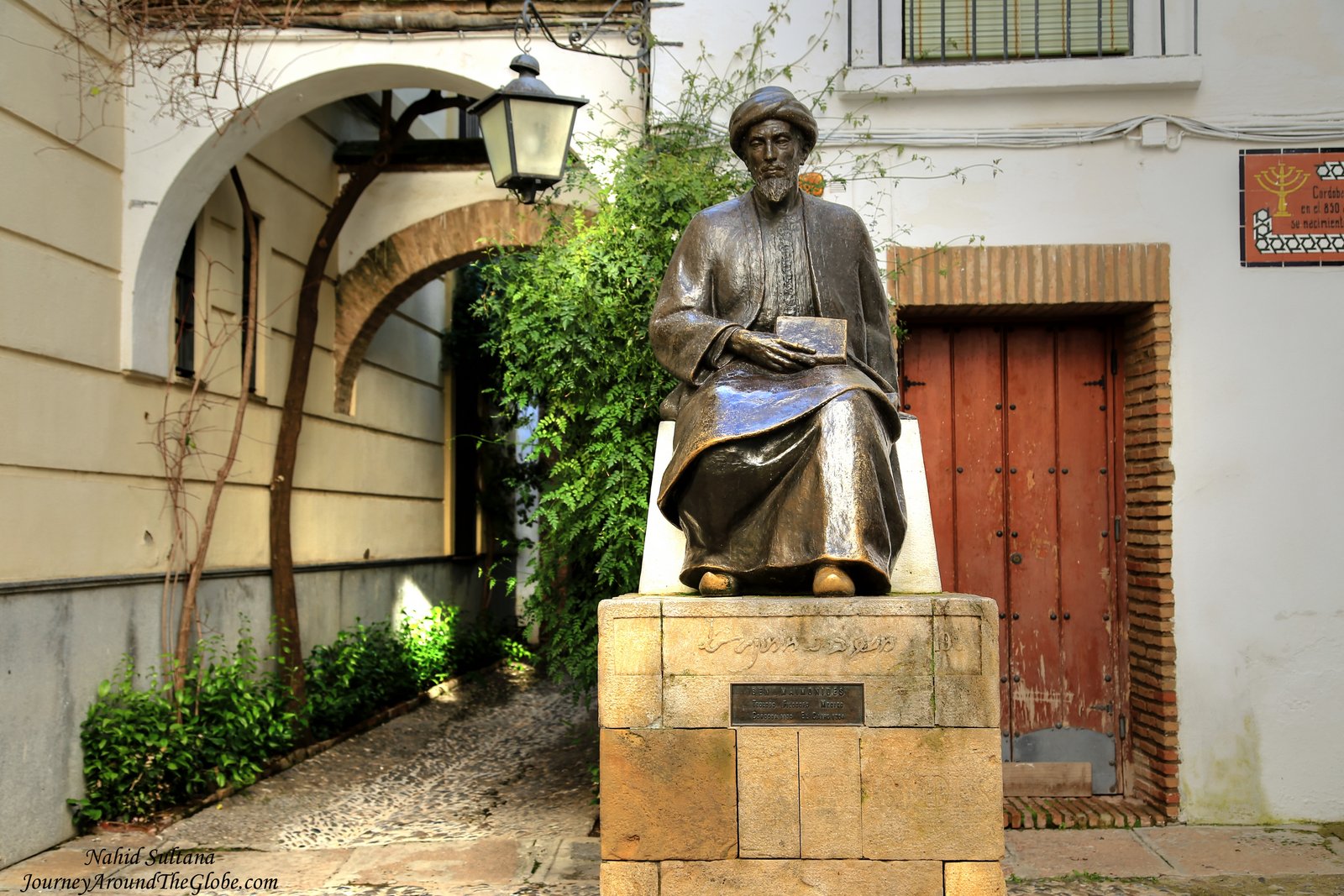
PLACES WE’VE VISITED: We had a day and half in Cordoba. Walking is the best way to get around. Old district of Cordoba is a beautiful place to roam around and get lost in small alleys. Most of the interesting places are located here and can be covered on foot. The Mosque Cathedral is the center point of this quarter and the old city surrounds this prominent establishment. We couldn’t visit the synagogue, it was very close to our hotel in the old town but when we walked there, it was already closed by then. The synagogue is from the early 14th century and one of only three remaining in Spain. May be another interesting place we could have visited was Museum of Al-Andalus Life. All of the following places we visited in Cordoba were in the old town. Best part of being here was that on the 2nd day, we walked some small alleys and different neighborhoods in the old district without a map. It was fantastic passing by beautiful shops, restaurants, and old buildings. You don’t see too many tourists here, may be some…but saw mostly locals. Here are all the places we could cover in a day and half.

- Looks like a statue of a Caliphate (?) in Jewish quarter of Cordoba, Spain
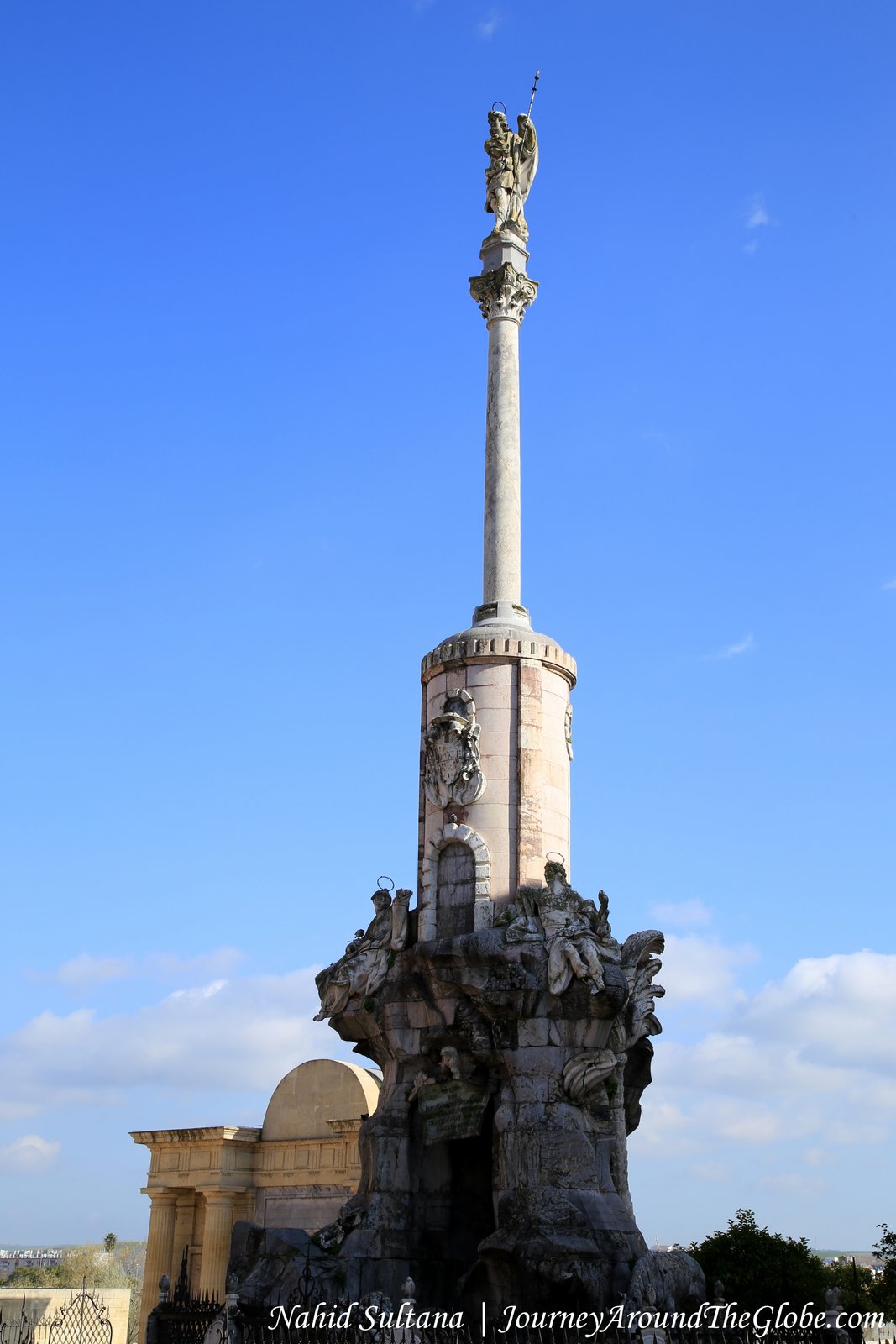
1) SAN RAFAEL’S TRIUMPH: After checking-in at our hotel and having a fantastic lunch, it was late afternoon by then. We started walking towards Mezquita, the center point of Cordoba. Passed Mezquita and walked a bit further to reach the Roman Bridge. San Rafael’s Triumph is a pretty nice and tall sculpture in a small square at one end of Roman Bridge (on the Mezquita side) in Plaza del Triumfo. Some old buildings and the cathedral surround the square. We eventually came back here again and sat down for an hour on the next day just enjoying the bridge, river, and people…loved it.
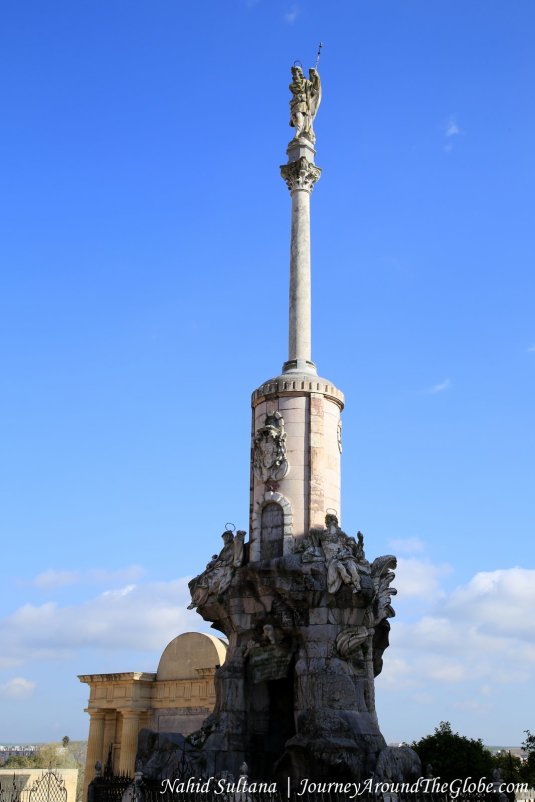
- San Rafael’s Triumph at one end of Roman Bridge in Cordoba, Spain
2) ROMAN BRIDGE (Puente Romano): This is one of the best spots of Cordoba to enjoy some nature. It is truly beautiful having shallow River Guadalquivir running underneath and looking at historic Mezquita. It is a pedestrian bridge from the Roman time in Cordoba, think from 1st or 2nd century. This has to be perfect place to take some sunrise/sunset photos.
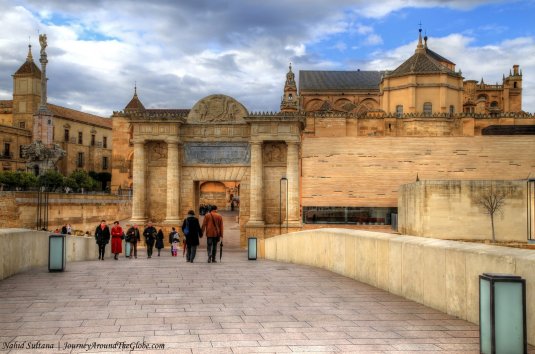
- Walking on the Roman Bridge of Cordoba, Spain and looking at Mezquita
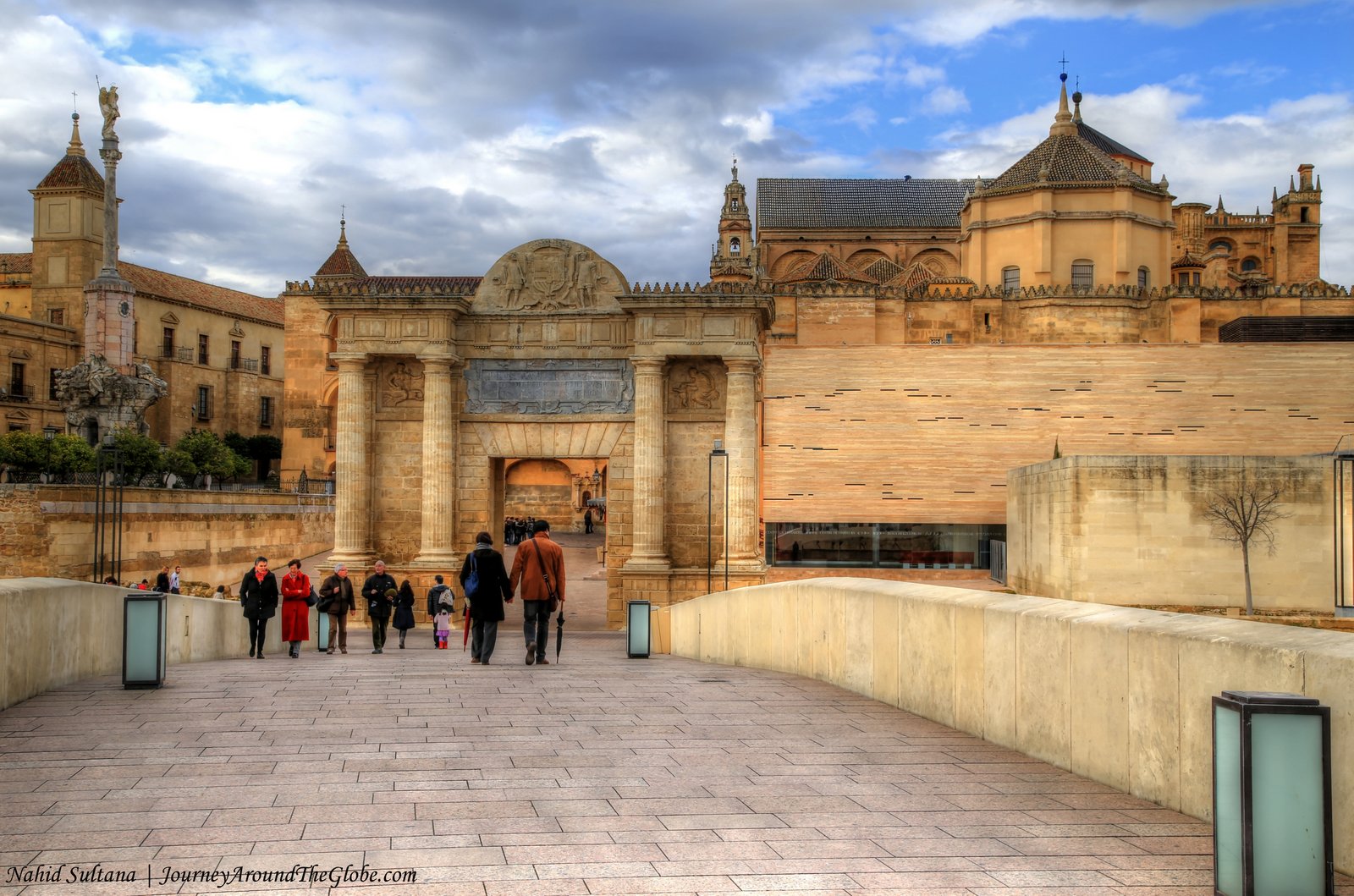
At one end, on the cathedral side, is the triumphal arch Bridge Gateway, located few steps away from San Rafael Triumph. From the bridge you can see the old Albolafia’s Waterwheel, looked like an old water pump or something. On the other side of the bridge is Calahora Tower which houses a museum. The snapshot is gorgeous from this side of the bridge. You can lay your eyes over the whole old town, can see the bridge and its arches, and the flowing river. It is a picturesque sight that shouldn’t be missed. We walked along the river (keeping it on the right side) and came back to city center via the next bridge, called San Rafael Bridge. It was a long walk, but was worth every step. We leisurely went back to our hotel stopping at some points to take in the beautiful atmosphere…enjoyed it much.
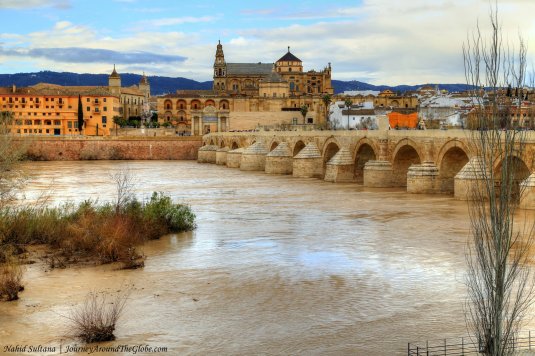
- Roman Bridge as we were walking along River Guadalquivir in Cordoba, Spain

3) FORTRESS of the KINGS (ALCAZAR de los REYES CRISTIANOS): Next morning, we started our day with a visit to Fortress of the Kings, which we could see from our hotel windows.
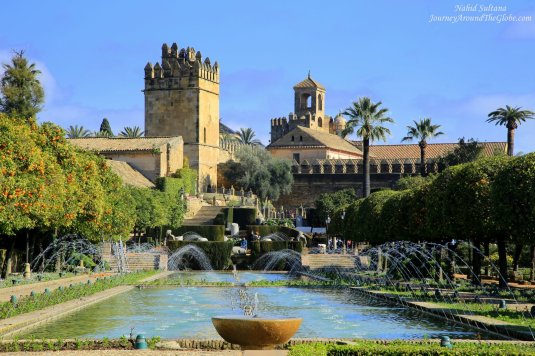
- Alcazar de los Reye Cristianos in Cordoba, Spain

Originally the fortress was built in the 8th century as a caliphate residence. Later it was used as residence and fortress of King Ferdinand and Queen Isabella. It was expanded by the order of King Alfonso XI in 1328 and was the residence of the Christian Kings when they stayed in Cordoba. The main façade of it is original along with couple towers. Some important undertakings have been planned inside this building such as the discovery of America or the reconquest of Granada. Interesting Gothic tower vaults, patios, and baths were built under the reign of King Alfonso XI. During the Modern Ages, it was the seat of the Inquisition. The Baroque chapel was built in the 17th century which was used as a prison building in the 19th century. In the 20th century when the chapel was bought by the Town Council, it then provided with gardens and decorated with Roman mosaics and other historical items.
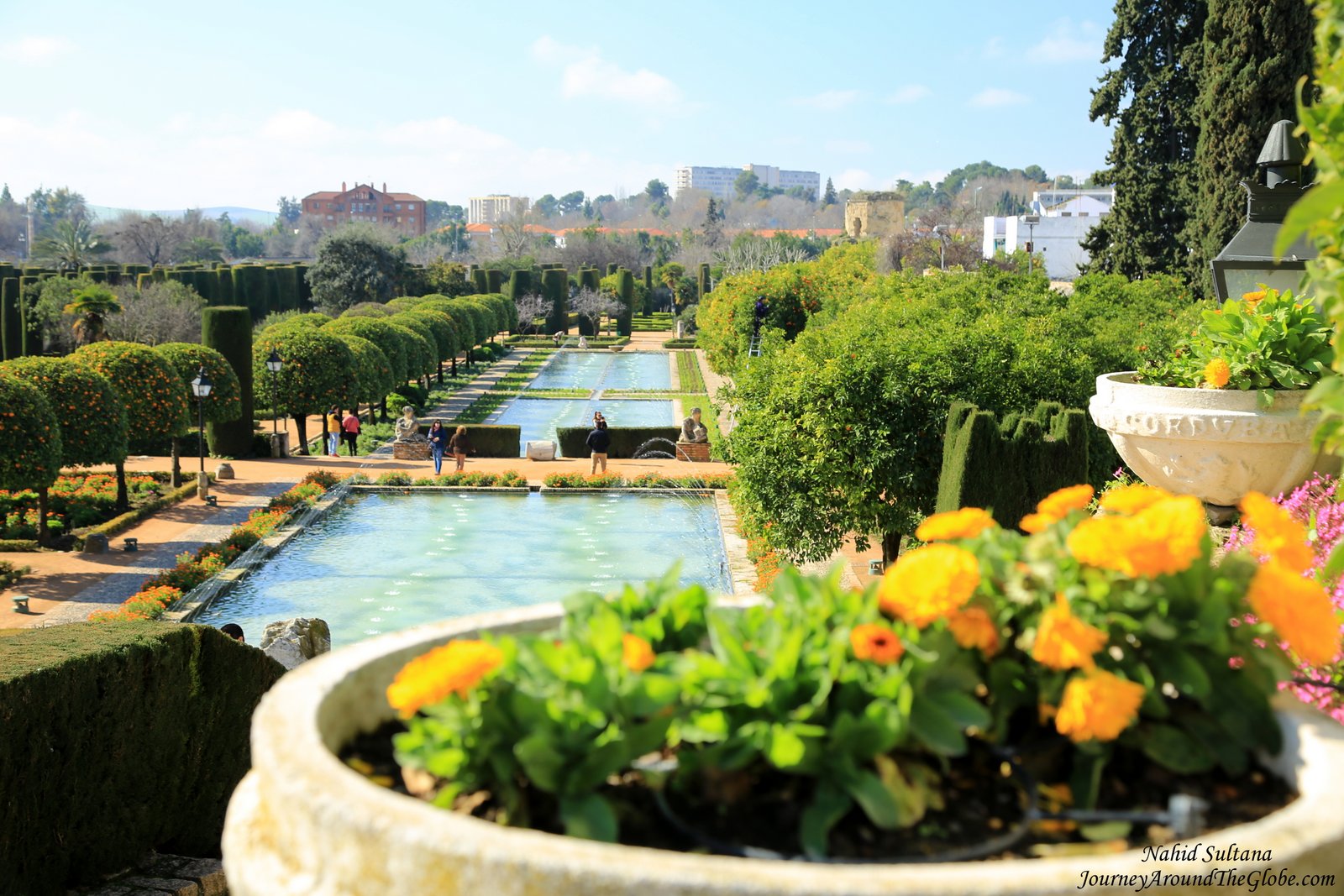
The main attraction of the Alcazar is the prettiest fountains and lush gardens with many orange trees all around. We spent more than an hour just in the garden walking and enjoying every corner of it. You can see the Moorish influence here too, especially with the fountains and little courtyards. The weather helped too, otherwise it wouldn’t have been fun walking outside.

- Gardens and fountains of Alcazar de los Reye Cristianos in Cordoba, Spain
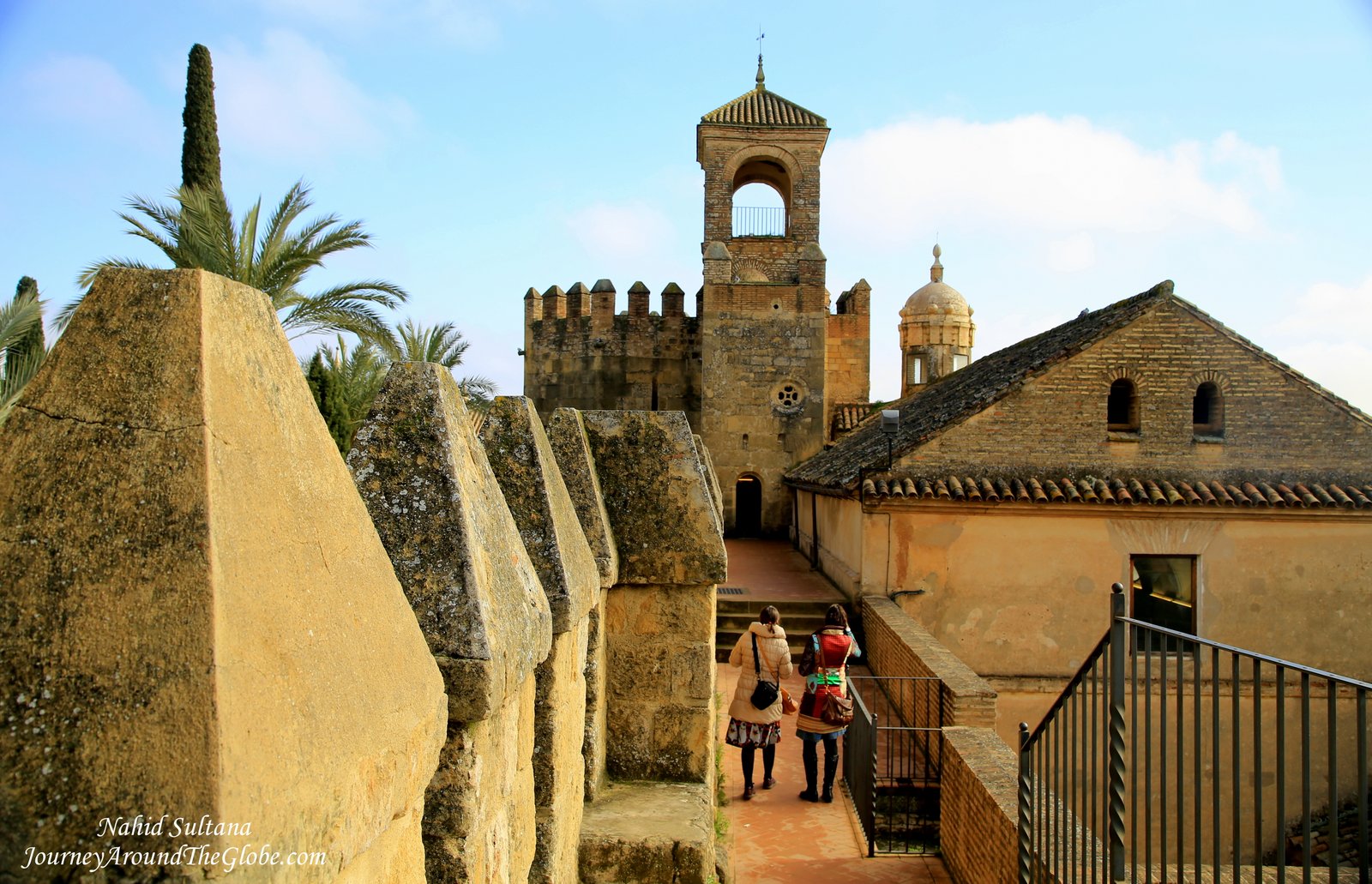
Make sure to climb the towers for a great views and walk along the old walls. There are some small museums and displays here and there where you can see Roman mosaics, sculptures, and some old findings from this place.
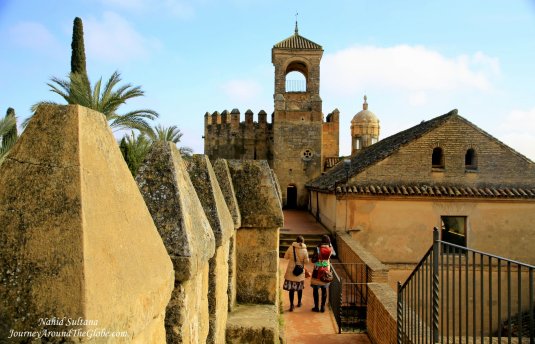
- From one of the towers of Alcazar de los Reye Cristianos in Cordoba, Spain
It is 4:50 euros per adult to enter the fortress. You need at least 2 hours to see it fully…don’t rush, otherwise you’ll regret later.
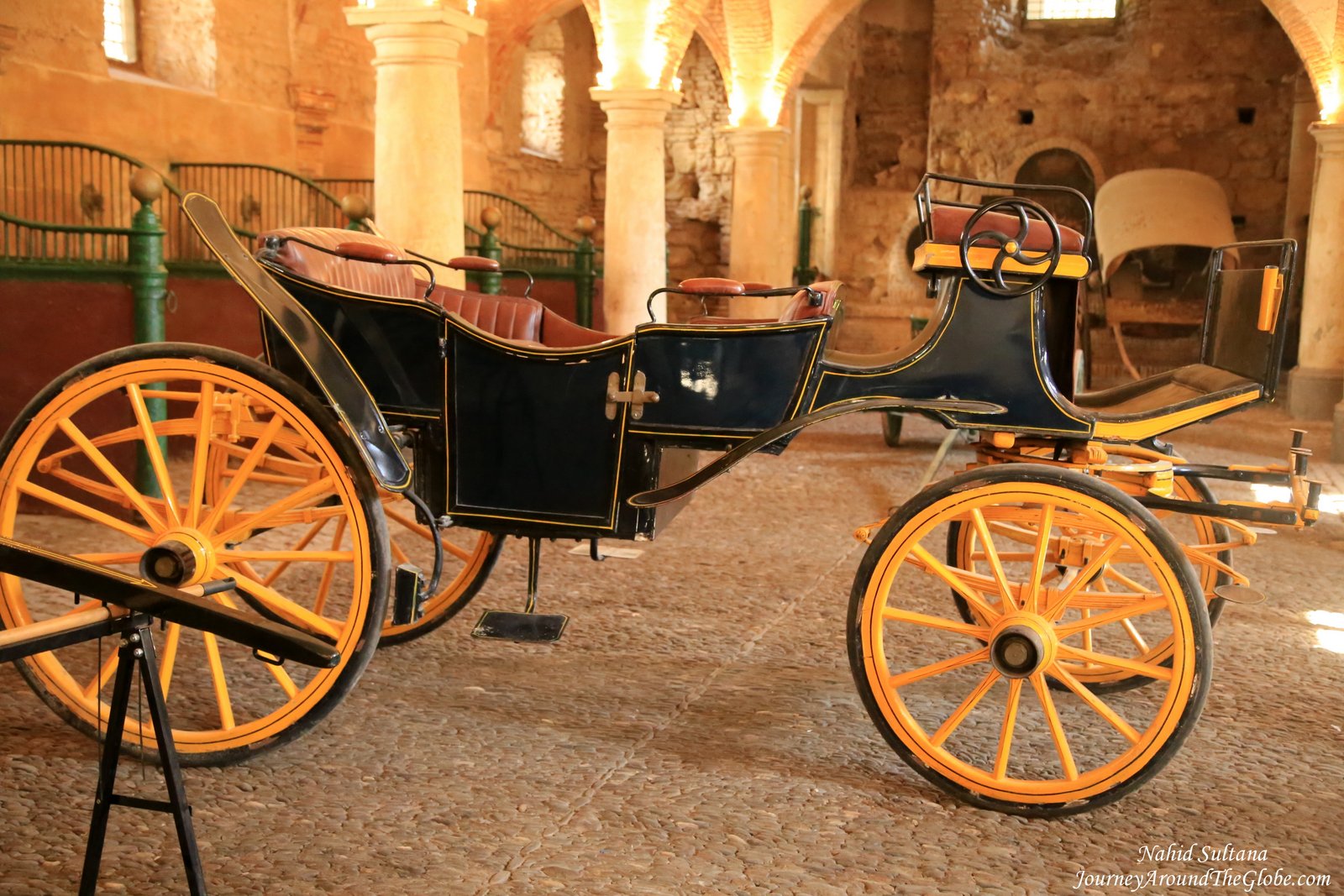
4) THE ROYAL STABLE and EQUASTRIAN/FLAMENCO SHOW: Royal Stable is the next building beside the Alcazar and that’s where we headed for our next stop. It is free to enter. You can see some pure breed of Spanish horses in the current stable. In the old stable many elegant and decorative carriages are in display that the royals once used many centuries ago.
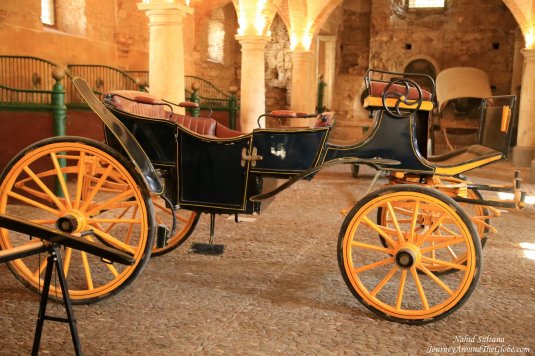
- An old carriage inside the Royal Stable of Cordoba, in Spain
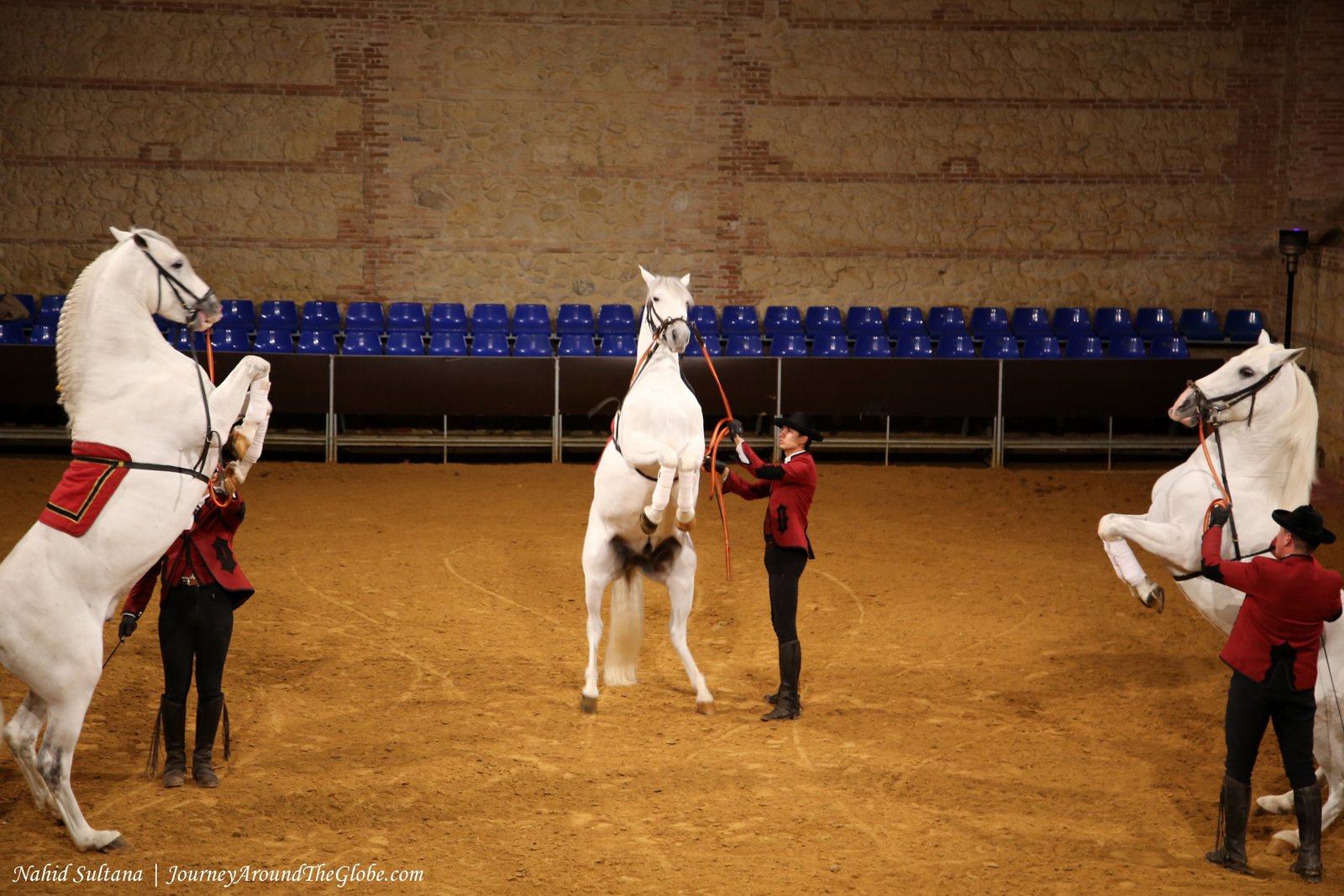
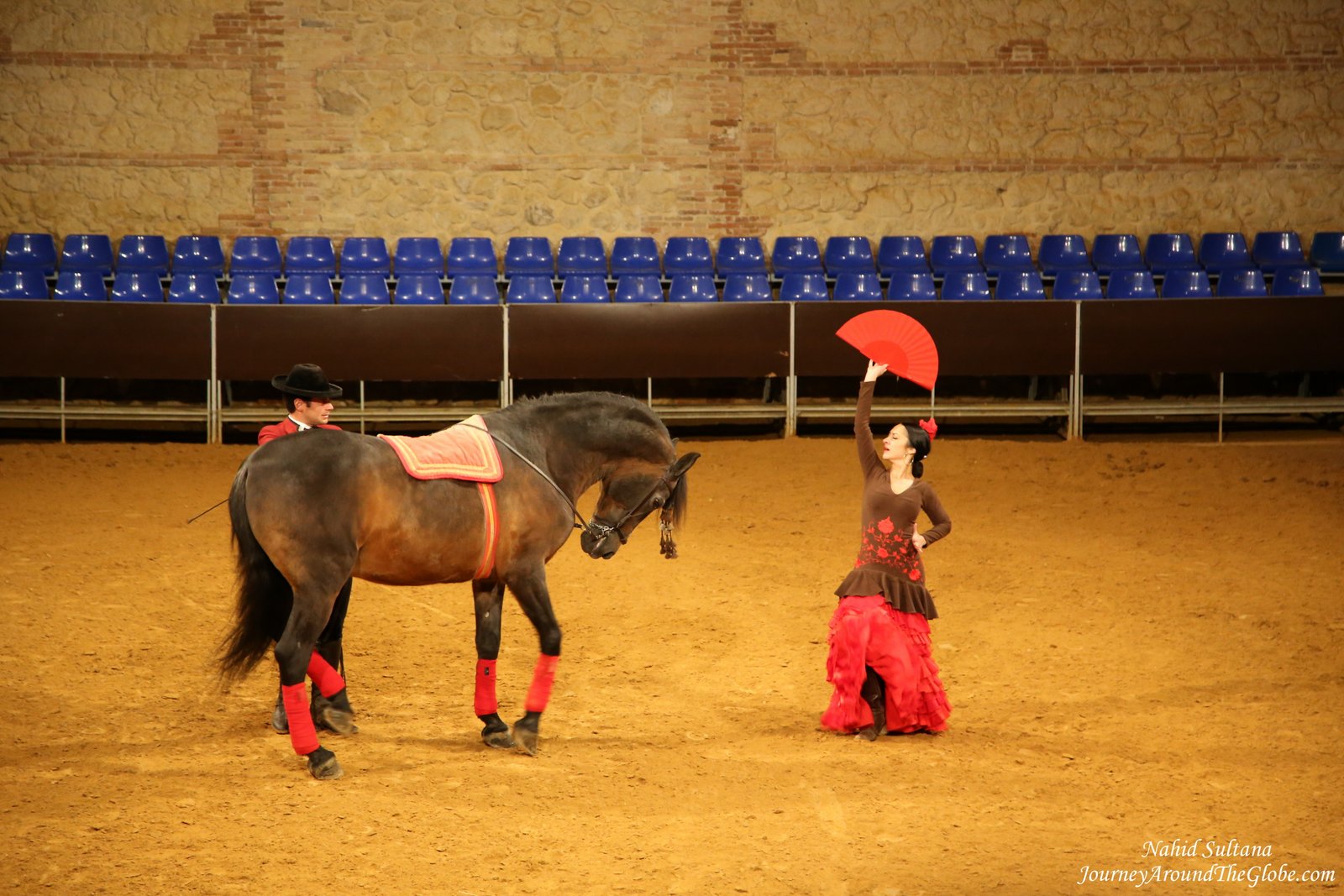
The Royal Stable also hosts daily Equestrian show with Flamenco performance. We were thinking of attending a Flamenco show but this sounded even better. We bought the ticket right away and came back at night for the show. Various types of tricks and plays by different horses are shown here. Two ladies performed Flamenco with the horses. Our daughters loved the show and were very excited about it. They had beautiful arrangements with lights and Flamenco music, a great experience for all of us.
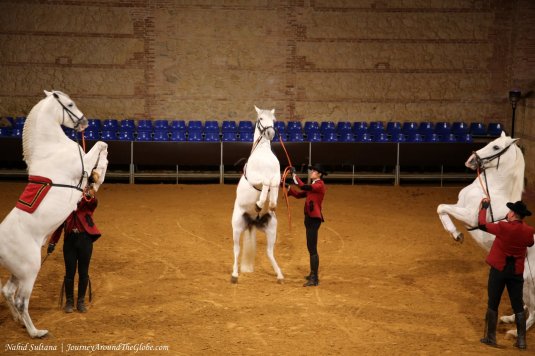
- Equestrian show on our 2nd night in Cordoba, Spain
It was 15 euros per adult and 10 euros for kids 3-12 years old. The show started at 8pm and was for an hour. It’s better to buy the tickets ahead of time, may be that morning…because it was quite packed in the auditorium.

- And some Flamenco performance
5) BATHS of CALIPHATE in ALCAZAR (Banos del Alcazar Califal): As we were walking towards the old town leaving Royal Stable behind, we saw the sign for Baths of Caliphate on our right…sounded interesting and off we went to explore.
Located opposite of Alcazar and the Royal Stable, these Arabic baths most likely belonged to the now disappeared Umayyad dynasty. The oldest elements and decorative designs are from the times of Caliphate of Cordoba in 10th century. It is inside Umayyad Alcazar, the residence of Amirs and Caliphs and the seat of governors until the conquest of Cordoba by the Catholic monarchs. These baths were discovered in 1903 and finally in 2002, after a long restoration period, the modern building was designed where they are now housed. These consist of several rooms with stone walls. Four of them have vaults with star-shaped skylights supported by horseshoe arches on marble columns.
The baths of the Caliphate Alcazar are a good illustration of the immense archeological heritage dating back to the Umayyad period. It’s a fine example of palace architecture in the service of the Amirs and Caliphs and a model that was to be followed in Spanish-Muslim art for centuries to come. The Andalusian baths, the descendants of the thermal baths of classical times, were for the purification of the body as well as for hygiene and cosmetic treatment. They were also a place for enjoyment and social relations. There were royal, public, and private baths. Royal baths received more attention on the decoration which could be architectural or using luxurious materials. And public baths were designed to cater for more users. These royal baths were to serve the Caliph, who could use them for himself, his family or as a political meeting place. In the baths, there took place a whole ritual for the cosmetic, physical, and therapeutic care of the Caliphs.
In these baths, tourists can see the changing rooms, cold rooms, warm rooms, and hot rooms. The heart of the baths was in the service area, with the furnace and boiler. Here, the heat, water, and steam supply to the inside of the baths were maintained.

- Where the furnace used to be inside the Baths of Caliphates in Cordoba, Spain

Couple tragic historic events took place in one of the baths here in the early 11th century. The Caliph of Moroccan origin, Ali Ibn Hammud, was slayed by three of his slaves in one of the halls here. Another event, took place few year later, was the capture and execution of the Umayyad Caliph Abd al-Rahman V by the people of Córdoba, in the same hall.
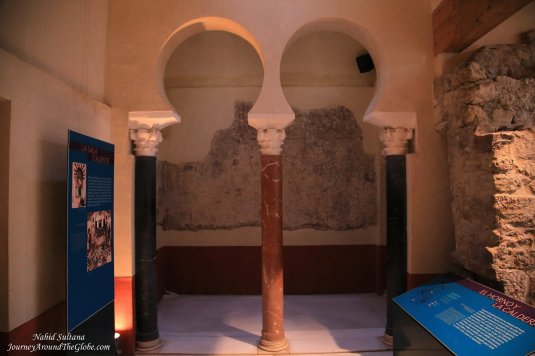
- Some tragic events took place at this very hall during Umayyad dynasty in Cordoba, Spain
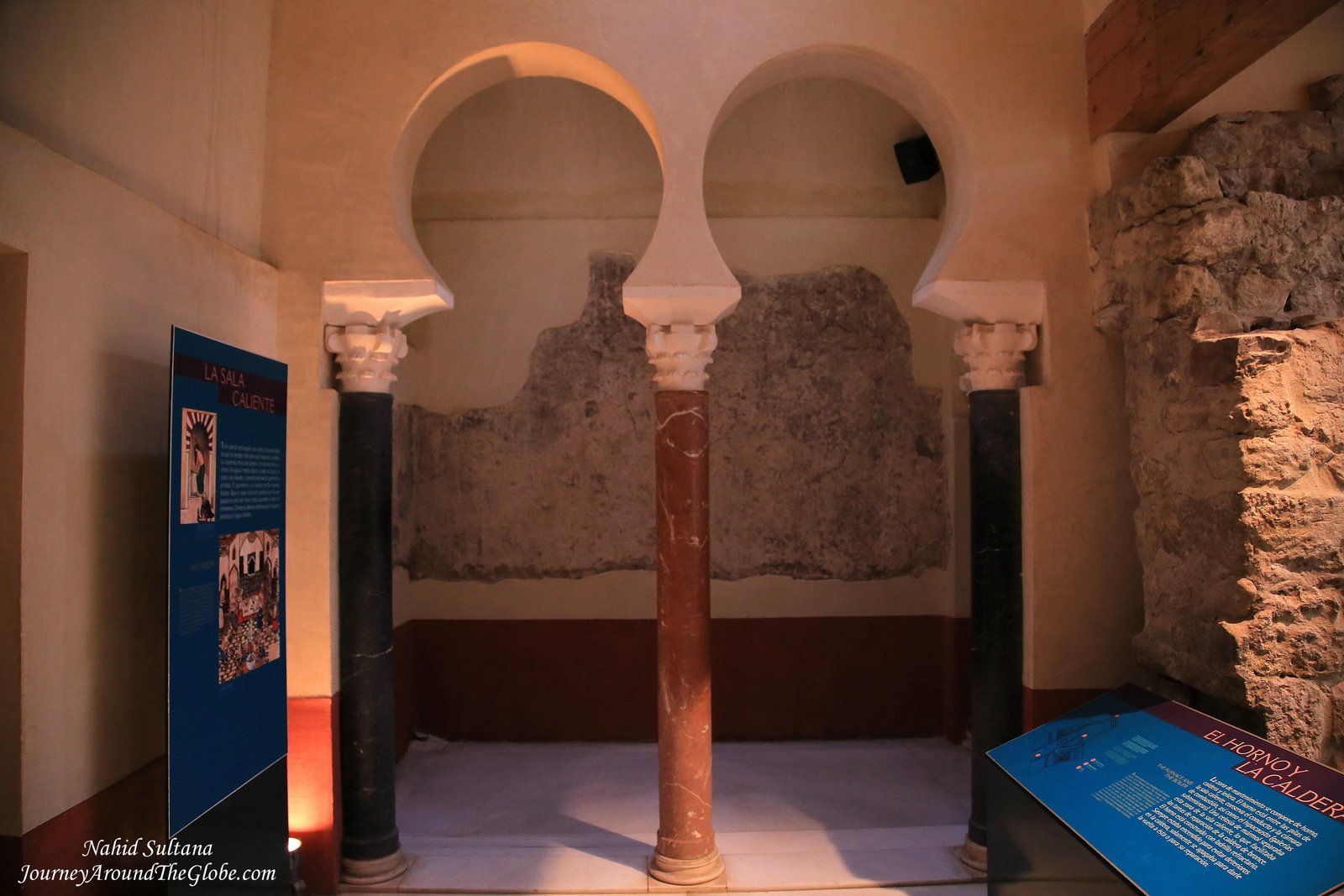
Although in ruins now, visitors can see the original furnace, hot rooms, cold rooms, original walls from the 10th century, a small museum displaying findings from this site, and few rooms from the 12th and 13th century.
Ticket is 2:50 euros per adult, kids are free. Don’t miss the videos that give brief history on this historical site.
6) OLD CITY WALL and PUERTA de ALMODOVAR: Almodovar Gate was one of the original gates to enter the old town. After our visit to the baths, we started walking along the old city wall and came in front of this old gate of Almodovar. You enter the historic city center upon entering this gate. Cordoba has one of the most beautiful and well-preserved old parts in Spain. We started walking on the cobble-stoned alleys towards the cathedral without any map. Getting lost is half the fun, you get to see old houses, narrow alleys, beautiful stores, and cafes.

- Old city wall and Almodovar Gate in the old town of Cordoba, Spain

7) CORDOBA CATHEDRAL or MEZQUITA: Also known as the Mosque Cathedral, it is the biggest attraction of Cordoba and a massive building that deserves major attention. It is the live witness of Cordoba’s past days. It was included in the UNESCO World Heritage list in 1984. This building has been a hallowed ground throughout the history of the city.
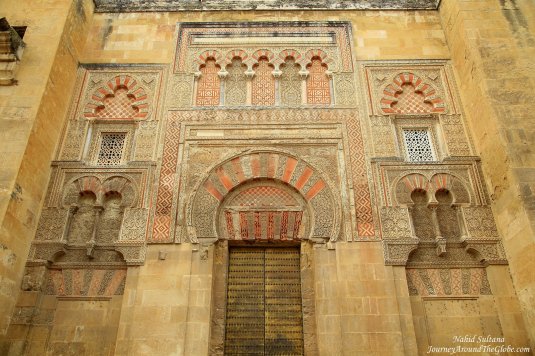
- An old gate and exterior wall of Mezquita in Cordoba, Spain
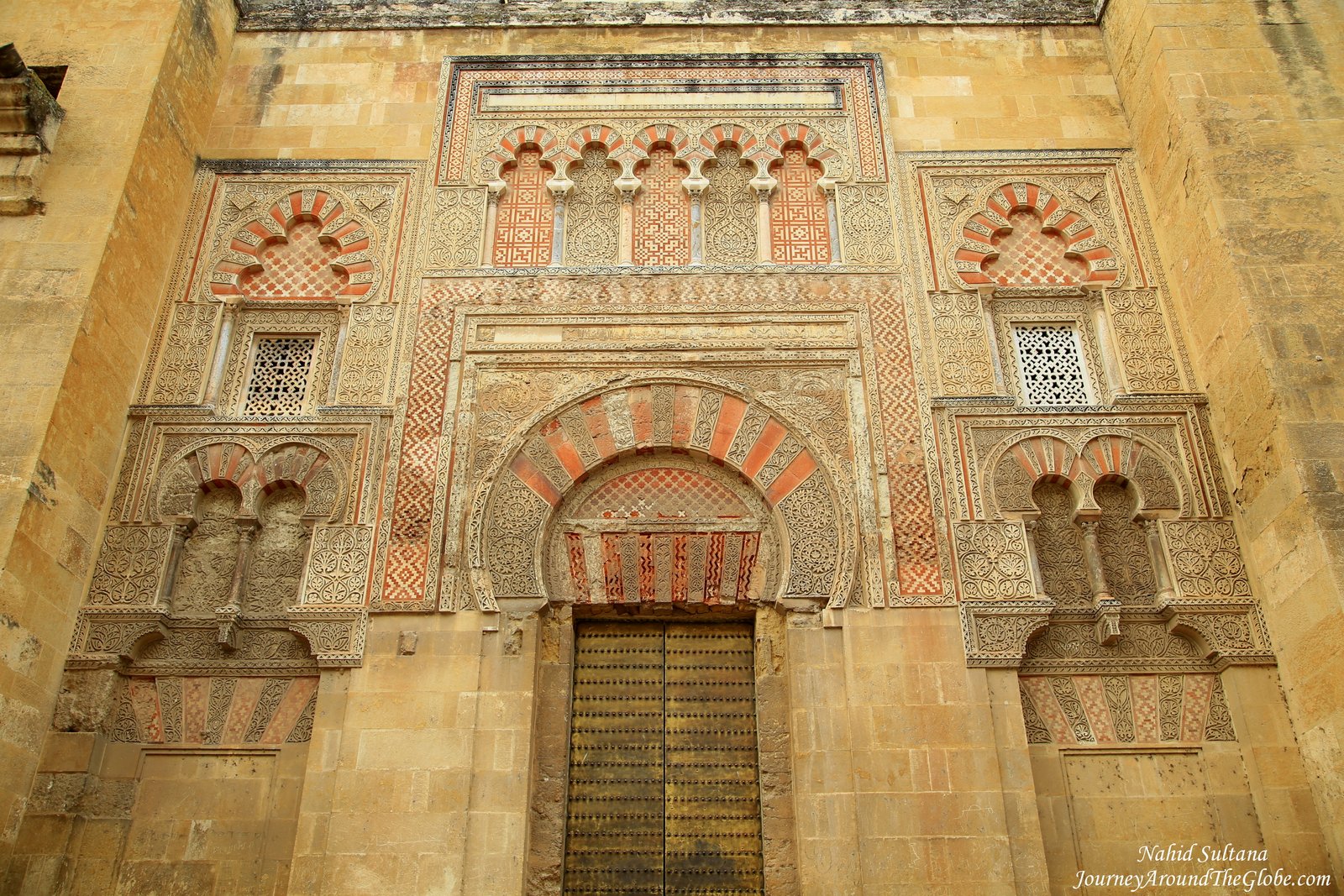
Historically, Basilica of St. Vincent stood in this very spot around early 4th century AD (Visigoth Period). The floor plan with its heavy columns and the Greco-Roman order of the whole monument date from the Hellenistic tradition of the Mediterranean world. When Andalusia came under Muslim rules, Amir Abd Al-Rahman I built the primitive mosque in 786 AD that would come to be considered the most important sanctuary of Islam in the Western world. This impressive creation was the site of not only religious but also social, cultural, and political manifestations. Later the mosque was successively extended and adorned by Muslim governors over the few centuries until 976 AD. When the city was reconquered by Christians in 1236, it was converted to the Cathedral of the Blessed Mary. In 1523, they tried to change the interior design of this place giving an ingenious integration of the Moorish structures with the Gothic, Renaissance and Baroque creation. But despite being a cathedral now, most of the original mosque structure remained remarkably well-preserved.
The highlight of this place is its countless columns that cover the whole interior with signature red and white striped arches designed in Islamic style. These columns are standing for centuries rows after rows almost as far as you can see.

- Red and white stripped arches of Mezquita – an original Moorish design from the 8th century

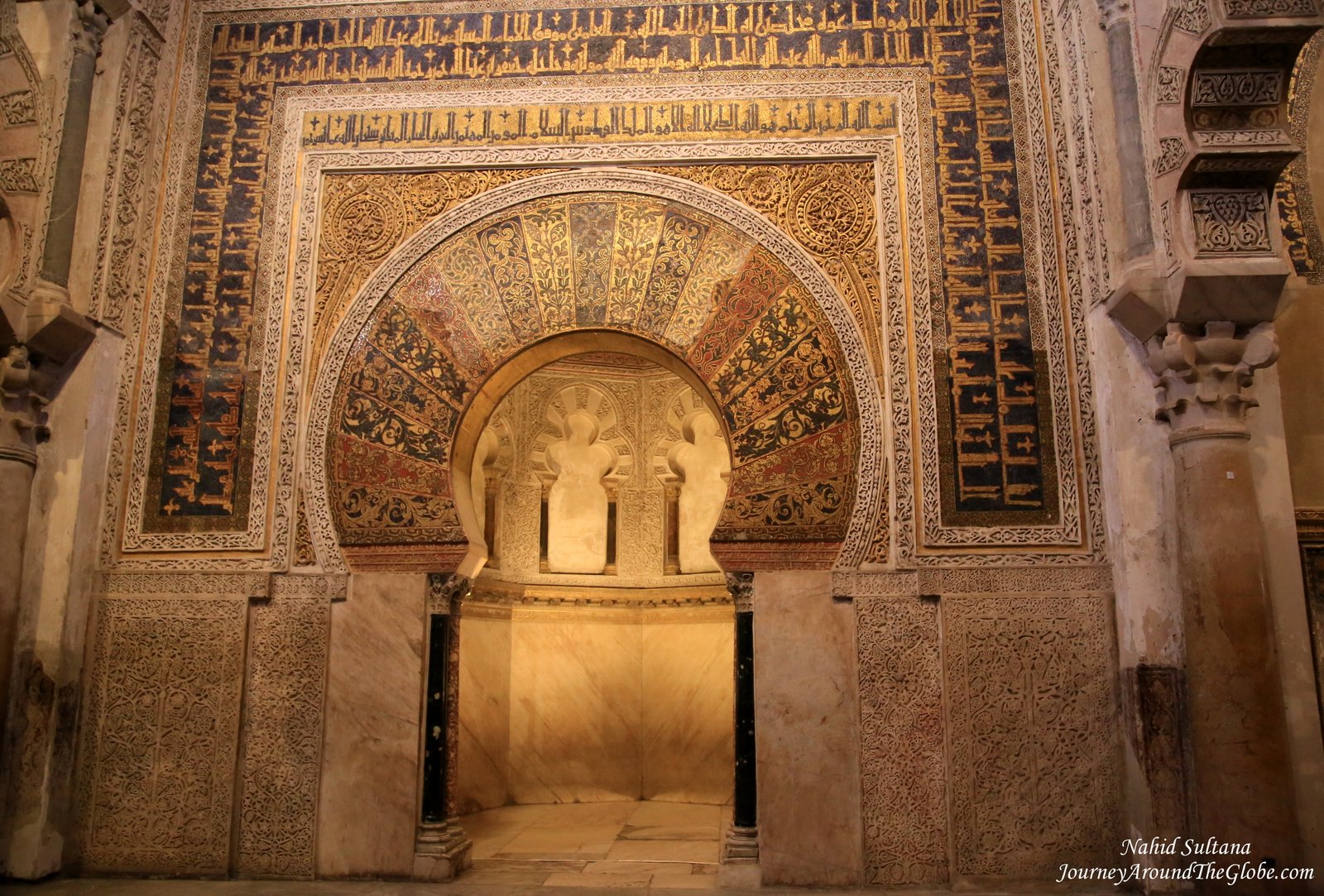
The original “Mihrab” of the mosque is intact ‘til today with its beautiful mosaics and the well-preserved vaulted skylights. It was the focus of the mosque which faces the direction of “Ka’ba” in Mecca and at which every Muslim face at the time of prayers.

- The original Mihrab of Mosque Cathedral in Cordoba, Spain
The main chapel and choir are from the early 17th century. The Royal Chapel hold the remains of King Ferdinand IV and Alfonso XI. The main altar in the middle of this building is an extremely gorgeous focus point.

- Gorgeous main altar of Mosque Cathedral in Cordoba, Spain

Minaret in the courtyard that is now embedded in the tower of the cathedral, dates back to the reign of Abd-Ar-Rahman III. Looking over the old town, the top of belfry (from the 16th century) is presently crowned by a sculpture of San Rafael, the archangel guardian of the city. Below the tower is Puerta del Perdon (Door of Forgiveness), the main entrance to the precincts. The Muslim courtyard was remodeled with the construction of the cloisters. In the 15th century, palm trees were replaced with orange trees and gave its name as “The Orange Tree Courtyard” or “Patio de los Naranjos”. A grove of orange trees are planted in nicely organized rows in this courtyard. This part of the complex is free to enter and anyone can enjoy it without going inside the cathedral.
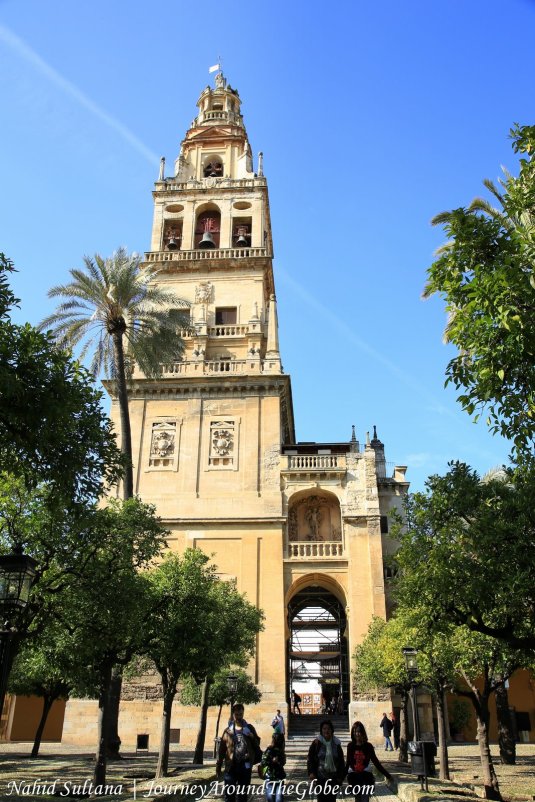
- Bell Tower of Mosque Cathedral or Mezquita in Cordoba, Spain

The cathedral’s mission was not the destroy the magnificent interior of the previous mosque, rather it ensured that the cathedral, old Western Caliphate Mosque, and World Heritage Site are not in a pile of ruins. The authorities tried to safeguard and inspire culture and art. That’s why you can still see lots of Islamic calligraphy and artworks inside the cathedral. This is one of the most magnificent religious building I’ve seen so far.
Entrance fee is 8 euros per adult and kids are free.
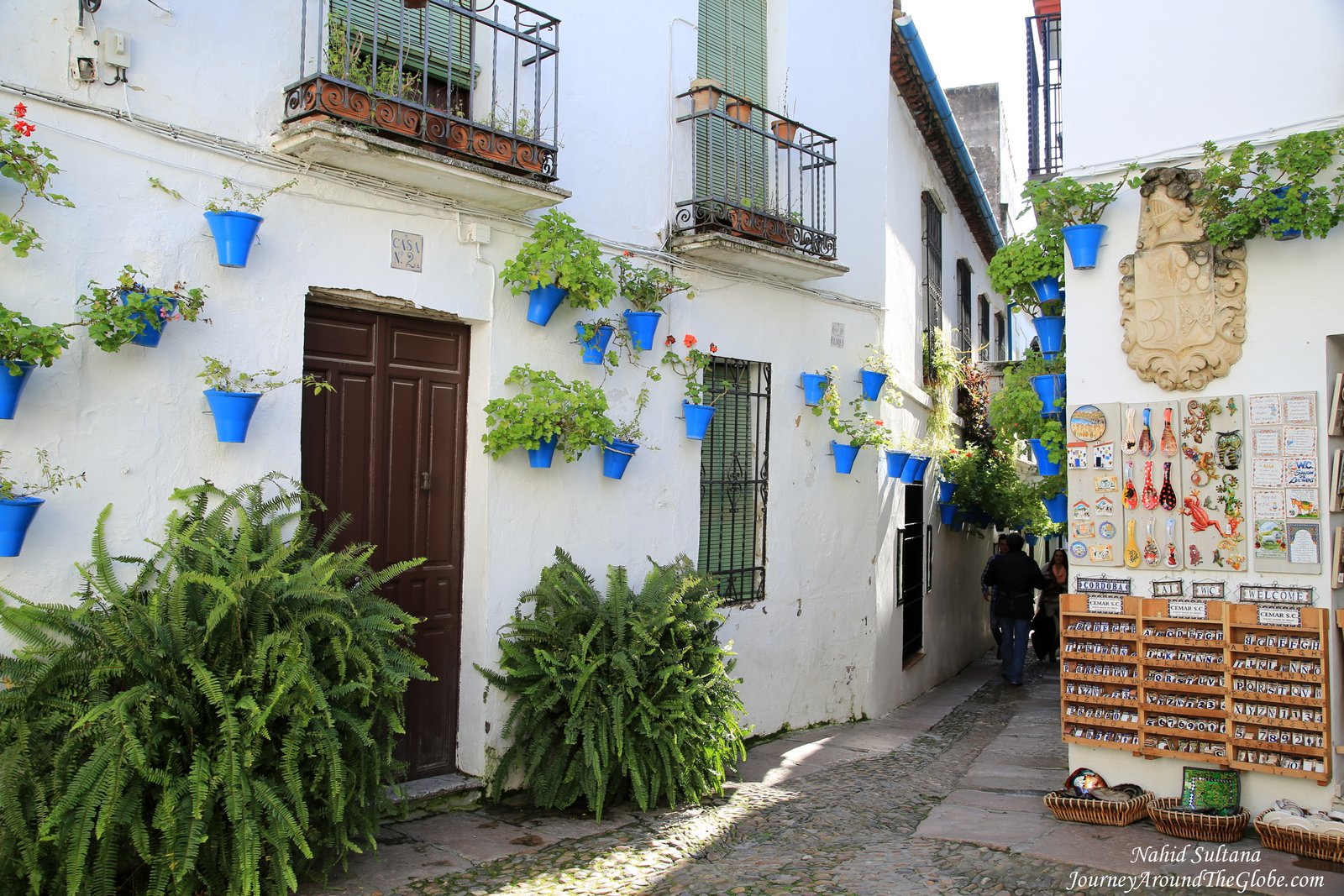
8) FLOWER STREET (Calleja de las Flores): The last thing on our itinerary was this cute little street. The name tells your how beautiful this street can be. It’s a cozy passageway in the old town decorated with fresh flowers in colorful pots hanging from both sides of the wall. At the end there is a tiny square/courtyard from where you can see the bell tower of the cathedral. There were few shops selling souvenirs and local trinkets. We were there in February, think in summer this street looks even prettier with more fresh blooms.

- Flower Street or Calleja de las Flores in Cordoba, Spain
Share this:

Grand Granada (Spain)
GRANADA, SPAIN: Located in Andalusia region of Spain, Granada is one of the most touristic places in Spain for its rich diverse history and culture. In 711 AD, after the city was conquered by the Moorish rulers, it became the center of Al-Andalus. Influenced by Moorish culture, Granada is the depository of one of the finest collections of Islamic art anywhere in the world.

- Stunning view of Granada and Sierra Nevada Mountains from Alhambra
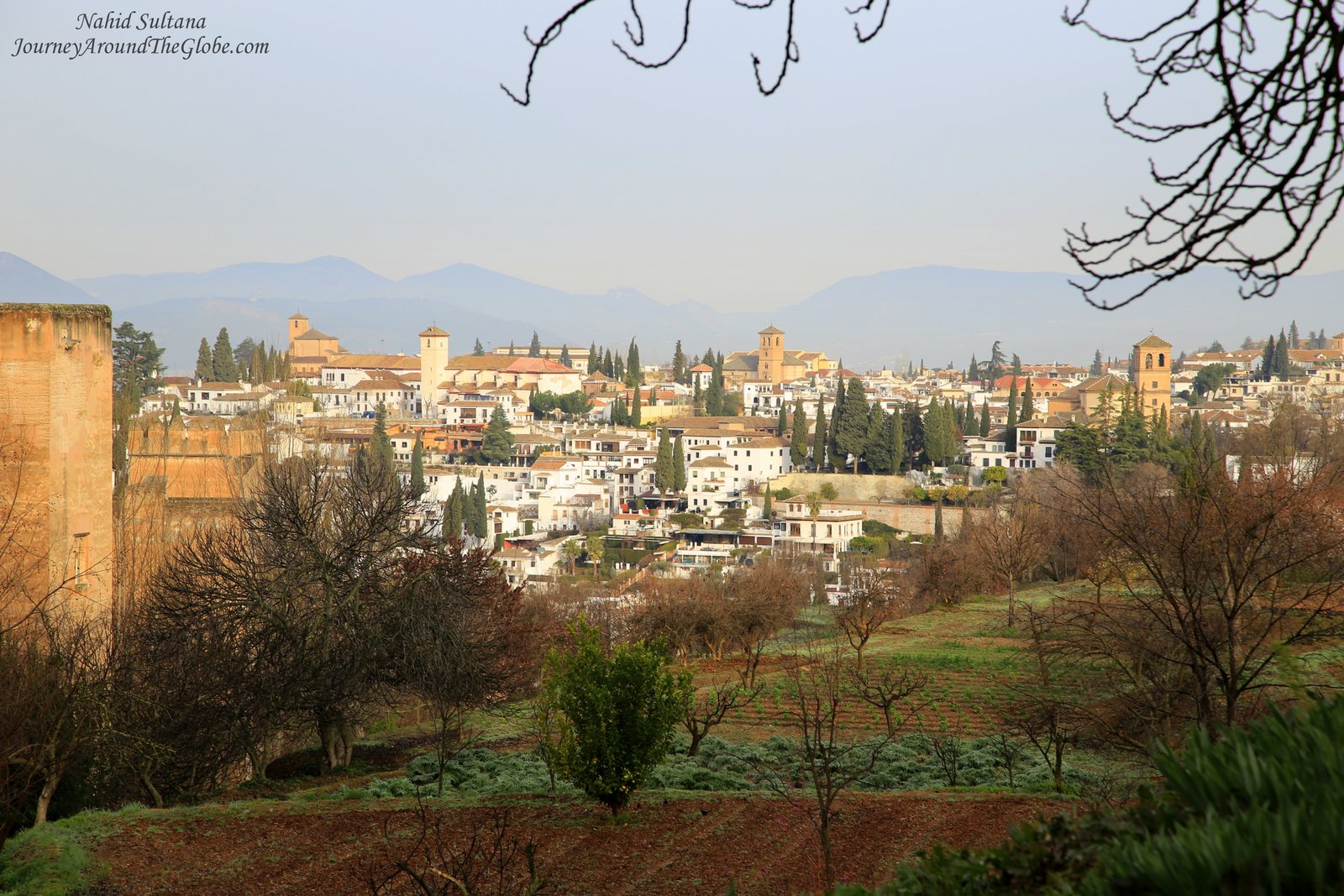
Being surrounded by Sierra Nevada, there are many sports activities that anyone can do to get out of the city life. Also, if you are in Granada, don’t miss the chance to go to Cordoba or Seville to enjoy more Andalusian cities…you won’t regret it at all.
We stayed mostly in central Granada which is the historic center and the liveliest part of this city. Granada, home of world-famous Alhambra, the most iconic monument of the city and one of the most historic places that leaves you overwhelmed in awe in whole of Spain. Honestly, the city itself didn’t impress me much like the other Andalusian cities we’ve visited in this trip, such as Malaga, Cordoba, or Seville. But Alhambra alone makes it worthwhile visiting Granada.
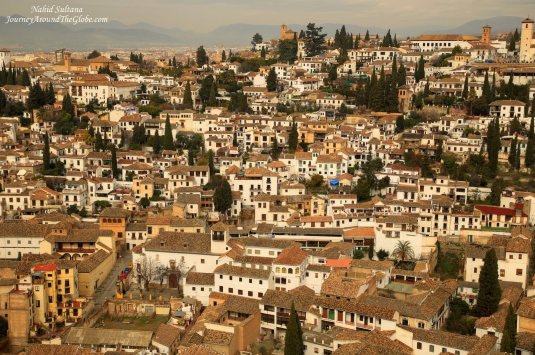
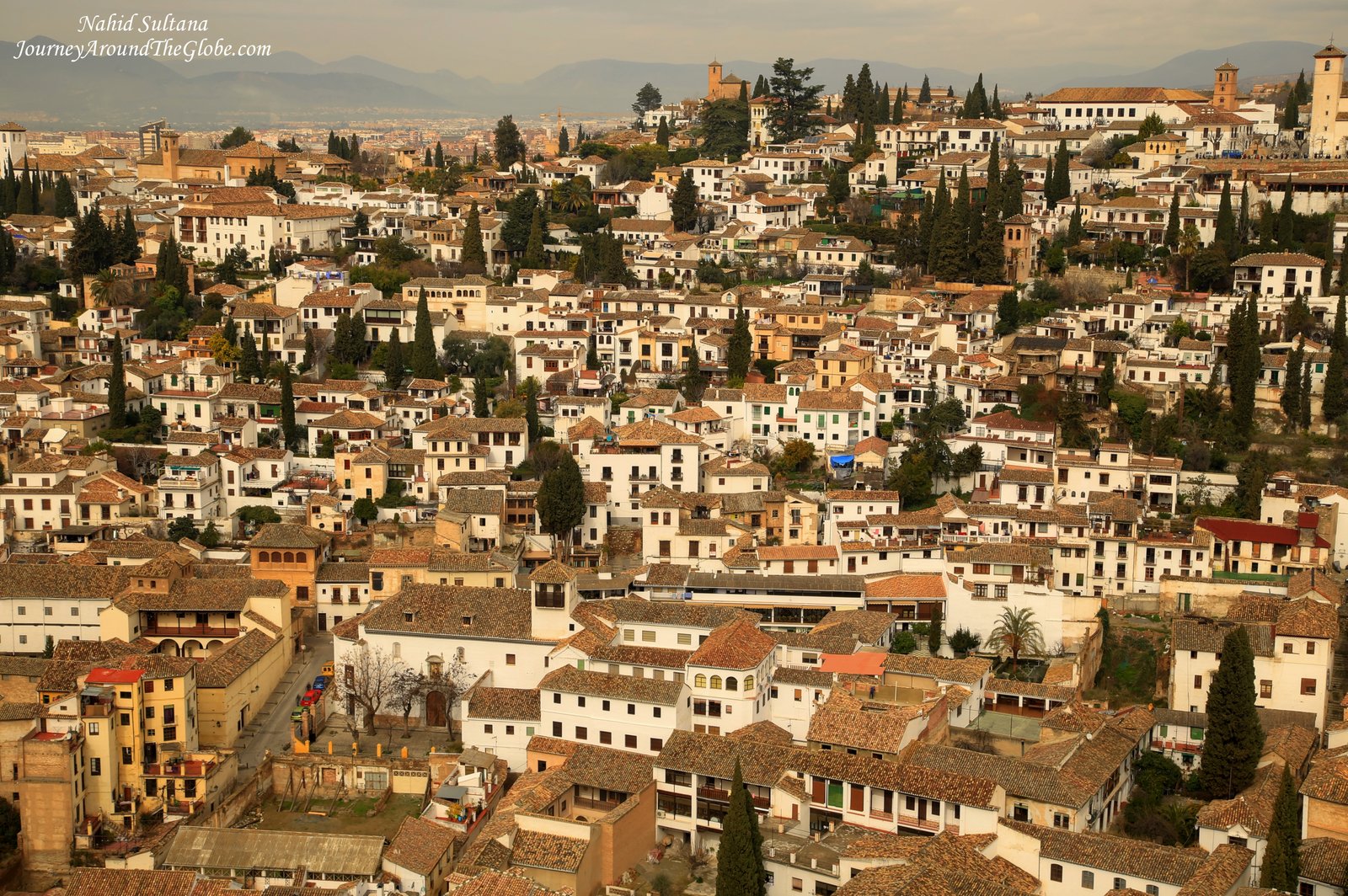
- Another stunning view of the whole city of Granada in Spain from Alhambra
TIME of TRAVEL: We were on the journey to explore Andalusia, Spain in February of 2014. We flew to Malaga from Belgium and stayed there for 2 days before coming to Granada. We had a rental car and it took us about hour and a half to reach Granada from Malaga. The weather here was nothing like Malaga. It was little more than just cold, especially the day we visited Alhambra; it was pretty chilly outside early in the morning. We were looking forward to some sunshine but got nothing but two gloomy days with some wind.
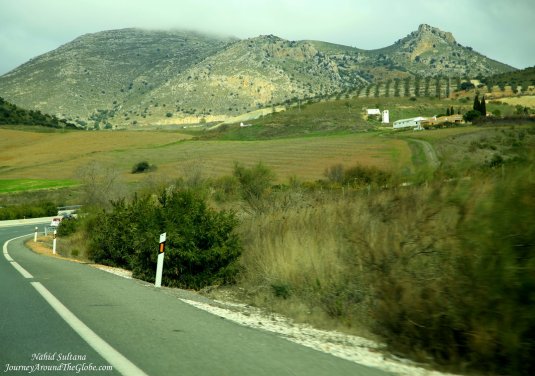
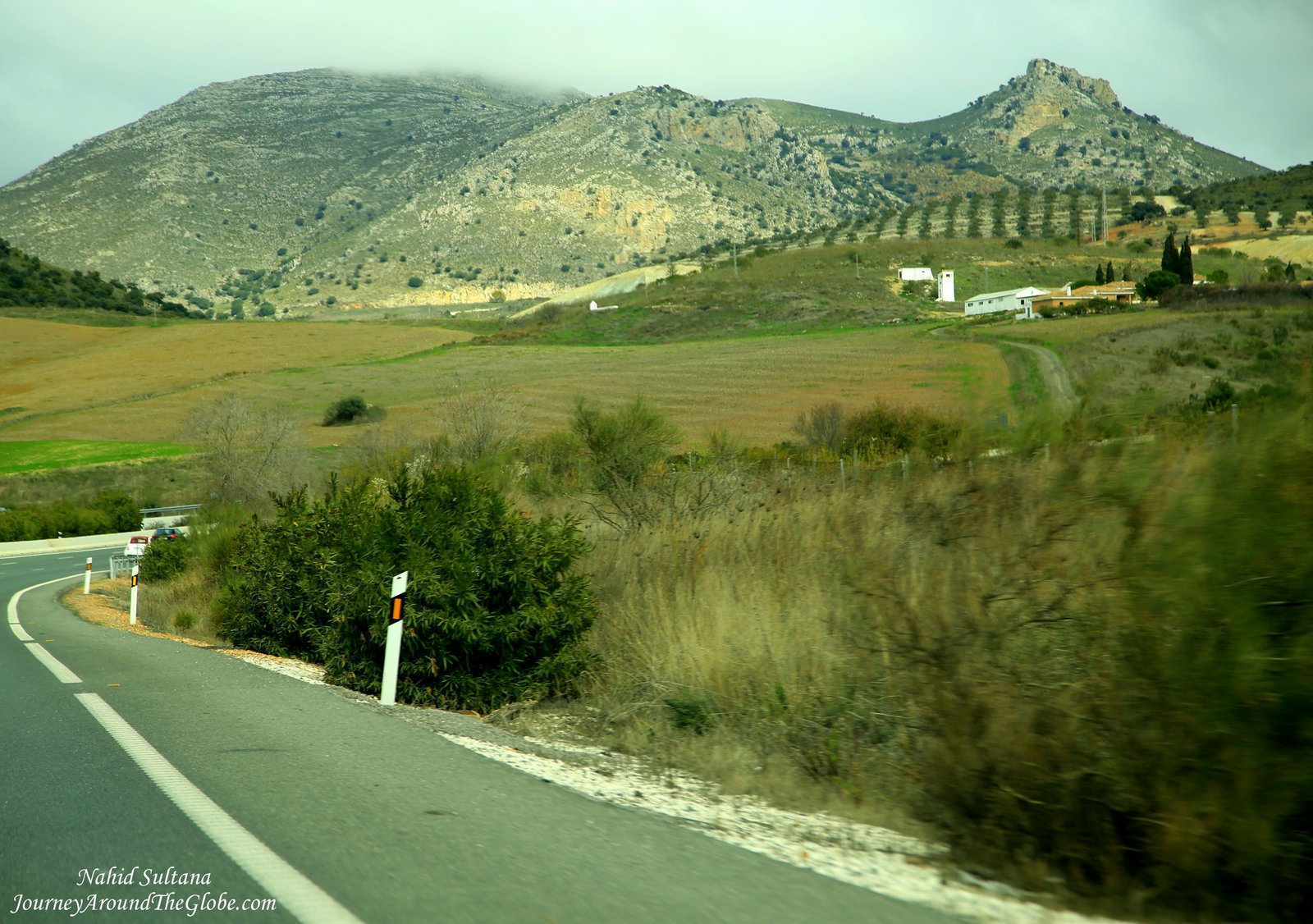
- Driving from Malaga to Granada…beautiful Andalusian landscape
OUR HOTEL: We stayed in Best Western Hotel Dauro II in Granada. It wasn’t very close to Alhambra but was within the walking distance from the city center, Granada Cathedral, and Moroccan Bazaars. Parking was a bit problem but thanks to the hotel management who valet parked our car to the nearest garage. We didn’t have free breakfast (it was something like 8 euros per adult for breakfast) included but had Wi-Fi in our room. Best part was that there was a whole street of tapas bars and some other restaurants just outside our hotel.
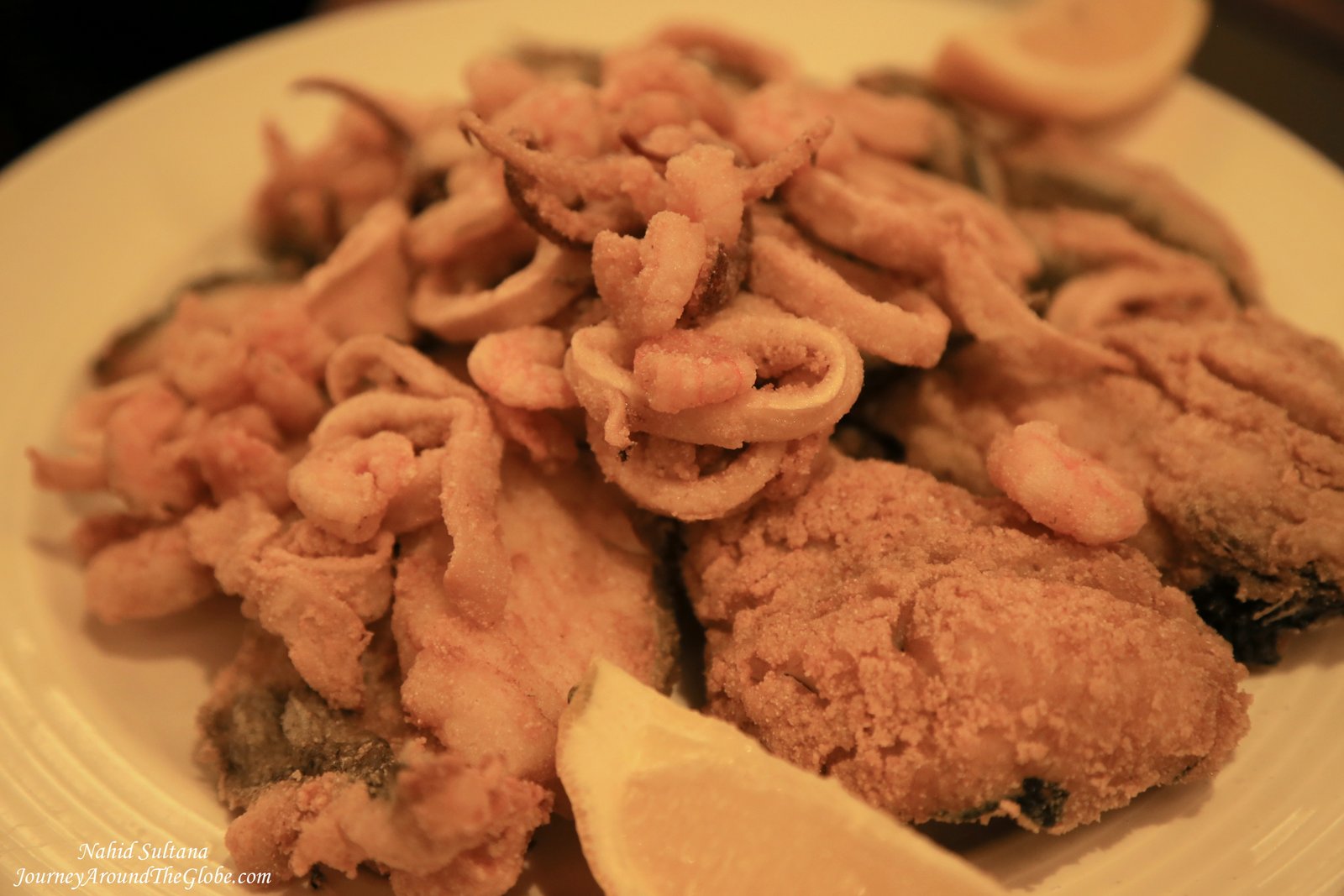
EATING and SHOPPING: As I said, there were tons of tapas bars right outside our hotel in Granada. After checking-in, we were out to satisfy our growling stomachs. All the places there were packed with tourists and locals. We sat down in a restaurant called “El Ganehe”. Their chicken tapas with fries was out of this world and was free too since we ordered some variety of tapas. We had mixed seafood tapas which turned out OK, but nothing like the chicken one. Other than tapas, while in Spain, try cold gazpacho soup (tomato base), paella, Spanish omelets (with potatoes), and lots of different unique dishes.

- Chicken tapas with fries on our first lunch in Granada, Spain
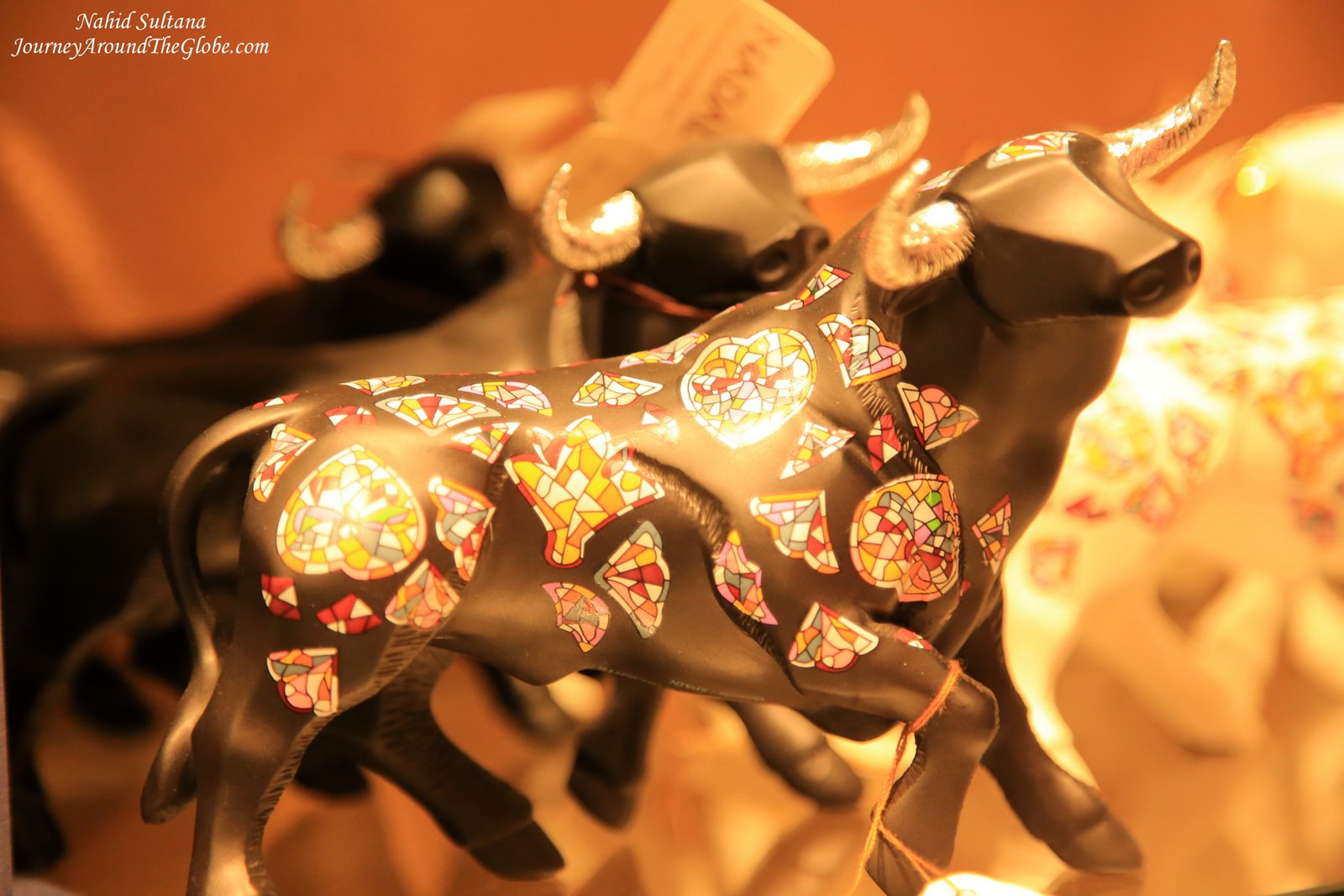
Granada is known for its commercial activity which mainly takes place in the center. International brands and small business in this area are bustling and lively at any time of the day. Main shopping areas include Recogidas, Mesones, and San Anton. Everything you look for when shopping can be found here. I was happy with their Moroccan bazaars in the city center. We bought 3 Moroccan leather poufs for 25 euros each, a mirror for 50 euros, a Flamenco CD, and Spanish saffron. Spices are something very popular here as well as many other traditional Moroccan goods like babouche, leather items, lamps, and etc. If you are looking for something Spanish, flamenco dresses for little girls, depiction of Alhambra, Spanish bulls, and potteries were some of my favorites.
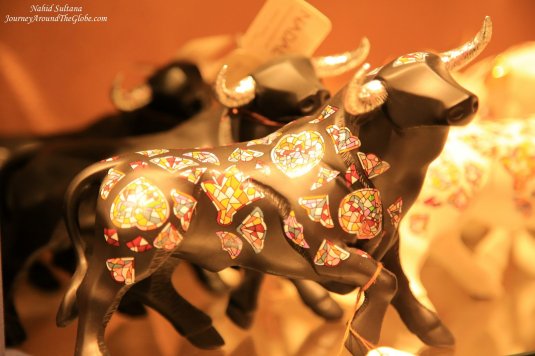
- A beautiful Spanish bull in a souvenir shop in Granada, Spain
PLACES WE’VE VISITED: We were in Granada for a day and half. First day we arrived here right around lunch. After having some good tapas we were out to explore some squares, a beautiful and old madrasah (Quranic school), and then to the Moroccan bazaars for some pleasure shopping. Next day our visit to Alhambra was early in the morning (my husband booked the tickets for Alhambra online from Ticketmaster) and got the morning slot for us. After that we visited Granada Cathedral and the Moroccan market around the cathedral. That was about what we did in Granada.
Granada tourist office recommends four areas of the city for their tourists: Alhambra, Albayzin, Center, and Realejo. While Alhambra is the main attraction of this city, if you have time stroll around the Moorish neighborhood of the Albayzin. Although we couldn’t do it, Albayzin offers picturesque streets and squares, accompanied at all times by the silhouette of Alhambra which dominates the skyline. Another place we didn’t visit was San Nicolas square. Its viewpoint provides you with the chance to contemplate “The most beautiful sunset in the world” (Bill Clinton). Take a walk along the Carea del Darro which is considered as one of the most beautiful streets in Europe.
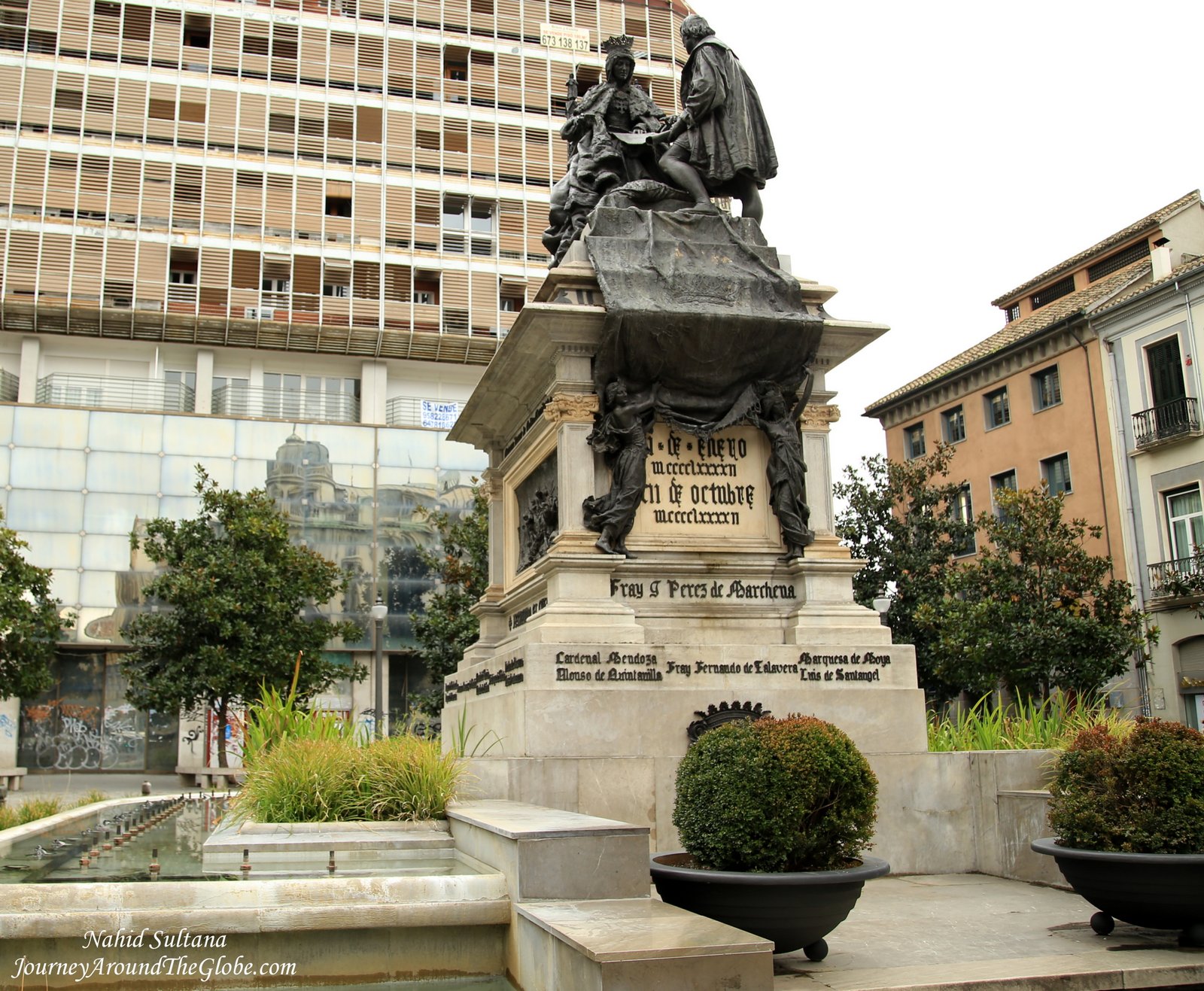
1) PLAZA ISABEL la CATOLICA: This is the central square of Granada, very close to the cathedral. The prominent statue in the middle of the square depicts the moment when Christopher Columbus asked permission from Queen Isabel to go and explore the Americas and outlines their agreement in preparation of his voyage. According to some historians, this even took place in Granada. A pleasant fountain surrounds the statue.
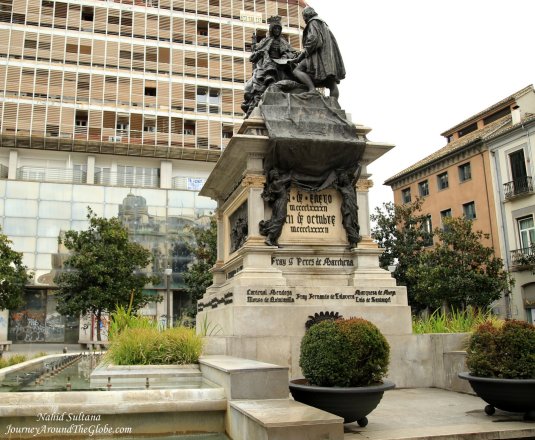
- Statue of Queen Isabella and Christopher Columbus in Plaza Isabella del Catolica – Granada, Spain
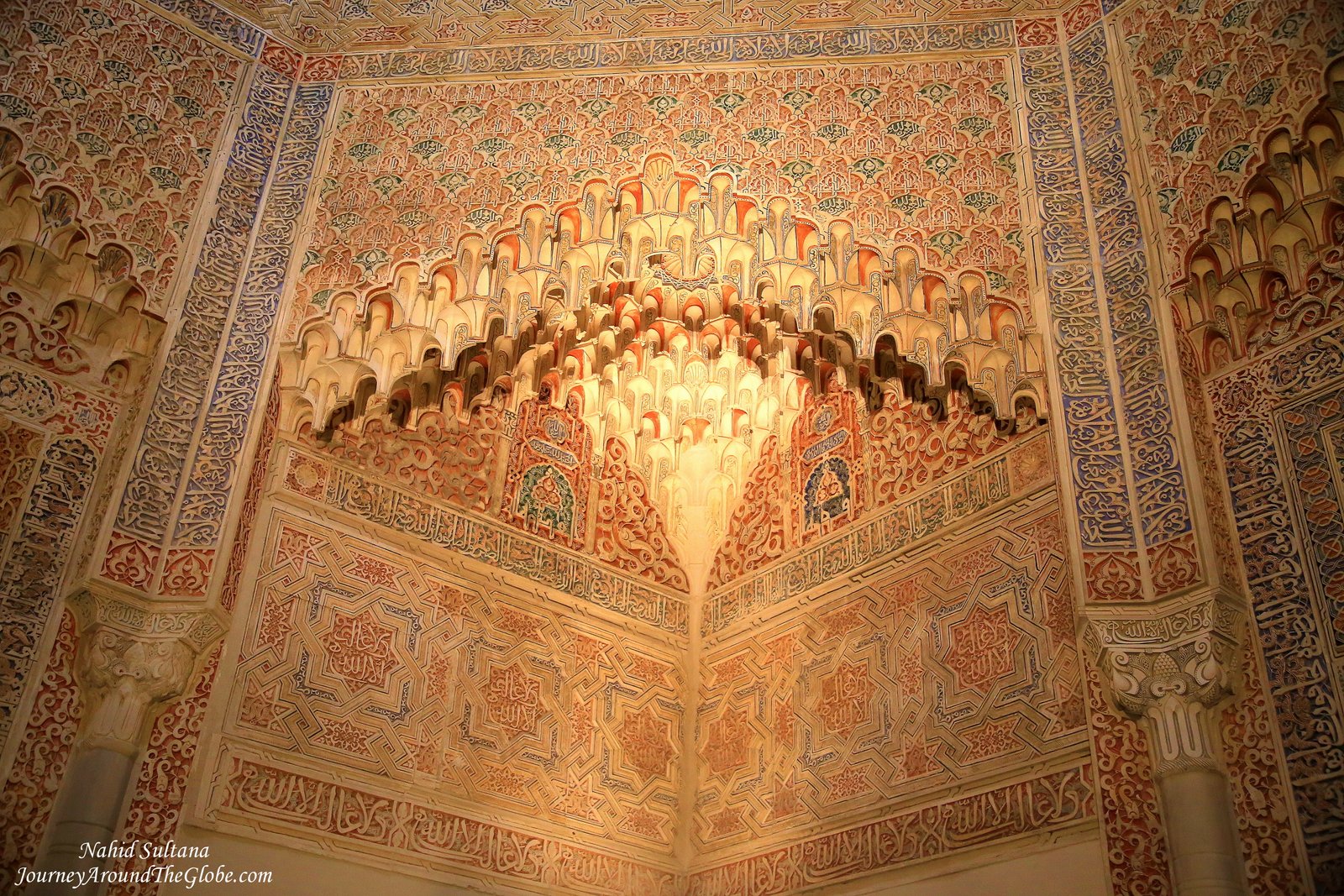
2) PALACIO de la MADRAZA: Our next stop was the cathedral here but since it was closed and we saw this madrasah opposite of the cathedral, so decided to check it out. Madraza or Madrasah is basically a Quranic/Islamic school where the students are taught Muslim’s holy book Koran (or Qur’an) and the correct Islamic etiquettes.
Palacio de la Madraza was founded by the Nasrid king Yusuf I in 1349 AD. It conserves a mihrab (chapel) from that date. It was built for only 20 students where they could stay and learn the Quran. The lady took us to the original Muslim prayer hall, wash room, and then to the conference room upstairs. Here the ceiling is from 16th century and the copula and stairs from 18th century still exist.
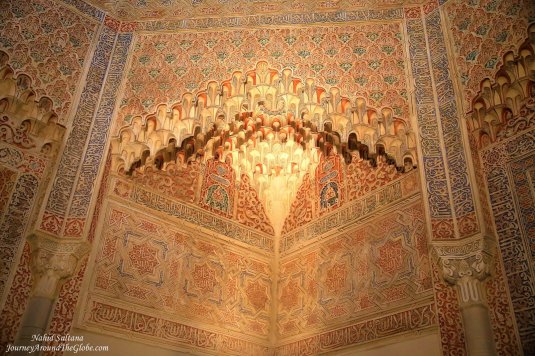
- Look at the gorgeous calligraphy in a room in Palacio de la Madraza – Granada, Spain
It used to be a country house in the 11th century. This is also happened to be the first Town Hall of Granada in the 16th century. From 1722 to 1729 it was rebuilt in Baroque style with galleries on its four sides. Now it’s part of Universidad de Granada.
It’s 2 euros per adult and can be visited only with a guide. The madrasah is open ‘til 10pm for the tourists.
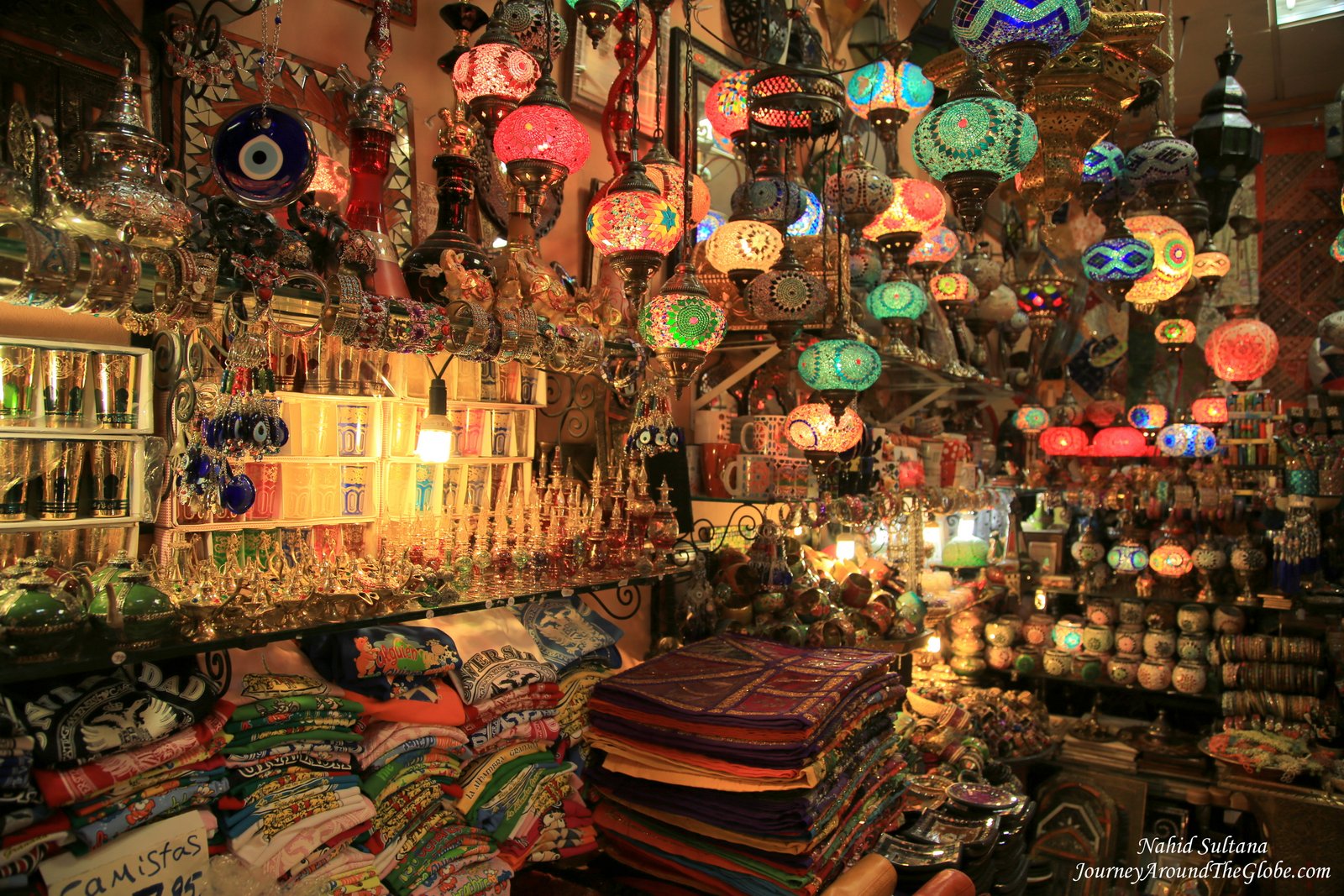
3) MOROCCAN BAZAARS: There are two Moroccan bazaars in the center of Granada. One is near the cathedral and the bigger one is on the other side of the cathedral, about couple blocks away. The bigger one is actually quiet big and consists of few narrow alleys (some with steps) and beautiful neighborhoods. I felt like I was walking thru Middle-Eastern souks while there. You can find all sorts of things in these stores. These colorful shops with unique items are worth a visit even if you don’t buy anything. But if you are into souvenirs, these markets offers some traditional Moroccan or Islamic arts and items. Starting from spices, leather things, decorative lamps/lanterns, babouche, tea-sets, pillow covers, potteries, scarfs, and tons of other items are available here. Make sure to bargain whatever the price they offer, may be start with half price of whatever they are asking for.
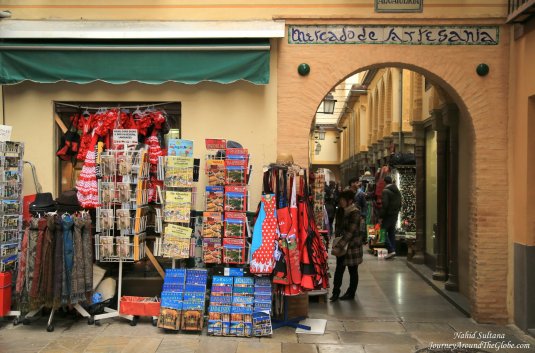
- An entrance to the Moroccan market near Granada Cathedral in Granada, Spain
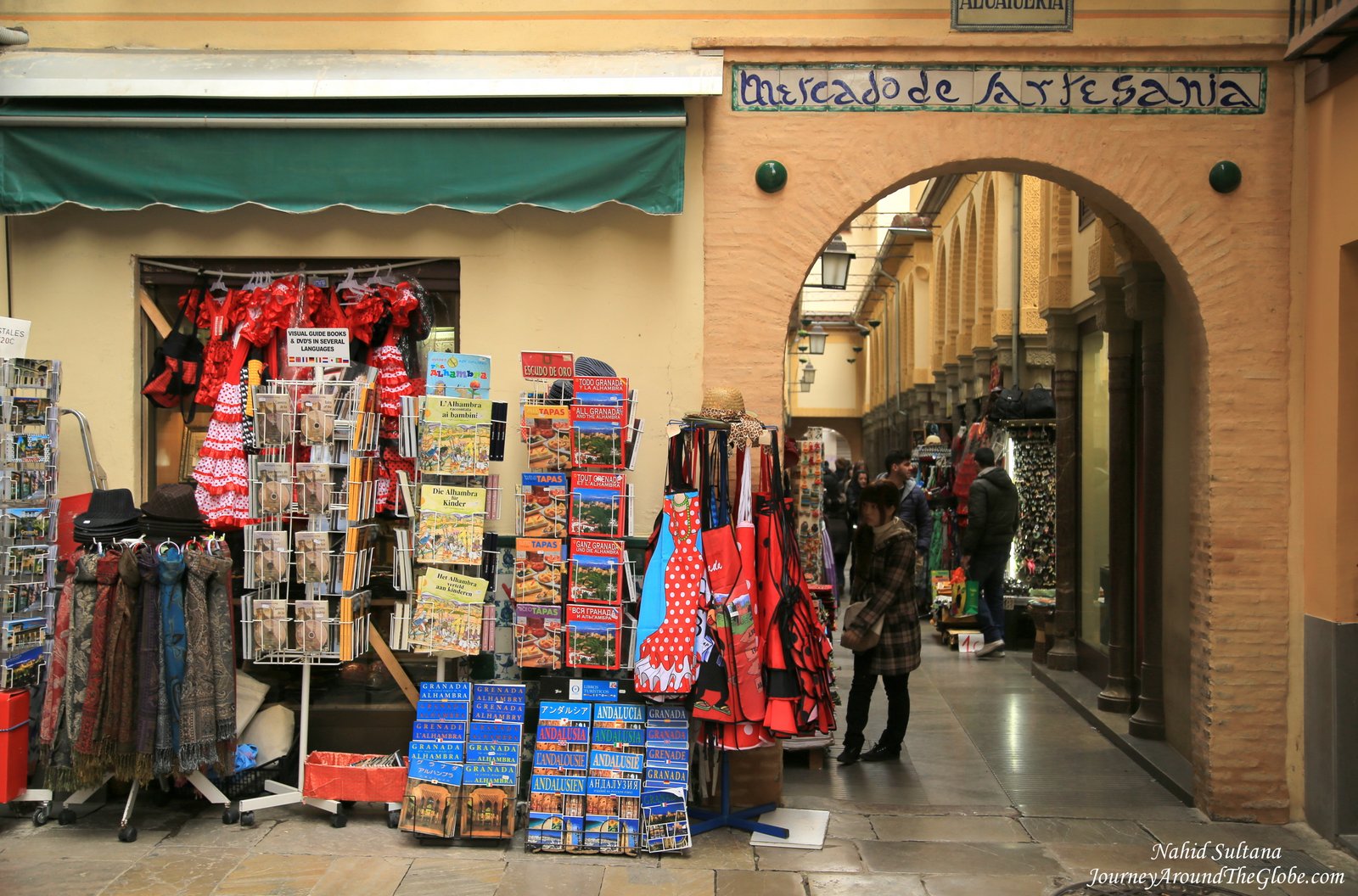
This also a good place if you are looking for Middle-Eastern cuisines. I saw some Lebanese and Moroccan type restaurants serving kebabs, pita, falafel, rice dishes, and salads in nice cozy environment.
- One of the stores of Moroccan bazaar in Granada, Spain
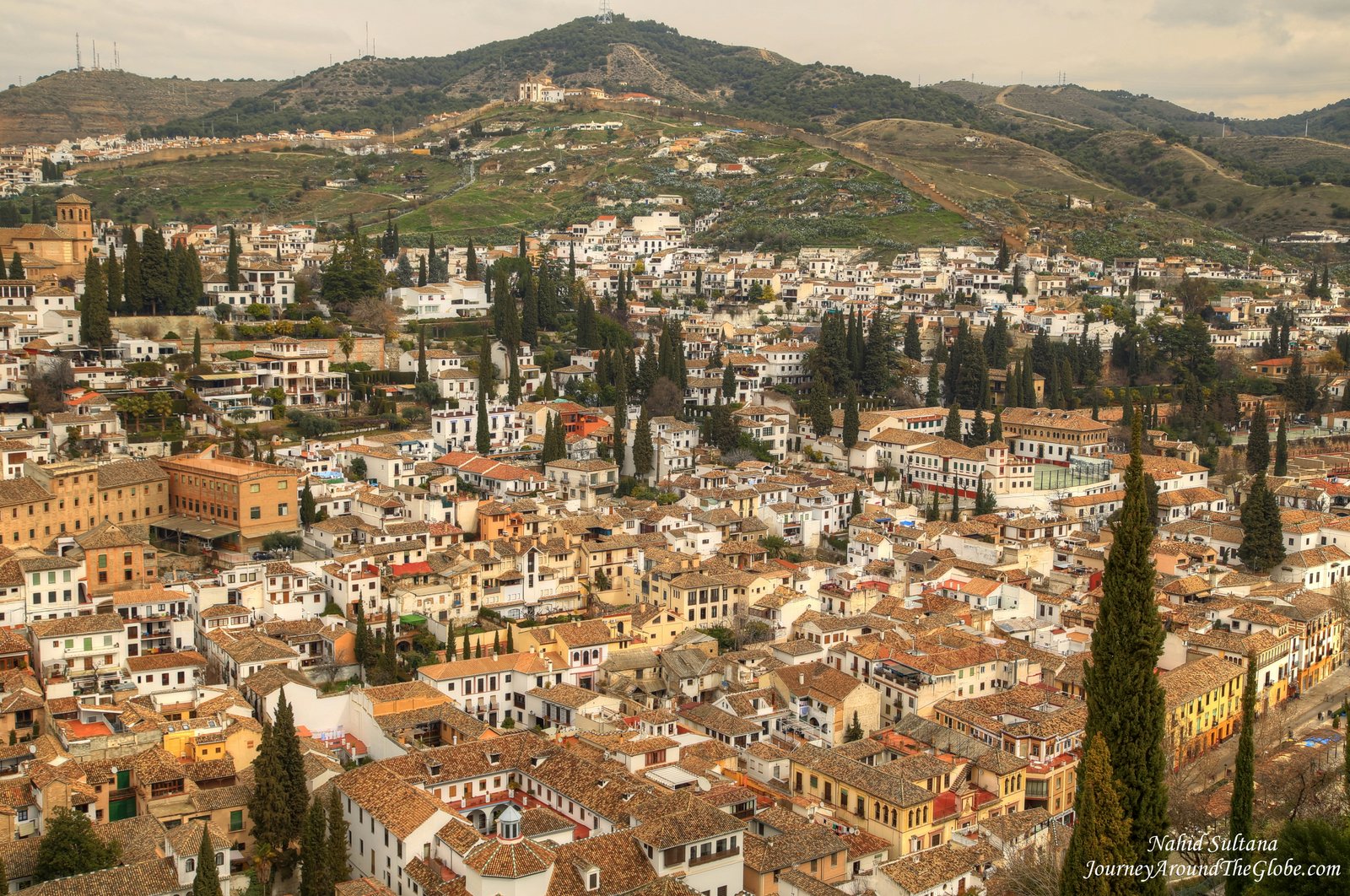
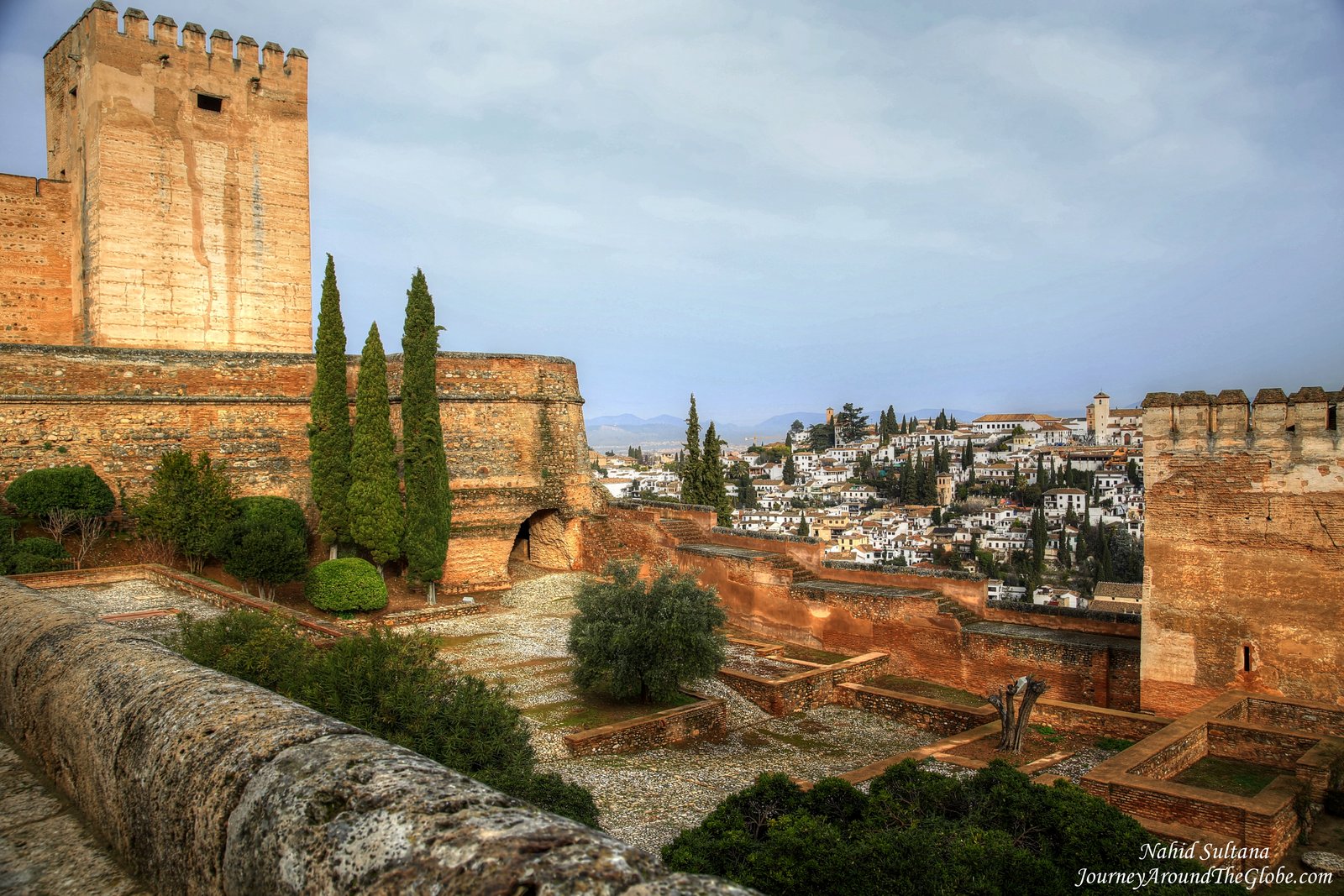
4) ALHAMBRA: This is the main attraction of Granada, an unforgettable site with rich heritage of historical sites that everyone should visit during their stay here. This medieval complex overlooking Granada is one of the top attractions of this country. Alhambra is the last symbol of Moorish power in Europe and it reflects the affluent Moorish civilization in Andalusia. This is known worldwide for its Nasrid palaces…the city’s most emblematic monument and a must visit site. I have never seen such magnificent and intriguing architectures in my life. Alhambra was a palace, citadel, fortress, and the home of Nasrid Sultans…overall, a hive of artistic activity. This vast place is a cradle of ornamental architecture, lush gardens, water fountains, spectacular view of the city, and firm history.

- View of Granada from Alhambra in Granada, Spain
Founder of the Nasrid dynasty Muhammad I installed his Court on the hill of Sabika and started construction of the Alhambra in 1238. In 1333, 7th Nasrid ruler Yusuf I built the Comares Palace and in 1354 Muhammad V ruled over the heyday of the Nasrid sultanate when he completed the Palace of the Lions. In 1492, last Nasrid Sultan Muhammad XII surrendered Alhambra to the Catholic Monarchs. In 1516, Queen Isabella of Castile and her husband Ferdinand conducted extensive repairs and alterations to Alhambra. They installed the Royal House and the headquarters of the Kingdom of Granada in the Alhambra. King Charles V visited the Alhambra in 1526, after his wedding to Isabella of Portugal and built the Palace of Charles V, a prime example of Spanish Renaissance architecture. In 1870, the Alhambra was declared a National Monument and from 1923 to 1936 massive restoration of this place took place. Finally, in 1984, UNESCO World Heritage designated the Alhambra and the Generalife a World Heritage Site.
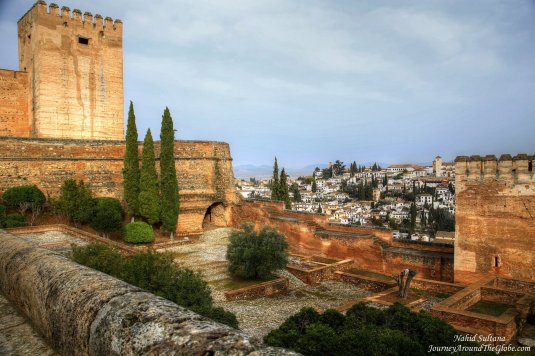
- Alhambra overlooking Granada
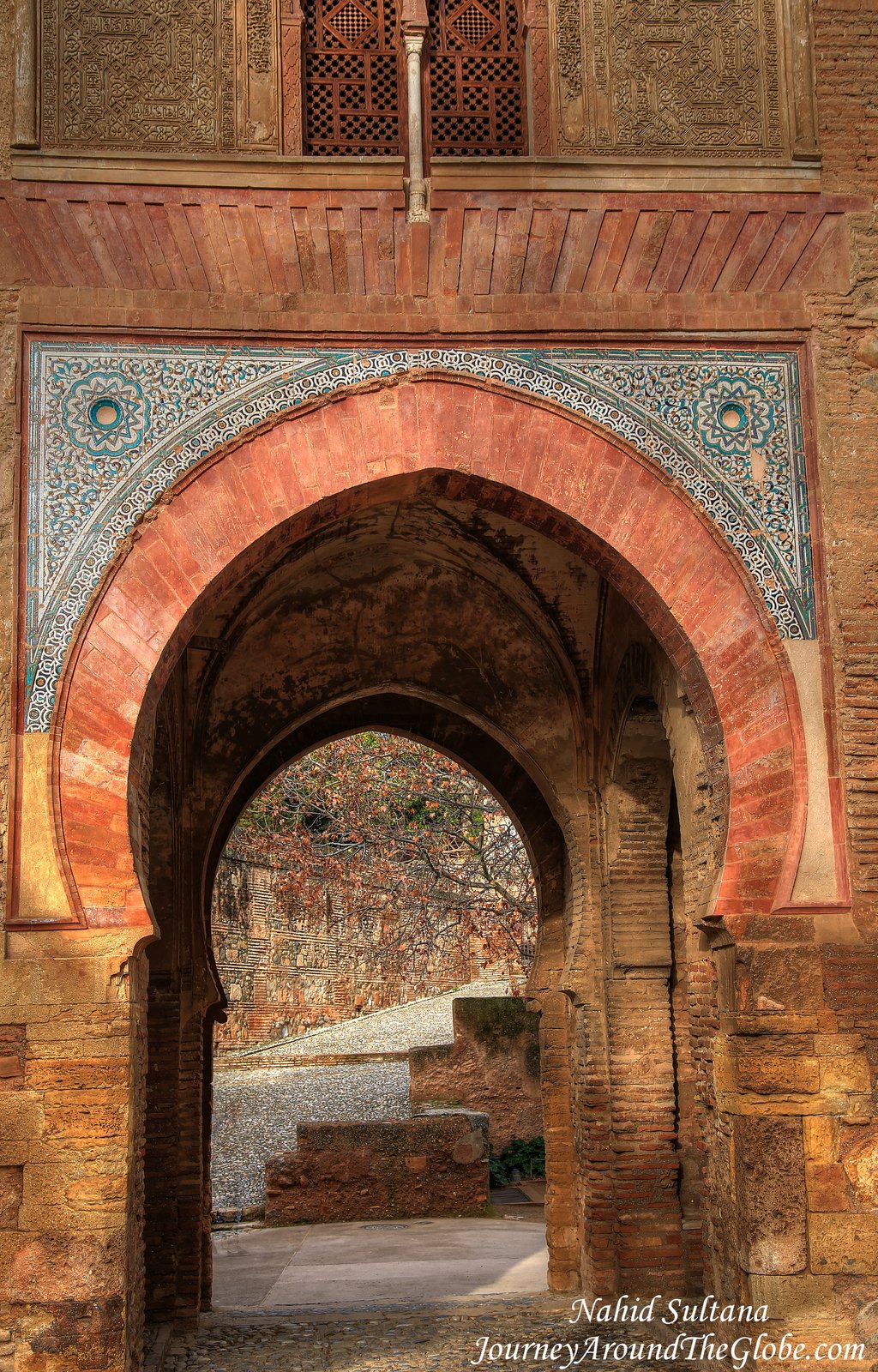
The main sections of Alhambra are Alcazaba, Nasrid Palace, and Generalife. You can see many types of elements that were used to decorate different parts of Alhambra, such as plastered walls and decorative motifs made from plaster, stairs, columns, fountains, water channels, paving, sculptures, and etc. made with stone, and finally decorative parts of buildings made with wood. There are many big and small off the beaten path attractions to explore at every corner of Alhambra, other than the main four sections, like Royal Sultan’s Water Channel, Water Stairway, The Mosque Baths (from 1302), Church of Santa Maria de la Alhambra, some archeological areas, many old gates, fountains, and towers.
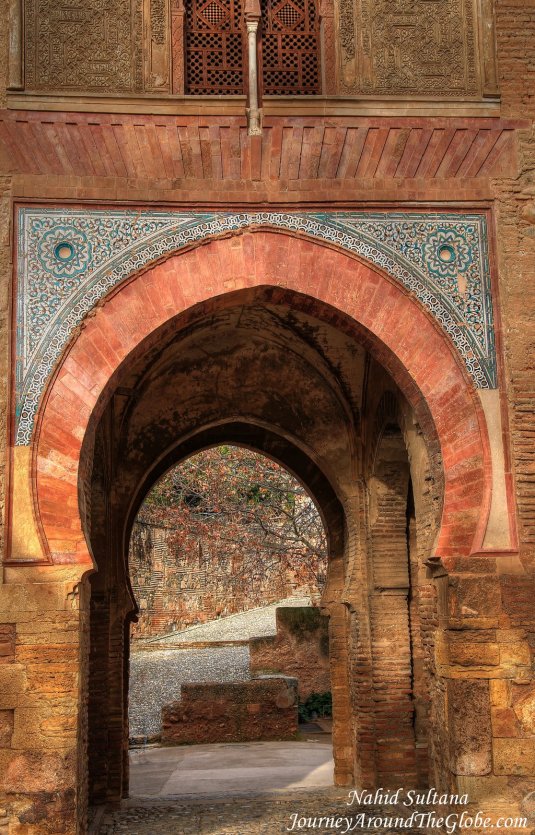
- You will countless arch gates like this one in all over Alhambra
Nasrid Palace is the main attraction, at least I thought, of Alhambra. There are three Nasrid Palaces from different periods in this complex. Mexuar Palace of Ismail I and Muhammad V is from 1362, Comares Palace of Yusuf I is from 1333, and finally Palace of the Lions of Muhammad V is from 1362.

- Fascinating architecture of Nasrid Palace (near Fountain of the Lions) in Alhambra
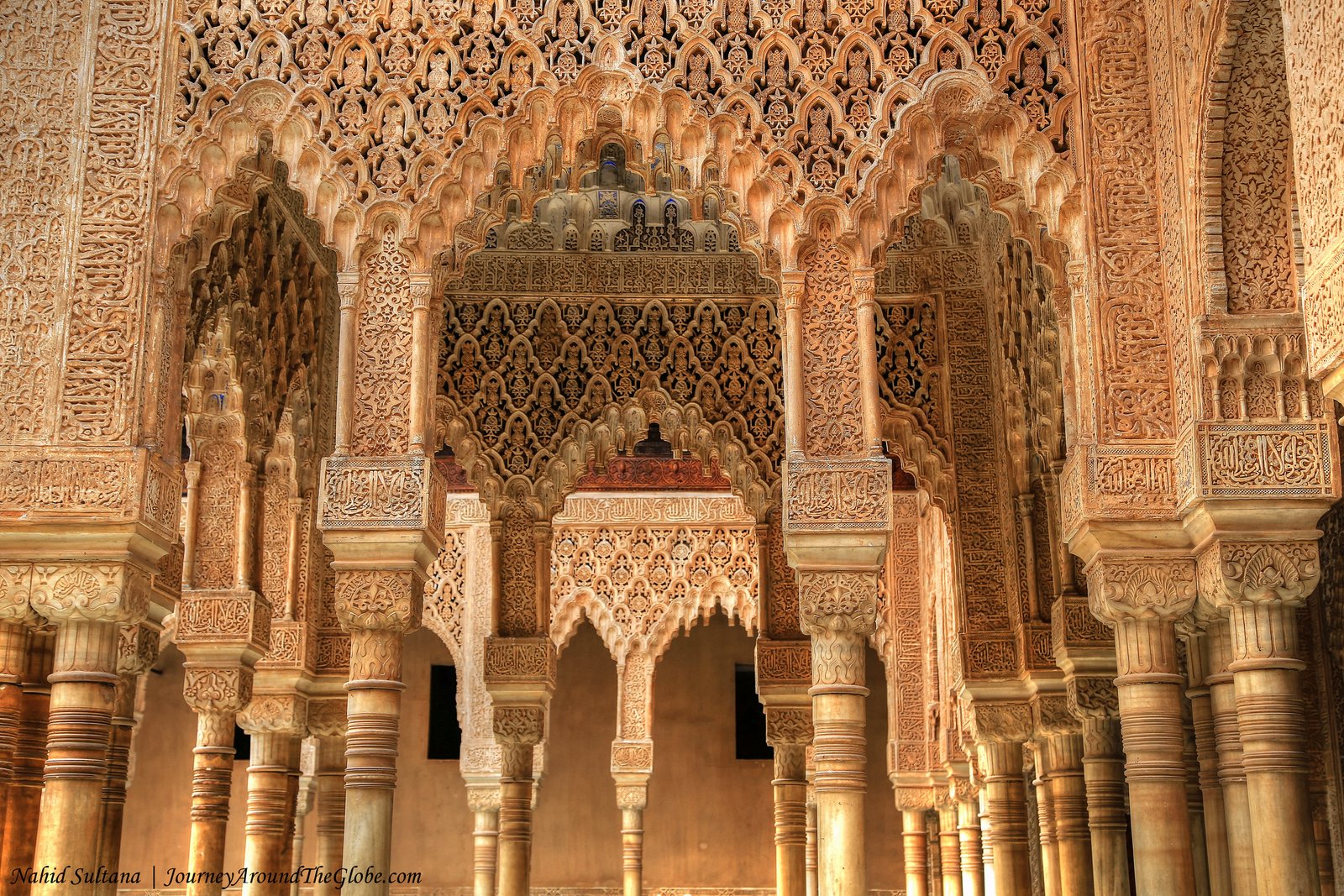
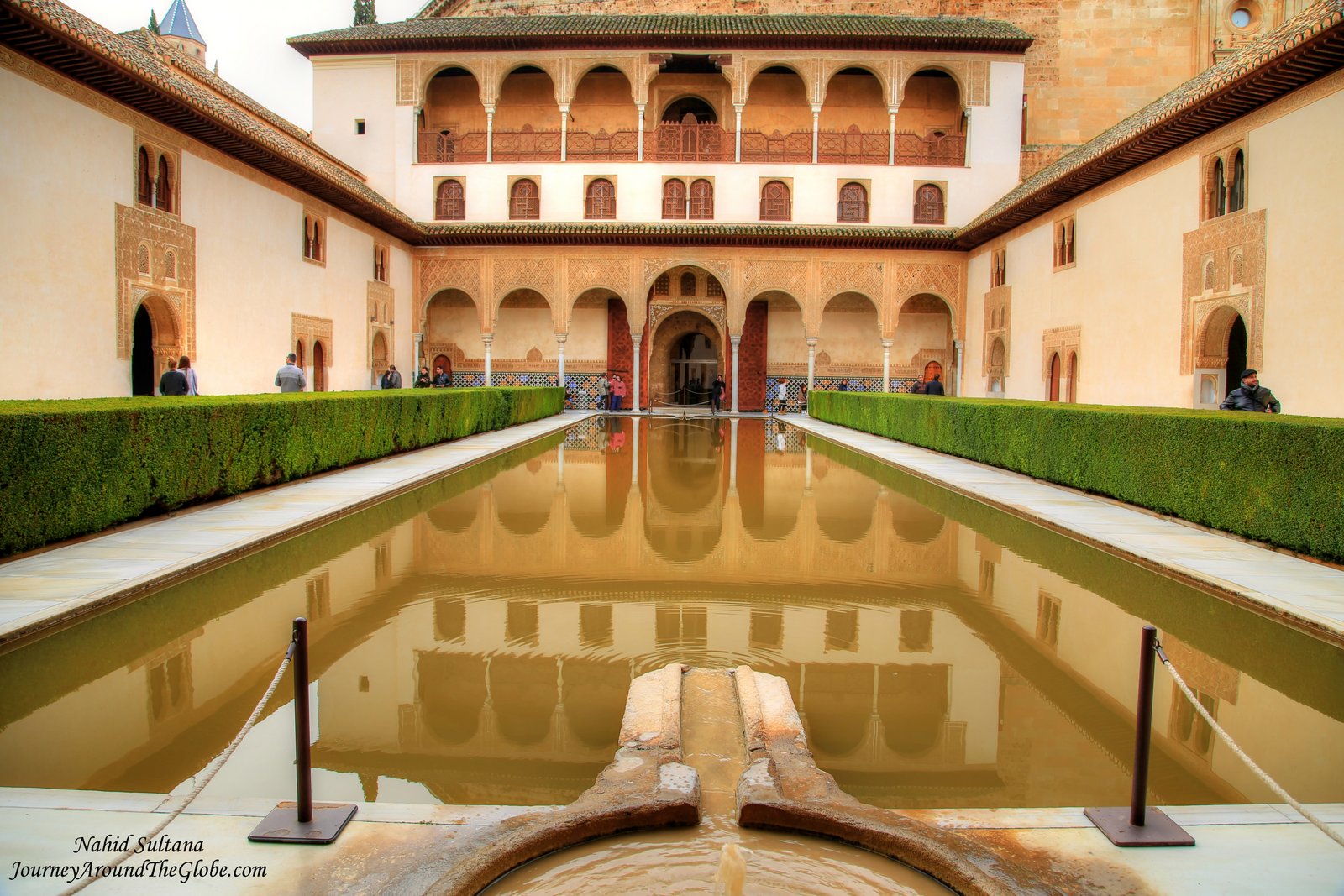
We entered Nasrid Palace thru The Houses of the Partal. It was built in the times of Muhammad III that later became the traditional Nasrid Palace with a courtyard with a central pond and galleries around borders. Many of the walls of Nasrid Palace are curved with beautiful calligraphy, mainly with Quranic texts. Façade of Comares and Court of the Myrtles are some eye-catching spots in Nasrid Palace.
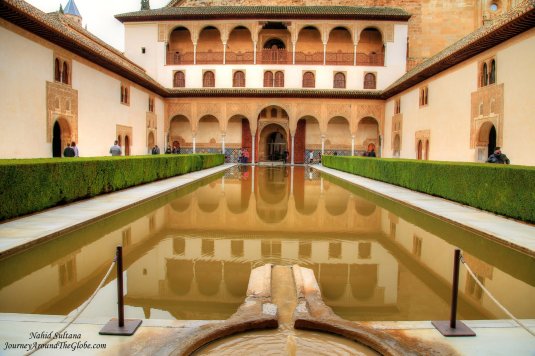
- “Court of the Myrtles” of Nasrid Palace in Alhambra – Granada, Spain
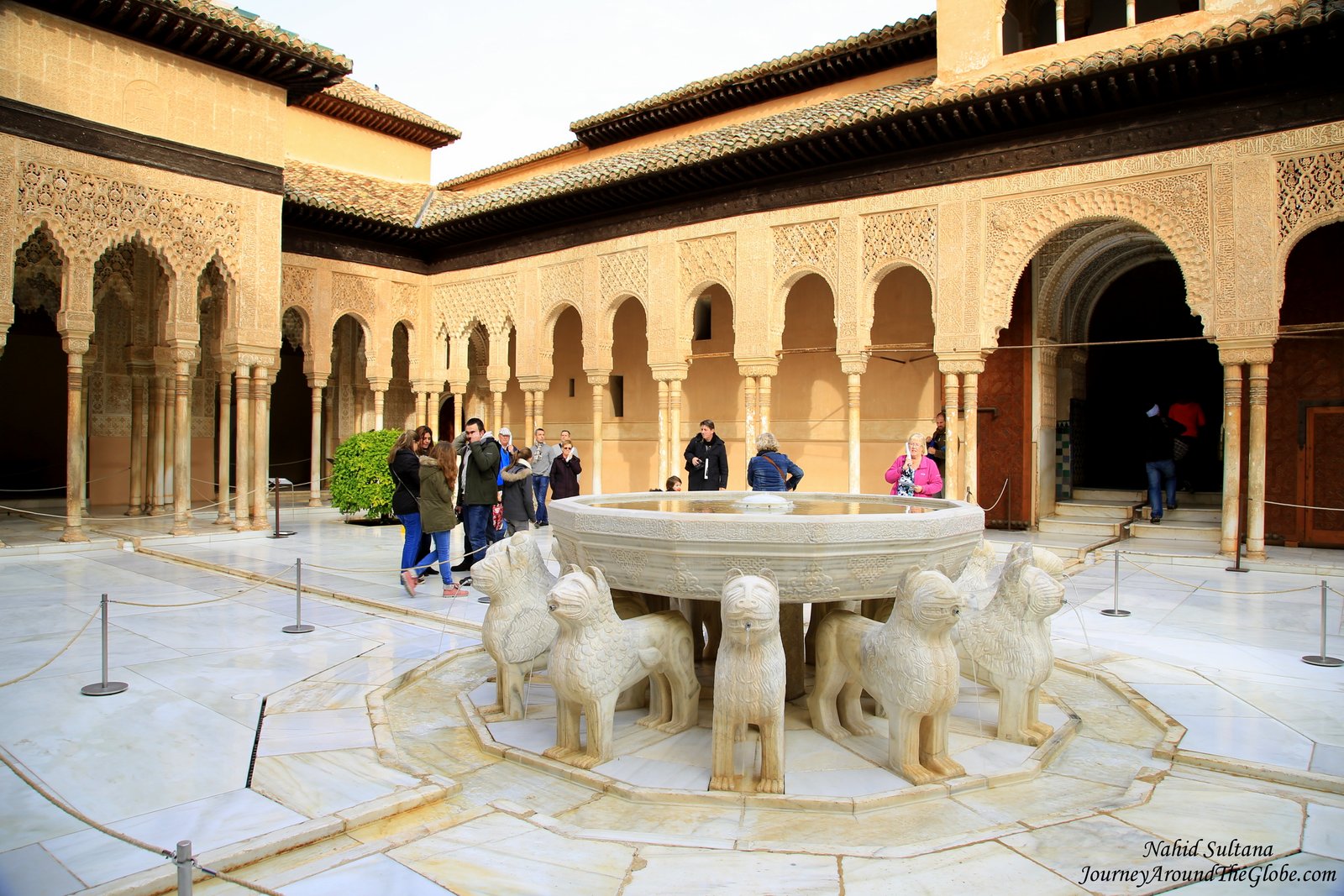
“The Fountain of the Lions” is one of the most beautiful courtyards of Nasrid Palace. This unique hydraulic device from the 14th century was created from marble for Sultana Muhammad V. A beautiful poem by Ibn Zamrak adorns around the edge of the twelve-sided bowl of the fountain supported on the backs of twelve lions which defines the fountain as a sculpture of pearls.
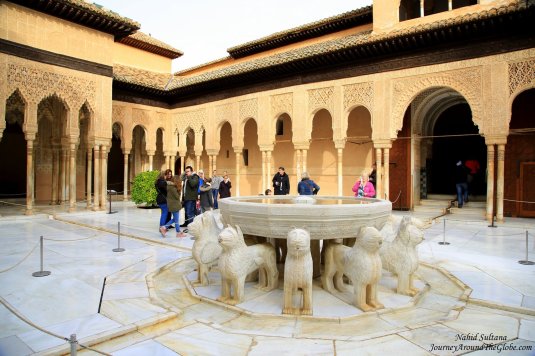
- “The Fountain of the Lions” in Nasrid Palace of Alhambra – Granada, Spain
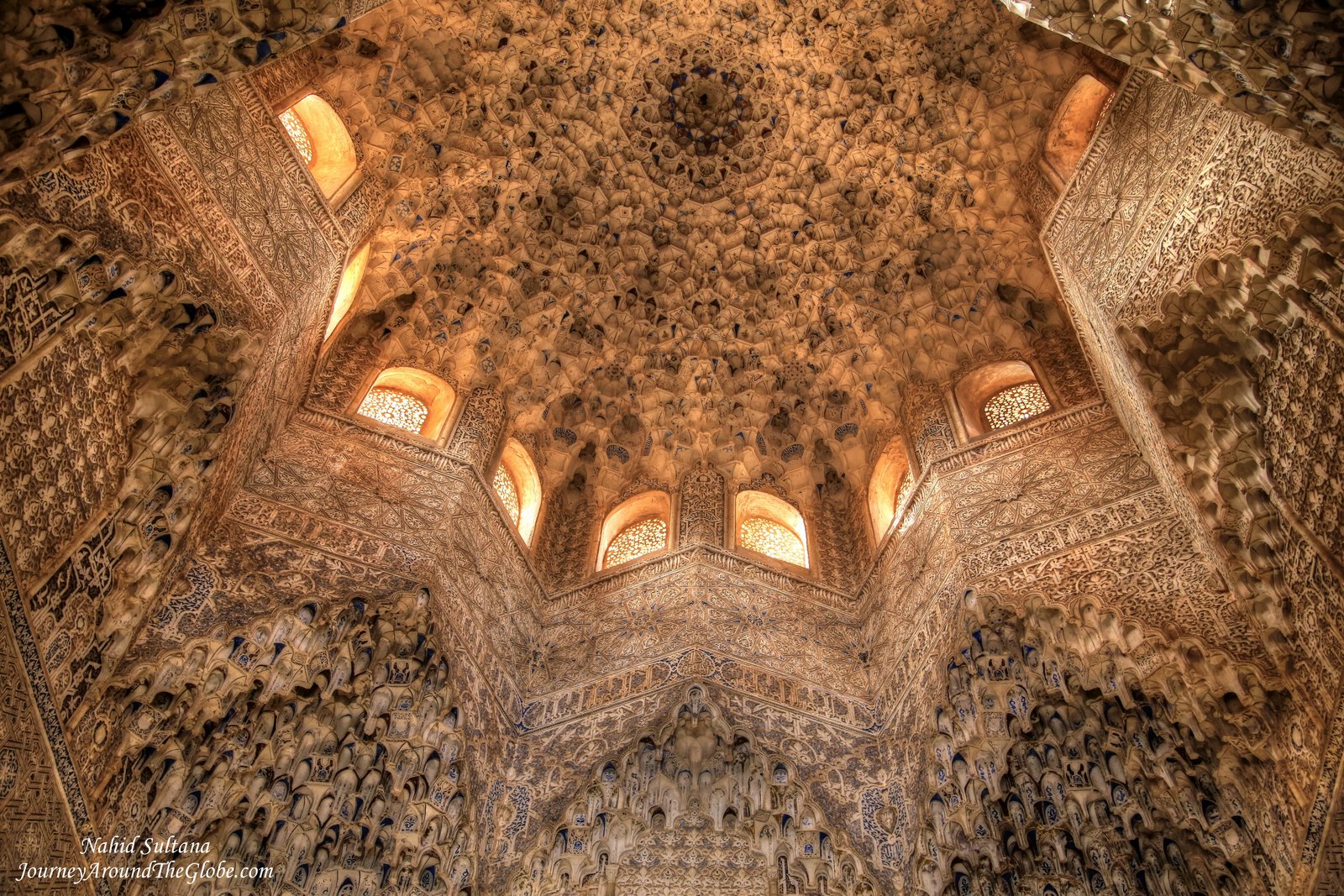
Every single room of Nasrid Palace is exquisitely decorated with Arabic calligraphy, stunning ceilings, many arch doors and windows, vibrant tiles on the walls. Make sure to check out the breathtakingly beautiful ceiling in the Hall of Two Sisters. There are many halls, courtyards, gardens and fountains all over here. Nasrid Palace alone took us little more than an hour to explore its all corners.
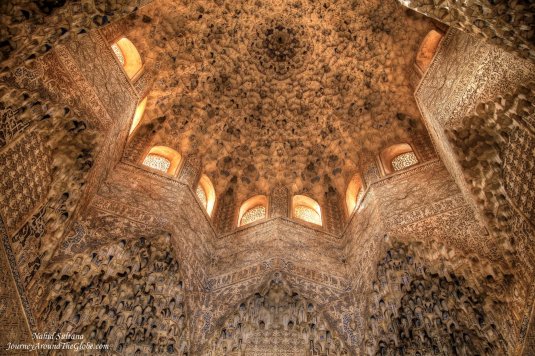
- The ornate ceiling of “Hall of Two Sisters” in Nasrid Palace of Alhambra – Granada, Spain
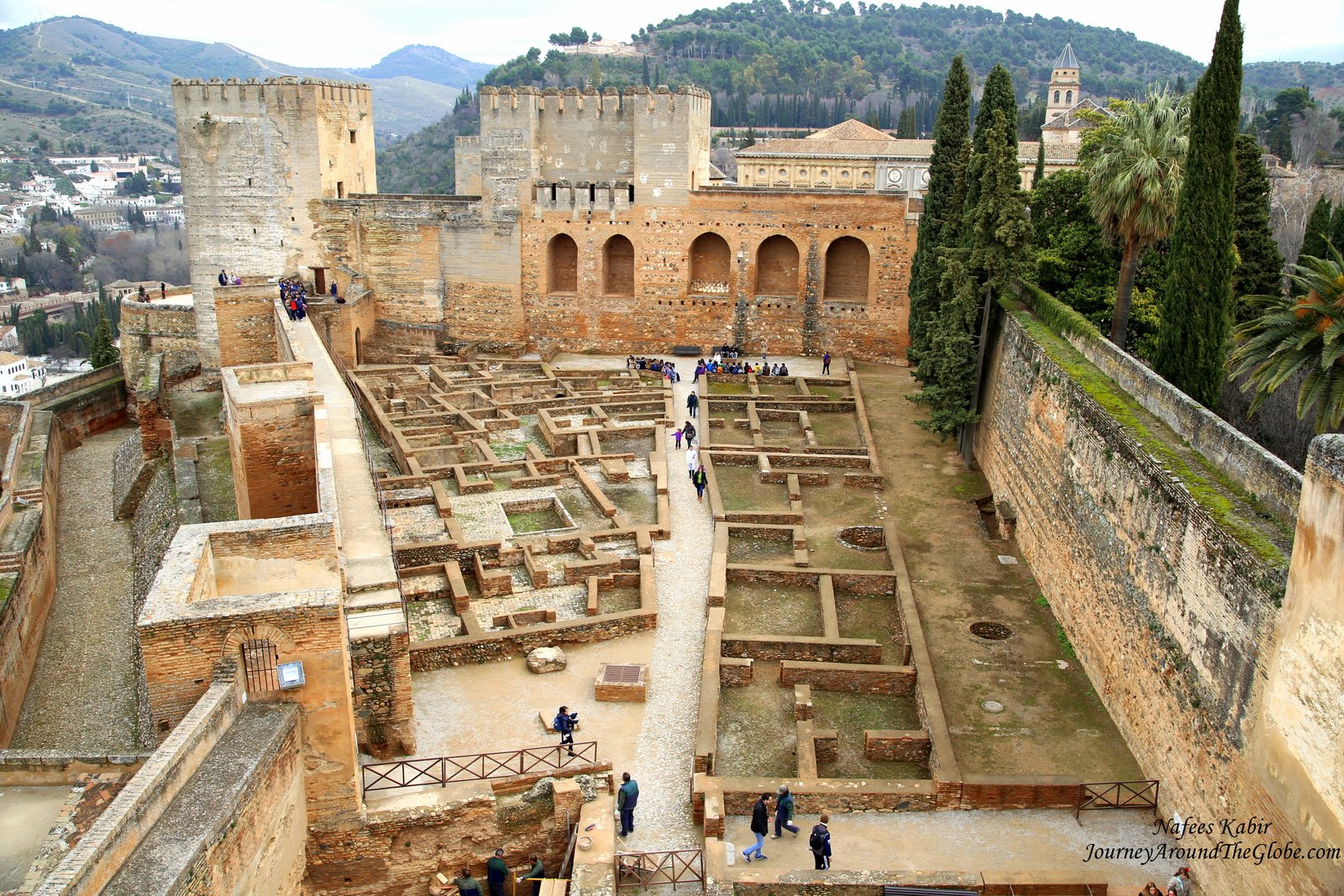
One of the first works completed in the Alhambra after the Christian conquest was the construction of a large cistern in the gully separating the Alcazaba (fortress) from the rest of the Alhambra. Alcazaba is the ruins of massive fortress that looks over the city and is one of the oldest parts of the Alhambra. Here you can visit the military quarter, Gate of Arms, and the gardens. Torre del Cubo (Round Tower) and Torre de la Vela (Watchtower) are two towers where we climbed up for a fantastic view of Alhambra and the city of Granada. Sierra Nevada Mountains and the whole panoramic view of the city from any point of Alcazaba are fantastic.
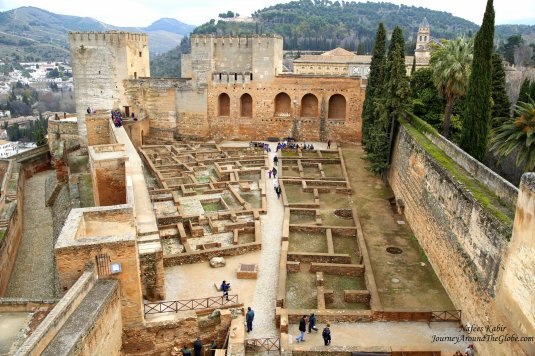
- Looking over the ruins of Alcazaba, Alhambra from Torre de la Vela (Watchtower) in Granada, Spain
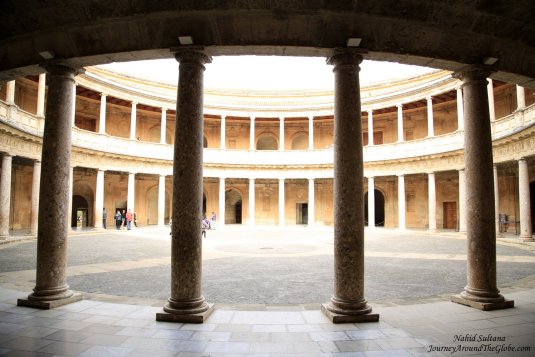
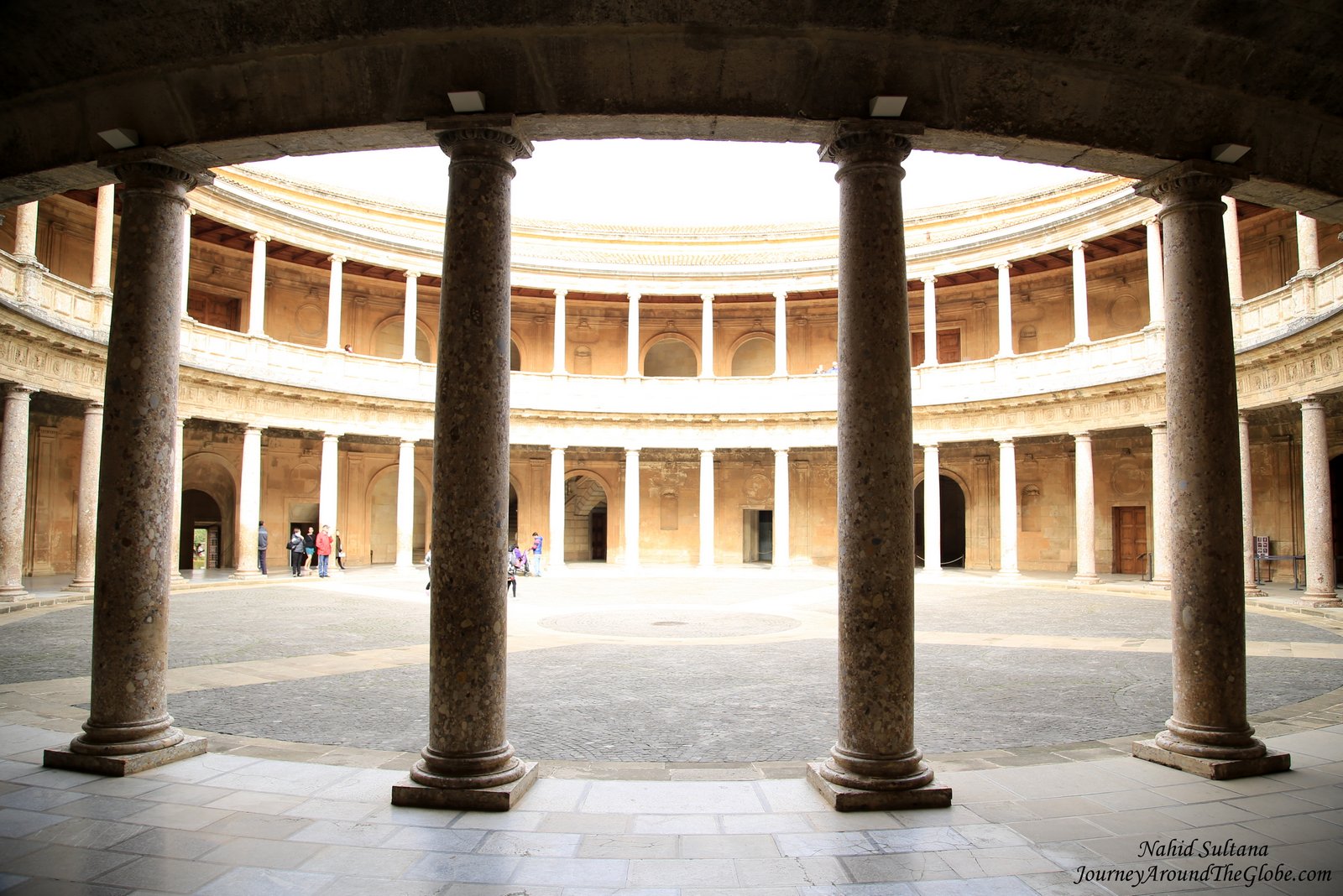
Palace of Charles V is a notable Renaissance style palace within the Alhambra complex. This structure with two levels and big circular courtyard ringed by a colonnade within is a beautiful 16th century structure.
It houses Museum of the Alhambra on the ground floor (with historical artifacts from the site) and Museum of Fine Arts on the upper floor. We also saw some temporary exhibition in the Palace of Charles V. These museums has examples of Nasrid art, elegant dress, and offers as insight into Andalusia’s societies and culture from the Moorish time.
- Palace of Charles V in Alhambra, Spain
Last part of Alhambra that we explored was Generalife. This is the finest example of Moorish gardens in Andalusia. You will find lush gardens, serene shades, colorful flowers, exquisite architecture, and elegant fountains. This area includes the lower gardens, the Generalife Palace, medieval access way to the Generalife, Court of Sultana, Water Stairway, and the upper gardens. It was constructed as the leisure area of the Granadian monarchs, where they escaped from the official routine. The Generalife’s New Gardens (also known as the Rose Gardens or Labyrinth Gardens) were created very recently in 1930. They are located south of the lower entrance to the Palace of the Generalife, occupying part of the old orchards of the medieval agricultural settlement from Hispano-Islamic times. Romantic gardens with a palace and beautiful fountains are appealing and worth spending time.
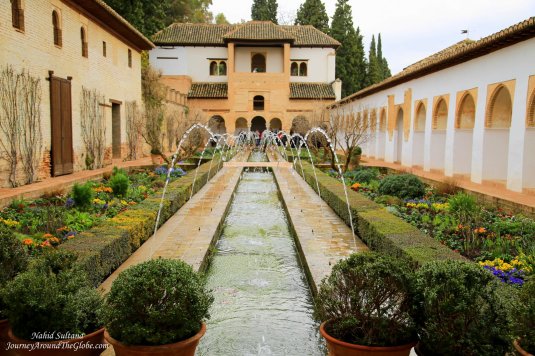
- A peaceful garden in Generalife of Alhambra in Granada, Spain
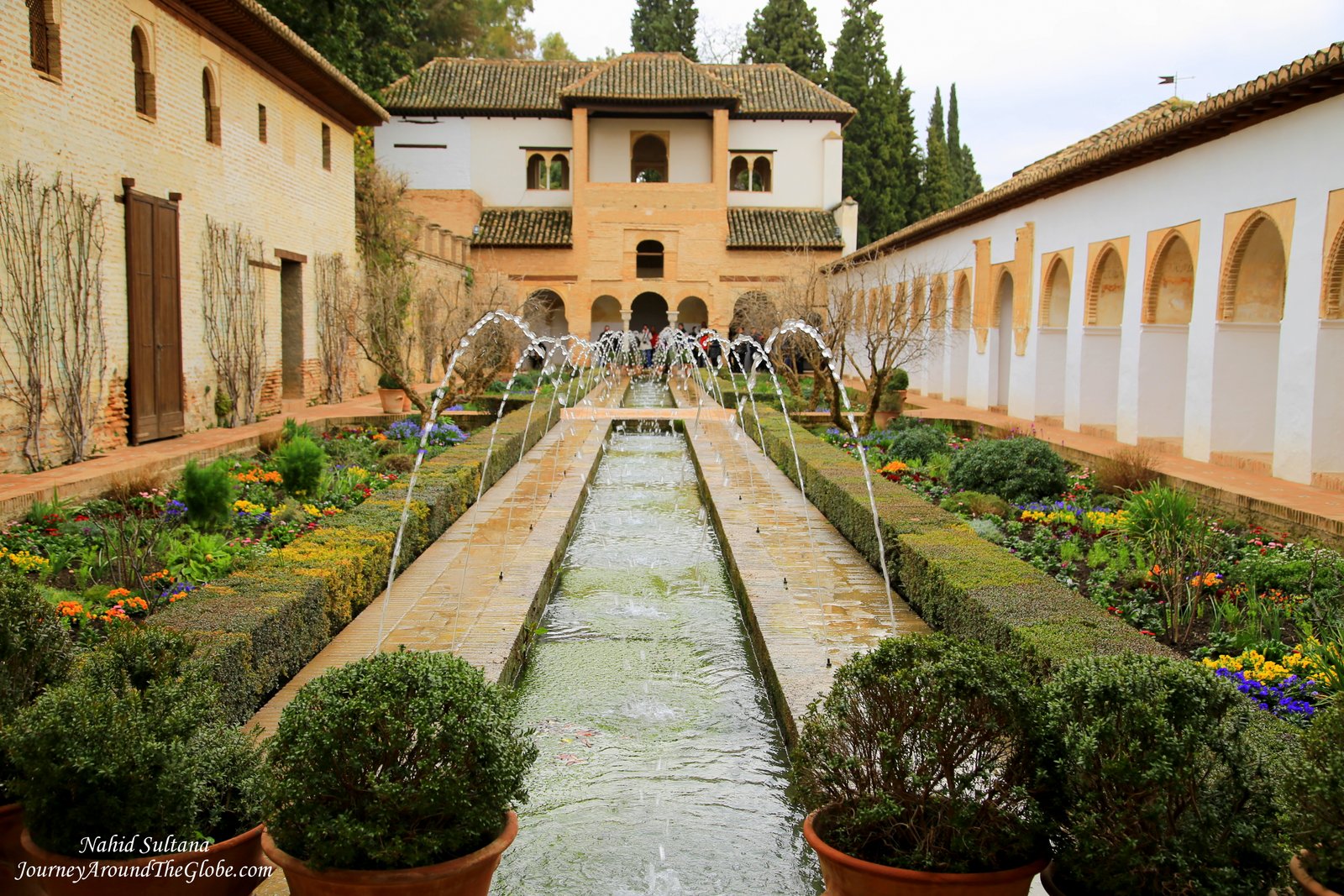
The highlights of Generalife are its palace and the gardens. Patio de la Sultana is one of the many beautiful gardens of Generalife. Have a little break sometimes, relax, and take in the landscape.
- Court of Sultana in Generalife, one of the highlights of Alhambra in Granada, Spain
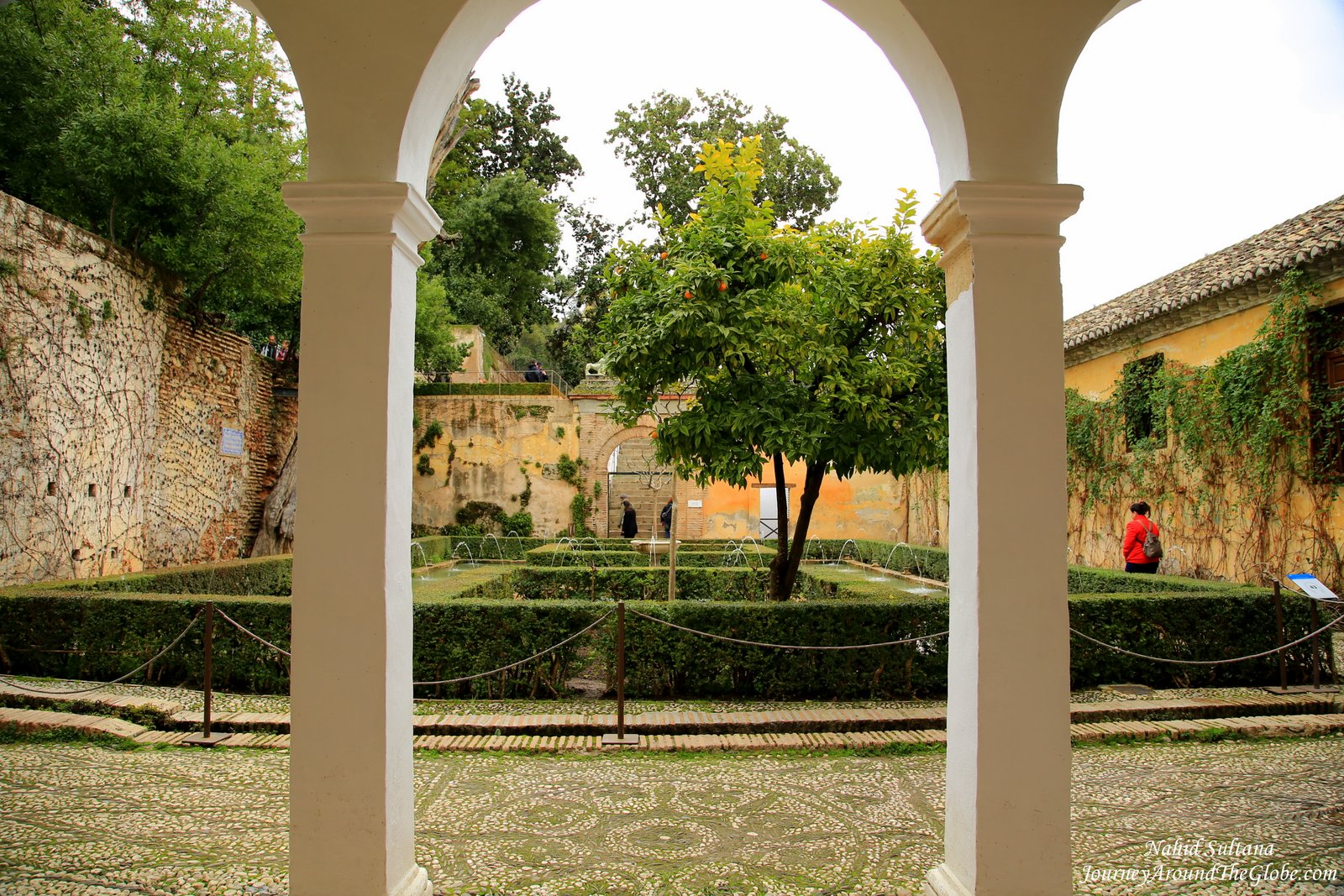
There are a lot to do and see in Alhambra. The parts of the Alhambra and Generalife sites open for public visits are divided into four areas: the Alcazaba, the Nasrid Palaces, the Partal and the Generalife. When deciding on the order of the places to visit, bear in mind the allotted access time for your visit to the Nasrid Palaces, printed specifically on each ticket. After this time you will not be allowed access to the palaces, as the number of visitors allowed at any given time is limited. Don’t forget to wear appropriate footwear and enough sun protection…there are lot of walking to do in Alhambra and not all of them are smooth paved paths. Strollers are not allowed in Nasrid Palaces and backpacks or large bags must also be left at the left luggage service or locker.

- One of countless gardens of Alhambra in Granada, Spain
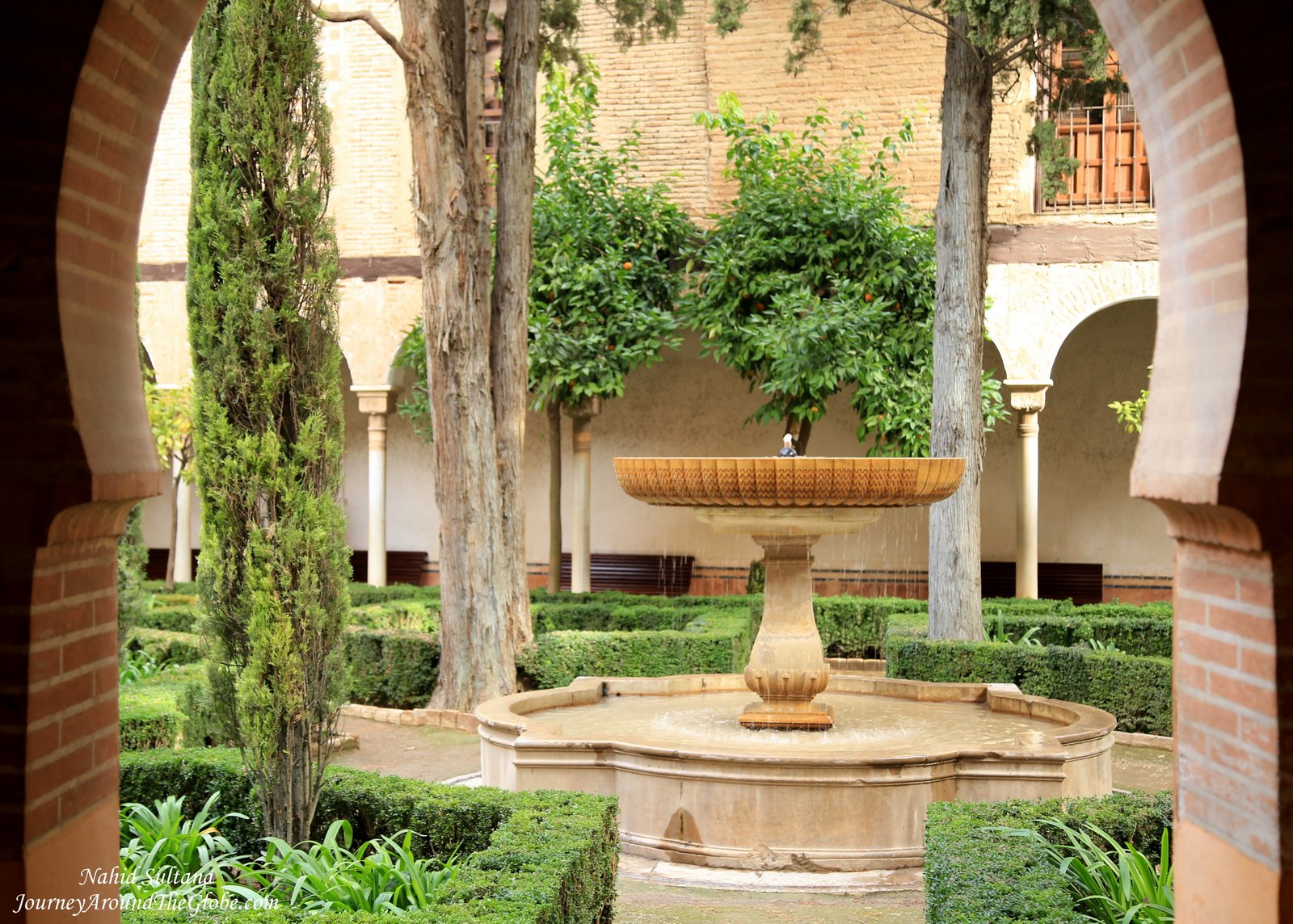
We bought the ticket for Alhambra online way ahead of our trip. There are different types of visits to the Alhambra. It’s open every day throughout the year (except December 25th and January 1st. You can choose either morning or afternoon visit. We took the package of 15.40 euros per adult which included Nasrid Palace, Alcazaba, Partal Gardens, Palace and Gardens of the Generalife and we chose the morning visit from 8:30am to 2pm. Average recommended time to visit Alhambra is 3 hours, but it took us about little more than 5 hours and still couldn’t visit all the stuff here. Its 7 euros for just Alcazaba, Partal Gardens and Generalife. Alhambra also offers some night visits, like “Alhambra at night Palaces” for 8 euros and “Alhambra at Night Generalife” for 5 euros. The entrance fee doesn’t include audio-guide, you have to buy it separately for 7.50 euros.
5) GRANADA CATHEDRAL: We were done with Alhambra by 2:30 pm, had lunch, and walked over to the cathedral. This is a huge edifice in the center of Granada surrounded by Moroccan markets and other stores. The cathedral is a mix of architectural styles from different eras. A portion of Granada cathedral occupies the site where the Major Mosque of Granada used to stand. The central part of it is covered by a hemispherical dome and the four sides of the transept by domical vaults. The present Baroque look of it is from 1705. Inside the cathedral looked a bit simple to me, but beautiful with white and golden combinations. Organs and the main altar were gorgeous. Royal Chapel of this cathedral houses tombs of King Ferdinand II and Queen Isabella I, the Catholic monarchs who conquered the city against Muslim rulers.
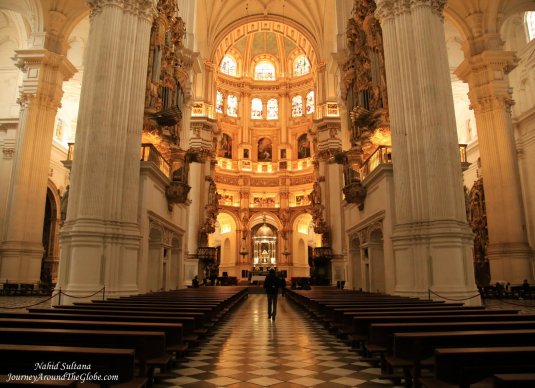
- Granada Cathedral – the 2nd biggest cathedral in Spain
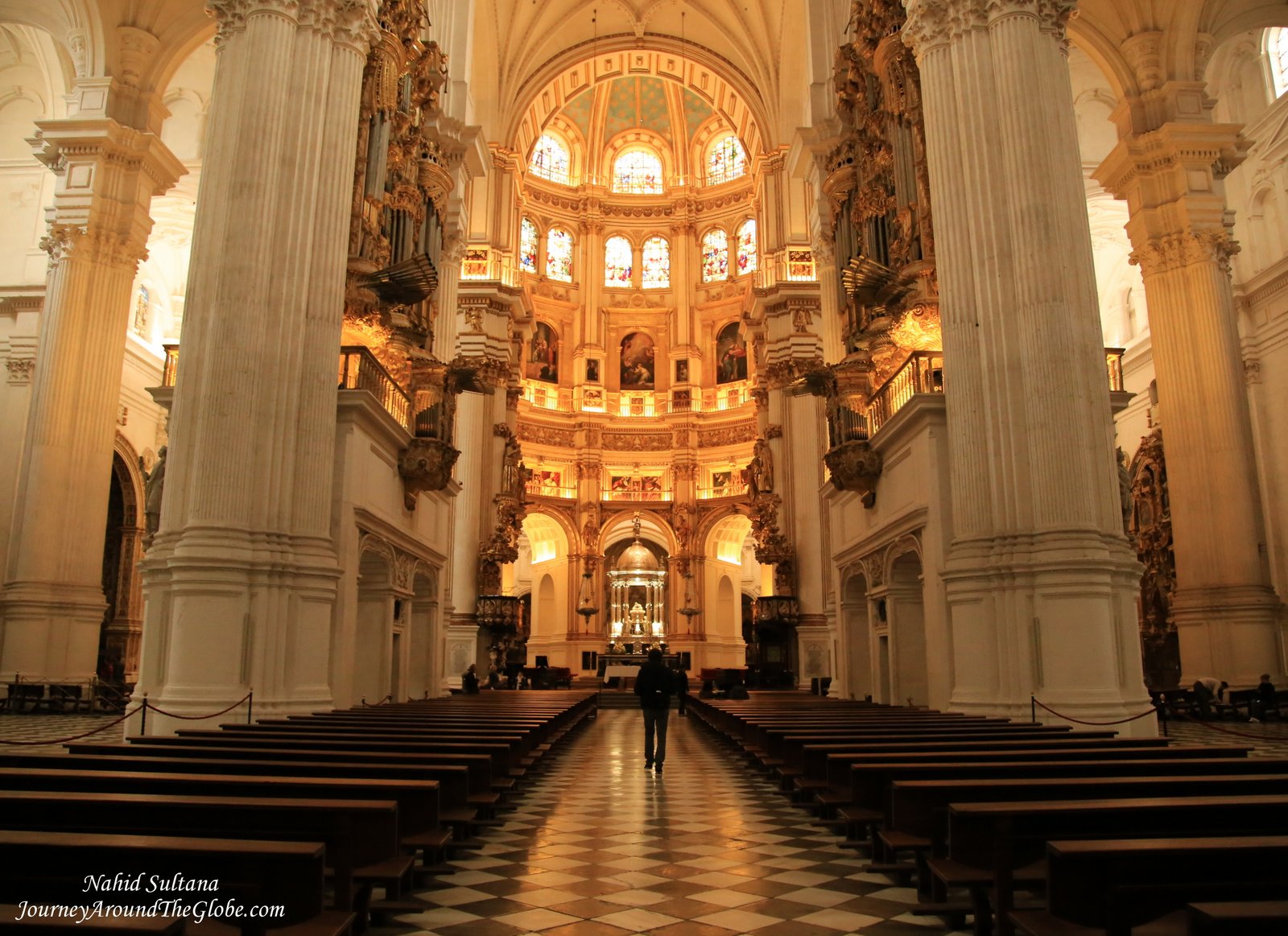
The main cathedral is the 2nd biggest one in Spain and one of the most impressive temples of Spanish Renaissance. It features elements from Gothic, Renaissance, and Baroque all under one roof. The Renaissance part of this cathedral dates back to 1522. Emperor Charles V turned the cathedral into a royal mausoleum. In the building, five naves are juxtaposed to a rotunda with a double ambulatory. It houses a central tower, royal vault, an allusion to the Holy Sepulcher in Israel, and an emblem of imperial domain. The central altar indicates a very precise ideological program: the sacred sacrament of the Eucharist irradiating over a city that was still Muslim. It’s 4 euros per adult to enter the cathedral, kids are free.
Share this:

Business Excellence Award 2020 from AI Global Media for The Most Entertaining Personal Travel Blog – Pacific Northwest USA

Top Posts & Pages


Authors
 Globe Runner
Business Excellence Award 2020 for The Most Entertaining Personal Travel Blog – Pacific Northwest USA

Business Excellence Award 2020 from AI Global Media

 Journey Around The Globe