Journey Around The Globe
ready for the next destination
Visiting the smallest town in the world – Durbuy, Belgium
DURBUY, BELGIUM: Arguably, Durbuy is (or at least once was) known to be the smallest town in the world (or may be just Europe). Situated by River Oarthe, this village of Province de Luxembourg is a charming French-speaking part of Belgium (Wallonia) with many hidden wonders. I can visit this place over and over without getting tired. This is a naturally beautiful city in the hilly area with beautiful old town and cute buildings. The village has only 14 streets and 250 inhabitants, according to one of the locals my husband spoke to.

- Charming restaurant in Durbuy, Belgium
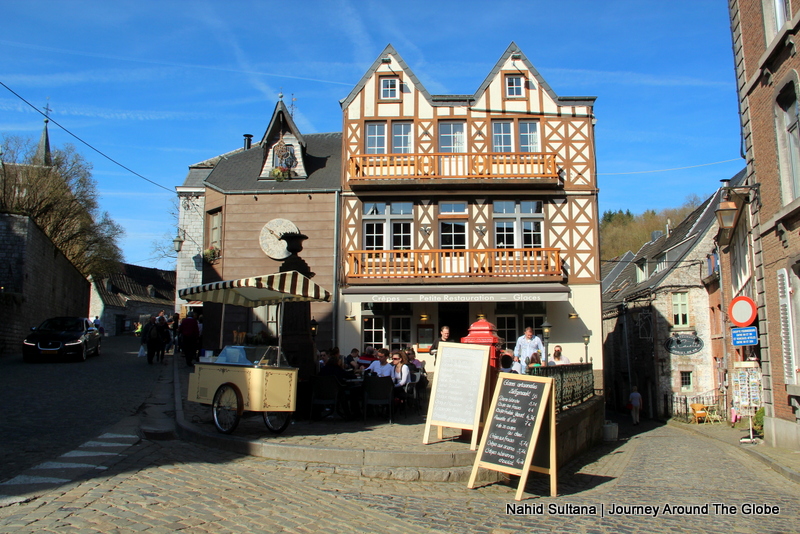
It was jam packed…I mean, seriously, heavily crowded the afternoon we visited Durbuy. We reached there after 4/5 pm and had hard time finding a parking spot or a proper parking place. I thought something was going on, but no it’s just locals, people from surrounding villages, other tourists and lots of bikers…made this tiny place a real lively spot to hangout.

- Decorative doors and windows of Durbuy, Belgium
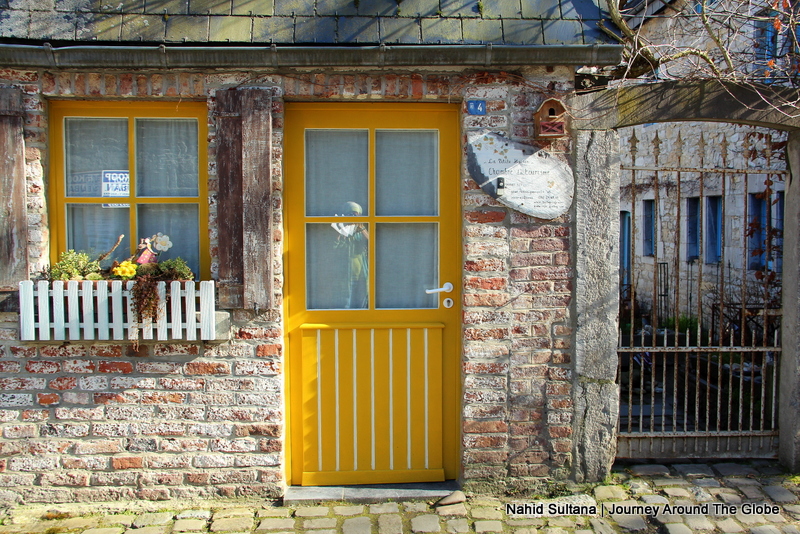
TIME of TRAVEL: It was a bright and sunny Sunday of April, 2013 when we went to Durbuy for couple hours. We first stopped at Dinant, then drove another 45 minutes to go to Durbuy. The day turned out to be a hot day and felt heavenly after a long and dark winter in Belgium.
EATING and SHOPPING: Although this is a tiny village but no shortage of restaurants and cafes…they are everywhere. City center or the main square of the village has tons of them lining at one side.
Durbuy has some nice small boutique stores at many corners of pedestrian zones. They looked so nice and cute from outside…too bad we didn’t have enough time to fulfil my heart.
PLACES WE’VE VISITED: This is not only the smallest town in the world, but also one of the prettiest. Durbuy is a popular destination for kayaking. We saw plenty of stores renting out kayaks. Other than the following mentionable places, whole city of Durbuy is very beautiful and scenic. Roaming around small alleys of old town is pretty cool. A walk through the old town is a must for every visitor. We spent some near a small park by the river at the end of the day.

- Old stone houses in Durbuy, Belgium
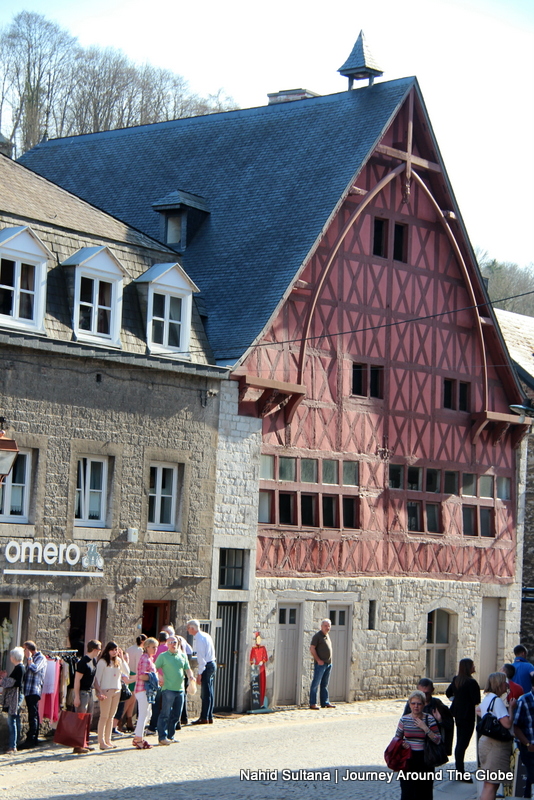
1) ST. NICHOLAS CHURCH: This is a small and simple church very close to the chateau. Interior and exterior of the church show the age of this place. You can tell it has been standing here for centuries.
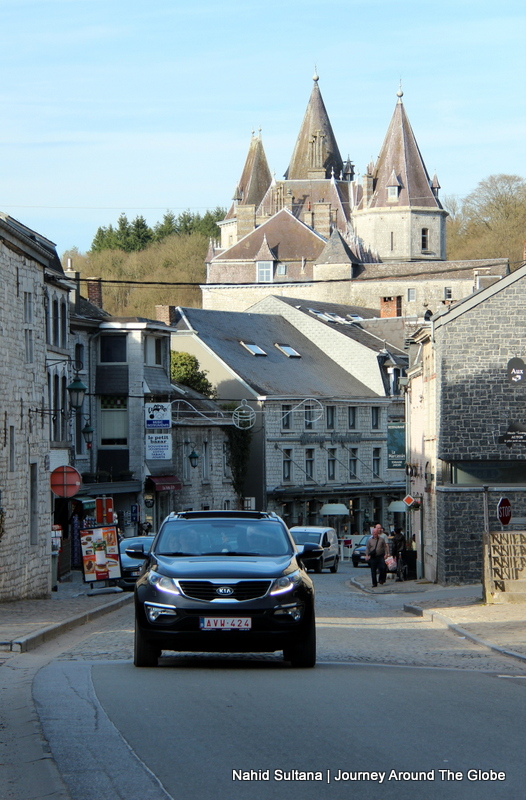
2) LE CHATEAU: The castle was built around 1880 and is located at the heart of the city. Tourists are not allowed to go in but the bold architecture is definitely admirable.

- Durbuy Chateau in the back
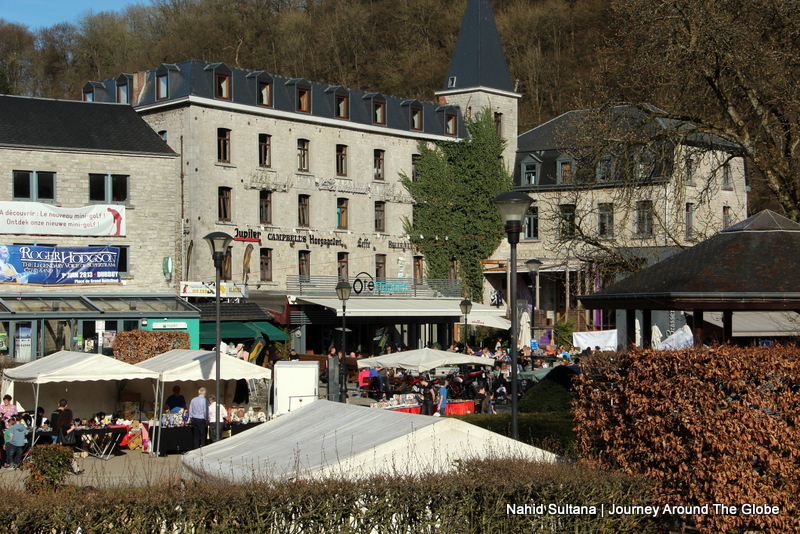
3) CITY CENTER: Located at foothill of a small hill, city center is the hot spot of Durbuy. Many restaurants and shops can be found here. They had a nice antique market here during our visit. Most of the crowd gather here for meeting, hanging out, and watch the world go by.

- Looking over city center of Durbuy, Belgium
Related articles
- Wallon capital of Belgium – Namur (journeyaroundtheglobe.com)
- Another seedpod (francobolli666.wordpress.com)
- Easter (francobolli666.wordpress.com)
- Some chocolate facts (journeyaroundtheglobe.com)
- The Belgian Army (ww1history.wordpress.com)
Share this:

Easter Break 2013 – Trip to Sofia, Bulgaria
SOFIA, BULGARIA: Sofia is a city with heights and contrast, lot of ancient history surrounded by contemporary look. It is the capital and the biggest city of Bulgaria. You can see a unique combination of European and Communist style architecture in the city center. The motto of the city “It grows, but never ages” really matches the culture of it. Surrounded by Vitosha Mountains, Sofia is one of the most scenic cities of Balkan region and in Eastern Europe.
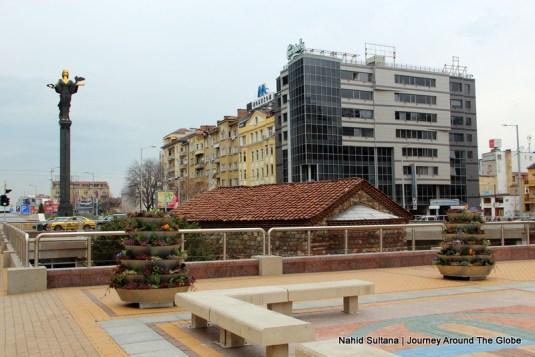
- City center of Sofia, Bulgaria…Statue of St. Sofia on the left
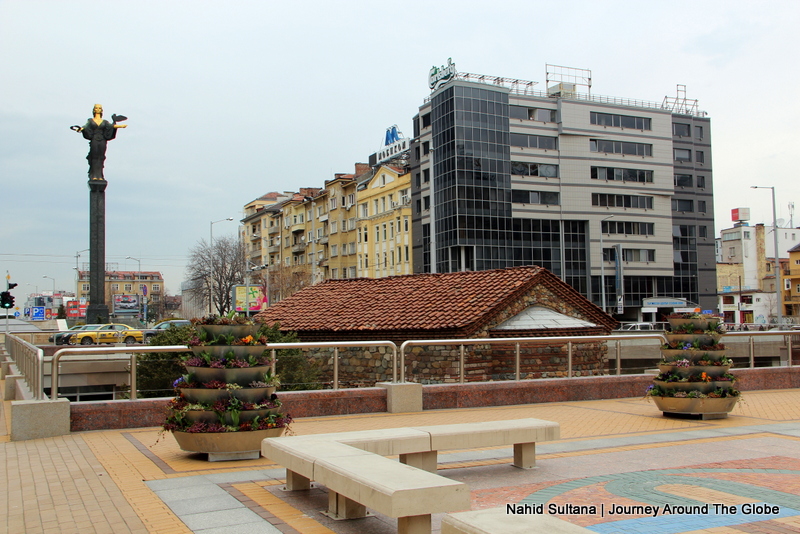
Most of Sofia’s main sights are centrally situated and can easily be visited on foot. City offers free walking-tour for its guests. Just be cautious when crossing the roads since I hardly saw any zebra crossing here, most of the time you have to use underground tunnels or subway stations to go to the other side of the streets. To make it easy on the travelers, all of the major attractions are very well marked and is provided with information boards written in both Bulgarian language and in English. For those who like updating their Facebook statuses every now and then, it’s great to know that most of Sofia’s shops and restaurants have free Wi-Fi.
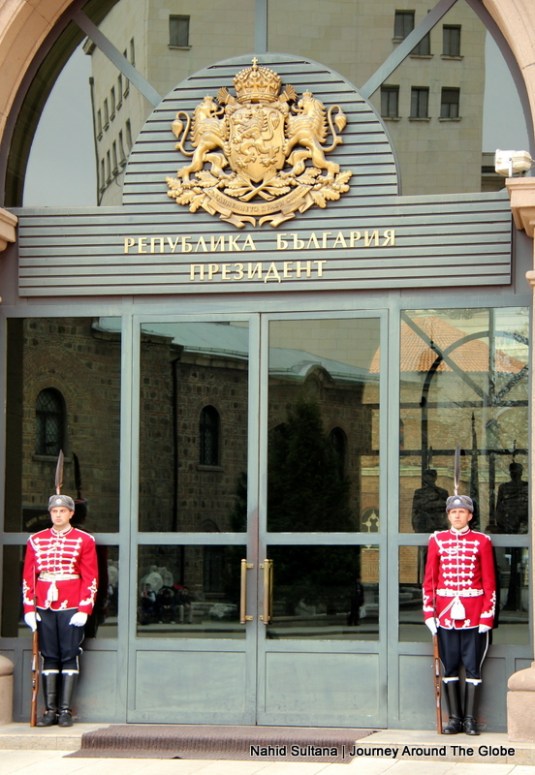
- Guards standing in front of a gov’t office in Sofia, Bulgaria
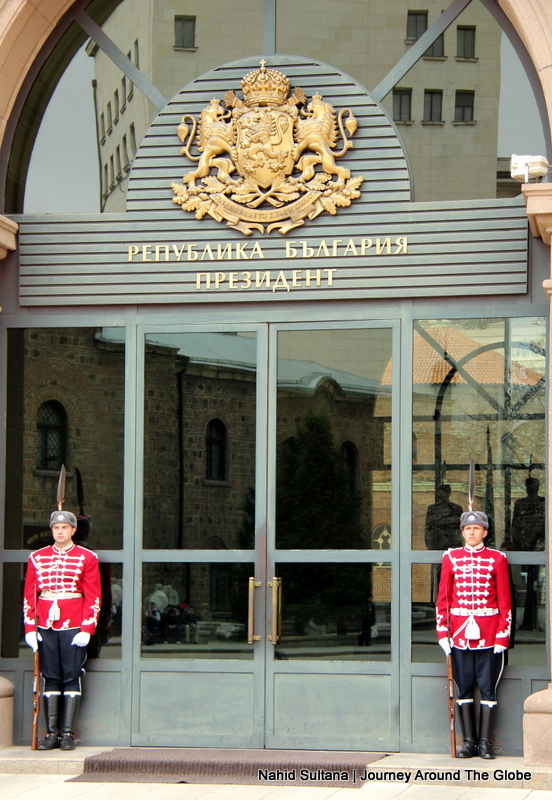
TIME of TRAVEL: Sofia was our 2nd destination on our Easter Break trip of 2013, after visiting Kiev in Ukraine. It was during the first week of April when we came to Sofia. It was absolutely fantastic weather here…not as cold as Kiev and not too hot either. We got a little bit of drizzle once in a while but no major rain.
OUR HOTEL: Our hotel in Sofia, Hotel Maria Luisa, was a beautiful 4-star hotel situated within walking distance from the city center and Metro station “Serdika”. It’s a very cozy hotel with luxurious living style and extremely helpful staff. We had free breakfast every morning with many options and free Wi-Fi to stay connected with everyone.
EATING and SHOPPING: Bulgarian cuisine is a mixture of Slavonic, Greek, and Turkish. There are many trendy cafes and restaurants in the city center with outdoor seating when the weather is nice and warm. There are also McDonald’s, KFC, Subway, and other local fast food restaurants for quick meals.
Bulgaria is known for its roses. They have valleys of roses few hundreds km away from Sofia. Therefore, rose products are popular souvenirs. You can find rose flavored soaps, lotions, body spray, bath salts, and etc. in any shops.
PLACES WE’VE VISITED: We spend about a day and half in Sofia dedicated just to explore the city. Other than the following major attractions, we have also visited these places from outside or just passed by them: Levski Square Monument, National Library, Sofia University, Bulgarian Parliament, Tsar Monument, war memorial, Orlov Most, and Court of Justice. They are definitely worth visiting if you can spare time and good thing is that they are all close to each other.
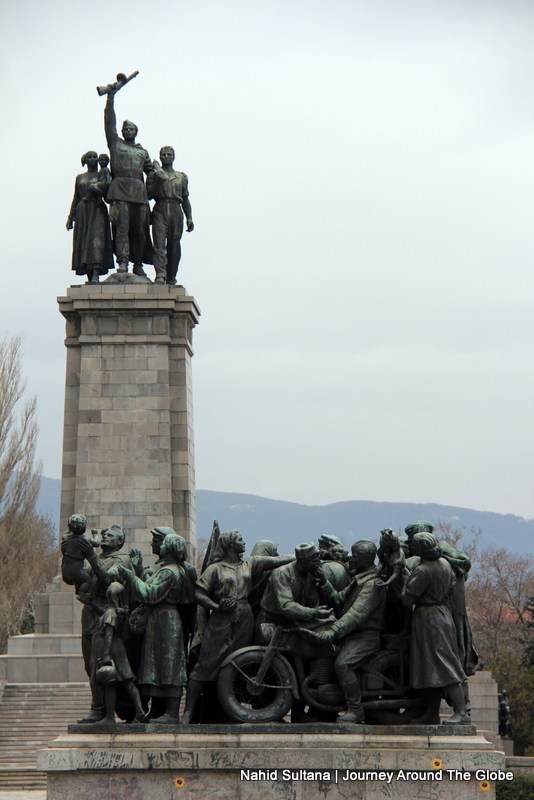
- A War Memorial while roaming the city in Sofia, Bulgaria
1) ALEXANDER NEVSKY MEMORIAL CATHEDRAL: This massive cathedral with big gilded dome is number one attraction of Sofia. Construction of this remarkable piece of architecture was completed in 1912 in memory of the thousands of Russian, Bulgarian, Ukrainian, Moldavian, Finnish, and Romanian soldiers who, from 1877 to 1878, laid their lives for the liberation of Bulgaria from the Ottoman Empire. Inside the cathedral is decorated with 300 dramatic murals featuring many Biblical scenes and important saints of that time. Vaulted ceilings, high copula, Venetian mosaics, and huge chandeliers are superb. Main focus of this cathedral is the richly decorated façade. Interiors of the cathedral recalls the shapes of the decoration of the Hagia Sophia church in Istanbul and Roman traditions. Marbles, Brazilian onyx, and alabaster made its interior a marvelous place to visit. As one may expect, this is not a typical cathedral with rows of seats, main nave, and big altar. There are some benches on the sides but the floor in front of altar is just a big open space.
Area around the cathedral is the largest square in the city for welcoming foreign dignitaries, such as Pope, presidents, and etc.). Visitors can buy souvenirs, antiques, arts, and many unique things in the open air market here.

- Exterior and shinning domes of Alexander Nevsky Memorial Cathedral in Sofia, Bulgaria
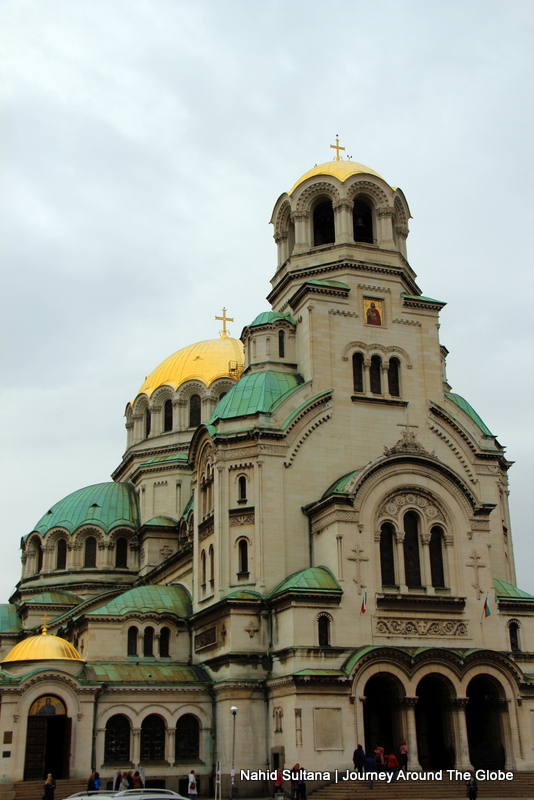
The cathedral is located opposite of St. Sofia Cathedral and in front of International Art Gallery. Although there are signs that taking picture is not allowed inside, but I saw everyone was doing it and no one really says anything. The crypt is located on one side of the main entrance and is open from 10 – 5:30.

- Inside Alexander Nevsky Memorial Cathedral in Sofia, Bulgaria
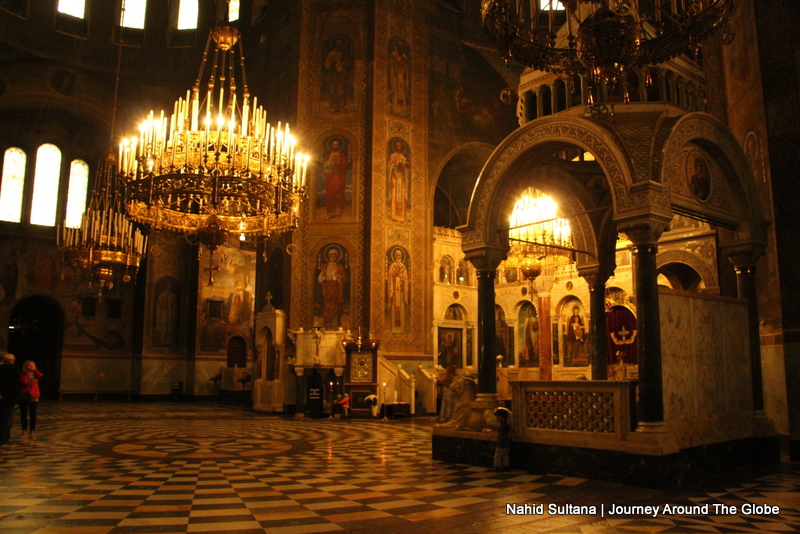
2) ST. SOFIA or HAGIA SOFIA CHURCH and MONUMENT to the UNKNOWN SOLDIER: St. Sofia’s Church is the most notable church and a valued cultural monument in whose honor the city was named after in the 14th century. It was built in 565 AD under Byzantine Emperor and was used as a mosque during the Ottoman rule. Interior, mainly built with stones, is small but nice.
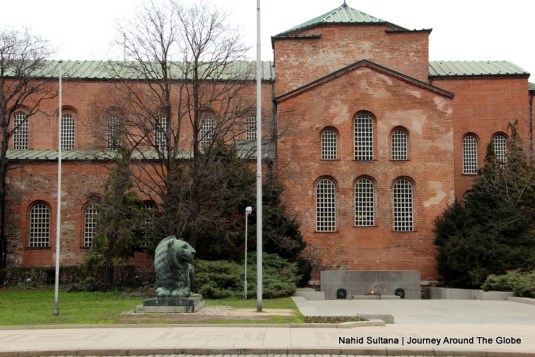
- One side of St. Sofia Church where Monument to an Unknown Soldier is located in Sofia, Bulgaria
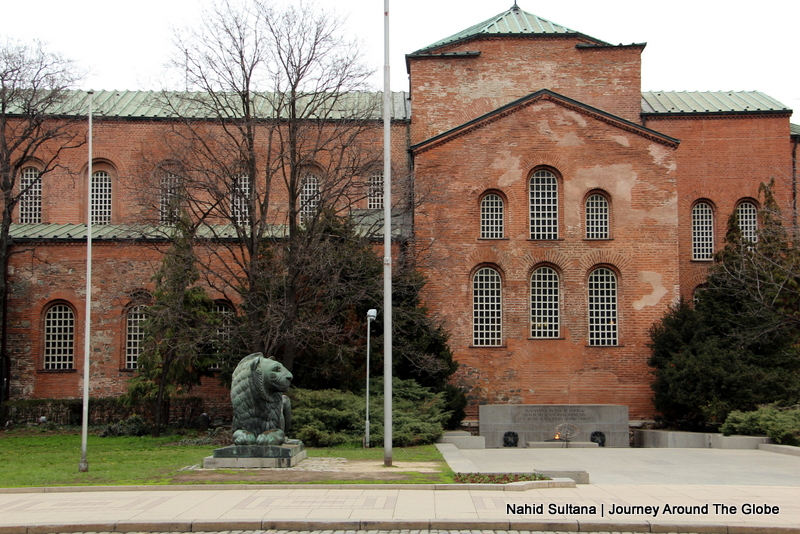
Just outside the church is the lion sculpture and an eternal flame of the Unknown Soldier which was unveiled in 1981. Both of the monument and the church is located across from Alexander Nevsky Memorial Cathedral and in front of City Hall of Sofia. There is no fee to enter the church.
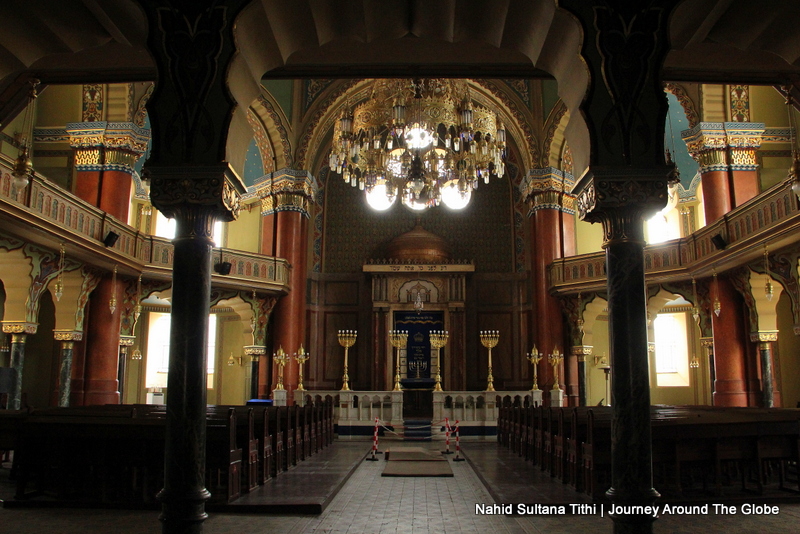
3) SOFIA SYNAGOGUE: This is one of the largest synagogues and the largest Sephardic synagogue in Europe. This beautiful architectural monument is known as Bulgarian National Romanticism. It’s really gorgeous inside with Venetian polychrome mosaic floor, ornamented walls, big circular dome, and decorative furniture. Remarkable is the main chandelier, weighing two tons, the largest one in Bulgaria. There is a small museum representing the history and the culture of the Jewish community in Sofia and Bulgaria, but nothing was written in English.
The synagogue is located behind Municipal Hall and very close to Banya Bashi Mosque. It can be easily recognized by its big golden dome with David’s stars on top. It is 2 LV to enter the synagogue, kids are free. The synagogue is open for visitors from Monday to Friday: 9 – 4 pm and Sunday from 10 – 2 pm.

- Inside Sofia Synagogue in Bulgaria
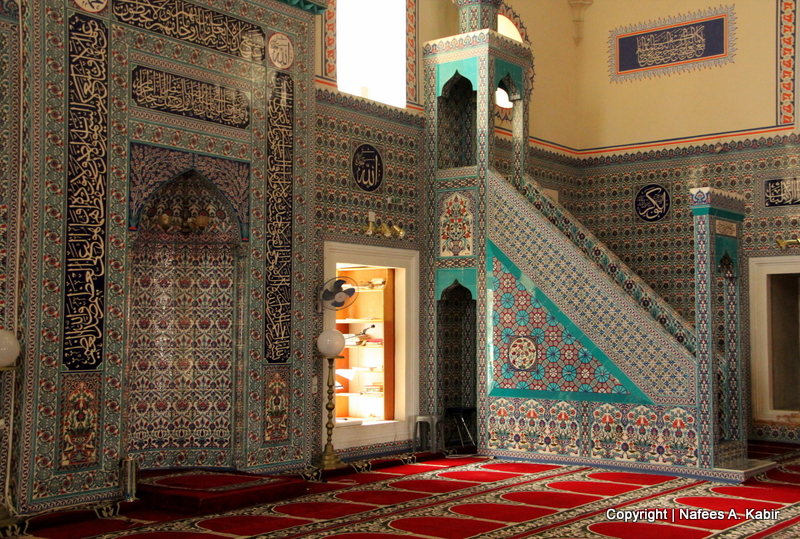
4) BANYA BASHI MOSQUE: Located very close to Sofia Synagogue, this Turkish mosque was built in 1576. The dome and its minaret can be seen from far. You can actually hear “Adhan”, calling for prayer from its minaret right before prayer time if you are walking by it. Inside the mosque is embellished with artistically inscribed citations from the Koran. Banya-Bashi Mosque is one of the few buildings, monuments of Ottoman architecture, preserved in Sofia, which is still being used by the worshippers.
There is no fee to enter but don’t forget to take your shoes off before entering the mosque. Also be mindful of the dress code.

- Banya Banshi Mosque from the time of Ottoman Empire in Sofia, Bulgaria
5) ST. SOFIA STATUE and SVETA PETKA or ST. PETKA: At the main intersection of the city near Metro station “Serdika” stands a 24 meters tall Statue of Sofia which was unveiled in 2001. Under the metro station, there is a small 14th century church Sveta Petka or St. Petka. This is an ancient Christian monument which is still active. Inside is a bit dark but you can see its well-preserved frescoes from different periods. Climb the stairs to go to the 2nd floor to see a tiny chapel. There is no fee to enter the church.
6) ST. GEORGE ROTUNDA: This is a charming round red brick church dating back to 4th century (from the time of Emperor Constantine The Great), the oldest architectural monument in Sofia and the only building city preserved. The roof dates as far back as the Roman Empire. The frescos can still be seen inside the church which dates back to the 10th century. It’s a small church with small altar with really old walls and copula. This was also used as a mosque at one point of history. It’s located behind Sheraton Hotel near the Statue of St. Sofia. There is no fee to enter but no photos once inside the place.
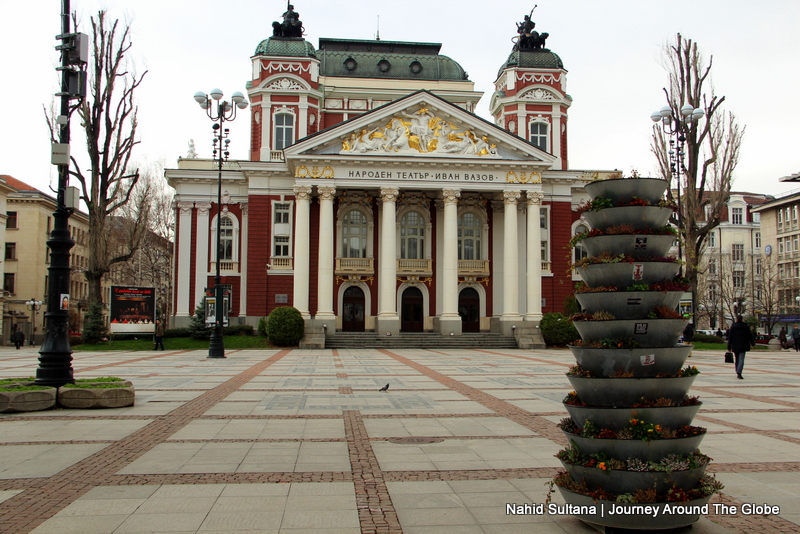
7) IVAN VAZOV NATIONAL THEATRE: This is a beautiful maroon and white building surrounded by a big park in front for walking and strolling. The two towers are decorated with copper sculptures of Goddess Nike and the façade is decorated with a large triangular pediment with a mythological relief of “Apollo and the Muses”. Atmosphere near the theater is nice, you can hear live music when the weather is warm. The fountain in front of it wasn’t open when we visited but I can imagine its beauty when they reopen it in spring.

- Ivan Vazov National Theater in Sofia, Bulgaria
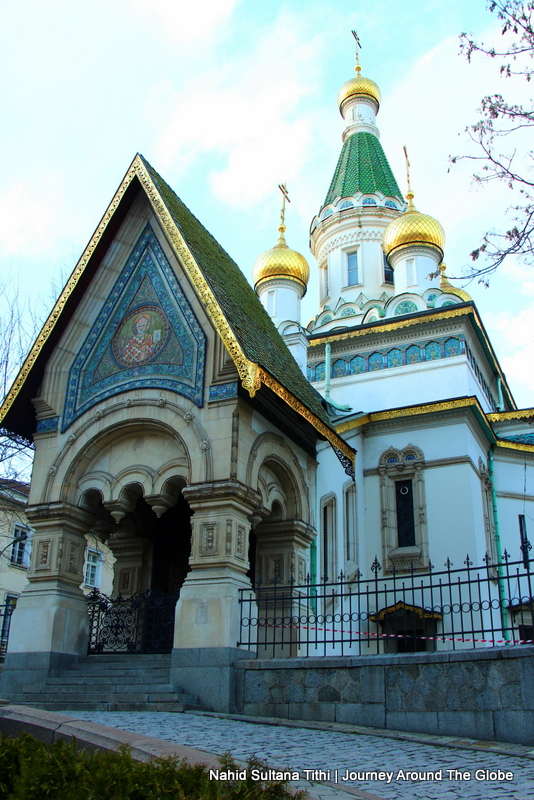
8) ST. NICOLAI RUSSIAN CHURCH: This church was built in 1914 at the site of the Saray Mosque which was destroyed in 1882. It has a typical Russian medieval style in the shape of a marquee. It’s a very small but beautifully ornate church with five golden onion domes. Church was under major renovation during our visit. There is no fee to enter and is open from 8 – 6:30.

- St. Nicolai Russian Church in Sofia, Bulgaria
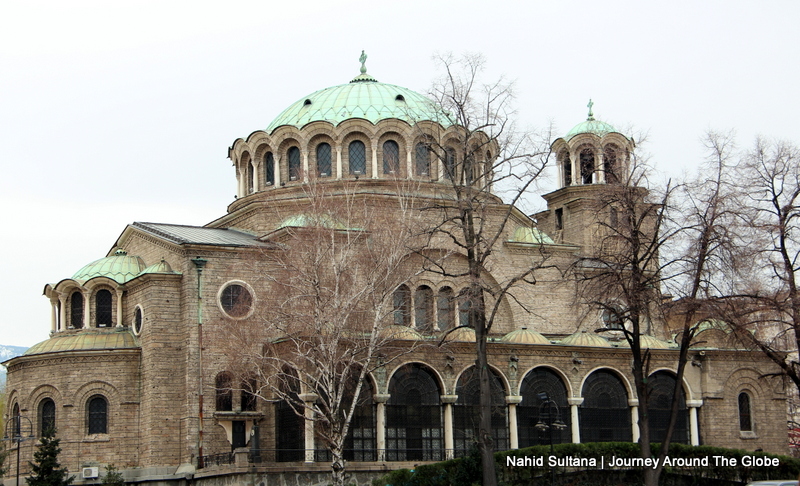
9) SVETA NEDELJA or HAGIA NEDELJA CHURCH: This is another bold architecture of Sofia in the main city center surrounded by busy streets, many shops, and cafes. It has been standing there since the 10th century. Interior is very old with high dome and richly ornate. It’s free to enter and to look around but have to pay a fee and take permission to take photos inside.

- Sveta Nedelja Church in Sofia, Bulgaria
10) TRIP to BOYANA CHURCH: This ancient church is located about 6 miles (10 km, took us about half an hour) from the city center at the foothills of Vitosha Mountains. This is considered to be one of the most valuable memorials of Bulgarian and European culture. This is an 11th century church that has undergone major restoration and is now open to the public. The remarkable realistic frescoes are acclaimed as “the best examples of Eastern medieval art” with the earliest murals dating back to 1259…these frescoes are considered as predecessors of European Renaissance. These paintings belong to the masterpieces of Bulgarian Medieval art. It was added to UNESCO World Heritage Site for its historic significance and cultural value. The park and the garden are very calm and serene with lots of trees and some scattered old ruins.
We took a private taxi (our hotel receptionist’s friend) to take this trip to Boyana Church. He charged us 60 LV (~30 euros) for this 1 1/2 hours trip. It’s 10 LV to enter the church (kids free). They only allow 8 people at a time and visitors can stay for 10 minutes inside the church, which was more than enough for us. The church is open every day from 9 – 5:30 pm from November 1 to March 31 and 9:30 – 6 pm from April 1 to October 31.
Related articles
- Bulgaria protests: New self-immolation in Sofia (danubeinstitute.wordpress.com)
- Living an Adventure in Bulgaria (bulgarianow.wordpress.com)
- Stunning frescoes in Bulgaria’s Boyana Church (bulgarianow.wordpress.com)
- Emergency shutdown at Bulgarian nuclear plant (bulgarianow.wordpress.com)
Share this:

Some chocolate facts
My uncle-in-law from Chicago, Illinois is here in Belgium now. He is not a novice when it comes to Europe. He lived in The Netherlands for couple years and he toured all over Europe due to his work purpose for the past few decades. We went to Brussels city center in Grand Place past weekend and took him to “Museum of Cocoa and Chocolates” which was our first time too. After all, you can’t leave Belgium without knowing the history of chocolate and why it’s so popular in Belgium, right?
It’s a cozy museum with few levels to explore. We saw man demonstrating how chocolate shells are made with different types of fillings and making of variety shapes of chocolates that we see in the stores beginning of the tour. At the end of the demonstration we got a chance to actually taste some of those heavenly dark chocolates with chocolate ganache inside.
It was a fun and educational museum for all of us. I wanted to share some facts on chocolates, especially Belgian chocolates from that museum.
1) Thousands of years ago, Mayas and Aztecs were first to cultivate cocoa trees in Central and South America.
2) For Europeans, the history of cocoa begins in 1502, the fourth voyage of Christopher Columbus to America.
3) First trace of chocolate in Belgium dates back to 1635 in the City of Gent.
4) In 1912, Jean Neuhaus (alchemist) invented first bite sized filled chocolate, named pralines.
5) Europe alone consumes 50% of all chocolate production.
6) Ivory Coast is the number one cocoa producing country.
7) Belgian chocolate uses 100% cocoa butter, instead of vegetable fats. That’s why the quality of Belgian chocolate is appreciated through the world.
8) Cocoa contains components that stimulate both mind and body.
9) 30 grams of dark chocolates bring 22% of daily intake recommended magnesium for an adult and 23% of iron.
10) The fruit of the cocoa tree is called “Pod” and this pod-like fruit contains 30 – 40 beans embedded in a pulp.
11) Chocolate is delivered in 3 forms: drops or “callets”, 5 kilos tablets, and liquid.
Related articles
- Belgian Chocolate Makers Seek Copyright Protection From Rivals (chocolatestate.wordpress.com)
- Chocopolis (cristainbrussels.wordpress.com)
- Belgium! (rota2013.wordpress.com)
Share this:

Bits and pieces on Kiev, Ukraine
KIEV, UKRAINE: Situated by River Dnieper, Kiev is the largest city in Ukraine. After the fall of Soviet Union in 1991, Kiev became the capital of Ukraine. This is also ONE OF THE OLDEST cities in Eastern Europe dating back to 5th century. The city was pretty much destroyed when former Soviet Union was invaded by the Germans during WWII.
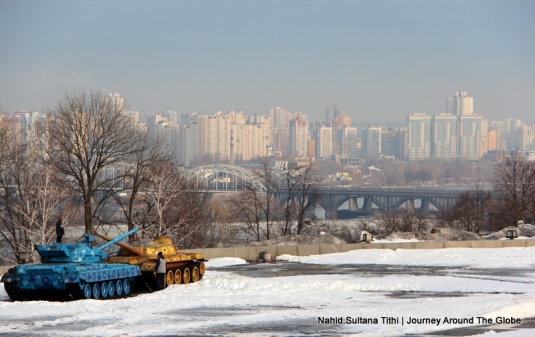
- Kiev skyscraper as seen from Motherland Statue

I didn’t want to be judgmental but my first impression of Ukrainians were that they were a bit unfriendly. But that thought changed as we interacted more with the locals. The locals are very helpful if they can properly communicate with you. Most of them barely speak English, but they try to help tourists as best as they can.
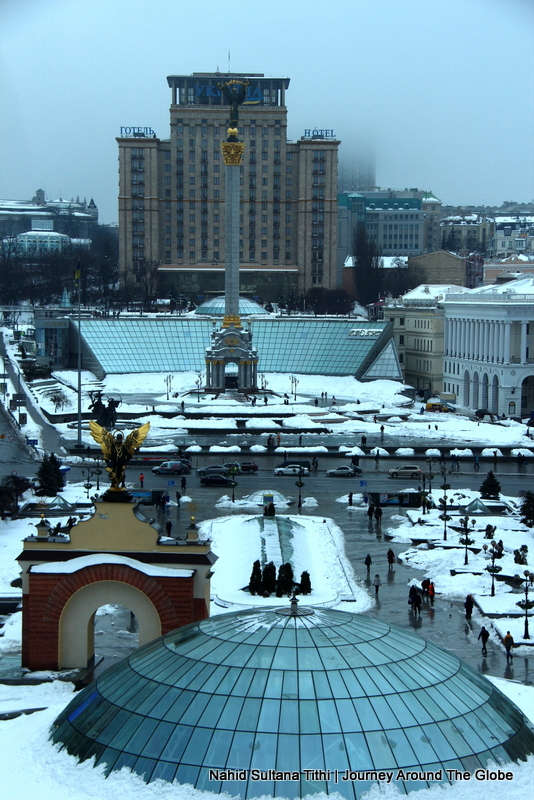
- Independence Square from our hotel window in Kiev, Ukraine
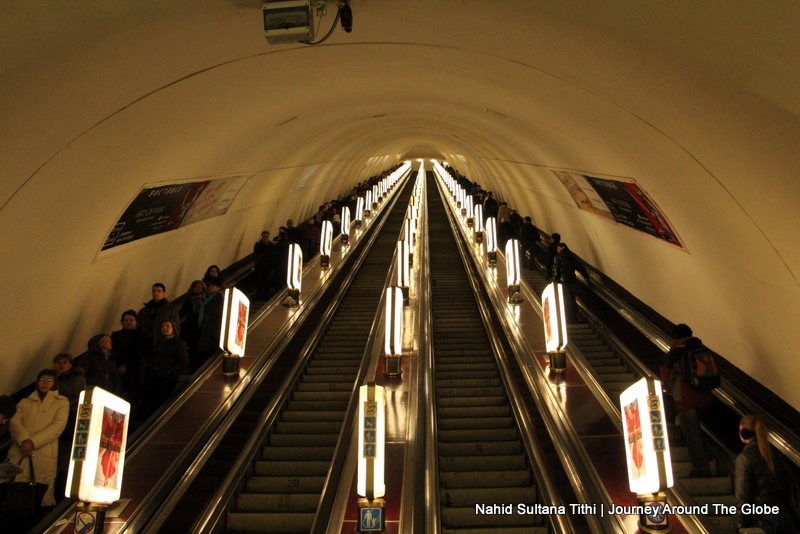
For transportation, Metro is probably the best way to get around. Look for the big green “M” sign for Metro stations. We paid only 2 UAH to enter the platforms to go anywhere. Some taxis go by meters, but with some, you may have to bargain. Another way to get around from upper town to the lower town near the river is the funicular. It costs 1.5 UAH per ride and the ticket station is behind St. Michael’s Church. Funicular is open from 7 am – 10 pm in weekdays and 8 am – 10 pm in weekends. It takes you down the small mountain and in Podil which is a hip area with many restaurants and shops.
TIME of TRAVEL: We flew to Kiev during Easter Break of 2013 at the very beginning of April. Temperature on the day we arrived and the next day were very low…either freezing or below freezing. But luckily, the last two days turned out to be a bit warmer and sunnier.
OUR HOTEL: We stayed in an apartment style hotel in the heart of Kiev, called “Khryschatyk Business Suites”. They have few different locations in the city center and ours was located right off of Independence Square. Along with a bedroom, a family room, nice bathroom, and a kitchen, we also had a great view of Independence Square right from our 6th floor apartment. There was no breakfast, but had free Wi-Fi.
EATING and SHOPPING: Other than pizza, shwarma, McDonald’s we had lunch in one fancy Ukrainian restaurant on our first day, name “Spotykach”. Borsch is a popular soup that I saw here and in couple other restaurants which is made from beet combined with some meat. We ordered some pumpushkin (Ukrainian breads) with the soup that came with 3 different types of yummy spreads. Also Ukrainian pancakes are very filling and good too, you can find these pancakes almost everywhere in Eastern Europe. I ordered my pancake with zucchini and sour cream…it was fantastic. Overall, food is very reasonable here compare to other European countries, I guess because they don’t use Euro here. You don’t have to empty your pocket to eat in a good restaurants in Kiev.

- Ukrainian zucchini pancakes in Kiev

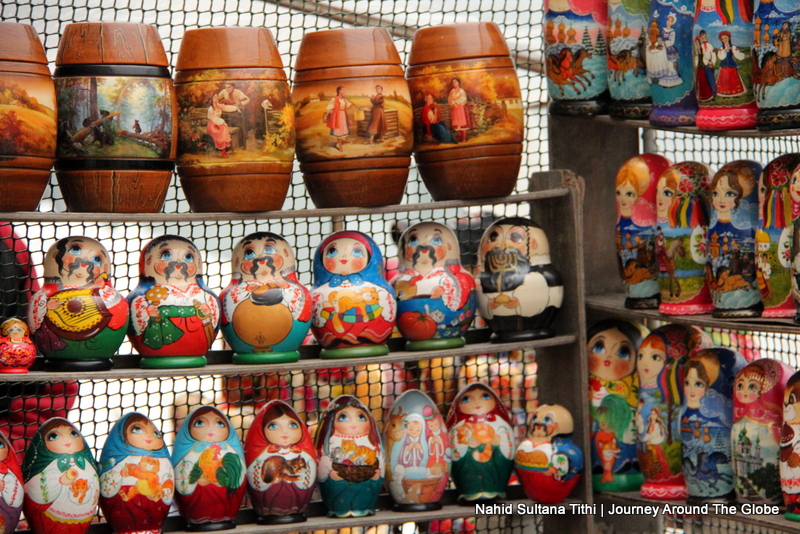
Since Ukraine was under Soviet Union once, many souvenirs have Russian influences, like Russian dolls and other trinkets. Russian dolls, known as “Matrioshka”, are very popular here. They can be cheap or expensive depending on the design and how many pieces they come with. The one we got had 10 pieces and we paid about 250 UAH. We saw many other traditional dolls in the stores too. Also colorful flowery wooden bowls and cutleries, jewelry boxes are beautiful to take back home. Scarves, embroidered tunics are almost everywhere too. There is also a big underground mall in Independence Square…very nice and has lots of brand name stores with a big food-court. Khryschatyk Street is a long stretch of shopping street that runs in the main city center near Independence Square. The street is very lively and crowded during weekends…a good place to just wander around.
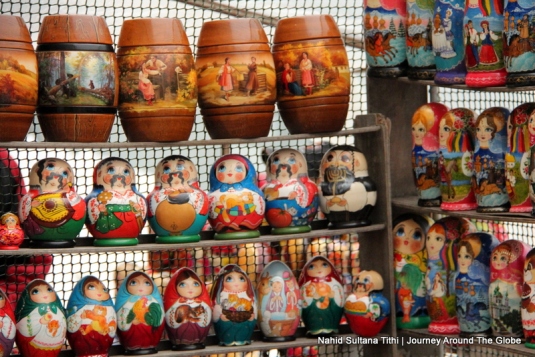
- Russian dolls “Matrioshka” in Kiev, Ukraine
PLACES WE’VE VISITED: The following places of Kiev we have visited were done in three days. Most of them we did it on foot while some were with metro.

- L-O-N-G stretch of Kiev’s escalator in subways
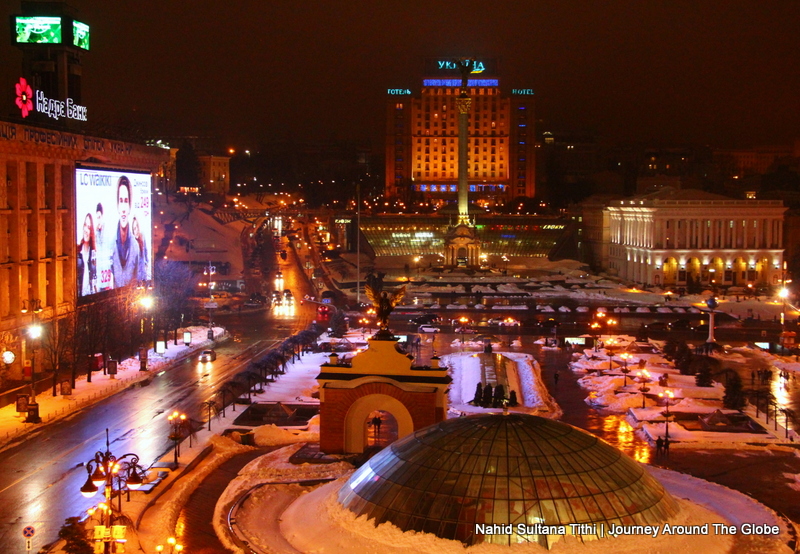
1) INDEPENDENCE SQUARE or MAIDAN NEZALEZHNOSTI: Located on Khryschatyk Street, this is the main square and center of Kiev where you can spend hours roaming around. Independence Square is where Ukrainians met for protests many times in history. This is a beautiful and busy place to hang out day or night. “Monument in Honor of Independence of Ukraine” stands across the street on one end of this square and from the other end you can see green domes of St. Sophia’s Cathedral on Sofiyas’ka Street. Don’t forget to go to underground mall for good food and cool shopping.
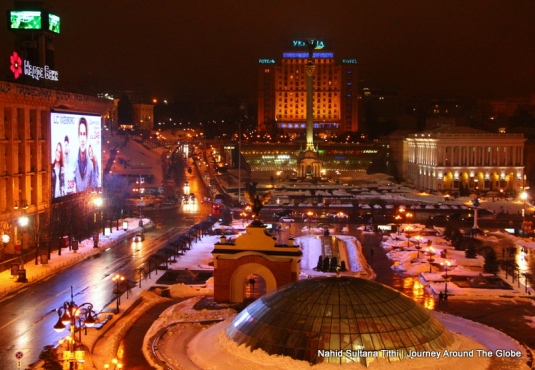
- Night view of Independence Square in Kiev, Ukraine
2) ST. SOPHIA’S CATHEDRAL and MUSEUM: St. Sophia’s Cathedral is a beautiful center-piece in the City of Kiev. This is the oldest remaining church of the city and an UNESCO World Heritage Site. This 11th century architecture has been preserved almost intact. It was built by the Greeks and is an orthodox church.
Whole ground of this monastery is secluded with a boundary. Uniquely designed turquoise and white designed Bell Tower and the gilt copper entrance door to the cathedral are both from the 18th century. You can’t miss the sparkling multiple green domes when standing out in the square. The statue in the square where St. Sophia’s Cathedral stands is a statue of Bodhan, who was liberated Ukraine in the 17th century.
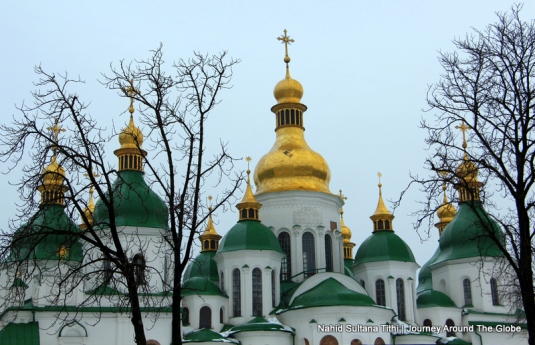
- Domes of St. Sophia’s Cathedral in Kiev, Ukraine

St. Sophia’s Cathedral has world’s BIGGEST ensemble of FRESCOES and mosaics from the 11th century revealing ancient exposed masonry. Some of old mosaic floors have been preserved in fragments. The present cast-iron floor slabs were laid in the 19th century. Some wall paintings from the 11th century, mosaics, and about 3000 sq. meters of fresco were preserved very mannerly and still can be seen inside the cathedral. Gorgeously decorated altar is the focal point and high dome with rich color frescoes are very eye-catching. We were told that builders used gold for all the mosaics here.
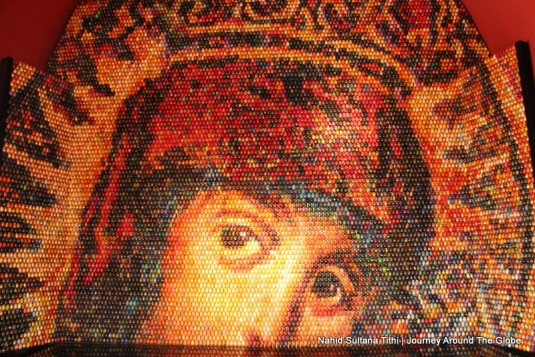
- This artwork inside St. Sophia’s Cathedral was created by 15,000 hand-painted Easter eggs
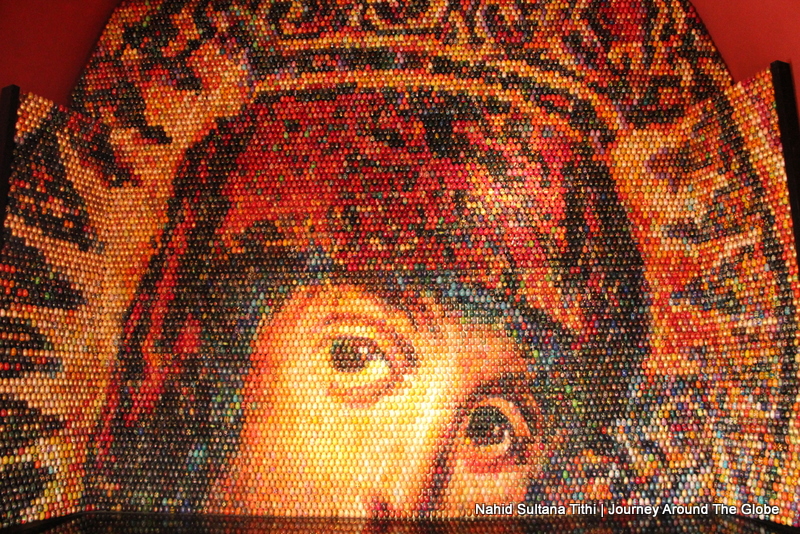
Metropolitan’s Residence of this cathedral is place, which is open to public now, was primary residence of the Father of the cathedral in the 18th century. You can see many decorative fireplaces and stoves here along with some old frescoes. It is considered as an outstanding and a historical monument of Ukraine. Refractory of St. Sophia’s Cathedral is another building in the monastery where you can see some old ruins, mosaic arts, and paintings. Nothing is written in English here but it’s a nice place to look around.
St. Sophia’s Cathedral is within walking distance from Independence Square and St. Michael’s Monastery. The museum and cathedral are open daily from 10 – 6 pm and 10 – 5 pm on Wednesdays. During winter, from November to April, it’s closed on Thursdays. Just to enter the territory, visitors must pay 3 UAH and 10 UAH extra to go top of the Bell Tower. General ticket, which includes admission to the territory, St. Sophia Cathedral, Refectory, and the Metropolitan’s Residence…the fee is 53 UAH for adults and 23 UAH for children. Visitors cannot take photos inside the cathedral; there are few green-robed ladies who sit in every corner of the cathedral and will shout if they see you clicking.
3) ST. MICHAEL’S GOLDEN-DOMED MONASTERY and STATUE of PRINCESS OLGA: This is a working monastery that dates back to the 12th century. The blue and white Bell-Tower from the early 18th century and the big mural before entering the monastery are eye-catching. Inside the church is very similar to St. Sophia’s Cathedral with striking and graceful mosaics. Exterior structure of the church is Ukrainian Baroque style while the interior kept its early Byzantine style. Colorful altar façade and frescoes of many saints are drop-dead gorgeous too. The place was destroyed by the Communists in the 1930s and was rebuilt in 1990s. Shiny golden domes add incredible beauty to the whole surroundings and to the monastery.

- St. Michael’s Golden-Domed Cathedral in Kiev, Ukraine
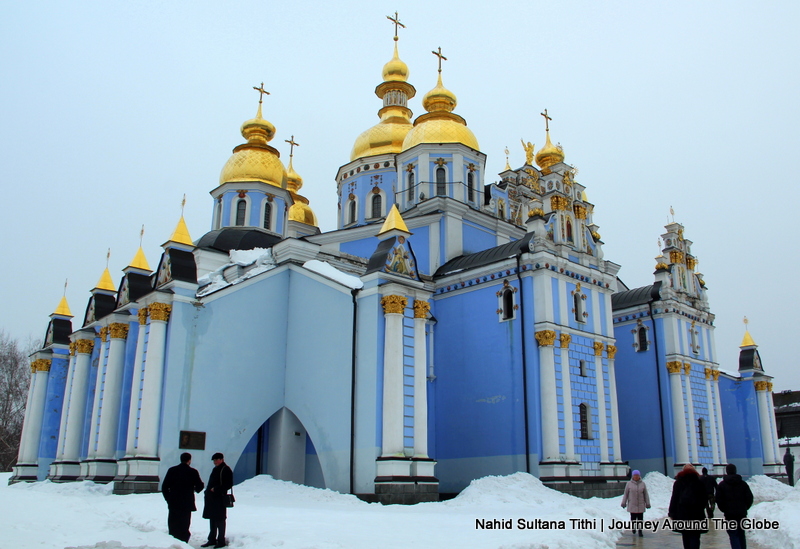
The monastery is located in Mikhailovska Square and can be seen from St. Sophia’s Cathedral. There is no entry fee to enter the monastery or the church inside. Tourists can take photos outside in the perimeter but not inside. Visitors can pay to climb the Bell Tower for a 360 view of the city.
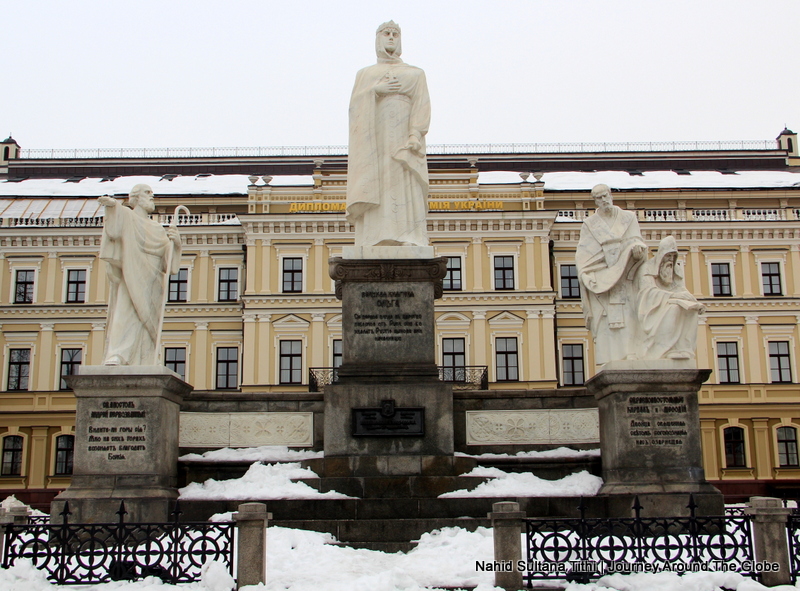
Statue of Prince Olga dominates the big square, Mikhailovska Square, in front of St. Michael’s Golden-Domed Monastery. She was the FIRST known FEMALE RULER of the country. Behind the statue is Diplomatic Academy of Ukraine and on the right side is Foreign Ministry office near the square.
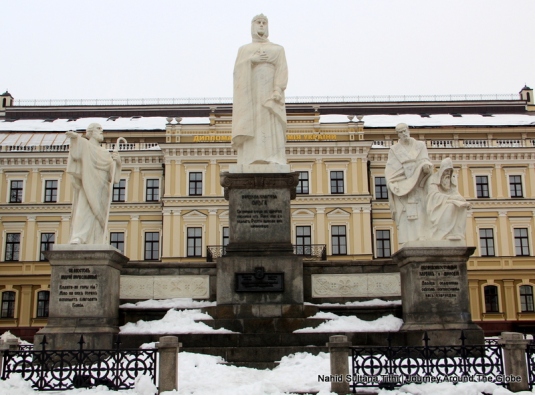
- Statue of Princess Olga in front of St. Michael’s Monastery in Kiev, Ukraine
4) ANDREW’S DESCENT and ST. ANDREW’S CHURCH: Andrew’s Descent is a rough cobblestone street; at the one end of this winding road is Kontraktova Ploshcha in Podil and the other end, at the top of the hill is St. Andrew’s Church. There are many small shops, galleries, and souvenir sellers in Andrew’s Descent and near the church. Once on top of the hill, go up the stairs to enter the church. It’s a small church but very beautiful and richly decorated with red and golden colors. You can see River Dnieper and the city from up there. There is no fee to go inside.
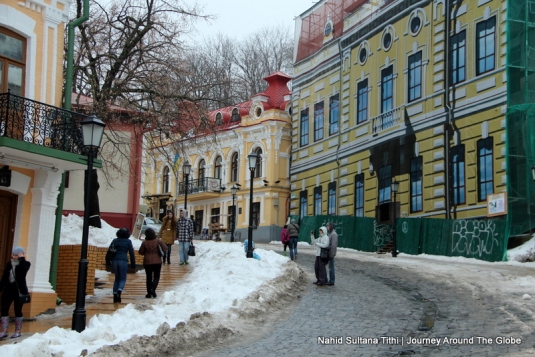
- Charming path of Andrew’s Descent in Kiev, Ukraine
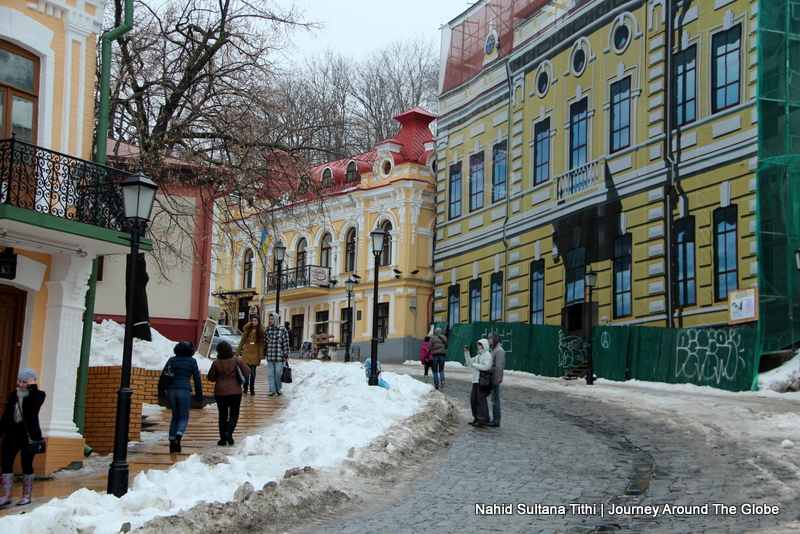
We took funicular from behind St. Michael Cathedral down to Podil then walked to Kontraktova Ploshcha and up to St. Andrew’s Church. This was a bit tiring, may be better way to do this is walk down Andrew’s Descent to Podil then take funicular up to the upper town.
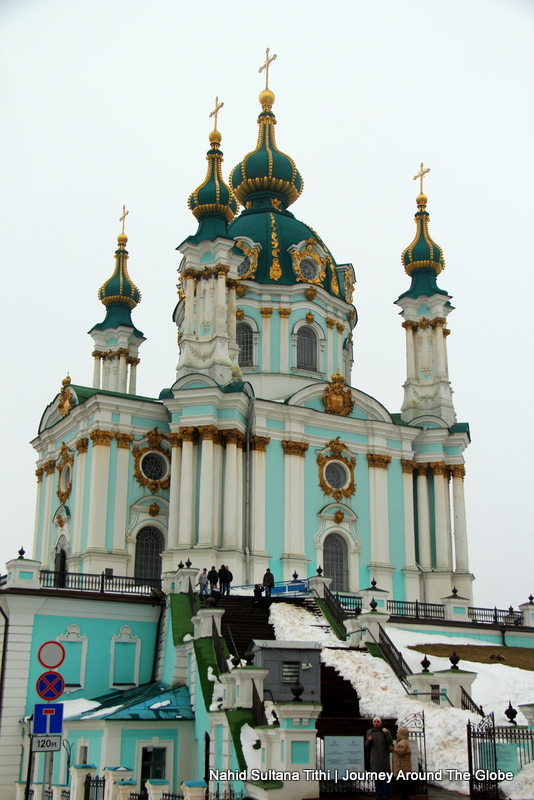
- St. Andrew’s Church in Kiev, Ukraine
5) CHERNOBYL MUSEUM: I’ve heard of Chernobyl disaster when I was very young, so going to its museum was a must while visiting Ukraine. This is a very moving museum for adults and educational for kids. This nuclear plant disaster happened on April 26th, 1986 at 1:23 am due to faulty infrastructure and machine designs. As many as 76 communities near Chernobyl plant were destroyed and evacuated after the incident. Many are still suffering even after all these years of that catastrophic event. More than 7,000 items are on displayed in the museum. Museum has pictures of many rescuers, liquidators, and authorities who helped, suffered, and died due to heavy radiation burns or side effects. Tourists can also see some of their families and material belongings. The museum isn’t very graphic as far as after effects of the burst, like mutated human beings or animals…makes it very suitable for children.
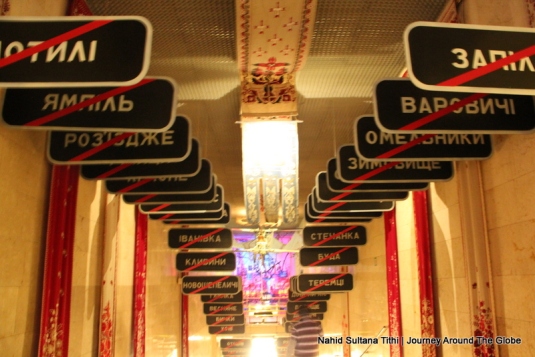
- These boards in Chernobyl Museum in Kiev show all the communities/villages that no longer exist after Chernobyl disaster in 1986

A century old fire station houses Chernobyl Museum and it can be reached via Metro at “Kontraktova Ploshcha” and then few minutes of walk from there. It took us about little more than an hour (may take longer for some) inside the museum. It’s closed every Sunday and last Mondays of each month and open from 10 am – 6 pm all other days. Entry fee is 10 UAH for everyone including kids and we also had to pay 50 UAH to use our camera in the museum. Most of the information in the display are described in Ukrainian language…we couldn’t find anything in English. Therefore, I’d highly recommend it to rent English audio guide tour which gives a lot of background and detailed information on the museum and what actually happened in Chernobyl. There is a refundable 100 UAH fee for the audio guide.
6) MONUMENT to an UNKNOWN SOLDIER: #6 to #9 are all in one area and can be done together. We got off at Metro station “Arsenalna” and started walking towards Pechersk Lavra and saw these places along the way. This is the hilly part of Kiev, therefore you get a view of the lower city from this part. A big park before arriving to Lavra has few memorials and is decorated with many beautiful statues where we saw #6 and #7.
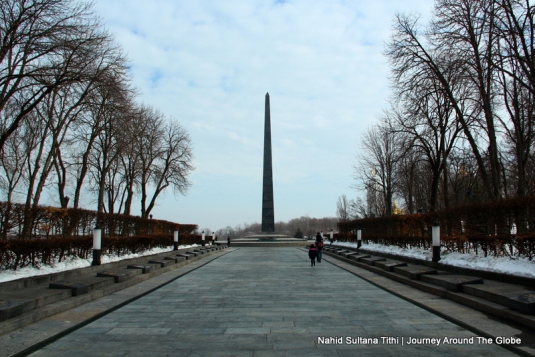
- Monument for an Unknown Soldier in Kiev, Ukraine

Monument to an Unknown Soldier was our first stop after getting out from the metro. The tall obelisk stands in the middle of an open park. Walk around the monument and you will get a nice view of River Dnieper from above.
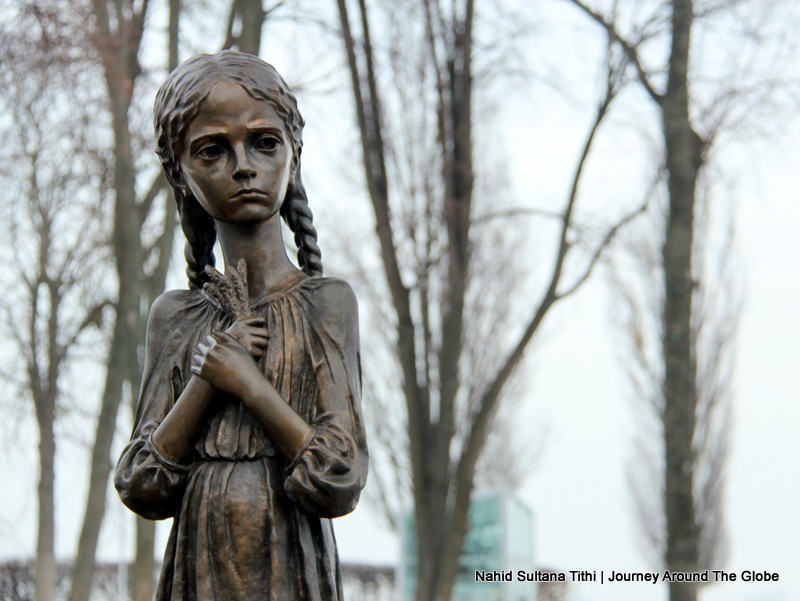
7) MEMORIAL for FAMINE VICTIMS in UKRAINE: During Soviet Union reign Ukrainian people suffered horrible tragedy/famines which took millions of Ukrainian lives. The WORST humanitarian CATASTROPHE of 20th century for Ukraine was man-made Famine of 1932 – 1933 (artificially engineered by Stalin’s regime), during which few millions of people died. A white, black, and gold memorial with a statue of a little starving girl in the front was built for all those victims. Walk pass the Monument to an Unknown Soldier and walk towards Lavra…you can’t miss it.
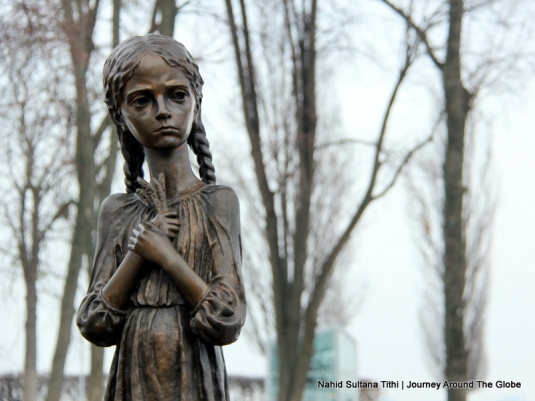
- Statue of a starving little girl in front of Famine Monument in Kiev, Ukraine
8) PECHERSK LAVRA (CAVE MONASTERY): This is one of the oldest and most important monasteries in Ukraine and former Soviet Union. It was founded in 1077. The caves in lower Lavra were dug out by the priests who lived there as hermits. Nowadays, tourists can visit these caves for free if properly dressed…but they were closed during our visit, so we missed it. This is an UNESCO World Heritage Site and definitely a must see in Kiev.
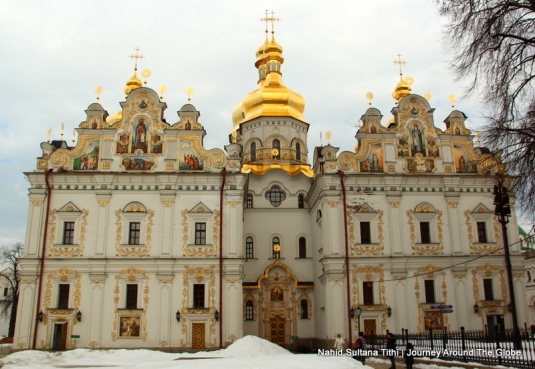
- The cathedral inside Pechersk Lavra in Kiev, Ukraine
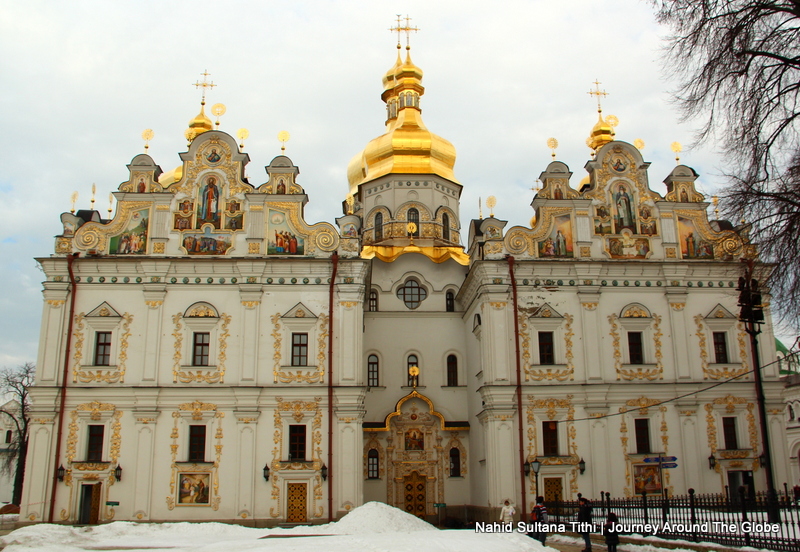
The monastery is still active and surrounded by many small old neighborhoods. This is a big compound and within the territory of Lavra you can see many golden domes and steeples shinning at every corner…some are of small chapels and some are big. We visited a small chapel of the main church near the grand Bell Tower since the main one was not accessible at that time. Many exhibitions were going on in different buildings of Lavra which are free to enter once you are inside the compound.
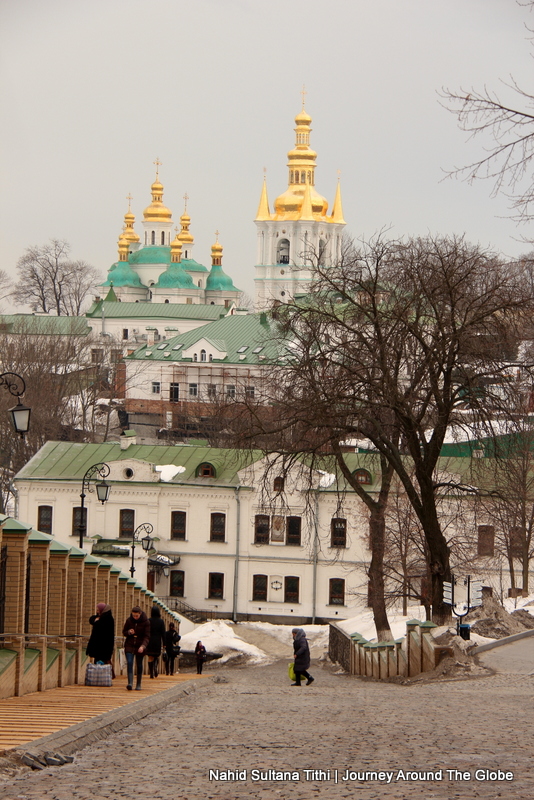
- Walking around Lavra Monastery in Kiev, Ukraine
Metro station “Arsenalna” is only few blocks away from the monastery. Opening hours are 9 – 6 pm in winter and 8 – 8 pm in summer. They are closed on Tuesdays. We paid 50 UAH per person (kids free) to enter the perimeter. It’s not strictly maintained, but visitors are not supposed to take any pictures inside any chapel…outside is ok.
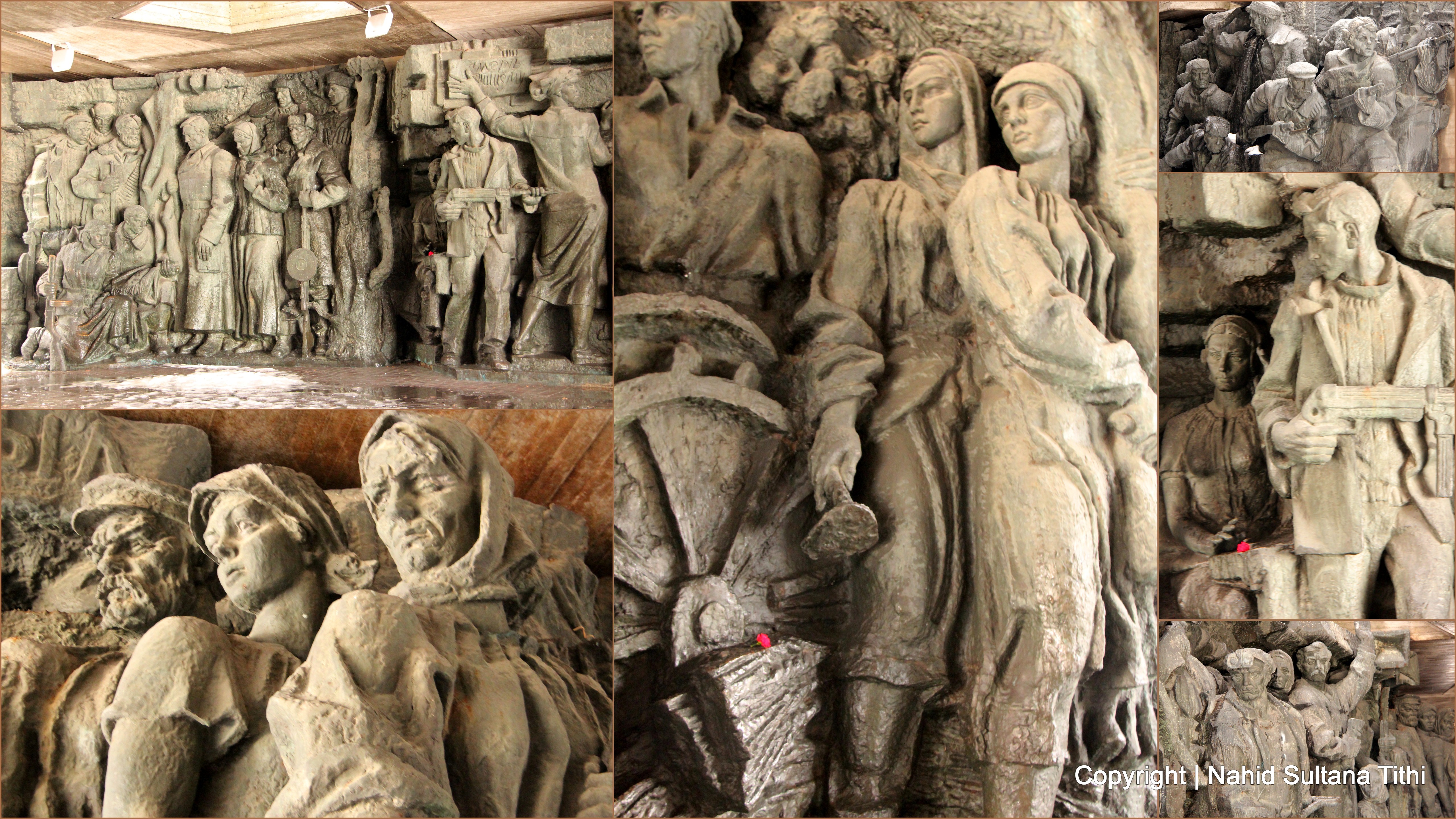
9) MOTHERLAND STATUE and GREAT PATRIOTIC WAR MEMORIAL: This is not a typical war memorial. It’s is a big open park within walking distance from Lavra with many war statues and couple of museums. Walking towards the focal point of this complex which is “Motherland Statue” we passed few small memorials, statues, a museum that features all the vehicles and tanks that were used in WWII. Gigantic silver “Motherland Statue” is a lady looking over Kiev and River Dnieper with a sword in one hand and a shield on the other. The Museum of the Great Patriotic War (WWII) is located at the base of the statue. The museum was already closed by the time we went there but it’s a must if you are interested in German-Soviet war in WWII. The whole complex was built in memory of WWII from 1941 – 1945. You won’t miss the massive sculpture of many soldiers representing combats of German-Soviet war. Walk around areas surrounding the museum and the statue, especially under the bridge for many groups of statues depicting some touching pictures of WWII. You can see many examples of classic Soviet-era war pictures. This is also probably one of the best places to get a good view of Kiev skyscrapers and the river.
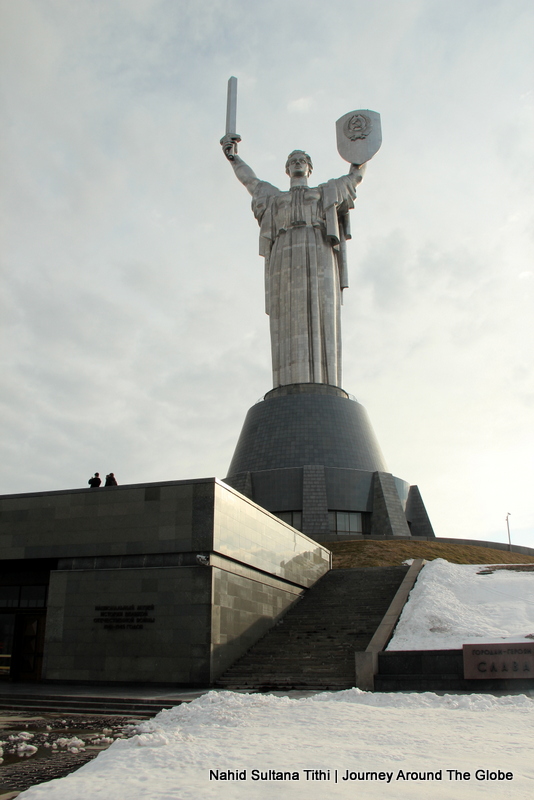
- Motherland Statue on top of Great Patriotic War Museum in Kiev, Ukraine
This is a big open park, great for walking, strolling, and enjoying Kiev from top. Metro station “Arsenalna” is the closest station from here. But if you are already near Pechersk Lavra, it’s about 10 – 15 minutes’ walk from there.
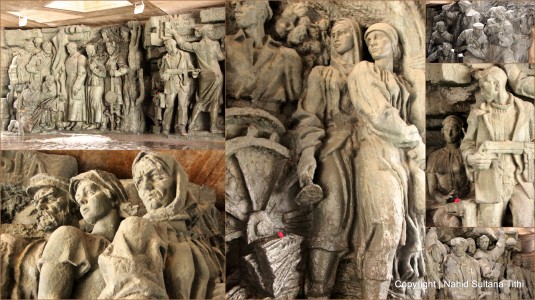
- A collage of many statues near Motherland Statue in Kiev, Ukraine
10) GOLDEN GATE of KIEV: This is very close to St. Sophia’s Cathedral and in Metro station “Zoloti Vorota”. Honestly, I wasn’t too impressed with the exterior of the building…it’s a big square-shaped building. We didn’t go inside but the statue in one side of the building was nice.
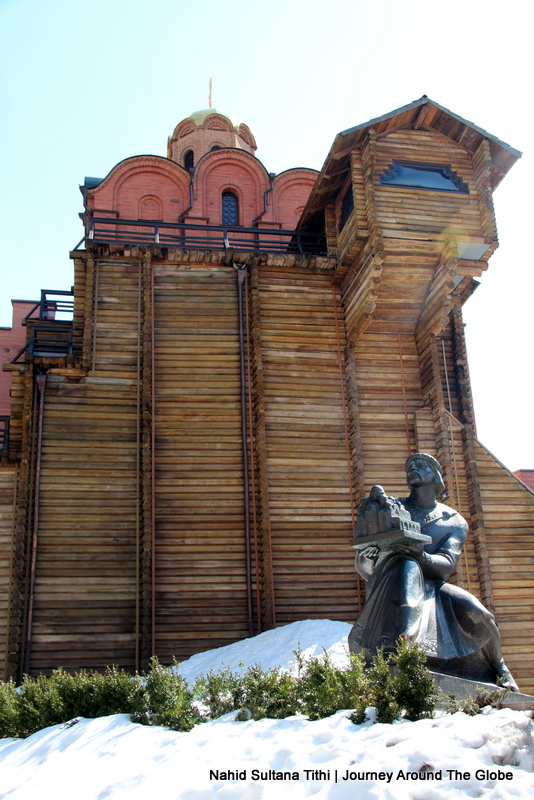
- Side view of Golden Gate of Kiev in Ukraine
11) BABYN YAR: This was a site where German NAZI armies MASSACARED Jewish, Gypsies, and many others during WWII. As many as 60,000 VICTIMS were executed in and near a big ravine. The surrounding area of 1 or 2 km was used to commit the mass murders. Now it’s an open park with many trees and a pathway. A big memorial to “Soviet Citizens” stands in one side of the ravine. There isn’t much to do here but the place does make you feel sad. The park can be reached via Metro station “Dorohozhychi”.
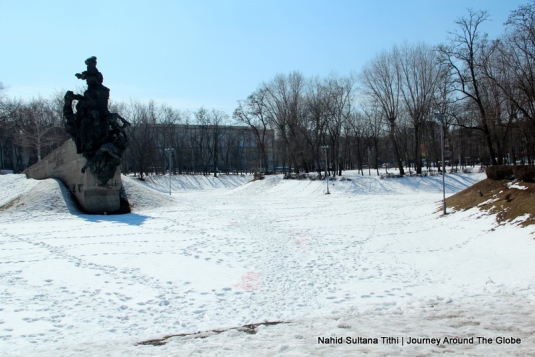
- A monument in Babyn Yar to commemorate 60,000 innocent victims death in the hands of German Nazi during WWII in Kiev, Ukraine

Related articles
- 1st day in Kiev, Ukraine (journeyaroundtheglobe.com)
- Kiev – Ukraine (via Transnistria apparently!) (aroundtheworldin40years.wordpress.com)
- Course: Bridge Education Abroad Institute, Kiev, Ukraine (thenewirscholar.wordpress.com)
Share this:

Travel theme: Benches
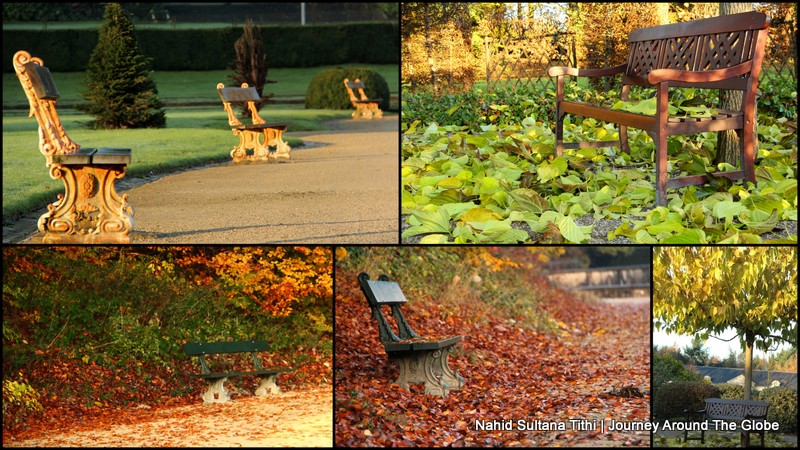
I love taking photos of lovely benches in the parks. Unfortunately, when I look back at these pictures, I do regret for not sitting there for 5 minutes just to relax and enjoy the atmosphere. Oh yeh, I was so busy taking picture from the correct angle that I actually forgot to enjoy these benches. Nevertheless, they do take my stresses away just by laying my eyes upon them. Enjoy…next time I have to remember to enjoy one of these benches 🙂
Share this:

Business Excellence Award 2020 from AI Global Media for The Most Entertaining Personal Travel Blog – Pacific Northwest USA

Top Posts & Pages


Authors
 Globe Runner
Business Excellence Award 2020 for The Most Entertaining Personal Travel Blog – Pacific Northwest USA

Business Excellence Award 2020 from AI Global Media

 Journey Around The Globe