Journey Around The Globe
ready for the next destination
Maltese Islands – Gozo and Comino
ISLANDS of GOZO and COMINO, MALTA: Islands of Gozo and Comino are two sister islands of Malta. Both of their culture and history go back hand in hand with Malta. Both of these islands are famous for their unspoiled beaches, diving sites, pre-historic landmarks, and shimmering scenic beauty. No one should leave Malta without taking trip to Gozo and Comino…this is where the adventure lies of this island nation.
We took this trip on our second day in Malta. It was 30 euros per adult and 20 euros for kids over 5. We met up near Sliema Ferry Service (it’s not the same service) in one of Luzzu Cruises’ kiosks and set off at 10 am. Our first destination was hour and half journey to the north to Island of Gozo. After reaching Gozo’s main harbor, Mgarr Harbor, they took all the tourists (except us, since we were all feeling sick from the bumpy ride on the sea) in small vans for a 3 hours sightseeing tour. Then came back to the dockyard and went for another 5 minutes cruise to Blue Lagoon in Comino. We had about little more than hour to swim or hang out in Comino. At 4 pm we started cruising back to Sliema stopping by the Caves of St. Mary’s for few minutes. It was around 5:30 pm when we arrived back to where we started from in Sliema. This boat only departs every Monday, Wednesday, and Friday from June to October. Good part of this deal was that you can take a free hour and half harbor boat tour the following day with the same ticket. We had to pass that trip, we wanted to go back to Valletta for our last couple hours in Malta.

- Our boat “Luzzu Cruise” standing on the azure water of Blue Lagoon in Comino, Malta
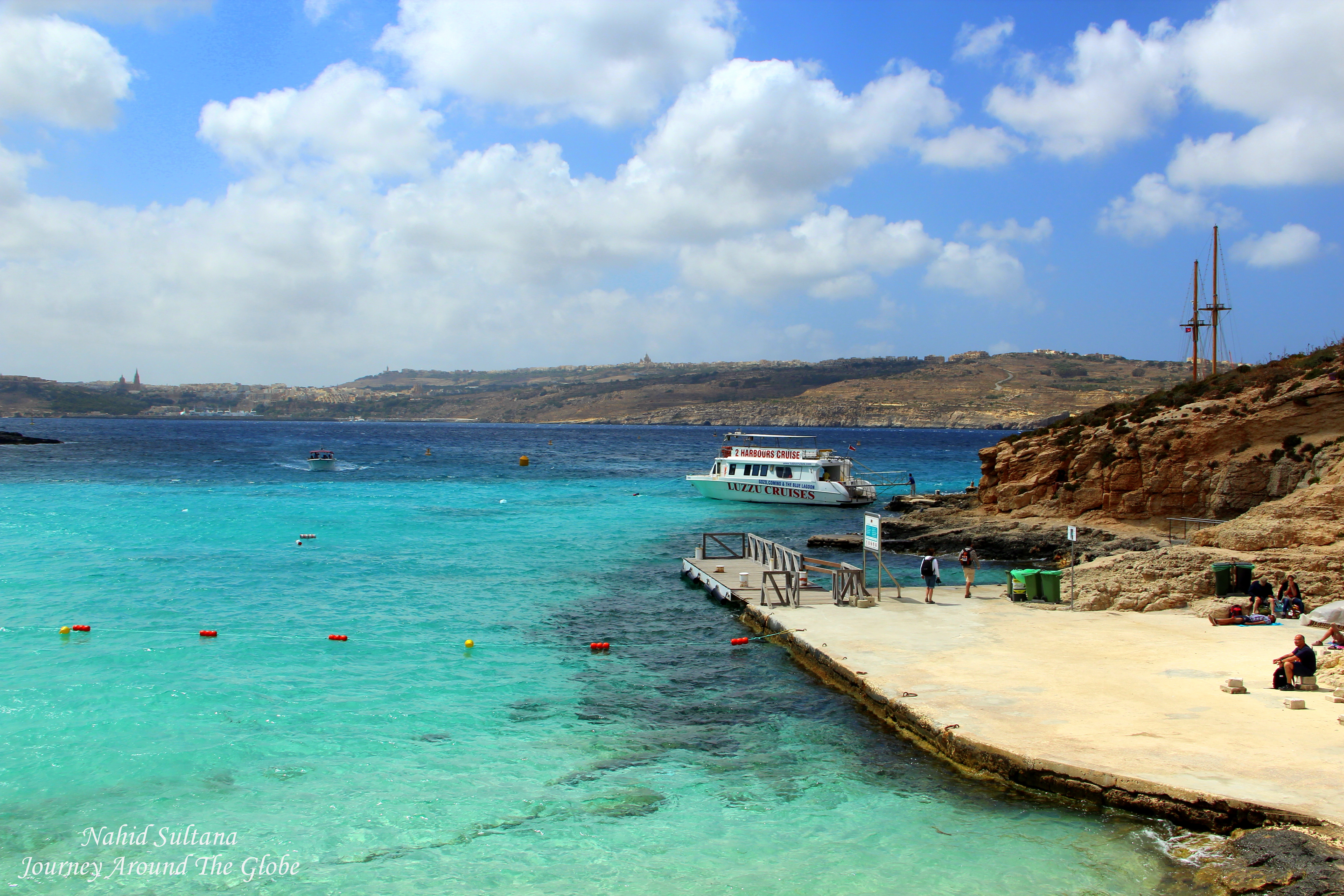
There are also some night harbor cruises or fishing trips. Travelers can email leo_kir@hotmail.com for any service with Luzzu Cruises.
TIME of TRAVEL: It was beginning of June 2013 when we flew to Malta. It was a lovely day to take such tours, but our captain warned my husband that the sea was going to be rough that day and since we were traveling with kids, we should be careful. I was scared at first, but he explained there is no danger going to the sea, but the ride will be VERY bumpy. We decided to go anyway thinking “how bad can it be”. Oh man, after 10 minutes of that up and down ride my 7-year-old literally threw up on my pants. It felt like someone was shaking that whole vessel and was throwing it into the sea without any mercy. Then I started puking, my little one started crying, and my husband feeling helpless. I don’t remember how many times my eldest daughter and I threw up (sorry if I am making you disgusted)…but after a while we both were tired and fell asleep. Then as soon as we got off shore, we decided not to go with the sightseeing van in Gozo. We freshened up, washed our clothes, hired a taxi, and went around Gozo with my wet pants on. It was one hell of a ride…phew, if we only knew what the captain was talking about.
OUR HOTEL: We stayed in Hotel Plevna in Sliema, another city in Malta. The best part of this hotel were the location and its view. We could the Mediterranean Sea from our balcony both on the right and left side. I actually managed to get up one morning during sunrise at 5:30 am and walk to Sliema promenade to take some shots and enjoy the morning sun. The hotel itself was pretty awesome too, had free breakfast included in the price. The only thing we wished was Wi-Fi in our room, lobby had free connection. The hotel also had free beach club for its guests by Sliema Promenade. We used to walk only 5 minutes to the ferry terminal to go to Valletta. All the nice restaurants (along with McDonald’s and Burger King) are also very close-by with a nice sea-view. If I ever go back to Malta, I will stay in Hotel Plevna again for its nice staffs and great location.
EATING and SHOPPING: We really didn’t have lunch that day since we were all feeling yucky and sick and wasn’t in the mood for heavy lunch. The girls and we had some Snicker bars and Pringles with some juices. But I think the others in the group who went on the jeep tour were given time for lunch/snacks.
PLACES WE’VE VISITED: In total, we had about 4 hours for Gozo and Comino (not counting the ride). Gozo definitely has more things to do and see than Comino. We couldn’t see the Azure Window of Gozo, a beautiful rock on the Mediterranean, along with some other beaches and ancient landmarks here.
1) ISLAND of GOZO: Gozo, one of the three islands of Malta, is a popular destination for diving and other beach/water activities. It’s smaller than Malta and less modern and more remote. There are many scenic fishing villages, green landscape, and fine beaches in this island. Azure Window is one of the most popular sites of Gozo. We haven’t been to any of these spots, because of our sickness from the sea. Other than natural beauty, Gozo is officially home of the oldest structure on the planet…Ggantija Temples. Gozitans (they get annoyed if you call them Maltese) speak similar language like Maltese but in different dialect and speak very good English.

- Rabat or Victoria, the capital of Gozo Island in Malta, you can see Gozo Citadel in the distance
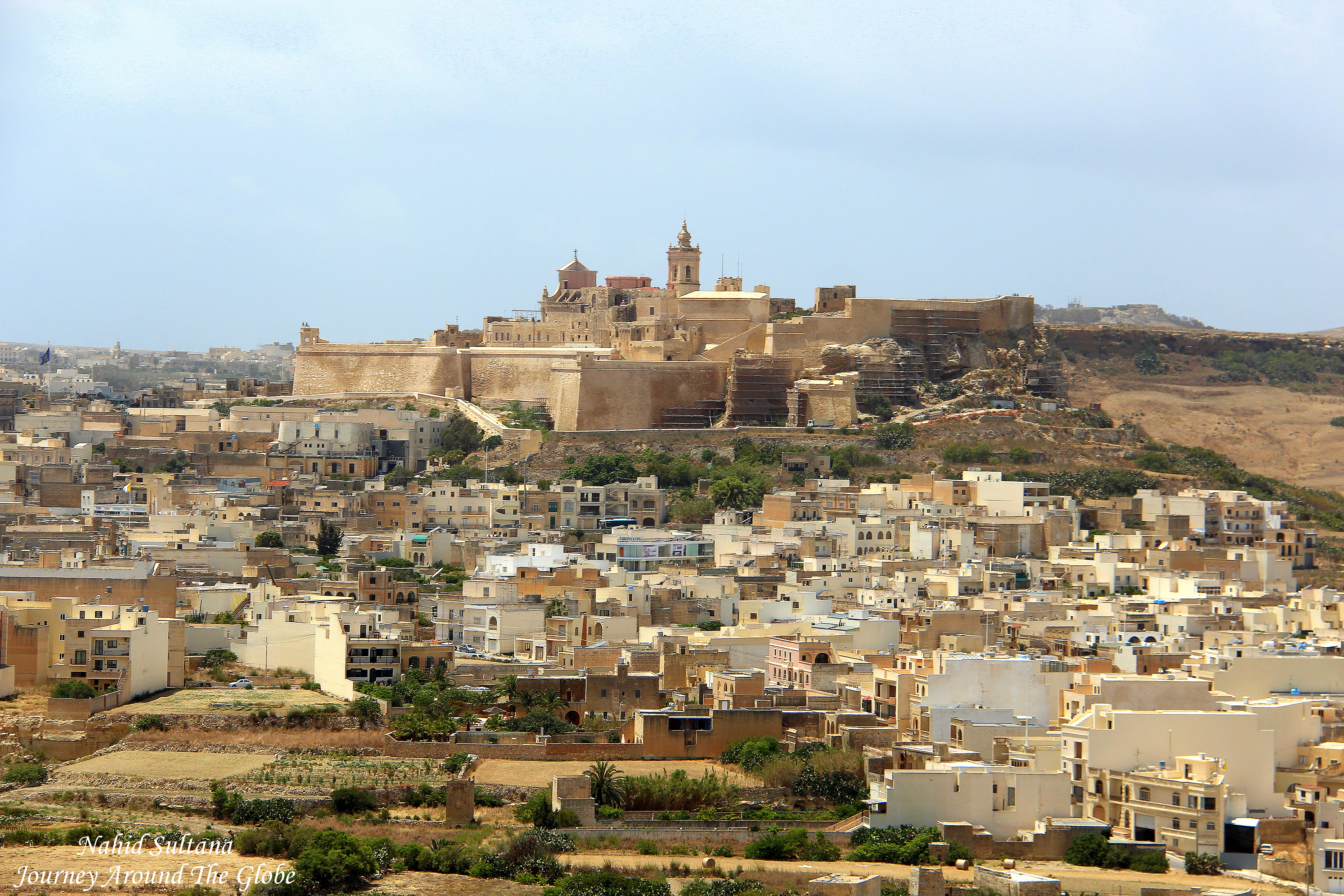
We had about 2 hours in Gozo after freshening up. Since we didn’t go with our sightseeing bus, we hired a taxi for 40 euros to takes us around the island. We managed to visit the following four spots. The taxi was supposed to take us to a nearby fishing village too, but we had to get back to the dock to catch our boat to Comino.
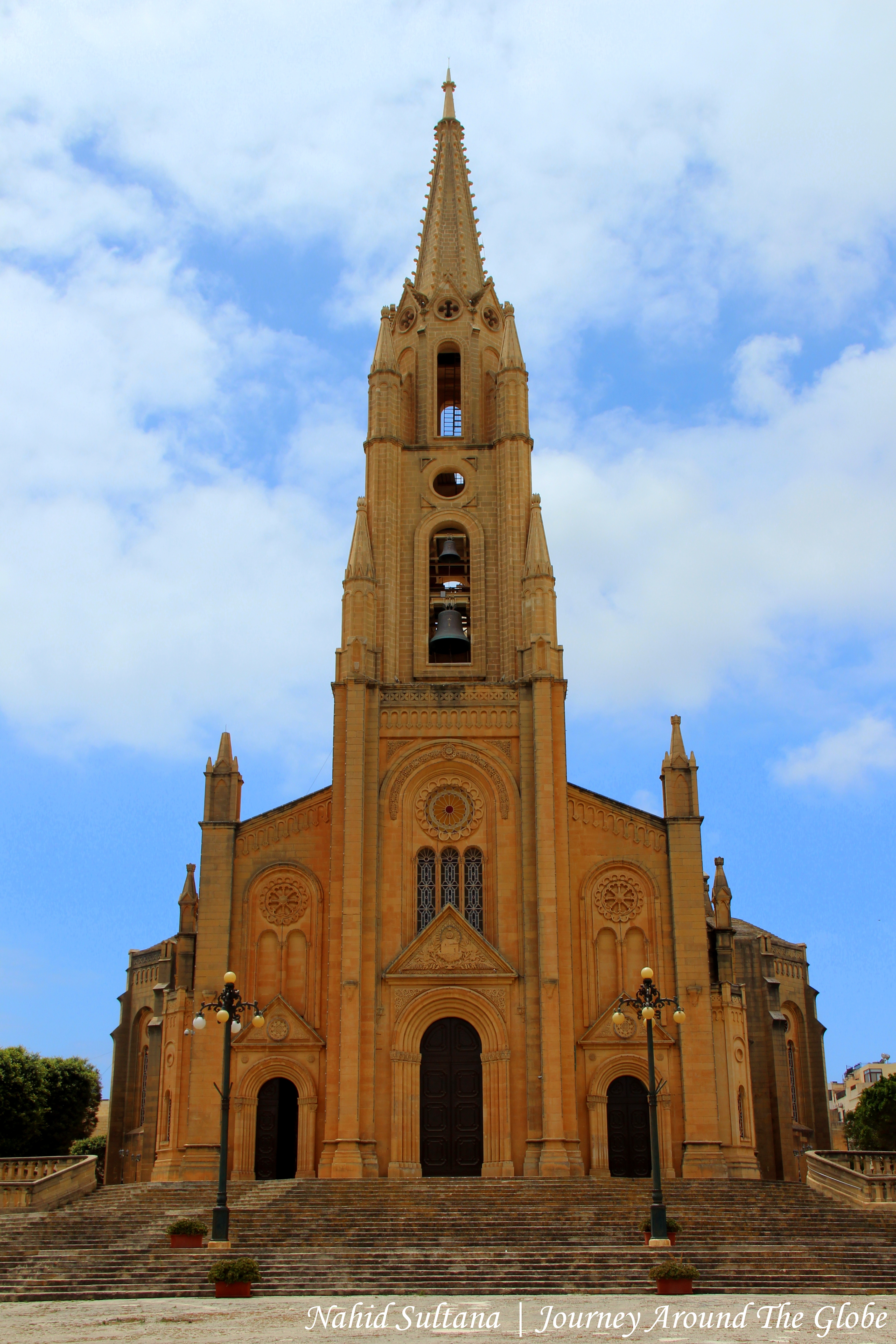
a) CHURCH of OUR LADY in LORETO: It’s a very beautiful big white church in the village of Ghajnsielem. It was our first stop and a quick one. There is no fee to enter.

- Church of Our Lady in Loreto, Gozo, Malta
b) THE GGANTIJA TEMPLES: The Ggantija Temples, “Place of giants”, are thought to be the oldest free-standing structures in the world. The temples were the first of the Maltese prehistoric monuments to be cleared of the accumulation of earth and debris. The megalithic complex of Ggantija was erected in three stages over a period of several hundred years (3600 – 3000 BC) by farmers and herders of Gozo at the center of the Mediterranean. This complex stayed in used for some 1000 years until Maltese Temple Culture disappeared abruptly and mysteriously. Later around 2500 – 1500 BC the site was adopted by the inhabitants as a cremation cemetery. They say, these temples are 1000 years older than the pyramids in Egypt, making it a UNESCO World Heritage Site. Presently it’s only the ruins we saw but definitely are among the best-preserved temples on the Maltese islands.
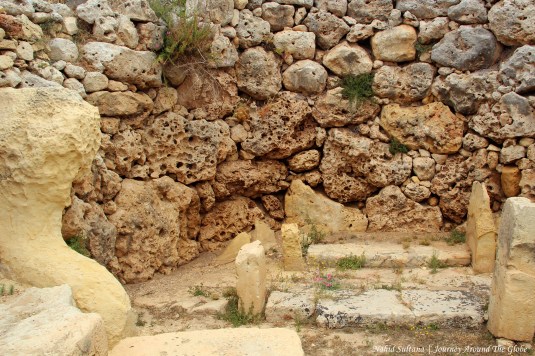
- Ggantija Temples in Gozo, Malta – the oldest free-standing structure in the world
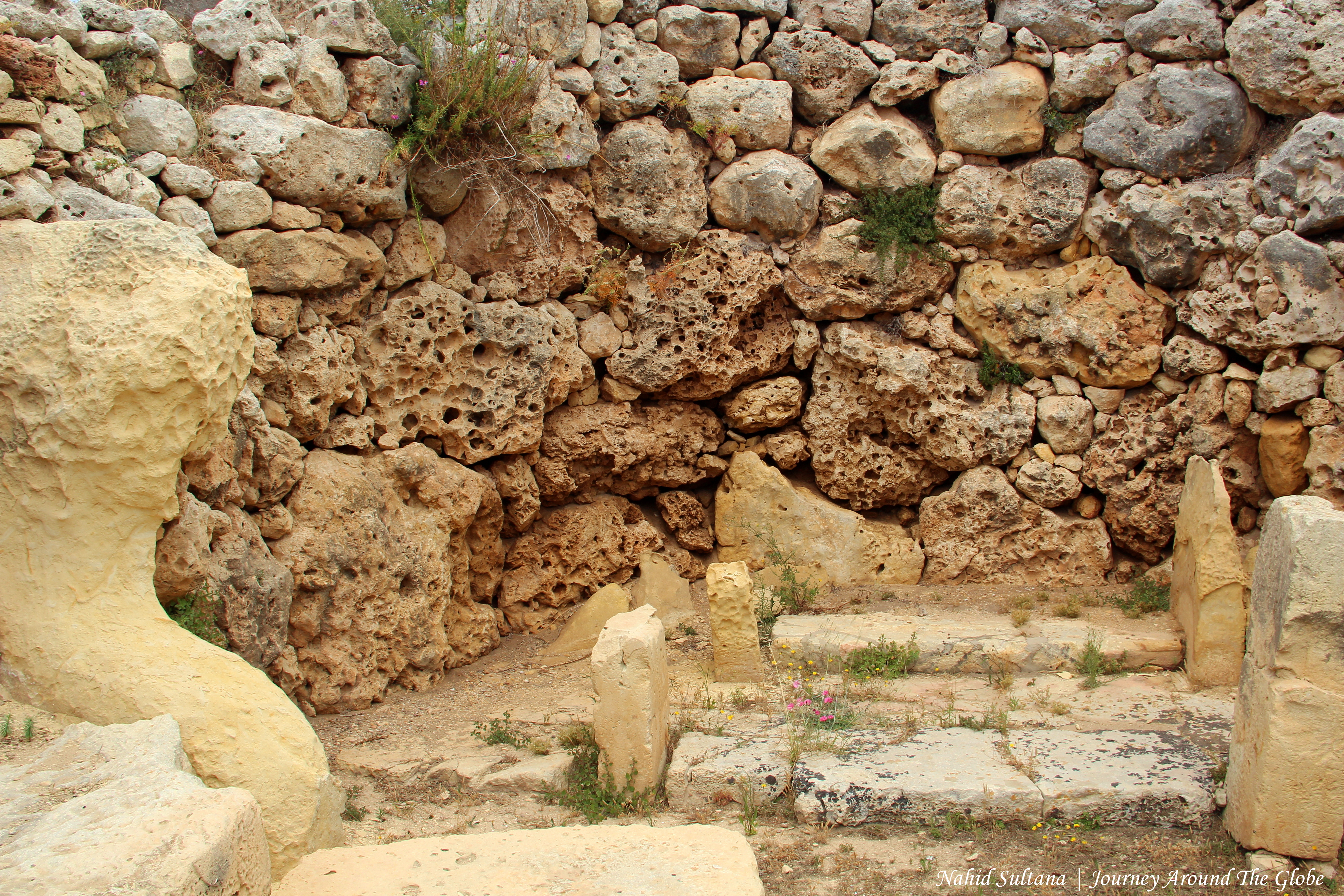
Visiting the temple didn’t take us more than half an hour. Entry fee is 5 euros per adults and 2.50 euros for children 6 -11 years of age. The temple is open Monday thru Sunday from 9 to 5 pm (last admission at 4:30) and closed on public holidays. Ticket to Ggantija Temples also allows visitors to see Ta’Kola Windmill.
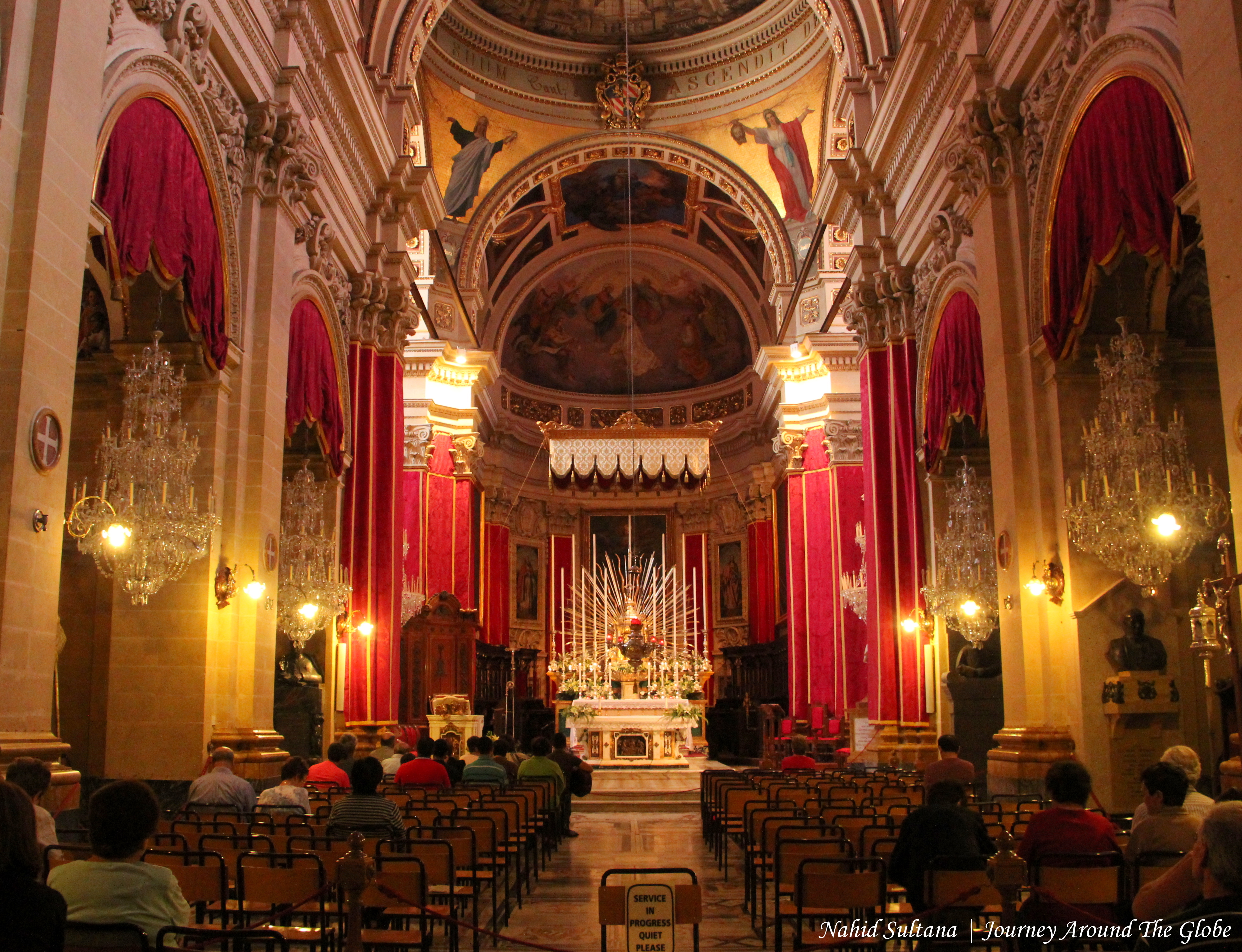
c) GOZO CATHEDRAL: Also known as Citadel Cathedral, this is a beautiful Baroque cathedral from the early 17th century. It’s small but very graceful. Check out its mosaic marble floor with tombstones and painted ceiling…they are remarkable. There is no fee to enter, but definitely worth a visit. It’s located at the same site as Gozo Citadel.

- Inside Gozo Cathedral or Citadel Cathedral in Gozo, Malta
d) GOZO CITADEL: Located in Rabat (also known as Victoria), capital of Gozo. The setting had very middle-age touch and looked like it was built with sandstones. This island’s fortress was built somewhere around the 15th century and was never conquered by anyone. It rises steeply above the surrounding countryside offering a superb view of the island.

- Walking by the old walls of Gozo Citadel in Gozo, Malta
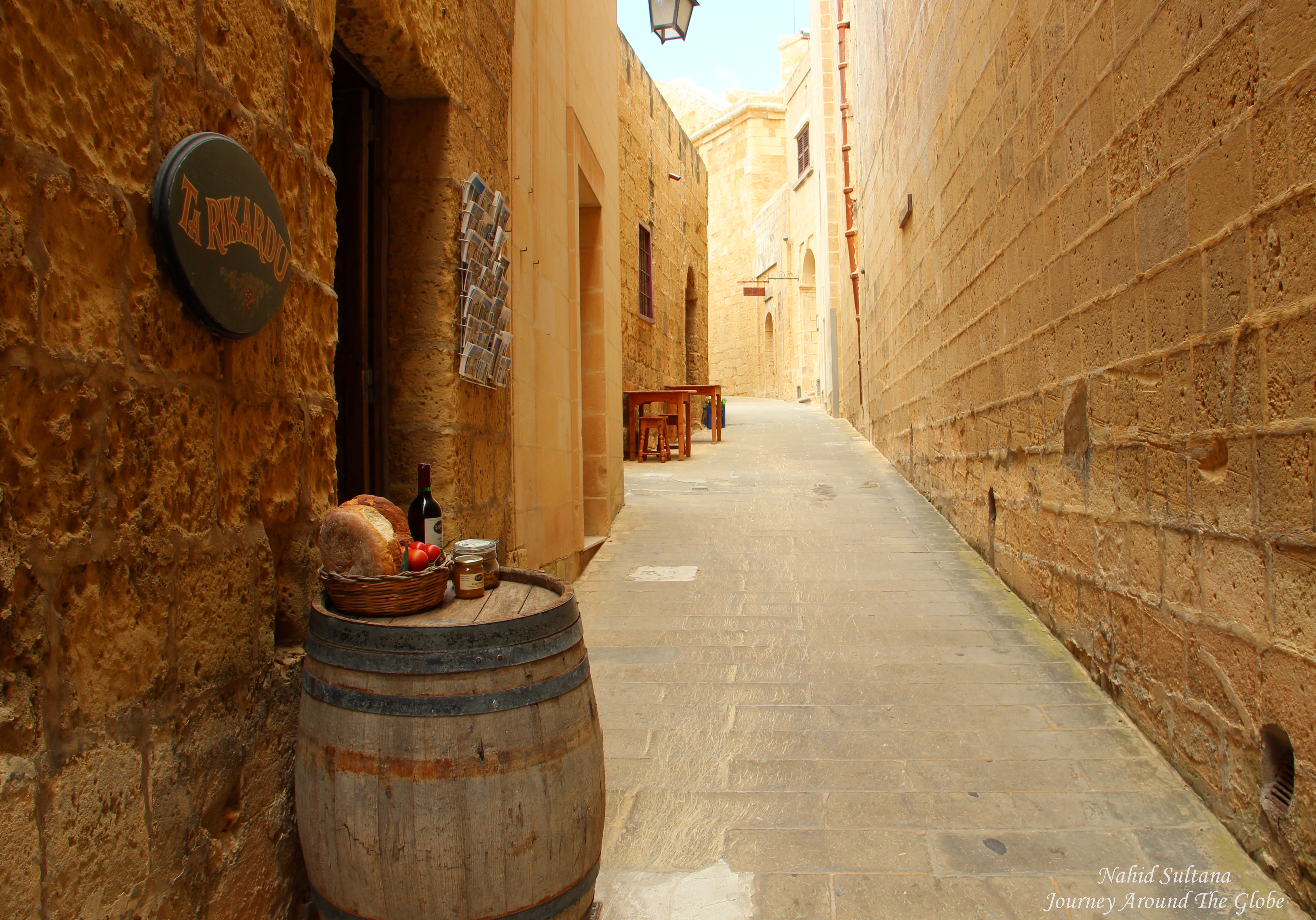
It’s free to enter the citadel’s courtyard. But the museums and exhibitions have entry fees. We just walked along the old walls of citadel and then top of the hill for a nice view over the village. We only had about half an hour or so to just get a glimpse of the citadel before catching our taxi to the boat terminal.
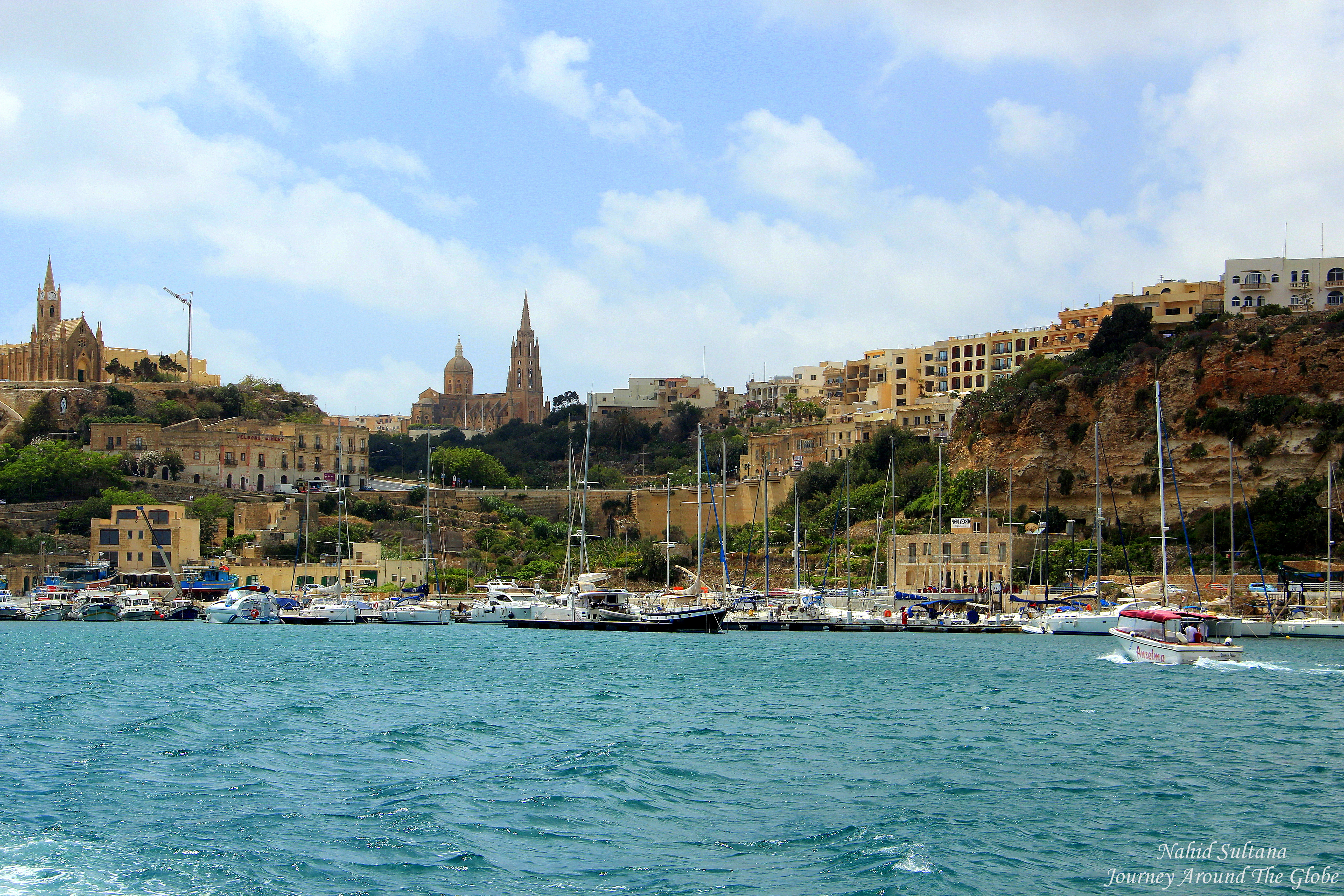
2) ISLAND of COMINO: Island of Comino is the least developed among all the three Maltese islands. The island is known for its tranquility and remoteness. The lagoon with its shimmering aquamarine water, this makes an ideal choice for most kind of water sports, especially snorkeling and diving. There are no roads or streets in this small place. Our taxi driver in Gozo was saying only 6 people live here now and there is only one hotel, a 5-star, and a police station in Comino. It’s all natural beauty everywhere we looked. Gozo can be seen from here, as it’s only 5 minutes boat ride between these two islands.

- That’s Gozo from our boat, heading towards Comino in Malta
a) BLUE LAGOON: This is the main attraction of tiny island of Comino and popular for day trips. Blue Lagoon is famous for its stunning azure-blue water. Tourists come here for swimming, sunbathing, or snorkeling. The scenic beauty is beyond words can explain. Small but picturesque white sandy beach surrounded by turquoise blue water and big rocks in the distance can make everlasting impression on everyone’s mind.
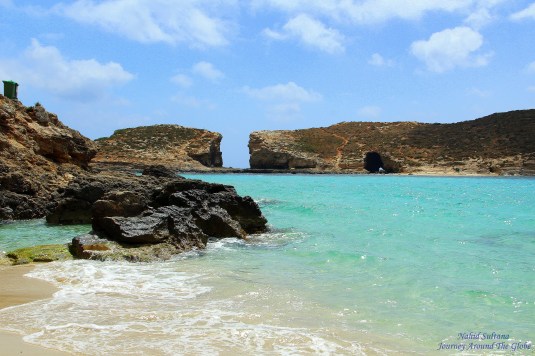
- Blue Lagoon of Comino in Malta
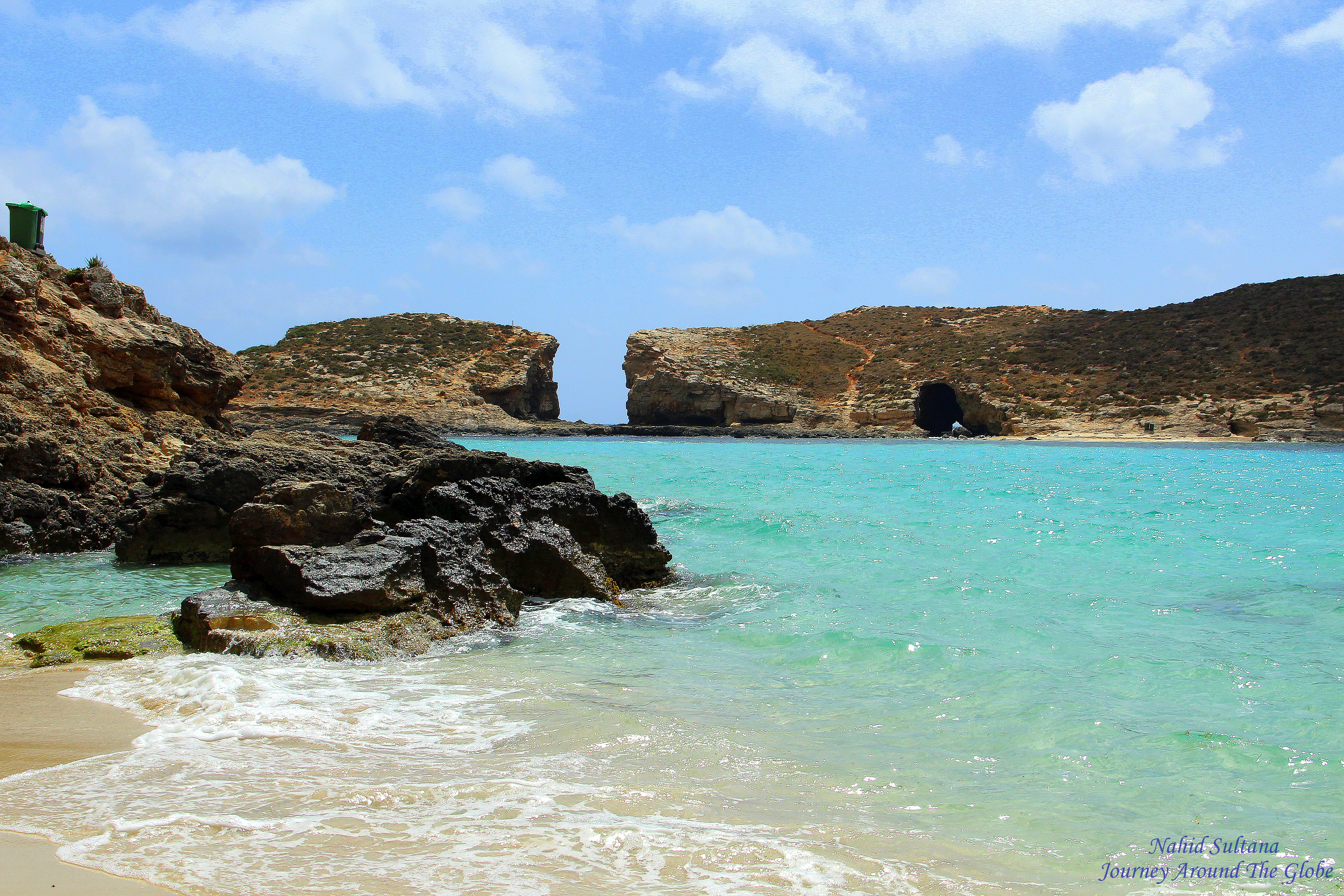
We stayed here about an hour. While some of our group members took a dip in the water, our daughters and I soaked our feet in the transparent water, took some pictures, and went on exploring Comino on foot. There is a tower, Santa Maria’s Tower, which we couldn’t find…other than that there isn’t much to do if you are not into water sports.

- Blue Lagoon in Comino, Malta
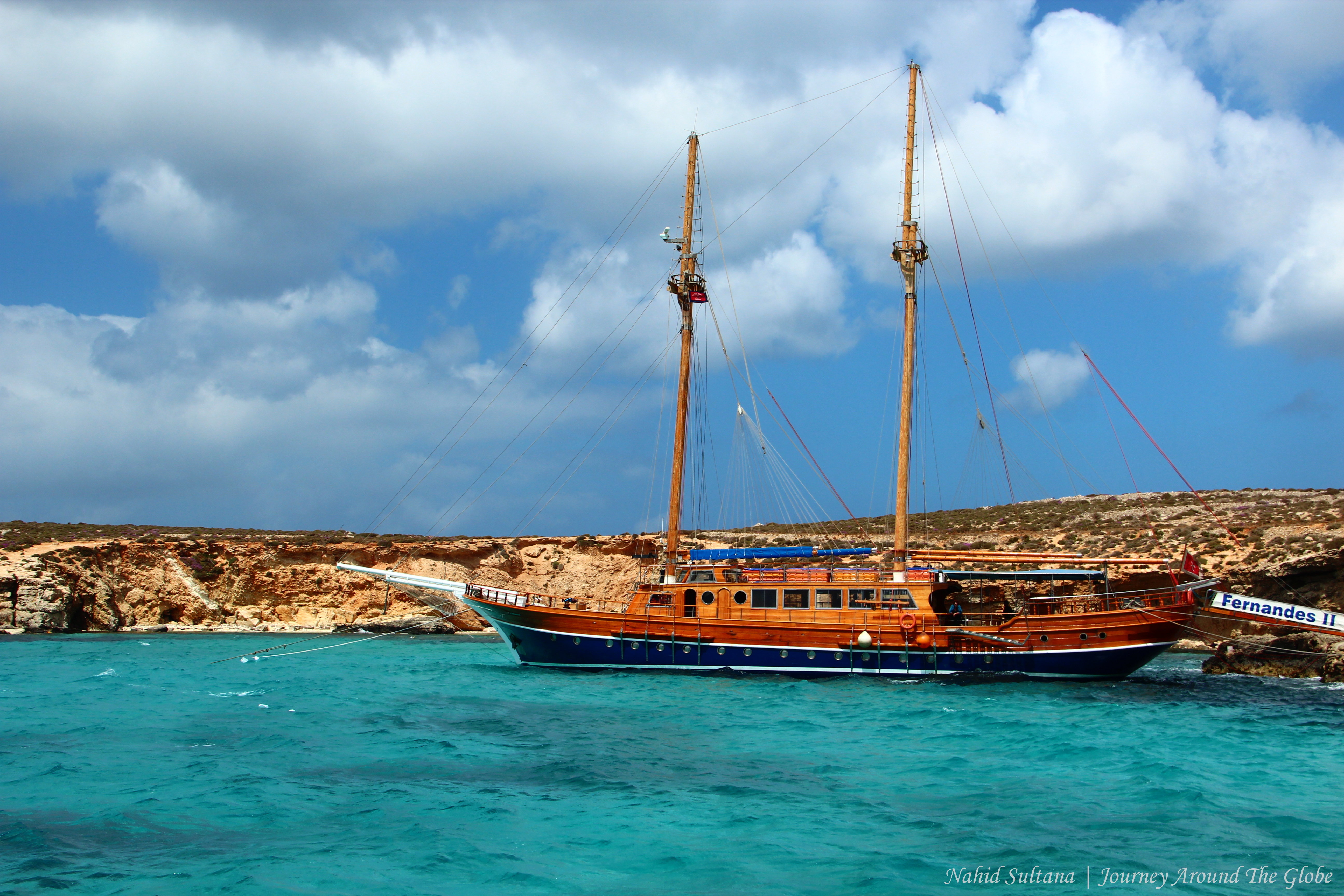
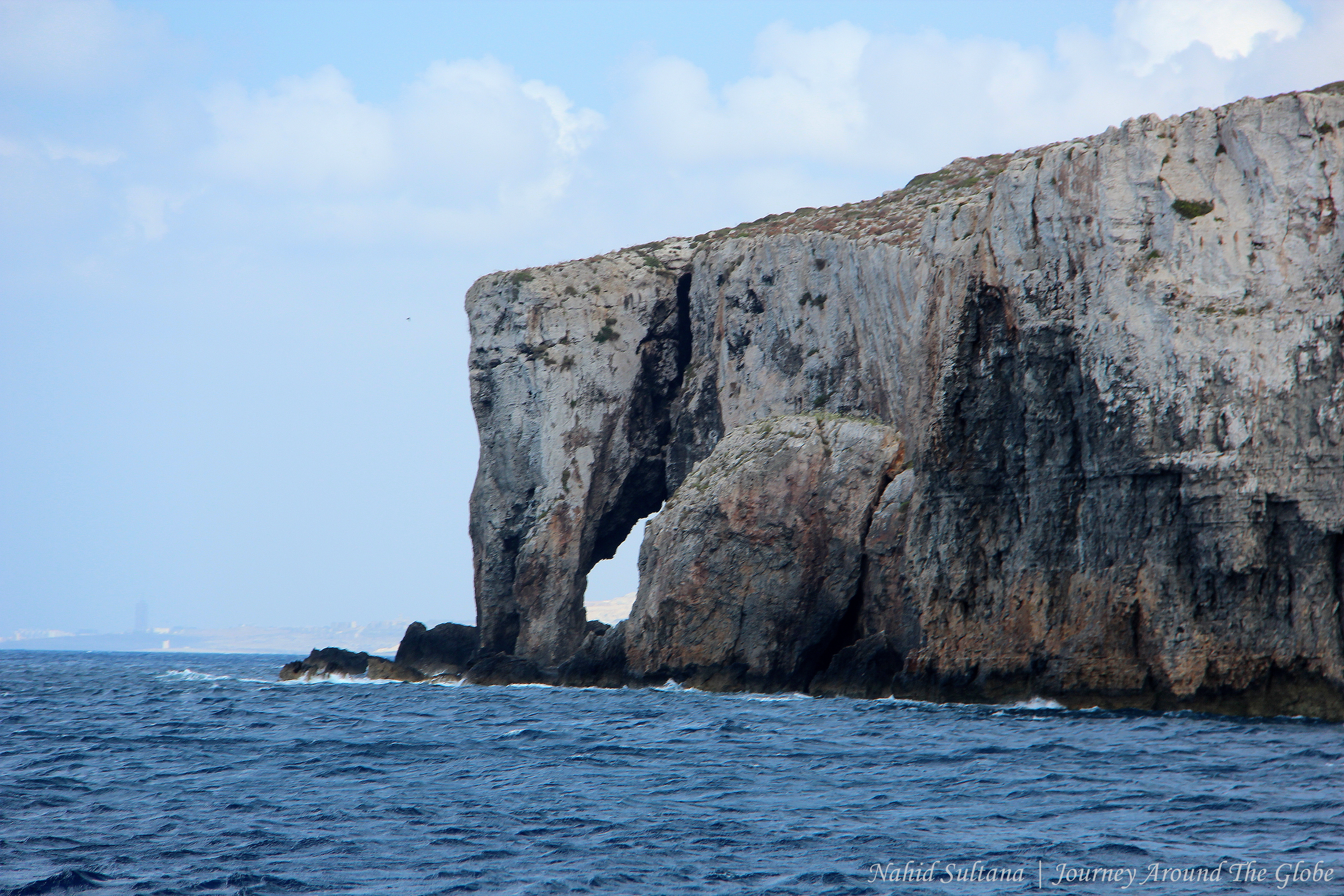
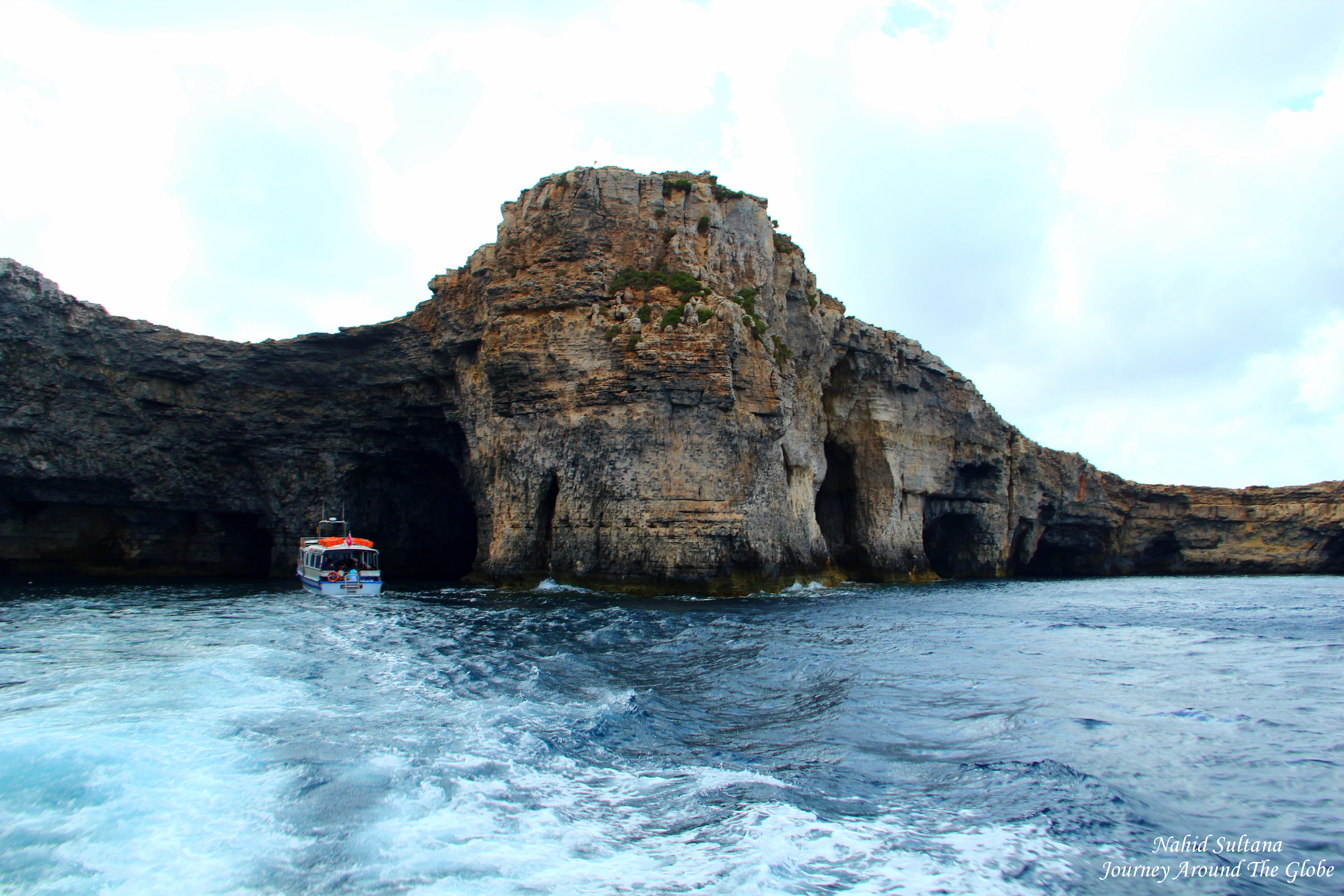
b) CRYSTAL CAVES of COMINO: Crystal Caves are located at the north coast of Comino and only few minutes boat ride from Blue Lagoon. The boat took us near a large cliff and beneath are these caves. Caves were dark, couldn’t really see anything inside…gives you a creepy feeling. Don’t forget to look for a rock formation that looks like elephant’s trunk near Crystal Cave.
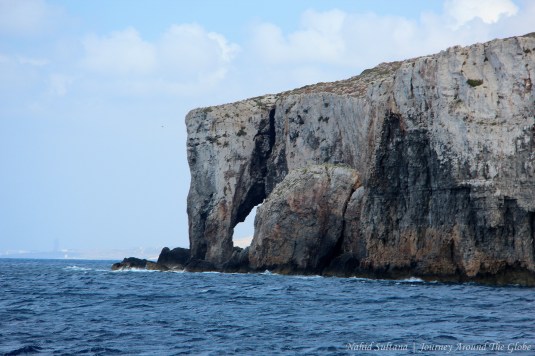
- Elephant’s trunk rock near Crystal Cave of Comino in Malta
After the caves, it was end of our Gozo & Comino trip. It wasn’t that bad on our way back to Sliema because the wind was going on our direction. All four of us took a nice nap in the boat and before we knew we were back to our familiar spot. If I knew the ride was going to that crazy, I probably would have canceled the trip; but at the same time, that god we actually went on, otherwise would have missed the real beauty of Mediterranean and real pearls of Malta.
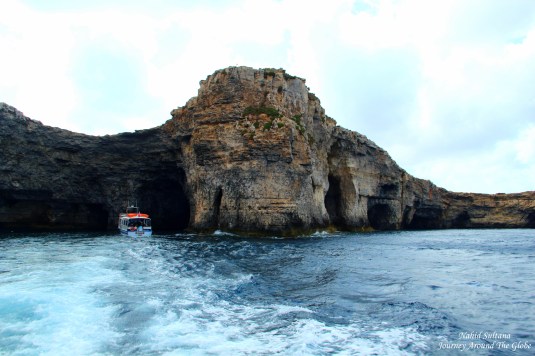
- Crystal Caves of Comino in Malta
Related articles
- Valletta – the Maltese capital on the Mediterranean (journeyaroundtheglobe.com)
- Gozo island – Malta (passport2happiness.wordpress.com)
- Rippling near the shearwaters (maltaseabirdproject.wordpress.com)
Share this:

Valletta – the Maltese capital on the Mediterranean
VALLETTA, MALTA: How often do you come across thousands of years’ worth of history, blue waters, and good Mediterranean food over 316 sq. kilometers of land mass? This can only happen when you come to Malta. Being by the Mediterranean Sea, Malta’s capital Valletta is more than just a beautiful old town of this island nation. But what makes this harbor city prettier is that the city kept its 16th century look at almost every corner. It was one of the earliest sites that got listed in UNESCO World Heritage Site for its old world splendor and magnificent Baroque architectures. Valletta was one of the first cities in Europe to use a grid street system. I used to look for colorful doors, windows, and typical wooden window-like concealed balconies while walking in the old town…these are everywhere and add more beauty to this place.

- Valletta, Malta – the whole city is A UNESCO World Heritage Site
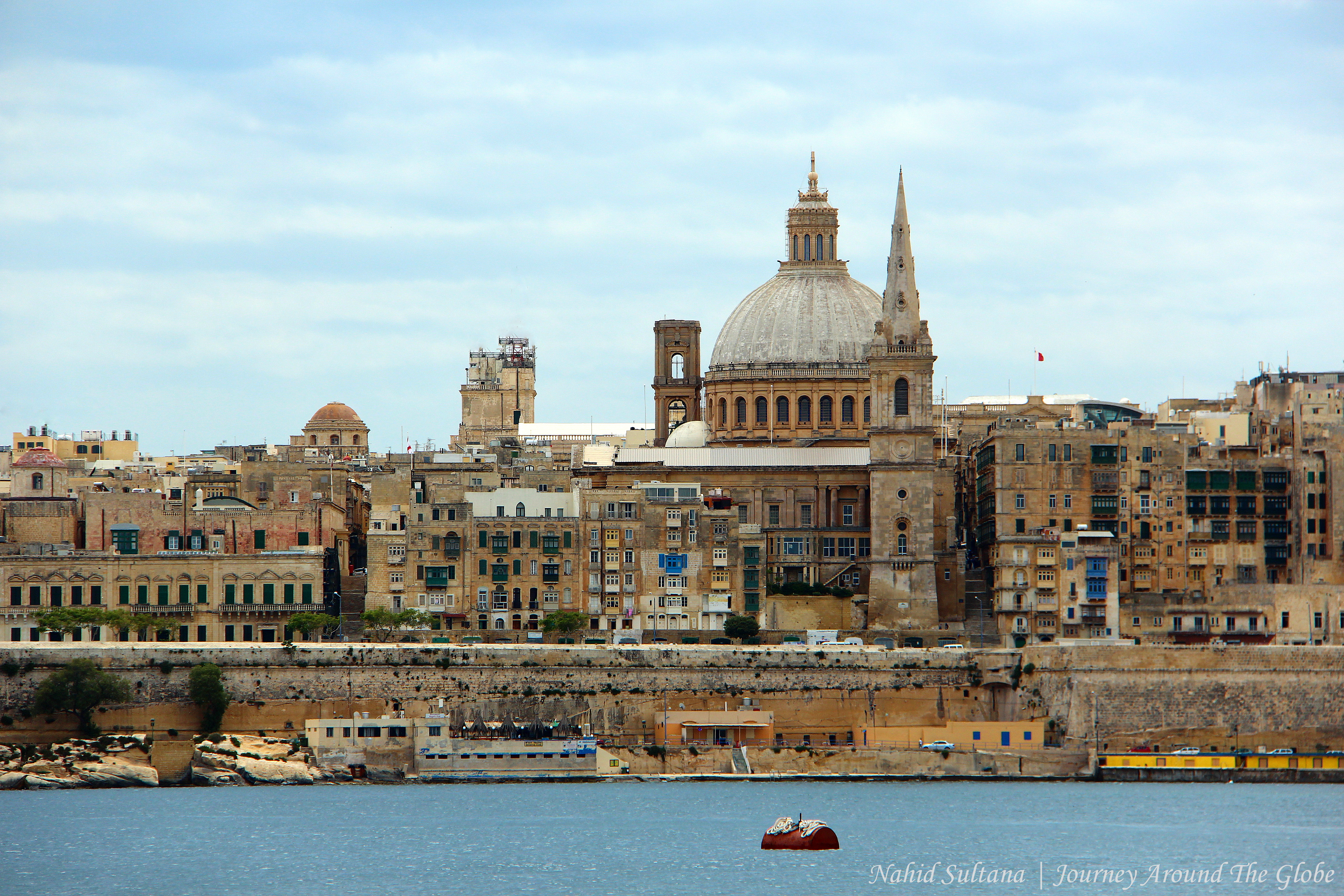
Malta is a small island and inhabit a tiny spot in the universe but it has a culture that spans about 7000 years. Valletta was built as a fortified city – intended to keep the enemy out. Historically, Knights of St. John built Malta in 1565 AD to protect the land from the Turks. From the earliest days of the Knights of St. John on Malta, they kept a guard ship and troops near the entrance of Grand Harbor looking for Ottoman spies. Later the country was attacked and conquered by many civilizations over and over, finally getting its freedom from the British in 1964.

- Valletta, Malta
Maltese speak very good English and are very welcoming. Local language here is a very unique language that combines different languages like Arabic, French, Italian, and Spanish.
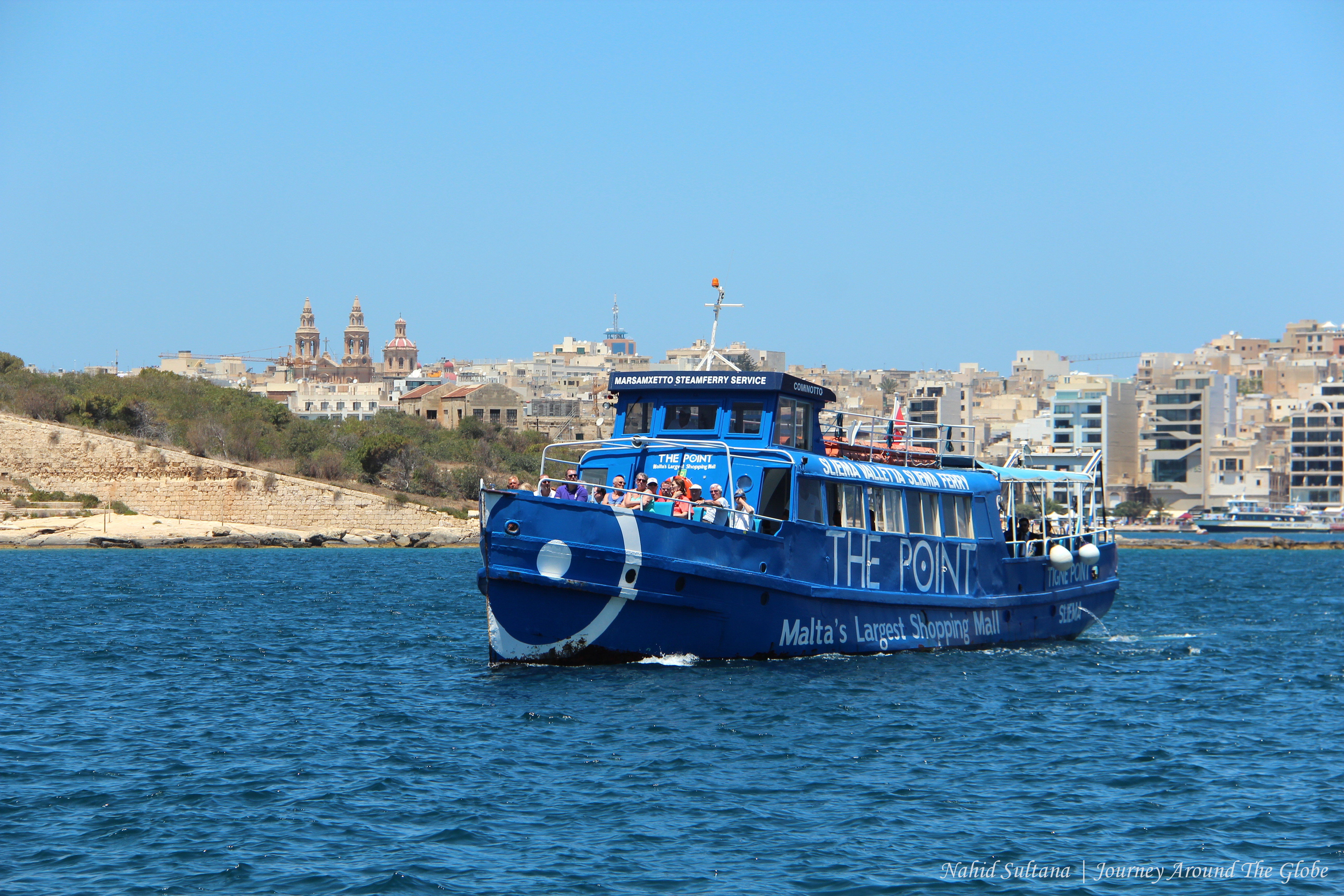
Republic Street and Merchant Street are the main and parallel streets of Valletta. Marsamxetto Ferry Service is the best way to go back and forth from Sliema to Valletta. There are also public buses from Sliema, but ferry is the best way. They run every half an hour from 7 am – 6 pm and 10 – 4 on Sundays and public holidays. It is 2.80 euros for round trip per person over 5 years of age and it takes less than 15 minutes to cross the water-body. There are many companies who offer boat tours of various kinds to various parts of Malta, like the islands of Gozo and Comino (see my post on Gozo & Comino). They come in many services, prices, and timetables.

- The blue ferry that connects Sliema and Valletta in Malta
If you are planning to drive in Malta, just keep in mind that they drive on the left side of the road like the Brits. We also rode on a horse-wagon after the ferry ride to Valletta to go to St. John’s Cathedral for 20 euros for all of us with an extra visitor, Charlie. We met Charlie, originally a Maltese but lived all over in the USA for 61 years, at Marsamxetto Ferry terminal on our way to Valletta. He came back to his own land recently to spend rest of his life by the sea. He got on the horse-ride with us and was very energetic giving us some general insides on this island.
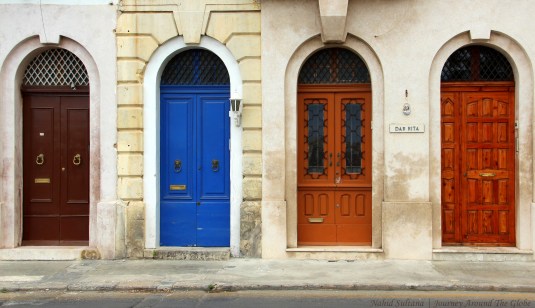
- Loved these colorful doors of Malta

TIME of TRAVEL: We flew to Valletta in the first week of June 2013. We were expecting some hot-summer days there. It was above 75 degrees but little bit windy every now and then. Overall, the weather was pleasant. June is in fact a great time to visit Malta. The weather is warm yet the beaches and bays aren’t taken over by the tourists. As it gets deep into summer, the weather can get really crazy hot and places become more crowded with hundreds and thousands of tourists. Maltese population triples to nearly 1 million tourists from all over the world during this time.

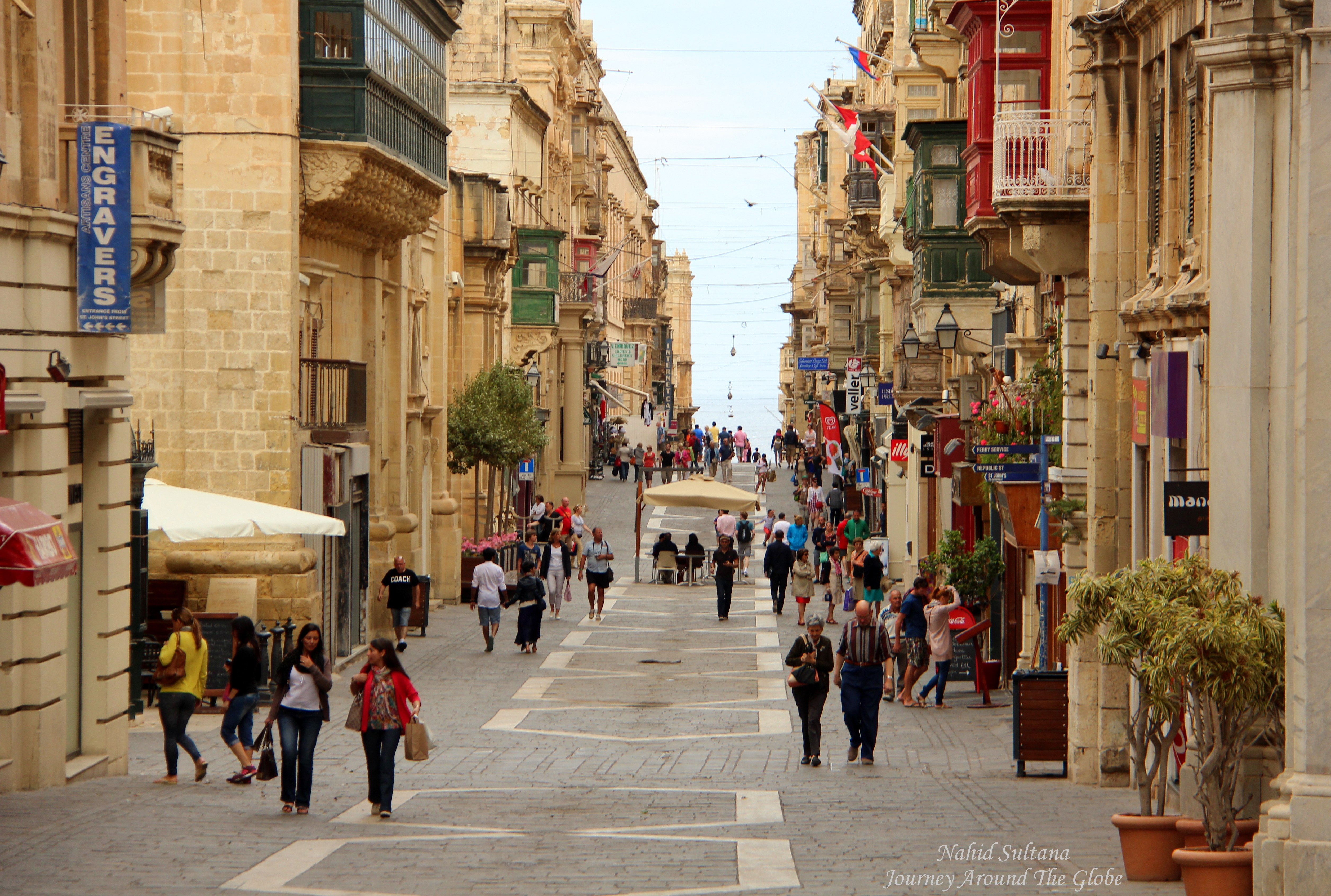
- Old town of Valletta in June…not too crowded yet
OUR HOTEL: We stayed in Hotel Plevna in Sliema, another city in Malta. The best parts of this hotel were the location and view. We could see the Mediterranean Sea from our balcony both on the right and left sides. I actually managed to get up one morning around sunrise at 5:30 am and walk to Sliema promenade to take some shots and enjoy the morning sun. The hotel itself was pretty awesome too, had breakfast included in the price. The only thing we wished was Wi-Fi in our room, lobby had free connection though. The hotel also had free beach club for its guests by Sliema Promenade. We used to walk only 5 minutes to the ferry terminal to go to Valletta. All the nice restaurants (along with McDonald’s and Burger King) are also very close-by with a nice sea-view and skyline of Valletta on the other side. If I ever go back to Malta, I will stay in Hotel Plevna again for its nice staffs and great location.

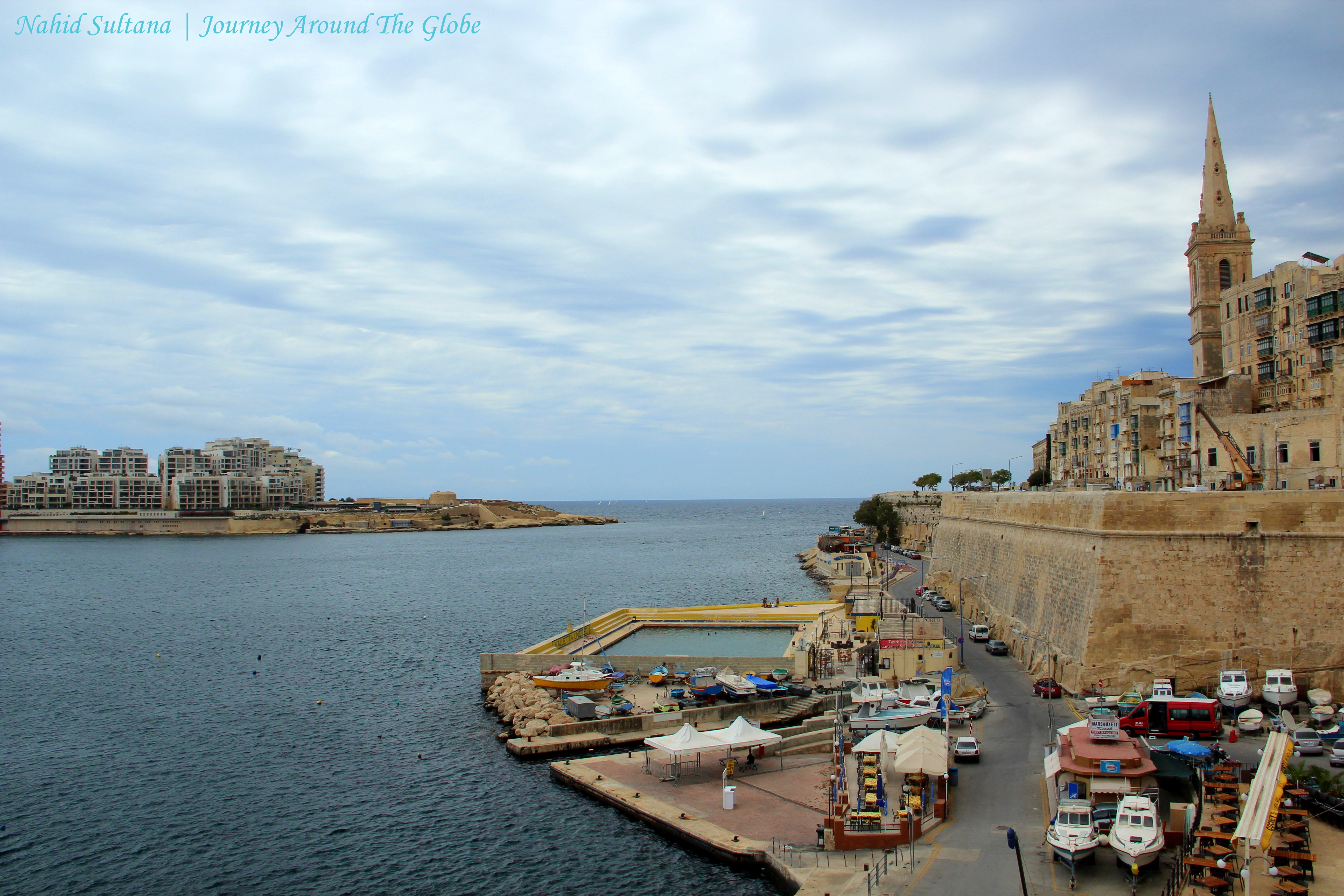
- Looking over Valletta from Sliema Harbor in Malta
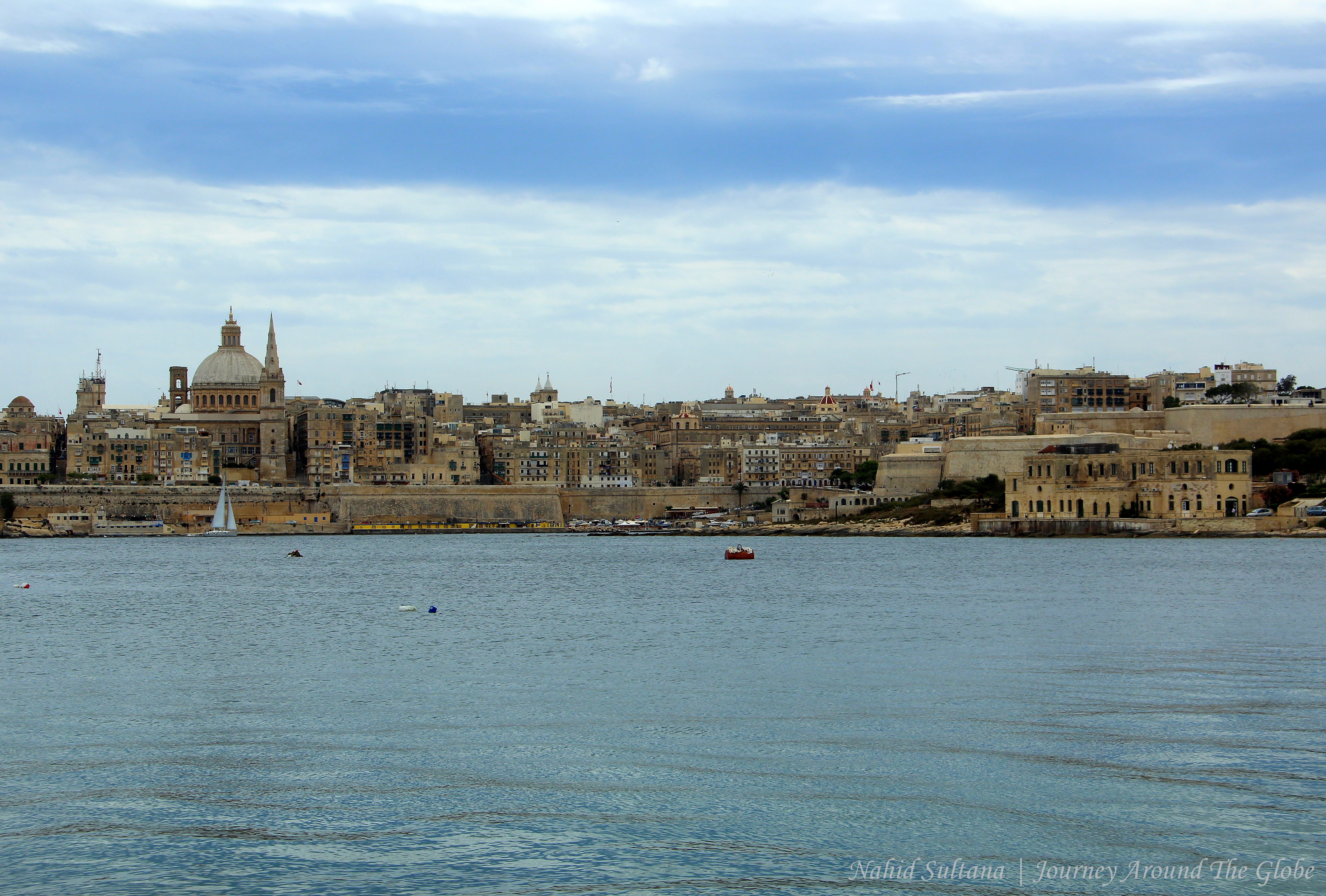
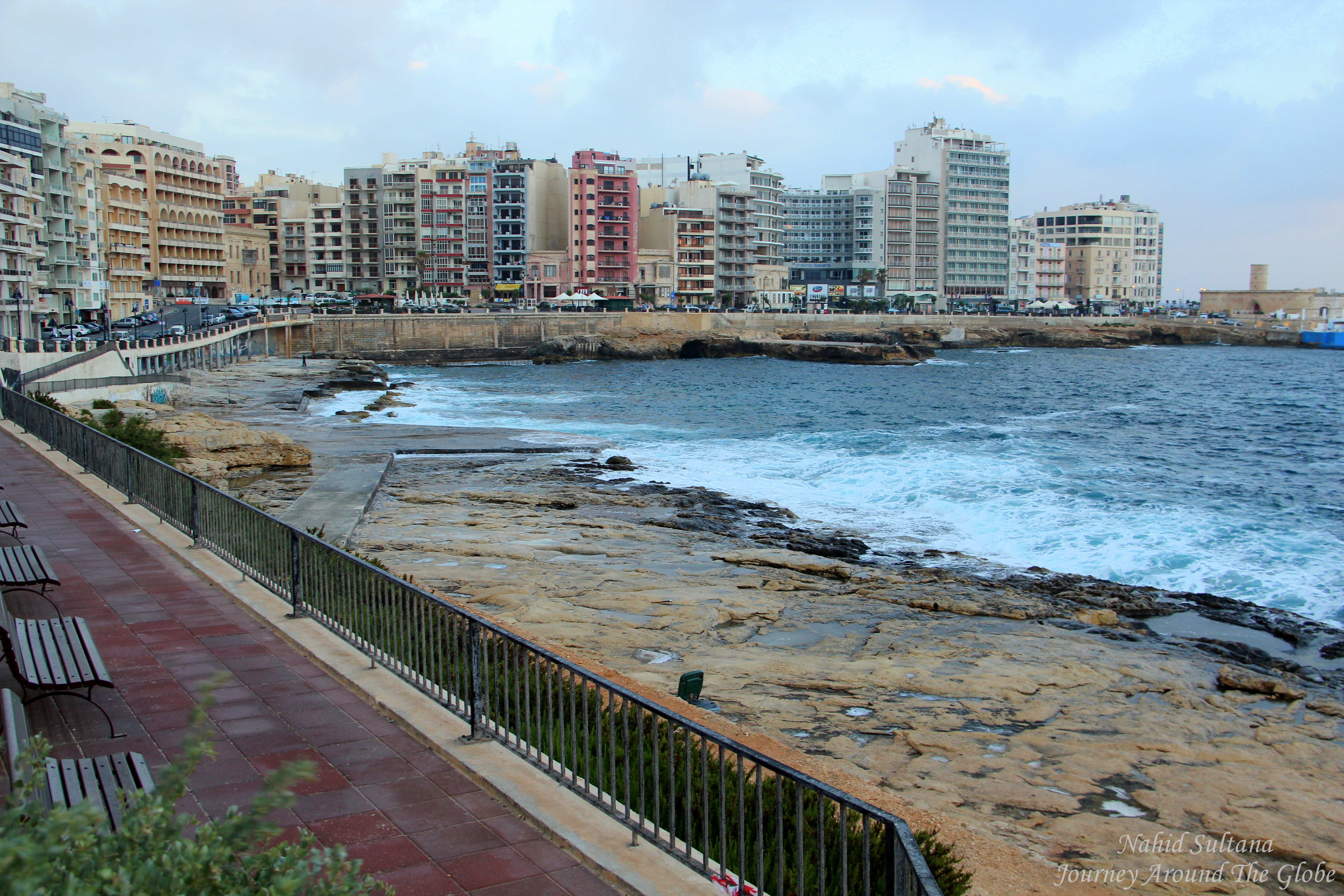
Sliema is one of Malta’s most modern areas and this is where most of the tourists stay. The promenade offers great view of the blue sea. The main harbor of Sliema also is a great place to hang out, enjoying nightlife, eating, and shopping. You can get a jaw-dropping view of Valletta standing in Sliema harbor.
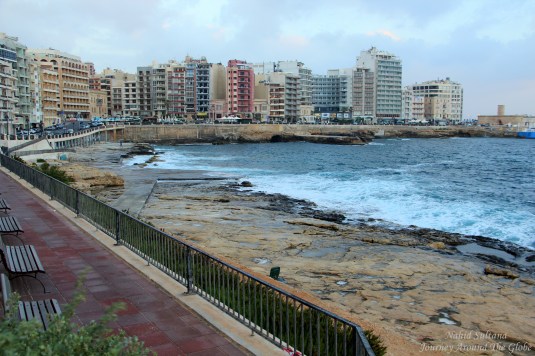
- Sliema Promenade by the Mediterranean
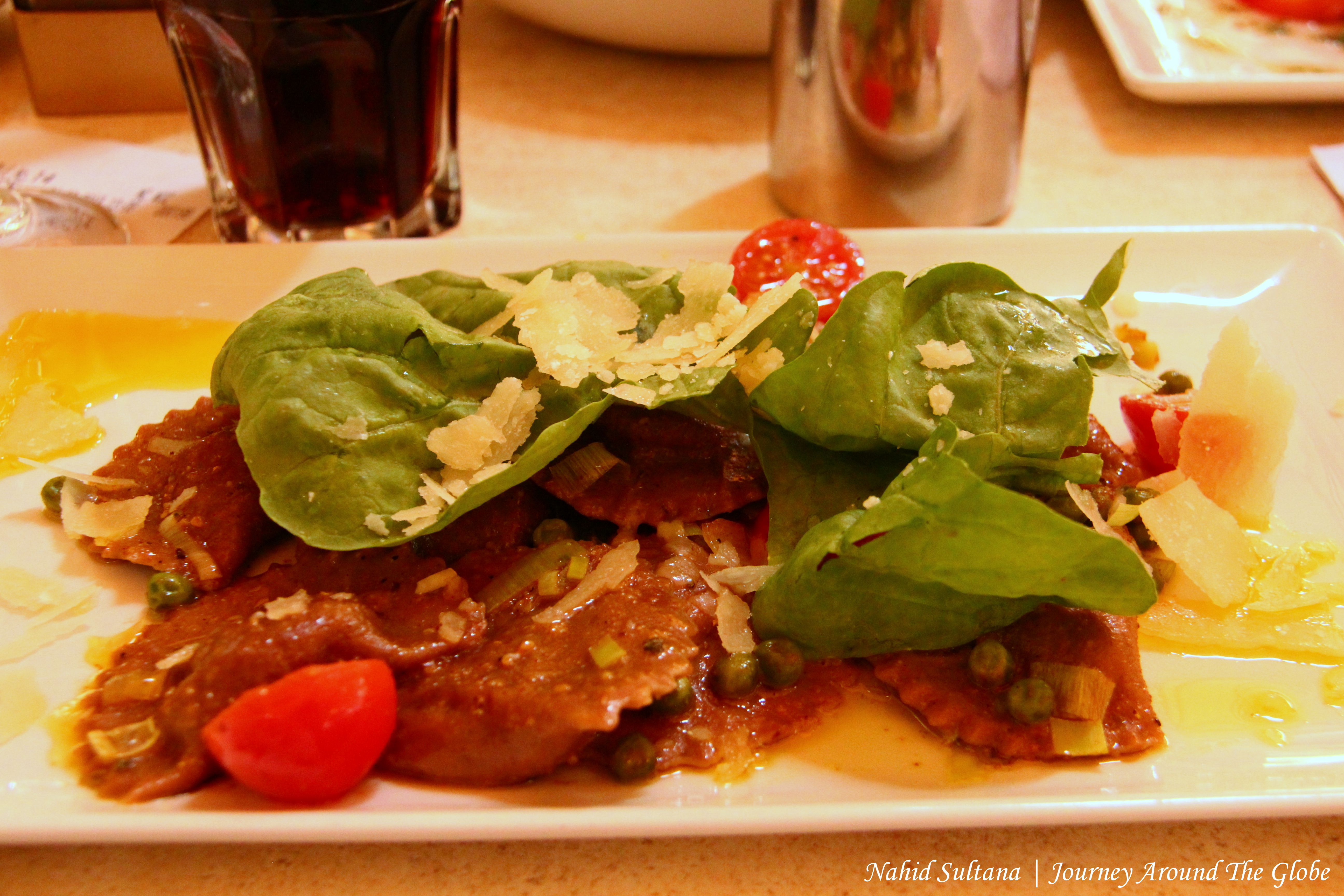
EATING and SHOPPING: Maltese love their rabbits and it’s their national dish. First lunch in Malta, we sat down in a nice restaurant, San Giovanni, in St. John’s Square right in front of the cathedral. And I had to try a Maltese rabbit, of course. There were many dishes here that serve rabbit in different forms. I tried rabbit ravioli with herb sauce and olive oil (or something similar)…it was beyond my expectations, so good. Most of the cafes with tables and big umbrellas in the sunny piazzas are full of people throughout the whole day…drinking, chatting, eating, or just enjoying, loved it.
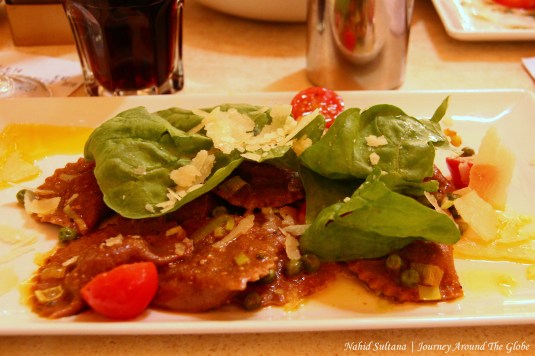
- My lunch in Valletta – rabbit ravioli
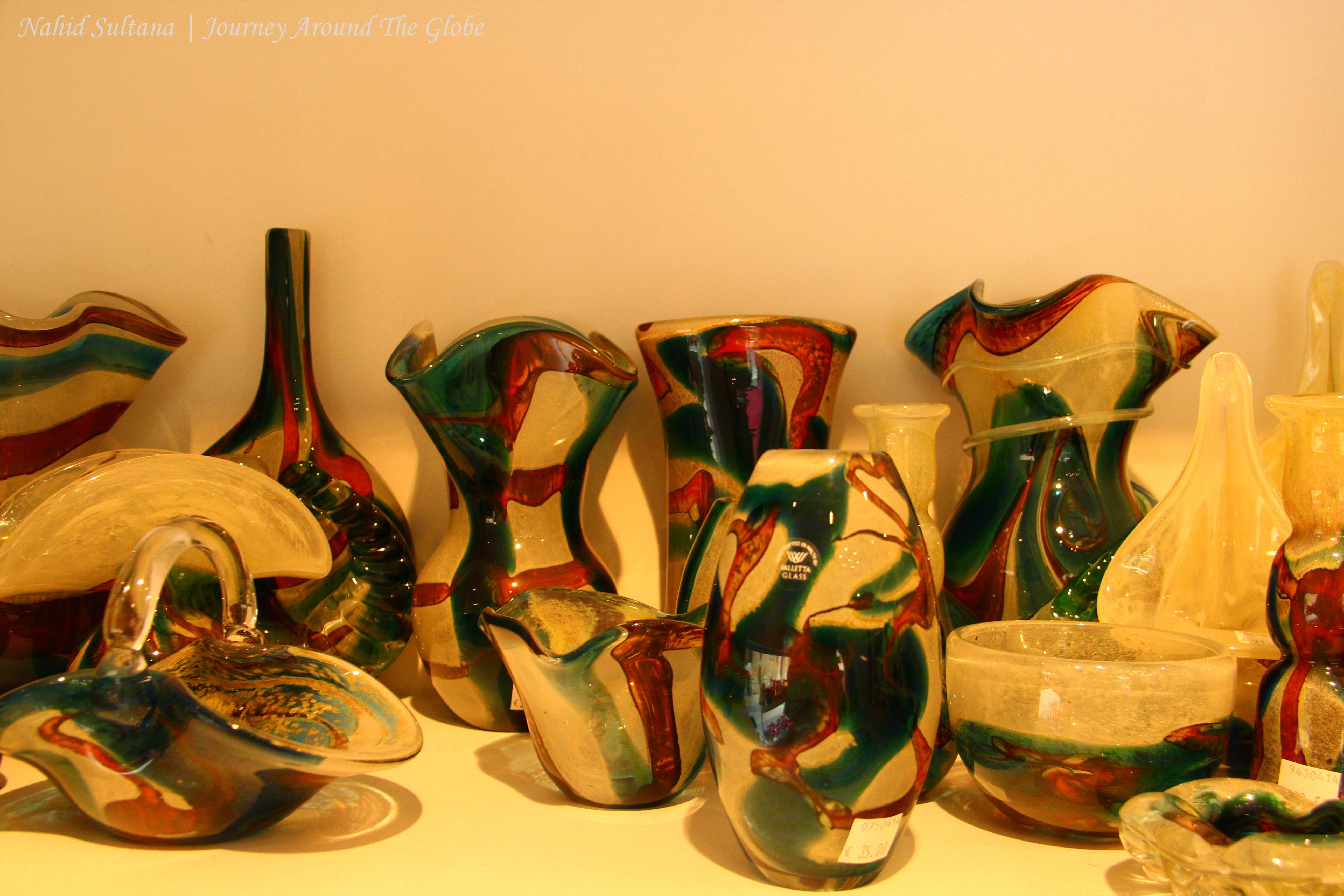
Hand-made glass arts from Mdina (a small town of Malta which once used to be the island’s capital) are very famous here and something exquisite to take back home. We didn’t go to Mdina but there were few shops in Valletta where we bought our set of hand-blown glasses…6 pieces for 76 euros, couldn’t beat that. Other than that many souvenir shops in old town Valletta sell usual gifts items like t-shirts, bags, key-rings, and etc.
- Handmade Mdina glasses in a shop in Valletta, Malta
PLACES WE’VE VISITED: We spent about a day and half in Valletta. 1st day in Valletta we couldn’t see the main spot of this island, St. John’s Cathedral, since it closes at noon on Saturdays. So we had to come back on Monday for that. Just to keep something in mind that every cathedral or church in Valletta is either closed completely or for half a day in weekends. There are few museums in Valletta for archeology, fine arts, and wars, if you are into those. And if time allowed us, I would have visited some gardens, and Palace of the Grand Masters, now Presidential Palace. Mdina is another city of Malta which is worth visiting for a day too, but didn’t get a chance.
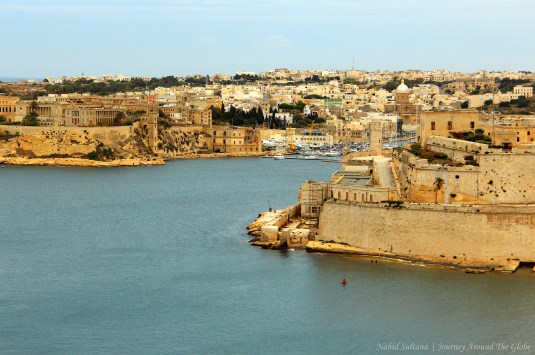
- Looking over Grand Harbor from Upper Barracca Garden in Valletta, Malta
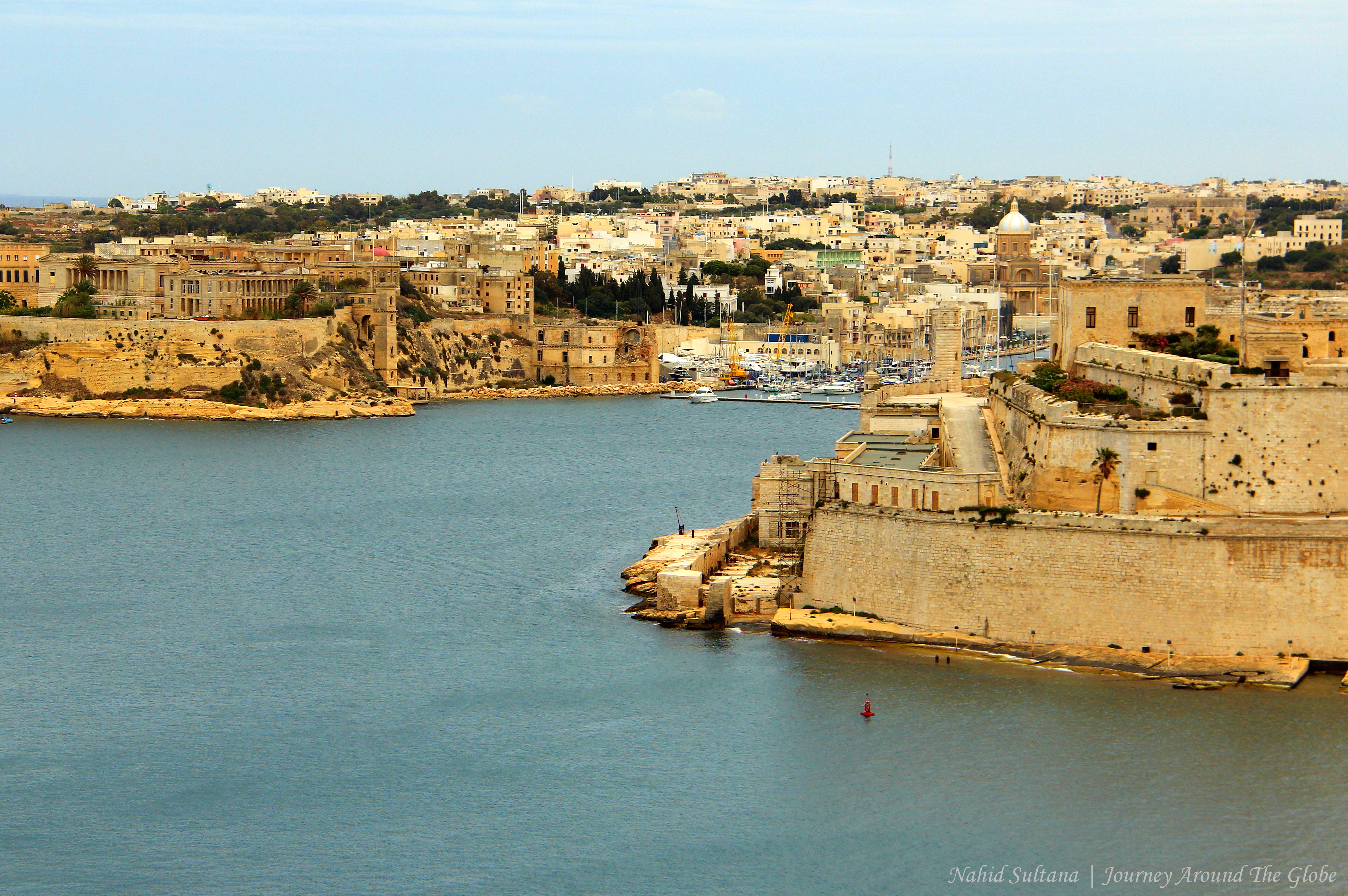
1) ST. JOHN’S CO-CATHEDRAL: The simple façade of St. John’s flanked by two large bell towers has more of characteristics of a fortress than a cathedral reflecting the sober mood after the historic episode of Great Siege of Malta. But no one can imagine its lavish interior by looking at its plain face.

- St. John’s Cathedral in Valletta, Malta…served as the headquarter of the Knights of St. John in 1577
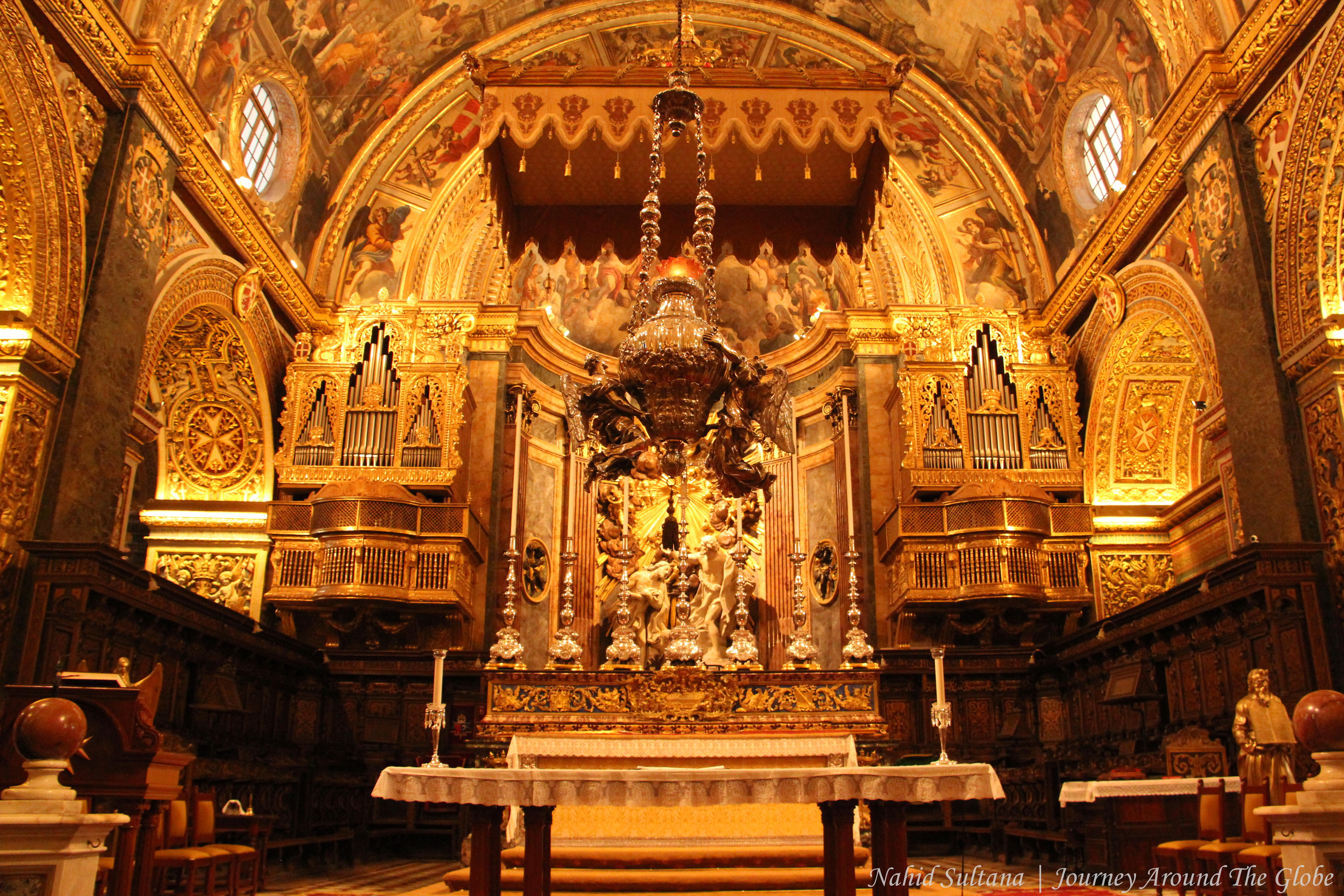
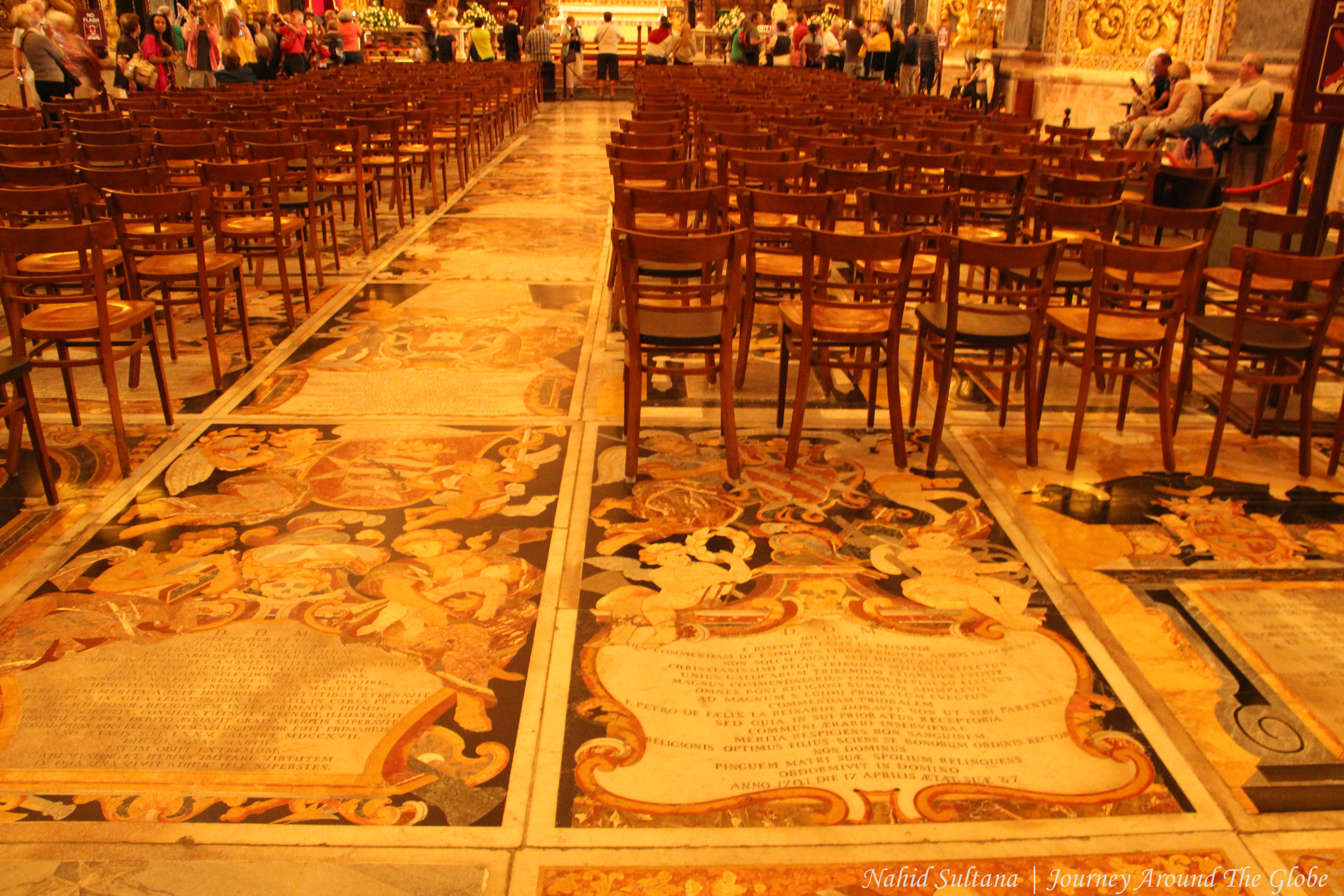
It was built in 1577 in the very heart of newly founded city of Valletta to serve as the headquarters for the Knights of St. John. The cathedral’s glorious Baroque interior reveals a spectacle of rich marbles, precious metals, paintings, and decorative ensembles that overwhelm the spectator with an impressive first vision. Elaborate motifs on the side walls and gilded foliage, flowers, and angels are some characteristic of Baroque ornamentation of this monument. The splendid inlaid marble memorial slabs on the floor are a collection of tombstones of important knights and noblemen make this floor a unique treasure of St. John’s. Some of these tombstones reveal individual stories, their acts of chivalry, and religious ardor. A huge, vigorous work of art dominates the oratory. Overall, every inch of St. John’s Cathedral is an incredibly ornate place and by far one of the grandest cathedrals I’ve ever seen so far.

- Inlaid marble memorial slabs on the floor in St. John’s Cathedral of Valletta, Malta
FYI, There are 365 churches in Malta…one for every day of the year to worship!! We couldn’t go to the museum or the crypt where many tombs of Knights of St. John are kept. Visitors should dress properly covering their shoulders, chest, and legs upon entering the cathedral. Opening hours for the cathedral is Mon-Fri from 9:30 to 4:30 pm (last admission at 4 pm) and Saturday from 9:30 to 12:30 pm (last admission at 12 pm). It’s closed on Sundays and public holidays. Entrance fee is 6 euros for adults and children under 12 years are free. The fee includes visit to oratory and museum in addition to an audio tour guide.
2) ST. PAUL’S PRO-CATHEDRAL: This is an Anglican church (Church of England) of Malta and Gozo. It was built in 1844 in neo-classic style with simple and spacious feel. Maltese limestone was used to build this cathedral. Its 60 meters spire can be seen from Sliema across the sea. The cathedral is a noted Valletta landmark. It was free to enter but if you take pictures you are supposed to pay 1 euro.
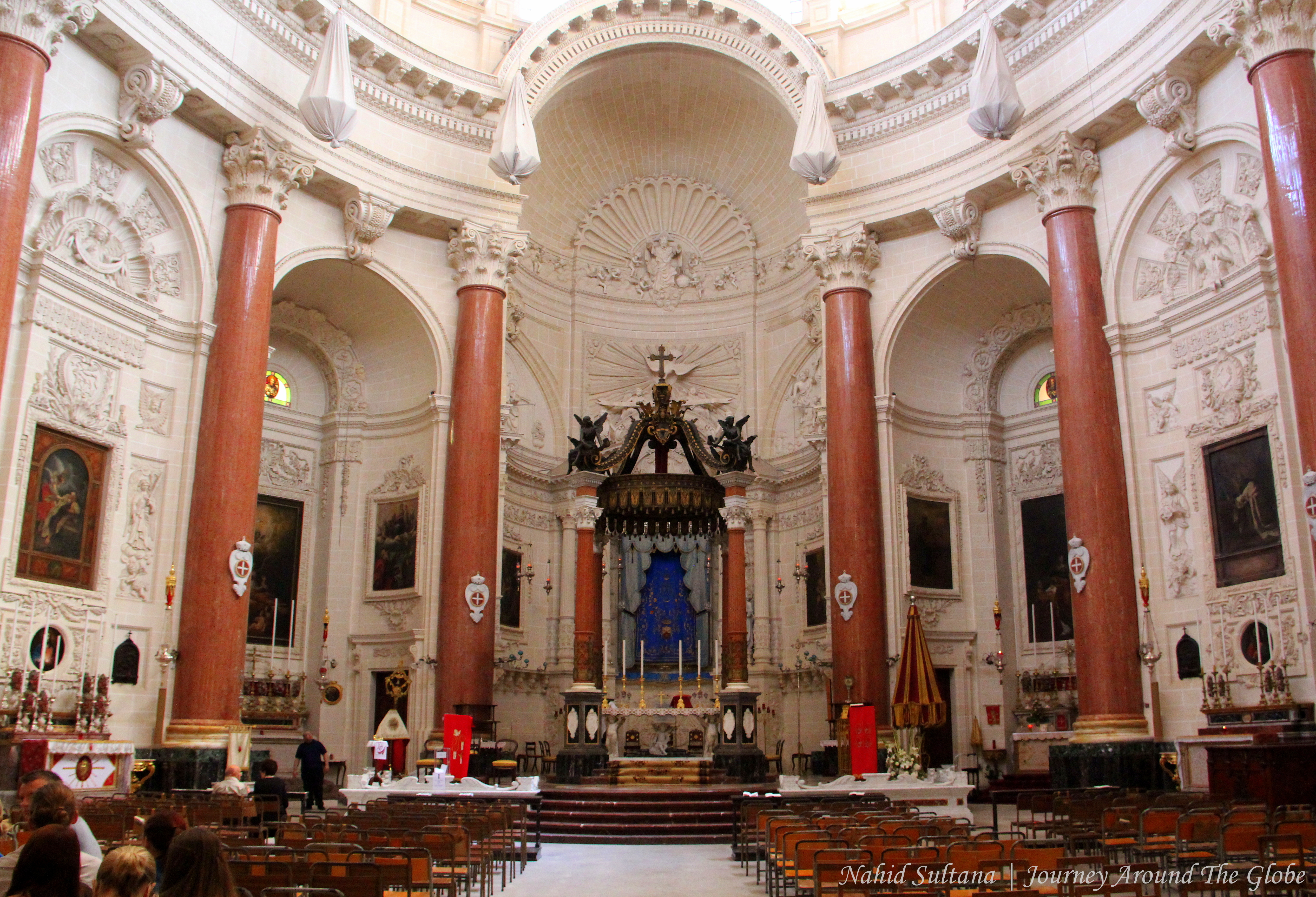
3) TEL-MADONNA TEL-KARMNU: The dome of this Catholic Church dominates the view of Valletta as seen from Sliema. It has a gorgeous and spacious interior with high copula. It’s located right next to St. Paul’s Cathedral and there is no fee to enter.

- Tel Madonna Tel Karmnu Church in Valletta, Malta
4) ST. DOMINIC: We walked inside this church while walking back to our ferry terminal. Exterior of this church had old façade. But inside was very decorative with beautiful ceiling and a gorgeous altar.

- St. Dominic Church in Valletta, Malta
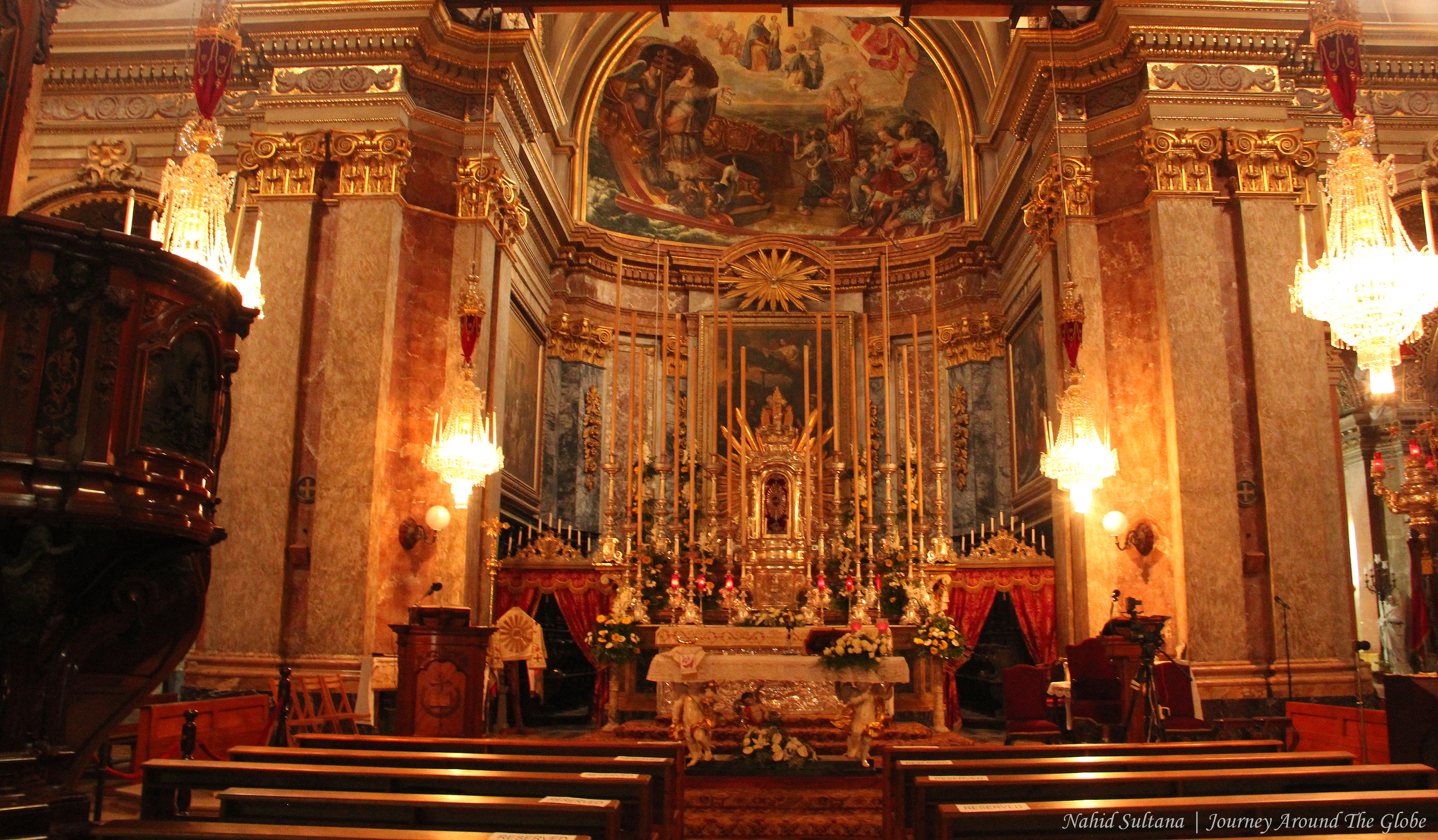
5) UPPER BARRACCA GARDENS: This garden is located on the upper part of the town offering visitors unrivalled views across one of the world’s largest and deepest natural harbors, Grand Harbor, and over to the Three Cities. The garden itself is small but pretty nice place for strolling. There are some fountains, statues, and arches that make this place really charming. There was a wedding going on when we went there. The old Saluting Battery provides artillery salutes to visiting dignitaries and shipping. A noon-day gun is still fired daily, recreating the age-old tradition. It’s free to enter.

- Looking over Grand Harbor from Upper Barracca Garden in Valletta, Malta
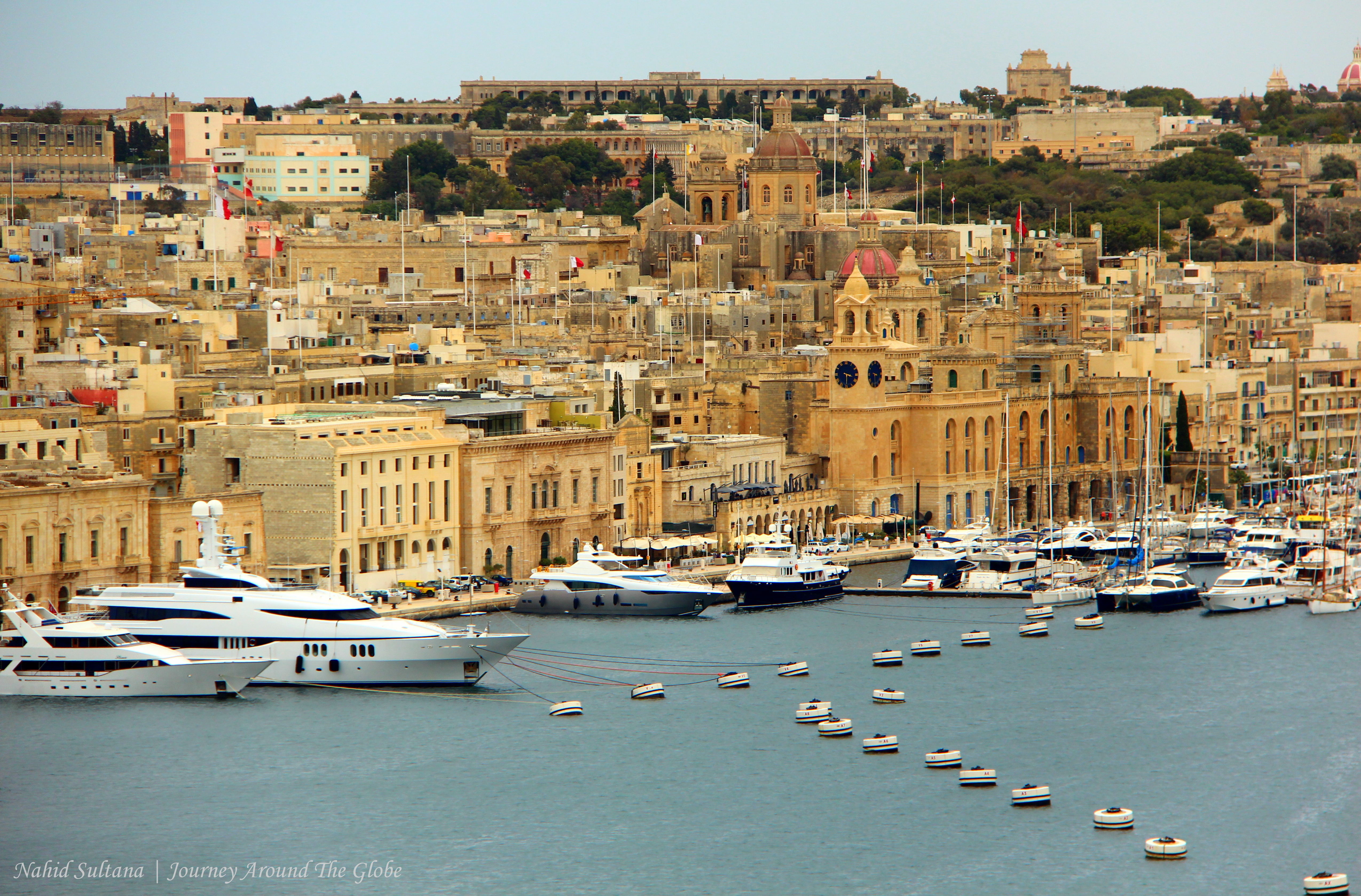
6) NATIONAL LIBRARY of MALTA: The origin of this building dates back to 1555. We didn’t go in, but as I’ve heard, a huge archive of the Knights of St. John from the Crusades in the 11th century until the late 18th century are kept in this library. It’s located in Republic Square next to Grandmaster’s Palace.

- National Library of Malta…from 1555 AD
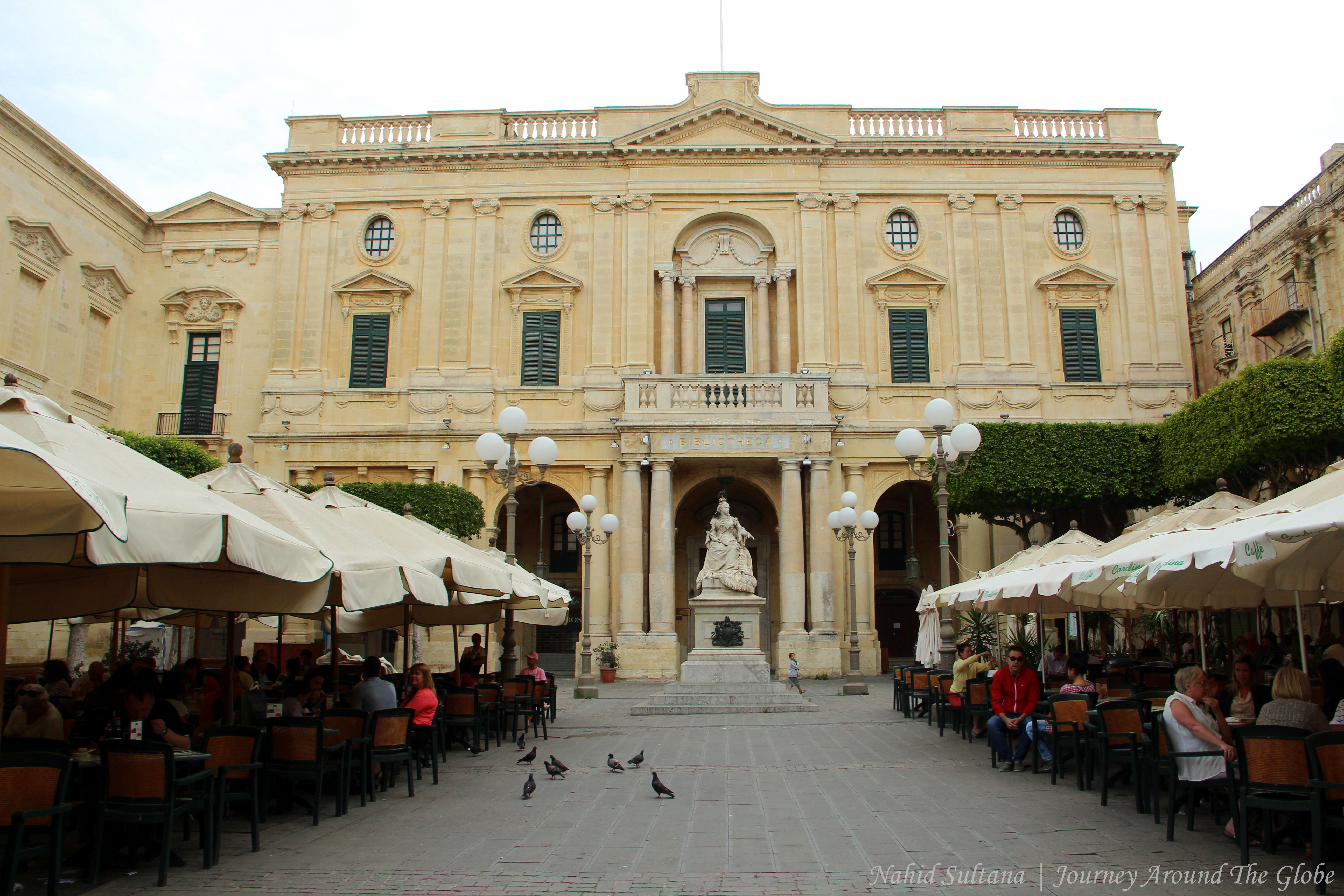
7) FORT ST. ELMO: This is an old fort at the tip of the peninsula. It was also built by the knights in 1551 guarding the entrance to both Grand and Marsamxett Harbors. Turks tried to invade it in 1565 but overall, this fort was never invaded by anybody in the history. We couldn’t go there since it was under renovation that time.
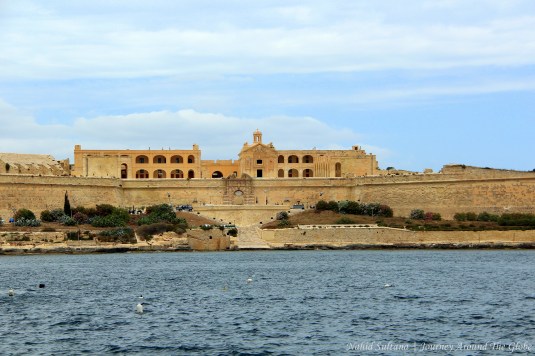
- St. Fort Elmo by the Mediterranean Sea in Malta
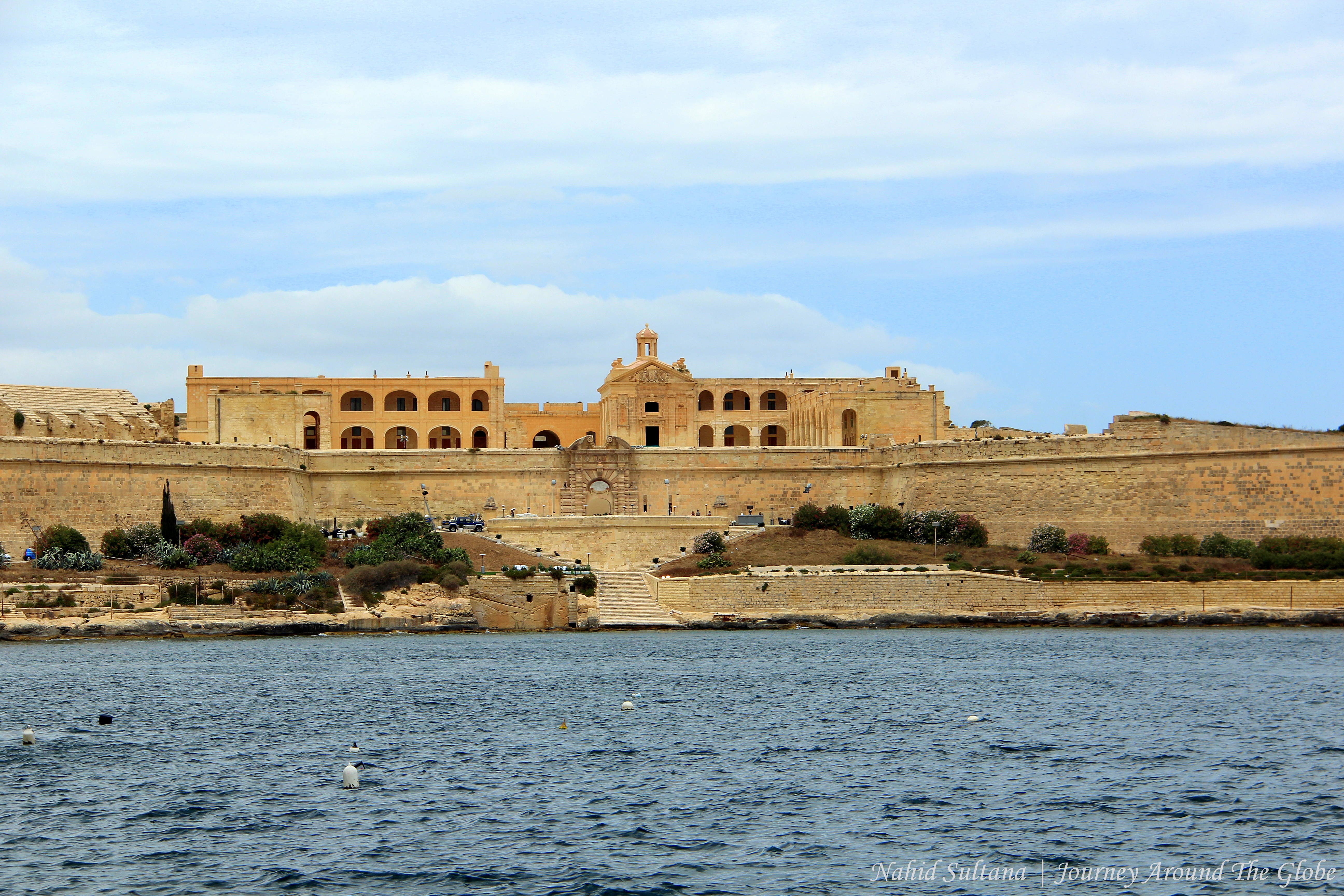
8) GREAT SIEGE SQUARE: This is a nice big square which has the entrance to go to St. John’s Cathedral. Opposite of the cathedral is the Justice Department of Malta. The square has lots going on with many shops and clothing stores in one side. That’s where our daughters got henna tattoos on their hands. There were many street vendors with trinkets all over the square.
Related articles
- Valletta, Malta (wootencruise.wordpress.com)
- My Valletta 2018, C’est Beau! Hija Sabiħa! (valletta2018.wordpress.com)
- Valletta, Malta (sivsopheapssp.wordpress.com)
Share this:

Dusseldorf, Germany
DUSSELDORF, GERMANY: Düsseldorf is another Rhenish city of Germany situated by River Rhine. This is a Mecca for arts, culture, and shopping. Just enjoy, relax, and go for a stroll by the river or get lost in the windy streets of old town. Promenade is the trendy place to look over the pretty water body. Visit Gehry buildings in Media Harbor to see some masterpiece transparent architectures with bold curves and cubes.
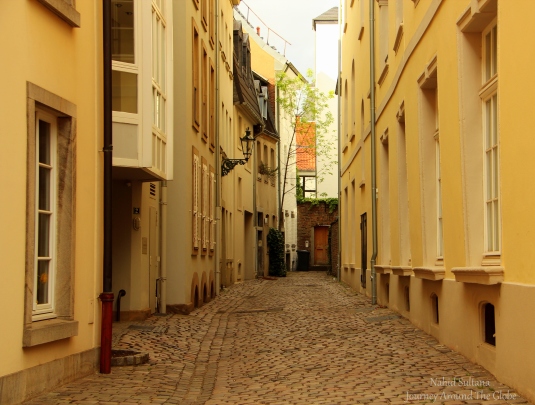
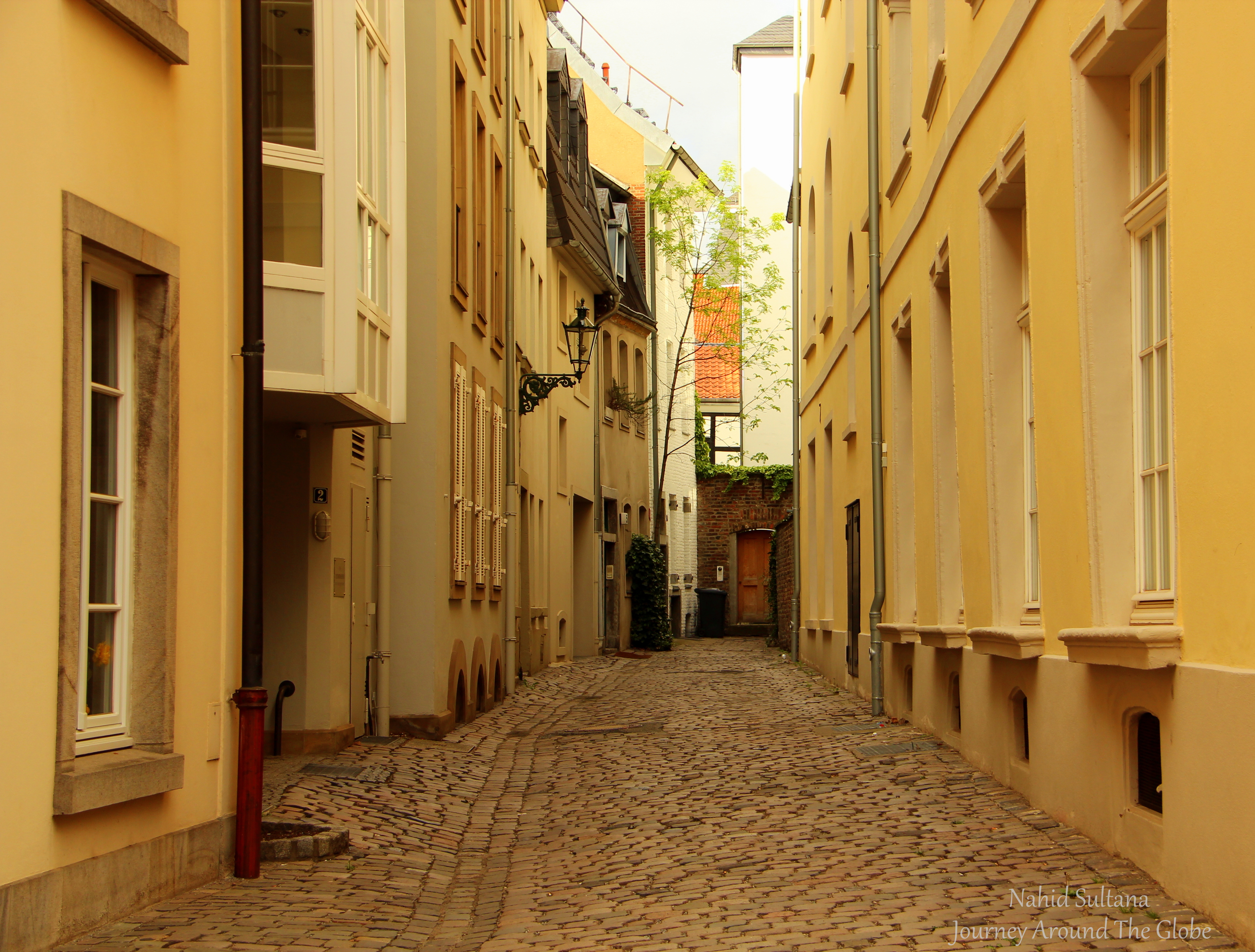
- Old town of Düsseldorf, Germany
This makes a great day trip from cities like Cologne, Bonn, or Frankfurt. The city is known for its bustling night life, many events/fairs, and fine shopping experiences.
TIME of TRAVELING: We took a mini-Germany trip in a long-weekend of May, 2013. My aunt was here with us from Baltimore, MD. Düsseldorf was our first city to visit in this trip, later we visited Bonn, Frankfurt, and Heidelberg. Luckily that day turned out to be a nice one with some sun shine and without black clouds. Düsseldorf is only a little more than 2 hours of drive from Tervuren, Belgium…so close, but never made it there in the last 2 years of our stay in Europe.
OUR HOTEL: We stayed about 15 minutes walking distance from the old town. It was called A&O Hotel/Hostel. It was like a in between a hotel and a hostel. But the setting was really except my aunt complained that she had hard time sleeping for too much outside noise. It didn’t have breakfast or free Wi-Fi in the room, nor a restaurant in the building. It looked like a place for the young travelers with pool table and some other activities in the lobby. Our room was nice and clean with moderate space.
EATING and SHOPPING: Old town is definitely a great place for meals or drinks, especially area around Schneider-Wibbel-Gasse. We didn’t sit down for anything here, was only drooling by looking at those . Same with shopping, old town had many boutiques and unique stores. Koningsallee is another perfect place for shopping if you have few hundreds of euros to spare in your pockets…it’s the fashion district of Düsseldorf with many upper-class exclusive shops.
PLACES WE’VE VISITED: I wouldn’t stay all the attractions in Düsseldorf are within walking distance. If you are into just old town, like us, then it’s all good. But other sites are scattered all around the city. We only had a day to spend here. It wasn’t enough but we only concentrated on the old town this time which was a fantastic experience.
- Walking towards the old town of Düsseldorf, Germany
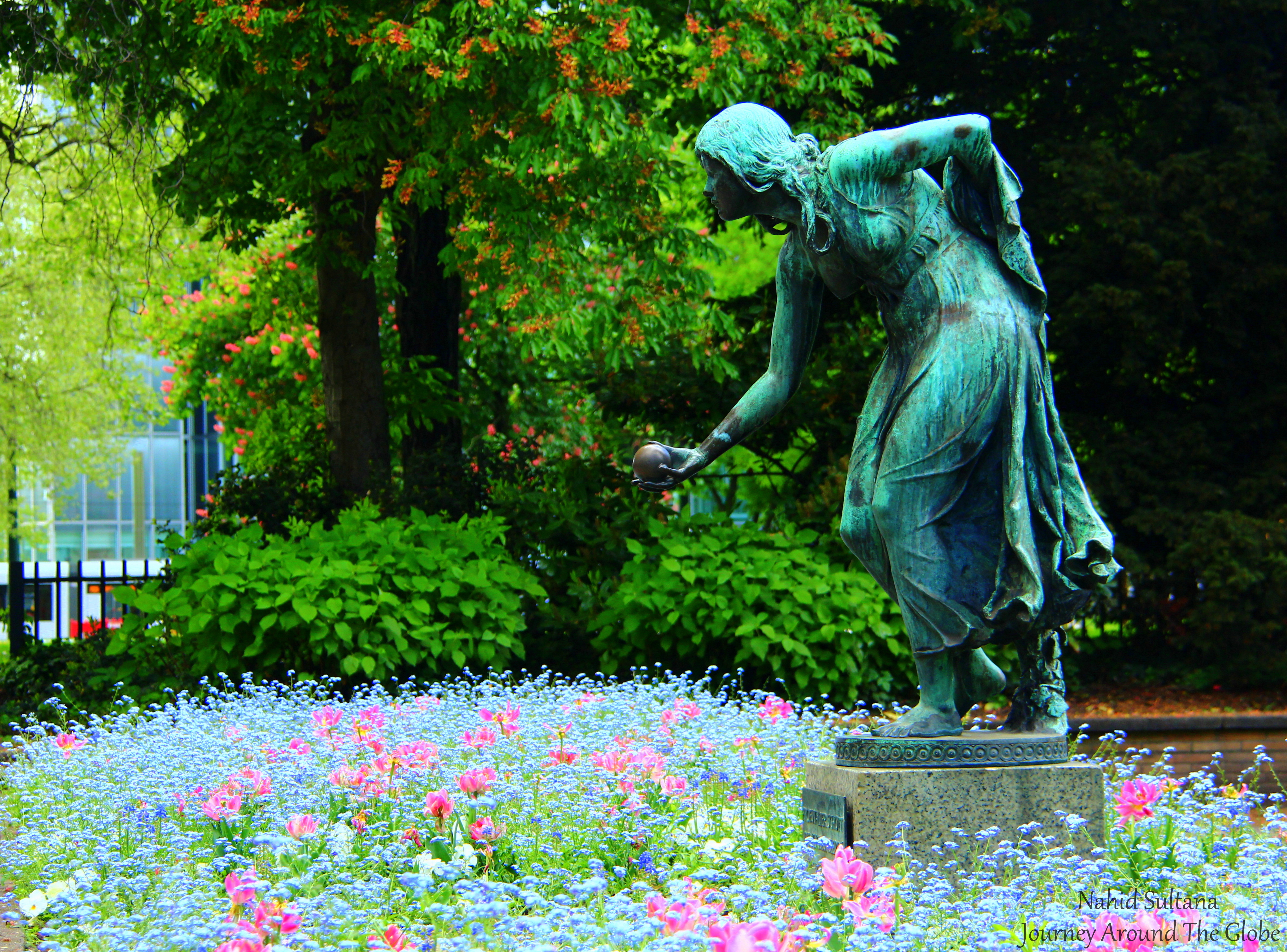
1) OLD TOWN: The old town of Düsseldorf was heavily destroyed during WWII and was later rebuilt according to the original plan. Therefore, the old district looks historic but with a hint of new attitude. For the tourists, don’t forget to look around and check every corner for beautiful buildings, statues, and street performers. This place has many small alleys which are loaded with tons of shops, cafes, restaurants, and pubs. Düsseldorf old town is very big compared to many other old towns in Europe. You can spend hours just wandering around in its cobblestone alleys eating, shopping, or just getting lost.

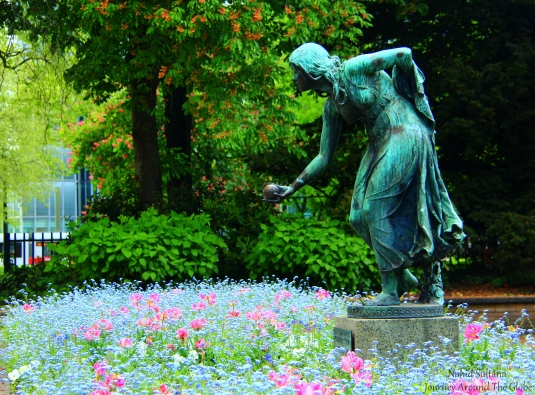
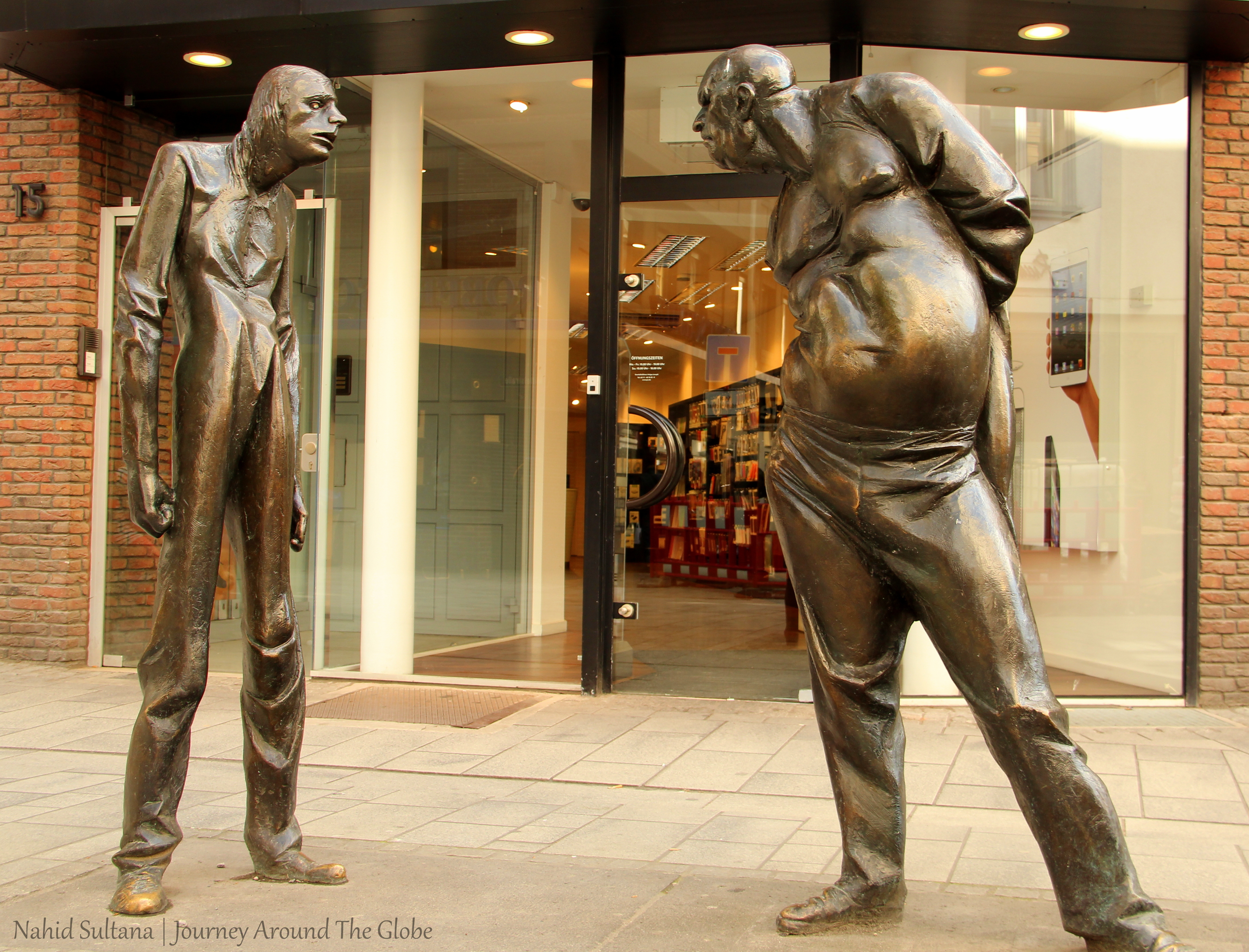
- A statue, known as “Conflict”, in the old town of Düsseldorf, Germany
2) ST. ANDREAS CHURCH: This was our first stop in the old town. It wasn’t in our to-see list. It was free to enter, so we just took a chance of going inside. This Renaissance style church was founded in 1629. Interior is pleasantly decorated with all whites.
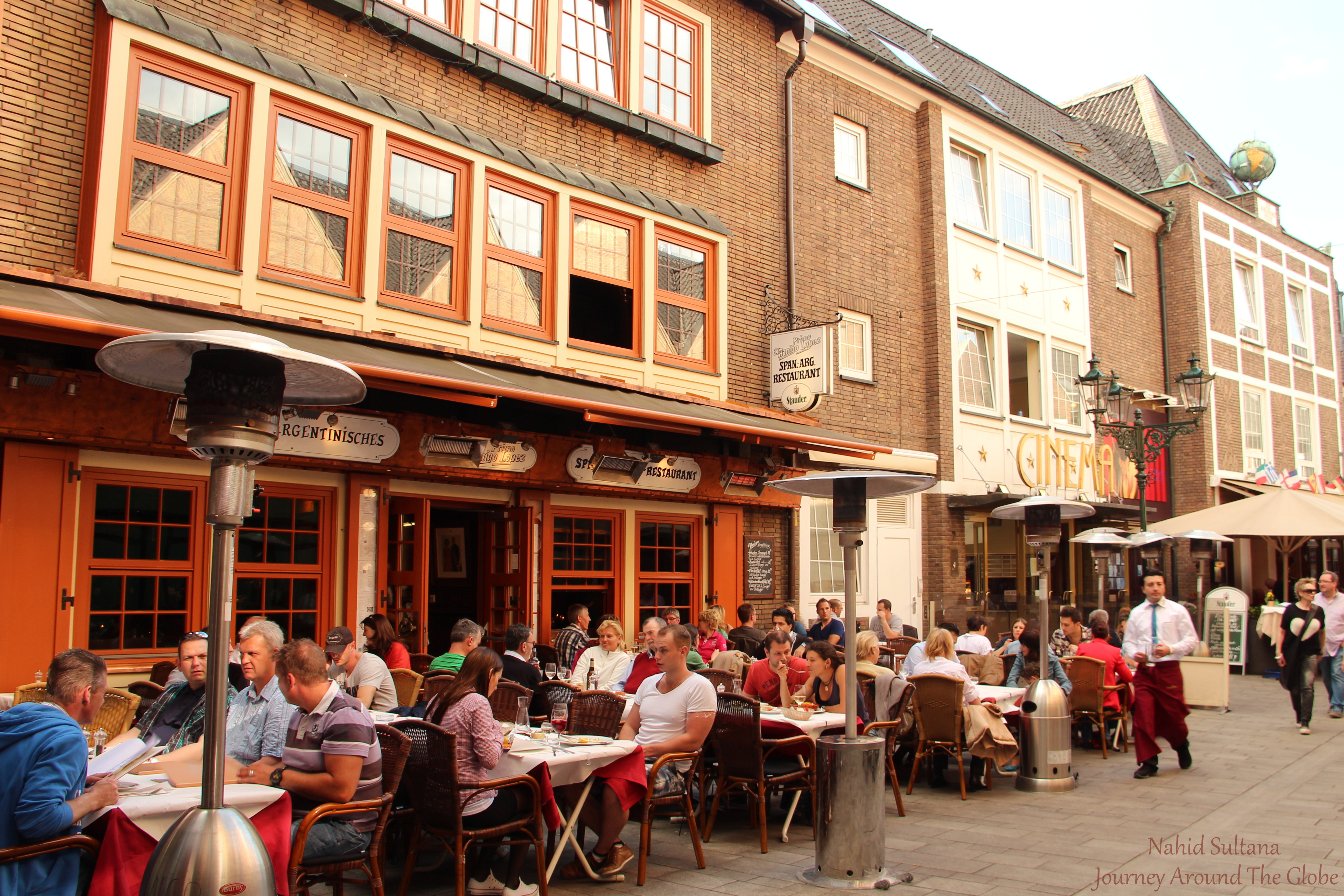
3) SCHNEIDER-WIBBEL-GASSE: This is a small lane in the old town which is packed with restaurants and bars. All the old buildings here were turned into restaurants, most of which offer Spanish or Latino food. Looks like the cool crowd of Düsseldorf love to gather here for fun…absolutely the best place for meal.
- Schneider-Wibbel-Gasse in Düsseldorf, Germany
4) CASTLE TOWER in BURGPLATZ , CARTWHEELERS’ FOUNTAIN, and CITY MONUMENT: Burgplatz or Castle Square is a big and lively square near St. Lambertus Basilica in the old town next to River Rhine. Once there stood a Baroque castle which was burned down in the late 19th century leaving a tower behind intact. Castle Tower or Schlossturm, now a navigation museum, is located in one side of the square.
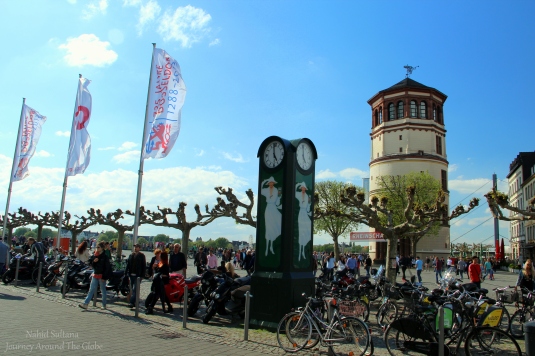
- Castle Tower or Schlossturm in Burgplatz of Düsseldorf, Germany
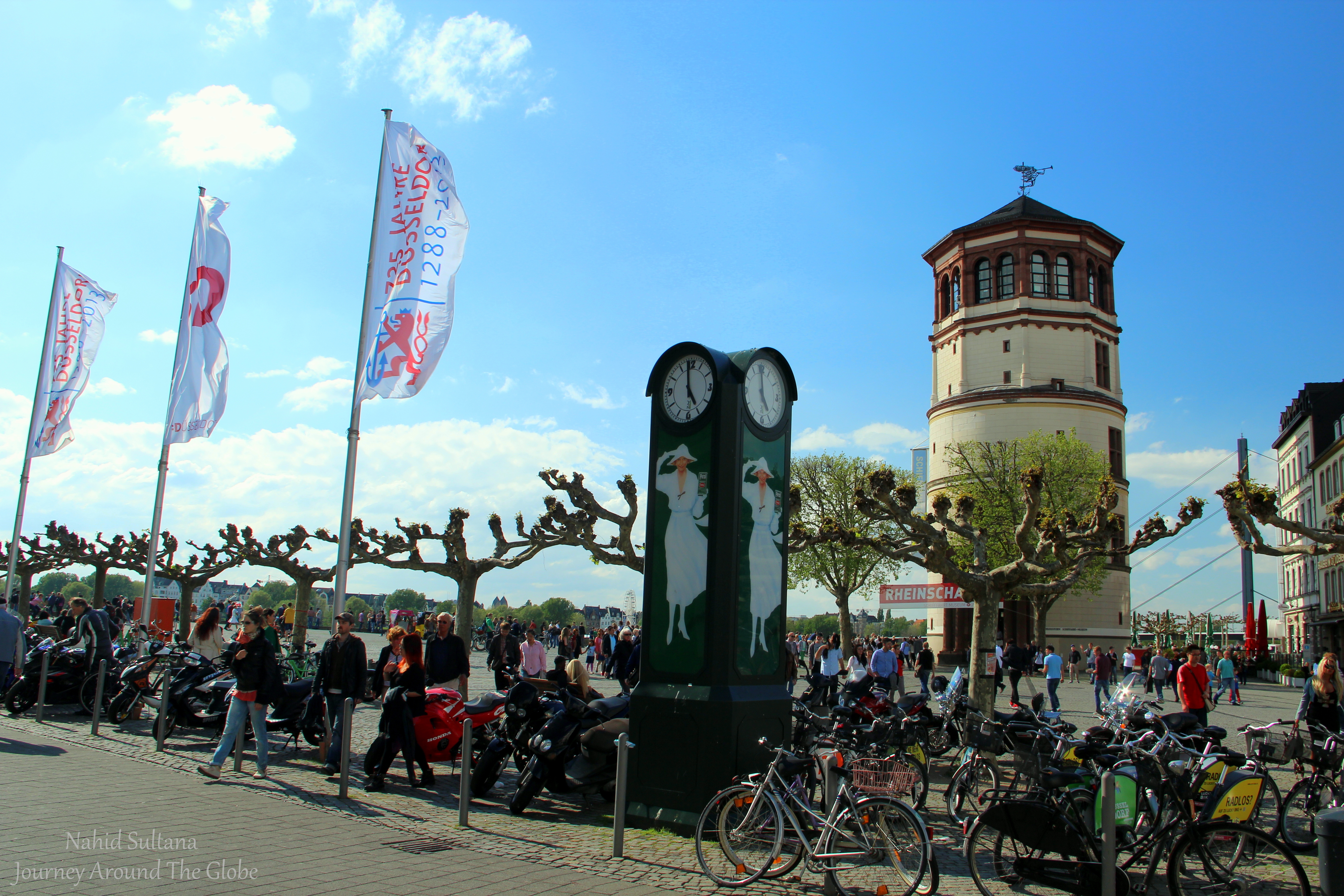
Cartwheeling is a popular activity among the young crowds here…they even have annual competitions of this “sport” in Düsseldorf. There is a Cartwheeler’s Fountain in Burgplatz which is about a little boy cartwheeling while another one watching him.
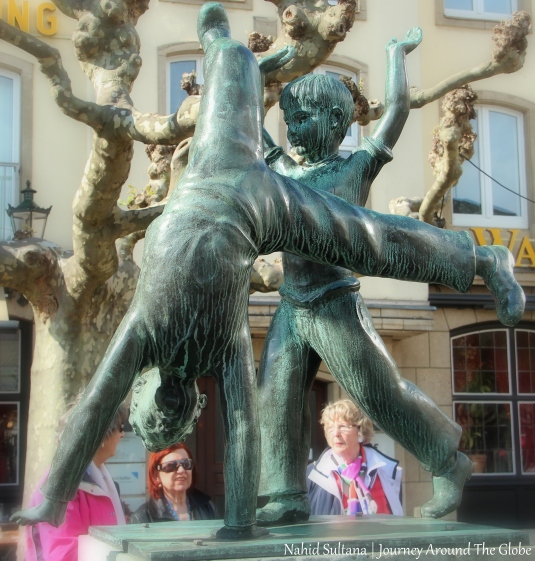
- Cartwheeling statue in Burgplatz of Düsseldorf, Germany
City Monument at Burgplatz, near St. Lambertus Basilica, was a donation on the occasion of the 700th anniversary of town foundation. The monument is full of symbols and depicts some important histories of the city. Right beside the monument is a small river, Northern Dussel, which gave the city its name.
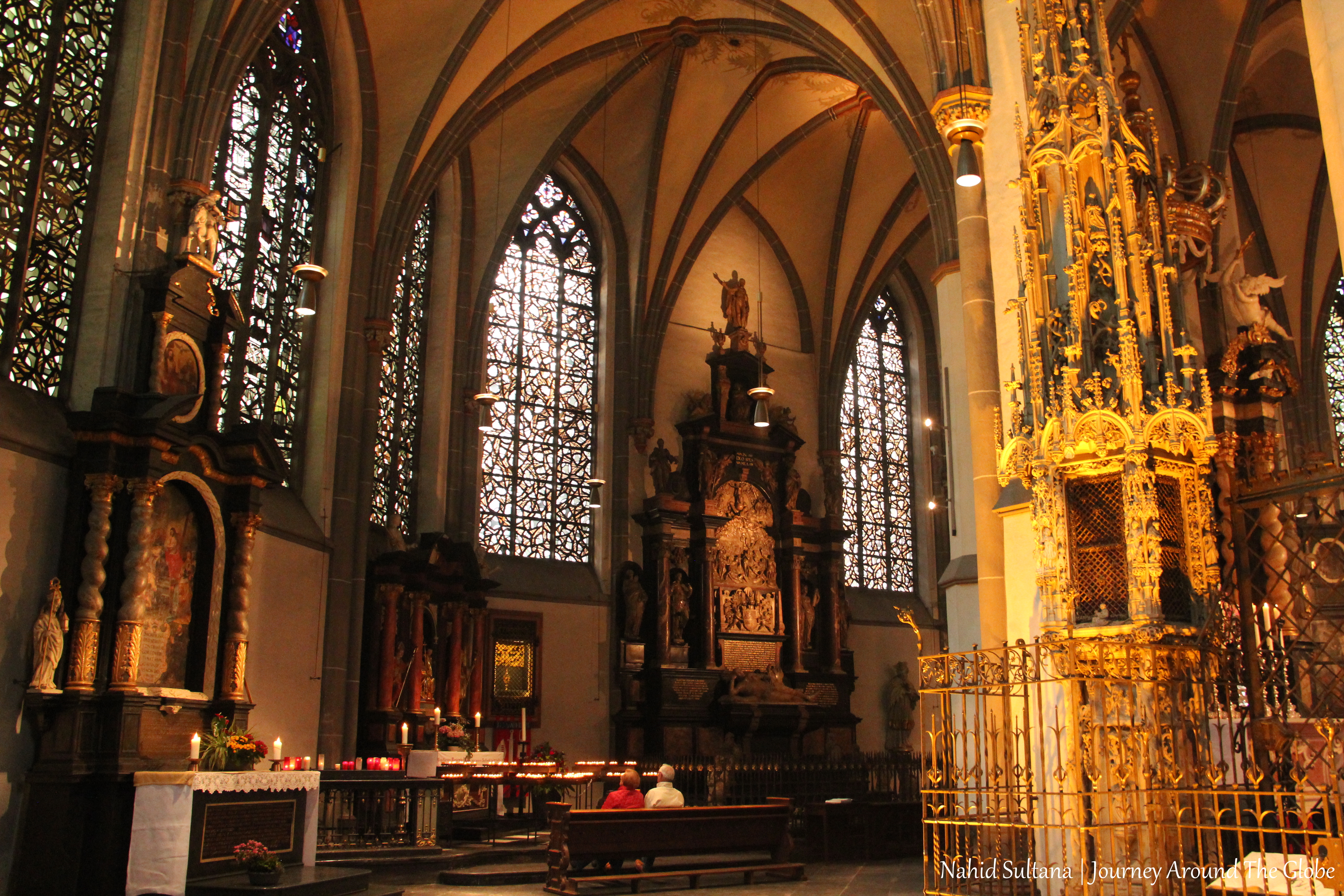
5) ST. LAMBERTUS BASILICA in STIFTSPLATZ: Stiftplatz is a calm and warm square that houses some nice old buildings and couple of cafes. Walk a bit further and you will see the Lower Rhine Gothic style St. Lambertus Basilica with its brick exterior and soaring tower. The basilica has some uniquely pattered stained-glass windows with elegant interior decorations. This is probably the oldest building in Düsseldorf, dating back to 1159 or even further back.

- St. Lambertus Basilica in Stiftsplatz in Düsseldorf, Germany
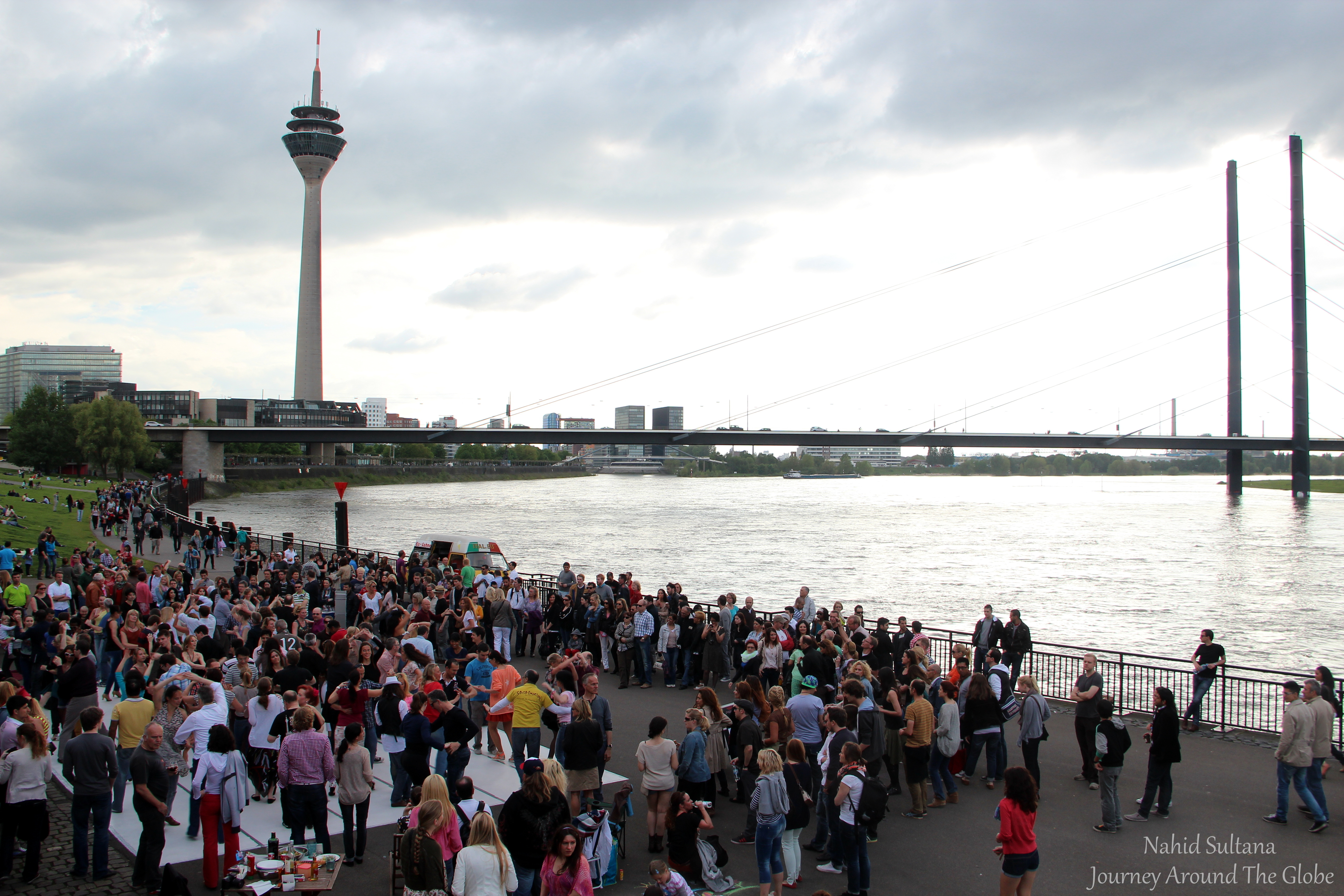
6) PROMENADE by RIVER RHINE: Promenade by River Rhine near old town is one of the most beautiful promenades in whole of Germany and a wonderful place to spend late afternoon. This is a long stretch of pathway…nice for a short walk. It offers an amazing view of the river, bridges, and Rhine Tower. This was our last spot in Düsseldorf. Sitting on the green grass by the river bank watching local crowds was a perfect way to end the day.
- Rhine Tower and Promenade by River Rhine in Düsseldorf, Germany
7) MARKTPLATZ, CITY HALL (RATHAUS), and STATUE of JOHANN WILHELMS II: Marktplatz is located next to Burgplatz in the old town but not as lively as Burgplatz. The square houses the historic city hall of Düsseldorf from the 16th century. There is a guided tour available few times a week which we didn’t take.
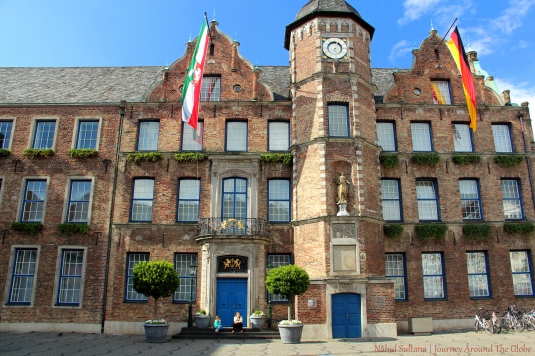
- Düsseldorf City Hall (Rathaus) in Marktplatz
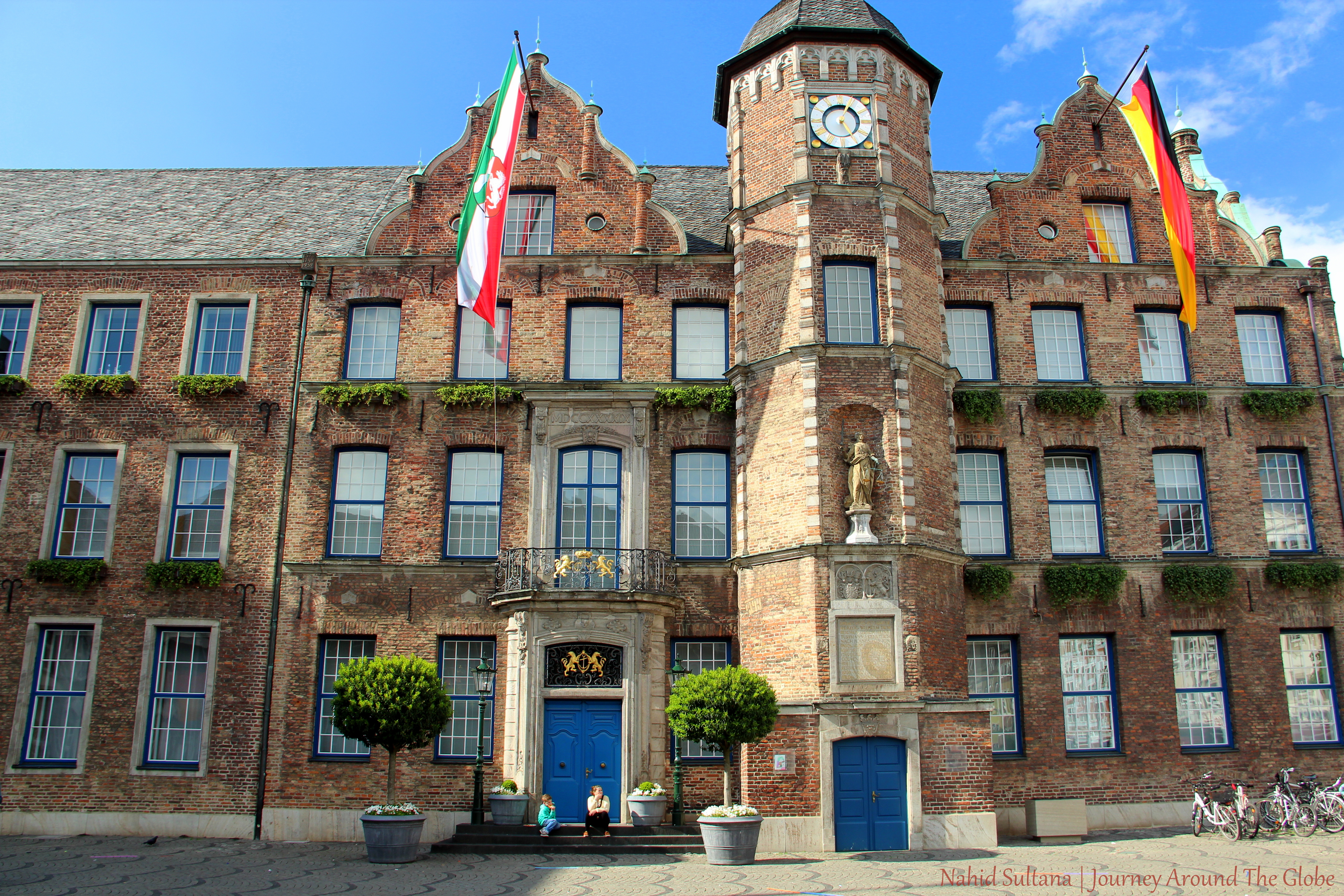
Marktplatz is dominated by a monument of Johann Wilhems II (1658 – 1716) on horseback in front of the city hall. He is a beloved son of Düsseldorf who boosted the development of the city. The monument was raised in 1711.
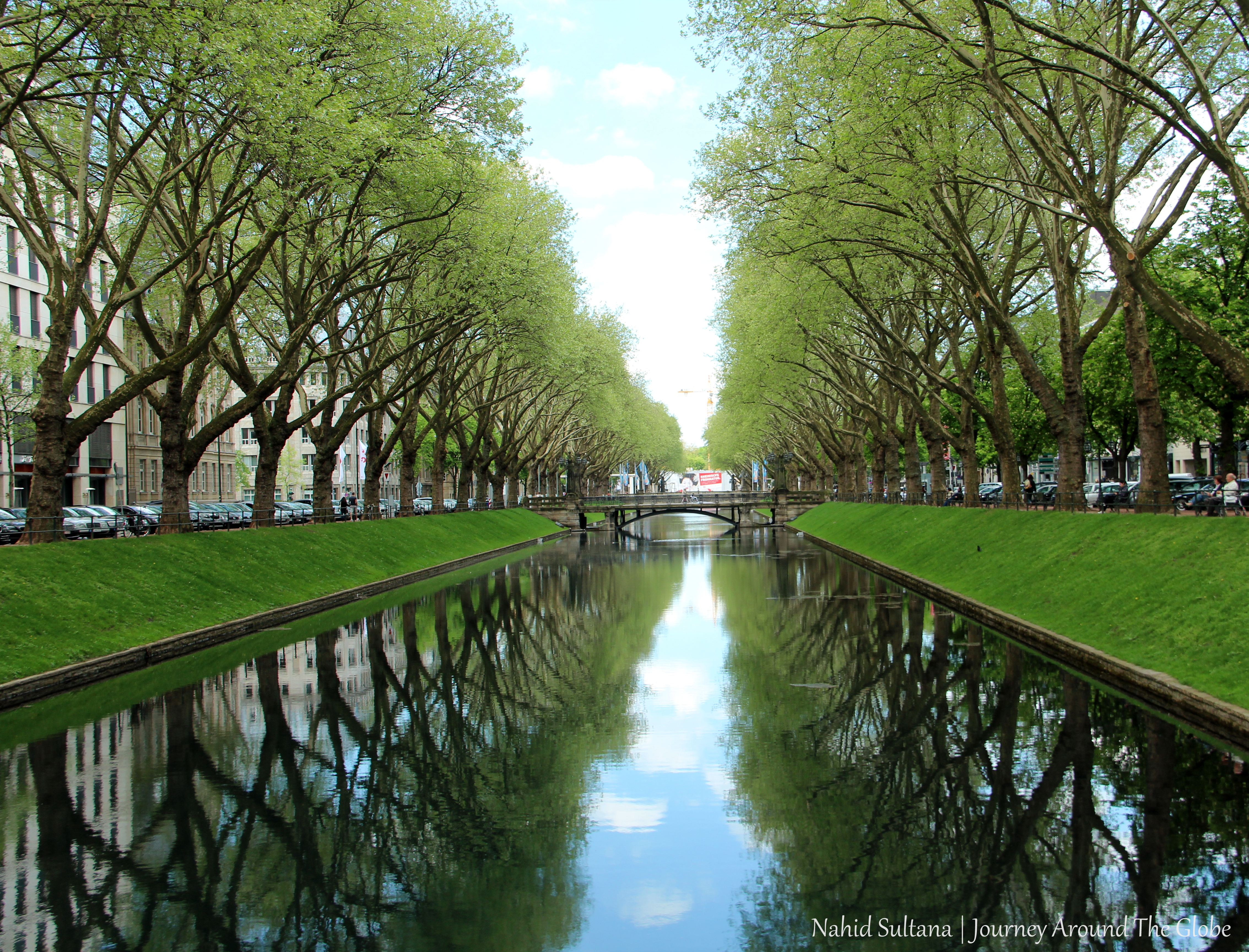
8) KONINGSALLEE: This is the “Champs-Elysees of Germany” as some people refer this street to which is the shopping district of the city with high-end fashion stores (like Burberry, Armani, Tiffany, and Louis Vuitton etc.), many brand names shops, and few mid-range places… I am sure you can find something within your budget. Even if you don’t buy anything this street is a very nice one for taking a stroll by a small river. At one end of it has an entrance to the old town.

- A small river by Koningsallee in Düsseldorf, Germany
Related articles
- Beethoven’s birth place – Bonn, Germany (journeyaroundtheglobe.com)
- A truly charming German town – Heidelberg, Germany (journeyaroundtheglobe.com)
Share this:

A truly charming German town – Heidelberg, Germany
HEIDELBERG, GERMANY: Heidelberg is one of the most charming German towns I’ve visited as of yet. Situated by River Necker, it makes a great getaway from Frankfurt or Bonn. It’s a neat little organized city with warm beauty everywhere you look. This would be in my top-10 “picture-perfect” cities of Europe so far…loved it so much. Enjoyed its beautiful atmosphere with old-time settings and would love to go back there again and again with every chance I get.
- Old town of Heidelberg, Germany
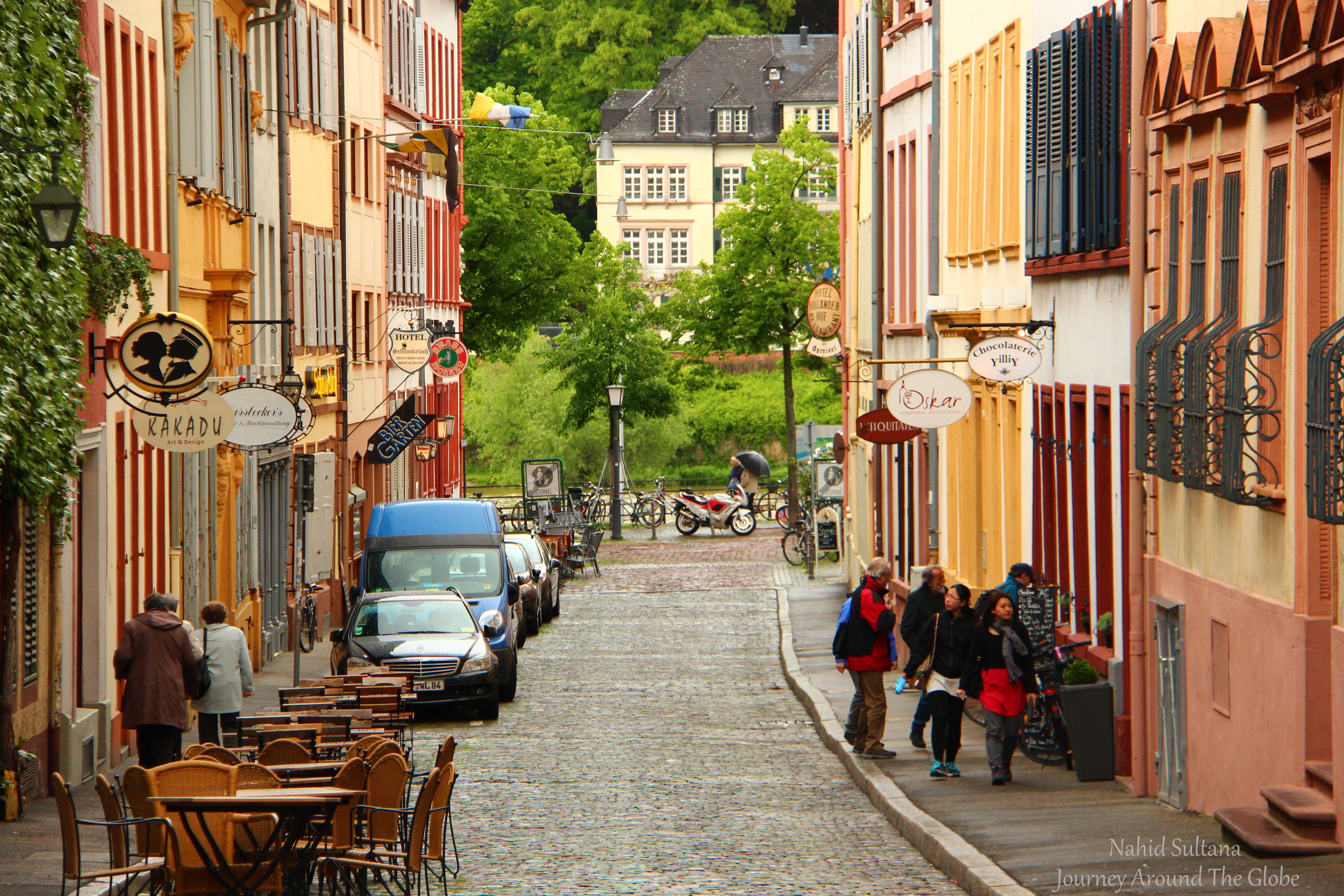
Old town of Heidelberg kept its charming medieval look and feel all throughout the city. Cobblestone streets, narrow alleys lined with many designs of colorful buildings, flower pots on the windows, small cozy cafes make this little town a fun place to spend a day or two. I can guarantee that this place won’t disappoint anyone who is into small town beauty and looking for a fun getaway from the chaos of big cities.

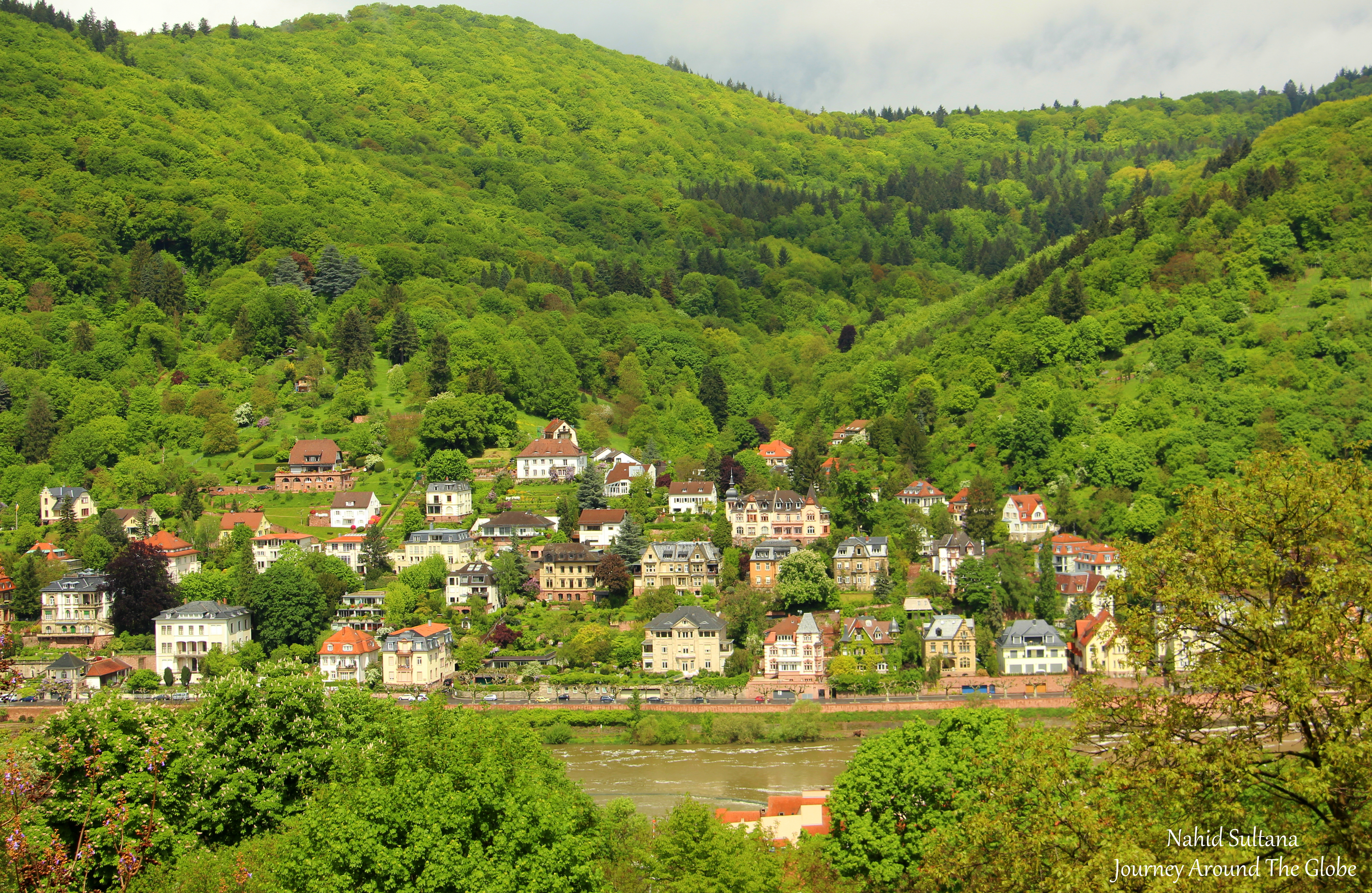
- View from Heidelberg Castle hill in Germany
TIME of TRAVEL: We were out with my aunt, visiting us from the USA, on a long weekend of May 2013. This was our last stop of our mini-Germany trip that included Düsseldorf, Bonn, and Frankfurt. It was not in our itinerary but one of my husband’s colleagues had suggested Heidelberg and I was truly thankful to him for recommending this place. If I can remember correctly, it took us about little more than hour to reach here from Frankfurt. It was cloudy and was raining a bit when we arrived. The weather continued to be like this throughout the whole day surprising us with little bit of sun shine once in a while.

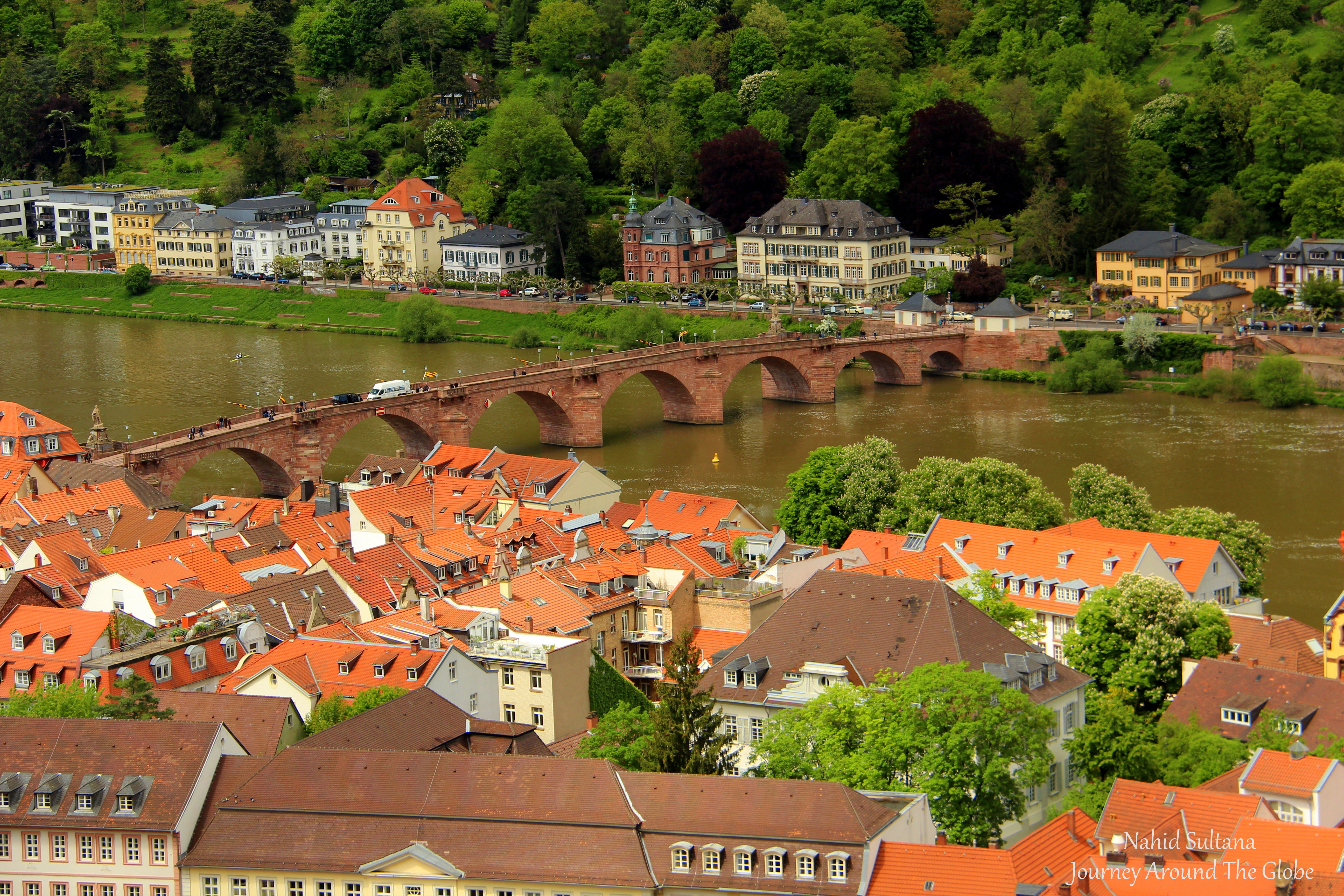
- Alte Brucke – a pedestrian bridge on River Necker in Heidelberg, Germany
OUR HOTEL: We didn’t stay in Heidelberg. We stayed at Novotel in Frankfurt. After checking out in the morning, we headed straight towards Heidelberg before heading back home to Tervuren, Belgium.
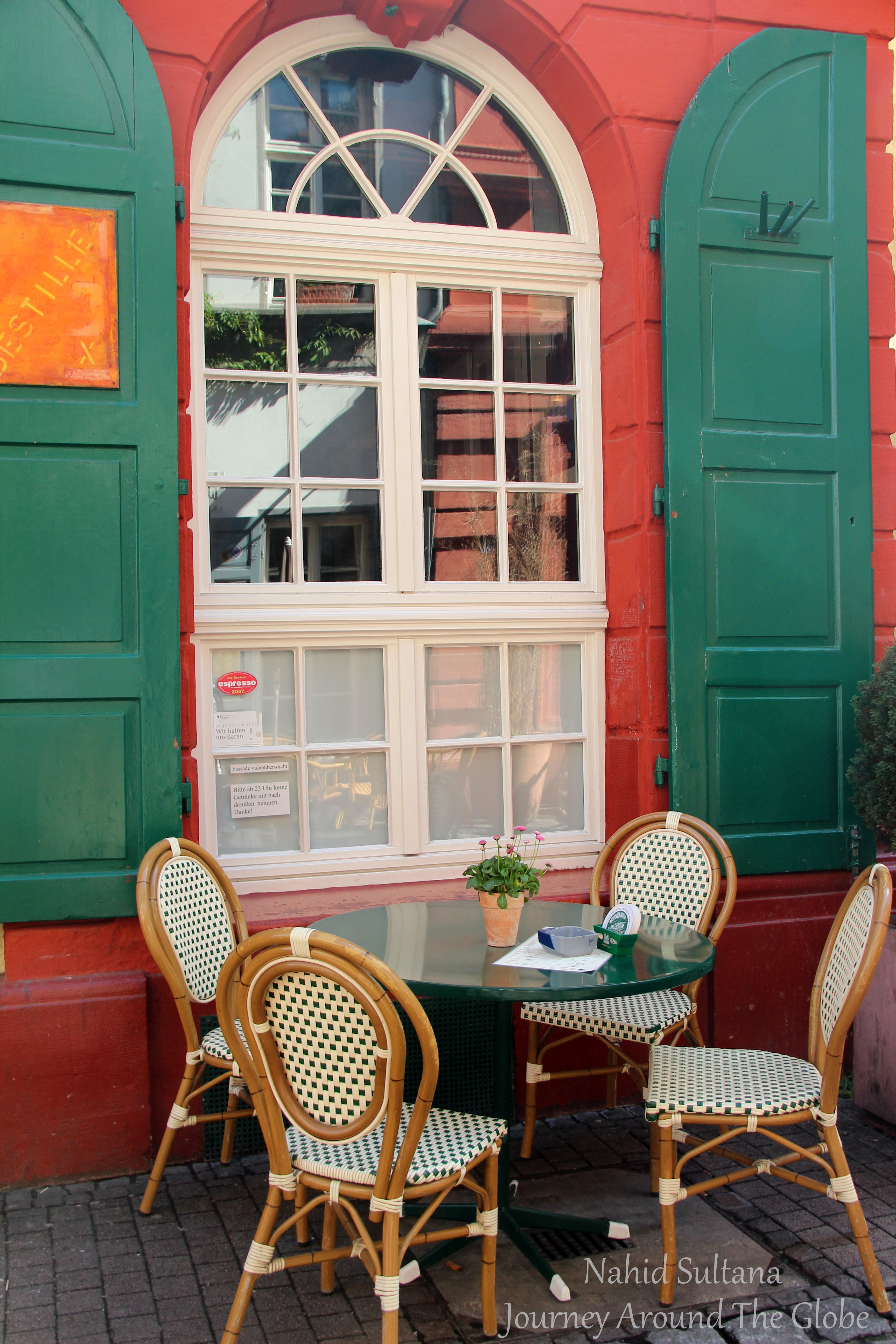
EATING and SHOPPING: Heidelberg is overloaded with tons of nice cafes and restaurants. We had lunch in a kebab and pizza place in Marktplatz opposite to Heiliggeistkirche. Every café or restaurant I saw, looked so welcoming and warm. Outdoor sitting arrangements with cute designs and lovely decorations make them very cozy.
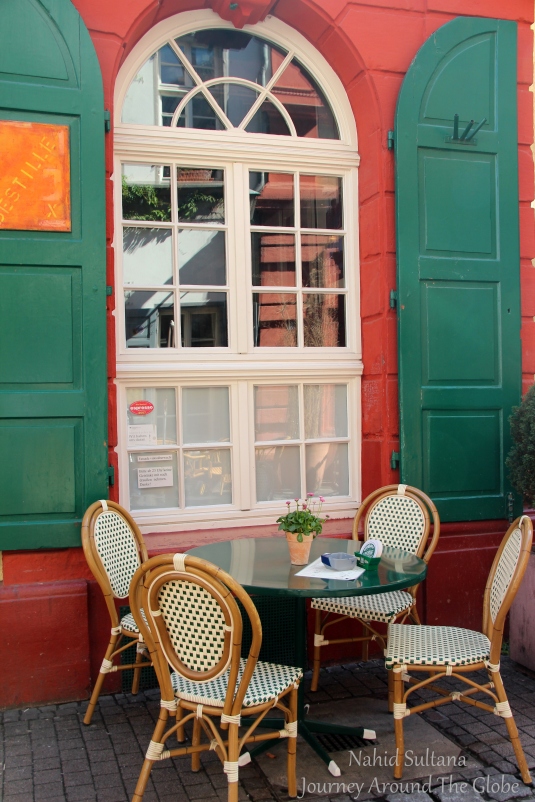
- One of many cozy cafes of Heidelberg, Germany
Many souvenir shops can be found in Marktplatz of Heidelberg. Sketches, beer mugs, and cuckoo clocks are just few things to name you can find in these shops along with many other gift items. Old district of Heidelberg has many boutique and locally owned shops where you can find unique things.
PLACES WE’VE VISITED: Walking around the old town of Heidelberg is the main attraction of this city. We spent about a whole day here before heading back home, about 4 hours of drive. All the main sites here can be seen on foot and I highly recommend doing it on foot…otherwise you will miss out the main beauty of Heidelberg. Walk on Haspeigasse (takes you to the river) or Steingasse for nice charming surroundings.
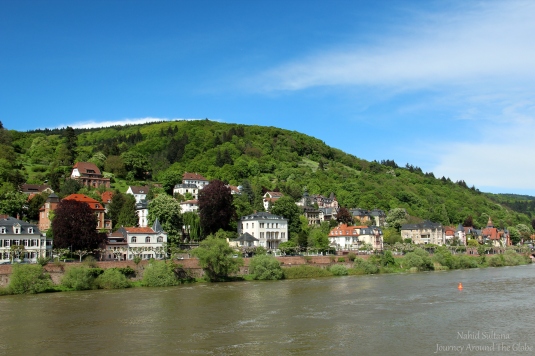
- River Necker and its bank in Heidelberg, Germany
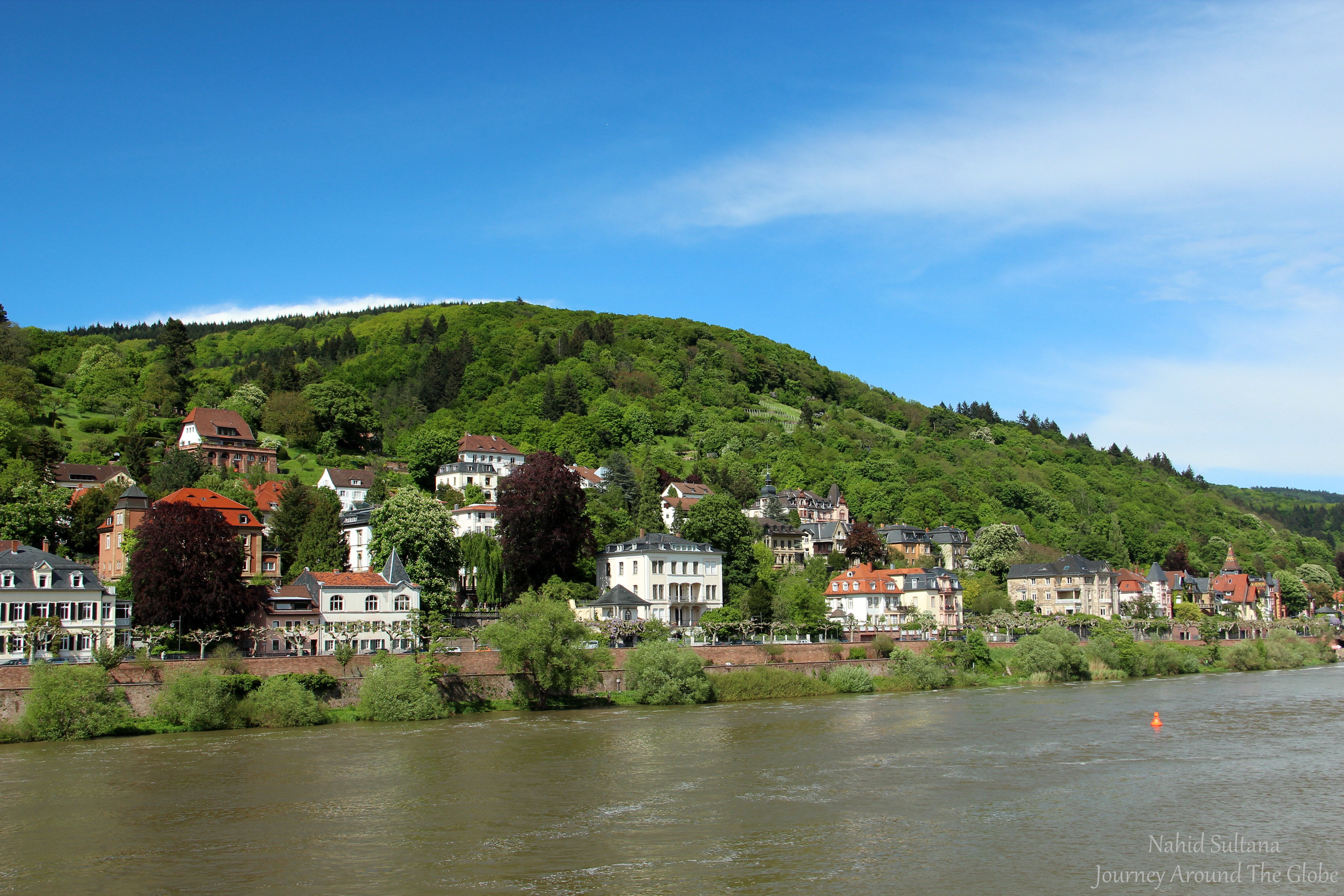
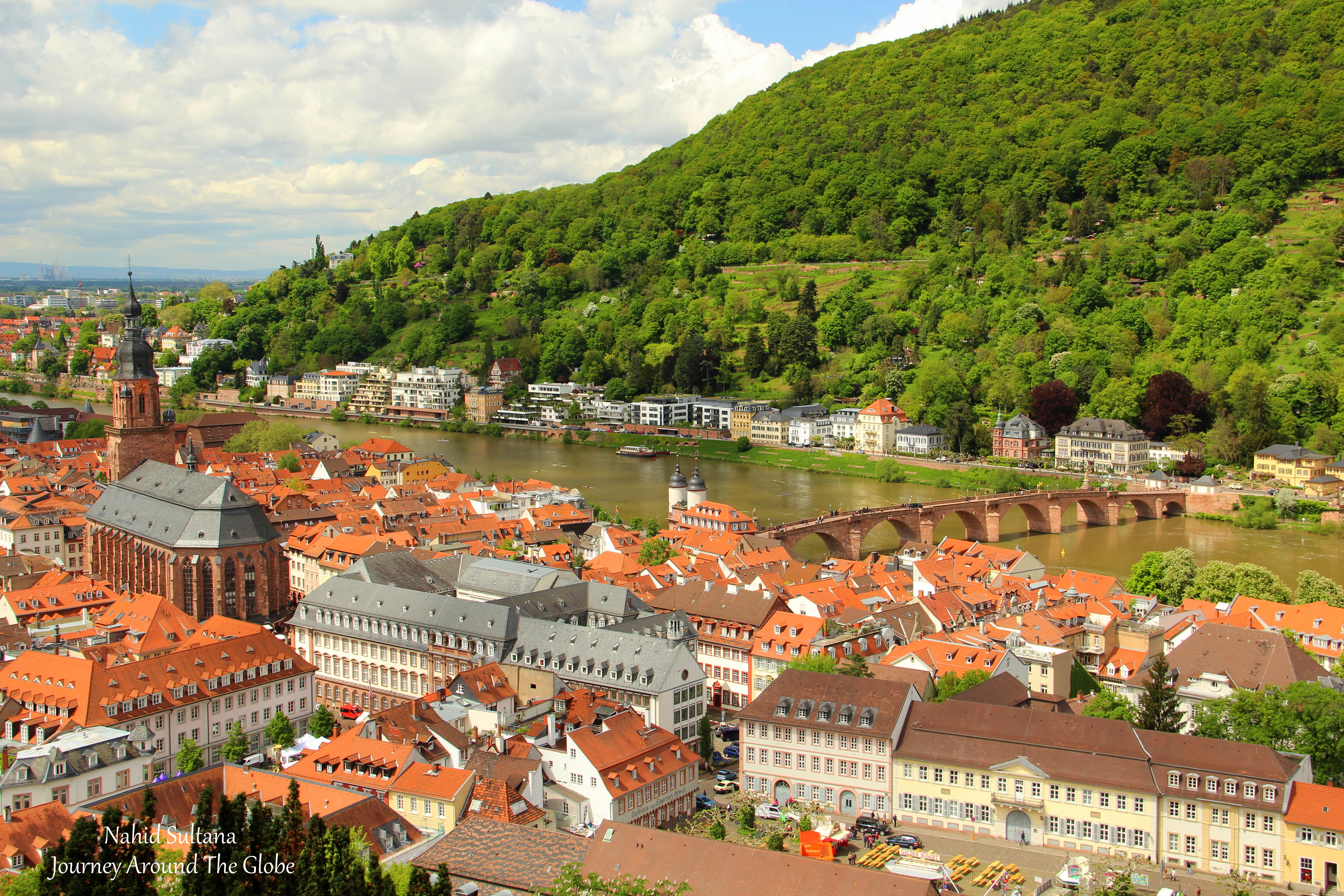
1) HEIDELBERG CASTLE/SCHLOSS and GARDEN: The ruins of Heidelberg Castle is a famous landmark of Germany and number one spot to visit in Heidelberg. Located 260 feet up on the hillside, the castle dominates the view of old town of the city. The original structure of this castle was built before 1214 A.D. Heidelberg Castle gives a fabulous view of River Necker and the small town at the foothill. Go to the terrace beyond the courtyard to enjoy the view from different angles and sides. The surroundings couldn’t get any better…it was simply outstanding.

- View from the hill of Heidelberg Castle in Germany
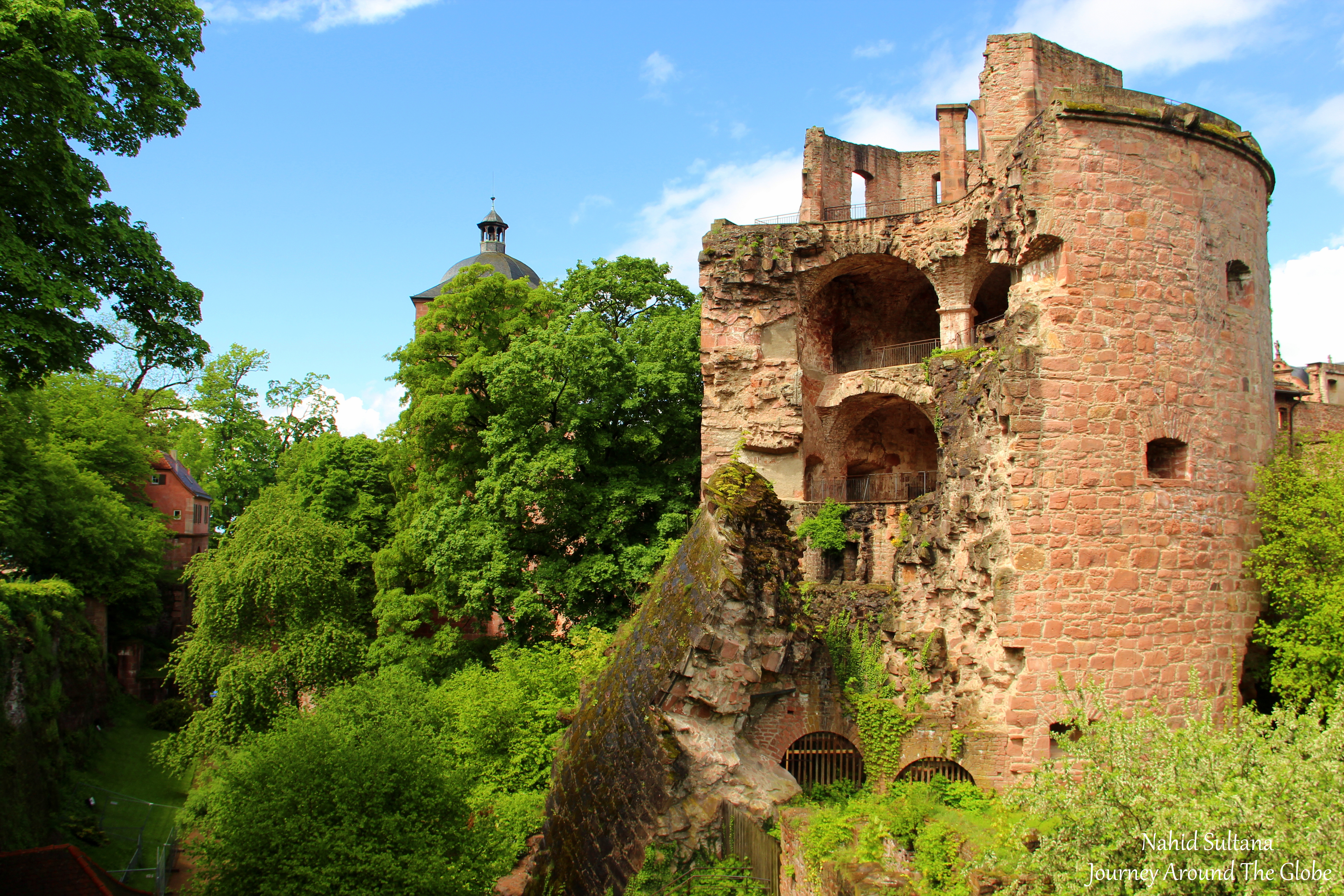
The park of the castle is very calm and green with a fantastic overview of the whole town and small hills. Old ruins of a tower in one side of the park looks like telling stories from the past. Statue “Father Rhine” at one end of this park is an added dimension to the castle garden.
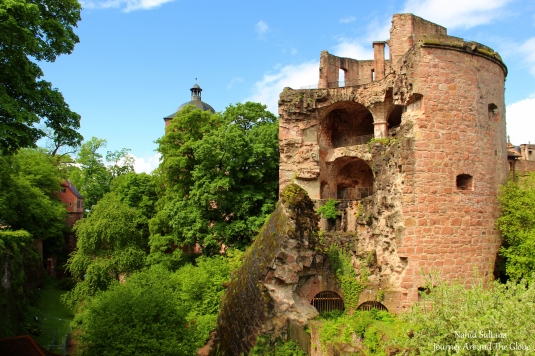
- Ruins of Heidelberg Castle from its park in Germany
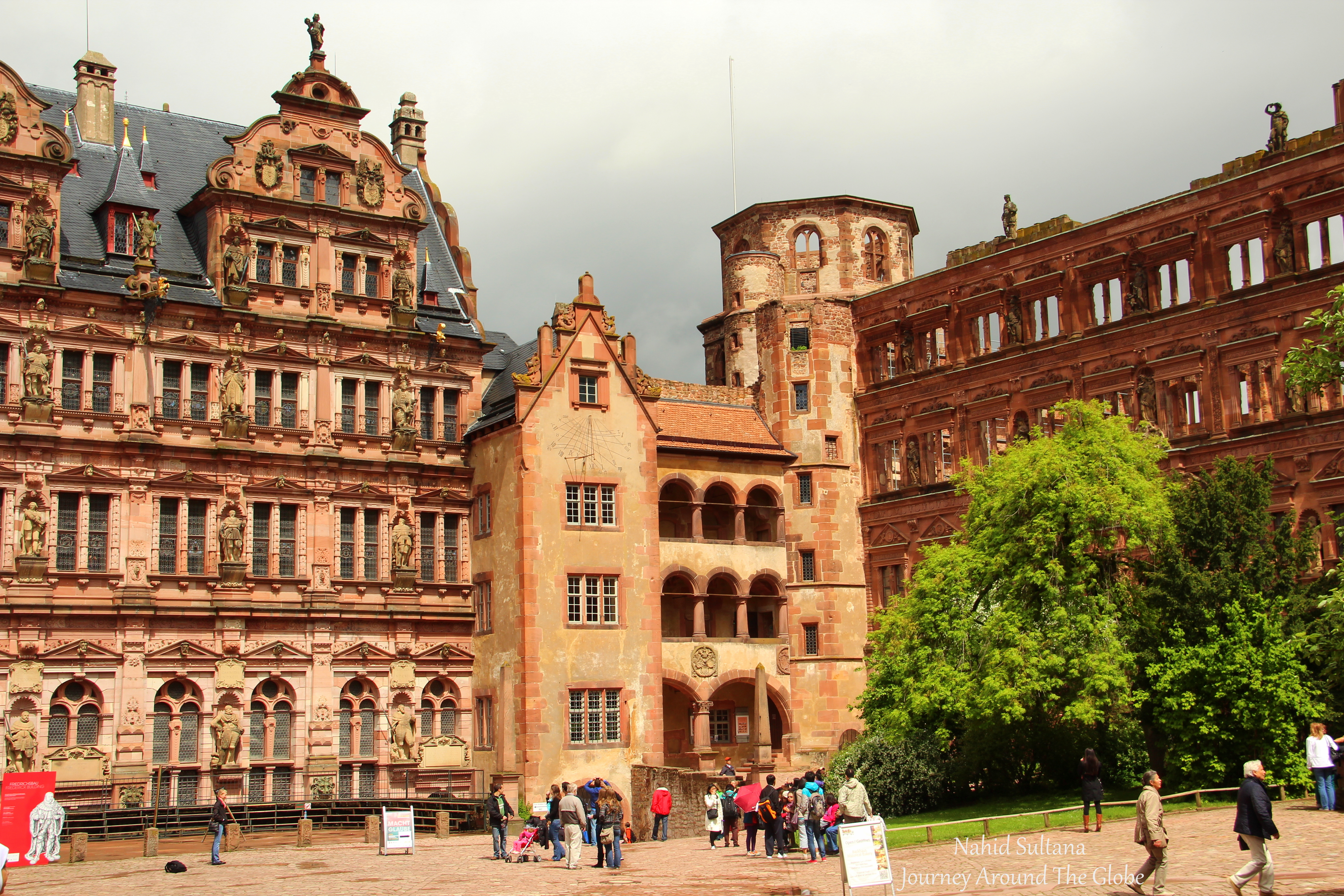
The courtyard is truly enchanting and takes you few centuries back. Statues and detailed work on buildings are something to appreciate. Magnificent façade of Frederick building with 16 sculptures on it looks very decorative.

- Courtyard of Heidelberg Castle in Germany
German Pharmacy Museum is a small museum that the castle houses giving history of medicines in Germany and some other parts of the world. You can see herb processing tools and laboratories from an early age.
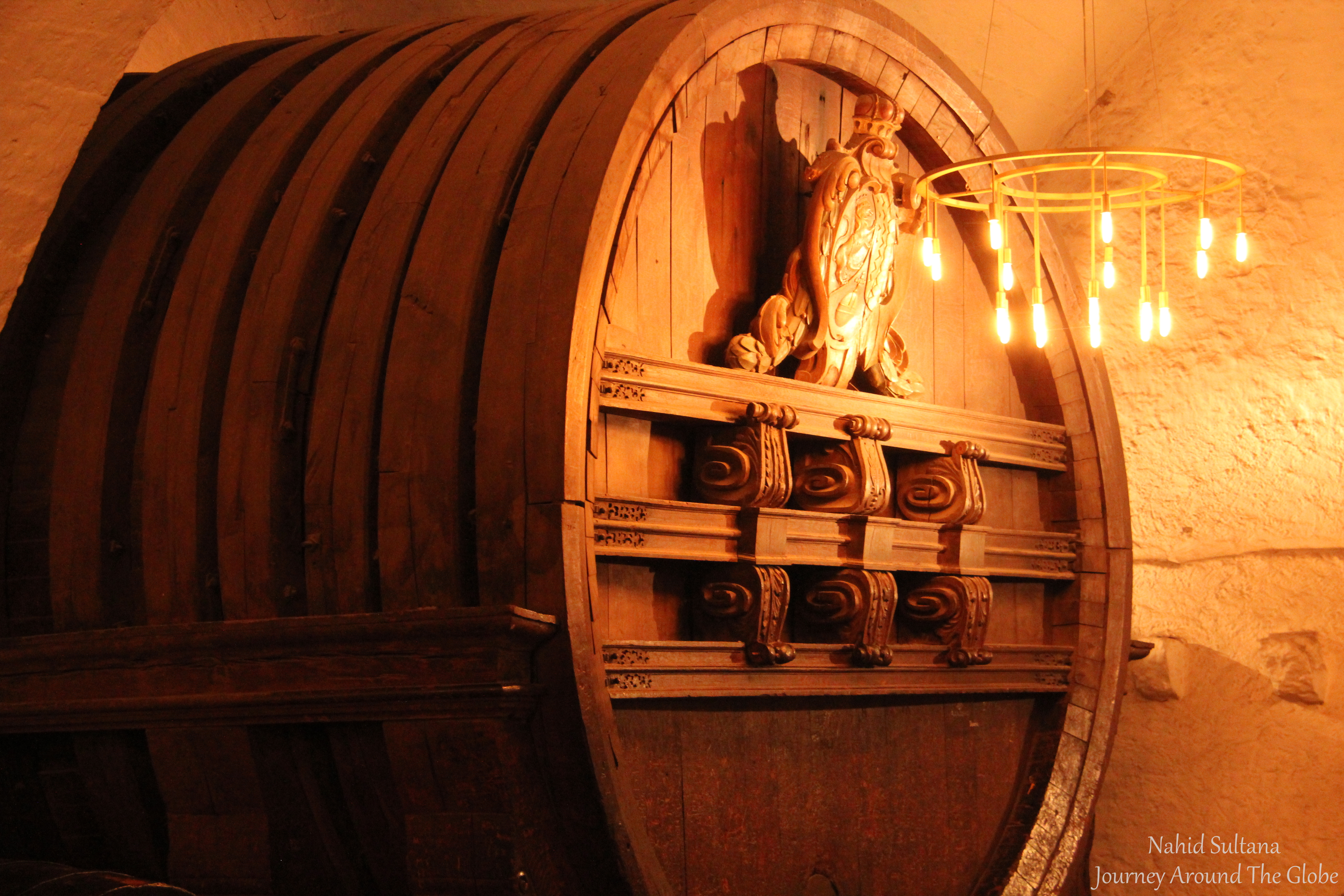
The “Great Barrel” at Heidelberg Castle dates back to 1750. It was made with oak wood and the wine deliveries from various communities were stored in the barrel. By 1767 it showed large damages caused by decay and was kept as an object of interest for visitors of the castle. This is located in an underground wine-cellar display.

- Great Barrel of Heidelberg Castle in Germany
There are three ways to go down to the old district from the castle. Tourists can either walk for 10 minutes or take 315 steps or take a short funicular ride to altstadt (old town). The ticket we bought for 6 euros covered German Pharmacy Museum, Great Barrel, and funicular ride down to altstadt (old town).
2) KORNMARKT: This is a small square at the foothill of Heidelberg Castle just beside Marktplatz. There was a nice setup with many activates for the kids during our visit.
3) MARKTPLATZ: This is the main square of Heidelberg that houses Town Hall (Rathaus in German) at one side and many old buildings on other sides. There was a big farewell party for the US Military who were stationed here for a long time. Loud music, dance, food, lot of people made that place very lively during our visit.
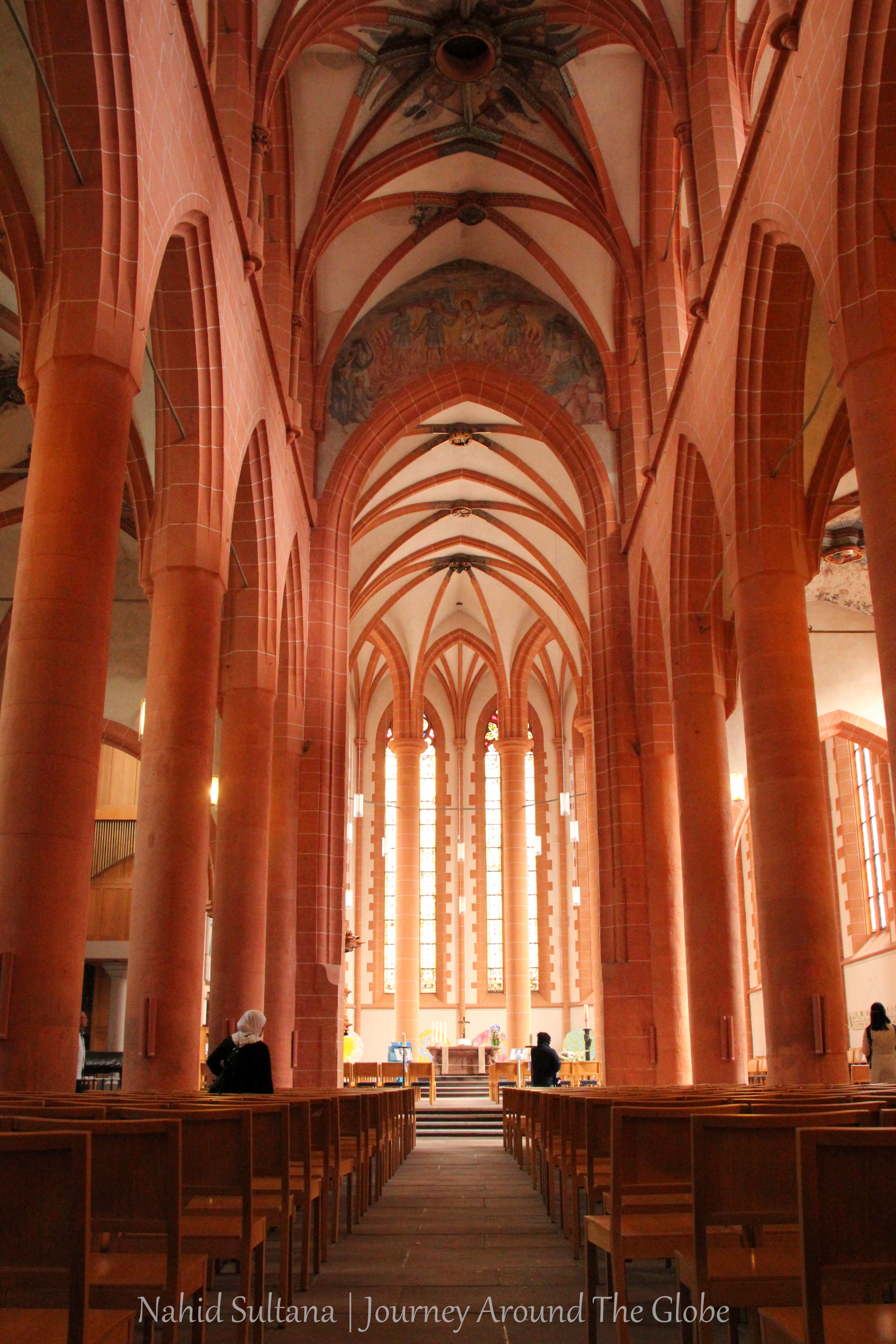
4) HEILIGGEISTKIRCHE (CHURCH of the HOLY SPIRIT): This is a beautiful late Gothic church and the most famous one of Heidelberg. Built in 1563, the steeple of this church dominates the township. Salmon color interior of it with tall columns, high ceiling, and pretty patterned windows make this church a nice place to spend some time in. it’s located in Marktplatz and there is no fee to go inside.

- Inside HEILIGGEISTKIRCHE (Church of the Holy Spirit) in Heidelberg, Germany
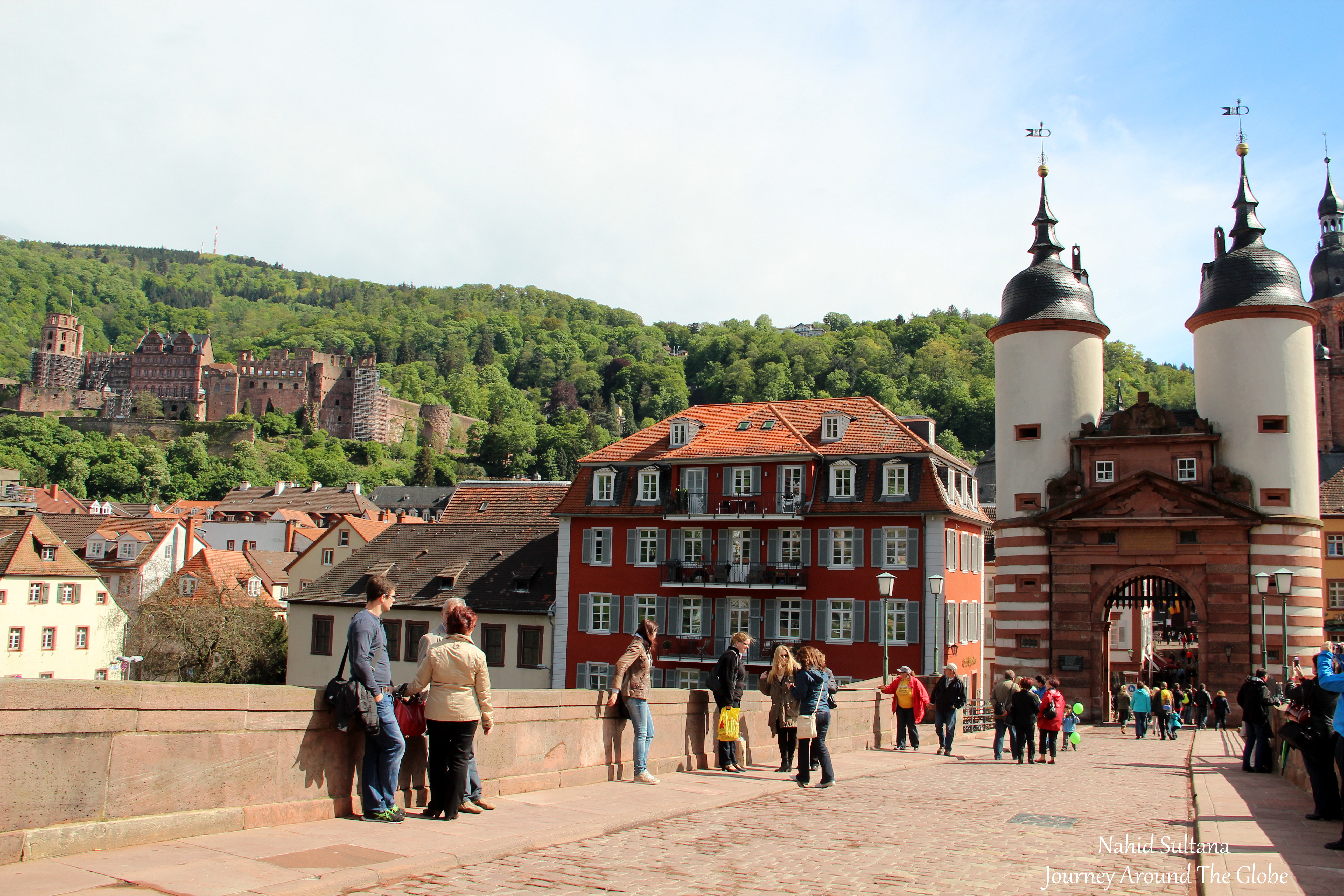
5) AM BRUCKENTOR and KARL-THEODOR BRUCKE (ALTE BRUCKE): You can see the towers of this gate, am Bruckentor, from the castle up on the hill. Crossing it will take you right to the 200 meters long pedestrian bridge, Alte Brucke, on River Necker. Don’t miss the fantastic view of the river, its beautiful banks, mountains, and castle in the distance from the bridge. We spend about half an hour enjoying the surroundings and looking at other tourists…great moments.
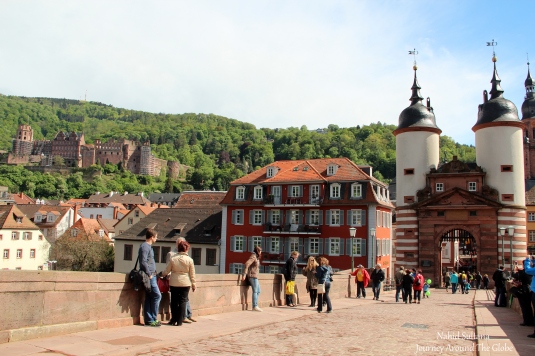
- am Bruckentor (on the right), Heidelberg Castle on the hill on left…a view from Alte Brucke on River Necker in Heidelberg, Germany
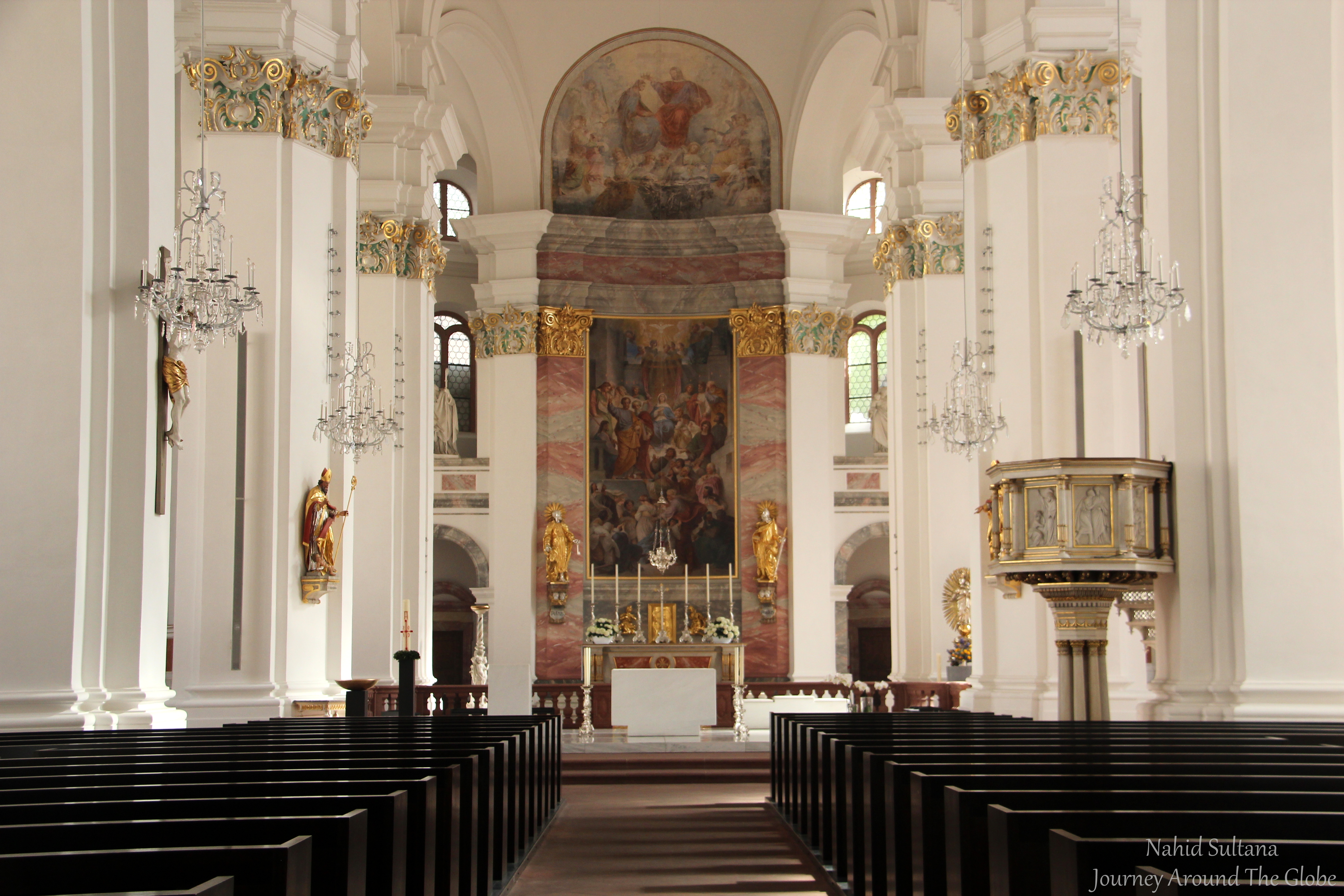
6) JESUITENKIRCHE: This was our last stop in Heidelberg but wasn’t in our list. The building looked good from outside, so we decided to check it out. This is an old church from 1711 with all-white and a very elegant looking interior. The altar is simple but very pretty. Cute chandeliers and biblical frescoes make this place worth a visit in this old city.

- Jesuitenkirche in Heidelberg, Germany
Related articles
- Heidelberg, Germany (wellreadbetterfed.wordpress.com)
- Heidelberg – Germany (petersadventures.wordpress.com)
- Heidelberg (weltschule.wordpress.com)
- Beethoven’s birth place – Bonn, Germany (journeyaroundtheglobe.com)
- Day 20: Heidelberg Castle and the Road to Rothenburg (featuring trains) (lukestarrenburg.wordpress.com)
- Heidelberg Castle (tourmagnet.wordpress.com)
Share this:

Finally visiting Moulin Rouge in Paris
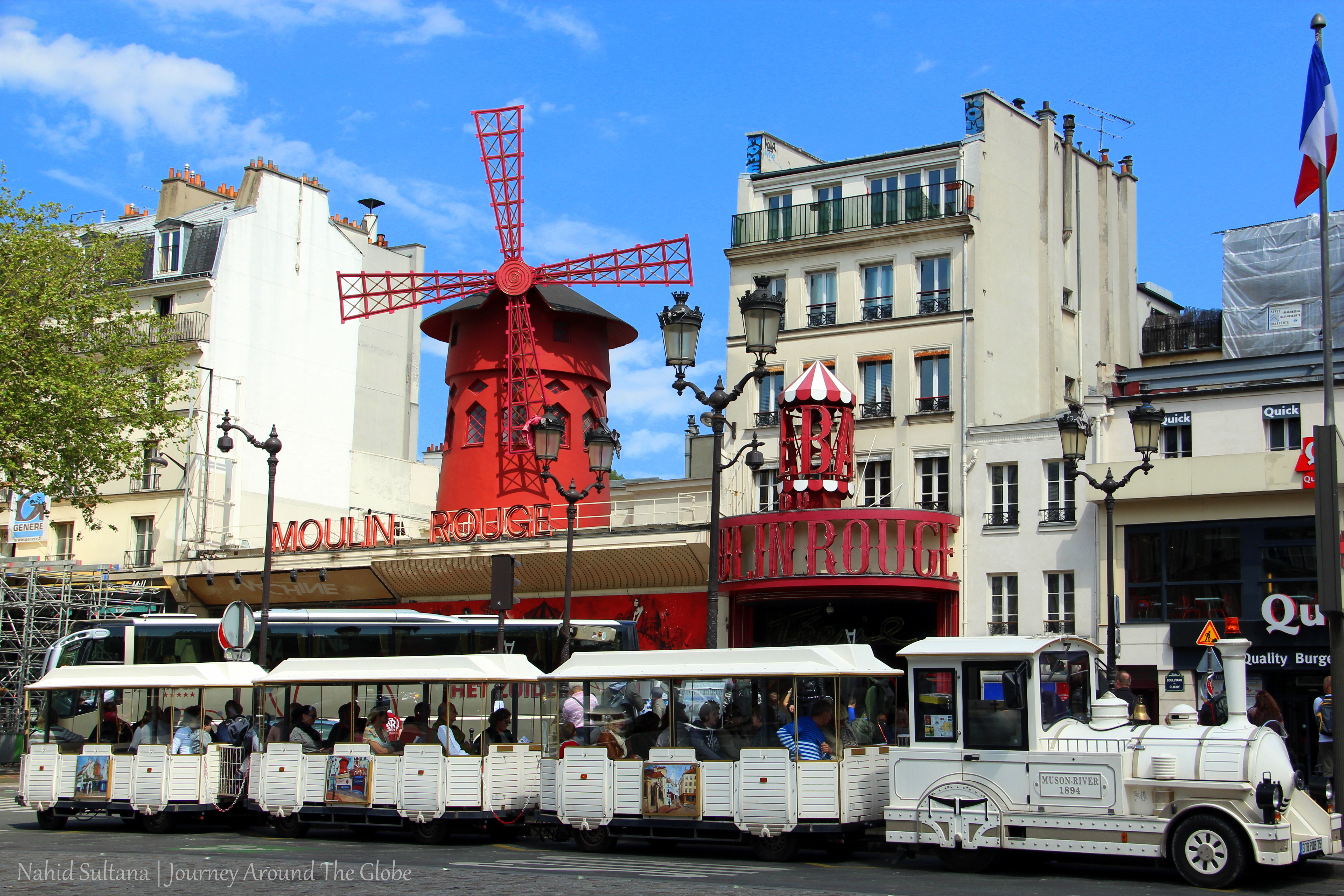
I’ve been to Paris few times now…taking guests to places. Most of the time we end up going to the same usual spots that they want to see or we think they should see in Paris, like Eiffel Tower, Notre Dame Cathedral, Louvre,….and more places depending on allowed time. Last visit to Paris was with my aunt from Baltimore, Maryland. It was her first visit to Europe and we decided to take her to Paris for a brief trip in a weekend. Although I am not a great fan of big cities, but Paris never fails to surprise me with its atmosphere and surroundings. But this time I was determined to go somewhere in that Romantic city where we never put our feet before. It was Moulin Rouge…the classic cabaret which was the birthplace of modern can-can dance.
Mouline Rouge, located in the Red-Light District, is not only a cabaret club, but also a popular tourist attraction in Paris. It was founded in 1889 and with its signature red wind-mill on the roof, soon the place became a hot spot for entertainment in whole Europe and then in the whole world. I was checking some tickets online for the shows in Moulin Rouge…they are usually more than 100 euros per person…not my cup of tea. But I did enjoy going there and finally get the chance to see this glittery place (although during the day-time…but oh well). So here is a picture of Moulin Rouge that I took during our visit…may be someday I will get to go inside and enjoy its true beauty and talented artists in a dim-lit room with hundreds of audiences. But for now, I guess I will be happy watching Nicole Kidman’s “Moulin Rouge” in my DVD player 😉
Related articles
- Moulin Rouge (anotherbonjour.wordpress.com)
- Paris – Day Three (anaveroe.wordpress.com)
- Paris Day 2, the Louvre and Moulin Rouge (eaglesineurope.wordpress.com)
- Daily Prompt: Journey (suzie81.wordpress.com)
- Eiffel, Seine and the Moulin Rouge (tasteplaytravel.wordpress.com)
- France for Christmas (meinedelweiss.wordpress.com)
- Au revoir Paris (bannonabroad.wordpress.com)
- More from Paris (bc12e.wordpress.com)
- Week One – Barcelona part 1 and Paris (anahitamahdi.wordpress.com)
- Our Fifth and final week! (sinclairfamilyholiday.wordpress.com)
Share this:

Business Excellence Award 2020 from AI Global Media for The Most Entertaining Personal Travel Blog – Pacific Northwest USA

Top Posts & Pages


Authors
 Globe Runner
Business Excellence Award 2020 for The Most Entertaining Personal Travel Blog – Pacific Northwest USA

Business Excellence Award 2020 from AI Global Media

 Journey Around The Globe