Journey Around The Globe
ready for the next destination
A fairy-tale region of France – Alsace
ALSACE, FRANCE: I saw road side signs of Alsace Region in France when we were driving to Belgium from Basel, Switzerland about more than a year ago. The whole region looked so gorgeous from my car window that I came home and googled that place. I was thrilled by its amazing countryside looks and vast vineyards. My husband and I were planning to go to Alsace since then. After failing few times with our plans, we finally went to this one of a kind place in Europe. And believe me this is a little wonderland where I would love to go back again and again to get me out of the reality of life.
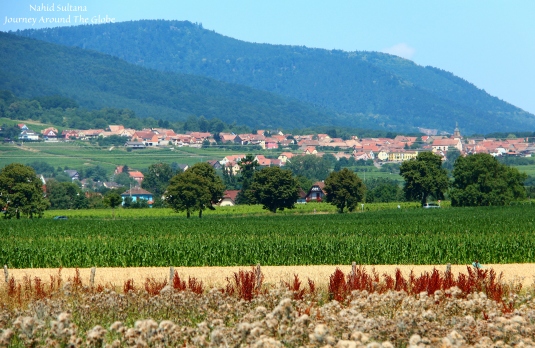
- Driving on highway in Alsace, on our way to Colmar on the 1st day
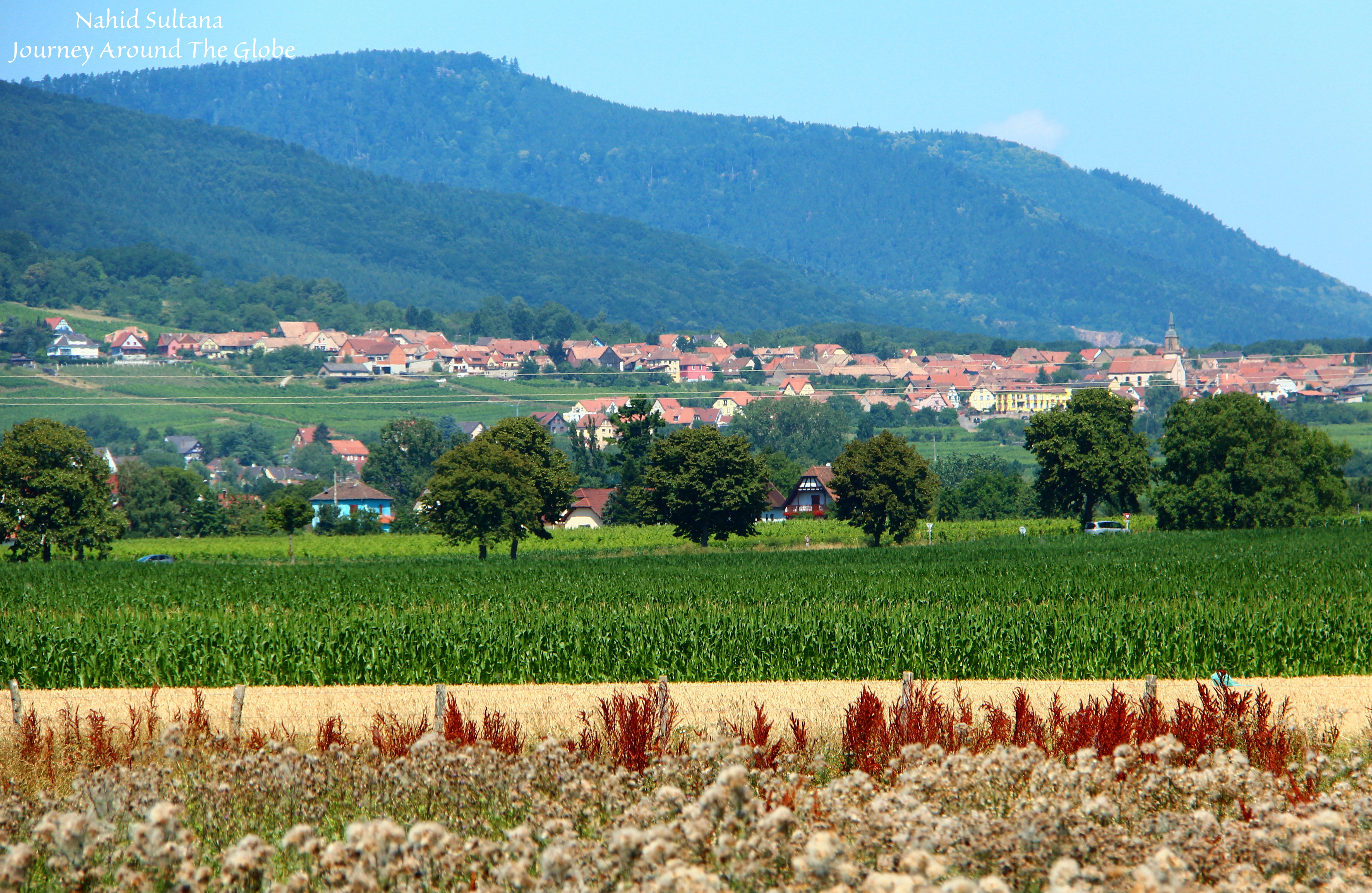
Colmar and Strasbourg are two big cities of Alsace, located about an hour drive from each other (via highway). But villages here are very close to each other surrounded by miles after miles of vineyards. Each village is more elegant and scenic than the other one. People usually come here and hop from one village to another and from one wine maker to the other…that’s where you can get the taste of real Alsace. The whole region is a fairy-tale place…you can’t go wrong with any city/village you visit.
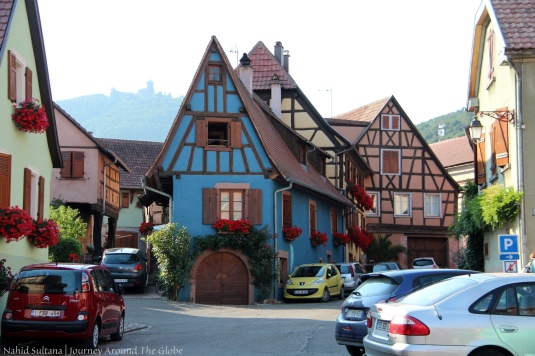
- Don’t know the name of this village in Alsace, just looked too pretty
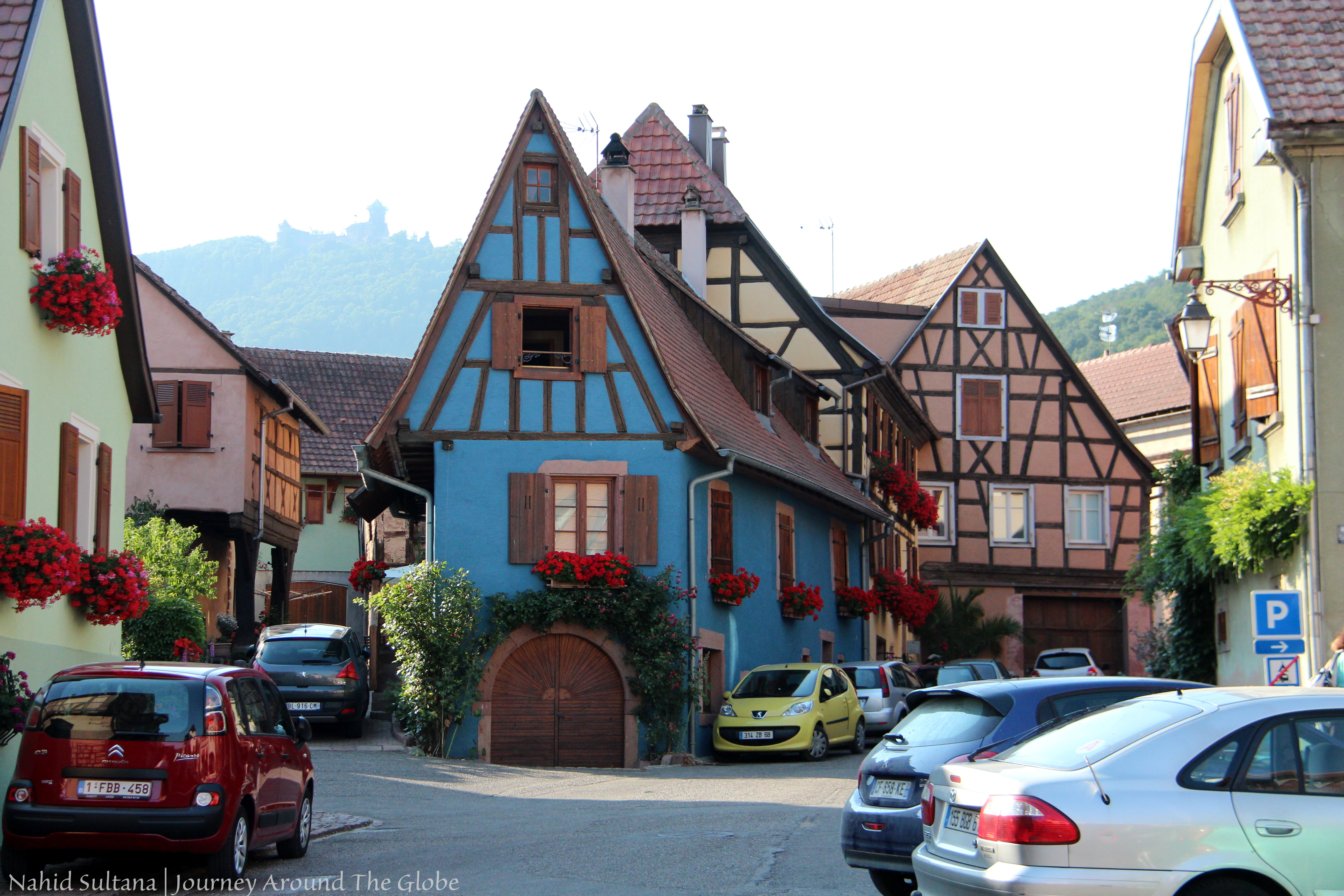
When we were coming back from Colmar to our hotel, we took the famous “Wine Route” of Alsace. This route is a crossroad at the heart of Europe and probably is the best way to discover this romantic region of France. Ruins of medieval castles, vast vineyards, and the Renaissance houses lined up by the flower decorated roads are just little things that make Alsace Wine Route the best known of its kind in France. The route is about 170km in length, running through a multitude of valleys and hills…making it a slower route than regular highways. But it offers a magnificent perspective of the region and its wine makers. Just follow the sign “Route des Vins d’Alsace” which indicates the Wine Route and all the winegrowing villages of Alsace. The route passes through more than 50 communes of Alsace from Marlenheim to Thann. It is much more than just a scenic journey for visitors to admire the countryside, the architecture, and the food: it also leads the way to the doors of many wine cellars and tasting rooms, most of which are open all year round.
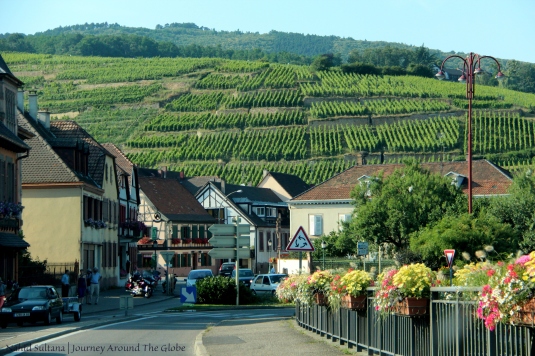
- Driving on “Wine Route of Alsace” in Alsace, France
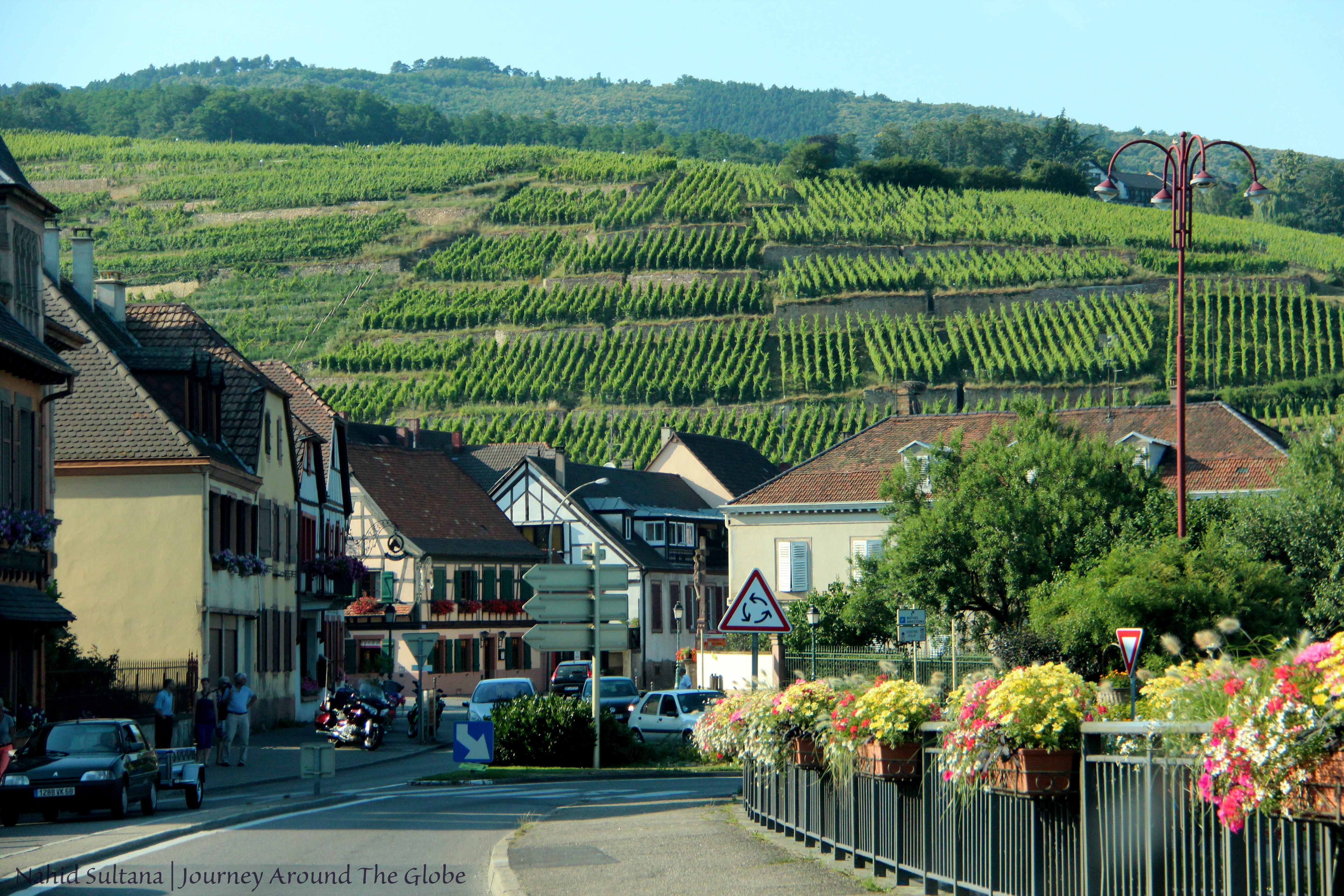
Summer is the best time to visit Alsace when you can see all villages are vibrantly decorated with hundreds and thousands of flower bouquets and baskets. If you take the “Wine Route”, do look for flower-rating of villages upon entering them. I think, the region rates each village with flowers (the way hotels are rated) on the level of decoration.

- Summer blooms in Kayserberg, France – a small village in Alsace
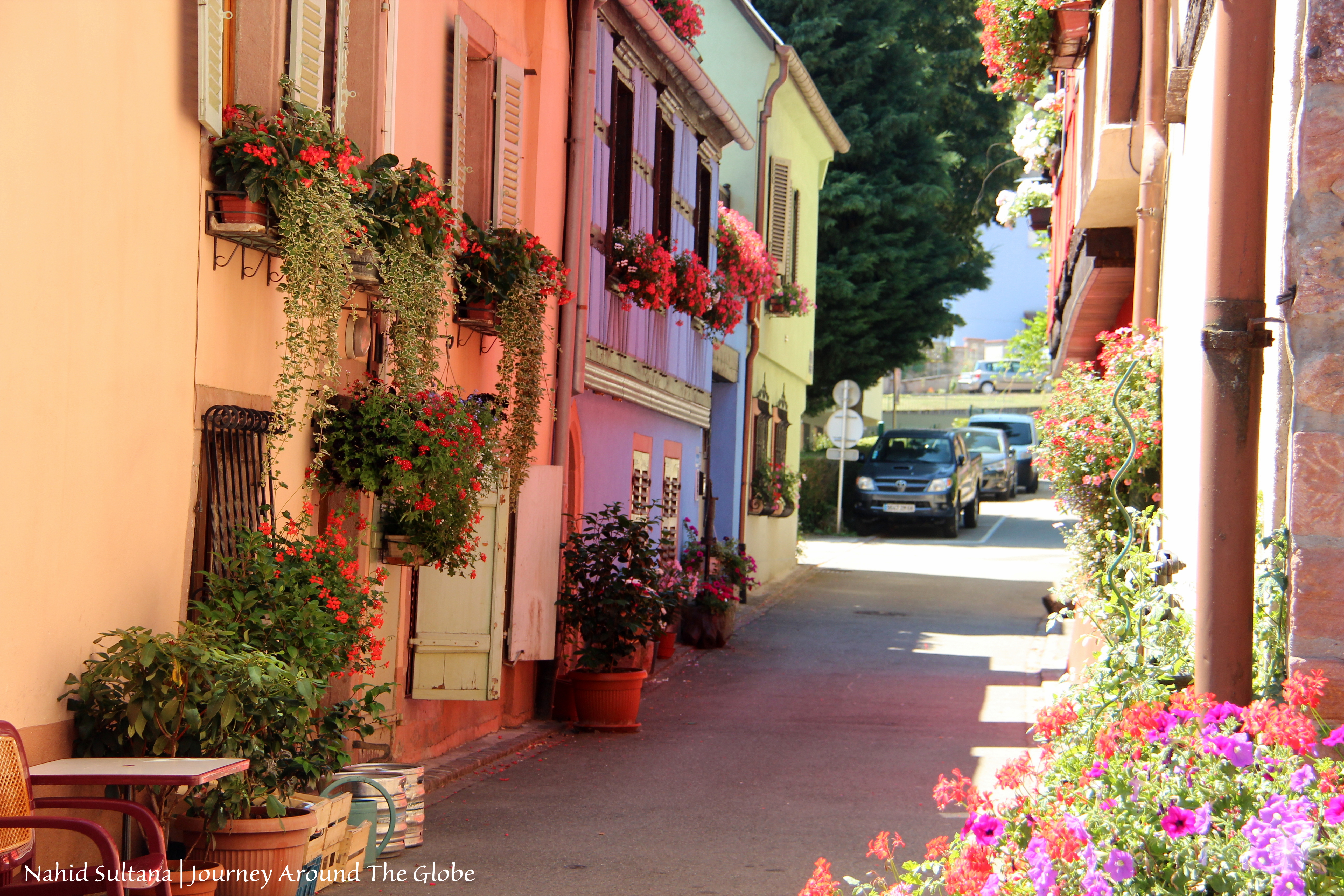
Grapes harvest normally takes place between mid-September and late October and it’s the busiest of seasons. There are many wine-festivals during this time. These are essential parts of Alsace Wine Route. When we were visiting in July, we saw many posters that some small villages were holding their own wine related events/festivals.

- Vineyards in Alsace, France
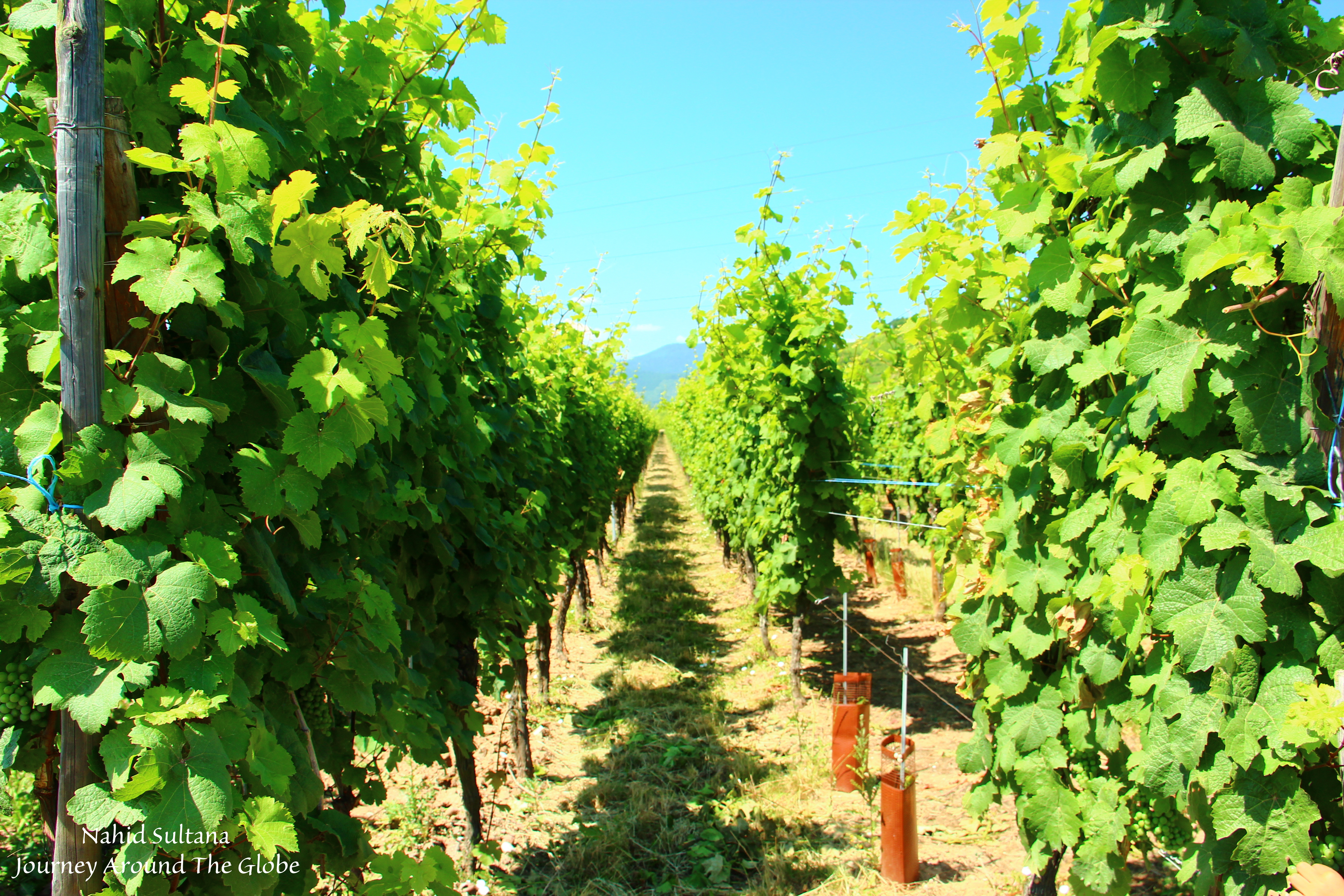
TIME of TRAVELING: We visited Alsace during a weekend in mid-July of 2013. It was very hot those few days…about 90 degrees F. But to see the colors of this region, better to come in summer when everything comes alive in every village.

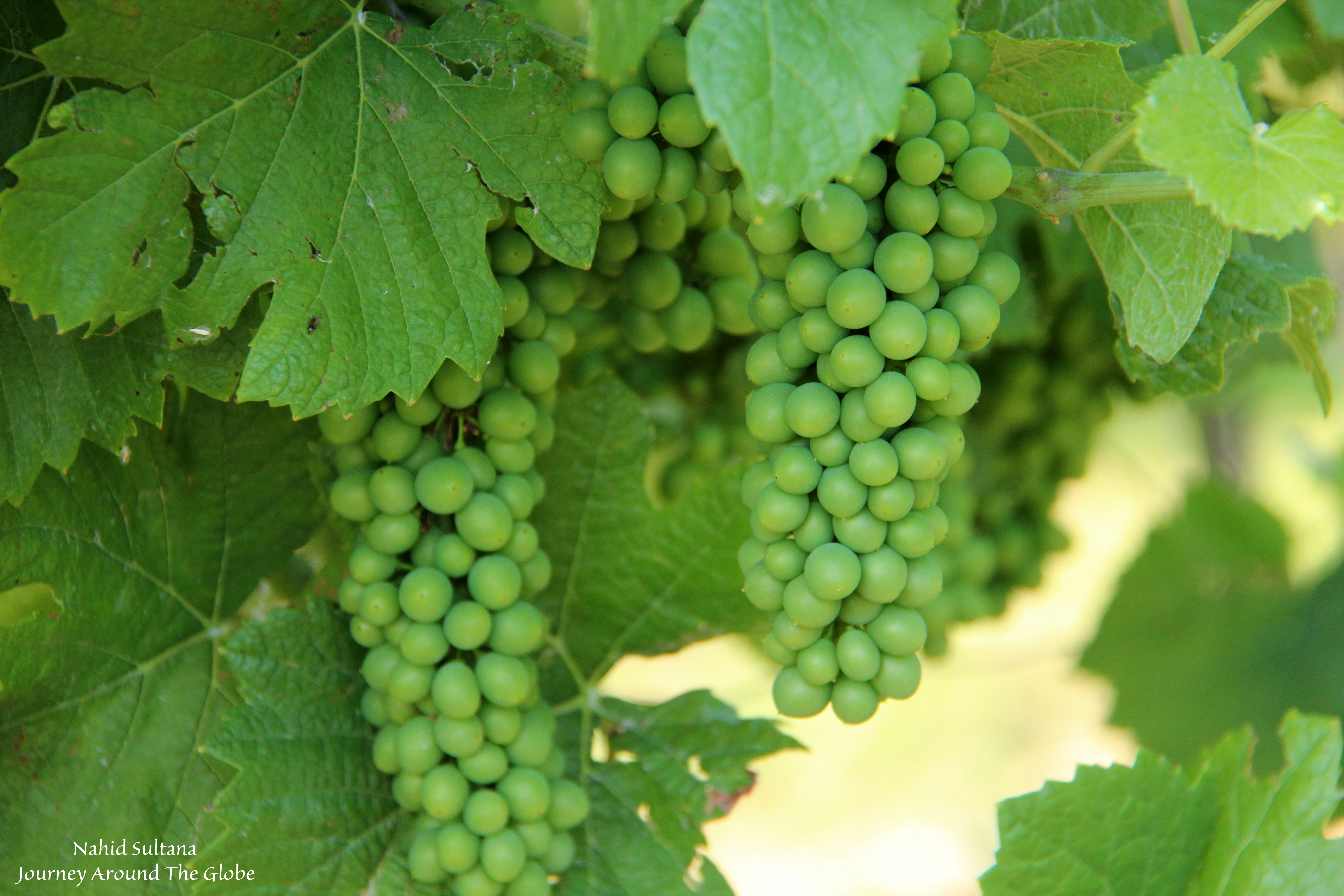
- Grapes weren’t fully grown in July…but looked beautiful
OUR HOTEL: We stayed in a budget hotel “Mr. Bed Strasbourg” in a small town, Ostwald, very close to Strasbourg. It’s probably the cheapest hotel in that area. The room was pretty small with a tiny bathroom. But the staff and workers were nice and helpful. There was a breakfast service for a minimal fee and free Wi-Fi in our room. But the main problem was that it was extremely hot that weekend and the hotel didn’t have AC. We could open our window only half way but no cross ventilation for the air to pass. Man oh man, four of us in that tiny room without air was a nightmare. I would recommend this place for anyone looking for a cheap place to stay but not in the summer time. There was a heater in our room, so winter shouldn’t be bad…but this place definitely is not for summer tourists.

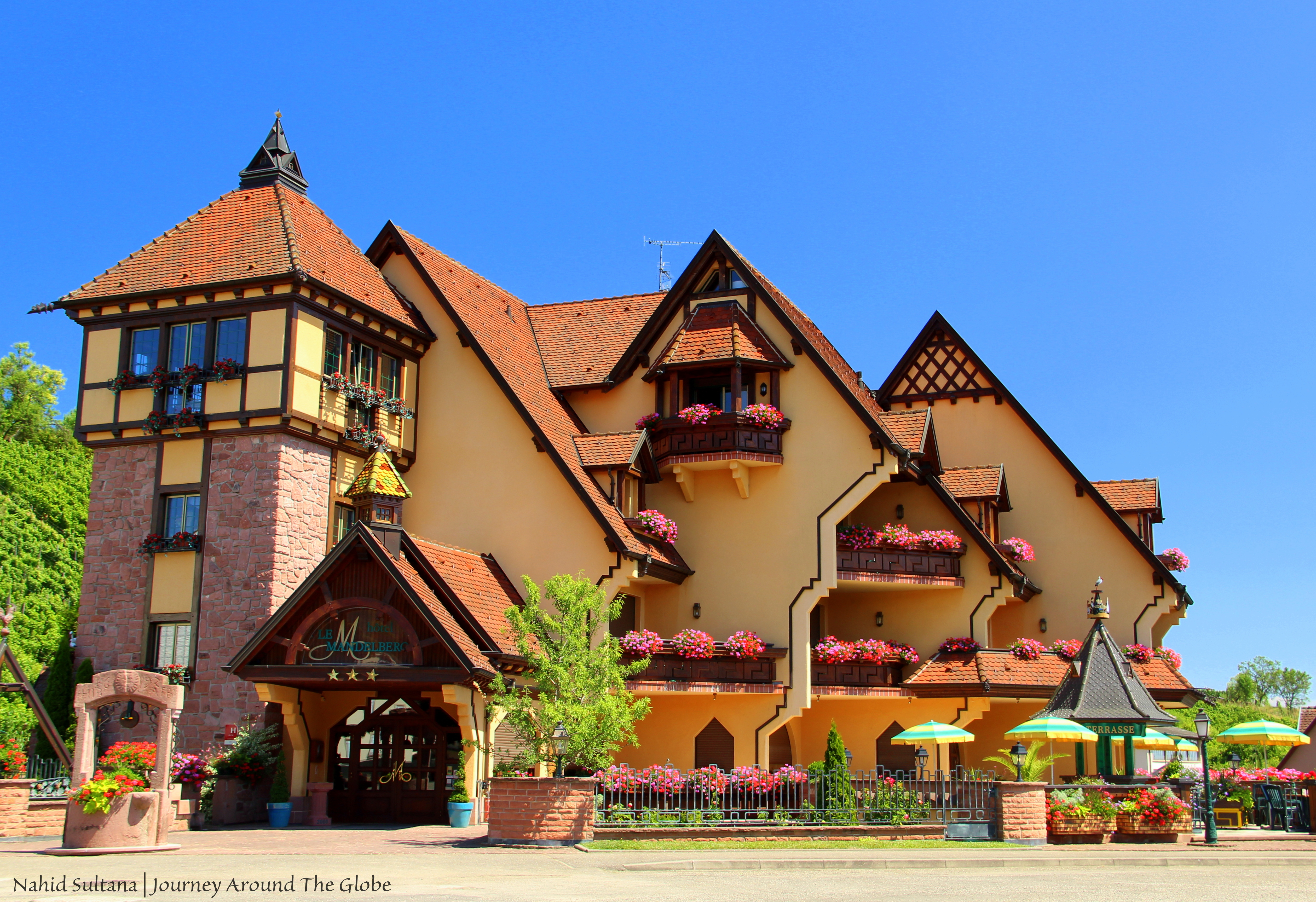
- Saw this beautiful hotel/resort while driving on “Wine Route” of Alsace, France
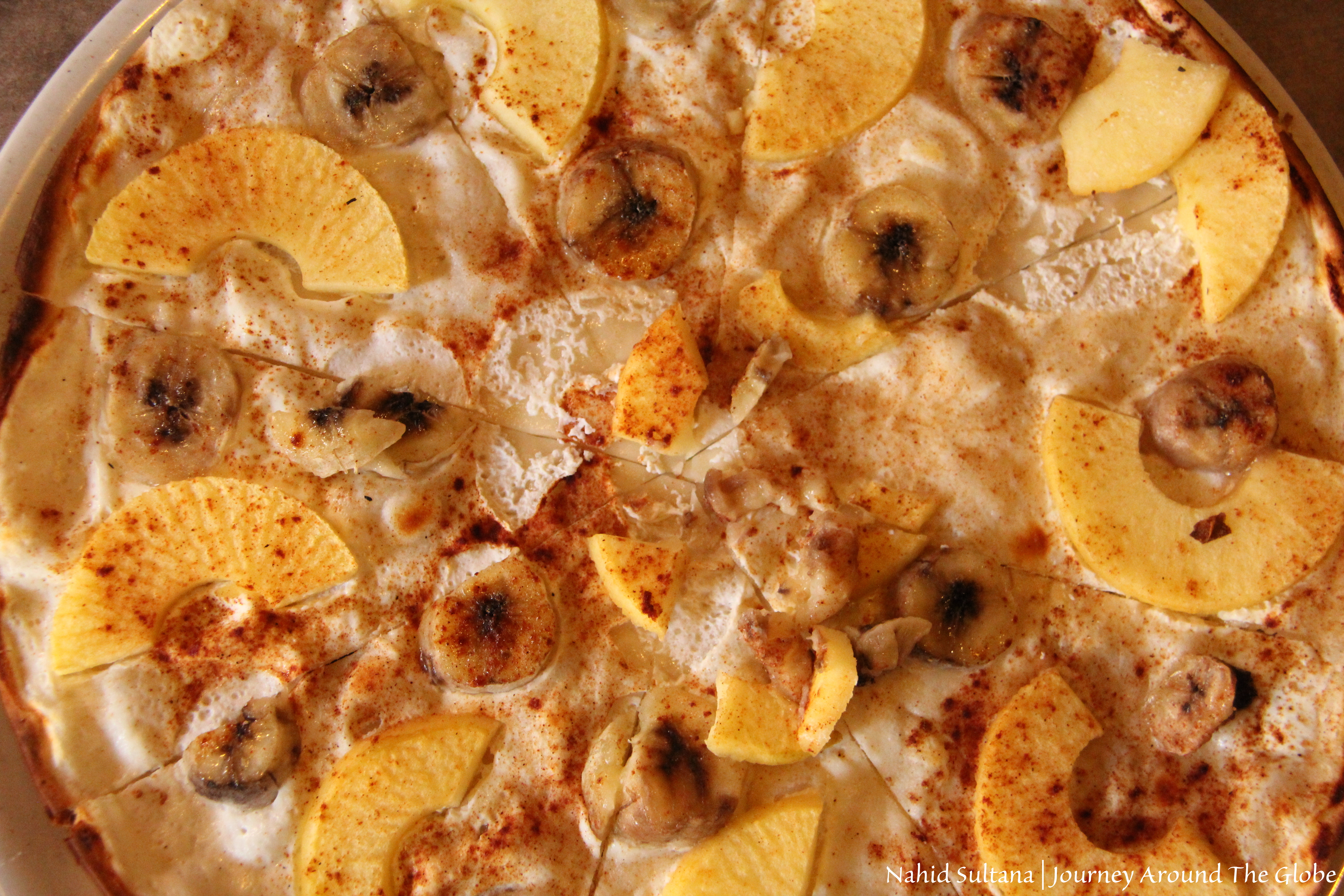
EATING and SHOPPING: First day we had regional lunch in old town of Colmar. The restaurant had variety of salads from different villages of Alsace which was great for me. Also when you are in Alsace, you have to try “Tarte Flambe”. It’s a popular pizza-like desert here which comes with fruits and other toppings. Savory tarte flambe usually comes with ham and onion. We ordered one tarte flambe that came with apple and banana…very light and yummy.

- Tarte Flambe – a very popular dessert of Alsace
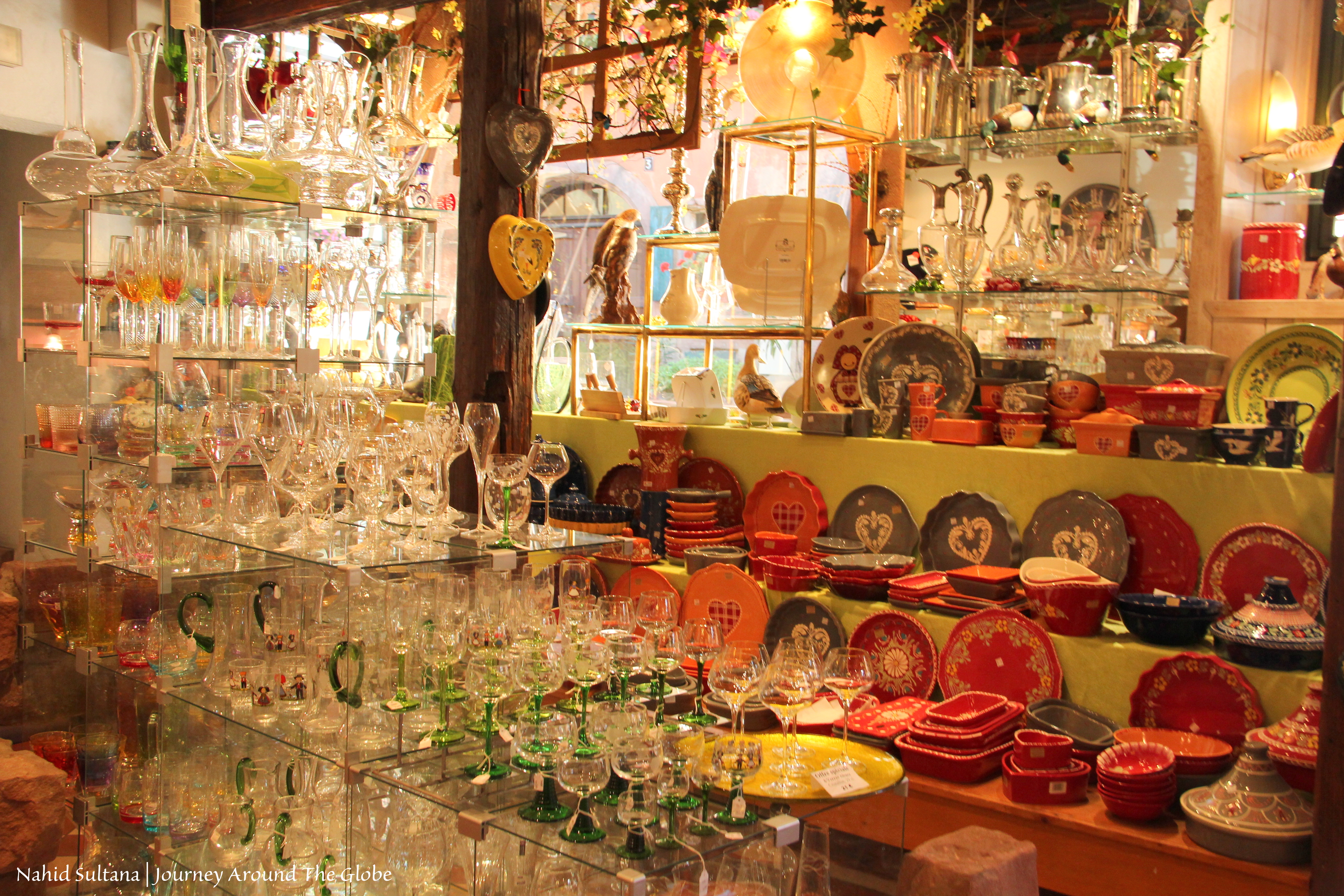
Most of the villages have countless souvenir shops in the old towns. Alsatian potteries and ceramics are very popular. They are all handmade and hand-painted in this region. Although they can be a bit pricey they are unique of this place. Stork is a regional bird of Alsace and you can find many things with its picture. Look at the cute metal signs on top of many stores as it was the old way of telling which store is selling what.
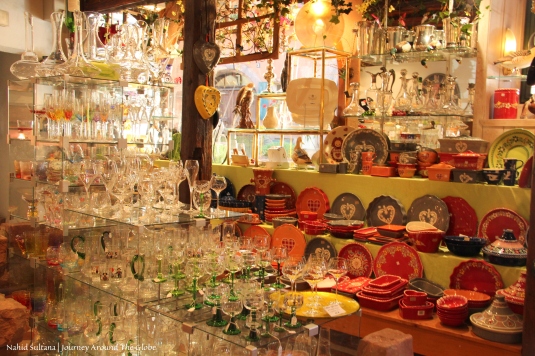
- Alsatian potteries and typical looking wine glasses in a souvenir shop in Riquewihr, France
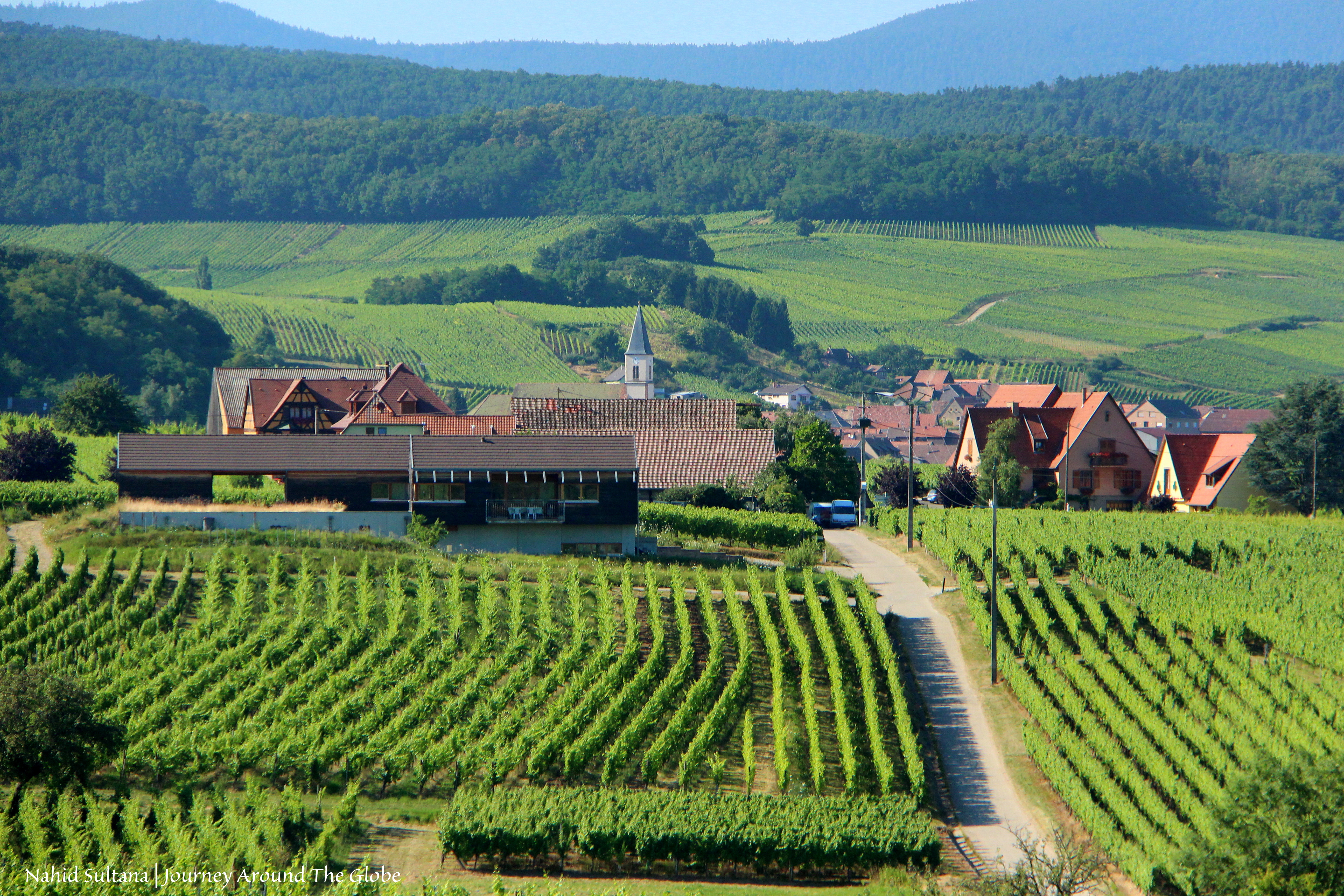
PLACE WE’VE VISITED: We stayed three full days in Alsace visiting Colmar in one day, 2 villages on our 2nd day and Strasbourg for half a day before heading back home in Belgium. You can easily spend a month here exploring all the villages, castles, and wineries. We are planning to go there again probably in a cold winter season to see all the Christmas markets and decorations…let’s see. But it was surely hard for me to choose only couple villages this time out of some 40 or 50 picture perfect post-card looking villages. But as I mentioned above, the best way to get a quick glimpse of Alsace is to take “Wine Route”…then just sit back and enjoy the scenic views rolling by.

- Scenic Alsace – an enchanting region of France
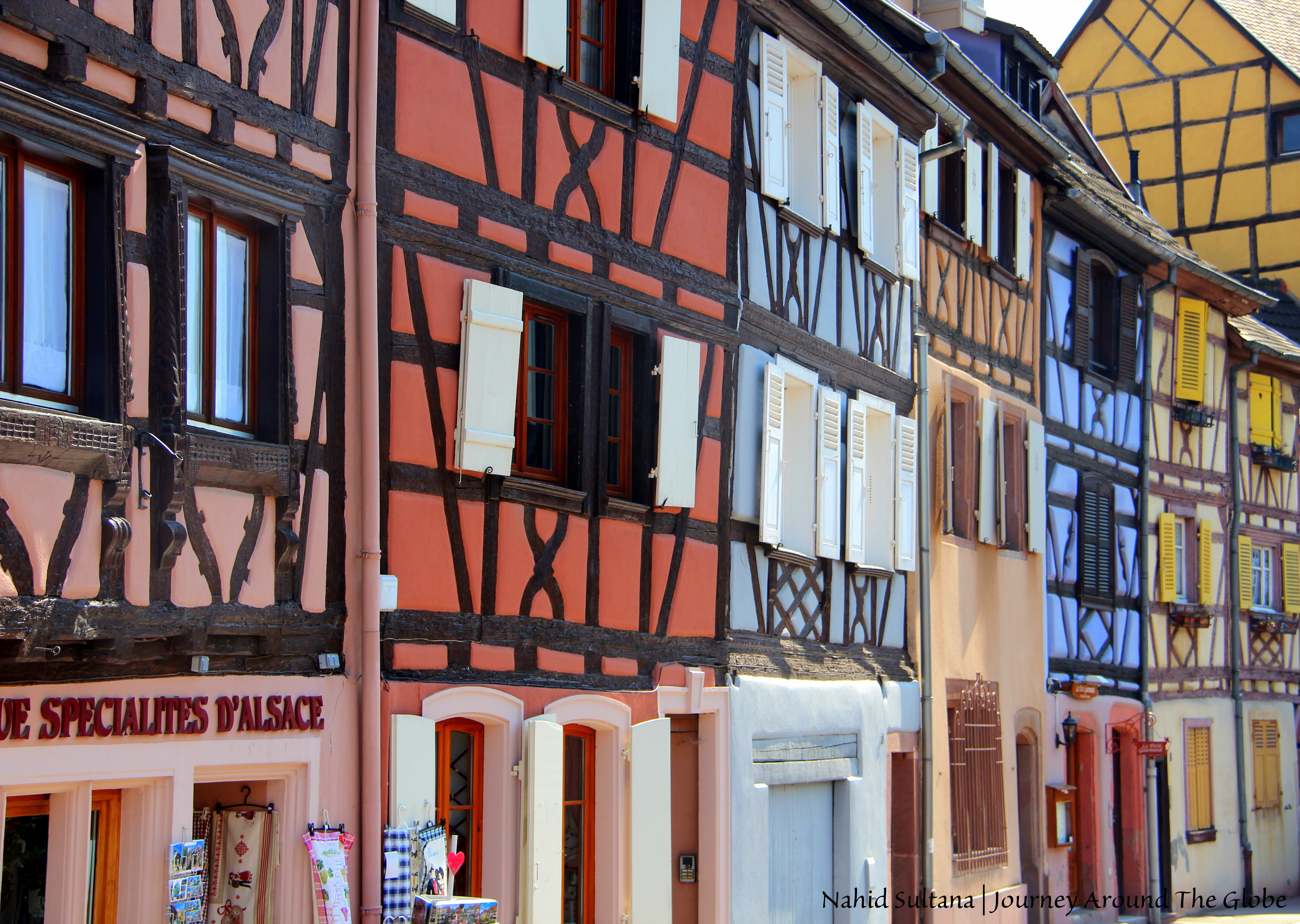
1) COLMAR: We visited Colmar on the 1st day of this journey. It’s the wine capital of Alsace. Old town is the main attraction and is very well-preserved where you can see countless half-timbered bright-colored houses with gorgeous summer blooms everywhere. Many shops, cafes, and old style decorations give this place its uniqueness.

- Vibrant color buildings of Colmar, France
This is also the home town of Frederic Auguste Bartholdi – the sculptor of the Statue of Liberty. You can actually see a miniature version of the Statue of Liberty when entering the city from north (from Strasbourg). Old town of Colmar still has the house where Bartholdi was born (now a Museum) in 1834. Although we didn’t go inside, it has the largest collection of works, models, and souvenirs of the designer of the Statue of Liberty that was unveiled in New York in 1886.
Our first stop in Colmar old town was Saint-Martin Cathedral. Built in 1235, this is the most imposing Gothic church in Middle Alsace. It is definitely worth a visit for its oversized old paintings, stained glass windows, and massive exteriors. It was free to enter and located in Place de la Cathedrale.
Another monumental church in Colmar is Eglise des Dominicains or Dominican Church. The construction of it started in 1283. The present superb stained glass windows survive from that period. It’s a small church but is famous for “Virgin of the Rose-Bush” painting from 14th century. The church is about 10 minutes of walk from St. Martin Cathedral and we needed 1.5 euros per adult to enter the church.
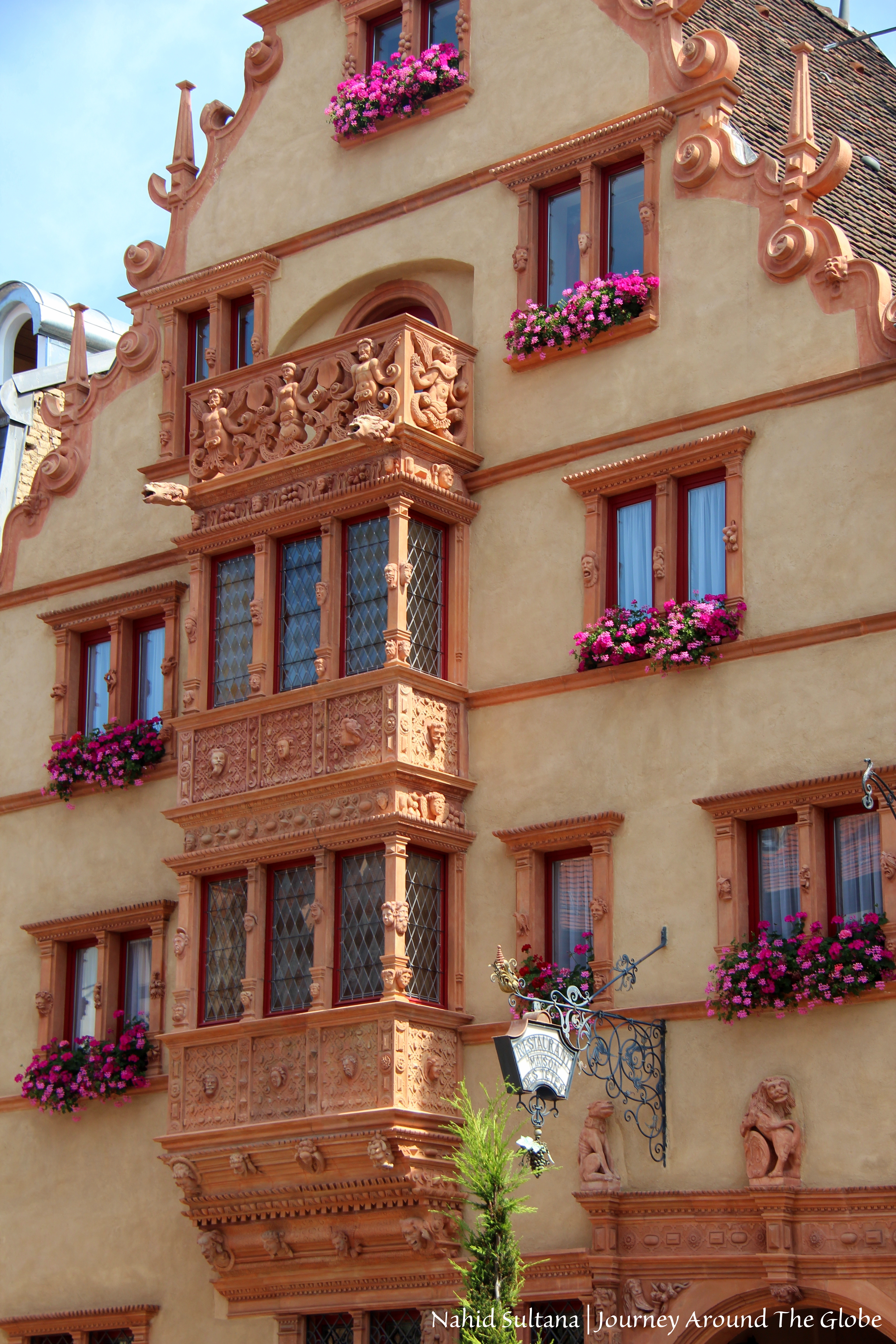
Maison des Tetes (House of the Heads) is a remarkable orange building in the old town of Colmar. It is a Renaissance building; exterior decorated with many heads and faces…very artistic.

- Maison des Tetes (House of Heads) in Colmar, France
Maison Pfister (opposite of Bertholdi Museum) is a jewel of the Renaissance and one of the oldest houses in Colmar. This wooden residence was built in 1537 for a wealthy hatter. The façade is beautifully decorated with paintings allegorical figures, biblical characters, and scenes.
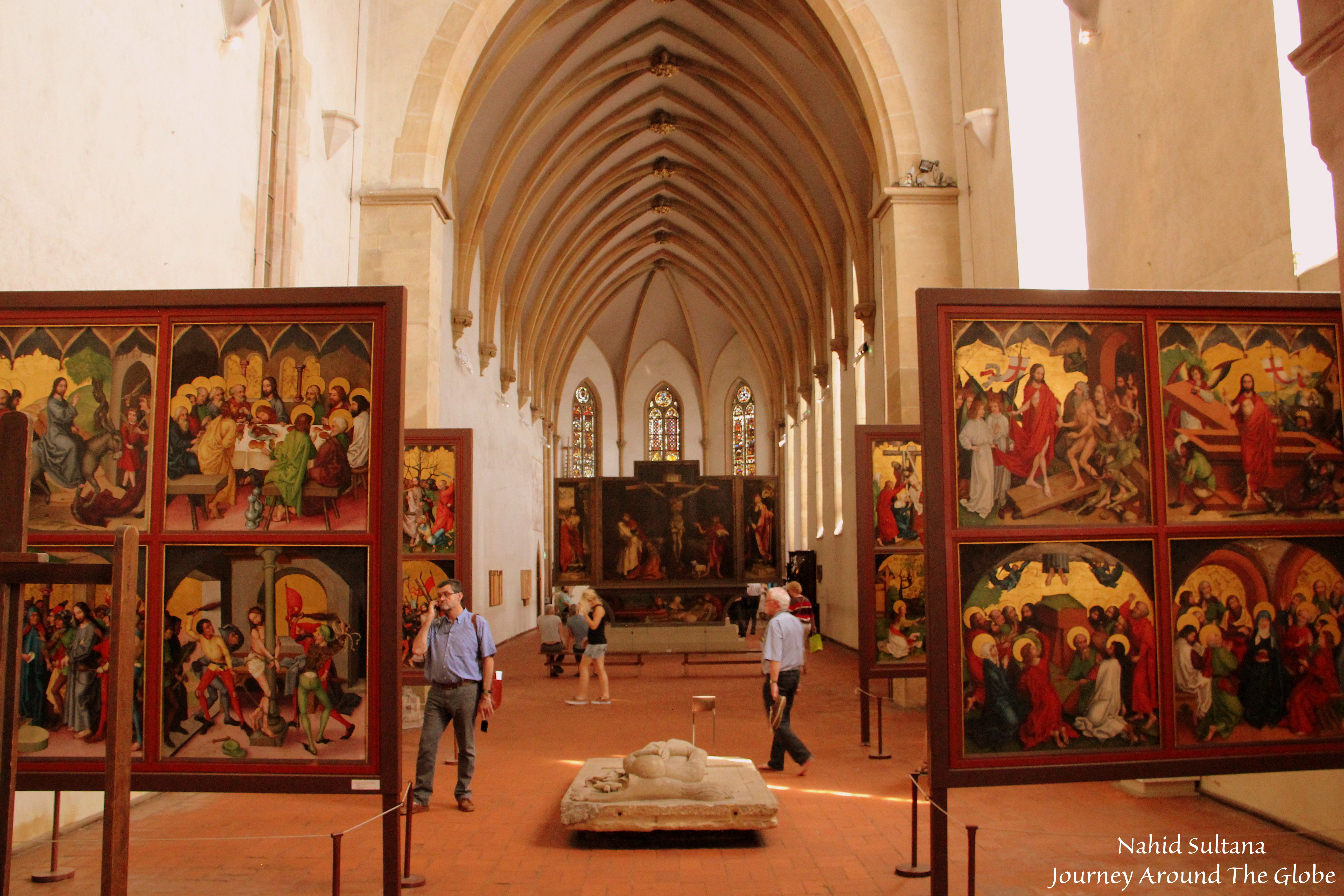
The only museum that I visited in Colmar was Unterlinden. This is a former Dominican convent with Gothic cloister which was built in 1289. The collection here provides a window into the Colmar region’s past and present through numerous objects recovered from dwellings and burial sites. Along with a vast collection of German arts, the museum boasts a remarkable collection of gorgeous paintings, religious arts, sculptures, furniture, and decorative art objects from the late-Middle ages and the Renaissance. Unterlinden features many talented artists from Alsace on popular art, medieval art, and traditional art including the statue of Colmarian painter and engraver Martin made by Bartholdi in 1860. One of the masterpieces that the museum holds is the Isenheim Altarpiece from 1512…celebrated its 500th anniversary in 2012. It was under major renovation during my visit, that’s why I couldn’t see some sections. The museum is located in the beautiful historic city of Colmar and charges 8 euros per adult. The museum is open daily (except Tuesdays from November to April) from 9 am – 12 pm and 2 pm – 5 pm.

- Lots of religious paintings inside Unterlinden Museum of Colmar, France
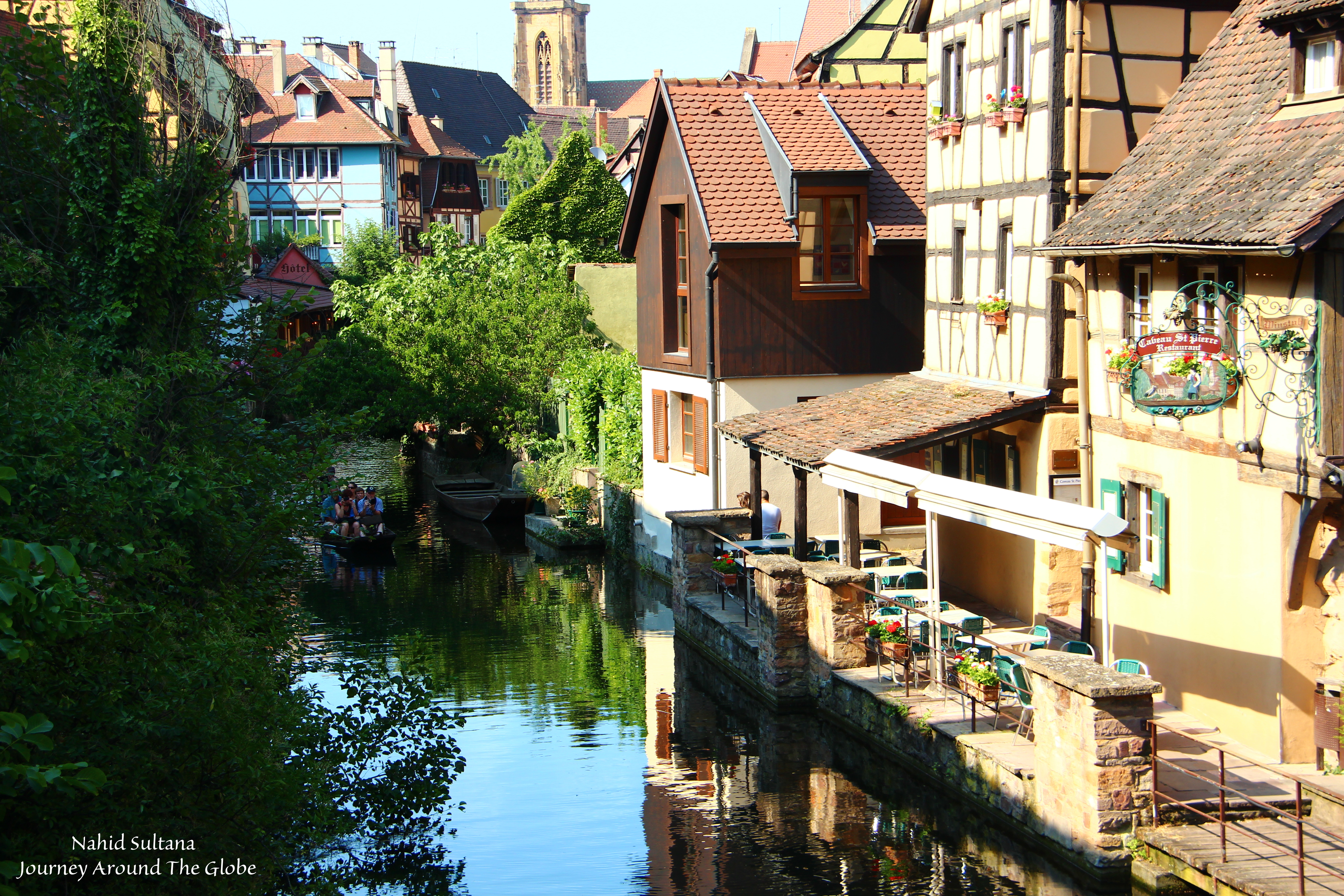
“Petit Venice” is a historic quarter that is perfectly preserved in a little corner of Colmar that reminisces Venice, Italy. This picturesque neighborhood has many old houses, cafes by canal, and a perfect place to walk and get lost. Colmar visit is incomplete without a stroll in Petit Venice. You can catch a boat ride from Petit Venice through its canals which charges 6 euros per person for a 30 minutes ride.

- “Petit Venice” in Colmar, France
Most of the tourist spots of Colmar are within walking distance. Colmar is not a small village but a big city and needs at least one full day to stroll along its old streets. “Rapp” parking is the closest to old town.
2) KAYSERBERG: On our 2nd day in Alsace, we visited two villages: Kayserberg and Riquewihr. Choosing these two villages were the hardest part. All the villages that I saw online looked and sounded very charming. After many change of mind, finally narrowed down to these two villages.
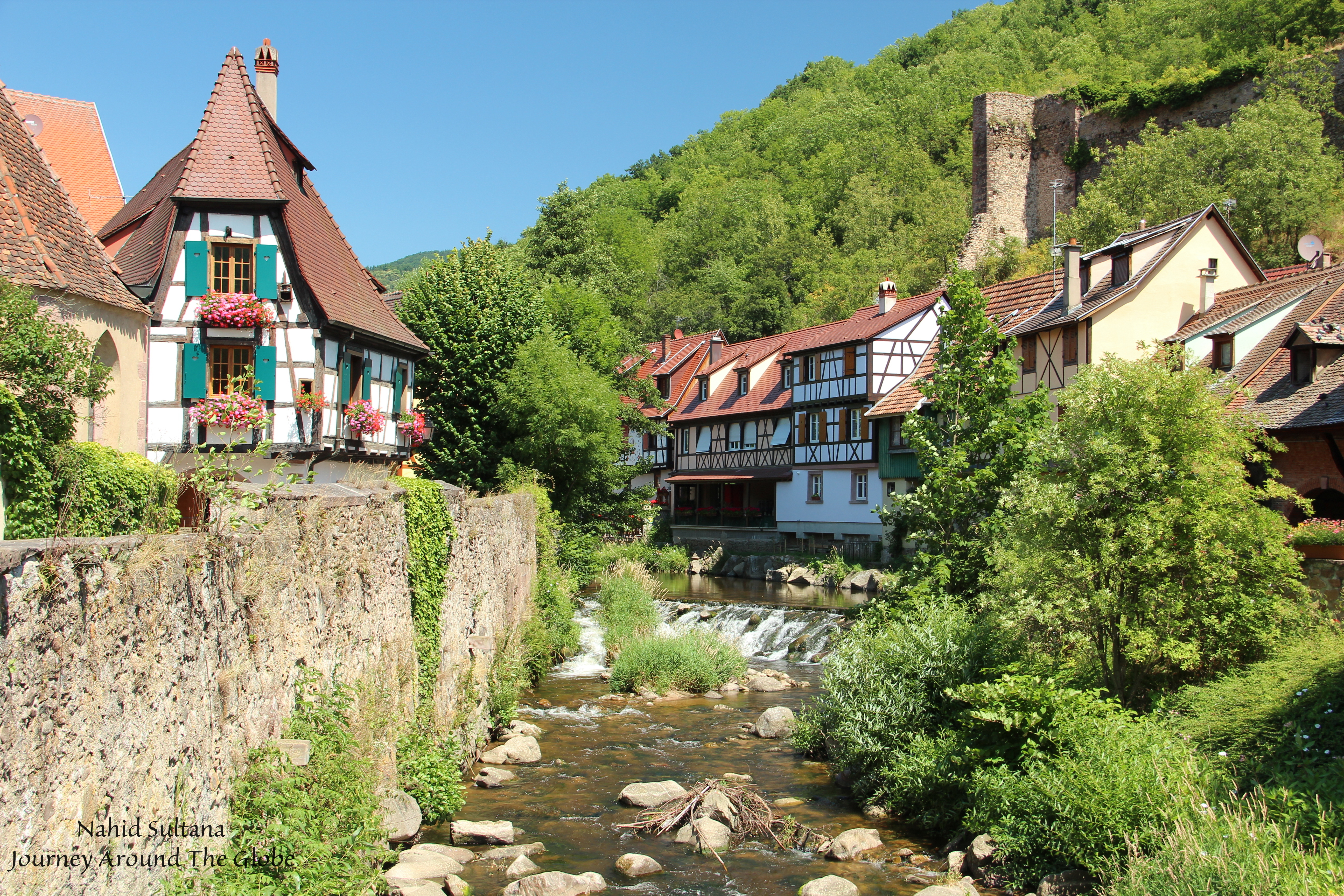
Kayserberg is a popular tourist center with significant medieval and Renaissance influences. The village is famous for annual wine festival due to its typical Alsatian settings and charms. The village is very proud of its talented son Dr. Albert Schweitzer who was awarded Nobel Peace Prize in 1952. There is a museum (which was his birthplace) in the old town dedicated to Dr. Schweitzer’s work and life.
- Kayserberg – a small Alsatian village in France
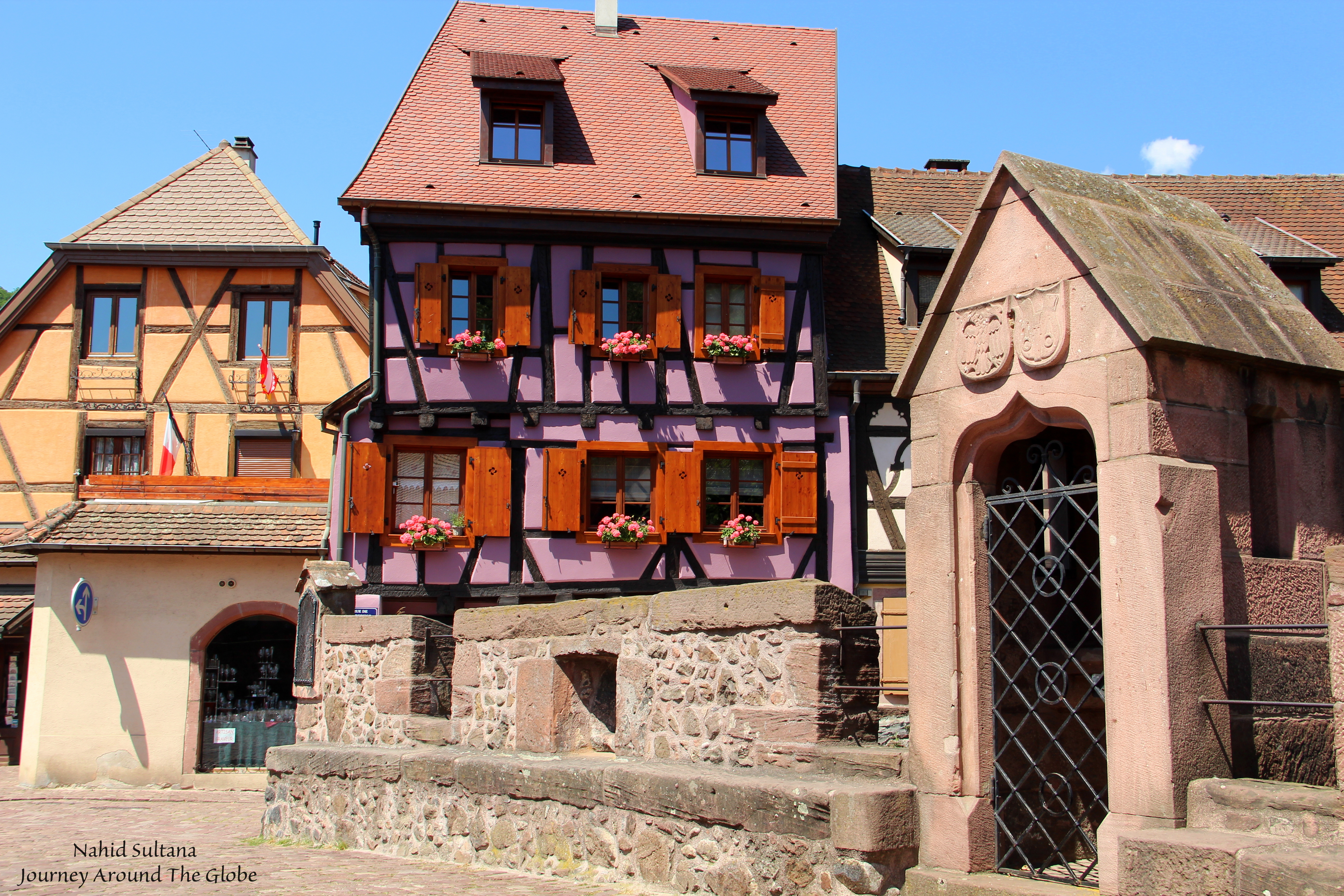
Rue du General de Gaulle is the most vibrant street of Kayserberg. It’s the main pedestrian path connects one end of old town to the other end. Many cafes, stores, old half-timbered houses can be seen here. Some of these houses are not just pretty…they look like picture perfect fairy-tale cottages from story books. Pont Fortifie on this small street dates back to 1514 and Town Hall in Kayserberg is also few centuries old from 1604 near the big church.

- Pont Fortifie from 1514 on Rue du General de Gaulle in Kayserberg, France
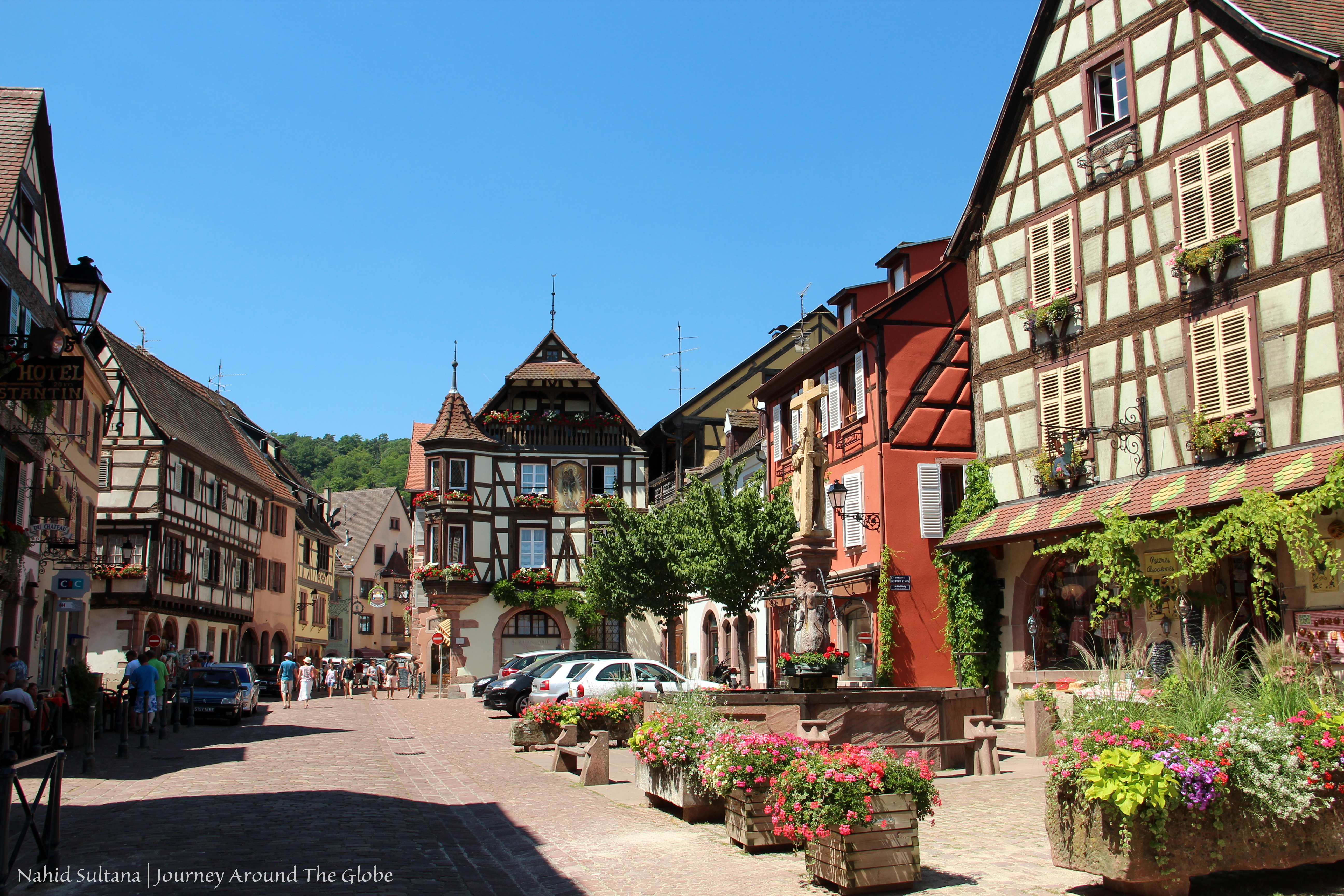
One of the remarkable architecture of Kayserberg is Church of St. Criox. It’s a Gothic church in the center of the village. Some of the remains of this Romanesque church still exist both within and outside the edifice such as remarkable carved doorway. It was constructed around 1235 and is very nicely decorated with eagles and mermaids. Fountain in front of the church is known as Fountain of Constantine which dates back to 1521.

- Main square of Kayserberg in front of Church of St. Criox in France
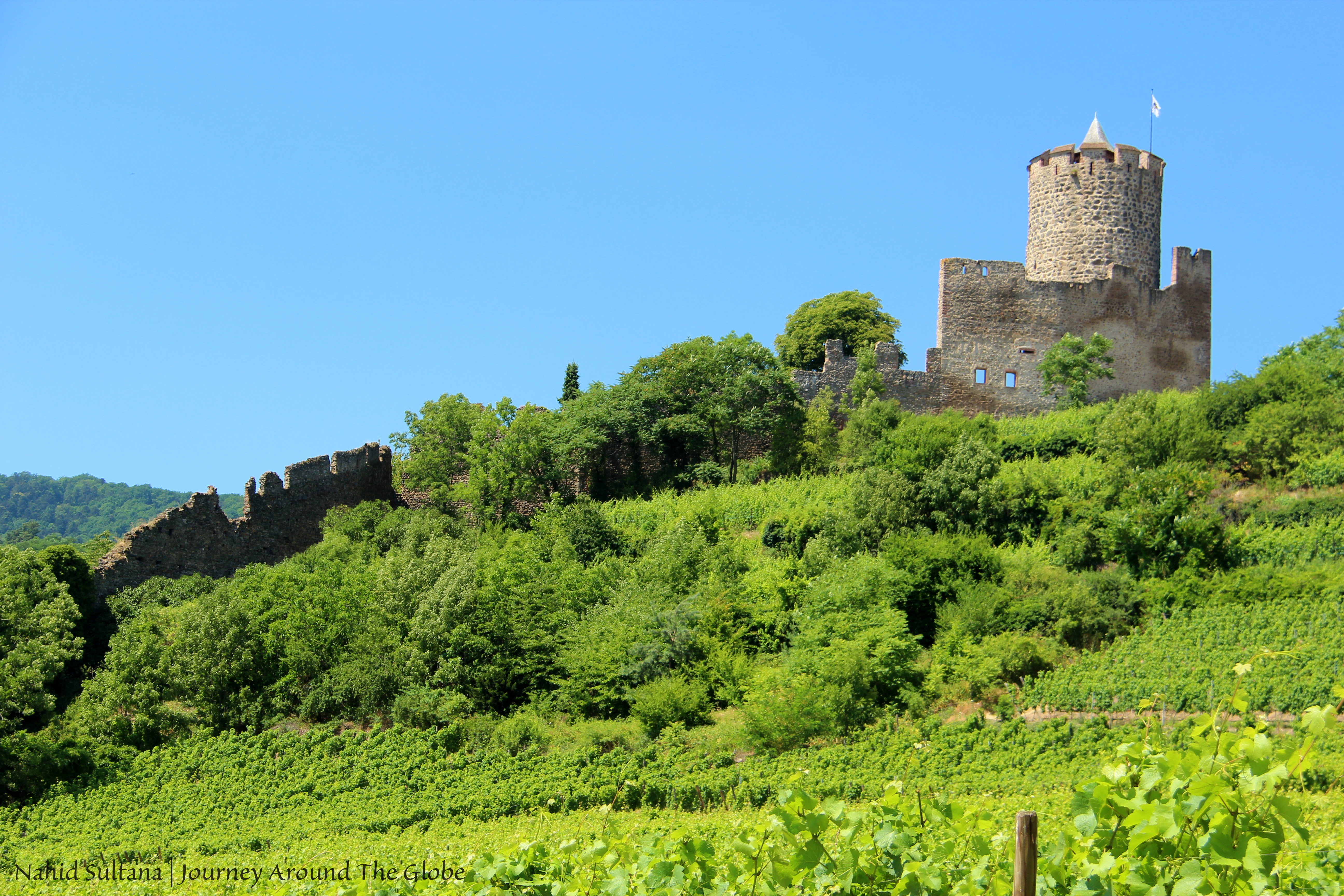
Ruins of Castle of Kayserberg from 1220 AD is magnificently located on top of a small hill. It’s about 15 minutes of walk from the old town. You can see the small vineyards, a nearby village, and Kayserberg from top of this hill. Overall, view from here was simply marvelous.

- Ruins of Kayserberg Castle in Kayserberg, France
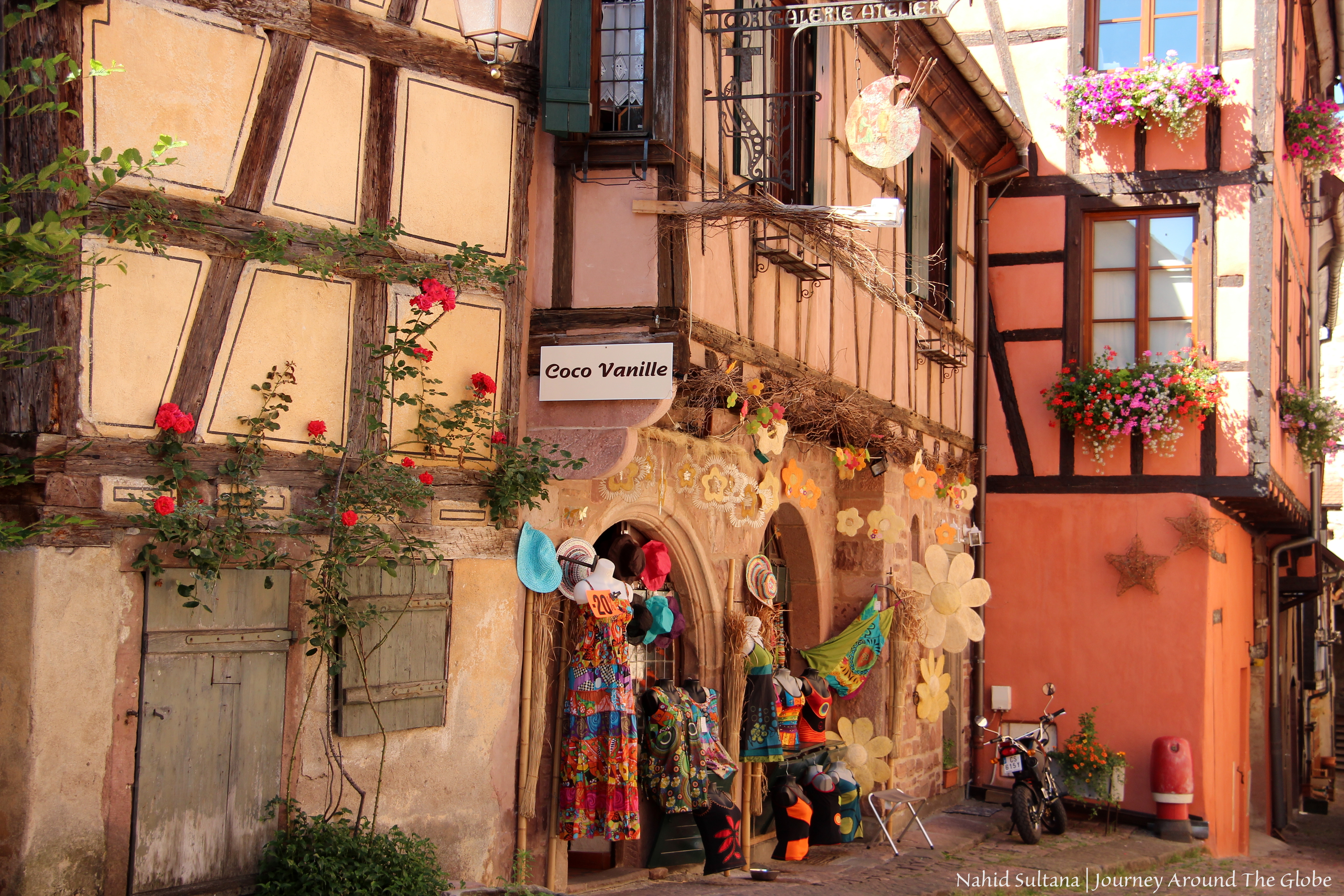
3) RIQUEWIHR: Riquewihr was rated as one of the prettiest villages of France according to an independent organization. This is an admirably well-preserved medieval and Renaissance place. There are fortifications, houses, and courtyards from 13th, 15th, and 17th century. Many old fountains still exist here and there. Setting of this village looks like an enchanting place and every corner is vibrantly decorated. Everything here is within walking distance and I would highly recommend discovering the village on foot. There is a tourist train that starts near Hotel de Ville (Town Hall).
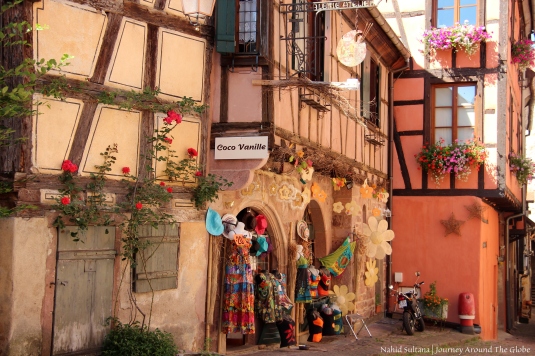
- Cozy old town of Riquewihr, France
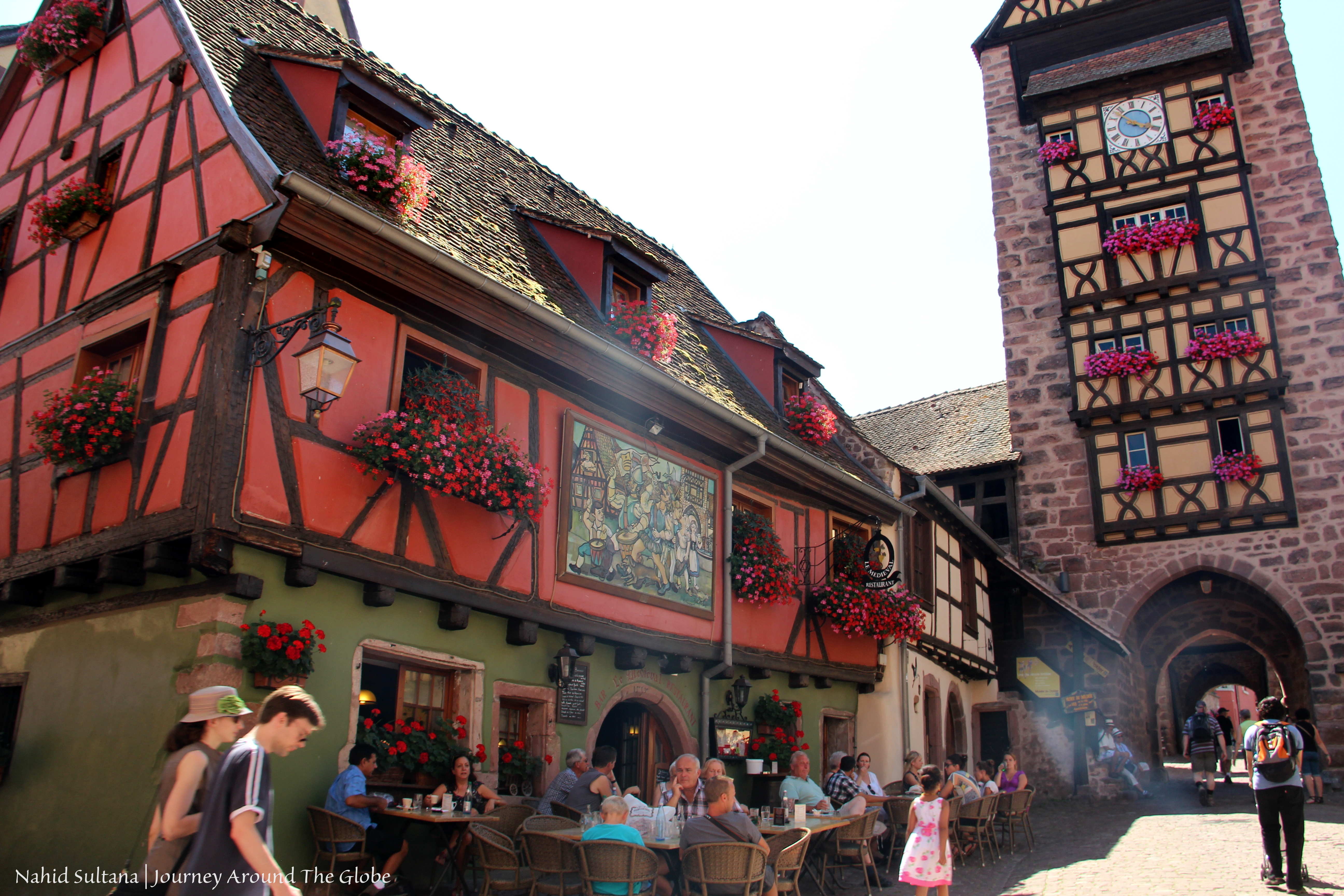
Riquewihr also has a street called Rue de General de Gaulle which is a lively street with many cafes and craft shops. At one end of this street is beautiful Dolder belfry watch tower from 1291. It’s an eye-catching half-timbered architecture. There is a museum inside the tower and outside looked very attractive with colorful flower baskets.

- Dolder belfry watch tower in Riquewihr, France
Thieves’ tower (with torture chamber) will amaze anyone. Original high gate to enter the courtyard of Thieves’ Tower and the well in front are very old, supposedly from the 16th century.
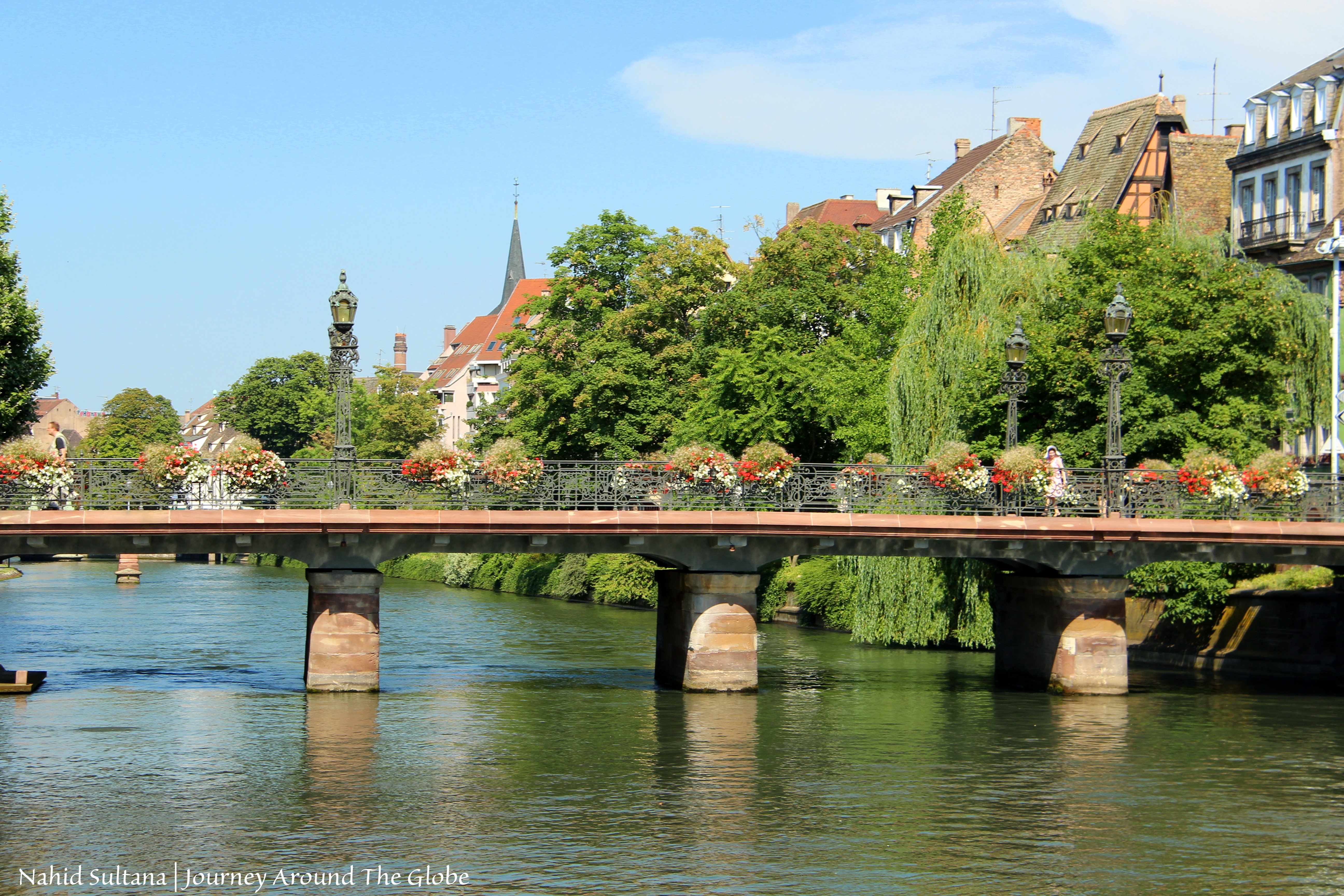
4) STRASBOURG: Strasbourg is a big metropolitan city, nothing like other Alsatian villages. Grand Ile area of Strasbourg was the first city center to be announced entirely as a UNESCO World Heritage Site. Gutenberg parking is the closest parking near Strasbourg Cathedral.

- A beautiful bridge on River Ill in Strasbourg, France
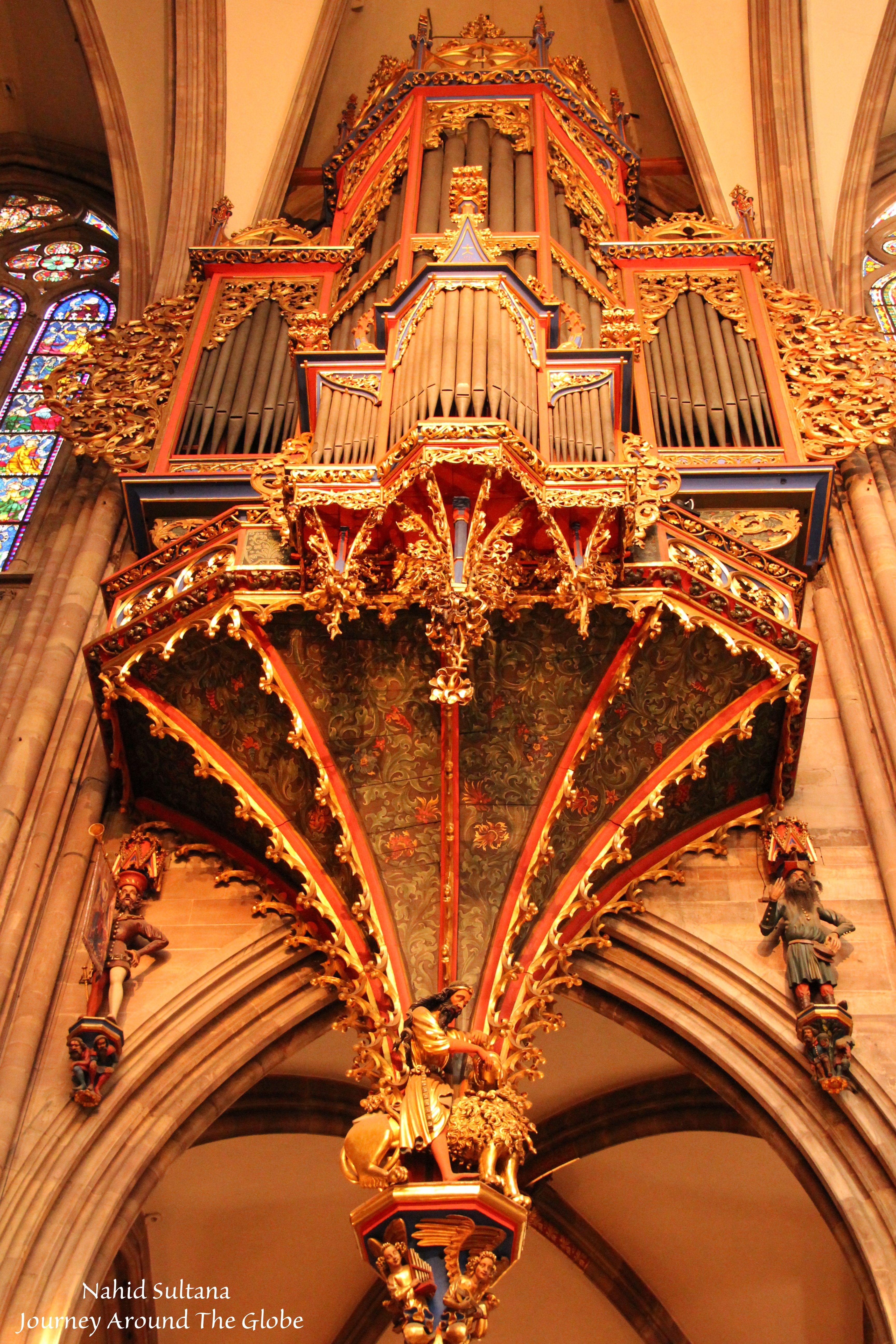
Strasbourg Cathedral or Cathedral Notre Dame du Strasbourg was our first spot. You can see its 142 meter soaring tower from distance (the highest cathedral tower in France). The construction started in 1176 AD and took couple centuries to finish it. This got to be one of the major highlights of Strasbourg and a finest architecture. Church organ is something unique, decorated elegantly with golden molding and bright color lines. There are many beautiful stained glass windows and monstrous stone pillars. Don’t miss the 300 years old Astronomical Clock at the back of the cathedral. Unfortunately we missed the Astronomical Clock show that takes place every day at noon.

- Decorative organ of Strasbourg Cathedral in France
There is no charge to go inside the cathedral. It’s open from 7am – 11:15am and 12:45pm – 7pm. Daily at 12 pm (except Sundays and feast days), the cathedral offers visitors the chance to see a film lasting 22 minutes on the astrological clock. Anyone wishing to see the presentation of the astronomical clock (film + procession of the apostles) is able to purchase tickets from the clock ticket office at 2 euros for adults.
Right outside the cathedral on the left side (when you are facing it) is historic Maison Kammerzell. This is a residence of a wealthy family from the 15th century. We just saw it from outside…not sure if you can actually go in.
Protestant church St. Pierre Le Jeune is another marvelous historical monument of Strasbourg. Construction of the present church began in the second half of 13th century. Some of the old frescoes on the wall were revealed and restored in late 19th century. These medieval frescoes make this church worth a visit. There is a big fresco opposite of the organ depicting “Storm on the Sea of Galilea”. It’s free to enter and about 10 minutes of walk from Strasbourg Cathedral.

- St. Pierre Le Jeune in Strasbourg, France
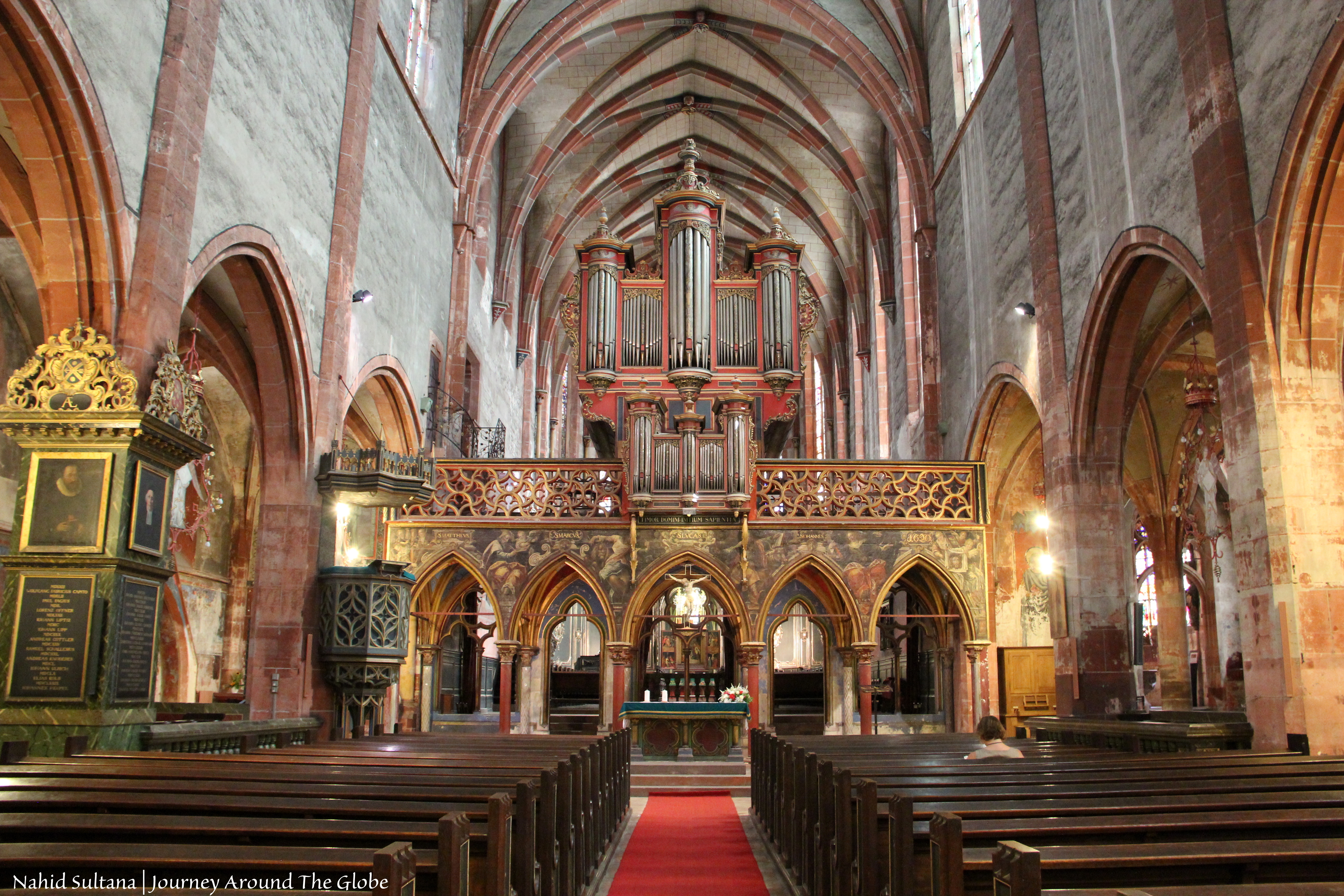
St. Thomas Church is another Protestant church and a landmark of this city. Its origins date back to the Scottish monks who arrived in this country in 6th century. The original church was built somewhere in 833 but the present front of the church is from 1250. It is simpler than St. Pierre but numerous monuments and interesting flagstones with obituary inscriptions decoration make it a nice place to see. It’s free to enter.
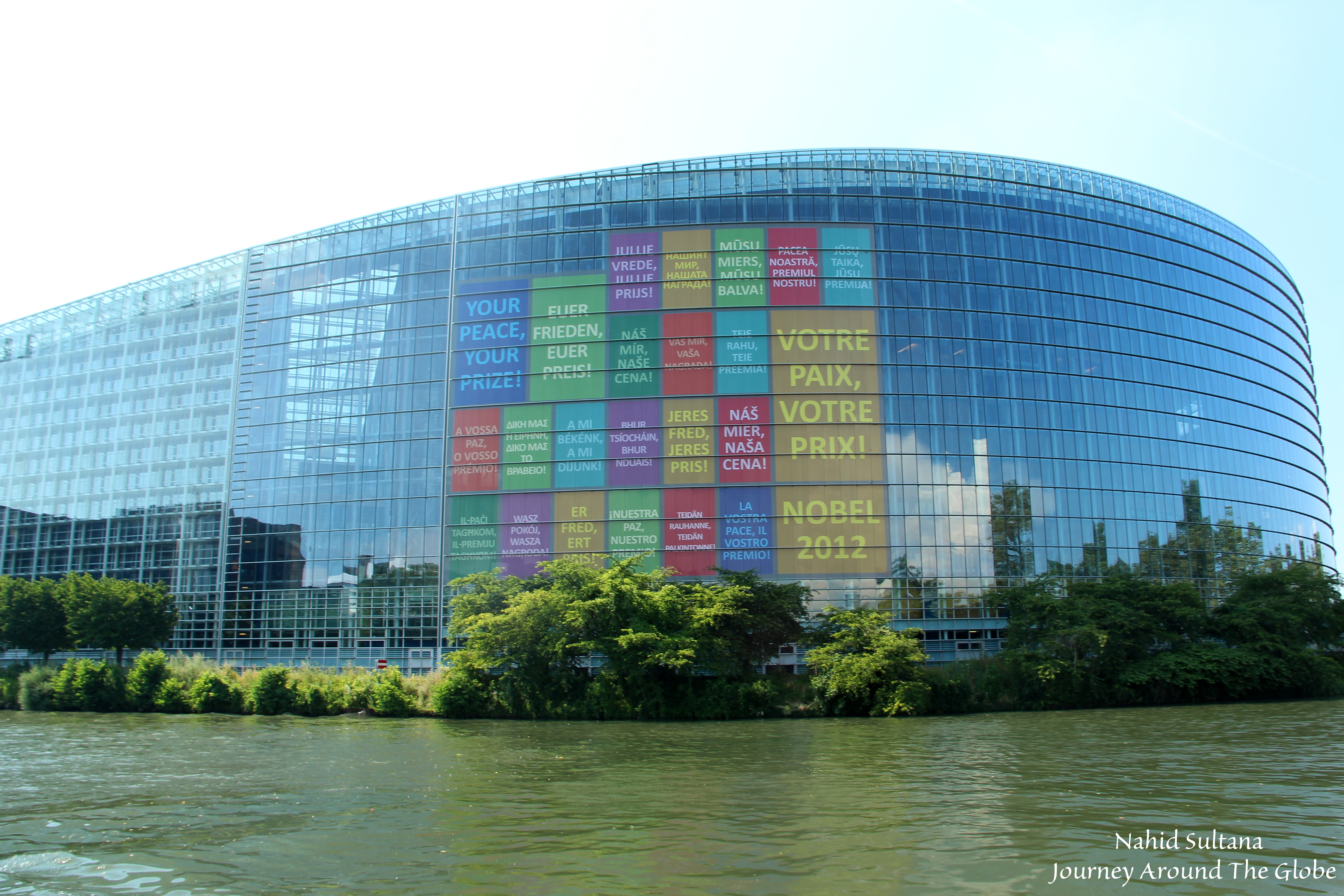
We took a boat tour in Strasbourg on River L’Ill as our last event here. “Batorama” organizes this tour for 1.10 hours (for 9.60 euros per adult and 5.20 euros for kids 3 -5 years of age) with audio commentaries of many languages. It departs from near Palais de Rohan by the promenade and is a great way to discover the city. Thanks to this tour, we saw Council of Europe, La Petit France (a picturesque neighborhood similar to Colmar), Palais des Rohan (now a museum), many of total 27 bridges on River L’Ill along with beautiful old buildings and other monuments by the waterfront.
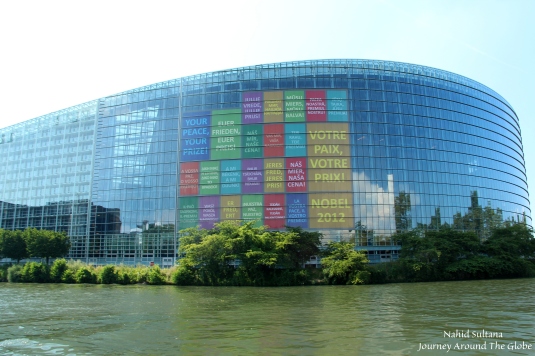
- Council of Europe in Strasbourg, France
Related articles
- Discover Why Riesling From #AlsaceRocks (winepredator.wordpress.com)
- Alsace¡¡¡ (pertus16.wordpress.com)
- Obernai, Alsace (thousandsky.wordpress.com)
- Route des Vins, Alsace (thousandsky.wordpress.com)
- Northern France – The Alsace region (moonofhoney.wordpress.com)
Share this:

Belgian beach town – Ostend
OSTEND, BELGIUM: It was a nice day here in Belgium last Sunday (of July 2013). Last few days were actually pretty good for outdoor activities. This weekend we decided to hit the beach with one of my husband’s colleagues. We drove about hour and fifteen minutes from Tervuren to Ostend.
Ostend is a nice beach town very close to Brugge or Gent. It was around 3pm by the time we got there, stayed for couple of hours and headed back around 7pm. We really didn’t do any research as what to do or see in Ostend. It was just a quick getaway with the kids to enjoy the sun.

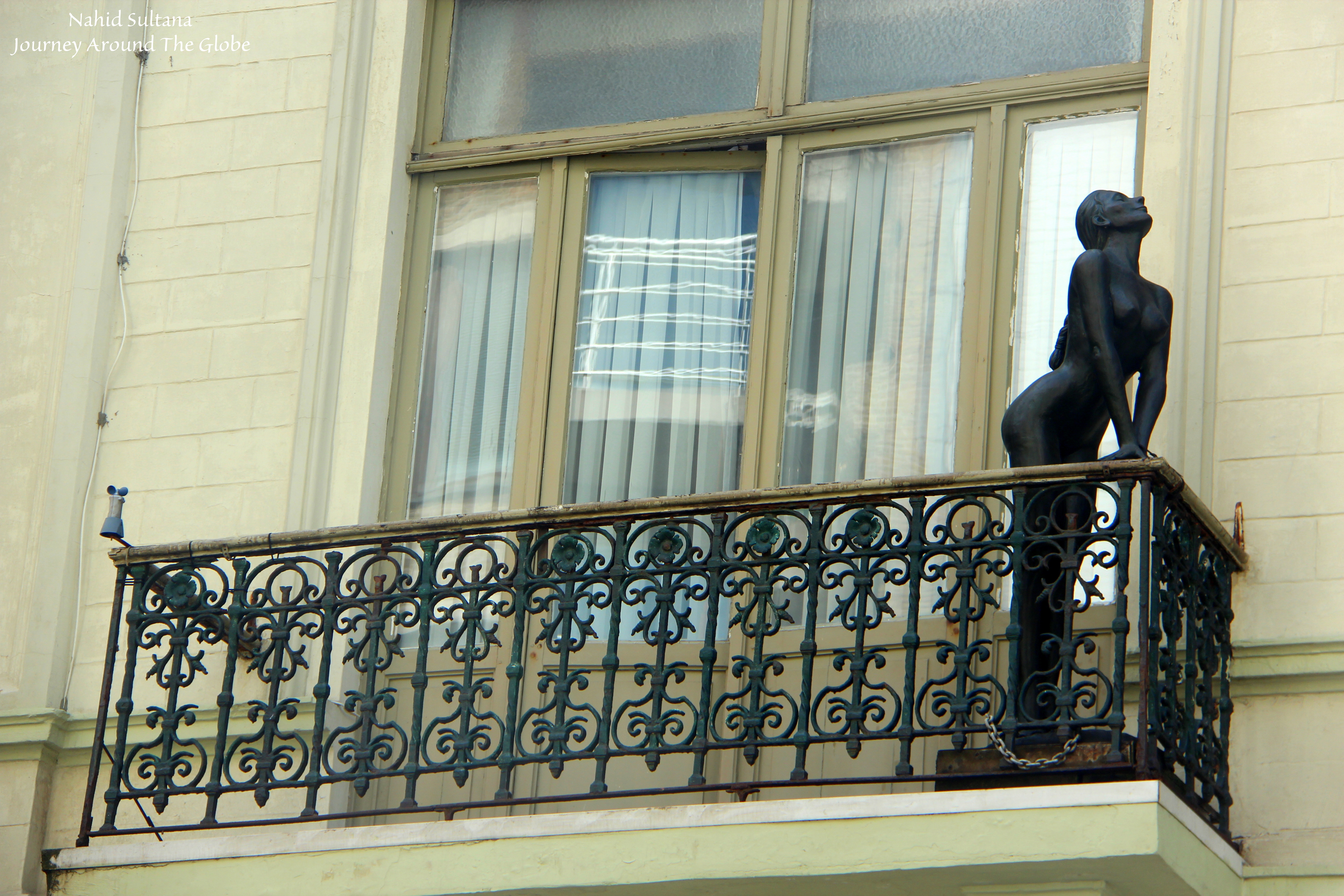
- Saw this unique statue while walking around Ostend, Belgium
ST. PAUL and ST. PETER’S CHURCH: We saw the grand spires of this church when we entered the city. We left the beach area and started walking towards the city looking for those spires. I think, we walked leisurely for about 15 minutes looking for it and there it was…a magnificent edifice with gothic exterior. Interior wasn’t as nice as the outside, but definitely worth checking it out for there is no entry fee. Stained glass windows were beautiful as well as the church organ. There are two statues of Peter and Paul near the main altar.

- St. Paul and St. Peter’s Church in Ostend, Belgium

There is a monumental belfry at one side of the church. You can see this type of belfry on many Flemish towns of Belgium.
BEACH and the PROMENADE: I think the whole town came to the beach today since the weather was so good. But the beach is so spread out that it didn’t look too crowded or anything. Ostend beach is more of a family place, great to take the kids to the sand and water. There are some museums and one aquarium very close to the shore too.

- Ostend Beach in Belgium

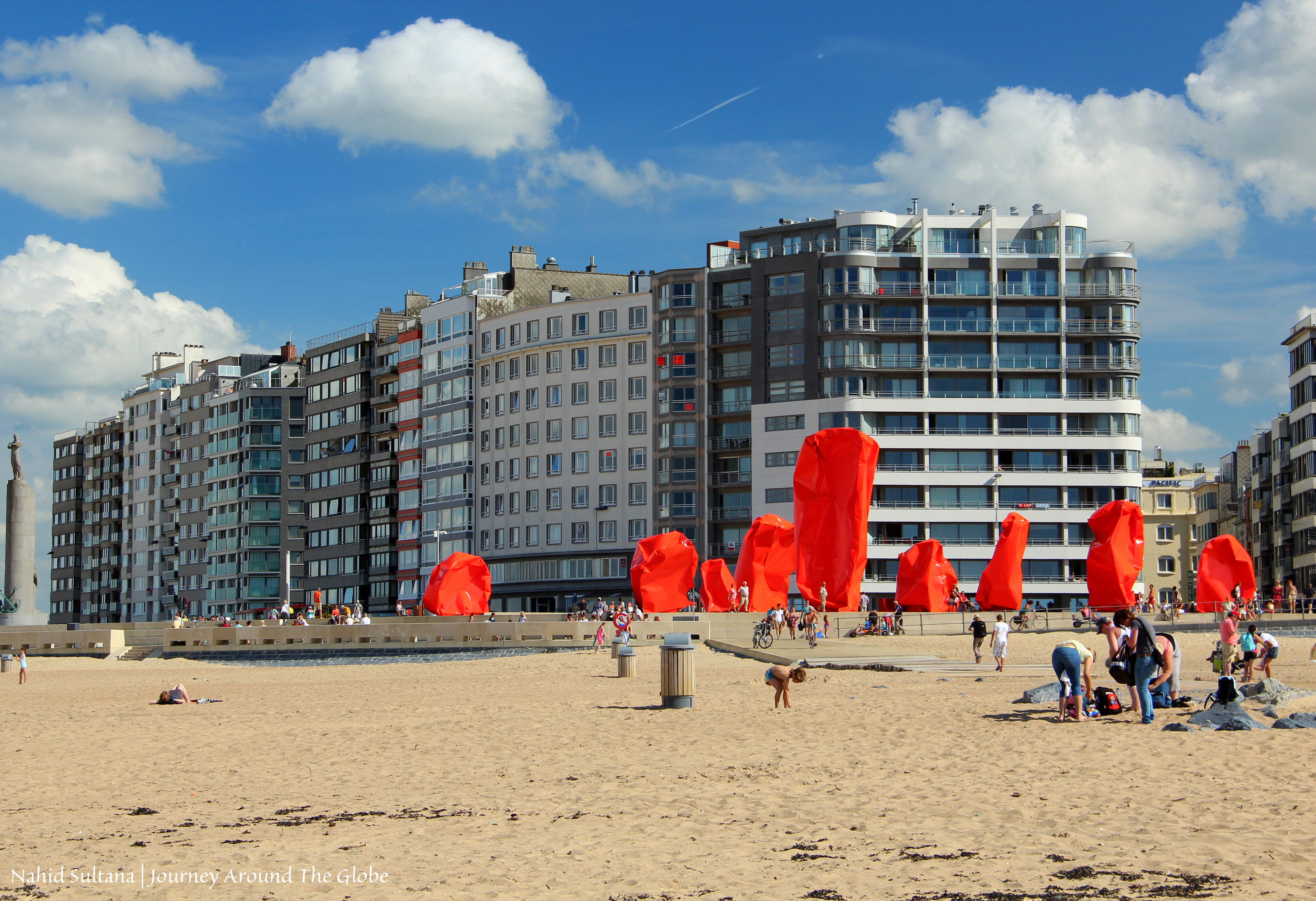
One side of the promenade had nice restaurants and cafes with some shops while the other side had some contemporary arts and sculptures. Tourist can find many hotels on the promenade with fantastic view of the ocean.

- Promenade of Ostend Beach in Belgium
Related articles
- Marvin Gaye in Ostend (ibrahcadabrah.wordpress.com)
- Never Mind (paintingsframe.wordpress.com)
- hemling hotel bruges (exavinse.wordpress.com)
Share this:

Going back to D-day on June 6th, 1944
NORMANDY, FRANCE: June 6, 1944 is the day that probably made Normandy so famous around the world. Normandy’s beaches are where the American, British, and Canadian troops landed on that day for their long-awaited D-Day allied invasion – Operation Overload during WWII. Normandy is not a city, rather a big region in northern-eastern France.

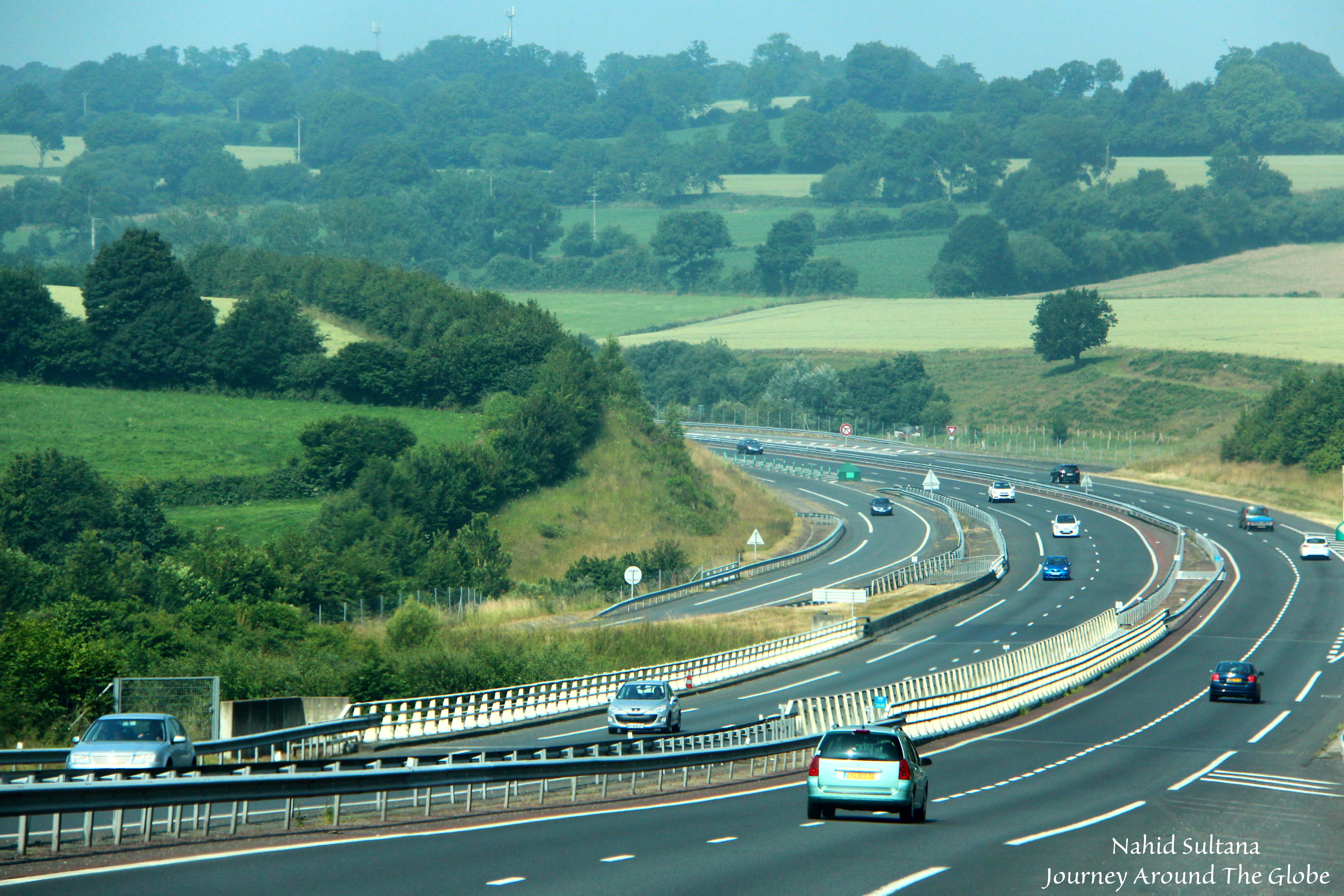
- Driving in Normandy…a very scenic region of France
TIME of TRAVEL: We went to Normandy during the 4th of July weekend in 2013. It was close to 80 degrees Fahrenheit those few days we stayed there. It can be a bit chilly at night but pleasant during the day.
OUR HOTEL: Our hotel in Normandy was in a small town of Bayeux, called Novotel Hotel Bayeux. It was very close to Bayeux city center, its famous cathedral, and WWII memorials and museums. We had free Wi-Fi in the room but no free breakfast. They had a quick breakfast menu where we paid 4 euros per person (our kids were free) for unlimited croissants and hot drinks. Bayeux is was a good place for our trip; it was little more than 45 minutes of drive from the Parachute Church (Saint Mere Eglise) and less than half an hour drive from the D-Day American beaches. But other parts of Normandy, like Mont St. Michel, Etretat, or Giverny were all more than an hour drive.
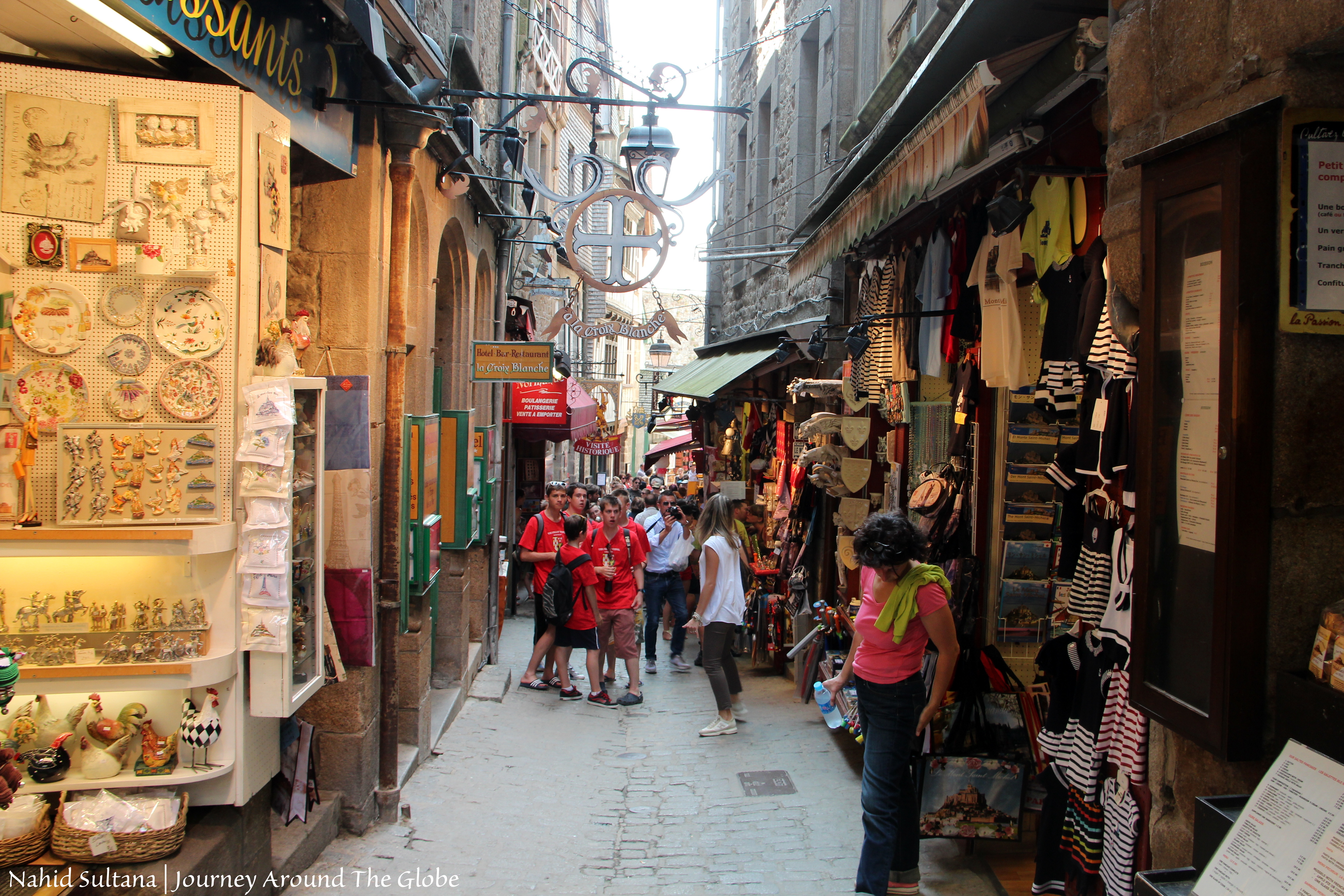
EATING and SHOPPING: Normandy’s egg omelet is something special and unique. They whip their egg until its light and bubbly. Our 1st lunch was at Utah Beach in a restaurant called “Le Roosevelt”. The building itself is a historic site where Germans had their communication center located. For the 2nd day, we were in Mont St. Michel and we ended up getting up a box of pizza from a small place in the mount. There were few seats there, so we took the box to nearby stairs and finished lunch there. During our visit to Giverny Monet Village, we had lunch in a restaurant near the garden’s parking lot “Grill au feu de bios”. The restaurant mainly serves grilled meat with veges and potatoes. What attracted us to this restaurant was its setting. It was beside a little garden and surrounded by lots and lots of flowers, just a perfect place to start our tour in Monet’s garden. War souvenirs, army toys and gifts, and WWII memorial items are what most of the tourists buy from Normandy. Mont St. Michel is also packed with many shops and royalties. Everything seemed more expensive here but the place definitely has some unique stores. Also, there are lots of paintings and art souvenirs in Giverny Monet Garden where you can find print copies of some of his very well-known paintings.

- Shops in the island of Mont St. Michel in Normandy, France
PLACE WE’VE VISITED: Main reason for us to come to Normandy was to visit the D-Day beaches and other WWII historical sites in this region. These D-Day landing beaches include 2 American beaches (Utah and Omaha), 2 British beaches (Sword and Gold), and 1 Canadian beach (Juno beach). We spent one whole day visiting the 2 American beaches and some other significant spots of Operation Overload from WWII. I really wanted to go to Etretat to see the white coast line and beautiful cliffs but we couldn’t manage in time for that trip.
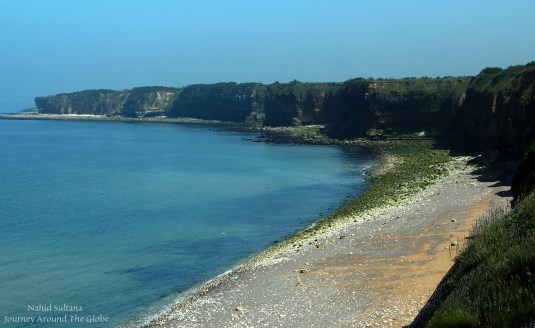
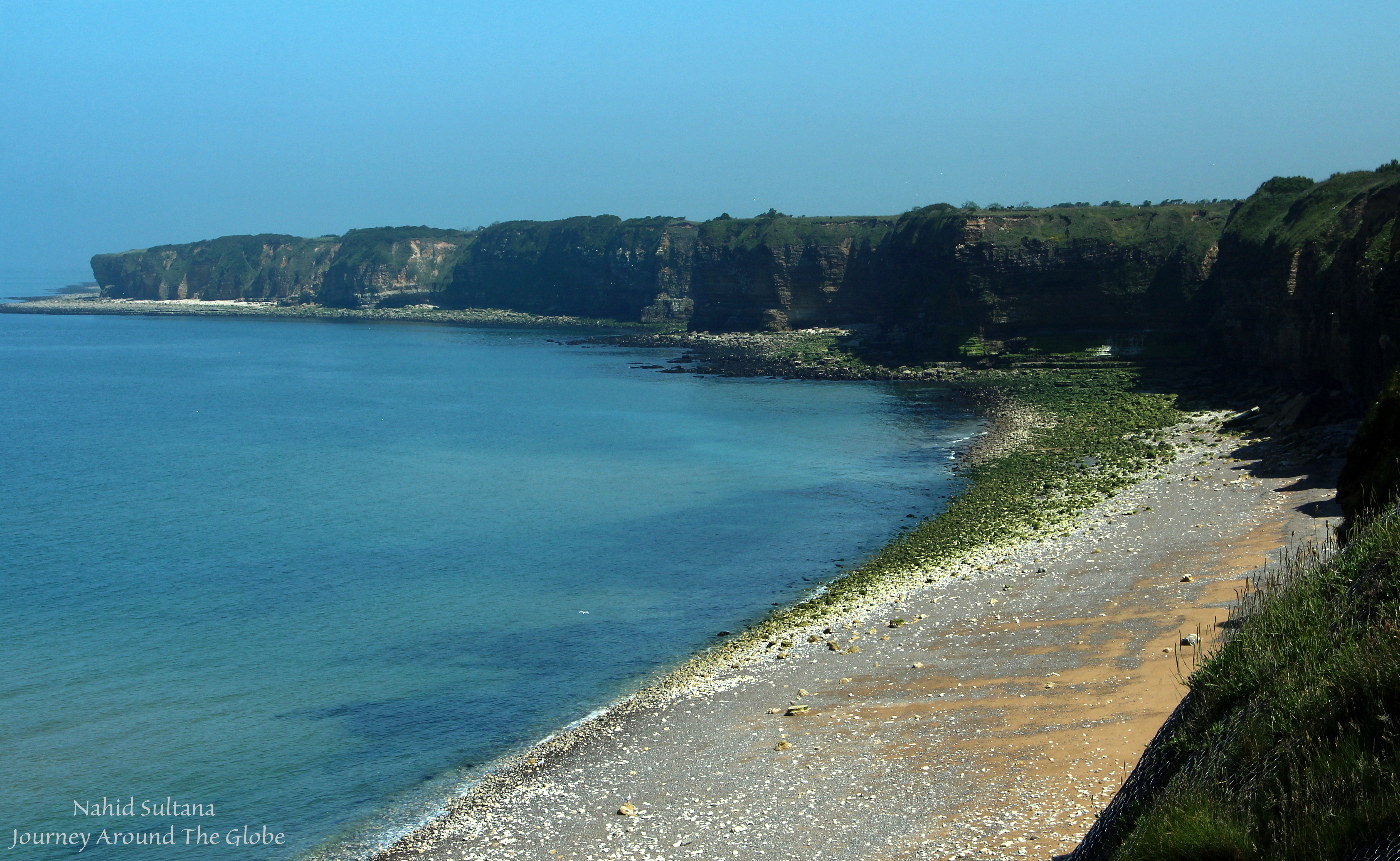
- Beautiful cliffs of Pointe du Hoc in Normandy, France – a historical site of Normandy Battle
1) ST.MERE-EGLISE: Also known as Parachute Memorial Church, this is located in lower Normandy, about little more than half an hour drive from Bayeux. The town where this church is located also called Sainte-Mere-Eglise and is the most famous D-day village. It played an important role in WWII and was one of the first towns to be liberated in the invasion. This whole village is like a memorial to the American, British, and Canadian soldiers who fought in WWII…flags of these three countries are almost everywhere. Many paratroopers hung from trees and poles and were shot dead before they were rescued.

- A dummy dangling from St. Mere Eglise commemorating paratrooper John Steele whose parachute got caught in this church’s spire on June 6, 1944, Normandy, France
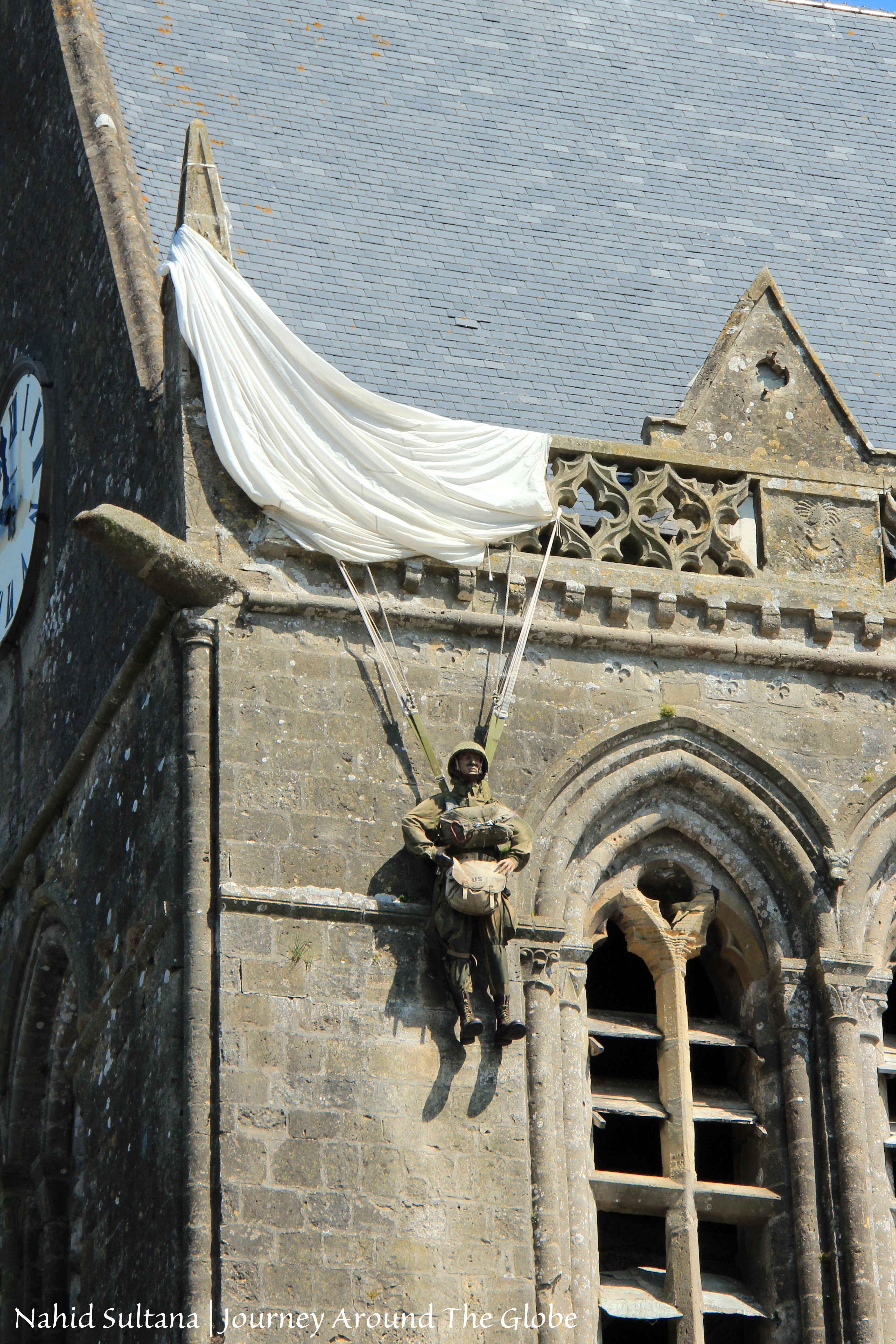
The incident why this church became famous involved paratrooper John Steele whose parachute got caught on the spire of this church during D-Day. He hung there for 2 hours pretending to be dead. Later he was taken as a prisoner by the Germans but he managed to escape and rejoin his own division. Luckily the church was not destroyed in the battle. The church bell tower still has a dummy parachutist dangling from it, making it more like a monument to John Steele. Inside the church is very small and simple. Some stained-glass windows feature the Virgin and the child, surrounded by paratroopers. Do visit other war museums in this town if time allows. There is no entry fee and there is a big free parking in front of it for its visitors.
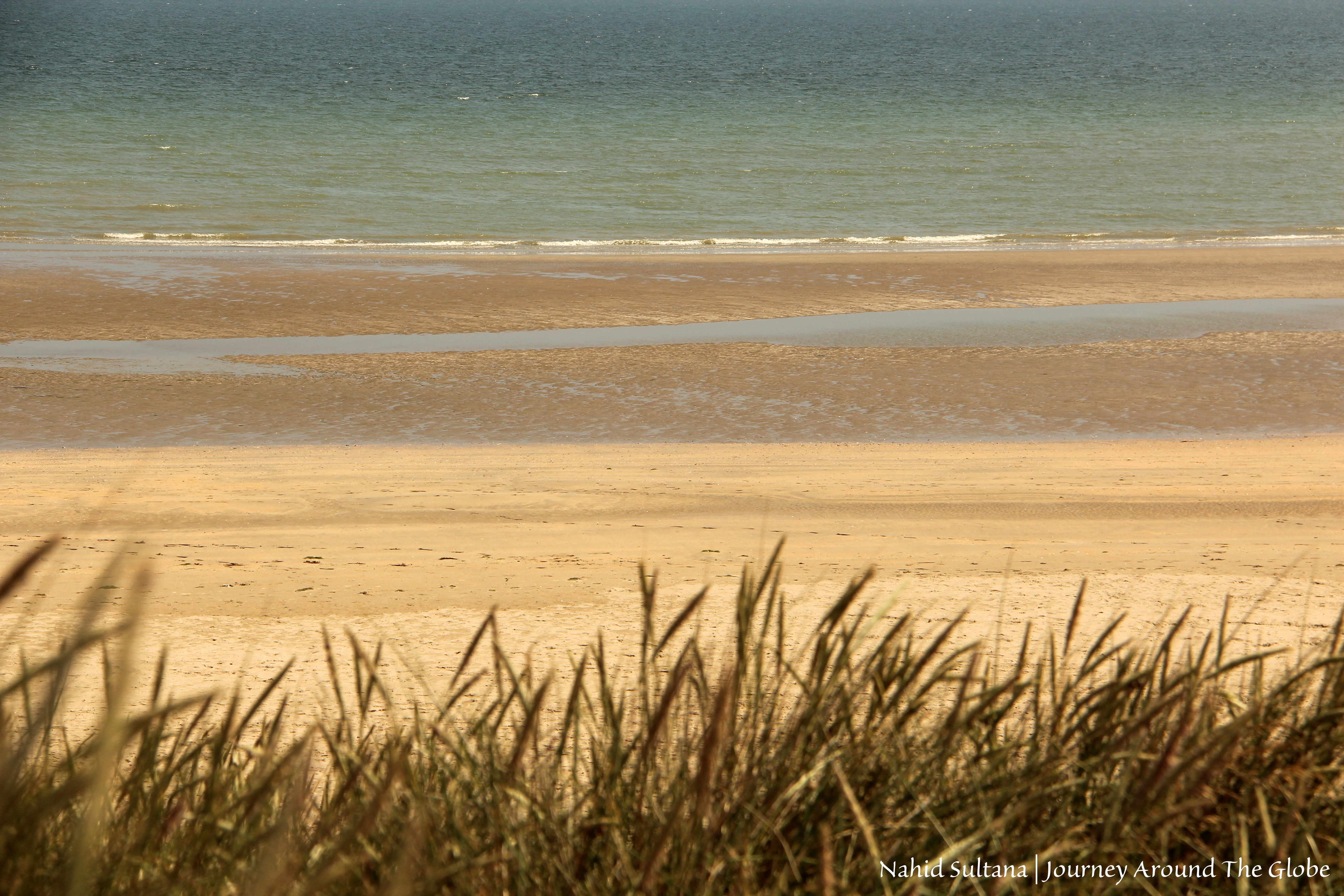
2) UTAH BEACH: Utah Beach is a D-Day landing beach where American troops came ashore through the early morning of June 6, 1944. We came across many memorials and monuments for the remembrance and commemoration of the US heroes before reaching the beach. But this is not a place for swimming or do any beach activities. You can see England vaguely on the other side of the ocean.

- Utah landing beach – an American landing site of D-Day Normandy Battle in Normandy, France
We had our lunch in a restaurant and souvenir shop “Le Roosevelt” which is a historic building itself. After lunch we requested our waitress to take us to a bunker within the building. It was once used to be a German communication center and was later captured by the USA army. The bunker is still in its original settings with radios, transmitters, beds, and furniture.
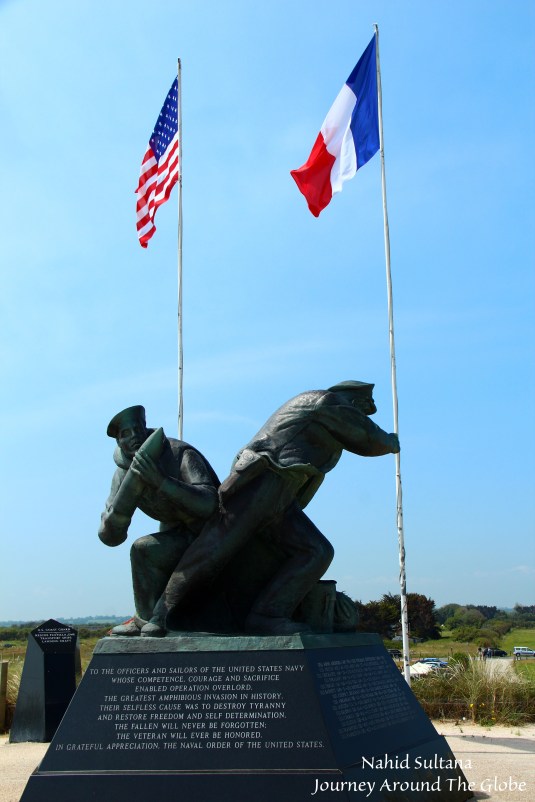
- A memorial in Utah Beach commemorating the US braves in Normandy, France
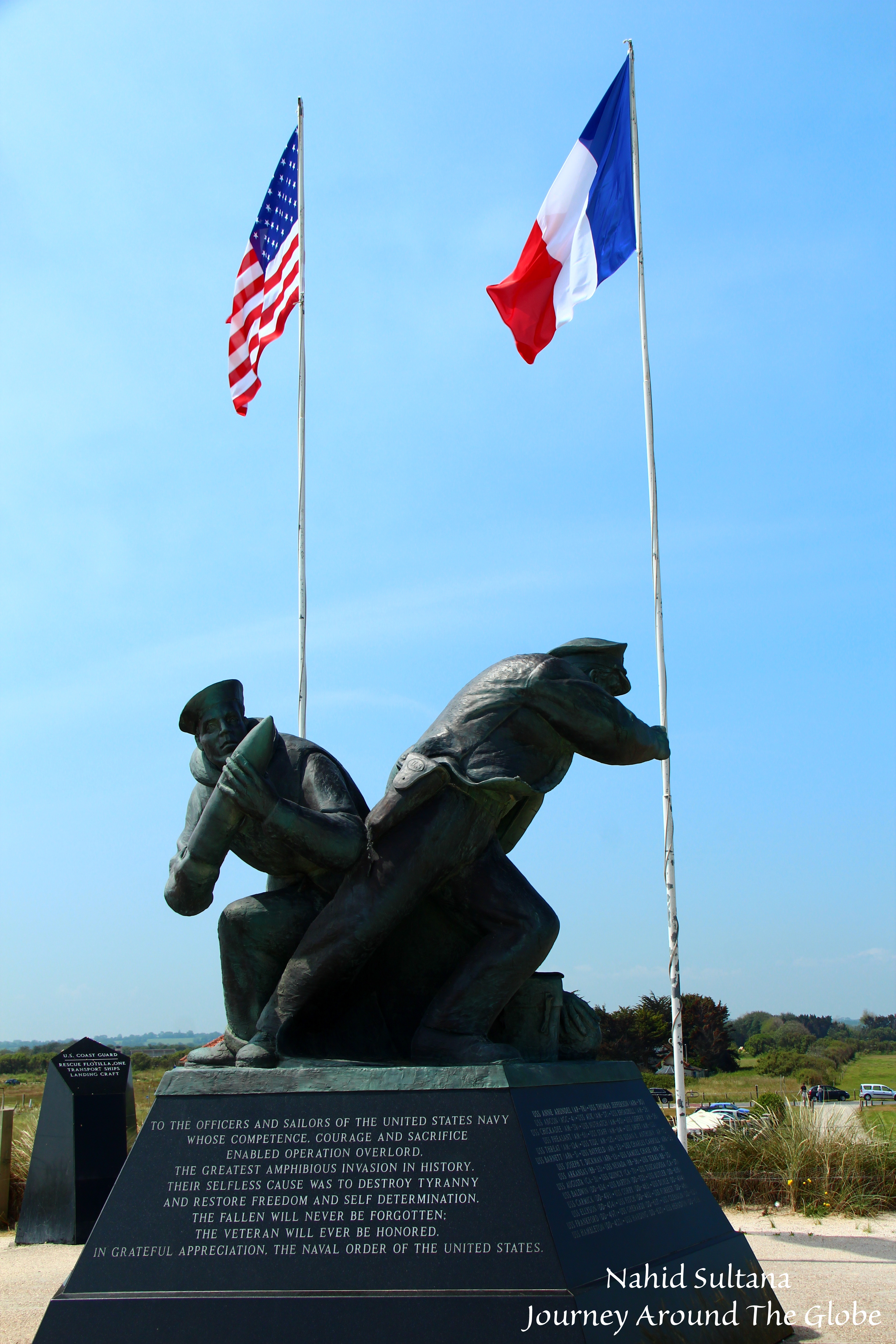
Utah Beach has plenty of war museums on the site, among those Utah Beach Landing Museum is probably the most notable one. We didn’t go to any museum but I am sure they are worth visiting. The beach is about 12 miles drive from St. Mere Eglise.
3) POINTE du HOC: This was a strategic point for the German fortifications on the Normandy coast. 30 meters above the sea, this site was bombed and shelled by US Rangers and was finally captured from the Nazi military. Today, visitors can still see many big and small craters that were created due to aerial bombings on this area. French government erected a symbolic granite dagger atop the bunker where bodies of soldiers still lie under the ruins, commemorating all the US soldiers who have fought bravely in defeating the enemy. Other than the shell craters, you can also see some underground rooms, gun position spots, ammunition storage area, and bunkers here. There are no original guns or canons on the site but the open air park definitely gives you a sense of pride and respect.
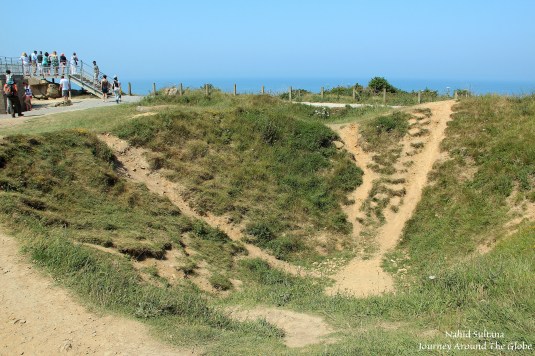
- One of many craters that were created due to aerial bombings on Pointe du Hoc during D-day invasion in Normandy, France
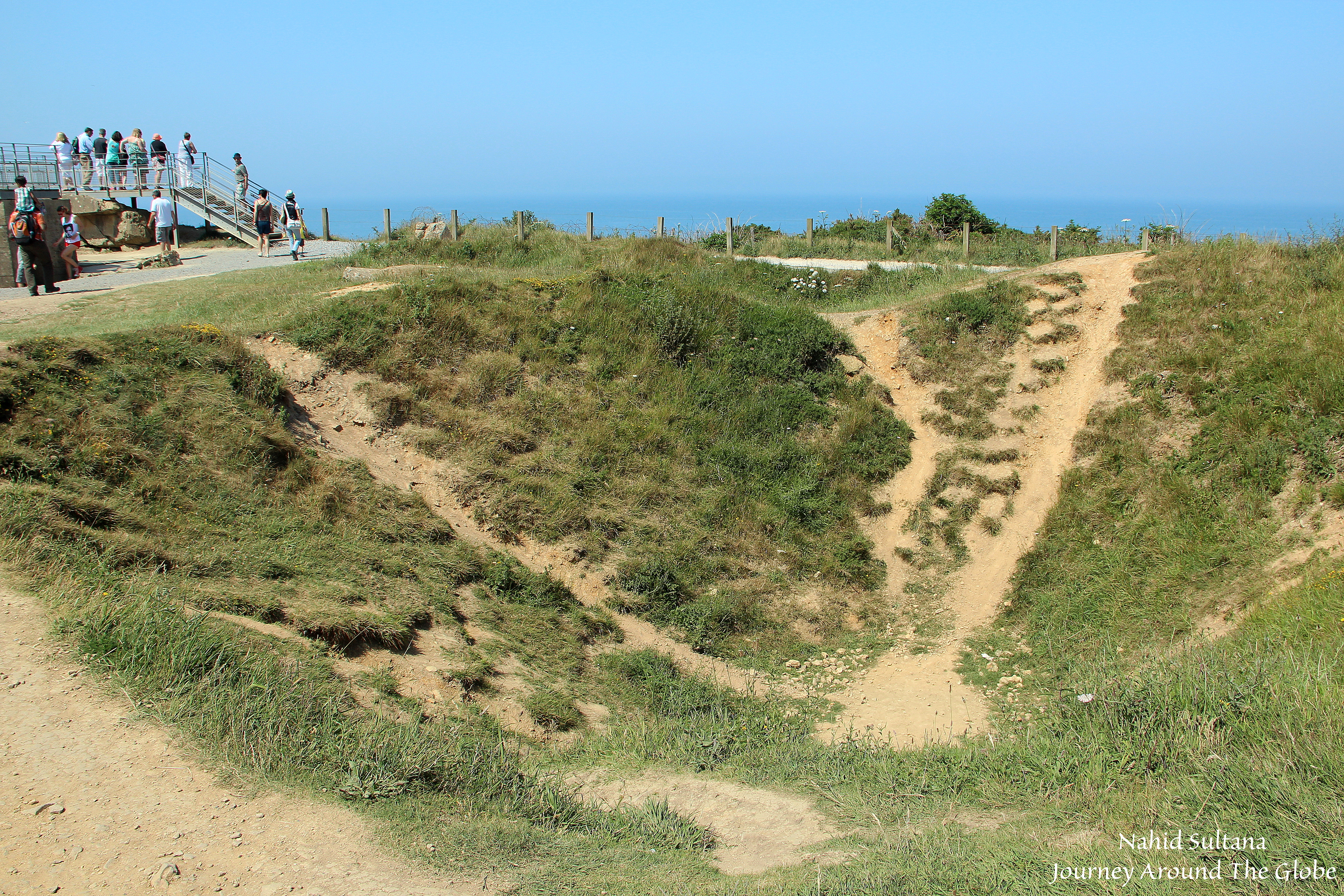
Pointe du Hoc is located by the Atlantic between Utah and Omaha beaches. View of the cliffs and the beach down below are very scenic. The French government transferred the area to the American Battle Monuments Commission in 1979 for perpetual care and maintenance. We spent about little less than 2 hours here just walking by the craters, enjoying the surroundings, and imagining what must have gone here almost 70 years ago.

- Memorial built on top of a bunker in Pointe du Hoc, Normandy, France
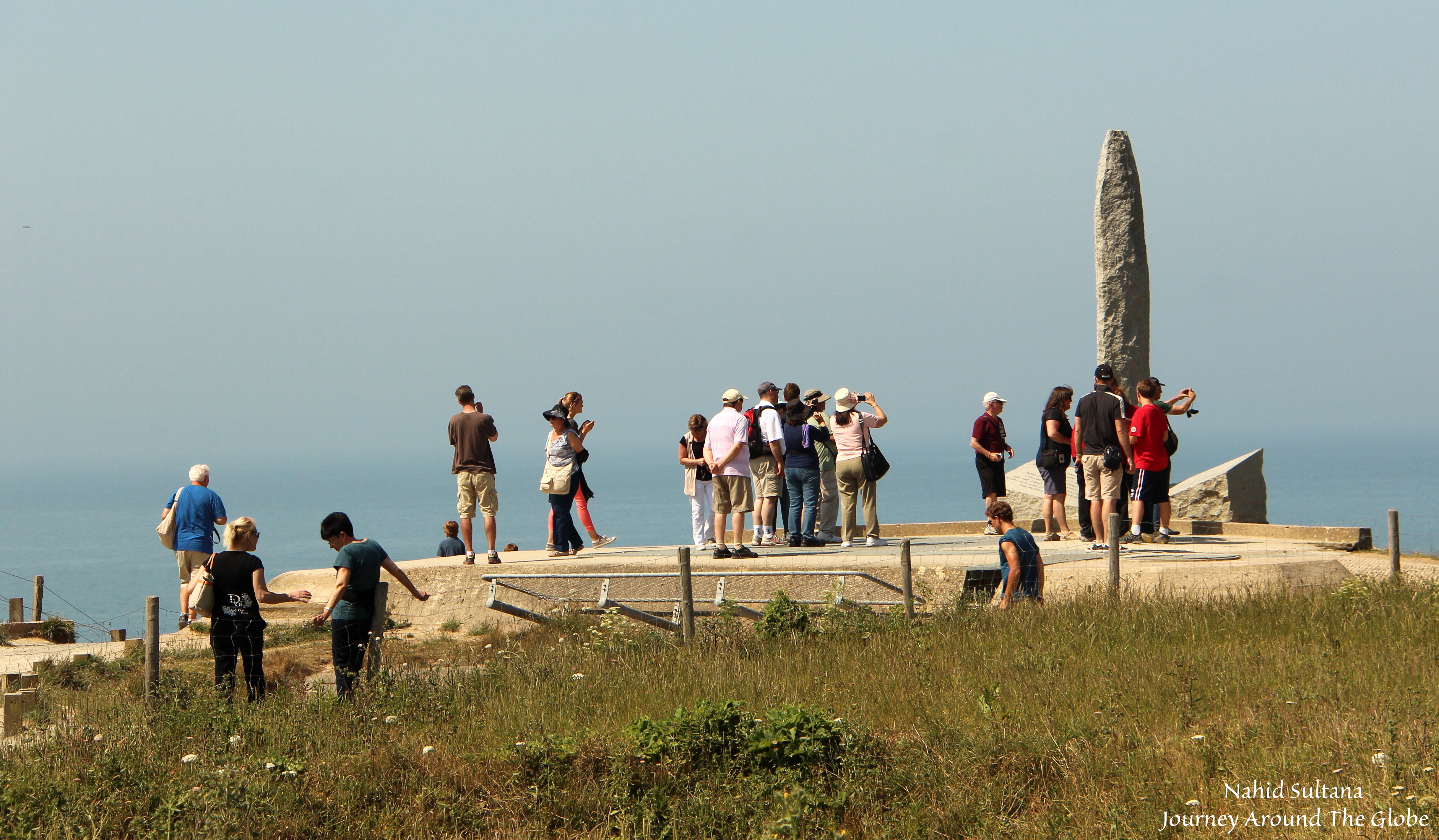
It has few designated free parking spaces for visitors and there is no entry fee.
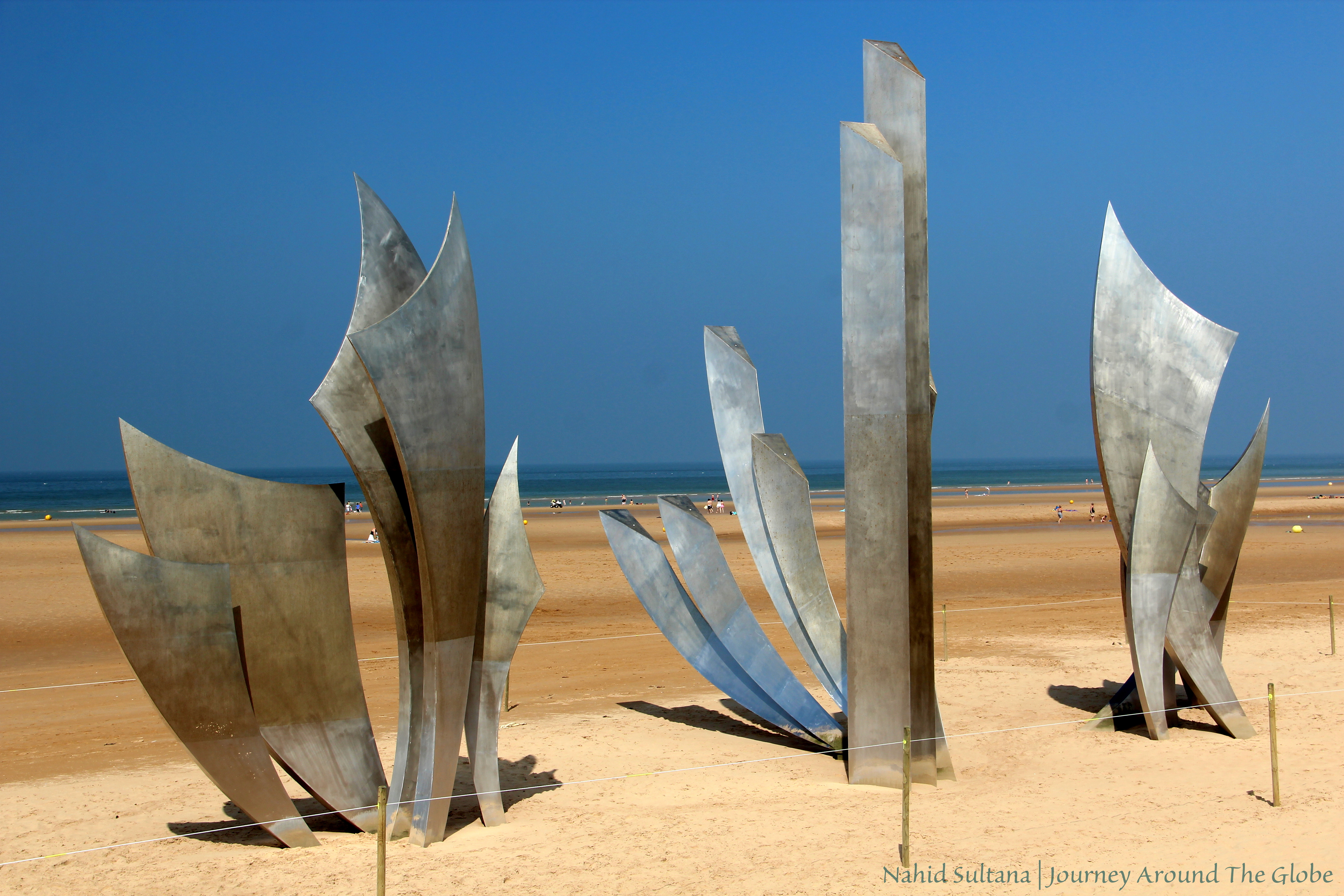
4) OMAHA BEACH: Omaha Beach is about 10 minutes of drive from Pointe du Hoc. This is longer than Utah Beach and another historic site where US troops landed on June 6, 1944. Here we saw people were actually swimming and playing by the beach. So, bring your trunks and swimming suits for this place.
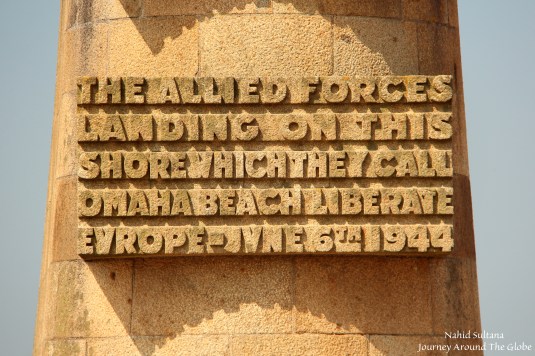
- Tribute to our heroes from French people in Omaha Beach, France
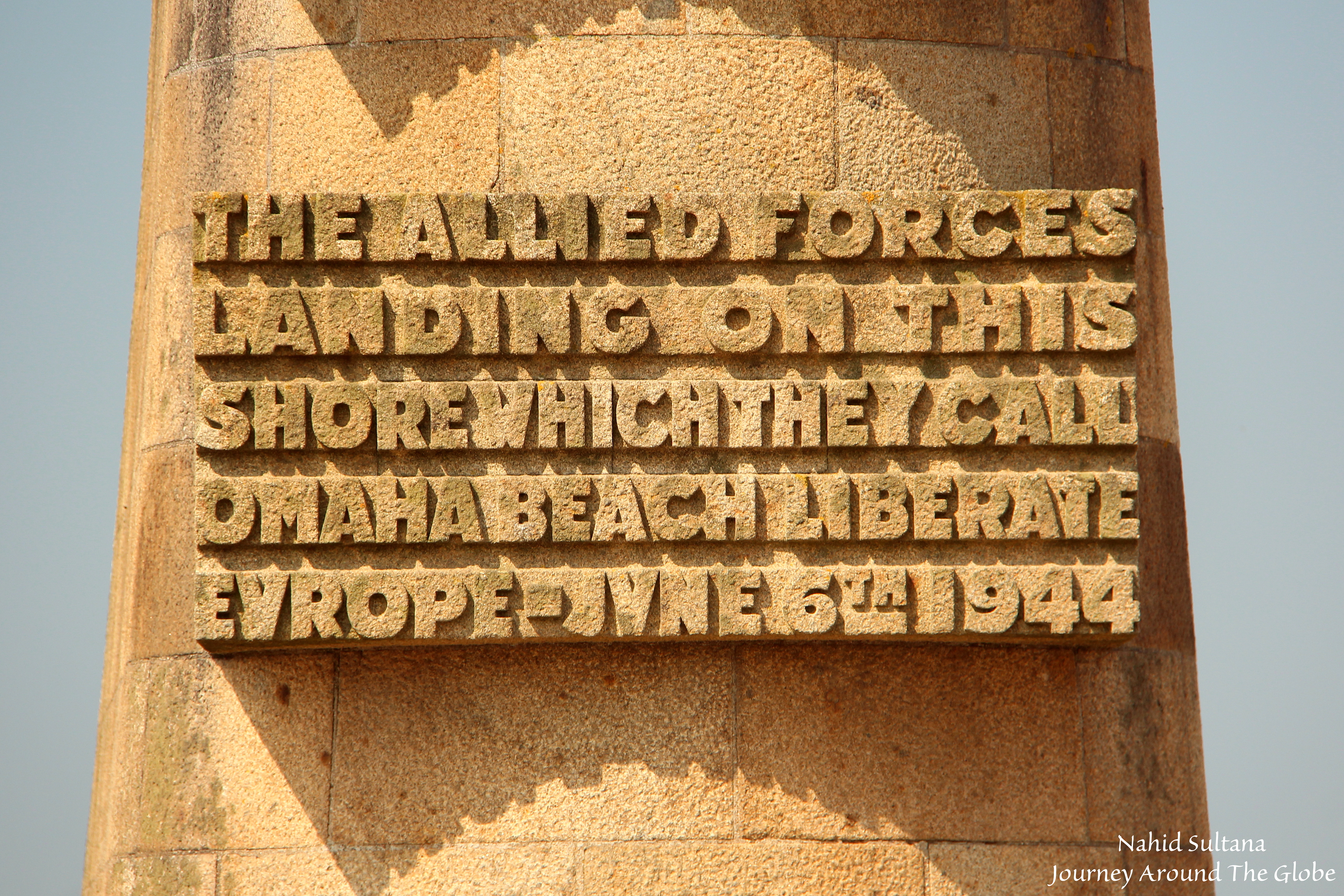
There are few statues and memorials honoring Allied Forces soldiers for their bravery. Although we didn’t go to any museums here, there are numerous of them in Omaha Beach and I highly recommend going to couple of these museums to get some real pictures and feelings of what happened in D-Day and during their operation.
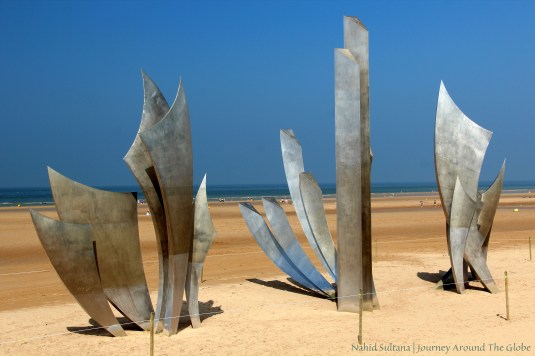
- Another memorial in Omaha Beach, France – remembering the heroes on the 60th anniversary of D-Day invasion
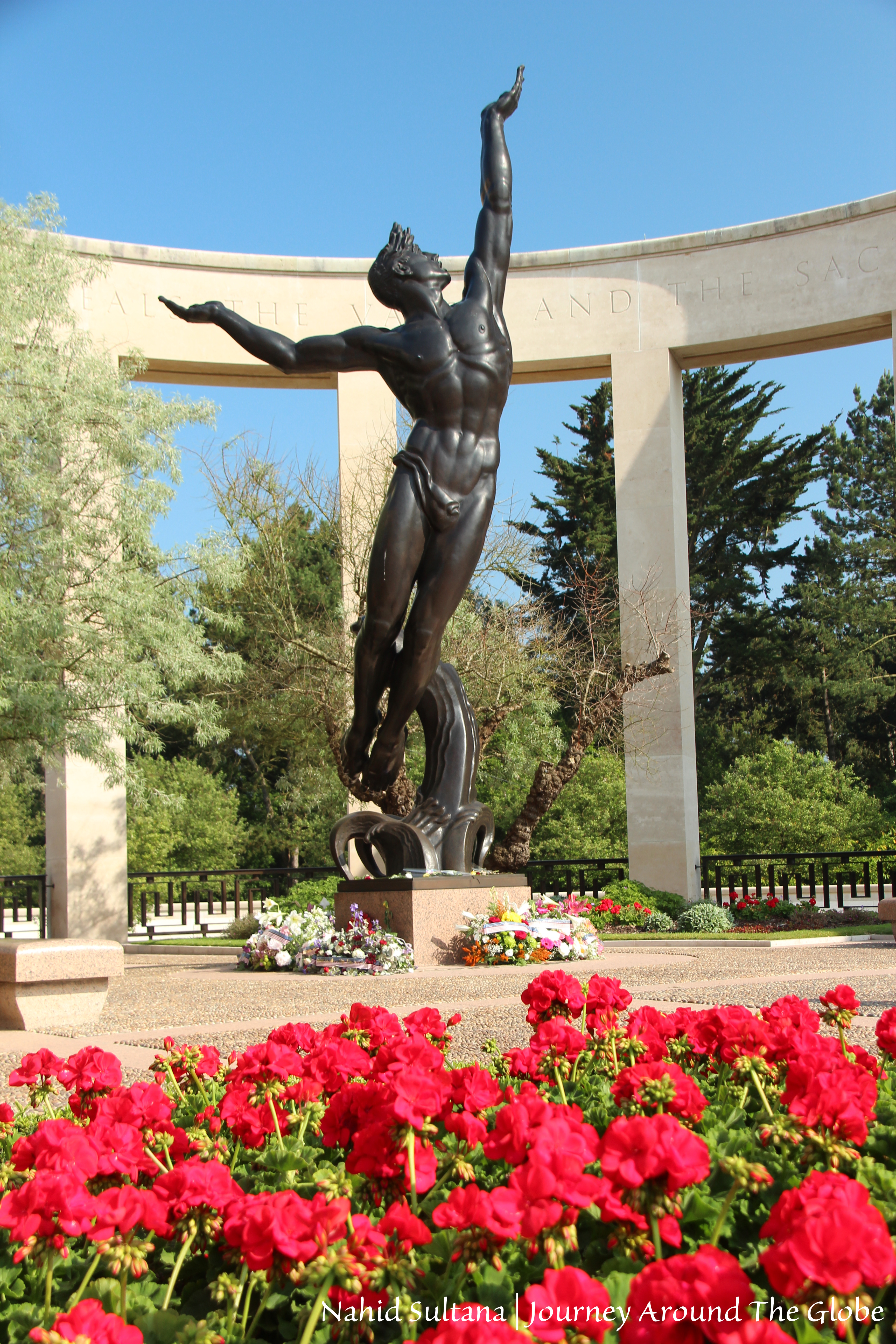
5) NORMANDY AMERICAN CEMETERY and MEMORIAL: This is a resting place for 9,387 US soldiers, most of whom lost their lives during the Normandy Campaign in WWII. There are 1,557 more names of missing soldiers in a garden of memorial. This is a place definitely brings your patriotism out and makes you feel proud for what our soldiers can do for humanity and justice.

- US soldiers in rest in American Cemetery of WWII in Omaha Beach, France

The cemetery overlooks Omaha Beach and there is a narrow passageway which leads down to the beach from the top. Take some time to stroll between the perfectly designed rows and aisles of these graves. I overheard someone saying Italian marble have been used for all the headstones of those graves. It’s a big open space with lush green lawn and unforgettable tranquility. A chapel, a Memorial, and a Garden of the Missing pay tribute to their memory. Families came from all over the world (especially U.S.A) to pay respect and tribute to these brave heroes.
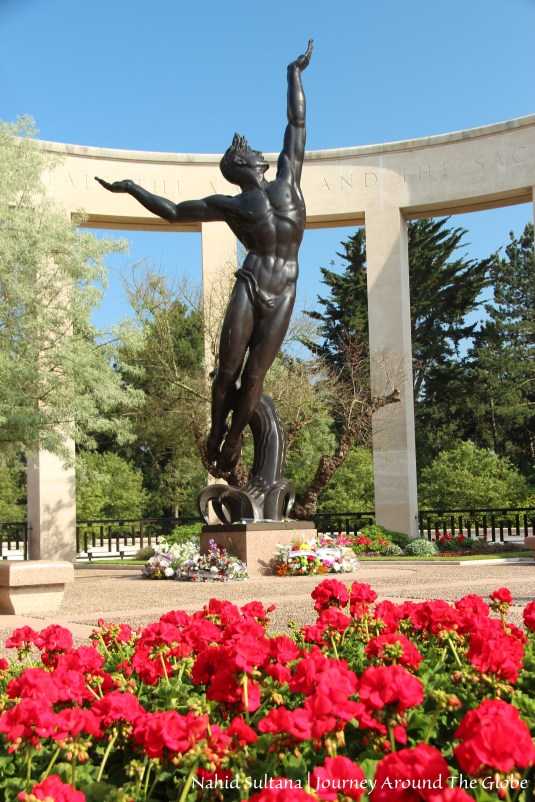
- A memorial for the US soldiers who fought heroically in D-day invasion during WWII – American Cemetery, Normandy, France
The cemetery closes at 6 pm and is free to enter. Museum in the cemetery has a fee but we didn’t go there. We spent about 1 ½ or 2 hours here at the end of our 1st day in Normandy.
6) MONT ST. MICHEL: The Island of Mont St. Michel is best known for its very well-preserved abbey of St. Michel at the peak of a rocky island. This is one of the most beautiful medieval islands with lots of twisty alleys and up and down passageways. The long history of Mont-Saint-Michel is thought to date back to 708 AD when a sanctuary was built in honor of the Archangel. Soon it became a major focus of pilgrimage and by the 10th century a village grew up below its walls. The Mont-Saint-Michel fortifications were gradually built between the 13th and 16th centuries to protect and defend the abbey and the village. Now it’s listed as a UNESCO World Heritage Site and attracts more people than the Eiffel Tower of Paris, making it the number one visited landmark in France.

- Pyramidal shape of Mont St. Michel from afar in Normandy, France
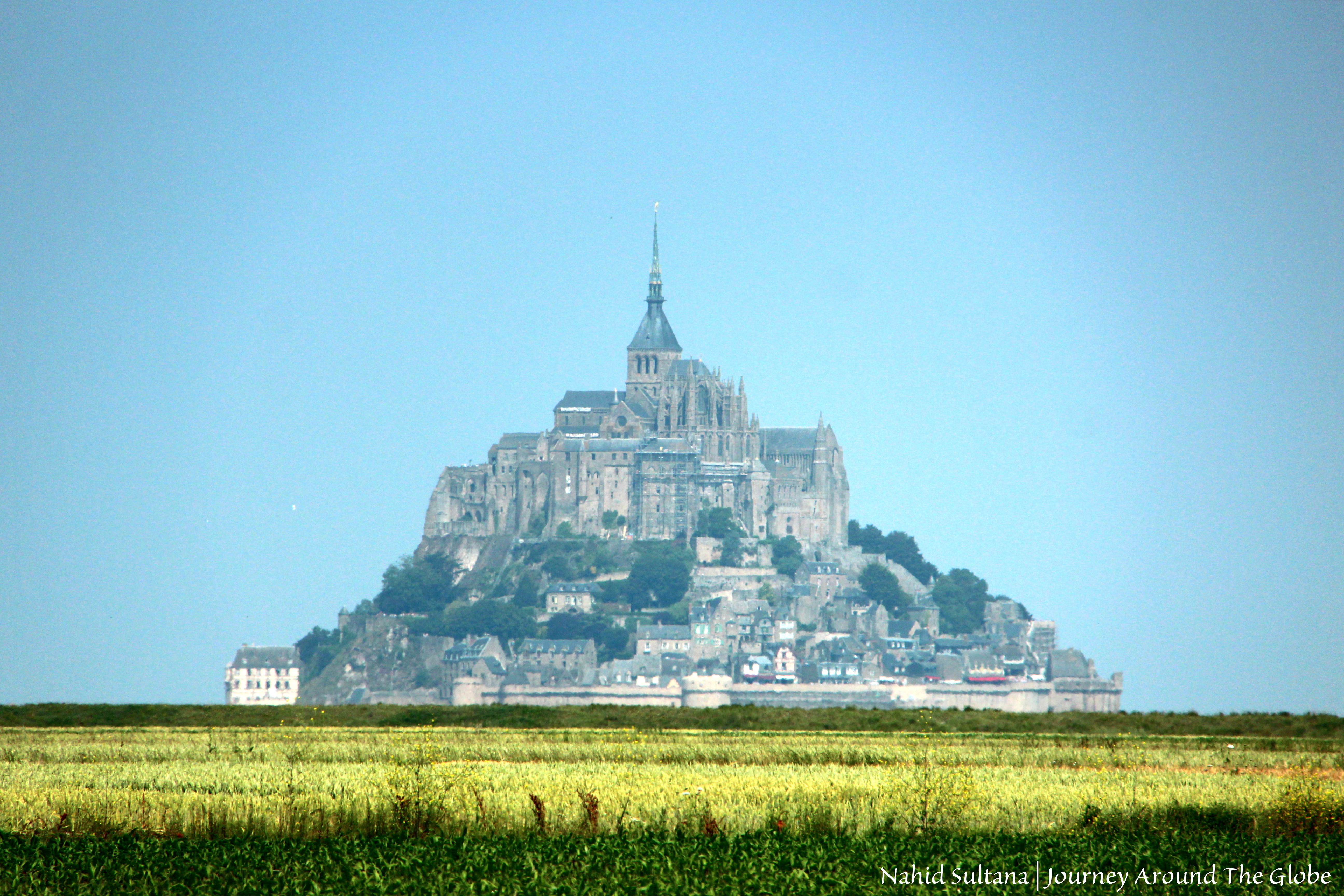
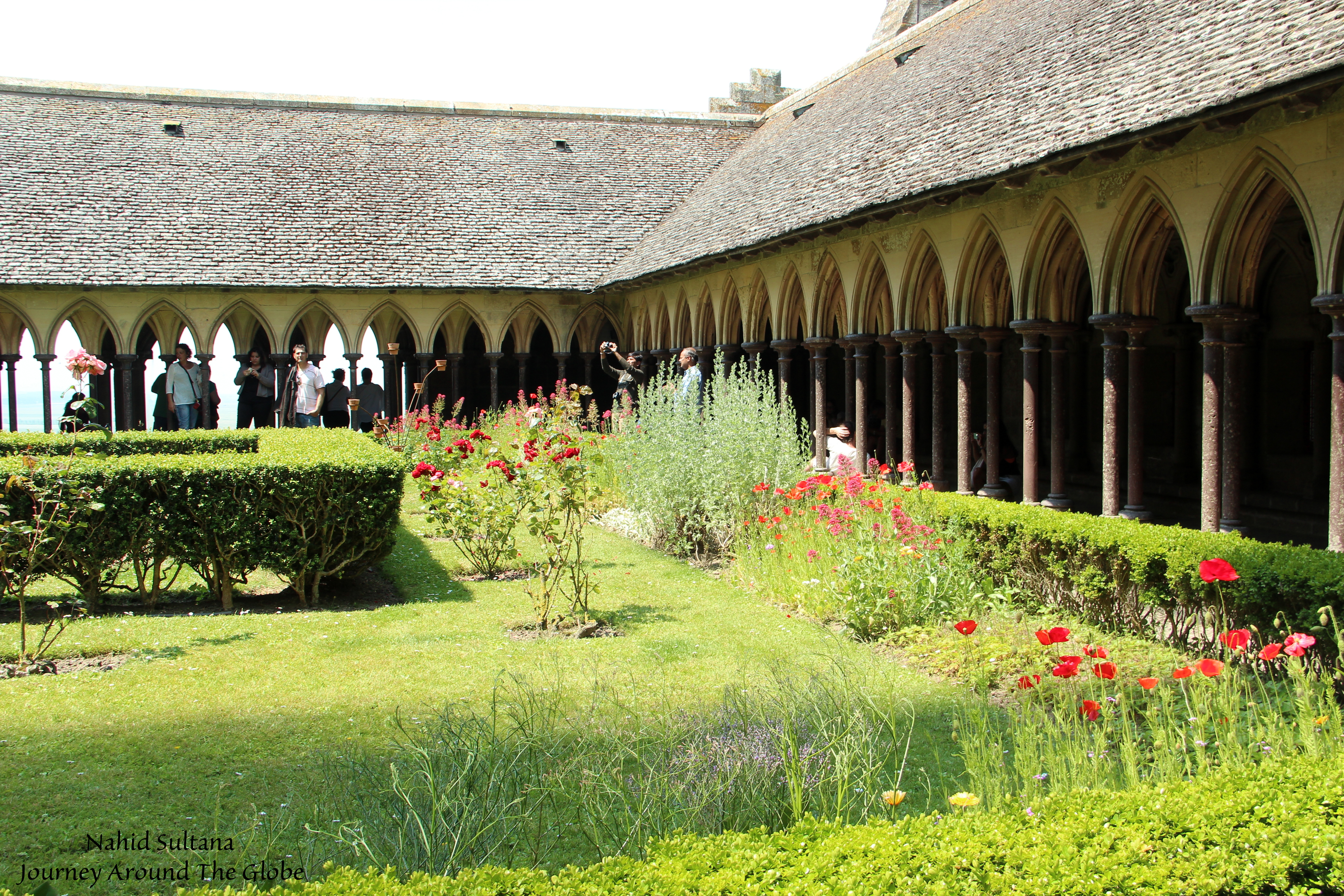
The abbey of Mont-Saint-Michel is a unique building. Constrained by the pyramidal shape of the Mount, its medieval builders wrapped the buildings around the granite rock. It was used as prison during the French Revolution. The abbey church is big but simple and is situated at the top. Follow the signs and walk around the enormous abbey to explore its cloister, terraces, big halls, crypt, and chapels. Be amazed by the old walls, floors, ceilings, and doors. The spire of the abbey stand between sky and sea, crowned with the statue of the archangel. Be ready to climb many steps to go up to abbey.

- Cloister of the abbey in Mont St. Michel in Normandy, France
There is no water surrounding the island during low-tide. But when the water is high, it’s advisable to take the shuttle bus instead of trying to reach the island any other way. There are many quicksand and deep mud holes where unwanted events happened in the past. It’s better to take an experienced guide or check the tide tables.
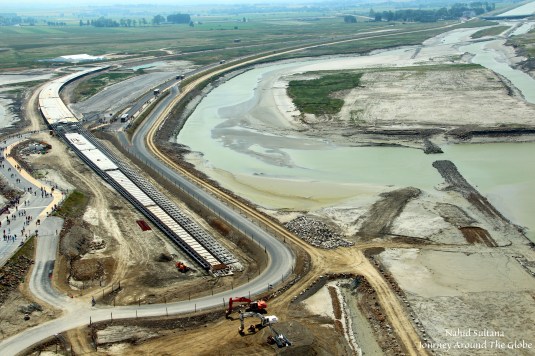
- Surrounding the abbey of Mont St. Michel in Normandy, France
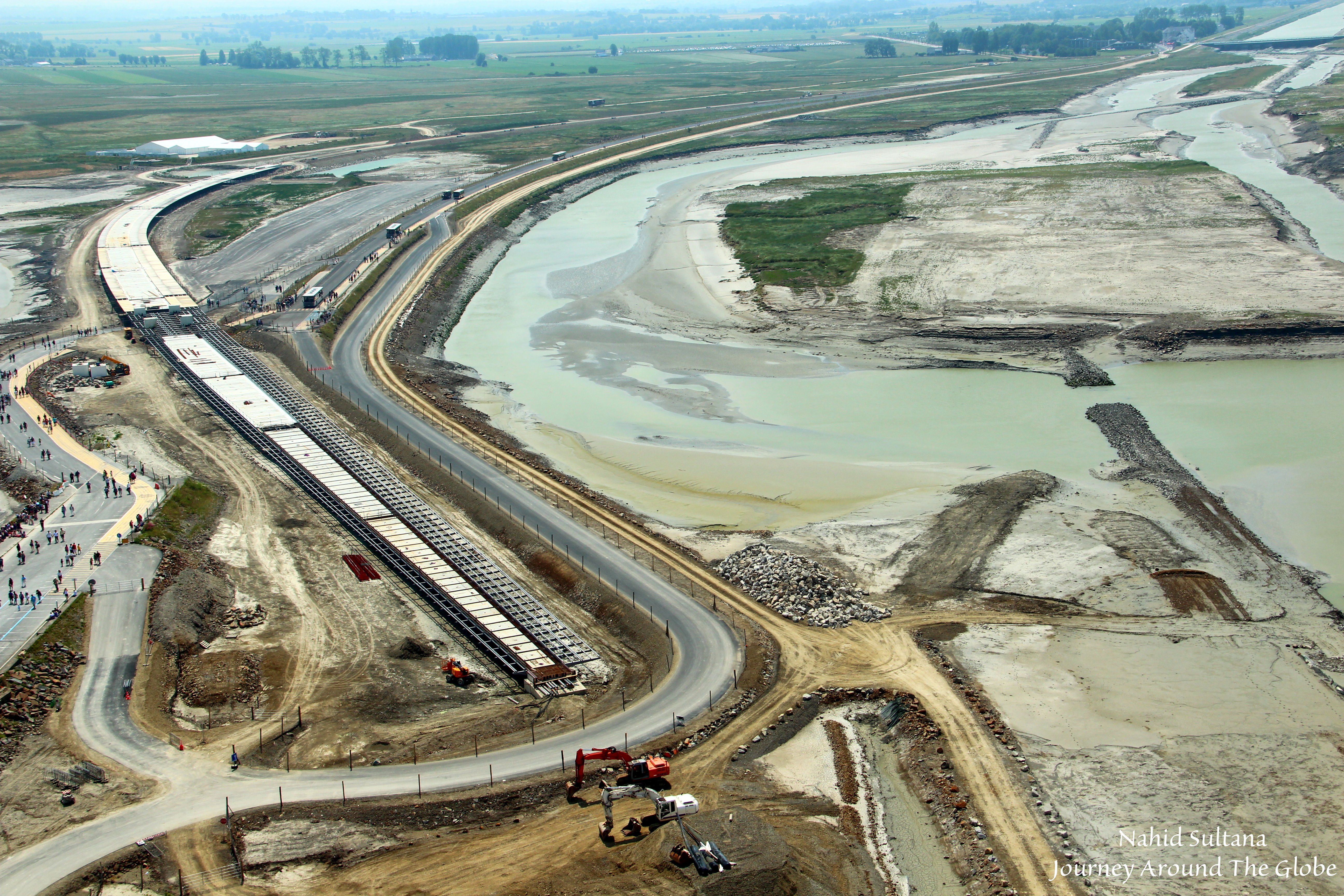
Mont St. Michel was about 1 ½ hours of drive from Bayeux and is located in Lower Normandy. It’s about 10-15 minutes of walk to the entrance after shuttle drops you off. Plan to spend at least half a day or more in the island of Mont St. Michel. The abbey is open from May 2nd to August 31st: 9am – 7pm and from September 1st to April 30th: 9:30am – 6pm. There is a paid parking but the shuttle bus that will take you to the island is free for the visitors. Food on the island can be very expensive. Visitors can pick up some food where shuttle picks you up from near the parking ground. There is also a horse driven carriage you can take to and from the parking lot which will cost 5 Euros per adult each way.
7) BAYEAUX CATHEDRAL and CITY CENTER: Our original plan, after visiting Mont St. Michel, was to go to Etretat to see its cliffs and rocks. But since we started the day a bit late and spent more time in Mont St. Michel than expected, we had to cancel Etretat. Instead we came to Bayeux to spend time here. Bayeux was the first French town to be liberated from the Nazis. It has some WWII D-day museums and memorials along with the largest British war cemetery in Normandy. Another reason tourist usually come here is to see the famous Bayeux Tapestry and its museum.
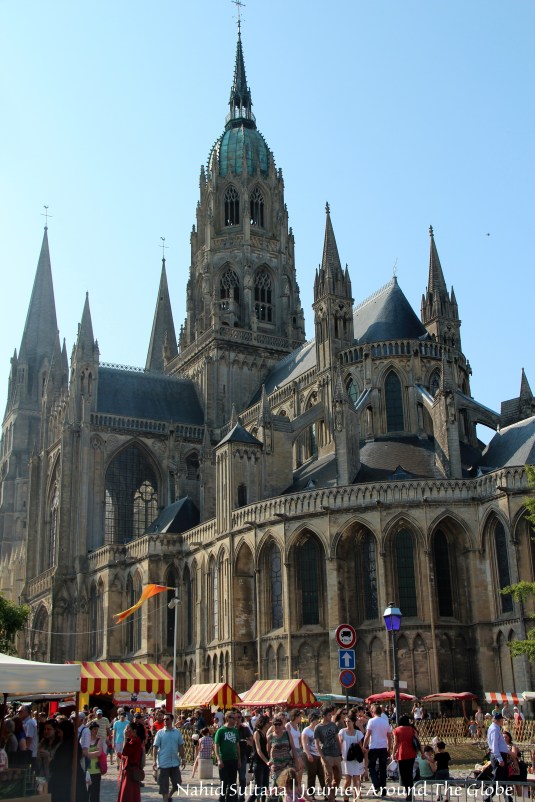
- Bayeux Cathedral in Bayeux, France
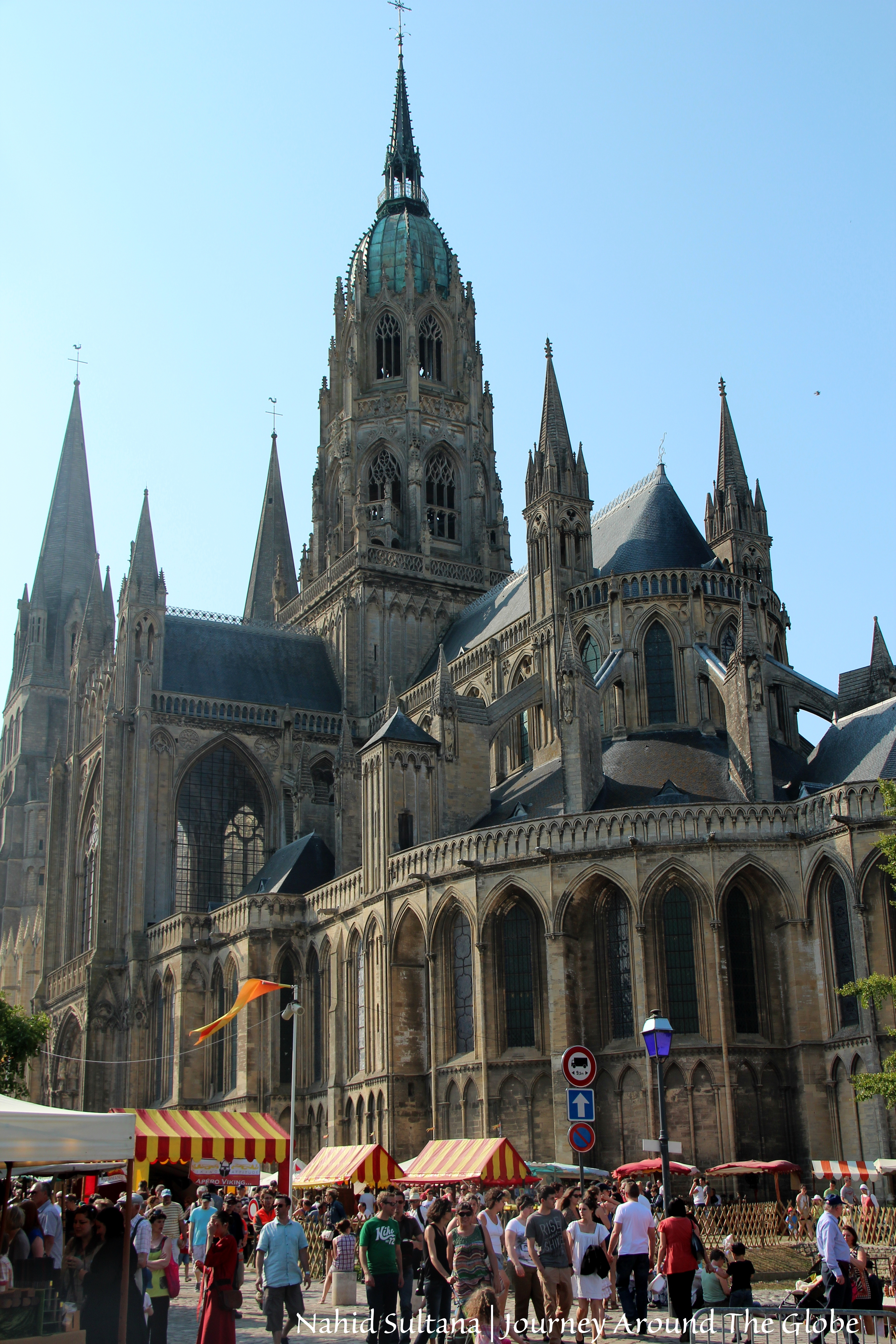
There was a big festival going on the weekend we visited Normandy, called “Medieval Bayeux”. We never went to any Renaissance or Medieval festivals, so this was a great fun for all of us. The festival took place around Bayeux Cathedral in the city center. This Norman-Romanesque cathedral as constructed in 1077 in the presence of William the Conqueror – Duke of Normand and King of England. The edifice now is a national monument in France. It looms over the entire town and its grandness can be seen from afar. It has a gorgeous altar, an empty crypt, some excellent murals, rich stained-glass windows, and very decorative interior. Outside structure of the cathedral is very dignified too with striking masonry. It’s free to go inside and definitely worth a visit.
8) GIVERNY MONET HOUSE and GARDEN: Giverny is a small French village only less than 60 miles drive south from Paris. This is a very pretty place with artistic houses and surroundings decorated with green plants and colorful flowers. The village of Giverny, also known as “Cradle of Impressionism” became well-known for the famous impressionist painter Claude Monet. He lived, painted some of his best paintings, and died in 1926 in Giverny.
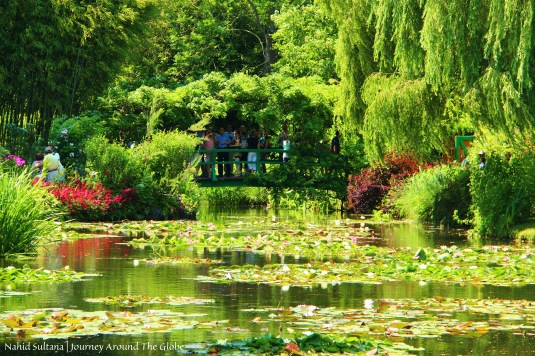
- Impressionist Claude Monet’s iconic garden in Giverny, France
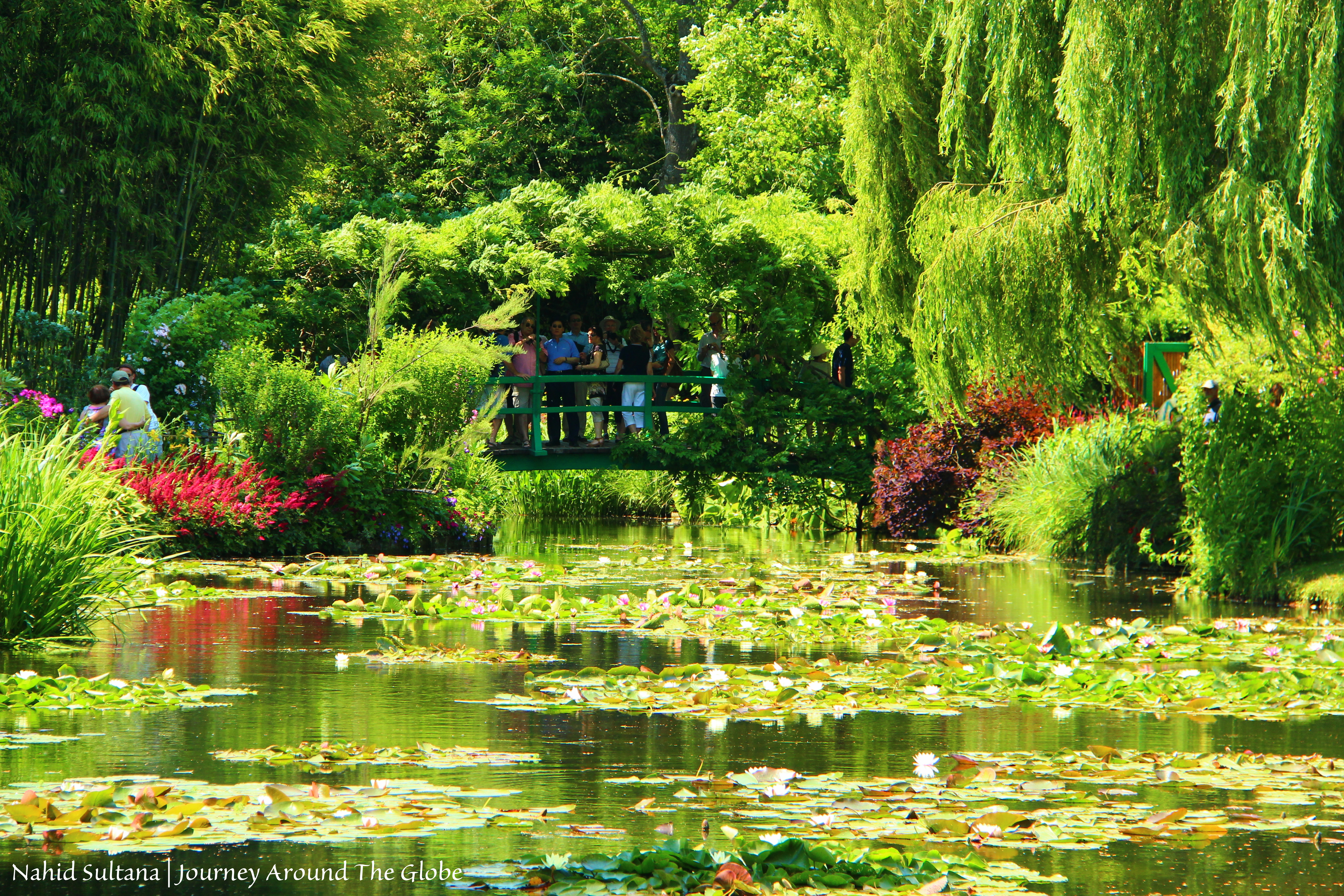
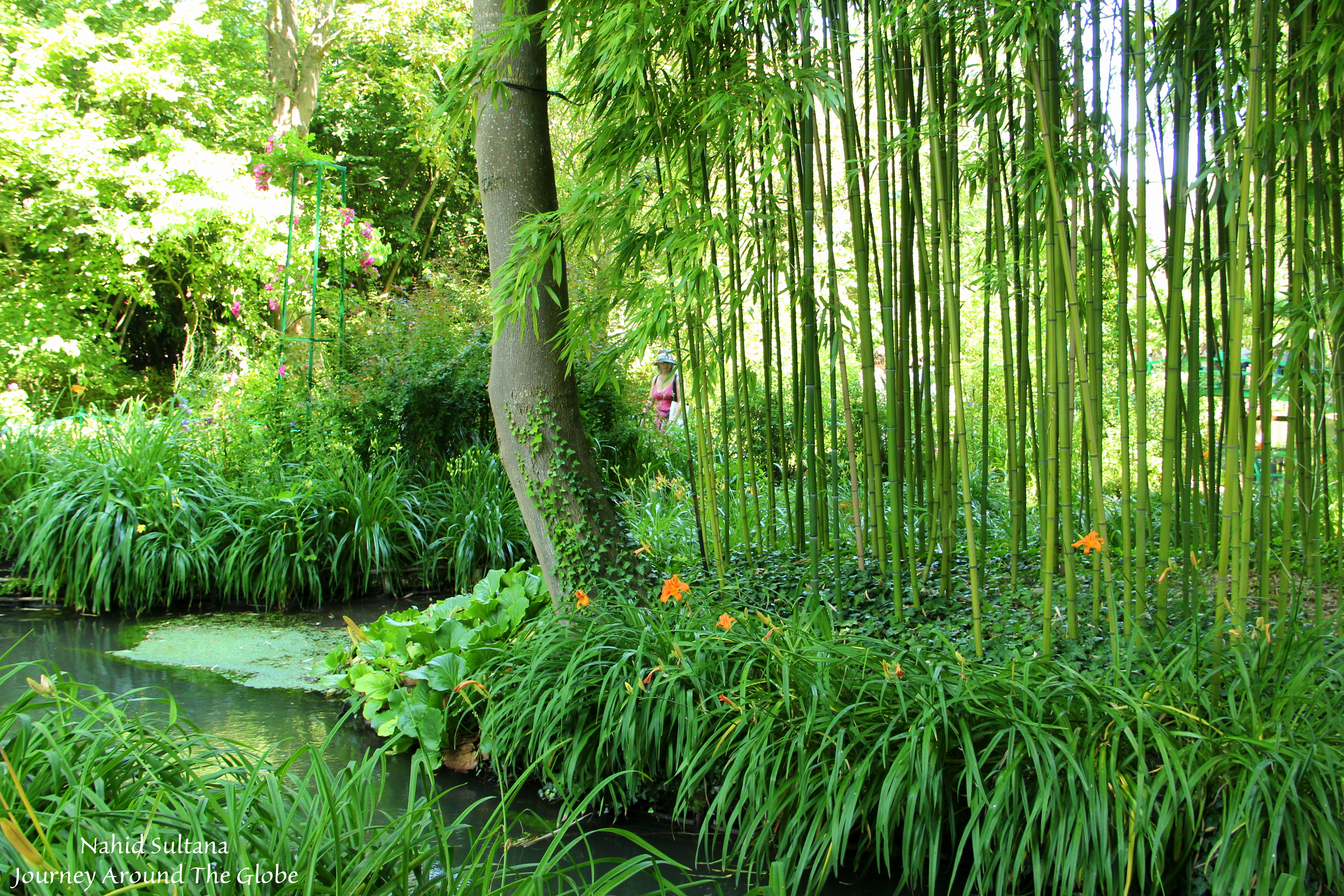
Garden surrounding the house where Monet moved in during late 19th century is what inspired him with his works. Many of his paintings were influenced by the weeping willows and water-lily pond of this garden along with one famous painting that include “Japanese Bridge” in the backdrop. Tourists can see all these subject matters that once inspired this famous artist in this Monet Village. People don’t want to miss the chance of standing on that “Japanese Bridge” of this garden. Come early if you want to avoid the crowd and like taking pictures without too many people in the background.

- Claude Monet’s garden and village in Giverny, France
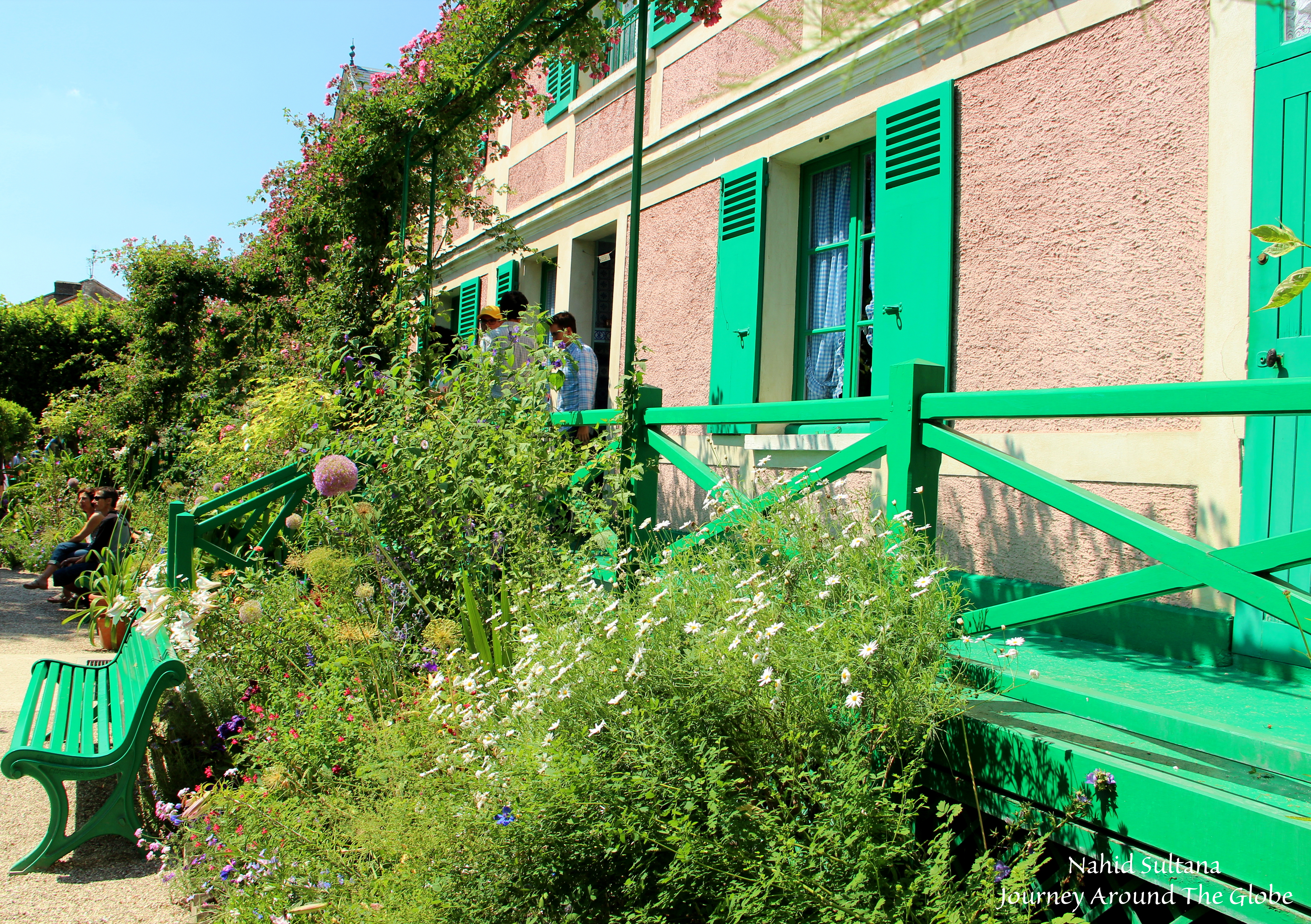
Monet’s house is located on the other side of the garden with a view of a big garden in the front. Walking around the garden gives you a splash of colors in your eyes. The house has lots of paintings of Monet (none original whatsoever) including his big collection of oriental style copies. His bedroom where he took his last breath in 5th December 1926 is also in display for the publics along with other parts of the house.

- Monet’s house in Giverny, France
It took us about little more than 2 hours from Bayeux to get to the garden. It’s located in Upper Normandy. The garden is open daily from 9:30 to 6 pm and the address is 84 Rue Claude Monet, Giverny, France. Entry fee for adults is 9:50 euros and free for kids under 5 years. There are more than one free parking grounds for the garden visitors.
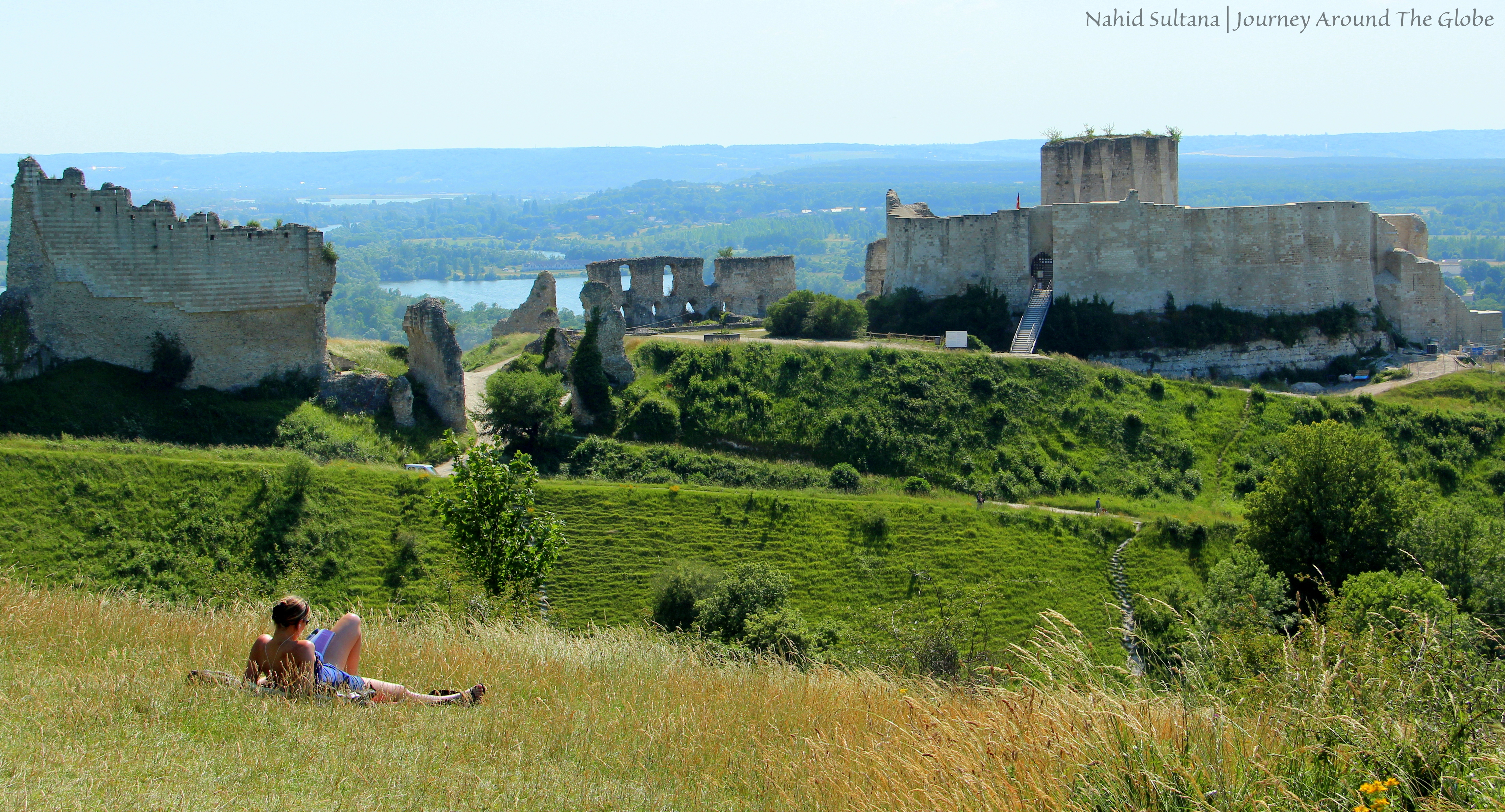
9) CHÂTEAU GAILLARD: This was our last stop in Normandy. Château Gaillard was constructed in 1196 by Richard the Lion heart, who was the King of England as well as Duke of Normandy at that time. It was a symbol of not only a modern military structure for that age but also a symbol of power of Richard the Lion heart. The location of it is very scenic, overlooking River Seine. The fortress is in ruins now. Remains of the keep and some towers can still be seen here. From a distance, we could only see the skeleton with old walls and the towers.
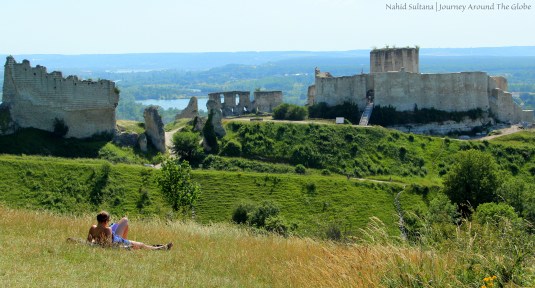
- Ruins of Chateau Gaillard in Normandy, France
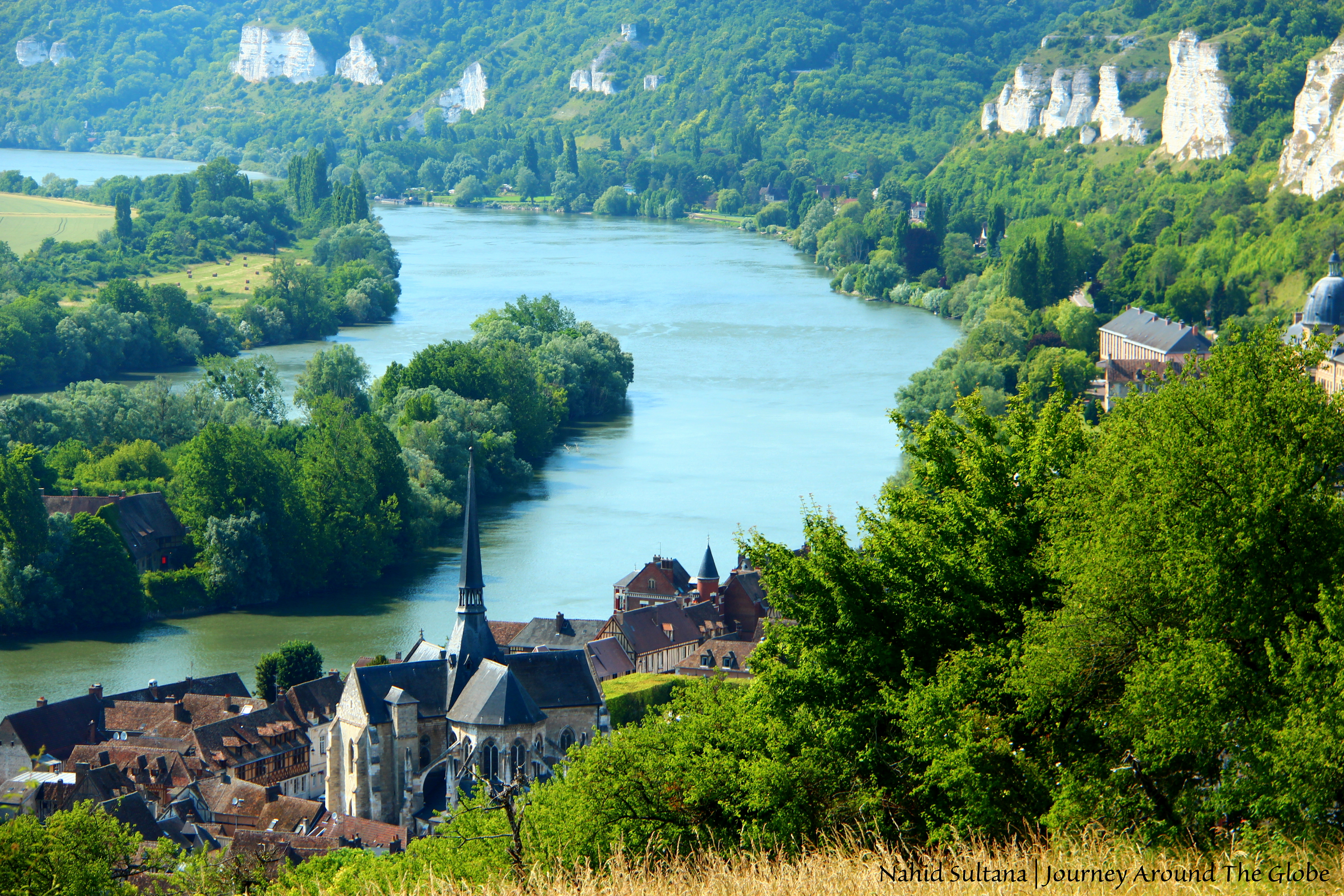
Château Gaillard is located in Upper Normandy in the commune of Les Andelys, within 60 miles from Paris. It took us about less than half an hour to drive here from Giverny Monet Garden which is 20 miles away. We didn’t go very close to it, just observed it from a view-point where you can see the ruins, River Seine, and surroundings. It was absolutely a breathtaking view.
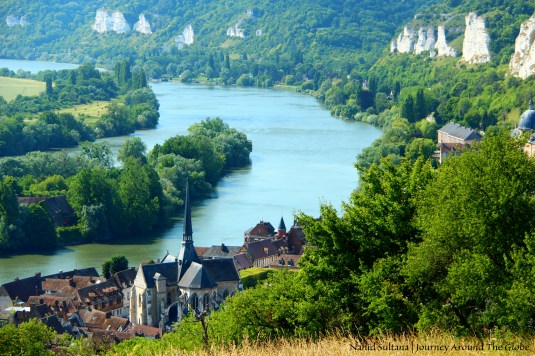
- River Siene and surround near Chateau Gaillard in Normandy, France
Address of this fortress is 8 Avenue de la Republique, 2770 Andelys (Les), France. The lower court is open all year round and upper court is open every from April to the beginning of November except on Tuesday and 1st May. Opening times: from 10am – 1pm and from 2pm – 6pm. Entrance fee is 3:20 euros per adult.
Related articles
- Bayeux Day 3 (7/11/13): Normandy Beach Tour! (hasbrookeurotrip.wordpress.com)
- Normandy Musings – Unexpected and Long to Linger (earlbrussell.wordpress.com)
- Utah Beach: Summary (normandyddayblog.wordpress.com)
- Normandy (bhoover64.wordpress.com)
Share this:

Day trip to Sintra, Portugal
SINTRA, PORTUGAL: Sintra is only 25 km from Lisbon and a historically significant town of Portugal. The whole town is listed as UNESCO World Heritage Site for its cultural significance and outstanding natural beauty. The majestic Sintra Mountains and scattered palaces on hills put a mysterious veil over this town. There are total 4 palaces, and 1 castle in Sintra, among which Moorish Castle and Pena Palace are the most notable and visited ones.
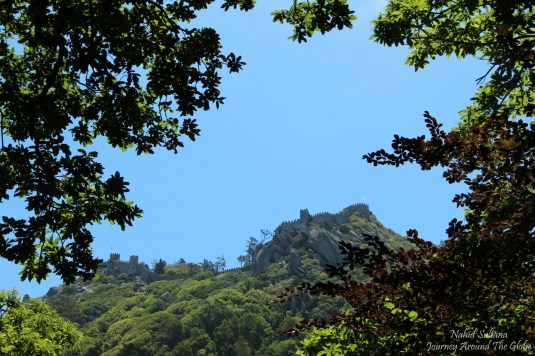
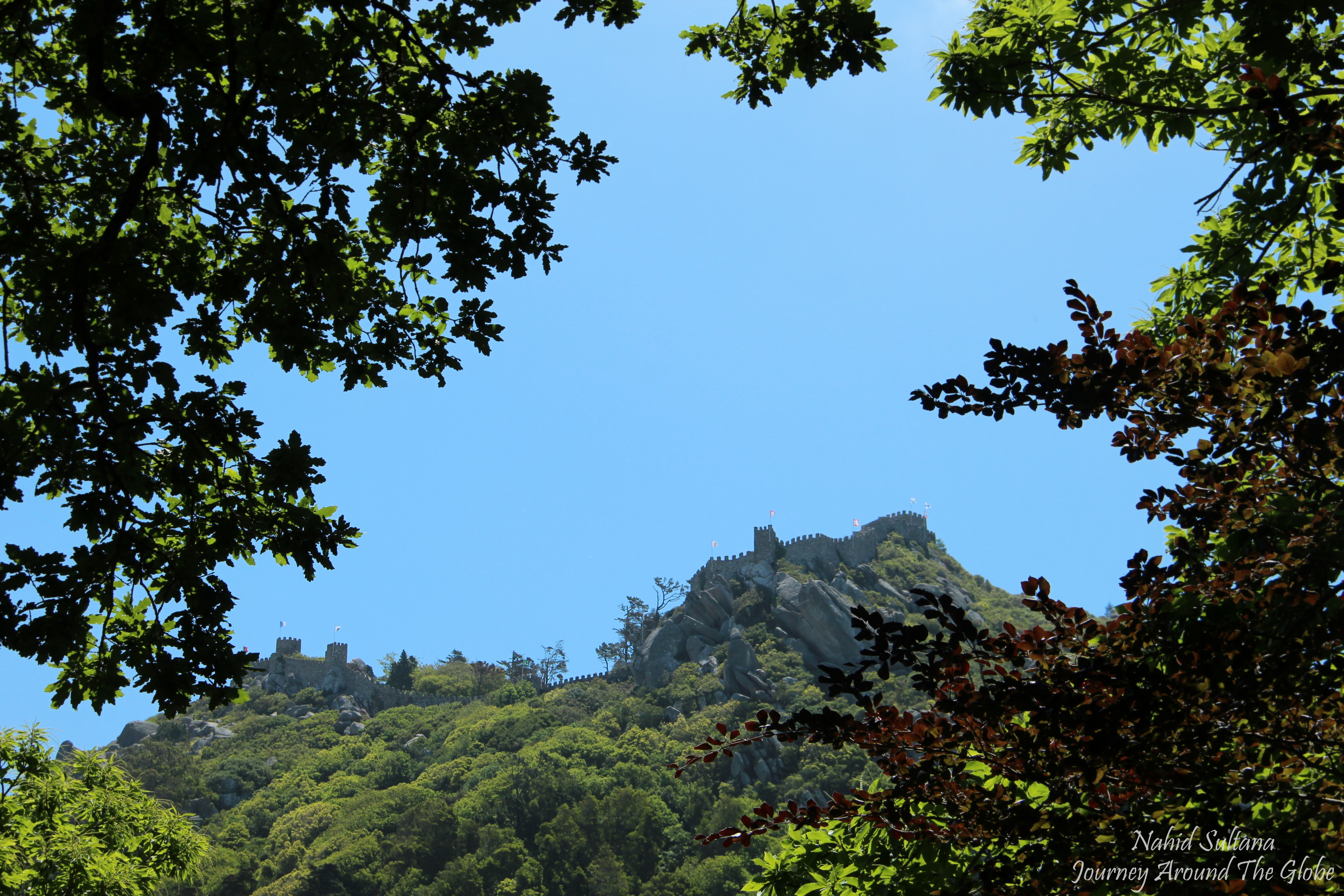
- One of the gems of Sintra, Portugal – Moorish Castle as seen from Quinta de Regaleira
Coming to Sintra using public transportation is not recommended because they won’t take you to the castles on the mountains and walking can be very hard too. You can drive there if you have your own transportation but finding it may be a bit hard. We booked this tour to Sintra through our hotel in Lisbon. The tour company’s name is “Mr. Friend” (telephone # 218954083 and website is www.mrfriend.pt). We were charged 58 euros per adult excluding my 3 years old. I was thinking of more like a big bus with a big group that will take us to Sintra. But a small van showed up in front of our hotel at 9 am sharp. There was only another young enthusiastic couple (from Belgrade, Serbia) with us in this tour making it more like a semi-private tour. It was cozy and good thing was we had some flexibilities unlike usual tour companies where you go with a big group and you have no option where to eat, when to eat, and etc.
TIME of TRAVEL: We flew to Lisbon in mid-June 2013 when my little sister was visiting us from Virginia, USA. The weather was extremely favorable the day we took Sintra trip. It was a perfect summer day to spend outdoors and by the beach; it wasn’t hot, but very pleasant.
OUR HOTEL: We stayed in Hotel DAH (Dom Afonso Henrique) in Lisbon. It’s not in the city center, but very close to metro station that takes you right there in a short time. We had free Wi-Fi in the room and nice breakfast on the roof terrace every morning. There was also a great Italian restaurant “Pepe & Oliva” only one block away from the hotel where we ended up having 3 dinners in a row…yummy food for a very low price.
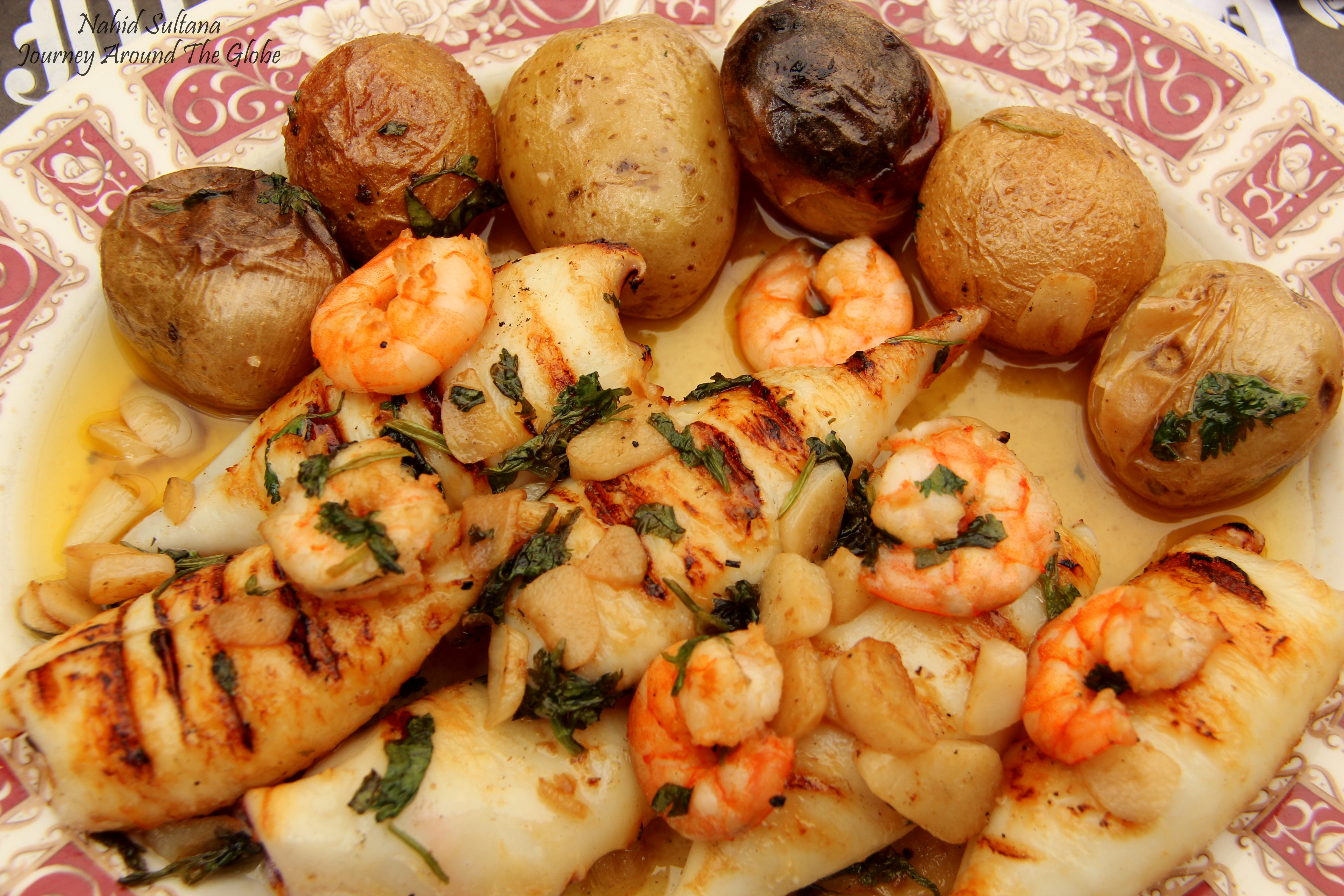
EATING and SHOPPING: When our tour guide asked us where we wanted to have lunch: center of Sintra or Cascais, which is a beach town…we chose Cascais without pausing for a second. Seriously, thank God we made that choice. There are plenty of restaurants in the center of Cascais that serve some of the best seafood dishes you’ve ever had. We picked “John Bull”…about a block away from the beach and very close to the center. As I mentioned in my previous post on Lisbon, that Portugal is known for its seafood feasts, especially sardines. But after having sardine in Lisbon, I was up for another fish items. So my sister and I ordered salmon and grilled squid with shrimps (2 separate dishes) with potatoes and some veges. Man, that squid was the best squid I had in my whole life…I can still feel that chewy delight in my mouth every now and then. The price for these dishes in Sintra, as well as in Lisbon, are very reasonable.

- My lunch in Cascais – grilled squids with shrimps
Cork made items, like post cards, bottles, are very popular in whole Portugal. Also, Portuguese think roosters bring good luck…so, you will find them everywhere too. There are many souvenir shops in Cascais center.
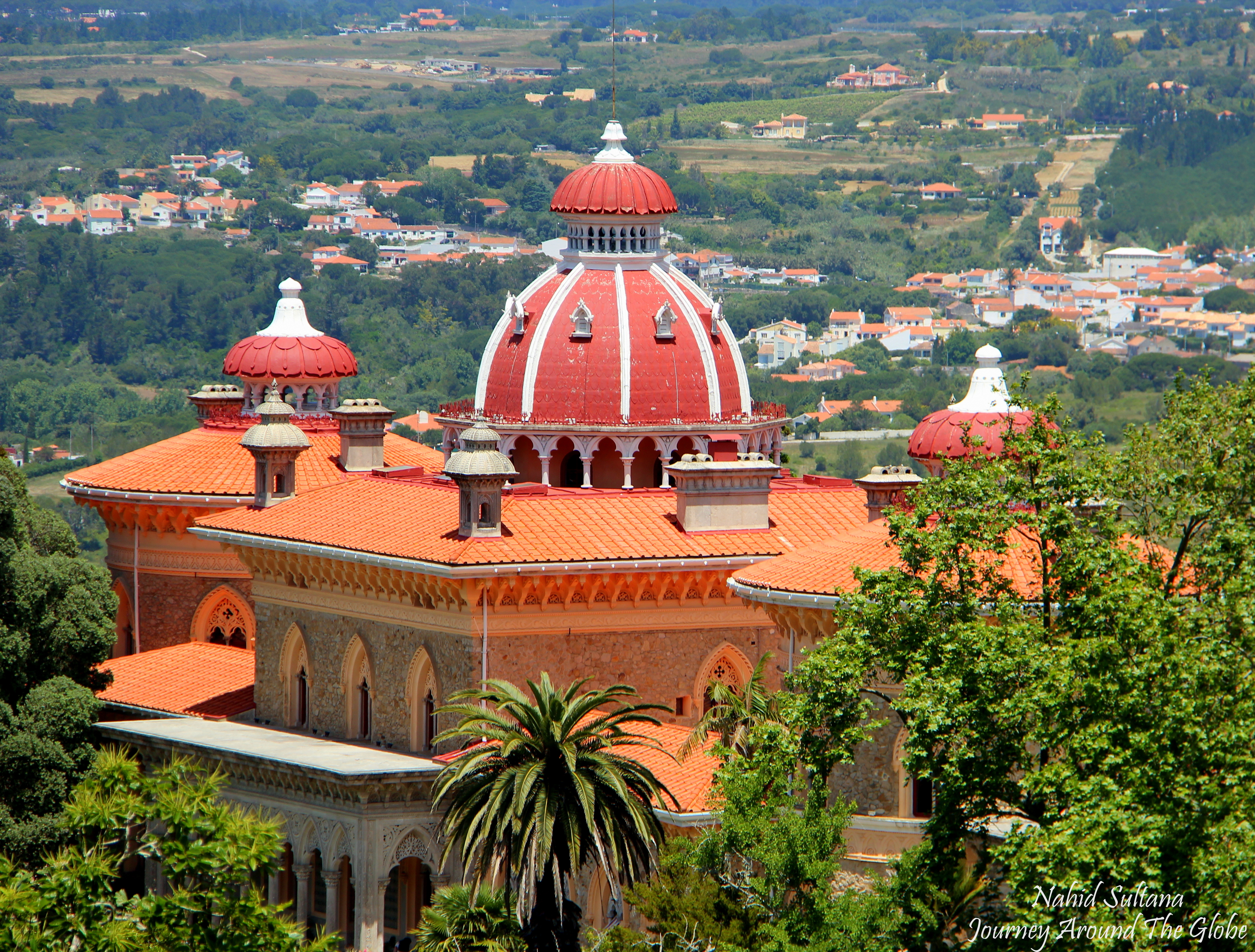
PLACES WE’VE VISITED: Sintra city center is a place which we passed by but didn’t stop. Sintra National Palace, a former royal palace with captivating architecture, is probably the main attraction here. Also look for “Hotel Lawrence” in Sintra which is almost 250 years old making it the oldest active hotel in Europe.

- Monserrate Palace on a hill of Sintra in Portugal
1) PENA PALACE: This was the first stop of our day-trip and probably one of the most romantic palaces I’ve seen so far. Sintra Hills and Pena Palace were listed as UNESCO World Heritage Site in 1995. The Park and Palace of Pena are the finest examples of 19th century Portuguese Romanticism and the integration of natural and architectural heritage. It is considered as the most important part of Cultural Landscape of Sintra. This is a quintessentially romantic palace filled with art works and souvenirs of royalty.

- A half-man, half-fish figure on the main façade of Pena Palace in Sintra, Portugal
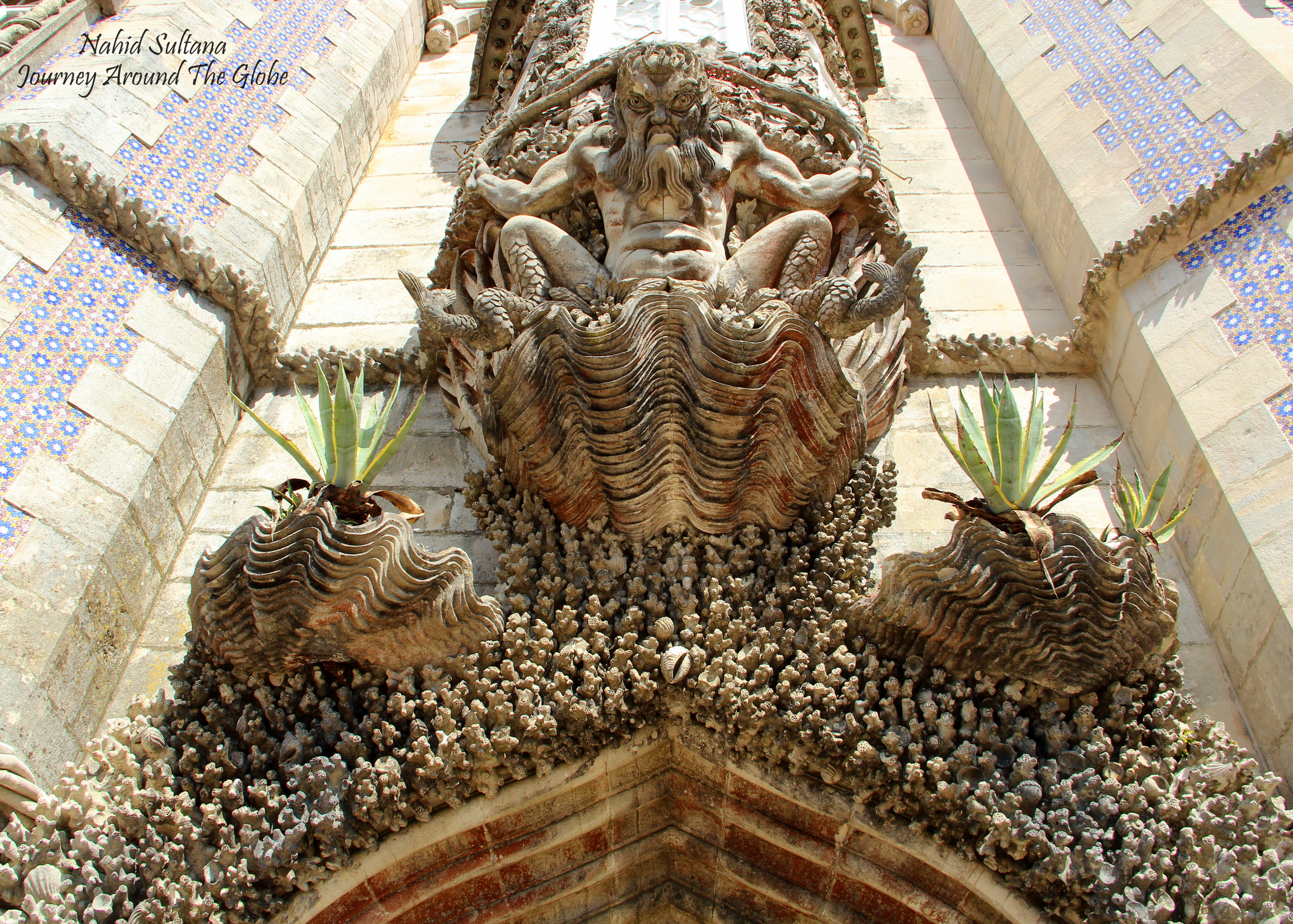
Main façade of the castle is decorated with geometric patterned Moorish-style tiles and the main allegorical gateway has an image of Triton with half-man and half-fish figure. Dominating watch towers were built in various shapes, sizes, and colors making it look like a Disney fairy-tale castle. The minaret of turret has a Moorish dome giving the whole place an Arab/Middle-Eastern touch. The whole architecture and its nearby hills can be best observed and appreciated from Queen’s Terrace. The chapel here is probably the oldest foundation of this place dating back to the 12th century.

- Breathtaking location of Pena Palace in Sintra, Portugal…as we saw it from Queen’s terrace
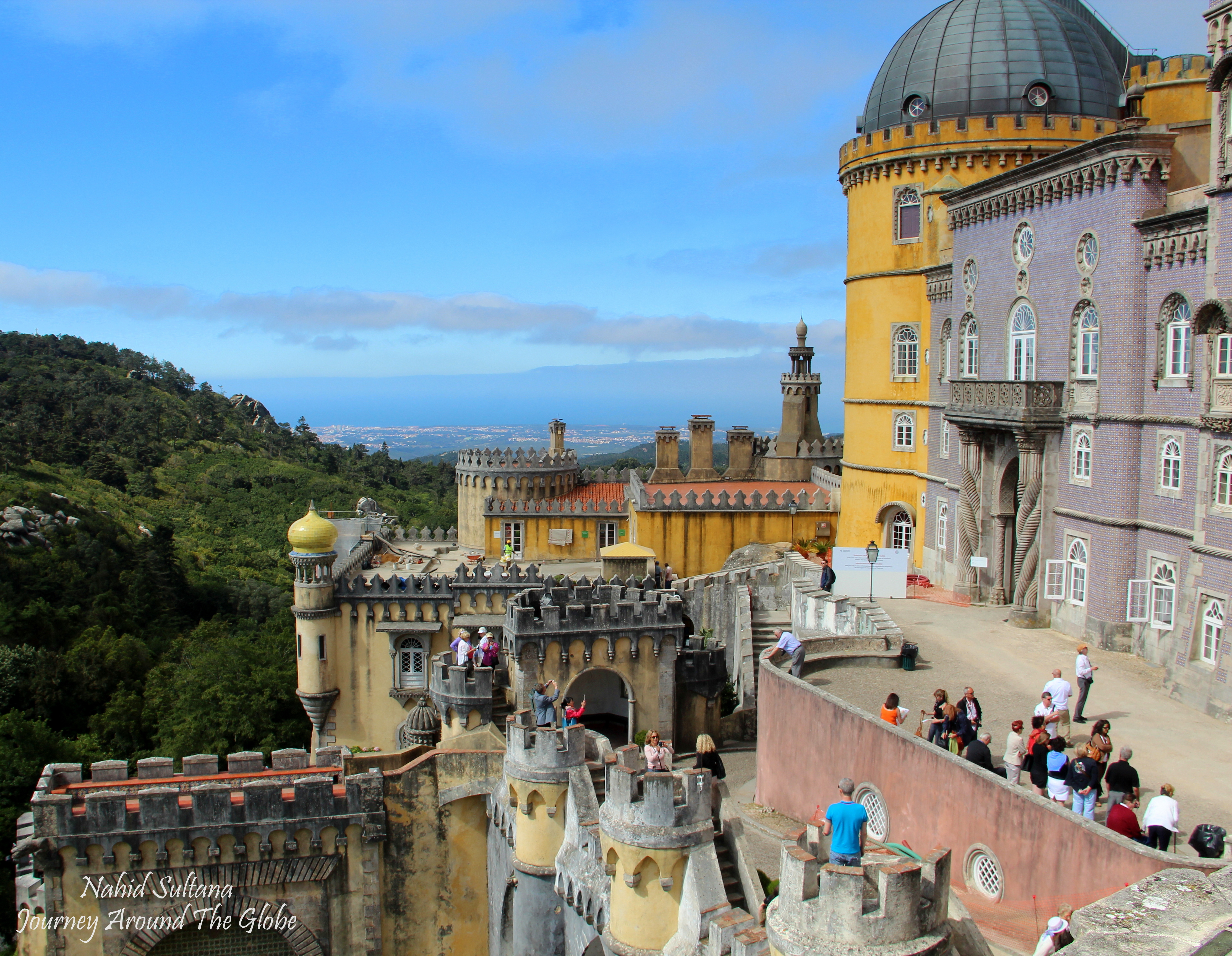
We had about little more than 2 hours for Pena Palace and could have used little more time enjoying its extraordinary beautiful landscape and surroundings. It is 13.50 euros per adult and 11 for children under 18 years of age. The park is open from 9:30 am – 8 pm but the palace is open from 9:45 am – 7 pm (last admission 45 minutes before closing time). This admission fees to Pena Palace was included with the tour price so the driver/guide got us the tickets beating the queue which was building up as we got there.

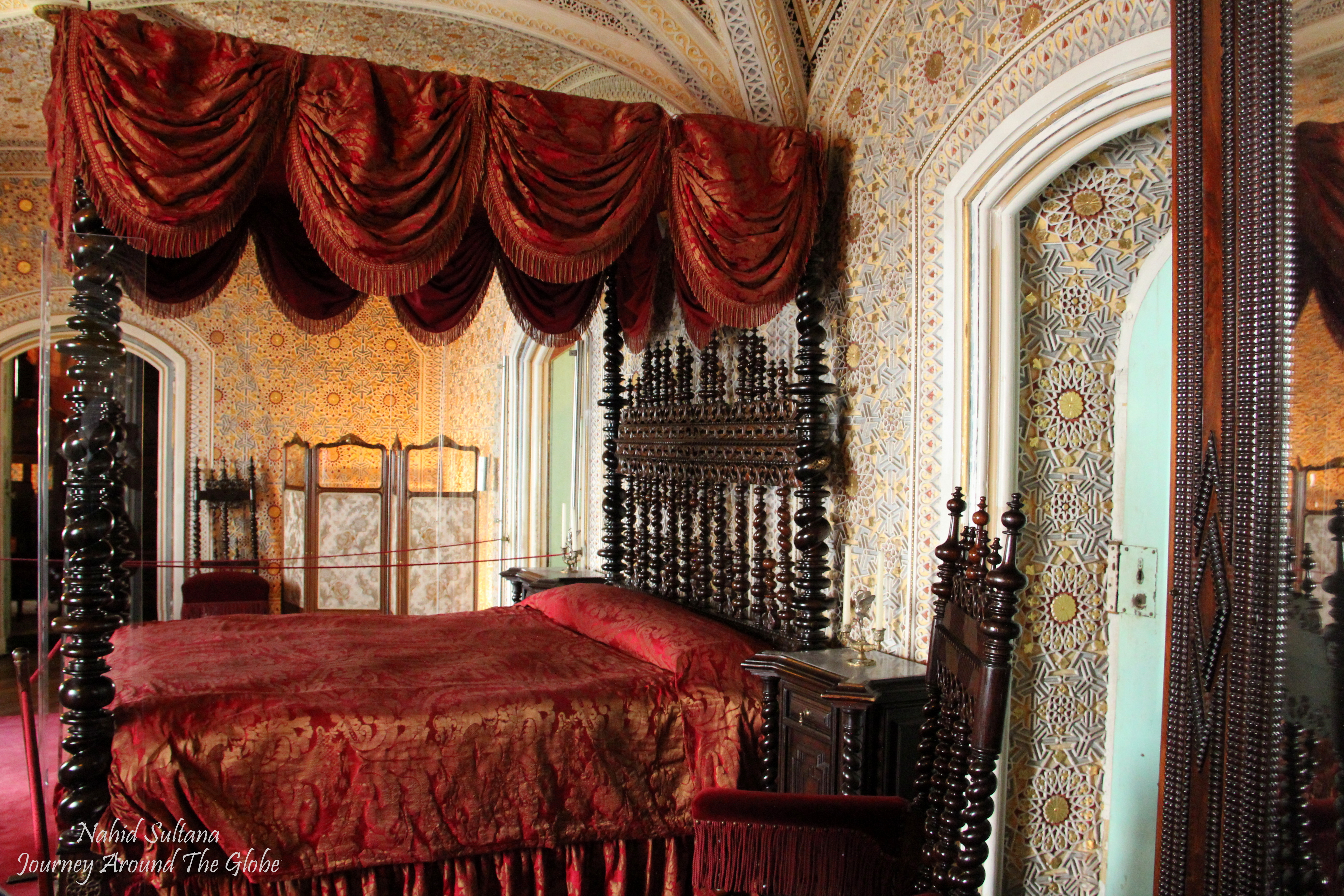
- Richly decorated queen’s bedroom in Pena Palace in Sintra, Portugal
2) QUINTA da REGALEIRA: By far, this is one of the best gardens I’ve visited in my little life. Quinta da Regaleira is considered as one of the most surprising and enigmatic landscape and a high point of Romantic Sintra. The garden is a magical and a mysterious place.
Historically, Quinta da Regaleira was the summer residence of Carvalho Monteiro family and was built in the neo-Manueline style. Portugal’s some of best artists were involved designing the palace and garden here. Among them, Luigi Manini is the most notable architect, painter, and designer who devoted 14 years of his life designing its park and palace.

- Regaleira Tower in Quinta de Regaleira in Sintra, Portugal
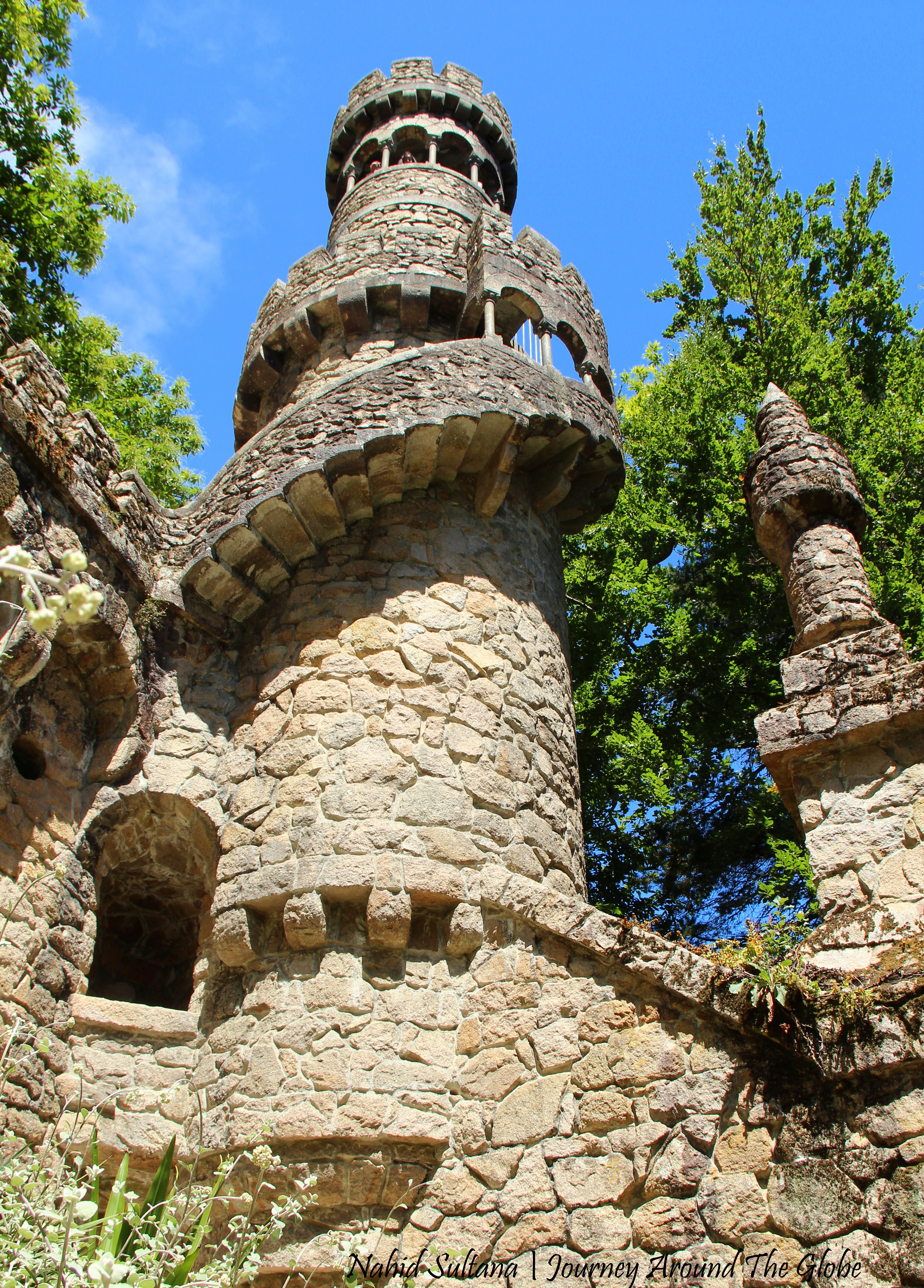
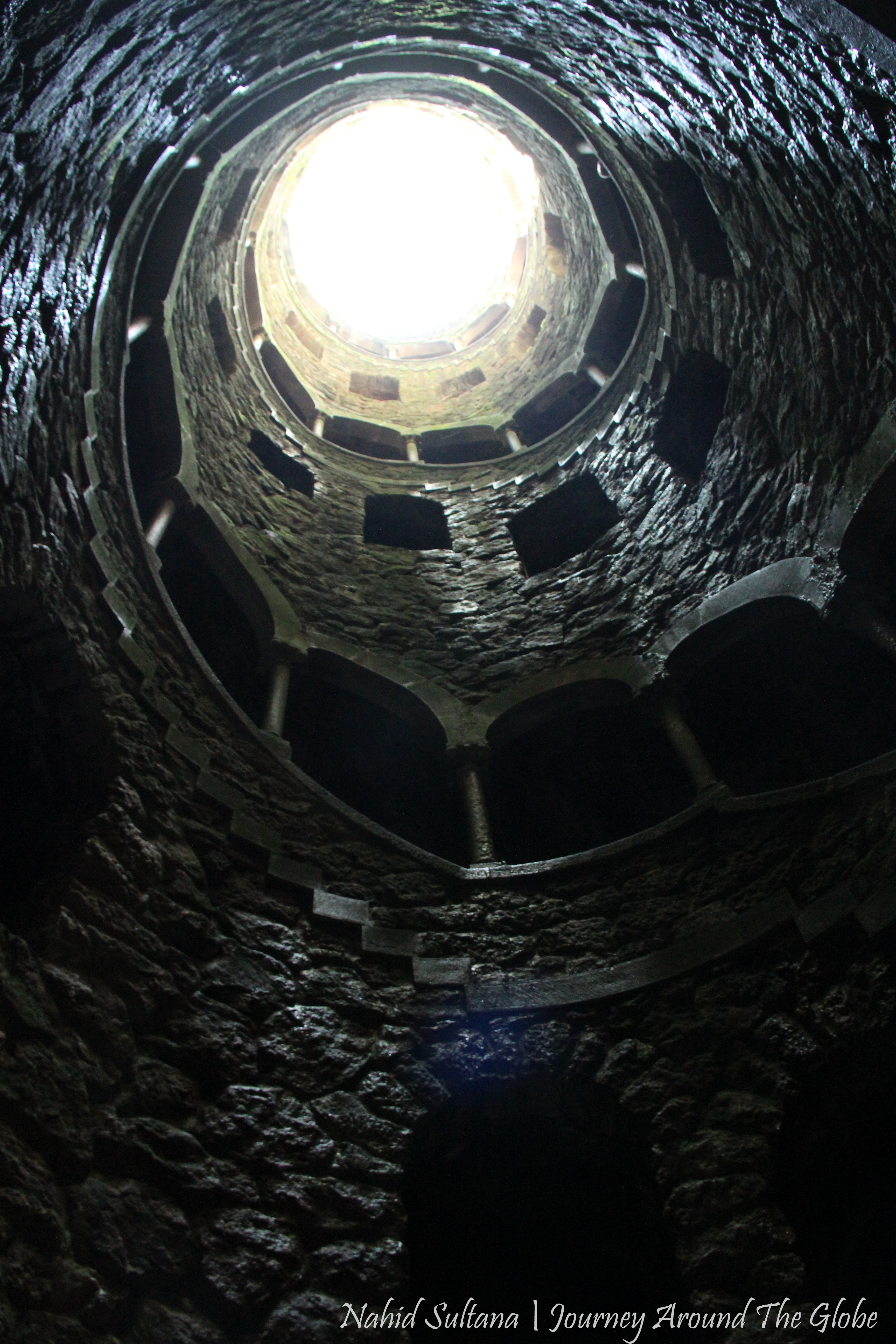
My favorite spot in the garden was the “Initiatic Well”. It’s a subterranean tower that sinks some 27 meters into the earth. Bottom of the tower is accessible by a monumental spiral stairway – a hallowed space with full of esoteric and alchemical look. This was built with local granites and symbolizes a bridge between earth and heaven. We went to the bottom of the tower, then followed a dark/wet underground tunnel to the outside garden again. It’s an exhilarating feeling being in this tower and not knowing where the underground walkway will take you to. “Regaleira Tower” is another little mind-boggling place where my sister and 7-years old daughter climbed up. The garden has countless mystical monuments like these all around…you just need time and lots of energy to explore its exotic secrets.
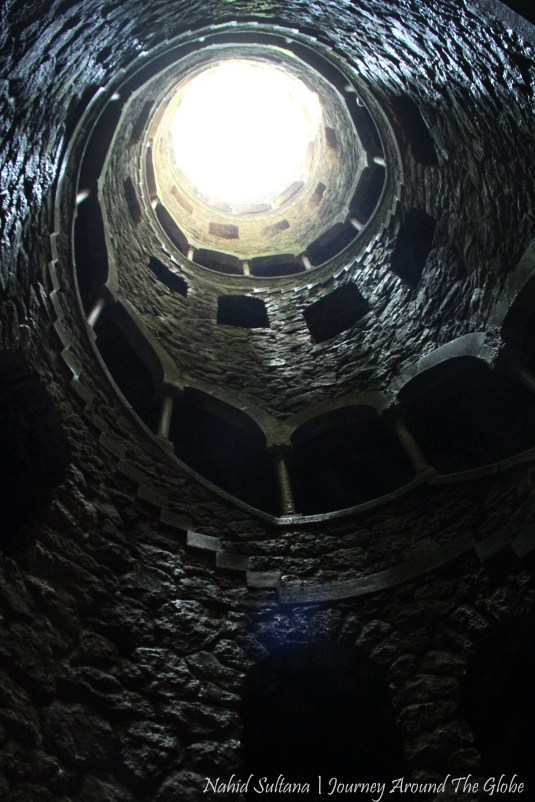
- From the bottom of Initiatic Well in Quinta de Regaleira in Sintra, Portugal
We were given about hour and half for this garden which was absolutely not enough. We left the garden without visiting “Promenade of the Gods” – supposed to be a beautiful avenue with statues of classical gods. If you don’t have time restriction you can easily spend couple hours getting lost in this huge grotto of secretes. You can take a self-guided tour with a map or take a guided visit during the opening hours. The park is open from 10am – 5:30 during winter and 10am – 8 pm in summer. Entry fee is 6 euros anyone over 18 years old and free below 9 years of age.
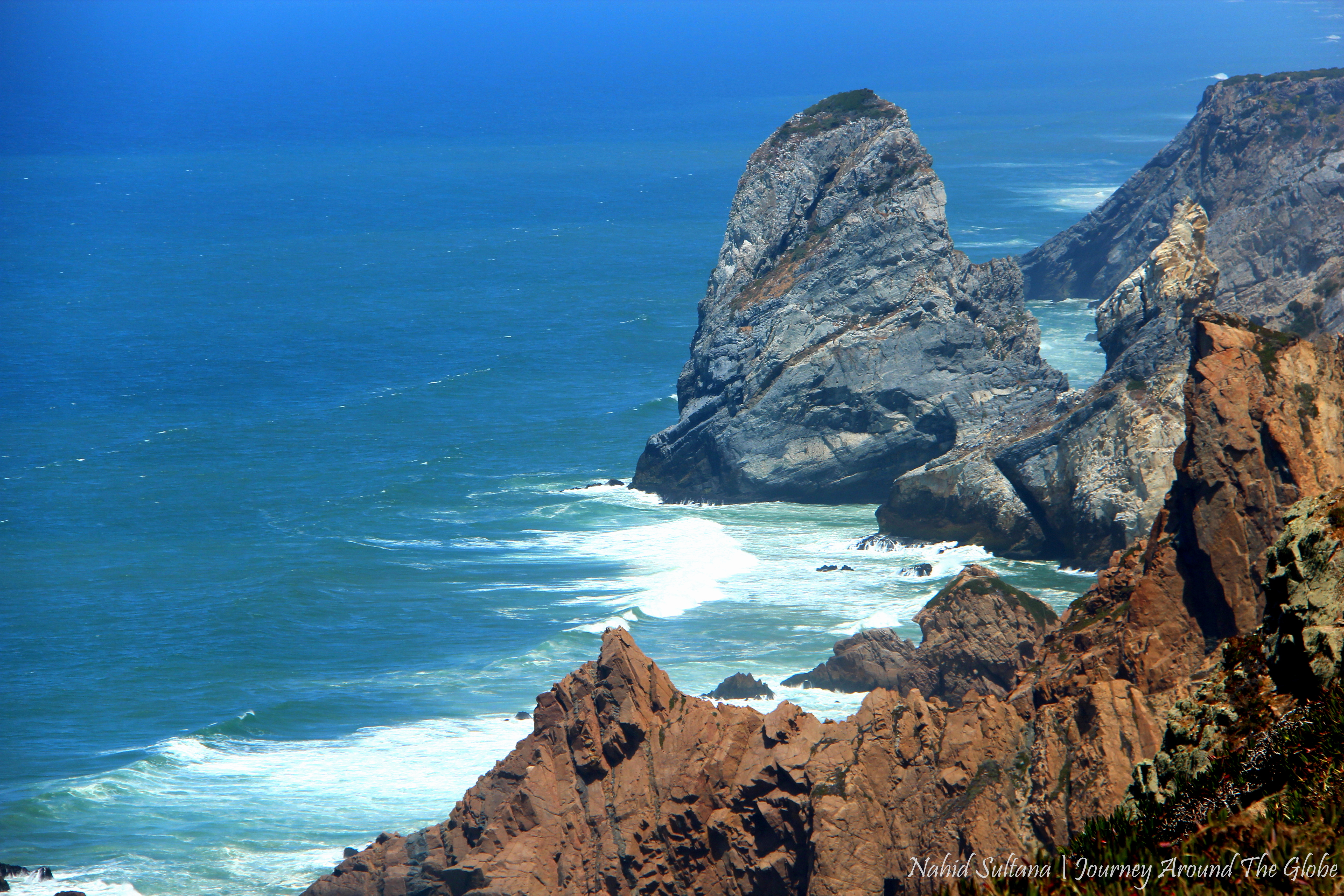
3) CABO da ROCA: Cabo da Roca is the western most point in the continent of Europe. The drive from Sintra to Cabo da Roca was by the beautiful coastline…simply breathtaking. This is a nice little viewpoint from where you can see the Atlantic. The area is a grassy hill with some walking trails, a nice lighthouse, a big cross, and small villages on the mountains in distance. Our guide was saying about 7000 km straight across from that point is Washington D.C. It was so darn windy that we took some photos (none of them were our own pictures though, wind was blowing us away) and went right back into the van.
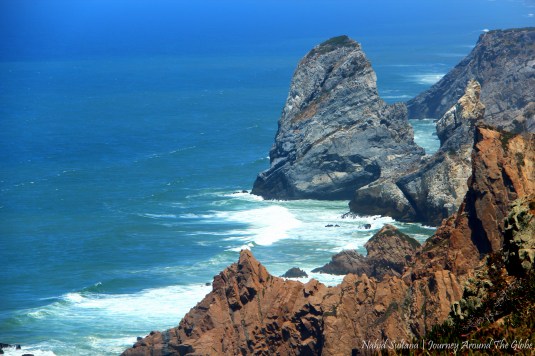
- Cabo da Roca in Portugal – the western most tip of Continental Europe
4) CASCAIS: Cascais was a lively little beach town on the Estoril Coast which is also part of Lisbon Coast. It’s very touristic but has a wonderful “Portuguese” charm. The short drive from Cabo da Roca to Cascais was mind-blowing. We reached Cascais late in the afternoon. We took our guide’s advice; the Serbian couple and us, decided to have lunch in Cascais (and not in the center of Sintra). It was a late lunch but thank god we picked this option. There were no restrictions once we reached Cascais as where to eat and what to eat. The Serbian couple went on their own and we started walking towards the main center where all the restaurants were.
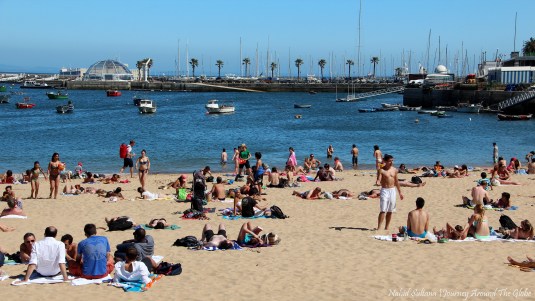
- Cascais Beach in Portugal
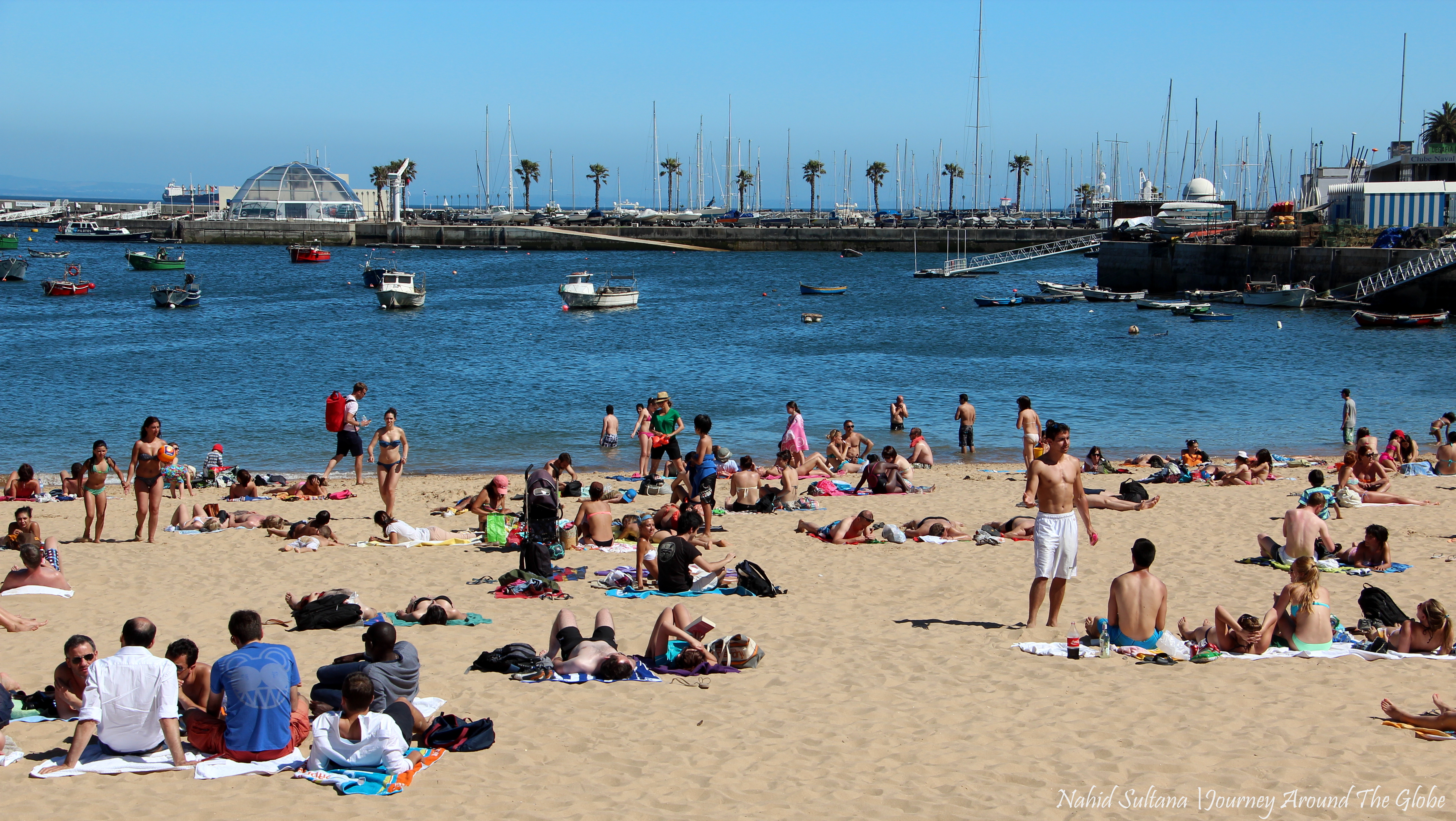
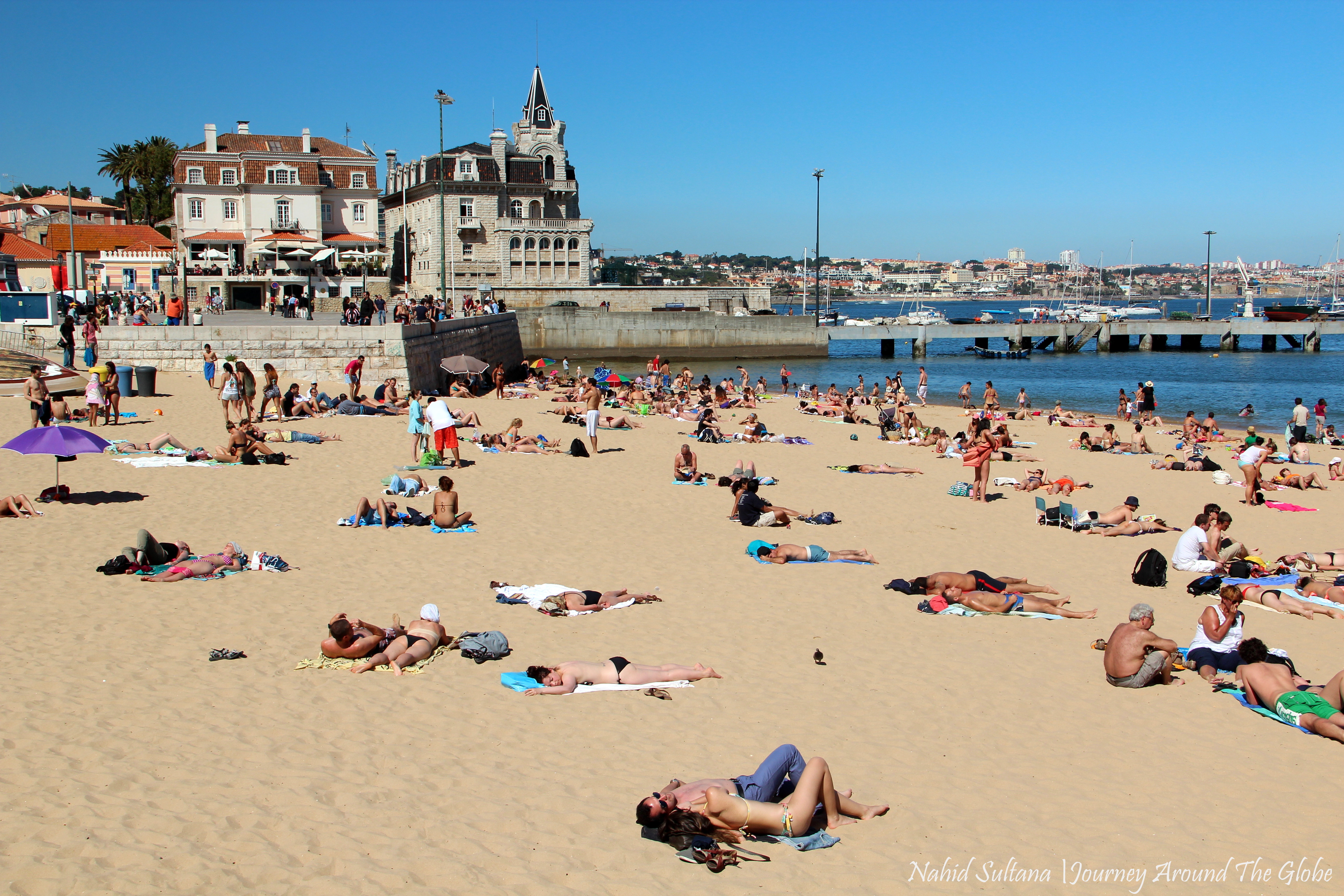
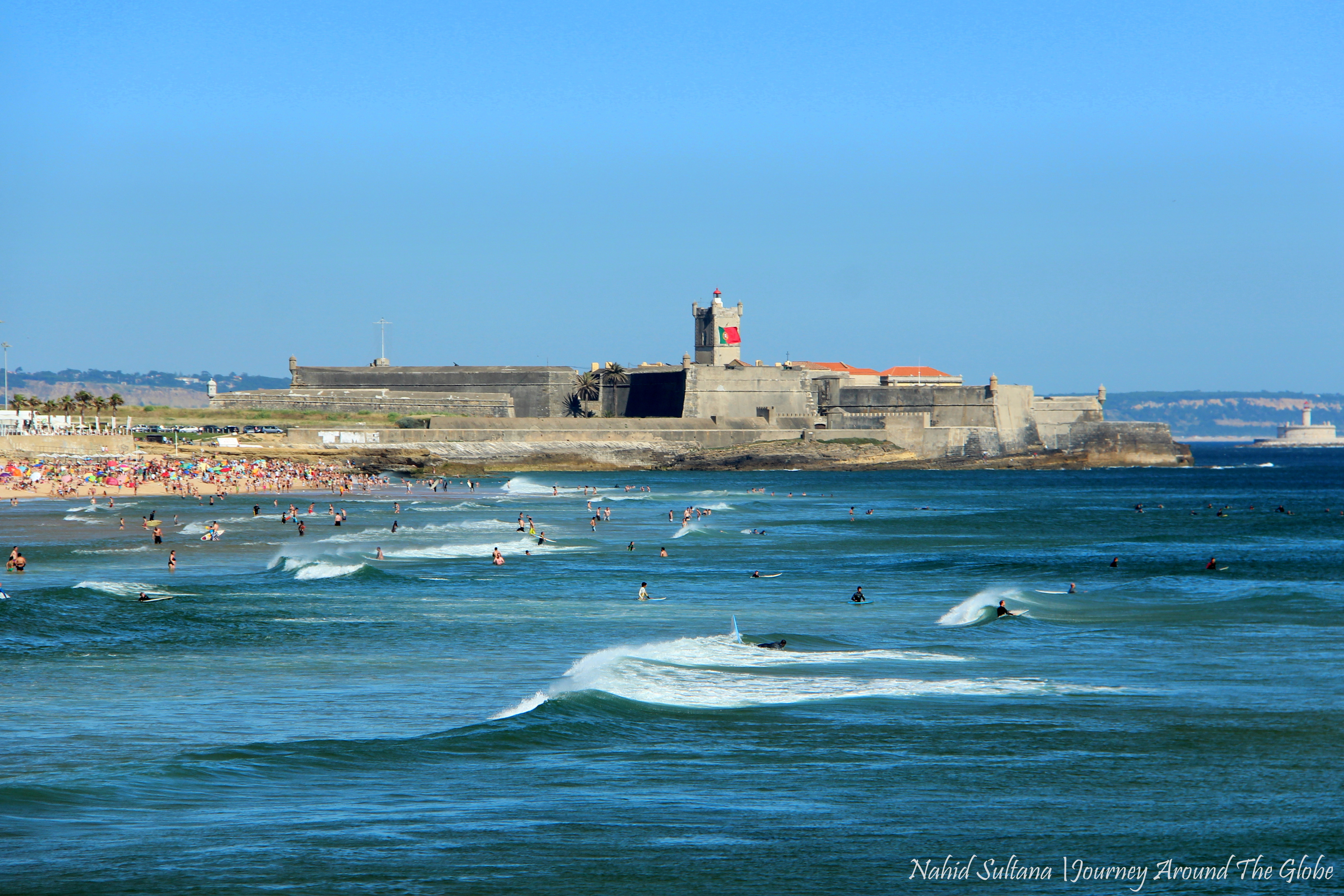
As I said, Cascais is an energetic beach town very close to Lisbon. We weren’t prepared but the other couple actually brought their trunks and swimming suits and took a dip into the ocean after lunch. But walking around its center area and looking at vibrant colored buildings and squares were fascinating. Some tourists stay here overnight or more to enjoy the ocean and its surroundings villages (wish we could do that too). There are many beautiful coastal spots not too far from city center to explore and relax. But for us, Cascais was a nice ending of that day and our tour to Sintra. Nothing beats gazing at the majestic blue ocean on a late afternoon and enjoying some family moments.

- Cascais Beach in Portugal
5) ESTORIL CASINO: This was our last stop but it was only for 2 minutes just to take a group picture in front of the casino. This is the 2nd largest casino in Europe, after Grand Monte Carlo in Monaco. It was only 10 minutes of drive from Cascais. Again most of the drive by Estoril Coast to Lisbon was very scenic. We reached hotel around 6 pm, barely had some so-called “dinner”, and went straight to bed while it was still light outside…what could we do, had to catch an early morning flight back to Brussels. Bye bye Lisbon…obrigado Portugal.
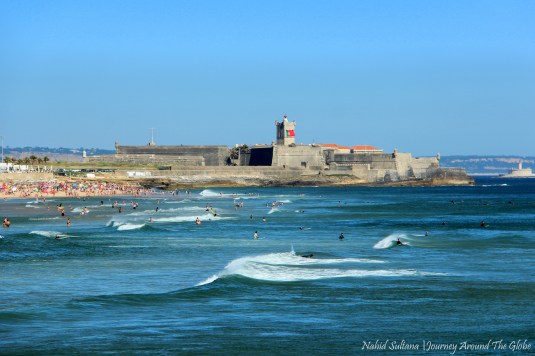
- Driving by Estoril Coast at the end of our trip to Sintra, Portugal
Related articles
- Weekend Wonderlust: A Brief Glimpse of Sintra, Portugal (smallworldthisis.wordpress.com)
- The romance of Sintra a fairy tale day out (wottraveltwickenham.wordpress.com)
- Day 1 In Lisbon (katietravelblog.wordpress.com)
- Lisbon and Sintra from captivating Portugal! (greyindecision.wordpress.com)
- Portugal – (globehugblog.wordpress.com)
- Time Flies – Take Me Back To Europa (eatsandfastfeets.wordpress.com)
Share this:

City of sardines – Lisbon, Portugal
LISBON, PORTUGAL: Situated by River Tagus, Lisbon is the capital of Portugal and a thriving European city at the edge of Atlantic Ocean. The history of this city can be traced as far back as to 7th century BC. It was severely destroyed by the big earthquake of 1755 which damaged majority of its structures. But today’s Lisbon is a lively and spontaneous place that attracts tourists from all over the world. Being so close to Spain you can see many similarities between these two countries in terms of their languages, cultures, and heritage though rivalry between these two countries is very obvious when it comes to sports and other things. There are lots of Islamic influences in Lisbon too (mainly architectures), since Moorish ruled this place many centuries ago and left their signs before leaving the Portuguese to themselves.
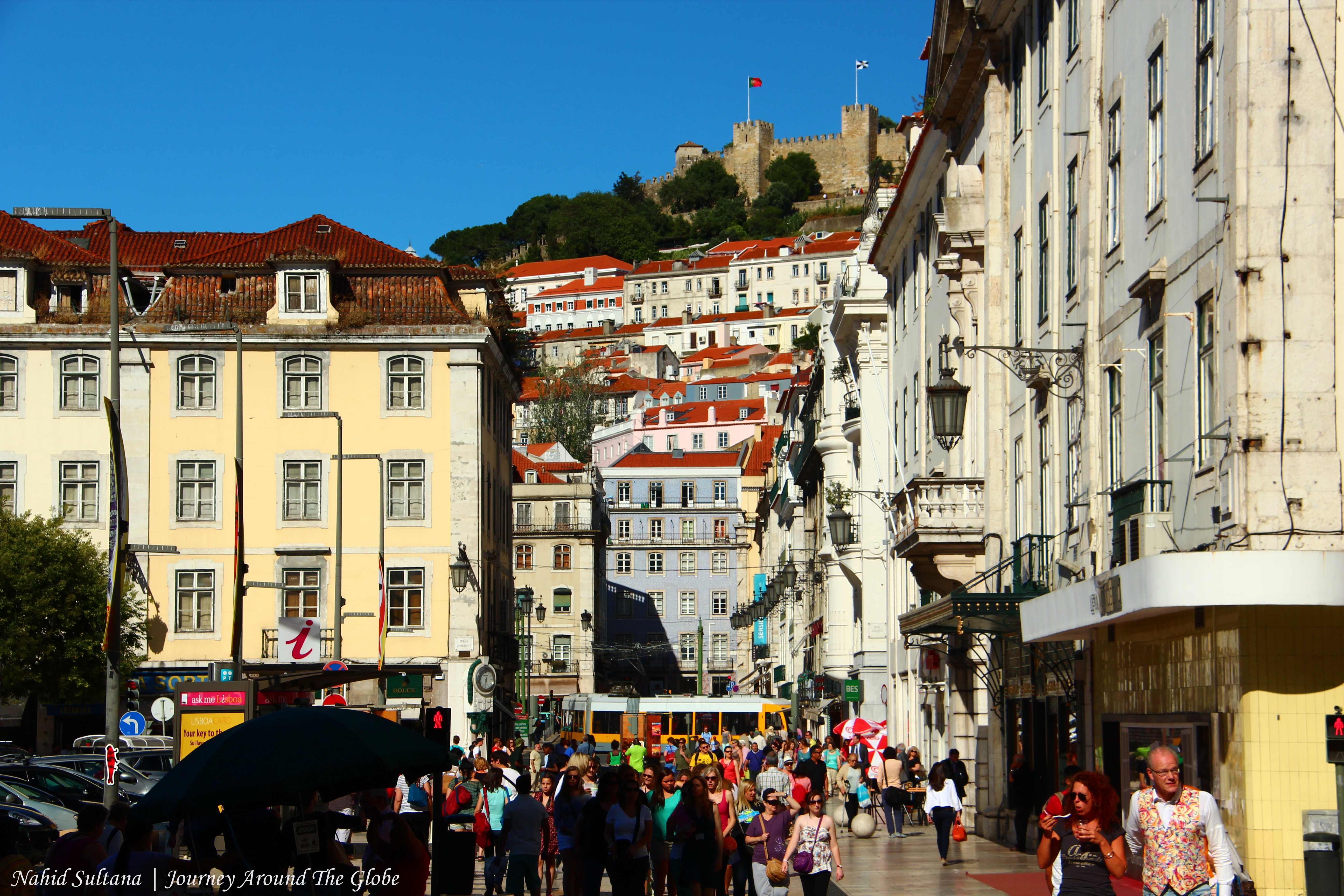
- Old town of Lisbon, Portugal – you can see St. George’s Castle in the back
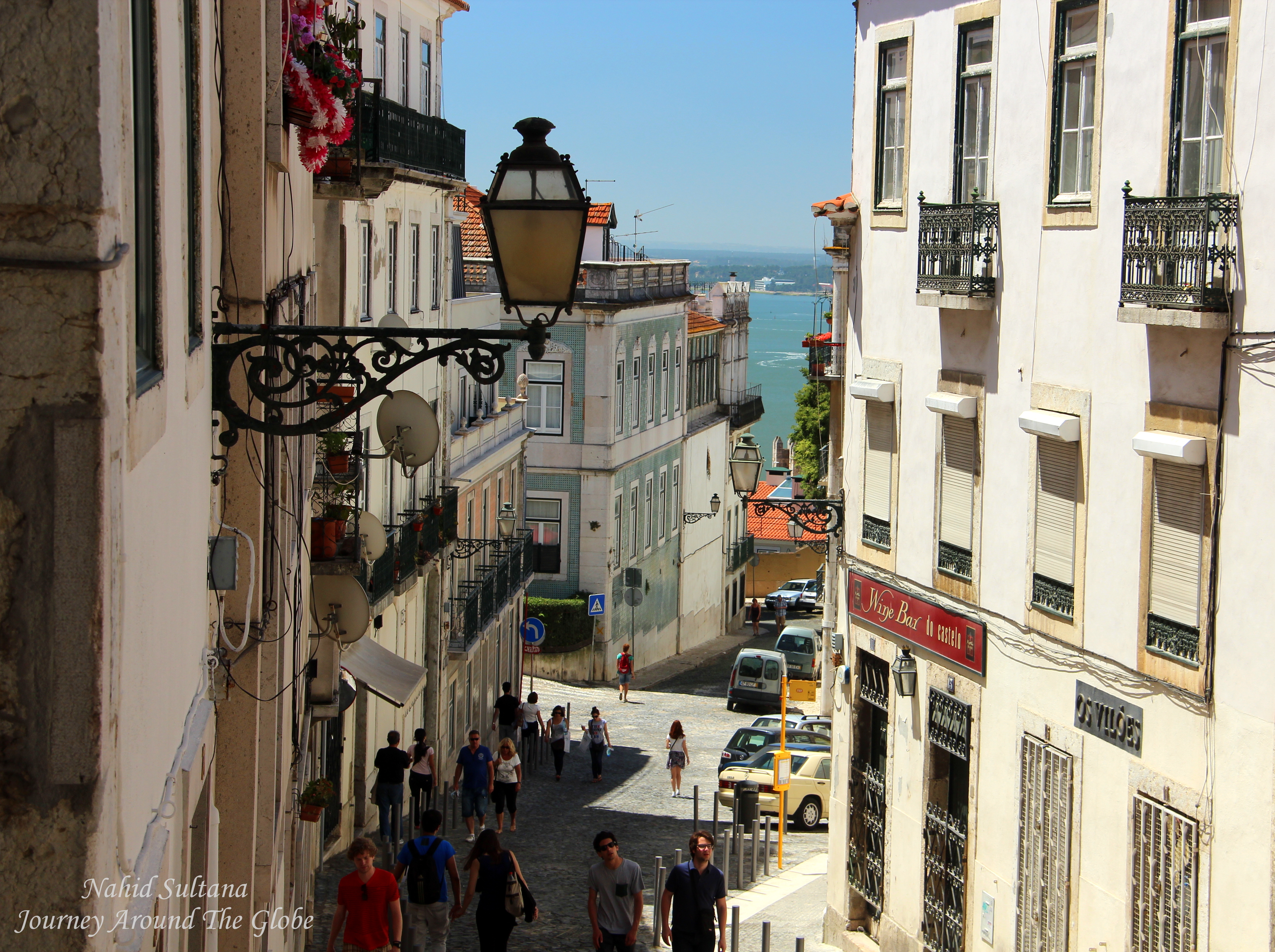
Lisbon is situated on seven hills, so there are lots of ups and downs all around the city. Many places have uneven cobblestone streets in the old town. Wear comfortable shoes if you are planning to cover the city on foot. Public transportation is good here too. There are metro, bus, tram, and boats available to take you anywhere in the city and beyond. Try to ride their historic small yellow trams on your way to St. George’s Castle or to Belem…but beware of the pickpockets there.

- Alfama neighborhood near St. George’s Castle in Lisbon, Portugal
TIME of TRAVEL: We visited Lisbon during the mid-June 2013. Temperature was extremely good…close to 80 degree Fahrenheit. It was nice to get a break from our wintry Belgium weather to a hot summer place. We still had our sweaters, because it gets a bit windy and little chilly after dark and near the waterfront.
OUR HOTEL: We stayed in Hotel DAH (Dom Afonso Henrique) in Lisbon. It’s not in the city center, but very close to metro station that takes you right there in a short time. We had free Wi-Fi in the room and nice breakfast on the roof terrace every morning. There was also a great Italian restaurant “Pepe & Oliva” only one block away from the hotel where we ended up having 3 dinners in a row…yummy food for a very low price.
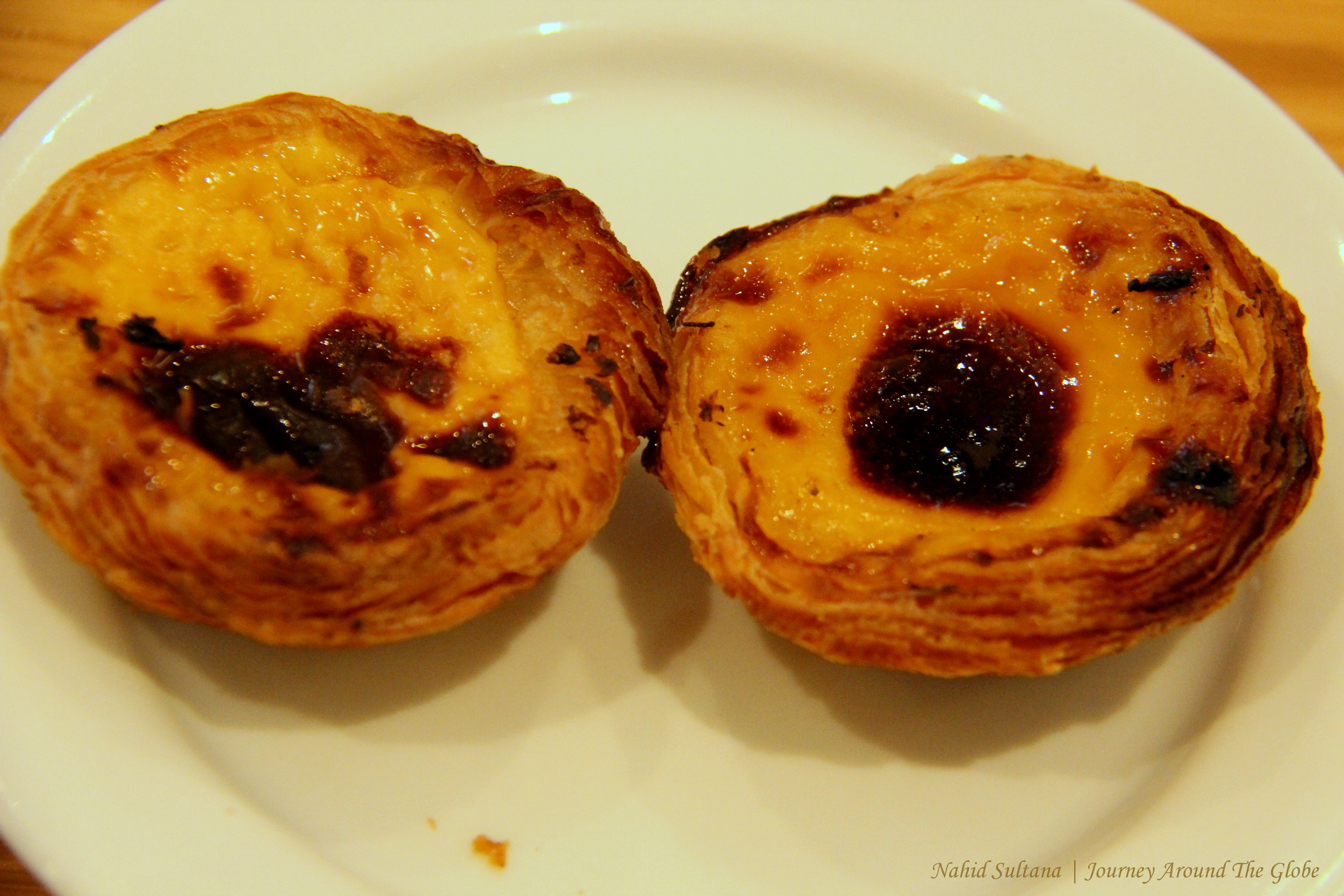
EATING and SHOPPING: Eating out in Portugal is very cheap and reasonable compare to many other European countries, even when you are eating seafood dishes. That’s a great news for us tourists, because you have to try Portuguese style seafood when in Lisbon…probably some of the best ones I had so far. You can sit in a fantastic restaurant with a nice seafood dish and end up paying very little for a large portion. Also, many restaurants offer live fado (string instrument, very popular in Portugal) music on certain days. For dessert, Pastei de Nata is the best and most popular among the locals and tourists. It’s a custard tart on a crispy pastry…looks a bit like crème brule except on a pastry shell. I am a not a big fan of sweets, but I ended up eating few of those wherever I saw them.

- Pastei de Nata – a popular sweet treat in Lisbon, Portugal
1st day we ate in a restaurant in Alfama close to Lisbon Cathedral, known as Vossemece. Sardine is probably number one dish that most of the tourists try in Portugal and I tried my part of sardine on the very first day too. I am not a big fan of sardine and really don’t know how to eat one with bones and skins. Portuguese have their own style of eating sardine leaving the skin and bones intact and eating the flesh neatly. I ate it with the skin, it was salty and …very fishy…and never felt like trying another grilled sardine again during this trip.
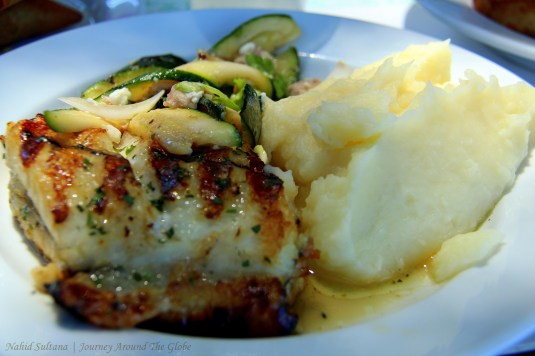
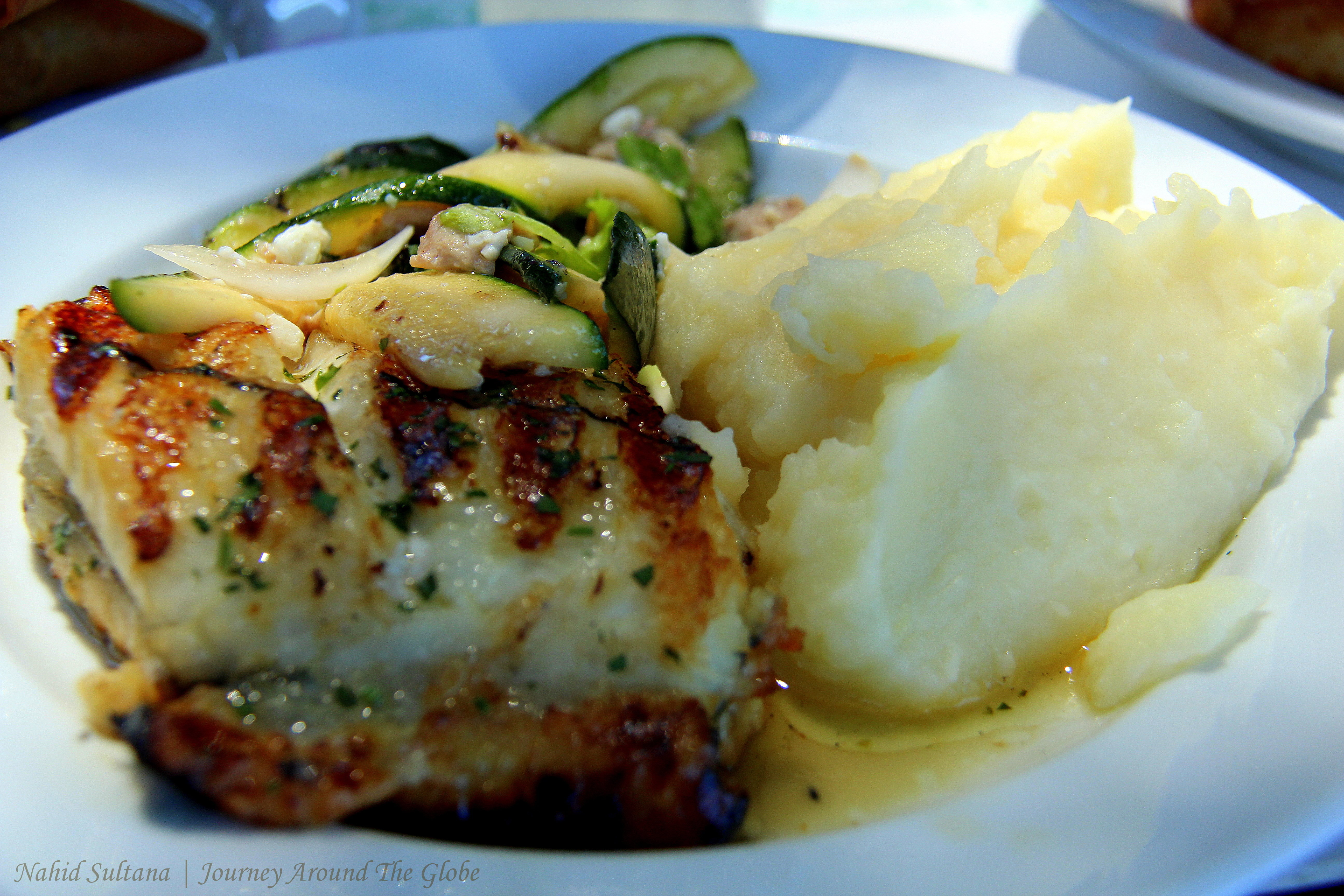
- My lunch in Lisbon – grilled swordfish
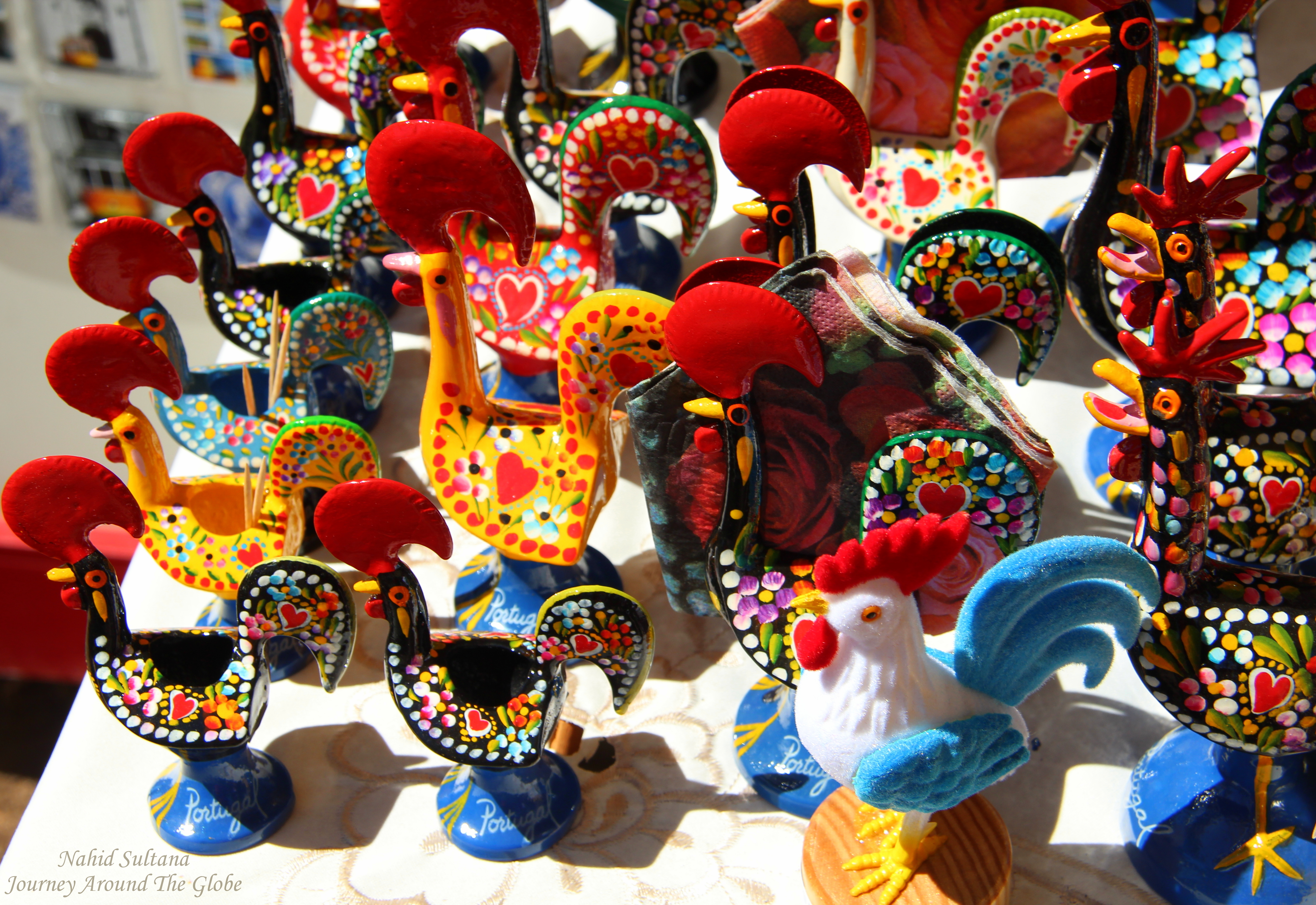
Tiles and ceramics are very popular souvenirs here. One thing we saw in EVERY store was many colors of roosters. They have a legend that rooster brings good luck; I am sure you can find one that will suit your taste. Also, sardine is a popular souvenir to take back home too…but not the actual fish. You can get lots of goods with pictures of sardine here, like t-shirt, mugs, small replicas, and etc.

- Roosters of Portugal – a popular souvenir to bring back home
PLACES WE’VE VISITED: We spent about two whole days in Lisbon. I wouldn’t say it was enough but nevertheless, we were able to hit most of the spots that were on our itinerary, except for Cristo Rei – a copy of the statue of Jesus in Rio de Janeiro.
1) ST. GEORGE’S CASTLE (CASTELO de S. JORGE): This Moorish castle is a national monument and a must-see in Lisbon. It has ruins of the former royal palace and small part of elite neighborhood.
History goes that the fortification was originally built by the Arabs/Moors in the mid-11th century. When Dom Afonso Henriques, the 1st king of Portugal, conquest Liston in 1147, the castle went through its golden age as home for the royalty until the middle of 16th century. The Royal Palace suffered heavy damage in the earthquake of 1755 when most of Lisbon was destroyed. But unlike other palaces, royals never resided here, it was used more as a fortress.

- View of River Tagus, Bridge 25th April, and Alfama neighborhood in Lisbon, Portugal
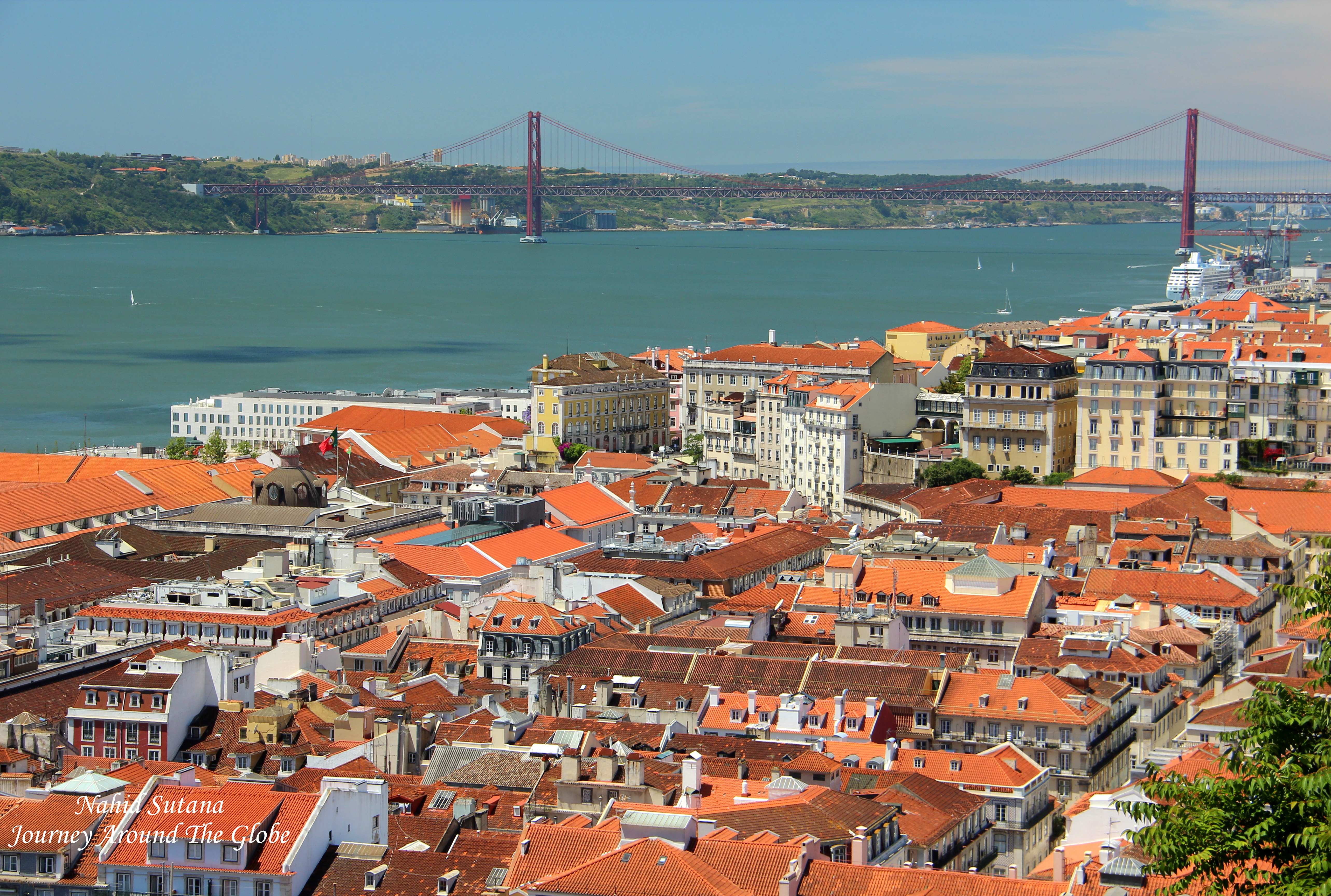
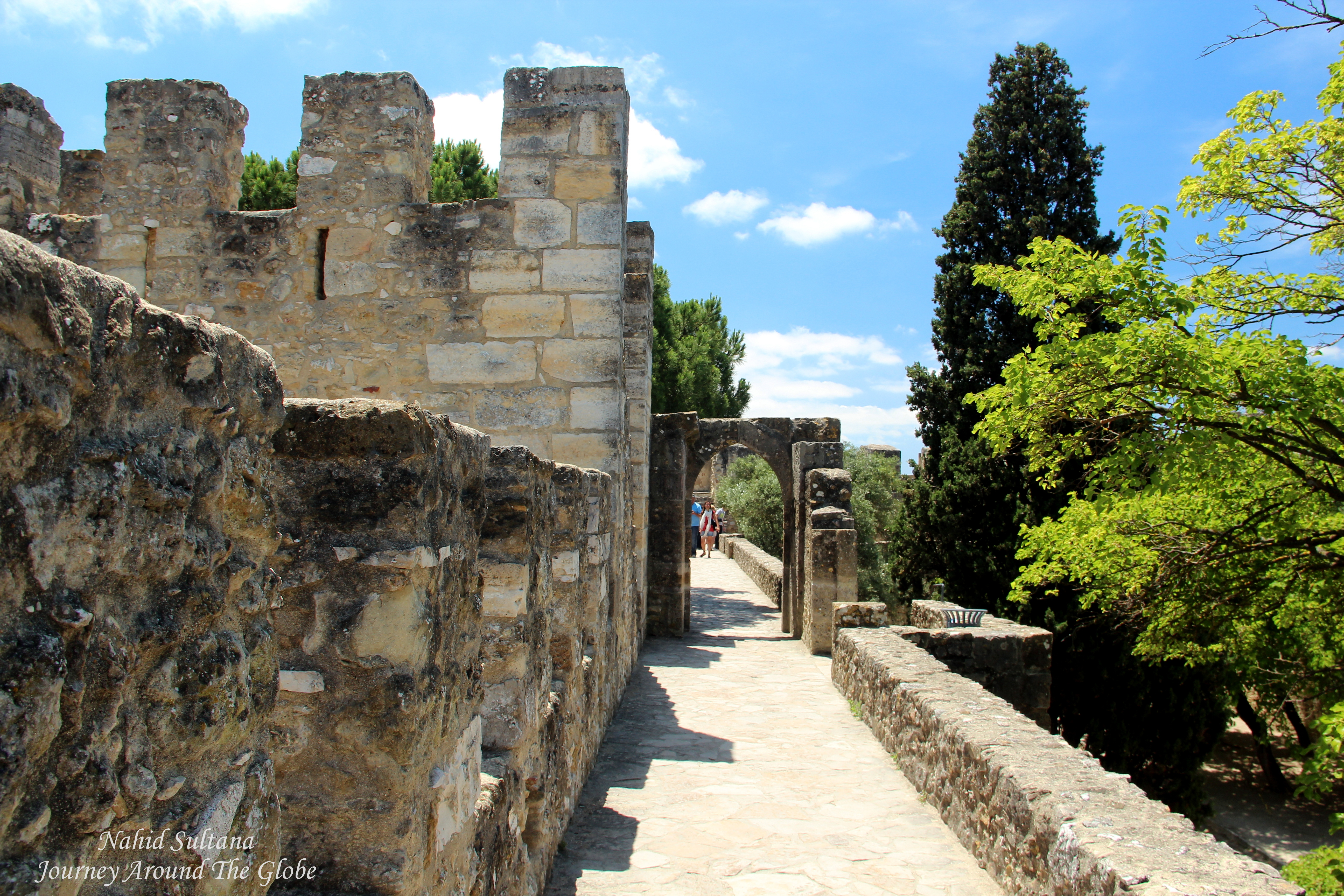
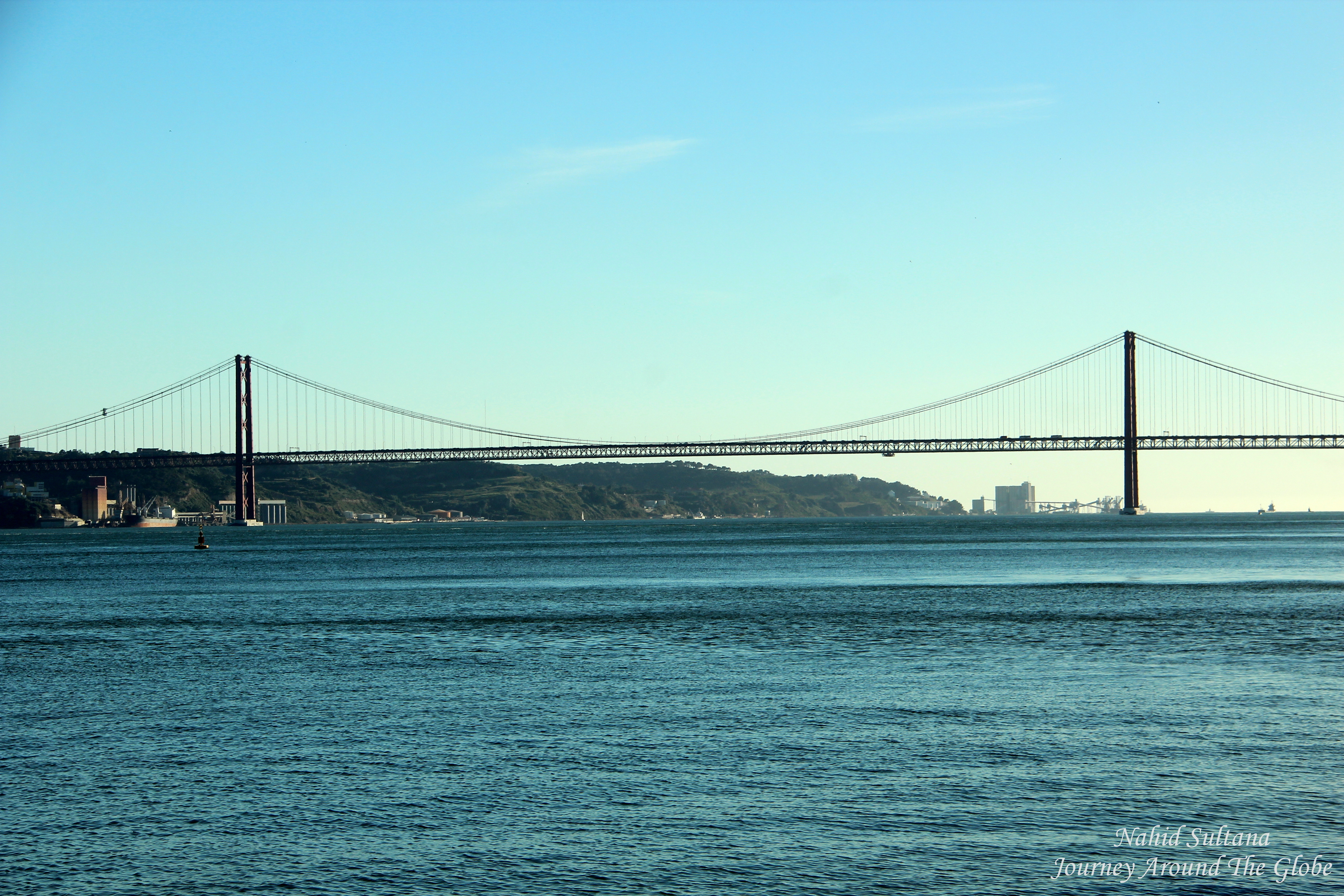
Being on a hilltop summit, St. George’s Castle is an outstanding location for majestic and unparalleled views over Alfama neighborhood – a historic old town of Lisbon, River Tagus, Cristo Rei on the other side of the river, 25th April Bridge, and overall Lisbon. This is a home of lots of stray cats and many beautiful peacocks. You can easily spend couple hours just wandering around the courtyards, climbing and walking on the old outer defense walls on some portion of the castle. Finally, don’t forget to visit the castle museum for some taste of the lifestyles from the past.
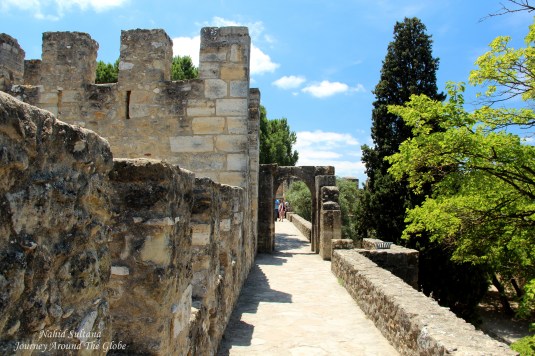
- The old defense wall of St. George’s Castle in Lisbon, Portugal
From March to October the castle is open from 9 to 9 and from November to February it’s open from 9 to 6. It is 7.50 euro per adult and for a family of 2 adults and 2 kids below 18 is 16 euros. It covers the castle and its museum. Lisbon’s historic tram # 12 and 28 go to the castle, also bus # 37.
2) BRIDGE 25TH APRIL (PONTE 25 de ABRIL): This is a sister bridge of the San Francisco Golden Gate Bridge over Tagus River and was designed by the same architect. You can get a view of this bridge from many points of Lisbon but St. George’s Castle is probably one of the best places to see it from atop.
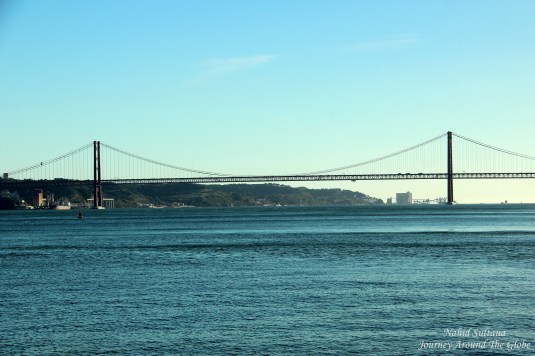
- Bridge 25th April – a sister bridge of San Francisco Bay Bridge in Lisbon, Portugal
3) LISBON PATRIARCHAL CATHEDRAL or SANTA MARIA MAIOR: This is a historic cathedral of Lisbon since it was built by their first king, Dom Afonso Henriques during the later part of 12th century. This used to be the worship place for general publics. Though the architecture is very grand, interior is simply decorated.
The cathedral is located in historic Alfama neighborhood, about 10 minutes of walk from St. George’s Castle. It’s open from 9 – 7 from Tuesday to Saturday and 9 – 5 on Mondays and Sundays. There is no charge to enter.
4) ROSSIO, CHIADO, BAIXA and WATERFRONT: Rossio, Chiado, and Baixa are the popular squares of Lisbon. They are all within walking distance of each other and are packed with many shops and restaurants. Rossio is the main meeting and gathering spot for locals and a beautiful one too. Chiado is more like an elegant shopping street close to Rossio, lined with many shops, bakeries, restaurants, and cafes. Walking on the cobblestone path, listening to live music on the street, and eating Pastei de Nata while doing window shopping (or real shopping) are just some of the things to do in Chiado. We went there twice and had tea-break in a bakery, called Eric Kayser.
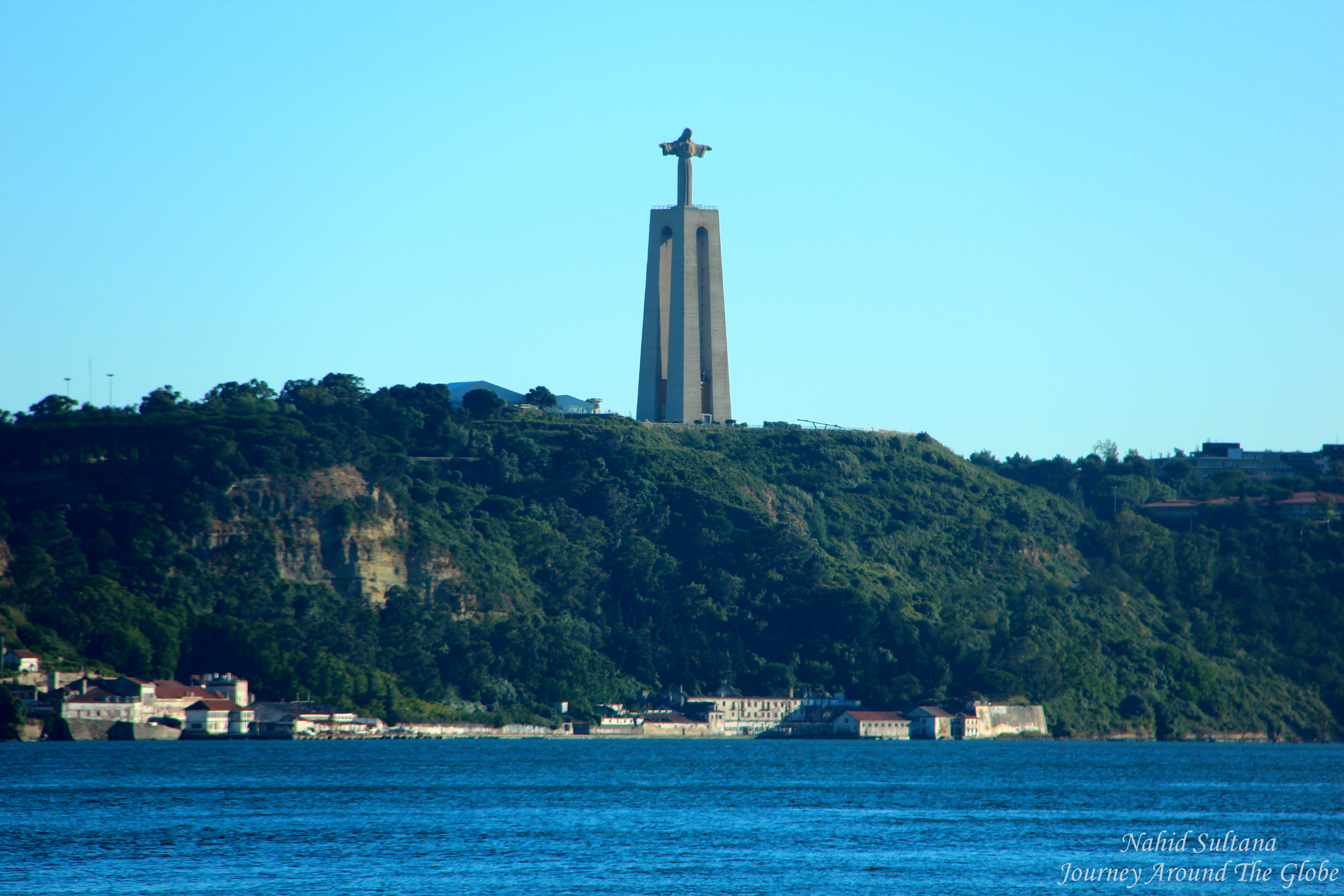
Baixa was a nice place just to sit down and enjoy the blue river at the end of our 1st day in Lisbon. The statue and arch that dominate Baixa square were under renovation, so we couldn’t see any part of those when we went there. So we just crossed a small street and sat down by the river before heading back to hotel. You can get a closer look of 25th April Bridge and Cristo Rei from Baixa than from top of St. George’s Castle. It’s very close to Chiado district and shouldn’t be missed.
- Cresto Rei from Baixa in Lisbon, Portugal
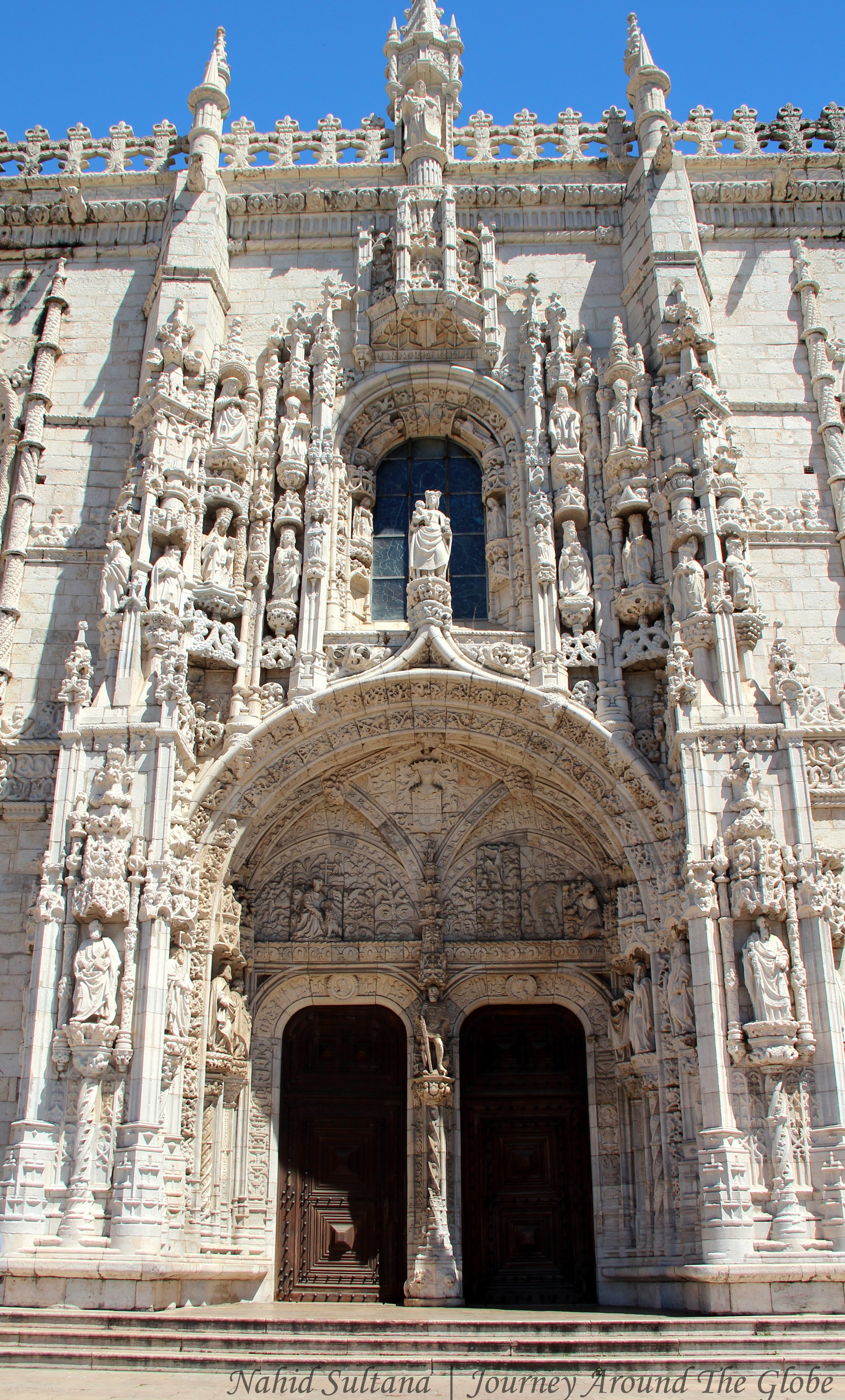
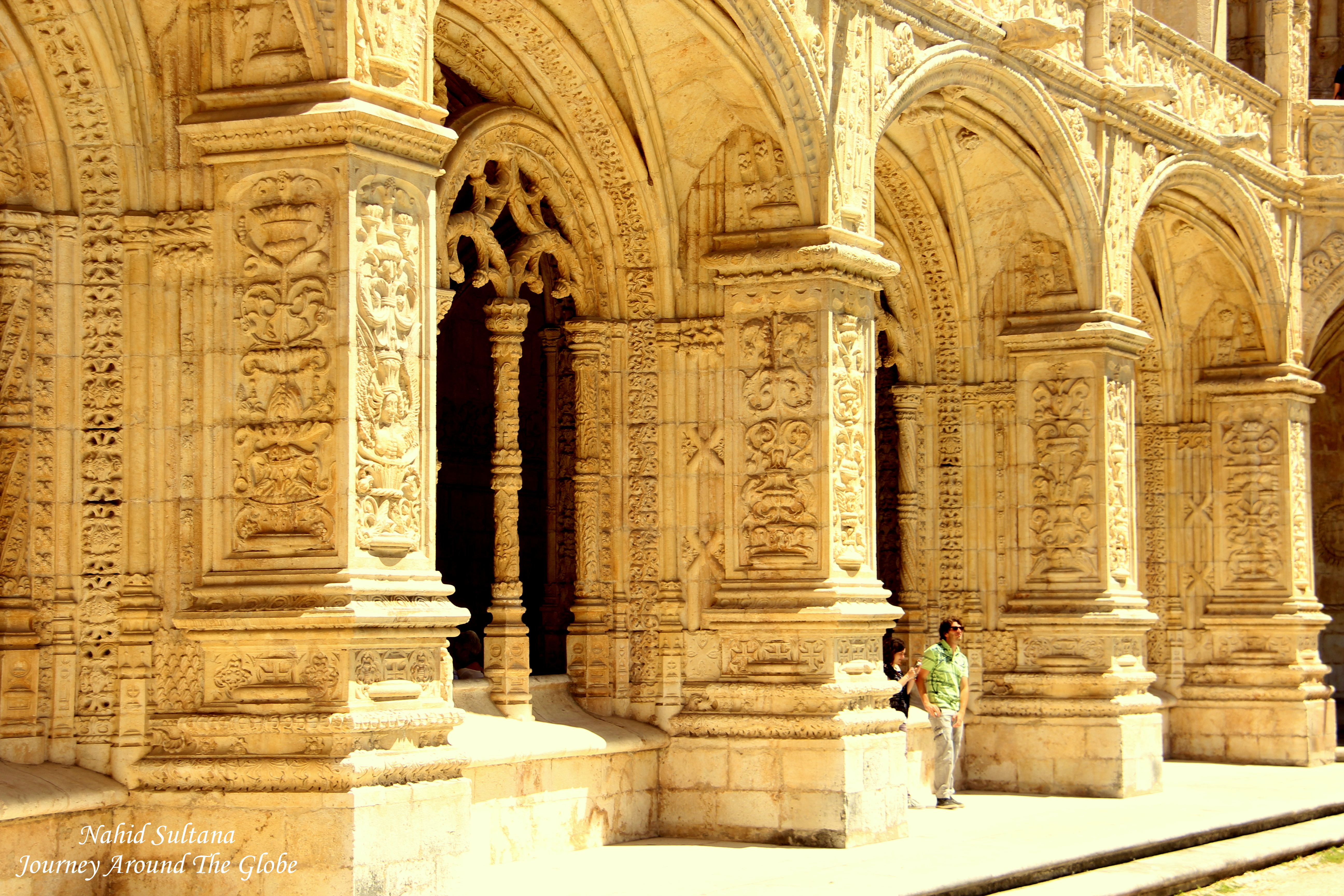
5) JERONIMOS MONASTERY (MOSTEIRO dos JERONIMOS): This is another national monument of Lisbon from the 16th century and an UNESCO World Heritage Site. You can’t leave Lisbon without visiting Jeronimos Monastery. It was built to create a pleasant place of meditation and recreation for the monks. The cloister of it was finished in 1541. Due to its value and symbolism the Cloister is considered to be one of the jewels of the Manueline style. Stone curved vaulted ceilings, rope, plant motifs along with imagery of fantastic animals on the walls, and peaceful courtyard give its guests some inner-peace and tranquility. Few portions of the monastery still display old ceramic tiles on the walls. Two levels of Jeronimos Monastery is really very atmospheric and a perfect place to find yourself in a serene surrounding. There were some small displays and temporary/permanent exhibitions during our visit. But we didn’t go to any of them…we were busy enjoying the monastery itself.
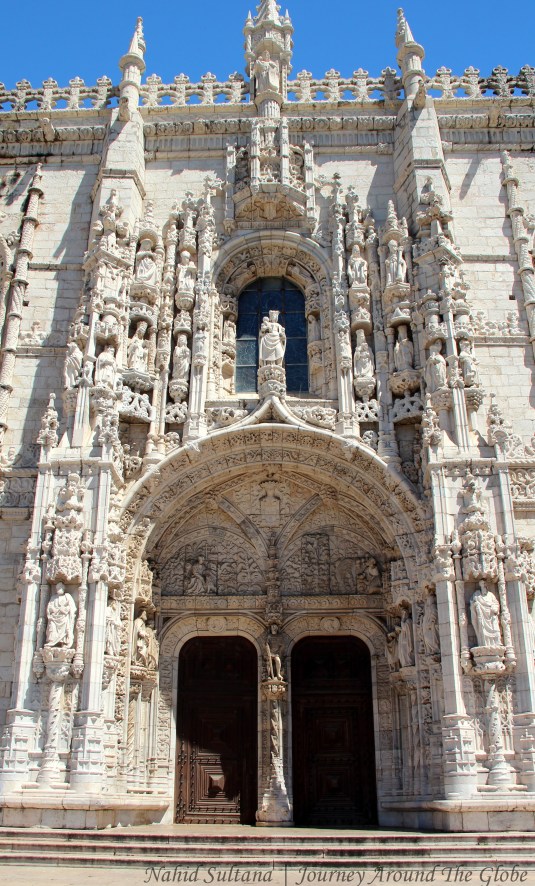
- Main façade of Jeronimos Monastery in Lisbon, Portugal
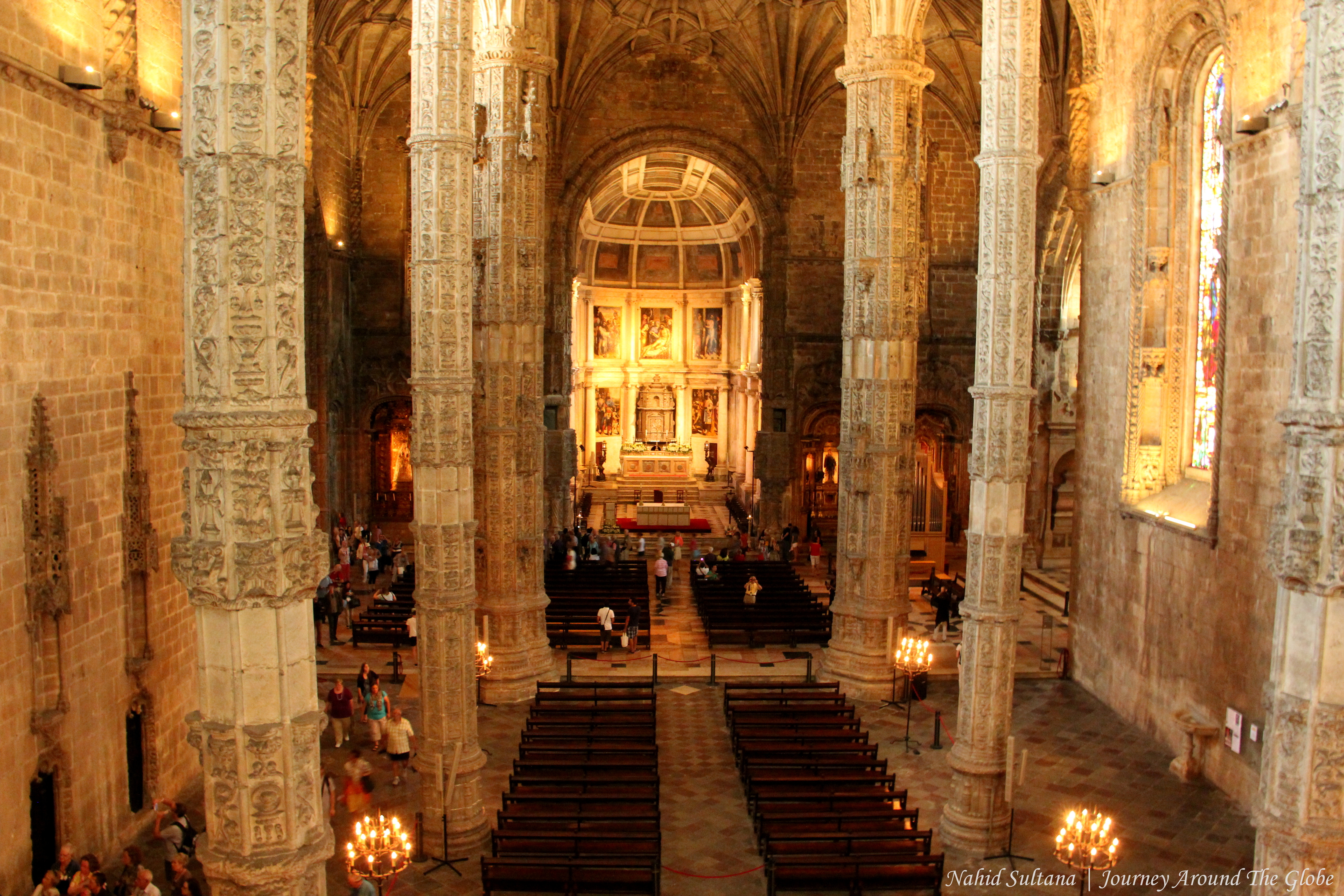
Church of this monastery comes before entering the ticket office. It’s dark and very gothic looking inside. It houses the tomb of famous Portuguese navigator, Vasco da Gama, who established the sea link between Portugal and India in the late 15th century.
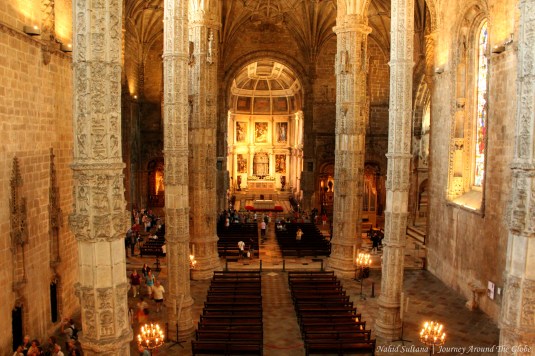
- Church in Jeronimos Monastery in Lisbon, Portugal
The monastery, #6, and #7 below are all located in Belem neighborhood. We took Lisbon’s historic tram # 15 to get here. Once we were there, everything is very close to each other. The cloister is open from October to April from 10 – 5:30 and from May to September from 10 – 6:30. It’s closed every Monday and public holidays. General admission to the monastery is 7 euros per adult and dual ticket of the monastery and Belem Tower is 10 euros.
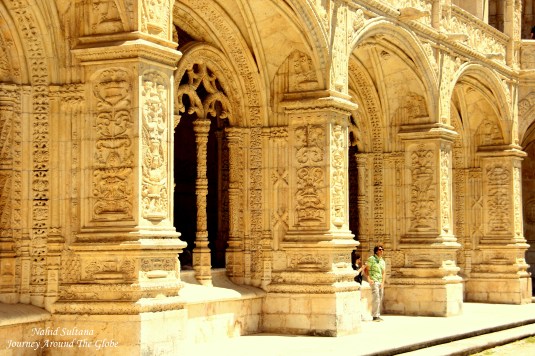
- Jeronimos Monastery in Lisbon, Portugal
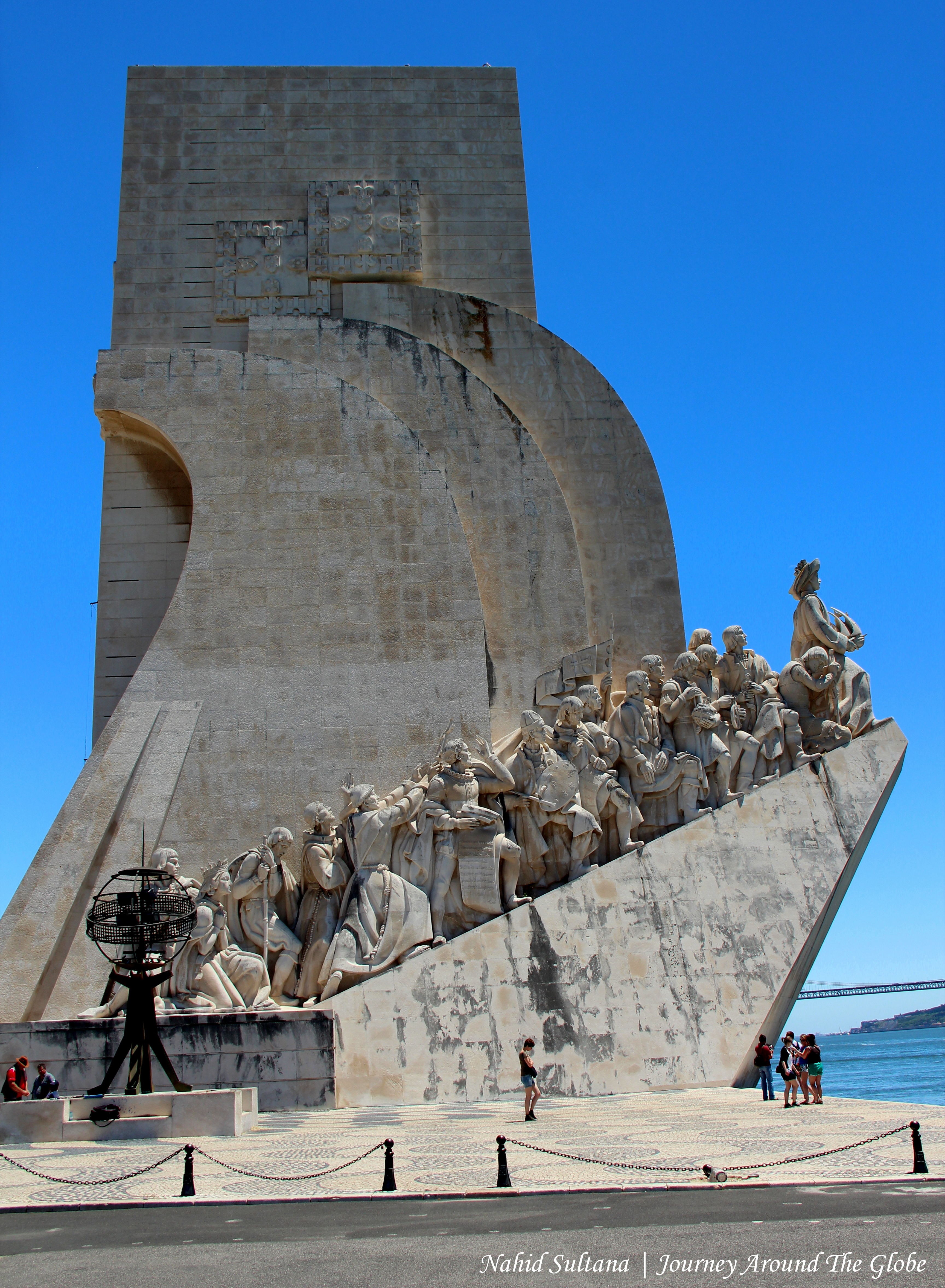
6) MONUMENT of the DISCOVERIES: This is a riverside monument built in 1960 to commemorate the 500th anniversary of the death of Prince Henry the Navigator. Although we didn’t climb the top, we could tell it offers nice view of Lisbon and River Tagus. The entrance is shape of a sword and both sides of this monument have statues of Lisbon’s talented citizens who contributed in discoveries and science so far. It’s located opposite of Jeronimos Monastery and right by Tagus River. There is also a map of all the places in the world where Portuguese had their maritime voyages and territory so far. Visitors can pay 3 euros to take an elevator on the top.
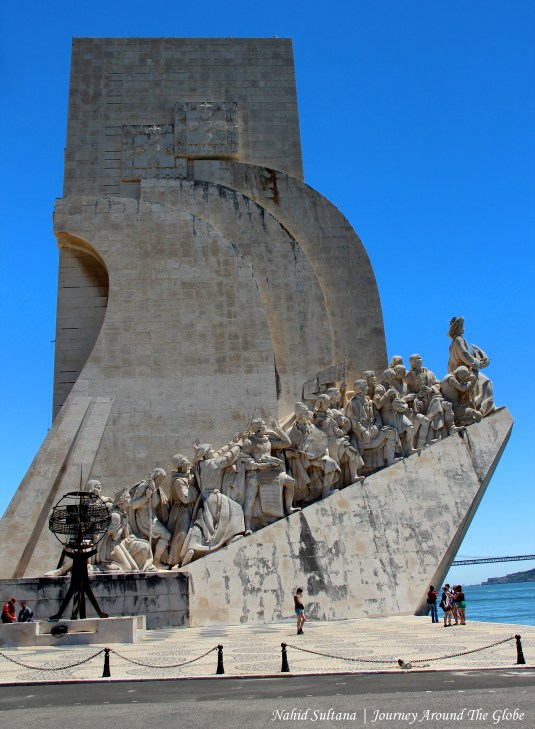
- Monument of the Discoveries by River Tagus in Lisbon, Portugal
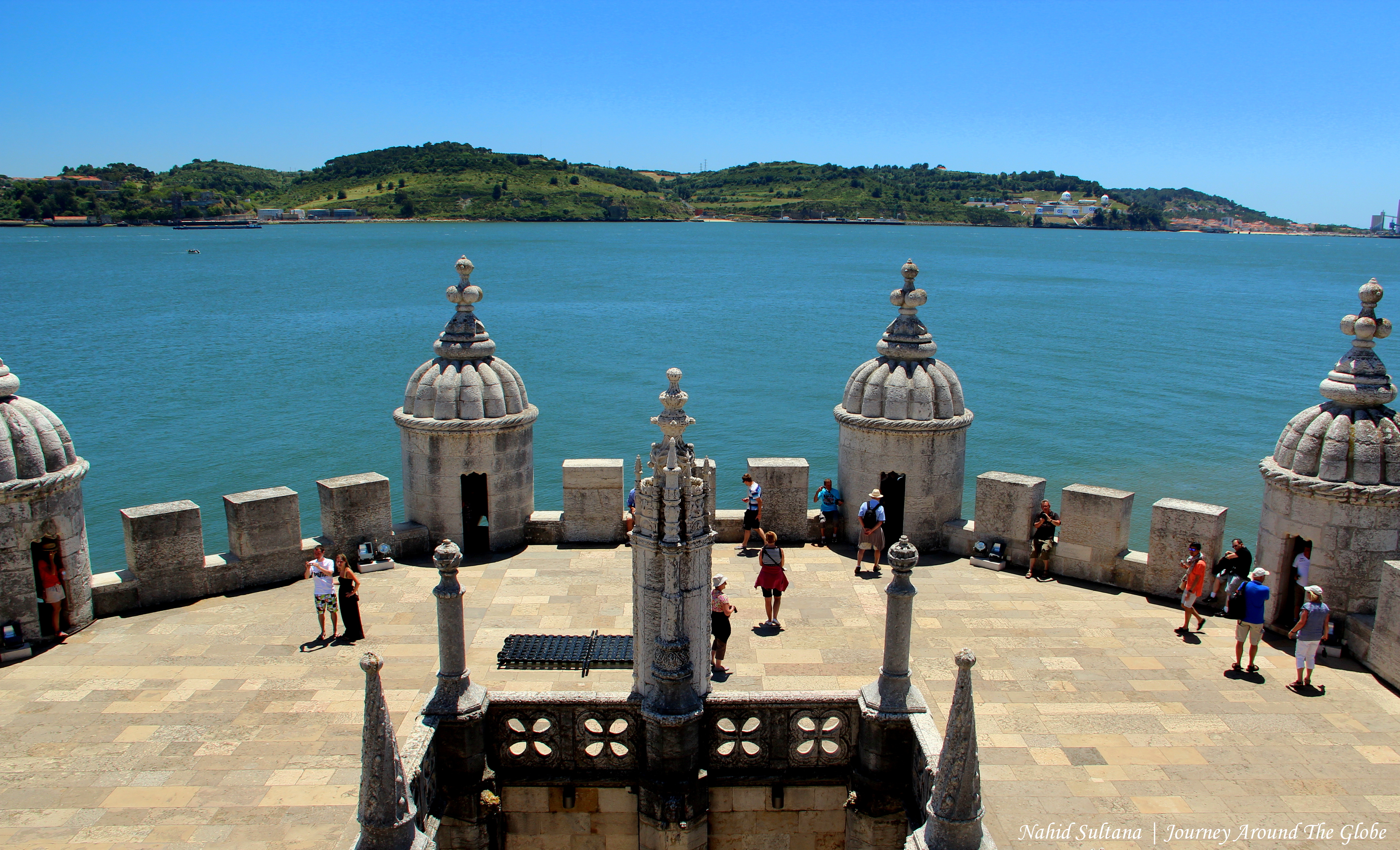
7) BELEM TOWER (TORRE de BELEM): This is a masterpiece of military tower in the Manueline style. The tower was built in the 16th century as a fortification for the defense of the Tagus River. This is also a National Monument of Lisbon and an UNESCO World Heritage Site. Lower level of the tower has magazine storage and prison cell. Terrace and roof of the tower will give you a fantastic view of the river and its surroundings. Decoration of the tower is heraldic and very emblematic.
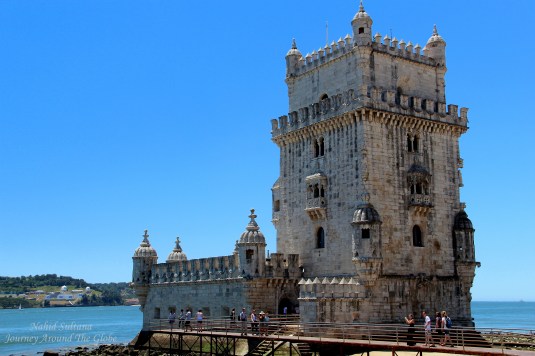
- Belem Tower from the 16th century in Lisbon, Portugal

There are 120 steps to go all the way to top of the tower. These steps are very narrow, twisty, and can be dangerous as the same stairs are used to go up and down.
Belem Tower is also located by Tagus River and about 7/8 minutes of walk from Monument of the Discoveries. The tower is open for the visitors from 10 – 5:30 from October to April and from 10 – 6:30 from May to September. It’s closed every Monday and other public holidays. Combined ticket for Jeronimos Monastery and Belem Tower is 10 euros per adult.
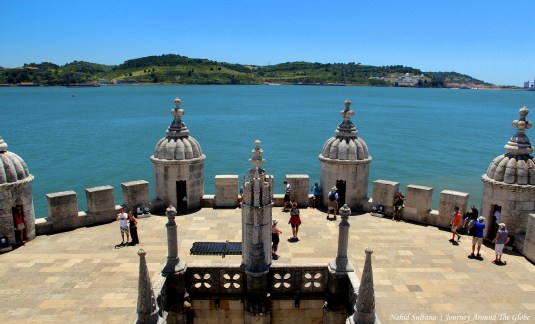
- From top of Belem Tower in Lisbon, Portugal
Related articles
- Railing through the Streets of Lisbon (munchow.wordpress.com)
- Time Flies – Take Me Back To Europa (eatsandfastfeets.wordpress.com)
- A lovely weekend in and around Lisbon, Portugal (mrsoaroundtheworld.com)
- Portugal and the love of sardines (myhelena.wordpress.com)
- Treasures of Lisbon (soslowcuisine.wordpress.com)
- A friend in my pocket (annikenbinz.wordpress.com)
- Lisbon and Sintra from captivating Portugal! (greyindecision.wordpress.com)
Share this:

Business Excellence Award 2020 from AI Global Media for The Most Entertaining Personal Travel Blog – Pacific Northwest USA

Top Posts & Pages


Authors
 Globe Runner
Business Excellence Award 2020 for The Most Entertaining Personal Travel Blog – Pacific Northwest USA

Business Excellence Award 2020 from AI Global Media

 Journey Around The Globe