Journey Around The Globe
ready for the next destination
Castles of Fussen, Germany
FUSSEN, GERMANY: Our main purpose of going to Fussen was to visit the two castles on the mountains of Bavarian Alps here. It’s a shame that we left this magnificent little town unexplored. A small village of Fussen, Hohenschwangau, is situated at the foothills of Alps in southern Germany very close to Austrian border. This is where the two castles, Hohenschwangau Castle and King Ludwig II’s fairy-tale looking Neuschwanstein Castle are located. It’s a beautiful lake district with breathtaking views at every corner. You can get glimpses of those blue water bodies from here and there as you walk up the mountains to visit these castles.
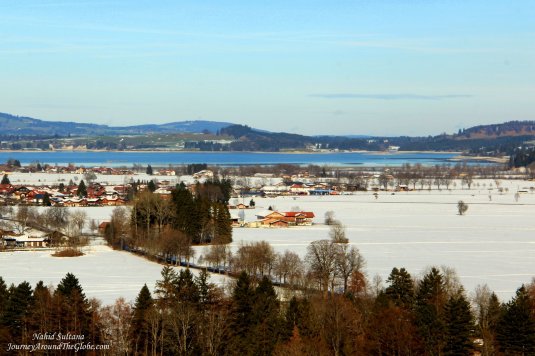
- Stunning view of Fussen and its surroundings from Hohenschwangau Castle in Germany
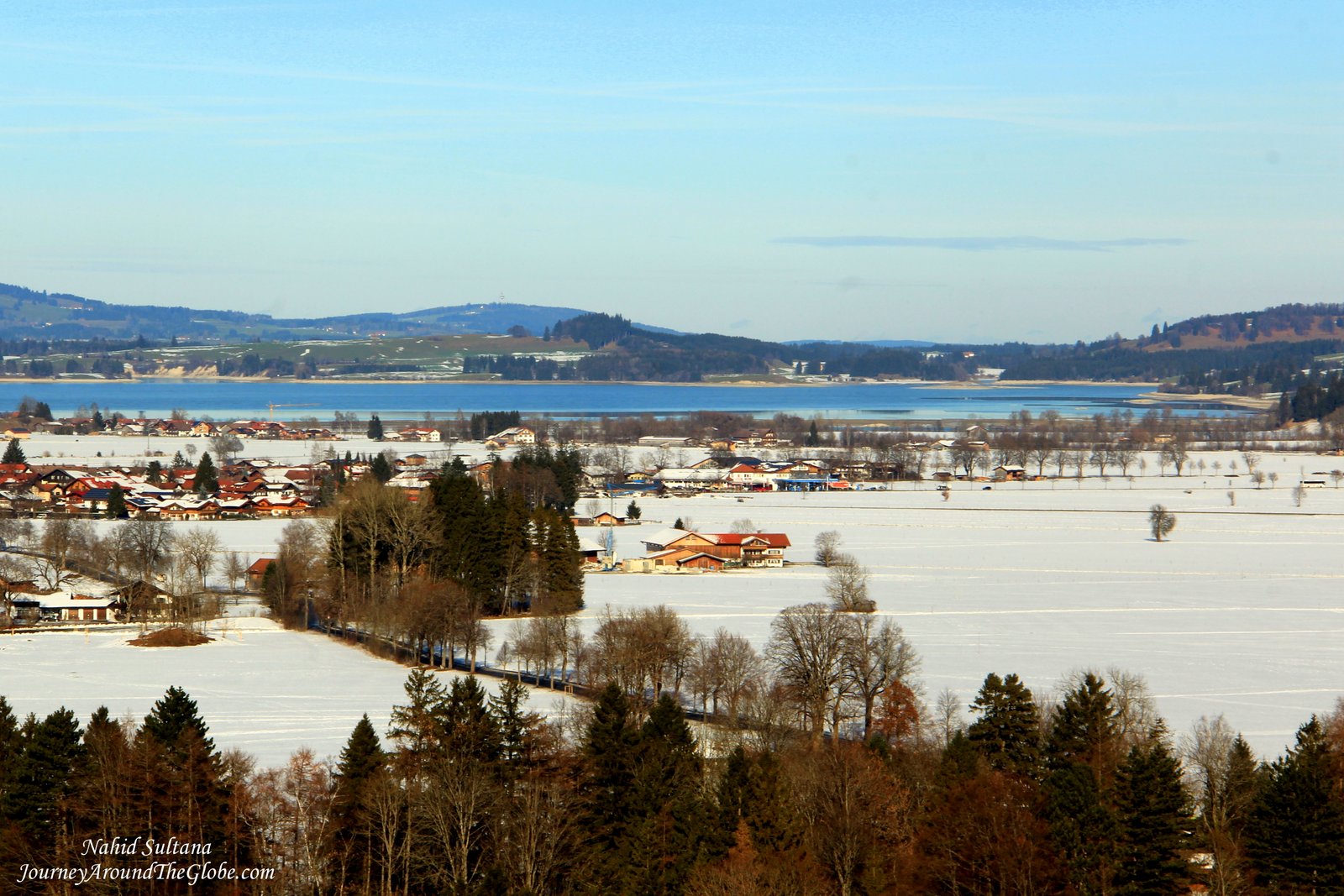
Other than the castles, there is also a museum, Museum of the Bavarian Kings, where we did not go. Also look around the visitor’s center while enjoying a hot drink (if you are there during winter), go to the city center of Schwangau (couple minutes of drive from here), or if you have time drive to the surrounding lakes or mountains, I am sure they offer tons of activities there too. Also to mention that this is the southernmost spot of the “Romantic Road” which run through Germany.

- Loved the wintry look of Bavaria…classic
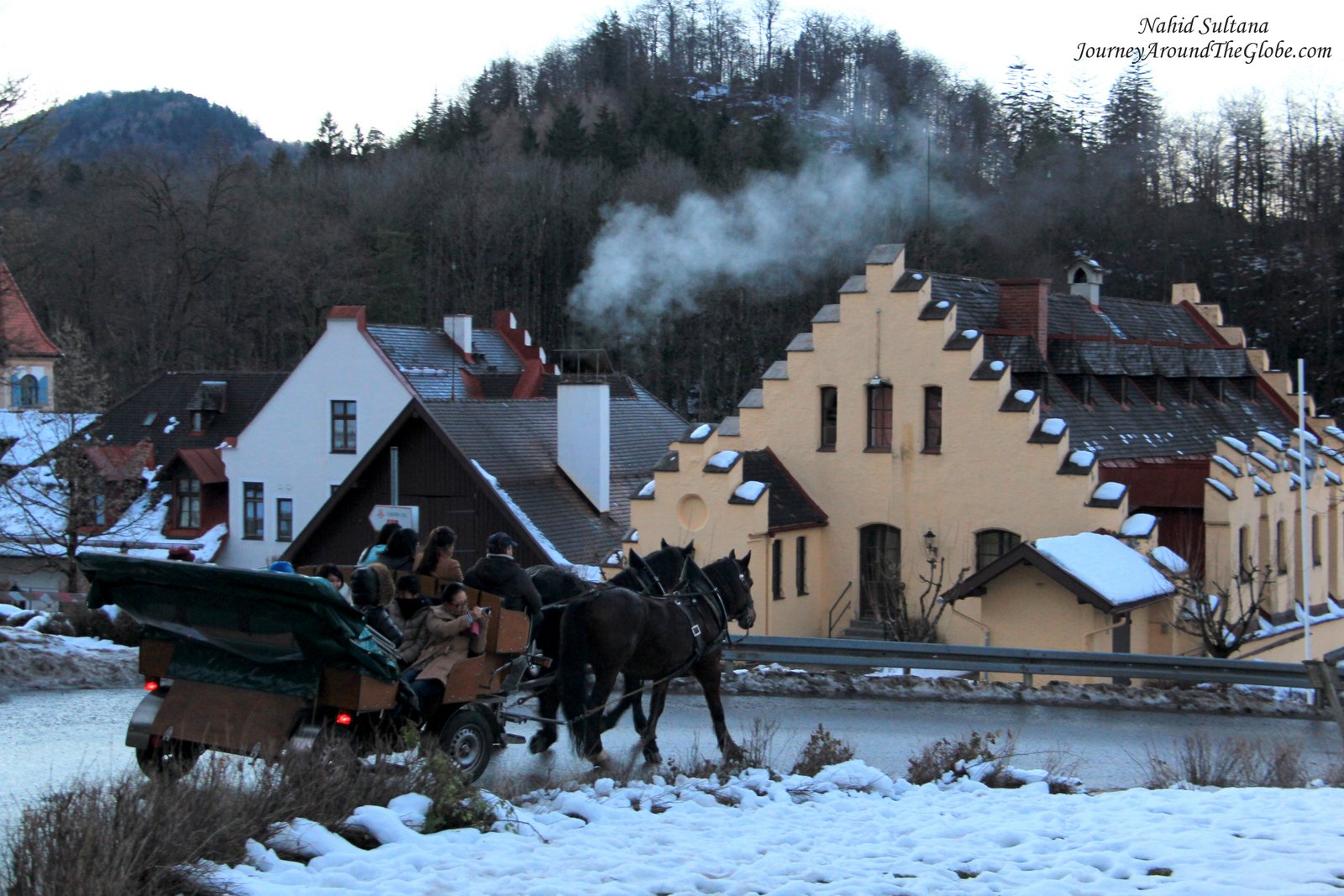
Hohenschwangau and Neuschwanstein castles stand on two separate small hills. There are total of 3 castles in this area, but only these two are accessible to the publics. We walked for about half an hour from Hohenschwangau Castle to go to Neuschwanstein Castle. Honestly, it was a bit hard for me to climb the long stretch of hill to go the 2nd one. If you have time and can wait for a horse-carriage, maybe it’s better and more enjoyable, but you still have to walk another 15 minutes towards the entrance after they drop you off on the top. But we didn’t have much time in between the tours of these castle, so we couldn’t stand in the long line for horse-carriage and had to rush to the other castle.

- The Alps and its reflection on Lake Alpsee in Fussen, Germany
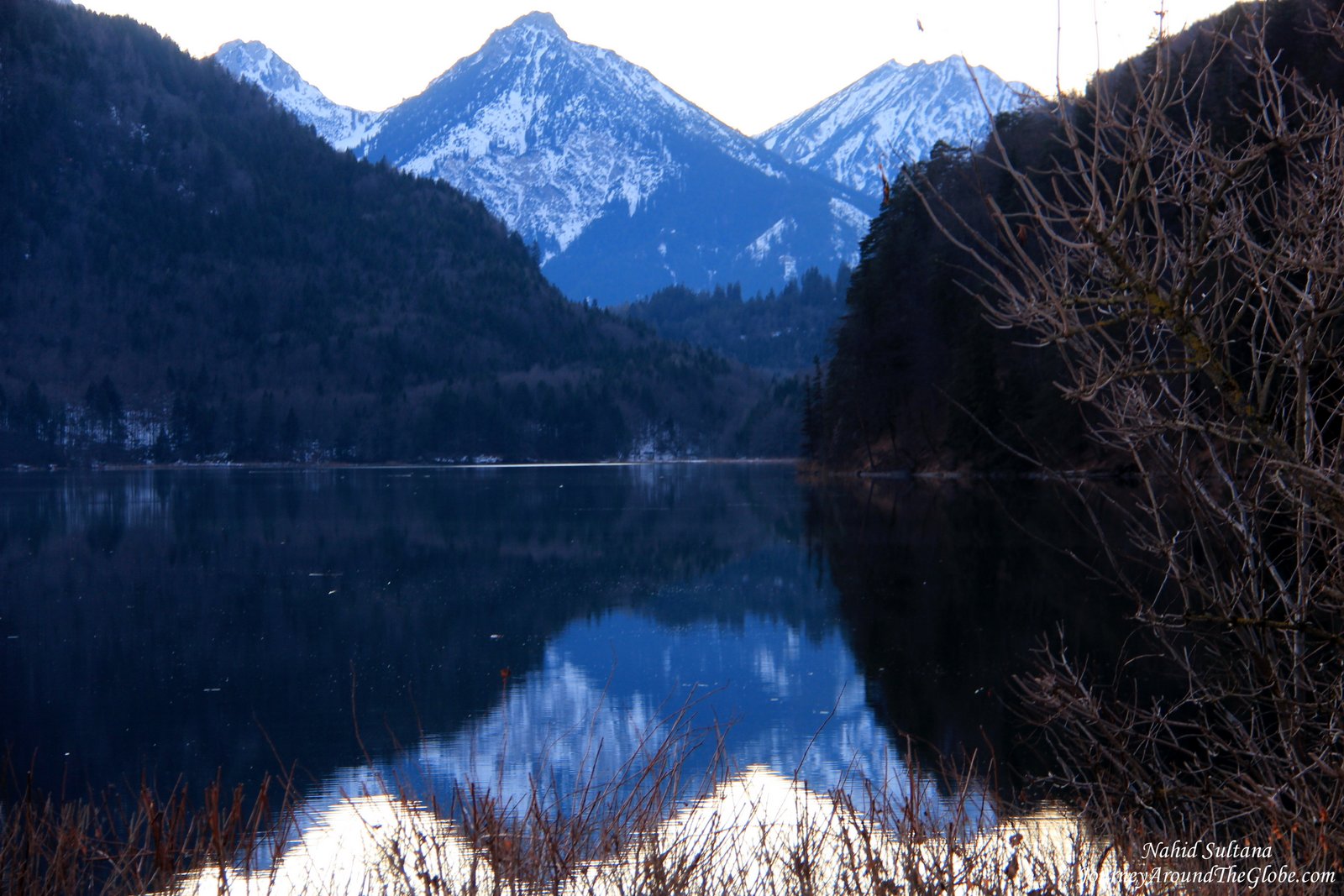
There is a big parking lot for the visitors of these two castles. There is also a beautiful lake, think it’s called Alpsee, by this lot where you can get a stunning view of portion of Bavarian Alps with its beautiful reflection on the water.
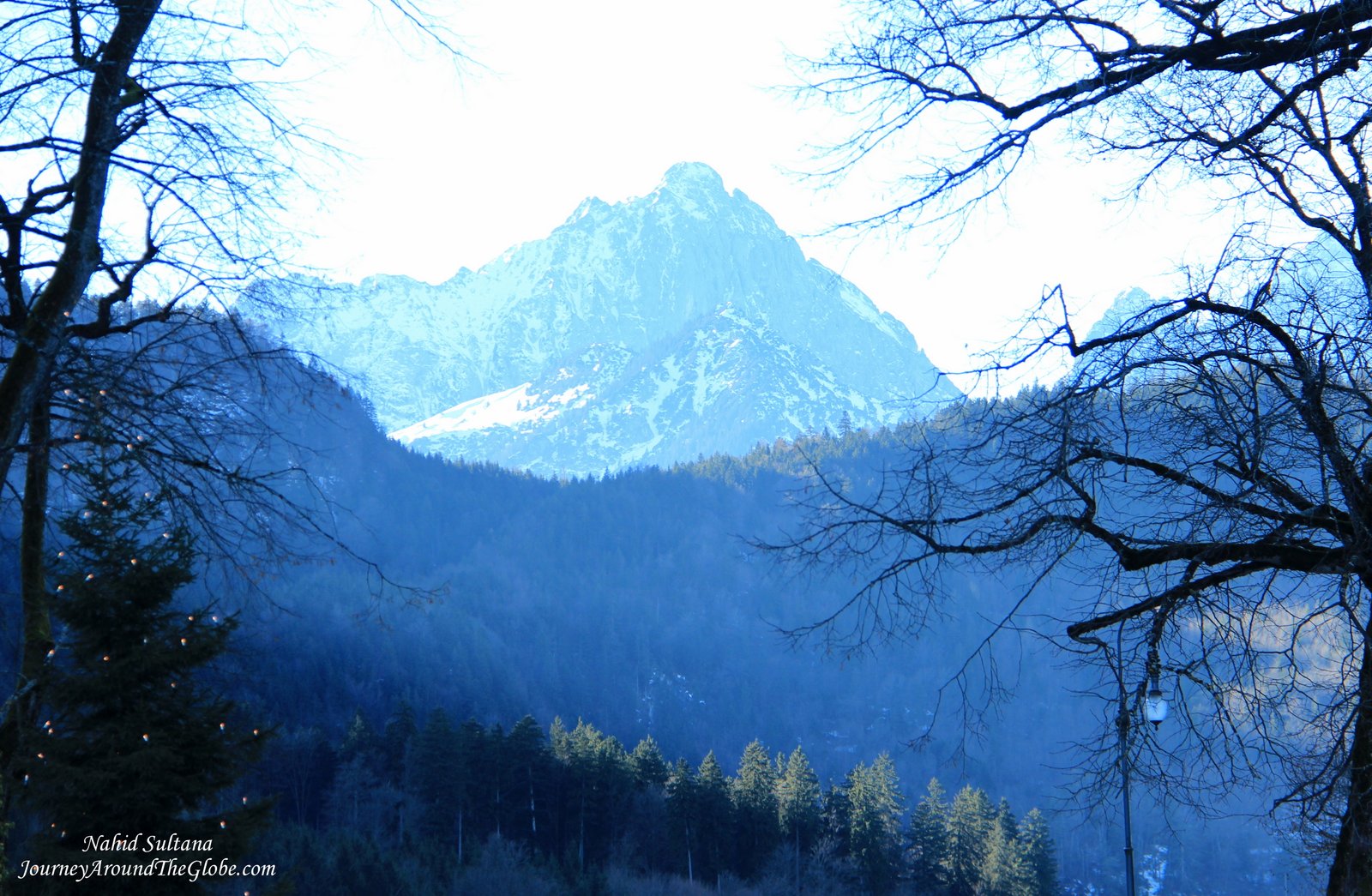
TIME of TRAVEL: During Christmas break of 2013, we took 2 weeks long road trip thru the Bavarian region of Germany and Austria, then to Czech Republic, and finally driving up north to end up in the eastern part of Germany. My uncle-in-law from Chicago was here with us for this wonderful trip. Visiting these two castles in Fussen, Germany was the first spot in our itinerary. It is a winter wonderland near the Alps in December. You can see snow on the ground, snow-capped mountains in the far distance, and skeletons of trees in the forests. It is a beautiful place to visit any time of the year. But don’t think you will find less crowded just because you are coming in winter. Everyone was bundled up and ready to enjoy the nature and history of this place.

- Mountains, mountains, and more mountains
EATING and SHOPPING: There are plenty of snack bars and restaurants near the tourist center of the castles. We actually picked up some sandwiches while going up the mountain towards Neuschwanstein Castle. But there were plenty sit-down and formal restaurants if you prefer that.
There were some souvenir stores in Hohenschwangau visitor center where you can get local t-shirts and etc. with some typical Bavarian items like beer mugs, wooly hats and gloves, sweet treat, and many more.
PLACES WE’VE VISITED: We reached Fussen around 10 in the morning and by the time we were done with both the castles and lunch in between, it was about 5pm. It was almost dark outside by then. But if the kids weren’t tired, maybe we could have spent some time in the surrounding areas before driving to our next destination…Innsbruck.
Please keep in mind that tickets for these below castles are not sold at the individual castles, rather in the visitor center. My husband actually booked them online way before our trip there. It is advisable to book tickets online else you run the risk of either standing in a long queue in the visitor’s center or missing out completely due to heavy crowd. You can visit either only one of the castles or both or a combo of both castles and the museum. Visit to these royal castles are only possible with guided tours and there are many different language tours available. Tours to both of this castles last about 30 to 45 minutes each.
1) HOHENSCHWANGAU CASTLE (SCHLOSS HOHENSCHWANGAU): This castle in the Southern Germany was built by King Ludwig II’s father King Maximilian II in the 19th century where Ludwig II spent his childhood with his family. The castle was constructed on an early fortress from the 12th century that was built by the knights. It served as their summer residence during the reign of King Maximilian II.
- Hohenschwangau Castle, built by King Maximilian II of Bavaria in southern Germany
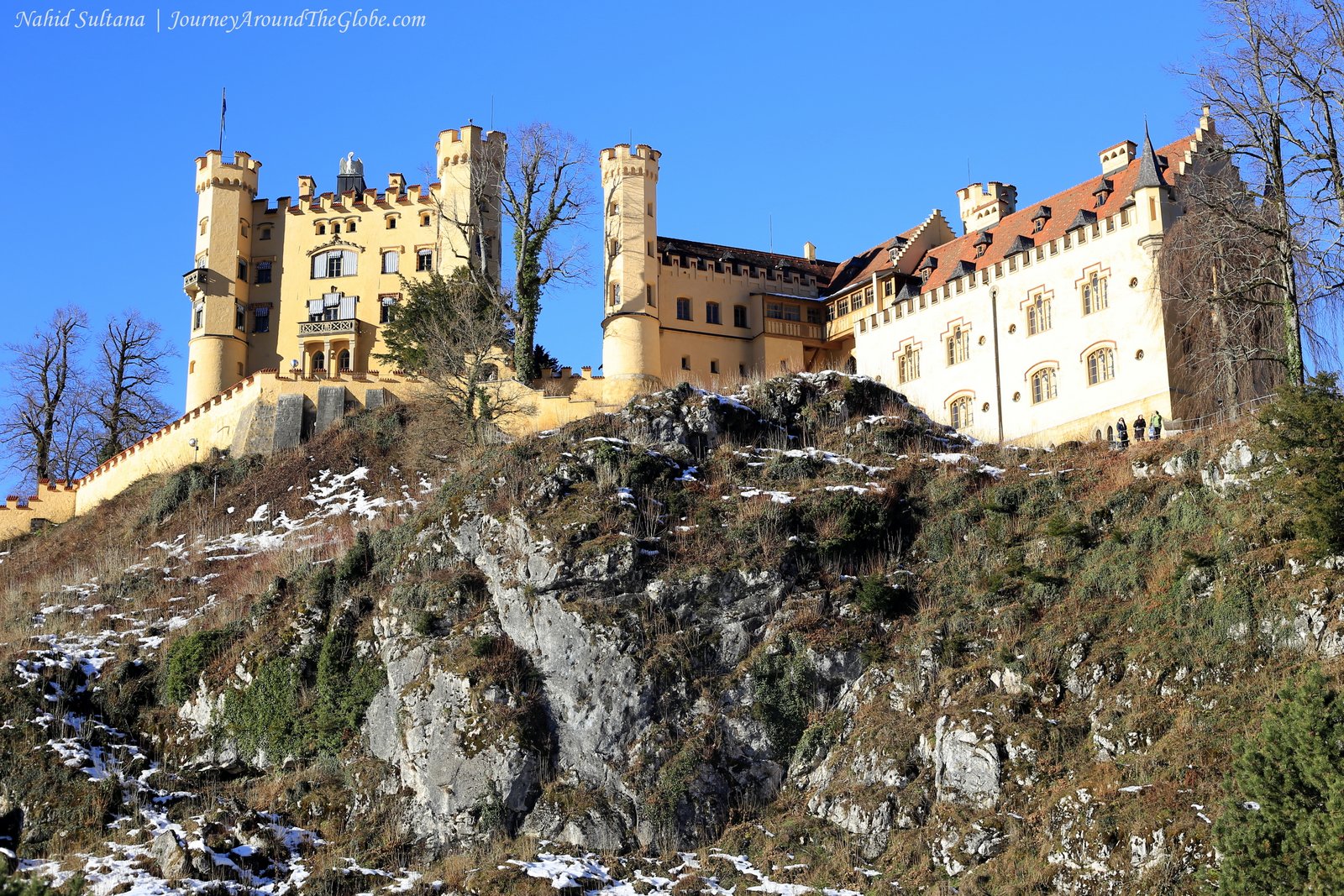
The castle is worth visiting for its new Gothic style façade, artistic ceilings, wall paintings, decorative pieces and furniture, portraits and wall frescoes from the mid-19th century, and the royal Banquet Hall. You can see the original billiard board in the Dining Hall from the early 19th century. Visitors can still see the antique items here since it didn’t suffer any damage during WWI or WWII.

- Inside Hohenschwangau Castle, the guide let me take only this picture

The castle is located in the village of Hohenschwangau in Fussen. The guided tour was for about 45 minutes and we were not allowed to take any pictures inside. But as I mentioned above, do plan to buy your tickets online or early to save a space for you.
2) NEUSCHWANSTEIN CASTLE (SCHLOSS NEUSCHWANSTEIN): This is the mother of all German castles and is the most photogenic castle of this country. Beautifully situated on the south Bavarian Alps surrounded by green forests, blue lakes, and snowy mountains, this is known to be the most visited castle in Germany. It is one of the most famous buildings in the world and a central symbol of German idealism. By the way, this castle was the inspiration for Disneyland’s Sleeping Beauty Castle.
- Neuschwanstein Castle, as seen from Hohenschwangau Castle

Directly opposite of Hohenschwangau Castle, King Ludwig II of Bavaria commenced this new castle in 1869 after his father Maximilian II died in 1864. The castle was built in Late Romanesque design in the style of late 11th or 12th century high above Ludwig II’s father’s Hohenschwangau Castle. Only one-third of it was completed and is still unfinished. Built and furnished in medieval styles, this castle was equipped with the latest technology of that time. Some of the halls and sections were inspired by Byzantine and early Christian churches.

- Entrance to Neuschwanstein Castle in Fussen, Germany
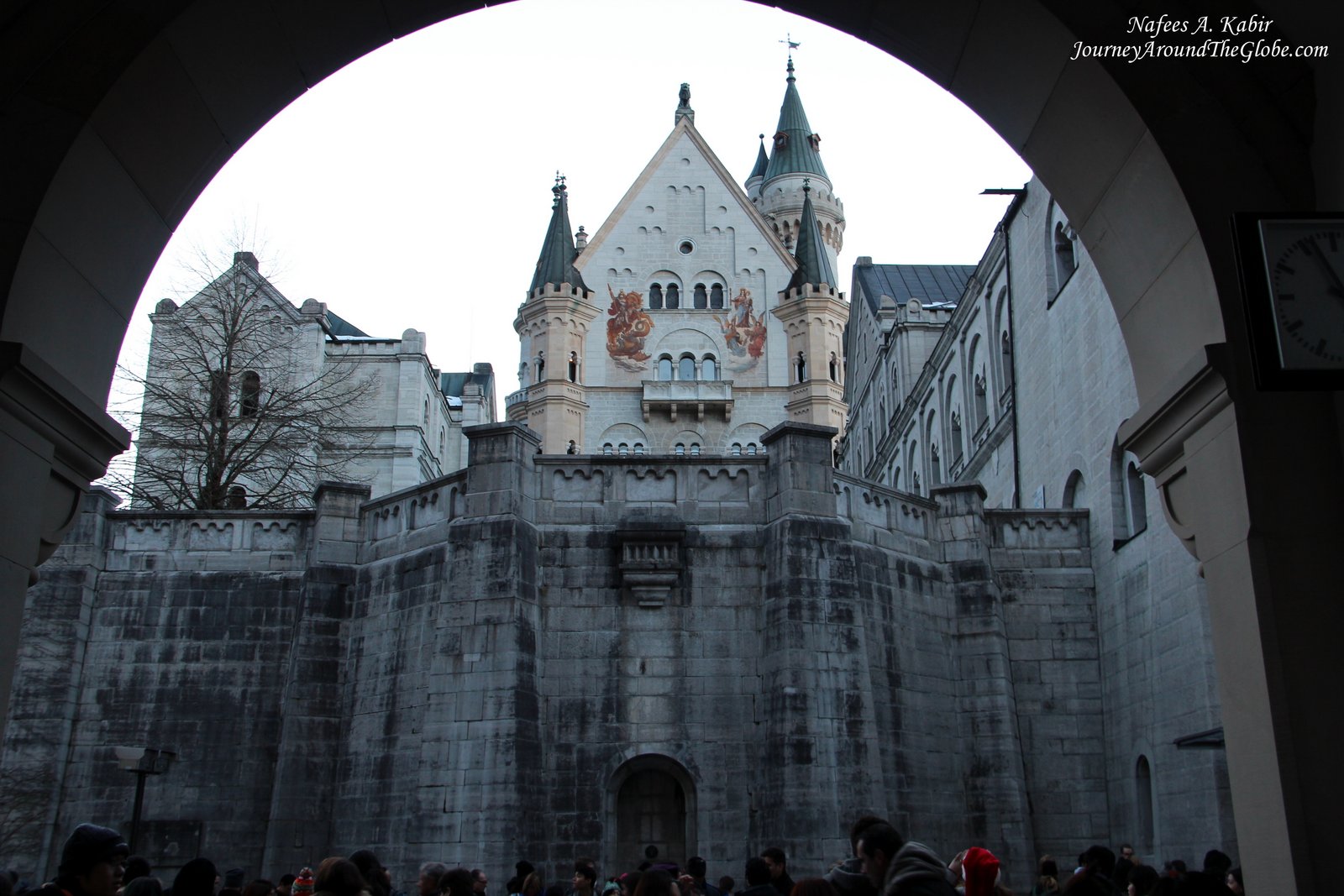
The history goes something like this, Ludwig II became king in 1864. Two years later he was forced to accept the defeat and domination of his country by Prussia. No longer a sovereign ruler, he was unable to cope with the role of a constitutional monarch. He created his own alternative world, in which as the reigning king of Bavaria he could live like a king of the Middle Ages or the Baroque age of absolutism. This is the idea behind his castles. On a ridge in a magnificent setting high above the Pollat Gorge with the mountains as a backdrop he built his new castle over the remains of two small medieval castles. It’s a pity that the king lived less than 200 days in this castle (I think, 176 days to be exact) before he was declared mentally ill and was sent to Munich for treatment where he eventually died (drowned) or was murdered; his death is still a mystery.

- Neuschwanstein Castle built by King Ludwig II of Bavaria in the mid-19th century in Fussen, Germany
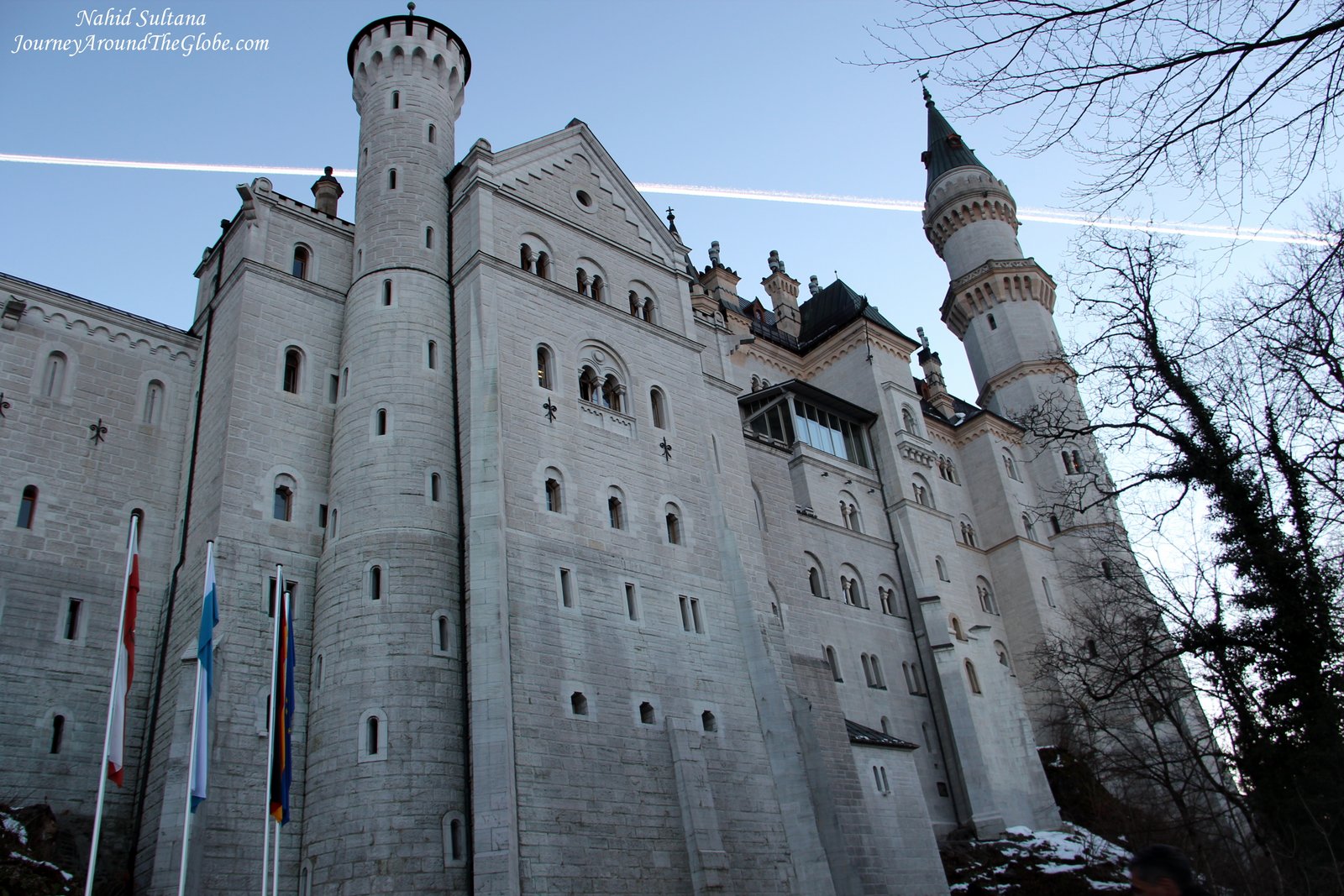
Neuschwanstein Castle is definitely more gorgeous than Hohenschwangau Castle. We saw couple chandeliers with precious stones, Moorish style ceilings, luxurious upholstery, detailed wood-curved doors and wall, and Gothic style King’s bedroom along with castle’s kitchen and other areas.
The walk from Hohenschwangau Castle to here is about 30-45 minutes (as I mentioned horse-carriage is also available). Make sure to buy your tickets ahead of time, doesn’t matter what time of the year you are visiting it. It’s only accessible by guided-tour and it lasts about 15-20 minutes, then you can roam around on your own for another 10/15 minutes.
Share this:

Visiting a Turkish territory in Cyprus
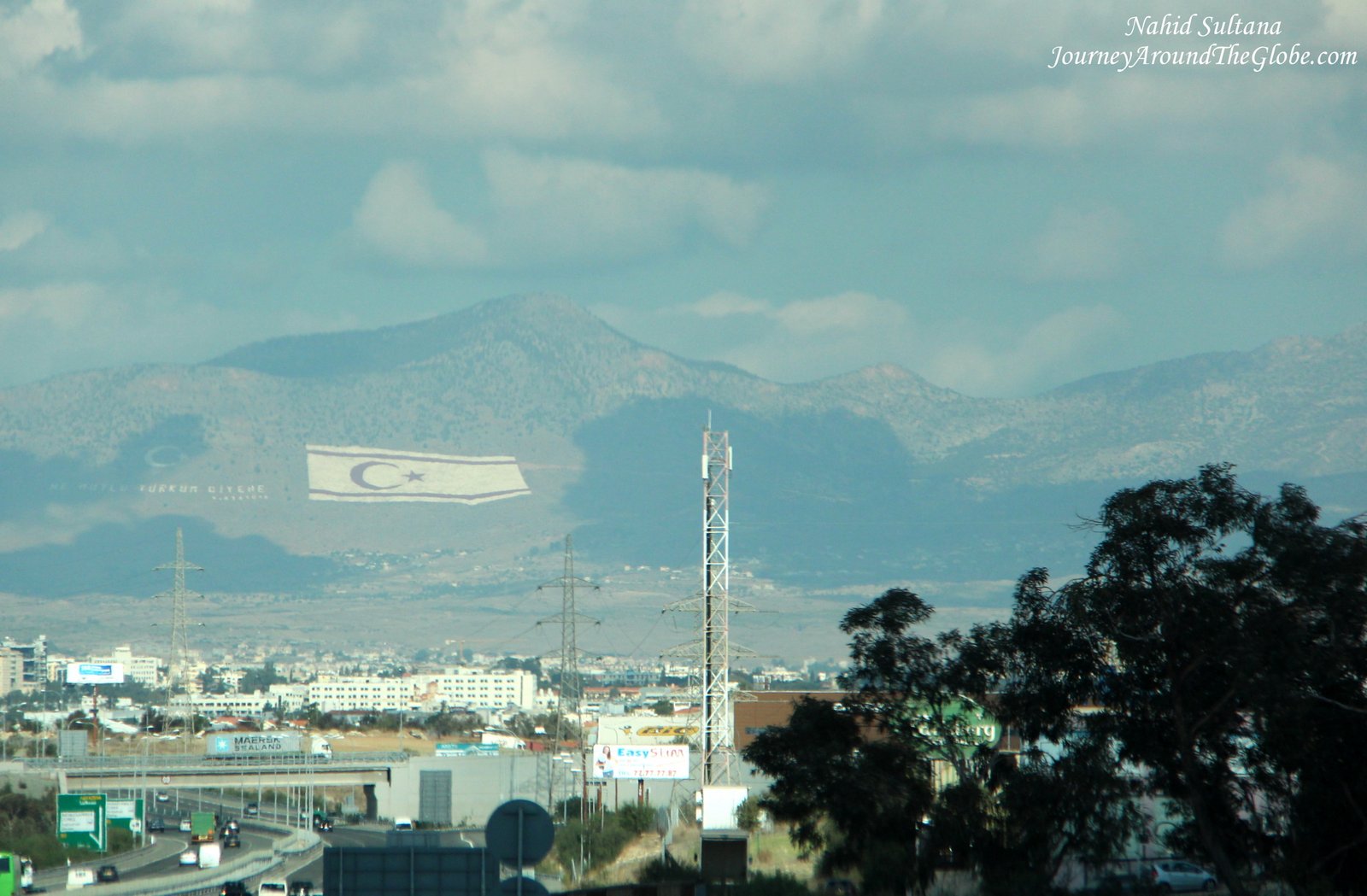
NORTHERN CYPRUS (or TURKISH REPUBLIC of NORTHERN CYPRUS): Sad but true that Cyprus is the only divided country in Europe and its northern part has been occupied by Turkish forces since 1974. Since then Turkey has been occupying 1/3 of this island and only Turkey recognizes this land officially calling it “Turkish Republic of Northern Cyprus”. Other countries and UN recognize this island as Republic of Cyprus and calls the Turkish side “Northern Cyprus or occupied Cyprus”. With proper documentation anyone can cross the border to go the northern part of Cyprus.
- Driving towards Nicosia, you can see a Turkish flag on the mountain
We spent a day in Northern Cyprus during our visit to Cyprus and got a little taste of Turkey in the northern part. Nicosia is the capital of Republic of Cyprus. Most of the tourists usually cross the border to go to the northern part on foot via Ledra Street for a day-trip and come back to the southern part. We parked our car in South Nicosia and walked to the border to go to the Turkish side. Northern Nicosia contains about half of the old city and this old walled city boasts of many attractions and heritage for its tourists.

- After crossing the border to North Nicosia in the old town
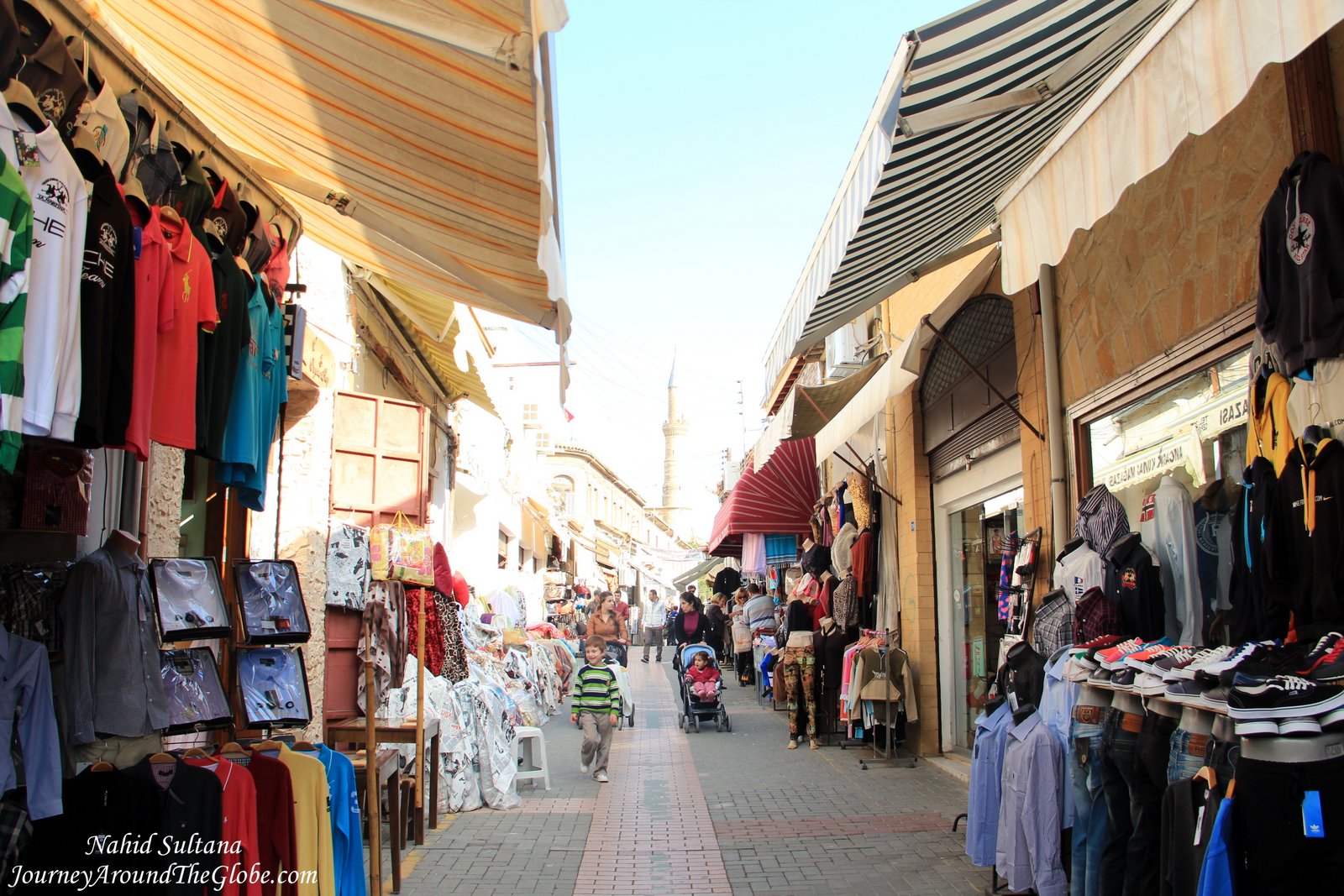
TIME of TRAVEL: We flew to Cyprus in December 2013 only for few days out of which we spent a day in the northern side. Weather is actually very pleasant in Cyprus in December, I guess being by the Mediterranean helps. It was a bit colder once in a while, especially after dark.
OUR HOTEL: Please see my page on Republic of Cyprus on the right-side bar to see which accommodation we used in Cyprus.
EATING and SHOPPING: When you are in Northern Cyprus/the Turkish territory, you can get a little bit everything that you would normally get in Turkey. Turkish delights, apple tea, potteries, wall décor, and small trinkets can be found in the old town of Northern Nicosia.
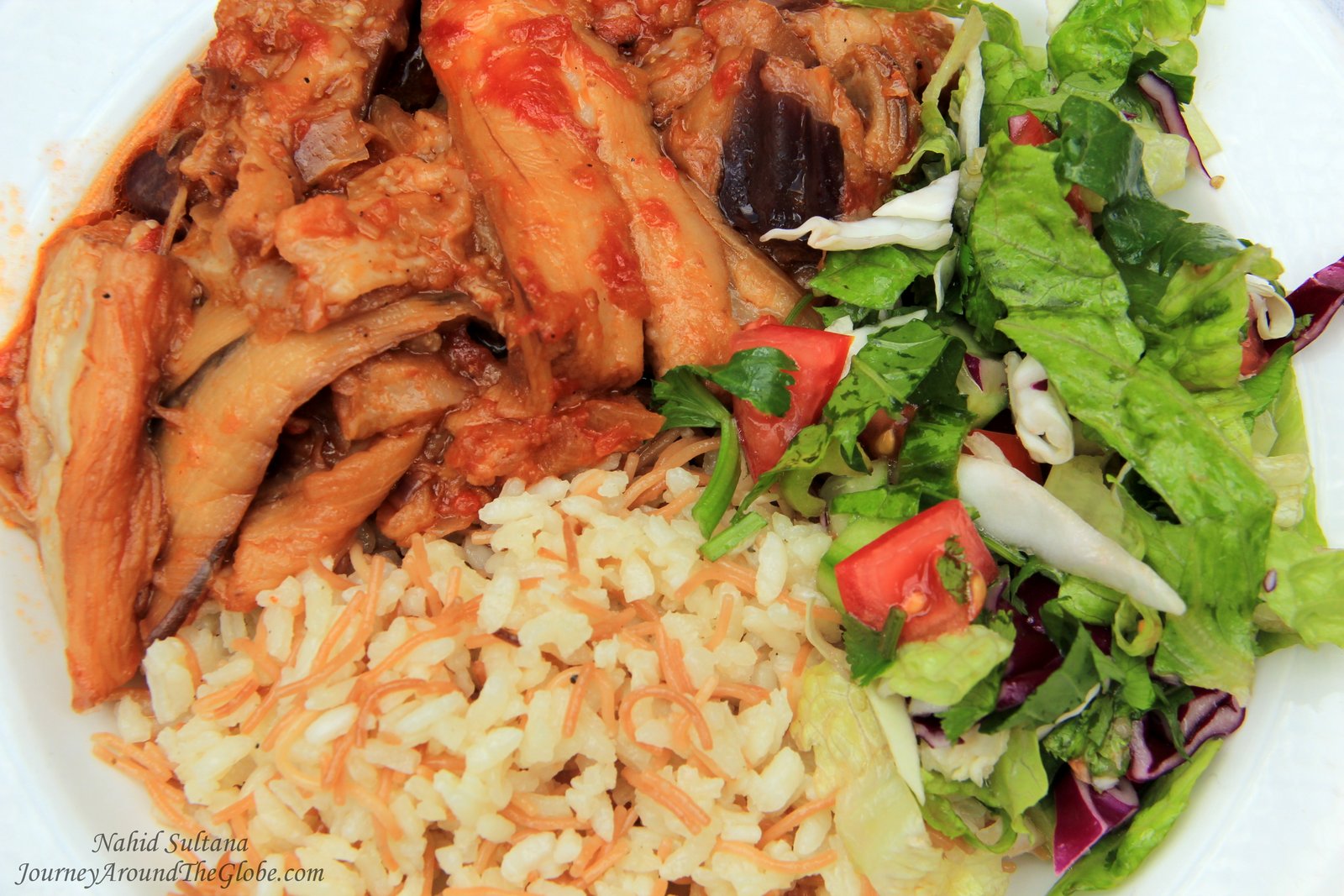
Dishes here are not very typical Turkish, nor Cypriot; they are more like blend of both. We had lunch in Muze Dostlari near Selimiye Mosque. They had very limited menu but had some good traditional food. I wanted to try moussaka but when I ordered it here, it didn’t look like the traditional Greek moussaka. I had moussaka which was more like a casserole but here the dish came with some cooked aubergine with Turkish style rice and salad. It was very tasty but just looked different. My girls had rice with Turkish style meat-balls, very well too.

- My lunch in Northern Cyprus – moussaka, Turkish style???
PLACES WE’VE VISITED: After crossing the border to Northern Cyprus, we spent few hours here, mainly staying in the old town and visiting sites within the wall. You can cover the old part on foot very leisurely, it’s small and very well marked.
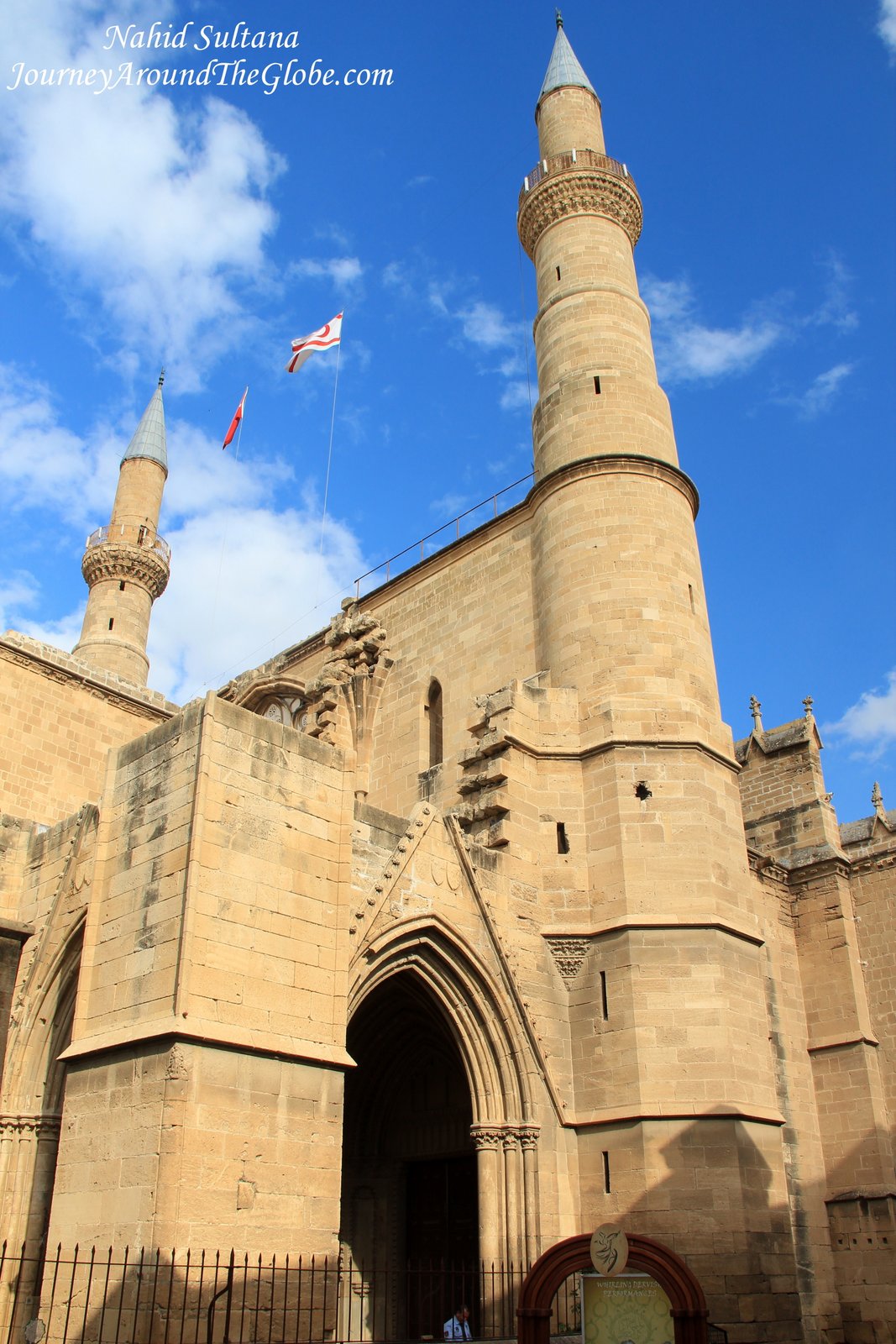
1) SELIMIYE MOSQUE: As locals call it Selimiye Camii, was once known as St. Sophia Cathedral. This is a top attraction of Northern Nicosia and a must-visit landmark. This fortress-looking mosque was built from 1208 – 1326. It was converted to a mosque in 1570 during Ottoman’ time and two minarets were added then. This is still an active mosque, therefore no visitors are allowed during prayer time. It’s a beautiful masjid/mosque inside and outside, especially loved the courtyard.

- Selimiye Mosque from the 13th century, one of the top landmarks of Northern Cyprus
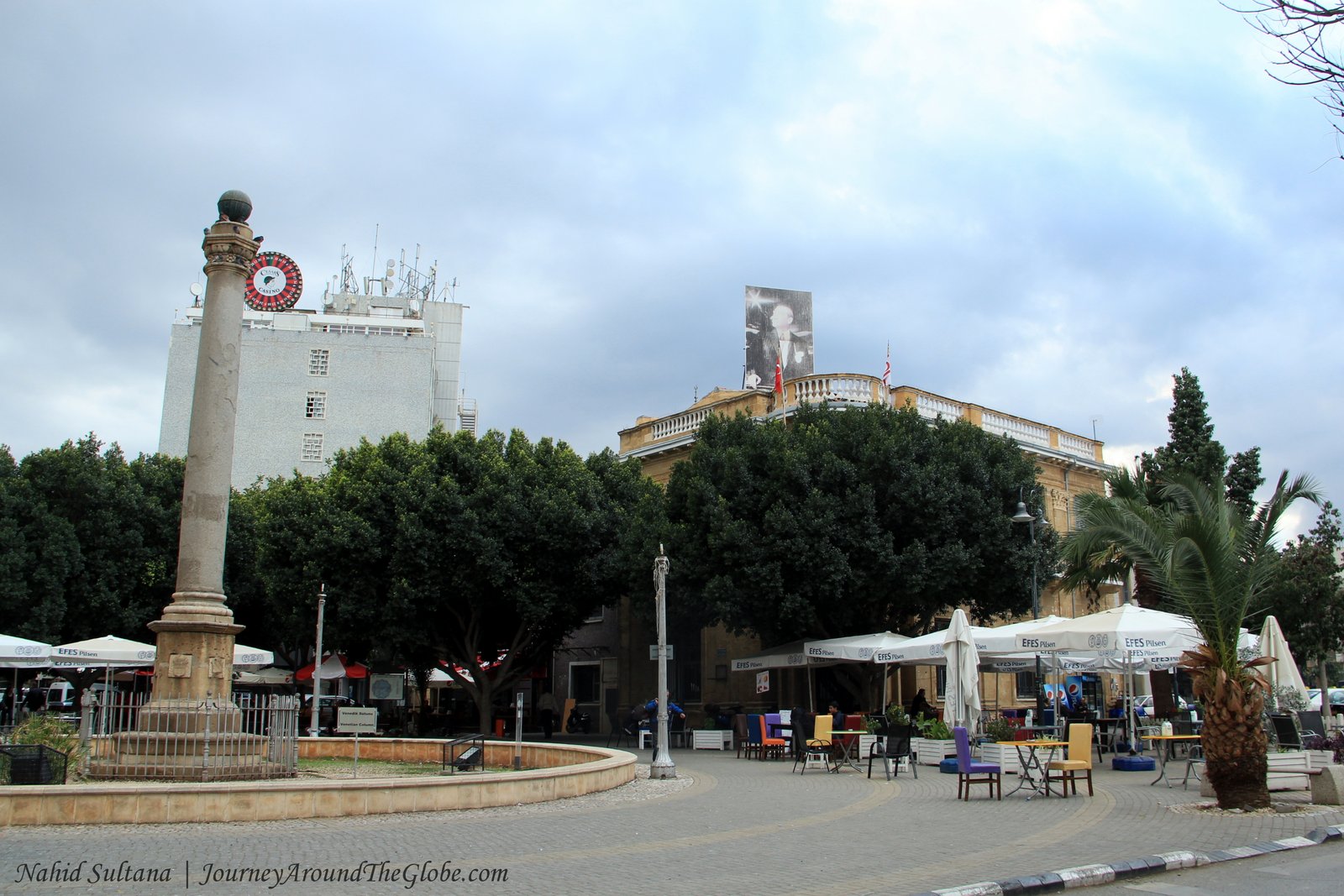
2) ATATURK SQUARE: This is the main square and supposed to be heart of the city. Don’t be disappointed by its simple and dull look. A thin medieval Venetian columns stands in the middle of the square surrounded by pedestrian walking zones. Historic judicial building is in one side of the square.

- Ataturk Square
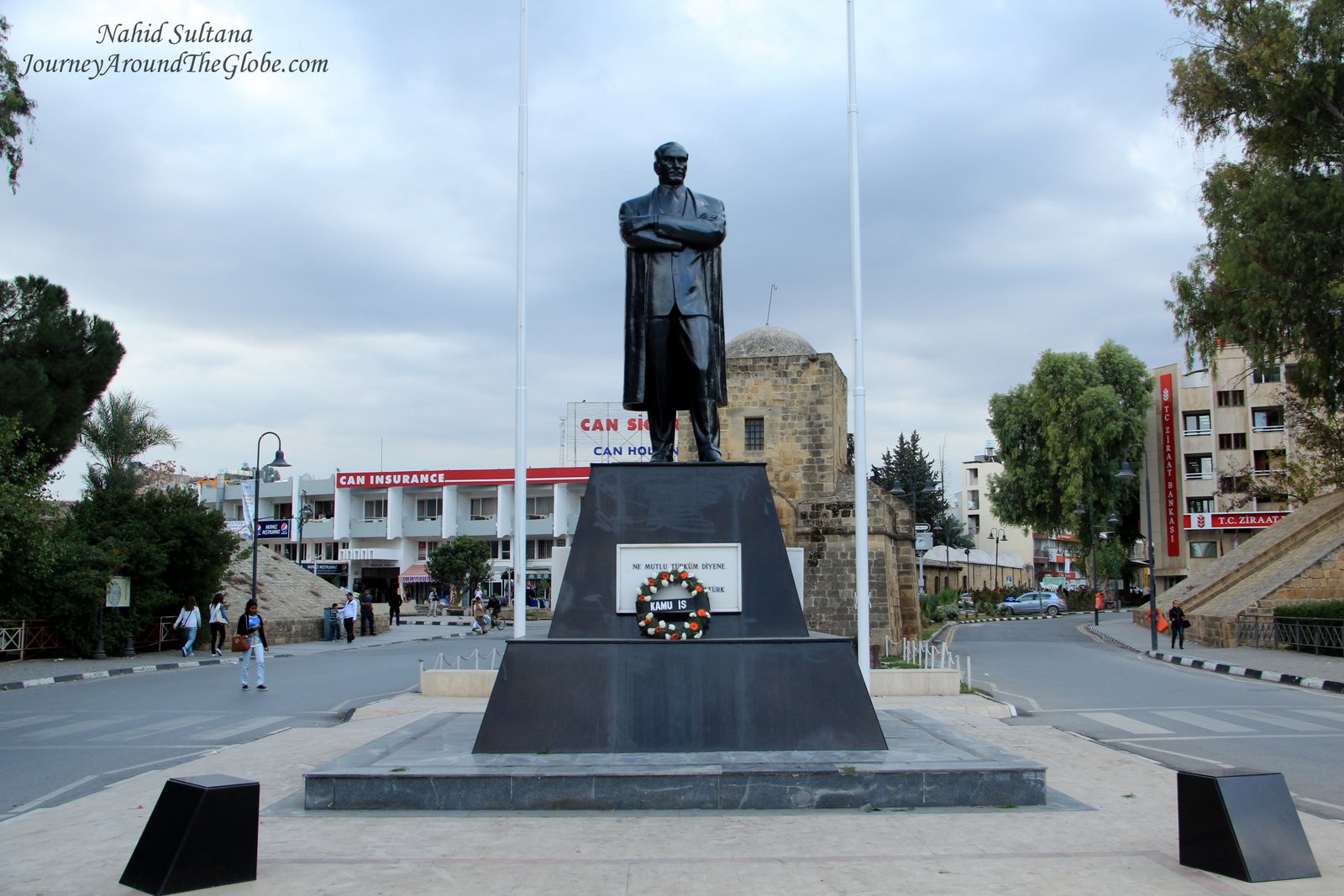
3) KYRENIA GATE: This is one of the original gates of the city from the Venetian time in 1567. A statue of Kamal Ataturk stands facing the big street in front of it.

- Kyrenia Gate from the 16th century with statue of Kamal Ataturk in Northern Cyprus
4) SAMANBAHCE HOUSES: This is a must-visit place in Northern Nicosia. You can see traditional Turkish Cypriot architecture and houses in this small neighborhood. The houses and streets are very well persevered and were decorated with fresh flowers and plants.
Originally, Samanbahce is thought to have been one of several gardens used by the residents of the Walled City. As the demand for housing grew, Samanbahce was developed into a social housing complex. Approximately by 1894 this was partially built and functioning as social housing. The whole construction was done in phases and was completed in 1955. This was the first known social housing to have been constructed in Cyprus and consists of 72 separate units along 5 rows parallel to Kyrenia Avenue.

- Traditional Turkish Cypriot architecture and houses of Samanbahce neighborhood
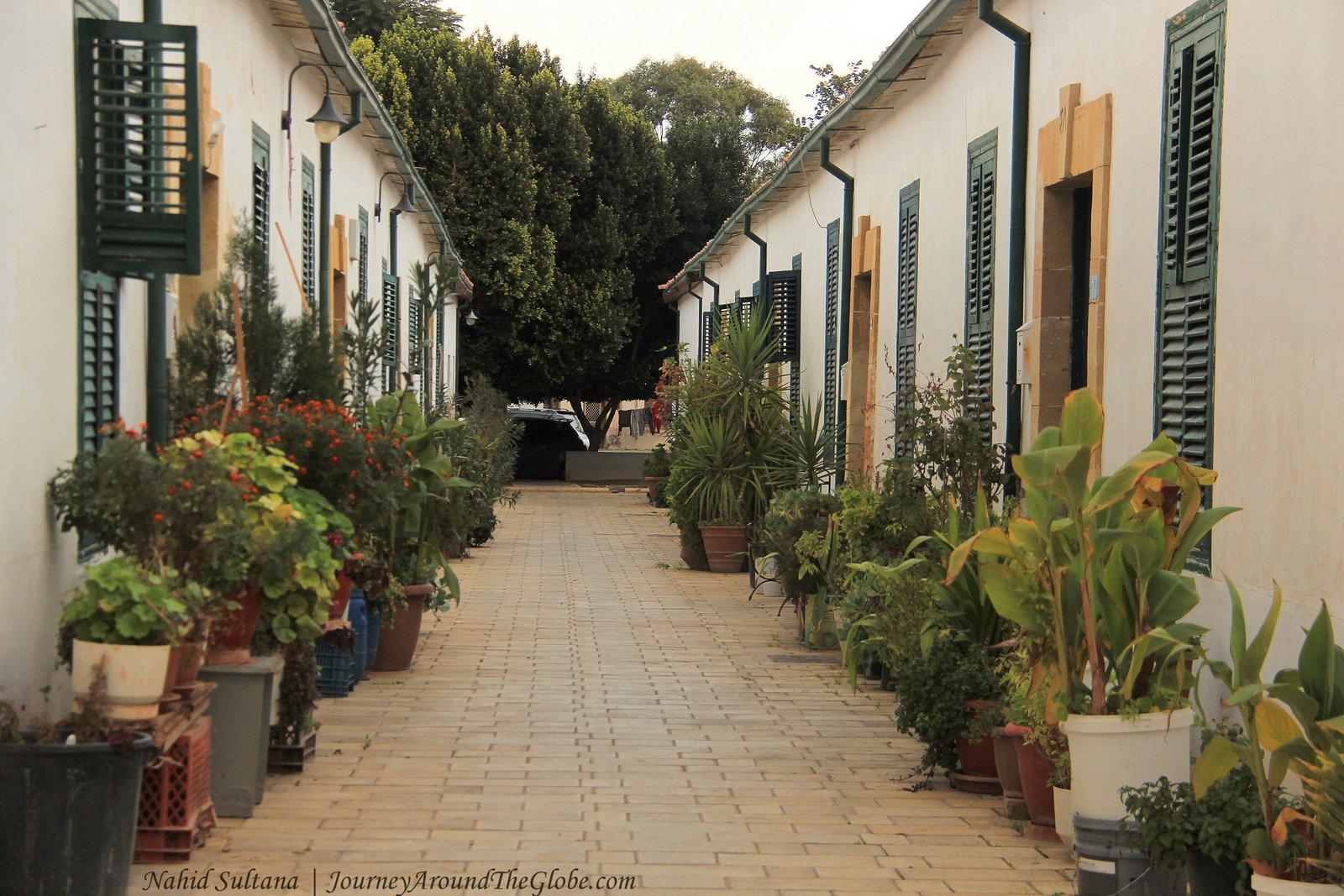
Samanbahce Area covers about 2000 square meters and is located on the northern edges of the walled city of Nicosia, very close to Kyrenia Avenue, and to the bastion of Quirini. It’s a unique neighborhood with much defined geometric narrow roads and units of one story mud-brick construction with red-tiled roof. A large fountain is located in the core of the estate while a large open space (parking and playground for children) can be found in the northern corner.
5) BUYUK HAMAM or GRAND TURKISH BATH: This building was once St. George of Latin’s Church. Built about 500 years ago, it is still an active place for relaxation. The hamam is open every day from 9am, for both men and women but only for customers, not for tourism purposes.
6) BUYUK HAN (THE GREAT INN): Built in 1572, this is one of the most important architectural works of the Turkish period in Cyprus. The “Han”, which was built to provide accommodation for travelers from Anatolia, Turkey and other parts of Cyprus. Presently it’s a nice place to do some souvenirs hunting and have some Turkish drinks or light snacks and enjoy the enclosing architecture of it. We sat down for some Turkish apple tea in the late afternoon after getting some small gift items from the downstairs shops.
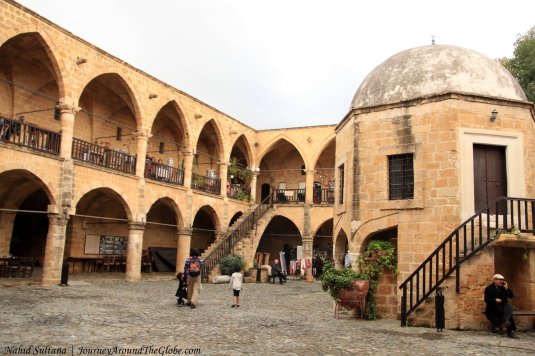
- Buyuk Han (Big Inn) from 1572 in Northern Cyprus
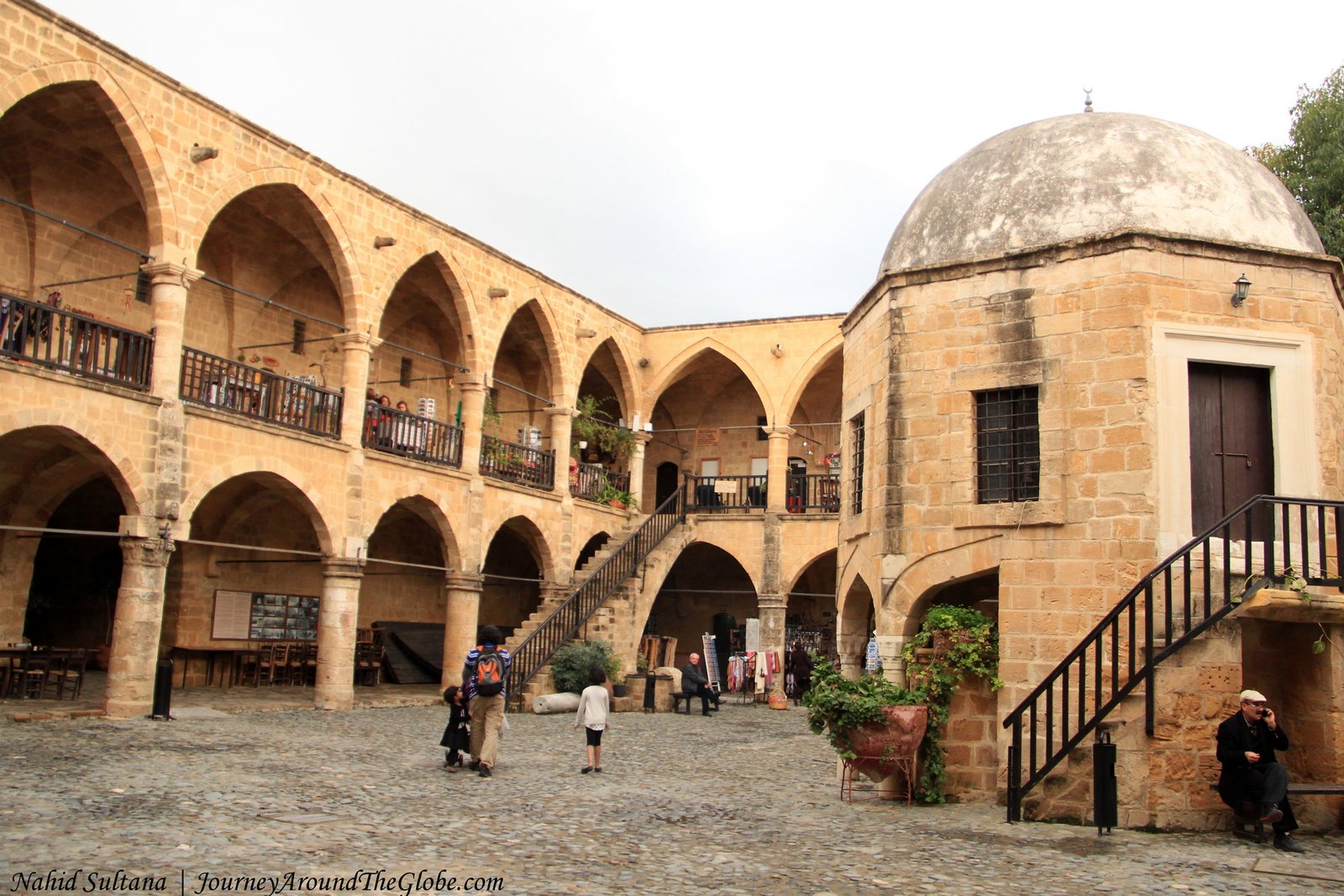
The Buyuk Han (Big Inn) is located in the traditional market center, within the city walls of Nicosia. The stone-paved square has two-story Buyuk Han that consists of 68 rooms which open to the vaulted galleried surrounding a square planned inner courtyard, and few shops which open to the outside of the Han. An Ottoman Masjid stands on marble piers, with a fountain (used for ritual ablutions) beneath, in the center of the courtyard. It has two entrances: east and west.
Share this:

Visiting birthplace of “Aphrodite” – Cyprus
REPUBLIC of CYPRUS: Cyprus, the birthplace of Greek goddess Aphrodite, is the third largest island in the Mediterranean. It’s an island of sun, sea, sand-white ancient temples, scenic sites, and cool mountain resorts. Cyprus can offer its visitors picturesque pine-clad mountains, golden sun-kissed beaches, modern cosmopolitan towns, tranquil and timeless villages, and genuinely welcoming Cypriots. I love visiting islands and this was just one of those perfect island spots that kind of reminded me of my trip to Santorini.

- Houses on the mountains in Cyprus
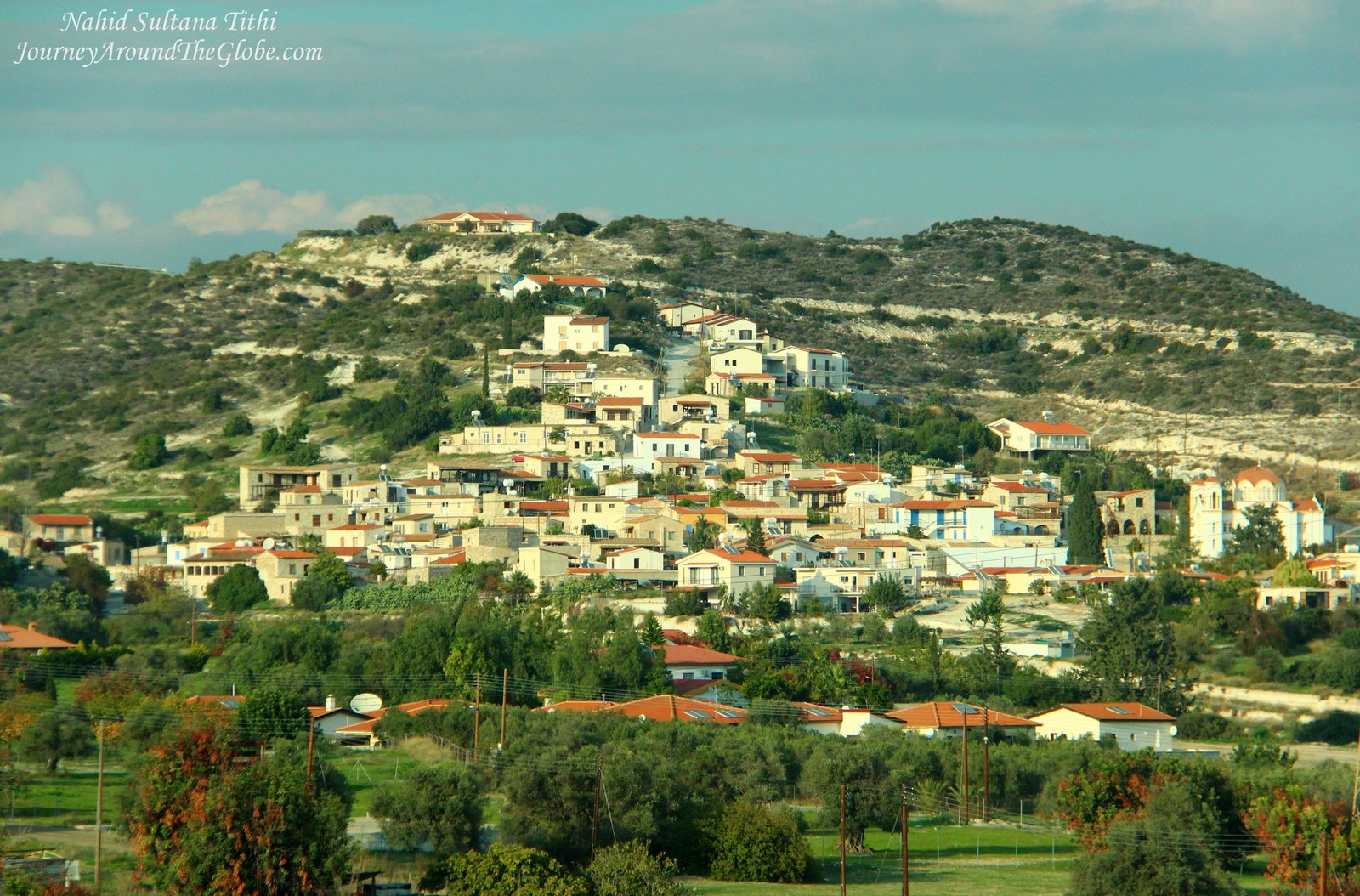
The strategic position of Cyprus attracted the first Greeks, who came to the island over 3,000 years ago at the end of the Trojan War. After that, over the centuries Cyprus came under the sway of various rulers including the Egyptians, Assyrians, Persians, Romans, Crusaders, Venetians, Ottomans, and finally the British. In July of 1974, Turkey invaded Cyprus. Since then Cyprus is the only divided country in Europe. You can go to the Turkish occupied side or as the Cypriots say “Northern Side” with proper documents and enjoy a little piece of Turkey there.
We rented a car from Paphos airport to get around the island and this is probably the best way to hop from town to town here. Cyprus can be a small island but don’t underestimate its seductive beauty and luring history. Cyprus is a beautiful country and has the capability to attract any sort of tourists from photographers, nature wanderers, winter-sports lovers, swimmers, food and culture hunters, those who are into Greek myths, to those who just want to be lazy and lay flat on the sandy beach by blue water and surrounded by hundreds of green palm trees. You can spend weeks in this island and will still find things you haven’t experienced before. Too bad we stayed only for few days but I can imagine myself going to some of the unseen places in Cyprus and the joy they would have brought me.
TIME of TRAVEL: It was in the beginning of December, 2013 when we flew to Paphos, Cyprus. Going from Belgium, I felt blessed to be in warm weather. Although it can be a bit cold after dark or really windy and chilly up in the mountains, Cyprus was still a perfect place to visit when most of the parts of Europe put on their greyish wintry looks. Beaches around this time of the year are less crowded but Mediterranean water is perfect for swimming. Sometimes it does snow in the mountains in December or January but don’t have to worry about that in the big cities.
OUR HOTEL: Unlike my hotel in Edinburgh (which didn’t have any toilette inside the room and where I could hear a baby crying for the whole night in the next room), this hotel in Cyprus was actually some 4-star hotel with fancy lobby, spacious room, furnished balcony, and ocean-view. Oh yeh, cause I wasn’t traveling alone this time, so more reason to pick a hotel with best reviews. The hotel was Mediterranean Beach Hotel in Limassol. It was like a grand resort by the blue water. Breakfast (lot of options…was really nice) and Wi-Fi were free. The hotel had a private entrance to the beach but the beach was accessible by anyone.

- Blue Mediterranean in front of our hotel in Limassol, Cyprus
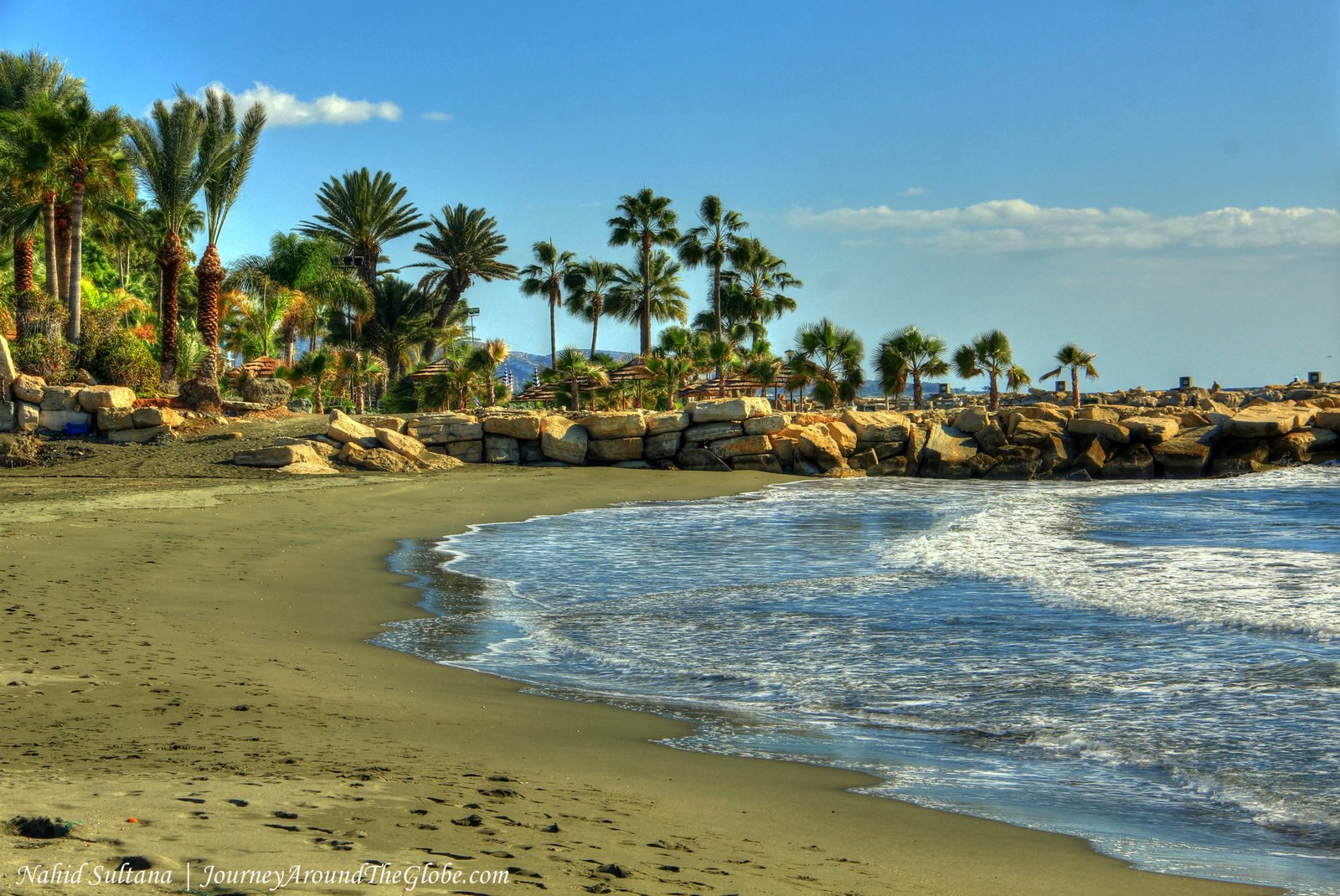
Staying in Limassol also made it easy and saved us time in commuting to different parts of this island, since it’s almost in the middle of the island and all the other towns were about an hour drive from Limassol.
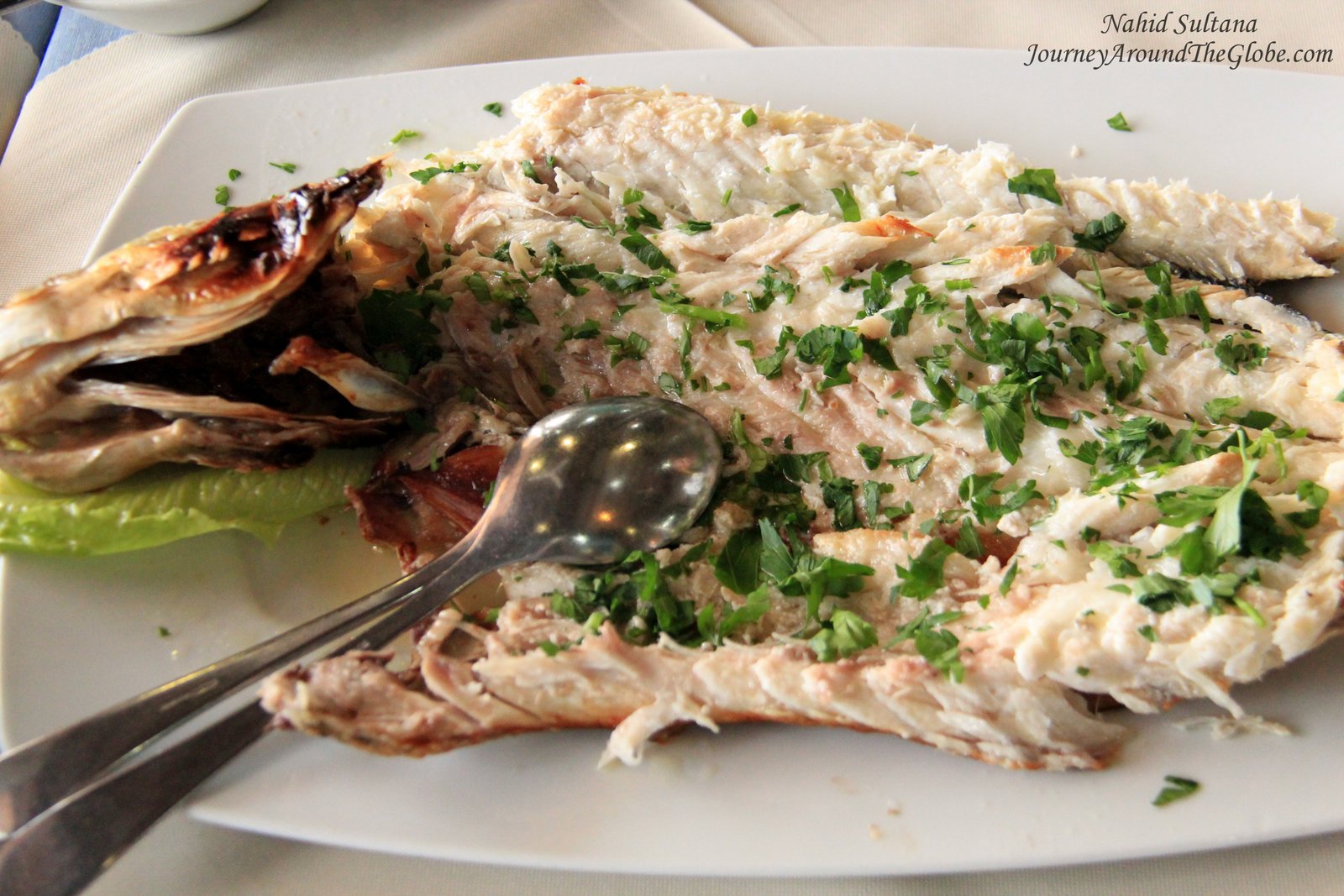
EATING and SHOPPING: Cyprus has a wide range of restaurants and fast-food places from local cuisines to any other international kitchens. I thought we would find more of Greek food here. I found some but not many and some similar Greek dishes have different names. I saw many Pizza Hut, McDonald’s, KFC, and Subway here and there. Our first lunch was in Limassol old town in a restaurant called “Caballeros” right in front of Limassol Castle. A row of restaurants can be found here, usually offering traditional food with some other international cuisines. Try Cyprus’ local cheese Halloumi which is very tasty. I had a very well-known Cypriot soup called “Afgo-Lemoni” which is made with chicken, lemon, egg, and rice…had a fantastic lemon scent to it. On our third day in Cyprus, some of our family friends treated us in a fish tavern called “Kastro Tavern” in Paphos Harbor. If you have a weakness for sea-food, Paphos is probably one of the best places to enjoy freshly caught seafood with beautiful view of the harbor.

- Grilled sea-bass, our last portion of lunch by Paphos Harbor
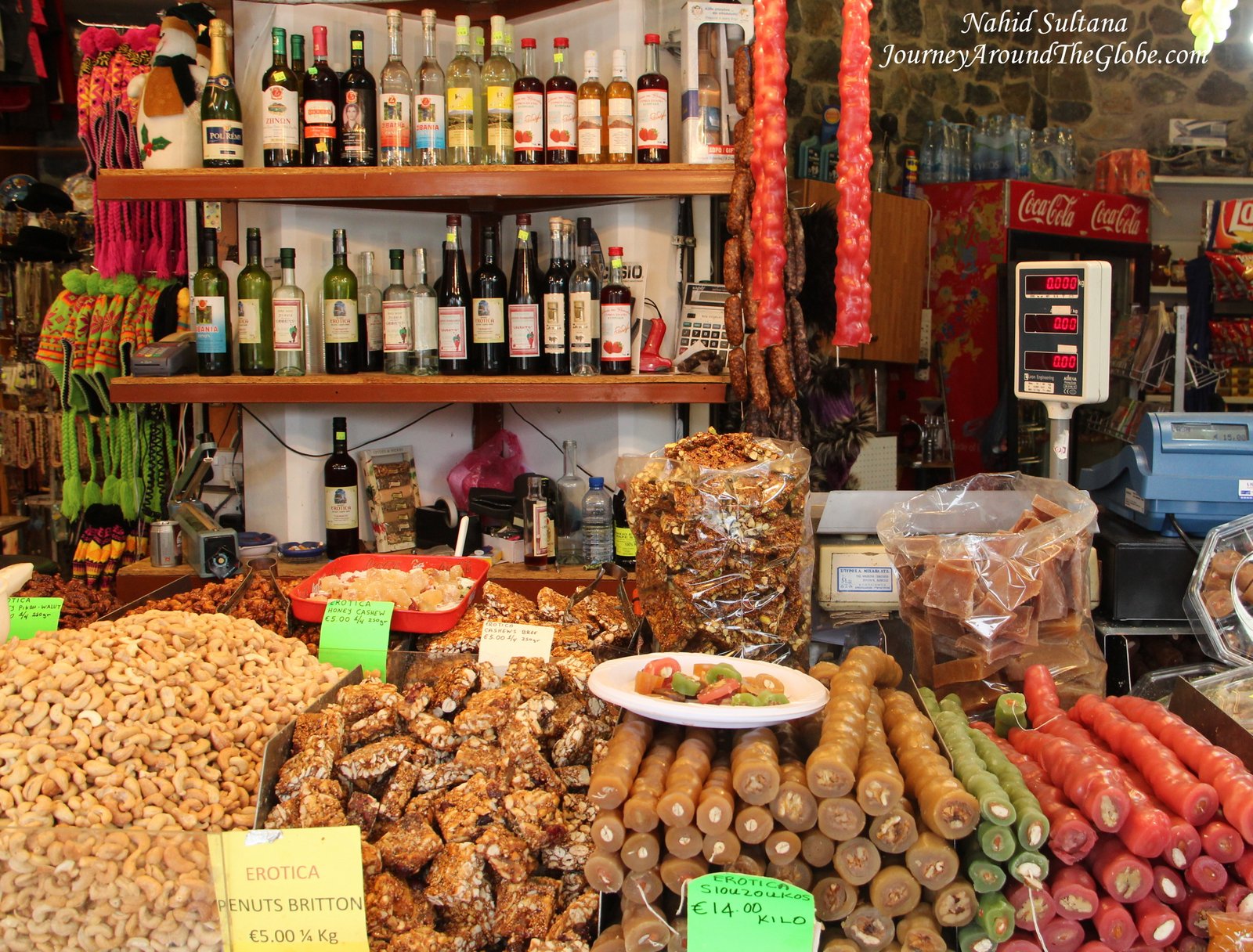
For shopping, village of Lefkara is very famous for the lace-like embroidery which is a very traditional and famous souvenir of Cyprus. One of the famous designs they do on fabric is inspired by Leonardo da Vinci art. Lefkara is also known for silver artifacts and local delights. Limassol old town also has a small market place near the castle where you can find some local trinkets and generic souvenirs.
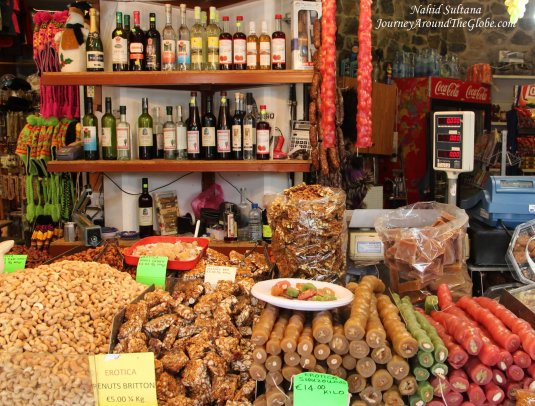
- Some typical Cypriot treats and delights in Troodos Mountains
PLACES WE’E VISITED: We spent total of two days in Southern Cyprus and one full day in the Northern part which is occupied by the Turkish now. Some of the towns here are small and can be combined with other nearby places. Renting a car definitely was the way to go here. Visiting these big and small cities were fun but half the entertainment was to drive by scenic highways and get to these small places.
1) LIMASSOL (LEMESOS): Since we stayed in Limassol, we decided to roam around Limassol on the first day. This is the 2nd largest city of Cyprus. The city is thriving with busy shopping centers, countless taverns, restaurants, and grooving nightlife.
Our first stop was Limassol Castle. Located in the historic city center of Limassol, the purpose of this castle was to guard and protect both the port and the city itself. The present edifice dates back to the Ottoman period, 1590. But archeological evidence indicates that it existed during the Byzantine period too.

- Inside Limassol Castle in Cyprus
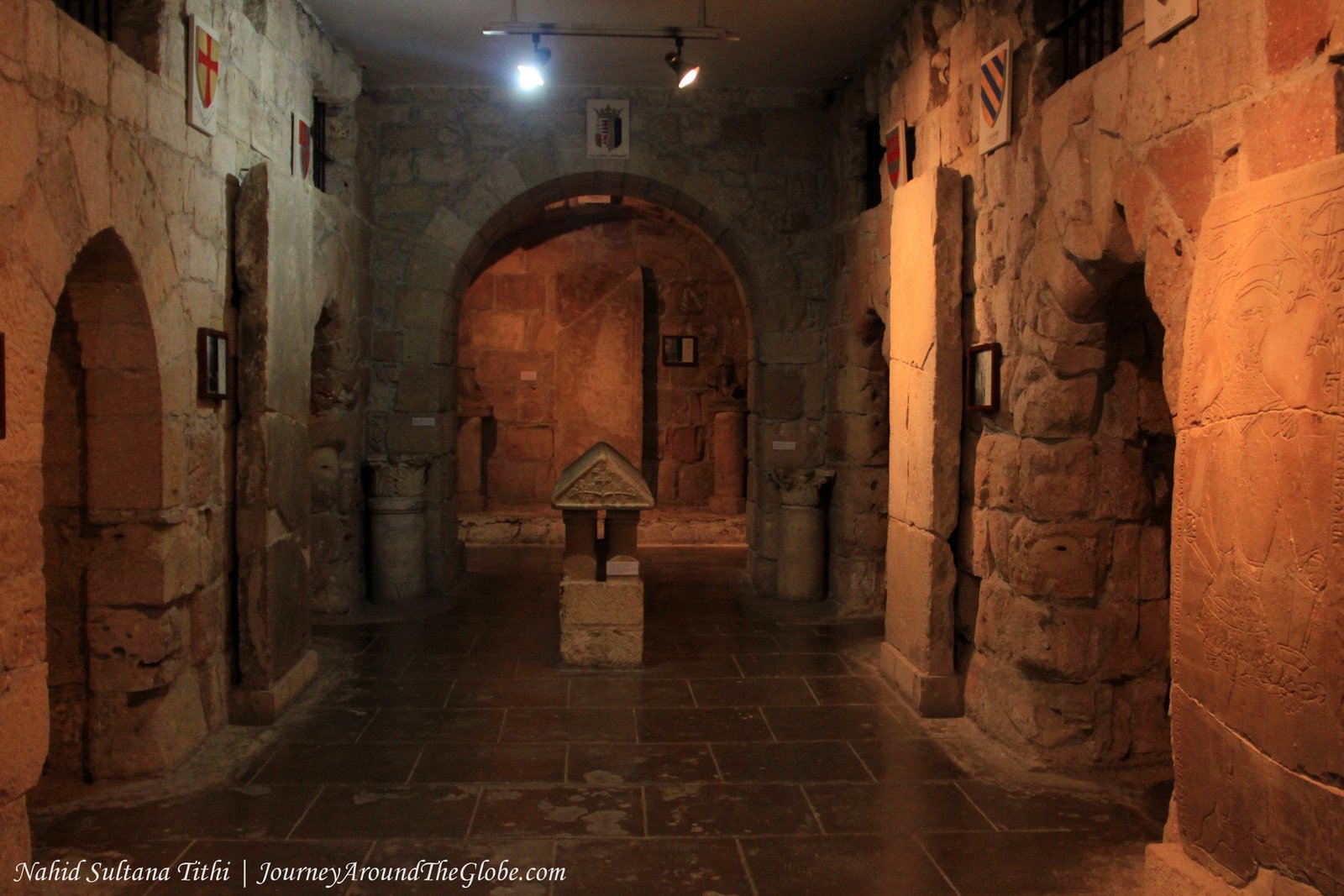
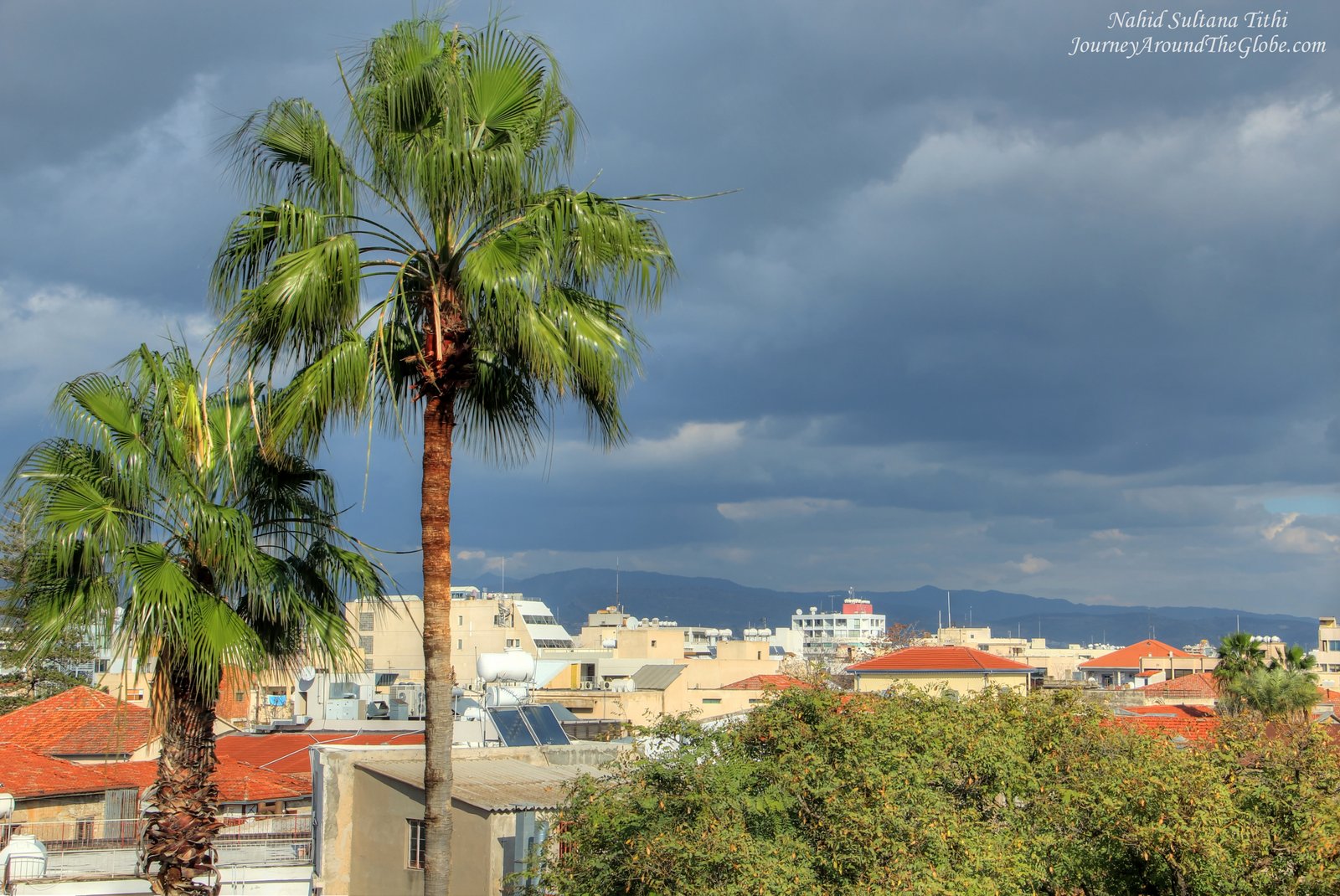
Some early excavations, like marble pedestal, floor of Middle Byzantine (10th – 11th century), bases of colonnades, basilica and chapels, and tombstones are some highlights of this castle. Limassol Castle houses the Medieval Museum of Cyprus today. In this ancient monument, artifacts are displayed which reflect the political, economic, social, and artistic development of Cyprus as well as everyday life on the island from the 3rd to the 19th century A.D. Do climb all the way to the terrace for a beautiful view of the town, mountains afar, and glimmering blue water.

- From the terrace of Limassol Castle in Cyprus
The castle is pretty small with 3 levels and took us about 45 minutes to visit. Entrance fee is 4.50 euros per adult. Castle is open Tuesday – Saturday from 9-5 and Sundays from 10 – 1 (closed on Mondays).
We didn’t manage to go to Kourion Theatre outside of Limassol, but this ancient site is worth visiting if you can spare some time. This amphitheater was extensively excavated which is still used for summer concerts and theatrical productions. Also the delightful villages in gentle pace of rural life are worth visiting, like ancient village of Amathus. On our last day we stopped at Governor’s Beach outside of Limassol. We went to the wrong point of Governor’s Beach where it was empty and dirty, but the main beach supposed to be a long sandy beach with many fish taverns, and beautiful white stone coast.
2) LEFKARA: Visiting the village of Lefkara (in Larnaca district) at the foothill of Troodos Mountain was a surprising treat for us. It’s only half an hour away from Larnaca. After finishing with Limassol and lunch, we took this pleasant drive thru the mountains to Lefkara.
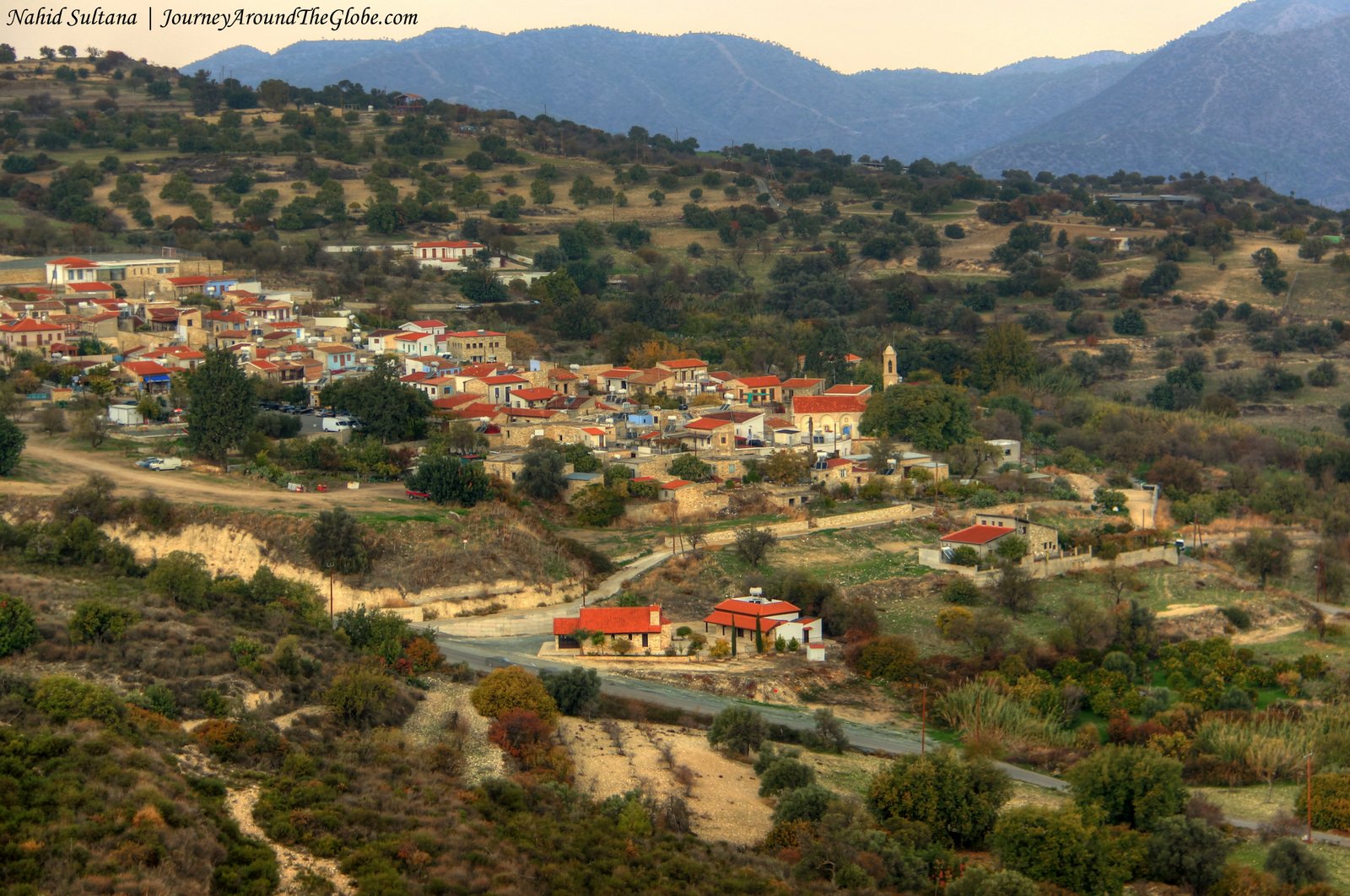
We first arrived in Kato Lefkara, which is the lower town. It’s a picturesque, unspoiled little town with lots of traditional houses and boasting culture. Kato Lefkara had silver mine before and has a long tradition in the art of silversmithing. We took about 15-20 minutes to walk around the villages, looking at lace shops and around the mountainous areas and then drove to Pano Lefkara (Upper town). We really didn’t get down on the upper part, just drove thru some small neighborhoods enjoying unique architecture. Both Pano and Kato Lefkara are famous for their lace-making tradition. Enjoy the old churches from 11th century, some museums, pleasant countryside, and artistic small alleys in these villages. Loved strolling thru the stone paved streets and photographic nature walk.

- Looking over Lefkara
3) LARNACA: It’s about 66km from Limassol to Larnaca and was our last stop of 1st day. It claims to be the oldest city in Cyprus with evident inhabitant dating back to 6000 years.
Salt Lake of Larnaca is opposite of the airport and is the home of thousands of migrating flamingoes during winter. It was almost getting dark when we reached there and saw barely any water on the lake…maybe it dries up during winter. You can see the muddy lake lined with lots of green and tall palm trees in one side and a beautiful mosque while driving parallel to the lake.

- Hala Sultan Tekke Mosque and Salt Lake in the front in Larnaca, Cyprus
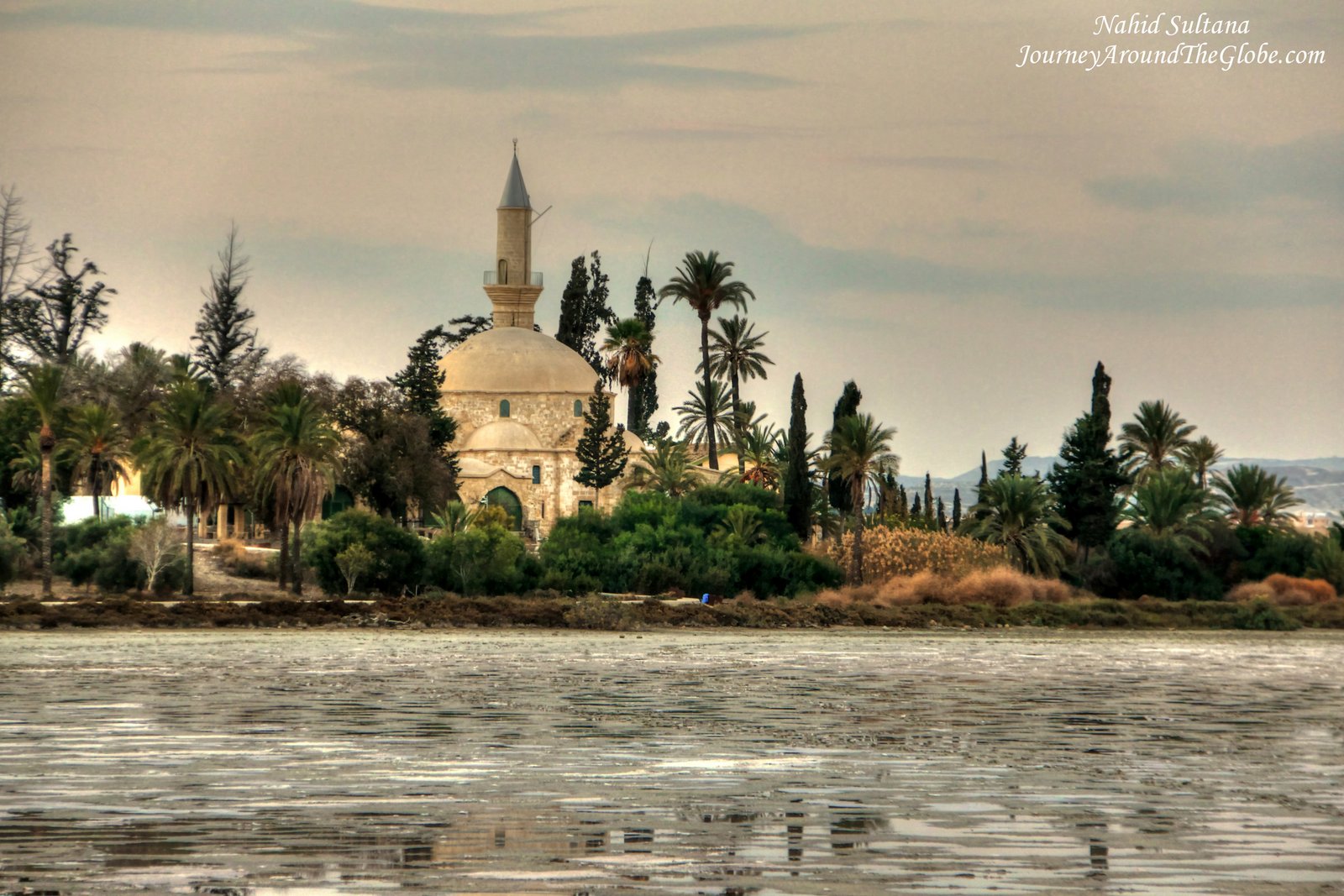
Beautiful and historic Hala Sultan Tekkke Mosque stands by the salt lake in Larnaca. The building of the mosque in its present form is dated from the 18th century. It is built over a tomb which according to the tradition belongs to Umm Haram, foster-mother of the Prophet Muhammad (pbuh). It’s the main Muslim pilgrimage site of Cyprus and among the most important holy places of Islam. Open Monday – Sunday from 8:30am – 5pm and closed on Fridays.
After the mosque and salt lake, we drove to Larnaca Promenade. It was already dark and could only hear Mediterranean’s roaring sound. It was pleasant taking a stroll by the water. There are many restaurants and bars here by the promenade Larnaca castle is located in the old town at one end of this promenade.
4) NICOSIA: Also known as Lefkosia, Nicosia is about 82 km from Limassol. It has been the capital of this island since the 11th century. Today, it blends its historic past brilliantly with the bustle of a modern city.
The heart of the city, enclosed by 16th century Venetian walls, is dotted with museums, ancient churches, and medieval buildings preserving the nostalgic atmosphere of years past. Lefkosia/Nicosia is the only capital city in Europe that remains divided by force. Although we didn’t go out of the main city, just few kms away are enchanting Byzantine churches and monasteries, charming villages and archeological sites.
We spent most of our time in the old town of Nicosia before crossing the border to the north side which is under Turkish authority at this moment. Ledra Street in old town led us to the border and check-point. The street is packed with many shops, and restaurants.
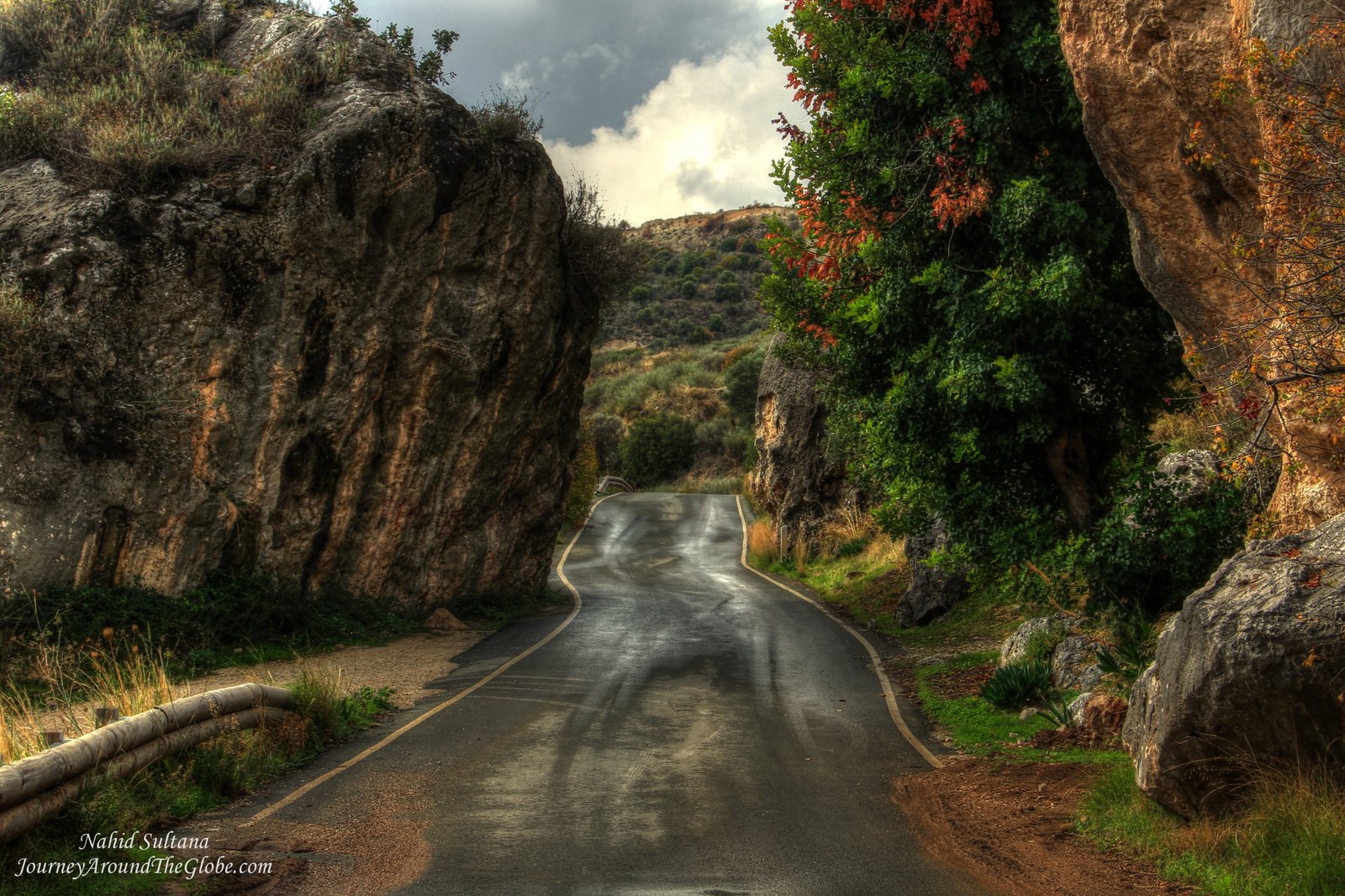
5) TROODOS MOUNTAINS: We met up with some family friends on our 3rd day in Cyprus and it was very nice of them to spend a whole day with us and showing around the island. We started our day with driving towards Troodos Mountains. Our first stop was at the main square of Troodos where we stopped for some shopping and stretching. Then started driving again towards Omodos Village.

- Roads in Troodos Mountains in Cyprus
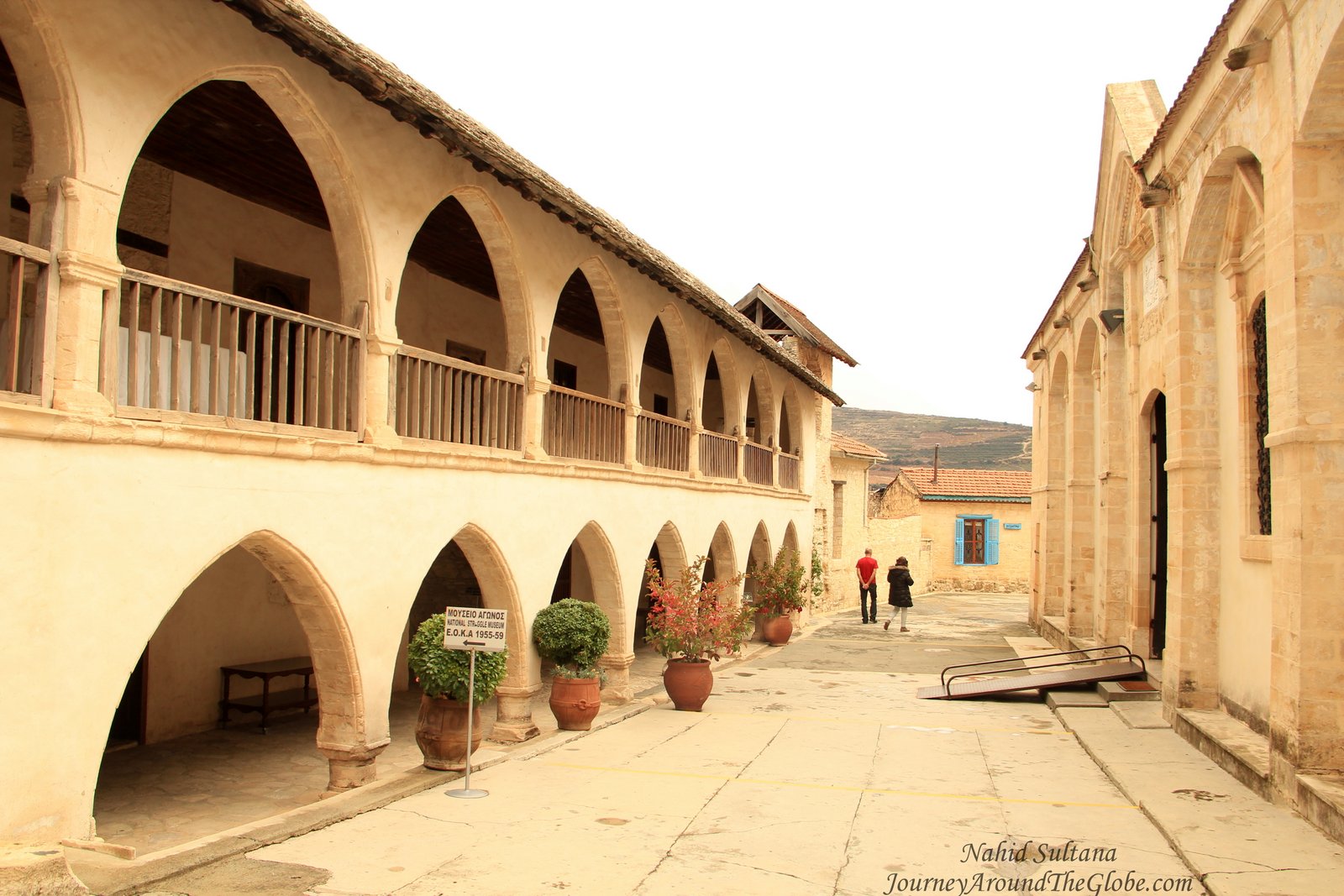
Omodos Village on the Troodos Mountain (geographically it’s in Limassol District) is a place where tourists can experience Cyprus’s genuine culture and architecture. This is the most authentic and traditional village in the island. Monastery of the Holy Cross is located here. The monastery is not active; it’s rather a museum now where you can get some glimpses of this country’s history.
- Monastery of the Holy Cross in Omodos Village, Cyprus
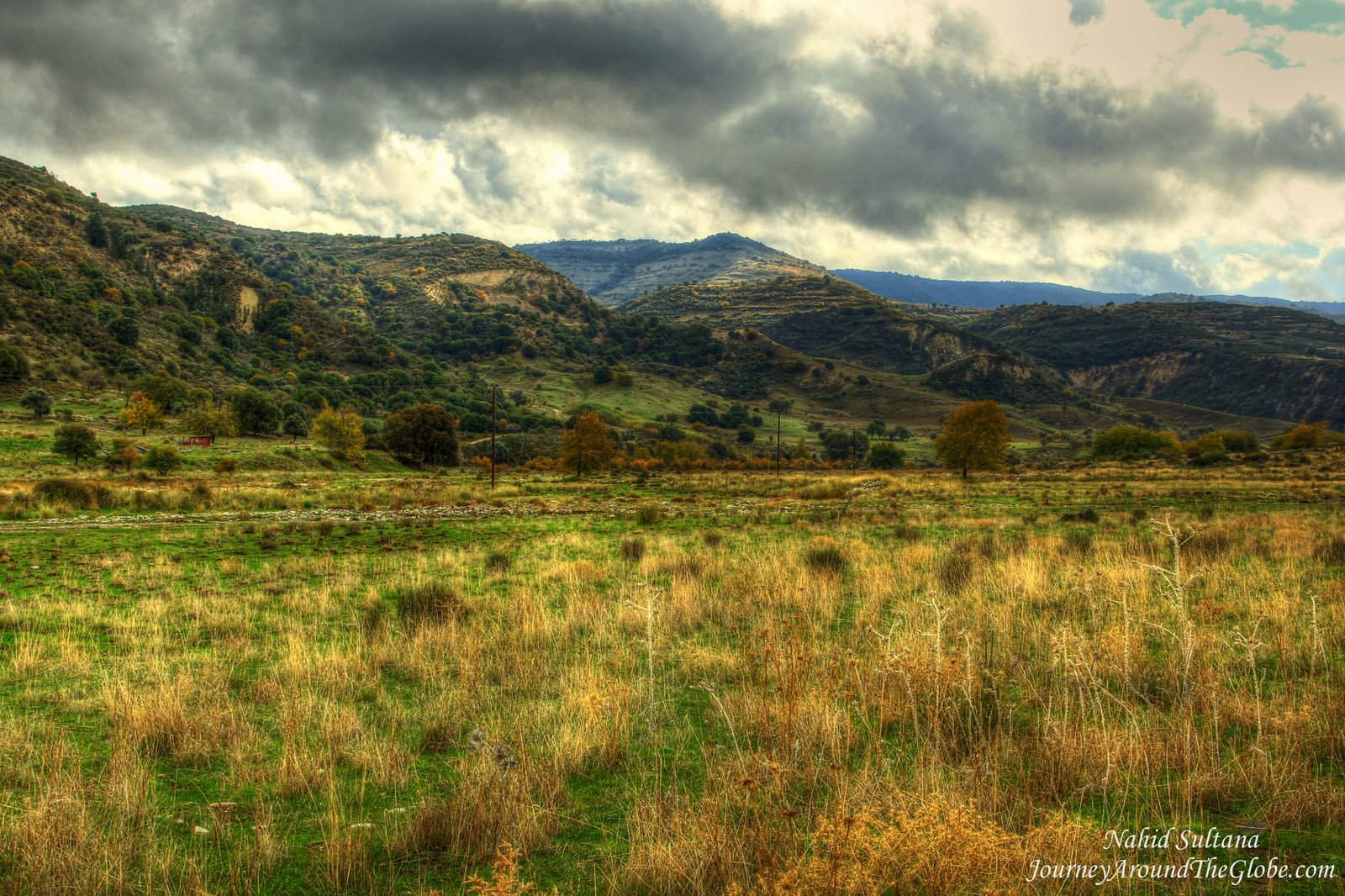
There are many falls and scenic panoramic points here where you can enjoy the valley below from up above. It was simply awesome to drive thru those mountains to get a different perspective of this island.
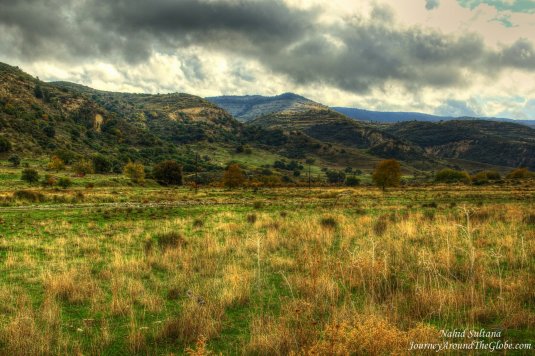
- Driving by scenic Troodos Mountains in Cyprus
6) PAPHOS: About 70km drive from Limassol, Paphos is probably the most bustling city of Cyprus. The city is known for being the birthplace of Greek goddess Aphrodite.
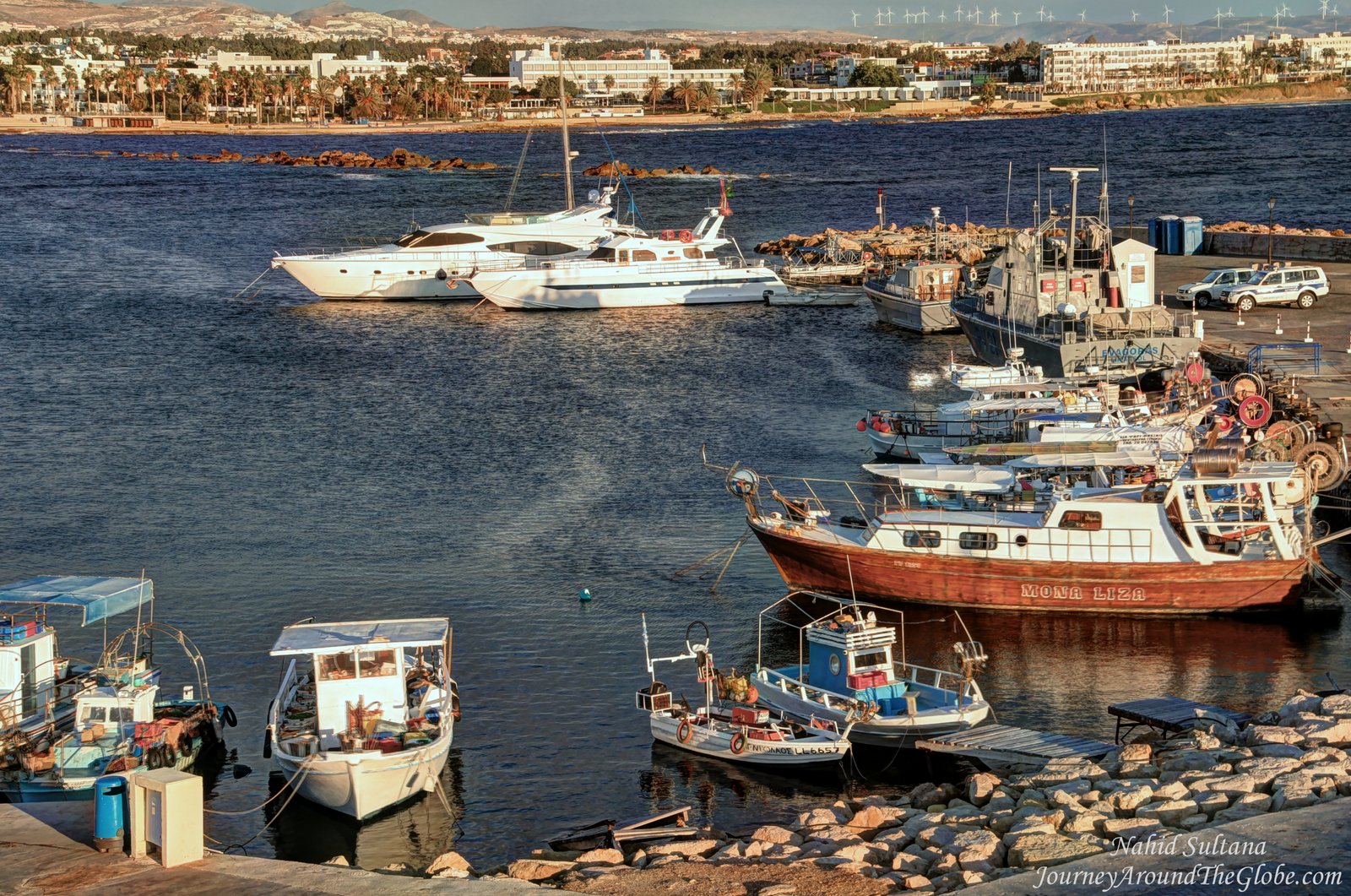
On our 3rd day, after spending some time in the mountains and villages and having a wonderful lunch by the water-front in Paphos, we went to the castle. Paphos Castle is located at the western part of the port, which once was a part of coastal defensive system of Cyprus. This ancient Venetian castle was restored by the Ottomans in 1592. What survives today is the Ottoman restoration of the western Frankish tower, its Venetian additions and the remains of the second tower at a distance of 50m to the east. Some parts of it were used as prisons cells during the Ottoman occupation. During the British rule, it was used as a salt warehouse.
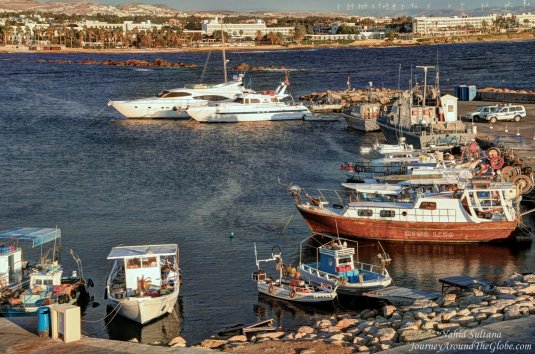
- Looking over Paphos Harbor from the castle, in Cyprus
A couple of minute of walk from the castle is Kato Paphos Archeological Site “Mosaics”. It was almost sunset and we could spend little time visiting only the highlights of this beautiful outdoor museum. It’s a UNESCO World Heritage Site. Excavations have unearthed the spectacular 3rd and 5th century mosaics of the Houses of Dionysus and other places which were buried for sixteen centuries but were remarkably intact. Some of the important monuments in this site are the House of Dionysus (Greek God of Wine), some early Christian basilicas and churches, Agora, Tombs of the Kings, and Hellenistic Theatre.

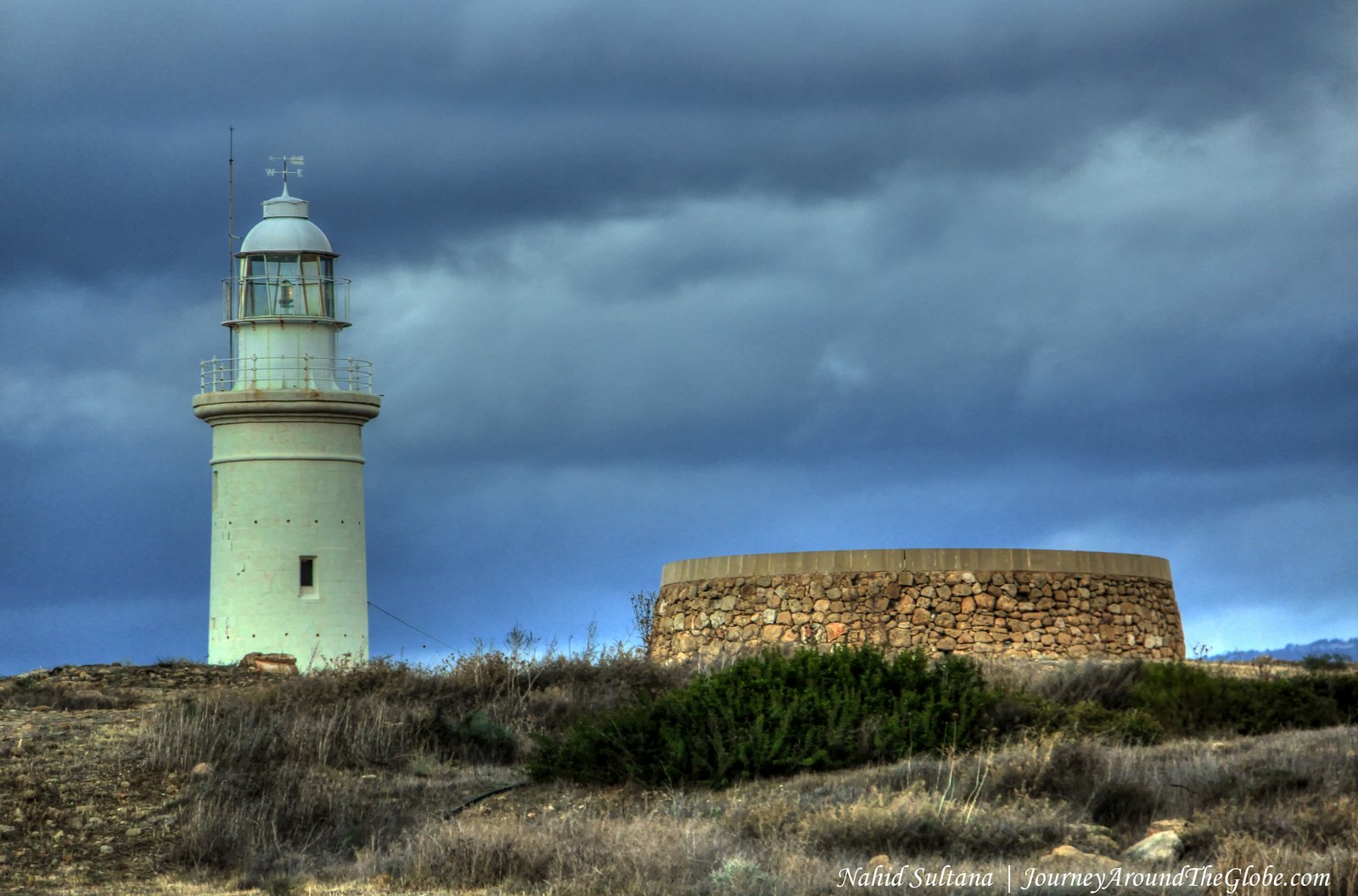
- A lighthouse by the sea in Paphos Archeological site
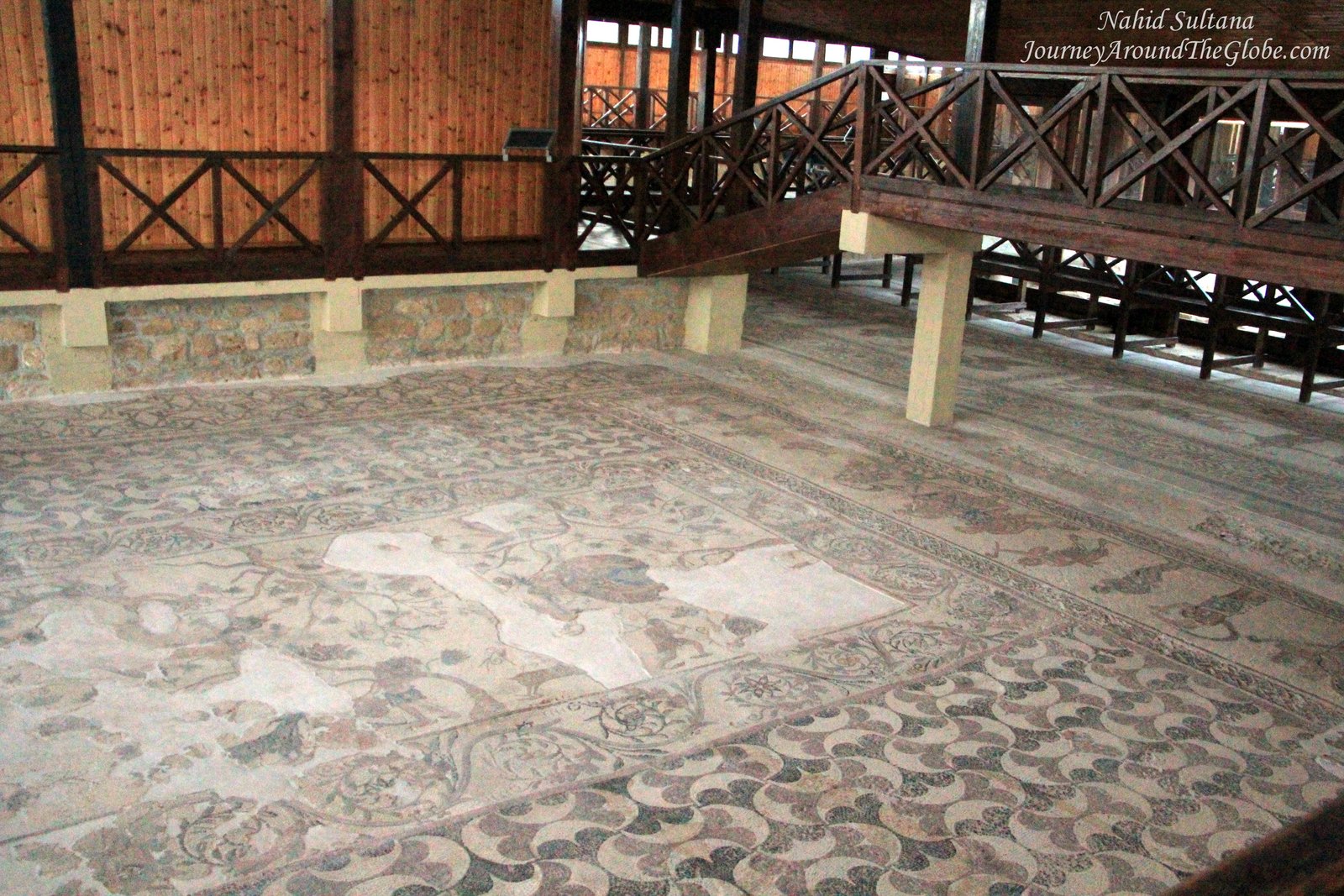
House of Dionysus (2nd – 4th century A.D.) was the first house with mosaic floors to be discovered in Paphos. The house consists of atrium with garden pool and about forty rooms. All these rooms and halls around the atrium are paved with mosaic floors. The oldest mosaic floor (dated to the early Hellenistic period) in Cyprus is the pebble mosaic near atrium representing monster Scylla. All the mosaics here are from late 2nd century or early 3rd century. It’s open Monday to Sunday from 8:30am – 5pm.
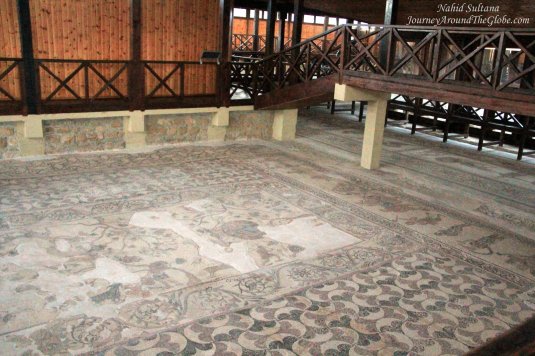
- Mosaic from 2nd-4th century in House of Dionysus in Paphos, Cyprus
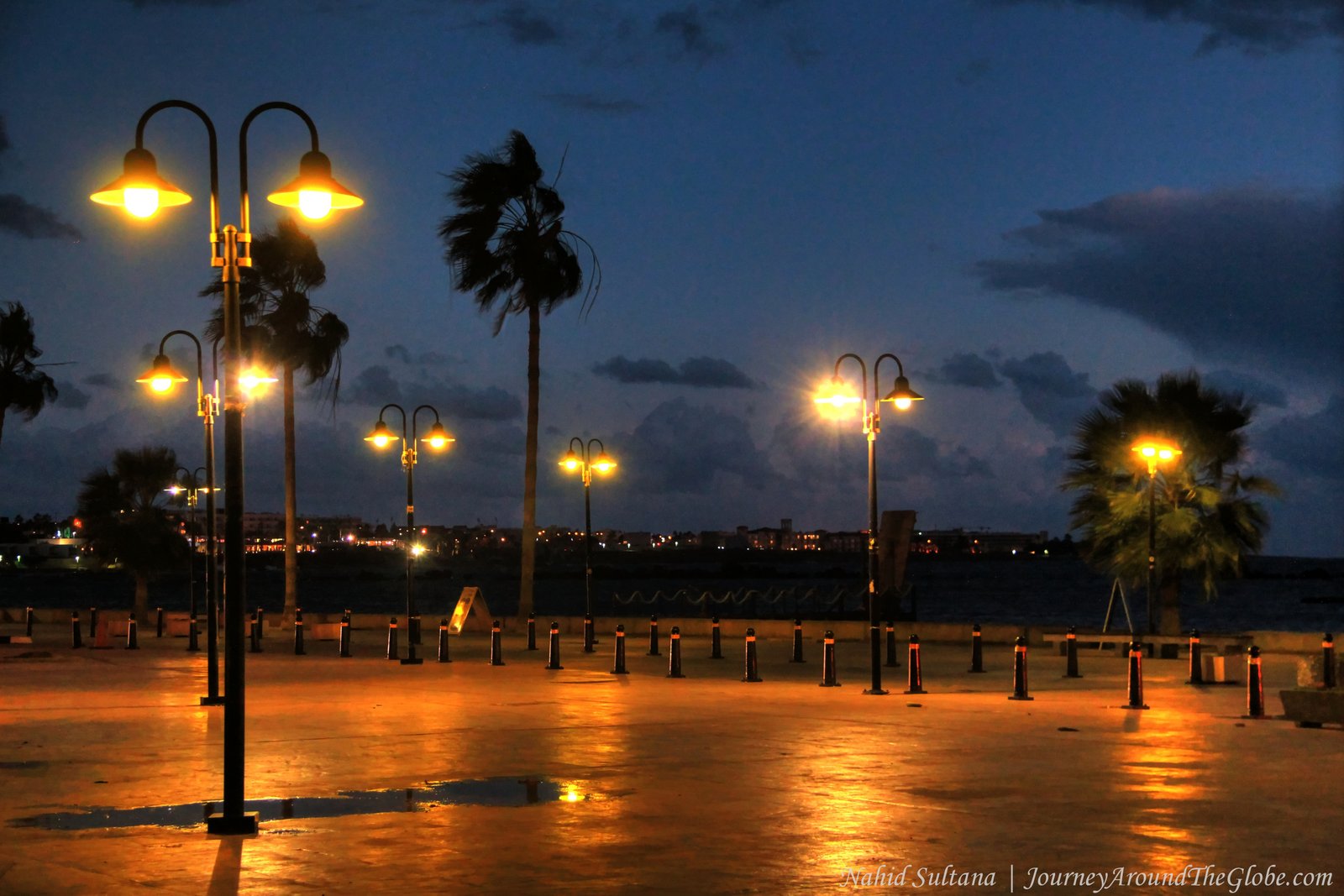
After the sunset, we came down to Paphos harbor for little stroll and some ice-cream time from “Coldstone”. It was absolutely fantastic walking by the promenade at night.

- Paphos Harbor at night
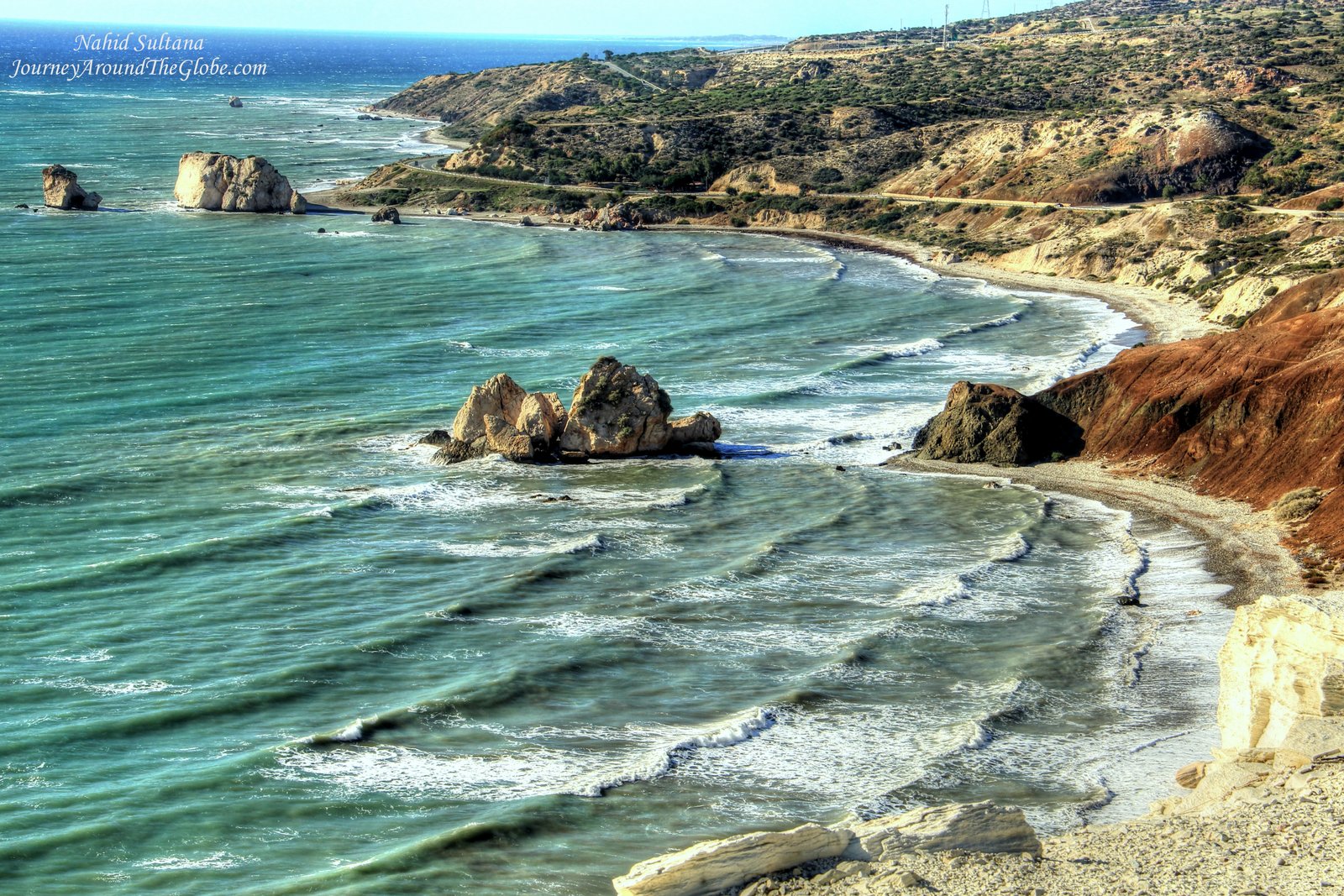
One of the most beautiful sites of Paphos or in whole Cyprus is Petra Tou Romiou or Aphrodite’s Rock which we visited on our last day in Cyprus. According to Greek legends, this is where Aphrodite, the Greek goddess of love and beauty, is said to have risen from the waves that crash on its shores. It’s a massive chunk of stone that marks the spot. Her birthplace is a place of pilgrimage for the entire Hellenic world and is a beautiful pebble beach.
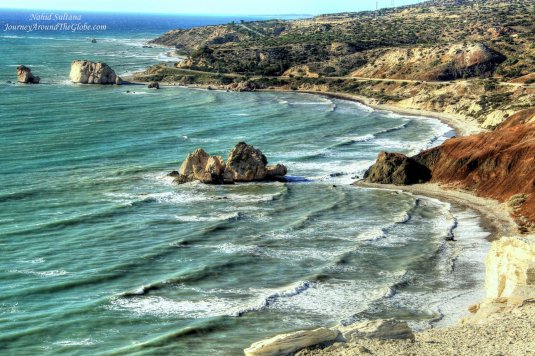
- Looking over Petra Tou Romiou from a panoramic point, in Cyprus
Related articles
- Top 10 Reasons for Choosing Cyprus (creativetourscyprus.wordpress.com)
- Cyprus – At a Glance (creativetourscyprus.wordpress.com)
- A Weekend in Limassol and Pafos (oliviaincyprus.wordpress.com)
Share this:

A day in Lille, France
LILLE, FRANCE: Lille is a buzzing city which is waiting to be discovered by tourists yet. It makes a nice day trip if you are visiting Brussels or Brugges in Belgium. Lille is one of the largest cities in France with lots of Flemish influences, may be for being a bordering city with Belgium. Old town of this city is where local crowds gather to hang out and enjoy the atmosphere.
Closest parking we found here was right at Place de General-de-Gaulle. You just walk up and voila, you are right in the middle of the main square.
TIME of TRAVEL: My older sister and her family were visiting Europe in May 2013. It was their first time in this continent. We picked Lille because it’s only little more than an hour drive from our little town in Belgium and could easily make a day-trip and come back home before the kids were tired. They were going to go to Paris anyways the following week, just wanted to show them a smaller French town nearby. The weather was great and many festivals were going on every street of Lille that day.
EATING and SHOPPING: Restaurant or cafes are everywhere in the city center, especially in Place du Theatre. This is where we had lunch in front of the Bourse or the Chamber of Commerce building. You can see many quick and fast food type places while walking towards Vieux Lille. Do try some French bakeries and pastries. For shopping, Rue de la Monnaie had many options from small local stores to big brand names.
PLACES WE’VE VISITED: The main city center is very compact and can be covered on foot. We spent only few hours here and just walked around the old part and visited some old churches and main landmarks.
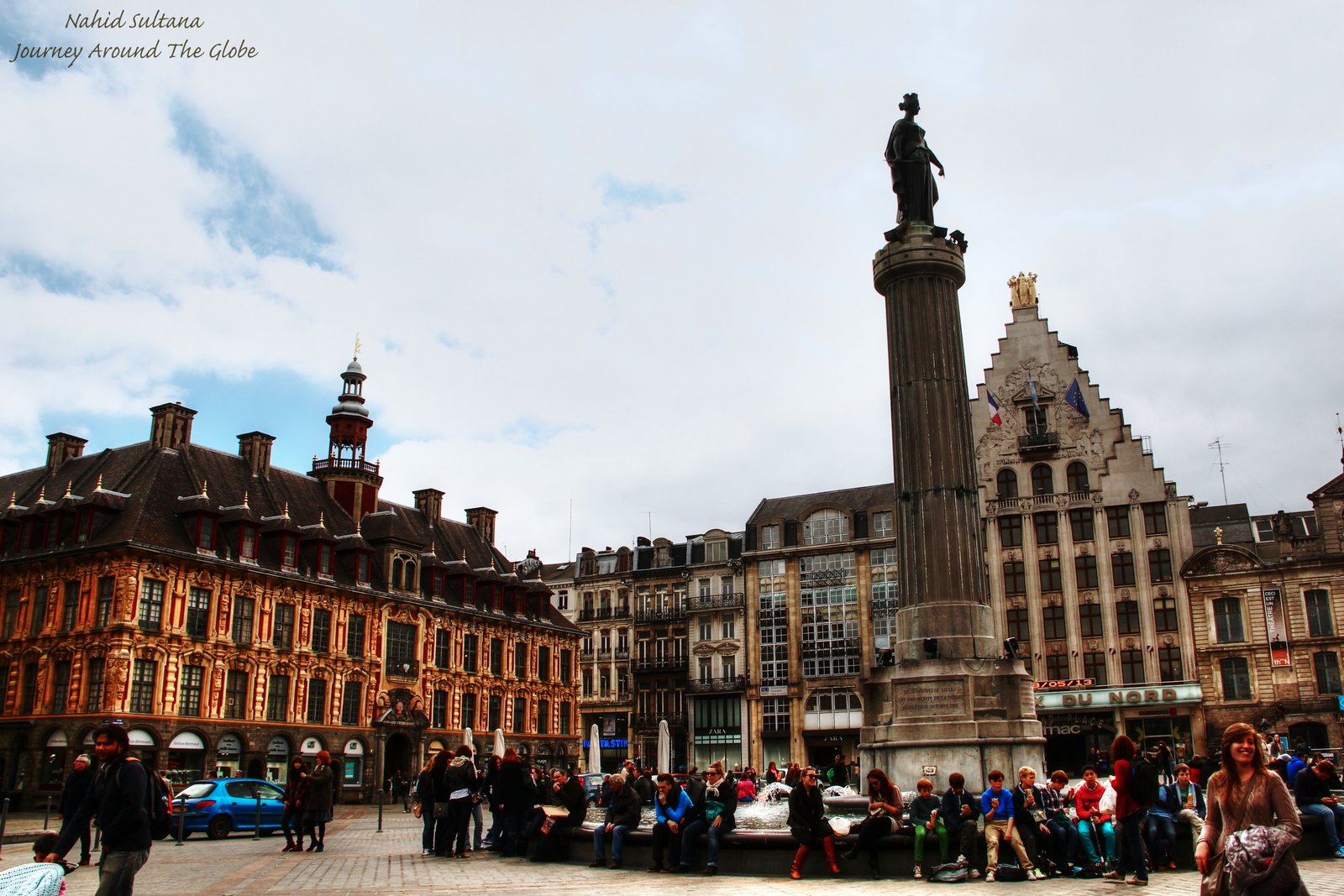
1) PLACE de GENERAL-de-GAULLE: The square is also known as Grand Place. This is the main square of the town with a big fountain in the middle with a statue known as Column of the Goddess from 1843. Many beautiful historic buildings are lined up on all sides of the square. One of the important buildings is a Flemish-style which is the headquarters of local newspaper La Voix du Nord.
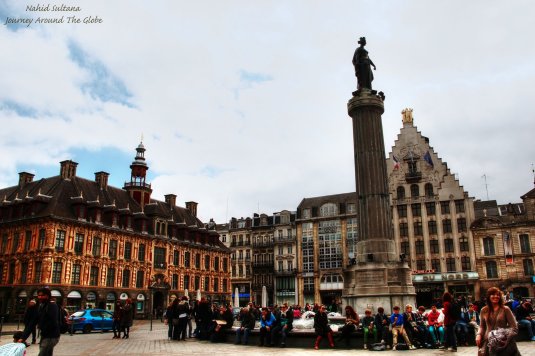
- Place du General-de-Gaulle, the main square of Lille, France
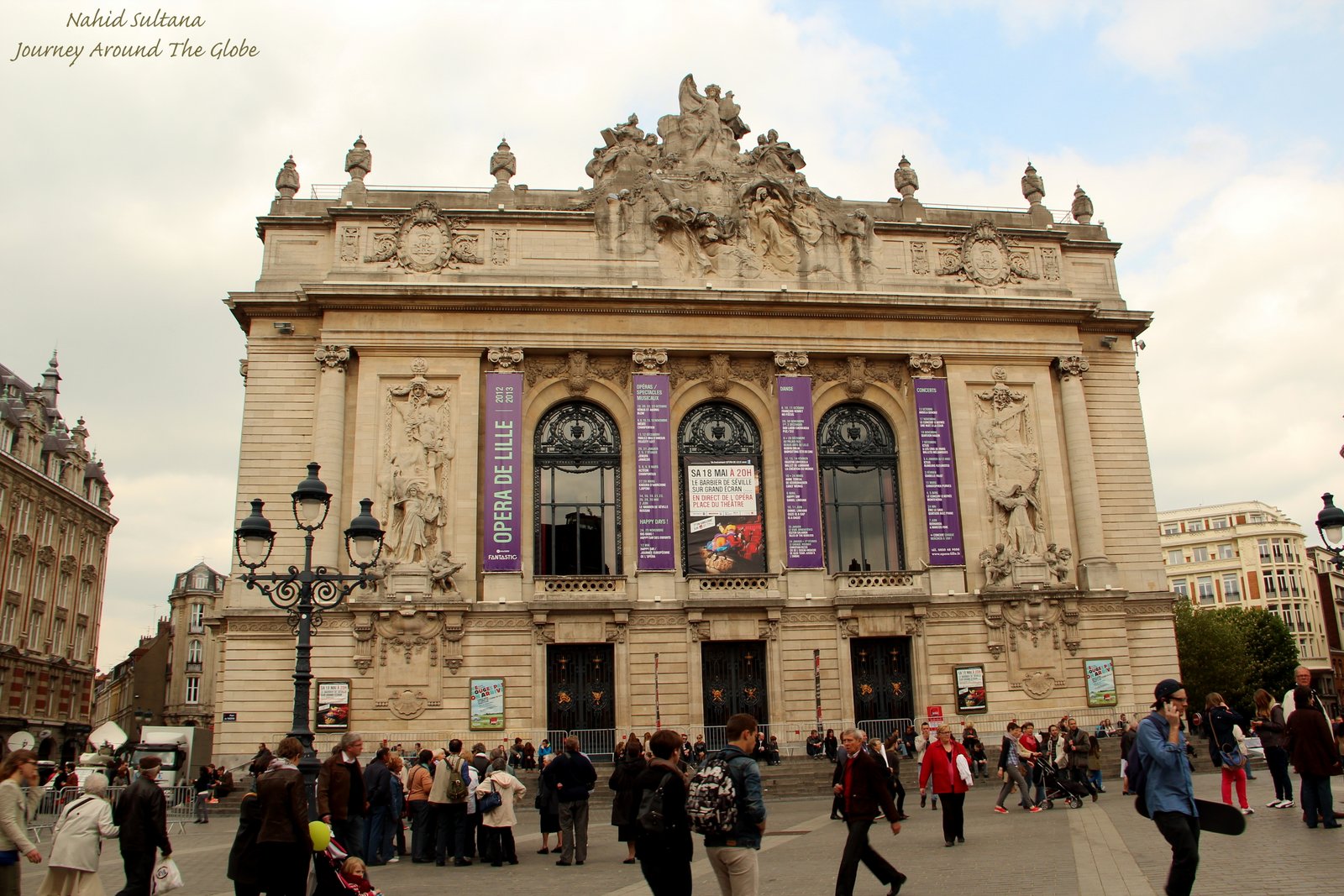
2) PLACE du THEATRE: This is a lively place with to stop and take a breath. Located beside Place de General-de-Gaulle, the square houses two beautiful and historic buildings: The Opera and the Chamber of Commerce. Both of the buildings are from 1920s. These buildings are supposed to look very nice at night when all the lights are on, but too bad we didn’t stay that long!

- Opera house in Place du Theatre in Lille, France
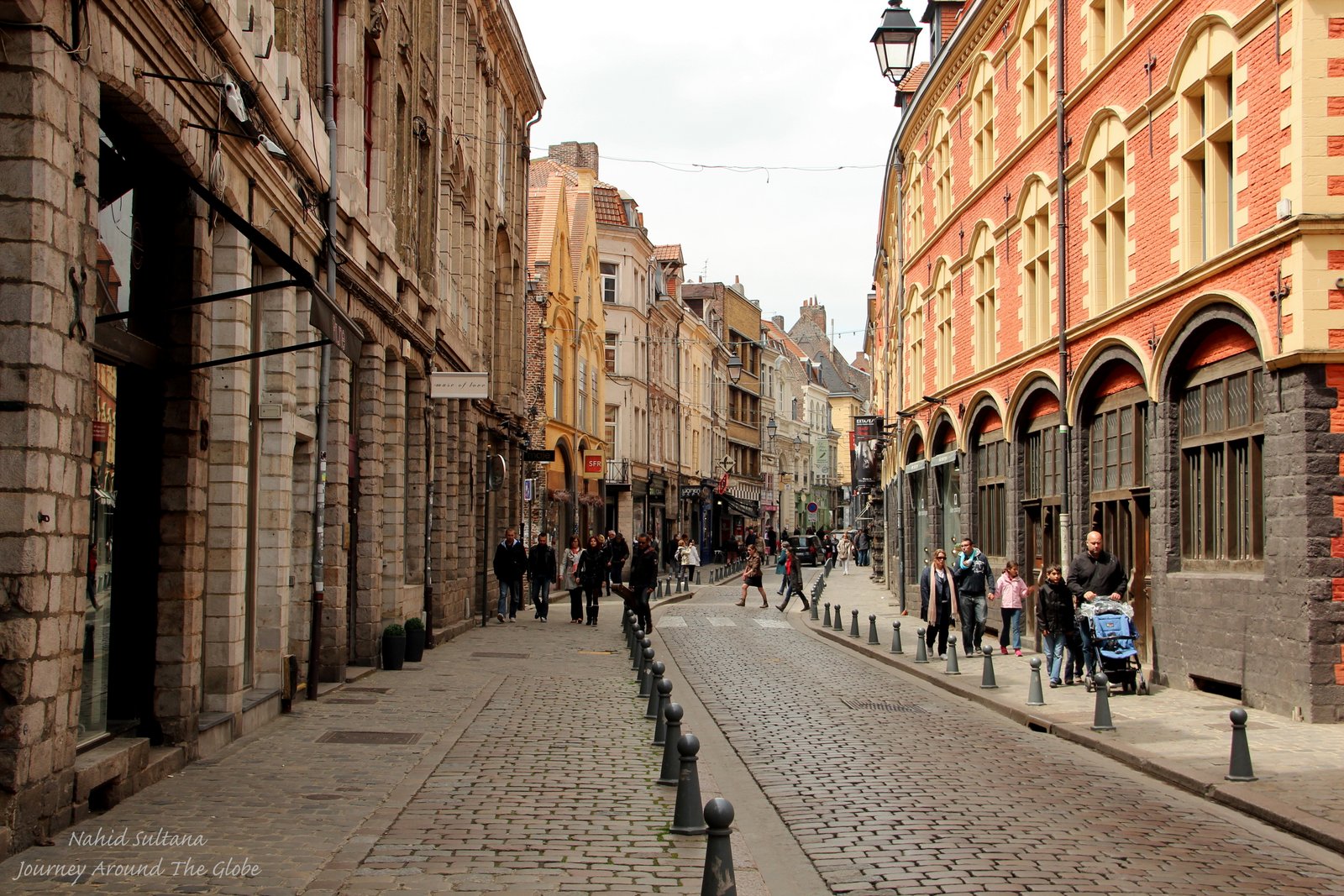
3) VIEUX LILLE: This is the old quarter of the city and nice place to take a stroll. Loved walking on the cobble-stone street of Rue de la Monnaie while enjoying the view of old houses and designer stores. Some museums are also located on Rue de la Monnaie.

- Vieux Lille – an old district of Lille
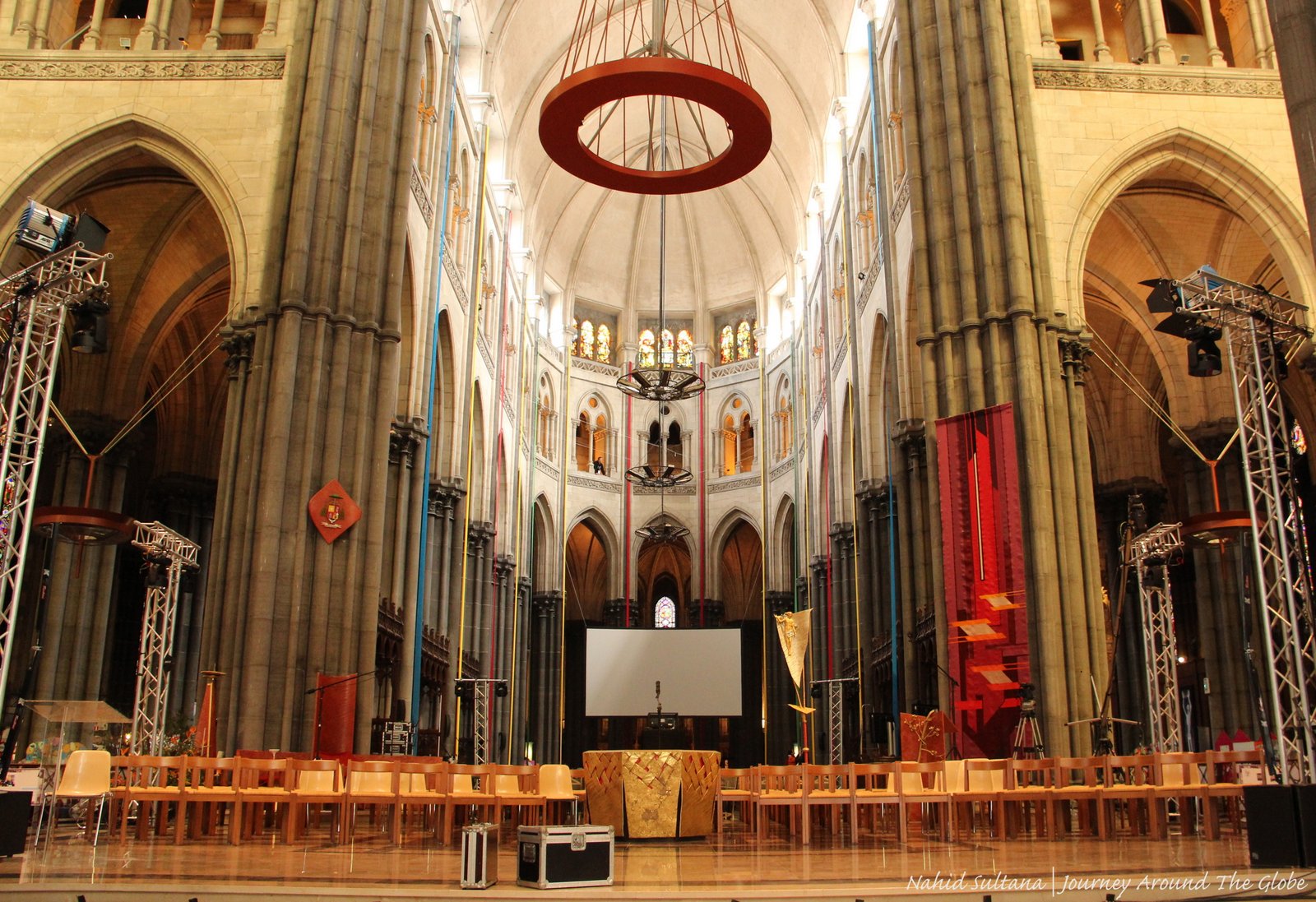
4) CATHEDRALE NOTRE DAME de la TREILLE: This is an old cathedral and went through many renovations and changes over the years. Outside it has that old and wise look but inside it is rather a very modern cathedral. Very grand but contemporary altar and some big colorful windows are worth looking. There was an art exhibition going on behind its main altar and a live band of youngsters was singing outside in front of the cathedral during our visit. It’s free to enter and is situated in Viuex Lille.

- Main altar of Cathedral Notre Dame de la Treille in Lille
Companille or the Bell Tower of this cathedral is very old compared to the cathedral itself. There was a big fair or festival going on when we were there. Live music, food stalls, kids play area, and many other things were going on around the cathedral that day.
5) EGLISE SAINT MAURICE: Not sure when it was built, but it looked like a very old Gothic church not too far from city center. It was a big church with some beautiful stained-glass windows and really large old religious paintings.
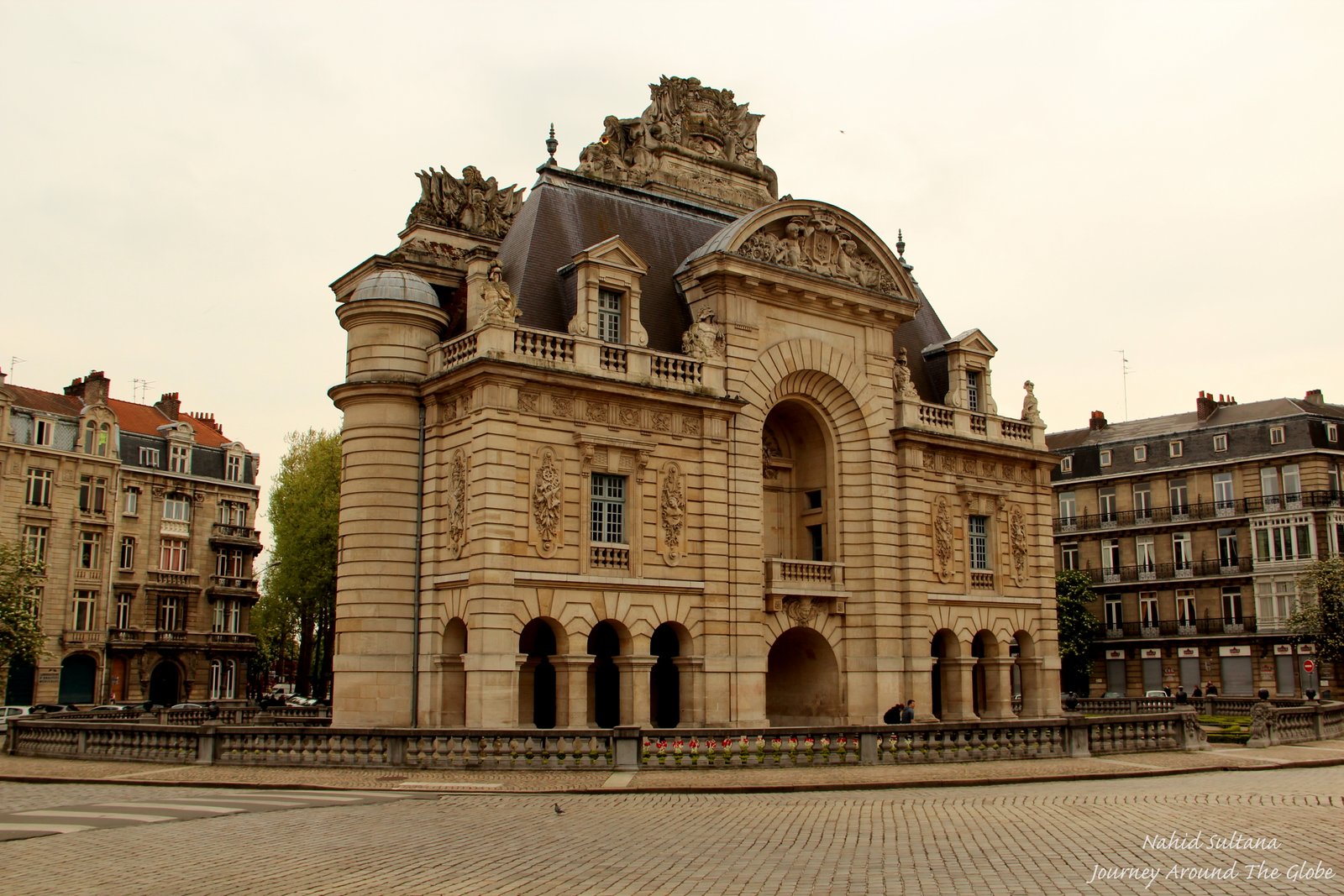
6) HOTEL d’VILLE: We walked about 15 minutes from Place du Theatre to go see Hotel d’Ville or the city hall of Lille. It’s a big orange building with a clock tower at one side and is something worth a look. Walk few step across the street and Porte de Paris is there with a nice small garden surrounding this old gate from 1692.

- Porte de Paris from 1692 near Hotel d’Ville in Lille, France
Related articles
- Lille Christmas Market (travelinitiative.wordpress.com)
- Lill’O. 2012. (lucieleforestier.wordpress.com)
Share this:

City built on a swamp – St. Petersburg, Russia
ST. PETERSBURG, RUSSIA: One of the top ten high-class destinations in the world and a UNESCO World Heritage Site, St. Petersburg, was a magical city for us to visit. It’s situated at one tip of Baltic Sea and by Neva River and has a long list of major attractions. I haven’t seen another European city like St. Petersburg before. I imagined the city having more old-style building/apartments from communist era, stubborn people, and blunt food. But my perception changed as soon as we drove to the heart of city and saw its historical sites, modern restaurants, and friendly people in the stores. Of course you will still see those communist style buildings in some of the town where people are still living with high rent.
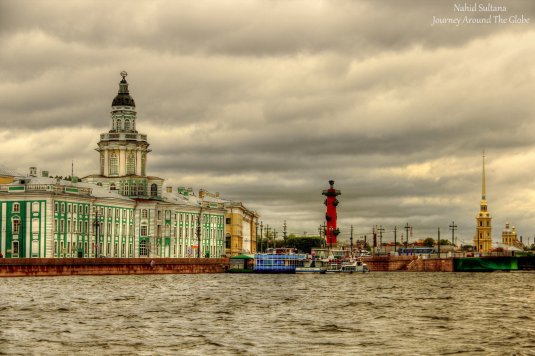
- Glimpse of St. Petersburg by Neva River
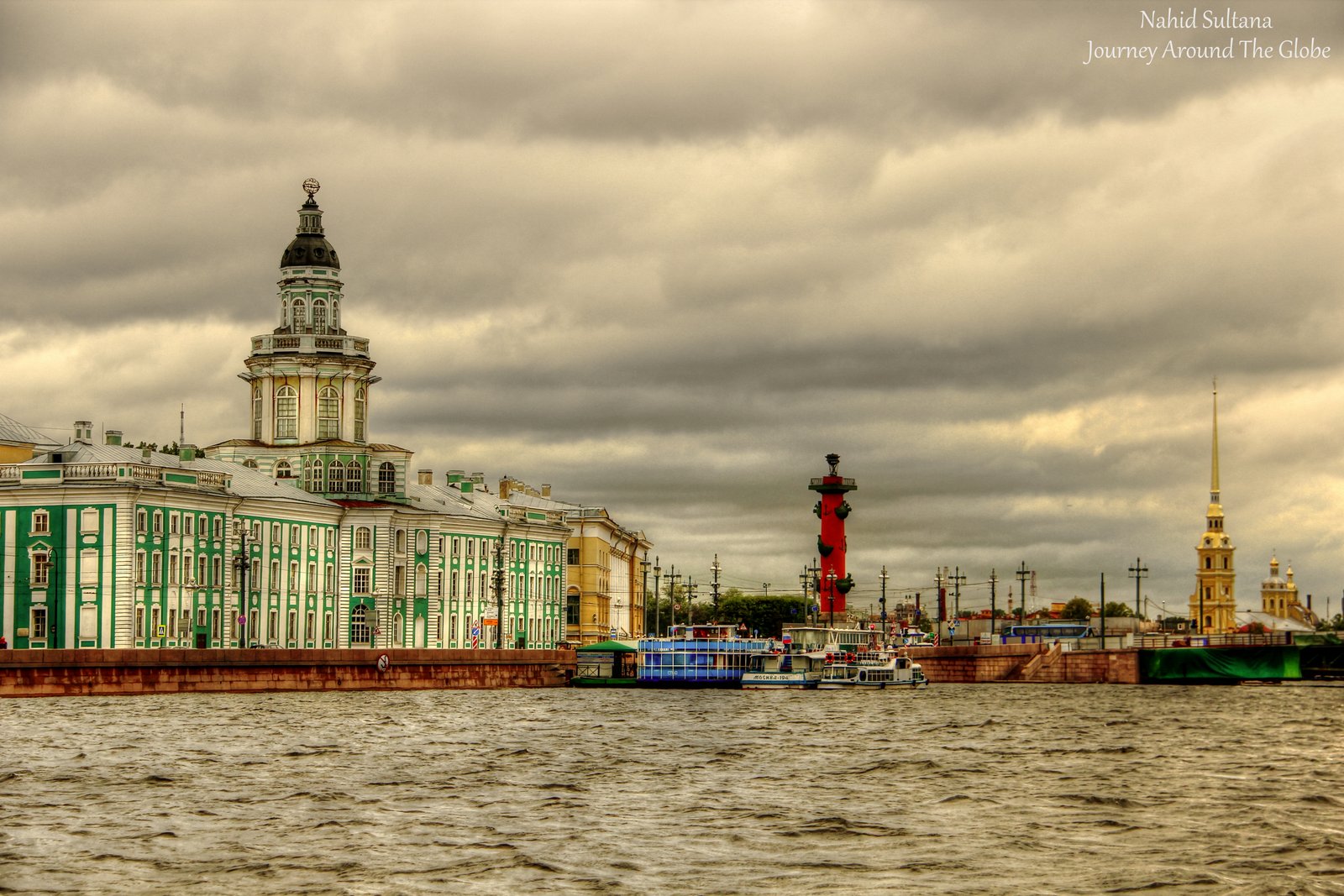
St. Petersburg, former capital of Russia, was founded by Peter the Great in 1703. He indeed built this great city on a swamp while his people laughed at his idea. Peter the Great was a long-visioned man and stuck to his idea and now St. Petersburg is one of the major destinations in Europe. But the city wasn’t named after him. St. Peter is the patron of the city after whom the city was named. It is the former home of the Russian Emperors who were known as Tsars/Czars and a center spot of imperial Russian culture. The city was known as Leningrad in 1924 honoring founder of Soviet Union, Lenin.
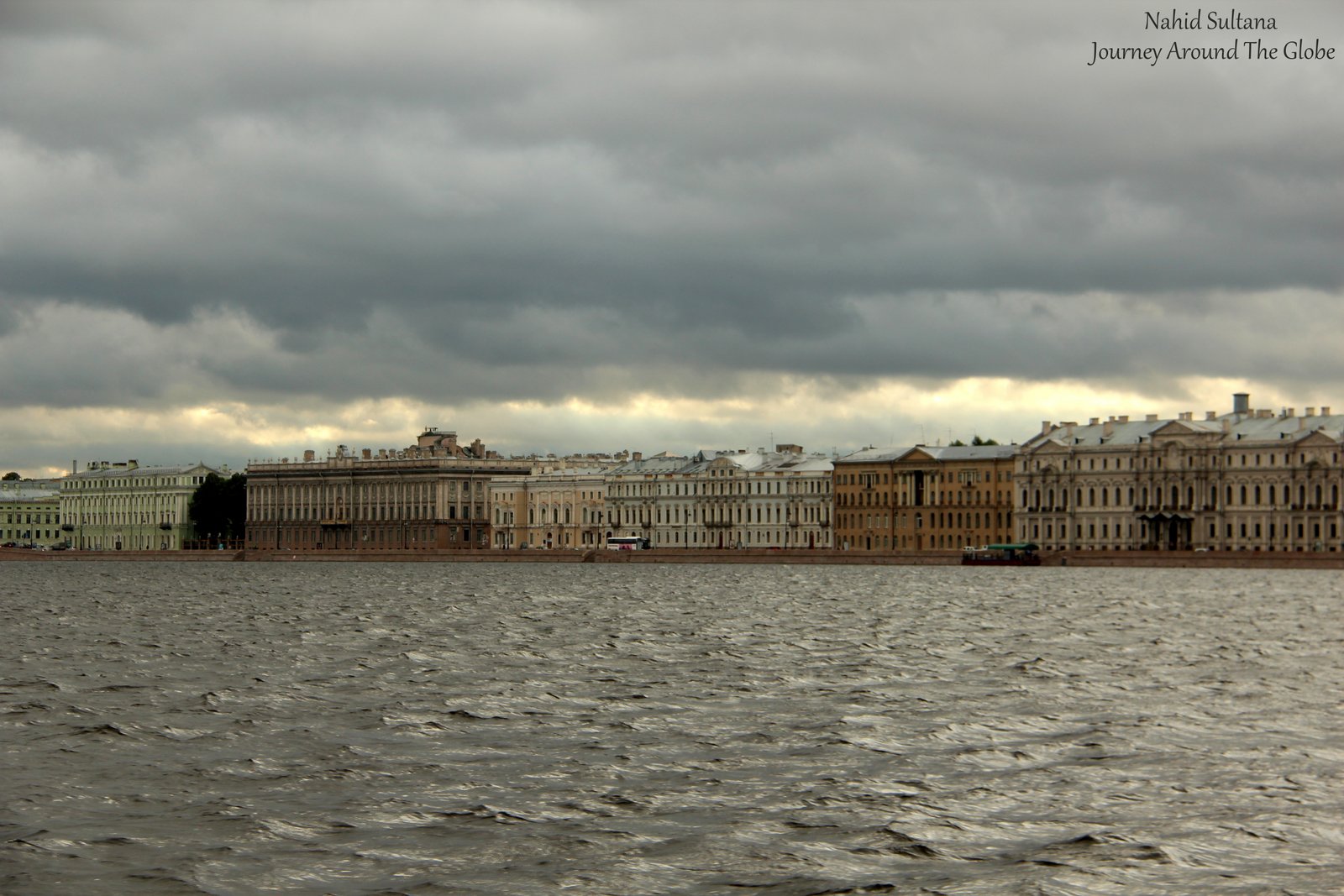
If you love palaces, this city has plenty of them and stunning ones too. A chain of these palaces and many other royal-type buildings are standing by Neva River one after another.
We had to visit the city through a tour company because you need an invitation from the country to get visa with American Passports. We booked this tour with SPB Tours. On the 1st day we were picked up from our cruise-port around 8am and ended at 6pm and the next day it was from 9am to 5pm. Our guide was a very enthusiastic lady and was very honest about her country, giving us some pros and cons on overall living conditions in past and present day Russia. She was very nice to even buy some typical Russian toys for my girls. Other than getting the visa, I think it’s better to have a guide when you are visiting any cities in Russia since almost everything is written in Russian.
TIME of TRAVEL: Our whole family took a cruise on the Baltic Sea in August of 2013 from Dover, England. It was a 12 day cruise that stopped at many cities but St. Petersburg was the highlight of this cruise for everyone. Our ship docked in St. Petersburg on an early morning. We had 2 full days to explore before we started sailing again on the next evening. It was cold in the mornings and a bit chilly both afternoons. Second day we had to deal with some clouds and rain for most part.
EATING and SHOPPING: It seemed to me Russia has countless traditional and local souvenirs to bring back home and some of them can be very expensive too. Russian Dolls (matryoshka) and hand-crafted lacquered boxes are very typical Russian gift items. I saw some good quality winter accessories and wooden decors or kitchen wares in almost all gift shops too. Painting on these wooden accessories is known as “Khokhloma” painting. It’s the name of a Russian handicraft style wood painting and national ornament, known for its vivid flower patterns, red and gold colors over a black background. The effect it has when applied to cheap and light wooden tableware is extraordinary, making it look heavier and giving it metal-like glamorous look.
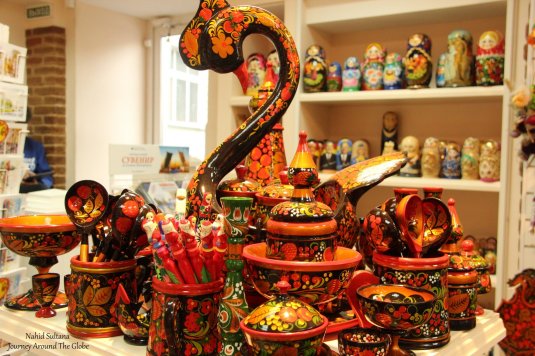
- “Khokhloma” – Russian wood painting hand-crafts, something beautiful to bring back home from St. Petersburg, Russia

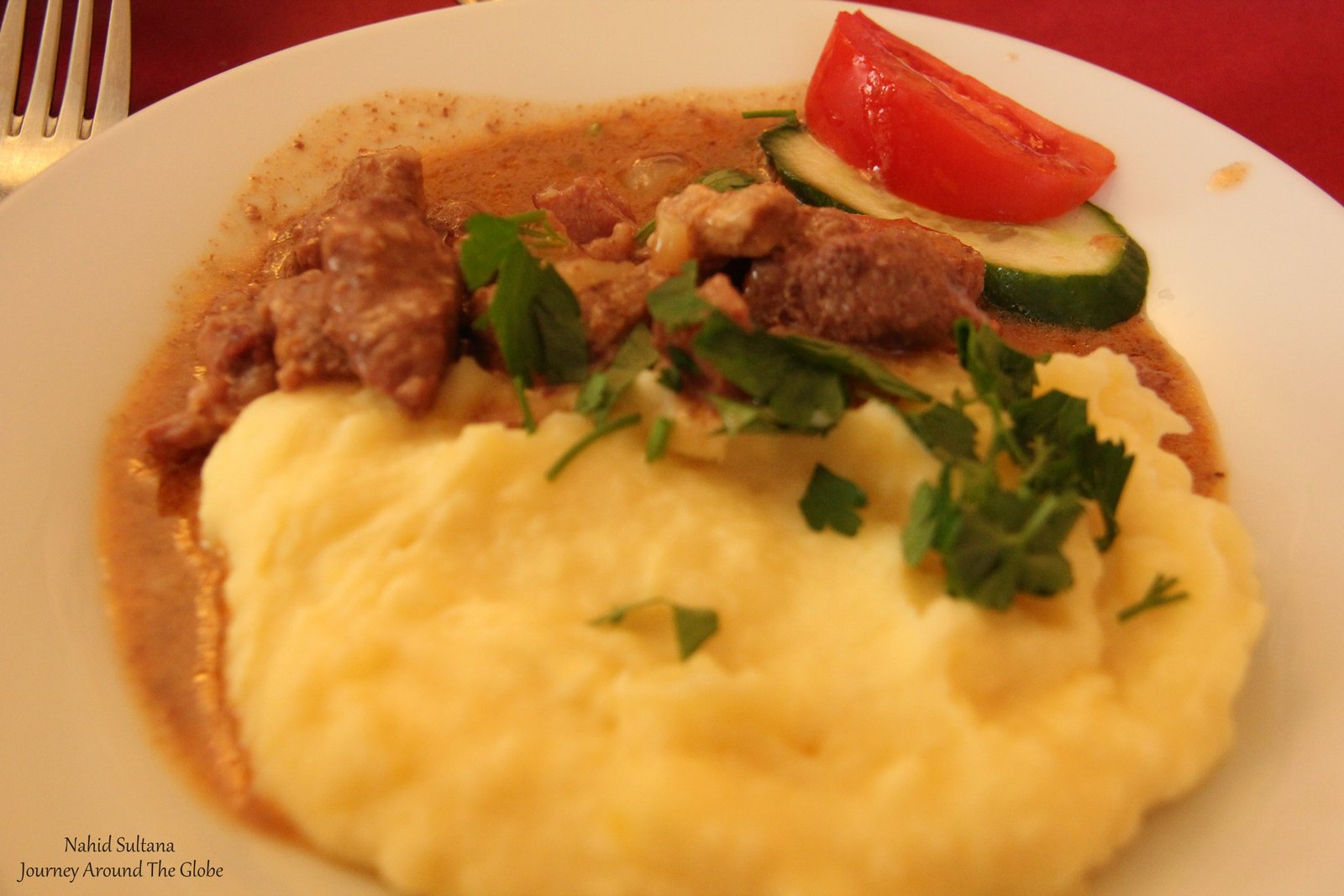
For food, first day we had lunch in a restaurant by the highway where our guide took us to. We had the chance of tasting some traditional Russian dishes here, like beat and cabbage soup for appetizer and beef stroganoff for the main course. After the lunch our guide told the history of stroganoff and where it came from. The story goes that Count Stroganoff in St. Petersburg loved eating beef. But when he became old and lost his teeth, the count told his chef to cut the meat in small sizes, so he could chew them easily and it became so famous that it spread out to the whole world. So, anyways, the second day we had Russian fast food which was a mushroom and ground beef pastry.
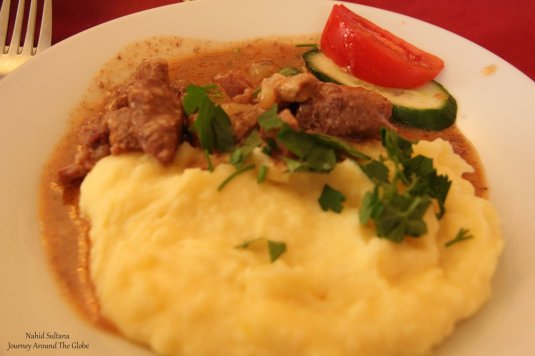
- Our first lunch in St. Petersburg – beef stroganoff
PLACES WE’VE VISITED: We had 2 full days to spend in St. Petersburg. It’s a huge city and everything is very spread out. I don’t think we could have seen all these spots if we didn’t have a coach and an expert guide. You can spend weeks here and still will be left with many unseen spots…St. Petersburg has countless things to see and do.
1) ST. NICHOLAS CHURCH: We started our 1st day in St. Petersburg with this church. Also known as Blue Church, St. Nicholas looked more like a monastery to me, something very similar to what we have seen in Kiev, Ukraine. This 18th century church has nice gold and green theme and a decorative interior. Like most of the Russian churches, it also doesn’t have any sitting arrangements; worshippers only stand or sometimes kneel down if they get tired from long services. Also check out the bell tower of the church few steps away. Since this is still an active church, no photos are allowed inside but it’s free to enter.
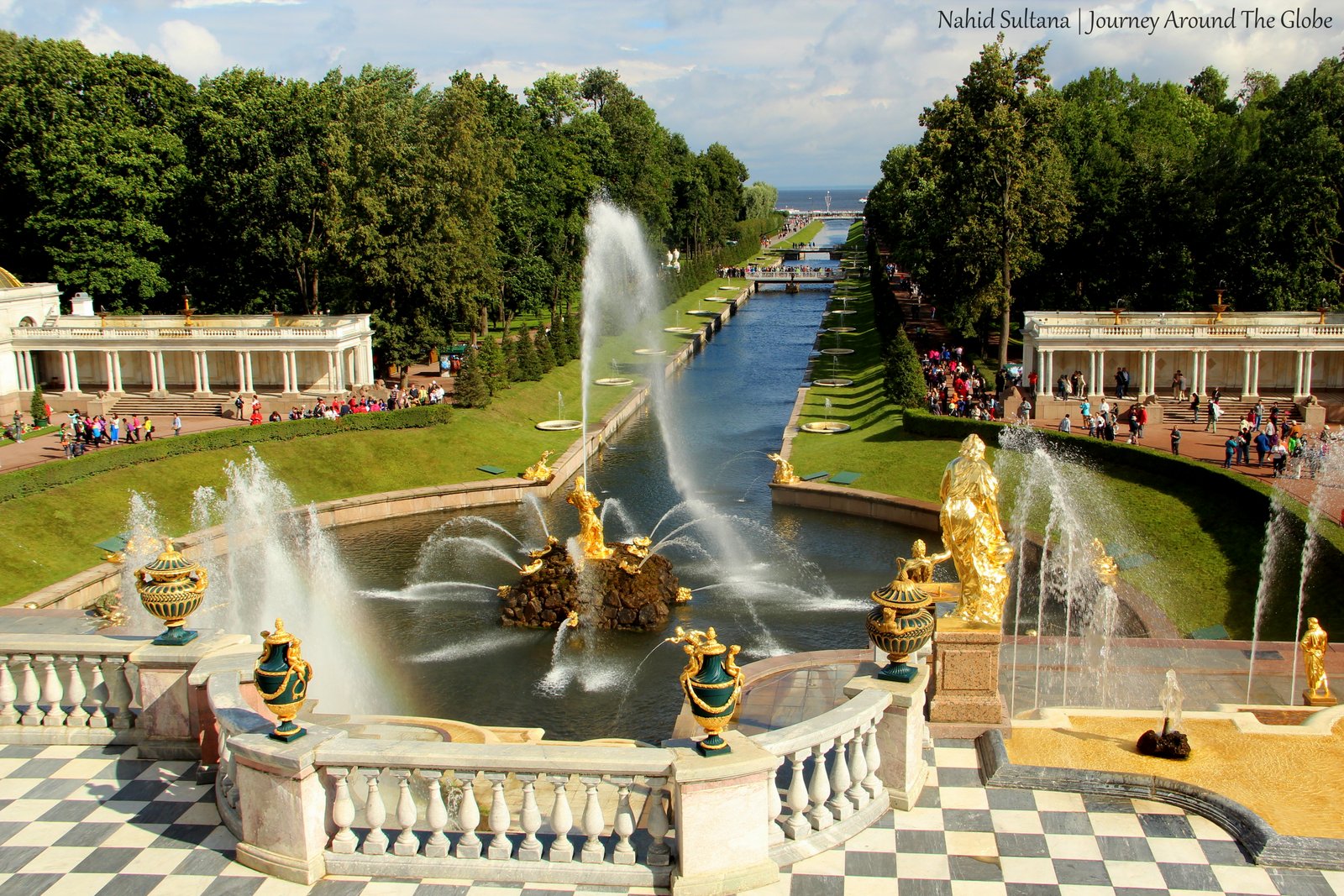
2) PETERHOF PALACE and GARDEN: Next we took a 30-minutes hydrofoil ride (it’s like a big boat that can go very fast on water) on Neva River from the city to its outskirt where Peterhof Palace and Garden is located. Situated by Gulf of Finland, Peterhof is best known for its vast and beautiful gardens and big parks with many statues. Garden of Catherine I and Palace of Catherine II are all here in this lovely place. Total of 135 (if I can remember correctly) big and small fountains are all over the garden and in front of the palace.
- One of many fountains of Peterhof in St. Petersburg
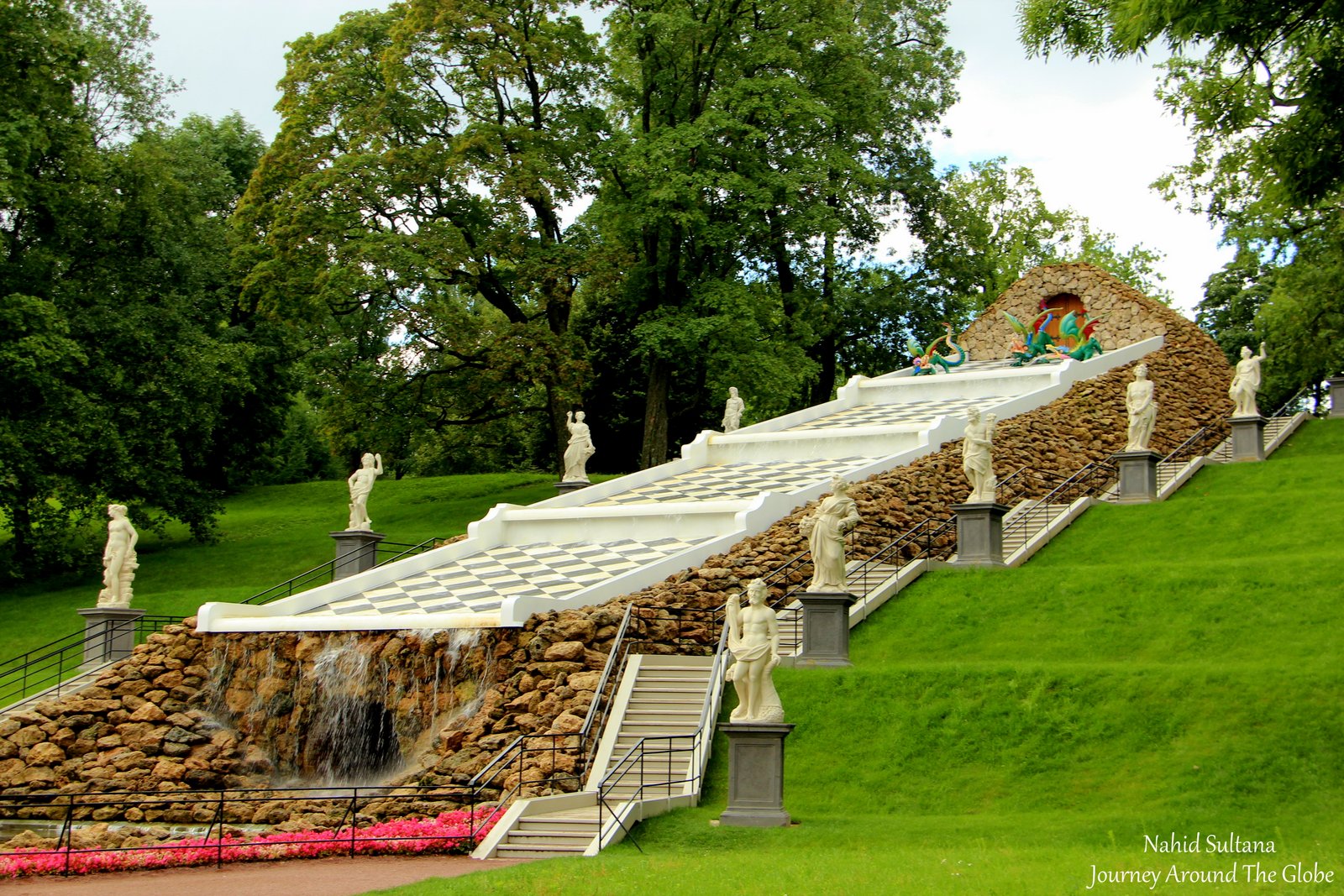
We entered Peterhof through Lower Park and walked up to the Upper Garden near the palace. After all those walking, we came to know that visitors are only allowed in 1/3 of this park. Countless small fountains, many busts, flowers beds, and a huge fountain decorate the Royal Garden in front of the palace. It is a stunning sight when you are standing on the balcony and looking over the garden. By the way, all the golden statues are actually gilded with real gold.
- Peterhof Garden and Palace in St. Petersburg

After climbing some steps we reached terrace of the palace. Only 6 rooms are accessible in Peterhof Palace. Although most of the fountains survived WWII, the palace was burnt to ground in the war and was later rebuilt.
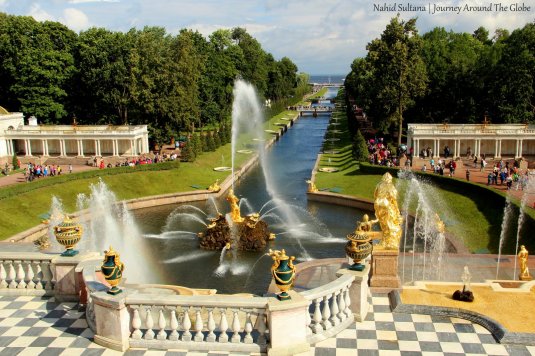
- Looking over Peterhof Garden from the terrace – St. Petersburg, Russia
3) TSARS’ VILLAGE or PUSHKIN PALACE or CATHERINE’S PALACE: From Peterhof we stopped for lunch and then headed towards Tsar’s Village. We drove about 25 km, about an hour, from Peterhof to get here. This is considered as one of the prettiest palaces in Russia. When we entered the courtyard, we saw the large series of buildings which was once summer residence of the Tsars.
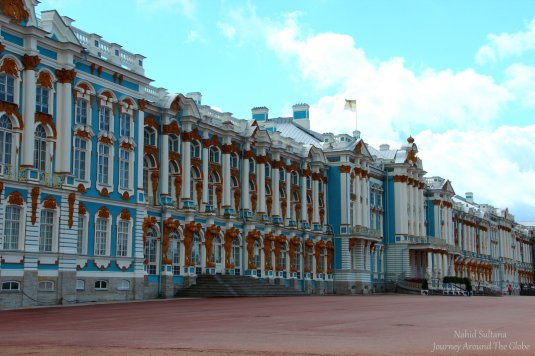
- Tsars’ Village in St. Petersburg
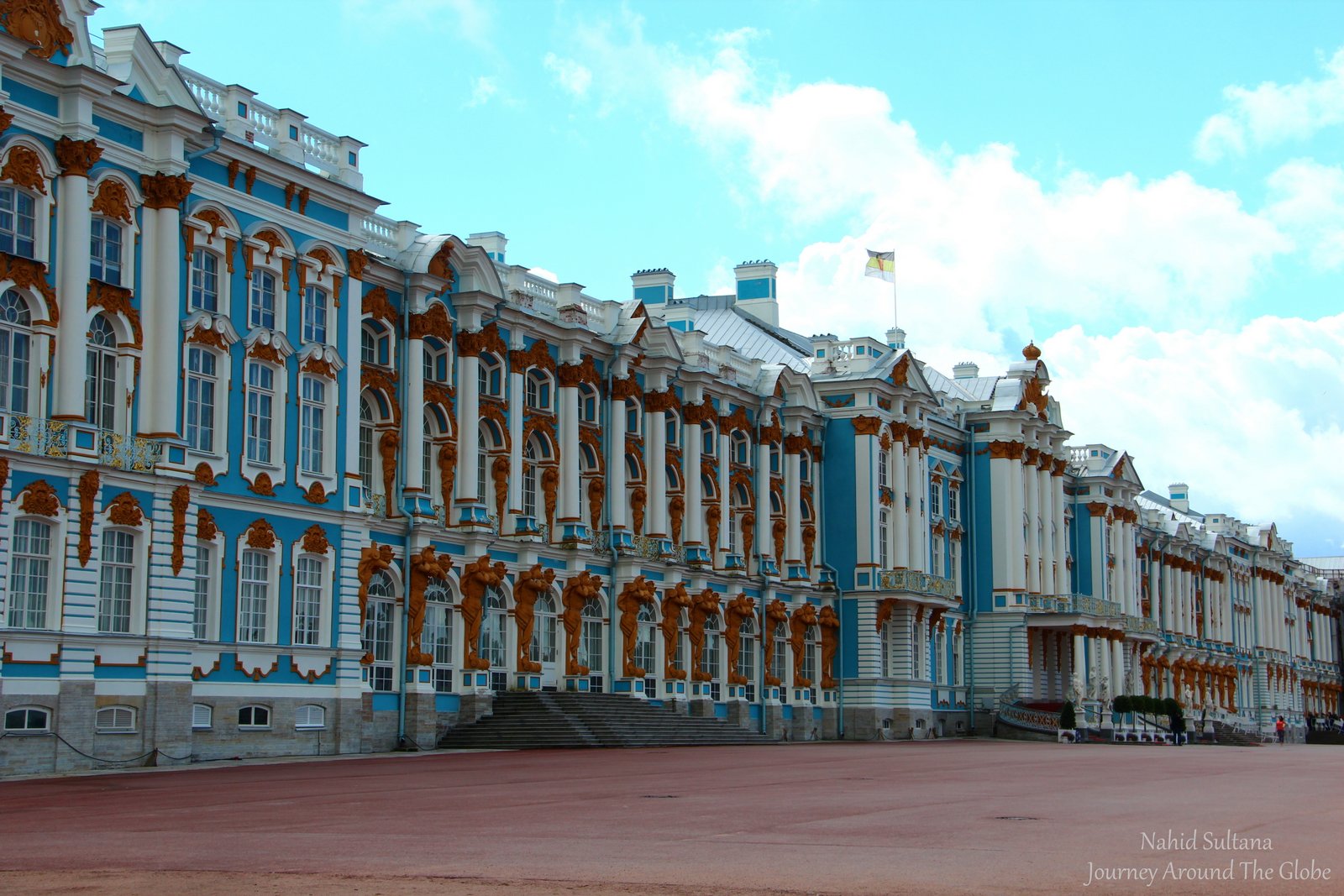
The most notable palace here Catherine’s Palace was a wedding gift from Peter the Great to his wife Tsarina Catherine I. The original palace was built in 1713 and then several wings were added later on. Peter and Catherine’s daughter Elizabeth’s favorite color was blue and pink, that’s how this palace got its blue and white color (originally was actually blue and pink). Previously it was gilded with real gold but Germans pealed all gold from the palace during WWII, now it’s just painted with paints. When Russians knew Germans were coming during WWII, they took pictures inside and outside of this palace 2 weeks before their arrival. That’s how they could restore the whole thing according to those copies.
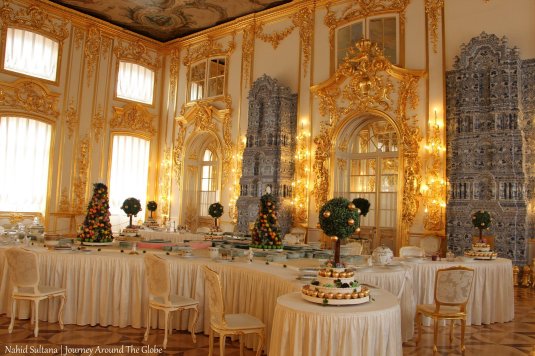
- A dazzling room inside Catherine’s Palace in St. Petersburg
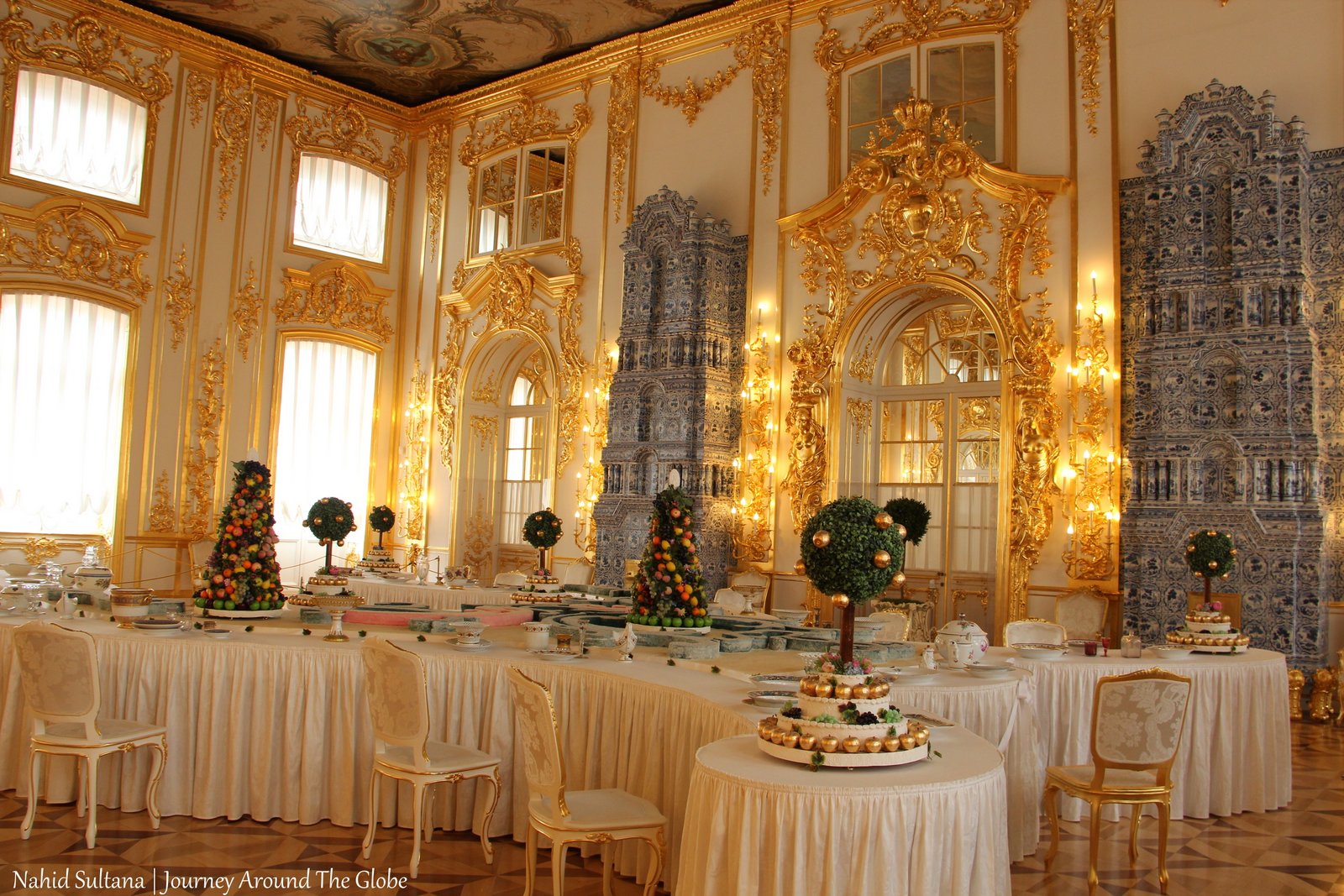
Inside of Catherine’s Palace is stunningly beautiful, reminded me of Versailles Palace in France. The whole palace has elegant golden theme. We saw many big rooms and marvelous halls. Bombs from WWII destroyed it heavily but was rebuilt like the original. Even they tried to decorate the interiors with similar items. Most expensive Chinese porcelain and large paintings are in its collection too.
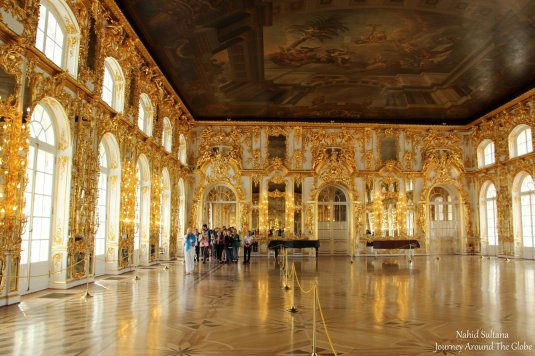
- One of the big halls of Catherine’s Palace in St. Petersburg
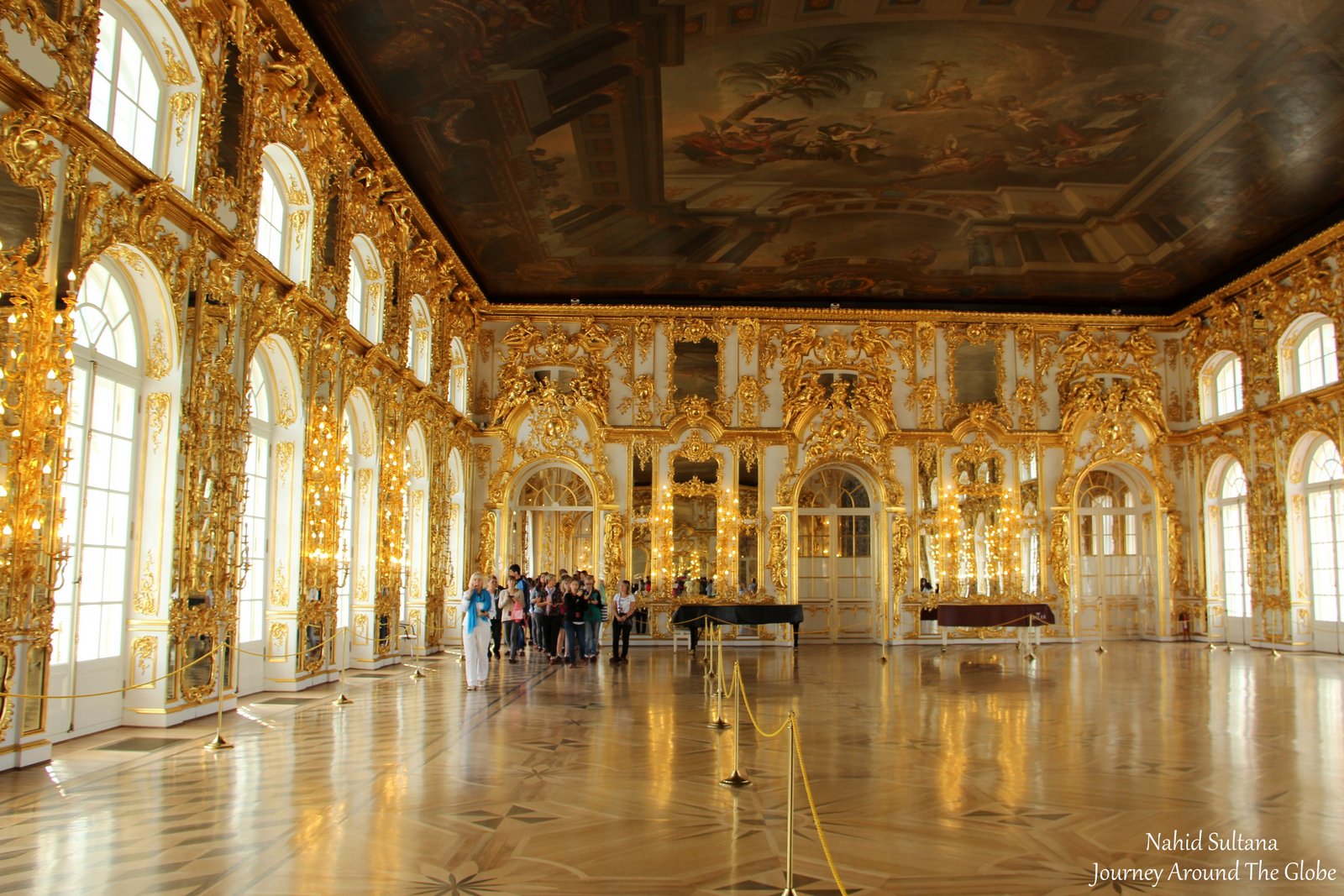
The highlights of this palace is the Amber Room. Every inch of this room has mosaic with real amber, making it one of the fanciest rooms in the world. No photos are allowed in this room, there were many guards standing looking over everyone making sure no one pointed their cameras at the walls.
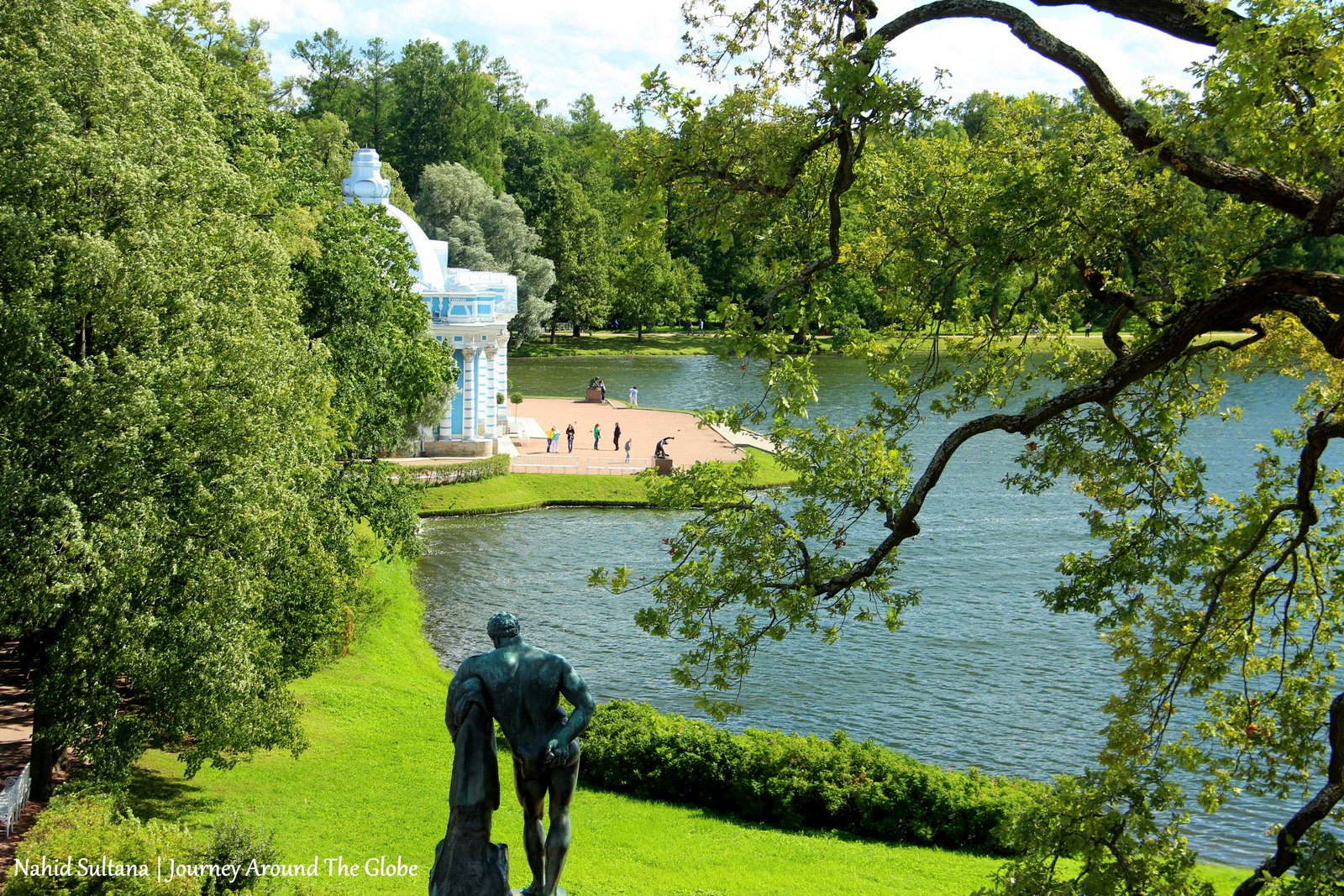
Do plan to stay in the garden here as it is not only huge but also very beautiful with unique architecture, lakes, statues, and meadows. Many other small palaces and parks are in the same complex where you can wander around for a whole day.
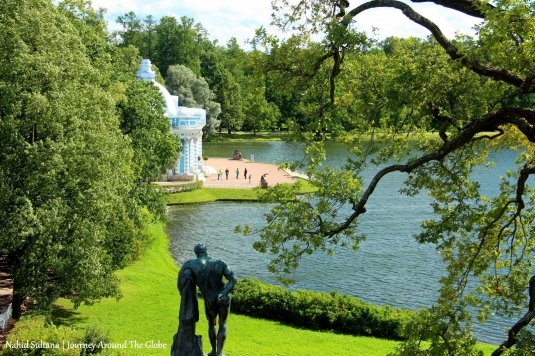
- Garden of Tsars’ Village in St. Petersburg
Inside the palace everything was written in Russian here, thanks to our guide for explaining all the details, otherwise audio guide is highly recommended.
4) PETER and PAUL FORTRESS: Our last stop for the 1st day was Peter and Paul Fortress. It is beautifully situated by Neva River. The fortress has a big compound with some museums, church, parks, and etc.
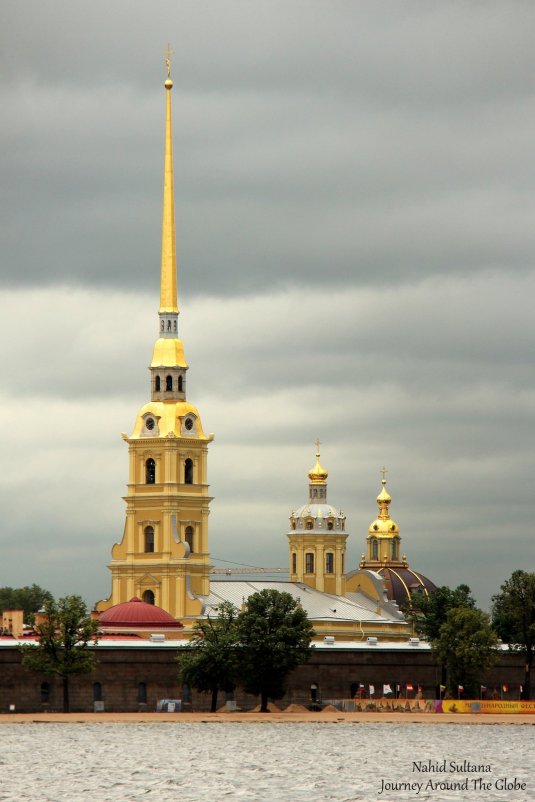
- Peter and Paul Fortress by Neva River in St. Petersburg

Cathedral inside the fortress compound is the burial place of all Romanov Tsars of Russia starting from Peter the Great to the last Tsar, except for three royal members. Nicholas II, his wife, their 3 daughters, and servants are all in one tomb located at one side of this cathedral in the Chapel of St. Catherine the Martyr. Since they were brutally murdered their faces were not recognizable, so they were all put in one tomb. One of the interesting facts about this cathedral that many people don’t know about is that it houses a piece of tunic that Jesus wore during his crucifixion. You can see it in a glass box in front of the altar.
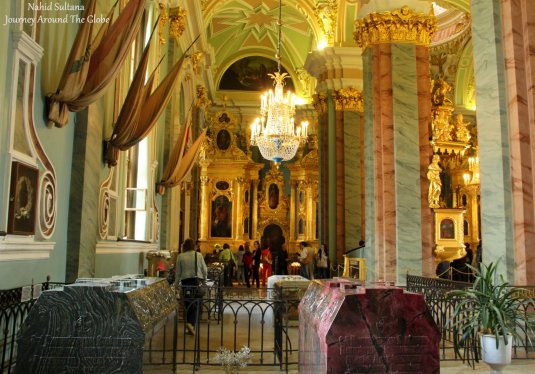
- Some royal tombs of Russian emperors inside the cathedral of Peter and Paul Fortress in St. Peterburg
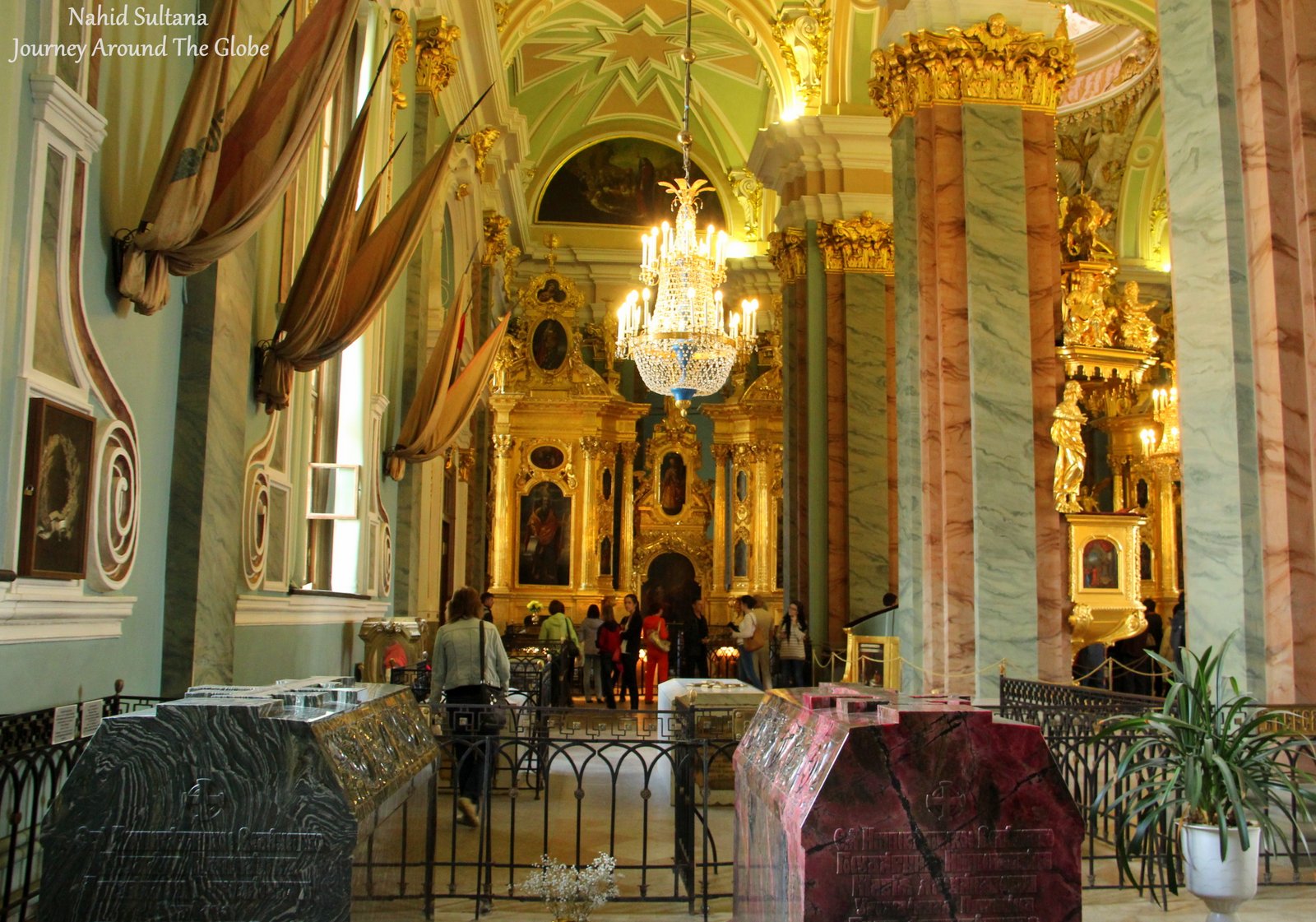
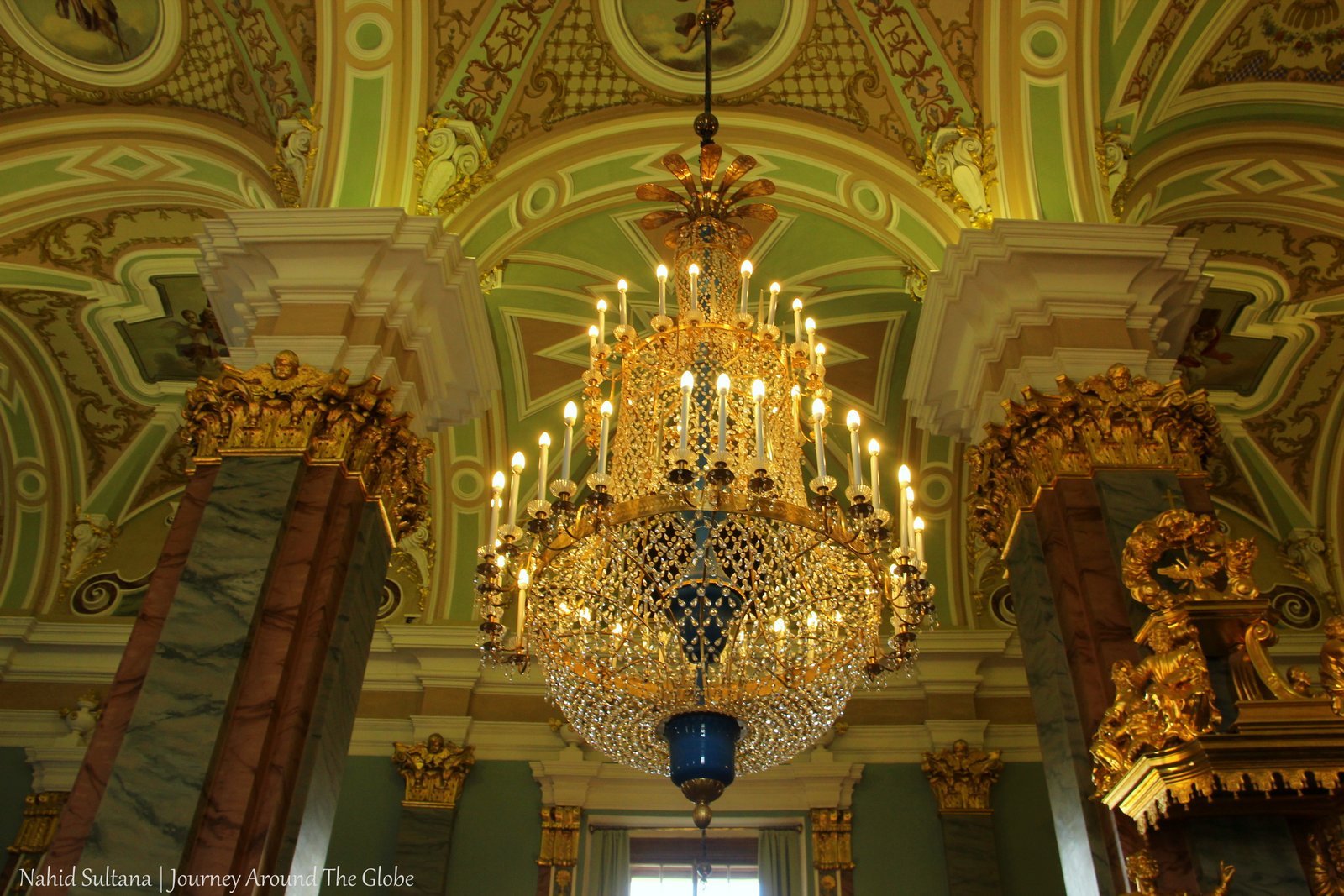
Inside the cathedral is extremely gorgeous and richly decorated. Look at the ceiling with frescoes and pretty chandeliers hanging from it. Its massive altar is gilded with 12 kg of gold with tombs of Peter the Great, his wife Catherine I, their daughter Elizabeth, and Catherine II in the front. Other tombs of Tsars and their families are spread around the whole cathedral. On the wall in you can see flags of soldiers from Russian-Turk War. The beautiful pulpit was never used.
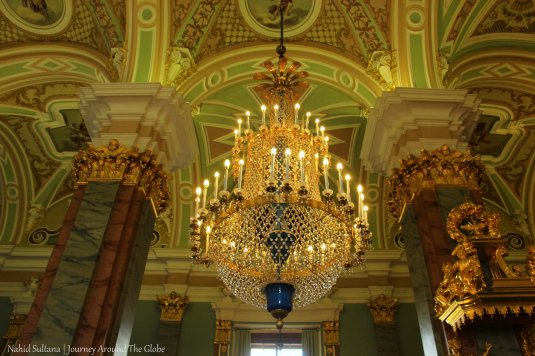
- Stunningly decorated cathedral inside Peter and Paul Fortress in St. Petersburg
Opposite of the cathedral, red brick building, is the artillery museum. Mint museum is also located here. Walk around the park here and you will see Monument to Peter the Great with small head and big body, which was true in his real life too.
5) BOAT RIDE on NEVA RIVER: The next day our tour started with a boat ride on Neva River that runs thru the heart of St. Petersburg. It was a 30 minutes ride and we got to see some of the highlights of this city in a glimpse, like Peter and Paul Fortress, domes of Church on Spilled Blood, and Hermitage Museum. Some important buildings, palaces, historic ships on the water, and bold bridges were all part of this trip. Make sure to grab a blanket as it can be a bit chilly in the morning depending on when you are visiting St. Petersburg.
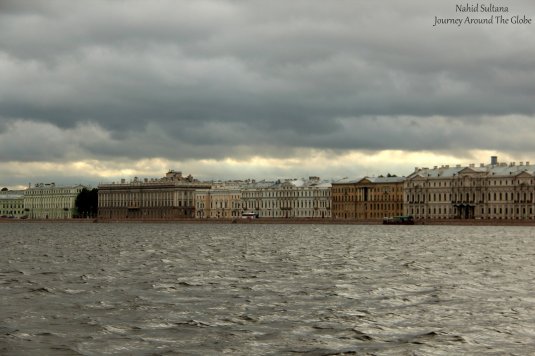
- A line of historic palaces and old buildings by Neva River in St. Petersburg
6) SUBWAY RIDE: Our guide took us to one of the stations of St. Petersburg just to show how grand the subways are here. Most of the stations here are very historic and like museums. Russians love their subways and are very proud of it. And of course there are reasons to be proud too: most of these stations go about 115 feet deep underground and they have the fastest metro in Europe. You won’t see any graffiti on the walls because people will be apprehended for that. Each station is decorated with mosaics and other wall arts according to its name and theme. Also, the stations have free Wi-Fi too!
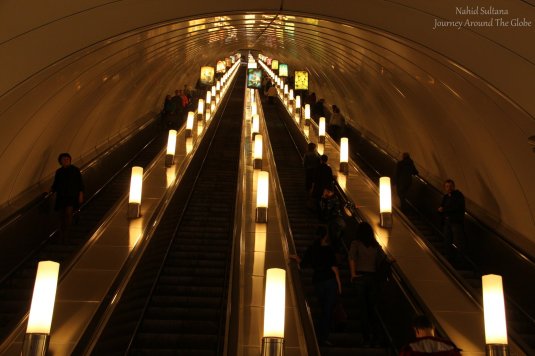
- Subway in St. Petersburg, Russia – famous for its depth and fastest metro service

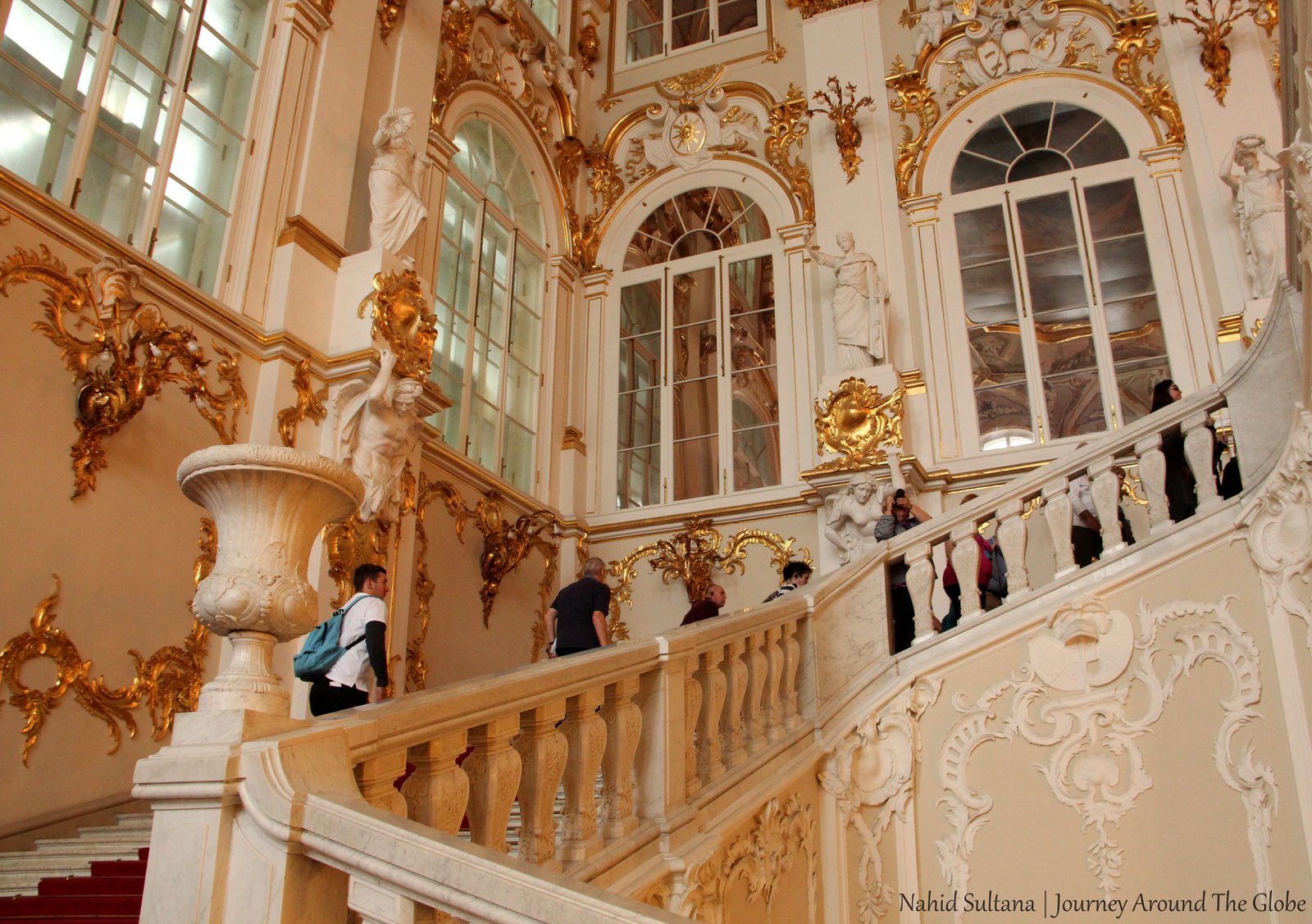
7) HERMITAGE MUSEUM in WINTER RESIDENCE of TSARS: Situated by Neva River, Hermitage Museum in the Winter Palace of Romanov Dynasty is definitely one of the most beautiful buildings in Europe and the best museum in St. Petersburg. It is well known for having one of the world’s greatest and oldest collections of art, treasure, antiques, and royal artifacts.
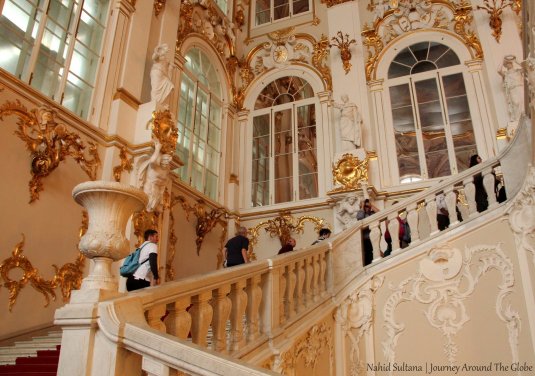
- Grand staircase of Hermitage Museum in St. Petersburg
The palace was burnt to ground in 1835 after a big fire that lasted for 3 days. Later it was rebuilt in the present way. You can actually see the big chandelier in one the halls that caused the fire.
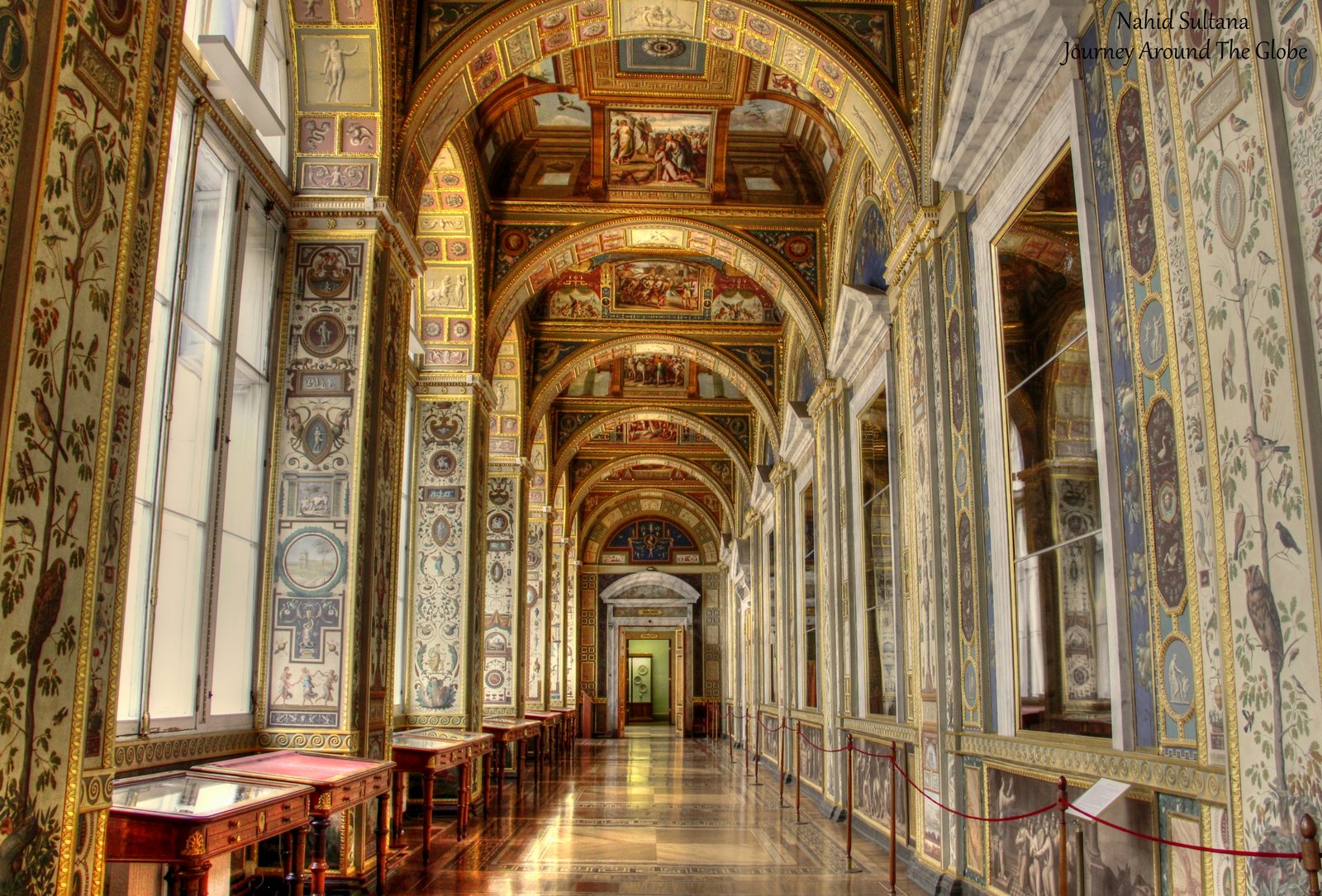
Winter Residence is a grand and one of a kind Baroque palace in the world. Elegant golden motifs and leaves decorate its walls, ceilings, and doors. We walked along large halls and Tsar’s throne in a beautiful throne room. The prettiest hall here is the Peacock Room where a gold peacock clock stands at one side, Italian marble mosaics lay on the floor, and Czech crystal chandelier hang from the ceiling. But all of the rooms and halls in Hermitage Museum has famous paintings (some of Leonardo Da Vinci works are here too), large vases, golden marble columns, Flemish tapestries, and some fine exquisite decors.
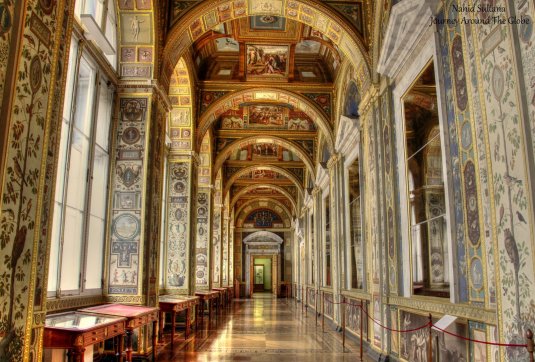
- Hermitage Museum in Winter Palace in St. Petersburg
Square in front of the museum has a statue of Tsar Alexander II and opposite is Russia’s first military headquarter.
There is a long…I mean long line at the ticket office before entering the palace. Thanks to our guide, we didn’t have to wait long enough. You have to cross a security point here. Plan to spend at least few hours to cover the whole museum and believe me it’s absolutely worth every minute. Museum is open from 10:30am to 6pm every day except Monday.
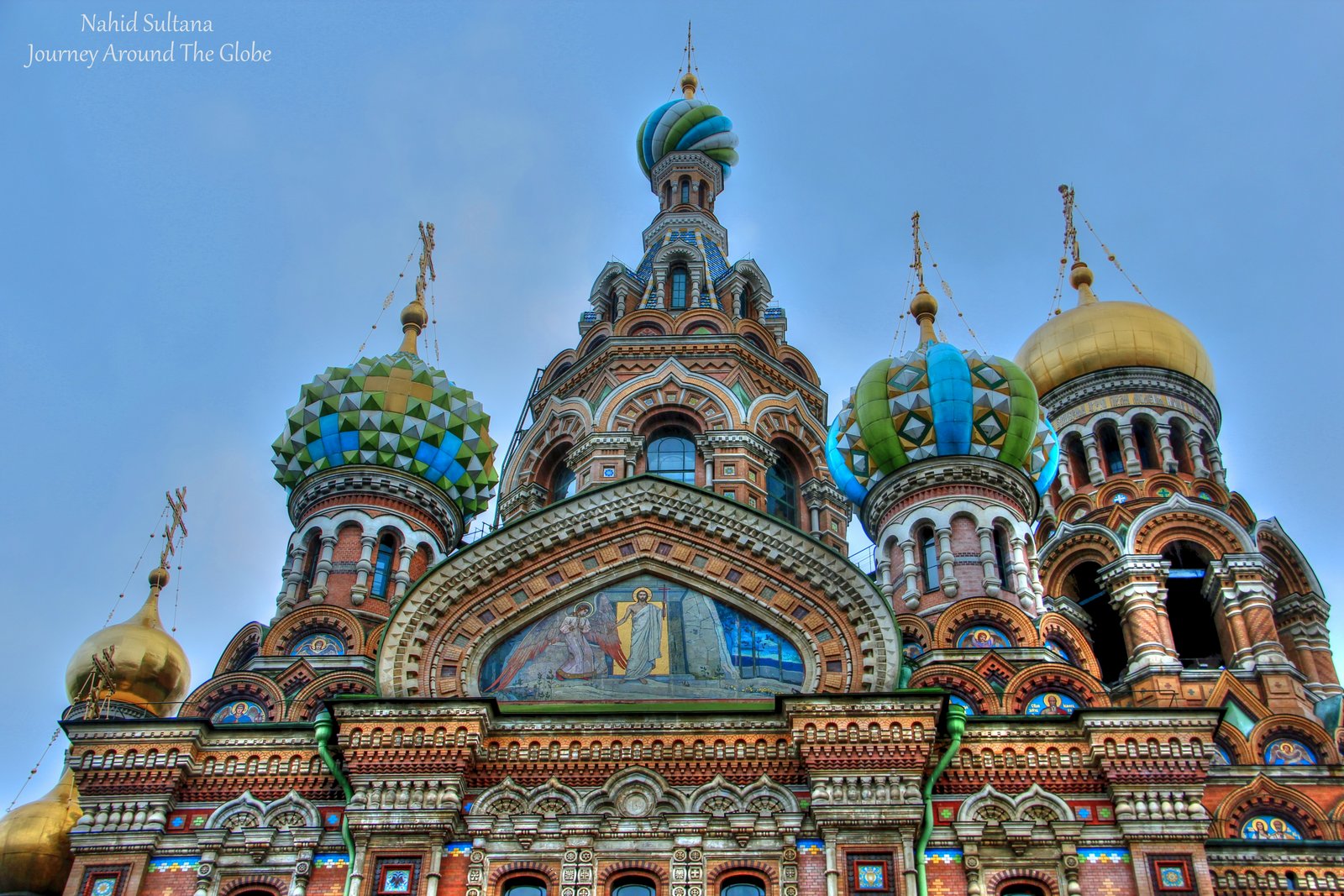
8) CHURCH on SPILLED BLOOD: This is one of the most beautiful churches I’ve seen in whole of Europe and the best looking Russian Orthodox Church in my diary yet. Constructed in 1881, this is the icon of St. Petersburg. The church was built on the spot where Tsar Alexander II was killed by terrorists. The blood wasn’t cleaned and they started building this church on top of his blood. Tourists can see the exact spot where he was assassinated.
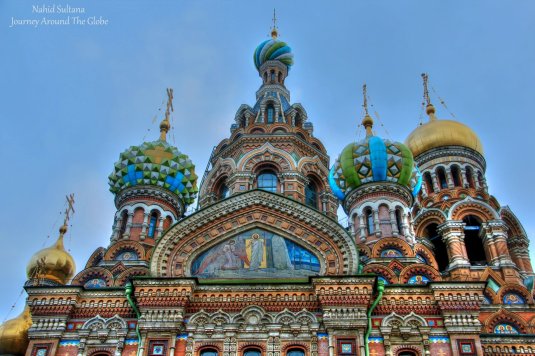
- Church on Spilled Blood in St. Petersburg, Russia
Every inch of its walls and ceiling of is elaborately covered with Moscow style frescoes and mosaics…which is more than 5000 sq. meter of mosaic. 8 different marbles were used all around this church. Many biblical stories and depictures of different stages of Jesus’ life (like young boy Jesus, which you normally don’t see in churches) are on the walls and ceilings. They were all magnificently done by Russian architects and artists. The dazzling altar was created in Italy depicting Tsar Gate with many stones and bright colorful mosaics. Also notice the black marble pillars; we were told that these shine with moonlight.
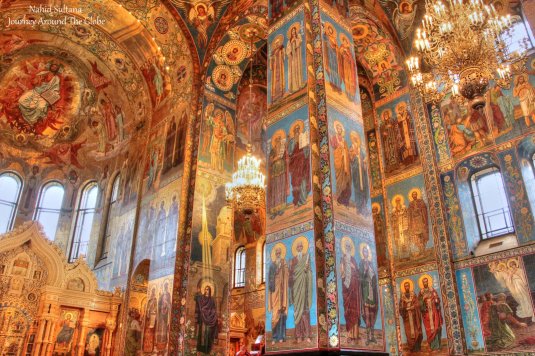
- Gorgeous frescoes and chandeliers inside Church on Spilled Blood in St. Petersburg
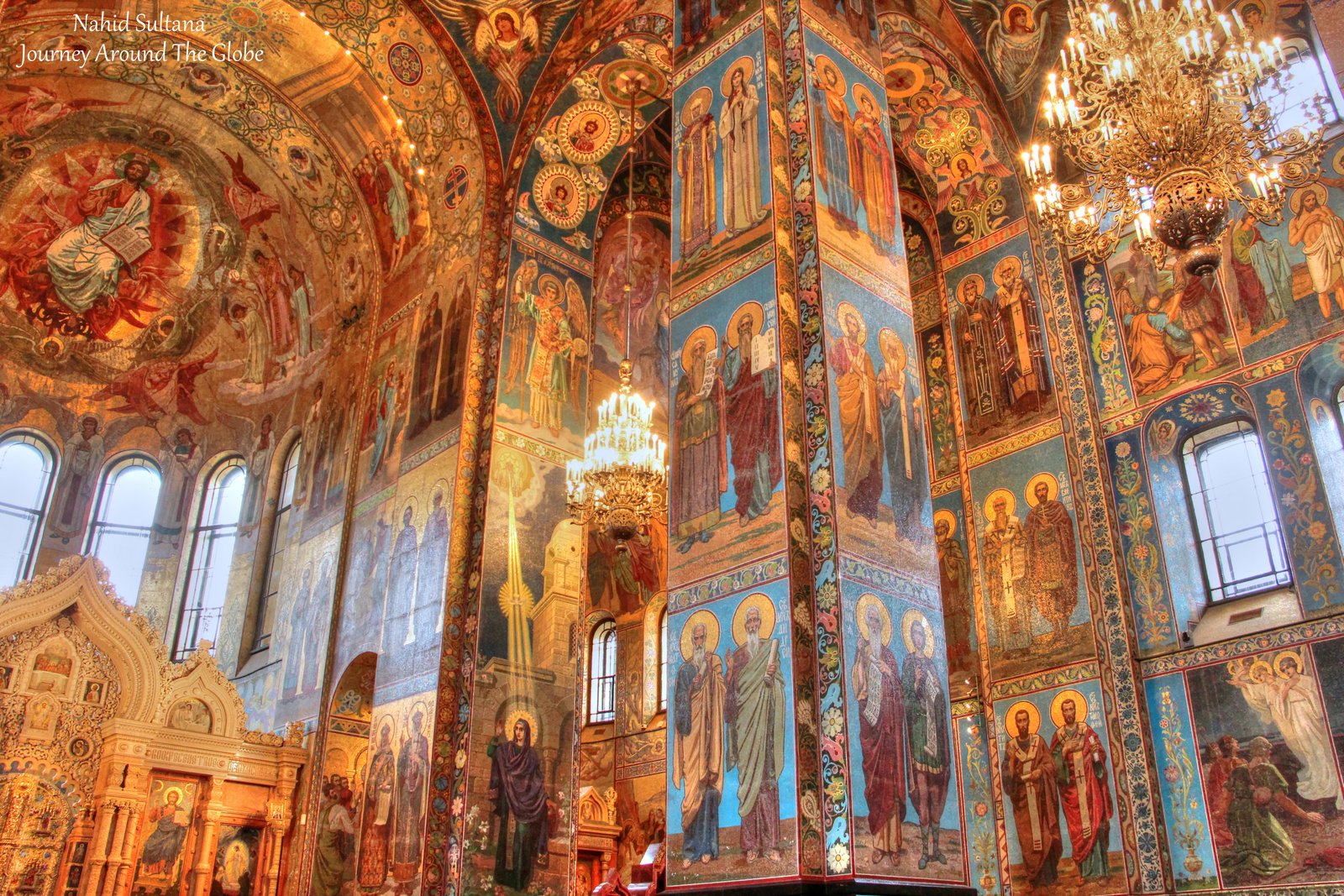
Church on Spilled Blood is a must see in St. Petersburg and should not be missed in anyway, you won’t see anything like this in anywhere in the world.
9) ST. ISAAC’S CATHEDRAL: St. Isaac’s Cathedral is another gem and a major landmark of this city. The church built in 1818 replacing a smaller one from 1712. It has a bold exterior, a glaring interior, and the 3rd highest cupola cathedral in the world.
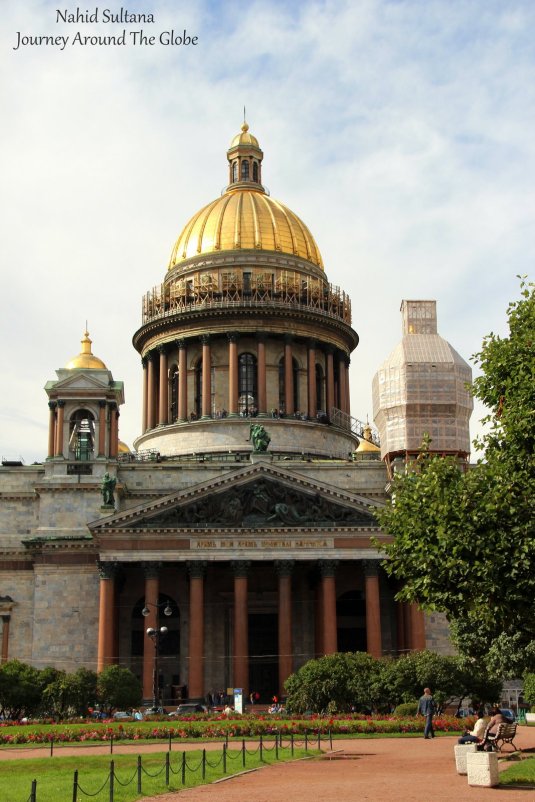
- St. Isaac’s Cathedral in St. Petersburg, the dome of it was constructed with about 300kg of real gold

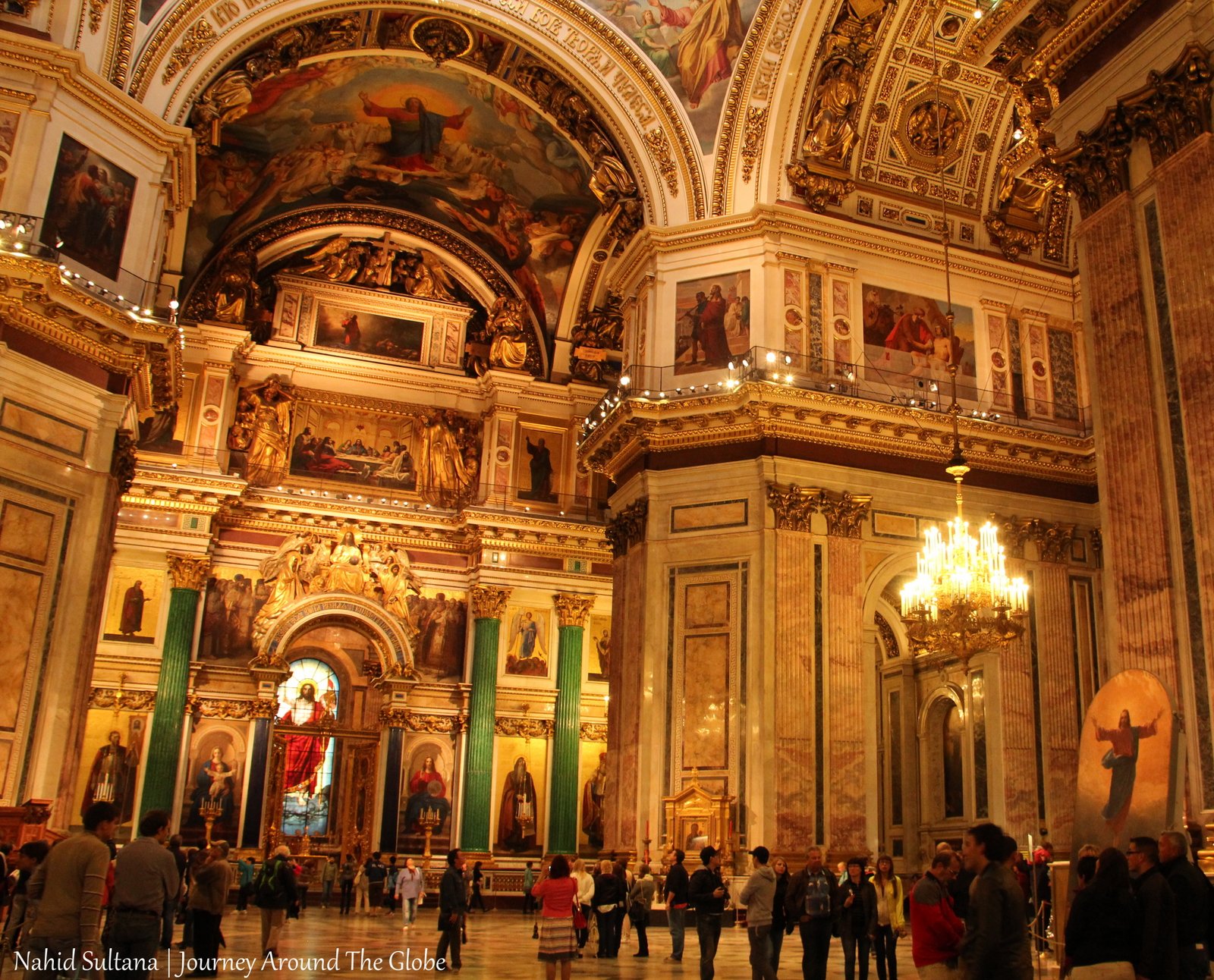
The dome of St. Isaac is made with some shocking 300kg of real gold. Made by Finnish granite, this cathedral can hold about 40,000 people inside. It’s extremely attractive interior is very lavishly designed with some extravagant vibrant colors decors. The main focus, its eye-catching grand altar has some rich mosaics and blue columns from Afghanistan. There are no chairs or organ in this cathedral, like other Russian churches. Many of Hermitage treasures were hidden underneath this cathedral during WWII.
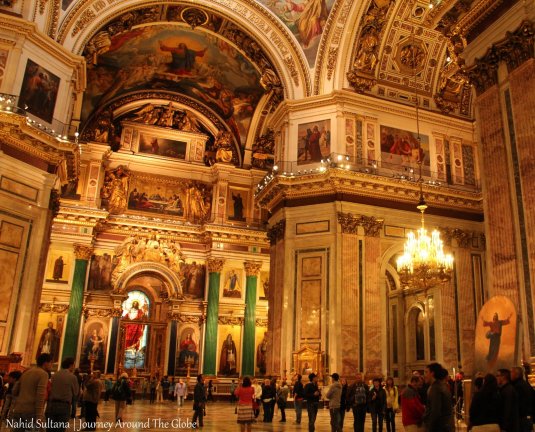
- Lavish interior of St. Isaac’s Cathedral in Russia
Luckily, the cathedral was not damaged in the war but some columns outside still have bomb marks. Although we didn’t climb to the top, it offers fabulous view of the city. The cathedral is located near the historic Hotel Astoria, where Hitler planned to have a victory party for capturing St. Petersburg within 3 days of entering the city but eventually the event never took place, since he could never capture St. Petersburg.
10) YUSOPOV’S PALACE: Yusopov’s Palace…our last spot in St. Petersburg. The palace itself may not be as charming as some of the other places we’ve been to in this city (after all it’s a bright yellow building), but hundreds of visitors come to this historic site to get a glance where that mysterious man, Rasputin was murdered.
Yusopov’s family was then the richest family in St. Petersburg (and I think in all Russia too). Mr. Yusopov, who was a Sheikh in Iran, was baptized later in his life and moved to Russia. He bought this house in 1856. The family was in gold, diamond, and oil business. With rich ornaments, mahogany walls and furniture, this is a great example of how rich Russians lived back then.
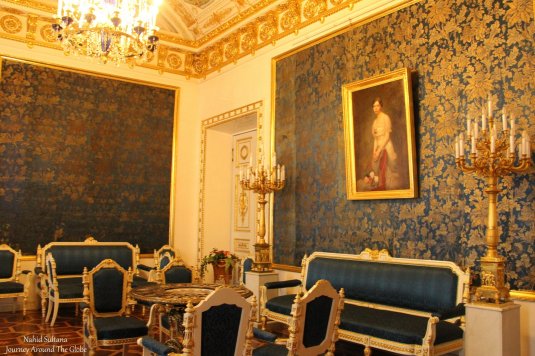
- One of the rooms of Yusopov’s Palace in St. Petersburg. Rasputin was murdered in its basement
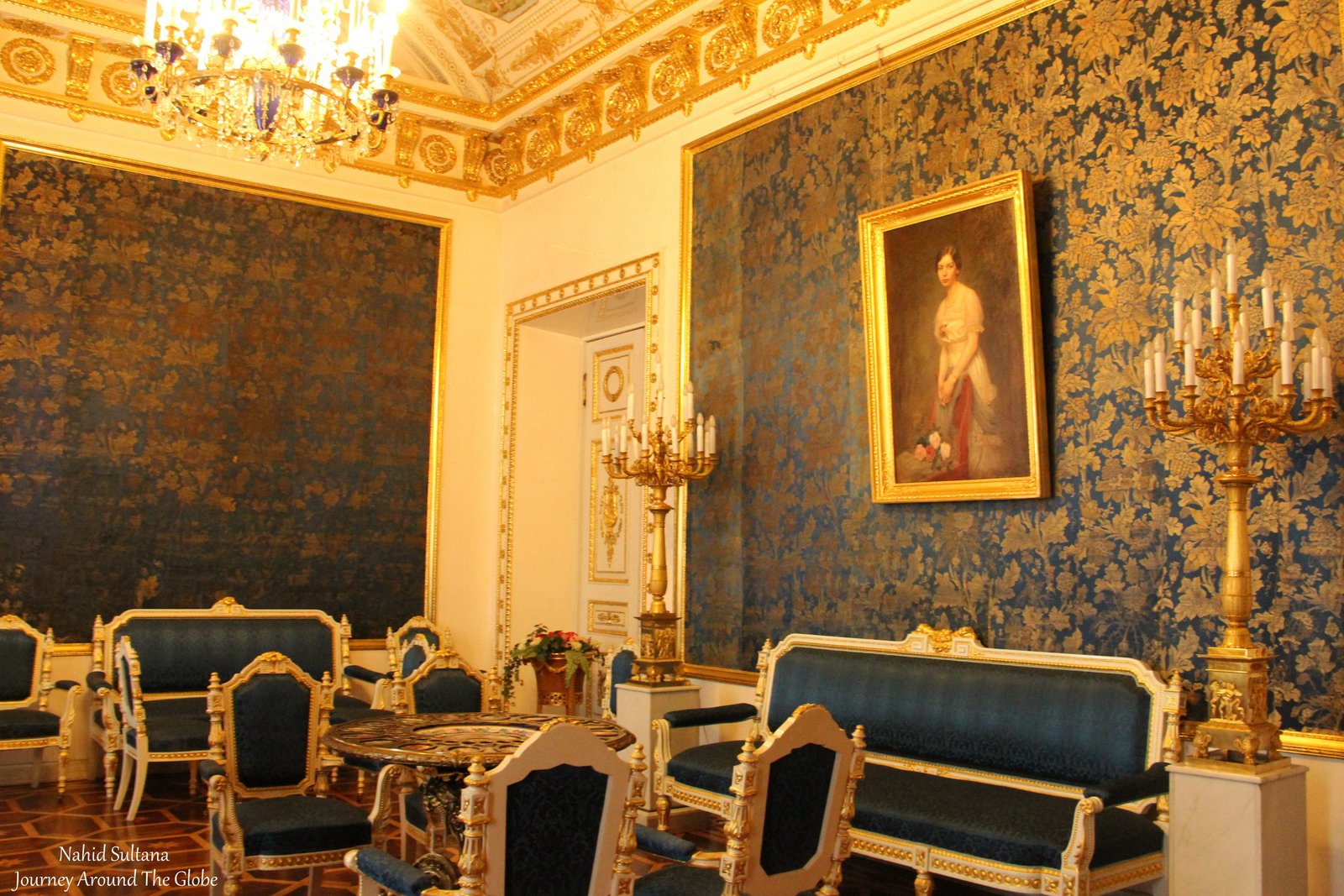
After visiting the upper part of this palace, were taken in the basement where Rasputin was killed by Mr. Yusopov’s youngest son and couple of his friends. He was then thrown into the canal in front of this building.
We have visited some cities of former USSR recently, but St. Petersburg has its own bold history and royal attitude. Knowing some of its past life and power, it actually gave me goosebumps while driving around and hearing stories from our guide. This is one of a kind place in the world…you won’t feel it unless you see it in front of your eyes.
Related articles
- Russia: The Good, the Bad and the Insane (rootlesslily.wordpress.com)
Share this:

Business Excellence Award 2020 from AI Global Media for The Most Entertaining Personal Travel Blog – Pacific Northwest USA

Top Posts & Pages


Authors
 Globe Runner
Business Excellence Award 2020 for The Most Entertaining Personal Travel Blog – Pacific Northwest USA

Business Excellence Award 2020 from AI Global Media

 Journey Around The Globe