Journey Around The Globe
ready for the next destination
Capital of Saxony – Dresden, Germany
DRESDEN, GERMANY: Situated by River Elbe, Dresden became a city in early 12th century. It has been the capital of German federal state of Saxony for many centuries. Therefore, this is the home to many Saxon kings and princes. They furnished the city with rich culture and artistic splendor over their reigns. Bombing during WWII destroyed the entire city center and ruined its original look. It was later reconstructed and restored to its former glory including some of the important buildings and churches. But you can still some black and burnt buildings in the old town…some evidences of what a war can do.

- Dresden, Germany…by River Elbe

I loved Dresden. It didn’t, for some reason, look like another German city. Whenever I think of Dresden, its old town with astonishing old architectures come to my mind. Another of my favorite was walking by the river…even in cold winter, summer will surely be more beautiful here.

- Old buildings of Dresden, Germany

TIME of TRAVEL: Dresden was our fifth stop during the winter road trip we took in Christmas of 2013. Before coming to Dresden we made few stops at Fussen in Germany, Innsbruck and Salzburg in Austria, and then to Prague in Czech Republic. Germany can get really cold and windy in December but we handled it very well. The weather was unexpectedly not that freezing or snowy. It was below zero at night but during day it was very nice.

- Christmas decoration in old town of Dresden

Last time we were in Dresden was in April of 2009. It was a short visit only for an hour when we were coming back from Prague. My husband stayed in the car with our daughter and I just took the camera and walked to Dresden Zwinger to take some pictures.
OUR HOTEL: We stayed in Holiday Inn Express in Dresden, less than 15 minutes of walk from the city center or old town. The hotel had free breakfast and Wi-Fi. The location was good too in a sense that it was only few steps away from a shopping street.
EATING and SHOPPING: We had our first dinner at a sushi place right in front of our hotel. Next lunch was at Restaurant Zur Frauenkirche in old town near Frauenkirche. They had plenty of different options of soup, salad, and yummy pastries.
I won’t say old town of Dresden is a paradise for shopping. It had souvenir stores here and there. No clothing or accessories stores came to my attention, may be they are on other sides where we didn’t go.
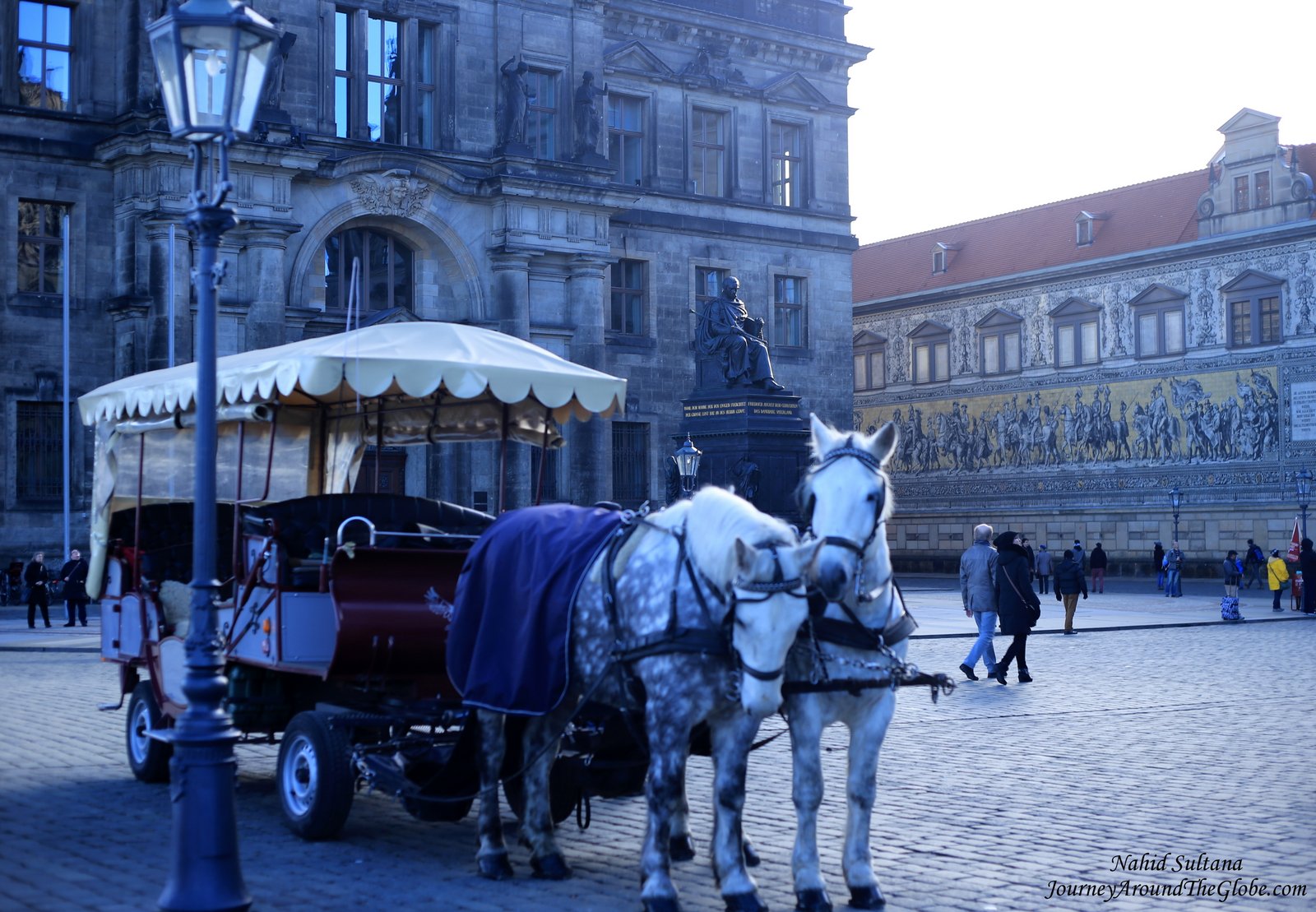
PLACES WE’VE VISITED: Most of the touristic spots of Dresden are in its old town or alstadt. We covered it on food but horse-carriage is also available. It’s pretty compact and organized. We had only a day to explore this town and these are what we did in Dresden:

- City center or old town of Dresden, Germany
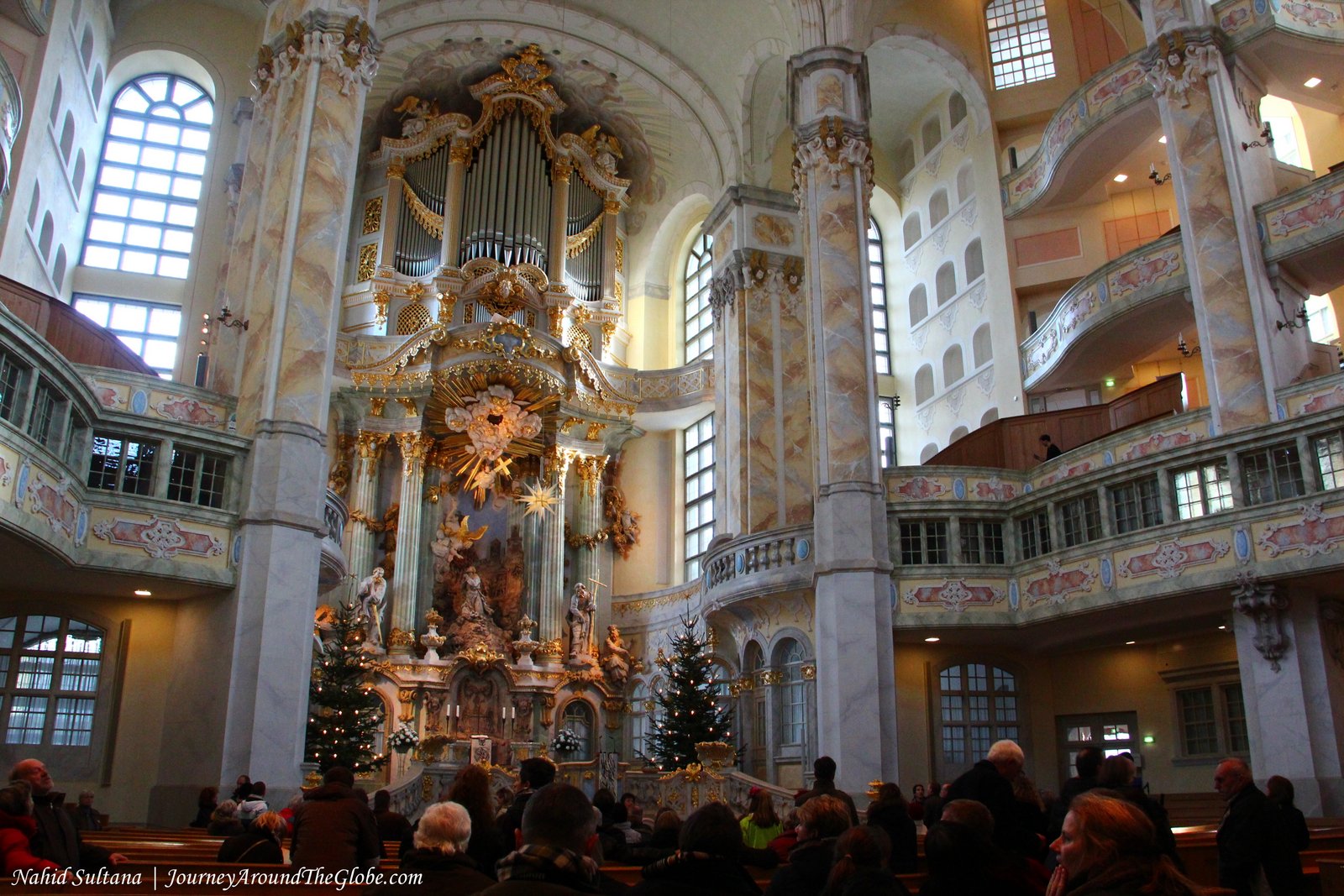
1) FRAUENKIRCHE: Located in Neumarkt of old town, Frauenkirche is the most famous landmark of Dresden. The church is very beautiful inside as well as outside. Interior of this church is relatively modern and not a typical looking one. A statue of King Augustus II and another statue of St. Martin Luther stand at two sides of this church. Frauenkirche was completely destroyed during WWII and was later reconstructed in 2005. It’s free to enter and visitors can climb its tower for a great view.

- Inside Frauenkirche in Dresden
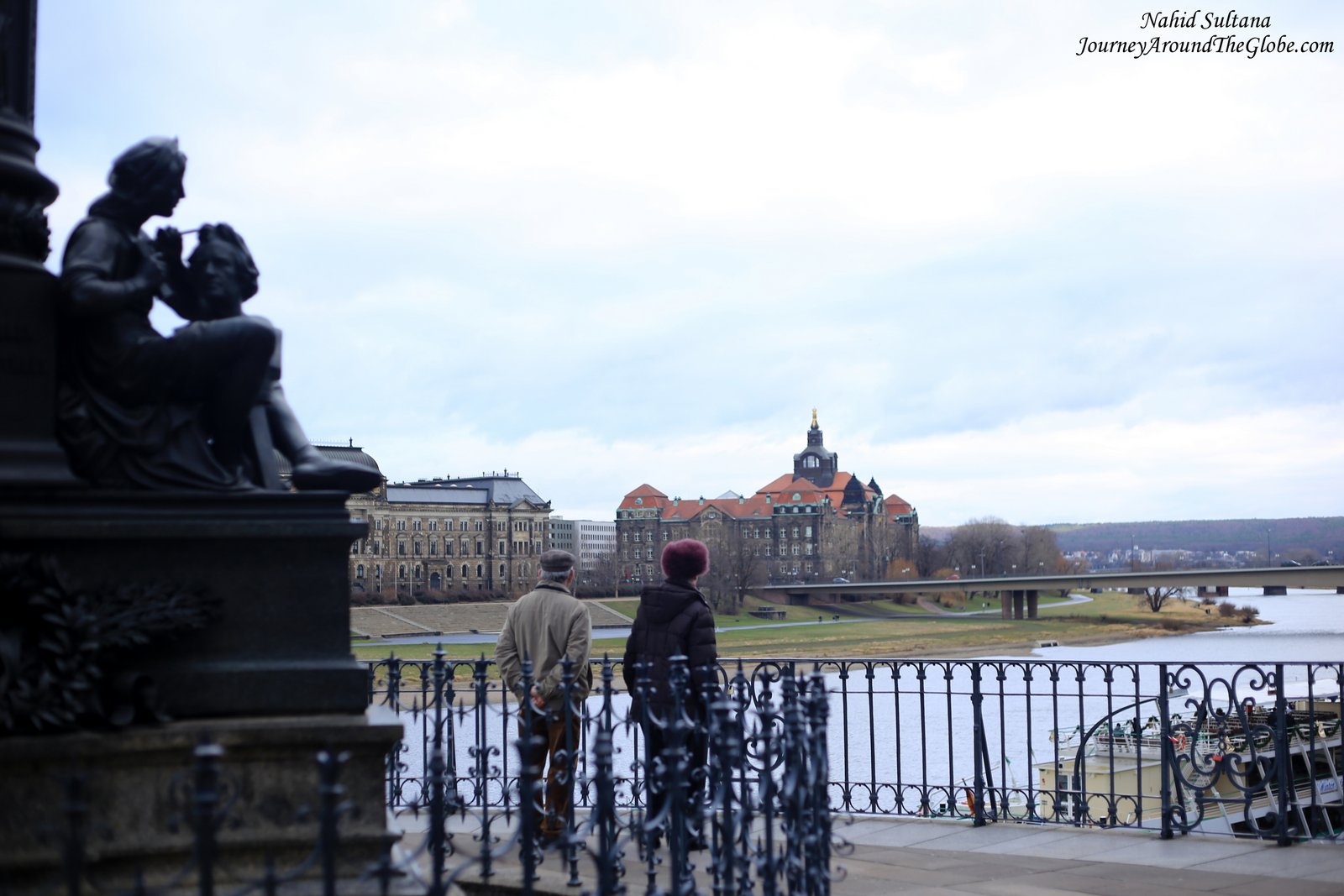
2) SCHLOSSPLATZ – FURSTENZUG and HOFKIRCHE: This is probably one of the best places to enjoy River Elbe. There is a pedestrian bridge or terrace where we went to get a fantastic view of the river and its banks. This is a nice place to take a stroll and enjoy city’s old architecture. Also, if you love taking photos at night, this is a perfect place for that too. You can see shadows of buildings and their lights on the river, looks stunning.
- From the pedestrian terrace in Schlossplatz, Dresden
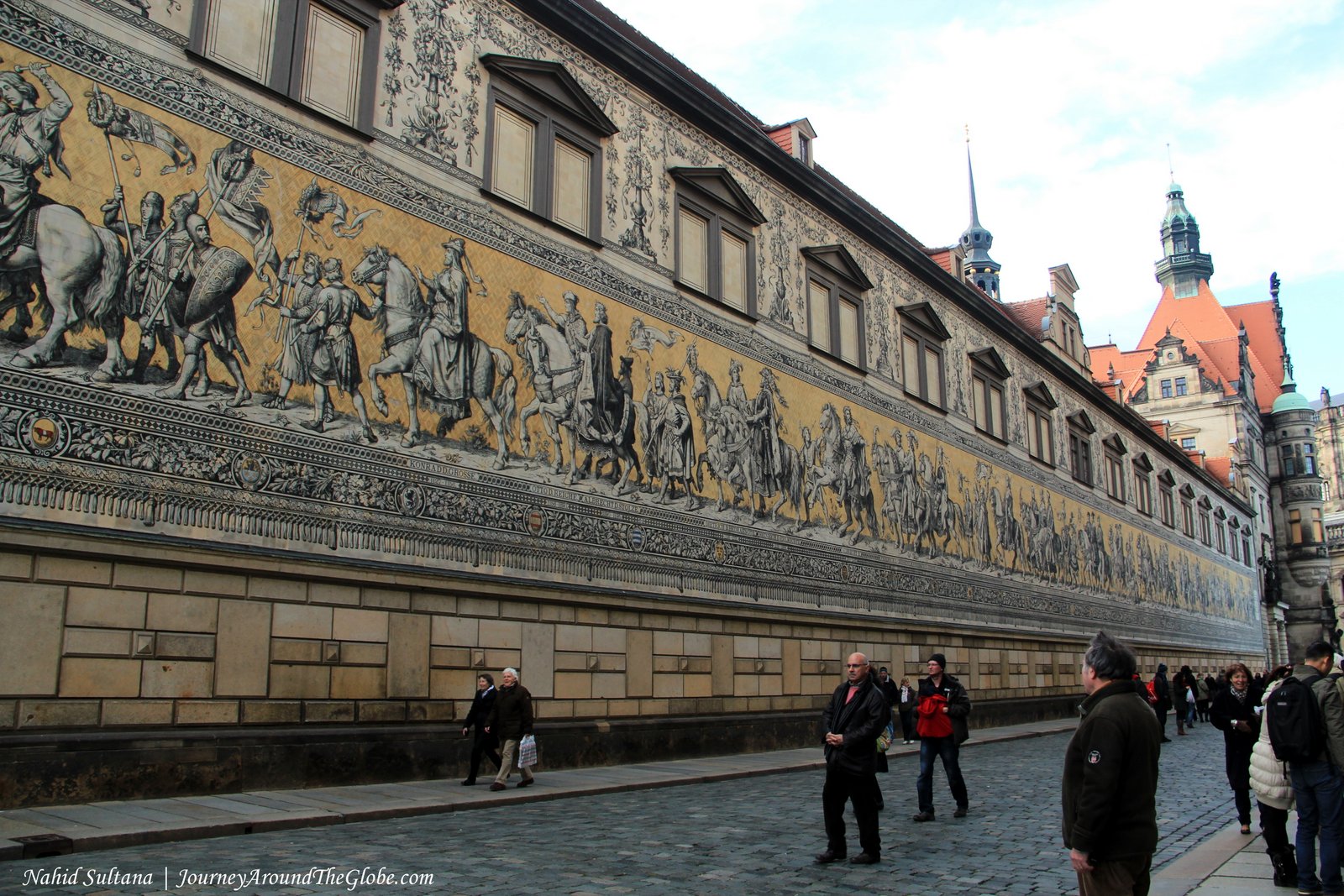
Furstenzug or “Procession of Princes” on Augustusstrasse in Schlossplatz is a famous mural from 1870s. This large mural depicts processions of the rulers of Saxony on their horses in parade uniforms from 1127 – 1904. The original painting from late 19th century was replaced with some 23,000 ceramic tiles in early 1900. With a length of 335 ft., this is considered world’s biggest porcelain art-work.
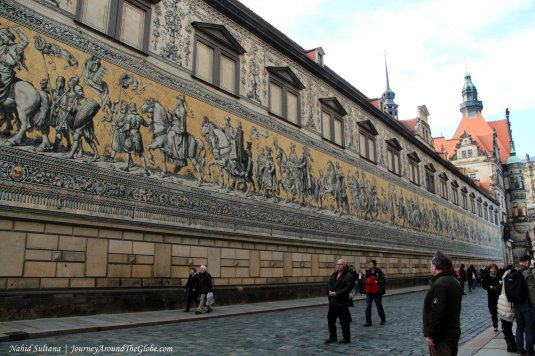
- Furstenzug – world’s biggest porcelain artwork in Dresden, Germany
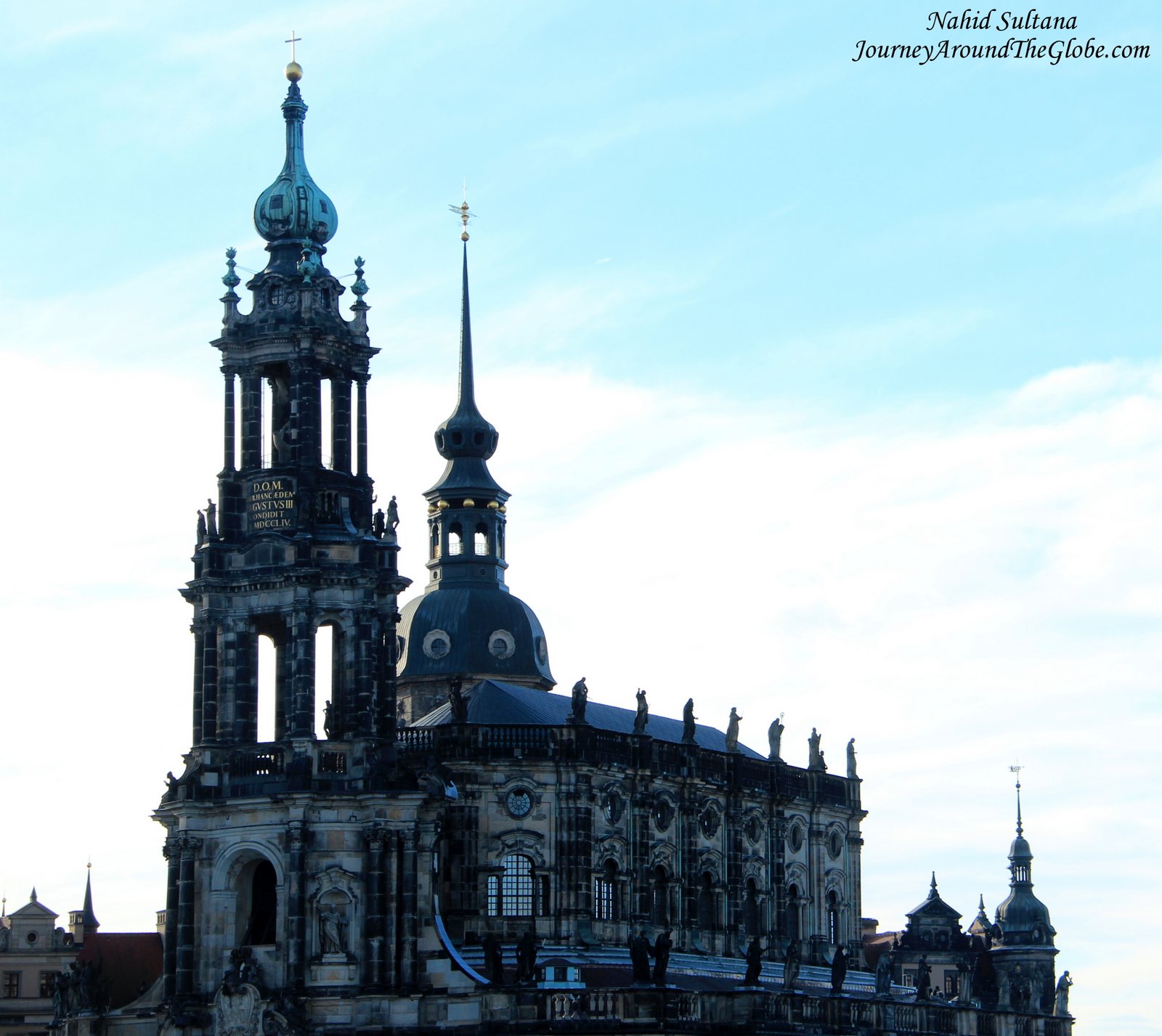
Hofkirche or Dresden Cathedral in Schlossplatz is located by River Elbe in the old town. This is a big cathedral with all white interior, a grand organ, and nice altar. Its exterior is intriguingly beautiful with many statues of saints on the walls and roofs.
- Hofkirche or Dresden Cathedral
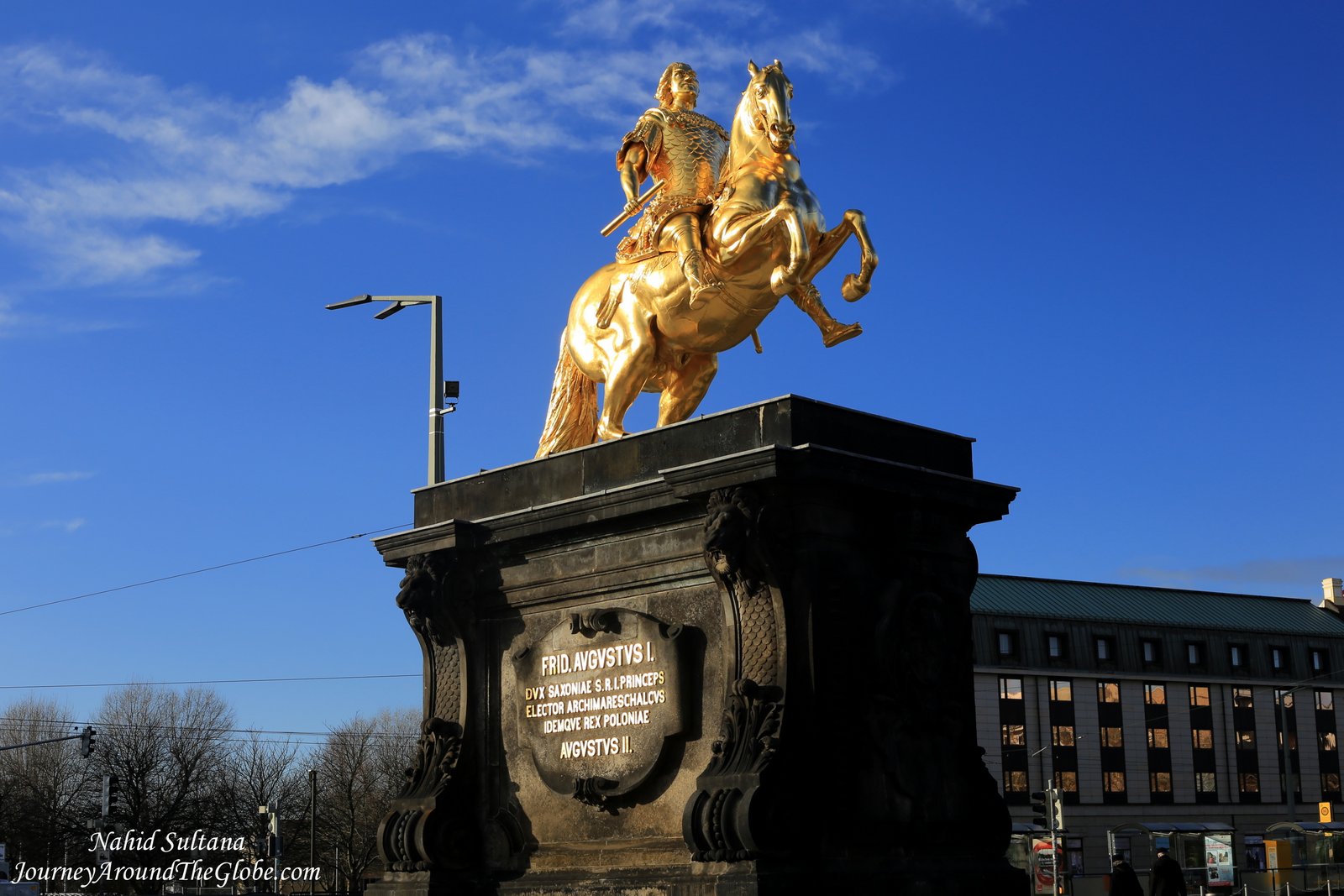
3) NEUSTADTER MARKT and GOLDENER REITER: After spending some in Schlossplatz we crossed the big bridge, called Augustus Bridge, and entered new part of the town. There are few things to see here, like Japanese Palace and some museums. We only went to the big square on the other side of the bridge after crossing an intersection. There is a golden statue of King Friedrich Augustus II in Neustadt, known as Goldener Reiter.

- Goldener Reiter – a golden statue of King Augustus the Great in Neustadt Dresden, Germany
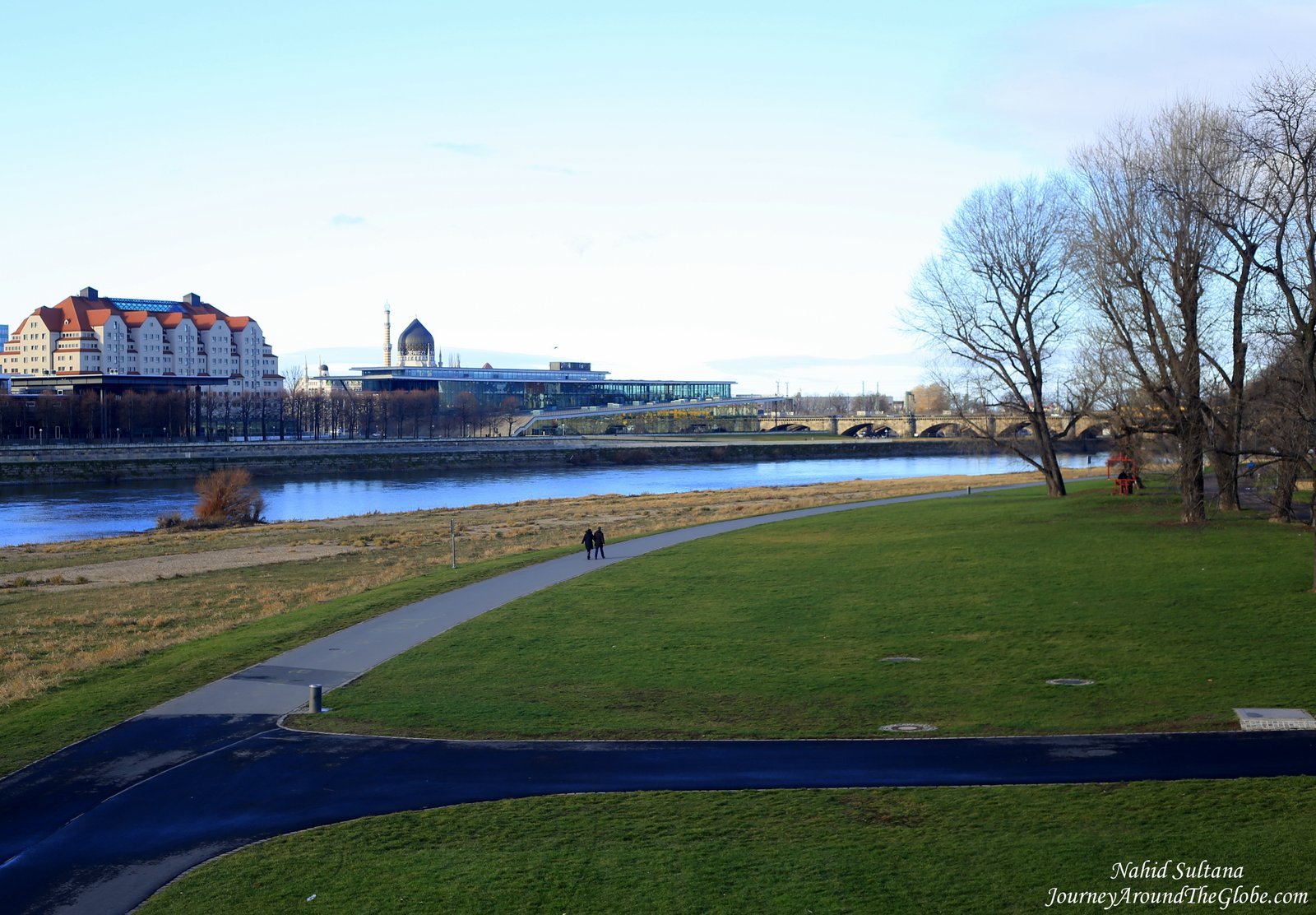
4) ELBE RIVER BANKS: We enjoyed view of the banks of Elbe while crossing King Augustus Bridge that connects old town with the new town. This long stretch of meadow by River Elbe is a very beautiful place to sit around or picnic goers in summer.

- Elbe River Bank in Dresden, Germany
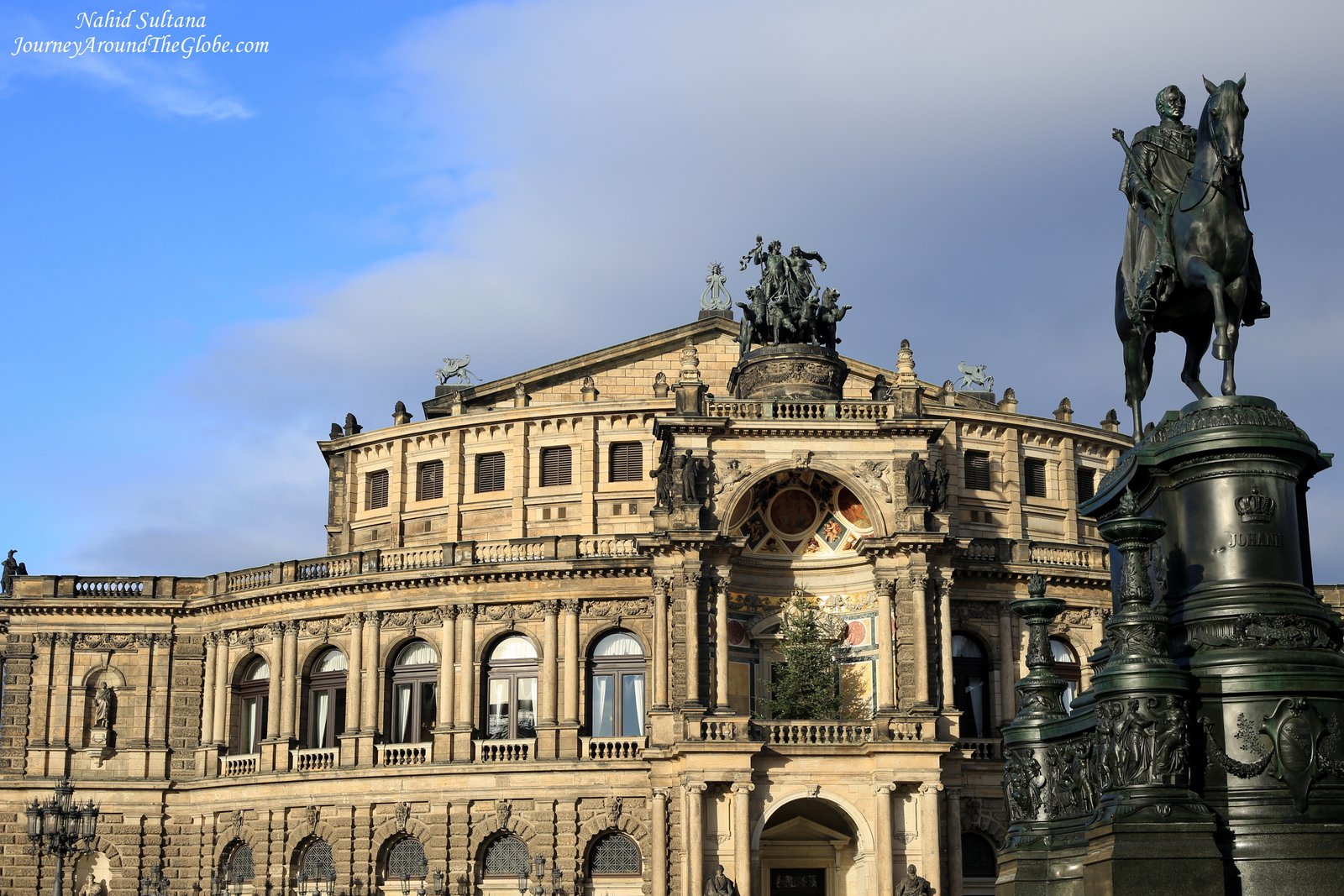
5) SEMPER OPERA: Semper Opera is definitely an eye-catching building in old town and is one of the most beautiful opera houses in the world. It was badly destroyed during WWII but was later rebuilt in 1985. It is located in Theaterplatz, opposite of Hofkirche. It can only be visited by guided tour, but unfortunately the tour was not available during our visit.
- Semper Opera in Dresden – one of the most beautiful opera in the world
6) DRESDEN ZWINGER: This is the main attraction of Dresden. It’s a big garden surrounded by old Baroque palace buildings on all sides. These palaces were never completed. Dresden Zwinger includes Semper Building, Glockenspiel Pavilion (Clock Tower), Crown Gate, Rampart Pavilion, Nymphs’ Bath, and Marble Hall. Three museums that tourists can visit in these buildings are – Math and Physics, Porcelain, and Art museum. This is a beautiful place to walk around. I remember from my 2009 visit here that all the gardens were looking fabulous with all the flowers and fountains. It was a bit dull in winter but you can still enjoy walking on the terrace or on the ground with many other tourists.

- Dresden Zwinger – Glockenspiel Pavilion (clock tower) on the right

Dresden Zwinger is located right beside Semper Opera. There is no ticket to enter the courtyard or garden but the museums require tickets.
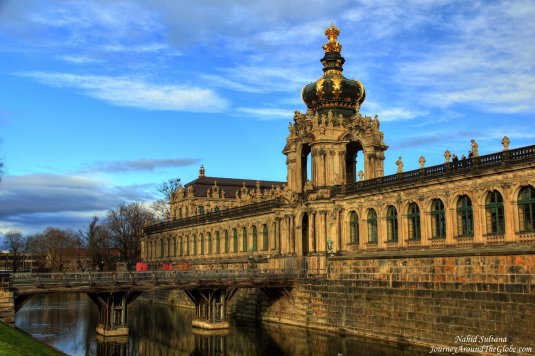
- Golden Gate of Dresden Zwinger

7) GRÜNES GEWÖLBE – MUSEUM of TREASURY ART: The Grunes Gewolbe is world renown as one of the richest treasure chambers in the world and definitely Europe’s most splendid treasure chamber museum. There are two permanent exhibitions in the Residenzschloss. Historic Grunes Gewolbe – Baroque Treasure Chamber is on the first floor of Residenzschloss. And the one we visited was Neues Grunes Gewolbe.
Museum of Treasury Art includes three sections: Turkish – Ottoman art from 5th century, Treasury – Historical Green Vault, and Armory.
Museum of Treasury Art, the Neues Grunes Gewolbe contains more than 1,000 priceless and exquisite antique objects. We were fascinated by every individual item and the infinite wealth of details on these extraordinary works of art like everyone else in that museum. It contains unique goldsmith’s artistic items made by court jeweler Dinglinger, an outstanding artist of Baroque jewelry work. You can also find precious objects made of amber, mother of pearl, and ivory gemstone vessels and elegant bronze statuettes. Exclusive royal jewelries, wall-hangings/tapestries, portraits, and parade textiles are also here. These are from personal collection of King August the Strong, mostly dating from 1697 to 1719.
Two of the most dazzling and remarkable work of art here are: 1) “Dresden Green Diamond” – the most valuable diamond of the entire jewel treasure in the Green Vault and is the biggest green diamond in the world. This is an exceptionally precious 41 carats green diamond with tiny cherry stone carved with gold and silver. No one knows how it came to Dresden from India many years ago. 2) The “Royal Court” at Delhi (India) on the occasion of the Grand Mogul Aurangzeb by Johann Melchior Dinglinger from 1701. This is a detail ornamental depiction of “The Throne of the Grand Mogul Aurangzeb”.
In the Turkish exhibition, you can see August the Great’s huge Turkish collection, armory, and antiques. Armory section also has a gorgeous collection and depictions of arms, swords, battle-uniforms, amours, weapons, and shields.
Museum is located in old town and is open every from 10 – 6 except Tuesdays. It was 10 euros per adult to visit Neues Grunes Gewolbe (Historic Grunes Gewolbe is separate). We weren’t allowed to take any pictures inside.
Share this:

Picture-Perfect Prague
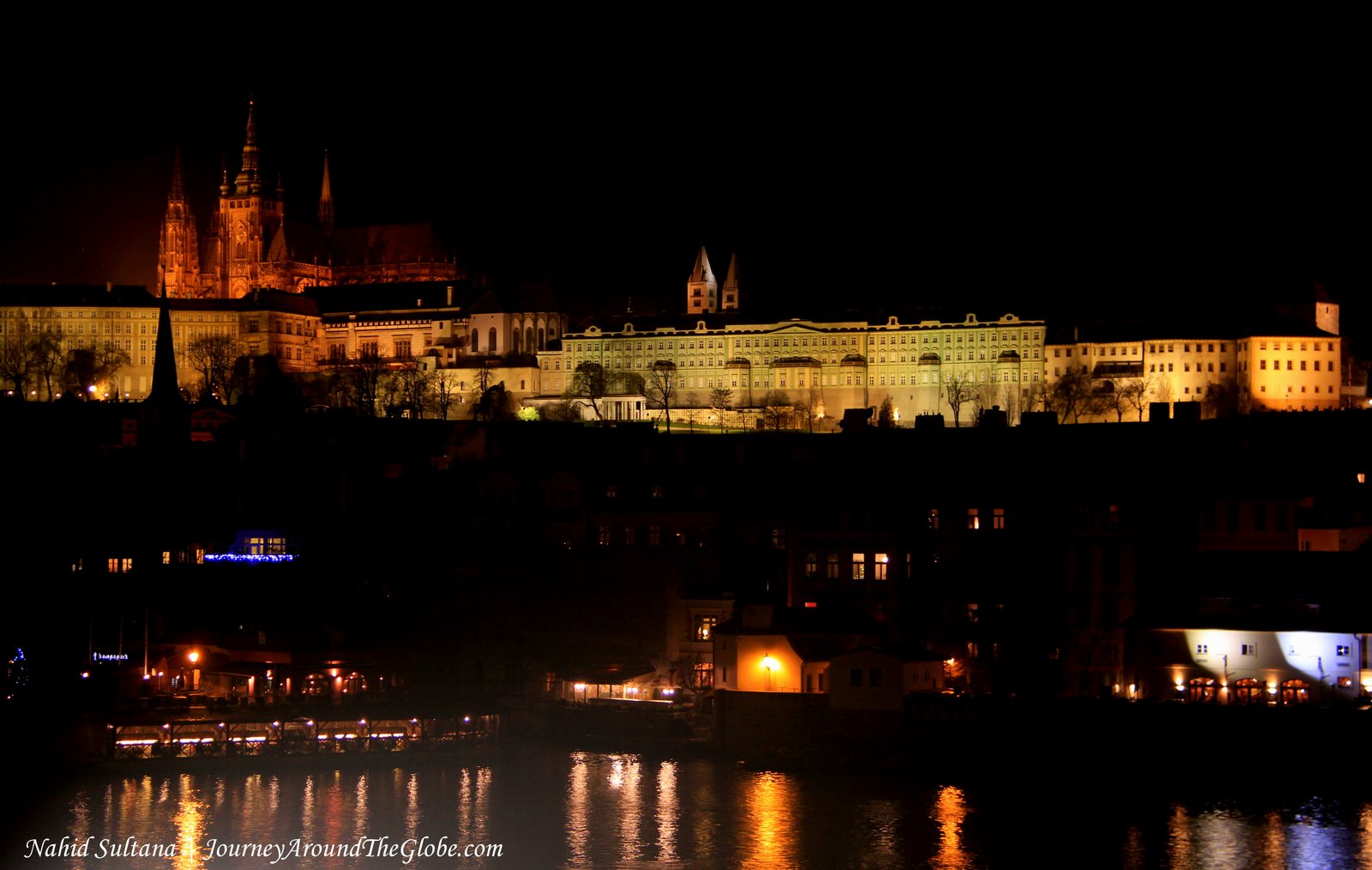
PRAGUE, CZECH REPUBLIC: Praha or Prague is a picturesque European city situated by River Vltava. Founded in 9th century, historically, this was once the capital of the Bohemian region. Now it’s the capital and the largest city of Czech Republic. Prague is such a beautiful city that it would be unfair to try to describe it with words or portray thru photos. This is one of my favorite cities in the world where I can come back at any given every opportunity.
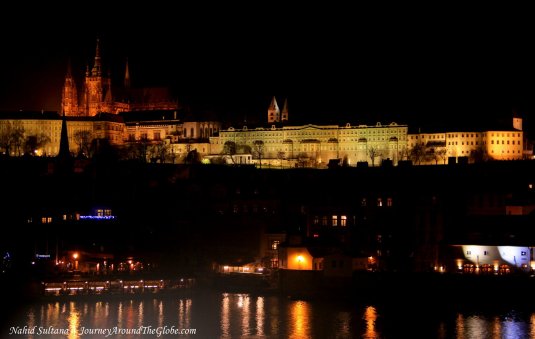
- One of my most favorite cities in the world – Prague
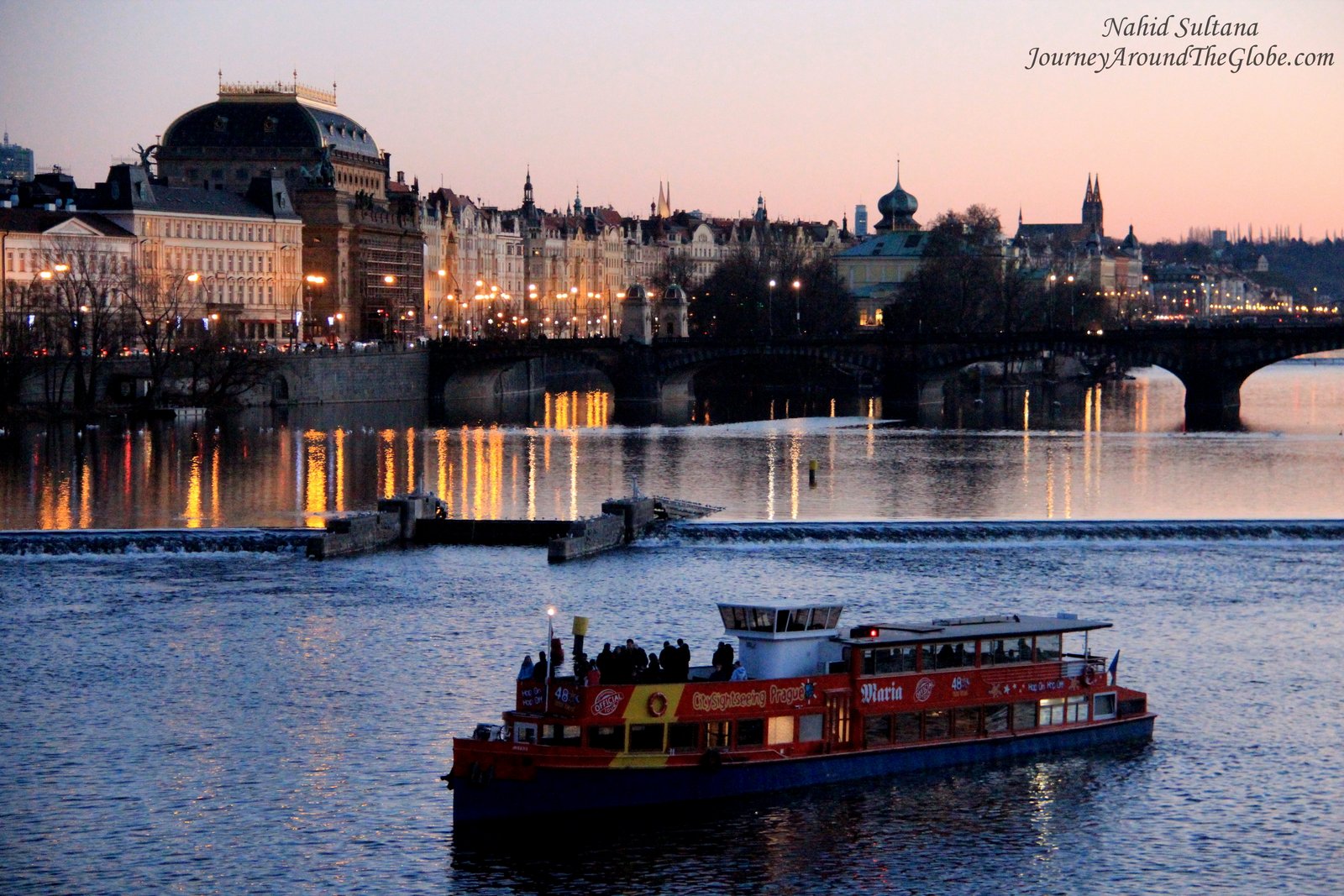
River Vltava and its bridges are what you probably seen in lots of pictures from Prague. It is indeed something to admire. The city can offer some stunning views from many points like Charles Bridge, Prague Castle, and many of its towers. Prague is regarded as one of Europe’s most charming cities and is one of the most popular destinations in Eastern Europe. Its old town was listed as UNESCO World Heritage site in 1992.

- River Vltava and the city of Prague from Charles Bridge
(Please excuse my old photos from 2009 with the big yellow dates on them.)
TIME of TRAVEL: I have mentioned in my last few posts that we took a road trip during Christmas of 2013. My uncle-in-law from Chicago was here with us during this trip. After visiting Fussen in Germany and Innsbruck and Salzburg in Austria we arrived in Prague the day after Christmas. Eastern Europe can be below freezing in December but it was actually not that bad during day. Temperature was definitely low at night but it didn’t stop anyone from having good time in Prague.
Last time we were in Prague was during Easter holidays of 2009. We took a two weeks tour around Europe when we were still living in Portland, Oregon. Easter is very colorful here. It doesn’t matter when you make a trip to Prague, it is always swamped with tourists and thriving with busy lives.
OUR HOTEL: This time we stayed in an apartment-style place, Hotel Julis, in Wenceslas Square. Parking can be a problem (the garage is 5 minutes of walk) but the best part is you are right in the middle of a busy square. Christmas lighting was fantastic as well as the markets on the pedestrian zone. It took us only 5 minutes to reach the main square from here and maybe another few minutes to reach Charles Bridge. There were many shops and souvenir stores just outside our hotel. It was a spacious room with a small kitchen in one side. Breakfast and free Wi-Fi were included in the price too.
Last time we were here in 2009 we also stayed very close to the old town. It was Hotel Unitas. It had breakfast and parking spaces for customers. If I can remember correctly, the hotel was only 5 minutes’ walk from the metro station.
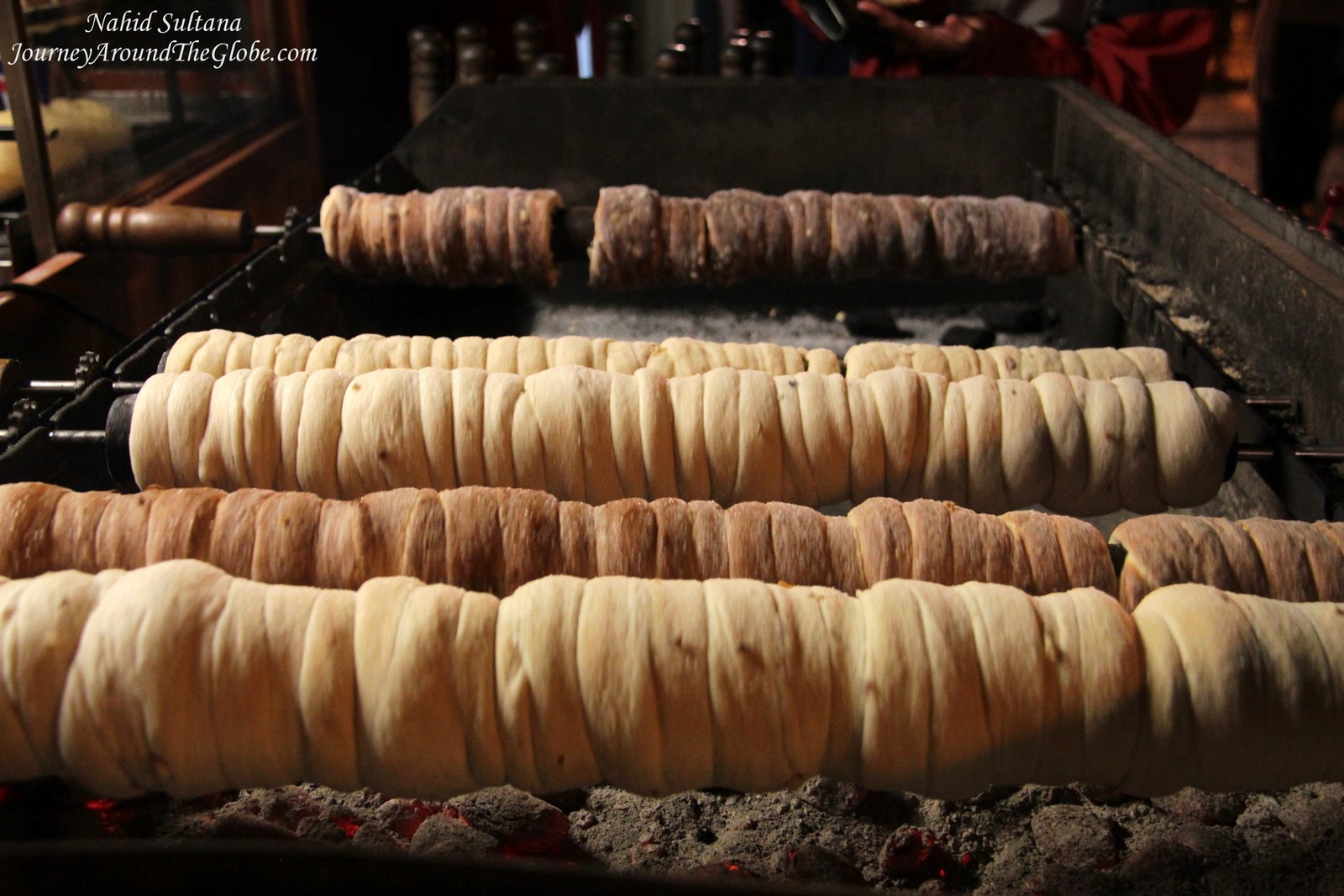
EATING and SHOPPING: Our first dinner in Prague was on the other side of Charles Bridge in Lesser Town. The name was “U Tri Zvonku” meaning “The Three Bells”. The food was fantastic, but the cool part of it was that there were small notes and writings on all the walls of this restaurant. Customers can write anything on its wall if they can find an empty spot. We also asked for some markers and our daughters wrote their messages on the walls too. Second night, we ate at “Taverna Toscana” near Astronomical Clock in the old town…good Italian food and nice people. Afterwards, we tried a traditional Czech pastry-like snack, called Trdelnik from the Christmas market. It’s a rolled pastry roasted on fiery coals.

- Trdelnik – a rolled pastry on burning coal, something local we tried in Prague
Last time in 2009 we had dinner in old town square at the corner of Astronomical clock. And I remember clear they had some awesome dishes, especially the dipping sauce they served with the warm breads…still can’t forget its taste.
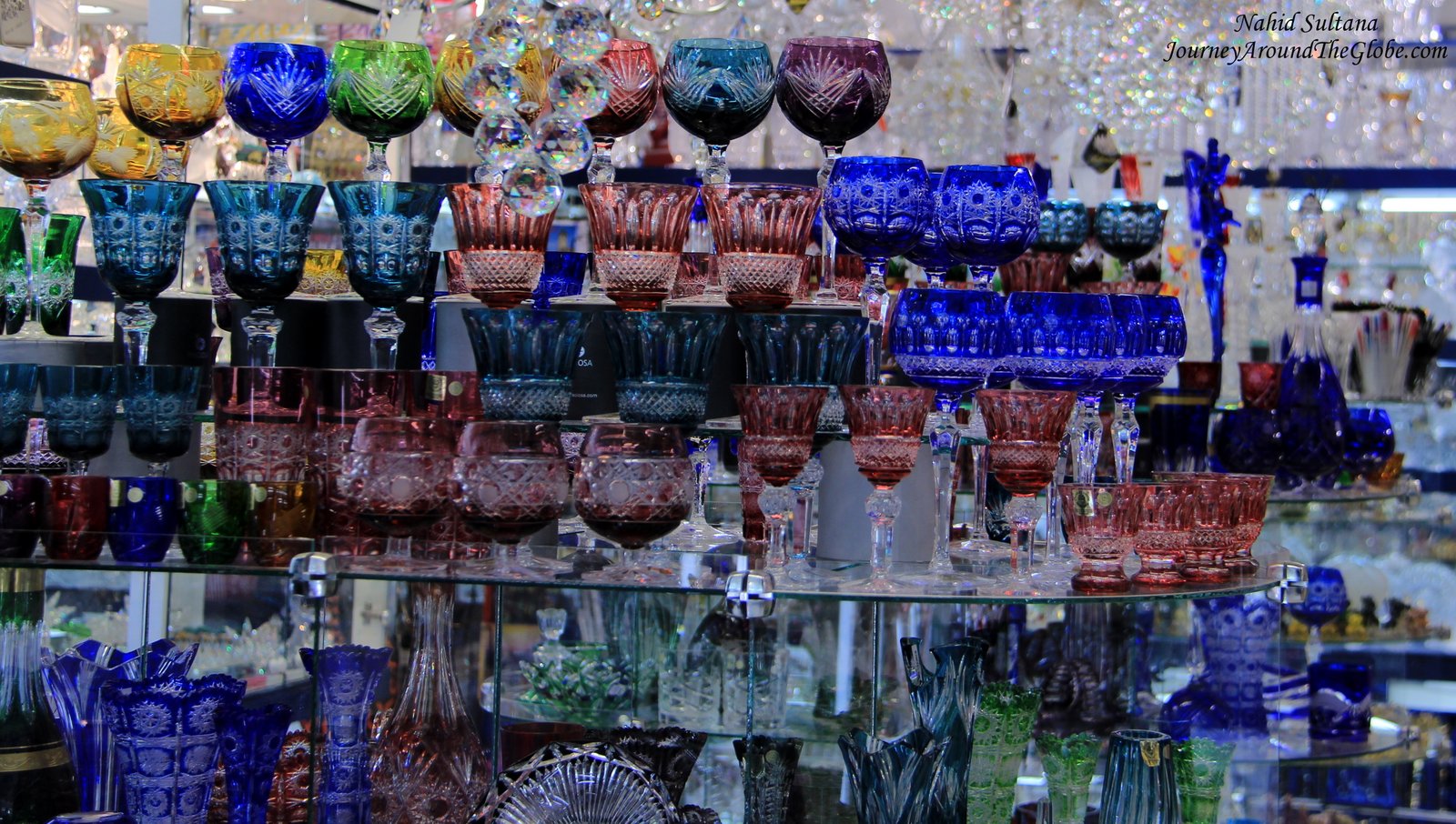
There are too many things in Prague to buy as souvenirs or memorabilia. Traditionally, Bohemian glass or crystal are something very famous in this region. They are very exclusive and can be very expensive. Bohemian garnet is also very well-known in Prague. I saw many amber stores too. Also lots of stores carry wooden toys and marionette puppets depicting many celebrities and traditional characters from stories.
- Bohemian glass and crystals in a souvenir shop in Prague, Czech Republic
Streets of Old Town and Lesser Town are packed with tons of stores. Shops in Old Town square during Easter and Christmas are good places to buy souvenirs for reasonable prices. Try to avoid buying things from the main old streets; you can find same items with much cheaper price in smaller alleys. We bought a print of sketch from Charles Bridge for 60 euros and a Bohemian glass vase with glass flowers from Wenceslas Square. In 2009, we bought a hand-crafted Bohemian crystal egg from Lesser Town for 20 euros, I think.
PLACES WE’VE VISITED: First time we were here in 2009, we stayed in Prague for 3 days but this time we were there for a day and half. There are countless things to do in Prague which can keep any visitor busy for weeks. It is a big city after all and has something for every taste. Enjoy classic shows in theaters, be amazed by really old churches or synagogues, enjoy the view of whole city from different towers – like TV Tower or Petrin Tower, appreciate old and new architecture of Prague (especially check out the Jewish quarter for that), get lost in small alleys of old town, or if nothing just take a stroll on Charles Bridge and enjoy its bustling scenes.

- Christmas lighting in Old Town Prague
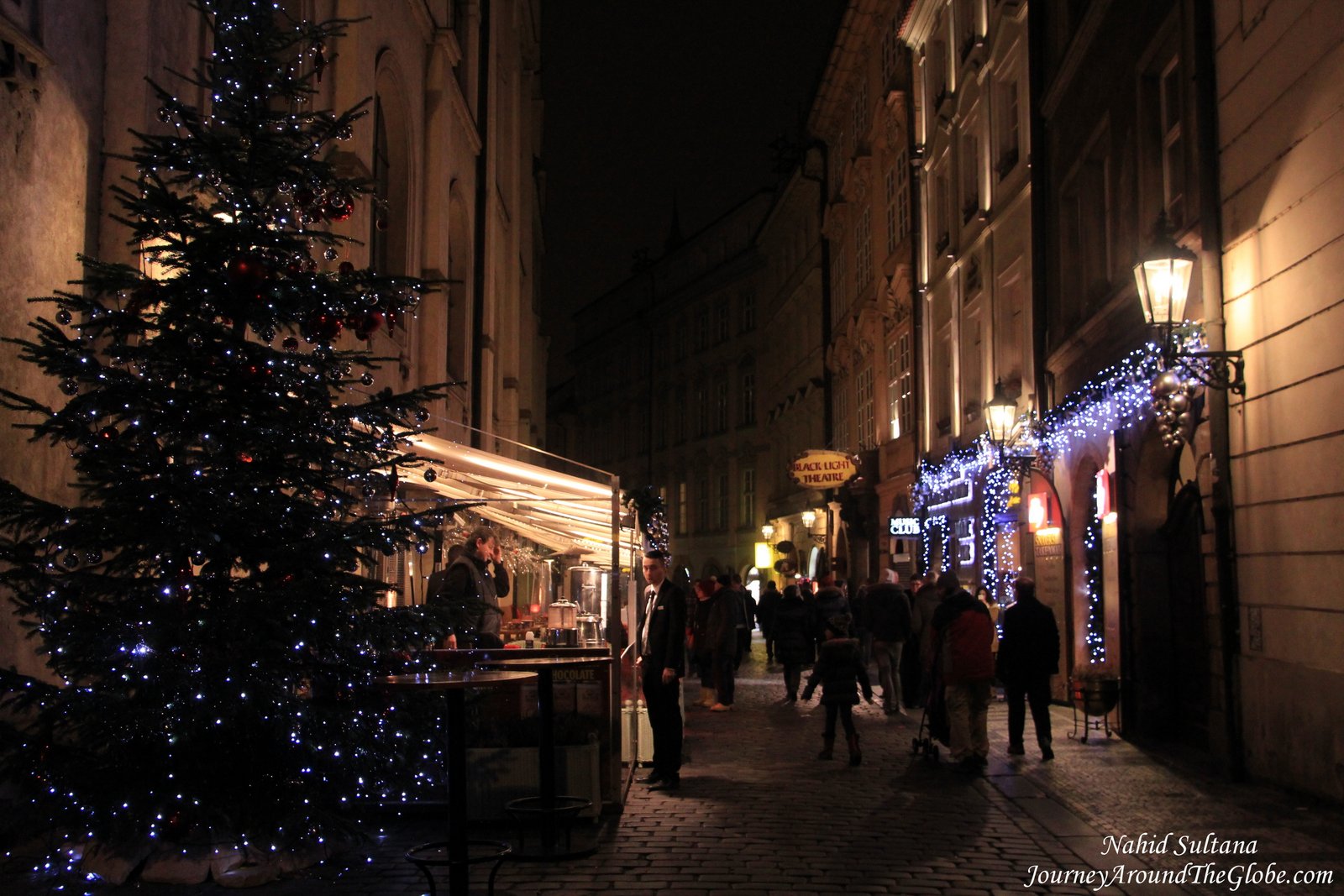
1) OLD TOWN and ASTRONOMICAL CLOCK: This is the main square and one of the liveliest places of Prague. The Christmas lighting and markets were fabulous here and the Christmas tree was one of the tallest and gorgeous I’ve seen so far. It includes several historic buildings, monuments, and churches. It’s a perfect place for drinks or a meal.

- Some Renaissance and Baroque buildings in Old Town Prague
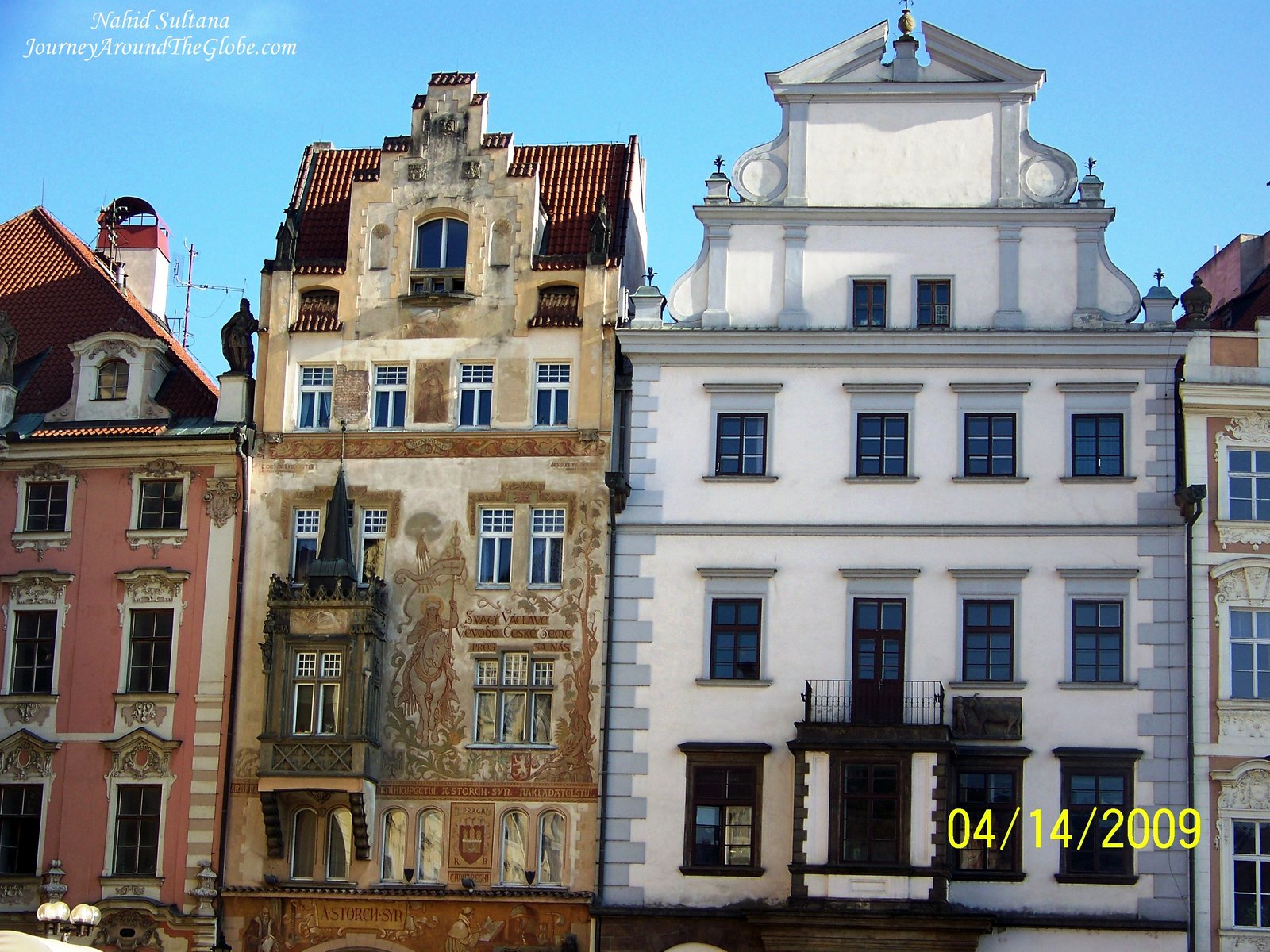
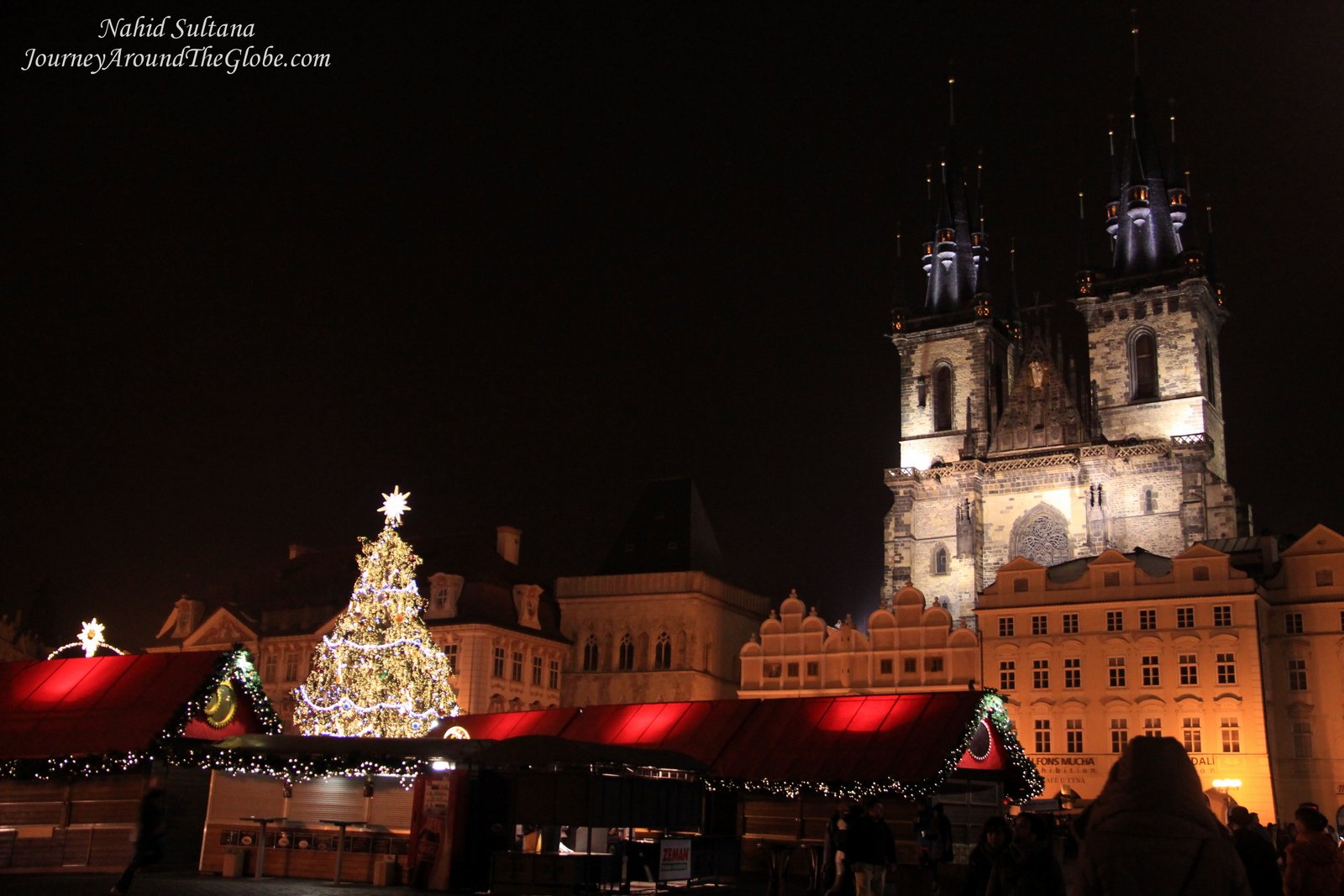
Last time when we were here during Easter, the place had many stores at that time too. We took a horse ride around the old town from here. St. Nicholas Church is a Baroque church from 18th century in the northern side of the square. We never went inside the church but it’s beautiful. Goltz-Kinsky Palace (now National Gallery) from 18th century is the most remarkable building in old town. Church of Our Lady before Tyn is a dominating feature of this square. This 14th century Gothic church was the main place to worship in old town during that time. Currently, I am not sure if visitors are allowed to go in but it looks gorgeous at night when its two towers with 4 spires are lit up. The southern side of the square has a series of some photogenic Renaissance and Baroque façade buildings covered with murals from couple centuries ago. And finally, a huge memorial to a religious reformer, Jan Hus, stands in the middle of this square.

- Main square of Old Town Prague and Church of Our Lady before Tyn
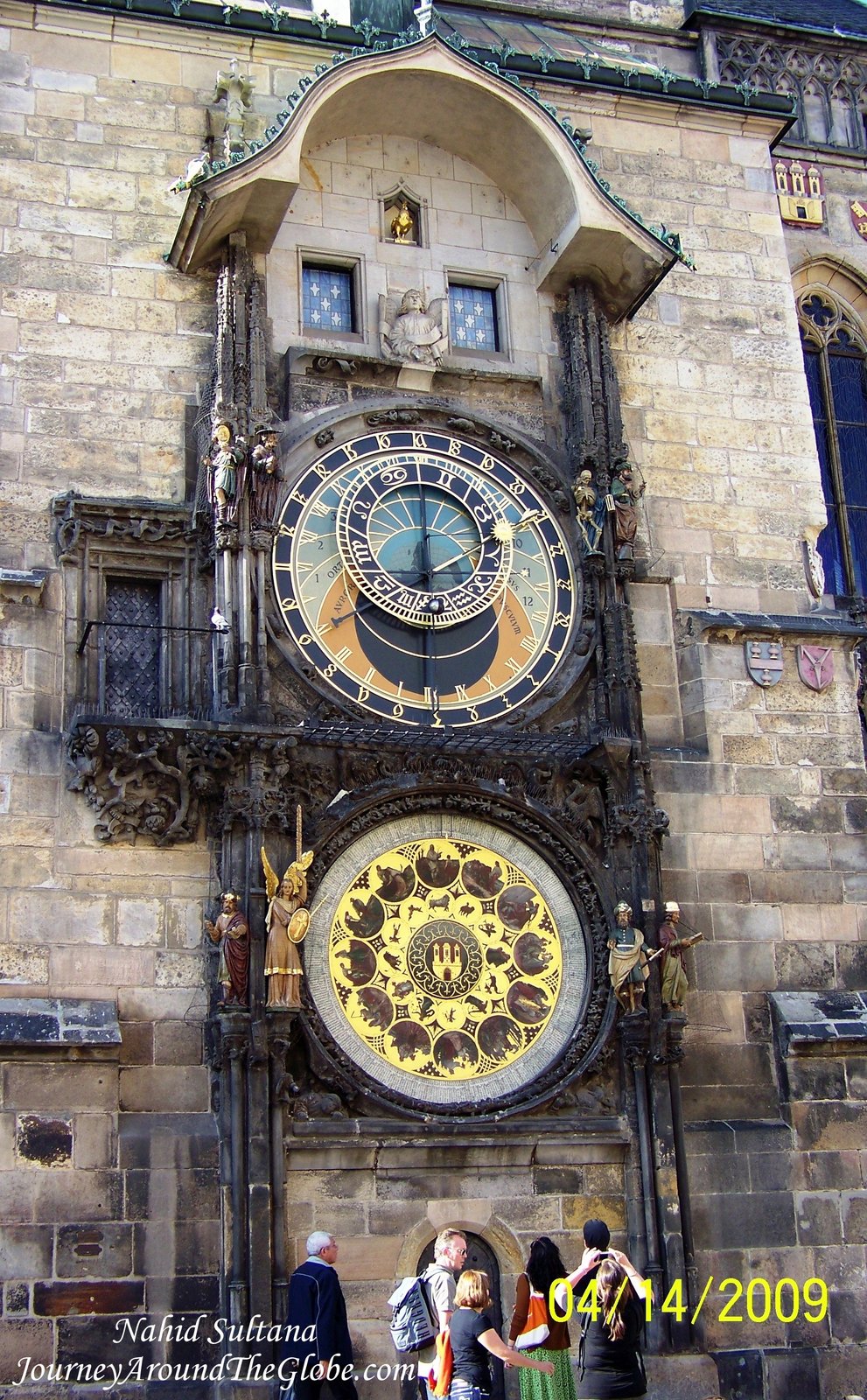
At one side of the square is Prague’s old town hall with a big old astronomical clock on it. It’s a 14th century Gothic building. There is a little show at very hour when the clock rings…something worth seeing. Tourists are allowed to go inside and to its tower for a little fee.
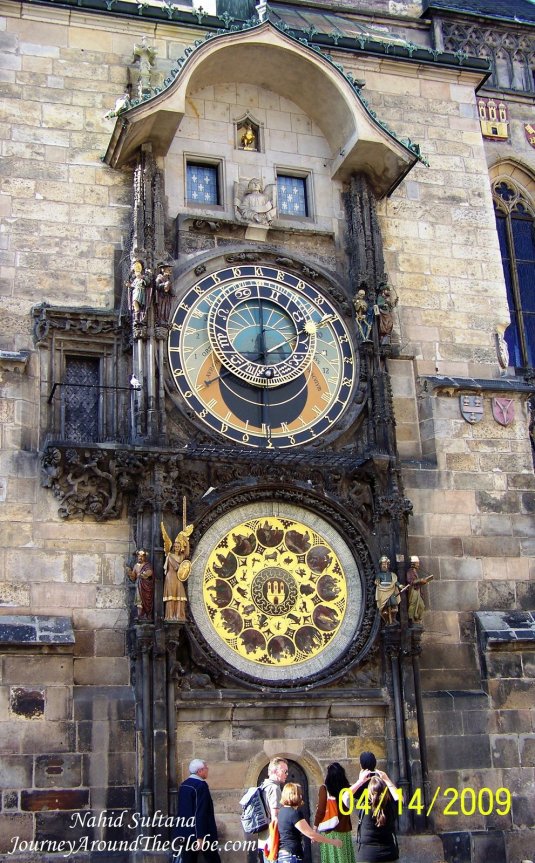
- Astronomical Clock in Old Town Prague
2) CHARLES BRIDGE (KARLUV MOST): This is my most favorite bridge in Europe and one of the must-sees of Prague. It connects Old Town with Lesser Town. It can be very crowded and touristy at any time of the year (particularly in summer days) but this pedestrian bridge over River Vltava offers absolutely stunning view of the river, other bridges, Prague Castle, and overall a nice view of a lovely town by River Vltava. This 12th century bridge has two impressive towers and I think, tourists can go on top on one of them. Thirty, mostly Baroque style, statues of various saints richly adorn the two sides of Charles Bridge (15 on each side). These sculptures are not the original ones (original statues were destroyed in floods and in other events) and you will see many people touching them for good luck. Take a stroll on this bridge both during day and at night to experience different looks of it.

- Charles Bridge at night, in Prague
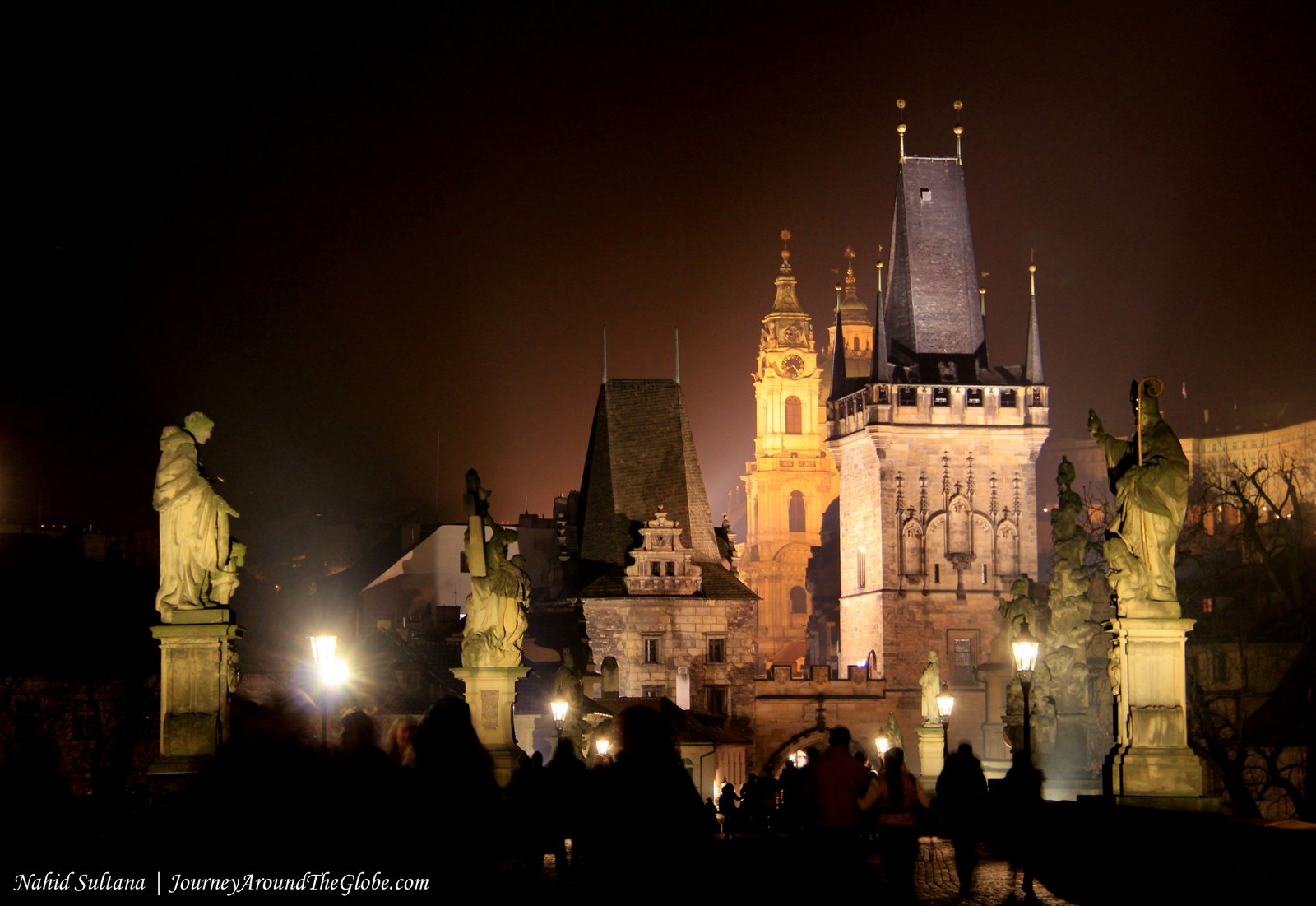
Charles Bridge is more than just a bridge, it is the symbol of Prague. The bridge is beautiful day or night. We crossed it once at night and then the next day to go to Prague Castle. By the way, this is a nice place to buy paintings or sketches done by local artists. You can also find some other local souvenirs on this bridge.
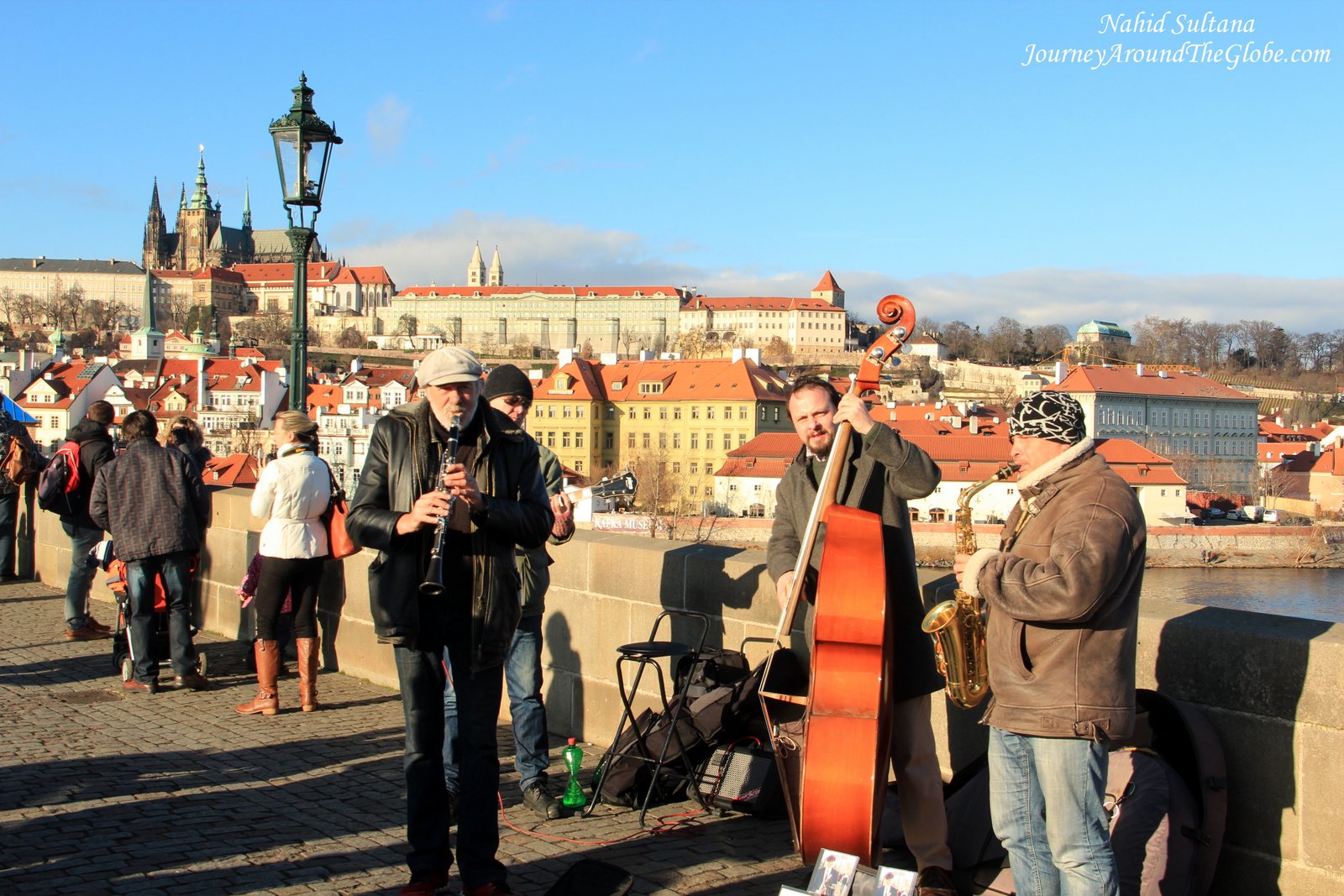
- Bustling life of Charles Bridge during day
3) PRAGUE CASTLE: According to the Guinness Book of Records, Prague Castle is the biggest ancient castle in the world dating back to 9th century. You can find virtually every architectural style of the last millennium in this castle buildings. This is the place where Kings of Bohemia, Holy Roman Emperors and presidents of Czechoslovakia and the Czech Republic have had their offices. The Czech Crown Jewels are also kept here. Austro-Hungarian Empress Maria Theresa gave the castle its present architectural form. Ferdinand I (V) was the last crowned King of Bohemia and his coronation in 1836 was the last important event at Prague Castle before the creation of independent Czechoslovakia in 1918.
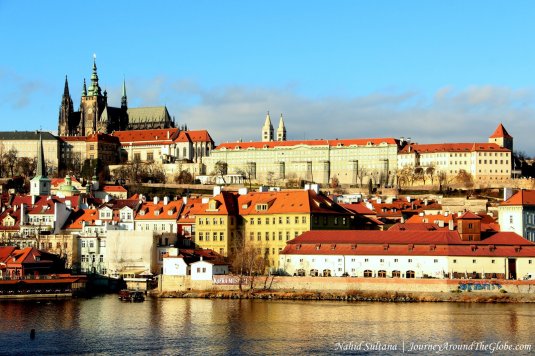
- Steeples of St. Vitus Cathedral and Prague Castle from Charles Bridge in Prague
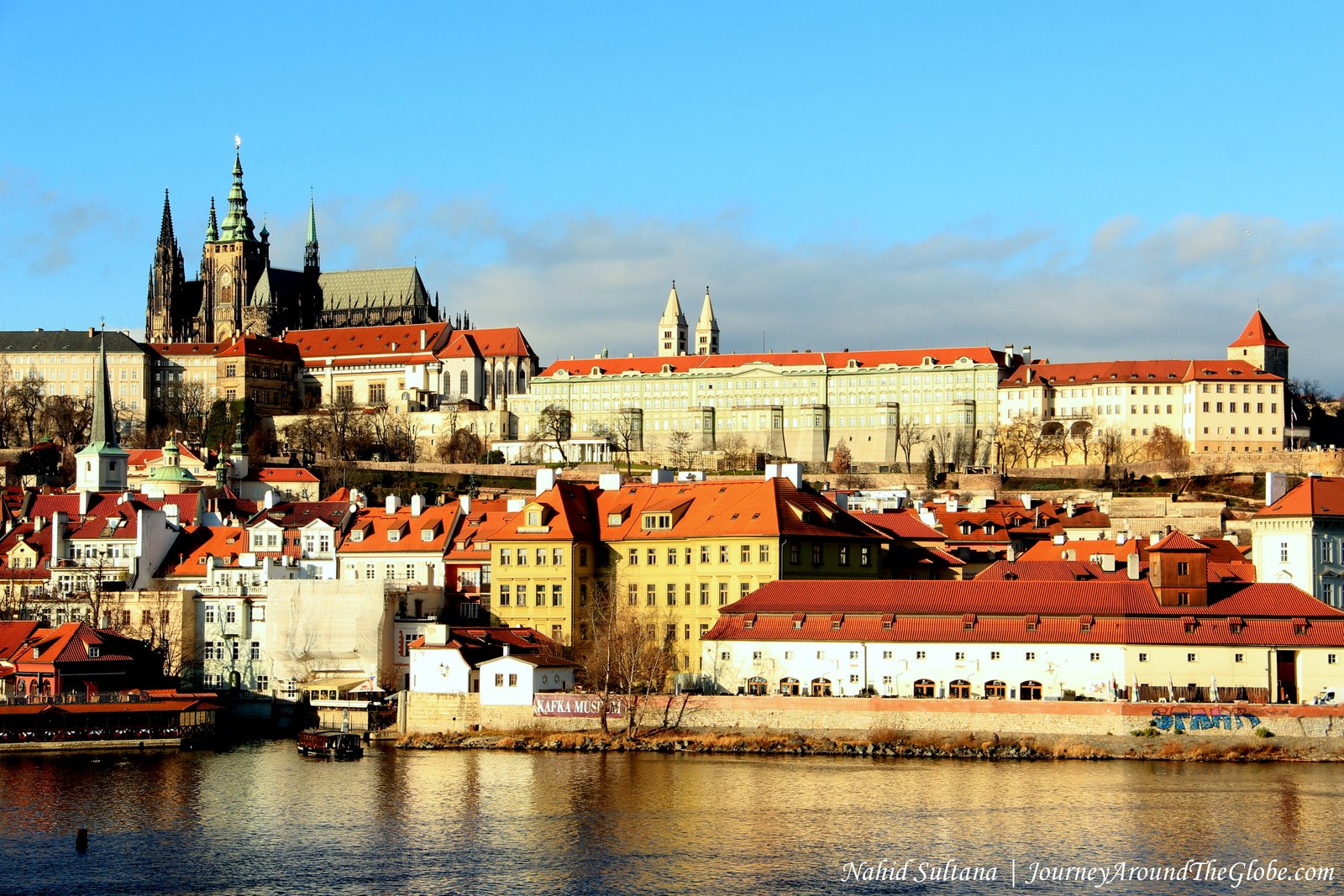
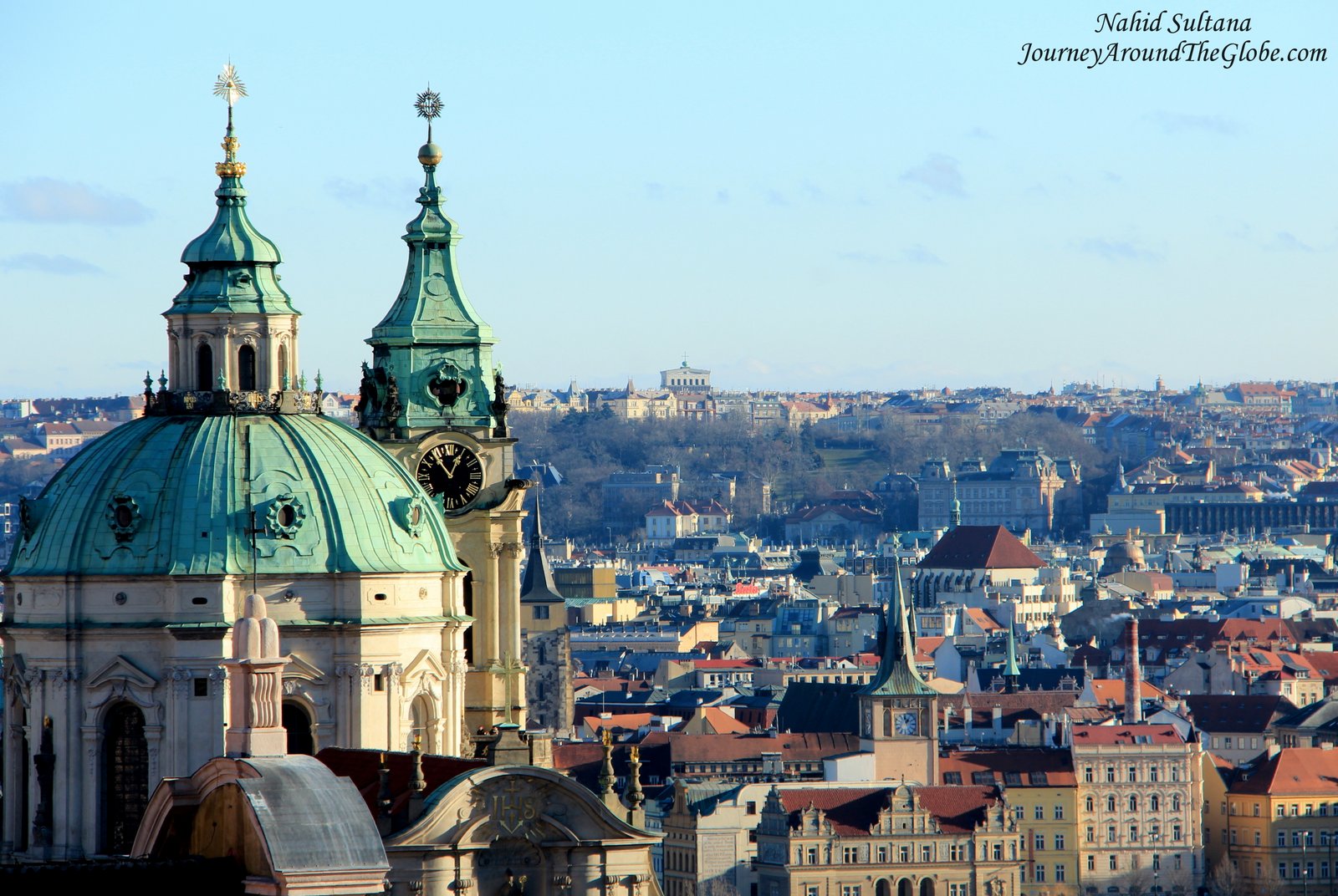
You can get one of the best views of the city from Castle Hill. Bridges, steeples and domes of many churches, red roofs of nearby neighborhood, and everything in the far distance look fantastic from here.

- A view you should not miss from Prague Castle
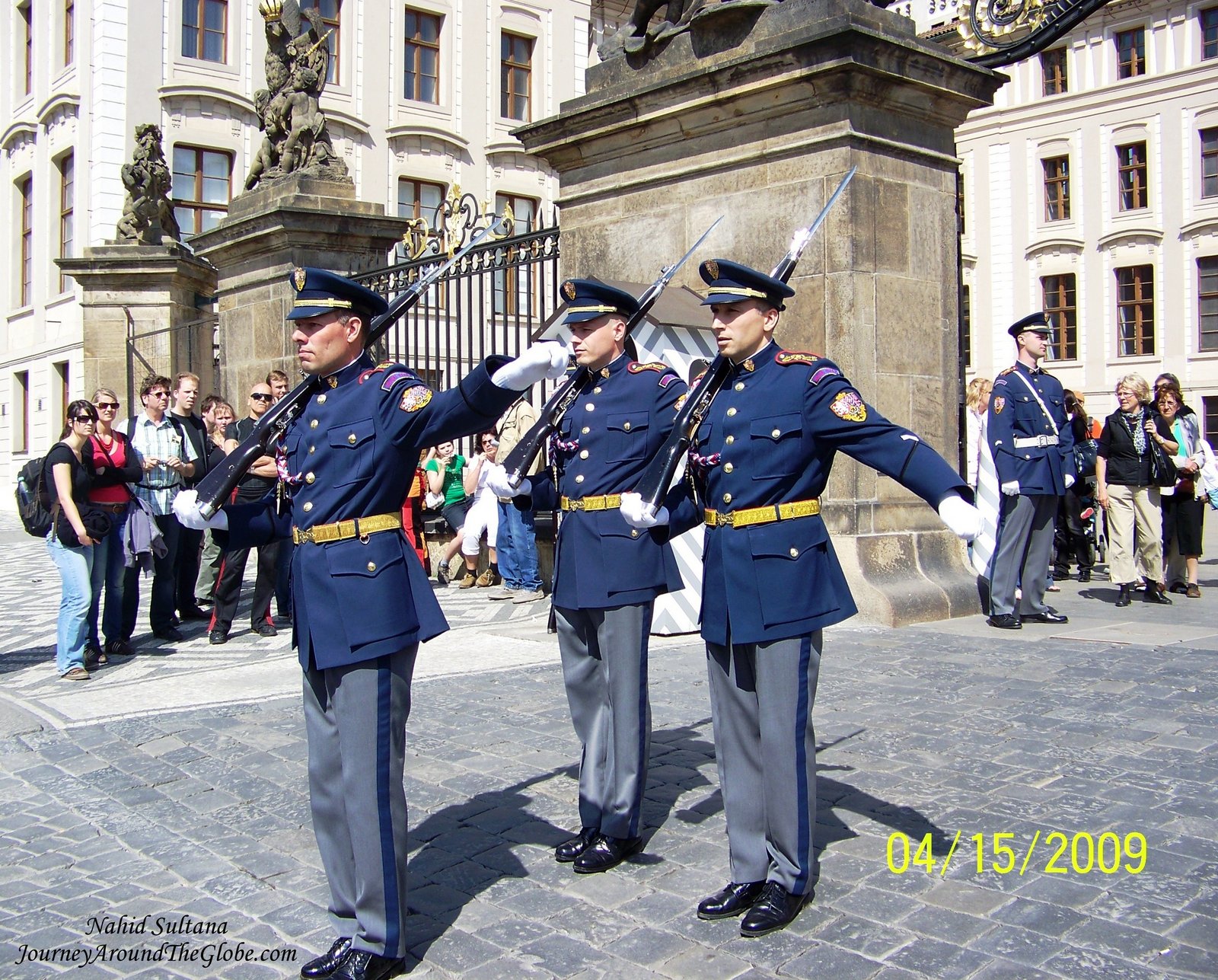
“The Gate of The Giants” is what the main entrance to the castle is called. Two royal guards stand there continuously. Make sure to be near the entrance to catch change of guards. It takes place every hour but if I think, at noon the event is longer and nicer. We saw it in 2009 but not this time.You can find several exhibitions, like art, history, toy museum, galleries, and few temporary or permanent exhibitions once you are inside the castle. Other than that the castle has several palaces, defense towers, and gardens. Most of the castle area is open to tourists. There are few big courtyards within the castle complex.
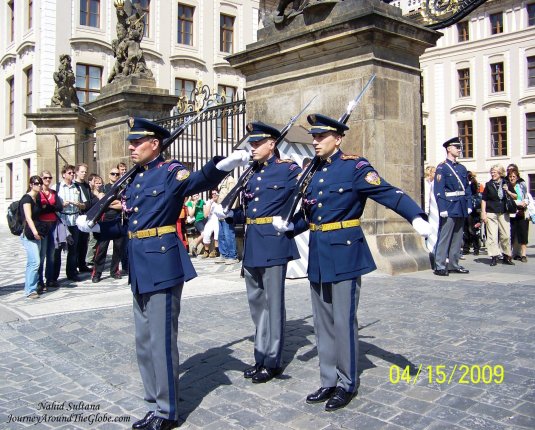
- “Change of Guard” at the entrance of Prague Castle
As soon as we passed the first courtyard, we saw St. Vitus Cathedral. This Gothic cathedral is one of the most prominent architecture in the whole city. This is also the biggest and the most important church in Czech Republic. This grand edifice is stunning outside and very ornate inside. The pair of its old and tall steeples can be seen from far away. Although we didn’t go, anyone can visit its bell tower for a unique view of the city.
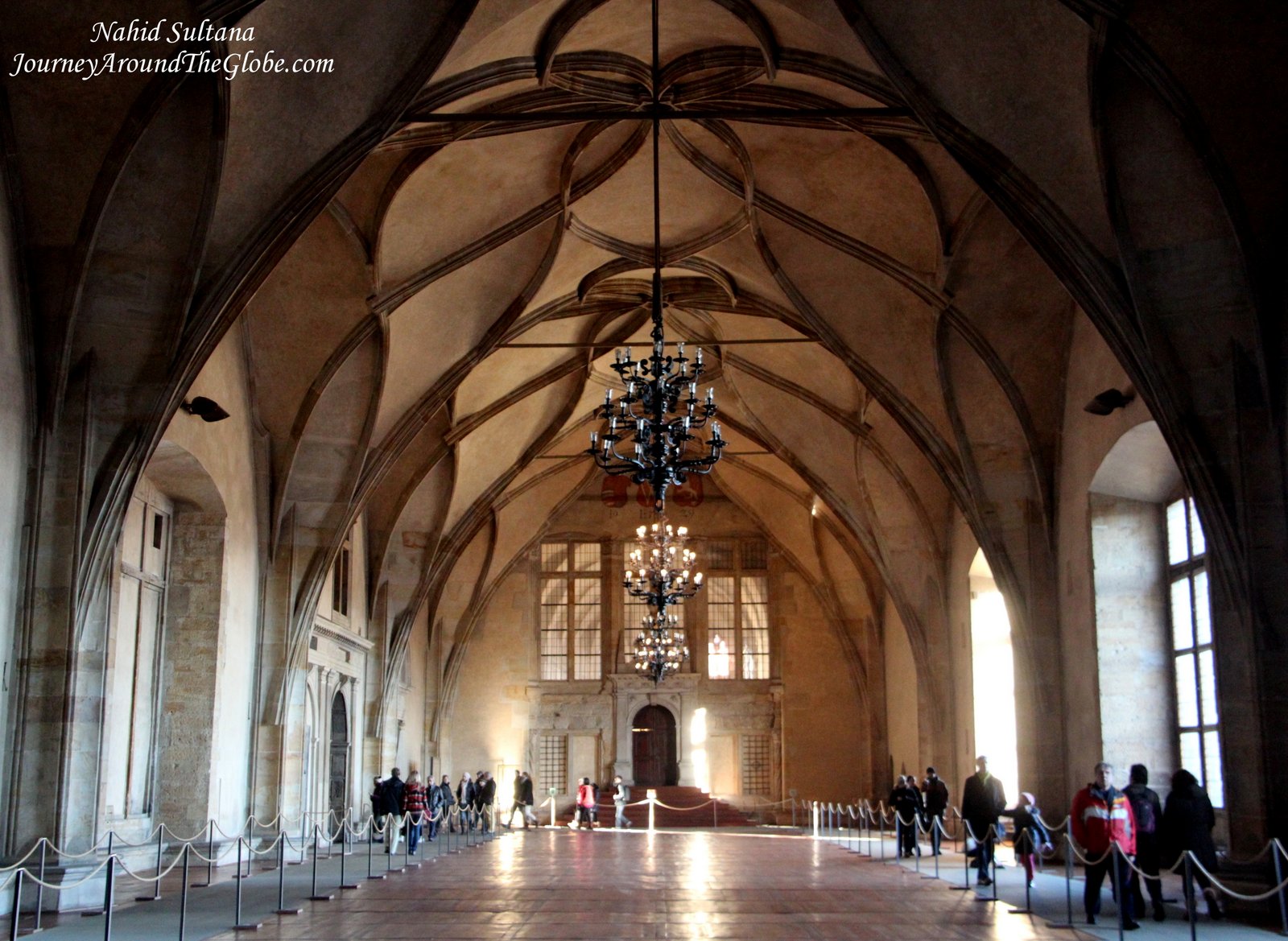
Then we stopped at Old Royal Palace. It may not be that impressive from outside but the palace houses some old portraits, large halls, few old furniture, a throne room, and replica of orb, crown, and scepter.

- One of the halls of Prague Castle
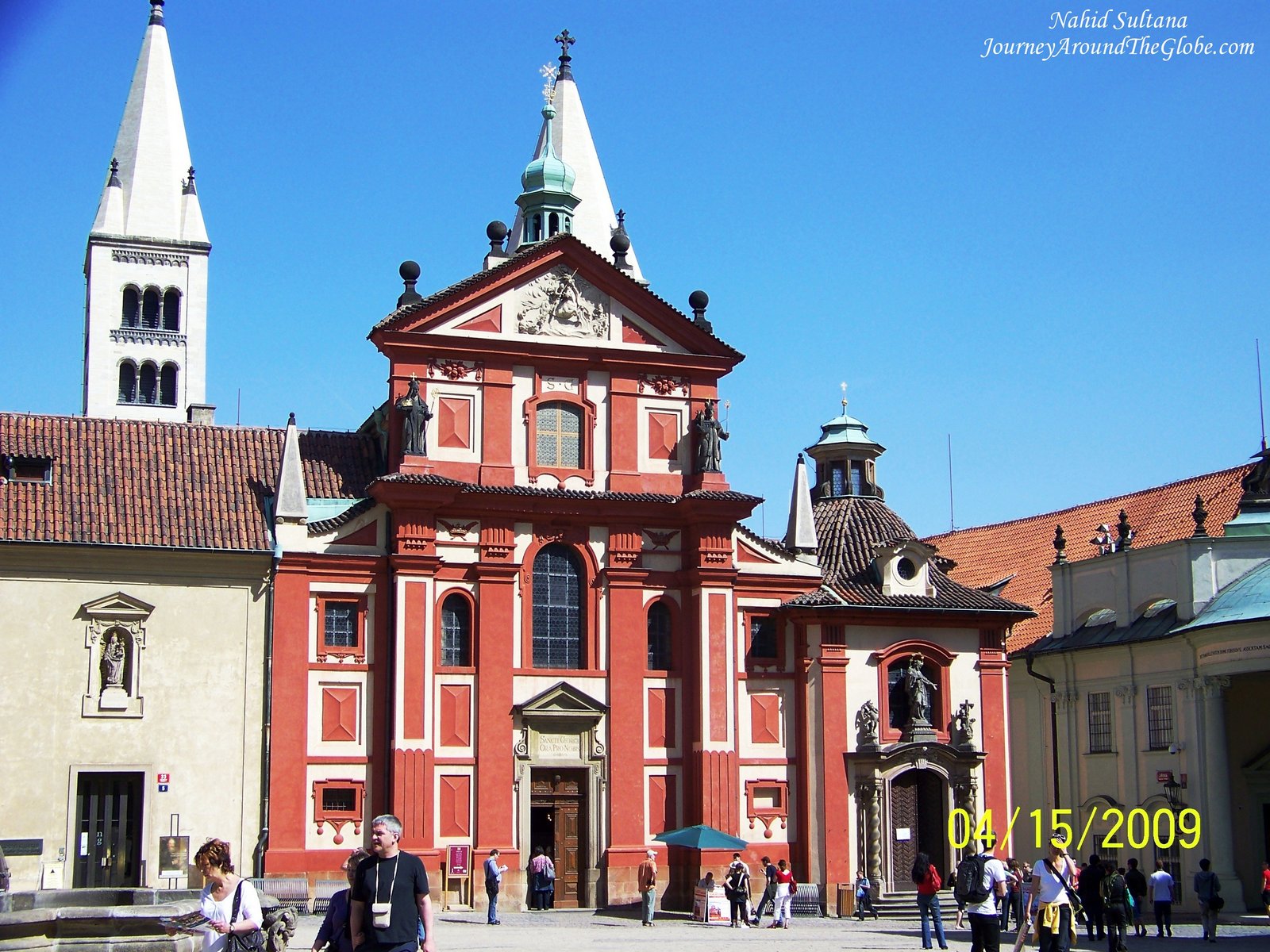
A red building beside Royal Palace is the Basilica of St. George. This Romanesque basilica was founded at the beginning of 10th century. It’s very simple and small. There was a small exhibition on church’s history here, maybe something worth visiting.
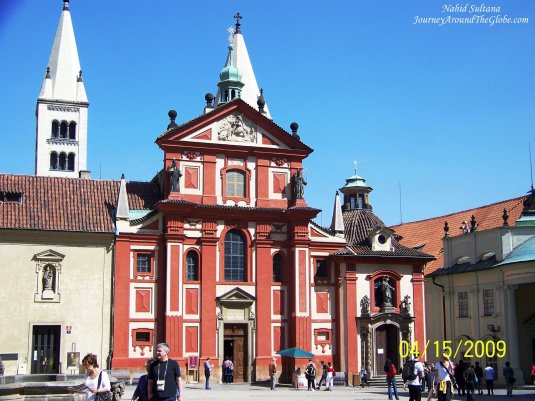
- Basilica of St. George inside the complex of Prague Castle
From there we grabbed some sandwiches before walking towards the Golden Lane. This is something we didn’t explore in 2009. This is a small cobbled-stone alley with some exquisite shops. The main attraction of this lane is that there are some displays of Renaissance age’s professions and how those professionals lived during that time. You can see goldsmith’s workshop, an old tavern, a psychic’s house, and etc.
Finally, we visited the prison room in the castle. It was a tiny underground cell from the medieval time. We get to see some old torture instruments and a big well where serious criminals were kept.
The castle is located on the Castle Hill near Lesser Town. You can either walk up the ramp or take lots and lots of stairs to go up to Prague Castle. There are few packages to explore the castle. We took the “Short Visit” which was 250 CZK and it included St. Vitus Cathedral, Royal Palace, St. George’s Basilica, and Golden Lane. Kids under 6 enter free.
4) LESSER TOWN: The neighborhood on the other side of Charles Bridge near Prague Castle is known as Lesser Town. This is also an old part of Prague. This historic quarter has some beautiful cobbled streets, churches, and local shops.
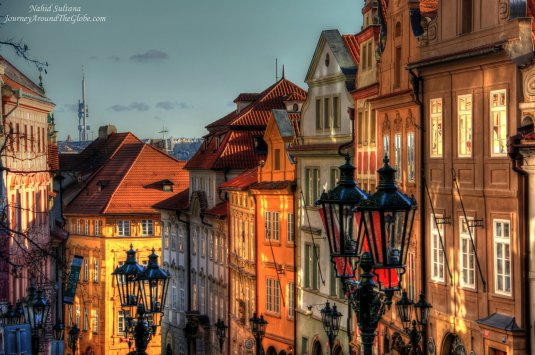
- Old buildings in Lesser Town of Prague

5) MARRIONETTE OPERA: Something new we did this time in Prague was that we watched a marionette opera show in old town of Prague. This side of Europe (including Austria) is very famous for their marionettes. The one we saw was called “Don Giovanni”. This was a gift from the famous composer Mozart to the city of Prague in 18th century. It’s a classic story with fantastic music and wonderful puppets. We went there mainly for the kids but I even loved it so much (although we couldn’t understand story) that I had to come back to hotel and read the story of Don Giovanni…should have done it before going to the performance.
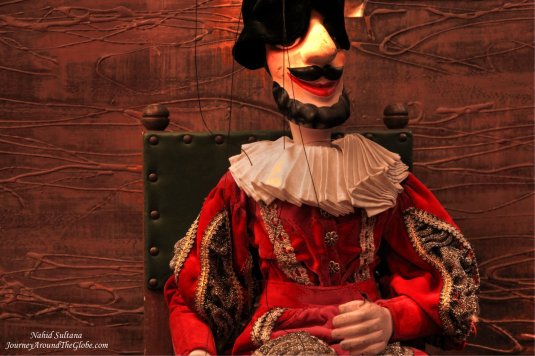
- Mozart’s “Don Giovanni” marionette show in Prague
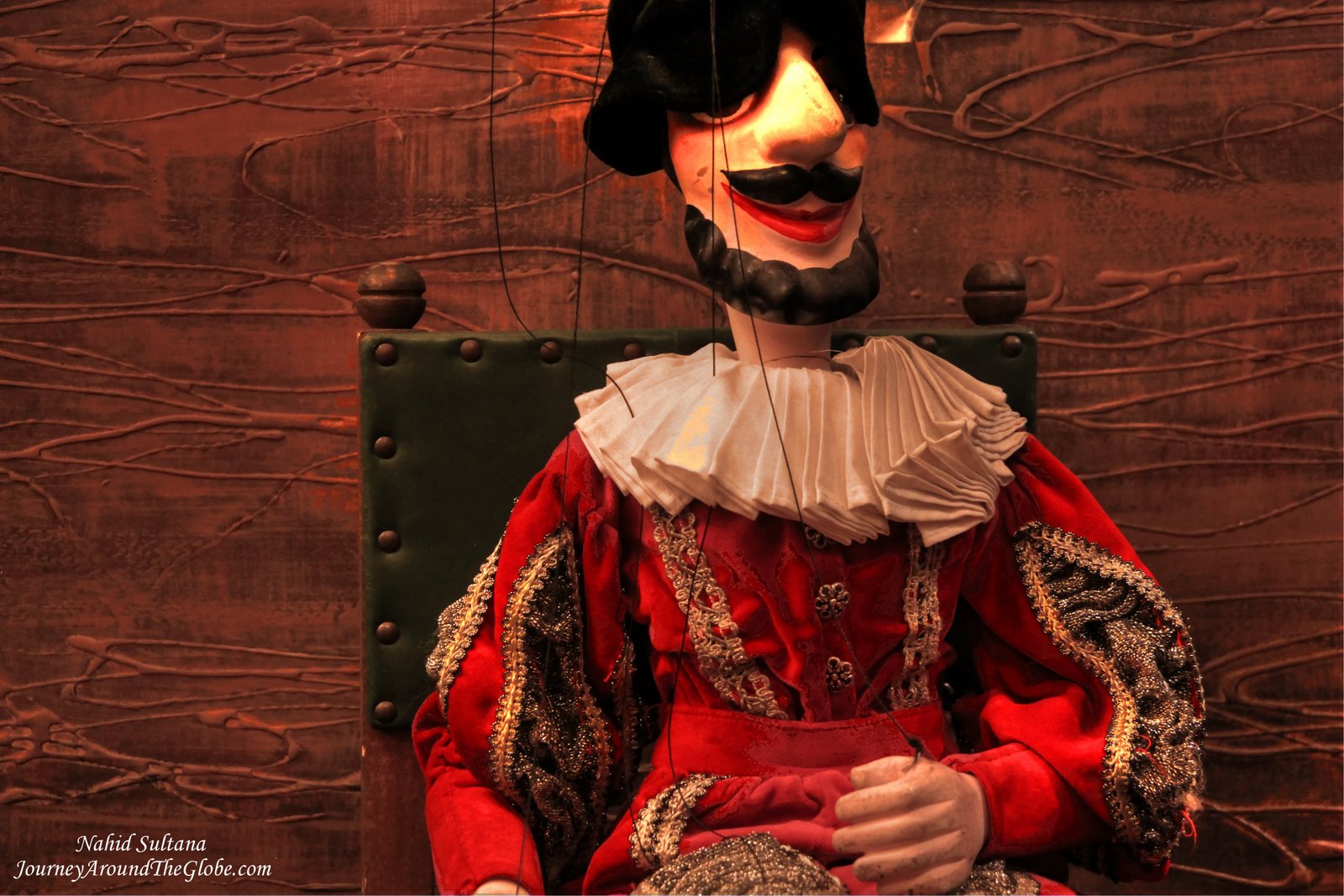
The theater is very close to Charles Bridge, can’t really remember the name. They have marionette shows like this every day at 5pm and 8pm and the show lasts for about 1 hour and 15 minutes.
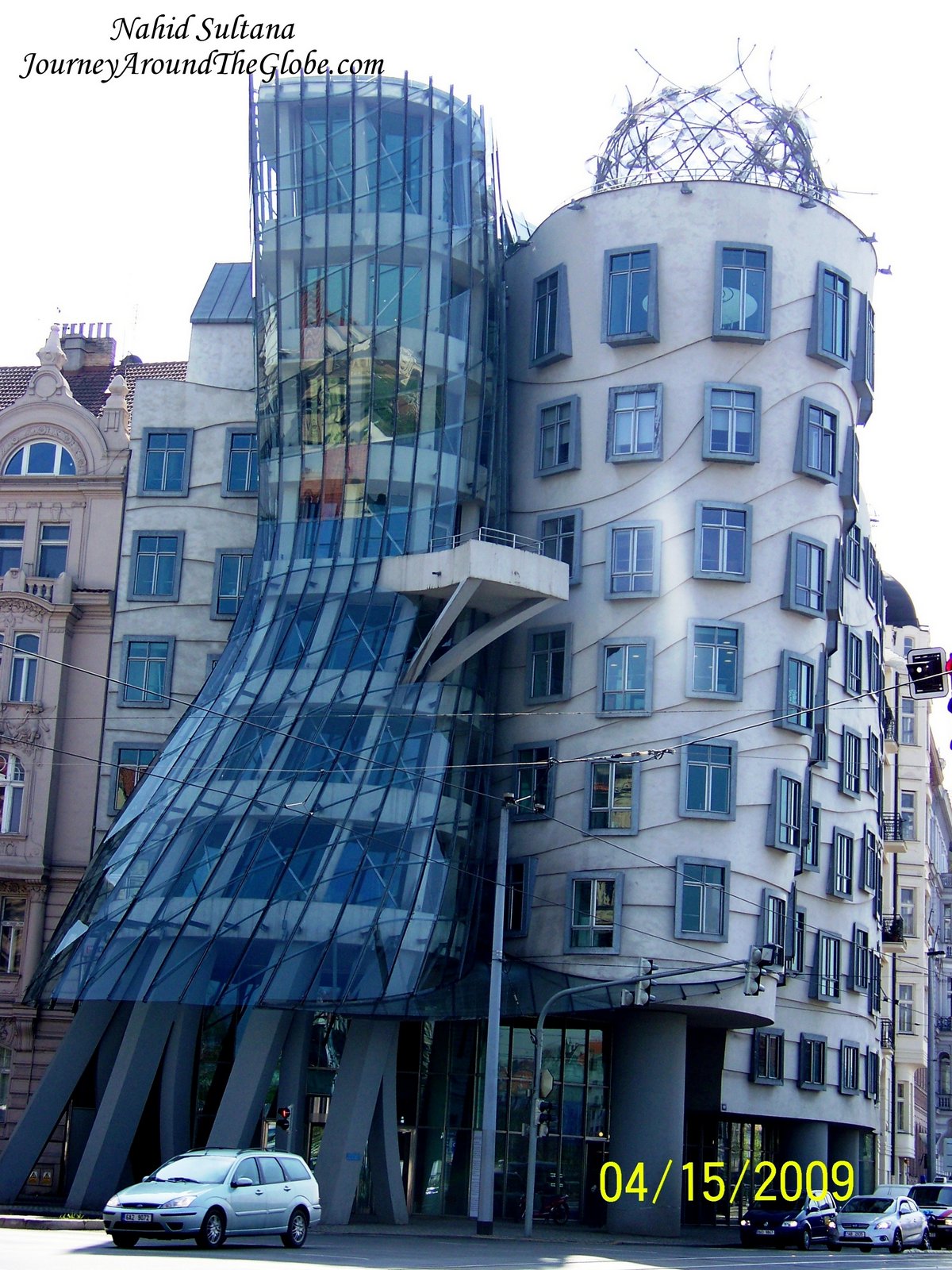
6) DANCING HOUSE: Also known as “Fred and Ginger”, this is one of the unusual buildings in Prague which was built in 1996. It was named after two dancers, Fred and Ginger. This is Canadian-American architect Frank Gehry’s one of the finest piece of works. You may have to walk a bit away from the old town but it is within walking distance and something worth the visit.
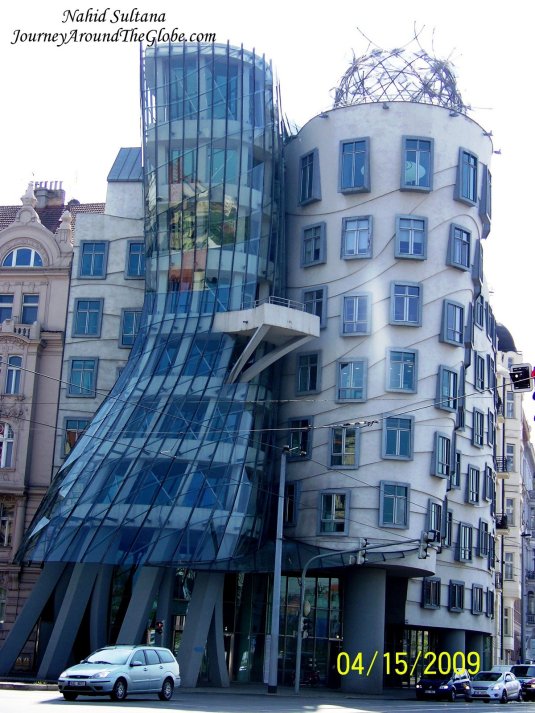
- “Fred and Ginger” or “Dancing House” in Prague, Czech Republic
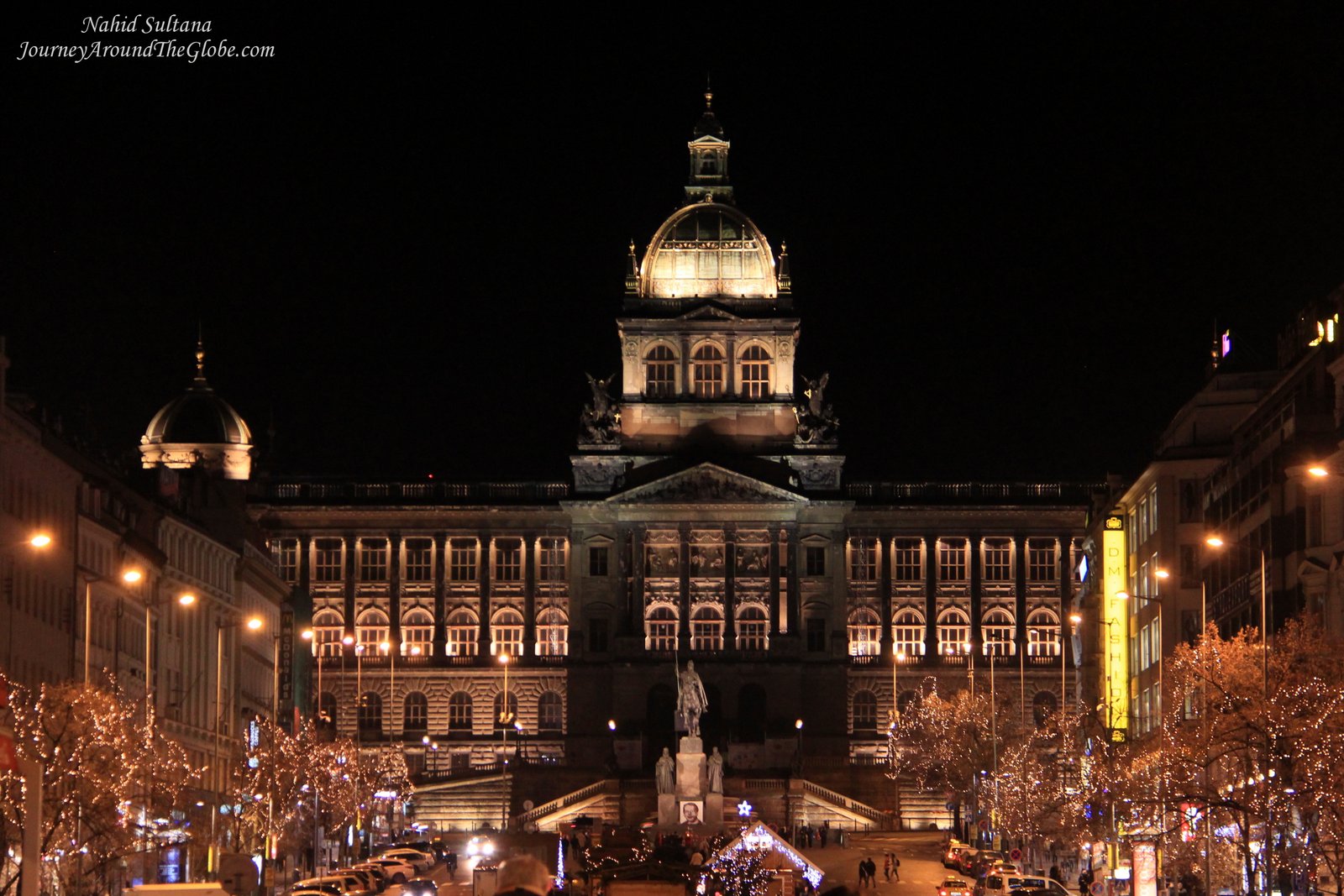
7) WENCESLAS SQUARE: Although this is the biggest square in Prague, it is more than just a typical square. Originally it was a horse market in the Middle age. Now, Wenceslas Square is more like a modern avenue lined up with many shops and souvenir stores…a fantastic place for shopping. The place comes alive especially after dark. We found a big Christmas market here too. A statue of St. Wenceslas was placed here in the 19th century. This is a historic place of the Czech people, this is where they came together to demonstrate against the communist government. At one end is the Czech National Museum.

- Christmas lighting in Wenceslas Square
Share this:

“Sound of Music” Tour in Salzburg, Austria
“SOUND of MUSIC” TOUR in SALZBURG, AUSTRIA: Salzburg become really famous with English-speaking people or at least those who are into English movies by the musical film “Sound of Music”. It was Julie Andrews’ one of the most famous works in her acting career. She played the role of “Maria”, a nun who was appointed to take care of seven children of an Austrian imperial navy captain. Based on a true story of a family with seven children and their father Captain Von Trapp, Christopher Plummer played the role of the captain. The setting of the story was from 1939 during the onset of WWII and the movie was shot in 1965.
I got acquitted with this film when I was very little and my mom used to sing “Do Re Mi Fa…” with much enthusiasm. She even tried to teach us that song (my mom was a professional radio singer and a music teacher) in her harmonium. I have some fond memories with this film and vividly remember my mom singing those melodious songs around the house and doing her chores.

- One of the walls in our hotel, dedicated to the movie “Sound of Music”, in Salzburg, Austria

In our first trip to Salzburg in April of 2009, we spend all our time in the city looking around its old part and the fortress (Hohensalzburg Festung) on the hill. But this time (during Christmas break in December 2013) we decided to go on with this tour to get out of the city. Also because both of our daughters watched “Sound of Music” so many times that they memorized all the songs and most of the dialogues from it.
We booked the tour with “Panorama Tours”. They are the most popular here for this trip. You can book thru you hotel or reserve your seat online ahead of time, like us. They operate even on holidays like Christmas day! Bus leaves every day at 9:30am and 2pm and lasts for 4 hours. It is 40 euros per adult and 20 euros for children 4 – 12. We were picked up from our hotel around 9:15am and taken to their main office near Mirabell Palace. Bus was about half full because it was Christmas day. The guide was fantastic and so was the driver.
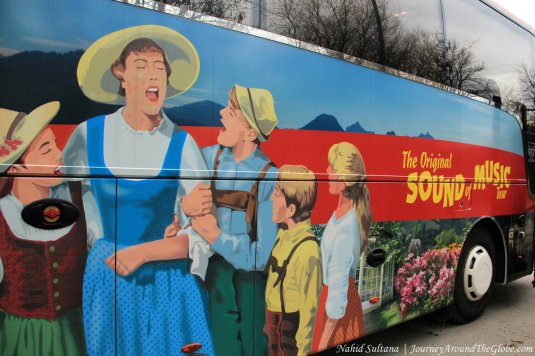
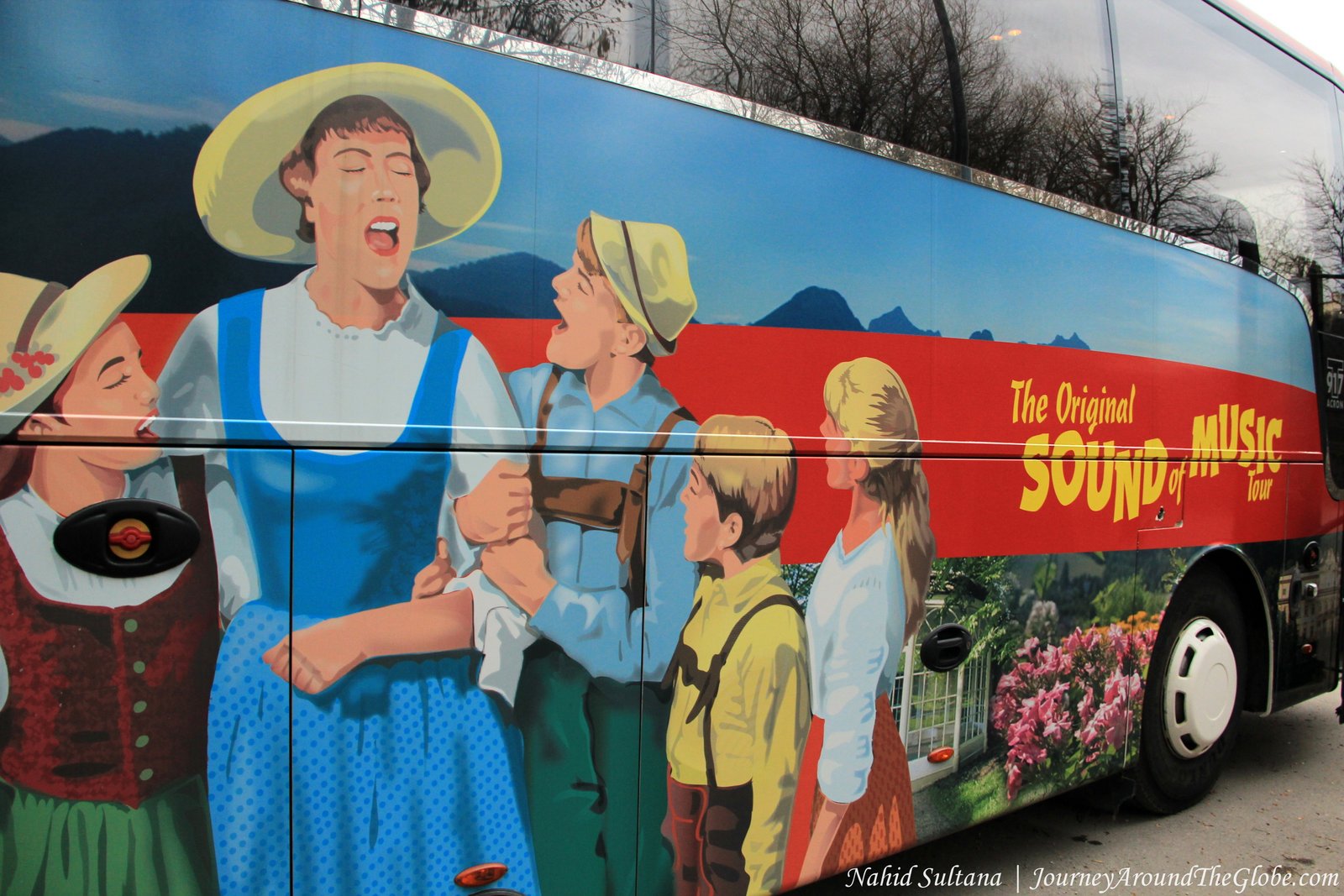
- Our “Sound of Music” bus in Salzburg, Austria
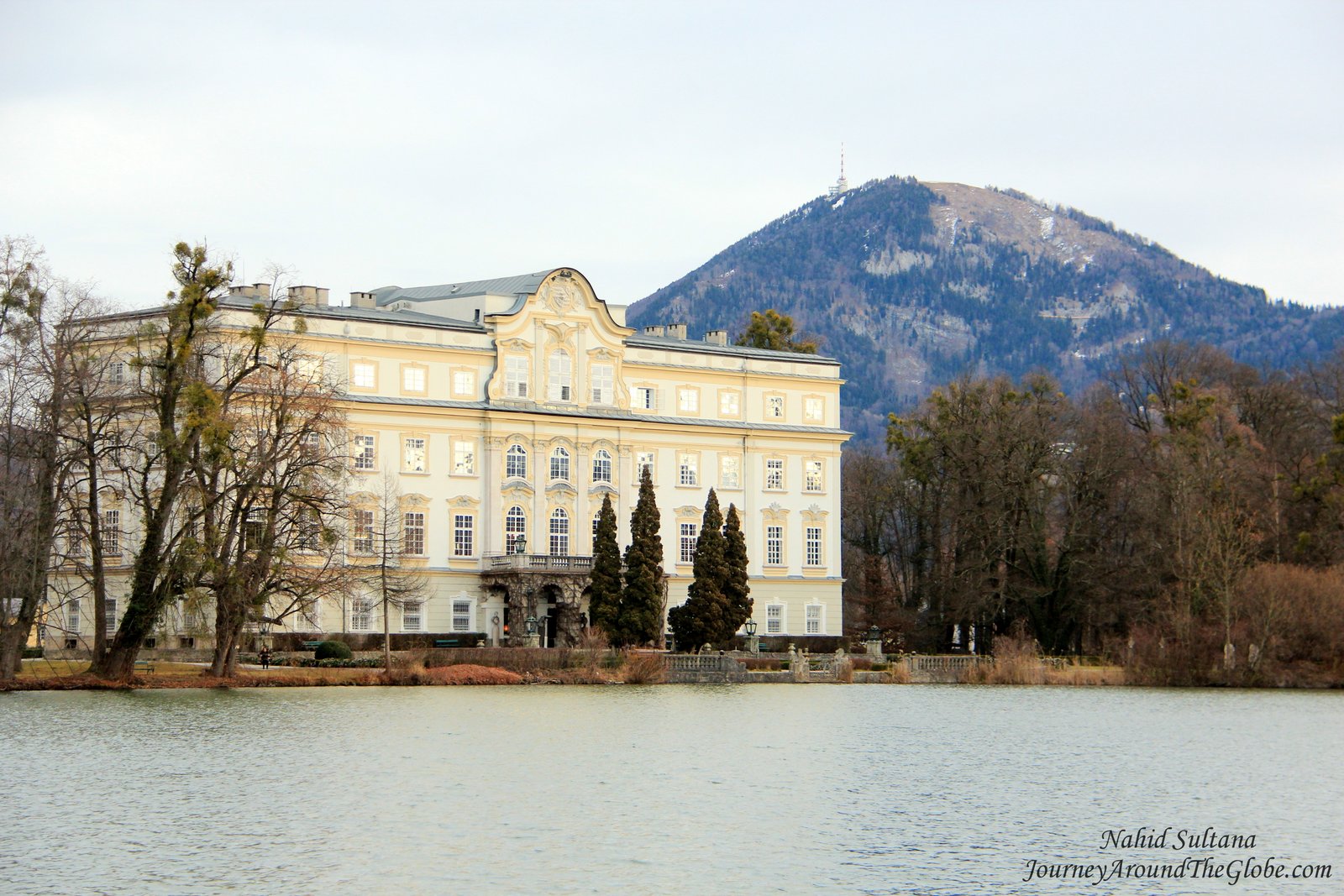
We were first taken to Leopoldskron Palace, just few kms away from Salzburg old town. This palace was used to only shot the “backyard” scenes of the movie. And the lake you see in the picture is where Maria (Julie Andrews) and the kids fell off the boat in one scene. It is a very scenic spot of Salzburg. We couldn’t go inside or even near the palace since it is not open to public, only saw it from the other side of the lake.

- Leopoldskron Palace was used to shoot all the “backyard” scenes of Julie Andrews’ “Sound of Music”
Next stop was Hellbrunn Palace garden. This is a bit away from the city. Before entering the palace there is an unpaved and tree-shaded road. This long path was used to shoot a small portion of “I have confidence” song when Maria left her abbey, got of the bus and went to captain’s house for the first time.
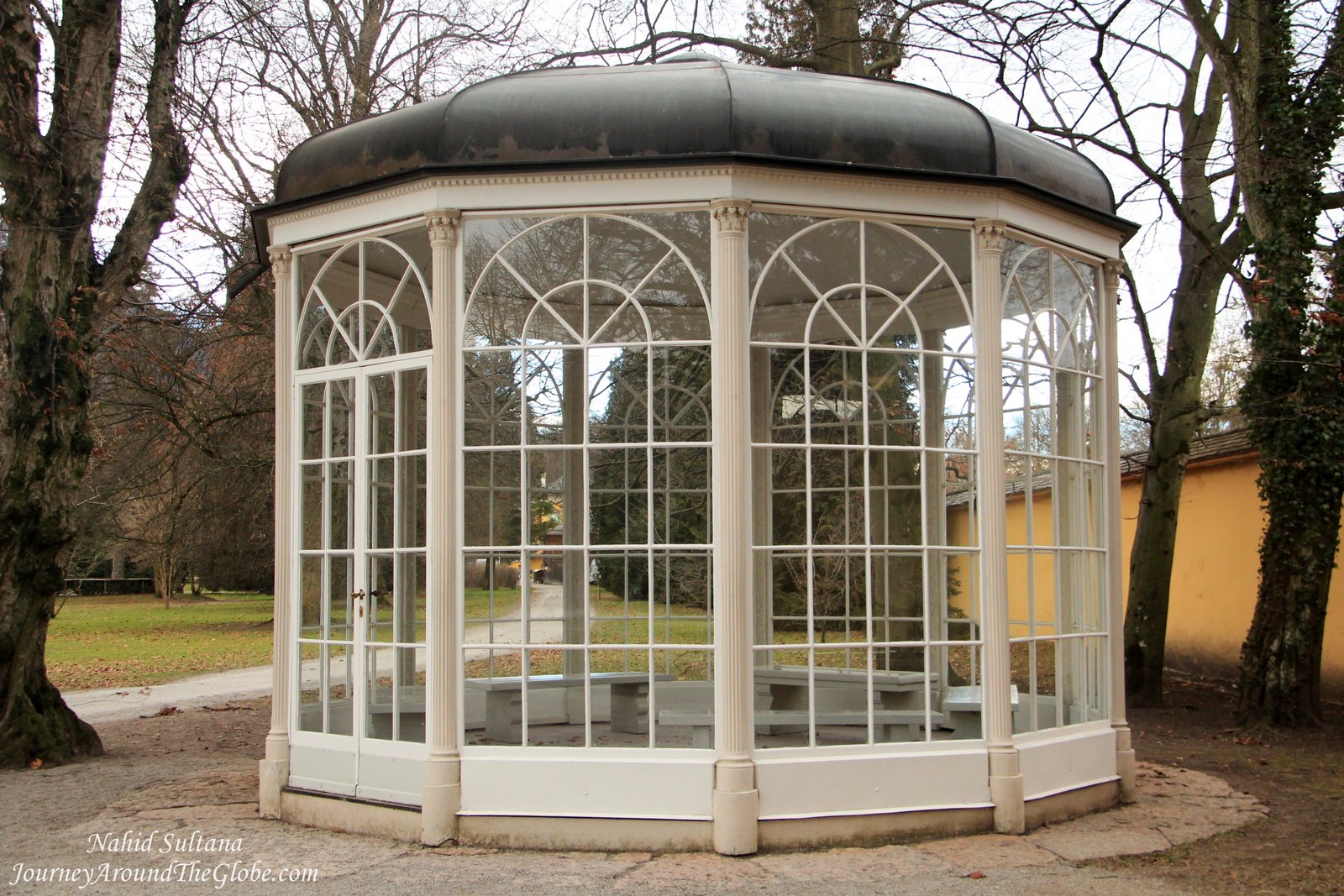
The purpose of coming to Hellbrunn Palace was to visit the famous gazebo of “Sound of Music”. It was shown in the songs “I am 16, going on 17” (with Lisle and Rolf) and “Something good” (with Christopher Plummer and Julie Andrews). The gazebo was originally located in Leopoldskron Palace garden during the movie but later it was moved here.

- The famous gazebo from the movie “Sound of Music” where the song “I am 16, going on 17” was shot, in Schloss Hellbrunn, Salzburg, Austria
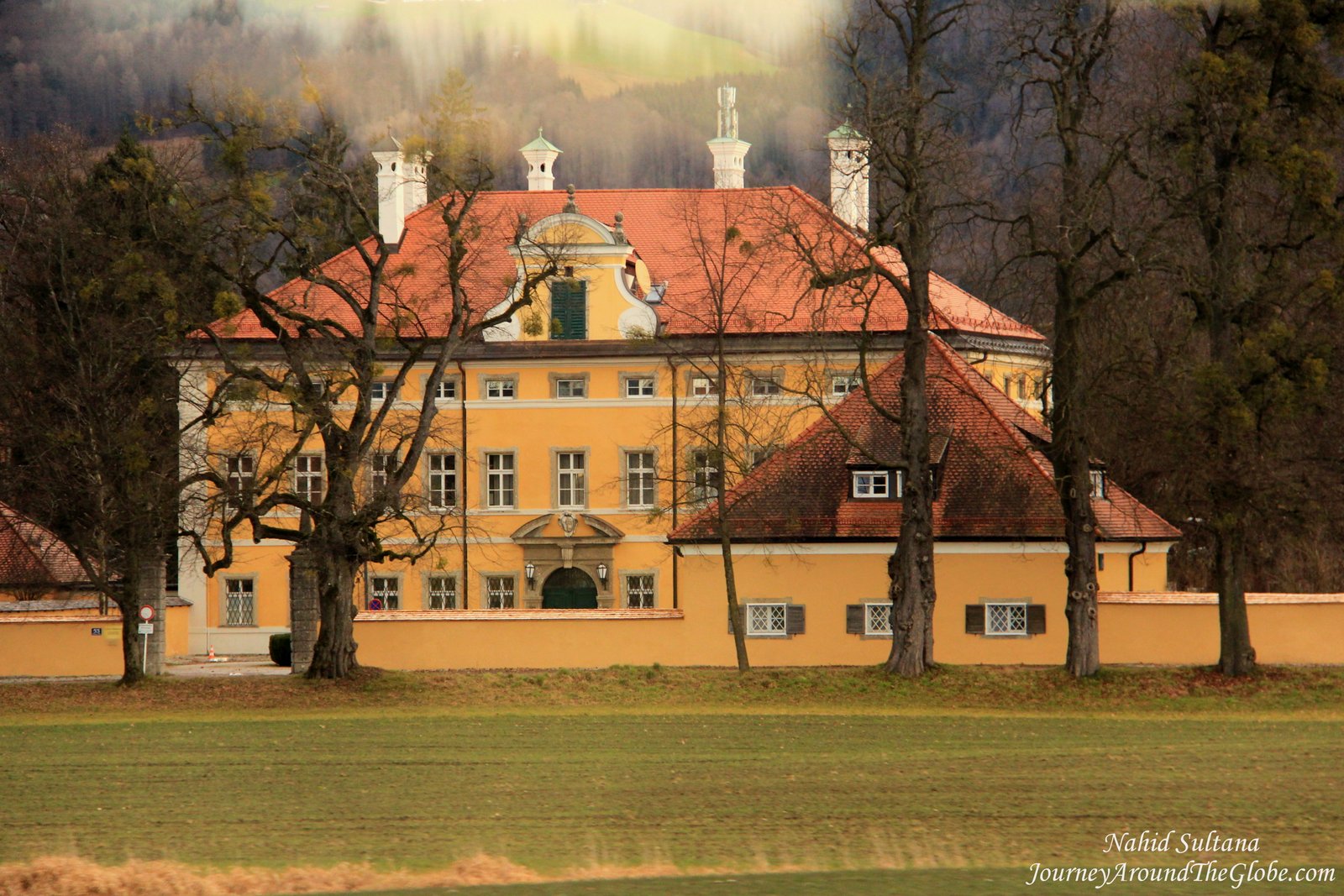
From Hellbrunn Palace, we drove by the mountains which you may have seen in the last scene of the movie when the family escape to Switzerland. Another spot we just drove by and didn’t make a stop was Frohnburg Palace. This yellow mansion was used only to show front façade of captain’s home. All the scenes inside the house were done in Hollywood.
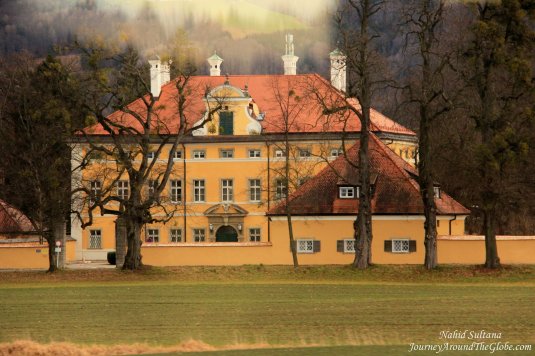
- Frohnburg Palace, they used only its front facade for captain’s home in “Sound of Music”
Third place we drove by without stopping was Nonnberg Abbey in Salzburg, within walking distance from Hohensalzburg Fortress. This abbey is from 740 A.D. and is still active. This is where the real Maria served as a nun. The movie also used the same spot to shoot Julie Andrews’ life as a nun. The abbey is not accessible to public.
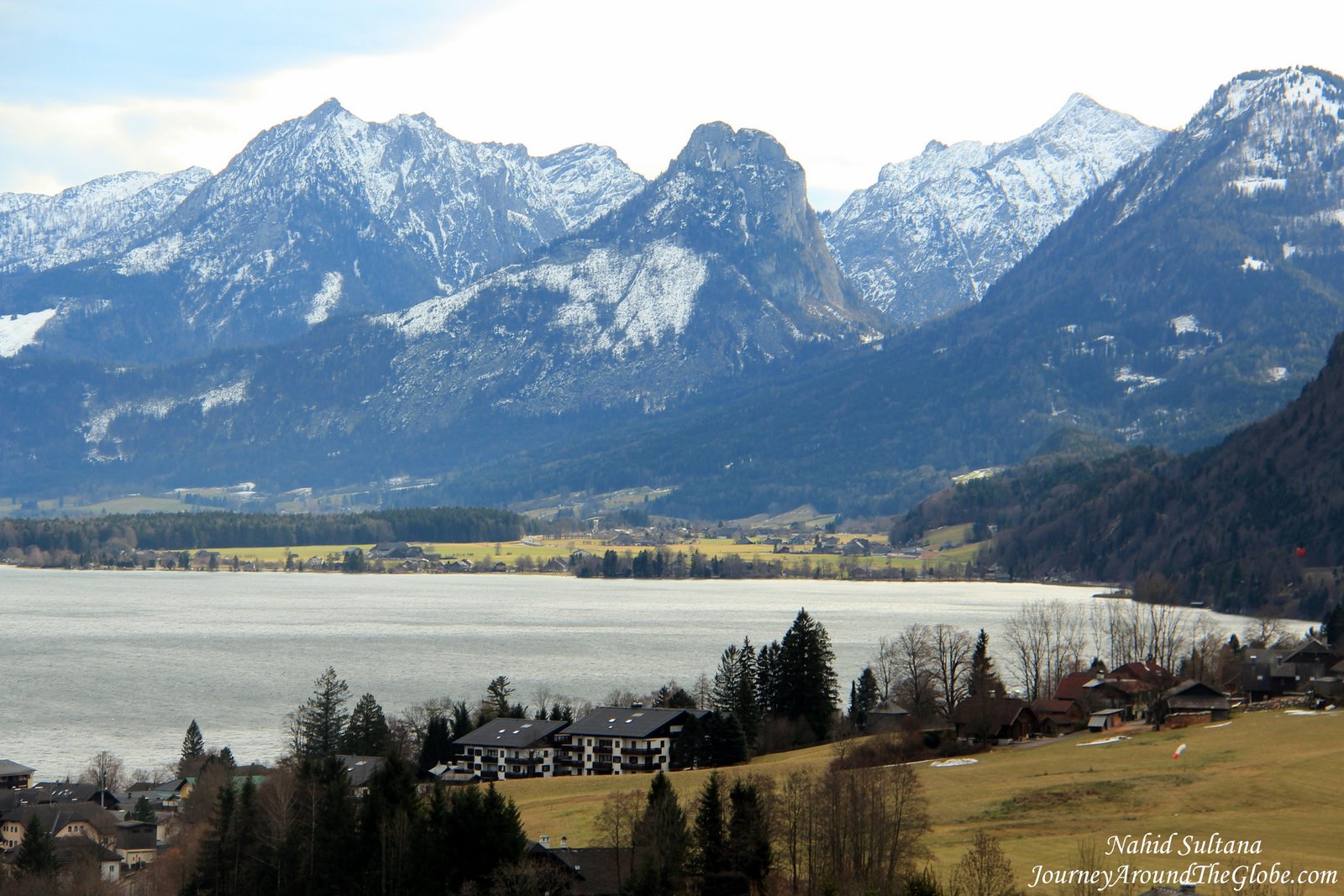
From here, we took a long drive through the mountains and lake-district of Salzburg. This was a very scenic drive with breathtaking views of Alps, meadows, trees, and lakes. After passing Fushel Lake, we made a quick stop at Wolfgang Lake in St. Gilgen. This whole region was shown as an aerial view at the very beginning of the movie and the mountains here were used to shoot the infamous “Do Re Mi Fa” song of this movie. Lots of people come here during summer for many water activities, to just relax by the lake, and to enjoy Alpine beauty. By the way St. Gilgen is also the birthplace of famous composer Mozart’s mother.

- Stunningly beautiful Lake Wolfgang in St. Gilgen
Our last destination of the tour was the “Wedding Church” in Mondsee. This is the place where Captain Von Trapp and Maria get married in the movie (not in real life). It was a former Benedictine monastery which is now called Parish Church St. Michael or Mondsee Basilica. The original monastery was founded in 748 A.D. Inside the church is extremely gorgeous and elegant, no wonder they chose this spot for their special wedding scenes. This church was selected over the actual abbey (Nonnberg Abbey) for the wedding scene due to its elegance and beauty. Even though in the movie it was portrayed that Maria and Captain got married in Nonnberg abbey!

- The “Wedding Church” where Captain and Maria got married in the movie
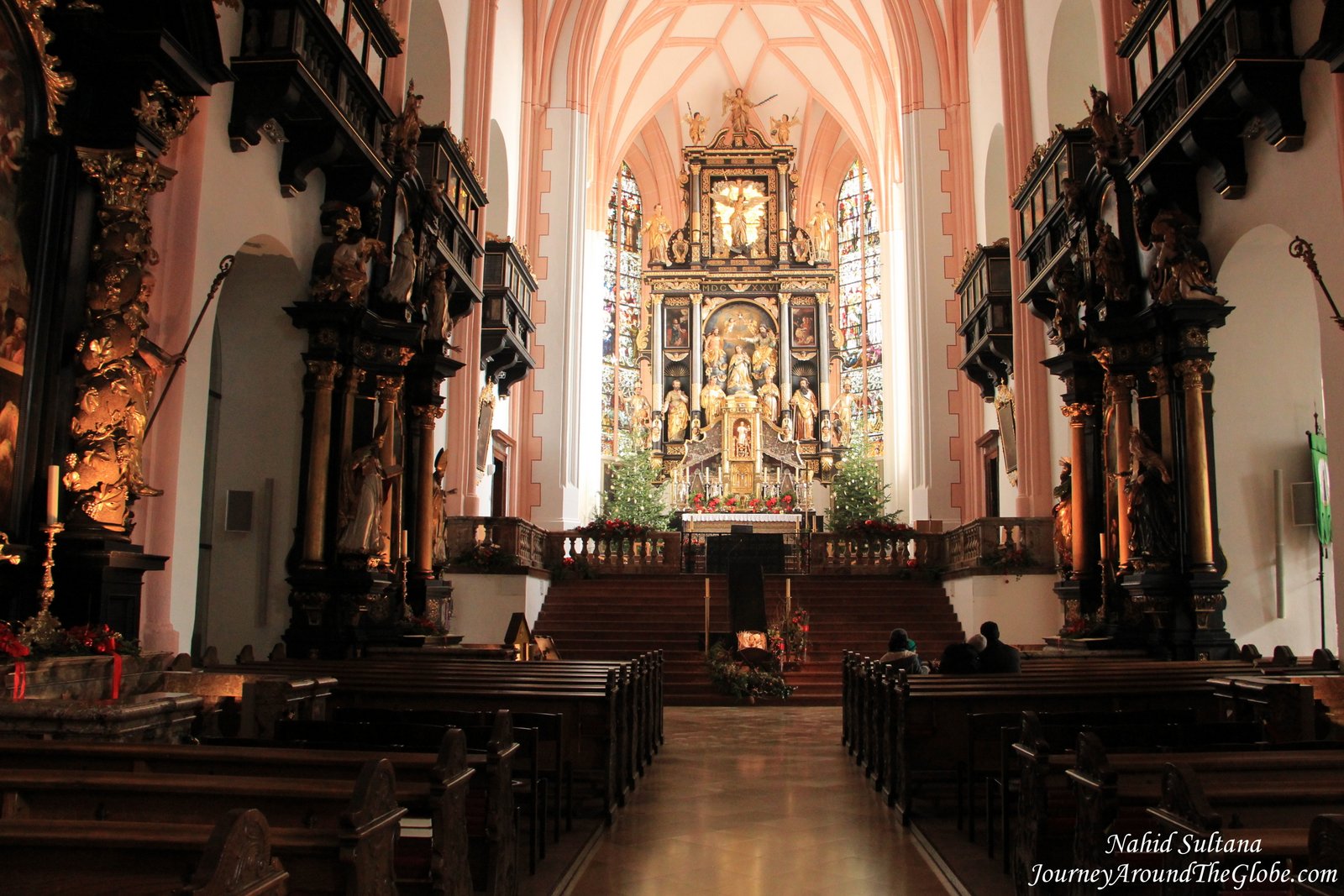
The small village of Mondsee is situated by stunning Mondsee Lake surrounded by the Alps. The city center where the church is located is absolutely beautiful. We didn’t have time to go by the lake, but I am assuming it must have a breathtaking view.
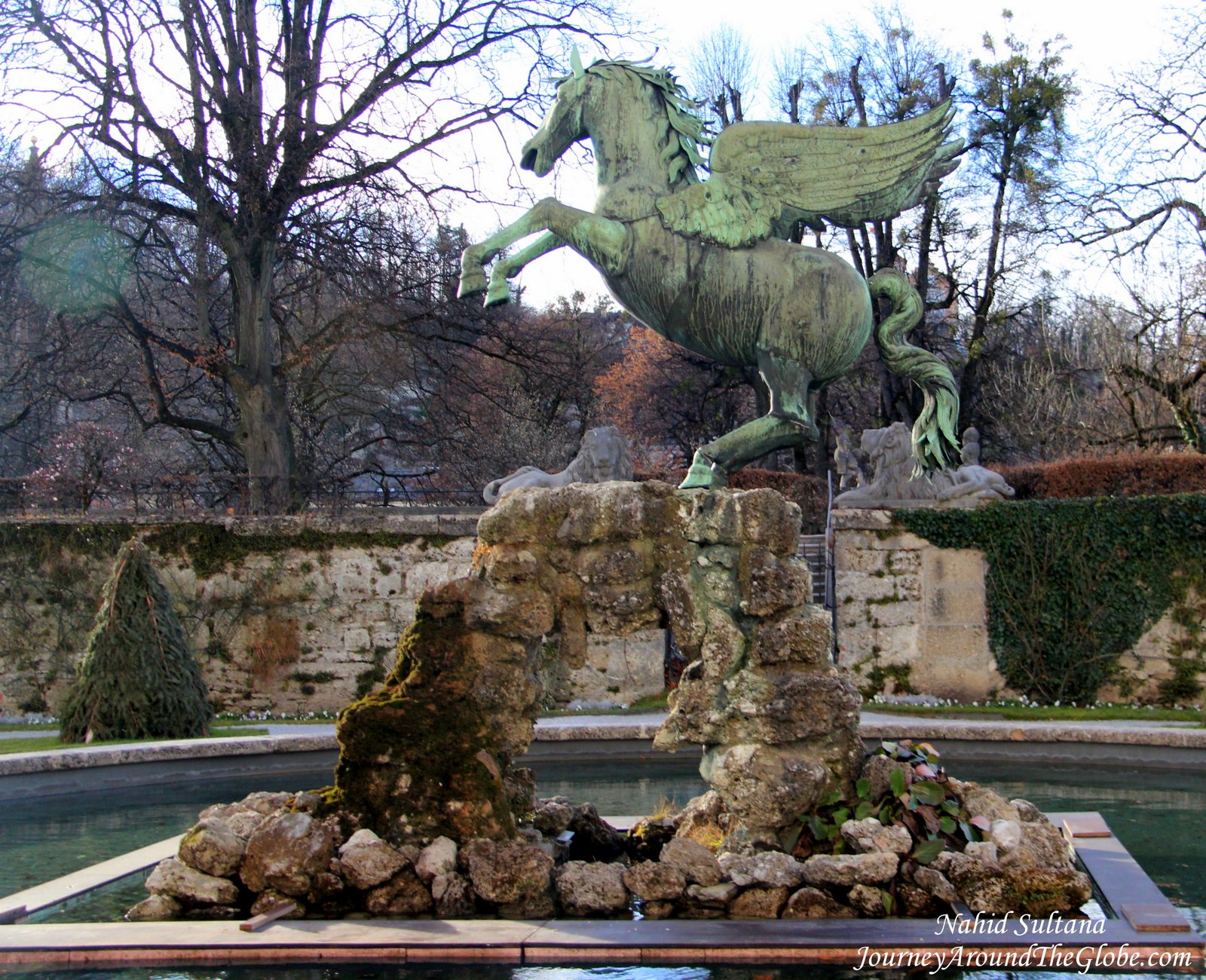
We were dropped off near Mirabell Palace and Garden in Salzburg at the end of the tour. Few scenes were also done in this beautiful garden. But the most remarkable statue was seen in some scenes was the statue of a Pegasus. It was moved around the city few times, I think, before it could find its final home in Mirabell Garden.

- Pegasus in Mirabell Garden which was seen in the movie couple times
Overall, this trip is a must for the fans of “Sound of Music”. Not only you get to see some spots of the movie right in front of your eyes but also you get to experience some Austrian Alps and its lake-district. It was a wonderful experience…probably the best part of this trip was when a lady on the other aisle started singing some songs from the movie with the CD our driver was playing on our way back to the town…I felt like I am in the movie singing too. By the way, my favorite song is definitely, “Edelweiss…Edelweiss, every morning you greet me, small and white, clean and bright, you look happy to meet me.” What is your favorite song from “Sound of Music”?
Share this:

Mozart’s City – Salzburg, Austria
SALZBURG, AUSTRIA: Salzburg is the city of music for being the birthplace of Mozart and where the famous movie “Sound of Music” was filmed in the 1960s. Mozart and Julie Andrews both made this city a major attraction for many tourists worldwide.
Situated beautifully by River Salzach, Salzburg is one of the most spectacular cities in Europe and one of my most favorite places to visit. I will pick Salzburg over Vienna anytime for its architecture, medieval look, cozy atmosphere, and elegant vibe. This is a city, I sometimes crave to go to and just enjoy its rich history and culture.
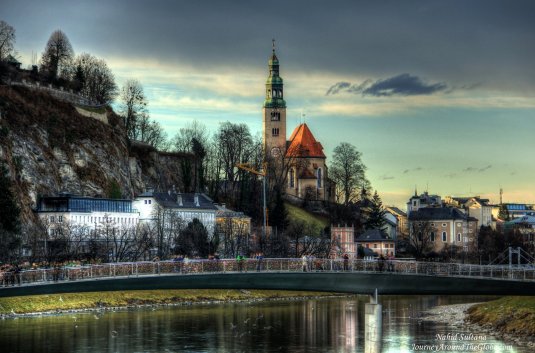
- One of my favorite European cities – Salzburg in Austria

Salzburg is very close to German border and has one of the best-preserved city center in the German-speaking world. The old town with many Baroque architectures, became a UNESCO World Heritage Site in 1997. You can never get bored in Salzburg with so many museums, marionette theaters, old churches and landmarks to visit, and a perfect cozy old town with endearing surroundings.

- Old town of Salzburg – kept its traditional look from many centuries ago

TIME of TRAVEL: Salzburg was the 3rd destination of our winter road trip in December 2013. My uncle-in-law was here to escape the below freezing temperatures in Chicago and also to spend few weeks with us. The whole trip was for 12 days. After visiting Fussen in Germany and Innsbruck in Austria, we reached Salzburg on the Christmas Eve. Weather was very mild to my surprise. I was prepared for some harsh cold temperature during Christmas for being so close to the Alps, but it was very nice, may be early to mid-40s during day and early 30s after dark…not bad at all.
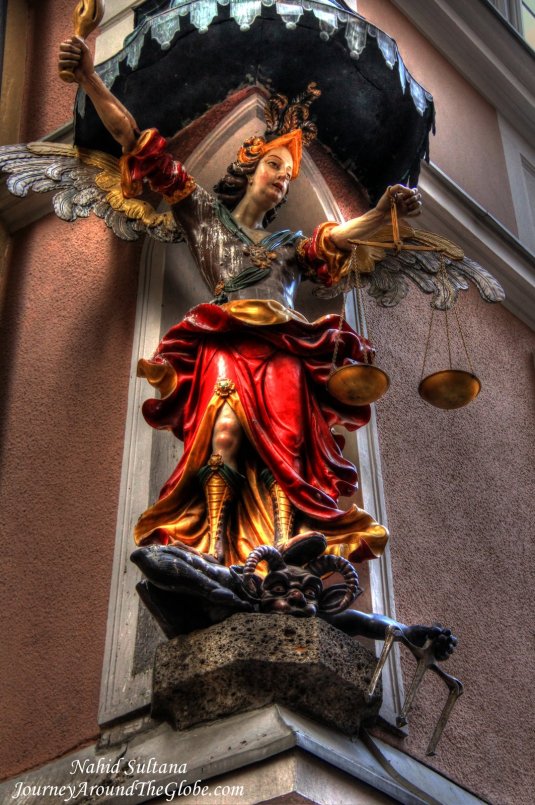
- Building art in the old town of Salzburg

By the way, this was our second time coming to this city. We have been here during Easter Break of 2009, when we were still living in the US. That time we toured around Europe for 2 weeks. I was longing to come back to Salzburg since then and finally it happened last month. Easter in Salzburg (or may be in whole Europe) is absolutely magical…it’s like Christmas in The States. Whole old town Salzburg was sparkling with lights and egg-decors. I have never seen Easter being celebrated with that enthusiasm before.
I have posted pictures from both of our trips, so you can see what the city looks like in spring and in winter. Excuse the big ol’ yellow dates on the old pictures.
OUR HOTEL: We stayed in Hotel Der Salzburger Hof in one side of Mirabel Palace, but was little away from the old town. It had its own restaurant, free breakfast and Wi-Fi for the guests. But the best part of this hotel was that each floor of it was designed in different theme. Like, one floor was in Mozart theme and ours was in “Sound of Music” theme. Our room even had some scenes from the movie printed on the wall. In 2009, we stayed closer to city center, in Hotel Austrotel, which is now called Hotel Am Mirabellplatz. This one didn’t have breakfast but has a bakery at the end of the street.
- One of the walls in our hotel, dedicated to the movie “Sound of Music”, in Salzburg, Austria
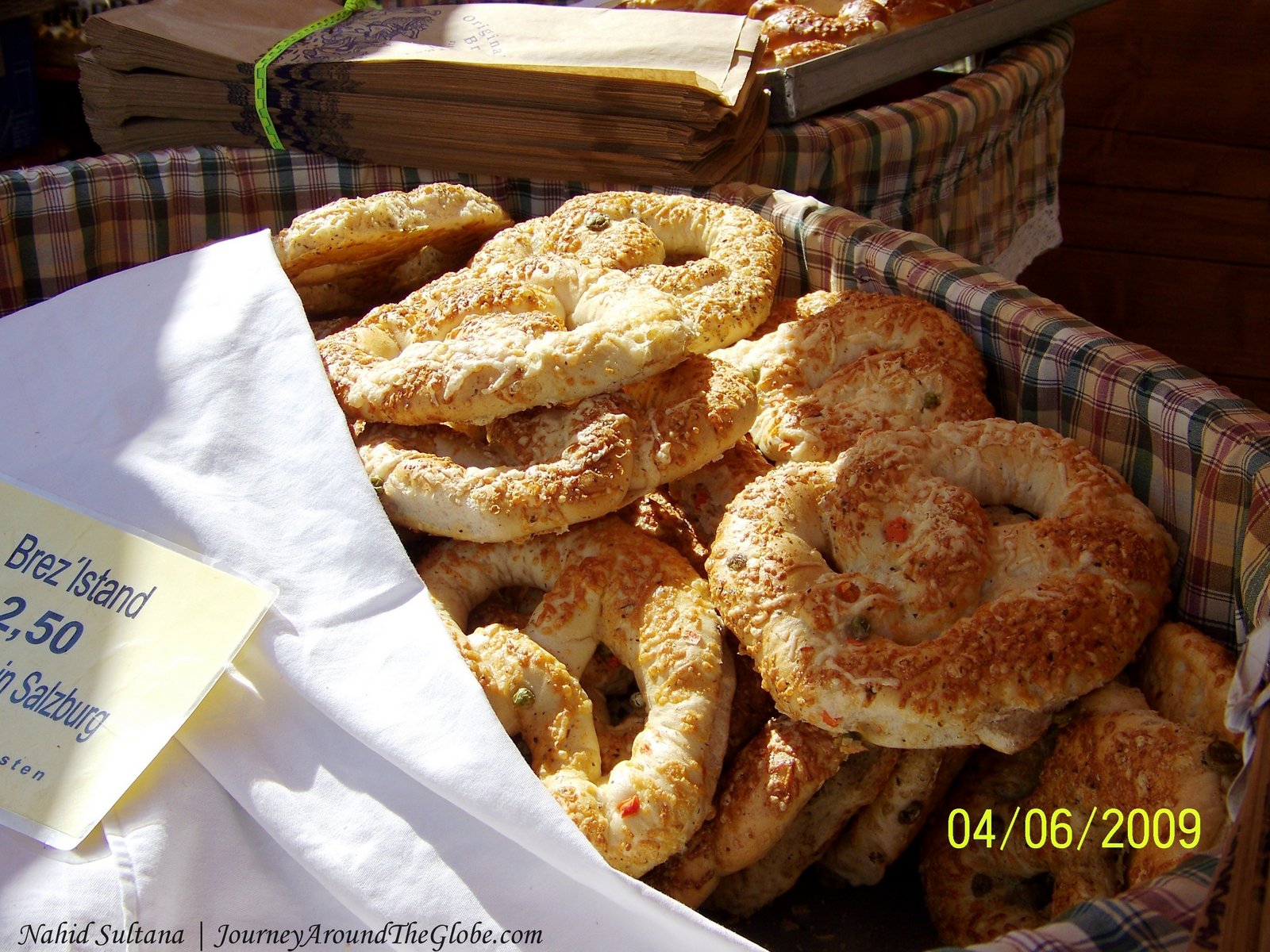
EATING and SHOPPING: That was a night to remember on Christmas Eve in Salzburg. As soon as we reached our hotel and checked in, we headed out for some food. After walking and looking and searching for a place to eat, the only option we were left with was Burger King. Everything was closed or was about to close. Thanks to BK burgers for saving our growling stomach that night. Next day lunch was some to-go sandwiches and for dinner, we had some lovely Indian food in our hotel restaurant. But the restaurant had some local Austrian dishes too, like schnitzel (fried boneless chicken breast with some potatoes and veges) which my husband tried. Do try “brazen” when you are in Salzburg; it’s like big and fat pretzels that come in sweet and savory flavors. You can get them in pizza, onions, herbs, and many other flavors. If you go there in Easter, you will also see colored boiled eggs (they only color the shell, so it’s ok to eat the eggs) in many bakeries or breakfast places. Another thing you will see here in almost every souvenir shop is Mozartkugeln. They are chocolates with marzipan filling inside…can be expensive but Salzburg is all about Mozart 😉
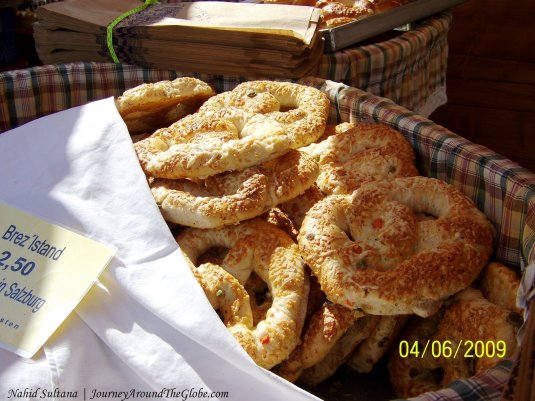
- Brezen, a preztel-like snack, is very popular in Salzburg
Whole old town of Salzburg is packed with tons of souvenir shops. Browse thru the small stands in Alter Markt or other fancy stores in the old alleys. On our first visit in 2009, we bought a decorative Bavarian beer mug (can be pretty expensive depending on the size). This time my husband bought a Tyrolean hat (very traditional here) with a feather on it…looks a bit like Robinhood’s hat; he regretted very much that he didn’t buy it in 2009. For our home, I got some small this and that from the huge Christmas market in Residenzplatz and Domplatz. The annual Christmas market is here very big and colorful here. Even if you don’t buy anything just come and join the fun, may be try some local knickknacks too. Also, marionettes are very popular here and you will find them in almost everywhere in old town. While you are in Mozart’s town, buy his classical CDs or other memorabilia.

- Christmas market in Residenzplatz in the old town of Salzburg

PLACES WE’VE VISITED: We spent two whole days in Salzburg during our first visit in 2009. But this time we took “Sound of Music” tour in the morning; so we were left with only half a day to spend in the city. We were dropped off near Mirabel Garden around 1:30pm by the tour bus and then we were off to venture Mozart’s city. Old town is very compact; take your time to absorb its appealing atmosphere. We did everything on foot and it was fun doing it that way.

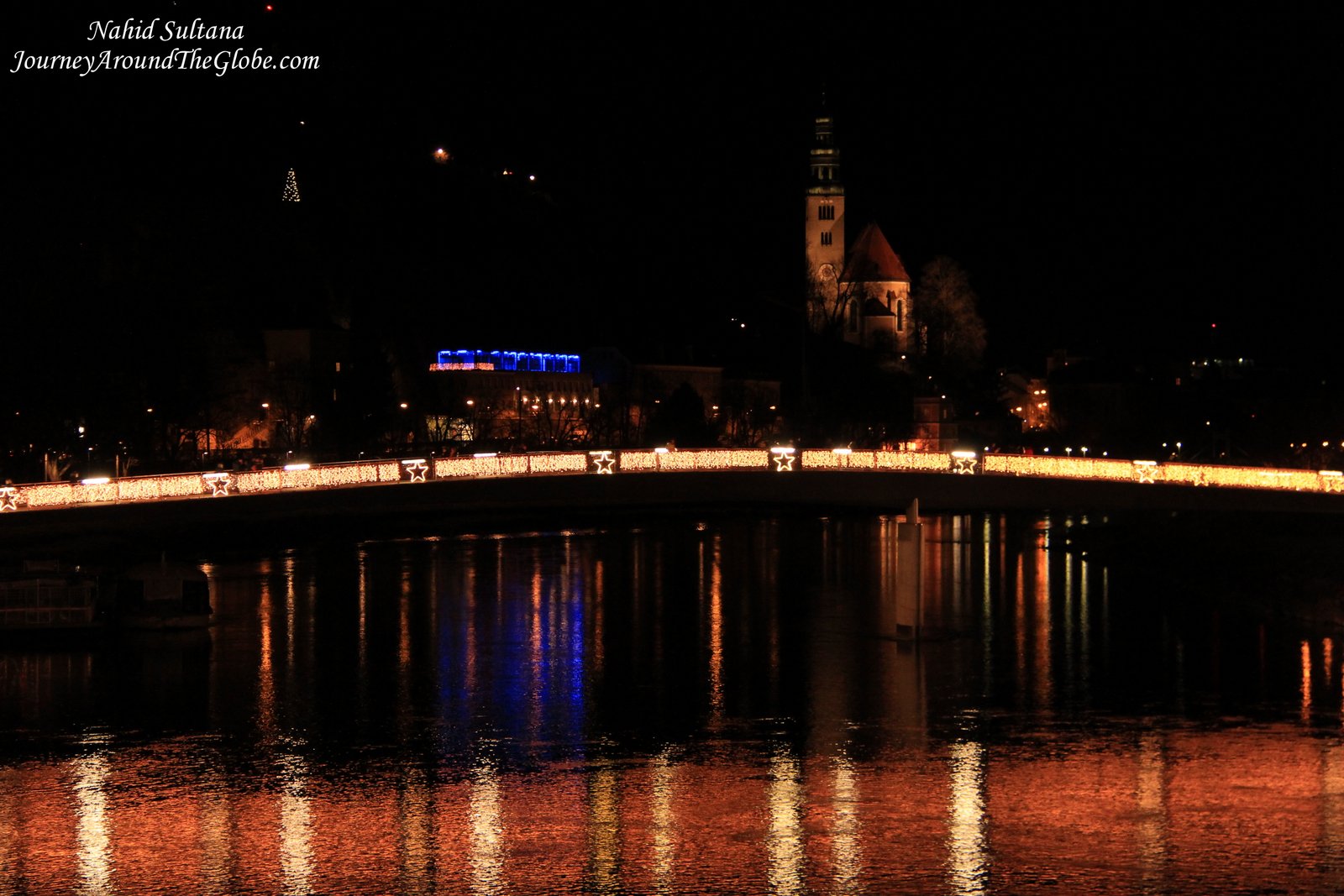
- River Salzach at night, walking back to our hotel
If you are done with the city and have more time, then try going to the lake-district, close to the mountains…few km away from Salzburg. If you have your own car, it takes about half an hour to reach there. It’s a perfect region for summer tourists and makes a nice getaway from the city-life and of course you will love its stunning natural beauty with lakes, mountains, and villages.
1) MIRABEL GARDEN and PALACE: We started our walk from Mirabel Garden and Palace. We didn’t really go inside the palace because I don’t think it is open to the publics for regular tours. It is said that Mirabel Palace has world’s most beautiful wedding hall and need to be reserved at least a year ahead. We walked via its garden towards Salzach River. Beginning of early spring, this garden looks at its best with fresh flowers and a big fountain in the middle surrounded by sculptures on the four sides. But we didn’t really see any flowers this time. The fountain was not on either. But it is a nice place to stroll around and sit down to take a little break.
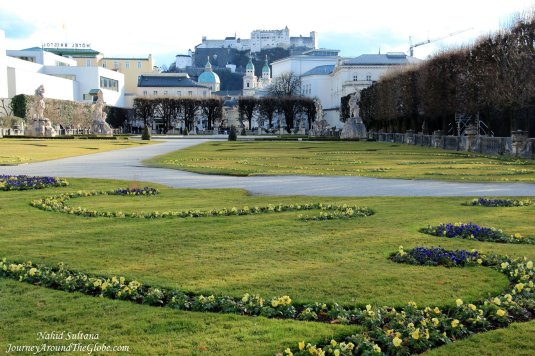
- Mirabel Garden and Hohensalzburg Fortress it the distance…in Salzburg, Austria

Mirabel Palace is located in Mirabellplatz, little bit away from old town. The walk is only about 10 minutes from old town but very close to Mozart Residence.
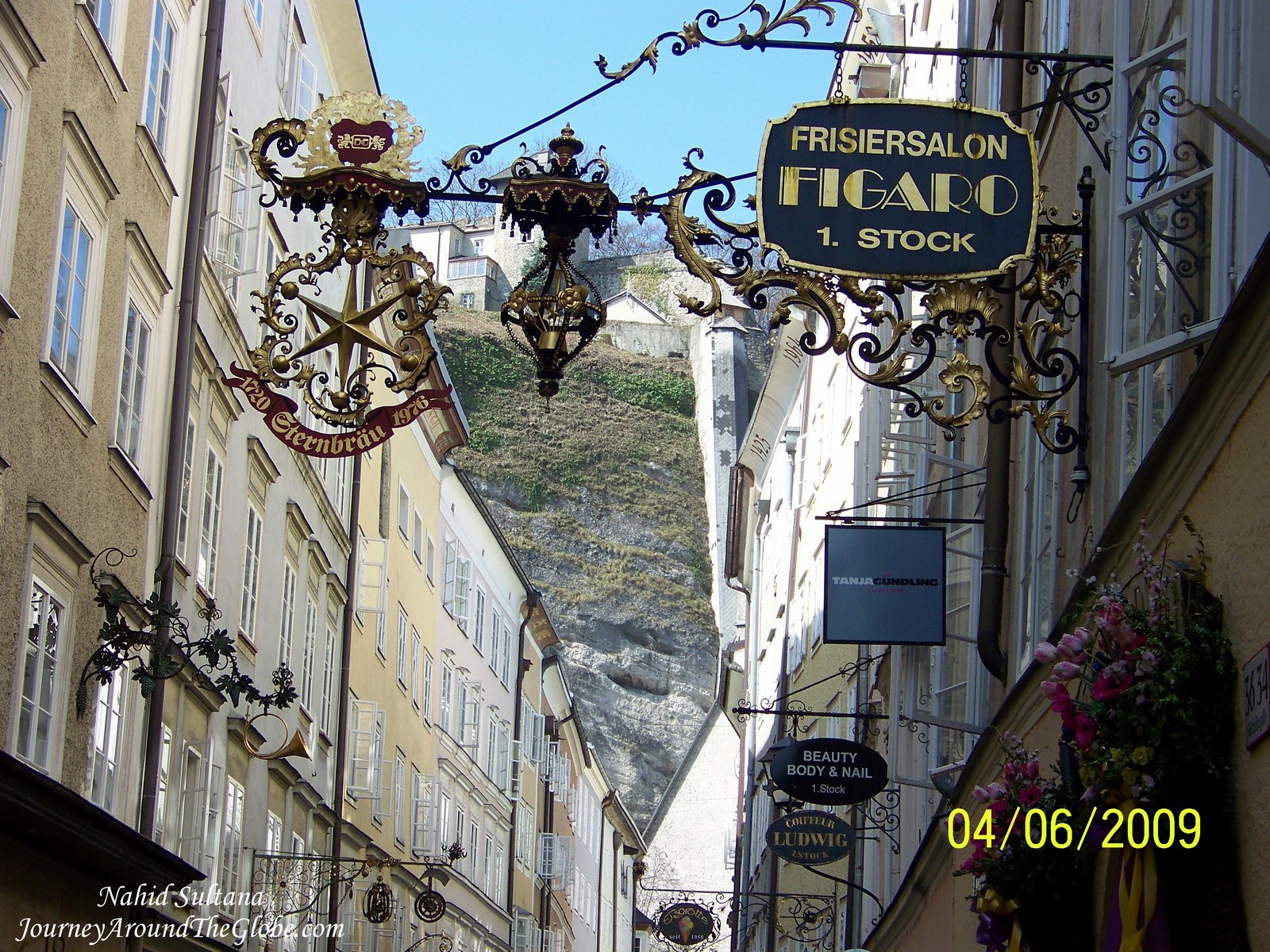
2) GETREIDEGASSE: After crossing a bridge on River Salzach from Mozart’s Residence/Wohnhaus we crossed the street and entered the old town. This is a long and narrow street here with full of shops and souvenir places. Stores on Getreidegasse still decorate their entrances with metal signs of what their stores are about, just like the old times. This can be a very crowded place to walk around but I guess that’s why I loved strolling up and down this street.
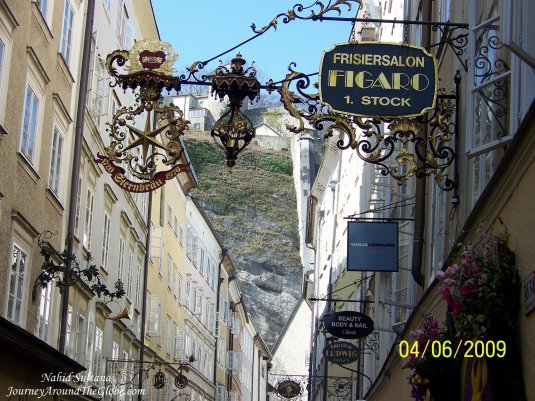
- Old store signs in Getreidegasse
3) MOZART’S BIRTHPLACE (MOZARTS GEBURTHAUS) and MUSEUM: On Getreidegasse, a bright yellow house stands amongst some other old buildings from few centuries ago. The famous composer Wolfgang Amadeus Mozart was born in this house in 1756 and lived here until 1773. Now it’s a popular museum devoted to his life, work, and family. Mozart is a major attraction of Salzburg and his birthplace is a site which his fans wouldn’t want to miss. This museum (along with Mozart Wohnhaus) has the largest collection of Mozartiana worldwide.

- Mozart’s Birthplace where he was born in 1756 and spent his childhood…Salzburg, Austria

This is a very special experience – to see, hear, and absorb the atmosphere of the place where Mozart was born and spent his childhood. In this three level exhibition, the visitors can learn details of his life including domestic circumstances, when he began to play music, his relationship with his family, his passion for opera, and much more. Besides original portraits and documents, there are some rare exhibits from Mozart’s possessions, such as the violin he played as a child and an authentic portrait which was painted two years before his death.
The museum is open daily (including Sundays and holidays) from 9am to 5:30pm and in July and August from 9am to 8pm. You can buy combine tickets for Mozart’s Birthplace and Mozart Residence in any one of these museums for a discounted price.
4) MOZART WOHNHAUS or MOZART RESIDENCE: Also known as the “Dancing Master’s House”, the former residence of the Mozart family stands on the right bank of Salzach River. Like Mozart’s Birthplace, this house is one of the most important memorial sites in Salzburg. By the fall of 1773, the rooms of Getreidegasse had become too small for the Mozarts. The family moved here in 1773 and Mozart himself lived here until 1780. His father died in this apartment in 1787. You can see the rooms used by the Mozart Family and the composer himself.
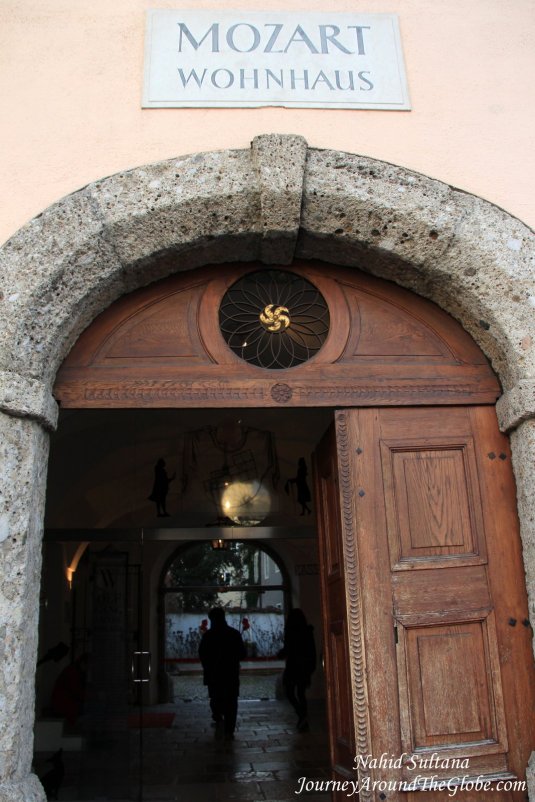
- Mozart Residence, apartment where he spent few years of his life

The building was largely destroyed during WWII but was reconstructed according to the original plan to reopen it as a second Mozart museum. Mozart’s own piano, music notes, and some portraits are some particular attractions here. His audio-visual collections, in addition to the exhibitions, contain sound and film recordings concerning the life and works of Mozart – some 22,000 audio and 2,800 video recordings.
Mozart Residence is located in Makartplatz, only 5 minutes of walk from his birthplace and opposite of Mirabel Garden. The museum is open daily (including Sundays and holidays) from 9am to 5:30pm and in July and August from 9am to 8pm. You can buy combine tickets for 12 euros per person for Mozart’s Birthplace and Mozart Residence in any one of these museums for a discounted price.
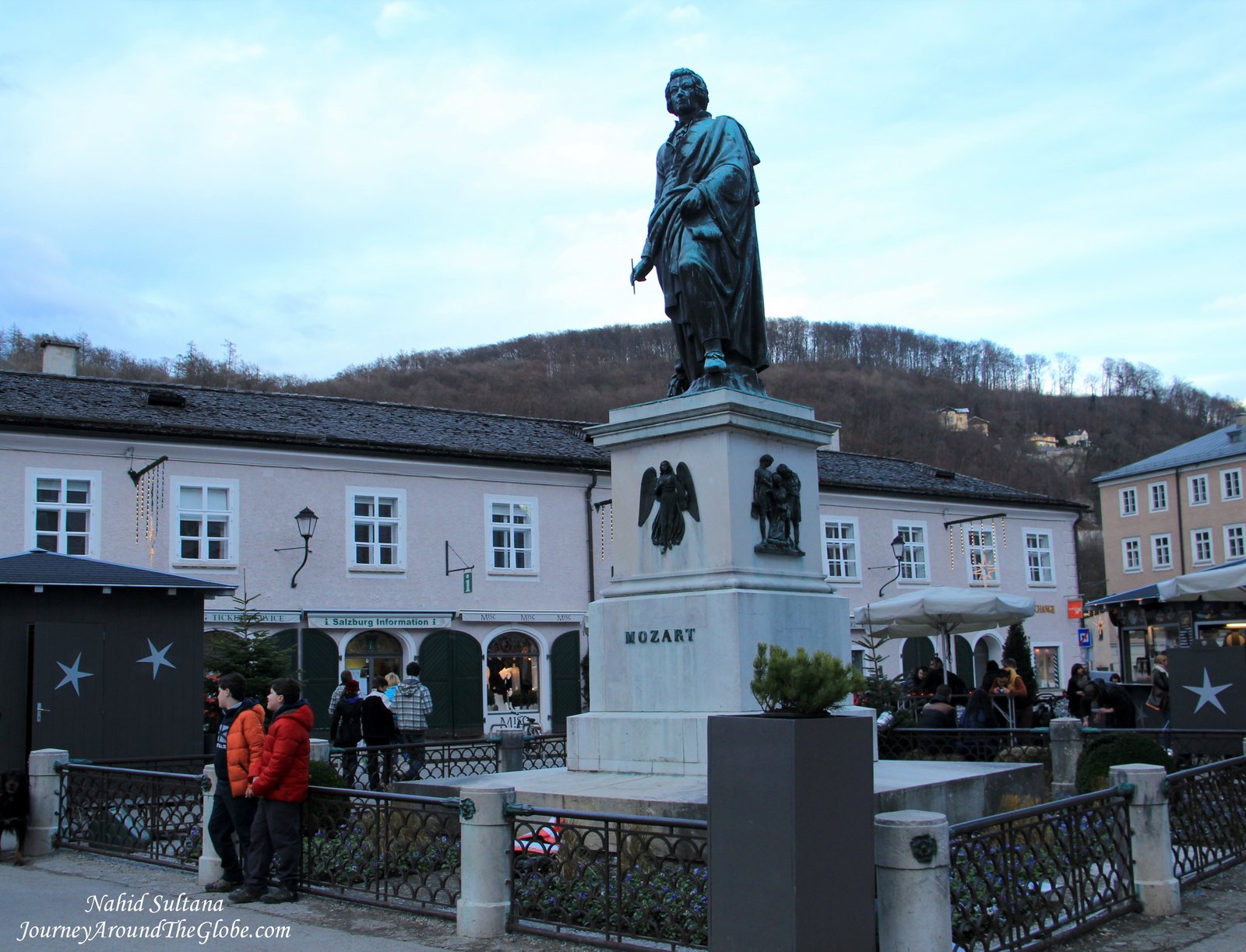
5) MOZARTPLATZ: This square is dedicated to Salzburg’s talented son, Mozart. A statue of young Mozart stands in the middle here. There was an ice-rink in the middle of the square when we were there in December. Many souvenir shops are here too.

- A statue of young Mozart in Mozartplatz, Salzburg, Austria
6) RESIDENZPLATZ: Right beside Mozartplatz is Residenzplatz. St. Michaels Church in Residenzplatz is an old church. It’s a small but beautiful church inside. We didn’t find it open on our 2nd visit but outside the church is very nice too.
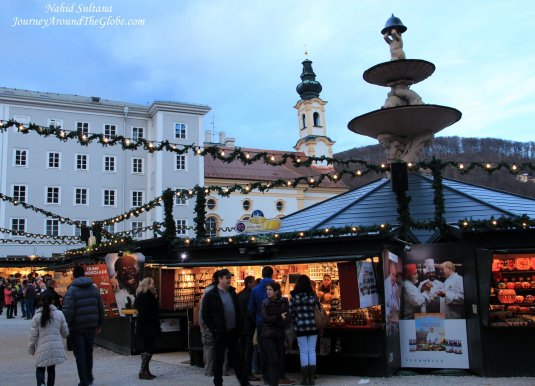
- Christmas market in Residenzplatz in old town of Salzburg, Austria

You can get horse-carriages from Residenzplatz to tour around the old town. Salzburg Museum and Residence Gallery are located in this platz. Christmas market here was one of the gorgeous ones I’ve seen so far. The place was bustling with many tourists and locals – everyone enjoying hot drinks, snacks, sweet treats, and of course doing little shopping along the way. This is probably one of the best places to try some local fresh finger-foods (same goes for the market in Domplatz).
7) DOMPLATZ and SALZBURG DOME CATHEDRAL: After passing Residenzplatz take few steps and you are in Domplatz. Dome Cathedral is one of the grandest architectures in whole of Salzburg. It’s an attractive cathedral both outside and inside. You will just love its high dome, impressive ceiling, majestic organ, old frescoes, and large biblical paintings. I think there is a fee to get inside but it was free on the Christmas Day.
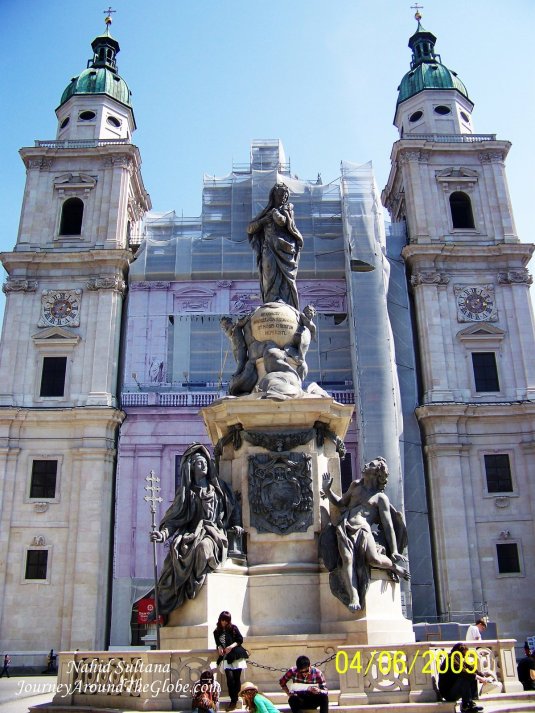
- Salzburg Cathedral in Domplatz

Domplatz also had a big Christmas market in front of the cathedral. It was also sparkling and dazzling with lights and decors. We bought some brezens (pretzel-like snack) from here and cotton candies for the kids while enjoying this big gathering. When we were here in April of 2009, the square was empty and quiet. There is a beautiful fountain in the middle of the square right in front of the cathedral.
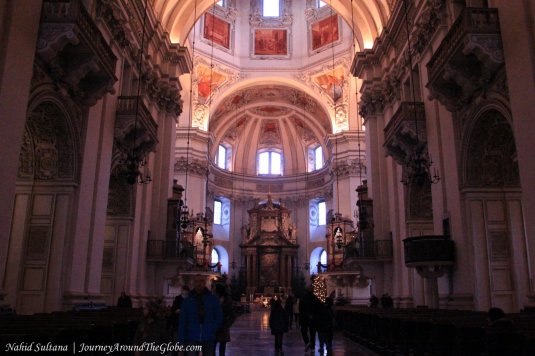
- Inside Salzburg/Dome Cathedral in Salzburg, Austria
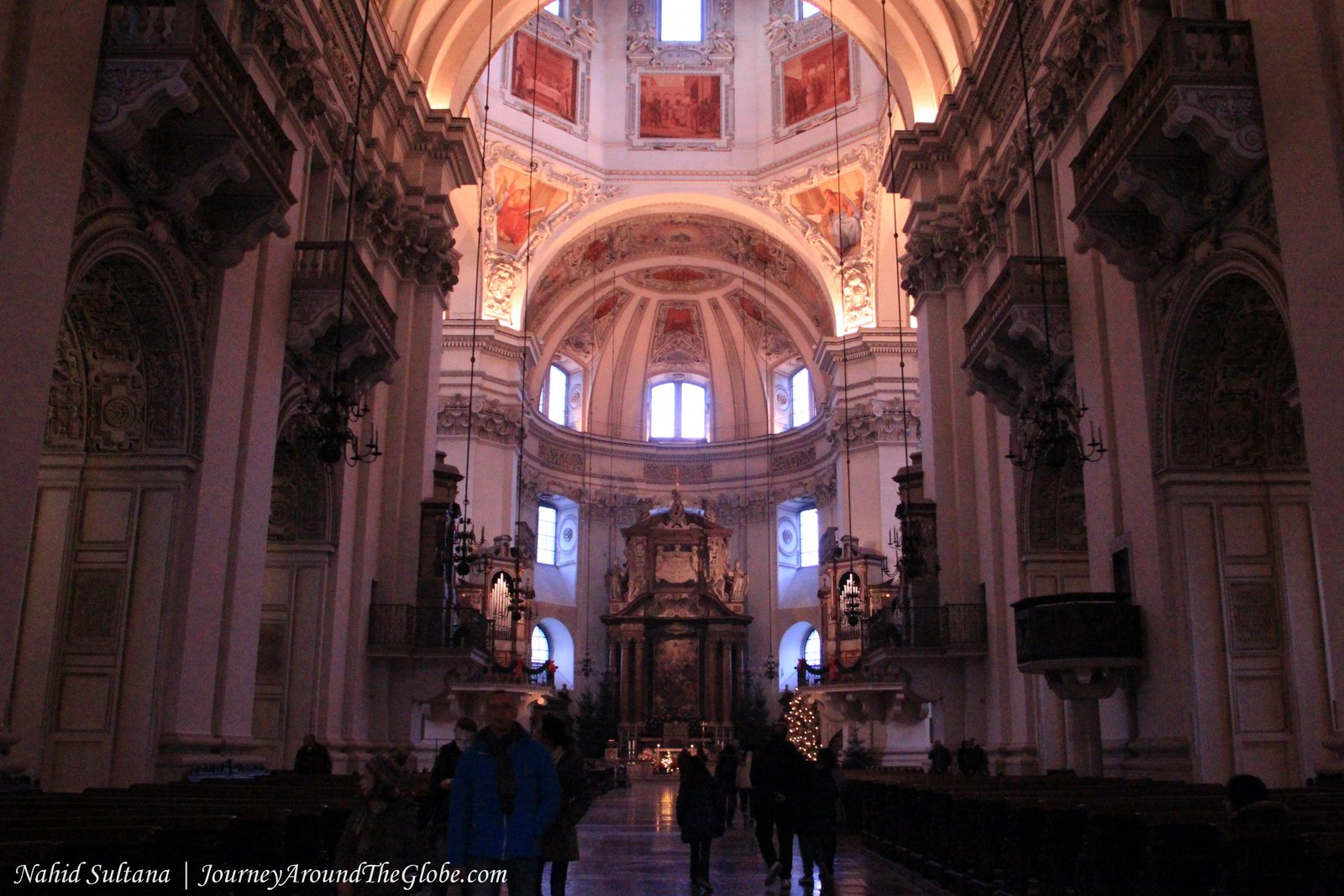
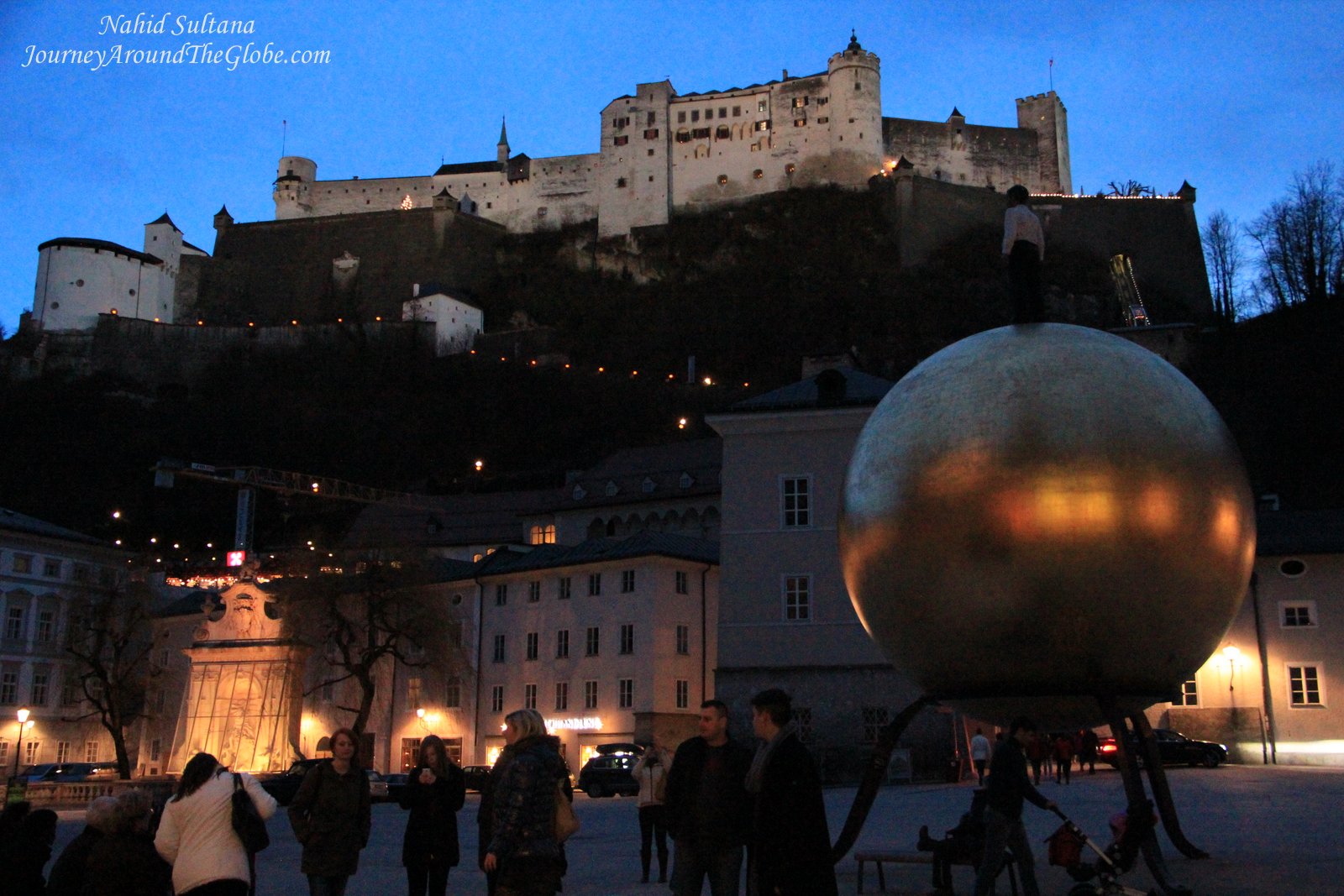
8) CAPITALPLATZ: Another few steps and on the left side of the cathedral is Capitalplatz. You can see Hohensalzburg Fortress on the hill from all the above squares but the closest view is from here. There is a big fountain in one side of this square right below Hohensalzburg. Play the giant chess if you ever get a chance or watch other people playing it.

- Hohensalzburg Fortress on the hill from Capitalplatz
9) ST. PETER’S CHURCH and CEMETERY: We didn’t go to this church this time. But I remember going there on our first trip. It’s another beautiful church of Salzburg. Can’t remember which square it is situated in, but it was a gorgeous church outside and inside. Before we reached the church, we saw St. Peter Cemetery. This is a really old cemetery and a very calm place. You can see many few hundred years old tombs.
10) HOHENSALZBURG FORTRESS (FESTUNG): This fortress is like the guardian of Salzburg looking over the city all the time. It’s located on top of a small mountain and can be seen from almost any point of Salzburg, far or close. The fortress was built in 1077 and expanded in the following centuries.
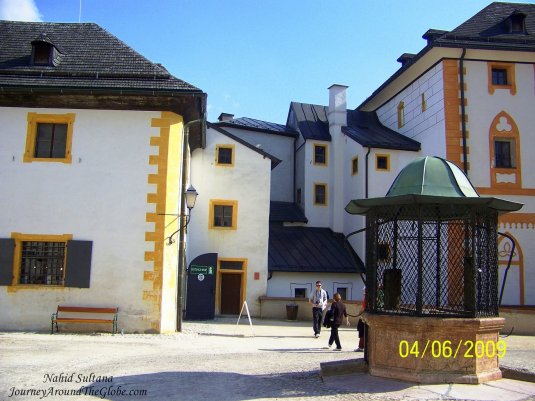
- Old barracks and quarters of Hohensalzburg Fortress in Salzburg, Austria

We didn’t’ go to up to the fortress this time. If I can remember correctly from our first visit, there are couple museums there and one of them is a marionette puppet museum, called “Welt Der Marionetten – World of String Puppets”. Walking in between its old walls on cobbled streets takes you back to medieval age. Visit small churches and old style buildings of this fortress.
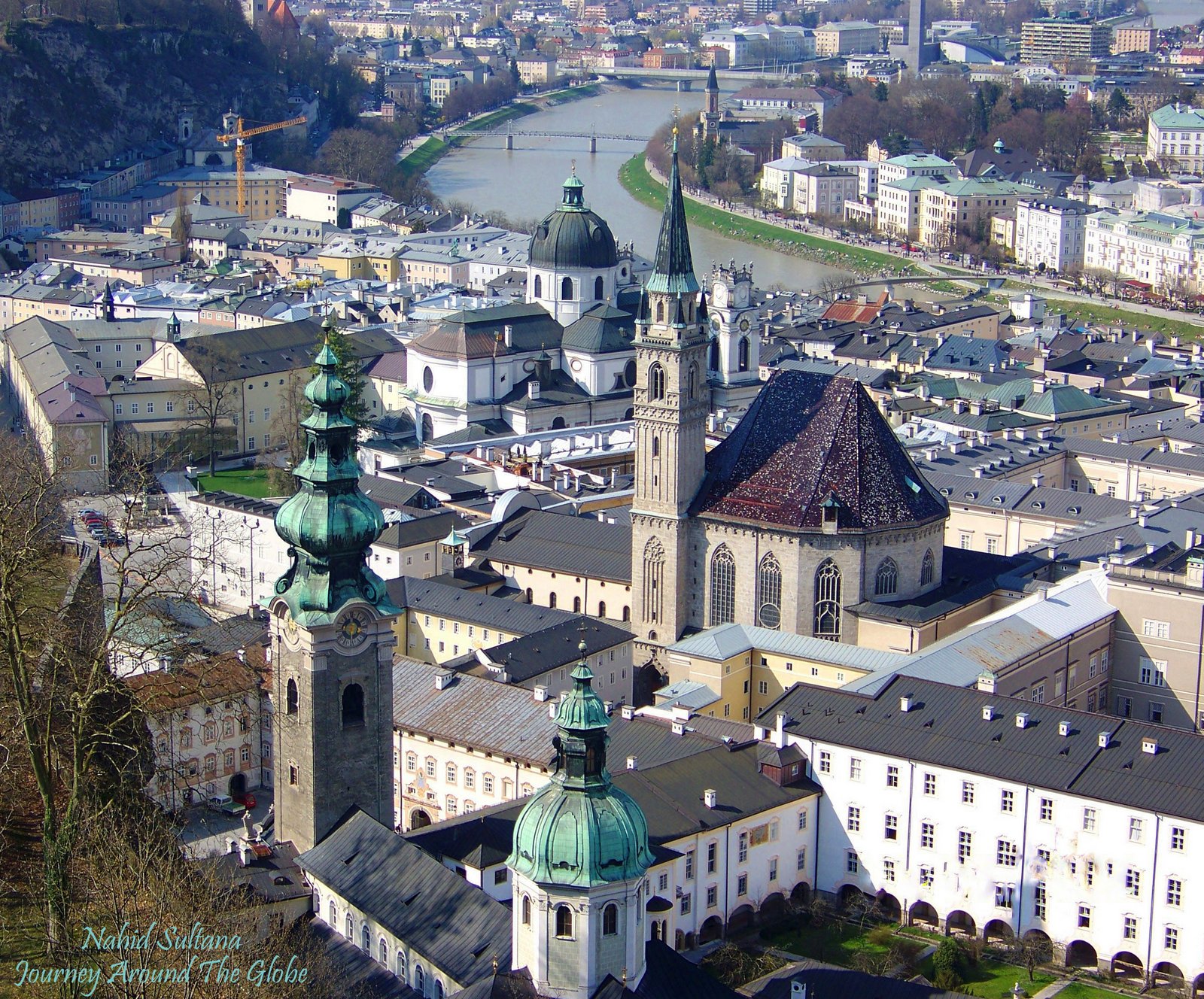
This is probably one of the best places in Salzburg to get a breathtaking panoramic view of the city. You can see River Salzach, steeples of many big and small churches, mountains in the distance, and the whole old town.

- Stunning view of Salzburg from Hohensalzburg Fortress
We took a funicular or “Festungsbahn” to go up to the fortress. I am not sure if you can walk up there but that would be quite hard as the mountain is a bit steep.
11) SCHLOSS HELLBRUNN: We didn’t really see whole of this place. As I mentioned above that we took “Sound of Music” tour the day we visited Salzburg. Our tour bus brought us here to show the famous gazebo from that movie where the song “I am 16, going on 17” was shot. It was a short visit but looked very beautiful even in winter with some gardens and little parks. This was originally the summer palace of Archbishop of Salzburg. I am guessing you easily can spend half a day or a day strolling around the garden, parks, and fountains…a perfect place for families with children.
- The famous gazebo from the movie “Sound of Music” where the song “I am 16, going on 17” was shot, in Schloss Hellbrunn, Salzburg, Austria
Share this:

Few Hours in Innsbruck, Austria
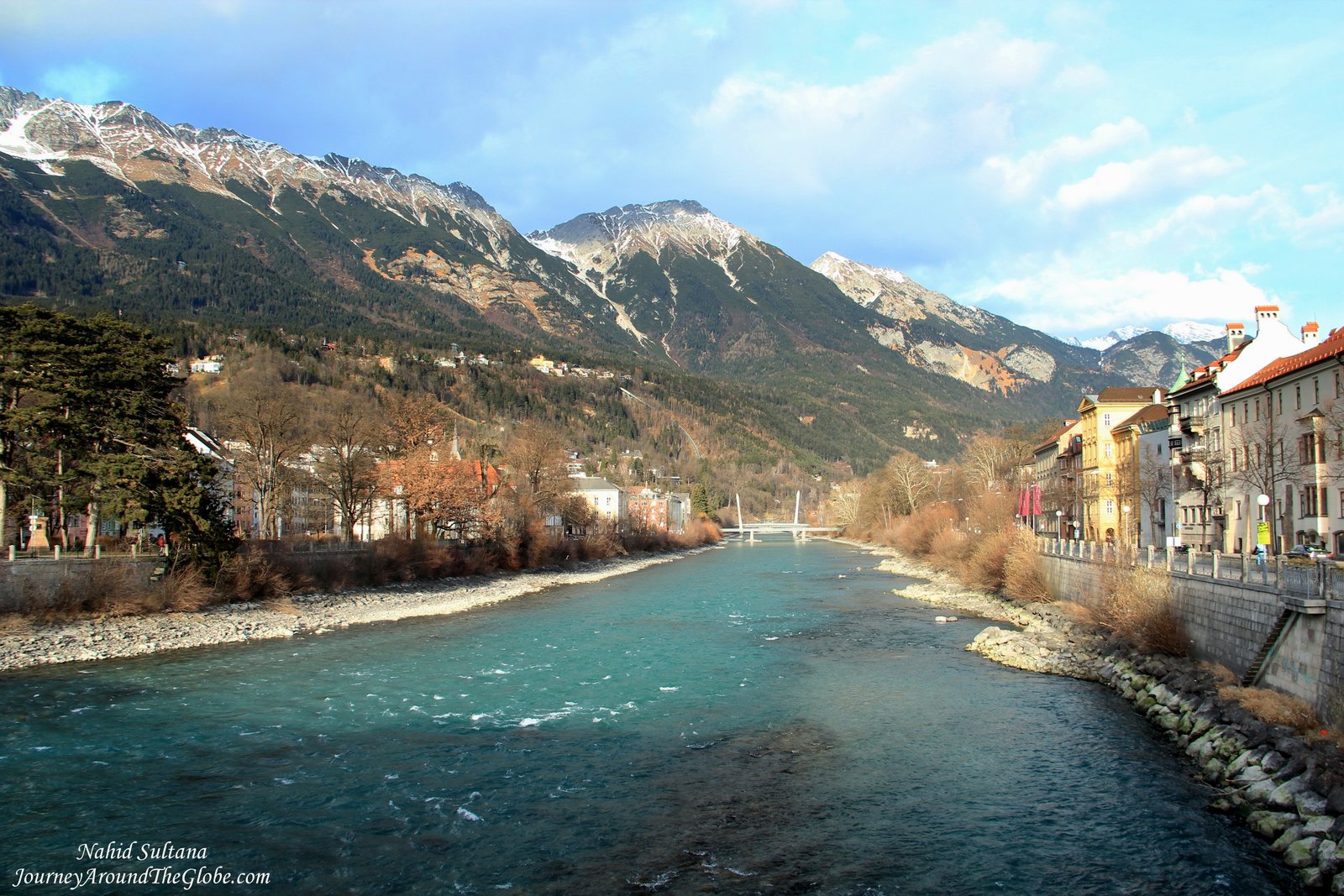
INNSBRUCK, AUSTRIA: Surrounded by the beautiful Alps and its snow-capped peaks, Innsbruck is a place to be at any time of the year. It’s a paradise for winter sports lovers for being surrounded by gorgeous mountain ranges. The city is known for alpine sports opportunities, especially in winter. Winter attracts more people in Innsbruck from all around Europe and the world. It hosted couple Winter Olympics before and winter sports are part of this city’s culture and pride.

- River Inn running thru Innsbruck with the Alps surrounding the town
For us, we had only few hours here and we stayed mainly in the old town which is an absolute charmer. There are tons of things to do in Innsbruck, especially for energetic athletes. Other than many historic landmarks, middle age buildings in old town, and lively city life, it has the largest ski resort in the Alps.
There is a parking structure very close to the old town where we parked our car. Old town can be covered on foot and you see a lot more doing it that way. If you don’t speak German like me, its ok, all the shops, restaurants, and tourist spots usually have people who speak very good English.

- Austrian Alps in Innsbruck

TIME of TRAVEL: Innsbruck was the second stop in our winter road trip 2013. We started our journey at the beginning of Christmas break. After visiting two famous castles in Fussen, Germany (first stop of this trip) we crossed into Austrian border the same night, stayed in Mieming (a small Austrian town very close to Innsbruck), and drove to Innsbruck next day for few hours before our next destination to Salzburg.
OUR HOTEL: We stayed about little less than an hour drive from Innsbruck in a tiny town called Mieming. Hotel’s name was Pension Café Seelos. The setting of this accommodation was like right out of a romantic book. Surrounded by the mountains, this homely place is in the middle of a quiet town away from any chaotic environment. It had free breakfast, parking and Wi-Fi with few restaurants within walking distance. We were traveling with my uncle-in-law in this trip. He fell in love with this town and hotel instantly and mentioned few times how he wished he could stay there little longer just to wake up close to the mountains and read books leisurely.
EATING and SHOPPING: There are plenty of restaurants and cafés in the old town of Innsbruck. We finished our lunch in Nord See, which is, I think, a German sea-food chain. It’s more like a fast-food type place with much better options and tastier food. We had some hot dishes but there were many take-away options too, like sandwiches and etc.
Austrian or Tyrolean hats are pretty famous and unique here. They are very elegant looking, sometimes decorated with feathers or ribbons or ropes. Most of the souvenir shops have these hats along with regular t-shirts, key-rings, and other stuff. We saw many unique Christmas decors during our visit. Winter cloth accessories (like woolen gloves and scarfs), Bavarian mugs, cuckoo clocks are some things you can find in the shops here too.

- A souvenir shop in Innsbruck old town
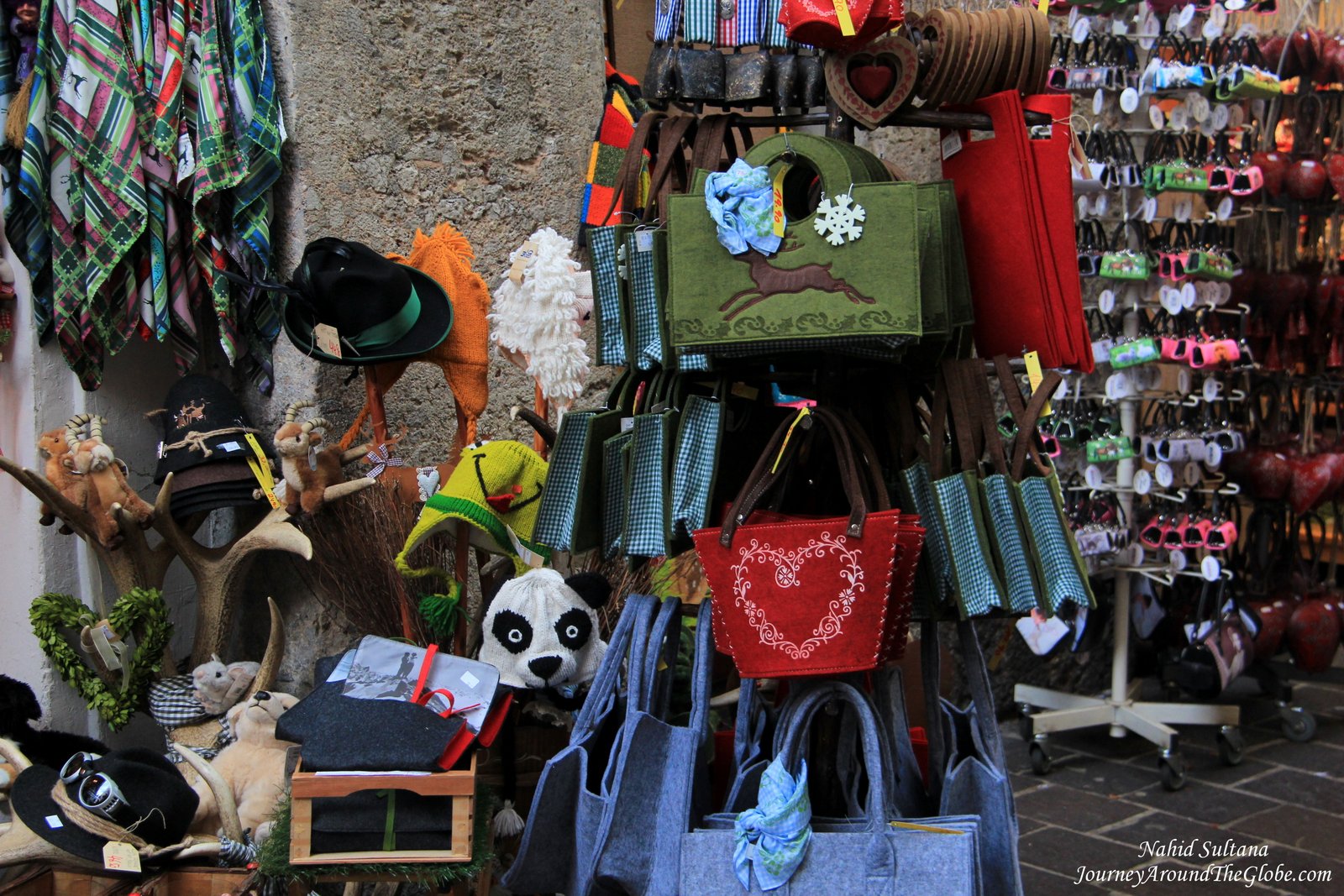
PLACES WE’VE VISITED: We stopped at Innsbruck on our way to Salzburg and spent few hours just touching only the highlights of this city. Innsbruck has bunch of museums, a zoo, and many historic landmarks within the city limit. If you are more of a nature-lover or like winter sports then you can drive up to the mountains and find some ski resorts. There is also a castle, Schloss Ambras short distance from the city…we haven’t been there but may be worth a visit if you have time.

- Innsbruck – a beautiful city by River Inn

1) JESUITKIRCHE (JESUIT CHURCH or UNIVERSITY CHURCH): This was our first stop although wasn’t in the list. The church was erected between 1627 – 1646 with the support of sovereign of Tyrol, Archduke Leopold V, and his wife, Archduchess Claudia de Medici, both of who are buried in the crypt here. It was severely damaged during WWII and looked like a ruin. Much of the interior decoration was lost forever. In 1953 it was newly constructed. Its high dome and white ceiling with detail design are worth seeing.
2) HOFKIRCHE: The Innsbruck Hofkirche with the tomb of Emperor Maximilian I is the most important monument in the Tyrol region and the most splendid of all imperial tombs in Europe. It is a product of European courtly art from far more than the German-speaking areas, for which Maximilian I employed the best artists of the period. King Maximilian I’s decorative tomb is enclosed by some real-size bronze statues that show members of different dynasties. It is a gorgeous church with grand interior and a must-see in Innsbruck.

- Hofkirche with the tomb of Emperor Maximilian I in Innsbruck, Austria
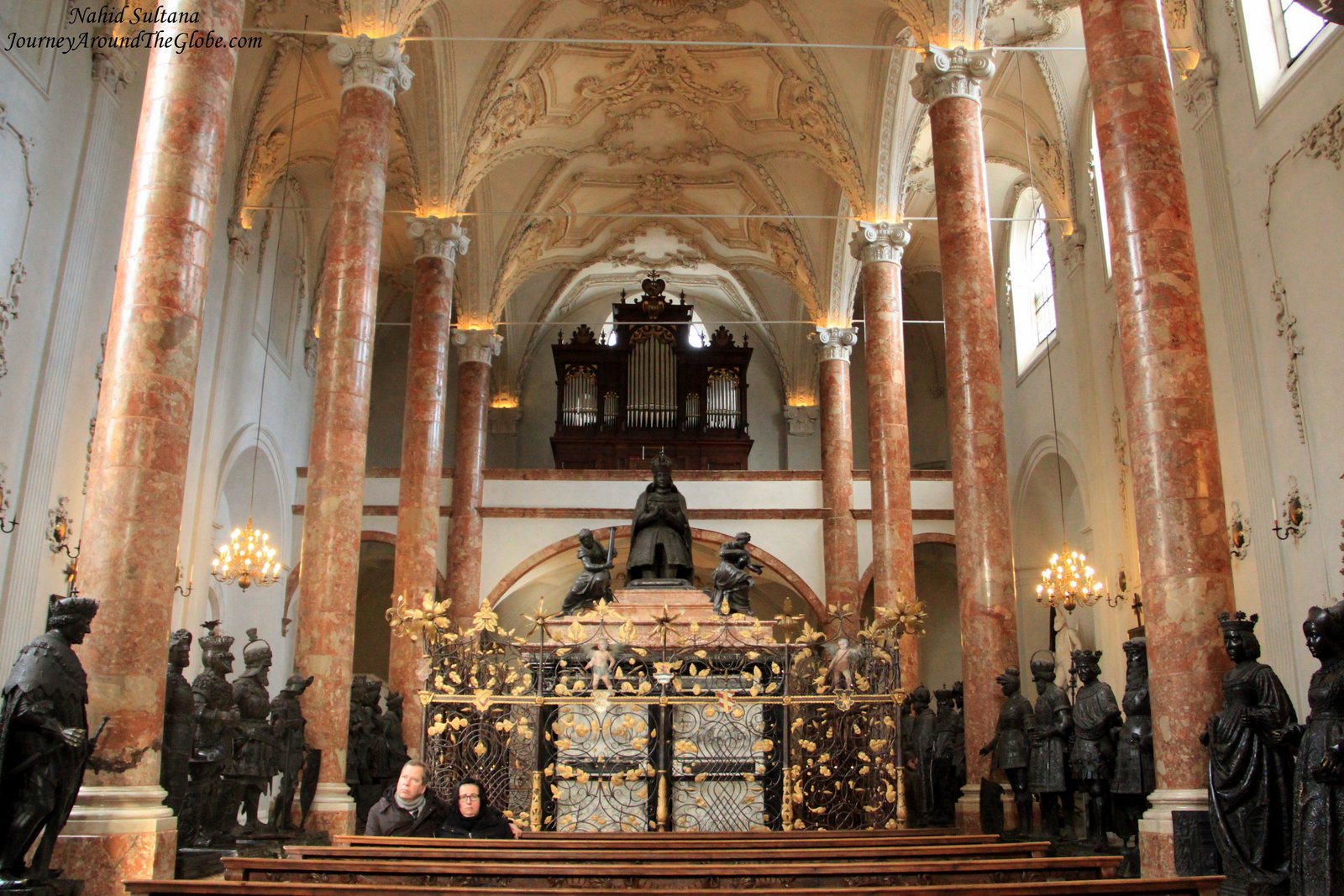
Although we didn’t go to Tyrolean Museum of Popular Art, it is in the same building with Hofkirche. It houses the biggest and most significant cultural heritage collection in Tyrol and offers an insight into the diversity of the arts and crafts from “Land in the Mountains”.
It’s open from Monday to Saturday from 9 to 5 pm and Sundays and holidays from 12:30 to 5 pm. There is a fee to enter the church, but we were there on Christmas Eve and it was free that day.
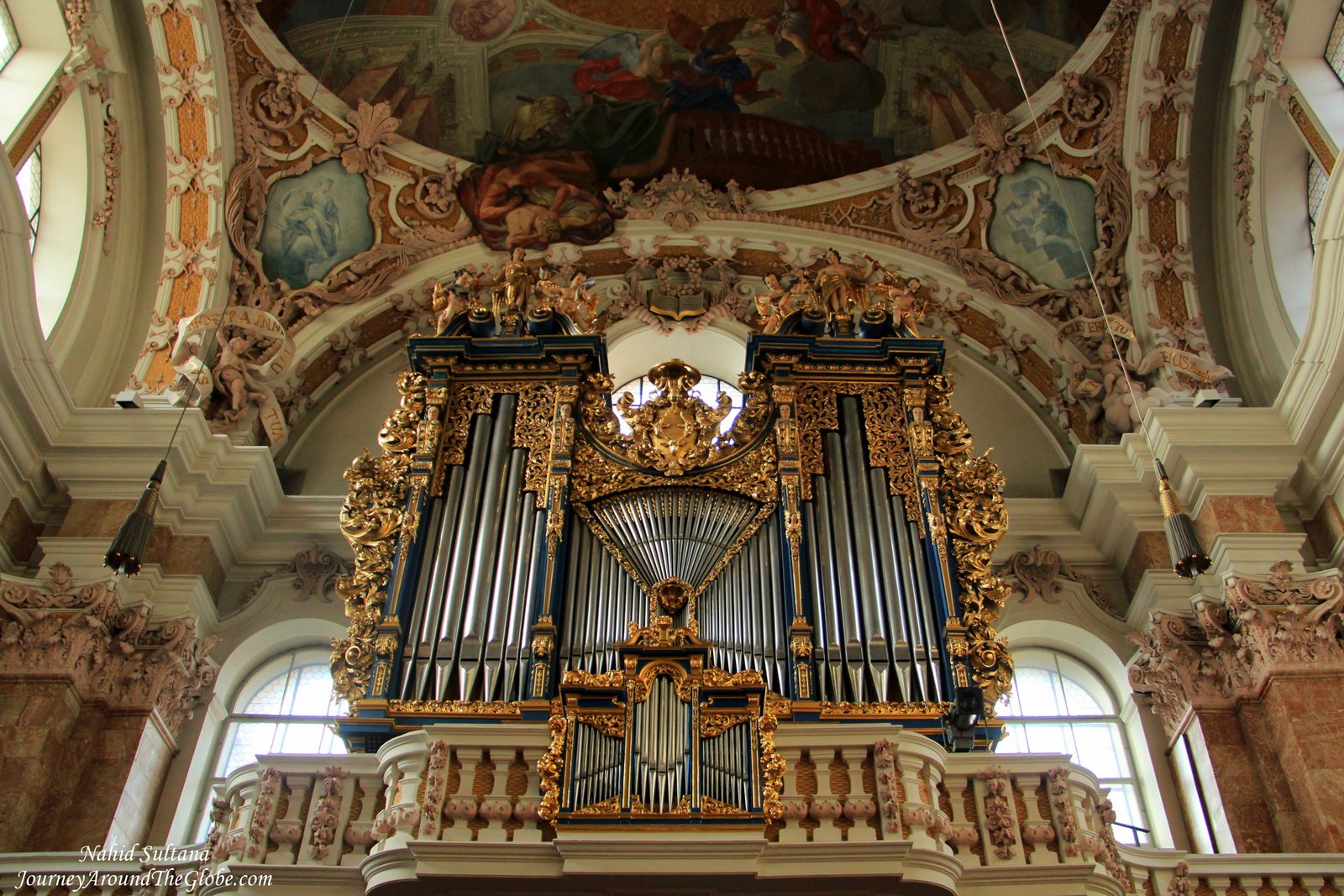
3) ST. JACOB CATHEDRAL: This is probably the most beautiful church/cathedral in Innsbruck. Few minutes’ walk from Hofkirche, St. Jacob Cathedral is a Baroque style architecture that deserves attention. Its gorgeous ceiling, fancy vaulted dome, ornate high altar, dazzling organ, frescoes, and pulpit make this cathedral one of the most exemplary works of Baroque interior in whole of Austria.

- Grand organ and beautiful ceiling of St. Jacob’s Cathedral in Innsbruck, Austria
4) HERZOG-FRIEDRICH-STRASSE and GOLDEN ROOF (GOLDENES DACHL):Herzog-Friedrich-Strasse was the old town’s main street once, now a pedestrian zone. Some artistic old buildings decorate both sides of this cobbled-stone street.

- Some beautiful buildings in Herzog-Friedrich-Strasse in old town of Innsbruck

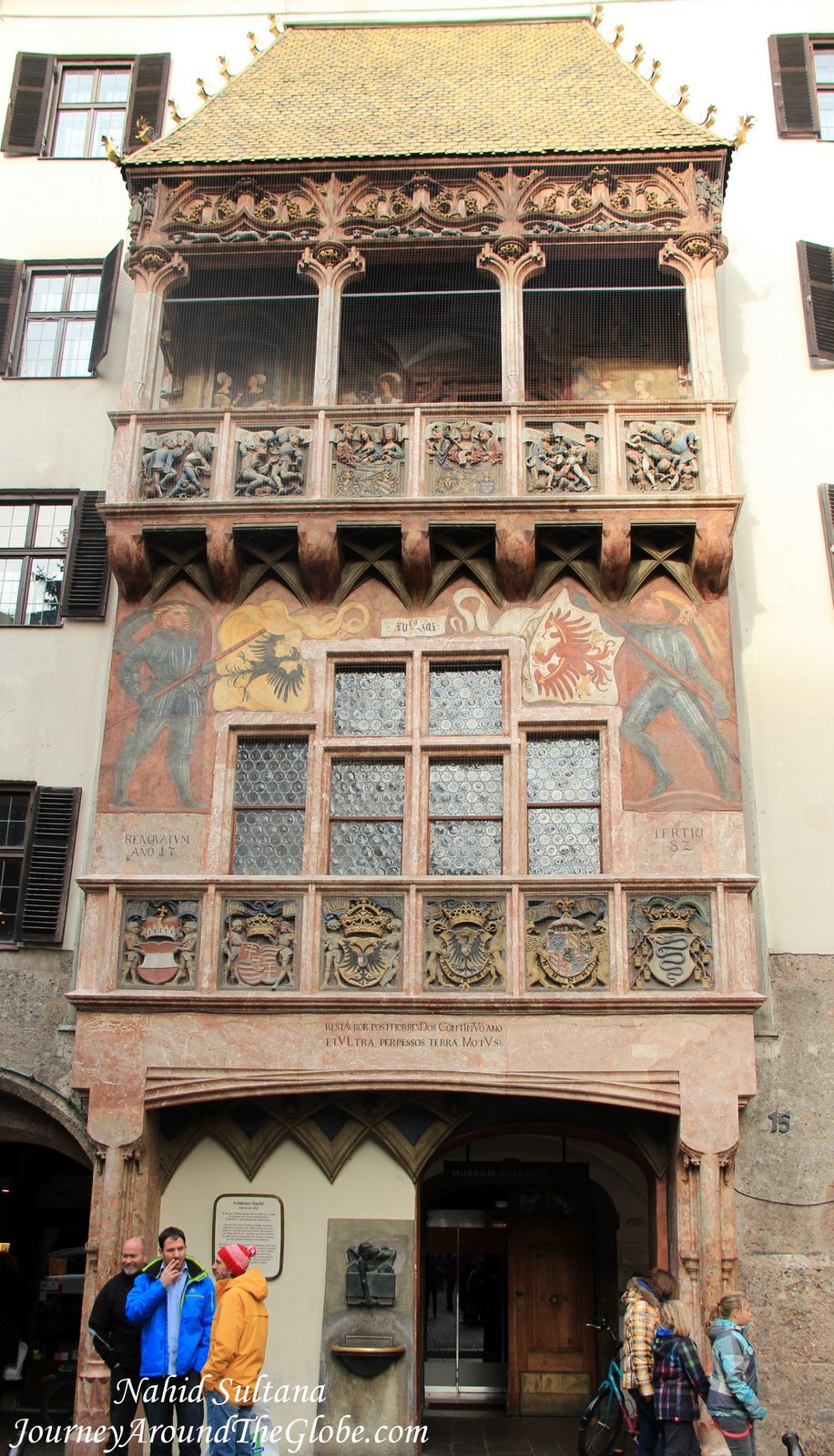
At one end of Herzog-Friedrich-Strasse, is the Golden Roof. It is a historic building from 1420 and was built on behalf of King Maximilian I. It has a beautiful façade with 2657 fire-gilded copper tiles. There is a museum if you want to go inside, we just saw it from outside and loved its marvelous façade.

- Golden Roof on Herzog-Friederich-Strasse in Innsbruck, Austria
5) MARIA-THERESIEN-STRASSE and ST. ANNA’S COLUMN: Across the street from Herzog-Friedrich-Strasse, is Maria-Theresien-Strasse. This is the central pedestrian area and a picturesque boulevard of Innsbruck. What makes this street beautiful is the prominent mountains range in the backdrop and its historic colorful buildings. There was a Christmas market here when we visited. Many shops and restaurants make this place a perfect gathering point for the locals and the tourists.

- Maria-Theresien-Strasse – a picturesque pedestrian street of Innsbruck
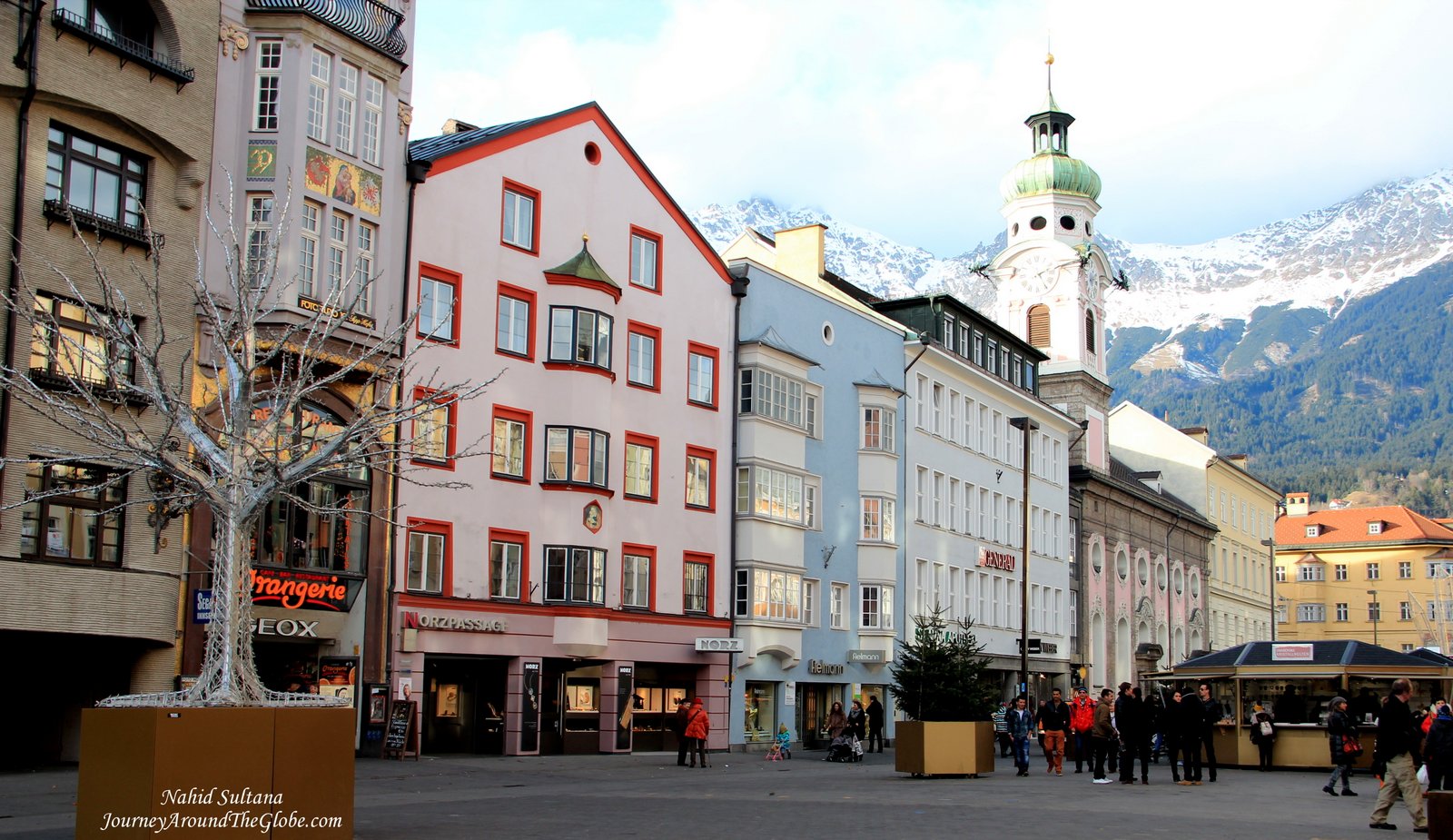
In the middle of this street stands St. Anna’s Column. It was built in 1706 using Tyrolean marble. I loved this part of Innsbruck where hustling city collides with the beauty of Alpine nature…it is an absolutely breathtaking spot.
6) RIVER INN and INN BRUCKE: There is a bridge, Innbrucke, over River Inn few steps away from Zerhog-Friedrich-Strasse from which the city adopted its name. There isn’t much to do here except for enjoying the stunning view of River Inn, the mountains, a flourishing city, and colorful buildings by the river. We crossed the bridge, Innbrucke (it’s for both pedestrians and cars) and came back to old town within few minutes. It is a lovely sight and shouldn’t be missed. It’s a slice of Tyrol’s natural beauty within the city.

- Standing on Bridge Innbrucke and enjoying this beauty in Innsbruck

Share this:

Business Excellence Award 2020 from AI Global Media for The Most Entertaining Personal Travel Blog – Pacific Northwest USA

Top Posts & Pages


Authors
 Globe Runner
Business Excellence Award 2020 for The Most Entertaining Personal Travel Blog – Pacific Northwest USA

Business Excellence Award 2020 from AI Global Media

 Journey Around The Globe