Journey Around The Globe
ready for the next destination
Dijon, France – the town of Mustard
DIJON, FRANCE: Yep it is that Dijon which you keep in your refrigerator for flavoring your sandwiches or other dips and sauces. And that was the sole reason for me to visit this town. I wanted to know where my Dijon mustard originally came from which I generously use on my turkey sandwich every time. But Dijon is more than just mustard or dipping sauces.
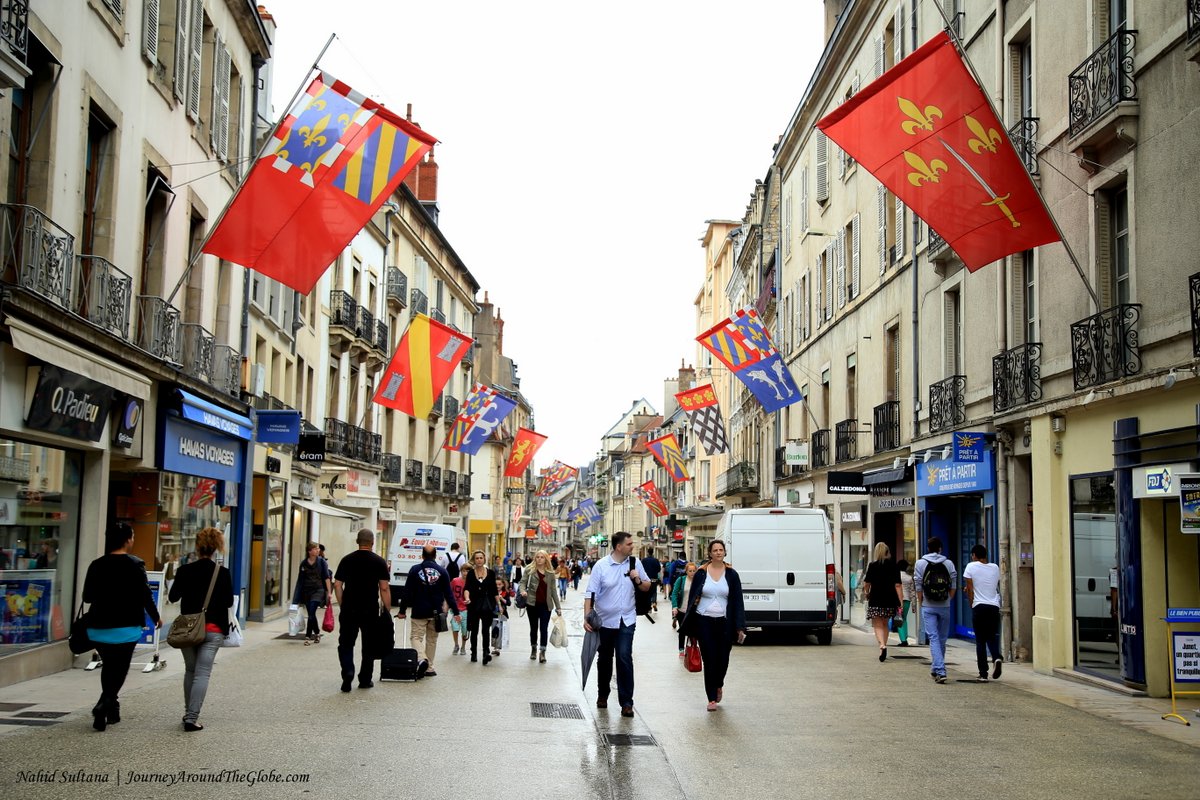
Dijon is the capital of Burgundy, a region in eastern France. It was a booming major center for Gothic and Renaissance culture and art around 14th and 15th centuries. And since the city wasn’t heavily damaged during the WWII, some of its historic buildings and icons from that era can still be seen around the old town of Dijon.
If you have spare time in Dijon, make sure to visit nearby towns and cities, like Annecy, Chamonix, or Nancy. Within couple hours from Dijon, Mont-Blanc stands majestically looking over whole Europe.
TIME of TRAVEL: We made a road trip in July of 2014 to the French Alps, visiting Mont Blanc…the highest peak of Alps. After visiting Annecy, Chamonix, and Mont-Blanc, our next stop was Dijon. It’s usually nice in July, but we got some wind and rain the day we were there. Being the last road-trip before leaving Europe, this whole journey was a memorable one for all of us.
OUR HOTEL: We stayed in Holiday Inn Dijon, a bit outside the main city center. We had free Wi-Fi and parking but breakfast wasn’t included. Hotel was of course great with cleanliness, staff, and everything else…it’s Holiday Inn after all, good reputation and good service.
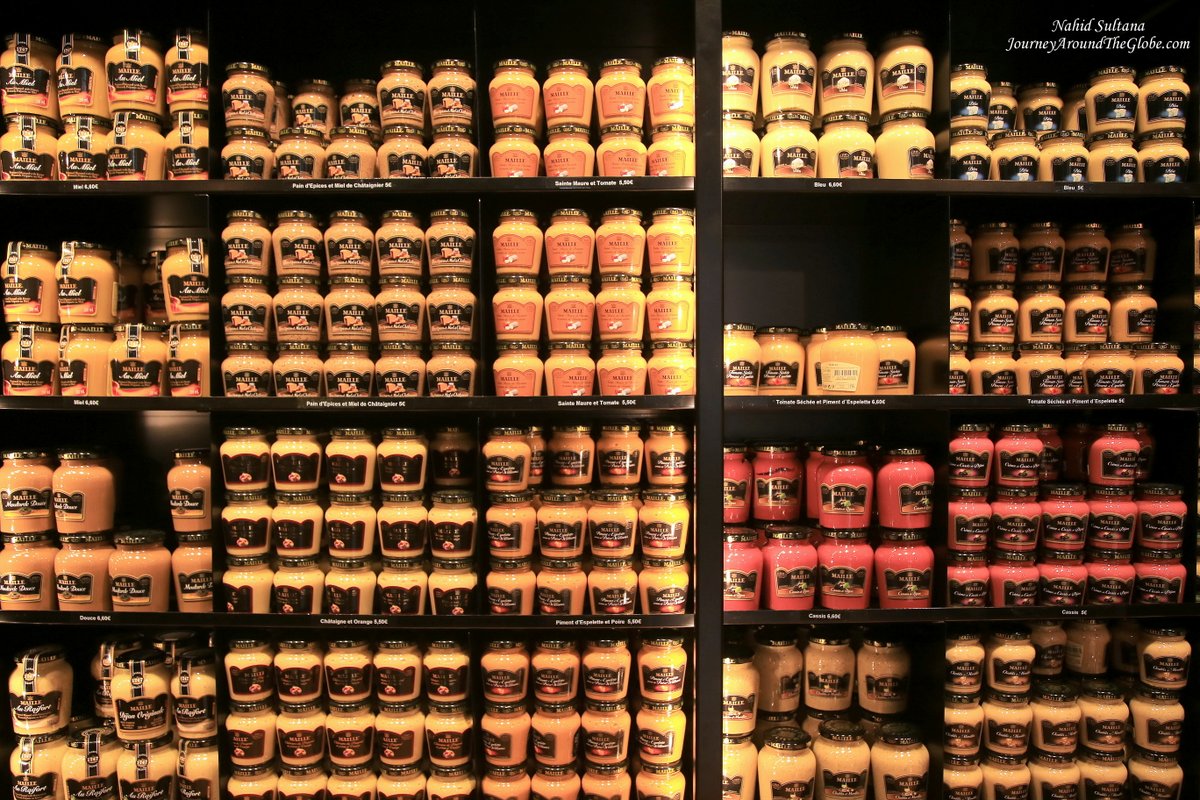
EATING and SHOPPING: Rue de la Liberte is one of the best places for meals or shopping. Other old parts also have hidden cafes and restaurants. We did our mustard shopping from “Maille” on Rue de la Liberte. This is a mustard store from 1747 that has more than 30 different types of mustard in their collections. “Edmond Fallot” is another store we went inside where you can find tons of different kinds of mustard and the store dates back to 1840. These stores offer free samples before buying…make sure you know what you are buying.
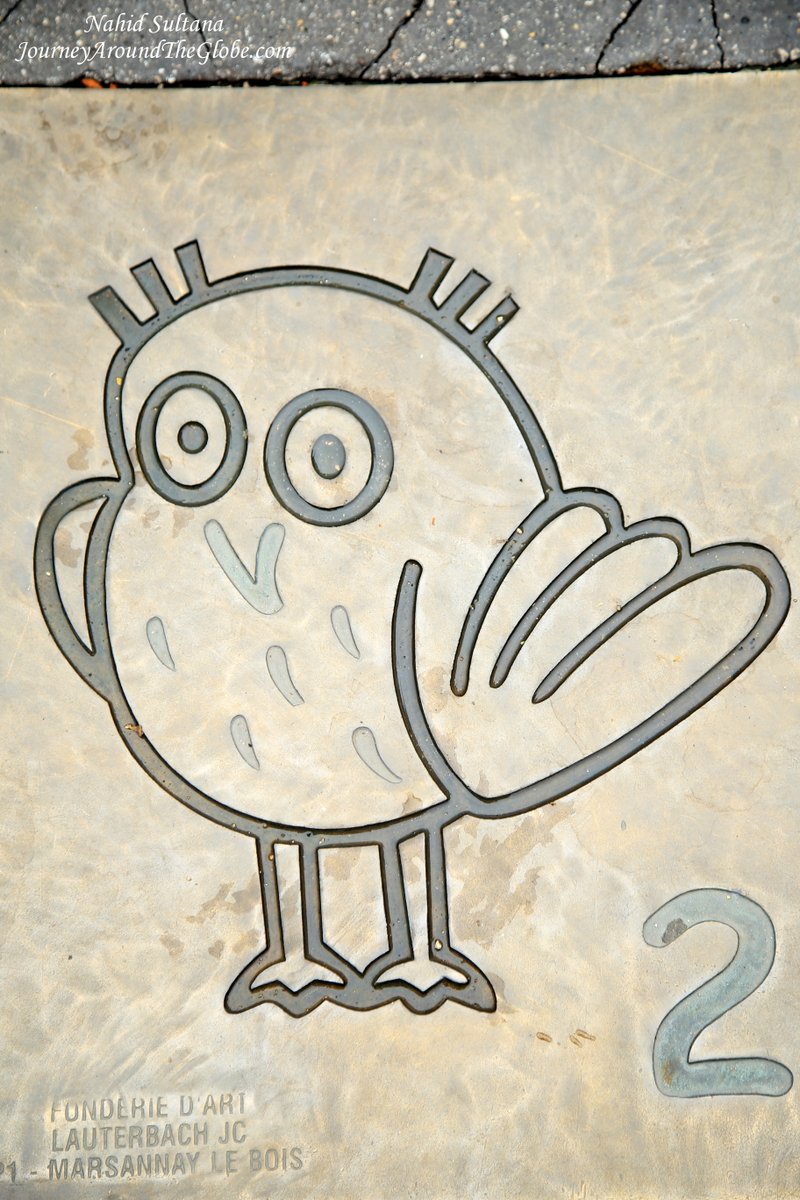
PLACES WE’VE VISITED: Walking is the best way to explore the city center of Dijon. And an easy way to do it in Dijon is following numbered “owl” metal plates on the ground. There are total of 22 stops and this self-guided tour takes you to most of the interesting places in walkable distances. Owl is the icon of this city and you will see lots of it at every corner here.
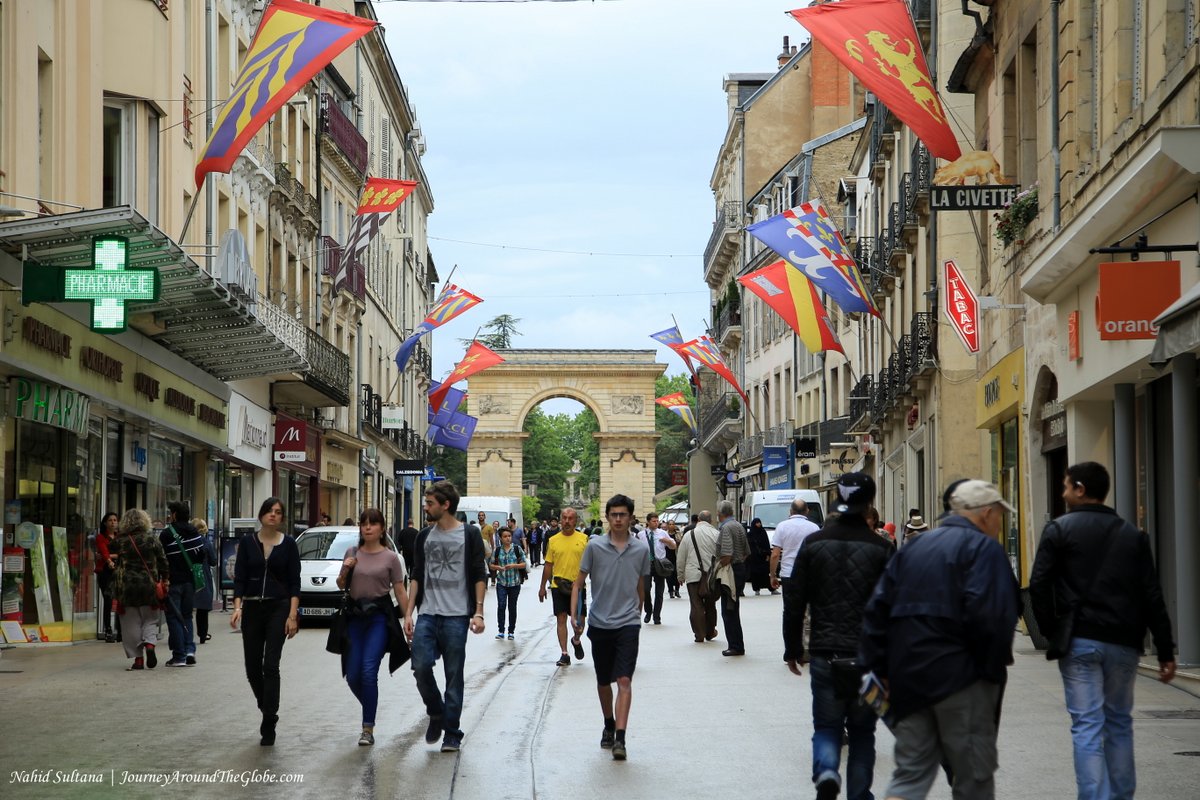
1) LA PORTE GUILLAUME and RUE de la LIBERTE: We parked our car right below this square or pedestrian zone. Rue de la Liberte is a long stretch of pedestrian only path packed with countless shops and eateries. La Porte Guillaume is an old gate, similar to Arc de Triumph in Paris, at one end of Rue de la Liberte.
2) CATHEDRALE SAINTE-BENIGNE: Walking from Rue d la Liberte, you can’t miss the Gothic spires and steeples of this cathedral. Built in the 14th century, this is a national monument of France. Inside is as gorgeous as its exterior. We spent some time going around and enjoying cathedral’s huge organ, big paintings, sculptures, and vibrant stained-glass windows.
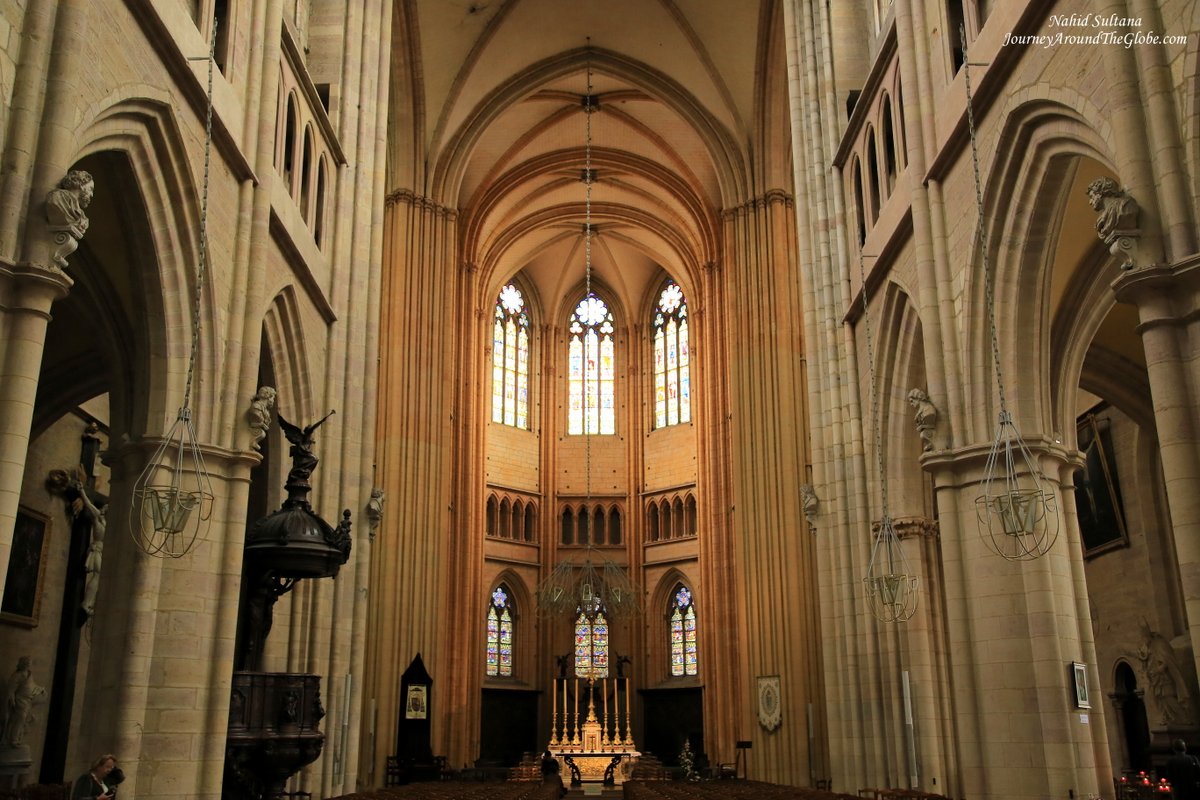
The cathedral is open from 8:30am to 7pm and free for any tourists.
3) EGLISE SAINT-PHILIBERT: Built in the 12th century on the site of an old basilica, this church is a remarkable example of Romanesque edifice. A flamboyant Gothic steeple was added in the 16th It was across the street from Cathedral Saint-Benigne. We walked past it without going inside the church because its current precarious state forbids visits.
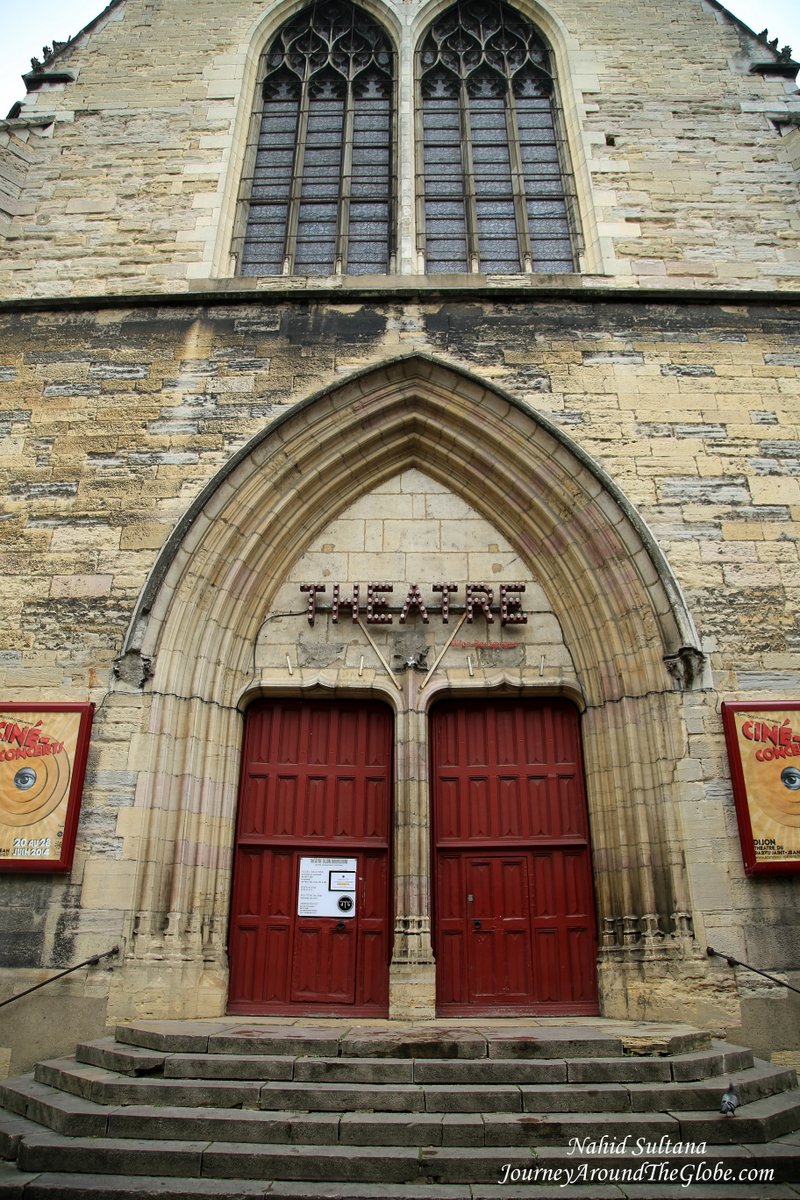
4) THEATRE DIJON-BOURGOGNE: After the above church, we continued following the “Owl” of Dijon and in couple minutes the “Owl” brought us to this old theatre which looked more like a medieval church. This was closed to tourists as well.
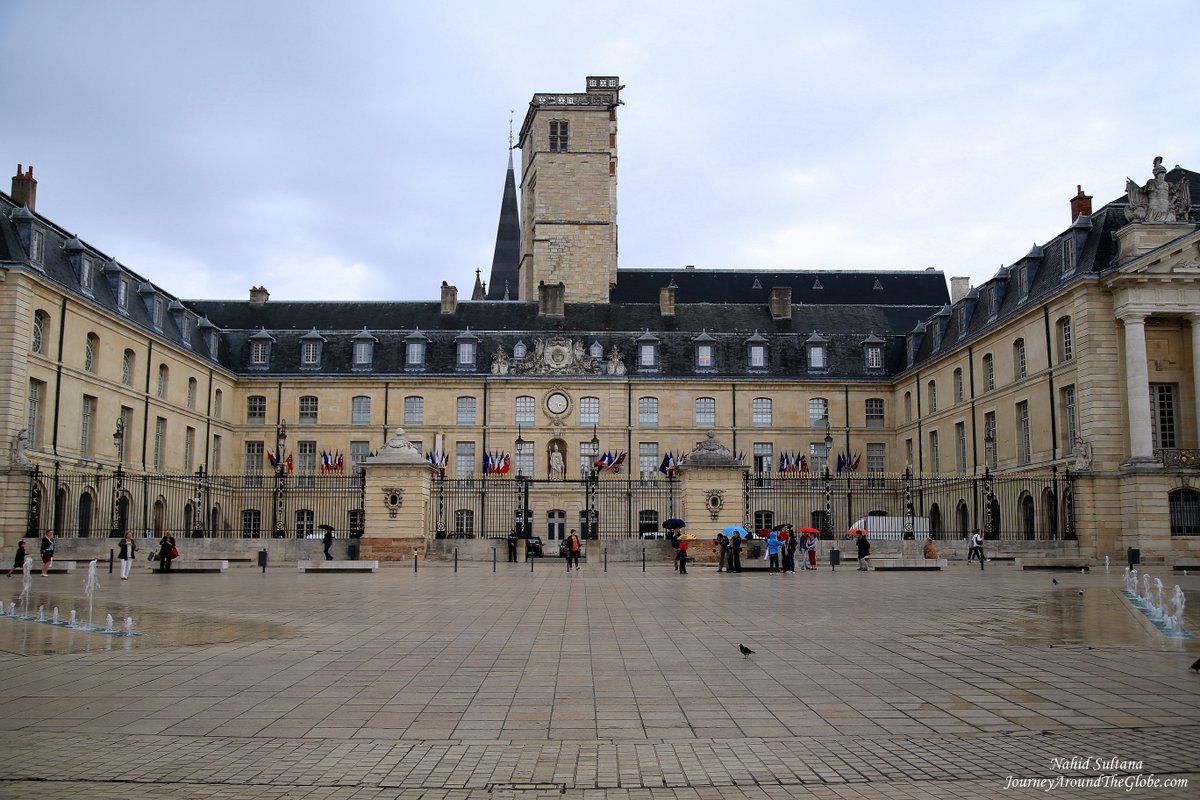
5) DUCAL PALACE: Although we didn’t go inside the Ducal Palace, it is a beautiful building in Place de la Liberation with an open space/square in front of it. It now houses a museum, known as Museum of Beaux Arts, which is considered as one of the best in this region. Other than that it has decent collection of medieval arts, paintings by local and Flemish artists, and some recent art collection which includes Picasso and Monet as well.
Place de la Liberation has many small shops, restaurants, and cafes. My girls loved the water fountain in the middle of the square, even though it was wet and cold.
6) NOTRE DAME CHURCH: Just 5 minutes of walk from Ducal Palace is Notre Dame Church. This 13th century church is small but very elegant inside. Old walls, stained-glass windows, and bold stone pillars put middle age touches everywhere.
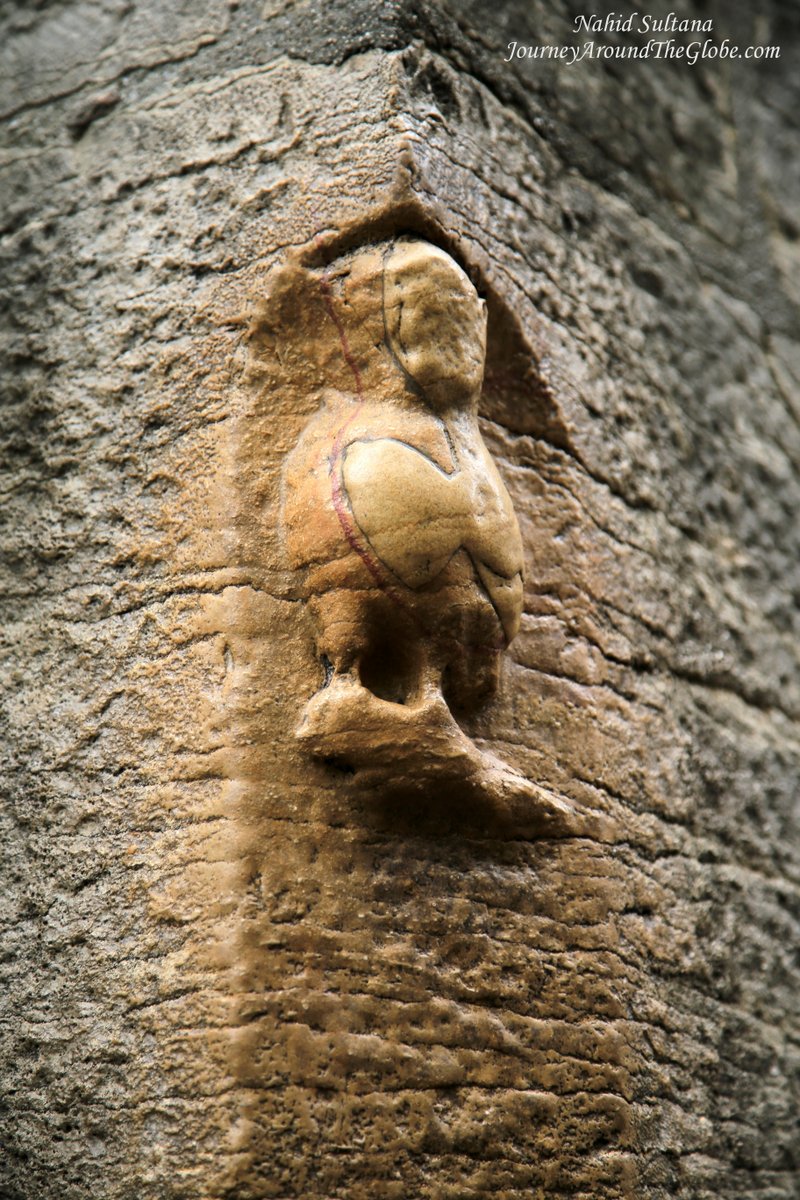
Once you are done with visiting inside the church, go around and look for the “Owl” icon sculpted at one side of the church. This is known to be one of the earliest image of the owl in Dijon, from the 16th century. Tradition is to touch it with your left hand from left to right to bring good luck.
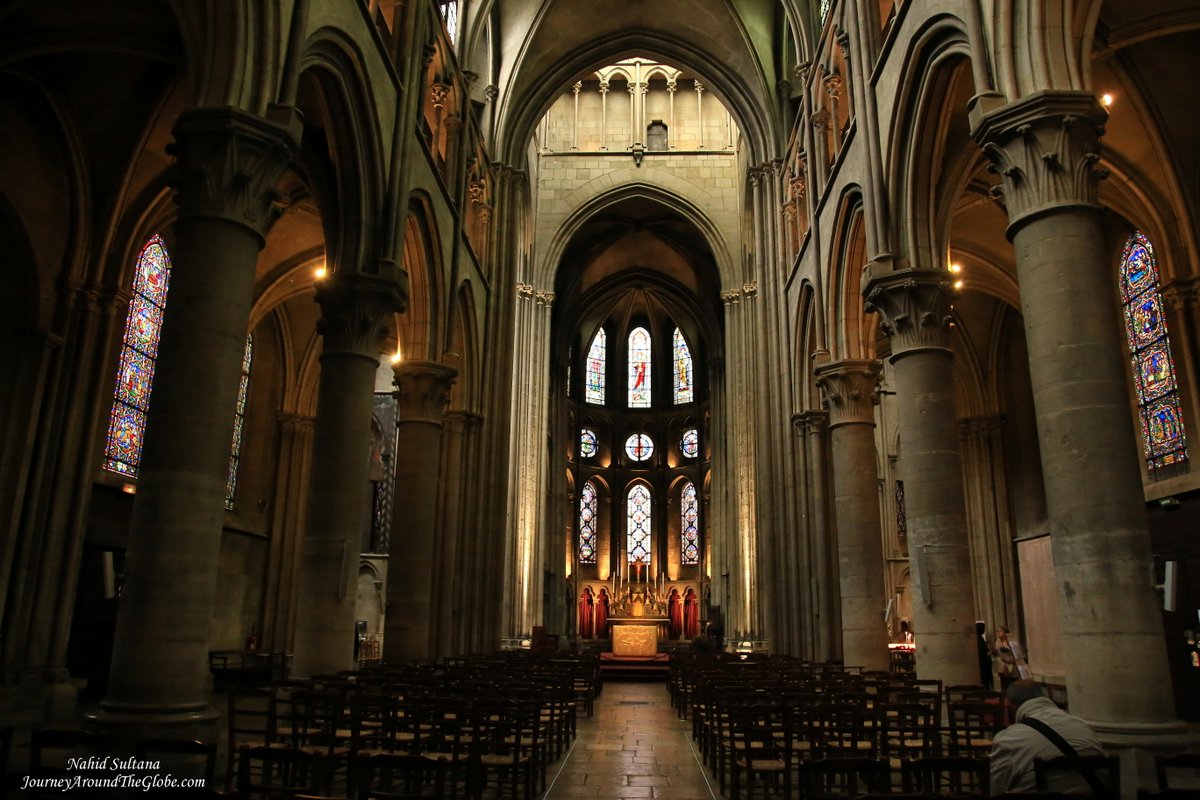
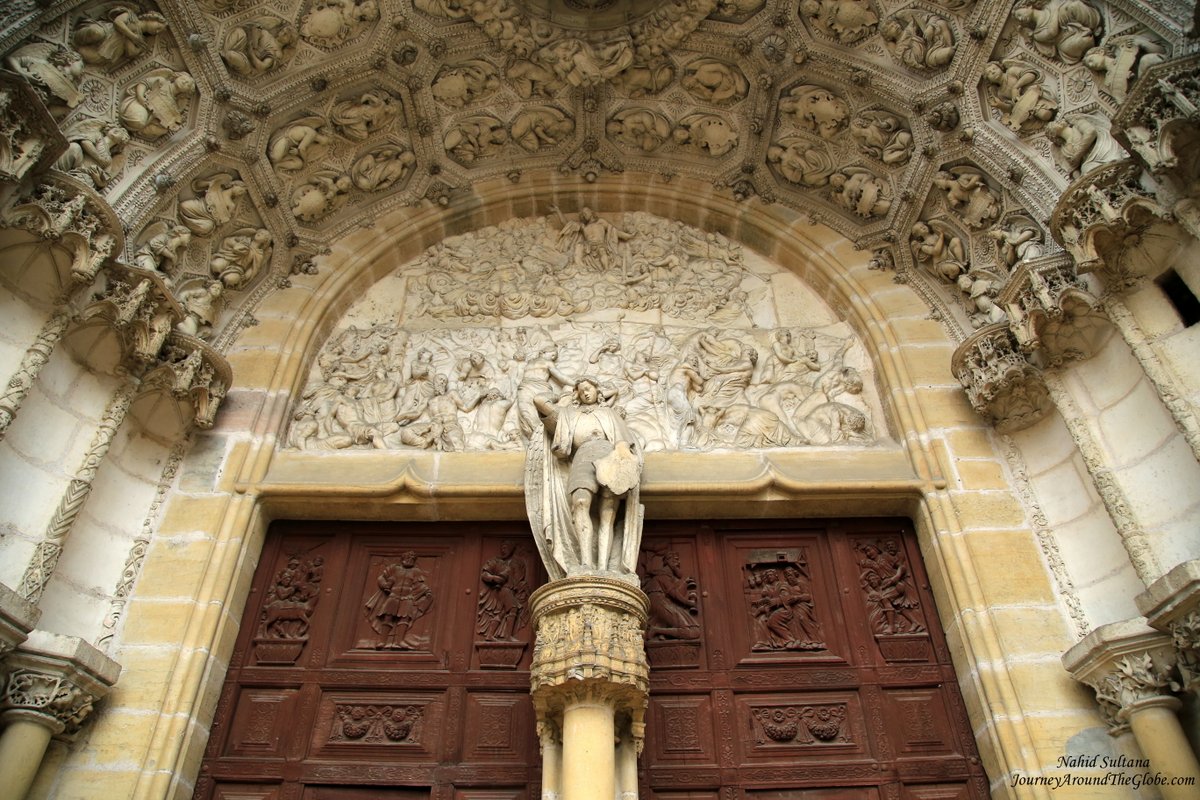
7) MICHEL CHURCH: It started drizzling when we came close to this church. We walked about few minutes from Notre Dame to get here. The present look of this church dates back to the very end of 15th century. The remarkable choir is from 1763. This is a big church, similar to Cathedral Saint-Benigne. It’s free to go in, don’t miss the grand stained-glass over the main altar.
Share this:

A French Alpine Town – Chamonix
CHAMONIX MONT-BLANC, FRANCE: Located at the foothill of majestic Mont Blanc in south-eastern France, Chamonix Mont-Blanc (or just Chamonix in short) is an attractive Alpine village to visit any time of the year. For decades, Chamonix was known to be a winter getaway for the up-scale travelers. It was this city which hosted the first ever Winter Olympics in 1924. Being 1030 meters (3400 ft.) above sea-level, many tourists keep coming back here for winter activities and for its charming and unique location.
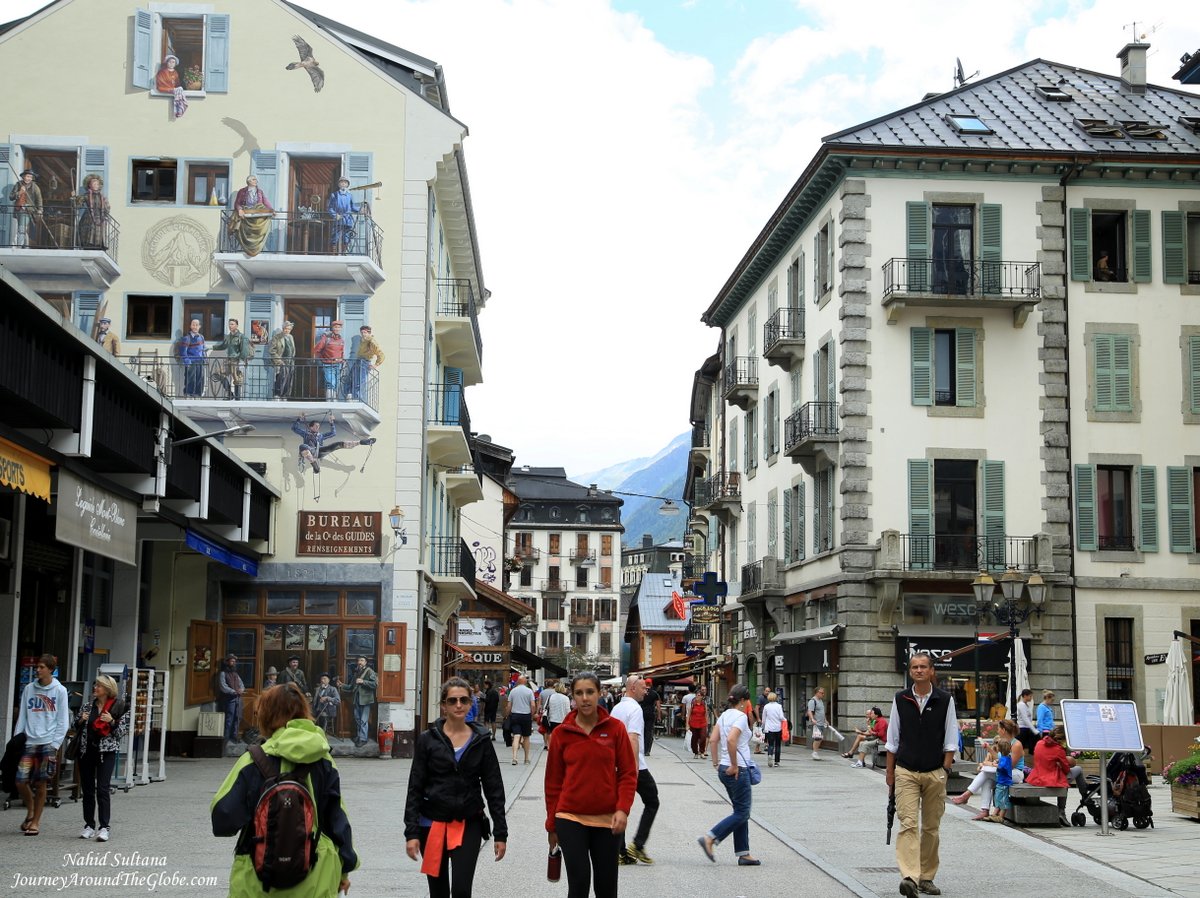
Chamonix is one of the towns that surrounds Mont Blanc from one side and is itself surrounded by the Alps. This is where passionate mountaineers come to fulfill their dreams of climbing the highest peak of Europe…Mont Blanc. Its picturesque squares with the Alps in the backdrop, artistic buildings, countless restaurants, and buzzing crowds make this place a relax getaway for travelers of any age.
TIME of TRAVEL: Visiting Mont Blanc was on our list for a long time when we were living in Belgium. The opportunity finally came right before we left Europe in July of 2014. Our friend Sidfar from Antwerp also joined us in this 5-day long trip. We visited Annecy, Mont Blanc, Chamonix, then Dijon, and Nancy afterwards. It was our last road trip in Europe, that’s why even memorable for all of us.
OUR HOTEL: Our hotel was not in or near Chamonix. We stayed in Annecy, about an hour drive from Mont Blanc. It was “Sejours & Affaires Pont Neuf – Cran Gevrier” somewhat close to Annecy Old Town. The hotel (which was more like a hostel) didn’t have 24-hour reception service. That was not a problem although we reached there really late at night (they left the keys in a safe-box for us). Good part of this place that we had a small kitchen and a balcony. We also had free Wi-Fi and parking. Annecy, situated by Lake Annecy, itself is a stunning town and is known as The Venice of France. Spare a day if you can for this little town and you won’t regret it for a second.
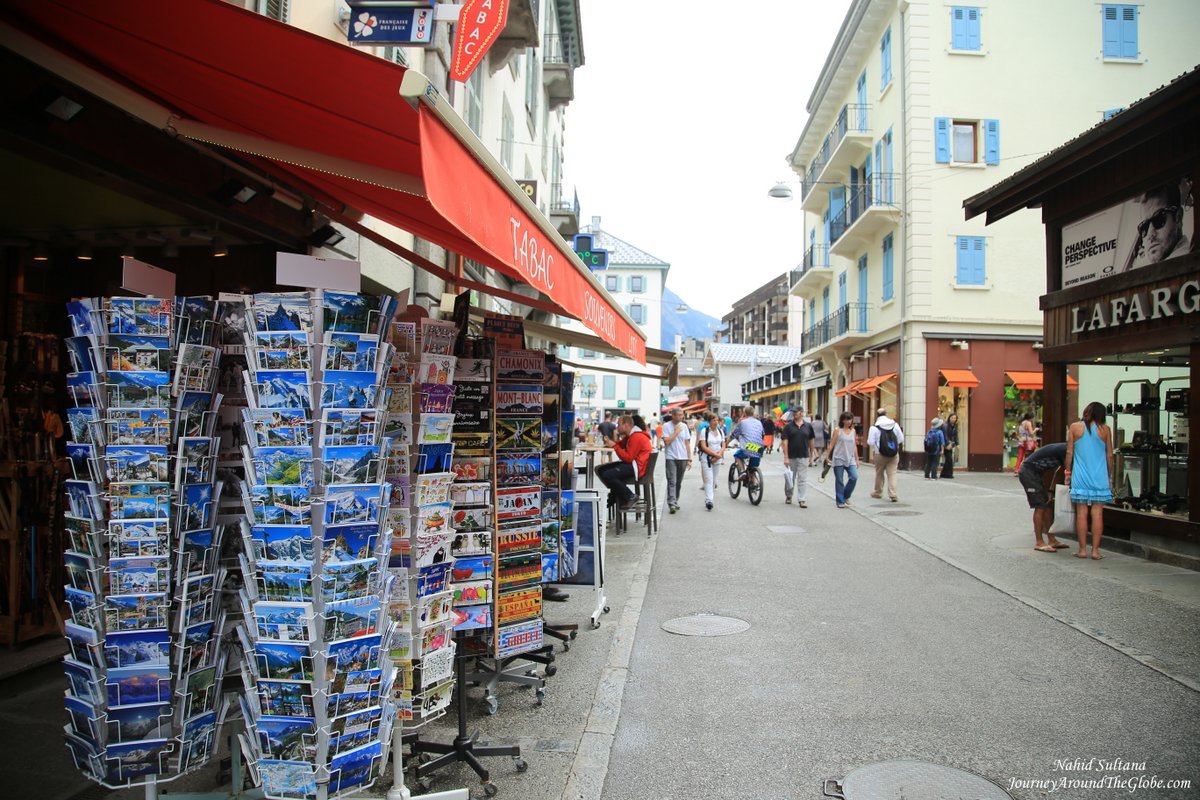
EATING and SHOPPING: Chamonix city center is the probably the best area for tourists to buy souvenirs or winter gears. There were tons of brand name stores where you can buy all the things you need to climb Mont Blanc massif from winter jackets, clothing accessories, to foot gears, and heavy duty sports items. This small town also boasts for gastronomic restaurants. Although we saw an Indian restaurant and did a take-away order from there, you will find tons of other restaurants offering traditional Mont Blanc cuisine right here in the heart of Chamonix.
PLACES WE’VE VISITED: Of course the biggest attraction of Chamonix and the reason most of the tourists is to get a glimpse of the highest peak of the Alps…Mont Blanc (check out my page/post on Mont Blanc). Upon arriving in Chamonix in the morning of our visit, we took a cable car to Aiguille du Midi and spent the whole day visiting different summits of French Alps enjoying glaciers, valleys, green meadows, and whitest snow of Mont Blanc massif. After Aiguille du Midi, we came down to the town and spent about little more than an hour in the city center of Chamonix.
1) CITY CENTER: This is the heart and the liveliest spot of Chamonix. It’s a relaxed atmosphere with trendy shopping streets and stunning view. Each block of this area was decorated with colorful fresh flowers bouquets and baskets. River Arve dissects the city center in two parts carrying water from the mountains.
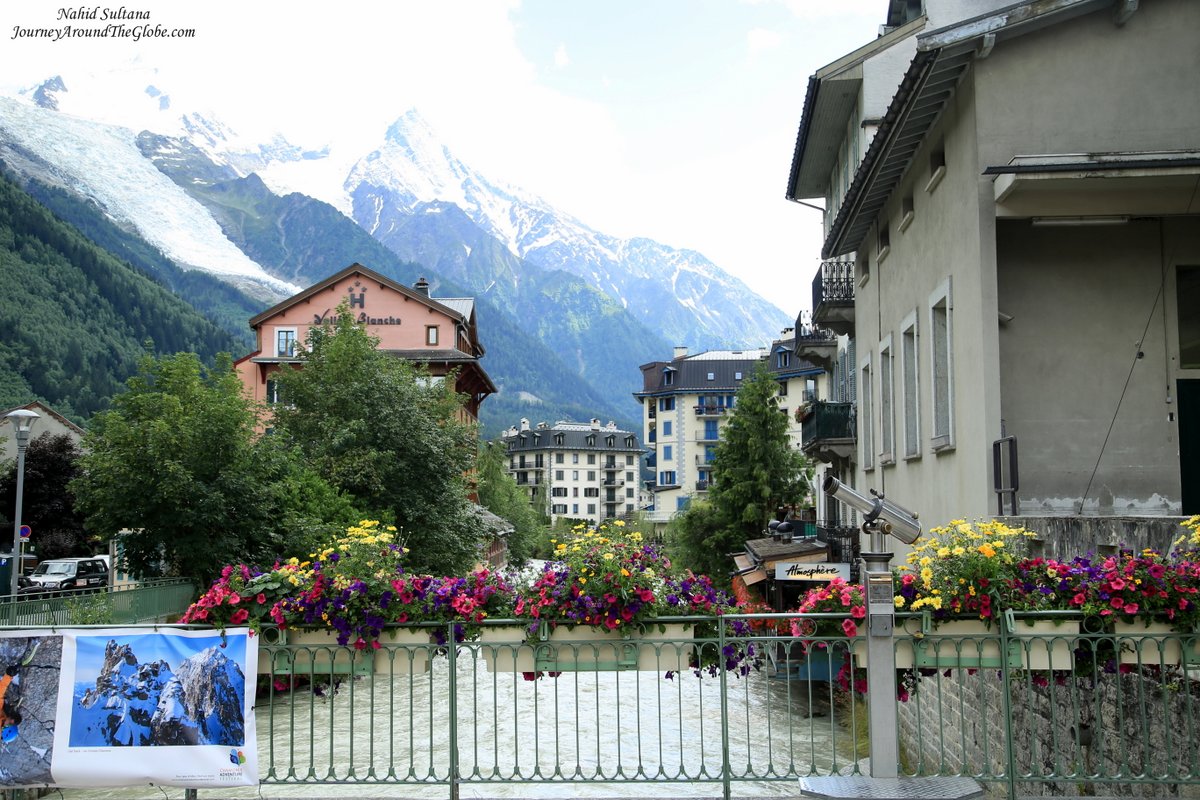
Being so close to Mont Blanc, one of the popular destinations for winter sports in the Alps, Chamonix city center has tons of sports stores like North Face, Columbia, and Ice Breaker. The place is crowded with serious and experienced climbers and hikers. Just looking at their heavy gears made me adventurous…they were here for real Alpine wilderness. And then of course, there were tourists like us who were enjoying the atmosphere and the natural beauty from our own comfort zone.
If you are there in summer, like us, take your time and go around the town center, enjoy the view of the River Arve, summer blooms, energetic crowds, and outdoor cafes. I am imagining, it’s completely a different scene in the winter time. May be the river freezes, Mont Blanc gets a new facelift with heavier and thicker snow pile, whole city center may look white but be dazzling with Christmas trees, lights, and decoration…not to mention Christmas markets and enthusiastic winter athletes.
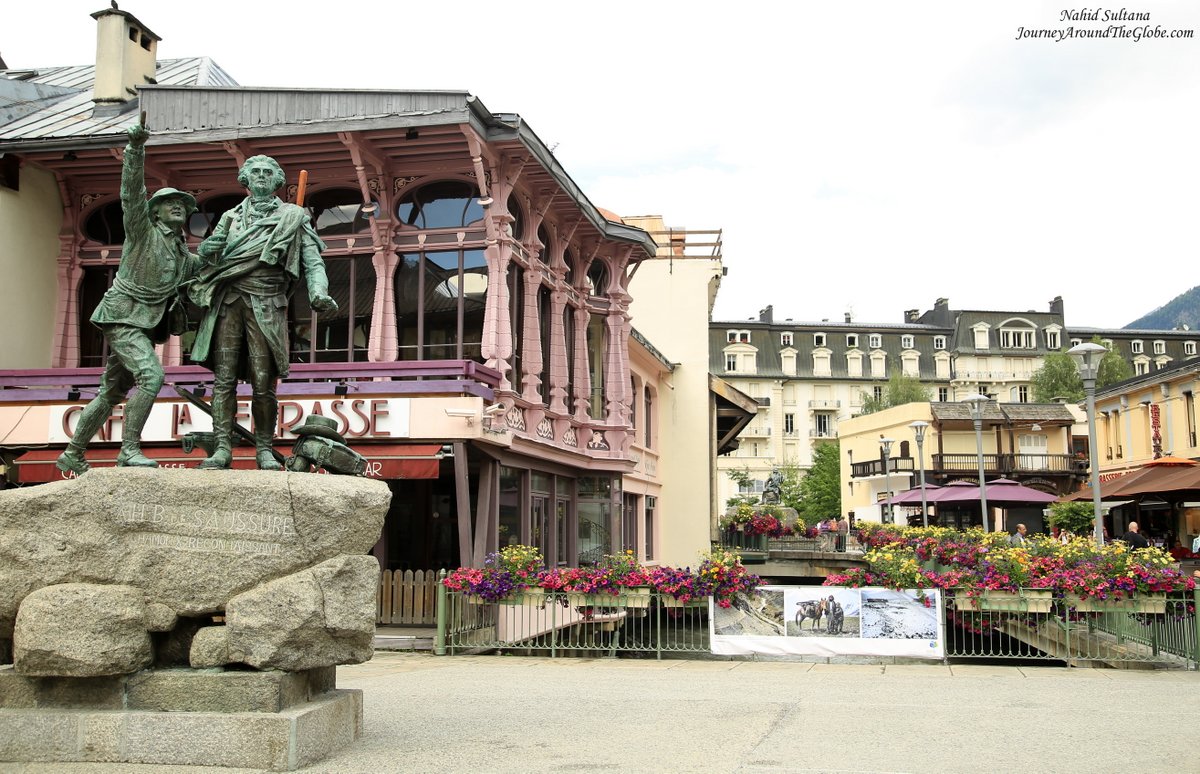
2) STATUE of de SAUSSURE: This is a statue of heroism and bravery in the center of Chamonix in front of a casino. It honors Horace Benedict de Saussure who was the first person to climb Mont Blanc. The statue portrays Horace Benedict de Saussure, beside him Jacques Balmat standing, pointing his finger towards Mont Blanc.
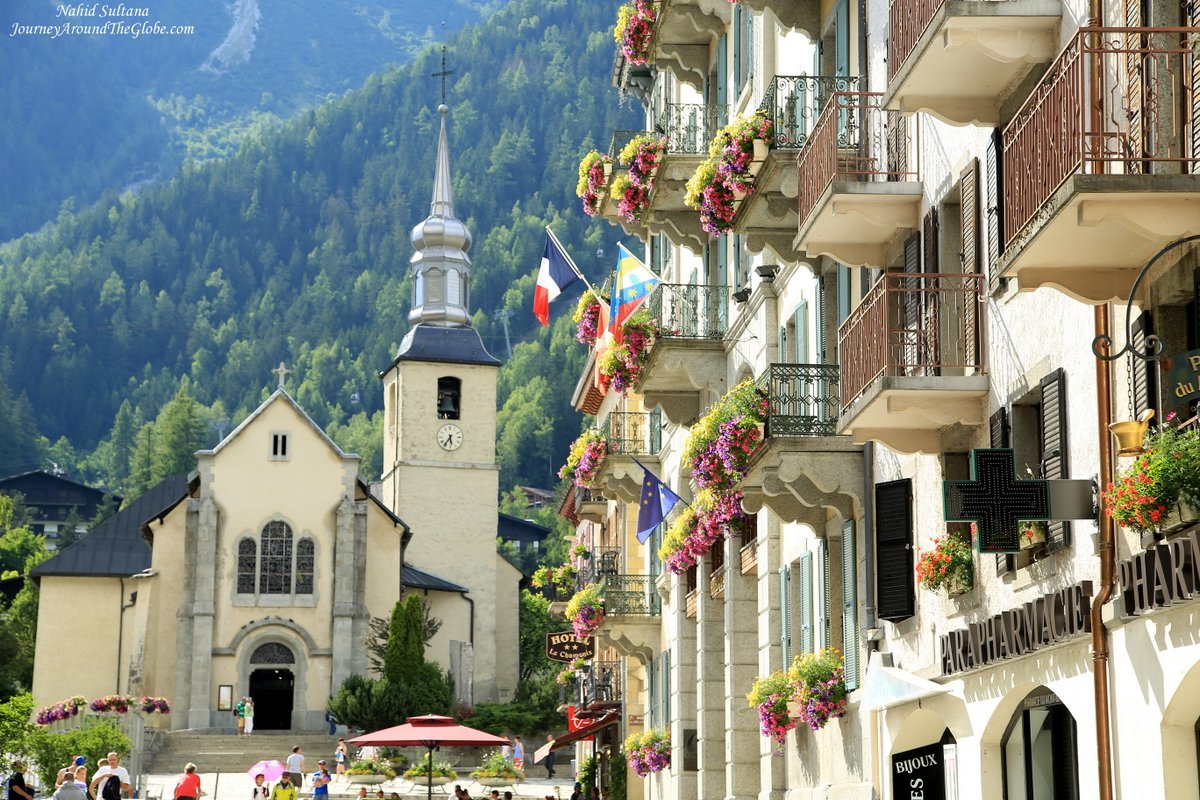
3) CATHOLIC CHURCH of St. MICHAEL: This church is in the city center near Place d’la Eglise which also houses Chamonix Town Hall. It was impressively decorated with vibrant hanging flower baskets and flags. I didn’t go inside the church but walking along that street was a pleasure no doubt.
4) PLACE JACQUES BALMAT: This beautiful and little square in the city center was named after Jacque Balmat who was the climbing partner to ascend Mont Blanc in August 8th, 1786 with Dr. Paccard. Again, plenty of flowers adorned this pedestrian zone while many shops and cafes made it a place where I wouldn’t mind going back over and over again.
Rue du Docteur Paccard is, you can say, the main shopping street in city center and got its name from Doctor Paccard who climbed Mont Blanc in 1786 as mentioned above. Their ascension to Mont Blanc was a historic achievement in mountaineering.
Share this:

Majestic Mont Blanc in France
MONT-BLANC, FRANCE: Finally, we were lucky to get a glance of the sheer beauty of majestic Mont Blanc right before leaving Europe. Mont Blanc, meaning the “White Mountain”, is the highest peak of the Alps and in the European Union. Situated on Mont Blanc massif in the southern region of France, this is known as the roof of Europe. It stands boldly and solemnly looking over the whole continent.
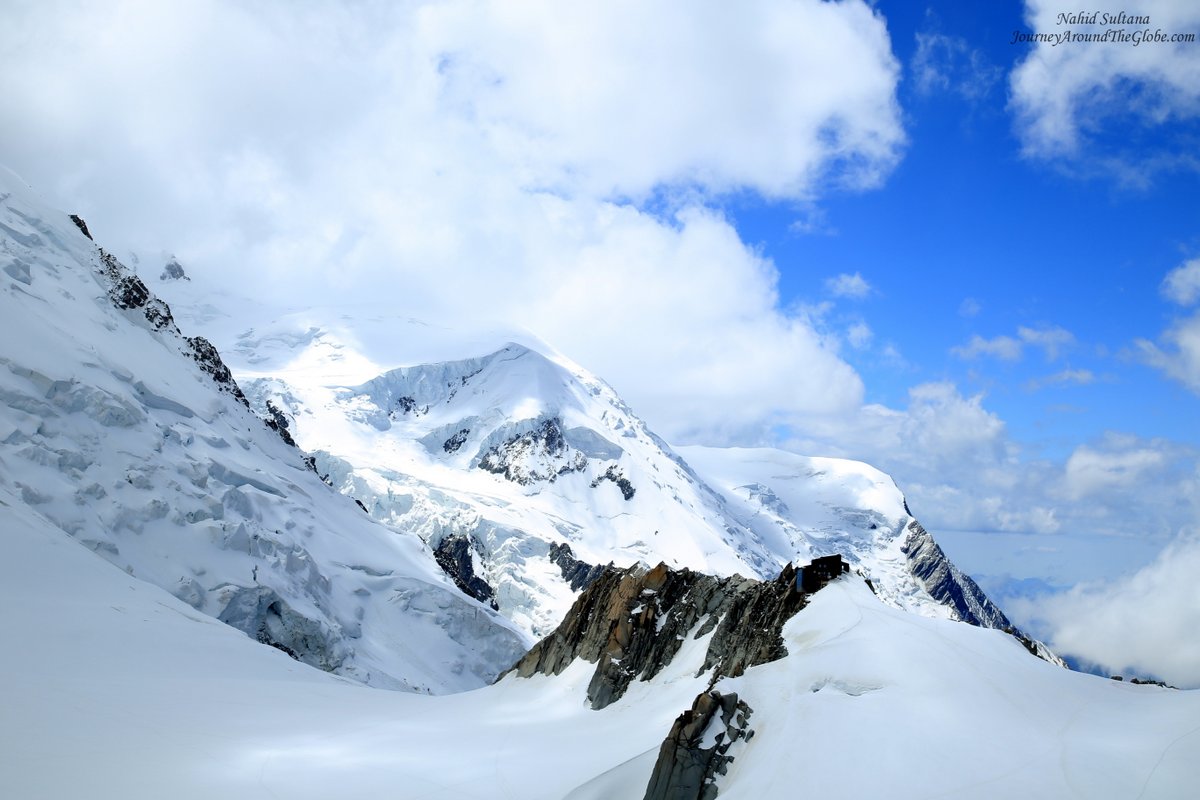
This is a popular destination for those mountaineers, hikers, climbers, snowboarders, and skiers. I myself is not that brave nor fit for those sports. So I enjoyed looking at Mont Blanc from the peak adjacent to it, Aiguille du Midi…which most of the tourist do here.
There are different levels of difficulties for hiking and mountain biking along many different routes. You can’t really go on top of the summit of Mont Blanc unless you are an experienced climber and high altitude doesn’t bother you.
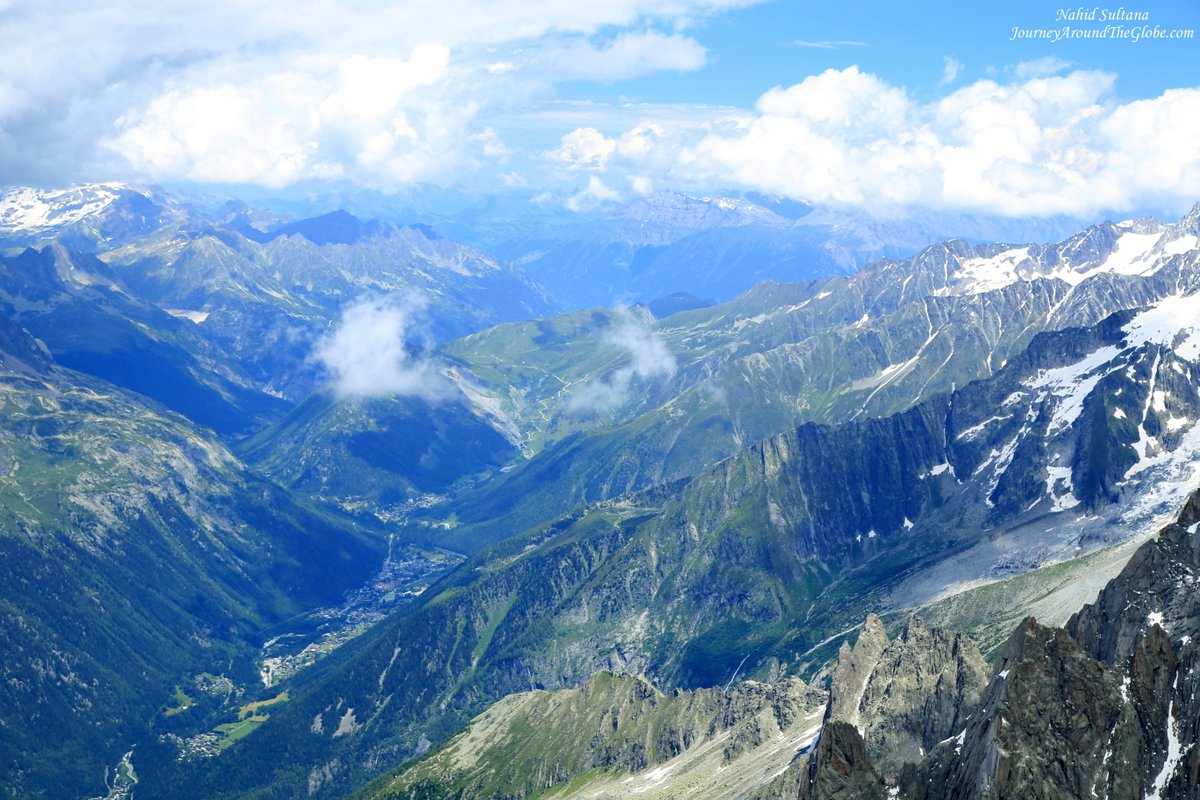
We reached Chamonix from Annecy in the morning, parked near the cable-car station, and went off toward the ticket office from where our thrilling journey to the Alps began.
TIME of TRAVEL: This was our last road trip before leaving Europe for good. Therefore, it’s a memorable trip for our whole family. And we couldn’t leave Europe before visiting the highest peak of the Alps…it would be simply unethical. Our friend Sidfar from Antwerp, Belgium also joined us in this trip. We drove from Tervuren, Belgium to our hotel in Annecy on a nice Friday of July 2014. On the 2nd day, we drove another hour on scenic highway to reach Chamonix for this trip.
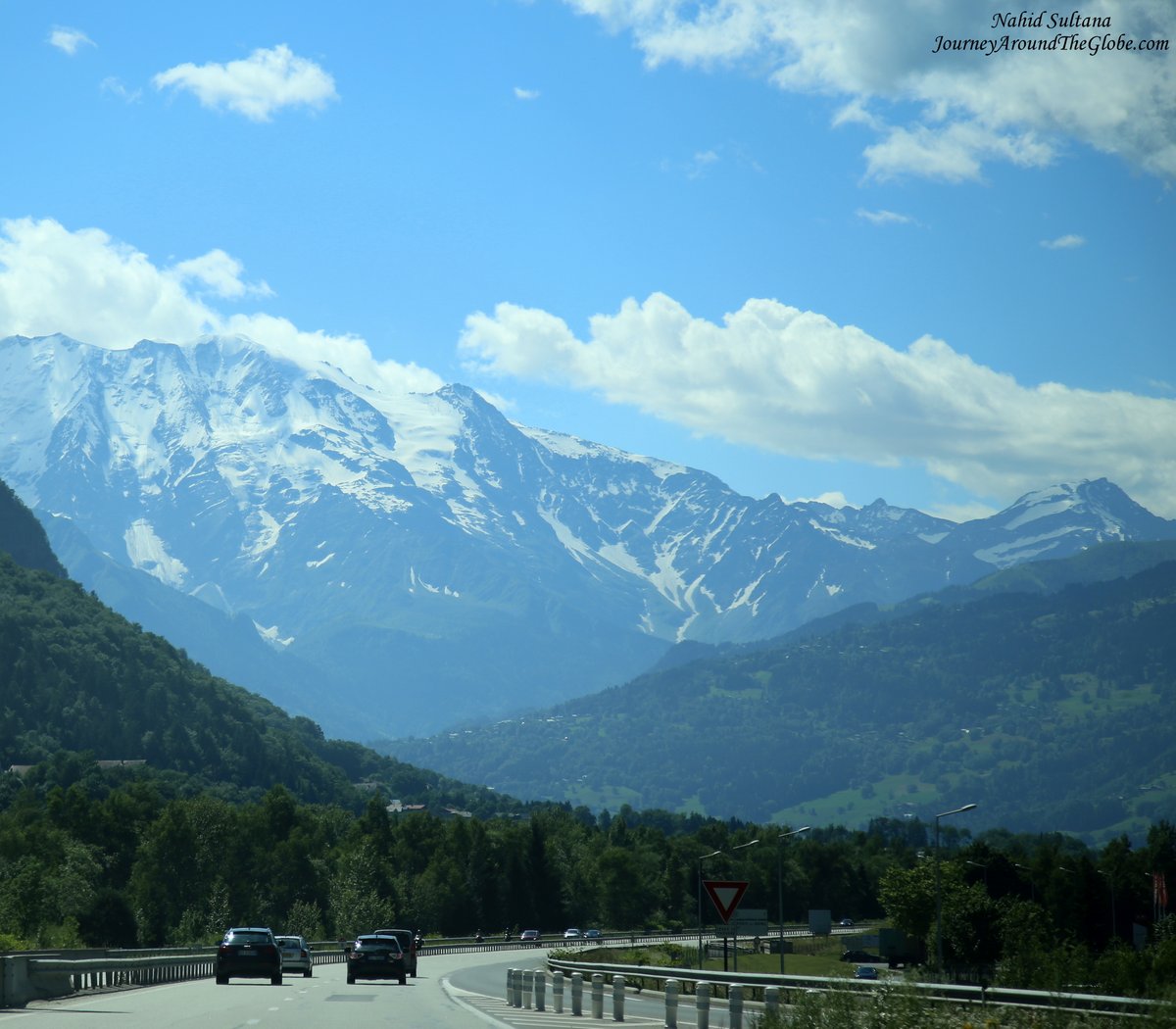
One piece of advice I want to give all of you who want to visit Mont Blanc, is that wear closed toe shoes and bring enough winter clothes with you for this trip, even if you are here in the middle of the summer. I saw some people they were not prepared and started complaining when they were up on the summit of Aiguille du Midi. You won’t enjoy anything if you are not properly dressed…so take it seriously.
OUR HOTEL: Our hotel was not in or near Chamonix. We stayed in Annecy, about an hour drive from Mont Blanc. It was “Sejours & Affaires Pont Neuf – Cran Gevrier” somewhat close to Annecy Old Town. The hotel (which was more like a hostel) didn’t have 24-hour reception service. That was not a problem although we reached there really late at night (they left the keys in a safe-box for us). Good part of this place that we had a small kitchen and a balcony. We also had free Wi-Fi and parking. Annecy, situated by Lake Annecy, itself is a stunning town and is known as The Venice of France. Spare a day if you can for this little town and you won’t regret it for a second.
EATING and SHOPPING: Chamonix is a good place for all your meals and souvenirs at reasonable price. Things are more expensive on the mountain summits. May be it’s not a bad idea to buy some sandwiches and drinks before getting on the cable car. For souvenirs, there was a big store near the ticket office in Chamonix.
PLACES WE’VE VISITED: We arrived in Chamonix from Annecy around 10-ish in the morning. After spending a whole day on Mont Blanc massif, we were down in the parking lot around 6 or 6:30pm. But then again we spent about an hour in Chamonix too (which will be my next post).
There are two sections of the “Telepherique” that takes you up to the summits from Chamonix: first one was from Chamonix to Plan de L’Aiguille and the next one was all the way up to the upper station of Aiguille du Midi.
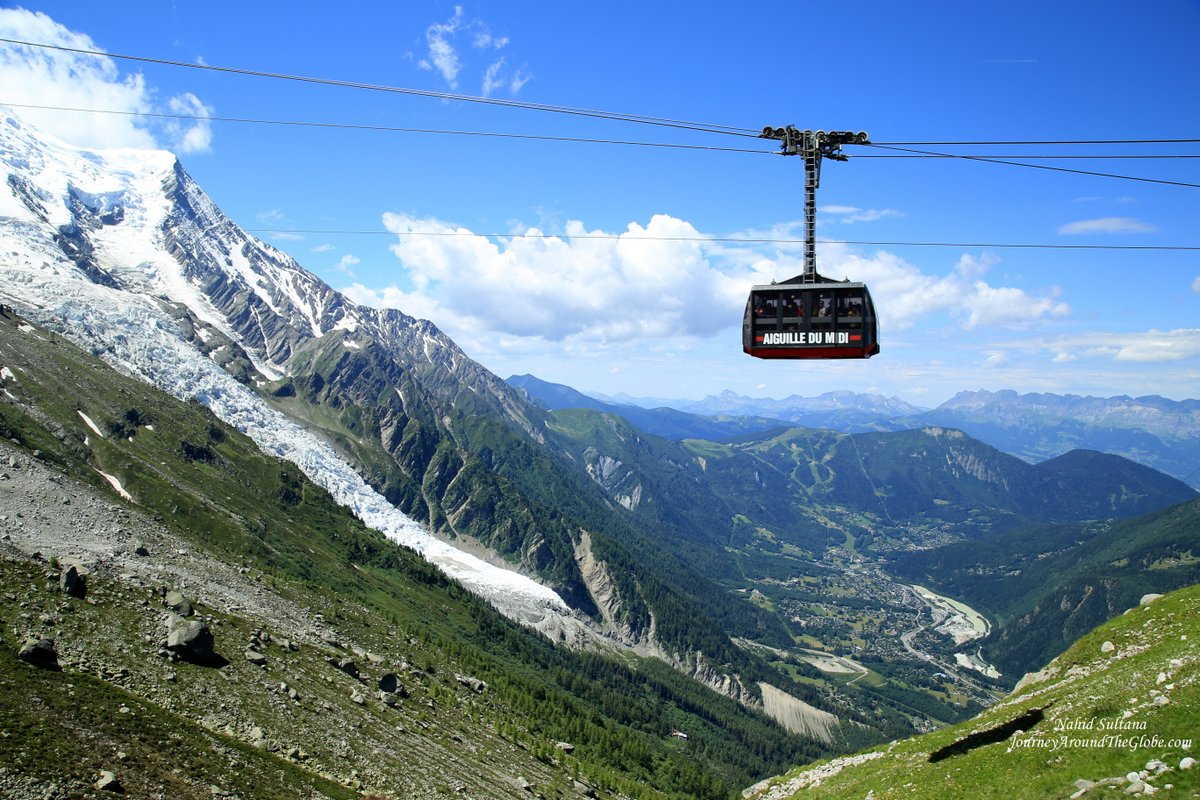
1) PLAN de L’AIGUILLE: With tickets in our hands we hurried to the line for the next cable-car. We saw couple cable cars leaving with many eager tourists in front of us. Five of us squeezed into that machine when our turn came. I am thinking in my head, hopefully it will take us safely to our next stop, Plan de L’Aiguille. For the next five minutes, we soared over a forest to reach the summit.
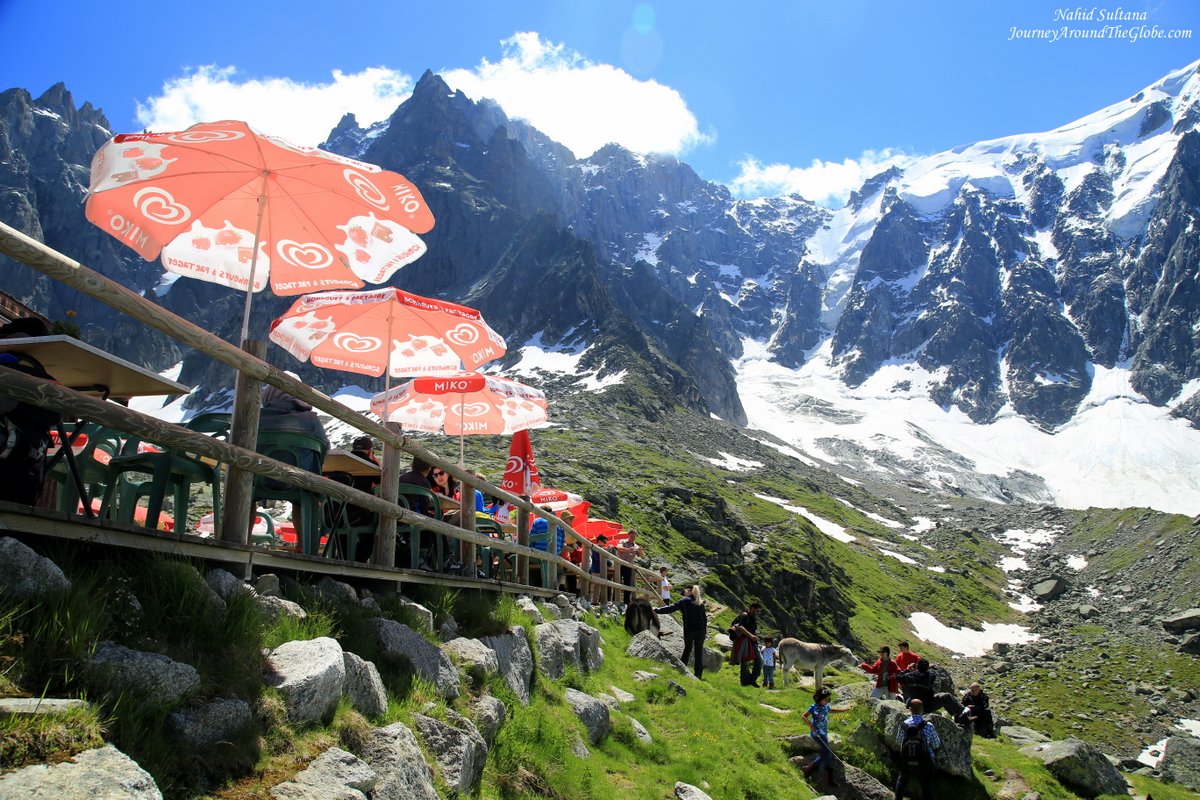
Plan de L’Aiguille is 2317 meters (or 7602 ft) above sea level. From the plain, view of the glaciers, valley, peaks, and endless layers of mountains are truly admirable. Loved breathing fresh air and looking over lush greenery from here. There is a small bar and souvenir shop up on Plan de L’Aiguille where you can get light snacks, hot drinks, and generic souvenirs. Take a look around, if you are lucky like us, you may see some donkeys chewing on the fresh mountain grass. We didn’t see any snow here, nor was it chilly.
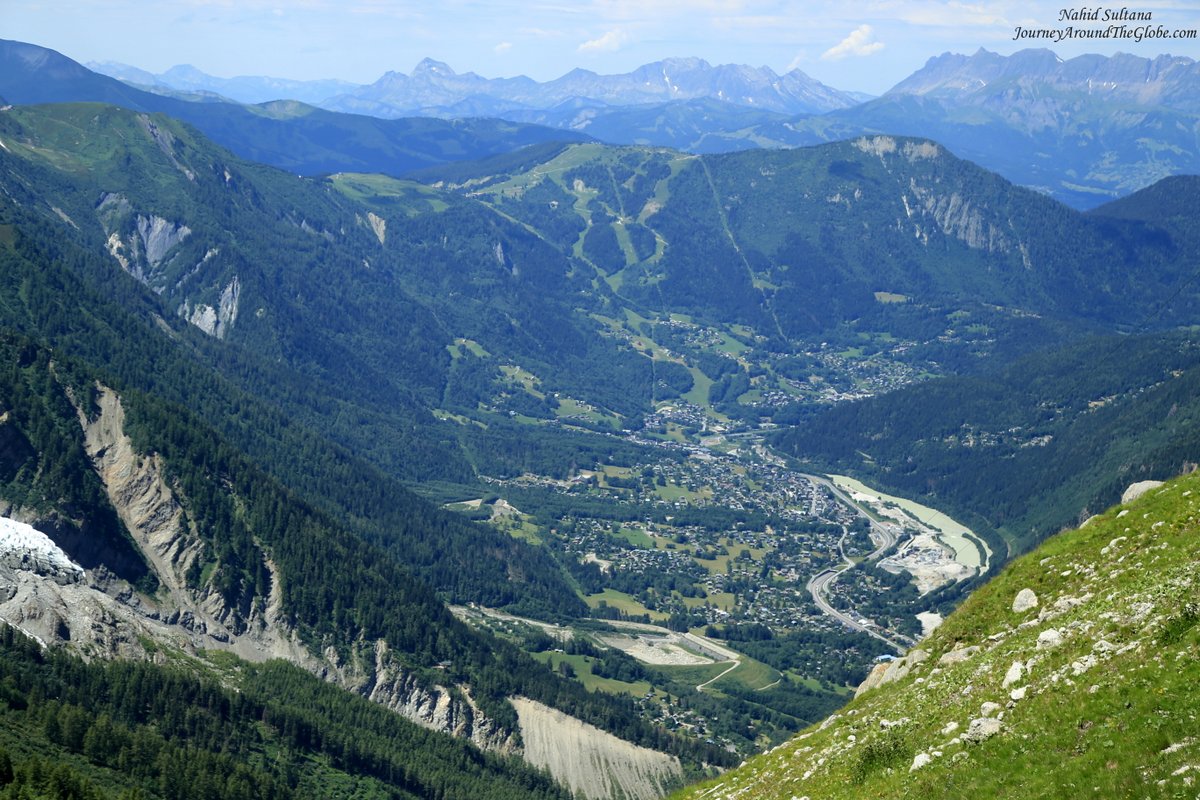
2) AIGUILLE du MIDI: From Plan de L’Aiguille we took another 5 minutes cable-ride to Aiguille du Midi which is another mountain in the Mont Blanc massif in the French Alps. The upper station of Aiguille du Midi is 3842 meters (12,602 ft) above sea-level. Now we were at the heart of high mountains. In 1949, this cabin linked the summit of Aiguille du Midi with the Plan de L’Aiguille for the first time. It holds the record as the highest vertical ascent cable car in the world. The distance between these two points is about 5 km (3.1 miles).
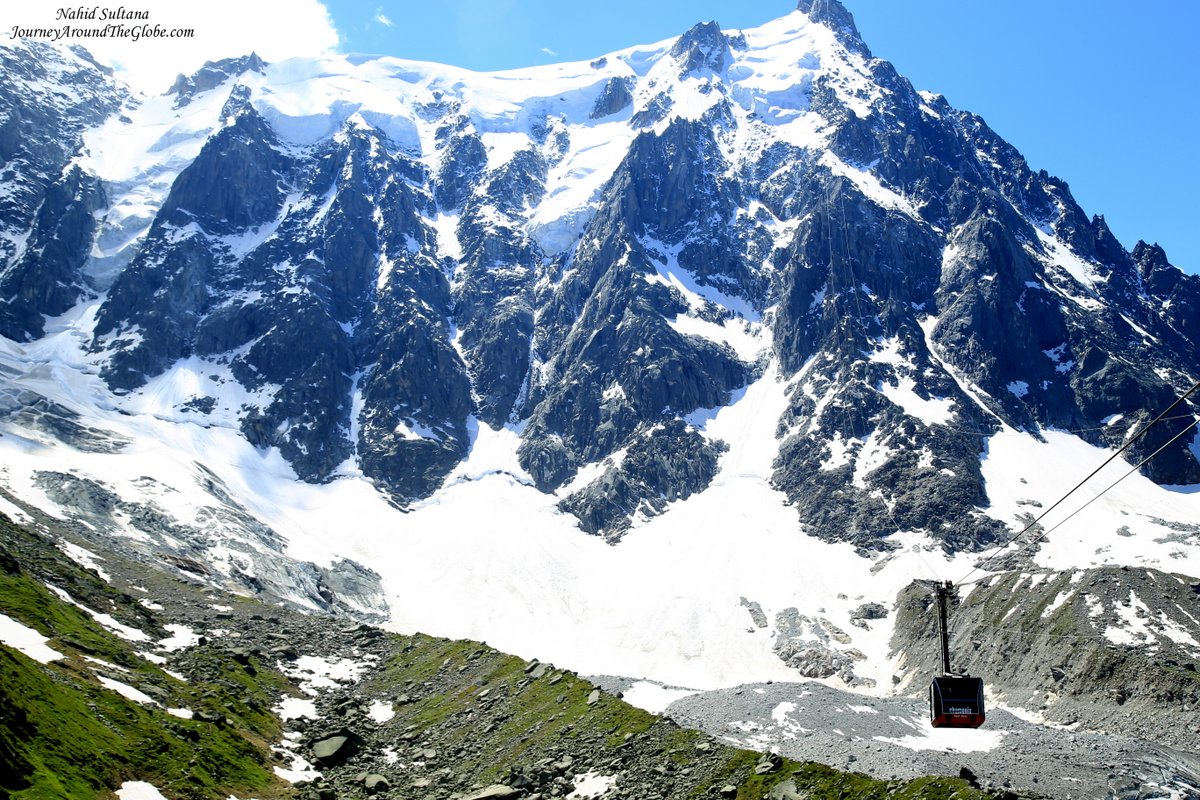
After reaching Aiguille du Midi, first thing we did was that we ran to a kiosk to buy tickets for Chamonix Panoramic Aerial Tramway. It’s a one hour ride over the Mont Blanc massif. Thanks to this aerial tramway that we were able to cross a massive stretch of snow valley, glacier, deep ice caves, and…hikers/climbers on the ground (yikes). There are some classic climbing routes to the summit of Mont Blanc. Of course you got to be a highly experienced mountain climber or hiker (who is also used to this altitude) to come here and climb the highest peak of the Alps.
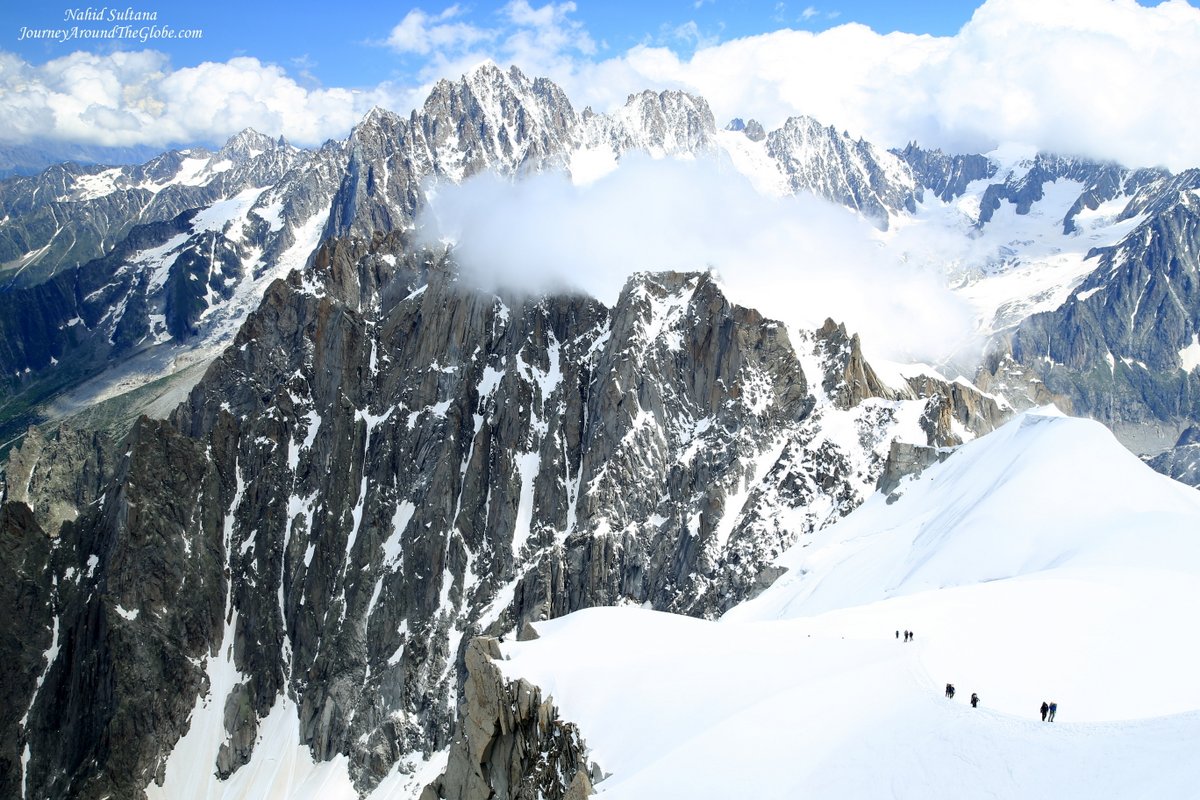
The best part of this ride is that it takes you to the Italian side of the Alps. It connects Aiguillle du Midi with Pointe Helbronner in Italy without making a stop on the Italian part (yes, you actually cross the French border and take a peek at the Italian Alps). The cable ride opened in 1958. Only 4 people can fit in each cable, making it perfect for our family. Make sure to take this tram-ride over the glorious Alps when you are here in summer…a thrilling and adventurous journey you should not miss.
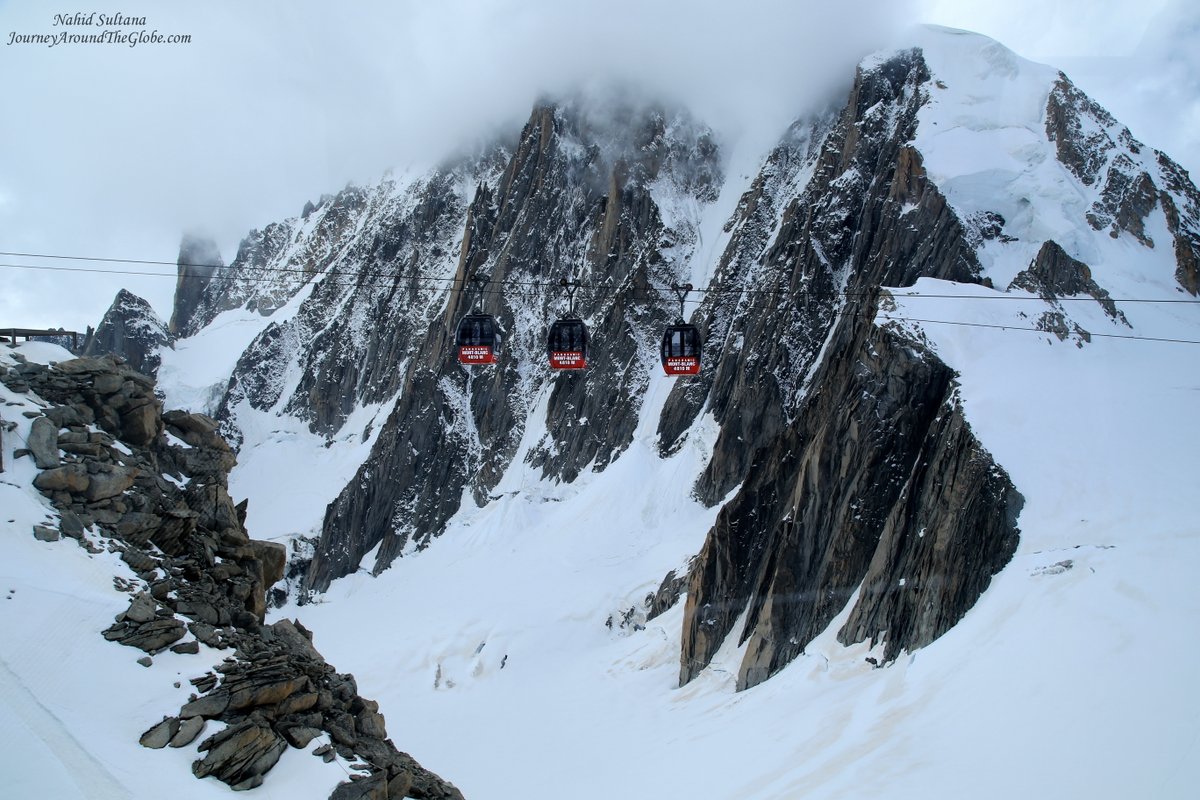
After some aerial Alps experience, we came back to the Aiguille summit. It has a panoramic viewing platform, café, shop, exhibitions. On a clear day, you can see the Black Forest, central mountain ranges, and other major summits of the Alps from the terrace. Be stunned by the jaw-dropping view of the French, Swiss, and Italian summits. After the terrace, we went to check out “Step into the Void”. “Step into the Void” is a small cube glass sky-walk which guarantees 100% thrills and offers an unforgettable experience with 1035 meters void straight beneath your feet thru the glass box on snow-covered mountains.
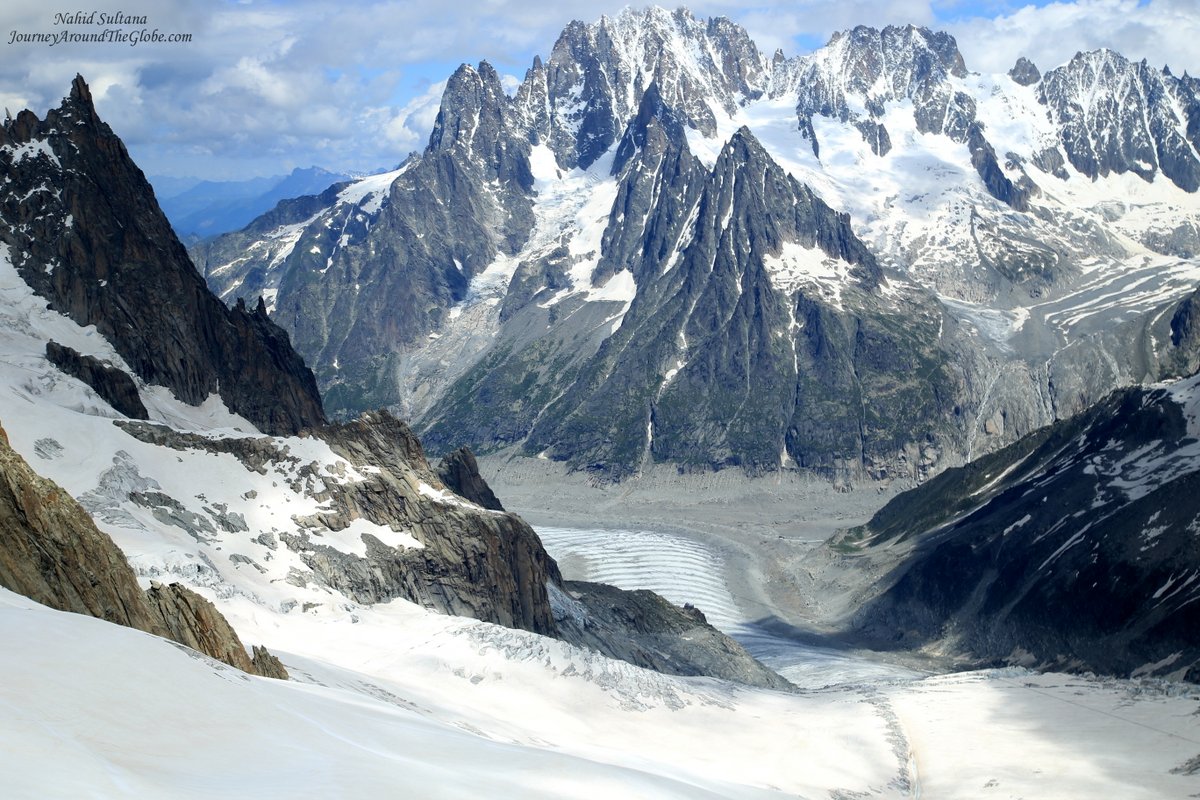
Make sure to spend at least couple hours here on top of Aiguille du Midi. Ticket per adult from Chamonix to all the way up to Aiguille du Midi (round trip) is 55 euros. The tramway to Pointe Helbronner is 25 euros (if I can remember correctly). The weather changes drastically from Plan de L’Aiguille to Aiguille du Midi. Even in July, it was very cold and windy. We saw thick snow and ice on the ground. Tourists should have plenty of winter clothes for this summit because it’s a lot cold and windy up here.
Share this:

Annecy – The Venice of France
ANNECY, FRANCE: Located in the north of French Alps, Annecy is known as “the Venice” of France. Small canals and streams branching out of Lake Annecy dissect and run thru this medieval town in many parts. Its thriving center is magnificently situated among mountains, lake, old quarters, and historic buildings that never fails to captivate its visitors. Surrounded by the majestic Alps, this place is gaining popularity among those who come to visit Mont Blanc…the highest peak of the Alps.
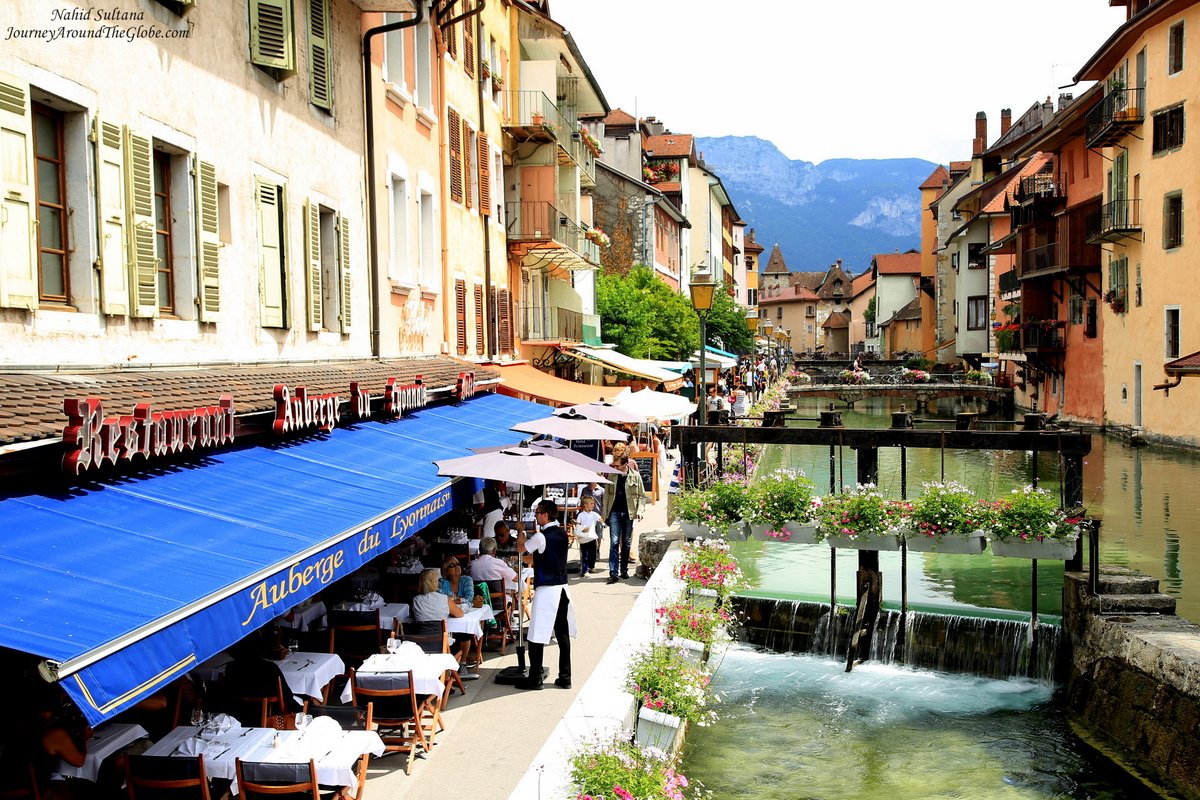
Annecy boasts of having a past which goes back much further than that of most other towns in the French Alps. Romans developed settlement here after the mid-1st century AD but the town gained importance after the destruction of older Annecy-le-Vieux. The city fell under the counts of Geneva when they settled here in 1219. The golden age of Annecy started from the 16th century when River Thiou (which runs through the city) became a motor of artisan development. Its town center was built around a 14th century castle.
Other Alpine cities like Geneva or Chamonix are very close. Also check out nearby villages for day-trips…can’t go wrong with them.
TIME of TRAVEL: This was our last road trip before leaving Europe for good. Therefore, it’s a memorable trip for our whole family. Our friend Sidfar from Antwerp, Belgium also joined us in this trip. We drove from Tervuren, Belgium to our hotel in Annecy on a nice Friday of July 2014. It was a scenic 5/6 hours of drive.
OUR HOTEL: Our hotel was not really in Annecy but in Cran Gevrier. It was “Sejours & Affaires Pont Neuf – Cran Gevrier”. The hotel doesn’t have 24-hour reception service. That was not a problem although we reached there really late at night (they left the keys in a safe-box for us). Good part of this place that we had a small kitchen and a balcony. We also had free Wi-Fi and parking. All the main attractions of Annecy was within walking distance, may be a bit long walk…but it’s doable.
EATING and SHOPPING: There are countless eateries in the old town, may be some of the best ones with some nice view would be by the canals. Many ice-cream parlors, cafes, restaurants of all sorts, and bars make Annecy’s old town a bustling city among the locals and tourists. As for souvenirs, there were plenty of those too. I can’t think of anything particular to buy from here…may be some uniquely shaped beer-glass or Dijon mustard. But t-shirts, key-rings, magnets, post-cards, and other nice trinkets are everywhere.
PLACES WE’VE VISITED: We spent a whole day in the old town of Annecy visiting the following sites. While walking we came across lots of historic buildings and monuments left and right. Unlike us, if you have extra days definitely do check out places like Notre-Dame-de-Liesse Church with its 16th century bell tower, former Hotel de Ville, St. Maurice Dominican Church from the 15th century, and surrounding natural beauty.
1) OLD TOWN: This is the main spot to spend time in Annecy and be blown away by its beauty. All the tourist attractions are located here within walking distance from one another. One of the prettiest parts of Annecy is looking at River Thiou running thru the old city. This is one of the shortest rivers in France (only 5 km). Make sure to visit Pont des Amours (Lovers’ Bridge) on Vasse Canal. Electric sluice gates near St. Francois Church control the flow and regulate the level from Annecy Lake. The best picturesque view of the old town can be enjoyed near Palais de I’Ile. Once a prison, the fortified house of Palais de I’Ile resembles a stone boat anchored in the Thiou.
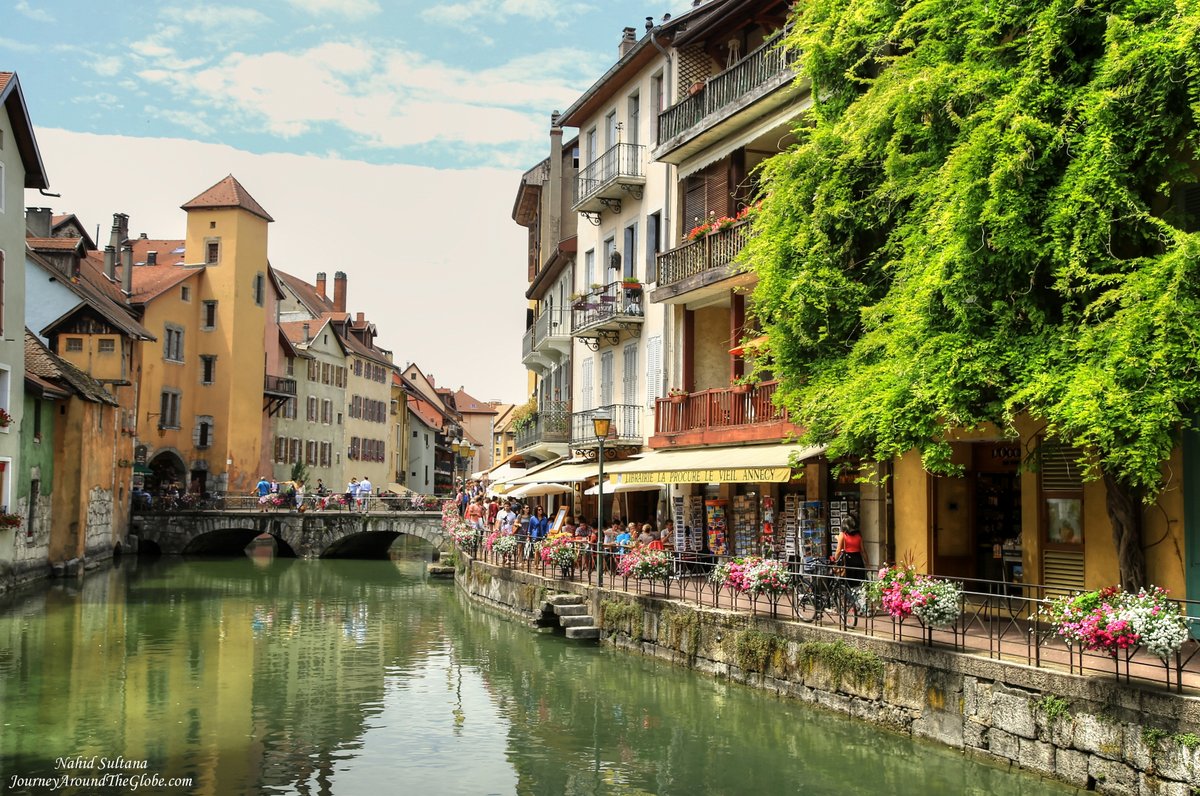
2) PALAIS de I’LLE: Our first stop in Old Town Annecy was Palais de L’Ile. Also known as “The Island Palace”, it was described as a “house in the shape of a galley” in a 17th century manuscript. It was built on a natural rocky island between the canals and is classified as a historical monument of heritage from the Middle Ages. This fortified house was first mentioned in 1325 (the oldest part dating back to the 12th century) and conserved its main function as a prison until 1864. Its current shape of the bow of a ship was doubtlessly built in the 15th Before the palace became a courthouse and prison, it was a coin minting workshop during the 14th century. Walking through the interior of the building, you can discover the history of the Palace on the island and the area around Annecy. Photographs in this museum displays different era of Annecy and surrounding region, mostly in France.

Visit the dungeons and old hearing room (the oldest part of the building) on the 1st floor. 2nd floor is dedicated to temporary exhibitions in small rooms built with large limestone blocks. The rooms from the coin minting wing illustrate the history of the monetary workshop run by the counts of Geneva. Its internal courtyard has couple tombstones from the early 18th century and forward. The chapel here is very small but has fragments of tomb burial from the 15th century. Many other small details from the bygone centuries on the entrance façade, tower, and staircase also add historic look and feel to this place
Ticket is 3.70 euros per adult for the ticket. We were done in less than an hour.
3) FRANCIS CHURCH: Also called Eglise St. Francois de Sales, was our next stop. It’s a fabulous view and atmosphere as we were walking from the prison to this church. Standing on a bridge (wooden, I think) you get some unparalleled views of Annecy’s old town. Current look of this church is from 1642. In 1923 the church was given to the Italian community of Annecy. It’s free to go in, so don’t miss out visiting a beautiful historic church.

4) QUAI de BAYREAUTH: We crossed a street, walked further down towards Lake Annecy, and there we were standing in Quai de Bayreauth…a magnificent promenade by the lake. Walking alongside the water, looking at the distant mountains, colorful houses, and small communities by the lake were breathtaking. I could spend hours just by sitting there looking at nature and people who were enjoying it.

5) ANNECY CHATEAU: It was one hot summer day when we visited Annecy. From Quai de Bayreauth we had to take a break in an ice-cream shop before starting our ascent towards Annecy Castle. This is a historic landmark of the town and a great place to get some panoramic view of Annecy because of its elevated position. The castle ground is not that big and is leisurely doable in couple hours even if you visit every exhibition and read every information board. Standing at one edge of this castle, we got to enjoy a 360 degree view of Annecy, the lake, mountains, and many church steeples.

Classified as a Historical Monument in 1902, Annecy Castle was the residence of the Counts of Geneva in the 13th and 14th centuries. The castle expanded over the next two centuries and gave its current look. Towers were added in the 12th and 14th centuries to strengthen the defensive system. Abandoned as a residence in the 17th century, it was used as military barracks until 1947 and later in 1950s it became a museum.
Ticket is 5.10 euros per person. The castle is up on a small hill and I was a bit tired getting up there on foot (seriously, I was tired from my 10 minutes of hike…bleh).
6) BASILIQUE de la VISITATION: Coming to this basilica was another long walk thru steep and winding paths and climbing many stairs. From the castle, we then walked along Avenue de la Visitation to come to the imposing convent and basilica of the Visitation tower.
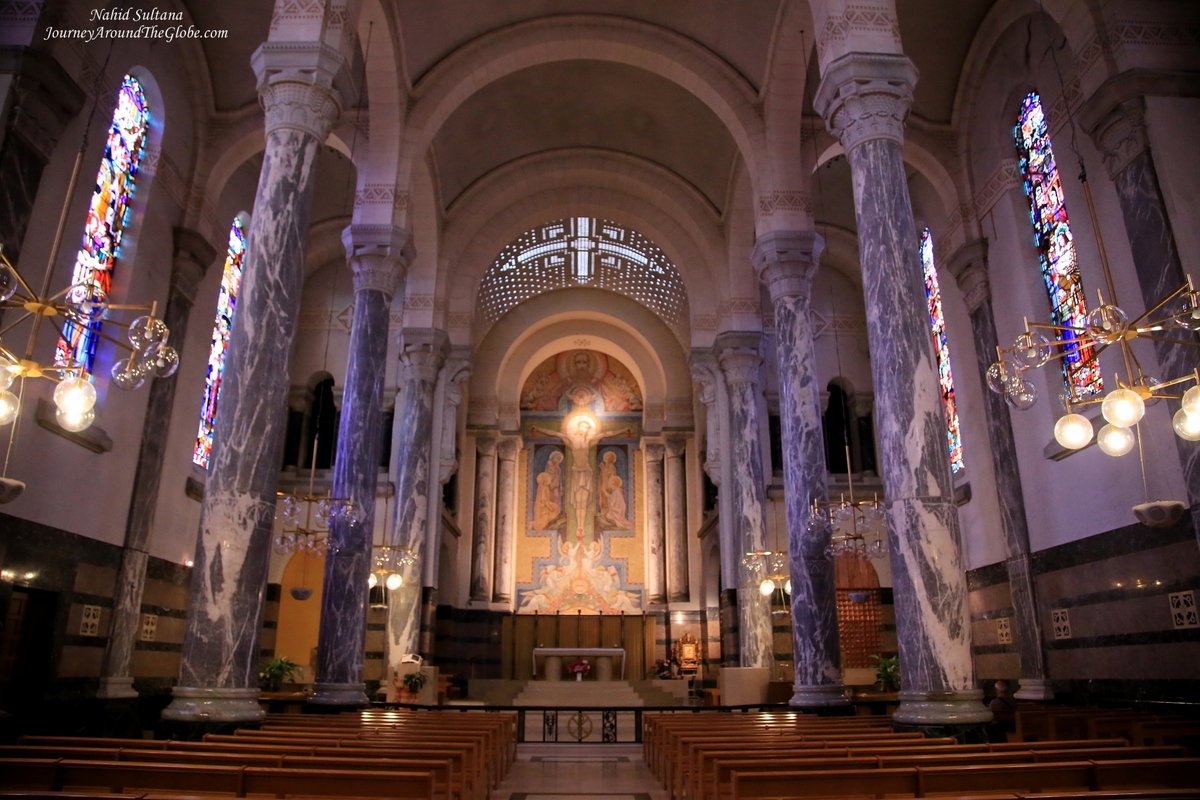
Built from 1909 onwards, The Visitation Basilica has been the home to Visitation nuns since 1911. The church was finally finished in the 1930s in Neo-Romanesque style. Inside, stained glass windows illustrate the lives of Francis of Sales and Jane of Chantal. Both were laid to rest in gilt copper sarcophaguses. The esplanade provides lovely views from the top. From here, you can appreciate the beautiful region of Annecy and its development. Inside the basilica is simple but has an elegant altar. Giant marble columns and exquisite stained-glass windows are definitely something to appreciate here.
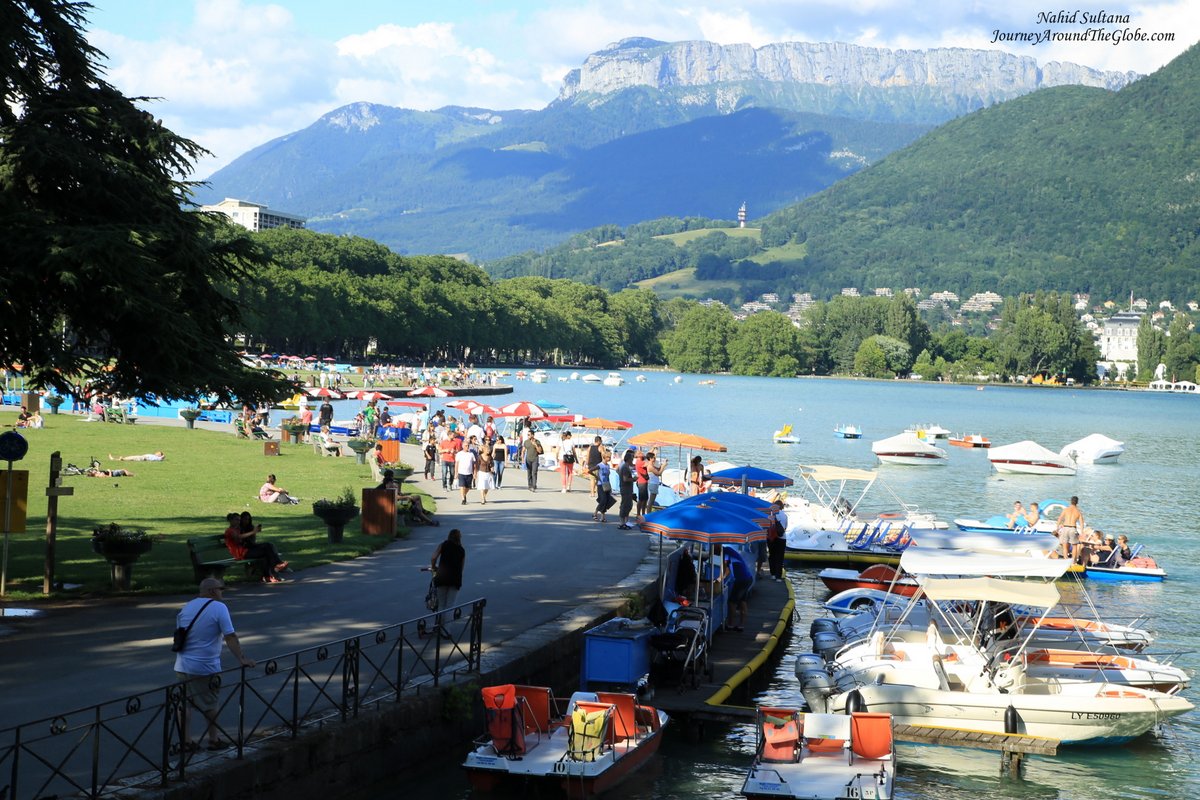
7) QUAI NAPOLEON III: Parallel to Quai de Bayreauth, this is another promenade by Lake Annecy. We sat down in the park with statues, fountains, benches, and of course breathtaking views of the Alps. My girls were tired…so it was a perfect place to chill and enjoy the surroundings.
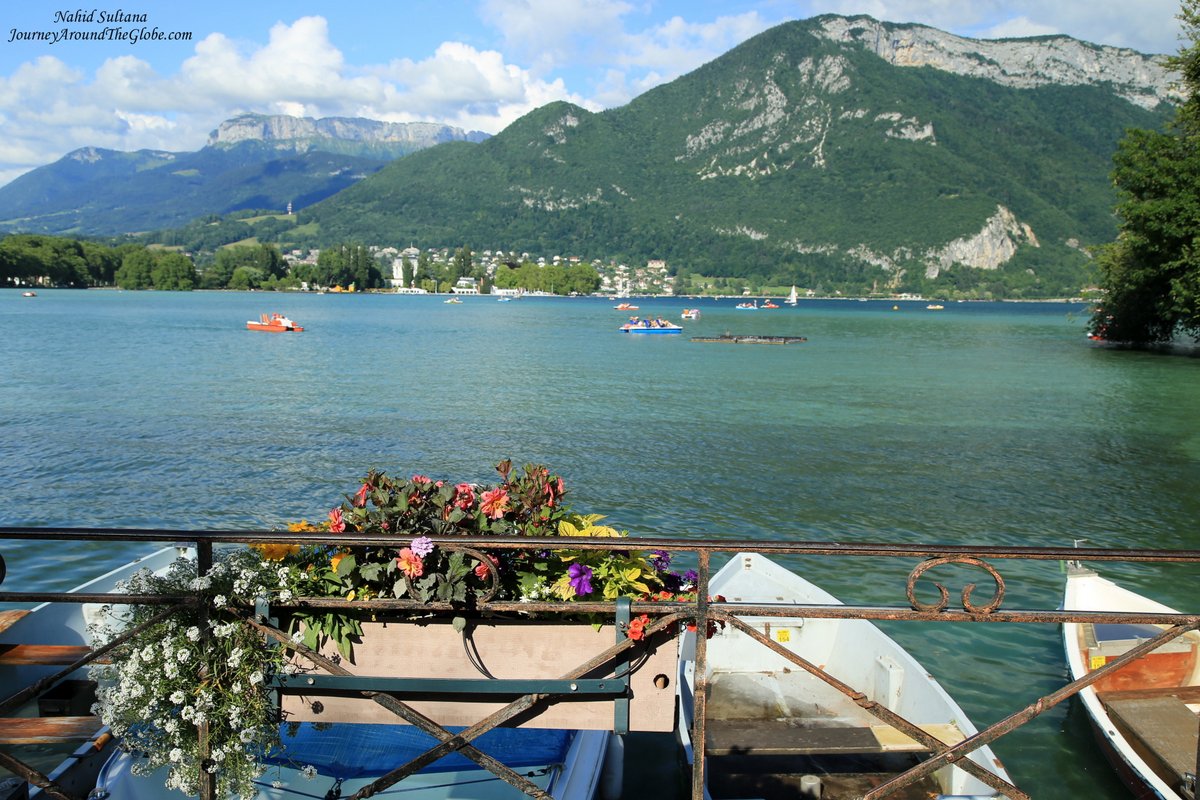
The small artificial island in the lake (Ile des Cygnes) looks beautiful with the French Alps in the backdrop. We sat down on the grass for a while. People were padding and canoeing on the blue water while some were enjoying live music in the park (and dancing too). On the edge of the quay a sundial stands from 1822.

We walked by the relaxed and beautiful promenade of Les Jardins de l’Europe, crossed Pont des Amours (where you can see love-locks hanging on the bridge railings), and strolled by Promenade Jacquet. Jardins de L’Europe is more like a children’ play area, a landscaped garden planted in 1863. Pont des Amours displays the iron architecture of the early 20th century. It crosses the Vasse canal which gently flows under a romantic vault of planes trees in the direction of a merry-go-round dating from the 1906. It was a late afternoon…the sun was soft. I couldn’t imagine being somewhere else other than here.
Share this:

Picnic at Silver Falls State Park in Oregon
SILVER FALLS STATE PARK, OREGON: Famous for its breathtaking waterfalls, old buildings, and temperate rainforest, Silver Falls State Park is the largest of five beautiful State Parks in Oregon’s central Cascade region. I can’t promise you that you will be able to finish it in days or just weeks. It’s because you can do variety of outdoor adventures here as well as spend relaxed family time out in the nature. Play by the lake, spend a night under the stars, or just pack your lunch for a picnic in the forest.
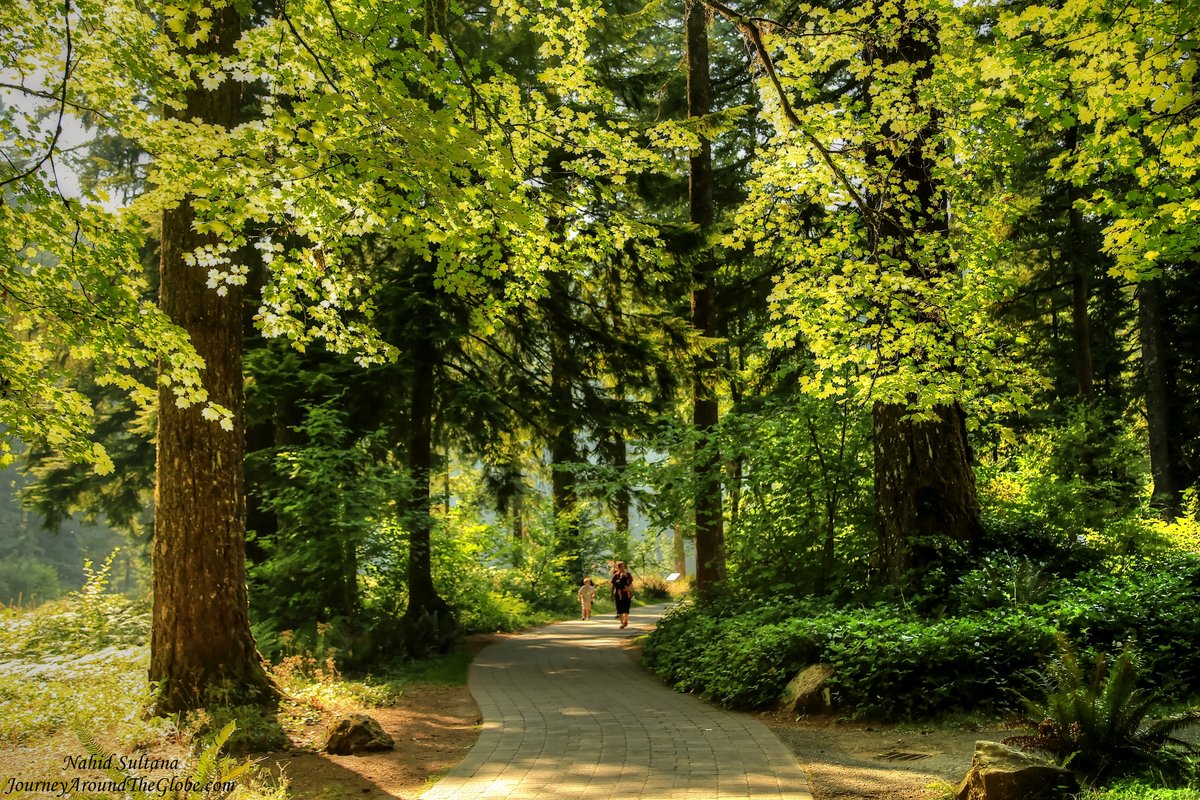
TIME of TRAVEL: First time we were there was with some friends in 2010 or 2011. We only walked around and behind the South Falls then. This time we were there for a community picnic. Although most of the time we were in the picnic ground, I managed to sneak out couple times to get a distant view of the falls and its trail. But didn’t really manage to go too close to it. If you are a photographer, I would highly recommend coming here during the fall season…should be beautiful looking at the bright colors surrounding the soft veil of the falls.
EATING and SHOPPING: There aren’t much of shops in the park (of course) but I saw a café/restaurant very close to the South Falls. Best thing to do here is to bring your own food and a blanky and sit down on the soft grass or use a picnic bench for meal.
PLACES WE’VE VISITED: For now, I am only adding South Falls of this park in my blog. There are at least ten falls you come across when you start walking on Trail of Ten Falls….a true paradise for the hikers or nature lovers or photographers. I will keep adding them every-time I visit a new falls. We were at a picnic there, so I couldn’t hike on this trail.
SOUTH FALLS: One of the most gorgeous falls of Silver Falls State Park is the South Falls. You can see the exposed rock in the waterfalls and creek bed with layers of rock laid down over the course of 26 millions years. Either you are looking from a distance or walking right behind the falls or just standing on the wooden bridge in front of it and looking high…this falls is breathtaking from every possible angle.

I am not sure how long is the walk from top of the falls to all the down near the water and coming back to top again, but this is a bit steep hike in some areas. Some places are wet and muddy too. I even saw a thin and small snake on the upper portion of this trail. I am not saying these to scare you or anything…if my friend’s toddler boy can do it, then anybody can do it. Just use some cautions and wear comfortable shoes…it will be a sight to enjoy for all ages.
Share this:

Business Excellence Award 2020 from AI Global Media for The Most Entertaining Personal Travel Blog – Pacific Northwest USA

Top Posts & Pages


Authors
 Globe Runner
Business Excellence Award 2020 for The Most Entertaining Personal Travel Blog – Pacific Northwest USA

Business Excellence Award 2020 from AI Global Media

 Journey Around The Globe